




Abstract
Democracies are commonly thought to provide greater levels of public goods than autocracies. Given that many public goods are provided locally, higher levels of local democracy are further thought to result in better rates of provision in both autocratic and democratic systems. However, several studies have cast doubt on democratic superiority in public goods provision both nationally and locally. We re-examine these contested relationships, investigating a locally provisioned public good: access to basic water. To determine what, if any, effects democracy has on public goods provision, we analyse the effects of both national and local democratic institutions, in conjunction with economic development. In cross-national regression analyses, we examine a global sample of 140 states from 2000 to 2015, arriving at three findings. First, access to basic water varies little by national regime type once accounting for development. Second, the existence of local elections and the degree to which they are free and competitive are positively correlated with basic water access rates in poor states. Finally, the positive effects of local democracy on water access in poor states increase with democratic institutional longevity. The findings of this study suggest two necessary additions to future research. First, more nuance is needed in the study of public goods provision beyond resources or a theoretical rationale for increased provision related to national regime characteristics. Second, considering the conditional influences of local institutional characteristics, development metrics could help illustrate the complicated circumstances determining access to basic public goods.
Introduction
Scholarship remains divided over the relationship between democracy and the provision of public goods. Early studies found that democratic regimes outperform autocracies in goods provision (Baum and Lake, 2003; Deacon, 2009; Lake and Baum, 2001; Przeworksi et al., 2000). More recently, the literature has asserted that in comparison with autocratic regimes, democracy does not result in better public goods outcomes (Bardhan and Mookherjee, 2005; Dahlum and Knutsen, 2017; Ross, 2006; Wang and Yao, 2007). For example, in the case of infant mortality, Ross (2006) found no significant difference across regime types, arguing that democracies create few incentives for governments to provide basic public goods for the poor as there is no direct benefit to the median voter. Similar results are found in studies of more advanced public goods, such as education quality. Given that verifying educational quality is difficult for ordinary citizens and that failings in provision are not easily attributable to the central government, few incentives exist for politicians to invest resources (Dahlum and Knutsen, 2017; Harding and Stasavage, 2014).
Discordant findings suggest that assumptions concerning democratic superiority in public goods provision require further study. In the following assessment, we focus on three assumptions that may help explain varied results. First it is often presumed that development is an independent causal factor and, inversely, that institutional characteristics in wealthy states are present, or indeed operate similarly, in poor states. We assert that development must be studied in conjunction with institutional context. While democratic and autocratic incumbents approach spending on public (and private) goods with different priorities, the level of development in a state sets spending capacity for both. For instance, while democracies have been shown to spend more on public goods, spending in poor states is ultimately constrained. In wealthier states, even if the median voter in many (or most) democracies will capture more public resources than the poor, there are nonetheless more resources available for spending on public goods. Therefore, development context must be considered when formulating expectations concerning public goods provision according to institutional context. Second, much of the literature is state-centric. We argue that the focus on the relationship between democracy and provision of public goods at the national level has obscured trends related to goods provisioned locally. Indeed, many public goods are made available at the local level and under the management and influence of local institutions. 1 Third, we focus on the treatment of public goods in prior literature as a monolith, producing a similar set of political considerations. Selecting basic water access as our case study, we suggest that the service delivery characteristics specific to it make it a highly politically salient good; water is a basic necessity that is rivalled, excludable, and has high visibility. These characteristics together result in political calculations that differ from those concerning higher order public goods (e.g. healthcare or education), such that even when development is low, politicians should be incentivised to provide it. We therefore set out to re-examine the role of democracy in affecting access to basic public goods by adding considerations concerning the relative level of development, local institutional characteristics, and the political calculations resulting from service delivery characteristics.
Together, our overarching hypotheses assert that water is a highly politically salient good and basic necessity, resulting in high incentives for politicians to provide it regardless of national institutional context. The provision of basic water should therefore be similar between democracies and autocracies at similar levels of development (H1). However, given that water is provided locally, we assert that the existence of local democratic electoral institutions should result in higher rates of water provision (H2). This is especially the case in poor states where resource constraints are greater. In short, local elections, and the degree of competition in these elections, increases the level of accountability of local officials, thus increasing the provision of public goods, including access to water.
We test these hypotheses by examining access to basic drinking water in cross-national regression analyses on a global sample of 140 states from 2000 to 2015. Basic drinking water is defined as ‘drinking water from an improved source [where] collection time is not more than 30 minutes for a roundtrip including queuing’ (Food and Agriculture Organization (FAO), 2019). Our empirical tests suggest three main findings. First, accounting for development context, there is little difference in water access across national regime types. Second, in poor states, the existence and competitiveness of local elections are positively correlated with basic water access. Third, longevity of local democratic electoral institutions increases the positive correlation between local democratic institutions and local water provision in poor states. In addition, the results, taken together, point to an opportunity to reconsider how development and local democracy can impact other basic public goods outcomes, including infant and child mortality.
Beyond the public goods and democracy debate, our research further contributes to literature attempting to account for variance in access to water. Presently 785 million people worldwide lack access to basic drinking water, and more than 2 billion people rely on drinking water sources that are contaminated with faeces (FAO, 2019). Despite the centrality of clean water for innumerable welfare outcomes, existing research cannot easily explain variation across countries. The average wealth of a country only partly accounts for the wide variance in water access 2 and other obvious considerations, including natural resources, development aid, and laws attempting to further water access have only marginal influences (Andersen and Langford, 2013; Schiel et al., 2020). 3 Instead, scholars point to failures in public policy and governance (Baer, 2017; World Bank, 2017), 4 elaborated on below.
In the next section, we review the extant literature related to public goods provision among democracies and local democratic systems and, separately, literature pertaining to water-specific service delivery characteristics. We then outline the rationale for our argument that local democratic electoral institutions are especially beneficial for improved water access in poor states. Next, we detail the methods and data utilised. Finally, we discuss the results, offering conclusions and areas for future research.
Literature review: Public goods and democracy
Public goods have traditionally referred to goods that (1) cannot be excluded from non-purchasers (non-excludable) and (2) cannot be used up (non-rivalled) (e.g. Head, 1962; Stiglitz, 2000). While both non-excludability and non-rivalry are traits common to many public goods, the existence of one condition is sufficient to consider a good collective or public. Public goods meeting only one of the aforementioned conditions, considered by some a quasi-public good, may include, for instance, public roads. According to this conception, our application case, basic water access, fails to meet both rivalry and excludability characteristics as water can be used up and groups can be excluded from provision (e.g. Batley and Mcloughlin, 2015; Krugman, 2016). Yet, while scholars disagree on the extent to which water, broadly defined, can be considered a public good, it can be argued that basic drinking water specifically (and not water utilised, for instance, in commercial agriculture) can be viewed as a public good. 5 First, water is inextricably linked to public health and governments have therefore assumed a role in managing water provision (Baer, 2014). This is in line with other public goods that are natural monopolies, thus creating the need for state management. Similarly, Justesen (2012) points to public and environmental health as classic examples of quasi-public goods that suffer from market failures and under-provision. Furthermore, given that drinking water is essential to public health, and indeed life, drinking water can further be characterised as a proxy for multiple other public health outcomes. 6 Second, while piped clean water can be both rivalled and excludable, this is not the only means through which individuals access drinking water, many of which are communal.
This pragmatic approach is strengthened by the constructivist challenge to public goods theory. It emphasises that both the present availability and the distribution of public goods are a matter of social construction and contestation (Kaul et al., 2020). In this respect, the focus is less on the technical qualities of the good but the ‘publicness’ of consumption, decision-making, and distribution. Thus, whether a forest is public good in practice is the result of a choice by the authorities, which is likely heavily influenced by struggles between stakeholders. It is a perspective that returns the concept of public goods to its non-economic and non-Anglo-American origins (see Wivel, 2007).
Turning to the role of democracy, much scholarship has asserted that democracies do a better job of providing public goods than non-democracies (Baum and Lake, 2003; Deacon, 2009; Lake and Baum, 2001; Przeworksi, 2005). Broadly construed, democracies are thought to provide greater access to public goods because they rely on larger coalitions (the general public) to maintain power (Bueno de Mesquita et al., 2005). Liberal electoral institutions allow the public to punish an incumbent who does not adequately satisfy public goods demands (Ross, 2006). In comparison with autocrats, a democratic incumbent has more to lose at the polls when confronted with an unhappy populace. To be sure, autocrats are also removed due to poor performance; however, the means of removal are more difficult and far riskier for those fomenting removal and thus occur less often. Sen (1981) contends that this should encourage democratic leaders to spend more on public goods, and especially basic public goods, than autocratic leaders. Supporting these notions, Brown and Hunter (2004) examine spending on primary education in Latin America and find that democracies spend more on public education than do autocracies. They suggest that this is to be expected given that investments in public education benefit the largest group of potential voters. Similarly, Stasavage (2005) investigates education spending by African states and finds that democracies consistently outspend their autocratic counterparts.
The reasoning asserted suggests that provision should be higher in democracies regardless of demographic or development contexts. For example, while scholars posit that goods provision is more difficult in heterogenous states owing to coordination costs (Alesina et al., 1999; Habyarimana et al., 2007), democracies both spend more on public goods (Lake and Baum, 2001) and are better able to solve distributional conflicts (Lipset, 1959). Therefore, democracies with more heterogenous populations should nonetheless be better able to serve their populations than similarly demographically situated autocratic states.
The rationales, outlined above, for why democratic regimes should perform better on measures of public goods provision broadly rely on two questionable assumptions. The first assumption concerns resources: democratic leaders should have sufficient resources available to distribute public goods widely. However, this is unlikely in poor states; poor countries lack the resources to meet broad distribution of public goods regardless of how accountable an incumbent is to their coalition. Certainly, given that any incumbent’s goal is to retain power, it is safe to assume that when possible, and to a reasonable extent, resources will be spent on satisfying the masses. However, with fewer resources, a democratic incumbent may be faced with allocating resources to private coalitions before the public (Keefer and Khemani, 2005) or to the median voter that is often not in the lowest or even second lowest income quintile (Ross, 2006).
Second, expenditure on a public good does not necessarily result in improved delivery. Ross (2006) finds that while democracies may spend more on public goods, this does not necessarily result in better public welfare outcomes. Once correcting for sample bias, country-specific effects, and exogenous health trends, he finds that democracies, on average, perform no better than autocracies on measures of infant and child mortality. Regarding education quality, Dahlum and Knutsen (2017) study student exam performance and find that while democracies provide greater levels of education, there is no link between democracy and education quality. Furthermore, recent research by Harding (2020) suggests that a rural bias exists in goods provision within democratic states in sub-Saharan Africa. Democratic regimes within sub-Saharan Africa, held accountable by a largely rural population, have increased public goods provision in response to population demands. However, the benefits have largely accrued to the rural population. Importantly, this research highlights the disconnect between intentions and outcomes. In short, democratic regimes may spend relatively more on public goods but do not necessarily achieve better outcomes.
Moving beyond the national and developmental aspects, the literature has recently begun to address the role of local institutions in public goods provision. Many public goods are made available and/or accessed locally, including water provision, sanitation, refuse services, primary and secondary education, basic healthcare, childcare, and housing support (Herrera, 2019). Moreover, local authorities are often involved in the provision, management, and/or oversight of access/availability of these public goods. Indeed, water specifically is largely locally provided, and only the smallest or most compact states provide water at a national level. Formal water services are provided overwhelmingly by local municipalities, utilities (public and private), or institutions based on water catchment systems, while informal water services are generated by local settlements, community initiatives, or ‘water mafia’ (Nganyanyuka et al., 2014). Therefore, we turn to discussing the effects of local democratic institutions on goods provision.
Decentralisation of power in the form of local democratic institutions (as opposed to the appointment of local officials) is thought to be beneficial for goods provision for two reasons: accountability and competition. The literature asserts three mechanisms through which the existence of local elections can increase accountability. First, the election of local officials represents a decentralisation of fiscal policy, allowing local communities to participate in the process of competing for resources. Second, local democratic institutions provide the public with an opportunity to monitor service delivery directly, allowing greater transparency and reducing corruption. Third, much as in national democracy, local democracy encourages accountability by holding government officials responsible for their actions in elections (Zhang et al., 2002).
Turning to competition, local democratic institutions are thought beneficial for public goods provision due to their ability to decrease elite participation in state capture (Díaz-Cayeros et al., 2014). Government officials that are subject to competitive elections are less able to collude to divert resources to private interests. This rationale suggests that for local elections to accrue benefits to goods provision, adequate competition must exist (Gottlieb, 2015). However, others suggest even lower levels of competition, those characterising unfree or unfair elections, are still beneficial. Miller (2015) examines elections in autocracies and finds that the existence of contested elections, including those marked by unfree and unfair conditions (electoral authoritarianism), can nonetheless contribute to advances in popular welfare. Taken together, we should therefore expect the greatest benefits to public goods to accrue when local elections exist and are competitive, although even the mere presence of local elections may be beneficial.
The review of the literature leaves us with several puzzles. First, democracies may spend more on public goods; however, this does not necessarily result in better outcomes. Second, beyond theoretical expectations for spending on public goods related to institutional characteristics, spending is likely conditioned by a state’s level of development. Third, for locally provisioned goods, like water, the existence of local elections and degree of competition likely plays a greater role than national institutions in determining provision. However, the degree to which the existence of local elections and their degree of competition are beneficial for goods provision is unclear. Attempting to situate these findings in a clear framework concerning development, institutional characteristics, and service delivery characteristics specific to water, we detail our theoretical framework below.
Theory and expectations for democracy and water access
Revisiting the relationship between democracy and public goods, we focus on access to water, which is both a basic public good and one which is almost exclusively locally provided. Examining what accounts for variation in water access globally, we review and apply our three areas of focus in relation to the provision of basic water. First, the service delivery characteristics of water make it a highly politically salient good, thus creating a strong motivation for all politicians to provide it to the extent possible. Second, the level of development in a state affects the degree to which politicians can spend on their priorities. Therefore, while institutional characteristics may determine spending priorities, development determines spending capacity. Third, considerations concerning national institutional characteristics (regime type) should be largely irrelevant for expectations surrounding the provision of basic water. Water is largely locally provisioned and therefore local institutional characteristics likely play a larger role in setting spending priorities than those of national institutions. The following paragraphs elaborate on this rationale.
Public goods are often studied as a monolith, with little attention given to the unique service characteristics of different goods. Service characteristics describe the ‘nature of the good being delivered, the type of market failure being addressed, the tasks involved in delivery, and how a service is demanded and consumed’ (Batley and Mcloughlin, 2015; 275). Water, compared with other public goods, is highly politically salient owing to its nature as rivalled and excludable, and requiring both high frequency and predictability. As both rivalled and excludable, water can be both used up and provided to specific groups, unlike, for instance, clean air. Next, regular access to water requires high-frequency provision and predictability. Changes in access to water, the gaining or losing of it, are highly visible. Unlike changes in water quality, where attribution is much less straightforward, attribution for changes to water access is relatively straightforward, making the administration of benefits and costs likely and therefore incentivizing leaders to provide and maintain adequate levels of provision (Batley and Mcloughlin, 2015). In other words, the visibility of water services makes any change easily attributable to the politicians responsible. Regardless of the regime type, politicians with the means to provide basic water access should be motivated to do so.
Beyond service delivery characteristics alone, drinking water as a public good is qualitatively different from other goods. That is, water is the most basic necessity and is therefore not subject to considerations that may apply to higher order goods. For example, when resources are limited, spending on education may be constrained due to a lack of available funding. Given that drinking water is a fundamental necessity for life, however, governments should be expected to prioritise access to water over other public goods. Briefly, the service delivery characteristics specific to drinking water, and its nature as the most basic of needs, make it especially politically salient, ensuring a high motivation for all politicians to provide it. Therefore, based on political calculations resulting from service delivery characteristics, we should expect little difference in access to basic drinking water between democracies and autocracies at similar levels of development. When states are poor, resources are constrained regardless of national institutional characteristics. When states are wealthy, even when they are not beholden to the public or large coalitions, we should expect that they nonetheless allot adequate resources to the provision of basic necessities such as water (Bueno de Mesquita et al., 2005). Taking together our expectations concerning public goods provision resulting from institutional context, service delivery characteristics, and level of development, we offer our first hypothesis.
Hypothesis 1. Democracies and autocracies at similar levels of development should provide similar rates of access to basic drinking water.
While we expect little variance in basic water access according to national institutional characteristics, we expect variance in water access according to both the existence of local democratic electoral institutions and their degree of competition. Broadly, the decentralisation of power allows local leaders to compete for funds and to make decisions according to local issues and preferences, thus improving the quality of services afforded to citizens (Lieberman, 2015). However, decentralisation without local elections may lead to inadequate representation. The existence of elected local officials, rather than appointed officials, increases accountability and transparency such that public goods provision operates more effectively and with less corruption, increasing access. Indeed, the literature has identified both the existence of local elections and the degree of competition of these elections as central to adequate goods provision (Díaz-Cayeros et al., 2014; Miller, 2015, and to a lesser extent Carlitz, 2017).
Beginning with the existence of local elections, both the power to choose a leader and the ability to impose costs for poor performance are central to the capacity of elections to increase goods provision. First, much as in the national context, the ability to hold an elected official accountable means that politicians will attempt to satisfy the demands of the population to a greater extent than if they did not face elections. Second, the ability to choose a leader, rather than local leaders being appointed, implies a degree of local autonomy such that local issues are more likely to be addressed.
Local accountability, we argue, is especially important for the provision of basic water, given the role that local institutions play in water management. While water services can be provided and managed exclusively by local governments, other non-state providers may be involved via public-private partnerships, and, at times, through full privatisation. However, almost all private services are contracted with a local municipality where local government officials decide on the implementation of water policy (e.g. Bel and Fageda, 2009; Langford, 2017), enhanced by a strong focus on decentralisation of water services in international development cooperation (Carlitz, 2017). Regardless of the means through which water services are delivered, we expect local electoral autonomy (and electoral competition) to play a pivotal role in motivating locally elected officials that pursue policies with the aim of improving water access. 7
Regarding competition in local elections, there are two ways in which it may result in greater goods provision. First, an adequate level of competition in local elections is necessary to maintain the desired accountability that comes with elections. If a politician can run unopposed, they are effectively not held accountable by elections. Second, local elections characterised by effective competition are better able to ensure that the benefits of increased accountability that result from elections accrue. The existence of free and fair local elections engenders political competition such that politicians are concerned with maintaining coalitions and less likely to collude with other elites to engage in state capture. Systems with appointed local representatives or elections with little to no competition allow elites room to conspire among themselves, engaging in corruption and patronage. 8
Putting this all together, adding the contingencies of economic development to local democracy, we reach the following expectations. When poor, competitive local elections help ensure that resources are spent on priority goods, including water. However, in poor states that are characterised by a lack of local elections, or those lacking healthy political competition, resources should be more susceptible to capture by elites. An important point to highlight here is that we expect economic development will have the largest impact in states below the mean of development, where there is room for improvement on rates of basic water access. Indeed, at higher levels of development, where water access is near universal, institutional characteristics should have a lesser effect. 9 This leads us to our second hypothesis.
Hypothesis 2. At similar levels of development, states with (a) local elections and (b) competitive local elections will provide basic water at a higher rate than states with either no elections or uncompetitive elections.
Data and methods
To address our questions concerning the effects of local and national institutional characteristics on the provision of basic drinking water, we employ regression analyses utilising a global sample of 140 states from 2000 through 2015. Our cross-national comparisons allow us to consider the effects of both national and local institutional characteristics, in conjunction with economic development, on water access. This empirical strategy offers the opportunity to determine the extent to which (1) national institutional characteristics (regime type) and (2) local institutional characteristics (local elections/competition) are associated with greater water provision. We utilise panel data, and a continuous dependent variable, and therefore employ ordinary least squares (OLS) regression. Robust standard errors are clustered by country to reduce heteroscedasticity. Finally, in line with Ross (2006), we replicate our results utilising fixed effects models to control for country-specific effects (Supplemental Appendix Tables A10 and A11).
Our dependent variable, percent basic access, records the percentage of a state’s population with access to basic drinking water. 10 Figure 1 presents rates of access to basic drinking water in low-, middle-, and high-income states. 11 As anticipated, states in the lowest quartile of development have the lowest rates, averaging around 59% access. States above the mean of economic development hover around 95% access, representing an over 30% difference in basic water access between the poorest and the wealthiest states. Initially, it appears that the level of economic development tells a compelling story of water access. The causes of poor water access – poor infrastructure, funding shortfalls, pollution, and conflict and environmental processes – are both present and compounded in poor states according to Langford (2005).
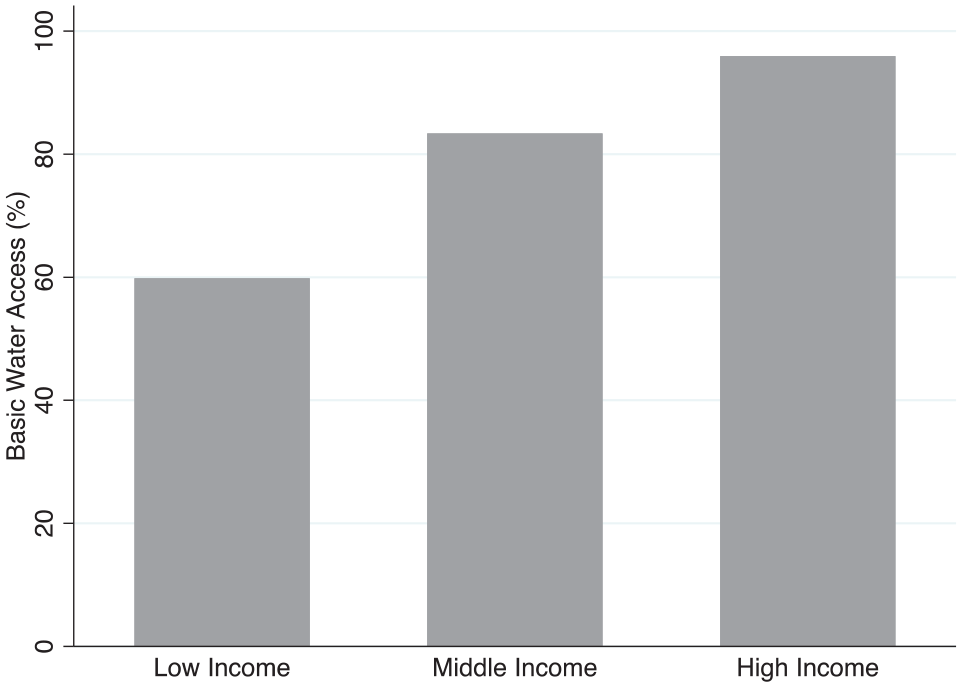
Economic development and water access.
Our four main independent variables are regime type, local elections, competition, and development. In tests examining national regime type, we utilise two measures. First, we employ a dichotomous measure, derived from the Rulers, Elections, and Irregular Governance Dataset (REIGN; Bell et al., 2021) - with results confirmed in robustness tests on a continuous variable. 12 REIGN regime type data are coded monthly, and therefore no further lags were required, making the data source preferable to other available democracy measures. Democracy is coded when a state meets a procedural definition including requirements for reasonably free and fair competitive national elections as defined by the Polity Project (Marshall and Gurr, 2018). States not meeting this definition are coded as non-democracies. 13 In addition to the binary measure of democracy, we also consider a state’s accumulated experience with democracy (democratic duration). This measure captures the logged number of consecutive months that a country has been democratic and is also derived from the REIGN dataset. Given the REIGN project records data on regime characteristics at the monthly level, we transform this variable to fit our country-year sample by taking the value recorded in the twelfth month for each country-year. A value of 0 denotes a country that is currently a non-democracy and larger values correspond to longer periods of successive democratic governance. 14
In tests concerning local democracy, we utilise two measures: local elections and competition, both derived from the Varieties of Democracy (V-Dem) dataset (Coppedge et al., 2019). The local elections variable is derived from the local government index (v2xel_locelec) and records the existence of elected local governments and their relative degree of autonomy. Next, the competition variable (v2elffelr) records the degree to which sub-national elections are considered free, fair, and competitive. 15 The measures are recorded as ordinal responses and converted to interval utilising the measurement model. The two local democracy measures are reported for both democratic and autocratic regimes and utilised in the full sample containing both democracies and autocracies. 16
Finally, development is measured with data from the World Bank (2020) and operationalised as the natural log of real gross domestic product (GDP) per capita in constant US dollars. In models examining national democracy, the interaction term consists of regime type or democratic duration × development and in models examining local democracy, the interaction term consists of development × local elections or competition.
We utilise six theoretically indicated control variables, all derived from the World Bank with the exception of ethnolinguistic fractionalisation. Beginning with population, we expect a negative effect on water access as a larger population should necessarily be more difficult to provide for. Second, net ODA (Official Development Assistance) records disbursement flows (in constant US dollars) that meet the Development Assistance Committee (DAC) definition of ODA and are made to countries and territories on the DAC list of aid recipients. While we do not expect a direct effect of net ODA, the inclusion of the measure assures that results are not biased in favour of ODA-receiving states. Third, we expect a negative effect of land area as larger states may experience greater challenges in provision related to infrastructure costs and greater terrain. Fourth, as rural communities are known to have less access to water supplies, we expect that states with a higher proportion of the population labelled urban will have better water access rates (e.g. Lim and Prakash, 2020). 17 Fifth, based on research suggesting that public goods are more difficult to provide to ethnically heterogenous populations, we control for ethnolinguistic fractionalisation (ELF), derived from the Ethnic Power Relations (EPR) database (Vogt et al., 2015). The measure is a Herfindahl–Hirschman index that records the market share of ethnic groups within a state. Larger numbers indicate more ethnically fragmented populations. Finally, we include a control for the post-2010 time period, marking the year the human right to water was established.
Results
Table 1 examines the interaction of national regime type and development on basic water access. Models 1 and 3 examine the effects of regime type, democratic duration, and development on water separately. Models 2 and 4 examine interaction effects of regime type and development (model 2) and democratic duration and development (model 4).
Democracy and development: access to water, 2000–2015.
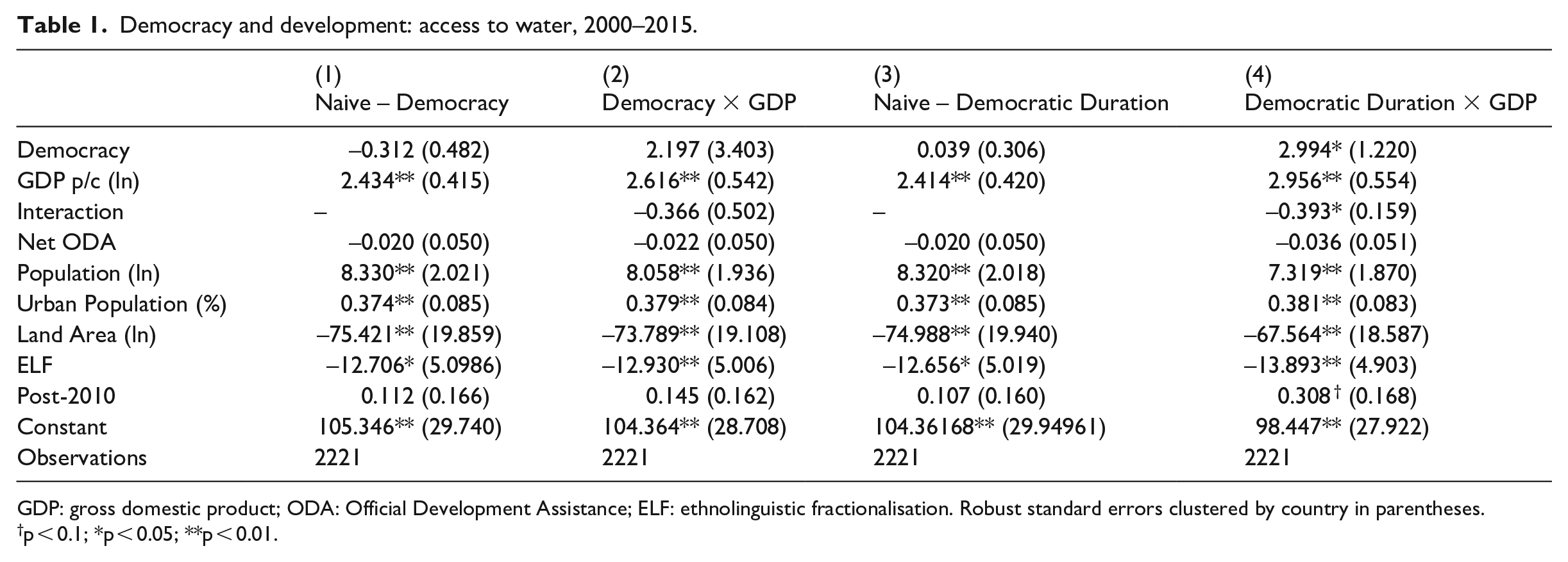
GDP: gross domestic product; ODA: Official Development Assistance; ELF: ethnolinguistic fractionalisation. Robust standard errors clustered by country in parentheses.
p < 0.1; *p < 0.05; **p < 0.01.
In models 1 and 3, the democracy terms fail to achieve statistical significance, suggesting that alone, neither regime type nor a state’s accumulated experience with democracy has a clear influence on basic water access. This lends initial support to hypothesis 1. The development coefficient is positive and significant, suggesting that greater levels of development are correlated with greater water access. In model 2, the constituent democracy term is again positive, though not significant, and the development term is positive and significant, suggesting that in autocracies, development is positively correlated with basic water access. Finally, the interaction is negative, though not significant, suggesting little difference between democracy and autocracy in the provision of basic water access at similar levels of development. The results of model 2 again offer support for hypothesis 1.
Following Gerring et al. (2012), model 4 examines the interaction of democratic duration and development, as the positive effects of democracy on public goods are thought to accrue over time. The constituent democratic duration term is positive and significant; when economic development is low, states with a longer democratic experience are associated with greater water access rates than autocracies or young democracies at similar levels of development. The constituent development term is similarly positive and significant; across regime types, development is positively correlated with water access. Finally, the interaction term is negative and significant such that the positive effect of democratic experience on water access declines as development increases. This is perhaps unsurprising, given the nature of water as a basic public good. Rather than assuming water access rates fall in wealthier states, instead, beyond a certain level of development, the effect is no longer positive as water access levels have already plateaued. Descriptive statistics support this notion with water access rates averaging 95% above the mean of logged GDP per capita. Model 4, therefore, casts doubt on hypothesis 1. First, it seems that at similar levels of development, at time t, there is little difference in water access rates. Next, when considering regime longevity, older democracies appear to outperform autocracies (and young democracies) in the provision of water when poor. To further assess these findings, Figure 2 presents the substantive effects of the interaction terms in model 4.
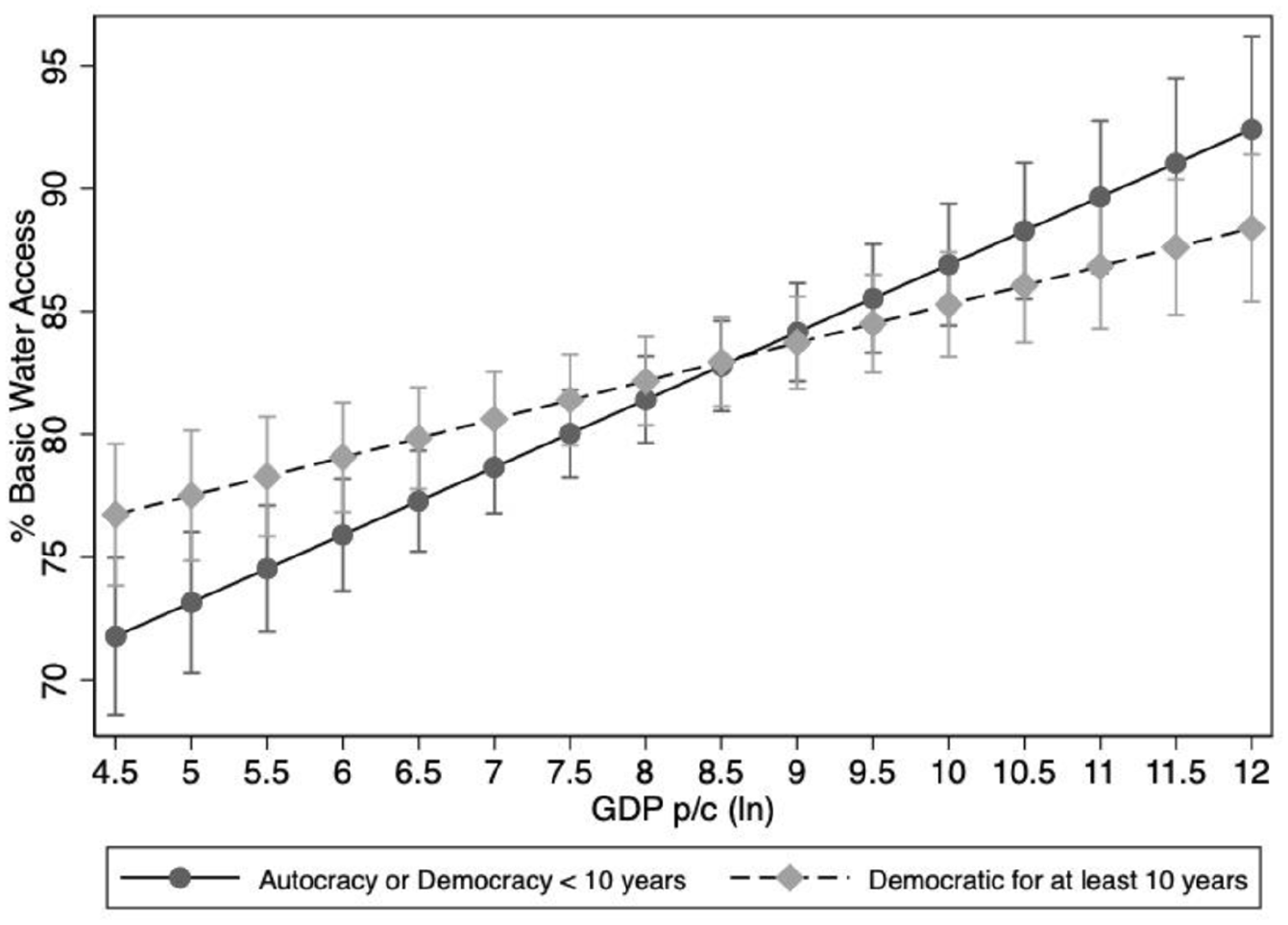
Marginal effects of regime type and development on water access.
Figure 2 illustrates the marginal effects of the interaction between democratic duration and development on basic water access rates. To plot the marginal effects, we transform our democratic duration measure to a binary indicator where 1 denotes states that have been democratic for at least 10 years and 0 otherwise. Beginning on the left, the x-axis plots the range of logged GDP per capita values and the y-axis, the range of basic water access rates. The solid line plots the interaction of development and autocracy (or states that have been democratic for less than 10 years) and the dotted line the interaction of development and democracy (states that have been democratic for at least 10 years). Both the lines have a clear upward slope as development increases, indicating that water access is improved in more developed states. As development increases, however, it appears that democracies begin to fall below autocracies on water access rates. Yet, while the interaction coefficient is negative and significant, confidence intervals overlap throughout the range of logged GDP per capita, suggesting little difference in water access rates between older democracies (>10 years) and autocracies/nascent democracies at similar levels of development. Together, the results of Table 1 and Figure 2 lend support to hypothesis 1: among democracies and autocracies at similar levels of development, there is little variance in water access rates. Second, while the interaction of regime type (democratic duration) and development suggests a statistically significant difference between regimes when poor, marginal effects reveal a lack of substantive effects.
Turning to local democracy, Table 2 examines two measures of local democratic institutions, local elections and competition, in conjunction with development. Table 2 thus reports six models, with models 1 and 3 reporting a naive model examining the development and one of the two local democracy measures. Next, models 2 and 5 examine the interaction of one local democracy measure and development at time t. Finally, models 3 and 6 examine the interaction at lagged versions of the local democracy measures (t-10). 18
Local democracy and development: access to water, 2000–2015.
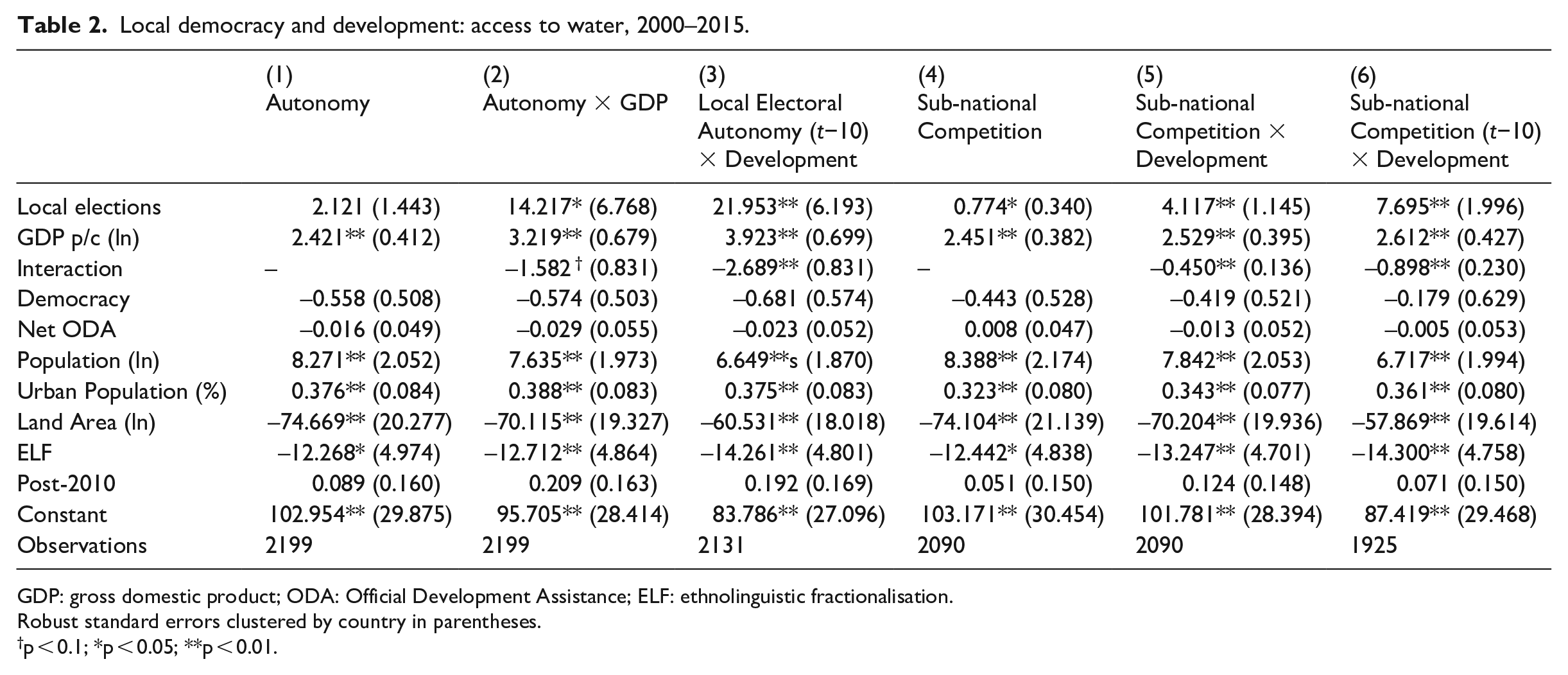
GDP: gross domestic product; ODA: Official Development Assistance; ELF: ethnolinguistic fractionalisation.
Robust standard errors clustered by country in parentheses.
p < 0.1; *p < 0.05; **p < 0.01.
Beginning with model 1, local elections alone is positive though not significant, suggesting little effect of the variable on its own. Development is positive and significant confirming the positive correlation between GDP and basic water access. Importantly, in models 2 and 3, both constitutive terms are positive and significant, indicating that when development is low, states where local leaders are elected provide better water access than states that appoint local leaders. Importantly, this suggests that the presence of local elections is associated with greater basic water access. Turning to the interaction term, the results of models 2 and 3 are negative and significant, indicating that the positive effects of local elections decline as development increases.
This is again unsurprising given the high average rate of water access (95%) above the mean of logged GDP per capita. Therefore, the results of the first three models in Table 2 lend support to hypothesis 2. States with local elections are correlated with greater rates of basic water access than states lacking local elections at similar levels of development, underscoring the critical importance of local electoral autonomy for the provision of basic water. In India, for instance, local elections have been instrumental in water access. Heller et al. (2007) point to fiercely contested local elections in Kerala, India following decentralisation reforms in the late 1990s as pivotal for public good delivery including access to improved drinking water. In addition, Fischer’s (2016) investigation into political changes in the Indian Himalayas further illustrates how local democratic institutions and accountability are influential in increasing access to public goods like piped water, as constituents were able to not only sanction political elites at the polls but simultaneously could also select leaders who were more attuned to their needs. Yet, as Carlitz (2017) shows in Tanzania, such electoral competition must create a virtuous cycle for accountability rather than encouraging zero-sum ‘pork-barrelling’. To further test the results, substantive effects of models 2 and 3 are plotted in Figure 3.

Marginal effects of local elections (t and t−10) and development on water access.
Figure 3 plots the marginal effects of the interaction between local elections and development on basic water access rates at t and t−10 (corresponding with models 2 and 3). The x-axis plots the coefficient of the interaction as it moves along the y-axis, plotting the range of logged GDP per capita values. Beginning with the figure on the left, examining local elections at t, when development is low, the effect of local elections on water access is positive. However, as GDP increases towards the maximum (~12 logged GDP p/c), the effect becomes negative. Next, in the figure on the right, illustrating the interaction of local autonomy at t−10 and development, the effect of the interaction appears stronger, becoming negative just beyond the mean of GDP per capita (designated by the vertical line). Marginal effects reveal that at time t, a change from having no elections to the mean of the local elections variable (about 0.6) results in an 8% increase in water access at the mean of development. 19 However, at time t−10, the same change results in nearly a 14% increase in water access. In short, the results thus far of Table 2 and Figure 3 lend considerable support to hypothesis 2. Importantly, the results suggest that the positive effects of local elections on water access increase with local democratic institutional longevity.
The final three models examine the local electoral competition. Model 4 reports the results concerning competition and development separately, and models 5 and 6 present the results of the interaction, with a lagged version of the competition in model 6. Beginning with the naive model, competition has a positive and significant coefficient. Free, fair, and competitive sub-national elections are correlated with improved basic water access. As we hypothesise, increases in electoral competitiveness increase elected officials’ level of accountability. Next, development reports a positive and significant coefficient, again confirming the correlation between development and water access. In models 5 and 6, the results are consistent with those presented for local elections, with a positive and significant effect of both constitutive terms. When development is low, states with free and competitive local elections provide better basic water access than states with less free and competitive local elections. In addition, when local elections either do not exist or are not free and competitive, development is positively correlated with better basic water access rates. Turning to the interaction, the coefficient is negative and significant in both models 5 and 6, suggesting that the positive effect of competition declines as development increases. The results of these three models lend further support to hypothesis 2. The substantive effects of the interactions in models 5 and 6 are plotted in Figure 4.
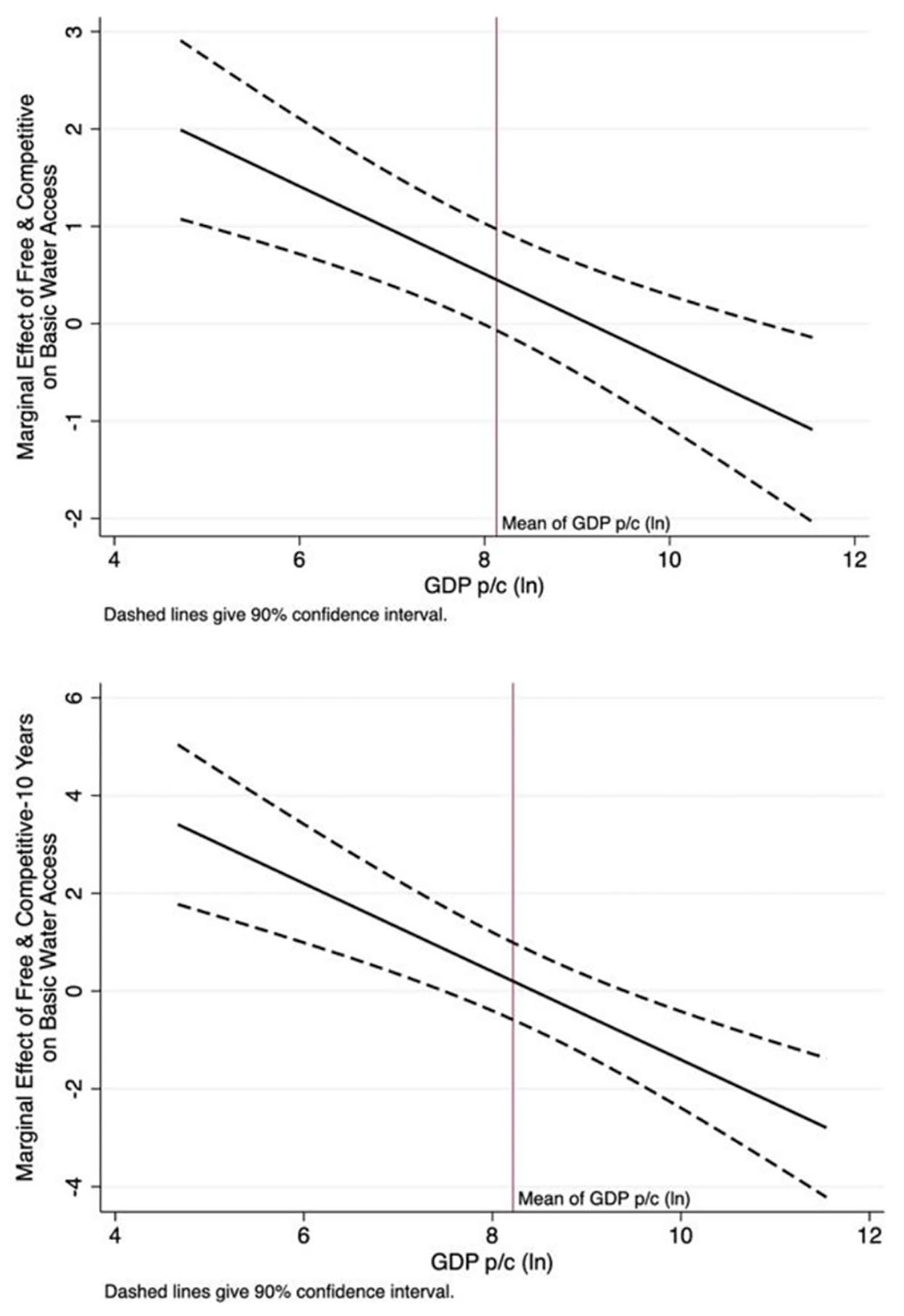
Marginal effects of competition (t and t−10) and development on water access.
Figure 4 plots the substantive effects of the interaction at time t and t−10 (models 5 and 6). Like the effects of local elections, competition is positively correlated with water access in poor states and maintains a positive correlation until about the mean of GDP per capita, and ultimately becomes negative beyond a certain income threshold. Beginning with the figure on the left, with the interaction of competition at time t, and development, the interaction coefficient is significant and positive until just before the mean of development. On the right, examining the interaction of development and competition at t−10, the interaction is significant and positive again until just before the mean of development. For reference, at time t, from the minimum of competition to the mean, water rates increase by approximately 15%. At t−10, the same increase in the variable results in a nearly 28% increase in water rates. The results of models 4 through 6 and Figure 4 therefore lend further, and considerable, support to hypothesis 2. Together, the results illustrate that not only is the presence of local elections impactful, but the competitiveness of these elections is especially important for access to basic water when states are less developed.
In addition to the support offered to hypothesis 2 by Table 2, Table A5 in the Supplemental Appendix re-examines our findings concerning local democracy and development on two alternative dependent variables: infant and child mortality, utilised in Ross’ (2006) study, to test whether the positive correlation between local democracy and water may be applicable to other, more commonly studied public goods in extant literature. 20 The results of Table A5, examining mortality under age 5 in models 1 and 2, and infant mortality in models 3 and 4, are robust to those in the main analysis, where lower mortality rates indicate better public goods outcomes, as opposed to higher rates in models examining water access. Therefore, the directional relationships are opposite; however substantive results are corroborated, reinforcing confidence in our findings. Cautiously, we believe these findings also speak to the broader applicability of our approach and point to the need to consider how local electoral autonomy and competition may impact other public goods provisions.
Examining controls in Tables 1 and 2, population and urban population have robust positive correlations with water access, suggesting that larger populations and states with a higher proportion of their population living in urban centres help to increase basic water access. Alternatively, land area and ethnic fractionalisation both illustrate negative and significant effects. In line with expectations, both larger states and more ethnically heterogeneous states are negatively correlated with basic water access. Finally, both net ODA and the control for the post-2010 time period fail to achieve robust results.
Finally, the Supplemental Appendix includes 28 additional tests and three figures, illustrating results robust to those presented in the main analysis. Models in the Supplemental Appendix include (1) additional controls related to water and democratic governance; (2) alternative dependent and independent variables; (3) restricted samples; (4) alternative model specifications; and (5) models utilising lagged independent and dependent variables to address possible endogeneity.
Conclusion
Motivated by the debate in scholarship on public goods provision, we set out to investigate whether a baseline measurement of public goods – access to basic drinking water – illustrated democratic superiority in the provision of public goods. Distinct from earlier work, we argue that the focus on the provision of public goods at the national level has obscured trends related to goods provisioned locally. For the provision of basic water access, a highly politically salient good that is largely provided locally, this is a crucial oversight. Both the presence and competitiveness of local elections, we theorise, can motivate locally elected officials to pursue policies aimed at providing basic water to their electorate in an effort to ensure their political survival. This, we note, is especially relevant for politicians operating in poorer states with inherent constraints on public spending. Through our analysis we arrive at three findings. First, supporting the findings of Ross (2006), democracies fail to achieve greater basic water access than autocracies at similar levels of development. Second, the existence of local elections, and their degree of competition, are positively correlated with water access in poor states. Third, and related, increases in democratic institutional longevity illustrate increases in the positive effects of local democracy on water access rates. Our findings underscore the importance of examining local democratic institutions as opposed to exclusively focusing on national-level characteristics. In line with Gottlieb (2015), our results illustrate how the existence of local democratic institutions, and the characteristics of these institutions, including both local elections and their degree of electoral competition, can promote increases in goods provision in poor states.
Considering these findings, we suggest three necessary additions to assessments of public goods in cross-national studies. First, studies examining a global sample of states have obscured patterns in the data by assuming that institutional characteristics in wealthy states are present, or indeed operate similarly, in poor states. While democratic incumbents are prone to increase public spending to maintain power, the choices faced by poor democratic incumbents may result in different outcomes. Therefore, to highlight dynamics related to economic circumstances in conjunction with institutional characteristics, we suggest that the addition of interactive effects considering development is necessary. Second, reliance on measures of public goods provision that gauge spending, or alternatively, on indicators influenced by myriad factors, including infant mortality, have likely further obscured findings. We advocate that the inclusion of baseline outcome measures can help to illustrate the true state of public welfare related to goods provision. Finally, and from our perspective, an imperative is the need for a renewed focus on local institutions, especially in the study of locally provisioned goods. Indeed, beyond the academic investigation of public goods provision related to institutional characteristics, policymakers and non-governmental organisations (NGOs) would be wise to consider economic and institutional characteristics, both nationally and locally, when addressing public welfare needs. In addition, members of the public and activists would similarly benefit from consideration of institutional characteristics when considering how best to lobby for public welfare needs.
Supplemental Material
sj-pdf-1-bpi-10.1177_13691481211070176 – Supplemental material for Democracy and public goods revisited: Local institutions, development, and access to water
Supplemental material, sj-pdf-1-bpi-10.1177_13691481211070176 for Democracy and public goods revisited: Local institutions, development, and access to water by Rebecca E Schiel, Bruce M Wilson, Malcolm Langford and Christopher M Faulkner in The British Journal of Politics and International Relations
Footnotes
Authors’ Note
Christopher Faulkner: The views expressed in this manuscript are the authors’ own and do not represent the Naval War College, Department of the Navy, or the U.S. Government.
Funding
The author(s) disclosed receipt of the following financial support for the research, authorship, and/or publication of this article: Research funded by the Norwegian Research Council. “Elevating Water Rights to Human Rights: Has it strengthened marginalized peoples’ claim for water? (Forskerprosjekt—FRIHUMSAM project number 263096). P.I. Bruce M. Wilson and the University of Central Florida Preeminent Postdoctoral Program (P3) grant number 0000007509; P.I. Bruce M. Wilson.

Supplementary information
Additional supplementary information may be found with the online version of this article.
Content Table A1: Local Elections & Development, Controlling for Water Measures. Table A2: Competition & Development, Controlling for Water Measures. Table A3: Local Elections & Development, Controlling for Governance Indicators. Table A4: Competition & Development, Controlling for Governance Indicators. Table A5: Local Democracy & Development: Infant and Child Mortality, 2000-2015. Table A6: Local Elections & Development: Access to Water, 2000-2015, Democracies. Table A7: Local Government Autonomy & Development: Access to Water, 2000-2015, Autocracies. Table A8: Competition & Development: Access to Water, 2000-2015, Democracies. Table A9: Competition & Development: Access to Water, 2000-2015, Autocracies. Table A10: Democracy & GDP: Access to Water, 2000-2015, Fixed Effects. Table A11: Local Democracy & Development, Fixed Effects. Table A12: Democracy (Polity Score) & Development. Figure A1: Marginal Effects of Democracy (Polity) and Development on Basic Water Access. Table A13: Democracy & GDP, Excluding Developed Countries – GDP pc (ln) < 8.25. Table A14: Democracy & GDP, Excluding Countries in the Top Quintile of GDP pc (ln). Table A15: Local Democracy & GDP, Excluding Developed Countries – GDP/pc (ln) <8.25. Table A16: Local Democracy & GDP, Excluding Countries in the Top Quintile of GDP pc (ln). Table A17: Democracy & GDP, Alternative Democracy Measures – Years Democratic. Table A18: Democracy & GDP, Moving 5-, 10-, and 15 year Polity Score Average. Table A19: Local Democracy & GDP, Moving 10 year Average Local Democracy Measures. Table A20: Democracy & GDP, Logged Dependent Variable. Table A21: Local Democracy & GDP, Logged Dependent Variable. Figure A2: Level of Development and Basic Water Access 2000-2015. Figure A3: Level of Development and Basic Water Access 2000-2015. Table A22: Tobit – Democracy & GDP. Table A23: Fractional Logit – Democracy & GDP. Table A24: Fractional Probit – Democracy & GDP. Table A25: Tobit – Local Democracy & GDP. Table A26: Fractional Logit – Local Democracy & GDP. Table A27: Fractional Probit – Local Democracy & GDP. Table A28: Local Democracy & GDP: Rural Access to Water, 2000-2015.
Notes
References
Supplementary Material
Please find the following supplemental material available below.
For Open Access articles published under a Creative Commons License, all supplemental material carries the same license as the article it is associated with.
For non-Open Access articles published, all supplemental material carries a non-exclusive license, and permission requests for re-use of supplemental material or any part of supplemental material shall be sent directly to the copyright owner as specified in the copyright notice associated with the article.
