



Abstract
The literature on globalisation and democracy has primarily paid attention to economic integration and its effects on democracies. Systematic empirical evidence on the effects of social globalisation on democracy is absent. This article intends to fill this gap. Social globalisation is disaggregated into interpersonal, information and cultural globalisation. I apply the generalised method of moments estimation and analyse democracies encompassing the periods 1970–1991 and 1991–2017. The results indicate that the democratic qualities affected by social globalisation are freedom of expression, equal access and protection, and the quality of elections. The moderating effect of a given country’s democracy stock has been confirmed across different estimations. However, and especially during the post–Cold War period, younger and older democracies benefit equally from the increased spread of information caused by globalisation with regard to equal access. Equally, both categories experience similar challenges with the rise of interpersonal globalisation in terms of the quality of elections.
Keywords
Introduction
While the existing empirical literature on globalisation and democracy acknowledges that globalisation is a phenomenon of different dimensions, trade liberalisation is utilised as a common proxy to describe different phenomena such as the interchange of people, goods, information and money across borders (see Eichengreen and Leblang, 2008).
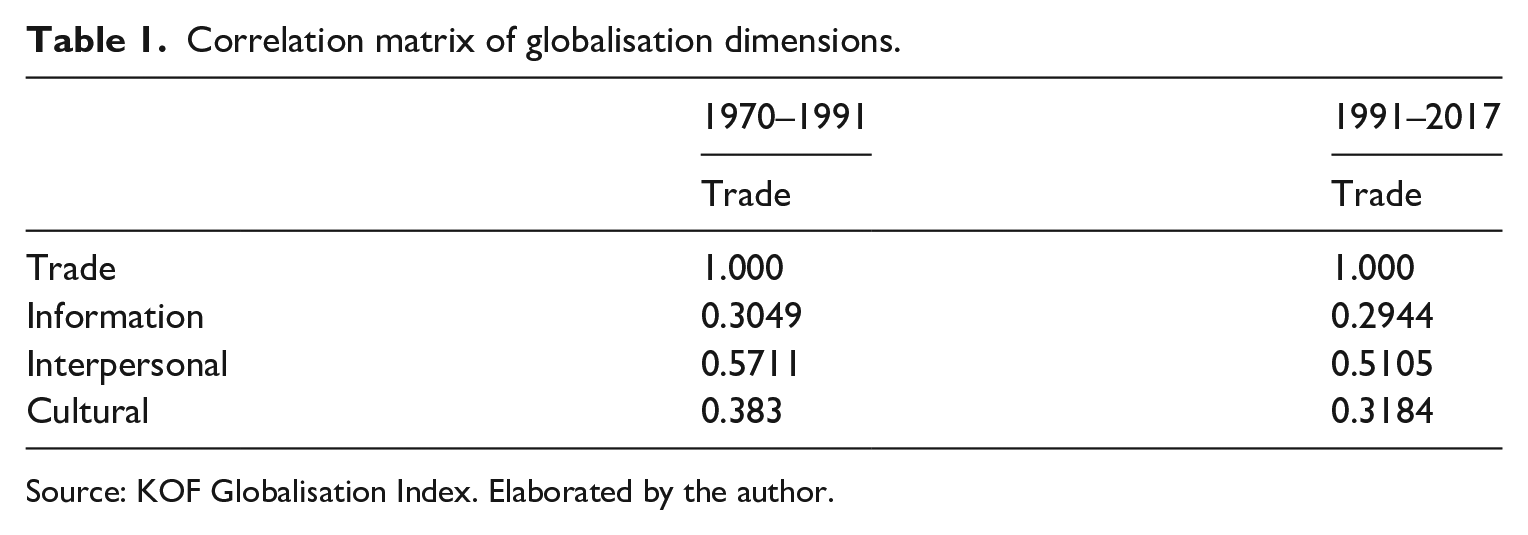
This leads to the question of whether trade globalisation goes hand in hand with other dimensions of globalisation. Table 1 illustrates the correlation matrix for trade globalisation and other globalisation dimensions. Based on the correlations, the use of trade globalisation as a proxy for all dimensions of globalisation seems to be rather questionable.
Correlation matrix of globalisation dimensions.
Source: KOF Globalisation Index. Elaborated by the author.
In this article, I focus on how social aspects of globalisation – interpersonal, information and cultural globalisation – impact different qualities of democracy. To answer this question, I apply a panel data regression with democracies for the years 1970–1991 and 1991–2017. In the following article, the definitions of globalisation draw on the work of Keohane and Nye (2000), who divide globalisation into three different dimensions, which have been operationalised by Gygli et al. (2019).
To advance knowledge on the relationship between interpersonal, information and cultural globalisation and democracy, I intend to answer whether and how these aspects of globalisation affect democratic freedom, democratic equality and democratic control. This is based on the premise that a democratic system tries to establish a balance between the normative, interdependent values of freedom and equality, which is achieved by a third principle: control (Bühlmann et al., 2012). Democratic qualities may be positively correlated with one another, but countries scoring high in one dimension may score low or middling in another (Knutsen et al., 2019). The literature on globalisation and democracy often relies on democracy measures such as Polity IV (Rudra, 2005) that does not allow to understand possible effects on different aspects of democracy more precisely (Heyne, 2018). This article follows in the footsteps of Heyne (2018) who analysed different aspects of globalisation and their effects on democratic freedom, equality and control to localise which specific aspects of democracy are affected by globalisation. Joining Gallagher and Thacker (2008) and Gerring et al. (2012) I innovate by including the democracy stock – the accumulation of democratic institutions – in my analysis, to see whether and how it moderates the relationship between social globalisation and democratic qualities.
Dimensions of globalisation – Previous research
The existing literature reinforces the importance of understanding dimensions of globalisation beyond economic integration. In general, empirical studies that analyse different dimensions of globalisation, besides economic integration, are rare. Moreover, they focus on other dependent variables, though some do deal with democratic qualities. A common shortcoming of the existing empirical literature is that the scholars do not distinguish between different dimensions of social globalisation, such as interpersonal, information and cultural globalisation.
To the best of my knowledge, there exists only one piece of empirical research that scrutinises the effect of social globalisation on different aspects of democracy (see Heyne, 2018). The author finds an overall positive effect of social globalisation on democratic freedom, control and equality. The research enriches the empirical literature on globalisation and democratic qualities. It has its shortcomings, however: it does not include disaggregated dimensions of social globalisation to measure interpersonal, information or cultural globalisation. This leaves open the question of whether the effects of all the sub-dimensions are similar or diverging.
The following studies analysed social globalisation but focus on different outcome variables. Cho (2013) concluded that social globalisation positively affects women’s economic and social rights, whereas economic globalisation does not show any effect on the same issues. Ben-Nun Bloom et al. (2017) argues that while the effect of economic globalisation on gender equality varies greatly across time and space, there is a need to consider the other dimensions of globalisation. They found that social globalisation – individual’s exposure to external ideas, people and information – moderates the effect of economic globalisation on women’s rights. Dreher et al. (2012) show in their study that physical integrity rights increase with economic, social and political globalisation, when including them separately in the models for estimation. Analysing a large sample of countries, De Soysa and Vadlamannati (2011) found in their research a strong positive association between overall globalisation, as well as its disaggregated components, and government respect for physical integrity rights between 1981 and 2005, analysing a large sample of countries. Their results show that an increased exposure to globalisation lowers state violations of basic human rights. Vadlamannati (2015) found a mixed effect of different globalisation dimensions on the laws and law enforcement to protect workers’ rights. While social globalisation is associated with a strengthening of laws and law enforcement for workers’ rights, political globalisation does not have the same effect.
Social globalisation and democratic qualities
In general, theoretical arguments on the direction of the effects of social globalisation are characterised by ambiguity. This section covers diverse theoretical arguments and research outcomes to illustrate the relationship between social globalisation and certain aspects of democracy. First, the role of the democracy stock – accumulation of democratic institutions – as a moderator of the relationship between social globalisation and democracy is discussed. The section then turns to the relevance of the time period for analysis and the sub-dimensions of social globalisation.
The role of democracy stock as a moderator
Democracy stock is defined as the historical accumulation of democratic institutions based on Gallagher and Thacker (2008). It is understood as the electoral principle of democracy (Coppedge et al., 2018). Democratic elections are the departure of an authoritarian government and represent the formative stage of democracies. But democracy is not achieved through elections alone (Beetham et al., 2008).
A democracy with a high democracy stock tends to foster a well-developed civil society in which associations play an important role (Gerring et al., 2012). Through these engagements, strong democratic societies create a culture of equality. This empowers all social groups to take actions to satisfy their rights and liberties (Alvarez and Dagnino, 1998). Countries with more democratic heritage show a higher level of democracy in the contemporary period (Pérez-Liñán and Mainwaring, 2013). This is based on the argument that democracy and authoritarianism bequeath deep legacies on contemporary political regimes (Gerring et al., 2012). Younger democracies are often defined as democracies when employing minimalist definitions of democracy. Competitive elections spread through the third wave of democratisations despite low levels of socio-economic modernisation (Møller and Skaaning, 2013). Competitive elections were introduced before the establishment of basic institutions of a modern state, such as accountability of governors or institutions of the civil society (Rose and Shin, 2001). Furthermore, younger democracies are characterised by disparities in wealth and income and elevated levels of poverty (Gerring et al., 2012).
When we understand countries as part of a globalising world, they become increasingly exposed to the world through social globalisation. This not only leads to challenges at the national level but also provides opportunities for democracies to learn from other countries’ experiences.
Table 2 demonstrates that the extent of the manifestation of different aspects of social integration such as personal contacts through tourism, immigration, flows of international information, exchanges of ideas and the disseminating of technology differs between younger and older democracies. The globalisation index varies between 0 and 100, where higher values are associated with higher globalisation.
Mean of globalisation dimensions by democracy stock and time period.

Source: KOF Globalisation Index and V-Dem.
Elaborated by the author.
Furthermore, Table 2 illustrates that both democracy groups – those with lower and higher democracy stocks – experience higher levels of information and interpersonal globalisation in the post–Cold War period than during the Cold War period. And the levels in cultural globalisation behave rather similarly in both time periods in both groups.
Thus, the first hypothesis, H1, to be tested is as follows: the democracy stock is a relevant moderator in the relationship between social globalisation and democracy.
It is, however, expected that the moderating effect of the democracy stock on the relationship between different aspects of social globalisation and democratic qualities is more pronounced during the Cold War period than in the post–Cold War period. This is explained by a tendency towards a convergence in social globalisation across different democracy groups since 1991, which can be described as an era of social hyperglobalisation. This is inspired by the concept of hyperglobalisation which refers to increased global economic integration after the end of the Cold War (see Rodrik, 2011). This convergence is observed when comparing overall correlations between the democracy stock and different aspects of social globalisation in the Cold War and the post–Cold War period. The correlations are lower in the post–Cold War period than in the Cold War period. 1 Thus, the distinction between globalisation levels in the Cold War and post–Cold War period is relevant. A ‘temporal sectioning’ approach has also been applied by Richards and Gelleny (2007) and others who study economic globalisation given that after the Cold War much of the world emerged from a persistent time of statism.
Based on the previous elaborations H2 is stated as follows: the moderating effect on the relationship between social globalisation and democracy is observed to a stronger extent during the Cold War period than during the post–Cold War period.
Figure 1 visualises year-average values of information, interpersonal and cultural globalisation. While the level of information, interpersonal and cultural globalisation varied between 40 and 50 during 1970–1991, the variation in the post–Cold War period is much higher, with high average values up to almost 80. This also illustrates that the level of information globalisation surpasses the levels of cultural and interpersonal globalisation in both time periods.
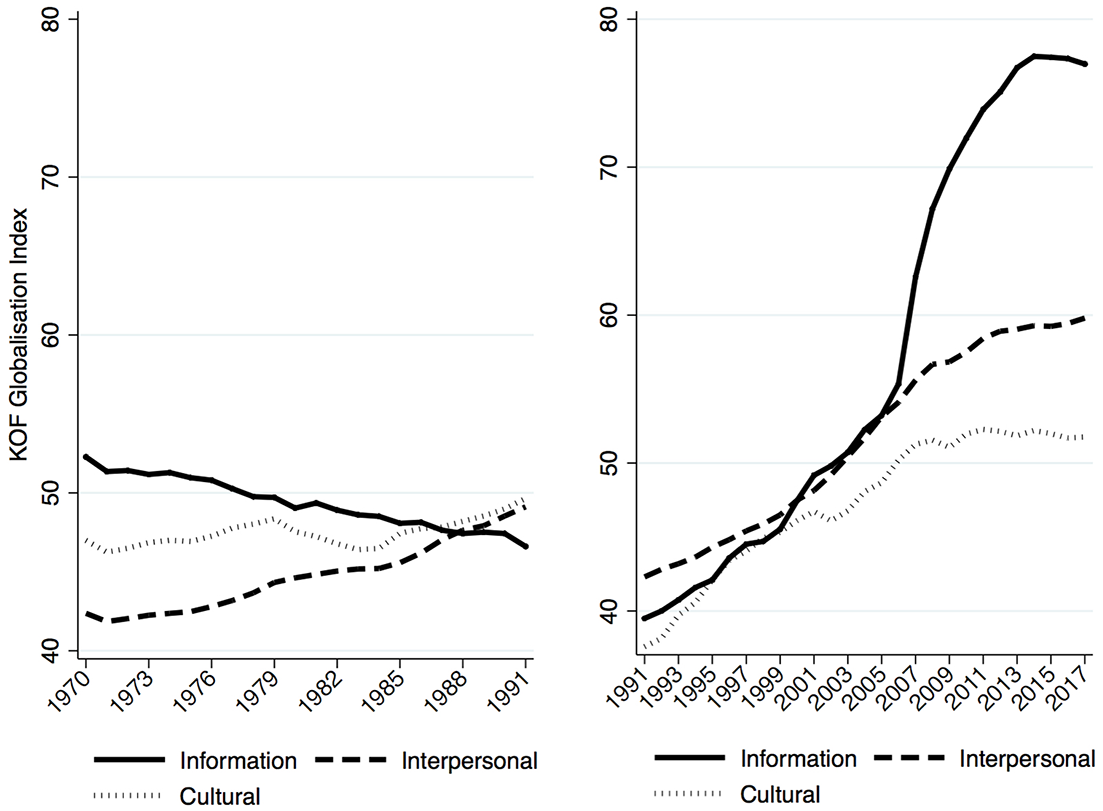
Social globalisation dimensions, 1970–2017. Source: KOF Globalisation Index. Elaborated by the author.
Interpersonal and cultural globalisation
Some scholars argue that increased flows of people and increased personal contact between individuals (Appadurai, 2001) lead to more rights and freedoms through diffusion (Fukuyama, 2006) or through international pressure on states (Finnemore and Sikkink, 1998). Simultaneously, the interaction between societies challenges existing traditions, values and identities (Ben-Nun Bloom et al., 2014). The perceived threat to the traditional values may lead to diminished democratic freedoms, when certain social groups start to disrespect or even dismantle other social groups’ rights as demonstrated in Ben-Nun Bloom et al. (2014) in regard to religious freedom. The sentiment of threat towards the national culture and established traditional values may generate negative attitudes towards certain groups in society and undermine the equal protection of different social groups and general political equality (Kriesi, 2013). More highly educated citizens might, however, be more tolerant towards other cultures since they have the resources to communicate with foreigners and have a deeper understanding of other cultures more generally (see Lipset, 1981).
A negative aspect of the interpersonal dimension of social globalisation relates to the security trap triggered by increased levels of tourism or migration (Heyne, 2018). Through increased flows of people, the need for security becomes more pronounced. More monitoring and controls within states may have a negative effect on the liberal component of democracy, in terms of democratic freedom and individual liberties. Especially since the terrorist attacks of 9/11, the security controls related to interpersonal globalisation’s values of civil rights and freedom of speech and association have suffered (Heyne, 2018). Busch (2012) argues that different police, intelligence and military services by the police became more blurred at this time, and the data exchanges between countries in regard to their citizens are less subject to democratic control. In the name of national security, a transnational field of political and security professionals – such as the police, intelligence and military – has developed, which in some cases has generated illiberal practices (Bigo, 2006).
In a nutshell, the effect of interpersonal globalisation on democratic qualities is ambiguous. While it can trigger democratic diffusion through interpersonal contacts, it can also cause resentments (Kriesi et al., 2008) and catch countries in a security trap (Heyne, 2018).
Interpersonal globalisation has been accompanied by increased non-personal contacts between societies, who develop a deeper awareness of different cultures through the spread of commodities with a symbolic cultural value. These growing cultural influences increase also the salience of differences between different societal groups (Ben-Nun Bloom et al., 2014). Some scholars argue that there is a tendency towards cultural uniformity (Hermans and Dimaggio, 2007), while others highlight the intensification of cultural heterogeneity and differences that are reinforced through cultural globalisation (Meyer and Geschiere, 1999). Barber (1996) warns that democracies may fall victim to these processes as they become caught between a clash of movements. We see, on the one hand, strong forces of integrative modernisation and aggressive economic and cultural globalisation and, on the other, disintegrating tribalism and reactionary fundamentalism.
Kriesi et al. (2008) assert that cultural globalisation may not necessarily be perceived and experienced in the same way by all citizens in a country. While citizens with higher education levels tend to have political value orientations towards cultural liberalism, cosmopolitism or universalism, poorly educated citizens tend to be less tolerant given their limited skills and resources to engage with foreign cultural artefacts (Lipset, 1981). Multicultural attitudes thus oppose positions in favour of national traditional culture (Kriesi et al., 2008).
Inglehart and Norris (2016) argue that the rise of post-materialist values such as environmental protection, acceptance of gender and racial equality, and equal rights for the lesbian, gay, bisexual and transgender (LGBT) community between 1970 and 1990 fostered a tolerance towards different lifestyles, multiculturalism and the protection of human rights. However, this spread of progressive values also stimulated reactions from conservative voices, in particular among older generations, and especially in the period after the end of the Cold War. These reactions are subsumed under the cultural backlash theory (Inglehart and Norris, 2016).
Based on the differences between younger and older democracies, a learning effect is expected through increased levels in cultural and interpersonal globalisation in democracies with lower democracy stocks – similar to the argument of Magistretti and Tabellini (2019) who scrutinised the effects of global trade flows on democracies. This may be called the democratic catch-up effect, where democracies with low democracy stocks have more potential to improve their democratic qualities in terms of freedom, equality and control. Cultural and interpersonal globalisation empowers citizens to engage more in politics and increases the demand for democratic freedoms, equality and more democratic attitudes more generally. Governments might be exposed to more pressure from the international community (Fukuyama, 2006) through enhanced levels of cultural and interpersonal globalisation, which further deepens democracy by encouraging more democratic freedom, equality and control.
Considering that democracies with stronger democracy stocks have better developed the freedom and equality aspects of their democracies, national changes triggered by increased cultural and interpersonal globalisation might be therefore more incisive in older democracies. The challenges arising from technological changes have implications, for example, on the mobilisation of political interest and the complexity of policymaking. And an increasing cultural heterogeneity and socio-economic inequality of national political communities provoked by social globalisation may undermine the societal preconditions for political equality. Anxiety towards increased global migration flows and linked to cultural heterogeneity has been particularly conspicuous in Western societies (Inglehart and Norris, 2016; Kriesi, 2013).
Given that cultural globalisation was more pronounced in the Cold War period than in the post–Cold War era and the level of interpersonal globalisation outstrips cultural globalisation after 1991 (see Figure 1), it is assumed that the effects of cultural globalisation are more visible in the Cold War period and the effects of interpersonal globalisation on democracies more salient after 1991. Thus, hypothesis 3 (H3) claims that the effect of cultural globalisation on democracy is mainly visible during the Cold War period and the effects of interpersonal globalisation more perceptible in the post–Cold War period. Younger democracies are expected to experience a catch-up effect, while for older democracies the opposite effect is anticipated.
Information globalisation
The ambiguous effects of information globalisation are the subject of many scholarly debates. While information globalisation offers new opportunities, it also produces new ways to control information in societies (Balkin, 2004). Bremmer (2010) argues that it has been assumed that the survival of authoritarian regimes depended on their ability to control the flow of ideas. With the advances of communication technologies came the expectations that people would be able to mobilise themselves. Communication technologies are powerful tools for civil society mobilisations. New sources of information and new opportunities to share ideas and engage are facilitated through innovations in communication technologies, but they also strengthen the power of governments, as they can be used to manipulate or monitor public opinion.
Norris (2001) claims that advanced communication technologies provide access to information, through which people are exposed to different values and images. But the impact of foreign ideas and information within a country may be curtailed when social exclusion mechanisms exist and where citizens cannot afford the costs of digital connectivity (Norris, 2001). The effect of new technologies on the promotion of freedom and overall democratic values, may therefore be more dependent on country-specific factors. Shirazi (2008) demonstrates a growing digital divide in democratic freedoms, despite the fact that rapid Internet communication technologies (ICT) are expanding. He also shows that Internet filtering has a significant impact on democratic freedoms.
The ambiguity of technology and information is exemplified in the case of social media. The emergence of social media as an interactive computer-mediated technology has initially received considerable support for its ability to renew democratic values by facilitating open and collaborative networking (Loader and Mercea, 2011). More recent analyses, however, point to new challenges with social media, as different groups try to get an advantage in the democratic process during elections by posting fake news on social media networks (Ochoa et al., 2019). Recent cases in Zimbabwe, for example, show how fake news and cyber-propaganda were omnipresent in the mainstream and social media during the country’s election (Ncube, 2019). Other examples where social media, fake news and social bots impacted politics are Brazil (Chaves and Braga, 2019) and the United States (Persily, 2017).
Thus, the effect of information globalisation on democratic qualities may go in both directions. On the one hand, information globalisation should have a positive impact on equal access and protection of rights and freedoms across social groups. Through the spread of different information technologies and enhanced information flows, citizens should feel empowered to put issues on the agenda and influence policymaking. It also enables governments and politicians to find new ways of providing democratic accountability for citizens. On the other hand, and depending on their technological design, governments and politicians may also use international information flows to manipulate the population, control information and therefore diminish democratic freedoms, equality and control.
In the context of young democracies, one expects to observe an oppression effect in democracies with lower democracy stocks – contrary to the catch-up argument as previously discussed, since in new democracies governments may use communication technologies and information flows to manipulate and control citizens. Younger democracies have lower levels of secondary school enrolment, more restrictions on the media and are more corrupt (Keefer, 2007). In addition, younger democracies have a weaker institutionalisation in the political sphere (Gerring et al., 2012), which is why political leaders in new democracies may be tempted to exploit the weak institutionalisation in terms of governance, extra-constitutional organisation or non-governmental organisations to control information flows and thus ultimately limit democratic freedoms, equality and control. Democracies with stronger democracy stocks tend to be economically more developed, and its citizens on average more educated and better organised in terms of civil society organisations (Gerring et al., 2012), which makes them able to use increased information flows to push towards more protection of rights and liberties and democratic participation. The oppression effect in younger democracies may be weaker or even disappear during the social hyperglobalisation era, which is marked by high levels of information globalisation and weaker correlations between the democracy stock and information globalisation. 2 When the level of information globalisation is high enough, political leaders in new democracies may find it more difficult to exercise control over citizens.
Hypothesis 4 (H4) is formulated as follows: during the Cold War period, it is expected that the democracy stock moderates the relationship between information globalisation and democracy. Younger democracies are expected to experience an oppression effect. This moderating is expected to disappear during the post–Cold War period, given that information globalisation drastically increased within that period in both younger and older democracies (see Figure 1 and Table 2).
Data and methodology
The dataset is split into two to make the point that the effects of social globalisation on democracy are different before and after the Cold War. The first encompasses the period between 1970 and 1991, and the second, the period between 1991 and 2017. The dataset for the Cold War period includes 56 democracies, while the sample for the post–Cold War contains 114 democracies. 3 The first and second datasets are strongly balanced given that each panel contains the same time points. Furthermore, generalised method of moments (GMM) estimations should be applied to small T large N panels (Roodman, 2009), where the split into two periods diminishes the T.
The social globalisation variables assume values scaled from 1 – minimum globalisation – to 100. De facto social globalisation is composed of interpersonal, information and cultural globalisation. De facto interpersonal globalisation aims to capture the creation of international personal connections via international voice traffic, international financial transfers, international tourism and foreign-born persons. De facto information globalisation captures international flows of technology, scientific knowledge and related information and is an approximation for outward-directed flows of information. De facto cultural globalisation captures the influence of external culture on a country (De Soysa and Vadlamannati, 2011) and is composed of trade in cultural goods, trademark applications, trade in personal services, McDonald’s restaurants and IKEA stores (Gygli et al., 2019). 4 The KOF globalisation has been used in more than 100 studies analysing the effects of globalisation on different outcomes (Potrafke, 2015).
Democracy measures from V-Dem are used as dependent variables (Coppedge et al., 2018). Democratic freedom is measured by two variables: freedom of expression and access to alternative sources of information, and individual liberty and equality before the law. Democratic equality is measured by two variables: equal protection of rights and freedoms across social groups by the state and equal access to de facto capabilities to participate and serve in positions of political power. Democratic control is measured by clean elections which measures the extent to which elections are free and fair (Coppedge et al., 2018). 5 Lagged values of the independent variables t−1 are applied to take into account the time lags of the effects as reported in the previous literature. Furthermore, the two-step system GMM dynamic panel estimation technique is applied that copes with issues arising from endogeneity, omitted variables and measurement errors. The GMM estimation method controls for endogeneity issues using lagged independent variables as instruments (Arellano and Bond, 1991). For variables that are not strictly exogenous, a standard treatment of lag 1 and longer and for the endogenous variables is employed, and for the endogenous variables a standard treatment of lags 2 and longer following the guidelines of Roodman (2009) is applied.
In addition, lagged dependent variables (LDVs) are included. Agiakloglou (2013) found that estimation of regressions in first differences or with an LDV eliminates the spurious regression problem. The inclusion of one or two dependent variables is therefore useful here. Wilkins (2018) shows that the improper exclusion of LDVs can lead to severe biases of coefficient estimates. Panel unit root tests identified some variables in the dataset 1970–1991 and 1991–2017 as non-stationary. To take this into account, the models are estimated in first differences.
In addition, a democracy stock variable is constructed based on Gerring et al. (2012). Each country’s polyarchy score from the V-Dem is calculated, from 1900 to the observation year to the present day, and a 1% annual depreciation rate going back in time is applied. This approach means that distant years receive less weight than recent ones. The V-Dem polyarchy variable measures the electoral democracy according to Coppedge et al. (2018). The V-Dem dataset on the quality of democracy across the globe measures democracy levels in all kind of political regimes; thus, it also captures democracy levels in a democratic country that suffered a democratic breakdown. In this case, the democracy level decreases for the next year, which also impacts the democracy stock. Argentina, for example, experienced a democratic breakdown in 1976, which diminished the democracy stock to 0.561 in 1976, compared with the previous year value of 1.356. Thus, the democracy stock diminishes when the democracy level in a given year diminishes. 6 When a nation-state was part of a contiguous empire, it receives the same V-Dem score for the relevant period. 7 The variable democracy stock is estimated for year t without a time lag, given the variable’s purpose, to operationalise the stock of democratic institutions. The time component is included in the variable given its historical nature.
As recommended by Roodman (2009), I include time dummies for the panel, and I use orthogonal deviations, country robust standard errors and standard treatment of 2 lags and longer for clearly endogenous variables such as the LDVs. Predetermined, not strictly exogenous, variables have a standard treatment of lags 1 and longer where necessary. I include lag limits and the collapse command in the GMM estimation to keep the number of instruments as low as possible.
I include the following control years: 1973 and 1979 to control for the oil shocks; 1980, 1981 and 1982 to control for the debt crises; 2001 for when China became a member of the WTO and the 9/11 attacks; and 2007–2009 for the global financial crisis.
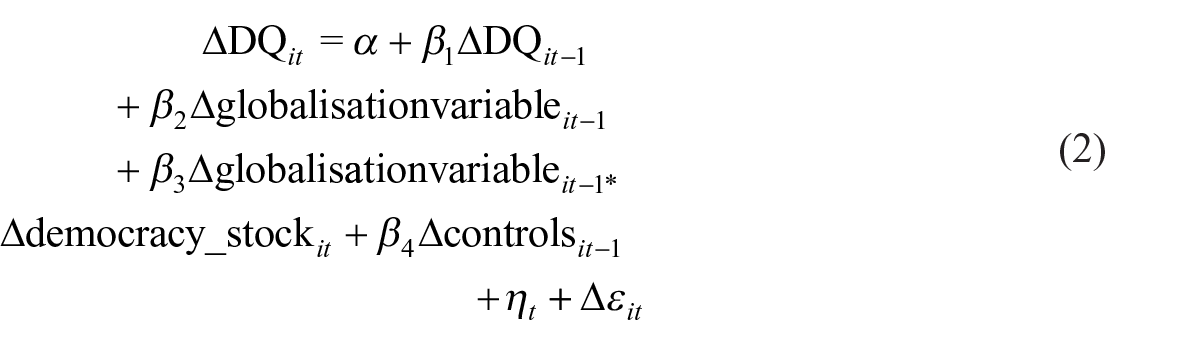
For each estimated model, results in first differences for the Arellano–Bond test for AR(1) and AR(2) are reported to ensure that for AR(2) the p-value is >0.05. In addition, I ensure that the Hansen test p-value is not below 0.1 and not 1.000 (Roodman, 2009). DQ it in all following models represents the different democratic qualities in first differences: freedom, equality, and control for country i in year t.
The first model (1) is estimated with all the disaggregated dimensions of social globalisation. The second model (2) is estimated with the inclusion of an interaction term of democracy stock and each social dimension of globalisation.
All models have these control variables: (log) GDP per capita, GDP growth, inflation, democracy stock, urban population and country size (see Heyne, 2018). 8 Aggregated economic globalisation composed of trade and financial globalisation is additionally included as a control variable in all model estimations for both datasets. 9

Results and discussion
This section reports and discusses the findings, but due to space restrictions only those results with significant regression coefficients are registered. 10 The moderating effect of the democracy stock on social globalisation and democratic qualities – confirming H1 – is mainly confirmed for the Cold War period as hypothesised in H2. The results from data in the post–Cold War period indicate that democracies with lower and higher democracy stocks face mostly similar challenges and benefits from social globalisation in regards to democratic qualities with an exception of the effect of interpersonal globalisation on freedom of expression during 1991–2017.
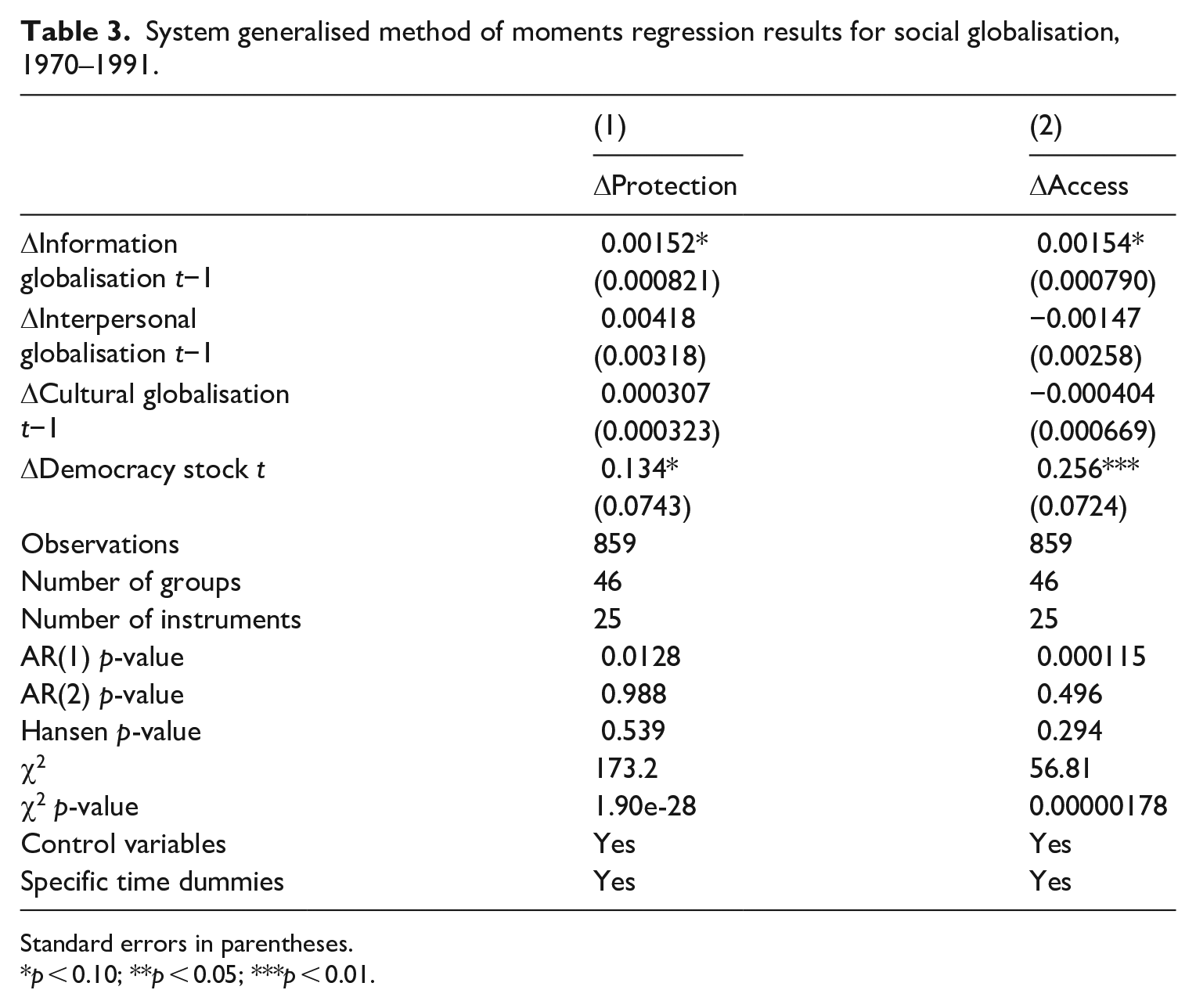
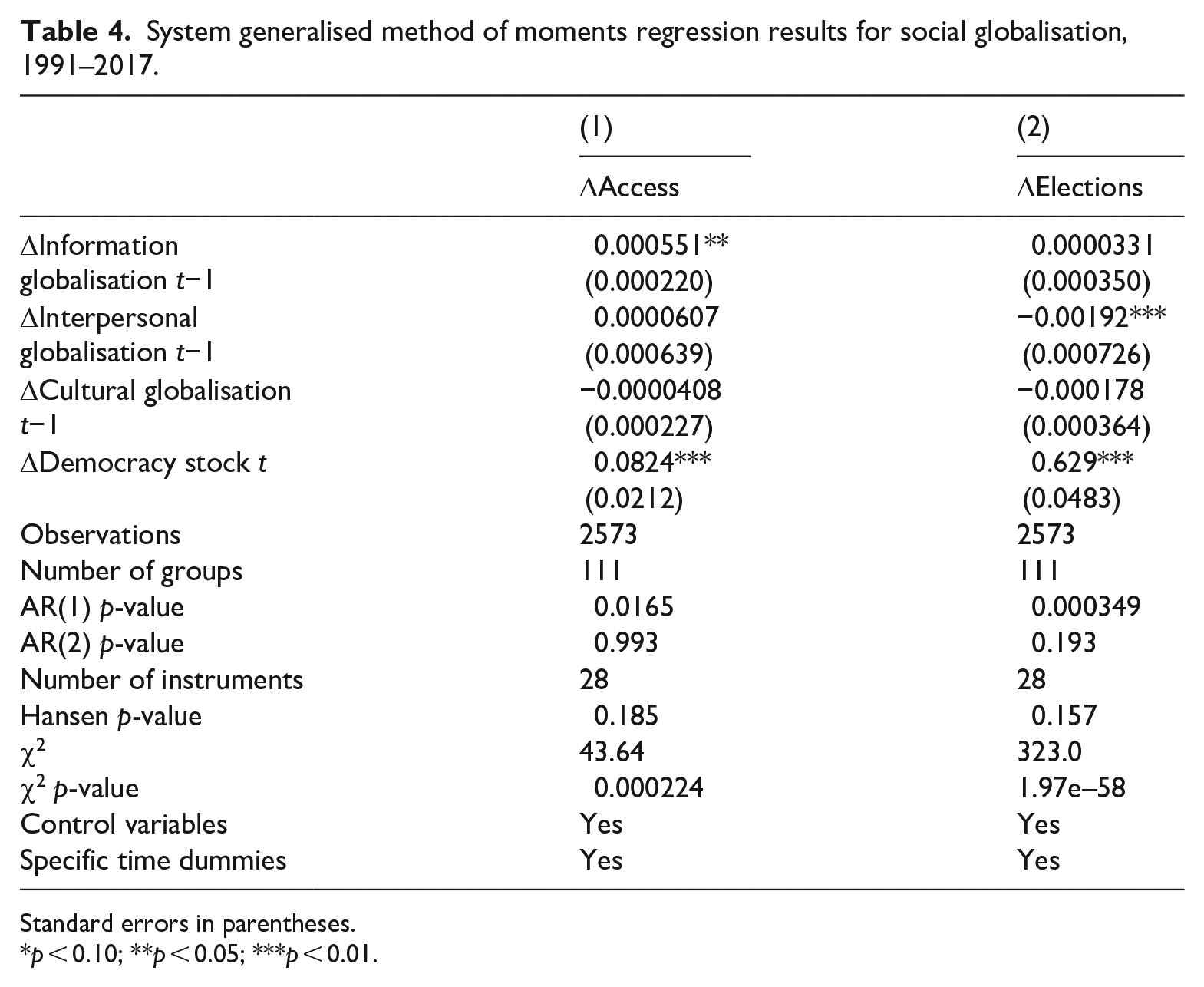
The results from Model 1 are presented in Tables 3 and 4.
System generalised method of moments regression results for social globalisation, 1970–1991.
Standard errors in parentheses.
p < 0.10; **p < 0.05; ***p < 0.01.
System generalised method of moments regression results for social globalisation, 1991–2017.
Standard errors in parentheses.
p < 0.10; **p < 0.05; ***p < 0.01.
Table 3 shows that information globalisation had significant effects on equal protection and equal access in the Cold War. The results for the post–Cold War (Table 4) period suggest that information globalisation also had a positive effect on equal access in the post–Cold War period, while interpersonal globalisation had a negative on the freedom and fairness of elections. The declining quality of elections over the past years has been reported in the 2019 annual V-Dem report. 11
Tables 5 to 9 summarise the results for Model 2. Figures 2 to 6 depict the results with the interaction terms. Statistically significant interaction terms in the regressions are illustrated in a graph as slopes of the dependent variable on the independent variable when the moderator variable, here democracy stock, is held constant at different combinations of values from very low to very high. This approach has also been utilised in Ben-Nun Bloom et al. (2017).
System generalised method of moments results for information globalisation and democracy stock interaction terms, 1970–1991.

Standard errors in parentheses.
p < 0.10; **p < 0.05; ***p < 0.01.
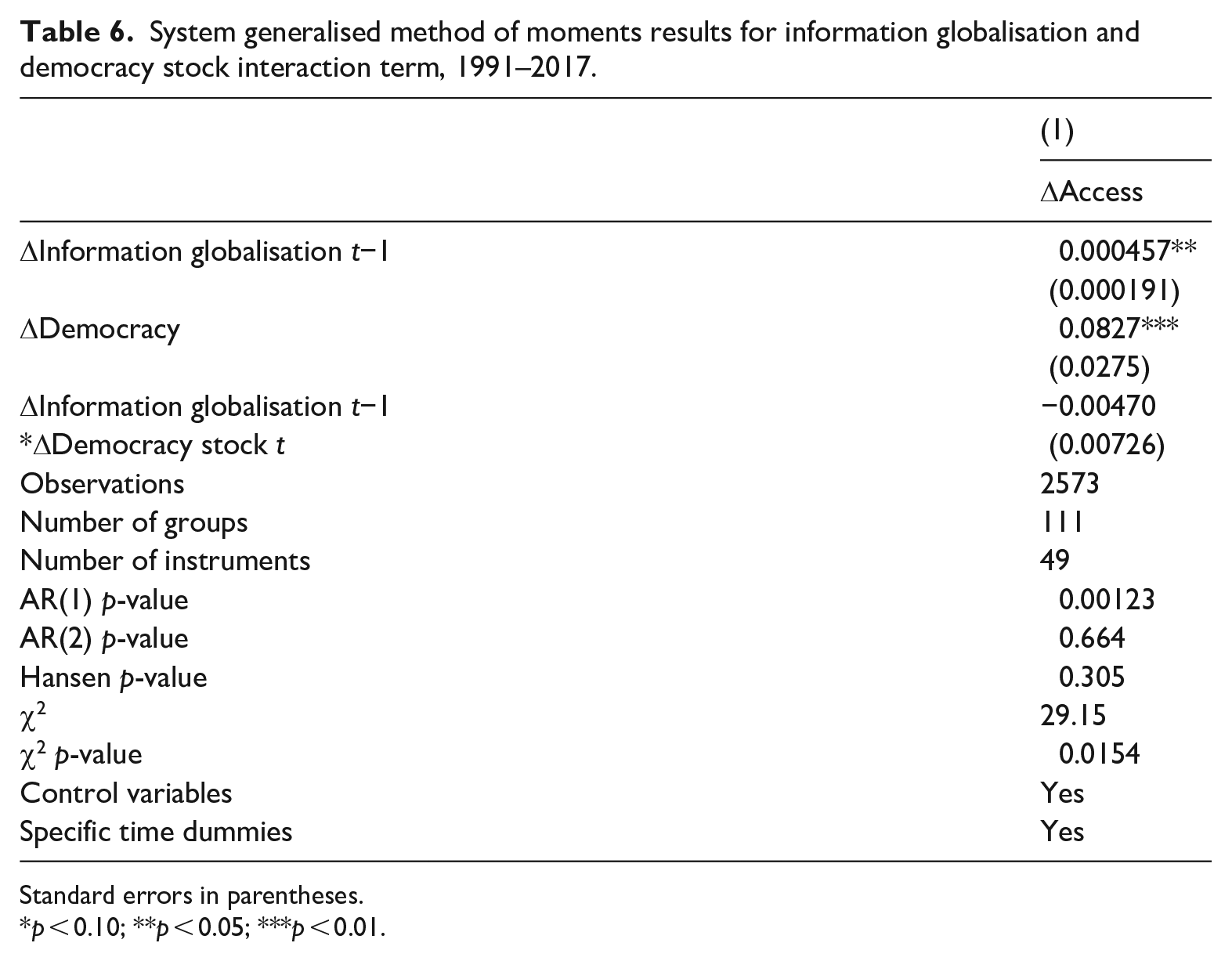
System generalised method of moments results for information globalisation and democracy stock interaction term, 1991–2017.
Standard errors in parentheses.
p < 0.10; **p < 0.05; ***p < 0.01.
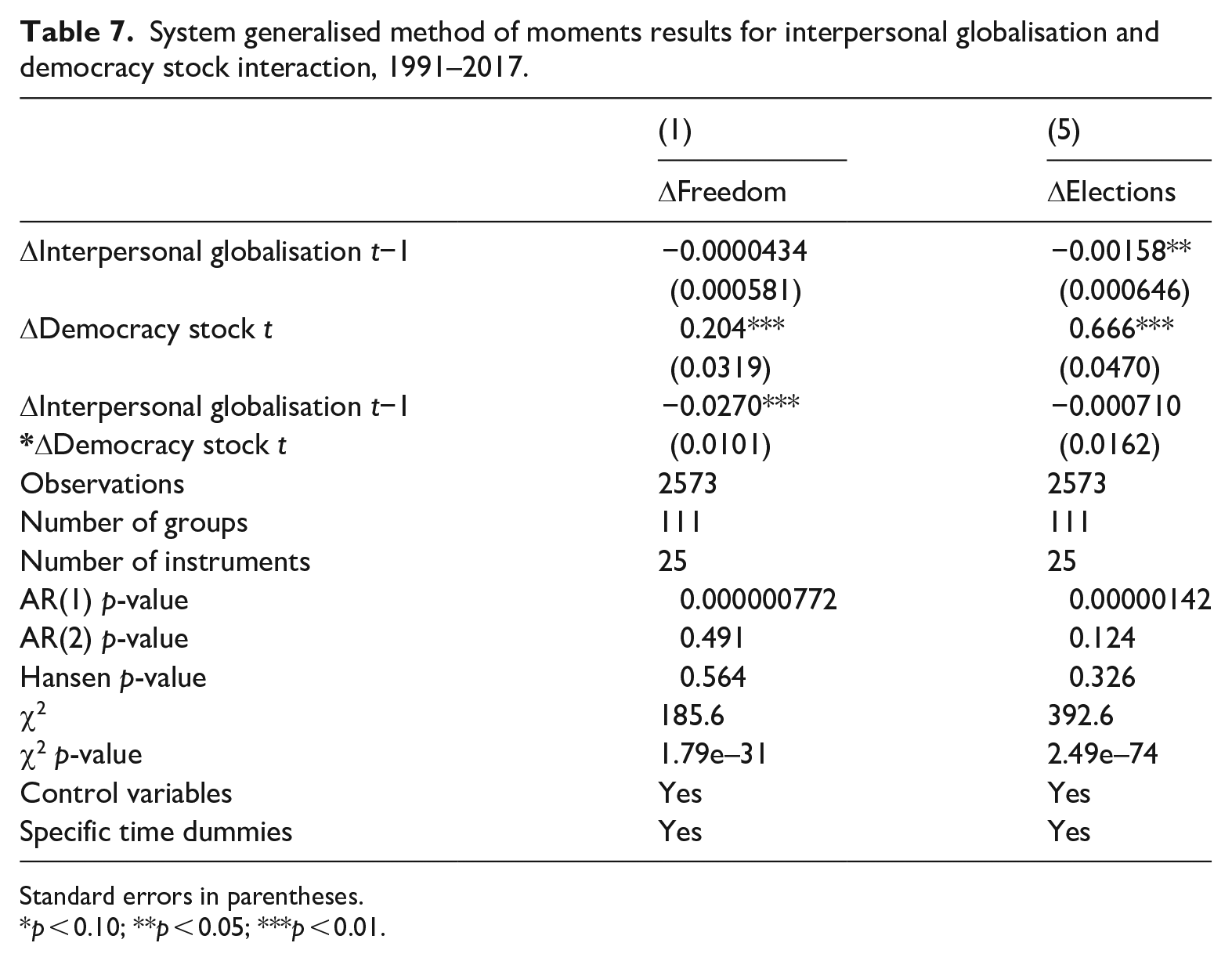
System generalised method of moments results for interpersonal globalisation and democracy stock interaction, 1991–2017.
Standard errors in parentheses.
p < 0.10; **p < 0.05; ***p < 0.01.
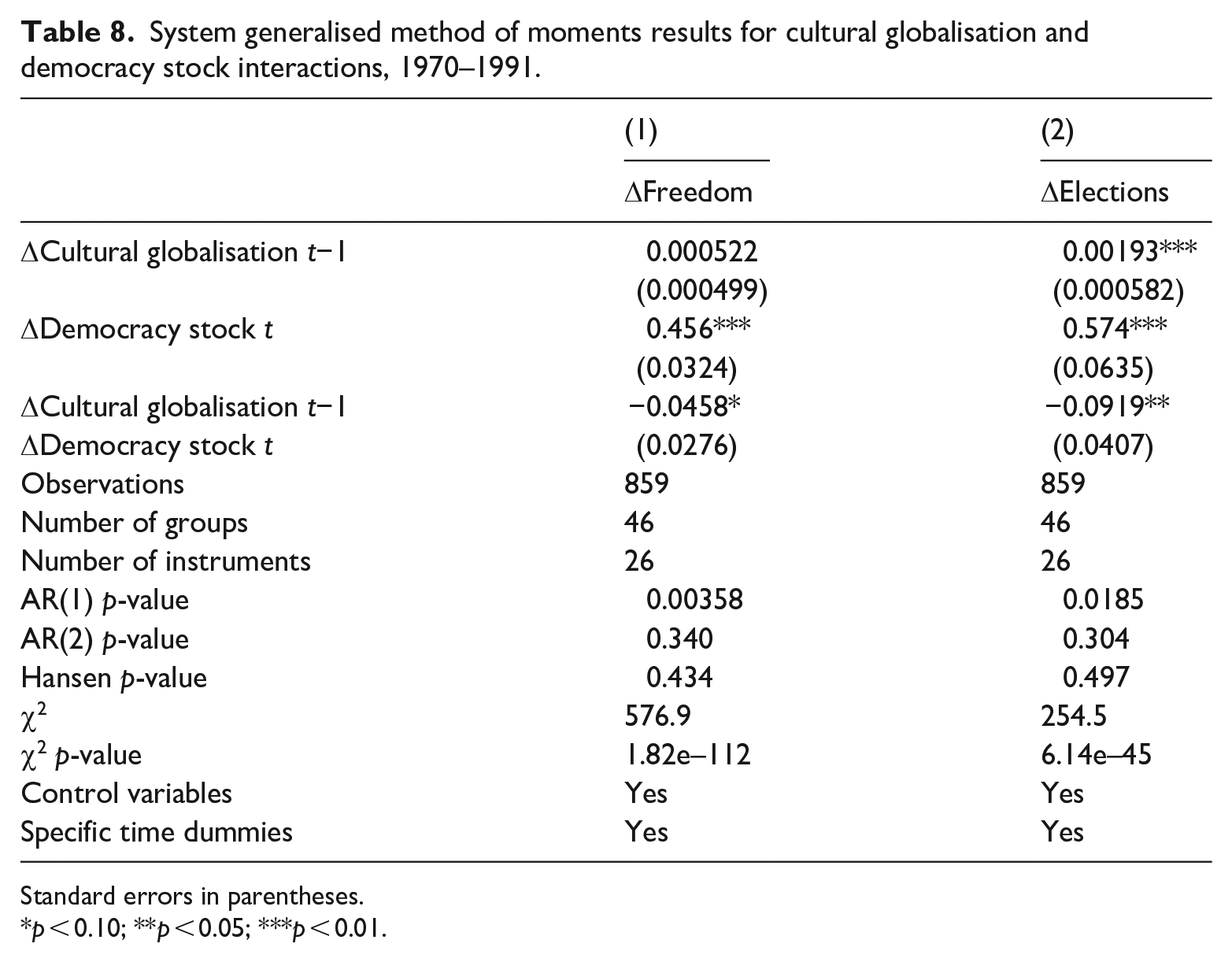
System generalised method of moments results for cultural globalisation and democracy stock interactions, 1970–1991.
Standard errors in parentheses.
p < 0.10; **p < 0.05; ***p < 0.01.
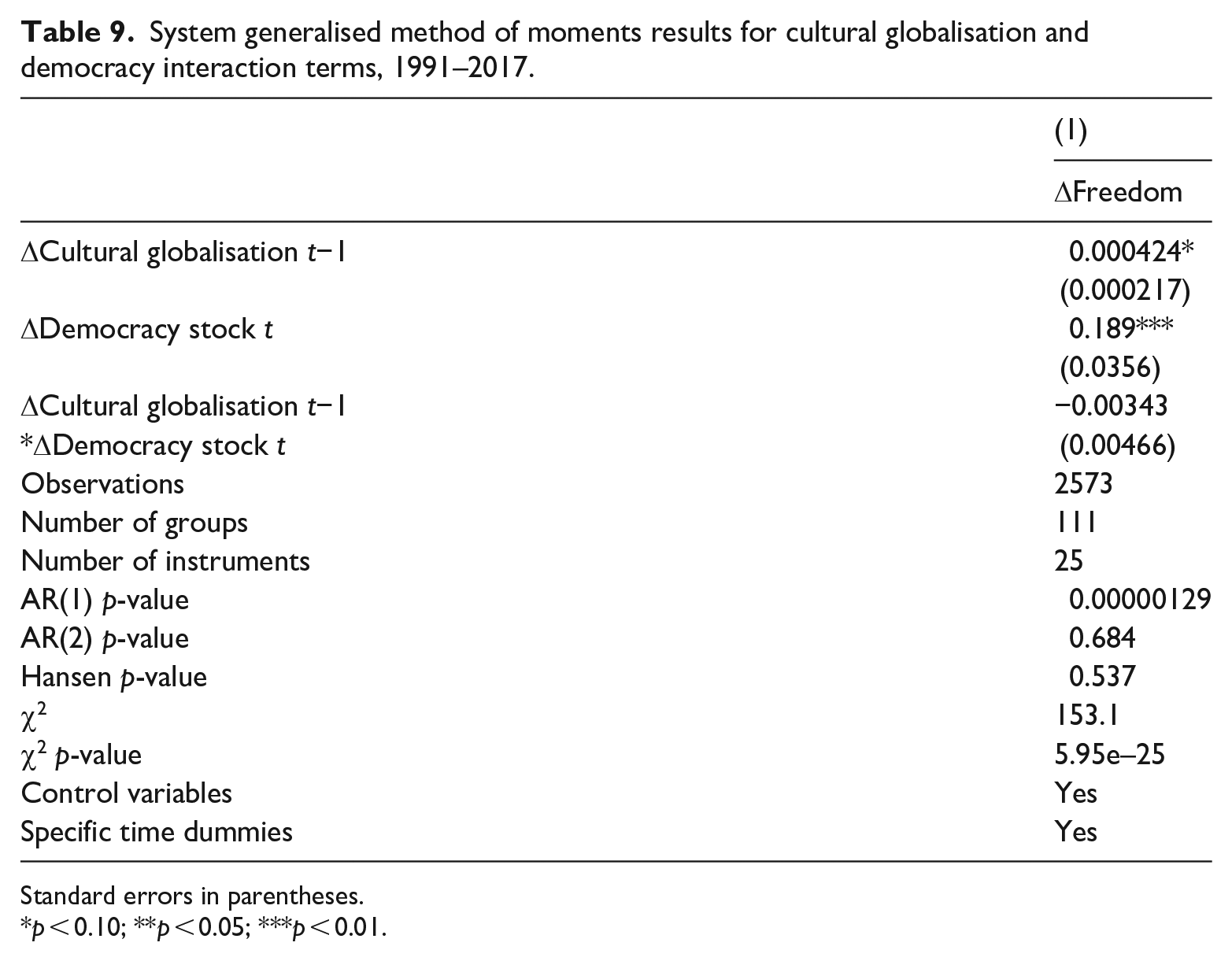
System generalised method of moments results for cultural globalisation and democracy interaction terms, 1991–2017.
Standard errors in parentheses.
p < 0.10; **p < 0.05; ***p < 0.01.
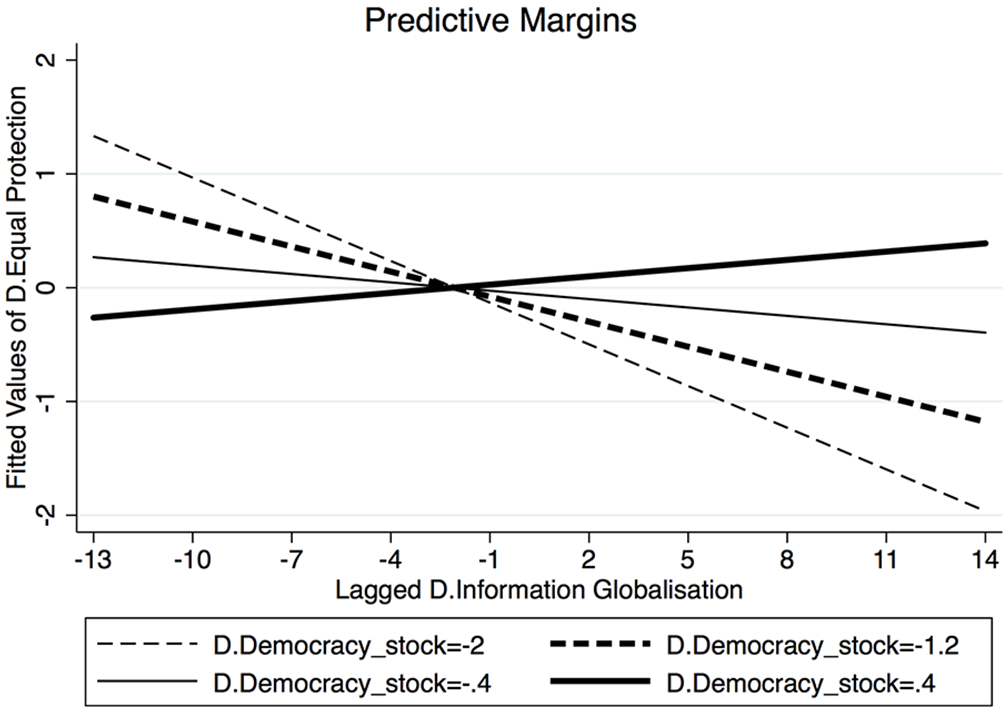
Information globalisation and equal protection by democracy stock, 1970–1991.
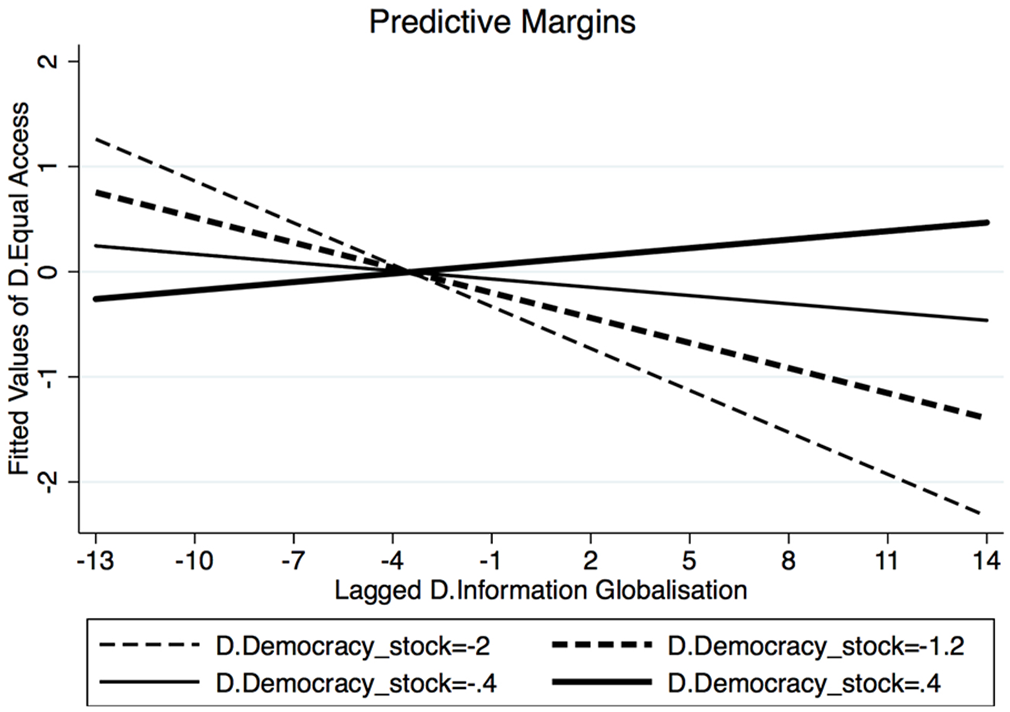
Information globalisation and equal access by democracy stock, 1970–1991.
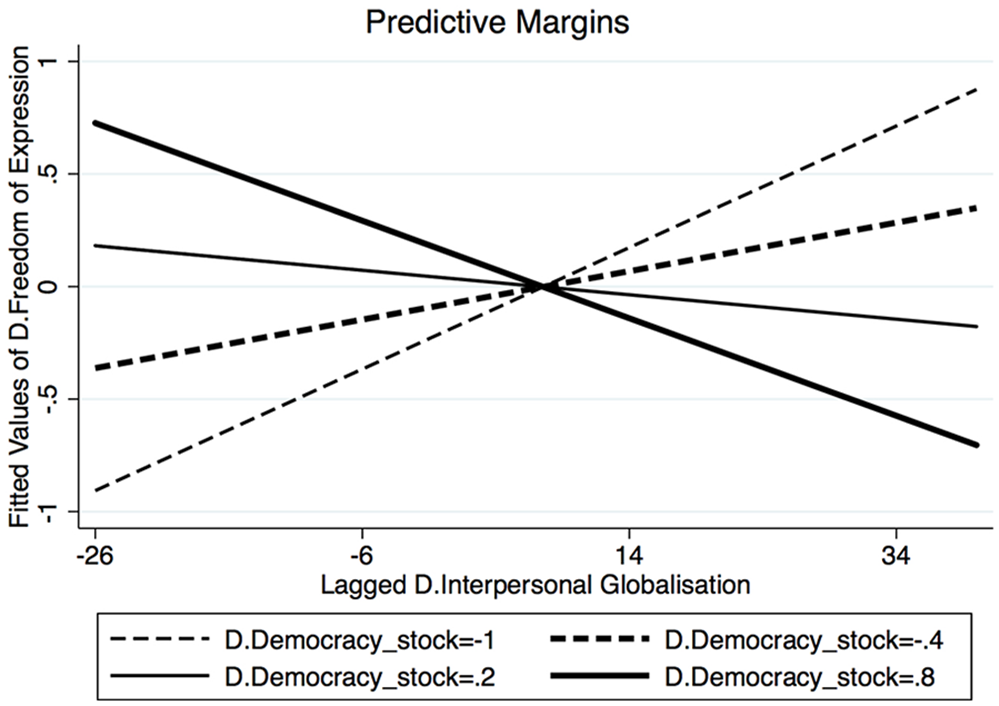
Interpersonal globalisation and freedom of expression by democracy stock, 1991–2017.
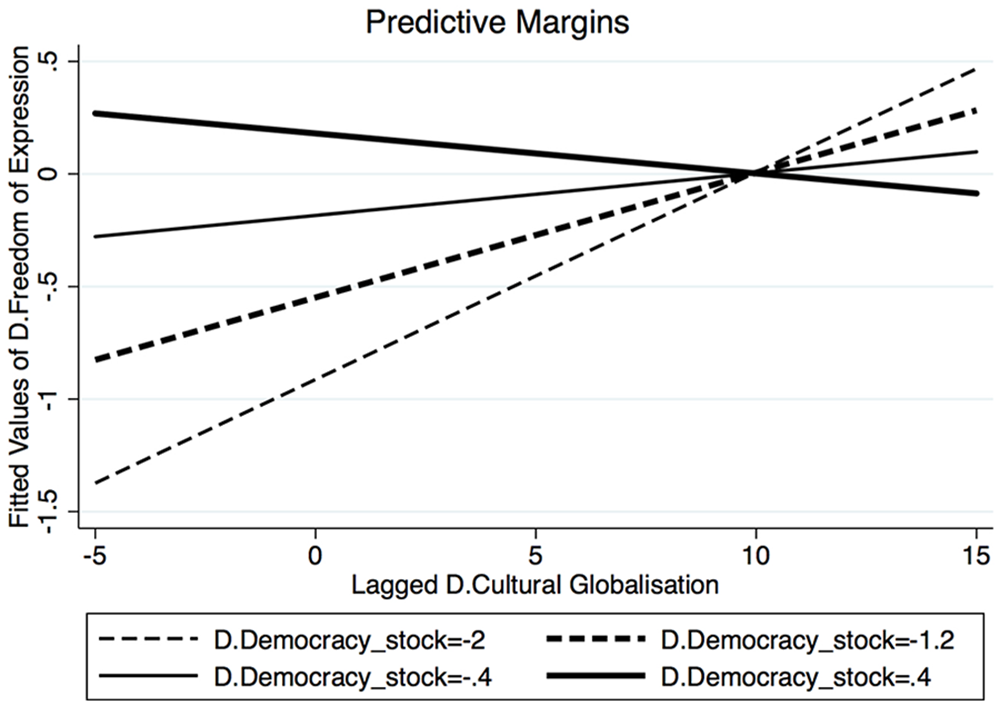
Cultural globalisation and freedom of expression by democracy stock, 1970–1991.
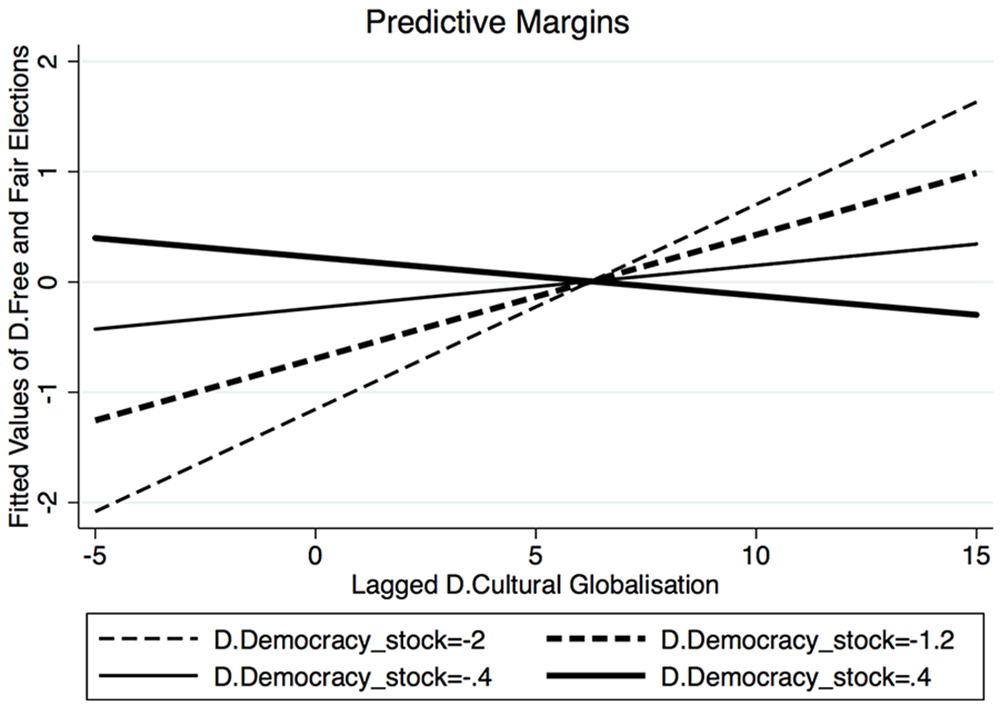
Cultural globalisation and free and fair elections by democracy stock, 1970–1991.
As Table 5 shows, in accordance with the oppression effect, information globalisation had a positive effect on equal protection of rights and liberties across different social groups and equal access to power in countries with high democracy stocks during the Cold War period, confirming H4. For countries with a lower and moderate democracy stock, the enhanced flow of information did not automatically contribute to an increase in equal access, quite the contrary. This can be explained in a number of ways. On the one hand, a possible explanation might be that governments with lower democracy stocks tend to use new information technologies to control or manipulate citizens and diminish their ability to actively participate in political life. On the other hand – at the societal level – the lack of socio-economic modernisation may create barriers to access information (Norris and Inglehart, 2009) or inequalities in terms of equal access to power. Norris and Inglehart (2009) find on an individual level that there is a clear skew towards educated and affluent segments of societies, which benefit from information globalisation more than the society at large. Countries with higher democracy stocks tend to have more equal structures. Thus, the society at large may rather benefit from information globalisation more than younger democracies. These differences are illustrated in Figures 2 and 3. Another result is observed in regard to the effect of information globalisation and the quality of elections. The quality of elections was positively impacted by the increase of global information flows, independently from the democracy stock of the democracy. Thus, the argument on the oppression effect in the Cold War period mainly holds when it comes to the protection of rights and liberties across different social groups and the equal access to power.
Table 6 presents the results for the second dataset. The results suggest the same effect as shown in the estimations of Model 1 summarised in Table 4, indicating a positive relationship between global information flows and equal access. This effect seems to be unaffected by the democracy stock in the post–Cold War period.
The results of the first dataset for interpersonal globalisation are omitted due to a lack of statistically significant coefficients. That interpersonal globalisation is relevant in the post–Cold War period is in accordance with H3. The results for the second dataset are presented in Table 7.
In regard to the quality of elections, the estimations of Model 1 (see Table 4) correspond to the estimations of Model 2 and suggest that interpersonal globalisation negatively affects the quality of elections. A possible explanation for this provides the argument that increased levels of interpersonal globalisation make the cultural dimension of socio-economic conflicts more salient. Inglehart and Norris (2016) suggest that cultural anxieties such as the perceived threat of growing multiculturalism, or changes in the loss of status, privilege or power can motivate voters to support authoritarian populists who disrespect democratic principles. Norris (2017) argues that populism is likely to damage trust in democratic institutions and confidence in the fairness of elections. The results show that this applies to both younger and older democracies in the post–Cold War period. Furthermore, populists often violate international standards of electoral integrity and increase the potential for collusion with foreign governments.
Furthermore, there is, as seen in Figure 4, a statistically significant cross-over interaction between interpersonal globalisation and the freedom of expression. This means that the direction of the effect depends on the democracy stock. There is a positive relationship between interpersonal globalisation and freedom of expression when the democracy stock is rather small.
This confirms H3, and thus the democratic catch-up effect which postulates that augmented interpersonal contacts may diffuse democratic values and generate more demand for democratic freedom. Democracies with moderate and higher democracy stock changes instead see their status quo challenged by increased interpersonal globalisation. Increased levels of interpersonal contacts through opening borders and the loss of control over criminals and terrorists negatively affected democratic freedoms in democracies with higher and moderate democracy stocks. In some cases, the increase of interpersonal globalisation resulted in anti-immigration sentiments (Kriesi, 2013). The decrease in freedom of expression means lower levels of government respect for press and media freedom, as well as academic and cultural expression. The Democracy Index 2019 report by the Economist Intelligence Unit registers a trend of democratic regression with respect to different aspects, since the 1990s onwards, which accelerated in the 2000s, with its peak of the decade lasting until 2019. A regression is also manifested with regard to democratic freedoms in the more advanced democracies of the United States and Europe, and also in countries in Asia, Eastern Europe and Latin America that have higher and moderate democracy stocks. 12
The results summarised in Table 8 on cultural globalisation and its effects on the quality of democracy during the Cold War period provide evidence for a democratic catch-up effect, for democracies with both lower and moderate democracy stocks. Younger democracies thus benefited from an increase of cultural globalisation with regard to freedom of expression and free and fair elections (see Figures 5 and 6), confirming H3. The effect was negative for democracies with higher democracy stocks. For the post–Cold War period (see Table 9), I find a positive effect on the freedom of expression, in democracies with both lower and higher democracy stocks, however only on a 10% significance level.
Conclusion
The results underline the importance of including international dimensions beyond trade – and more general economic globalisation – to understand changes in the various aspects of democracy.
The strong significance of the democracy stock in many estimations suggests that the development of democratic institutions is a slow process. Nevertheless, that the coefficients of social globalisation were statistically significant in many estimations points to the relevance of looking at different aspects of globalisation. Just because globalisation and democracy are contested concepts and their definitions vary, the empirical literature should not rely on the assumption that all globalisation and democracy dimensions go hand in hand. To advance knowledge in this field, it is necessary to look deeper and improve the operationalisations of both concepts. It becomes necessary to base arguments on the relationship between globalisation and democracy on more precise empirical evidence, especially in cross-country studies.
Second, the results provide evidence of an effect of different dimensions of social globalisation on various aspects of democracy. The multidimensional definition of democratic quality reveals that not all aspects of democracy are affected by globalisation. The main aspects that are affected by social globalisation are freedom of expression and access to alternative information, equal access and protection, and the quality of elections.
Third, the moderating effect of the democracy stock has been confirmed across various estimations. While in some cases older democracies benefit from globalisation in regard to certain aspects of democracy, in other cases, younger democracies were the main beneficiaries of increased globalisation. The post-Cold War results, however, suggest similar benefits of increased global information flows for both younger and older democracies, while similar challenges are triggered by interpersonal globalisation with regards to the quality of elections.
The results provide justifications for future work to pay greater attention to the domestic differences between democracies. Given the relevance of the democracy stock in this article, prospective empirical work should focus on other domestic factors that may moderate the relationship between globalisation and the quality of democracy.
Footnotes
Acknowledgements
The author sincerely thanks the referees, the reviewers and the editor for their valuable comments and feedback, which significantly improved the manuscript. She thanks Adriana Schor at University São Paulo (USP), Anthony Pereira at King’s College London (KCL) and Marc Berenson (KCL) for their constructive comments. Earlier versions of this paper have been presented at the International Association for Political Science Students (IAPSS) World Congress in Paris (2018), at Midwest Political Science Association (MPSA) and the European Consortium for Political Research (ECPR) Conferences. She is also grateful for the CAPES (Coordination for the Improvement of Higher Education Personnel) PhD scholarship from the Brazilian Ministry of Education.
Declaration of conflicting interests
The author(s) declared no potential conflicts of interest with respect to the research, authorship and/or publication of this article.
Funding
The author(s) received support from the CAPES (Coordination for the Improvement of Higher Education Personnel) Foundation of the Brazilian Ministry of Education.
