




Abstract
Women are more undecided than men about their vote choice, with around 20%–30% of female respondents giving a ‘don’t know’ response to vote intention survey questions in Britain. In this article, we employ a mixed methods research design to explore why women are more likely to be undecided about their vote choice than men. Using survey data, we find that the gender gap in ‘don’t know’ responses is associated with gender gaps in political engagement and perceptions of policy representation. In focus groups, we find differences between men and women in how they want to be represented, and gender differences in conflict-avoidance/conflict-seeking, both of which we expect to contribute to gender differences in making a vote choice in-between elections. Our findings contribute to our understanding of how men and women engage with politics in Britain, as well as having implications for interpreting gender differences in vote intention in surveys.
Keywords
Introduction
Women are more likely to be undecided about their vote choice in-between elections than men, despite eventually turning out to vote in similar numbers (Campbell and Childs, 2015; Carreras, 2018). Women’s greater propensity to be ‘floating voters’ is consistently identified in British polling (Campbell and Shorrocks, 2021), and has been noted in other contexts such as the United States, 1 Australia, 2 Canada, 3 Italy, 4 and Spain, 5 suggesting it is a phenomenon across post-industrial democracies. However, we know very little about, first, why women are more likely to be undecided than men, and second, what this means for gendered processes of political engagement and decision-making. In this article, we address this lacuna by analysing how and why women and men differ in how undecided they are about their vote choice in-between elections in Britain.
This is important for three reasons. First, the media, politicians, political parties, and ultimately the public need accurate between-election information on party political support. This is undermined if some sections of the electorate are systematically more undecided than others, especially if this group is then removed from headline vote intention figures, as is often standard practice. Second, and relatedly, if women are more undecided in political polling but this is being used by politicians and parties to inform political strategy, women’s preferences will be less well-understood, and hence, less well-represented, than men’s. Again, this is especially the case if undecideds are removed from headline vote intention figures. Finally, examining gendered differences in between-election political decision-making can help us to understand gendered patterns of political engagement in general. Are gender differences in the propensity to be undecided rooted in differences between men and women in how they relate to party and electoral politics at the national level, and what does this mean for reducing gender gaps in political engagement more generally?
We use a mixed-method approach combining survey data from the British Election Study Internet Panels (Fieldhouse et al., 2022) and focus groups of men and women conducted in June 2022. Our analysis of the survey data highlights that the gender gap in undecideds varies according to political context, narrowing when an election is closer but widening when an election is in the relatively distant future. We argue this suggests that women’s greater likelihood of saying they do not know who they will vote for is not solely rooted in gendered patterns of survey response (e.g. Atkeson and Rapoport, 2003), but instead reflects at least partly a genuine difference between men and women in how certain they are about their future vote. We find that the gender gap in undecided voters is greater for younger age groups, and is associated with gender gaps in political engagement as well as in differences between men and women in perceptions about the extent to which their policy priorities are represented. This suggests women are more likely to say they are unsure who to vote for because they are less knowledgeable about and interested in national-level, partisan, electoral politics, and because they are less likely to think that any party represents their policy priorities well.
The focus group analysis then allows us to dig further into these findings and to unearth additional possible mechanisms. Building on the quantitative finding that women feel less well-represented in their policy priorities by British political parties, our focus group analysis revealed gender differences in how men and women want to be represented. Men participants spoke of specific policies and ‘policies with impact’, while women participants often emphasised the importance of their political representatives having relevant lived experience or trying to relate to others. In addition, we also found differences in the ways women and men discuss politics. We find that women participants displayed elements of ‘conflict-avoidance’ (Coffé and Bolzendahl, 2017) when discussing political issues, which appeared to lead to their lower levels of engagement with partisan politics. At the same time, men participants tended to display ‘conflict-seeking’ behaviour (Wolak, 2020a), often leading to higher political engagement within the focus group context itself. These gender differences were evident in the interactions between our focus group participants, allowing us to examine how conflict-seeking and conflict-avoidant behaviours unfolded through interactions in ‘real time’, highlighting the value of focus groups as a research method. This suggests an additional mechanism by which women are less engaged with competitive electoral politics in-between elections, leading them to express more uncertainty when asked for their vote intention.
Our findings highlight that the gender gap in ‘don’t know’ responses to vote intention questions in election surveys and political polling is linked to differences between men and women in how they relate to competitive, partisan politics at the national level. Any analysis of gender gaps in vote intention should bear this in mind. It also suggests that parties have work to do to engage women in-between elections, who feel less well-represented by political parties than men and who have different opinions on what ‘good’ representation looks like. Moreover, given the differences we find in willingness to enter into political conflict or even discussion between men and women, attention should be given within the political sphere more broadly to how political debate can be made less conflictual while still ensuring a wide range of views are heard.
The remainder of the article is structured as follows: we first review the literature on gender and political engagement, generating hypotheses that we subsequently test in our data analysis. We then describe the quantitative data – the British Election Study Internet Panel – and present our findings from the quantitative analysis. We then describe the focus groups and how we collected and analysed these data, before elaborating on our findings from this stage. Finally, we reflect on our quantitative and qualitative findings as a whole, drawing out implications for gender and political engagement, the interpretation of gender gaps in political polling, and the value of mixed methods approaches for understanding gendered political processes.
Theoretical background and expectations
Gender gaps in political engagement, such as knowledge, interest, efficacy, and attention (e.g. Quaranta and Dotti Sani, 2018; Verba et al., 1997; Wolak, 2020b) are well-established. Men have higher levels of national-level, institutional, and ‘traditional’ political knowledge than women (Miller, 2019; Stolle and Gidengil, 2010), while women have higher levels of ‘practical’ or ‘gender-relevant’ political knowledge, such as how to access particular services or how many women are represented in the legislature, than men (Barabas et al., 2014; Dolan, 2011; Dolan and Hansen, 2020; Stolle and Gidengil, 2010; Verba et al., 1997). When it comes to more ‘traditional’ political knowledge, men’s greater ‘knowledge’ can be partially attributed to their greater propensity to guess on knowledge questions and women’s greater willingness to give a don’t know answer (Fortin-Rittberger, 2019; Lizotte and Sidman, 2009; Mondak and Anderson, 2004; Pereira, 2019), but men are still also more likely to give correct answers compared to women (Fraile, 2014). Similarly, women have been found to be less interested in national-level politics (Coffé, 2013; Sánchez-Vítores, 2019; Verba et al., 1997), partisan politics (Campbell and Winters, 2008), and political actors, institutions, and distributional conflicts (Ferrín et al., 2020), compared to men. The same studies find conversely that women are more interested than men in local politics, gender issues, and social policy, which are also the areas where women have higher levels of political knowledge.
Women’s lower knowledge of or interest in national-level, institutional, and partisan politics is not consistently associated with differences in socioeconomic status and/or resources between men and women (e.g. Coffé, 2013; Fraile, 2014; Frazer and Macdonald, 2003; Verba et al., 1997; Wolak and McDevitt, 2011). One exception to this is the finding that parenting children reduces self-assessed political knowledge, political interest, and political activity among women (Gidengil et al., 2008; Quaranta and Dotti Sani, 2018), reflecting the time constraints faced by women with caring responsibilities. Largely, however, scholars point to gendered socialisation experiences to explain the gender gap in political engagement, especially at younger ages as gender gaps in political interest tend to be present during adolescence and reasonably stable across the life-span (Fraile and Sánchez-Vítores, 2020; Prior, 2010). Scholars here emphasise the social construction of gender and gender-role expectations, which lead to normative and practical beliefs about appropriate behaviours for men and women (Wood and Eagly, 2012). Of particular relevance is the association of men with agentic traits and women with communal traits, which then condition gendered differences in (political) behaviour (Eagly and Karau, 2002). Consequently, women have been found to have lower levels of self-confidence which is then related to their levels of political knowledge, interest, and belief in their ability to influence politics (Coffé, 2013; Wolak, 2020b). At the same time, the competitive elements of politics are found to be more conducive to (young) men’s learning about politics than (young) women’s, with women’s political knowledge actually decreasing in the United States if they live in areas with higher levels of partisan heterogeneity (Wolak and McDevitt, 2011). Other studies similarly find that gender differences in the enjoyment or avoidance of conflict can help explain gender gaps in political participation broadly defined (Coffé and Bolzendahl, 2017; Wolak, 2020a).
In addition, the impact of the absence of women in national-level politics has been highlighted as a reason for why women’s political engagement may be lower in some areas than men’s. Where women’s descriptive legislative or executive representation is higher, women’s political interest, knowledge, and participation increases (Atkeson, 2003; Barnes and Burchard, 2013; Dassonneville and McAllister, 2018; Liu and Banaszak, 2017; McAllister, 2019; Wolak and McDevitt, 2011; Wolbrecht and Campbell, 2007), suggesting a ‘role-model’ effect where seeing women participate in formal, national, competitive politics increases women’s engagement with these forms of politics. Conversely, where women’s formal representation is lower, women’s broader political engagement may be depressed.
The scholarly consensus is, therefore, that men and women on average engage with different aspects of politics and have gender-specific political interests and knowledge. Men have a higher propensity than women to be engaged in political issues and topics that are most relevant to national-level, competitive, partisan elections, which may help us to understand the gender gap in undecided voters. Women may be less likely than men to give a party preference in-between elections because they are less engaged with this form of politics overall. This relative lack of engagement likely means women spend less time following national-level or partisan political issues and debates, discuss them less with others, and hence, know less about them. As a result, they are then more undecided or unsure about who they would ultimately support at election time. This leads to our first hypothesis to be tested in the quantitative analysis:
H1 (political engagement hypothesis). Women’s greater likelihood to say they are undecided about who to vote for compared to men is associated with gender differences in political knowledge, interest, and efficacy.
A second, related, explanation for the gender gap in undecideds is gender differences in party identity. Women are less likely to have a party identification, and are less likely to strongly identify with a party, compared to men (Quaranta and Dotti Sani, 2018; Wolak and McDevitt, 2011). Few studies explore the reasons for this gender gap directly, but it tends to be seen as part of women’s overall lower levels of engagement with national, partisan politics, rooted as described earlier in childcare responsibilities, gendered socialisation, and a lack of descriptive representation. This suggests that women are more likely to say they are undecided because they are less likely to have a stable party identity to look to when asked a question about their future vote choice, leading to our second hypothesis:
H2 (party identity hypothesis). Women’s greater likelihood of saying they are undecided about who to vote for compared to men is associated with gender differences in holding a party identity.
The final explanation for the gender gap in undecided voters is that women do know enough and are sufficiently interested in electoral, partisan politics to know about the options and choose between them, but feel more poorly represented by the options available to them relative to men. Some have found that women’s policy priorities – even on non-gendered issues – are less likely to be substantively represented by politicians. Reher (2018), for example, finds that when men and women differ in their average preferences, public policy is more representative of men’s preferences than women’s. Similarly, Homola (2019) found that parties in Europe are more responsive to shifts in men’s preferences than women’s. However, others find that parties are just as responsive to women as men (Ferland, 2020), or even that women’s average preferences are more accurately represented because of women’s high turnout levels at elections (Dingler et al., 2019). More broadly, however, gender-equality issues are rarely high on the political agenda in the British context (Campbell, 2016; Campbell and Childs, 2010), suggesting that at least some women may feel under-represented on the basis of their gender. Moreover, women’s descriptive under-representation in political institutions may lead some women voters to conclude that their perspectives are under-represented. This suggests our final explanation: women voters are more likely than male voters to feel that none of the party options adequately represent their priorities, and this translates into more uncertainty about who to vote for in a future election.
H3 (representation hypothesis). Women’s greater likelihood of saying they are undecided about who to vote for compared to men is associated with gender differences in perceptions about how well the party options represent their policy priorities.
Testing the hypotheses: Vote intention analysis
We first take a quantitative approach to testing our hypotheses, using data from the British Election Study Internet Panels (Fieldhouse et al., 2022). The key measure we are interested in is the proportion of voters who answered ‘don’t know’ to the hypothetical vote choice question: If there were a UK General Election tomorrow, which party would you vote for? 6 Figure 1 below shows the proportion of men and women giving this response across all British Election Study Internet Panel waves, excluding the immediate post-election waves where the hypothetical vote intention question is replaced with a retrospective vote choice question about the preceding election. The number of respondents answering ‘don’t know’ fluctuates over time, with the highest number of respondents giving this answer away from general elections and during periods of high political uncertainty, for example, in the aftermath of the Brexit referendum in June to July 2016, and in mid-2019 prior to the European elections of that year. It is also of note that the gender gap in ‘don’t know’ response varies over time, from the lowest gap of 3.9 points in March to May 2015 to the largest gap of 10 points in March 2019. The gender gap is largest when the proportion of don’t know responses is high, and smallest during the campaign periods prior to general elections, for example, March to May 2015 and May to June 2017.
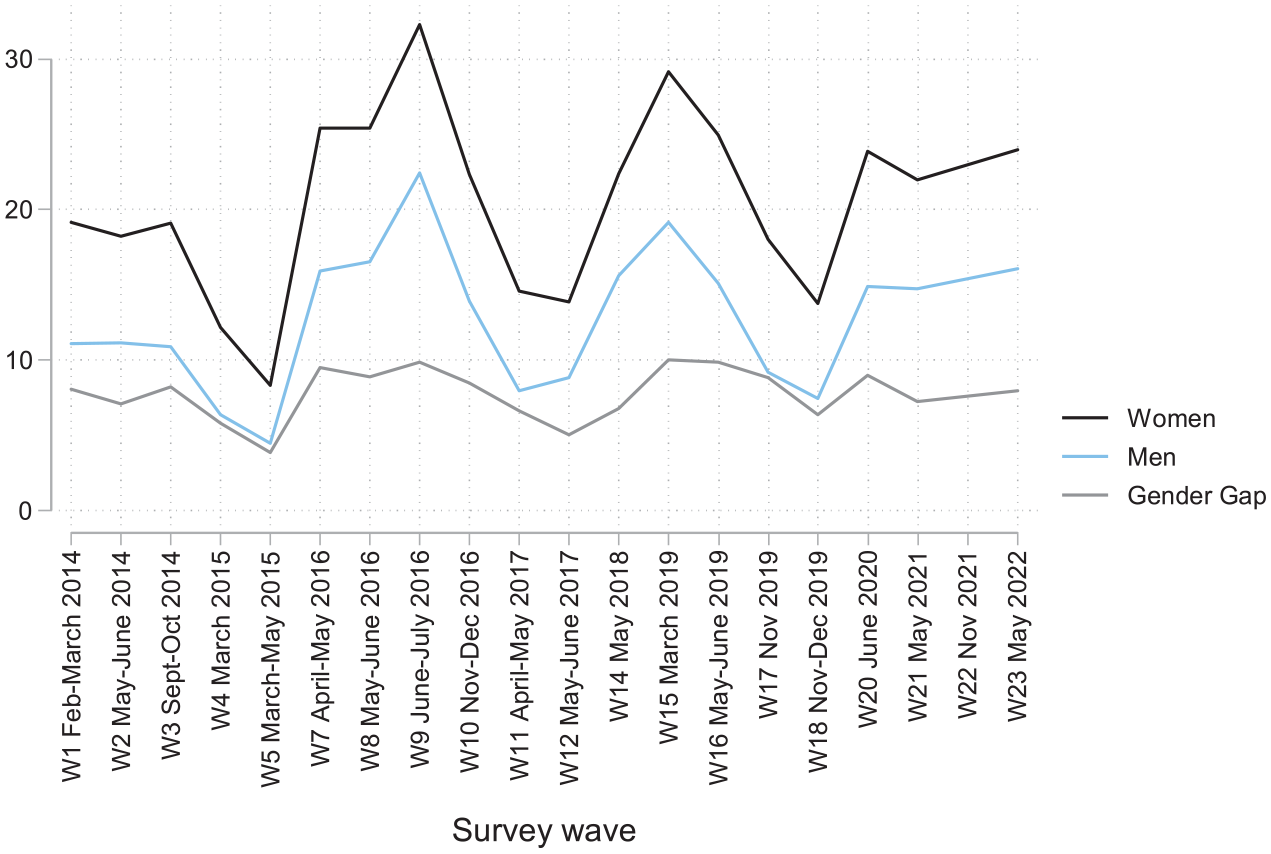
Proportion of respondents giving a ‘don’t know’ response by British election study survey wave, by gender (weighted).
Similarly, we also found, using BESIP wave 18 (campaign wave), that the gender gap in don’t know response declined steadily from 10 percentage points at the start of the 2019 General Election short campaign in November 2019 to less than 1 percentage point the day before the election. This suggests that while women are more likely to give ‘don’t know’ responses on political surveys, in general (Atkeson and Rapoport, 2003), the gender gap in undecided voters is unlikely to be solely a result of such gendered patterns of survey response because of the extent to which the gender difference here varies over time, suggesting ‘don’t know’ is likely to be a meaningful response that responds in logical ways to the political context, that is, increased political information during campaigns. Our observations here are also consistent with those who find that political campaigns can reduce the gender gap in political knowledge by increasing the correct answers given by women (Ondercin et al., 2011).
We test our hypotheses using data from Wave 17, conducted in November 2019, after the 2019 General Election had been called but before the short campaign began. We chose this wave of the British Election Study because it contains variables measuring all the concepts that we are interested in – such as political interest, knowledge, and efficacy, party identification, and how well parties represent voters’ policy priorities. While other waves do include some of these questions, W17 is the only wave to include all of them. Although the gender gap in undecideds varies over time as described earlier, we do not expect the factors we hypothesise to be associated with the gender gap to vary in their effects over time, nor can we test this due to a lack of overlap in the political engagement questions and inconsistencies in their measurement across waves. W17 also has a gender gap in ‘don’t know’ response close to the average for all waves: the gender gap in wave 17 is 8.8 points, compared to an average of 7.8 across all waves. Importantly, the gender gap for our analytic sample – that is, a sample largely excluding those who expressed a ‘don’t know’ response on our key independent variables (with a couple of exceptions described below) – is 7.2 points. This means even among men and women who provide complete responses on a range of political questions, women are more undecided in their vote choice than men. We take this as further evidence that this is a meaningful difference, rather than solely a feature of how men and women answer survey questions.
Our key independent variable is gender, a binary variable for being a man or a woman. We interact this with age and age squared because of evidence suggesting that gender gaps in political engagement may vary by age in a non-linear way (Campbell and Winters, 2008; Fraile, 2014; Fraile and Sánchez-Vítores, 2020). 7 We then run a series of logistic regression models (all analysis uses the weights provided by the BESIP). In the first model, we include sociodemographic characteristics – education, marital status, employment status, social grade, and whether there are children in the household. In the second model, we test H1 by including measures of political engagement: political interest, political knowledge, political efficacy, attention paid to politics, and political discussion. ‘Don’t know’ responses are excluded from all of these variables with the exception of political knowledge, where correct responses score 1, incorrect score 0, and don’t know responses score 0.5 to account for the fact that men are more likely to guess than women and this can inflate gender differences in political knowledge. 8 Although this does lead to the removal of more women than men respondents from the sample, as noted earlier, we still see a gender gap in ‘don’t know’ responses to the vote intention question in our analytical sample with the ‘don’t know’ responses on these questions removed. We take this to mean that even for those men and women (the vast majority of respondents) who are able to answer all the political engagement questions, women are still more undecided in their vote choice than men. In the third model, we test H2 by including a measure of whether respondents hold a party identity or not. Here, we include those who say they ‘don’t know’ as a third category. This is because this response could be meaningful, if respondents feel they do not have enough information about any of the parties to hold a party identity, or because they are undecided between multiple parties. 9 In the fourth model, we test H3 by including a categorical variable measuring whether respondents can identify a party that represents their policy interests, with the following four categories: (1) Respondent names a party that performs best on their ‘most important issue’, (2) respondent does not know which party performs best on their ‘most important issue’, (3) respondent says no party performs best on their ‘most important issue’, and (4) the respondent does not give a ‘most important issue’. We again include ‘don’t know’ responses here because it could be a meaningful response, especially given that these respondents have complete (i.e. non-don’t know) responses to the other questions. For example, a respondent might say they don’t know which party is the best able to handle their most important issue even if they are quite informed but have not heard any party addressing that issue. We also get similar results if we run the analysis below excluding those who say they don’t know which party is best able to handle their most important issue.
Our strategy here is to observe whether the gender gap in ‘don’t know’ response becomes substantially smaller once we include each set of variables. If it does, we can claim evidence that gender differences between men and women in political engagement/party identity/policy representation are associated with gender differences in being undecided about which party to vote for. We restrict the sample to those respondents with complete answers to all questions, leaving us with a sample of 26,111.
Table 1 shows the categories and distribution of the variables testing H1 to H3 for men and women. All gender differences shown in the table are statistically significant, and are in the direction expected. Women pay less attention to politics, discuss politics less, and have lower levels of political knowledge, efficacy, and interest compared to men. Some of these gaps, however, are fairly small, especially for political efficacy. Women are also less likely to say that they have a party identity than men. Finally, women are substantially less likely than men to name the party that is best able to handle their most important issue, both because they are more likely to say no party is best able to handle it and because they are more likely to say they don’t know which party is best able to handle it.
Variable coding and distribution by gender.
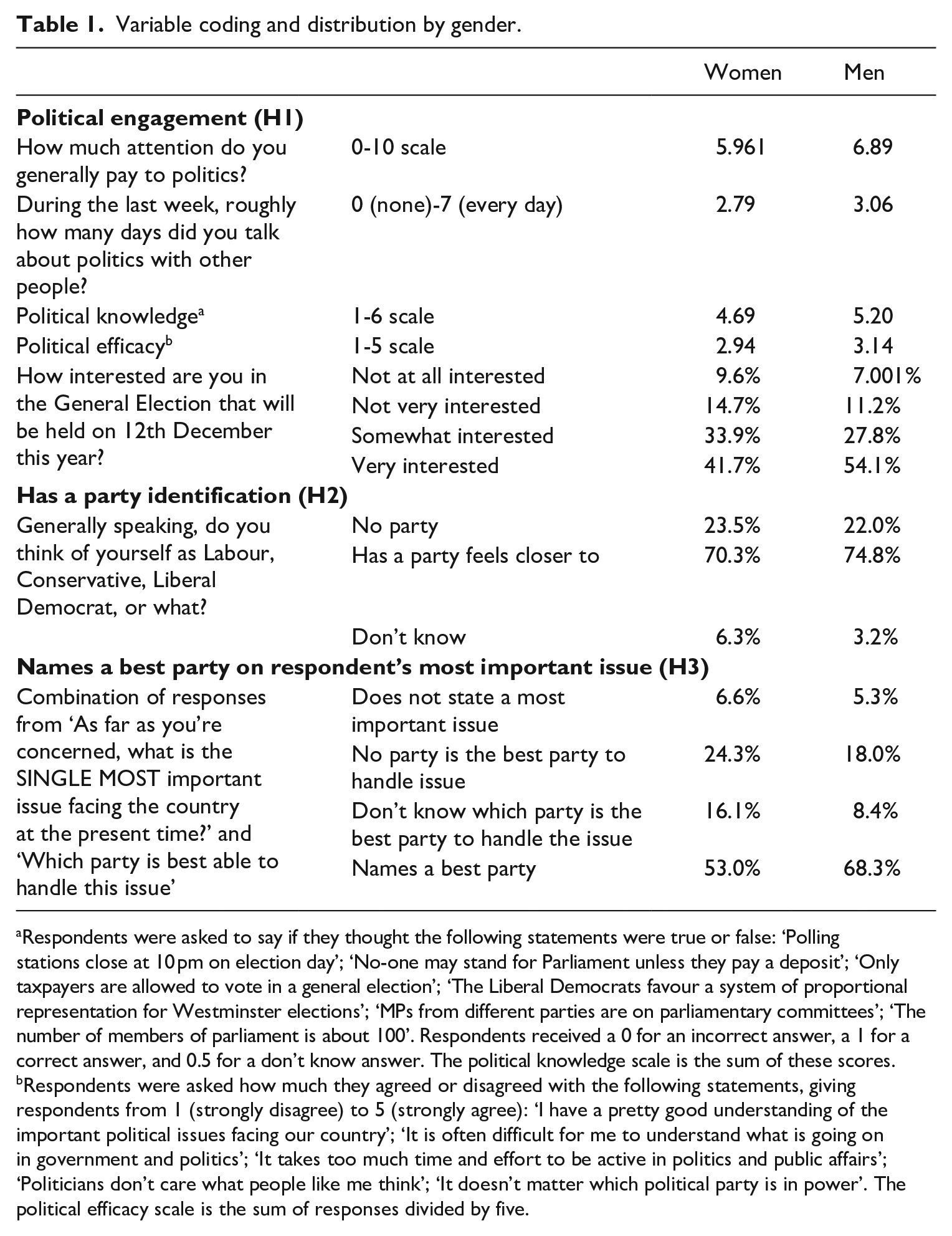
Respondents were asked to say if they thought the following statements were true or false: ‘Polling stations close at 10 pm on election day’; ‘No-one may stand for Parliament unless they pay a deposit’; ‘Only taxpayers are allowed to vote in a general election’; ‘The Liberal Democrats favour a system of proportional representation for Westminster elections’; ‘MPs from different parties are on parliamentary committees’; ‘The number of members of parliament is about 100’. Respondents received a 0 for an incorrect answer, a 1 for a correct answer, and 0.5 for a don’t know answer. The political knowledge scale is the sum of these scores.
Respondents were asked how much they agreed or disagreed with the following statements, giving respondents from 1 (strongly disagree) to 5 (strongly agree): ‘I have a pretty good understanding of the important political issues facing our country’; ‘It is often difficult for me to understand what is going on in government and politics’; ‘It takes too much time and effort to be active in politics and public affairs’; ‘Politicians don’t care what people like me think’; ‘It doesn’t matter which political party is in power’. The political efficacy scale is the sum of responses divided by five.
Figure 2 below shows the proportion of men and women who give a don’t know response to the hypothetical vote intention question. We calculate this from a model which includes gender and its interaction with age and age squared, to account for any potential non-linearity in age. We calculate the predicted proportion giving a don’t know response at 10-year age intervals. The proportion saying they don’t know who they would vote for is largest for those in younger and middle age groups, and lowest for those at older age groups, narrowing substantially for those aged above 50. We also detect these age patterns if we use a categorical variable for age instead of age and age squared. The patterns are consistent with Campbell and Winters’ (2008) finding that the gender gap in political interest is largest for younger age groups in Britain.
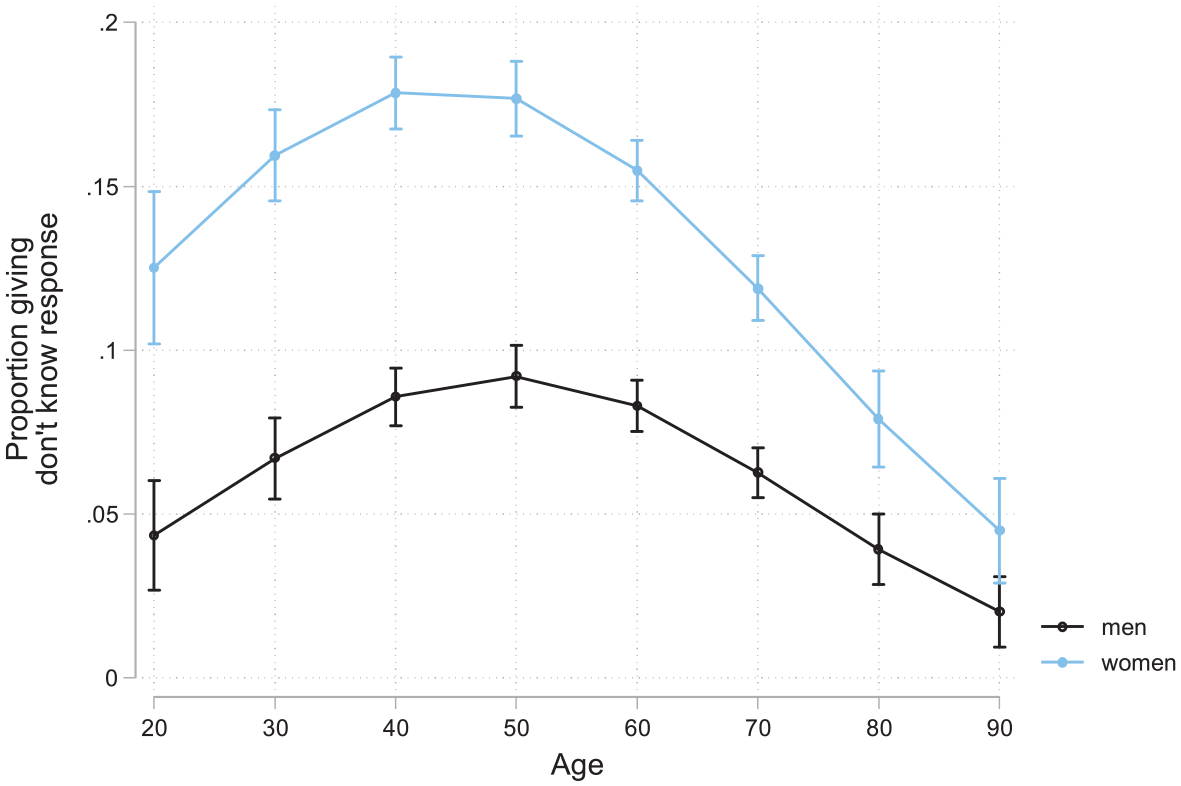
Proportion giving a ‘don’t know’ response by gender and age, wave 17 BESIP.
Figure 3 shows the predicted proportion of men and women saying they don’t know which party to vote for across age groups from models adding the sociodemographic variables, political engagement (H1), having a party identification (H2), and naming a party best able to handle the most important issue (H3). The model tables are shown in the Supplemental material (Table A1). Consistent with the literature on gender and political engagement, we do not see much difference in the gender gap once we add the sociodemographic variables (top left panel) compared to the gender gap in Figure 1, indicating that gender differences in education or employment status are not associated with the gender gap in being undecided about who to vote for. We also tested for an interaction between gender and having children in the household, but we do not find any evidence that women with children are more likely than men with children or other women to say they don’t know who to vote for once we take age into account.
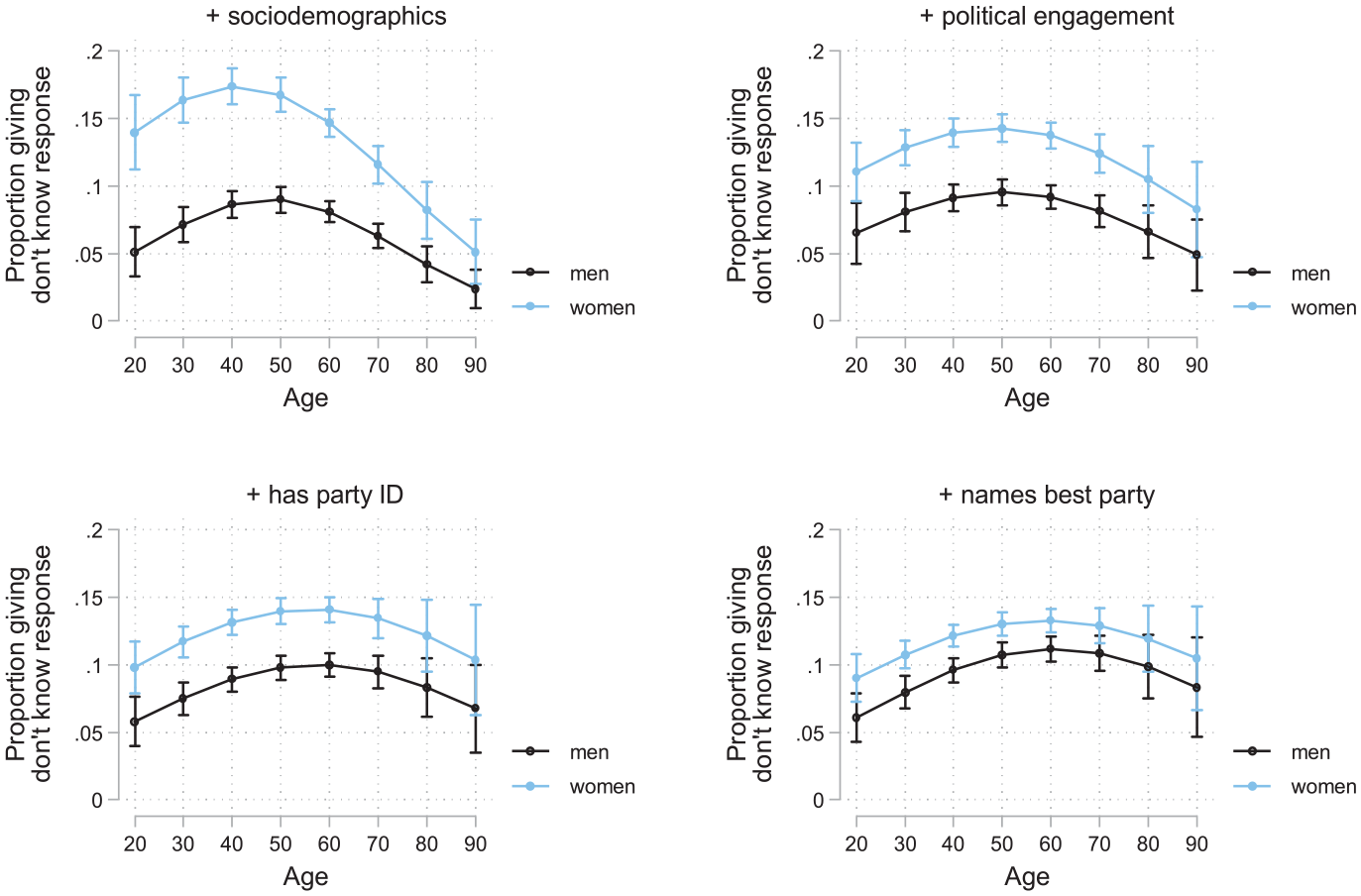
Proportion giving a ‘don’t know’ response by gender and age from logistic regression models after adding sociodemographic characteristics (top left), political engagement (top right), party ID (bottom left), and naming best party variables (bottom right), wave 17 BESIP.
The top right panel of Figure 3 tests H1 on political engagement. Once we add the political engagement variables the gender gap reduces in size, especially for younger age groups. This provides evidence for H1 and suggests that women are more likely to say they don’t know which party to vote for because they are less engaged with politics in general. When we add the political engagement variables one at a time, we find that all of them contribute in a similar way to the reduction in the size of the gender gap across ages. However, a statistically significant gender gap of around 4 percentage points across all age groups remains with the political engagement variables in the model. The bottom left panel on Figure 3 shows the predicted probability of giving a don’t know response when we add whether the respondent gives a party identity, testing H2. We see no change when this variable is added, indicating that the gender gap is not associated with gender differences in holding a party attachment. This is relatively unsurprising given we found quite small differences between men and women in partisanship in Table 1. Finally, the bottom right panel shows what happens when we add whether the respondent names a party best able to handle their most important issue, testing H3 on representation. We see some support for H3; the gender gap reduces in size again, suggesting that the gender gap on don’t know response is associated with gender differences in perceiving there to be a party option which best represents respondents’ policy priorities.
Overall, then, our quantitative analysis suggests that the gender gap in ‘don’t know’ responses to vote intention questions is related to gender gaps in political engagement (i.e. interest, knowledge, discussion, and efficacy) and to gender differences in feelings about policy representation. We next turn to our focus group analysis to explore these findings in more detail.
Exploring the mechanisms: Focus groups
After our quantitative analysis, questions remain about how political engagement relates to how men and women make decisions about who to vote for and what drives the gender difference in perceptions of policy representation. Moreover, a statistically significant gender gap remains even in our final model which includes an extensive number of covariates. This led us to explore in the focus group analysis any additional factors that could help us understand the gender gap in ‘don’t know’ responses to vote intention questions.
We selected focus groups to complement our quantitative analysis given their unique advantage of group interaction. Focus groups are ‘inherently social’ – encouraging a synergism between participants – and therefore researchers can use them to examine social interactions as well as examine individuals’ and group responses to questions (Cyr, 2016: 1038). Through group interaction, participants can ‘bounce’ ideas off each other, allowing them to generate new ideas that might be otherwise untouched in a standard interview (Sanders, 2022: 5). We also draw on focus groups specifically as they are an ideal method to complement, and negate the weaknesses of, quantitative research. As Cyr (2016) notes, ‘focus groups reveal why and how individuals think as they do – something that surveys and other large-N methods cannot easily accomplish. At the same time, the survey overcomes a weakness of focus groups: their lack of generalizability’ (p. 1040). Therefore, the strategy behind our use of focus groups is not to strive for generalisability. Rather, we seek to explore in depth the mechanisms that men and women use in their voting behaviour, and generate theories that can be tested further in quantitative research.
We conducted four focus groups with men and women voters throughout June 2022, notably during the aftermath of the inquiry into ‘Partygate’ and the nascent downfall of the then Prime Minister, Boris Johnson. Given these events, the timing of the focus group discussions is specific to this period of British politics. However, our findings may still provide empirical utility beyond this context. First, the timing of the discussions sits more widely in a context of public disapproval in government. Between February 2011 and November 2023, government disapproval among the British public has averaged 55%. 10 At the time of our focus groups, government disapproval stood at 60% (Cyr, 2016), suggesting that government disapproval was slightly higher than average, but not substantially. Second, recent years in British politics have been characterised by turbulence, with Britain witnessing five Prime Ministers in a 6-year period (2016–2022). Finally, the findings we draw out from our qualitative research relate to the mechanisms that are evident in men and women’s political behaviour, rather than this specific context of British politics.
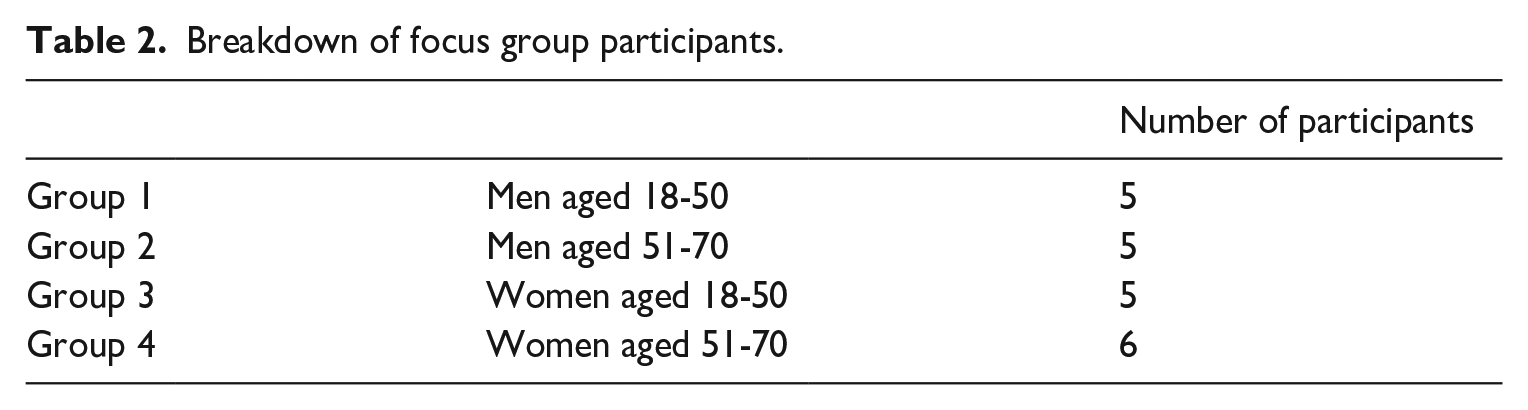
The four focus groups were split by gender (two groups of men and two groups of women) and age (‘younger voters’ aged 18–50 and ‘older voters’ aged 51–70). In terms of age, we select 50 as our cut-off point to reflect our quantitative finding that the gender gap in ‘don’t know’ response narrows for those aged above 50 (see Figure 2). The aim of running groups with participants of similar ages and the same gender was to encourage participants to feel comfortable sharing their views. Groups were also designed to include a mix of those who were decided and those who were undecided in their voting intention, although all participants had voted in the 2019 General Election. We interviewed 21 participants in total. Of our participants, nine stated they were undecided in their voting intention in the pre-focus group screening. Below, we show an overall breakdown of the focus groups (full details of individual participants are listed in the Supplemental material, Table A2).
Breakdown of focus group participants.
All participants were based in Greater Manchester, with participants drawn from various local authorities across the city region. Each focus group lasted approximately one hour, and was held online using Zoom. There are potential limitations to holding online focus groups. For instance, online groups may risk losing the authenticity of face-to-face discussions. However, studies directly comparing online and face-to-face discussions have found very little difference in the quality of data collected (Daniels et al., 2019; see also Flynn et al., 2018). All focus group discussions were recorded and were transcribed verbatim after the interview.
The focus group discussions were based on a semi-structured interview format. This was used to facilitate a natural flow of conversation between participants, while ensuring that the discussion stayed relevant. Interview questions were designed to correspond to our hypotheses and were based on four themes: party identification, political interest, political knowledge, and representation. The questions asked were focused on trying to understand how participants thought about politics and how they used this to make choices at election time. The full topic guide can be found in the Supplemental material. Below, we discuss the key findings from the focus groups, first by focusing on an area of consensus across the groups, and second by examining two areas where men and women substantially differed in their discussions.
Consensus: Political (dis-)engagement
Across the focus groups, men and women were similarly negative and pessimistic about the current state of politics, which is perhaps unsurprising given the timing. For example,
I just feel as if it’s in such a mess or I’ve just come to the point where [I think], ‘what’s the point’?
They’re all as bad as each other.
I used to be really interested in politics but I’ve kind of been just disheartened by it. You just hear the same things, year on year on ‘yeah, we’re gonna do this’, we’re donna do this’, Just nothing materialises.
Respondents across all our focus groups expressed similar levels of (low) engagement with politics in the contemporary British context, which they largely linked to the conduct of politicians (not exclusively Boris Johnson), as well as a range of problems in the country with many references made to the National Health Service and the rising cost of living. There were then two main areas where we identified substantive differences between our men and women participants. The first was related to questions of representation (H3), and the second was related to a factor that we did not measure quantitatively and which we identified through analysing the group interactions as well as the content of participants’ answers: conflict-avoidance versus conflict-seeking.
Representation: Policies versus lived experience
Despite there being a gender difference in the quantitative data in terms of whether men and women could identify a party best able to represent their policy priorities, across our focus groups most participants, men and women, felt they were not adequately represented by political parties, in line with the general negativity expressed towards politics in all groups. Gender differences arose instead in how men and women felt they could be better represented. Men often discussed practical improvements to the policy process, such as more details on policies and ‘politics with impact’, for example,
I want them to paint me a story of where they’re putting the stuff in, to produce this, to get there . . . If it can be done show us how, if it can’t be done show us why.
Policies with impact. Policies that actually work . . . you can see things happening, things working for people, I suppose.
In contrast, women often discussed the importance of representatives sharing lived experience with those they are representing. For many women, this was currently lacking:
If it’s on the news and people say, ‘oh you know the fuel crisis and people can’t afford to eat’, the defence immediately is always ‘oh we’re doing this and we’re putting this much into the economy, and we’re doing this, and we’re doing that’. But I don’t think I’ve ever heard anyone say, ‘yeah, I understand. I really understand’.
It seems like [parties] need to be on the ground where they can see, feel and you know, access realities . . . they have no aspect of how people live day-to-day.
How many times has Boris Johnson been to a food bank to see actual people queuing up outside and things like that? Like, probably not that often. Sure, there are occasions where they do do that, but are they actually doing anything to change what they’re seeing?
Elsewhere, other older women commented on the need for more visibility and accountability of politicians. There was a view among older women that current platforms holding politicians to account are lacking. Several women in the older group suggested that one way this lack of visibility and accountability could be solved is through the creation of a TV show, which could host politicians and require them to answer questions from the public. In developing the idea for the TV show, group synergy was particularly evident, demonstrating the value of group interaction from focus groups:
I think they should get out there more and relate to people.
They don’t do enough interviews. They just hit fleetingly on the news. They need to do a programme on it. If I was a producer I’d do it now. Maybe I should [laughs]. Get out there, you’ll see the news soon with just the Prime Ministers and all the politicians. Political Night, they should call it . . . The Political Night, once a month.
Or The People’s Say.
Yeah, The People’s Say. For the People. Political Views for the People.
[Laughs] We’ll cook it up between us, Barbara.
These findings add depth to our quantitative results; not only do women feel less well-represented by existing political parties, as expected by H3, but the sources of disaffection with politics may differ between men and women. While men discussed specific policy proposals as the main thing that would improve representation for them, women highlighted the experiences and actions they wanted politicians to have. This might point us towards a source of gender difference in political engagement – politicians may be more likely to highlight their policy proposals than their lived experiences, making them perhaps more appealing to men than to women on average. It is also interesting to note that politicians do tend to be ‘on the ground’ more during election campaigns, and this could be one reason why women become more decided in their vote choice the closer to an election it gets. This points to further research into how politicians’ behaviour matches up to the different expectations of men and women voters, as well as how politicians’ behaviour differentially shapes how well men and women feel they are represented in the political sphere.
To explore this idea further, we went back to the quantitative data and analyse over-time variation in responses to the most important issue/best party on the most important issue questions (see Figure A1 in the Supplemental material). Here, we observed that the gender gap in saying that no party is the best party, or on naming a best party, do tend to be smallest around election time – specifically, in the post-election survey waves. This lends further weight to the notion that women do respond to election context and feel more able to make judgements about the political parties at this time.
Conflict-avoidance versus conflict-seeking
We also identified differences between our male and female focus groups in how they responded to political conflict. As discussed earlier, existing research has found that women are less comfortable with interpersonal political conflict than men and that this partly accounts for the gender gap in political participation (Coffé and Bolzendahl, 2017). We could not test the role of conflict-avoidance or conflict-seeking in the quantitative analysis due to a lack of relevant questions in the British Election Study. However, women’s conflict-avoidance was evident in the focus group discussions, and appeared to be a mechanism that reduced their engagement with politics. Across the groups, women were less likely than men to say that they spoke to their family and friends about politics, largely stemming from their desire to avoid conflict. Many women explained that they were reluctant to discuss politics with others because they did not want to engage in arguments or disagreements. Conflict-avoidance was prominent in discussions with both older and younger women. For instance, older women cited examples of not discussing politics with those ranging from their partner to their children and parents:
I don’t even speak to my husband about it. Because I can remember my mum saying when I was little ‘don’t ever speak about politics, somebody’s weight, or religion, and you won’t really argue’ . . . I would never get into a big discussion about politics, definitely not. And I tell my children not to as well. I mean my daughter – she’s 23 – I mean she’s staunch, like Labour . . . and yeah, I don’t take her on board.
[m]y dad can’t stand Boris. Yeah, I know, he’s the complete opposite to me . . . It means that I kind of daren’t mention him, Boris, to my dad. Because I know that he doesn’t like him . . . so I leave him to it.
Similarly, younger women also gave examples where they avoided political discussions with their family and friends:
I tend to try and keep politics out of my friendship group because I just don’t want to fall out with people . . . But I also find it quite frustrating having a conversation about politics with my mum, because she’s obviously a slightly older generation. We obviously again have different opinions. So I think it’s best if you want to get on with everyone, not to discuss it with them.
Jennifer’s reference to being told by her mother not to discuss politics when she was younger suggests that her tendency to avoid conflict stems from socialisation. She noted that this is something she has also taught her own daughter, suggesting a continued pattern of socialisation. Gendered socialisation has been noted as one explanation as to why women display greater levels of conflict-avoidance than men (Coffé and Bolzendahl, 2017; Ruddick, 1989; Wood and Eagly, 2012). Gender stereotypes often uphold men to masculine or ‘agentic’ traits such as aggressiveness and competitiveness, while women are upheld to feminine or ‘communal’ traits portraying them as compassionate, compromising, and anti-conflict from an early age (Diekman and Schneider, 2010; Eagly et al., 2004; Eagly and Karau, 2002; Wolak, 2020a). Such stereotypes frame the way that men and women deal with conflict in later life, leading to a greater avoidance among women, and conflict-seeking among men (Diekman and Schneider, 2010).
Women’s conflict-avoidance is therefore likely a source of their lower levels of political discussion – also identified in the quantitative data (Table 1) – and this may affect their political knowledge. One younger woman, Natasha, explained that prior to the Covid-19 pandemic, she ‘used to always talk about politics’. But since the resulting lockdown, she noted that this changed, explaining that: Now obviously a lot of us work from home, barely in the office . . . and I’m normally at home with my children so I’m not going to speak with them about politics. So I just feel like I just don’t think I know enough about it.
It is notable that Natasha links this lower level of political discussion with having less knowledge about politics. Being unwilling to talk about politics but also having fewer opportunities to do so may therefore lead women to have lower levels of knowledge about politics, and hence to be less likely to know who they would choose to vote for in a hypothetical election. The gendered division of labour that reinforces stereotypes of women as caregivers may prevent them from building up relevant political resources and participating in political activity (Wood and Eagly, 2012).
In explaining gender gaps in political engagement, other scholars have pointed to men’s greater likelihood than women’s to express conflict-seeking behaviours (Wolak, 2020a). This mechanism was also reflected in our findings, where men were more likely than women to express elements of conflict-seeking. Interestingly, this conflict-seeking behaviour was evident in the way men interacted with each other in the focus group discussions, which exhibited more political debate and crucially disagreement than in the women’s focus groups. Men’s openness to disagreeing with others was illustrated in, for example, a disagreement on Net Zero in the younger men’s group. In addition, older men openly disagreed with each other in their views, for example, on the former Prime Minister, Tony Blair:
There [were] no weapons of mass destruction and they sold that story to the general public. Bush did in America, Blair did here . . .
You’re talking about foreign policy . . . To do with this country, Tony Blair, he was actually good for the economy, he was good for the country, and he was a popular leader.
He was a popular leader, but foreign or in this country, you know, not good at all. He lied, he basically lied.
Men have been found to display a greater likelihood than women to enjoy political discussions as well as ‘contentious’ forms of politics, due to their greater conflict-seeking behaviour (Wolak, 2020a). A body of literature highlights a greater propensity among men to adopt an argumentative and competitive nature, compared to women’s, which is often based on protecting social relationships (Cross and Madison, 1997; Holmes, 1995; Tannen, 2001; Wolak, 2020a). These gendered traits have been found to lead to men’s higher political engagement than women’s (Brooks, 2010). Several men – particularly in the younger age group – explained that they often started political discussions with their friends and family, even if these discussions were contentious or adversarial:
With my friends, we exchange things, news stories, activities, protests we’ve seen in our local area. Yeah, there’s lots of interaction. Something we’ve always done, sometimes to my detriment, but I don’t care, I am what I am. Like it’s something I’ve brought up at dinner parties, social engagements, you know, I’ll start a sort of political discourse going.
I talk to family and friends. Both equally . . . I guess it’s good to get a rounded view I think of opinion from people that you are close to, respect, and are good friends with. It’s useful to hear all sides of arguments, I think.
Women’s conflict-avoidance and men’s conflict-seeking behaviours were not only evident in their daily interactions, but also appeared to condition their views on formal politics. Westminster politics is often considered to be an adversarial system that encourages conflict (Lijphart, 1999). Across all groups, men and women equally acknowledged that conflict is rife in the political system. For women, this conflict appeared to deter them from politics, often leading to their lower political interest:
[S]ometimes I think it’s like a back and forth between the two parties in the sense of they’re just trying to prove which one’s better than the other . . . I just lose interest in it and can’t keep up because it just seems like a battle between each other . . . sometimes it’s just enough to kind of put you off being really involved in it, I suppose.
For men, this mechanism appeared to work in the opposite direction: men were more likely than women to enjoy political conflict, and this enjoyment appeared to lead to their higher political engagement. Several men likened politics to a form of entertainment or a hobby. Shaun, for instance, described politics as ‘just like another TV show’. A similar comment was echoed by two other men:
I know it’s life and it’s serious, but it’s almost . . . it’s like a bit of a soap opera at times as well. It’s a bit of entertainment.
There’s an aspect of me that watches it – politics – as a form of panto, almost. And the jousting I find quite interesting and almost [like] a batsman or bowler. And you sort of defend your position and attack.
Conflict within politics offers a further explanation for the gender gap in ‘don’t know’ responses when it comes to expressing a vote intention, as men’s greater conflict-seeking might encourage learning and engagement with politics, while women’s greater conflict-avoidance might lead them to avoid discussions or other scenarios where they might learn about politics. While the BESIP does not include questions about conflict-seeking or conflict-avoidant orientations, wave 19 does include the question ‘Are you ever reluctant to post about politics on social media for fear of a negative response?’ which may tap into fears (or lack of) about engaging in political conflict. Here, we saw a small but statistically significant gender gap among those agreeing: 38.4% of women, compared to 35.3% of men (N = 5939). When we broke this down by age, we found that for those below 50, there was no significant gender gap (38.5% women, 37.8% men), but there was a larger and significant gender gap for those above 50 (38.2% women, 31.0% men). While this only captures opinions about conflict on social media, it does suggest that there is a systematic pattern whereby women (especially older women) are less likely to engage in political discussion because of the potential for conflict that may result.
Discussion and conclusion
Using a mixed methods approach, this article has explored why women are more likely than men to be undecided about their voting intention. Quantitatively, our findings support our first hypothesis: women’s greater likelihood of being more undecided than men in their vote choice is associated with gender differences in political knowledge, interest, and efficacy. We find some support for our third hypothesis, that the gender gap in undecided voters is associated with perceptions about how well parties represent one’s policy priorities. However, our second hypothesis – that women are more likely to be undecided than men due to gender differences in party identity – was not supported. Taken together, this suggests that political engagement and feeling represented by a political party on a named most important issue partly explain women’s greater likelihood to be undecided than men in their vote choice. Yet even once we account for these factors, a gender gap in those who are undecided in their voting intention remains across most age groups. As such, we conducted focus groups to explore these mechanisms further and gain a deeper insight into the reasoning behind men and women’s political behaviour.
Our focus group analysis reveals two additional findings that complement our quantitative analysis. First, we find differences between men and women in how political parties can better represent them. Men tended to cite changes to the policy process, such as more detailed and transparent policy proposals, whereas women often talked about the importance of representatives having lived experience, and being visibly ‘on the ground’. In many ways, we might expect these feelings of representation to change during periods of election campaigning. Representatives are often more visible and ‘on the ground’ at election time, through canvassing, television debates, and engaging with voters, as well as releasing manifestos with policy proposals. This may partly explain the narrowing of the gender gap in the run-up to election periods. Future research could usefully develop quantitative measures to capture voters’ varied representational priorities, identify gender gaps, and measure the extent to which these feelings vary across political cycles. It could also explore the potential socialisation processes which produce these gendered differences in representational priorities.
Second, we find evidence that when it came to political discussions and perceptions of politics, women were often more conflict-avoidant than men. Women were much more averse than men to discussing politics with their friends and family, and tended to view politics much more negatively as a result of conflict. At the same time, men tended to be more conflict-seeking in their behaviour. For women, their greater dislike of conflict appeared to lead to their lower engagement in politics, whereas men’s enjoyment of conflict in politics appeared to encourage their greater engagement. Our findings are consistent with both Coffé and Bolzendahl’s (2017) findings of women’s propensity for conflict-avoidance, and Wolak’s (2020a) findings of men’s conflict-seeking, but we find that both processes are important. We suggest this is a helpful mechanism for understanding how politics attracts men/puts-off women, which then may have implications for how men and women think about politics and the party options between elections. Future research could turn to quantitatively measuring conflict-avoidance and conflict-seeking in non-US contexts and analysing the extent to which these are associated with other political behaviours.
The findings around conflict-avoidance and conflict-seeking illustrate the strength of taking a mixed methods approach. We were unable to measure conflict-seeking/conflict-avoidance in the quantitative data, and we did not explicitly ask about orientations towards conflict in the focus groups. Nevertheless, the focus group data demonstrated both how conflictual men and women saw politics, as well as their different reactions to this. The focus groups – and in particular, the interactions between our participants – showed us how conflict-avoidance and conflict-seeking condition both how men and women view politics and their interactions with others, which we could observe and analyse due to the relational nature of this data. We acknowledge that due to small sample sizes the findings from the focus groups cannot be generalised to the wider population. Therefore, as highlighted above, quantitative research should further explore our qualitative findings. However, future research on gender and political engagement could make more use of mixed methods approaches. To date, studies on gender and political engagement have been predominantly quantitative, but we show how a combination of quantitative and qualitative techniques allow us to test our hypotheses while also exploring the underlying mechanisms in more depth and identifying other potential explanations in an exploratory manner.
In addition, while our findings suggest correlational evidence of the effects of political engagement and perceptions of policy representation on the gender gap in undecided voters, we were unable to establish a causal relationship in the quantitative data. As such, future research could employ experimental methods to identify the causal effects driving the gender gap in undecided voters. Previous research has drawn on these methods to explore the gender gap in political knowledge (Ferrín et al., 2022; Miller, 2019) and political interest (Preece, 2016), but little scholarly attention has been devoted to gender gaps in political engagement in a British context.
Our findings have implications for political parties and political polling. First, we suggest strategies for political parties to increase levels of political engagement among women. In particular, having representatives with relevant lived experience or a willingness to demonstrate empathy and understanding with the lived experience of others is important for women to feel substantively represented – as others have also argued (Mansbridge, 1999; Phillips, 1995). Second, given gender gaps in political conflict, there is a need to reform the current model of Westminster-style governance, which encourages an adversarial and gladiatorial style of debate and therefore has the potential to marginalise women from the political process. Finally, our results indicate that when interpreting voting intention questions in-between elections, we should pay careful attention to the extent to which women express a ‘don’t know’ opinion. We show this is reflective of the gendered ways in which men and women engage with and relate to politics, and therefore that any gender gaps in vote choice should be interpreted with this in mind.
Supplemental Material
sj-docx-1-bpi-10.1177_13691481241240385 – Supplemental material for Gendering the floating voter: A mixed methods study of gender and undecided voters in Britain
Supplemental material, sj-docx-1-bpi-10.1177_13691481241240385 for Gendering the floating voter: A mixed methods study of gender and undecided voters in Britain by Rosalind Shorrocks and Anna Sanders in The British Journal of Politics and International Relations
Footnotes
Acknowledgements
We would like to thank participants at the Elections, Public Opinion and Parties (EPOP) Conference 2022 and the Political Studies Association (PSA) Annual International Conference 2023 for helpful discussions and feedback on this article. We are also grateful to the anonymous reviewers for their helpful comments on this paper.
Funding
The author(s) received no financial support for the research, authorship, and/or publication of this article.

Supplemental material
Supplemental material for this article is available online.
Notes
References
Supplementary Material
Please find the following supplemental material available below.
For Open Access articles published under a Creative Commons License, all supplemental material carries the same license as the article it is associated with.
For non-Open Access articles published, all supplemental material carries a non-exclusive license, and permission requests for re-use of supplemental material or any part of supplemental material shall be sent directly to the copyright owner as specified in the copyright notice associated with the article.
