



Abstract
The robust multi-objective optimization is conventionally achieved by minimizing expected values and standard deviations of performance functions by imposing equal importance to each individual gradient of the performance function. But, it is well established in the literature that all the gradients are not of equal importance to capture the presence of uncertainty. In this work, an improved sensitivity importance–based robust multi-objective optimization approach is proposed. The basic idea is to improve the robustness of the performance by defining a new index using the importance factors, proportional to the importance of the gradients of the performance. The efficiency of the proposed robust multi-objective optimization approach is investigated by optimizing a vibrating platform for maximum frequency and minimum cost. The minimization of the associated standard deviation of cost and frequency is also treated as objective functions. Noting the limitations of the conventional weighted sum method or ε-constraint method for solution of such robust multi-objective optimization problems, non-dominated sorting genetic algorithm II has been adopted for solution. The proposed robust multi-objective optimization yields more efficient Pareto fronts, that is, making a design less-sensitive to the variation in the input variables compared to the conventional robust multi-objective optimization approach.
Introduction
The development of optimization of structure has attained substantial progress due to the demands of light-weight, economic, and energy-efficient structures. The optimization procedure usually considers a single-objective function, and in most cases, cost or weight is treated as the objective function. But, it is well recognized by the optimization community that selection of a proper objective function is an important decision in the design process (Arora, 1989). Several objective functions have been used in the literature, depending on the practical requirements, namely, minimize cost, maximize profit, minimize weight, minimize energy expenditure, maximize ride quality of a vehicle, minimize ductility demand, minimize deflection, and maximize natural frequency. In many situations, an obvious objective function can be identified, for example, to minimize the cost or to maximize the profit. In other situations, there may appear to be two or more objective functions. For example, one may want to minimize the weight of a structure and at the same time minimize the deflection or stress at a certain point. These constitute multi-objective optimization (MOO) problems. One of the most widely used methods for solving MOO problems is the weighted sum method (WSM) that parametrically changes the weights among objective functions to obtain the Pareto front (Koski, 1988; Schy and Giesy, 1988). Among other approaches, the ε-constraint method where one individual objective function is minimized with an upper level constraint imposed on the other objective functions (Steuer, 1986), the equality constraint method that minimizes objective functions one by one by simultaneously specifying equality constraints on the other objective functions (Lin, 1976), the evolutionary computational method, that is, the genetic algorithms (GA) (Goldberg, 1989; Kicinger et al., 2005), the normal constraint method which generates evenly distributed Pareto solutions along the entire Pareto front for n-dimensional problems (Messac and Mattson, 2004), and the normal boundary intersection method where a series of single-objective optimizations is solved on normal lines to the utopia line (Das and Dennis, 1998). Logist et al. (2010) integrated the normal constraint and the normal boundary intersection with fast deterministic direct optimal control approaches for fast Pareto set generation. Kim and De Weck (2006) proposed an adaptive WSM for MOO of truss problem. An excellent state-of-the-art on the MOO procedure, presented in the study of Marler and Arora (2004), is of worth mentioning in this regard. Few other works on multi-objective deterministic optimization of structures can be observed in the study of Sun et al. (2014).
The MOO methods as mentioned above are primarily based on the assumption that all the design variables (DVs) and design parameters (DPs) involved in the optimization process are deterministic in nature. In optimization problem, the specific parameters designer needs to optimize to achieve the desired performance are the DVs. The DPs are those which cannot be controlled by the designer or are difficult and expensive to control. The major disadvantage of deterministic approach of MOO procedure is that they are unable to incorporate uncertainties in the DVs and DPs, even when the information is available. For example, the uncertainties in load- and resistance-related parameters in a structural system are not included in the deterministic approach. But uncertainty is inevitable in characterizing a realistic structural system. The uncertainty in the system parameters is important as the safety level of structure changes due to this (Chaudhuri and Chakraborty, 2006; Jensen, 2002; Meng et al., 2017), which is expected to affect the final optimal design significantly (Schuëller and Jensen, 2008). Incorporation of parameter uncertainties creates an interaction between the random descriptions of loading and uncertain structural system parameters. An optimal designs based on the deterministic approach are often prone to be the most sensitive to parameter uncertainty (Thompson and Hunt, 1974) and may turn out to be not robust, leading to substantial performance deterioration or design constraints violation. As a consequence, due to disregard of uncertainty, the cost optimization of a structure, with purely deterministic tools, may lead to improper designs, whose consequences will invite catastrophe. Thus, there is a growing concern by the optimization community to consider uncertainty within the optimization framework. In this regard, an excellent review can be found in the study of Schuëller and Jensen (2008) about the different approaches of optimization under uncertainty. The focus of this study is on MOO under parameter uncertainty.
Conceptually, the development of optimum design procedures of structure in presence of uncertainty has been progressed in three broad categories: (1) the performance-based design optimization (PBDO) (Ganzerli et al., 2000), (2) the reliability-based design optimization (RBDO) (Meng et al., 2015; Zou et al., 2017), and (3) the robust design optimization (RDO) (Roy et al., 2014; Su et al., 2016). The limitation of the first category is quite obvious as it optimizes the mean value of the performance function disregarding the variation in performance due to uncertainty. The RBDO ensures a target reliability of design for a specific limit state. But it does not focus on the variation in objective function. Hence, the RBDO may be sensitive to input variations due to uncertainty. But in the RDO, the design is made least sensitive to input variations without removing the source of uncertainty. This is a very desirable aspect of design under dynamic loading, like earthquake, wind, or machine vibration. The development of RDO for single-objective optimization problems is extensive as can be seen in the studies of Zang et al. (2004), Beyer and Sendhoff (2007), Park et al. (2006), Huang and Du (2007), and Baker et al. (2008). However, the same is not in the case for MOO problems. The robust optimization of MOO problem have been attempted following Taguchi’s design of experiment approach (Elsayed and Chen, 1993; Tsui, 1999) where the sensitivity of a design is measured by generalizing Taguchi’s loss function. These approaches are essentially exhaustive techniques and can be efficiently applied to optimize only a small number of factors and levels. Caballero et al. (2001) proposed a β-efficient formulation to solve stochastic MOO problem by transforming the original stochastic problem into an equivalent deterministic problem using the expected value and variance of the random variables involved by specifying the probabilities βi that describe the tolerable level of risk. Following this concept, there is a class of literatures where a weighted sum of the mean and standard deviation of the objective functions is minimized (Levi et al., 2005; Messac and Mattson, 2004). Shih and Wangsawidjaja (1996) applied mixed fuzzy-probabilistic programming approach to solve MOO problems. Lagaros et al. (2005) applied a non-dominant cascade evolutionary algorithm in conjunction with Monte Carlo simulation and Chebyshev metric to solve a robust MOO in order to generate Pareto front more efficiently. Gunawan and Azarm (2005) proposed a worst-case sensitivity region (WSCR) concept to measure the robustness in multi-objective robust design of a vibrating platform. The robustness of the design has been introduced as a constraint in terms of WSCR, and not as an objective. Brujic et al. (2010) presented a computer-aided design (CAD)-based robust shape optimization for a turbine considering multiple objectives. Ghanmi et al. (2011) presented robust multi-objective optimization (RMOO) of mechanical system considering uncertainty only in the DVs. Pourzeynali et al. (2013) presented multi-objective robust optimization of tuned mass damper system considering uncertainty in the stiffness and damping parameter only. A comparative study on multi-objective reliable and robust optimization under uncertainty has been presented by Gu et al. (2013) for crashworthiness design of vehicle structure.
The robustness of a design is generally measured in terms of some dispersion index, for example, the standard deviation, gradient index, or percentile difference (Huang and Du, 2007) which are usually computed by putting equal importance to each individual gradient of the objective function and constraints. But it is well known to the structural reliability community that all the performance gradients are not of equal importance (Bjerager and Krenk, 1989; Gupta and Manohar, 2004; Madsen, 1988). In fact, when a large number of DVs and DPs are involved in the structural reliability analysis problem, the dominant parameters, having relatively stronger influence on reliability are identified using the relative importance of the gradients to reduce the number of random variables. The concept can be applied in RDO. It is expected that the importance of the individual gradients should provide useful information to measure the robustness of the performance of a design.
Keeping the above view in mind, an improved RMOO procedure is proposed in this work. The basic idea of the proposed RMOO formulation is to improve the robustness of the performance functions using the importance of each gradient of the performance with respect to the uncertain DVs and DPs. In doing so, a new index of robustness measure, which uses the associated gradients with their relative importance, is proposed. Essentially, the proposed RMOO formulation becomes a multi-criteria deterministic design optimization problem, where the meanand the importance factor–based new robustness measure of each objective function is optimized. This way the design puts more importance to the gradients having maximum influence on the variance. Most commonly, the WSM or ε-constraint method is applied to solve such problem. However, considering the limitations of the WSM or ε-constraint method to capture non-convex Pareto front to solve MOO problem (Das and Dennis, 1997; Messac and Mattson, 2004), the non-dominated sorting genetic algorithm II (NSGA-II) (Deb, 2001), one of the most successful and popular methods, is applied in this study for solving the MOO problem. Further details on application of GA in MOO can be found in the study of Kicinger et al. (2005). The cost and frequency optimization of three-layer vibrating platform are optimized to elucidate the effectiveness of the proposed approach. The improvement in robustness by the proposed RMOO method is demonstrated by comparing the results with the conventional RMOO results.
Theoretical formulation
For effective presentation of the method, it will be informative to first discuss the fundamentals of deterministic MOO scheme and the usual RMOO followed by the proposed efficient RMOO scheme elaborating its differences with the conventional approach.
Deterministic MOO
By definition, the systematic and simultaneous optimization of a collection of objective functions is called MOO or vector optimization. The vector of n-dimensional DVs,
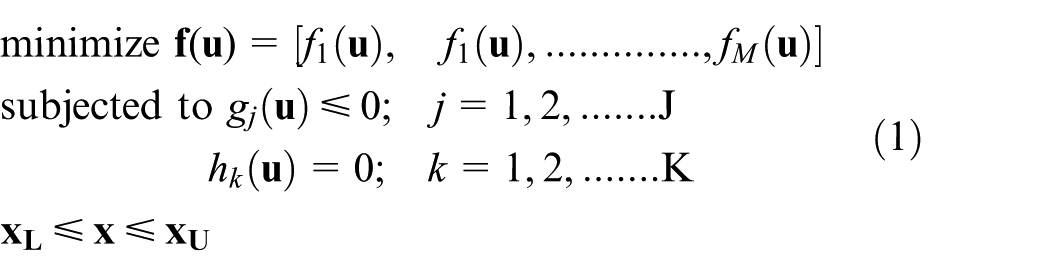
In the equation (1),
The deterministic MOO method, as described above by equation (1), does not consider the effect of randomness in the
Conventional RMOO
In MOO, it is quite desirable to obtain the solutions that are “multi-objectively” optima and robust to uncontrollable parameter variations due to uncertainty. The robustness of the performance is generally expressed in terms of dispersion of the performance from its mean value. The dispersion is measured in terms of variance and percentile difference (Huang and Du, 2007). Assuming ui as statistically independent random variables, the mean

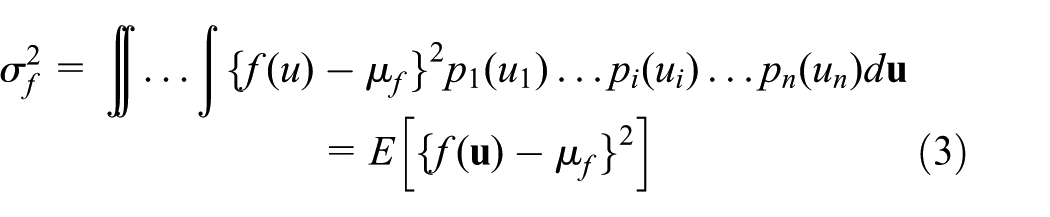
where

where
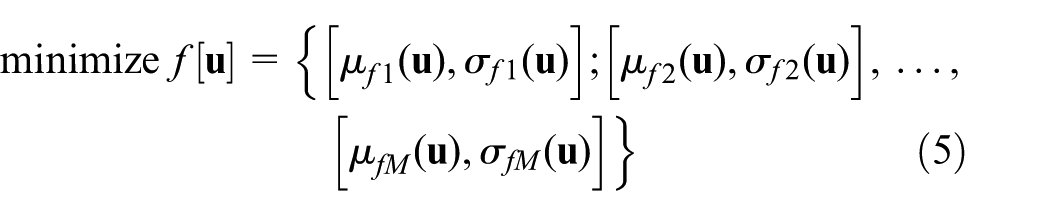
In equation (5),
Proposed RMOO
In the proposed RMOO method, a new concept to improve the robustness of design is introduced considering the uncertainty in the DVs and DPs. It is well known that the sensitivity information is useful to the designer as it provides indication to the performance changes in a design associated with an increase or decrease in the respective variables. In fact, to rank the random variables in order of their relative importance, it is common to use the importance factor as defined below (Haldar and Mahadevan, 2000)
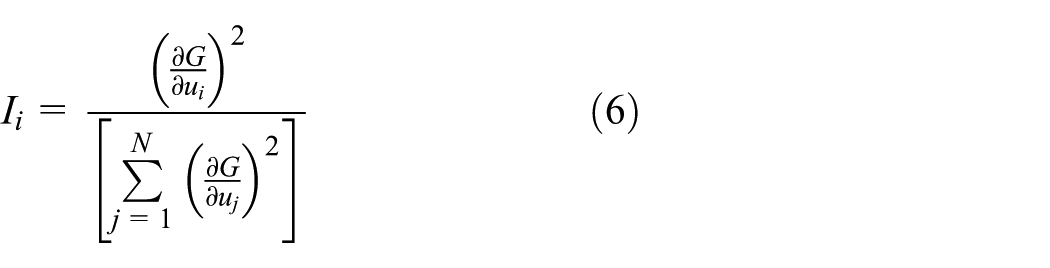
where Ii is the importance factor of ith variable, G is the failure surface defining the safe and unsafe regions, and N is the total number of random variables in a generic structural reliability analysis problem. Based on the entries of Iis, the random variables can be grouped into “important” and “unimportant” variables. The random variables for which the failure surface is more sensitive are identified as dominant variables. This is hinged on the fact that all the gradients of failure surface are not of equal importance in a typical reliability analysis problem. This intuitively indicates that all the gradients are not equally important to quantify the dispersion of the performance function as defined by equation (4). Thus, it is expected that the importance factor should play a role to indicate the measure of robustness of the performance. The motivation can be further clarified by presenting the expression of dispersion described by equation (4) in the following form

A close examination on equation (7) clearly reveals that the value of dispersion
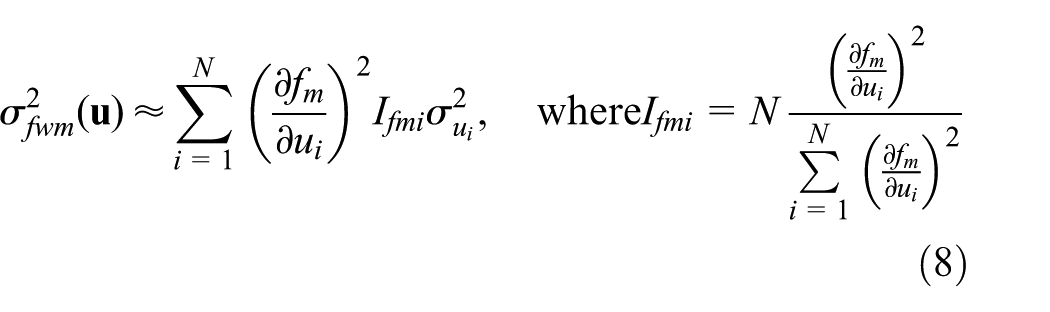
In equation (8),
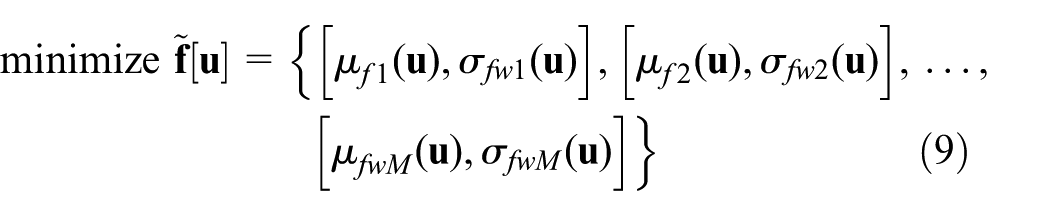
In the above,
It can be noted that many researchers adopt a separate sub-problem to find a search direction for a quick convergence toward the robust optima (Jung and Lee, 2002; Lee and Park, 2001; Wang et al., 2009). This of course will depend on sensitivities. Furthermore, when more than one variable is involved, the search should emphasize on the more sensitive variables for an efficient and quick convergence to the robust optima. In the present RMOO formulation, as the proposed dispersion index includes this aspect of assigning more weight to more sensitive DVs or DPs, it is expected that the proposed RMOO will reach to the robust optima more efficiently, without the help of any separate sub-problem for direction finding.
It can be noted that both for the conventional and the proposed RMOO approach, the final dispersion of the objective functions are compared in the same datum, since, in both the above cases, the dispersion is calculated by equation (4) after the optimal Pareto fronts are obtained by solving equation (5) for the conventional RMOO and equation (9) for the proposed RMOO approach. The efficiency of the proposed sensitivity importance–based RMOO approach has been presented for uncertain-but-bounded type of uncertainty in the study of Bhattacharjya and Chakraborty (2011) and Chakraborty et al. (2012).
Numerical study
A pinned–pinned sandwich beam with a vibrating motor on top, as shown in Figure 1 is considered to elucidate the proposed RMOO procedure. The platform has three layers of material (the inner layer, two middle layers sandwiching the inner layer, and two outer layers sandwiching the inner and middle layers). The properties of the materials of the each layer are shown in Table 1. In this table,
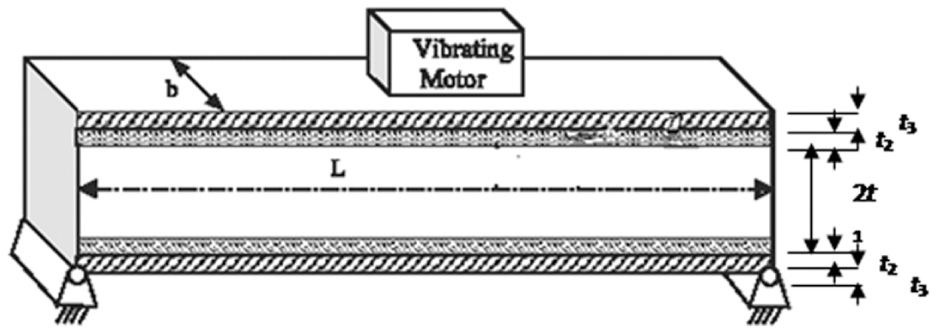
A pinned–pinned vibrating platform.
The details of materials properties and uncertainty information.
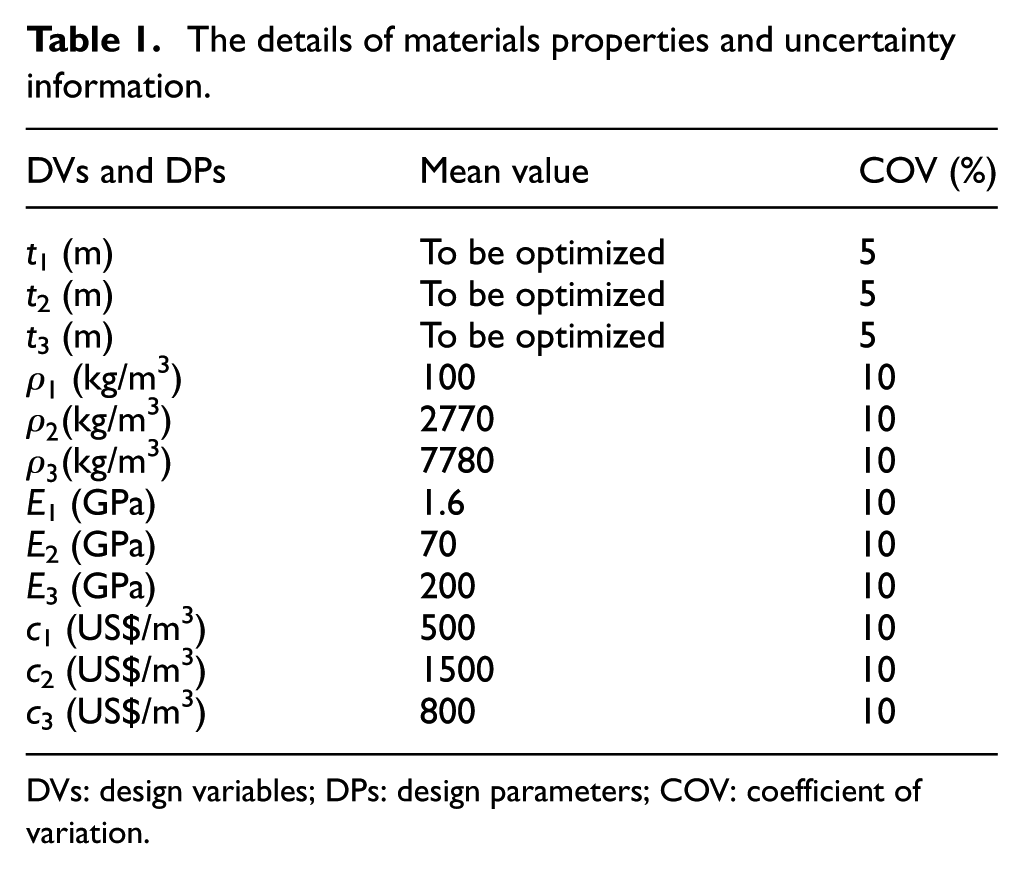
DVs: design variables; DPs: design parameters; COV: coefficient of variation.
The total cost of constructing such a platform needs to be minimized, and it is also required to maximize the natural frequency of the beam by controlling three sizing variables. The sizing variables are the thicknesses of three layers (2t1, t2, and t3). The width (b) and length of the platform (L) are taken as 0.4 and 4 m, respectively. These are considered to be deterministic. The MOO formulation for this problem can be mathematically expressed as
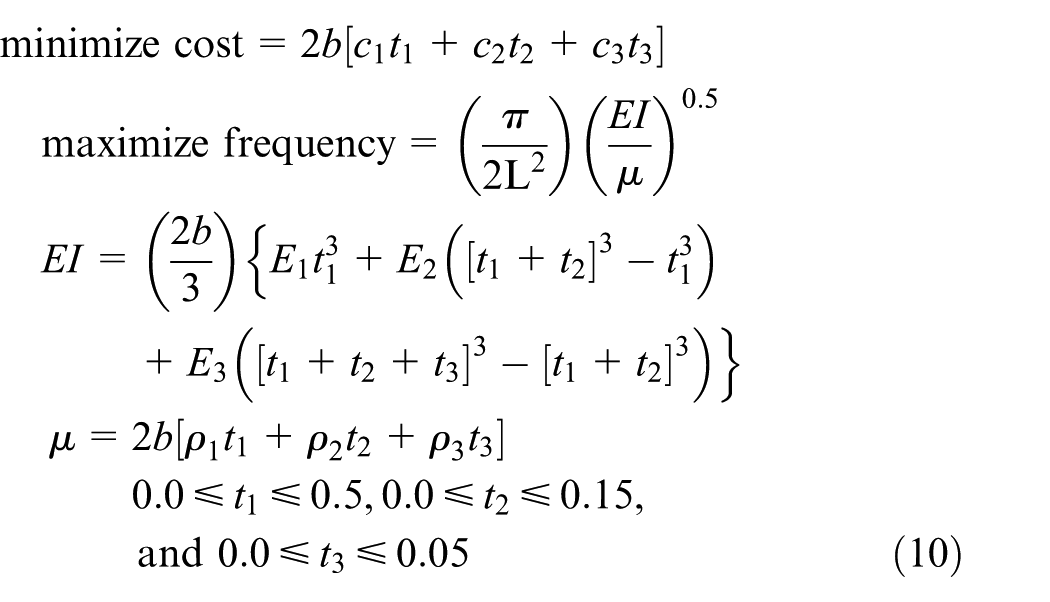
In equation (10), the notations (
The deterministic MOO and RMOO are executed using NSGA-II with 1000 generations and 500 populations. Details of the working procedure of NSGA-II can be found in the study of Deb (2001). It has been observed that, after 1000 generations, the Pareto fronts get stabilized. The RMOO is executed by both the conventional and the proposed importance factor–based RMOO approach. The resulted Pareto fronts obtained are presented in Figures 2 to 10. Figure 2 shows the Pareto front between the cost of the platform and its natural frequency for 5% coefficient of variation (COV) in the DVs and 10% COV in the DPs. For an easy comparison, the result of the deterministic MOO is also shown in the same figure along with the conventional RMOO and the proposed RMOO results. The same information is presented for 7.5% COV level in the DVs and 15% COV level in the DPs in Figure 3, and for 10% COV level in the DVs and 20% COV level in the DPs in Figure 4. It is observed from all these figures that, as expected, to achieve higher frequency, more cost is needed and vice versa. Depending on the cost and the frequency range of the operating machine to avoid a resonance, the designer can choose a suitable set of cost and frequency (i.e. a suitable point in the Pareto front) within the wide range of multi-objective Pareto solutions (i.e. the entire Pareto front).
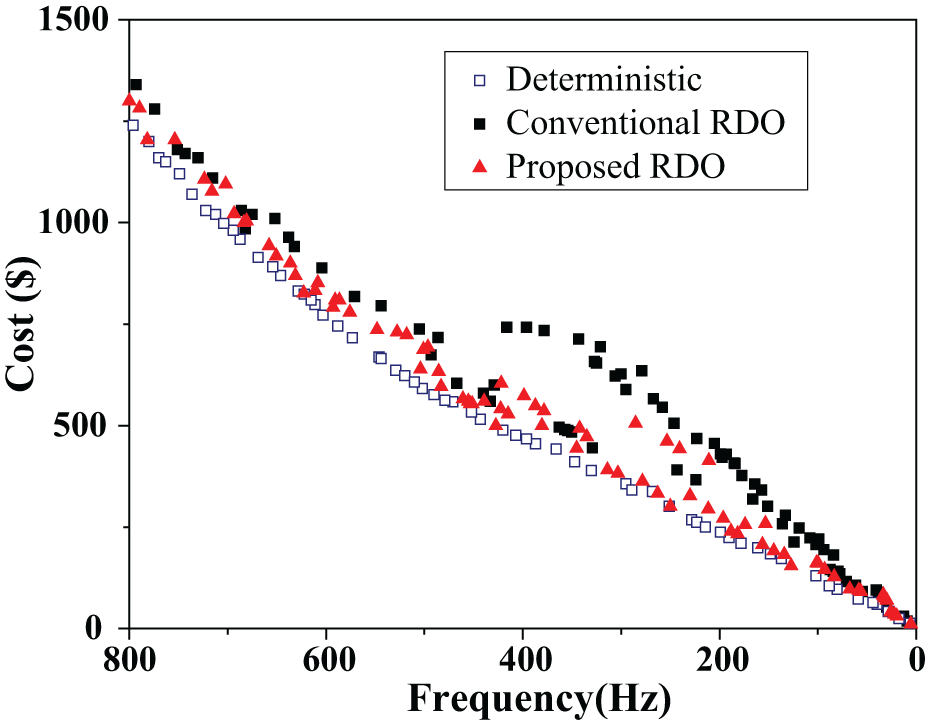
The Pareto front for cost and frequency of the platform (5% COV level in the DVs and 10% COV level in the DPs).
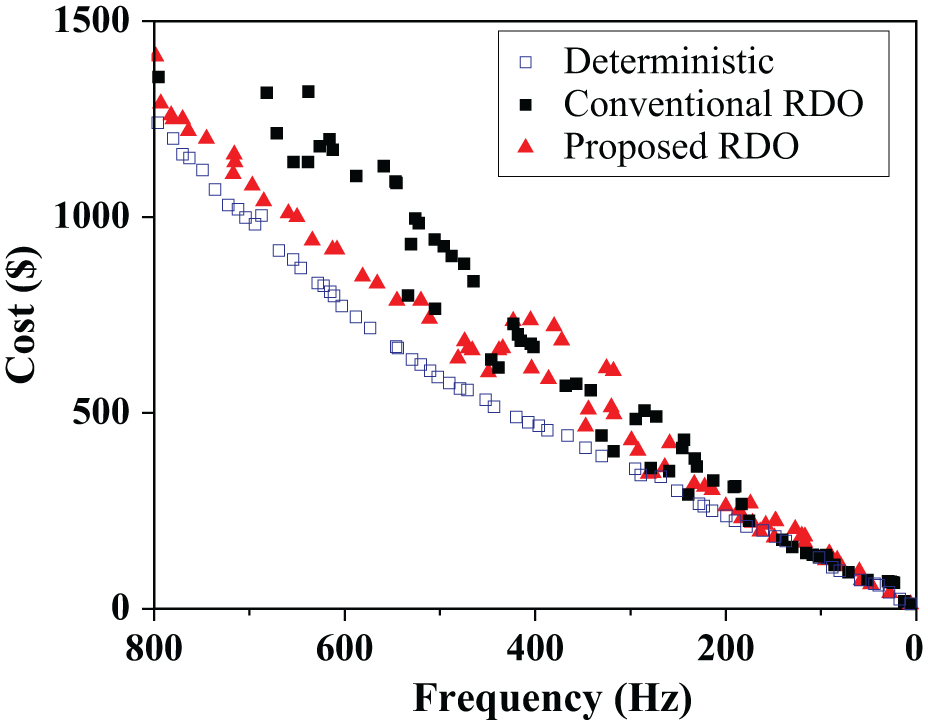
The Pareto front for cost and frequency of the platform (7.5% COV level in the DVs and 15% COV level in the DPs).
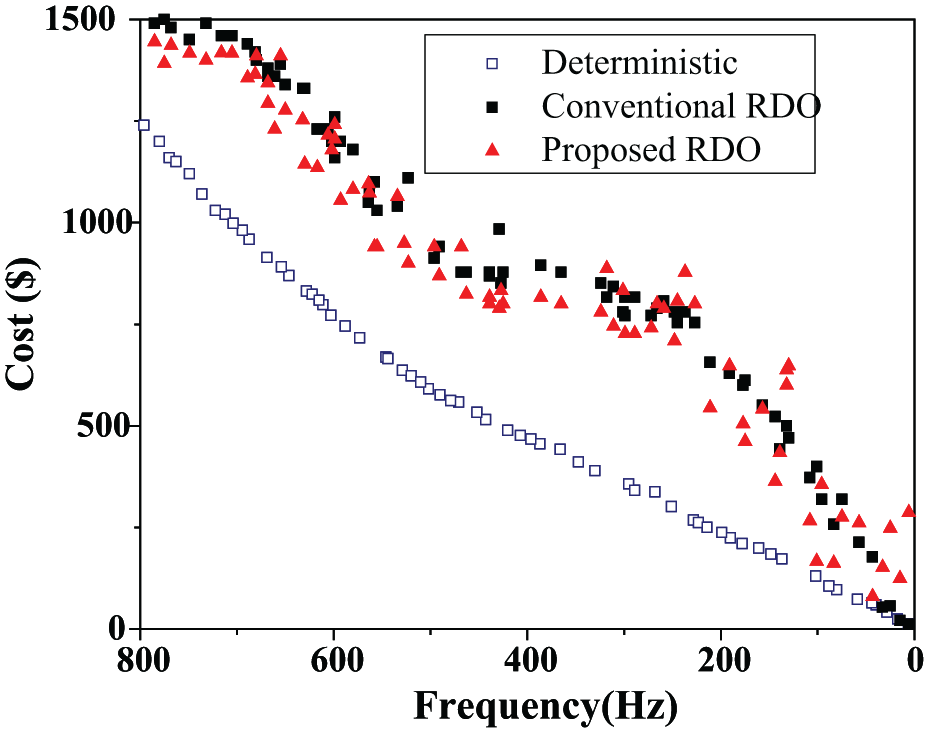
The Pareto front for cost and frequency of the platform (10% COV level in the DVs and 20% COV level in the DPs).
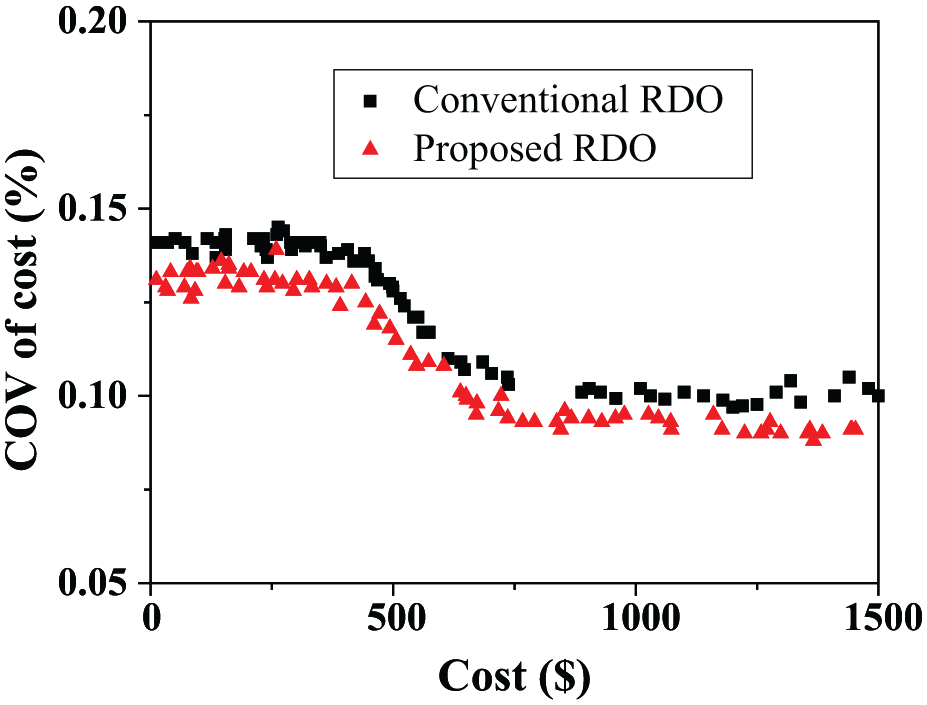
The Pareto front for cost and COV of cost of the platform (5% COV level in the DVs and 10% COV level in the DPs).
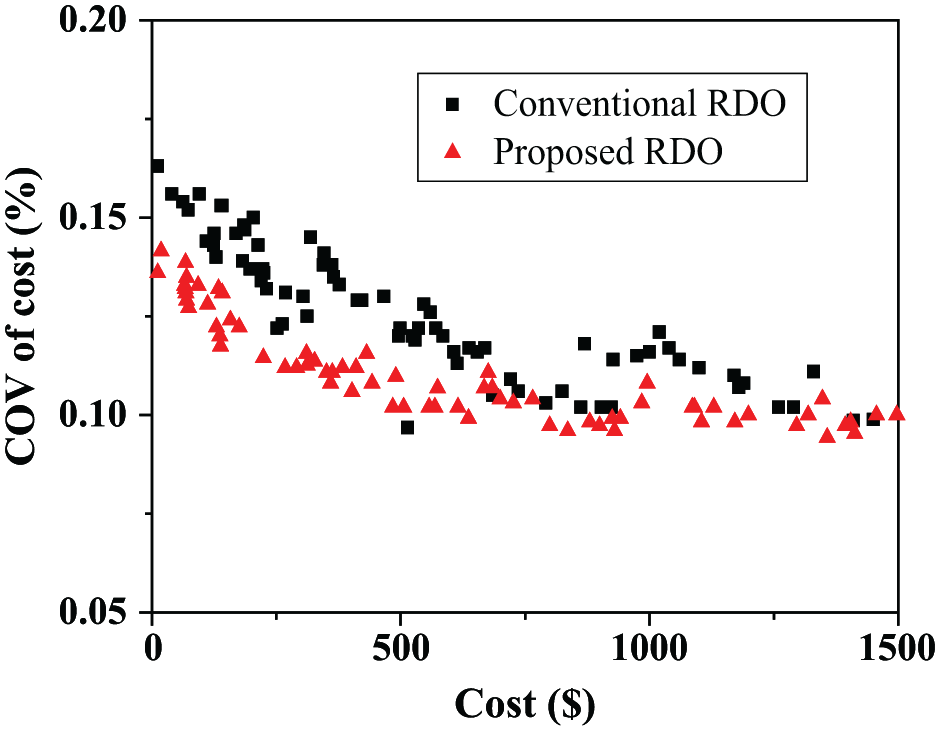
The Pareto front for cost and COV of cost of the platform (7.5% COV level in the DVs and 15% COV level in the DPs).
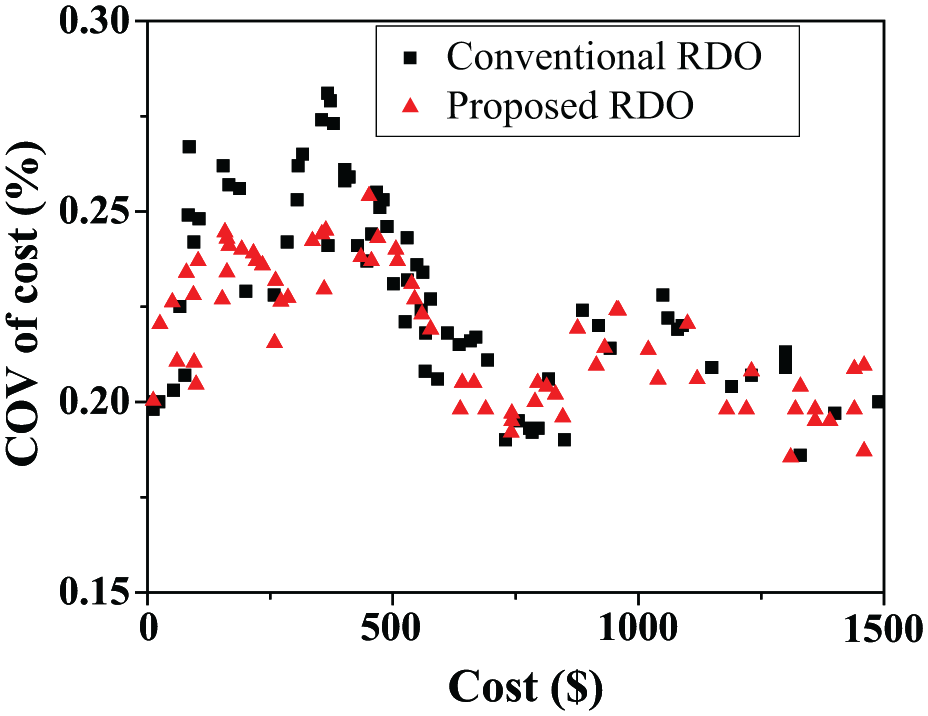
The Pareto front for cost and COV of cost of the platform (10% COV level in the DVs and 20% COV level in the DPs).
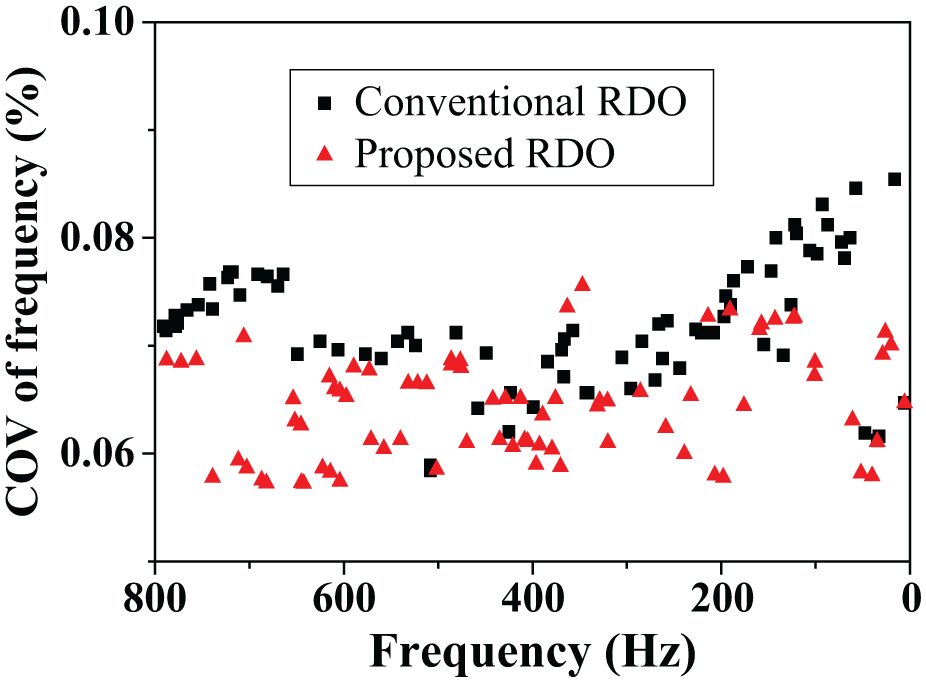
The Pareto front for frequency and COV of frequency of the platform (5% COV level in the DVs and 10% COV level in the DPs).
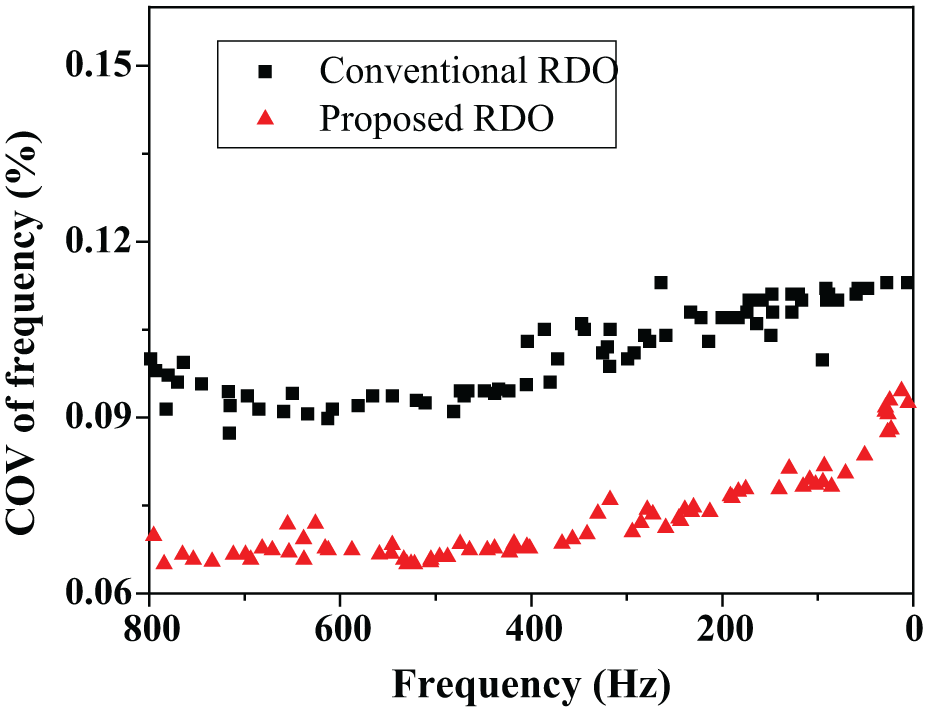
The Pareto front for frequency and COV of frequency of the platform (7.5% COV level in the DVs and 15% COV level in the DPs).
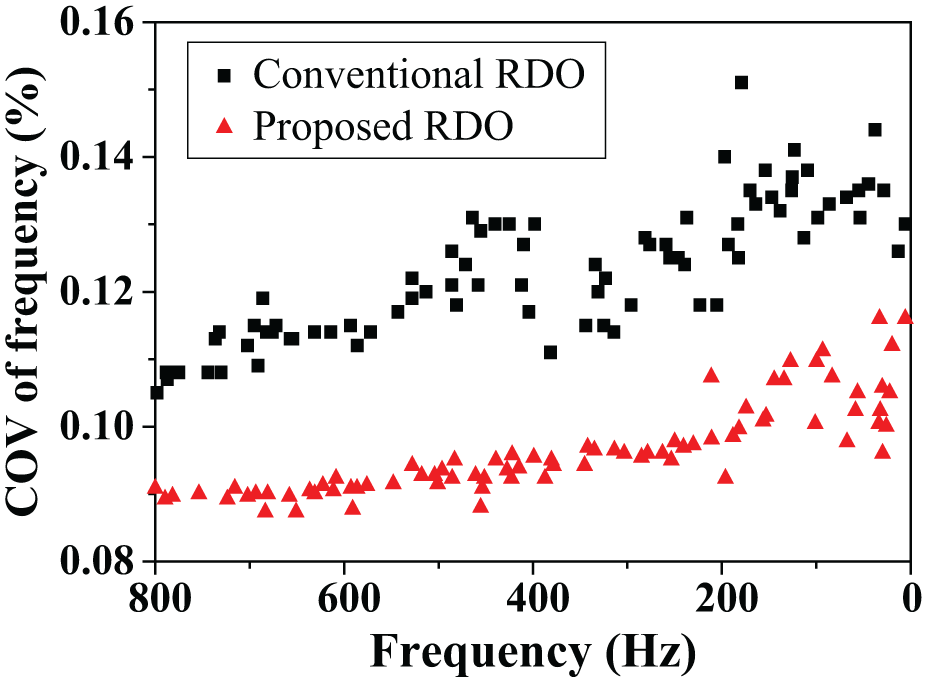
The Pareto front for frequency and COV of frequency of the platform (10% COV level in the DVs and 20% COV level in the DPs).
It is observed that as the system uncertainty level increases, the Pareto fronts get worsened, that is, more cost is needed for a prescribed frequency as might be seen from Figures 3 and 4 in comparison to Figure 2.
From Figures 2 to 4, it can be readily observed that the proposed RMOO method yields lesser cost for a particular frequency and higher frequency for a particular cost, that is, the proposed RMOO approach yields a better Pareto front than the conventional RMOO, both in terms of cost and frequency. For example, for 400-Hz frequency level, the cost required by the different approaches for different uncertainty levels are shown in Table 2. The deterministic approach requires the least cost, whereas as the uncertainty level is increased, as expected, the required cost is increased by both the approaches. This is true for other frequency values as well.
Comparison of cost by different approaches for 400-Hz frequency.
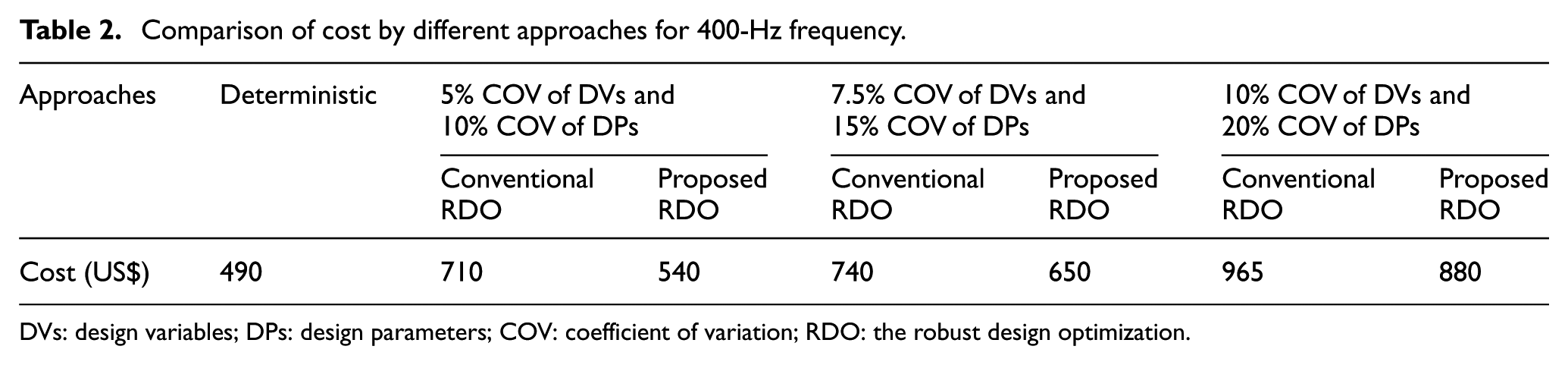
DVs: design variables; DPs: design parameters; COV: coefficient of variation; RDO: the robust design optimization.
It can also be observed from Figure 2 that when frequency and cost values of the designs are in the range of 50–100 Hz and US$25–US$125, respectively, the Pareto set by both the deterministic MOO and the proposed RMOO overlaps. The similar observations are also found in the study of Gunawan and Azarm (2005) as well. For making a selection of the final design, these overlap regions are good candidates. The designs in these ranges are not only insensitive to changes due to input uncertainty but also deterministically Pareto.
The variation of the cost and its associated COV are shown in Figures 5 to 7 for 10%, 15%, and 20% COV of the uncertain parameters, respectively, similar to Figures 4 to 6. These figures provide the robustness measure of cost (less COV of cost indicates more robustness), corresponding to a particular design (i.e. a particular set of cost and frequency) obtained from Figures 2–4. The implication of robust design can be easily conceived from these figures. In Figure 5, when the cost is in the range of US$600–US$1500, the COV of cost varies between 10% and 11% (i.e. it varies only by 1% for a change of US$900 cost) by the conventional approach and between 9% and 10% (i.e. again it varies only by 1% for a change of US$900 cost) by the proposed approach. Since, the COV of cost remains almost constant over such a wide range of cost, the robustness is attained by both the RMOO approaches. However, the proposed method yields more robustness which is clear from the lesser COV values of cost in Figure 5. The similar observations are also noted in Figures 6 and 7 for 15% and 20% uncertainty level in the uncertain parameters.
Figures 8 to 10 depicts the variation of frequency of the platform and the corresponding COV for 10%, 15%, and 20% COV level in the DPs, respectively. The COV of the DVs are considered to be the half of the COV of the DPs, as depicted in Table 1. The designer can have an idea about the robustness of frequency from these plots corresponding to the already chosen frequency from Figures 2 to 4, respectively. In Figure 8, the COV of frequency is found to vary in between 5% and 7.8% by the conventional approach and 3.5% and 7% by the proposed approach for a wide frequency range of 150–800 Hz. It is worth noting that the cumulative effect of nine DPs at 10% uncertainty level and three DVs at 5% uncertainty level can induce maximum 7.8% COV of frequency by the conventional RDO approach and maximum 7% COV of frequency by the proposed RDO approach. This endorses the fact that the design is less-sensitive to the input uncertainty. The proposed method yields more robust solution than the conventional method in all the uncertainty levels considered in the numerical study. However, it can be observed that the improvement in robustness is generally more for 15% and 20% uncertainty levels (see Figures 9 and 10) than for 10% uncertainty level (see Figure 8) in the uncertain parameters.
In general, it has been observed that the proposed RMOO method yields more economic and robust solution than the conventional RMOO. The number of function calls to yield the RDO solution is 8007, 9719, and 8643 by the deterministic MOO, the conventional RMOO, and the proposed RMOO, respectively, with 10% COV in the DVs and 20% COV in the DPs. The deterministic MOO takes least function calls as the sensitivity evaluations are not required by the deterministic RMOO. The conventional RMOO takes the highest function calls. The proposed RMOO requires lesser function calls than the conventional RMOO as the use of importance factors in the RMOO formulation imposes more weight to more sensitive parameters which helps the algorithm to find more robust solution by lesser number of optimization iteration. The same computational efficiency is observed for other uncertainty cases as well.
Conclusion
The multi-objective RDO of structure under uncertainty is studied. A new sensitivity-based RMOO approach is proposed to improve the robustness in design. The efficiency of the proposed approach is investigated by optimizing a vibrating platform for maximum frequency and minimum cost. The minimization of the associated standard deviation of the cost and the frequency are also treated as objective functions. Noting the limitations of the conventional WSM or ε-constraint method for solution of such MOO problems, NSGA-II has been adopted for solution. The improvement is achieved to yield more robustness in the optimization by making a design less-sensitive to the variation in the input variables compared to the conventional RMOO approach. Since all the variables are not equally important in capturing the presence of uncertainty, the more efficient Pareto front is captured by the present approach. The numerical study shows that the trend and the variations of the optimization results are in conformity with the conventional RMOO results indicating its potential over the conventional approach. The proposed RMOO approach provides improved robust designs more efficiently compared to the conventional RMOO approach. The numerical study is restricted to unconstrained optimization problem; however, it can easily be extended to constrained MOO problem. The approach being generic in nature can be applied to RDO of large complex systems as well. In fact, application of the proposed RDO in constrained MOO concerning with large-scale complex system is under consideration at this stage.
Footnotes
Declaration of Conflicting Interests
The author(s) declared no potential conflicts of interest with respect to the research, authorship, and/or publication of this article.
Funding
The author(s) received no financial support for the research, authorship, and/or publication of this article.