



Abstract
Considerable attention has been placed on the localised fire action in the structural fire safety engineering community. Localised fire action can be represented by a linear or exponential correlation between incident heat flux and radial distance. Society of Fire Protection Engineers proposes an exponential curve suitable for low fire load. Eurocode 1 suggests a combination of linear and exponential curves, which is suitable for high fire loads. This article discusses the feasibility of dimensional reduction for heat transfer analysis in structures subjected to realistic fires. The work has been presented to accurately estimate the error introduced by dimensional reduction under highly varying localised heat flux representative of the most non-uniform fire conditions in a building compartment. It is shown that beams and slabs can be adequately modelled with lower dimensional heat transfer analysis for most of the localised fire action.
Introduction
In the past decades, considerable attention has been directed to the field of structural fire safety engineering, where accurate modelling of the effect of fire on structural members is considered to be of fundamental importance. Furthermore, the modern built environment has undergone a transformation as architects have been favouring large open-plan column-free internal spaces. This is making traditional fire safety engineering approaches obsolete and there is increasing interest in performance-based engineering (PBE) in order to develop more scientifically robust solutions. In the past, it has been considered adequate to assume design fire scenarios, most often standard fires, that result in a spatially uniform gas temperature in the whole compartment, and heat fluxes to compartment boundaries and structural members are derived based on this assumption. Even when natural fires are used, such as the Eurocode 1 (EN 1991-1-2:2002, 2002) parametric fire, it produces a ventilation-controlled fire in the compartment also with a spatially uniform temperature at any instant of time. Stern-Gottfried et al. (2010) argue that the fire in a large enclosure is more likely to be controlled by fuel rather than by ventilation, which suggests that it could exhibit a localised character.
To examine the heat transfer and thermal response of structural components exposed to localised fires, many experimental and theoretical studies have been performed and correlations have been proposed for determining heat fluxes depending upon the distance to the fire origin. Research has established that the heat transfer from a flame to an adjacent surface or object is highly dependent upon the flame length. To quantitatively describe this correlation, it is suggested that the heat flux distribution can be represented as a function of the radial distance from the stagnation point (r) and the horizontal length of the flame beneath the ceiling
The commonly used assumption of uniform gas temperature in the compartment is very convenient from the point of view of simple and efficient modelling of heat transfer into the solid boundaries of the compartment and the structural members. The uniform temperature assumption allows the problem of heat transfer to be reduced from a three-dimensional (3D) problem to a two-dimensional (2D) problem for beams on ceilings and for any columns; and only a one-dimensional (1D) problem for floor and ceiling slabs and for walls. However, for spatially non-uniform and localised fires a full-blown 3D analysis seems to be unavoidable. This is not only computationally expensive but also makes the problem much more tedious for the analyst in terms of setting up full 3D models and meshing and therefore discourages the use of more realistic fires and PBE solutions. To overcome this problem, some researchers proposed alternative solutions, for example, it is suggested by Franssen et al. (2007) that a series of 2D analyses performed at various locations along the length could adequately describe the thermal response of a steel beam subjected to a localised fire. This idea could potentially also be extended to the heat transfer analysis of concrete slabs and walls, where a series of 1D analyses over the area of the slab or wall may be adequate as the temperature gradients parallel to the surface of the wall are likely to be much lower than the temperature gradients normal to the surface even for localised heat fluxes (hence heat transfer normal to the surface should remain dominant) Jeffers and Sotelino (2009, 2012); Jeffers (2013) developed an alternative approach to estimate the effect of localised heating using fibre based heat transfer elements, which allows along-length heat conduction in fibres and the section of structural members are discretised into a number of fibres for a frame member or layers for a slab to capture the heat conduction across the section. Increased computational efficiency has been shown via heat transfer analyses as well as structural analyses. However, this approach requires a significant time investment into programming heat transfer elements in existing software, and the section still needs to be modelled with many heat transfer nodes. This article attempts to investigate whether this effort is absolutely necessary, or the original suggestion by Franssen et al. (2007) of a simplified approach of dimensional reduction is adequate for most realistic fire scenarios expected in compartments of modern buildings. A quantitative measure of the errors of heat transfer analyses of members subjected to localised fires is presented to show conclusively for the first time that even in such severe cases, it is unnecessary to run full 3D heat transfer analysis for engineering design purposes. This conclusion had been shown to be valid for linear, quadratic or exponential heat flux distributions along exposed surfaces, which represent all of the usual assumptions of heat flux distributions along surfaces expose to localised fires. Idealised linear, quadratic and exponential heat flux distributions are applied to steel strips and concrete blocks for generating quantitative comparisons between dimensional reduction and full 3D heat transfer analyses. These analyses as well as further heat transfer analyses of the beams and slabs subjected to EC1 localised fires show that it is reasonable to use the approximation of dimensional reduction for continuous distribution of input heat fluxes even when the gradients are severe, such as in localised fires.
The authors also have other reasons that motivate them to investigate whether a dimensional reduction approach is feasible. An integrated computational tool for automated modelling of structures in fire is currently under development based on the open-source software framework OpenSees (McKenna et al., 2000; Usmani et al., 2012). This tool will enable engineers to use a single software for setting up realistic fire scenarios with spatially non-uniform fluxes on compartment boundaries, determine the temperature evolution in the structural members over the whole duration of fire including cooling and determine the fully non-linear mechanical response of the structure. All of this will be done without analyst effort, except at the problem setting up stage. The software will use efficient beam-column and shell elements for modelling the structure and only 2D and 1D heat transfer analyses for enabling large models to be run cheaply and quickly, thereby greatly facilitating more widespread take-up of PBE approaches. This computational tool will also be useful for researchers who will be able to run large structural model under a large range of realistic fire scenarios (including localised (EN 1991-1-2:2002, 2002) and travelling fires (Stern-Gottfried and Rein, 2012a, 2012b)), thereby producing greater insights into the nature of the fire hazard in buildings and the resilience of modern architecture and structural systems to such realistic fires. The natural progression beyond this would involve using this efficient tool to explicitly account for uncertainties by integrating a probabilistic analysis layer (this already exists within the OpenSees framework). To bring this vision to fruition, it is essential to investigate the feasibility of dimensional reduction for heat transfer analysis in structures subjected to realistic fires. The key aim of this article is to accurately estimate the error induced by dimensional reduction under highly varying localised heat fluxes representative of the most non-uniform fire conditions in a building compartment, excluding hydrocarbon or jet fires.
Localised fire action
Based on historical research on localised fires for developing correlations between heat fluxes and the distance to the fire origin, a number of empirical models have been proposed, such as the ceiling localised fire model in EN 1991-1-2:2002 (2002) and the correlations for a beam underneath the ceiling as shown in Figure 1 suggested in the SFPE Handbook (Lattimer, 2002) which are based on a number of tests (Hasemi et al., 1996; Pchelintsev et al., 1997; Wakamatsu et al., 2003; Wakamatsu and Hasemi, 1988). A slightly modified model using different plateau and exponential decay was adopted by Jeffers and Sotelino (2012).

Localised fire impinging on a beam underneath the ceiling.
Eurocode 1 localised fire model
For localised fires impinging on the ceiling, the Eurocode 1 localised fire model recommends the correlations between heat flux and radial distance as



where

In the above equation,


where
SFPE fire model for beams underneath ceiling
Derived from (Wakamatsu et al., 2003) tests, a model is specified in SFPE hand book to account for the shield effect of steel beams when localised fires occur underneath it. Basically, here the flame tip lengths are quantified for the beam lower flange


where



where the highest heat flux occurs at the downward face of the lower flange (DLF) as defined in equation (6a), and equation (6b) is used for the upward face of the lower flange (ULF) and the web. Heat fluxes at the downward face of the upper flange (DUF) are recommended as equation (6c). In these equations,
In Figure 2, heat flux distributions defined in the EC1 and SFPE localised fire models have been plotted, where the HRR

Localised heat flux defined in EC1 and SFPE localised fire models.
Idealisation of localised heating
Observing the above localised fire models, they are always expressed as a combination of one or more idealised correlations (e.g. see Figure 3) between localised heat flux and the distance from fire origin. When an idealised flux distribution varies sharply along the length of a structural member, the influence of conduction within the body of the structural member perpendicular to the incident flux on the surface may become significant. It is, therefore, necessary to select a few idealised distributions to quantify the longitudinal heat flow in the structural members, which have been detailed in Figure 3.
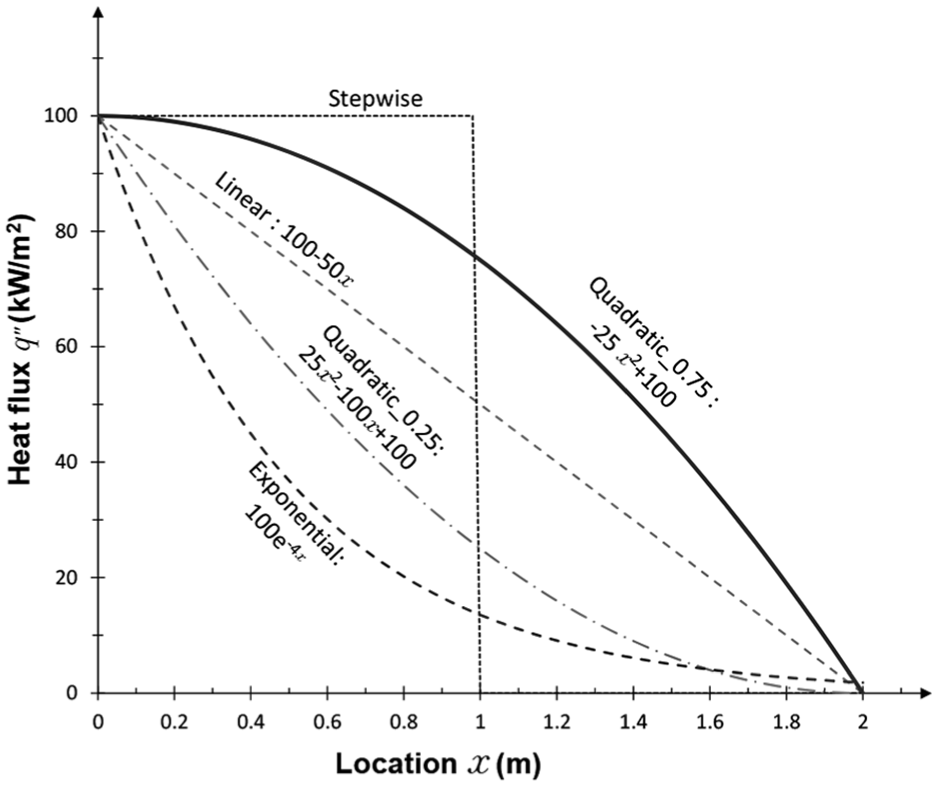
Idealised heat flux distributions.
The idealised distributions showing a linear and exponential decay represent the most common heat flux variations in recommended localised fire models. A discontinuous heat flux distribution will be used as an extreme limiting case. In addition to these three cases, two quadratic distributions are used to ensure that a full range of possible heat flux distributions is accounted for and that the conclusions from the study are robust.
Effect of horizontal heat flow caused by localised heating
Dimensionally reduced heat transfer analysis
When considering heat transfer into structural members subjected to localised fire action, it is an intuitive assumption that a full 3D heat transfer analysis is required for accurate resolution of temperatures. However, the premise of this article is that the error introduced using 2D or 1D (where appropriate) models may be adequate in the context of most building fires of practical interest. This has been depicted in Figure 4, where schemes of dimensional reduction are applied to beams and slabs.

Dimensionally reduced scheme for heat transfer in localised fire: (a) 3D to 2D analyses for beams and (b) 3D to 1D analyses for slabs.
Feasibility of dimensional reduction relies on whether the effect of horizontal heat transfer can be neglected as an engineering approximation. Considering that beam section dimensions are much smaller than its length and the slab subjected to a localised fire can be treated as an axisymmetric problem of heat transfer, it is appropriate to use 2D blocks as generic models to investigate the effect of horizontal heat flow as depicted in Figure 5. Whether it is possible to implement dimensional reduction depends upon the magnitude of unbalanced heat fluxes on either sides of the section, which is the gradient of horizontal heat flux along the length.

Heat flow in structural members subjected to localised fire action.
Two rectangular blocks representing concrete and steel structural members are shown in Figure 6. The steel block, representing the flange or web of a steel beam, is assumed to experience fire exposure on a single face from the localised heat flux and with no heat loss at the unexposed surfaces. The concrete block also experiences one-sided fire exposure, but it is assumed to lose heat through convection and radiation to the ambient air from both the upper and lower faces. Both blocks are 2 m in length. The depth or thickness of the concrete block is 100 mm and that of the steel block is 10 mm. The material properties for the steel block are defined as BS EN 1993-1-2:2005 (2005) corresponding to carbon steel, while concrete has been defined according to BS EN 1992-1-2:2004 (2004) for normal weight siliceous concrete with zero moisture ratio. To investigate the error caused by dimensional reduction, the results from 2D heat transfer analyses of the blocks are compared with 1D analyses at various section locations along the length of the block. The error is normalised as


Configuration of 2D blocks investigating effect of localised heat flux: (a) steel block with single exposure only and (b) concrete block with exposure and heat loss to the ambient.
Using the above models, the feasibility of dimensional reduction will be investigated for a range of heat flux patterns, material properties and duration of the exposure.
Implementation of localised heating
For the downward faces of blocks, localised heat fluxes are applied with the convective heat transfer co-efficient
The contour plots of the temperature profile after a 30-min exposure to a number of localised heat fluxes are presented in Figure 7. The upper part represents a steel block while the lower part represents a concrete block. As expected, the discontinuous flux produces the most abrupt transition of temperatures while the blocks subjected to linear and exponential distributions of incident heat flux produces much smother transitions. The heated region in the concrete block is concentrated close to the exposed face, again according to expectations, with a significant thermal gradient establishing through the depth for the member.
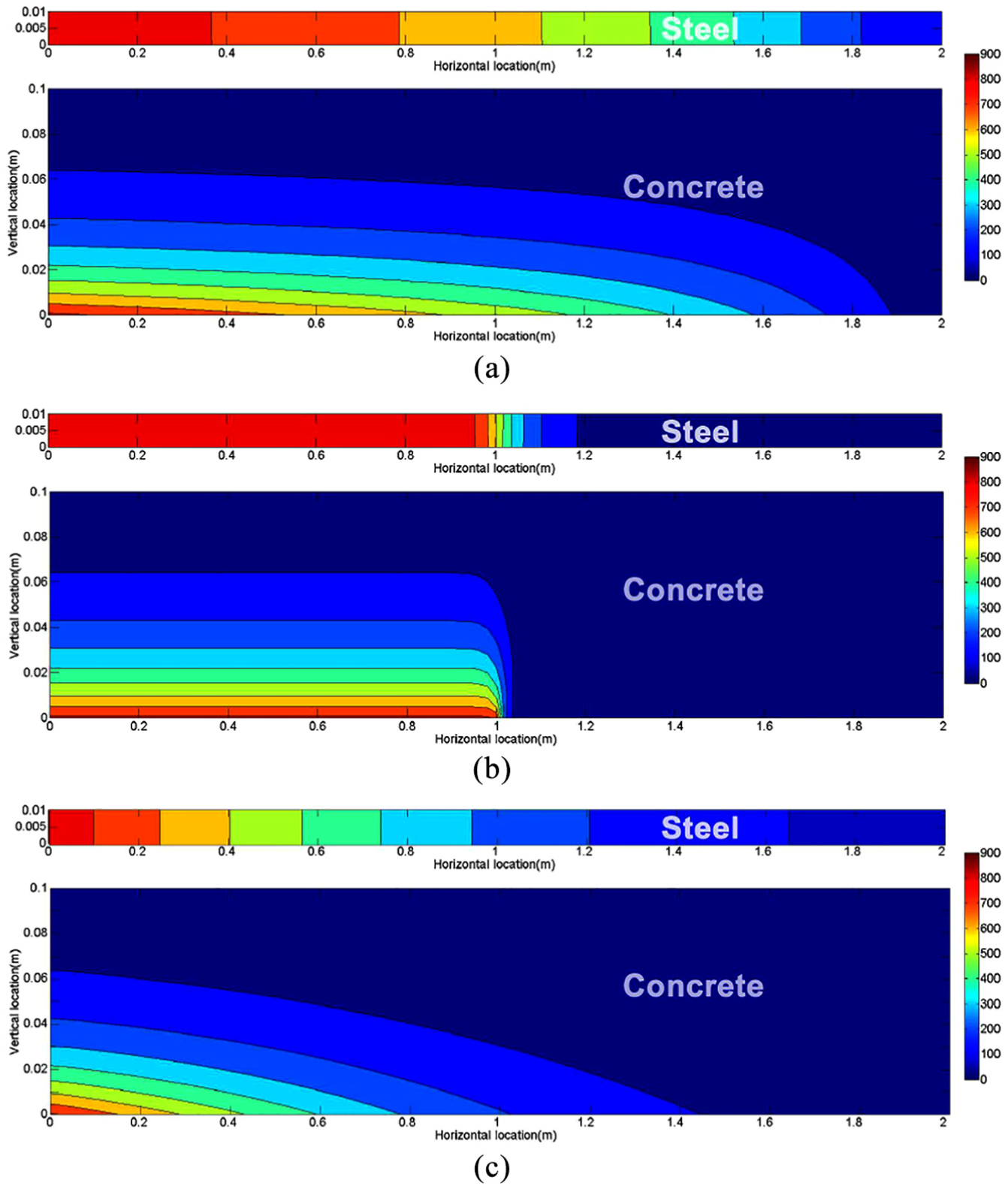
Thermal response to the idealised heat flux input: (a) linear, (b) discontinuous and (c) exponential.
Heat transfer analyses presented in this article are conducted using OpenSees. The heat transfer module developed in OpenSees has undergone validation against analytical solutions as well as experimental results (Jiang, 2012; Jiang et al., 2011). For this article, OpenSees analyses are compared with ABAQUS (2002) analyses of heat transfer in a steel block and a concrete block subjected to localised heat flux exposure, as presented in Figure 8. The comparison is made in regard to exponential heat flux distributions, where the results show that the two software produce nearly identical temperature distribution.
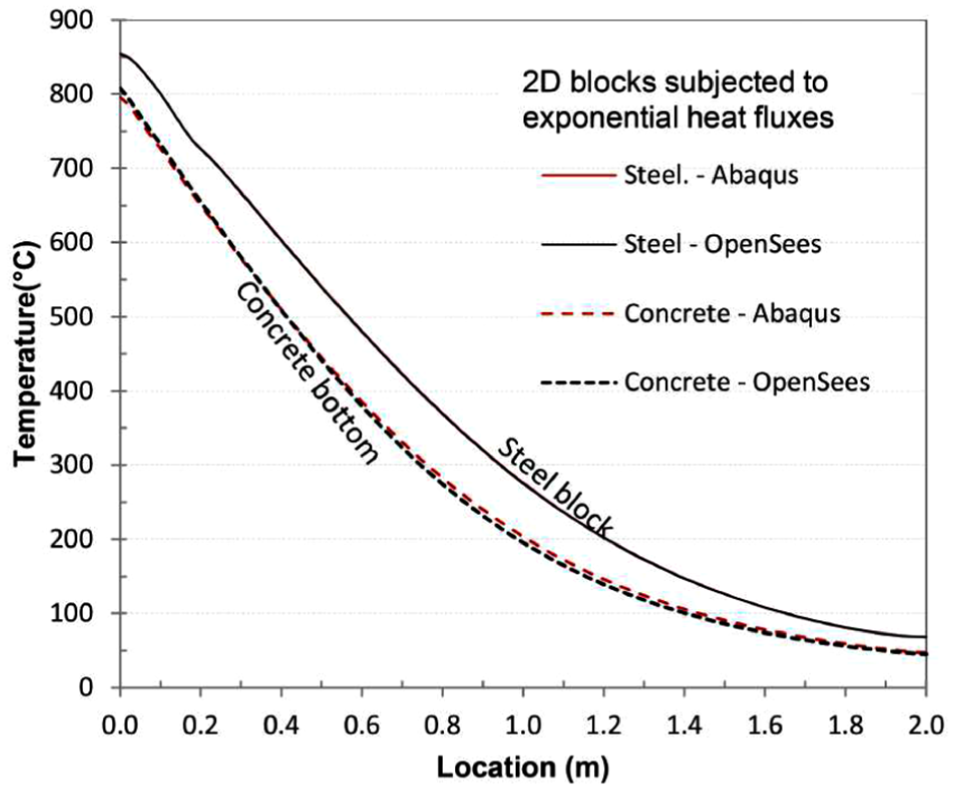
OpenSees/ABAQUS results of heat transfer analyses for localised heating.
Error analysis of dimensionally reduced heat transfer analyses
The normalised errors, as defined in equation (7), are plotted for the steel block subjected to various heat flux patterns as shown in Figure 9(a). The discontinuous heat flux produces the greatest errors as expected compared to the 2D analysis. Despite that this is an artificial situation and cannot really occur in practice, it is interesting to note that even for this extreme situation the error on the hotter left-hand side rapidly decays to being negligible, while the error on the right-hand side does not have practical significance as the temperatures are too low. The next highest error occurs for the quadratic

Temperature difference between 2D and reduced 1D analyses: (a) in steel block, (b) top surface of concrete block and (c) bottom surface of concrete block.
The normalised errors are also examined for the concrete block. The errors at the top surface of the concrete block are plotted in Figure 9(b) while those at the bottom surface are presented in Figure 9(c). The greatest error as usual appears in the case of the discontinuous distribution. It is also apparent that the rest of the distributions all produce an error at the right-hand end as observed from the response of the steel block, and this effect is more severe at the bottom surface. Even though the highest value of normalised error is approximately
Obviously, thermal conductivities of structural materials and duration of localised exposure are key factors leading to the errors in dimensionally reduced heat transfer analyses. For the extreme case that discontinuous heat fluxes are applied, the transition from the hot left portion of the steel block to the cool right portion is shown in Figure 10, which reflects the heat conduction in the longitudinal direction that is dependent upon the thermal conductivity of the material and the duration of exposure. A simple numerical test presented here is performed by varying these factors. From the simulated transitions illustrated in Figure 10, it can be observed that the discontinuous distribution is smoothed-out considerably as the thermal conductivity is increased to values nearly 10 times that of carbon steel. Figure 10 also shows different temperature distributions at different durations of discontinuous heating. After 30 min, thermal response reaches a steady state in the steel blocks when Eurocode 3 material is adopted. It should be noted that the heat loss from the unheated part is dominated by the convective co-efficient chosen according to Eurocode 1, whereas convective fluxes in reality are significantly affected by the air mobility next to the surface.

Thermal conductivity and time effect in the HT analyses with discontinuous heat flux action.
In the case of continuously decaying incident heat fluxes using idealised curves, the magnitudes of heat flow along the length of the steel block are much lower in comparison to the discontinuous case, as shown in Figure 11, where the horizontal heat fluxes have been non-dimensionalised against the peak incident heat flux (100 kW m−2). For linear and quadratic
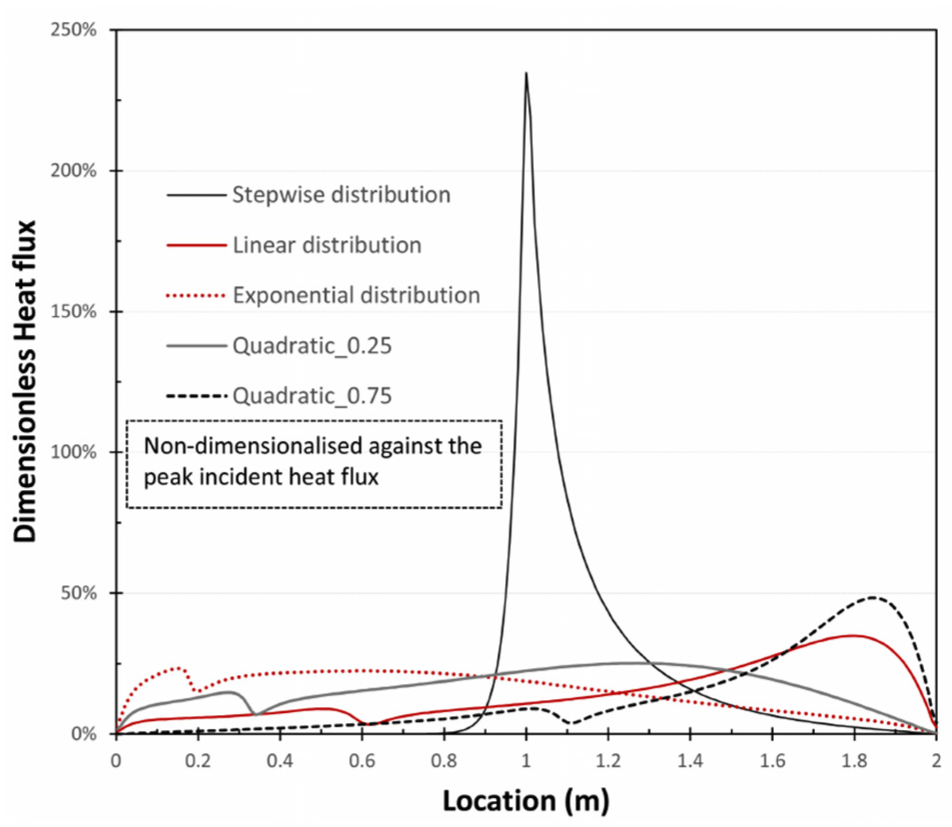
Non-dimensionalised horizontal heat fluxes in steel blocks subjected to different types of localised heating.
Dimensional reduction considering the effect of passive fire protection
Spray-applied fire resistive material protected steel block subjected to localised fire action
The passive fire protection is assumed to be a thermal barrier of specified thickness, such as a spray-applied fire resistive material (SFRM). As a type of passive fire protection, SFRM has been widely used to insulate the steel members from direct exposure to fire (Dwaikat and Kodur, 2011), with unique properties such as light weight and low thermal conductivity. However, as pointed out by Kodur and Shakya (2013), there is precious little public-domain information available on the thermal properties of SFRM. The work reported by Franssen et al. (2007) adopted a hypothetical material to represent passive fire protection, of thermal conductivity
Temperature increase in SFRM coated steel plate can be significantly delayed using passive fire protection. When localised heat fluxes are applied underneath the SFRM coated steel plate, the heat transfer results generated by 1D analyses and 2D analysis have been shown in Figure 12, where the thermal response is examined with respect to the linear and exponential distributions of incident heat fluxes. After 30 min of localised heating, temperatures of steel plate are significantly lower compared to the previously conducted analyses on the unprotected steel block. Despite the inhibited thermal response, variation along the length is still observed. The dimensionally reduced heat transfer analyses are also performed at a number of sections (20 sections), which indicates that the dimensionally reduced approach is able to predict the thermal response of the SFRM insulated steel block with an acceptable accuracy at most of the sections. For a linear decay of heat flux input, the largest error occurs at the right cool end as 30.6% (normalised). Moreover, the largest error for an exponential distribution of heat fluxes appears at the hot end (6.74%), with an accurate prediction in the region ranging from 0.2 to 2.0 m. These end errors are caused by unbalanced heat flow from hot area to cool area near the ends, which are related to the gradient of heat flux decay.
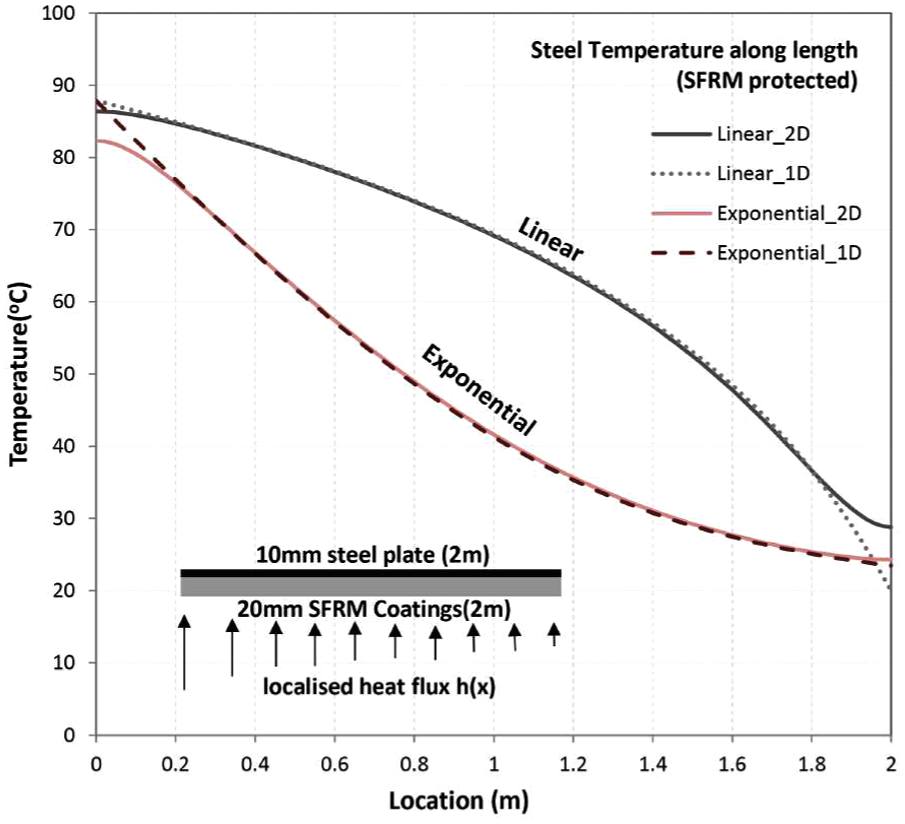
Thermal response of fully protected steel plate subjected to localised distributed heat fluxes.
Localised heating due to partially damaged fire protection
It has been observed and studied about the peeling off of SFRM coating due to large deformation of the steel plates (Chen et al., 2015; Dwaikat and Kodur, 2011). To address the partial damage of SFRM protection, some research deliberately removed a block of SFRM coatings at the end of the member (Wang and Li, 2009). This of course leads to another extreme case of localised heating where the feasibility of the dimensionally reduced heat transfer analyses can be questioned.
As shown in Figure 13, the 2-m-long, 10-mm-thick steel block is partially covered by a 1.6 m × 20 mm-thick SFRM layer, with 0.4-m-long region left unprotected. Heat transfer analyses are performed to model the thermal response of the steel block, with the fire placed underneath the plate. Uniform fire action represented by standard fire curve is first applied with various duration of exposure. Noted that the left part of unprotected steel block is identical to the unprotected case or the 1D heat transfer prediction. The temperatures start to decrease rapidly at the location of 0.3 m to the left end, and the downward gradient declines after entering in the protected region. In the large part of the area near the right-hand end, temperatures are the same as 1D results of insulated steel block. For fire actions lasting for 15, 30, 60 and 120 min, the maximum temperatures in the unprotected region rise to 564°C, 766°C, 938°C and 1002°C, respectively. In the protected region, the temperatures of insulated steel only reach 34°C, 70°C, 151°C and 302°C for 15, 30, 60, and 120 min period of exposure, respectively. From the maximum to the minimum temperature, a transition area exists from 0.2 to 1.2 m, which suggests that the dimensional reduction may not be appropriate to use here or requires a polynomial interpolation to approximate the temperature distribution.
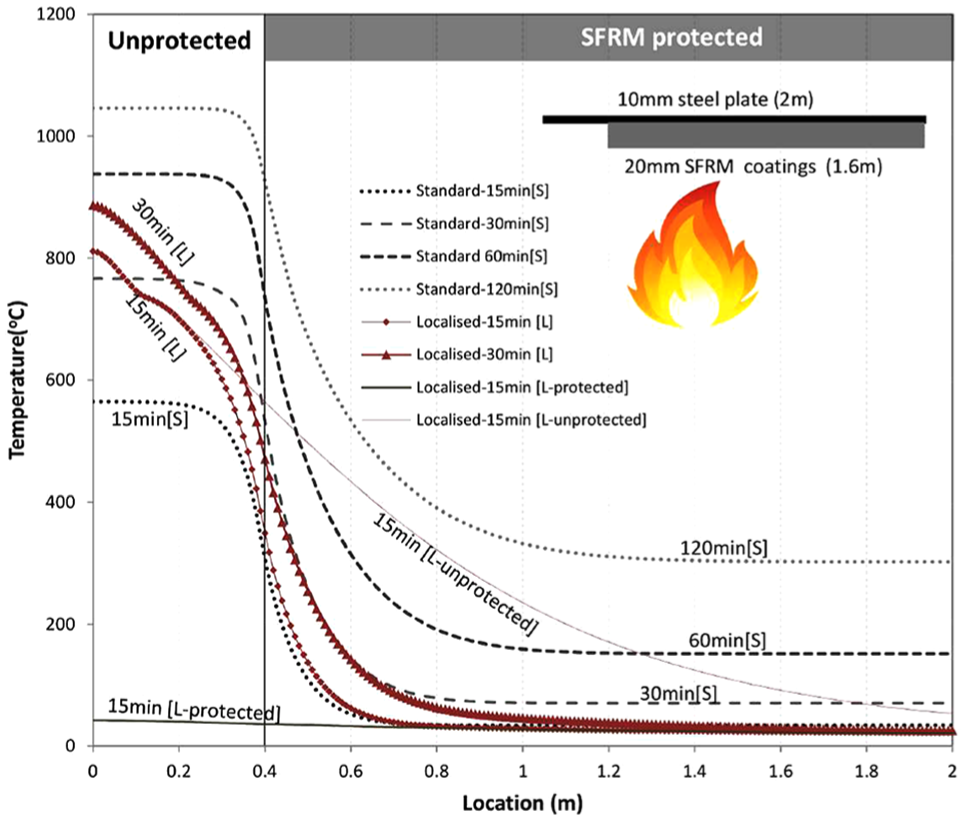
Thermal response of partially protected steel plate.
Heat fluxes distributed in an exponential pattern (as used before) is applied to the partially protected steel block as well, where the thermal responses to 15 and 30 min have been illustrated in Figure 13. A dramatic decay is seen in the unprotected part which is a combined action of the localised heat flux and partial SFRM protection. Comparing with the thermal responses of the totally unprotected and protected steel block, the temperature profiles are identical from 0 to 0.2 m and then differ due to the heat conduction from intensely heated area to the protected part. Therefore, the transition area in this case ranges from 0.2 to 0.8 m if the localised heating lasts for 15 min.
Comparison between 1D or 2D sectional and full 3D analysis of structural members in localised fires
In this section, an unprotected hot-rolled steel I-beam is subjected to heat flux distributions from the most commonly used localised fire models discussed earlier in the article. The beam is assumed to have a perfectly insulated top surface (top surface of the upper flange), while all the other faces of the beam section are subjected to the specified heat fluxes. The hypothetical boundary condition for the top surface represents a limiting case of heat exchange between the steel beam and the superstructure it supports. Conversely, perfect contact is assumed in the analysis of a steel and concrete composite beam discussed in section ‘Composite beams subjected to localised fires’, which allows free exchange of heat through the steel-concrete interface.
Steel beams subjected to localised fires
When the localised fire has a low HRR (<2 MW), the SFPE model must be used for considering the various flame tip lengths on the beam assembly. A localised fire of HRR = 1 MW and the fire source diameter of 0.5 m is assumed, and the distribution of input heat fluxes refers to Figure 2. A number of beams of different cross sections are investigated to determine the effect of dimensional reduction from 3D to 2D. The distribution of normalised error in averaged flange and web temperatures along the beam length is presented in Figure 14, for a

2D/3D temperature difference in a steel beam subjected to SFPE localised fire.
When the HRR of the fire source exceeds 2 MW, the variation of the flame tip length due to the shielding effect of the beam flange can be ignored. In this case the Eurocode 1, localised fire is appropriate for estimating the heat flux received by the exposed structural surfaces. A number of steel beams are subjected to the Eurocode 1 localised fire to examine the temperature difference between 2D and full 3D models at the selected section locations. The boundary conditions are identical to the analysis in the previous section and in accordance with EN 1991-1-2. A wide range of British universal beam sections are examined using the normalised error in the average temperature of the lower flange along the beam length as shown in Figure 15. The maximum error is again observed at the cooler end, approximately
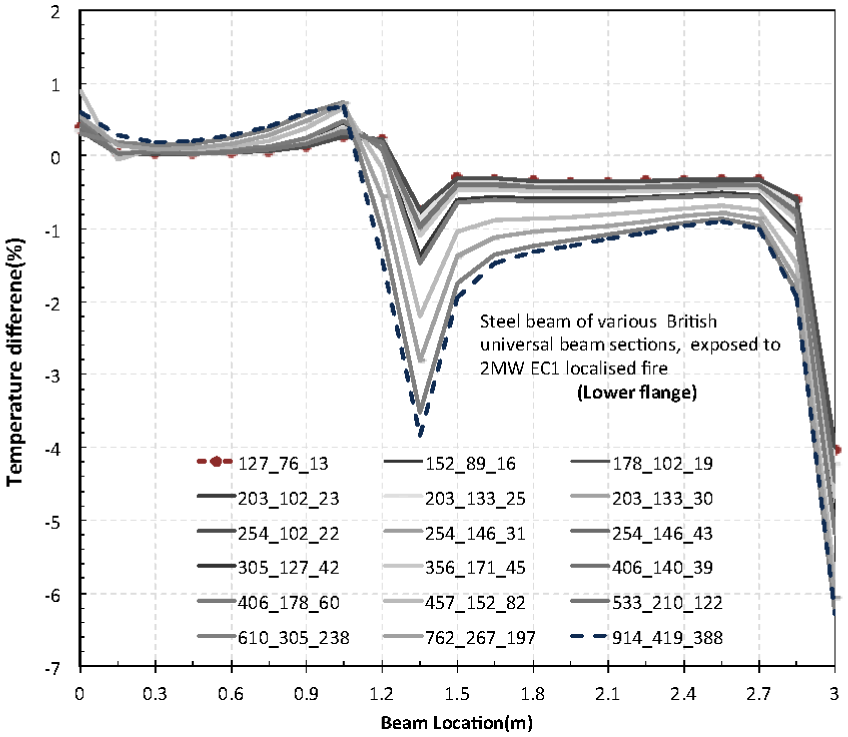
2D/3D temperature difference at the lower flange of steel beams of various cross sections.
Composite beams subjected to localised fires
Complementary to the single-beam analyses in the previous section, a composite beam is analysed here to examine the effect of heat transfer from the steel beam to a composite concrete slab. The interface between the steel and concrete is considered to be in perfect contact (a limiting case opposite to the a fully insulated top flange considered in the previous section). The assumed interface condition allows free heat exchange between the steel beam and concrete slab which behaves as a heat sink. During the exposure, the top surface of the concrete slab is treated as unexposed but with convection and radiation to the ambient air (heat transfer coefficients are adopted as previously mentioned). The composite beam has also been examined in terms of various British universal I-beam sections, under a 30-min exposure to a 2-MW Eurocode 1 localised fire. The concrete slab is assumed to be 100-mm deep with a width of 600 mm. Over the period of fire exposure, the bottom face of the slab is exposed to the localised fire except for the area shielded by the steel beam.
As the slab absorbs the heat from the composite steel beam, the top flange has a significantly lower temperature than the bottom flange and the web. Heat transfer to the composite beam subjected to uniform gas temperatures has been studied in the referenced work (Jiang, 2012; Lamont et al., 2001). Even in a localised fire, a similar temperature distribution can be observed. The temperature distributions in the beam section UB
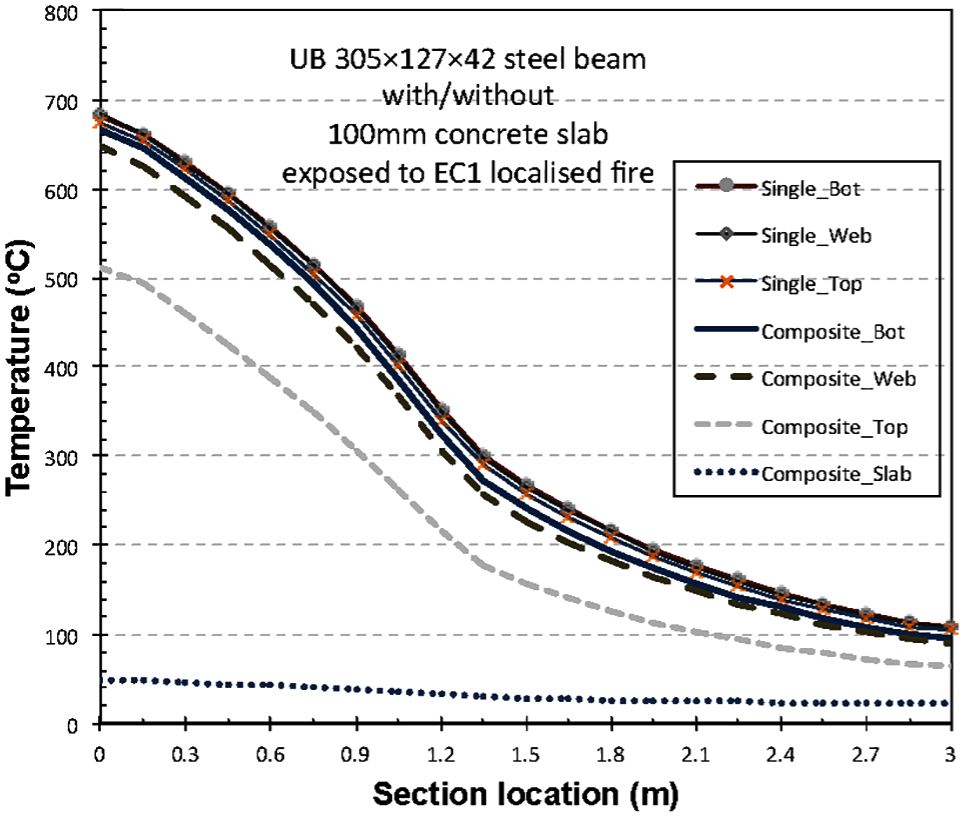
Temperature distribution in the single steel beam and corresponding composite beam.
As the bottom flange and web of the steel beam are less affected by the heat transfer to the slab compared to the top flange, the normalised error in the upper flange of the composite beam is plotted in Figure 17 along the beam length. The end effects and the discrepancy at the transition from linear to exponential curves are reflected in the plot as discussed earlier. The largest difference reaches 4.5% at the cool end of the beam for the
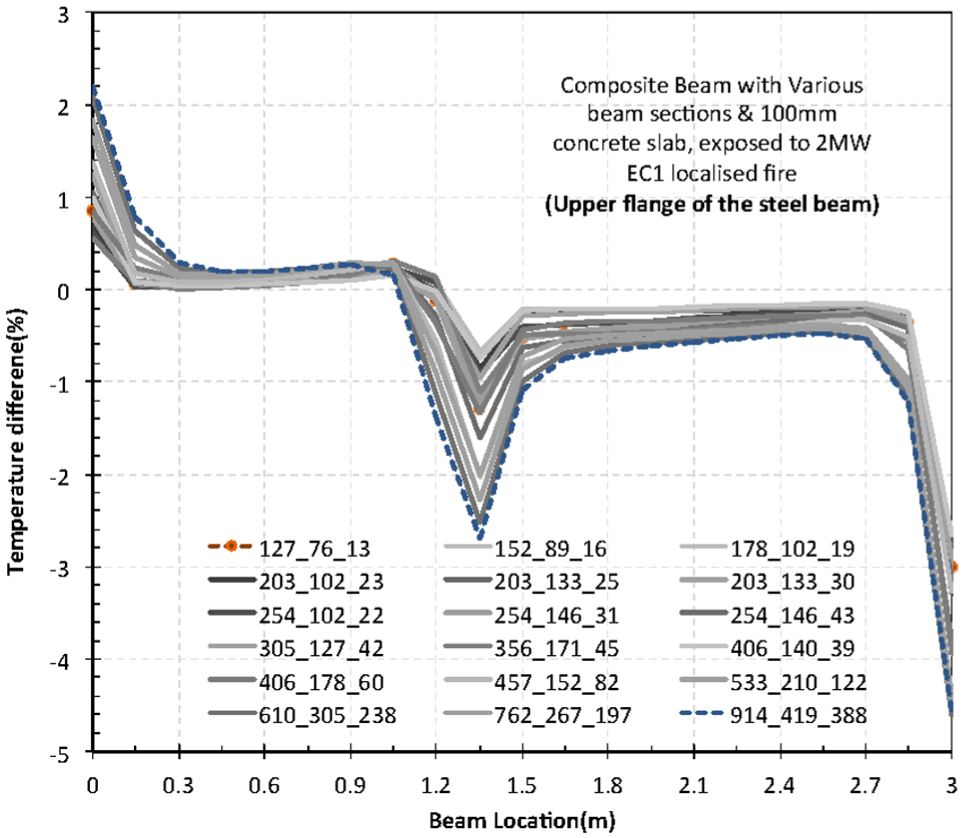
2D/3D temperature difference at the upper flange of composite beams of various cross sections.
Concrete slabs in localised fires
Given the considerably low thermal conductivity of concrete, it may be adequate to determine the temperature evolution of slabs in localised fires simply by a series of 1D heat transfer analyses over the depth of the slab for a number of points over the exposed area. In this section, a 3 m × 3 m × 0.1 m concrete slab is analysed against a Eurocode 1 localised fire action exploiting symmetry on two sides (therefore, one corner of the model is exposed to the peak heat flux). Similar to the previous models, the net incident flux is applied and the top surface of the slab loses heat by convection and radiation to the ambient air.
Figure 18 shows the temperature distribution from the doubly symmetric 3D slab model as a result of the localised 2-MW Eurocode 1 fire (D = 1 m). The plotted temperature profile shows the bottom surface temperatures. In order to examine the difference between the 3D simulation and 1D analyses, a number of points are chosen along the diagonal joining the point of peak flux to the coolest point opposite. The normalised errors are plotted along the path for the bottom and top surfaces and the mid-depth of the slab, as shown in Figure 19.
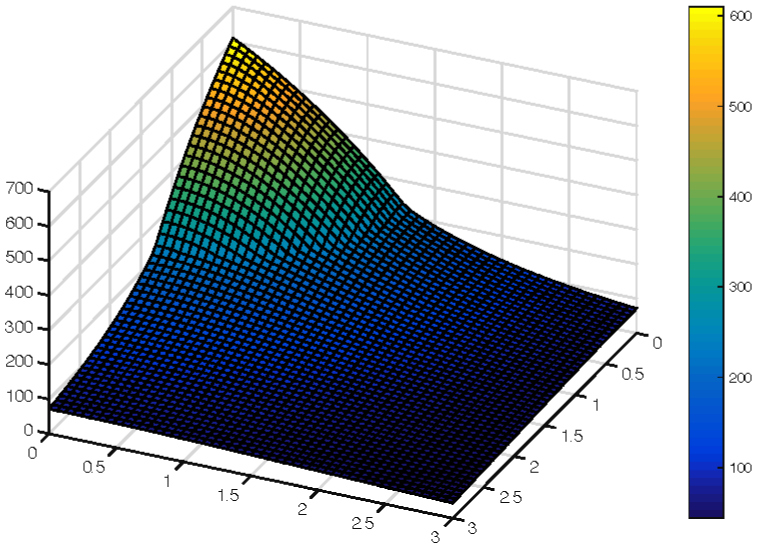
Thermal response of 0.1-m-thick concrete slab subjected to 2-MW EC1 localised fire.
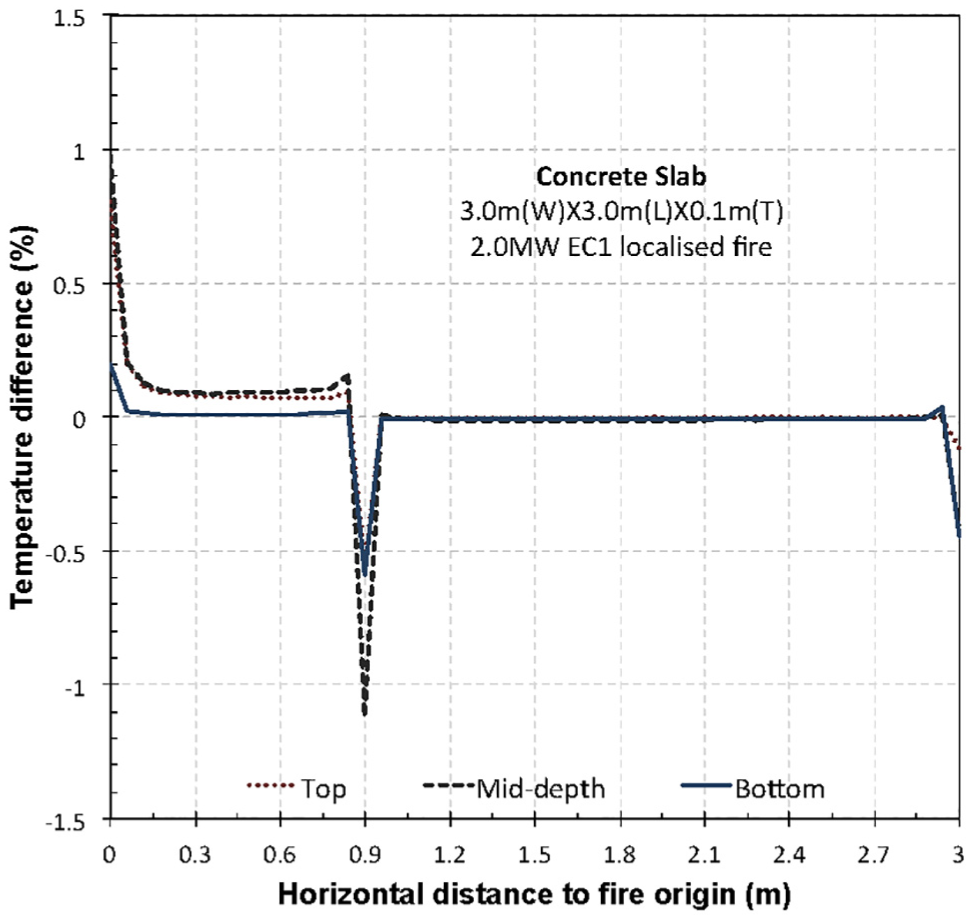
1D/3D temperature difference along the diagonal path in the slab subjected to 2 MW localised fire.
The error plot has presented a behaviour similar to that observed in the previous, small errors at the ends and at the transition from linear to exponential distribution. The absolute temperatures are practically identical from 1D to 3D heat transfer analyses as clearly seen in Figure 19. The normalised error does not exceed 1.2%, which appears in the transition area and is negligible for practical purposes.
Figure 20 shows the thermal response of concrete slab to a smaller Eurocode 1 localised fire of 1-MW HRR for a 1-m diameter burner. This fire shows a more intense decay compared to the 2-MW fire, causing an observable increase in normalised error at the corner, which reaches 3% at the top surface and the mid-depth layer. However, the difference at the bottom surface remains relatively low (around 1%).

Temperature difference from 1D/3D analyses with 1-MW EC1 local fire applied.
Conclusion
A set of comprehensive analyses have been carried out to determine the feasibility of dimensional reduction in heat transfer analysis for structural members subjected to localised fire action. The following conclusions can be drawn:
Based upon the numerical study of 2D blocks of steel and concrete, it can be concluded that 1D heat transfer analysis over the block depth can adequately represent full 2D analysis except for the extreme scenarios of discontinuous heat flux distributions.
For steel plates insulated by passive fire protection, much lower temperature rises are caused by localised fire and the error caused by dimensional reduction is reasonably low. For partially insulated steel plates, a dramatic decay can be found between the unprotected and protected areas and dimensional reduction may not be appropriate to use if not taking care of the transition zone.
For steel beams and concrete slabs subjected to localised fires, the temperature errors are acceptable when dimensionally reduced heat transfer analyses are employed. This applies to both the commonly used localised fires, the SFPE localised fire model for HRR less than 2 MW and Eurocode 1 localised fire model for larger localised fires.
Based on the results of this article, it is justifiable to use dimensional reduction in all practical heat transfer analyses for structural members exposed to localised fire action. This finding is of major significance in the context of modelling large structures under all practical cases of realistic fire exposures, whether spatially uniform, localised or potentially even travelling fires. The reduction in computational cost and analyst effort in building computational models that can be achieved using this approach can potentially make the difference between an engineer undertaking a large structural analysis for PBE of fire resistance or retreating to the unscientific prescriptive approach.
Footnotes
Acknowledgements
The work presented in this paper is based on the development for heat transfer analysis in OpenSees. Dr Yaqiang Jiang as the major contributor to the code is greatly acknowledged.
Declaration of Conflicting Interests
The author(s) declared no potential conflicts of interest with respect to the research, authorship and/or publication of this article.
Funding
The author(s) disclosed receipt of the following financial support for the research, authorship and/or publication of this article: The first author (L.J.) appreciates the China Scholarship Council and the University of Edinburgh Joint Scholarship for funding his PhD project.
