



Abstract
Temperature variation is an essential factor to influence the stability of concrete structure. In contrast to the uniform distribution of temperature in most existing approaches, this paper aims to study the natural temperature distribution in concrete structure and analyze its impact on structural mechanical behaviors in field. As a case study, an underwater shield tunnel is investigated using the presented method. Firstly, temperature sensors are installed in different positions to achieve real-time monitoring in field. Then, a statistical model is derived by monitoring data to describe temperature variation. As a core component of the approach, the devised statistical model is integrated into our program to determine the external loads imposed on model. Finally, the mechanical behaviors of concrete structure are discussed under uneven temperature distribution. Analytical results indicated the magnitudes of temperature distribution is related to different positions of structure, in which the significant distinctions can be observed at upper and lower of tunnel as well as the inside and outside structures. Also, the tensile stress of tunnel lining increases with the rise of temperature, for instance, in this case study per temperature rising would lead to an increment 25.3 KPa of tensile stress. As a promising application, the analytical results provide an assessment of concrete structure stability.
Introduction
Maintaining the stability of concrete structure has become an extensive concerned issue with the rapid development of infrastructure constructions (Ariznavarreta-Fernández et al., 2016; Chen et al., 2019; Jin et al., 2019; Wang et al., 2019b). The analysis of structural mechanical behaviors is vitally important for maintaining its stability, especially for underground constructions because the geological conditions and field environment of underground engineering are complex. The existing researches (Tan et al., 2019; Yang et al., 2018) indicated that water pressure, soil pressure and temperature are the main loads to influence the stability of structure. In traditional studies, temperature is considered as evenly distributing in tunnel, which is not agree with the actual conditions (Jun et al., 2017; Oluwaseun et al., 2019). According to the results provided by field investigations, the natural characteristics of temperature distribution of concrete structures during the period of server life should be considered as heterogeneous and uneven (Yang et al., 2018). Thus, this study is focused on the integrated analysis of temperature distribution in different positions of tunnel and the mechanical response of structure to the variation of temperature using the real-time monitoring technology and numerical simulation.
The temperature variation is one of the most important factors to influence the mechanical behaviors of concrete structure (Tan et al., 2019; Yang et al., 2018). In order to analyze the impact of temperature which imposed on concrete structure, an integrated method is performed in this study. This method consists of three components, field monitoring, analytical studies, and numerical analysis. The field measurement is an efficient method to obtain the values of temperature variation, and it provides fundamental data for further studying the mechanical behaviors of tunnel (Dhir et al., 2008; Foreman et al., 2013; Gao et al., 2019; James and Tatam, 2003). Based on these measurement data, many researchers have studied the response of tunnel strain and displacement to the variation of temperature (Yang et al., 2018; Yarnold and Moon, 2015). However, there are limited researches concerning the effect of temperature variation on structural performance and they usually assume the temperature distribution is uniform in structure. In fact, it is uneven because the complicated internal structure affects the heat convection. To find the characteristics of temperature distribution, the real-time monitoring method is carried out to record the variation of temperature in the different positions of tunnel. With the development of network, the real-time monitoring technology, represented by the structural health monitoring system (SHMS), has been widely used in many constructions (Felip et al., 2019). In addition, the numerical simulation is also an efficient method to analyze the mechanical behaviors of structures. Over the past few years, a number of numerical simulations have emerged in structural analysis, for instance, finite element method (FEM), and discrete element method (DEM) (Ju et al., 2005; Khoury et al., 2002; Wang et al., 2019a). Numerical analysis provides a great contribution for the mechanical analysis of many underground engineering (Brownjohn, 2007; van der and Peeters, 2003; Worden and Dulieu-Barton, 2004). The numerical model in the light of field conditions is critical to evaluate the stability of structure. Based on the monitoring and field investigation results, the FEM is carried out in this study to analyze the impact of uneven temperature on mechanical response of concrete lining. Comparing with the existing researches, our developed numerical model considers the influence of complex internal structure. Also, the devised statistical model is integrated into our program to determine the external loads imposed on model. As a promising application, the Nanjing Yangtze River tunnel is selected as a case study to analyze the actual characteristics of temperature distribution and structural mechanical responses, which provides a reference to other similar concrete structure projects.
This study is structured as follows. Firstly, an integrated framework is performed to analyze the impact of uneven temperature on the mechanical behaviors of tunnel structure. Subsequently, the presented framework is employed in a typical concrete structure to analyze the impact of uneven temperature on stress distribution. Also, the responses of concrete stress to temperature variation are discussed under various boundary conditions. Finally, the monitoring and numerical results are used to evaluate the stability of tunnel structure.
Modeling with the integrated analysis framework
Tunnel engineering is one of the most important concrete structures, which plays significant roles in the area of unban traffic control and management. This section aimed to develop an integrated framework to analyze the impact of uneven temperature on the mechanical behaviors of tunnel structure. It consists of three components, field monitoring, statistical analysis, and numerical modeling, all of which are introduced in following sections.
Classical analysis for temperature impact on concrete structure
With the improvement of construction technology, the function of tunnel engineering is becoming more perfect. For example, the individual layers used to escape and install electrical devices are designed compared to the traditional tunnel with only lane layer. Furthermore, some tunnels are designed to be the form of double-tube, double-deck, and multi-lane layers. Considering the inherent property of concrete material to temperature variation, it is critical to analyze the mechanical behaviors of tunnel under various temperature boundary conditions. The classical researches generally assumed that the temperature load applied on tunnel is uniform because the internal structure is simple thus the traditional field-testing method for temperature variation is inefficient. In fact, the complex internal structure has great influence on temperature distribution and subsequently affect the structural stress distribution. This is because the natural ventilation condition of underground engineering is poor, especially for highway tunnel with long distance, the gas emission exhausted by cars increases air temperature in lane layers. Furthermore, the electric wires used to connect various electrical devices, such as ventilator, lighting equipment, and monitoring equipment, are installed in gallery, which dissipate much heat during operation and make the temperature in this layer is different from others. Thus, temperature load is uneven in actual conditions. The classical model is not suitable to analyze the mechanical behaviors of concrete tunnel with complicated internal structure. It is critical to develop an improved model which considers the impact of uneven temperature to analyze the natural characteristics of stress distribution.
Monitoring scheme in field
In order to address questions existing in classical models, it has great significant to design reasonable monitoring scheme to collect temperature data at different positions and have a further analysis of them. Monitoring data provides basic information to analyze the actual characteristics of temperature distribution. In order to collect mass number of valid monitoring data, various monitoring points should be layout at different positions to monitor the temperature variation in a same time. Considering the characteristics of tunnel internal structure, at least one monitoring point should be determined in smoke layer and every lane layer. Also, it is crucial to monitor the difference of temperature variation between inside and outside of tunnel. The schematic of monitoring points layout is displayed in Figure 1, which shows that four temperature sensors are installed in the different positions of each monitoring section. One is installed in smoke layer, one is installed in the external side of lining, and the other two are installed in upper and lower lane layer, respectively.
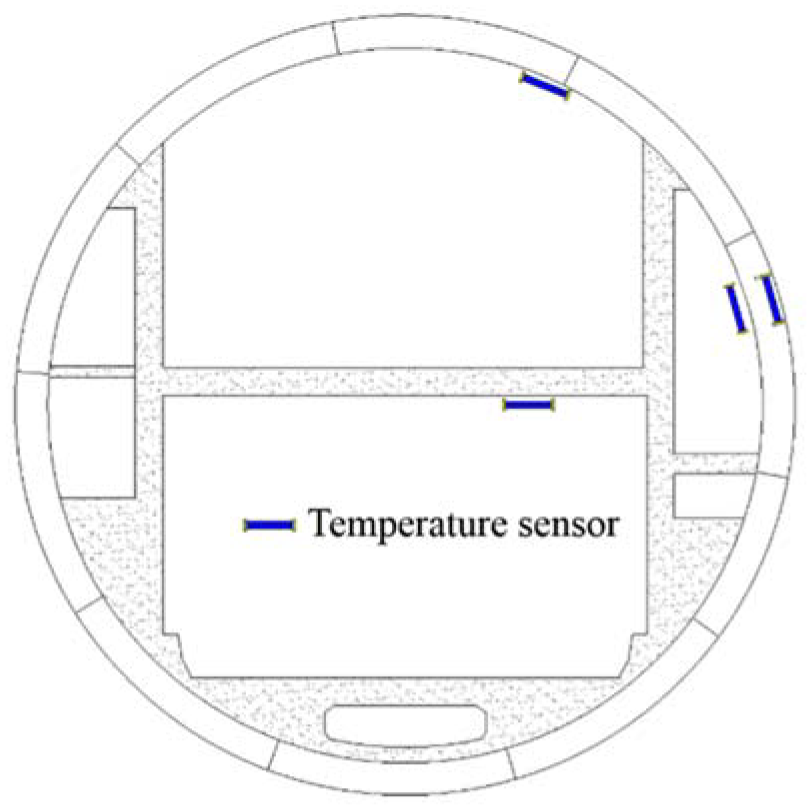
Schematic of monitoring positions layout.
Data analysis using statistical theory
The liner regression model is a widely used method to mine important information from mass number of data, and it has been applied in many complex constructions to analyze their mechanical behaviors (Mata, 2011; Salazar et al., 2017). In order to further analyze the characteristics of temperature variation in different positions, the liner regression model is carried out to process data obtained from field testing. According to regression theory (Roger, 2011; Shirley et al., 2001), the expression of liner regression model can be presented as follows:

where
To obtain an explicit form of equation (1), the value of

Supposing the matrix form of independent variable

where
Numerical modeling
Numerical simulation in the light of field conditions is critical to analyze the mechanical behaviors of structure. In the past few years, many simulation methods have been presented, such as finite element method (FEM) and discrete element method (DEM) (Wang et al., 2019). The FEM is a reliable method and it has been widely used in many infrastructures (Guo et al., 2018). In this study, the beam-spring model firstly presented by Koizumi and Murakami is adopted to establish tunnel model in the framework of FEM (1988). In addition, the beam-spring method assumes tunnel lining as a beam model, and the nonlinear springs are arranged around the external edge of lining to describe the effect of ground resistance. The stiffness of nonlinear springs is related to the geotechnical properties of surrounding rock, which can be represented as follows:

where k represents the stiffness of nonlinear spring,
As the core technology, the devised statistical model is integrated into our program to determine the external loads imposed on model. The tunnel model is meshed into mass number of elements and these elements are packaged into different sets corresponding to sensor locations. Subsequently, the different temperature loads are applied on element sets respectively to analyze the stress response to uneven temperature variation.
Analysis of concrete structure in field based on the proposed framework
The Nanjing Yangtze River tunnel is one of the longest shield tunnels in the world, and it is the first underwater shield tunnel to be designed as the form of twin-tube and twin-floor. As a case study, the presented integrated framework is employed in this project to analyze the stress response to uneven temperature distribution. The Nanjing Yangtze River tunnel is located in Nanjing, Jiangsu, China. The geological layers passed by tunnel are clay, medium-coarse sand, silty-fine sand, silty clay, pebbles, and weathered siltstone, as shown in Figure 2. The internal structure of this project is shown in Figure 3, which consists of lane layers, smoke layer, and escape layer. In order to improve air flow capacity, some ventilation devices are installed in arch crow of upper lane layer. Concrete segments are the main support structure, and the lining is assembled with ten segments in every ring, including one key segment, two adjacent segments, and seven standard segments.
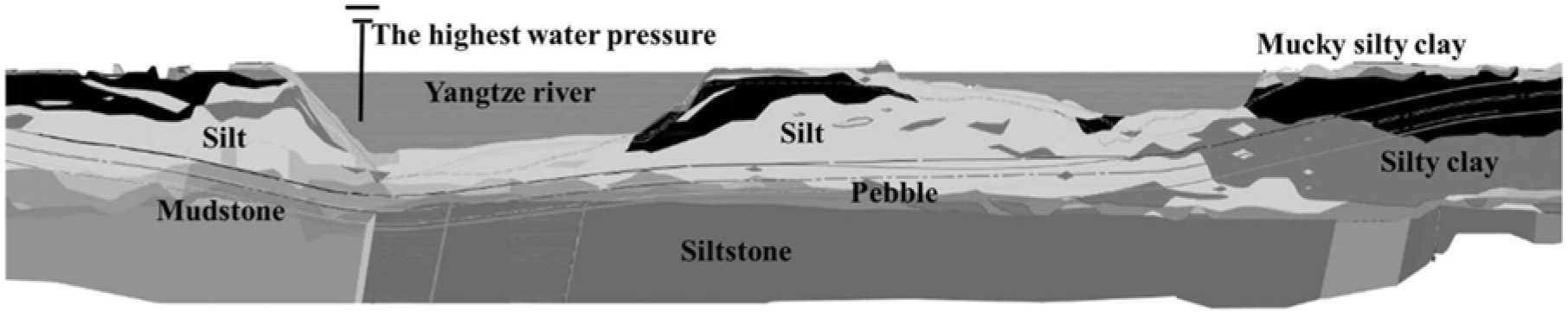
The geological condition of the Nanjing Yangtze River tunnel.
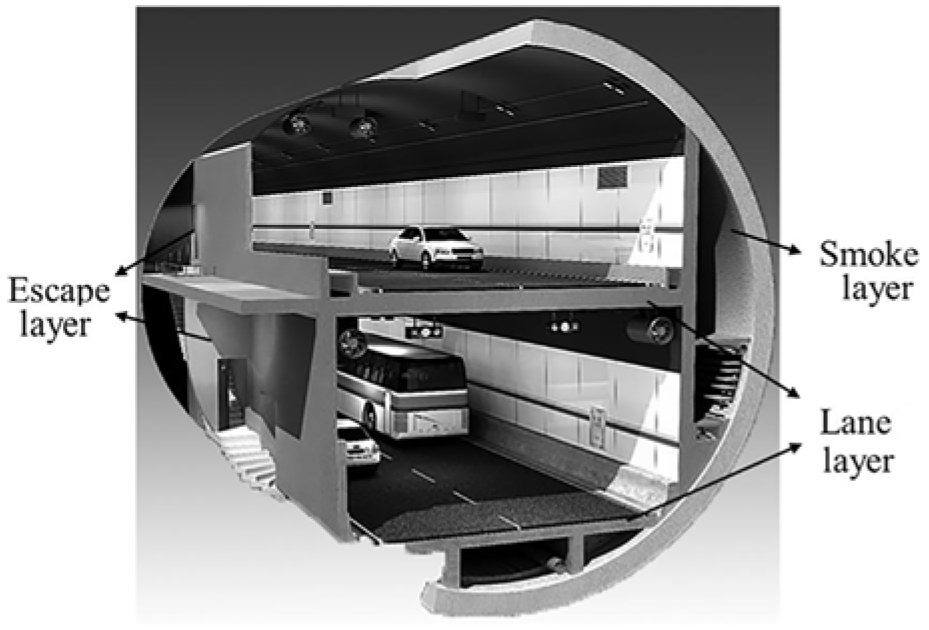
Schematic of the internal structure of tunnel.
Data monitoring with structural health monitoring system (SHMS)
In order to maintain the stability of Nanjing Yangtze River tunnel, an automatic structural health monitoring system (SHMS) is commissioned successfully in this project to provide early warnings of abnormalities. This SHMS consists of three modules, real-time monitoring in field, central database, and visual interface, which has been introduced in our previous study (Tan et al., 2019). Based on the monitoring scheme shown in Figure 1, four temperature sensors were installed in the different positions of each monitoring section. Also, ten typical monitoring sections are selected to record the real-time variation of structural mechanical behaviors in this system. Specifically, the temperature sensors installed in external side of lining is pre-buried during the prefabrication period, and the other three sensors are surface-mounted. In total, forty temperature sensors are installed in this tunnel. The measuring interval for temperature is determined to be 1 h, and it can be changed according to users’ command. The information would be transferred to central database through fiber optical cables after collection. All data information is stored in central database, and users can obtain them through smart visual interface.
Statistical modeling using monitoring data obtained from SHMS
The tremendous amount of monitoring data is obtained through the SHMS, which leads the challenges of data analysis. The monitoring results imply that the temperature variations are not significantly influenced by the positions of different monitoring sections. Two typical monitoring sections extracted from the entire tunnel structure, called S1 and S2, are selected as the interested positions, since the monitoring sections located at different positions exhibit similar behaviors regarding to evolution of temperature. The variations of temperature in different positions of tunnel are shown in Figures 4 and 5.

Monitoring results of temperature variation in S1.

Monitoring results of temperature variation in S2.
The monitoring results show that temperature varied with seasons significantly, which decreases from August to February, and then increases. The variation trend of temperature in different positions is similar, but the magnitude of them is different. It can be found that the temperature in lower lane layer is highest, and then is upper lane layer. In addition, the temperature inside tunnel is higher than that in the external side. The largest temperature difference is up to 8°C at the same moment, which would induce additional stress of concrete lining and affect the durability of structure. According to equations (1) to (3) and surface temperature published in Changjiang River Maritime Safety Administration (2018), the relationship among different positions of tunnel is established as follows:

where the
Based on the presented analytical model, the comparison between the calculated results obtained from linear model with the field monitoring data is displayed in Figure 6. The residual sum of squares (
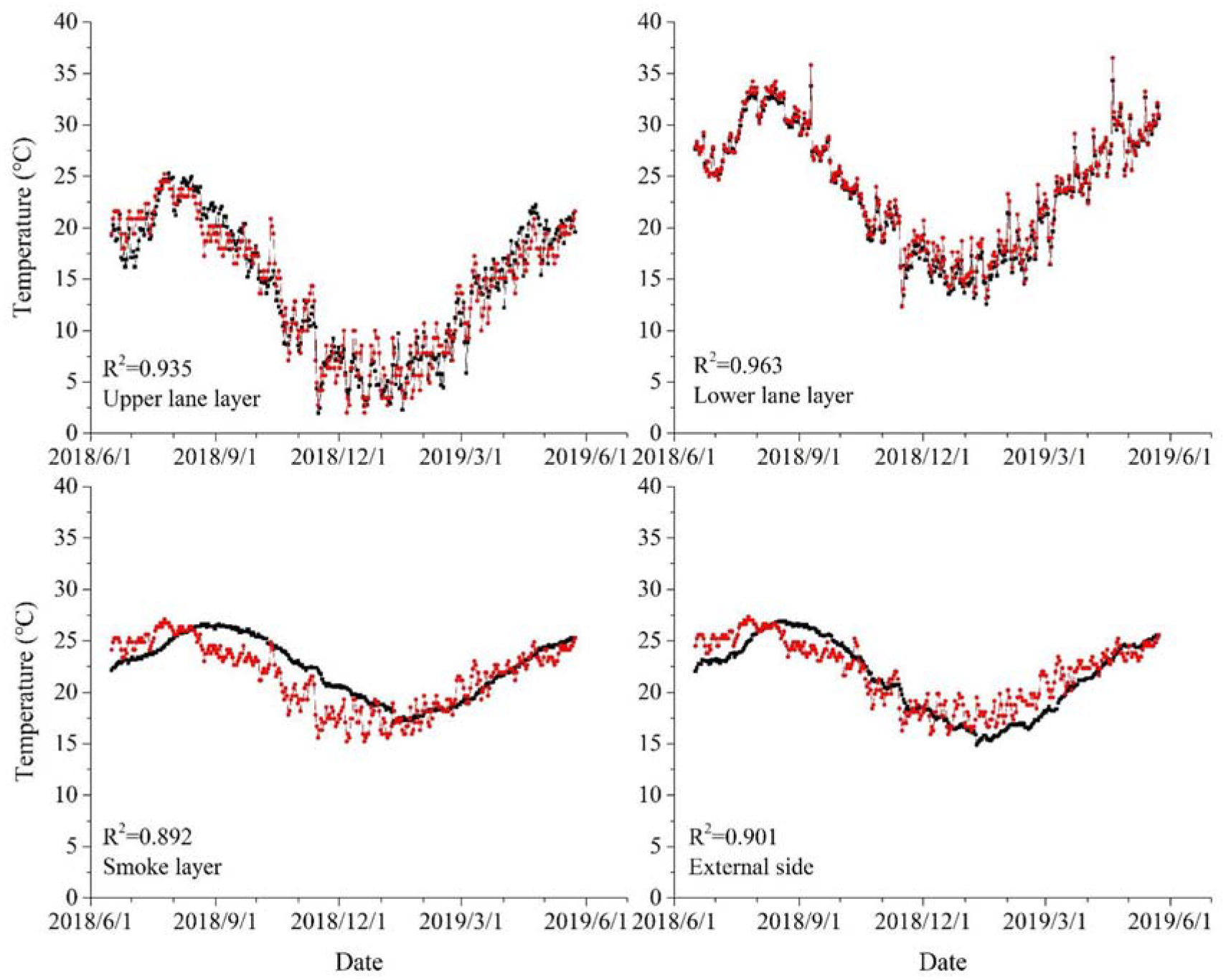
Comparison of monitoring data with analytical results, where black lines represent monitoring data and red lines represent analytical results.
Determination of parameters in numerical model
A typical section S1 is selected as an example for modeling due to the long length and complicated geological conditions of the Nanjing Yangtze River tunnel. The geological layer of this section is displayed in Figure 7 which shows the section is under water 42.7 m, and it through multiple geological layers, including silt, fine sands, silt clay, gravel. Specially, the fine sands are further divided into two classes according to the difference of porosity, named as fine sand-1 and fine sand-3, respectively. The size of the developed model is consistent with field conditions, in which the inner diameter of model is 13.3 m and the thickness of concrete lining is 0.6m. Furthermore, the complex internal structure, which has great influence on temperature distribution and mechanical analysis, is also considered in this model. The material property including both of the tunnel lining and internal structure is defined as C60, whose parameters are displayed in Table 1.
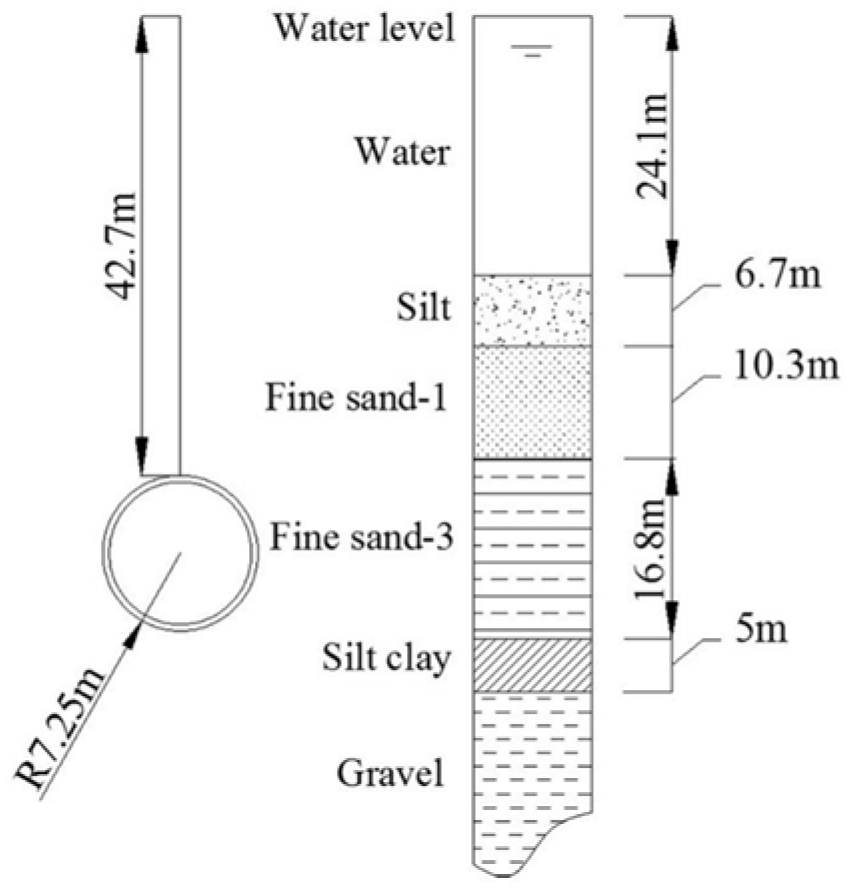
Geological layers of monitoring section (S1) in Nanjing Yangtze River tunnel.
Material parameters of tunnel lining.

The lining and internal structure are discretized into quadrilateral elements. In order to analyze the influence of uneven temperature distribution, the analytical expression is integrated into numerical model. The elements of numerical model are divided into different sets corresponding to sensor locations as shown in Figure 8, which are named as up-inner set, up-outer set, low-inner set, and low-outer set, respectively. To simulate the performances of the concrete structure under different conditions, temperature distribution applied on the established sets can be calculated using the analytical results. To this end, the temperature loads

The numerical model and mesh parathion of the Nanjing Yangtze River tunnel.
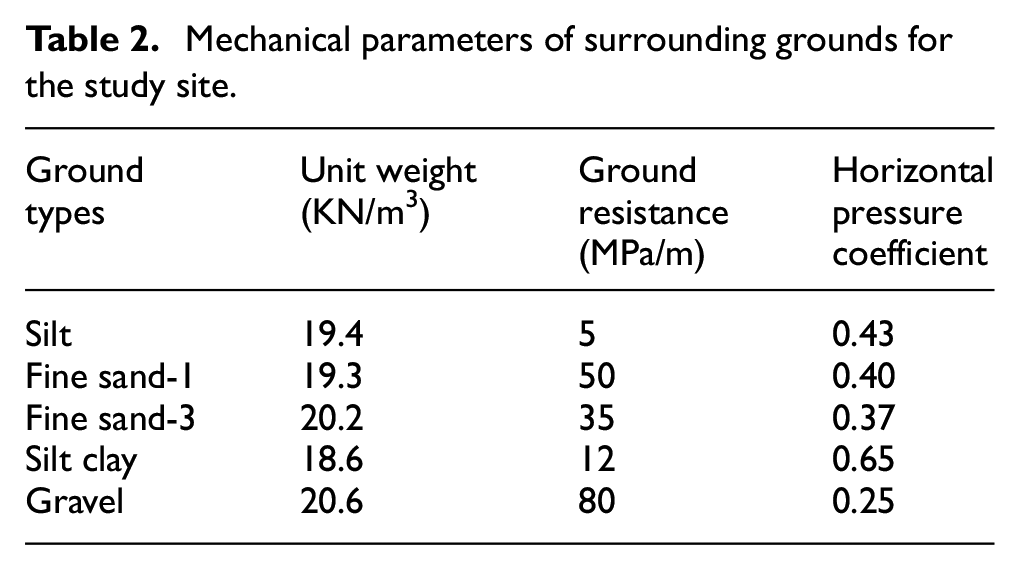
Except for temperature load, the stress boundary conditions created by water and soil pressure are applied on the numerical model according to field investigation results. The soil pressure and water pressure are the main external load to induce the mechanical response of tunnel, and they could be calculated according to the existing research (

where
The soil pressure consists of three components, overlying soil pressure
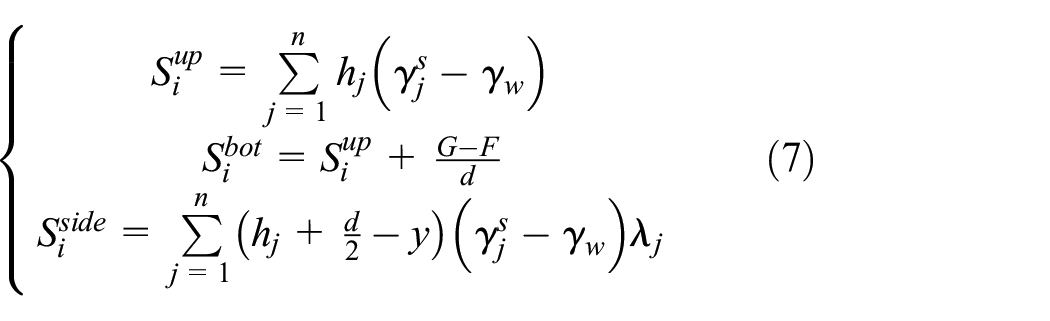
where y is the vertical coordinate, and the center point of section i is regarded as the origin of coordinates. Furthermore, n is the number of geological layers.
Mechanical parameters of surrounding grounds for the study site.
Results and discussions
Based on the natural characteristics of temperature distribution obtained in above section, the mechanical performances of tunnel under various boundary conditions are discussed in this section.
Effects of uneven temperature distribution on concrete structure
In order to indicate the impact of uneven temperature distribution on structural mechanical response, the comparative study is carried out firstly. The numerical models applied on uneven temperature load but without water pressure and soil pressure is developed in contrast to the classical numerical models. The other boundary conditions of these two numerical models are consistent. Both of tunnel lining and internal structure are concrete material, and the property parameters are shown in Table 1. If the surface temperature is determined, the temperatures in different positions of tunnel could be calculated according to equation (5). Thus, supposing surface temperature is 25°C, based on the developed numerical model, the characteristics of stress distribution under the uniform and uneven temperature load are shown in Figure 9.
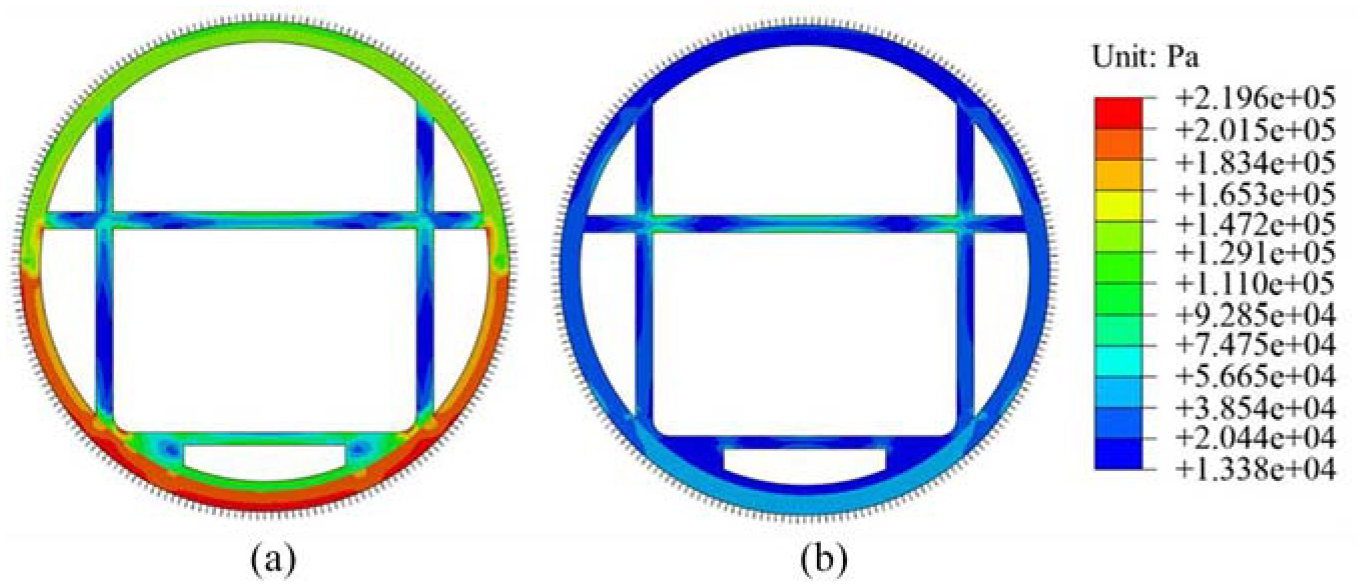
Stress distributions of tunnel under uneven temperature load (25°C): (a) uneven temperature and (b) uniform temperature.
The numerical results denote that the tensile stress is generated due to the effect of temperature. Under the effect of even temperature load, there is no obvious stress concentration phenomenon. But the difference of temperature stress distribution under uneven temperature load is significant compared to the uniform temperature model. It is obvious the stress in the lower half of concrete lining is larger than that in upper half part, especially in the position of arch bottom. Also, the stress inside tunnel lining is larger than external side. The largest stress of former model is located in the external side of tunnel lining, and the magnitude of this value is about 219.6 KPa. But that of the latter model is located on the internal structure, the maximum value of this stress is about 65.6 KPa. It can be calculated that the difference between these two conditions is up to154 KPa when the surface temperature is 25°C. Thus, it is critical to have a further research of the structural mechanical response to the variation of uneven temperature.
Characteristics of structural responses to temperature variation
In order to analyze the characteristics of stress response to the variation of temperature load, the numerical model in the light of natural field conditions is established. This model considers the effect of actual soil pressure and water pressure, and various temperature boundary conditions were applied on it. As Figure 7 shown, the water level of the study site is 42.7 m, and the depth of the overlying soil is about 21.3 m. Thus, the water pressure and soil pressure could be calculated according to equation (7). In addition, the surface temperatures are assumed as 22°C, 25°C, and 28°C, respectively. Then, different temperature loads are calculated and applied on the corresponding element sets. The numerical results of stress distribution are obtained shown in Figure 10.
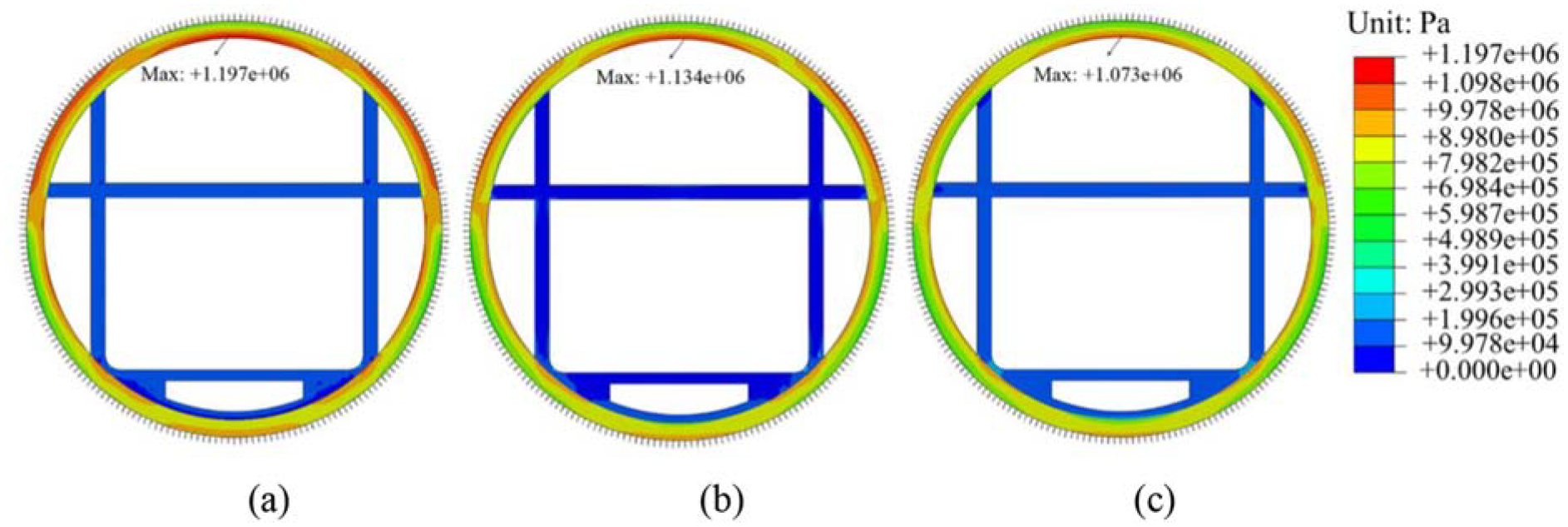
Stress distributions of the study site under various surface temperatures: (a) 22°C, (b) 25°C, and (c) 28°C.
The numerical results show that the characteristics of stress distribution in the study site are similar under different uneven temperature load. The concrete lining is under tensile stress, and the stress of concrete lining is larger than that of internal structure. The largest stress is located in the arch crown of tunnel, as displayed in Figure 10. The stress of tunnel lining inside is smaller than outside in the positions of spandrel and arch bottom, but this variation law is converse on the other positions of lining. In addition, there are some differences about the magnitude of stress distribution. The stress curves of concrete lining are obtained from above cloud pictures, as shown in Figure 11. It can be found the concrete stress is axisymmetric and it decreases with the rise of surface temperature. The reason is that the temperature stress counteracts the effects induced by soil and water pressure. Furthermore, there are some discontinuous points on the stress curves, which are remarked as A, B, and C in this figure. The positions of points A and C are located at the intersections between internal structure with concrete lining. It is indicated the complex internal structure have great influence on the stress distribution of tunnel structure. The discontinuous point B is located in the junction of upper and lower lane layers, where the temperature load varied at this position.
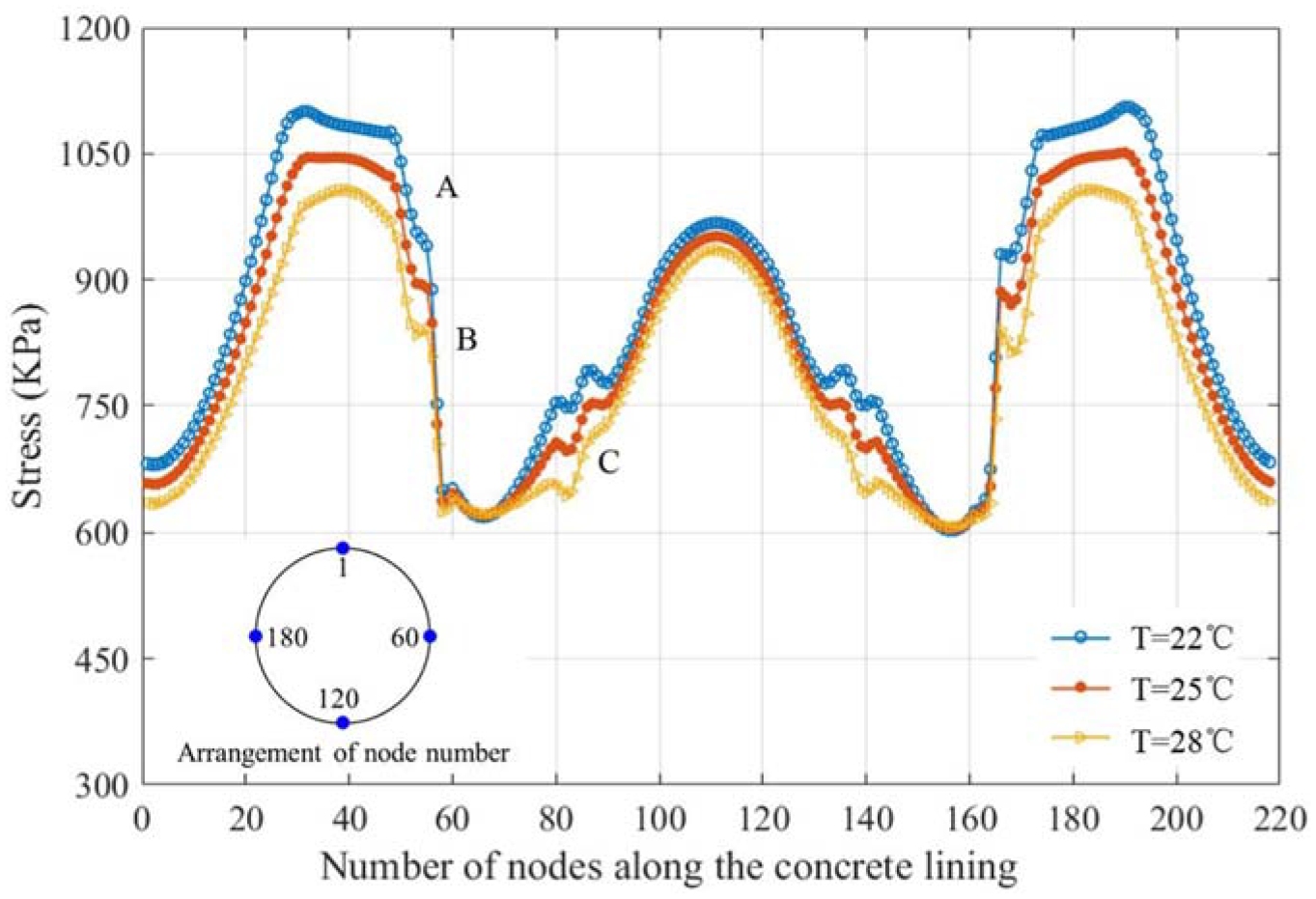
The stress curves of concrete lining under various surface temperatures.
In order to maintain the stability of the Nanjing Yangtze River tunnel, the mechanical response of concrete stress to the variation of temperature is analyzed. If the surface temperature changed 1°C, the response value of concrete lining could be calculated according to the stress curves, as displayed in Figure 12. This figure denotes the mechanical response is symmetrical, and there are many inflection points in the response curve. The response of lining stress increases from the position of arch crown (node numbered 1), and subsequently decreases from spandrel (node numbered 28) because the internal structure restricts its variation. For the same reason, the response value began to decrease from nodes numbered 80–140. Furthermore, the response of arch bottom changed slightly due to the influence of internal structure. The maximum value of stress response to the variation of surface temperature located at spandrel, and the minimum value of that located at inverted arch. The values of them are 25.3 KPa and 0.7 KPa, respectively.
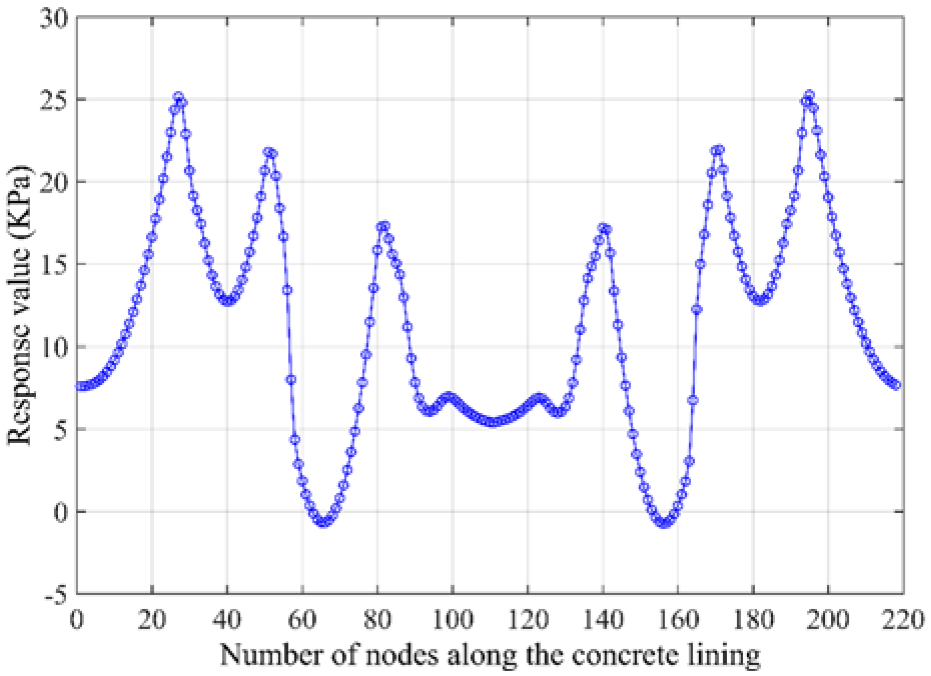
The distribution of stress magnitude along the structure under per unit change of temperature.
Assessment of the stability of concrete structure
The field monitoring data and numerical results denoted that temperature distributed unevenly in tunnel, which induced to the uneven stress of concrete lining. The concentration of tensile stress is an important reason to cause the development of crack and affect the durability of structure. Thus, this section focused on the stability evaluation of the Nanjing Yangtze River tunnel on the basic of monitoring and numerical results.
As displayed in Figures 10–12, the largest tensile stress of concrete lining is up to 1106.1 KPa when the temperature is 22°C, which is located in the spandrel of tunnel. The corresponding magnitude of response at this position is also largest, and the maximum value is 25.3 KPa when the surface temperature changes 1°C. In order to maintain the stability of tunnel, it is crucial to predict the further behaviors of structure and determine a reliable criterion for evaluation. It can be obtained from the numerical results that the lowest temperature in field is about 3°C, as shown in Figures 5–6. Thus, the largest tensile stress of concrete lining is predicted, and the value is 1586.8 KPa. In addition, the existing researches have denoted that the maximum tensile-stress criterion is a widely used theory to estimate the evolution of concrete crack (Zehnder, 2012). The recommended form of this criterion is expressed as
Considering the material of tunnel lining is concrete (C60), the tensile strength is determined as 2850 KPa. Based on the predicted results and the maximum tensile-stress criterion, the safety factor of the study site can be calculated. In this situation, the studied structure is stable since the safety factor satisfies the criterion.
Conclusions
To maintain the stability of underground engineering, an integrated method is performed in this study to analyze the characteristics of uneven temperature distribution and the mechanical response of structure to the temperature variation. As a case study, this developed method is employed in a typical underwater shield tunnel, Nanjing Yangtze River tunnel. The main conclusions are summarized as follows.
The integrated workflow consists of three components, field monitoring, analytical studies, and numerical analysis. The real-time monitoring is applied to record the temperature variation in different positions of tunnel. The measurement points are determined at lane layer, smoke layer, and external side of tunnel ling. Based on the mass number of monitoring data, the temperatures in different positions can be well described with statistical model, which denoted that the highest temperature is located in the lower lane layer, and the temperature inside of lining is higher than external side. As a core component of the approach, the devised statistical model is integrated into our program to determine the external loads imposed on numerical model.
The characteristics of stress distribution under various boundary conditions are discussed using the improved numerical model, including the impact of uneven temperature distribution and different surface temperature. It can be found that concrete lining expressed tensile stress under the influence of temperature load. The characteristics and magnitude of stress distribution varied with different boundary conditions. Furthermore, the maximum and minimum stress values of concrete lining are located in the position of arch crown and inverted arch, respectively. The stress at these two locations would increase 25.3 KPa and 0.7 KPa under the increasing of per unit temperature.
As a promising application, the integrated method is used to evaluate the stability of structure. The maximum tensile-stress criterion is introduced to estimate the evolution of concrete crack under various external load. The evaluation results indicate that the Nanjing Yangtze River is stable under the impact of uneven temperature load.
Temperature is an important external load influencing the stability of concrete structure. There are many reasons to induce abnormal conditions in large scale concrete structure. To prevent disasters, it is necessary to establish a comprehensive system which considers the effect of complicated external loads on stability of structure. This job would be carried out in future studies.
Footnotes
Authors’ Note
Luyu Wang is also affiliated with State Key Laboratory of Geomechanics and Geotechnical Engineering, Institute of Rock and Soil Mechanics, Chinese Academy of Sciences, Wuhan, China.
Declaration of conflicting interests
The author(s) declared no potential conflicts of interest with respect to the research, authorship, and/or publication of this article.
Funding
The author(s) disclosed receipt of the following financial support for the research, authorship, and/or publication of this article: This work was funded by the National Key Research and Development Plan of China (No. 2018YFF01014204) and the Fundamental Research Program of China (No. 2015CB057906). The authors are grateful to the reviewers and editors for their valuable comments and suggestions that helped to improve the quality of the paper.
