




Abstract
To overcome the weak lateral stiffness and weak anti-collapse ability of traditional spoke cable-truss structures, the crossed spoke cable-truss structure (CSCTS) is proposed. As structural stiffness and bearing ability are generated from prestresses produced by tensioning cable length, it is necessary to study the influences of manufacturing errors on CSCTS. The structural design method is proposed by theoretical derivation and the finite element (FE) model with a span of 100
Keywords
Introduction
Spoke cable-truss structures are a typical type of tensile structures, which has many advantages like the clear path of load transfer, light mass, considerable spanning ability, rapid construction speed, and so on (Deng et al., 2005; Huang et al., 2019). However, traditional spoke cable-truss structures have the two disadvantages of weak lateral stiffness and weak anti-collapse ability (Xue et al., 2021; Zhao et al., 2010), therefore a new crossed cable-truss structure system is proposed in the paper based on the two disadvantages. As crossed cable-truss structure (CSCTS) is a new type of tensile structures, it is necessary to firstly study its structural design method. The structural design method of CSCTS is proposed based on the existed references (Wang et al., 2010; Zhang et al., 2017). Meanwhile, CSCTS belongs to flexible tensile structures and its integral stiffness and structural shape is determined by the prestresses. Structural prestresses are generated from tensioning cable lengths, so manufacturing errors of cable lengths have great influences on structural behaviors and final structural shape (Lu et al., 2021a, 2022). There are hardly any references about construction control of CSCTS, therefore it needs to study its construction control problem.
Until now, some scholars have studied the construction control problem on different kinds of tensile structures in the world. Tian et al. (2011) proposed a method of solving the control criteria of cable length error based first-time and second-order moment reliability indexes. Gao et al. (2015) used the orthogonal test design method to analyze the deviations of the experiment model and finite element model of rigid bracing cable dome. Deng et al. (2016) introduced an uncomplicated sensitivity method for statistically evaluating the pretension deviation of tensile structures and revealed that different tensioning schemes take different effects on controlling the pretension deviations. A shape control framework which consisted of multi-objective search and reinforcement learning was experimentally validated on an active tensegrity structure by (Adam and Smith, 2007, 2008). Korkmaz et al. (2012) investigated the active control performance of a tensegrity bride to assess the practicability of an active tensegrity structure in practice. Liang et al. (2018) proposed an active control algorithm based on a nonlinear force method and the method was also used to prevent failure of the cable domes due to slackening of the ridge cables and excessive displacements of the central section of the cable dome. Luo et al. (2016) proposed the small elastic modulus method to analyze the random error analysis of combining cable length and cable force, and the control index in practical engineering was ensured. Jin et al. (2010) proposed the whole sensitivity analysis method of parameters and then come to the conclusion that the cable cross-sectional area has the largest effects on the cable net structure of FAST (Five-hundred-meter aperture spherical radio telescope). Kong et al. (2015) studied the influences of cable length errors and other parameters on cable force and then the deviation of cable length is the largest effects on the cable force. Shen et al. (2017) studied the independent error analysis and multiple error coupling analysis of cable-length error, active-cable tension error and outer-node coordinate of FAST based on the random error analysis method of normal distribution. Lu et al. (2022) studied the influences of manufacturing errors on spatial cable-truss structure without inner ring cables and then solved its control criteria of cable length. Based on the above research contents, there are few scholars to study the influences of manufacturing errors on CSCTS under different working conditions.
The below several aspects on manufacturing errors of CSCTS are studied in the paper. The paper firstly studies the structural design method of CSCTS and a FE model is designed based on the proposed method. Secondly, the influences of the elongation or shortening of cables on CSCTS are studied based on manufacturing errors. Thirdly, the influences of different manufacturing errors on CSCTS are studied. Fourthly, the influences of different prestresses states on CSCTS are studied. Fifthly, the influences of manufacturing errors on cable-truss frames with different positions are studied. Sixthly, the influences of manufacturing errors on CSCTS under the external loads are studied. Seventhly, control criteria of cable lengths are studied. Finally, the conclusions of the paper are given at the end of the paper.
The structural design of crossed spoke cable-truss structure
Structural design method
Based on the structural features of CSCTS in Figure 1(a), CSCTS can be simplified into a series of plane cable-truss frames, therefore the integral structure can be designed by through designing a plane cable-truss frame, and a plane cable-truss frame can be drawn as Figure 1(c). Then a series of plane cable-truss frames are reversely assembled into an integral structure according to certain rules. It is assumed that elements are in elastic range and there are no friction and slip at joints and material self-weigh is not considered, and it is assumed that the plane cable-truss frame is in the static equilibrium (Lu et al., 2021b).
In Figures 1b and 1(d), Elements OC and OD refer to ring cables of CSCTS, which is symmetric about Forced diagram of plane cable-truss frame. (a) Three-dimension diagram. (b) Plane projection. (c) Plane cable-truss frame (d) Forced diagram of ring cables.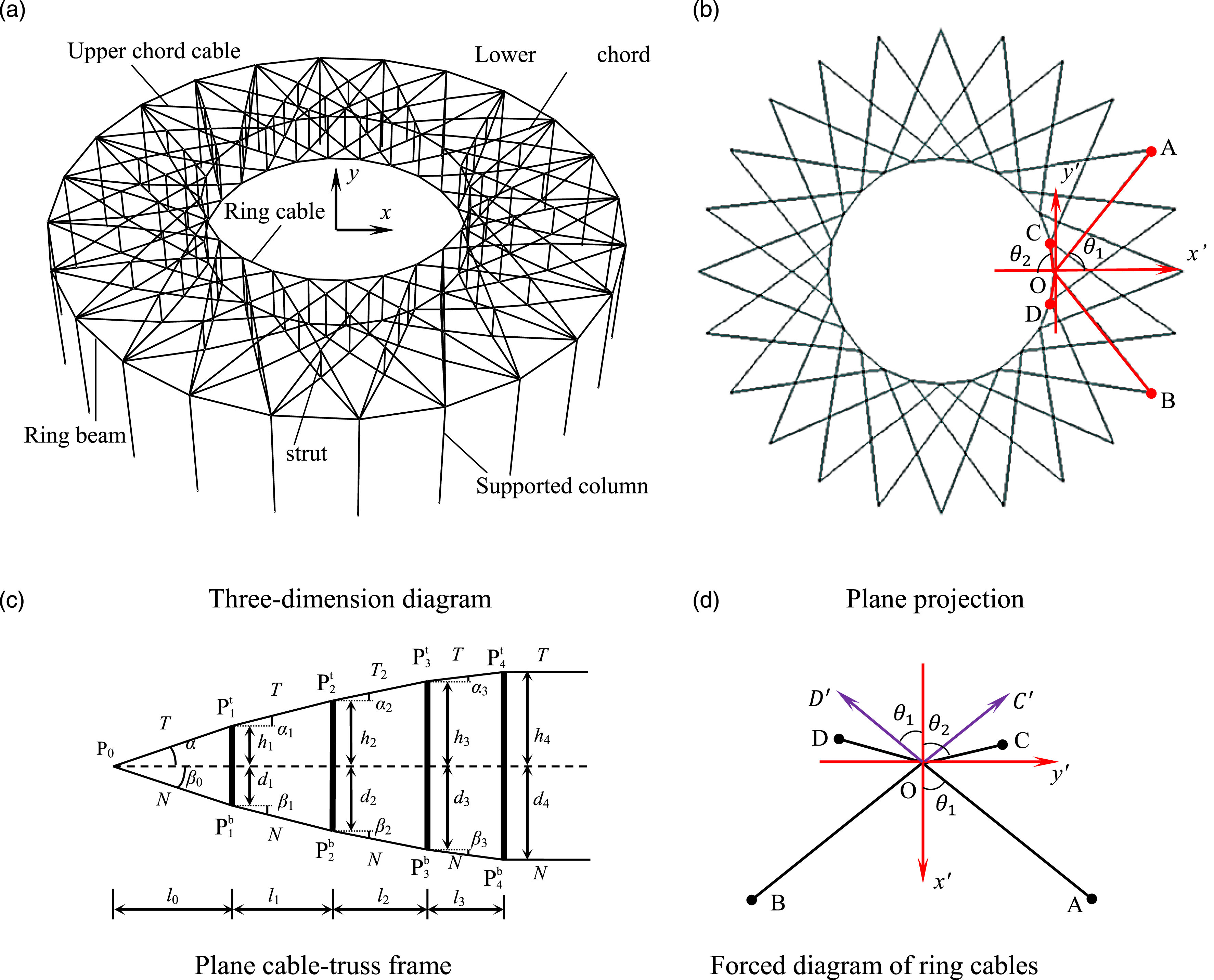
In Figure 1(c), take moment for node

The upper nodes of plane cable-truss frame are taken as research objects, and the equilibrium equation of all upper nodes in horizontal direction are obtained as follows
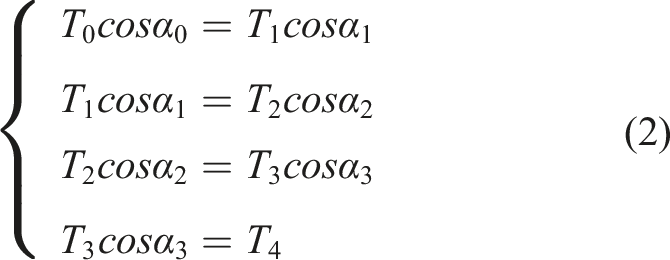
Equation (2) can be simplified into equation (3) considering general equation as follows

Similarly, the equilibrium equation of all lower nodes in horizontal direction are obtained as follows

Then all struts are taken as research objects, and the equilibrium equation of all upper nodes in vertical direction can be obtained, which can be further simplified as general equation as follows

Substitute Equation (3) and Equation (4) into equation (5), it can be obtained as follows

Based on geometry relations in Figure 3(c), it can be obtained as follows
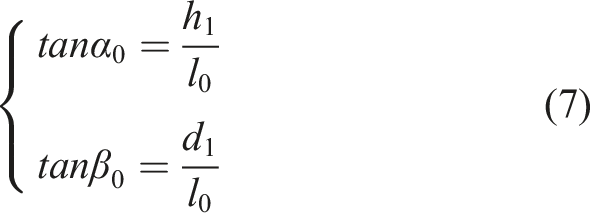
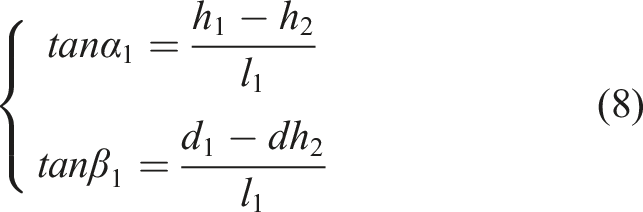
Based on Eq. (7) and Eq. (8), then equation (9) can be obtained as follows
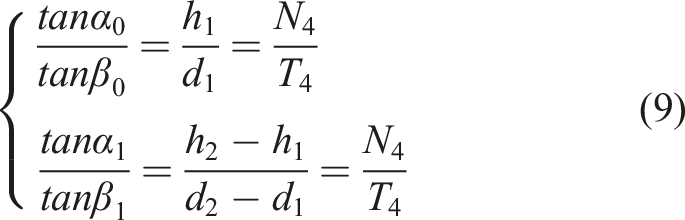
According to Difference Ratio theorem and equation (9), it is obtained as follows


Form equation (11), it can be observed that the ratio of upper part and lower part for all struts is a constant c when plane cable-truss frame is in arbitrary equilibrium. Meanwhile, equation (10) can be used to rapidly design plane cable-truss frame with a reasonable shape. The rise of plane cable-truss frame can be chosen from (Shen et al., 2006), and then the corresponding constant c can be obtained. In Reference (Shen et al., 2006), the economic rise-span ratio of upper chord cable is

CSCTS is a type of prestressed cable structure and its stiffness is generated from prestresses of cables. Therefore, it is essential to solve structural feasible prestresses or self-stress modes.
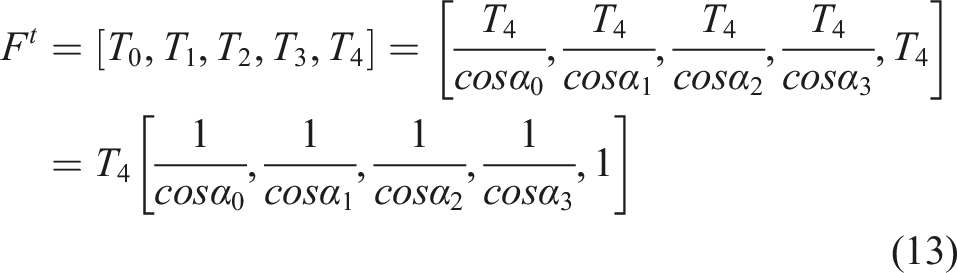
From equation (3), the cable forces of upper chord cables can be obtained as follows
Similarly, from equation (4), the cable forces of lower chord cables can be obtained as follows
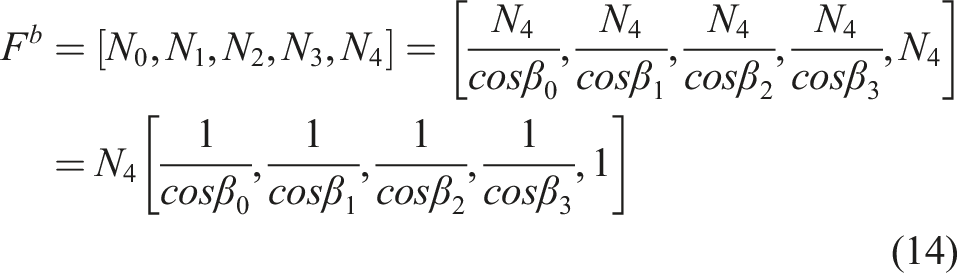
Based on Eq. (1) and Eq. (11), the cable forces of upper and lower chord cables can be obtained based on Eq. (13) and Eq. (14) as follows
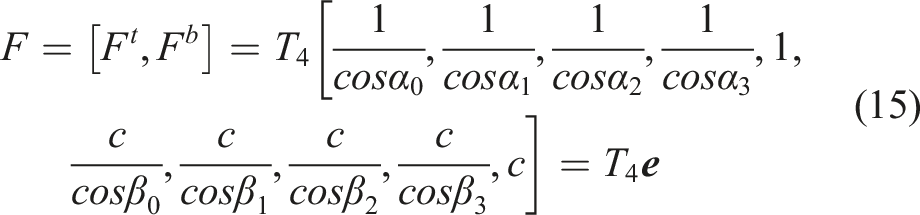
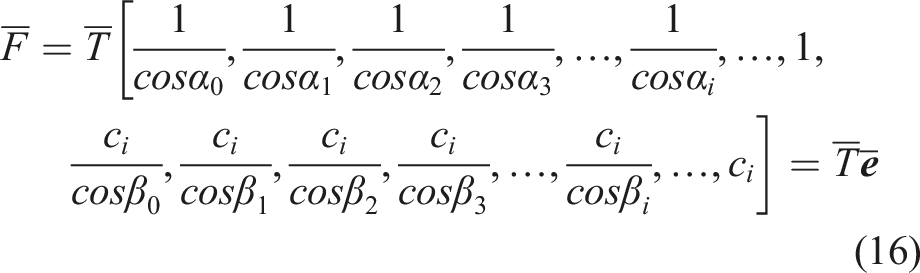
It can be observed that cable forces of plane cable-truss frame can be expressed as the form of equation (15). In equation (15),
Finite element model of crossed spoke cable-truss structure
A CSCTS with a diameter of 100 Relative diagrams of CSCTS. (a) FE model of main cable system (b) Size and number of half plane cable-truss frame.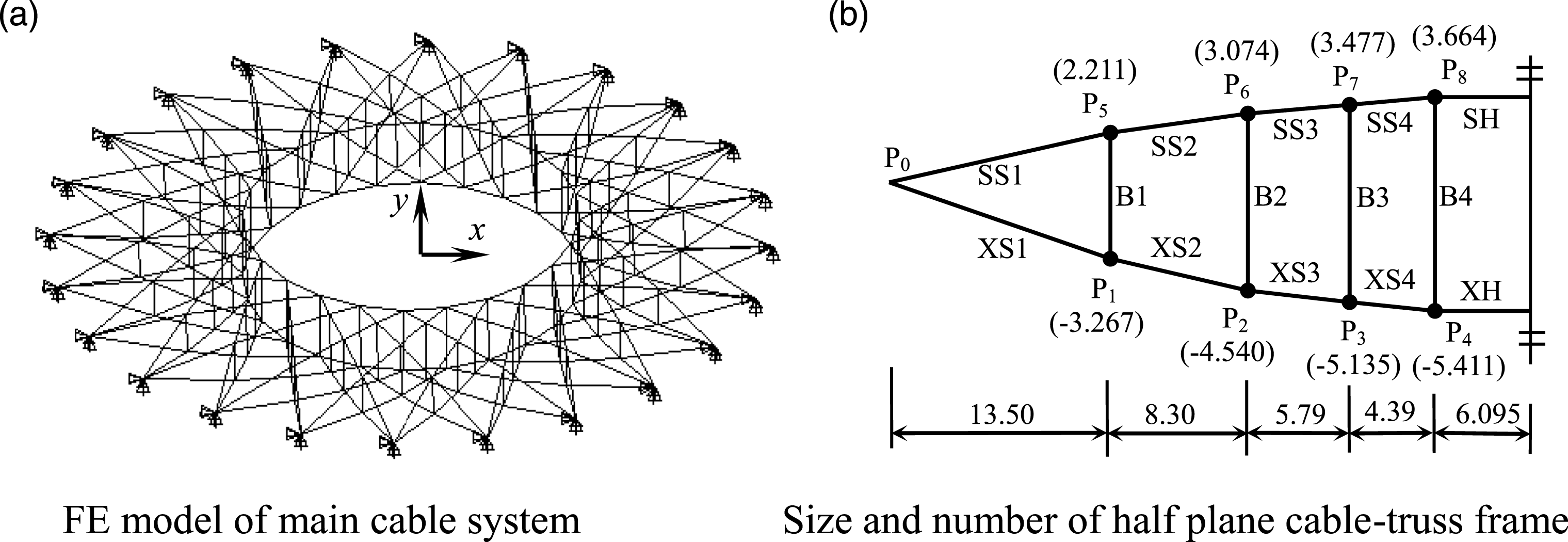
Distribution of prestresses of all kinds of components of CSCTS.

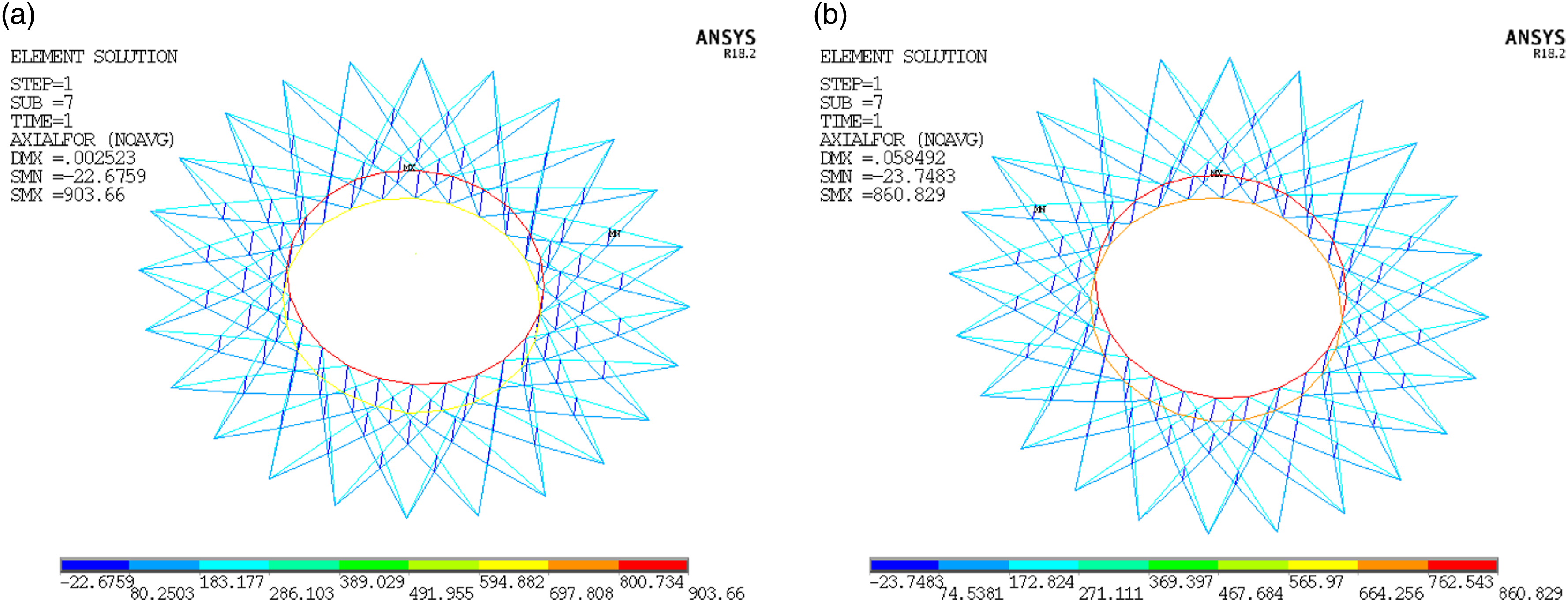
Feasible prestresses of integral FEM of CSCTS. (a) Internal forces without self-weight (self-stress mode) (b) Internal forces with self-weight (feasible prestress).
It can be observed from Table 1 and Figure 3 that the cable forces of upper and lower ring cables are much larger than those of upper and lower chord cables, namely the distribution of cable forces of CSCTS is nonuniform. While the cable forces of upper chord cables are from 180.26 to 182.51
Meanwhile, the minimum breaking strength of cables
The analysis method of sensitivity errors
The cable length can be shortened or elongated in the manufacturing process, which is called manufacturing length errors of manufacturing errors. The internal forces of cables and struts will be affected by manufacturing length errors. The influence magnitude can be expressed as internal force variation 
The sensitivity indexes of cable and strut can be expressed as follows
Similarly, the sensitivity indexes of other components can be gained by the same analysis method as equation (18).
Influences of different cable lengths and prestresses on crossed spoke cable-truss structure
Influences of elongation and shortening on internal forces of crossed spoke cable-truss structure
In numerical analysis, the elongation of cable and strut can be simulated by applying negative temperature (NT) to cable and strut, and the shortening of cable and strut can be simulated by applying positive temperature (PT) to cable and strut. But there are no relative references about how the elongation and shortening of cable and strut affect the internal forces of cable and strut. The influences of elongation or shortening of cable and strut on internal forces of components are studied. It is assumed that the length errors of all kinds of cables are 
When cable lengths are elongation or shortening by Influences of elongation and shortening of cables and struts on sensitivity indexes. (a) Upper chord cables SS1-SS4 (b) Lower chord cables XS1-XS4. (c) Ring cables SH and XH (d) Struts B1–B4.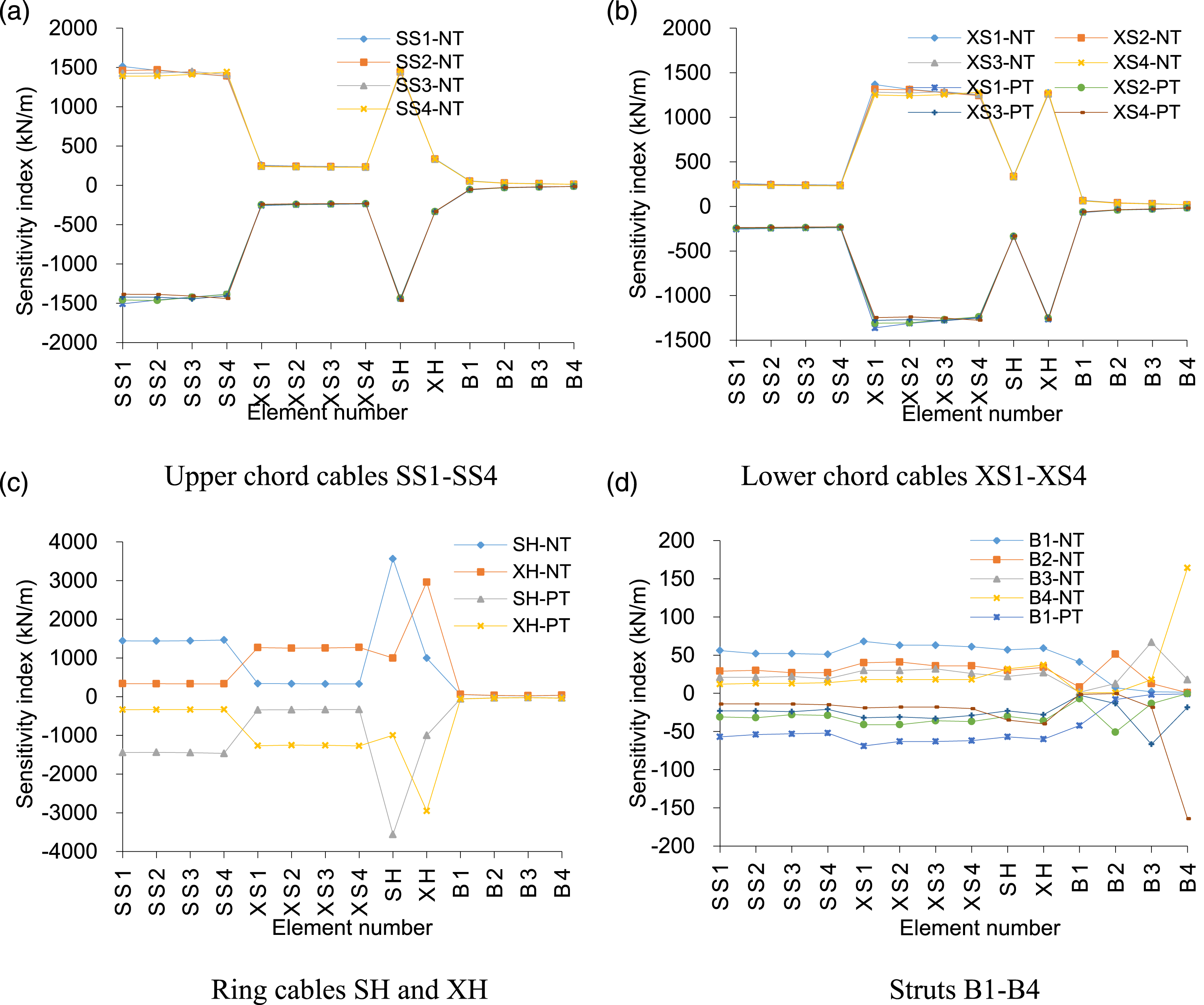
From Figure 4, it can be observed that the sensitivity indexes are the same when the elongation or shortening of cables and struts are equal. Namely, the change variations of internal forces for cables and struts are the same at linear elastic state when the negative temperature or positive temperature of cables and struts are the same. Based on the law, positive temperature is adopted for the following analysis of the paper.
From Figure 4, the sensitivity indexes of chord cables and struts are the same under the same length errors of ring cables, but the sensitivity indexes of chord cables and struts are different under the same length errors of ring cables, which shows that ring cables are the global sensitive member, and chord cables and struts are non-global sensitive member. The manufacturing errors have great influences on itself sensitivity indexes and have little influences on those of others. The most sensitivity indexes of upper and lower ring cables are
Influences of different manufacturing errors on internal forces of CSCTS
When manufacturing errors are equal to Internal force variation and sensitivity indexes of ring cables. (a) Internal force variations (b) Sensitivity indexes.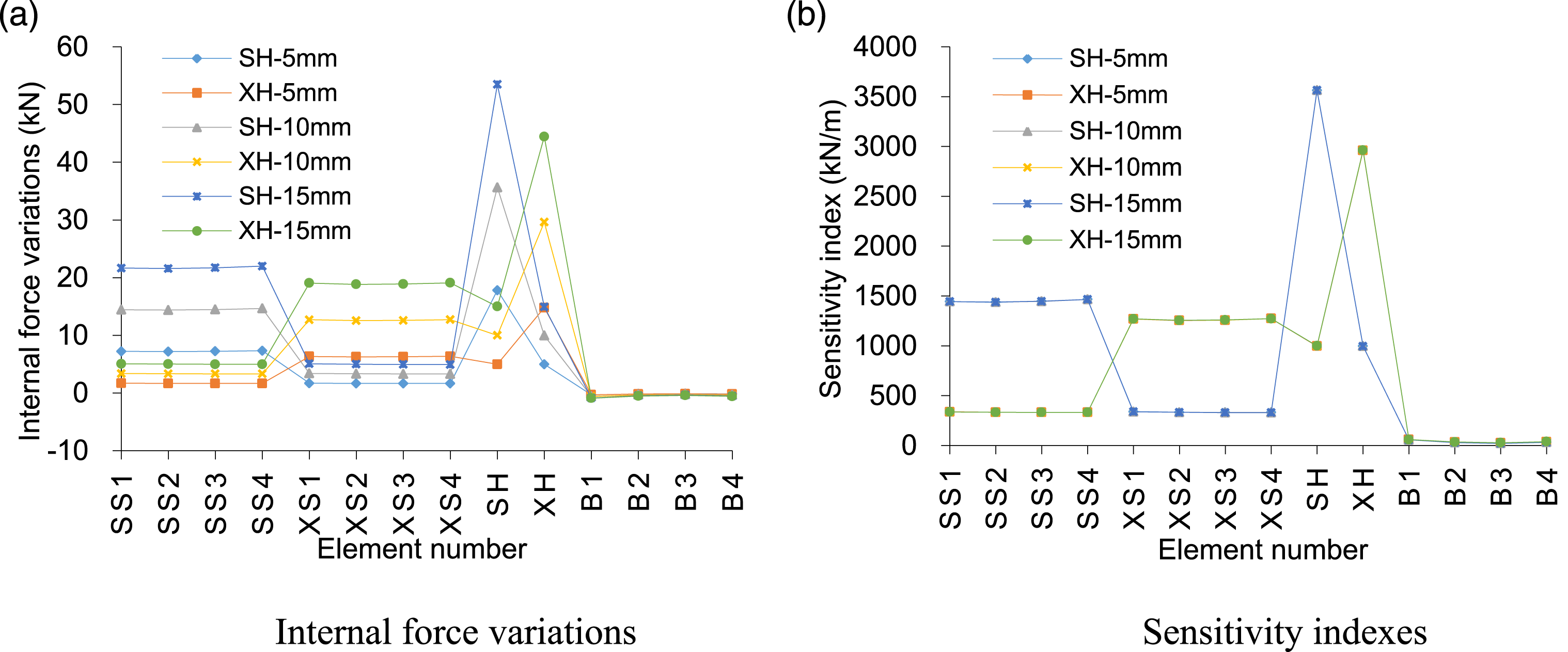
From Figure 5(a), it is observed that the internal force variations increase proportionally when length errors increase proportionally, namely the growth proportion of internal force variation and length errors are the same. Based on this above growth proportion, it can be further obtained from equation (18) that the sensitivity indexes are the same because sensitivity indexes
Influences of manufacturing errors on internal forces of CSCTS under different prestress states
Influences of manufacturing errors on mechanical behaviors of CSCTS under different prestress states.
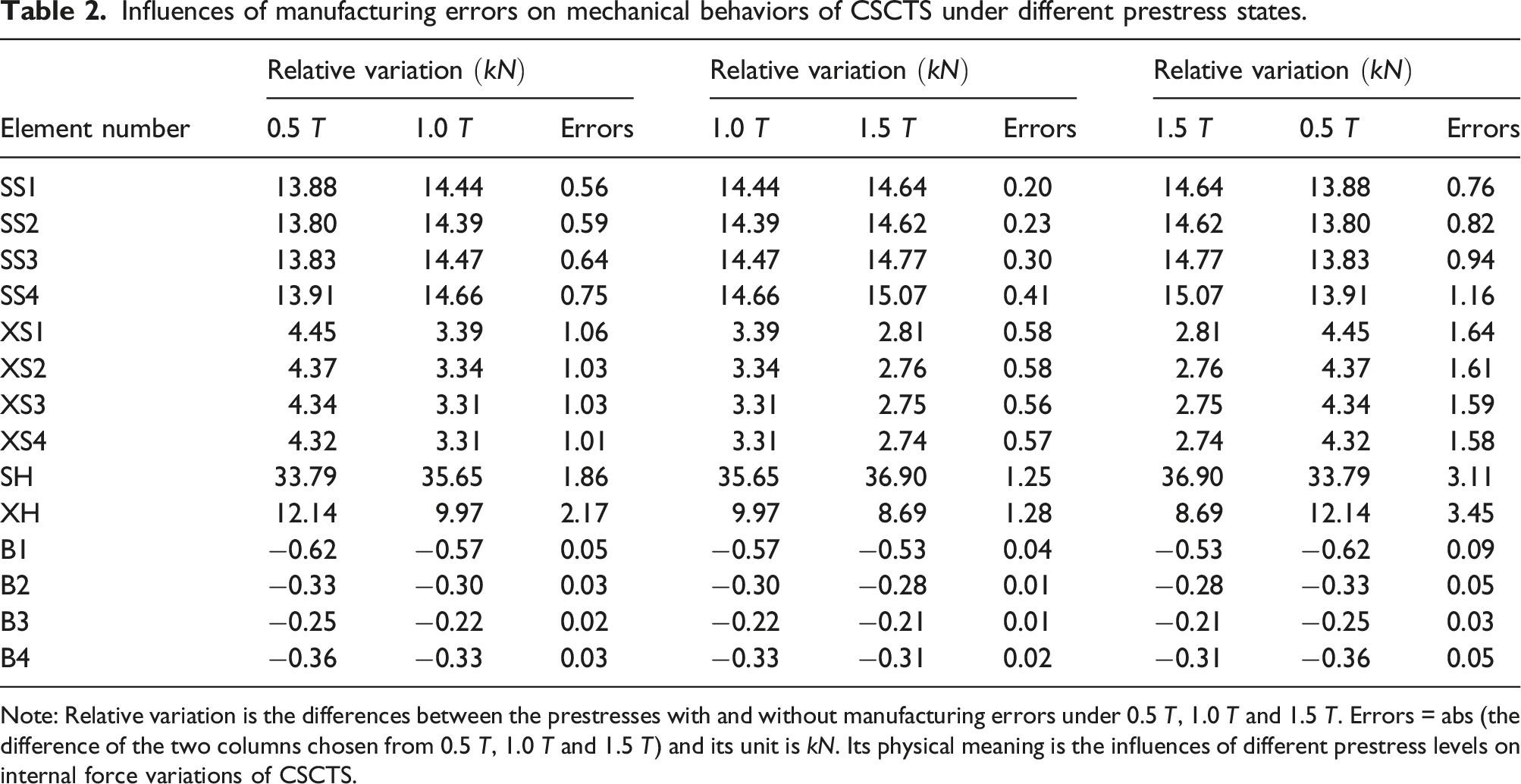
Note: Relative variation is the differences between the prestresses with and without manufacturing errors under 0.5
From Table 2, it is observed that when manufacturing errors are a fixed constant, the internal force variations are basically the same under different prestress states
Influence of manufacturing errors on cable-truss frames with different positions
In order to study the influences of manufacturing errors on different cable-truss frame (CTF), the four CTF1 to CTF4 are designed to study that the influences of length errors on different cable-truss frames when errors are located at CTF-1. The four cable-truss frames (CTFs) are shown in Figure 6(a). When errors are located at SS1, XS1, SH and XH, the results are shown in Figures 6b and 6(c). Four cable-truss frames and sensitivity indexes of cables. (a) Positions of four cable-truss frames. (b) SS1 and XS1 (c) SH and XH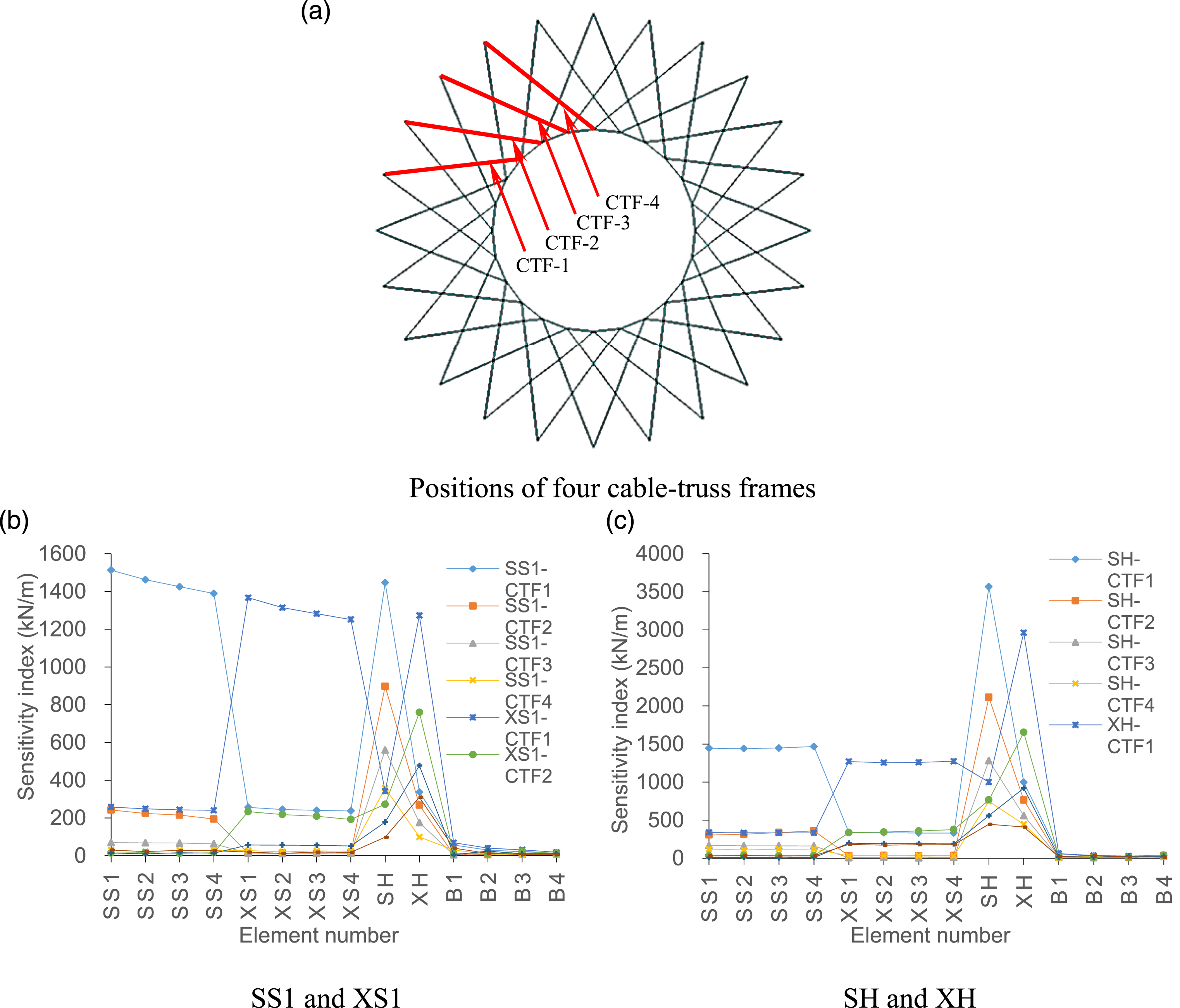
From Figure 6, manufacturing errors have great influences on CTF1 where the errors are located and have little influences on other CTF, the conclusion of which is similar to the reference (Lu et al., 2022). It can be known that ring cables are sensitive to length errors and the main reason is that ring cables belong to active stressed members that all cable-truss frames are installed and fixed on ring cables. It can also be observed from Figure 6(a) that each ring cable is connected with two cable-truss frames, therefore sensitivity indexes of two cable-truss frames are large when manufacturing errors are located at ring cables. Based on the conclusion, CTF-1 is just considered for the following analysis.
The influence of manufacturing errors on crossed spoke cable-truss structure under external loads
Influences of manufacturing errors on CSCTS under full-span loads
The influences of manufacturing errors on structural mechanical behaviors have been studied under non-external loads in Figures 4–6, therefore the influences of manufacturing errors on structural mechanical behaviors under external loads need to be further studied. External loads include full-span loads and half-span loads. The manufacturing errors can be divided into five types including the manufacturing errors of upper chord cable, lower chord cable, upper ring cable, lower ring cable, ring beam and ear-plate. The manufacturing errors is Influences of manufacturing errors on internal forces of CSCTS under full-span loads. (a) Internal forces of cables and struts when errors are located at SS1. (b) Internal forces of cables and struts when errors are located at XS1. (c) Internal forces of cables and struts when errors are located at SH. (d) Internal forces of cables and struts when errors are located at XH. (e) Internal forces of cables and struts when errors are located at ring beam and ear-plate.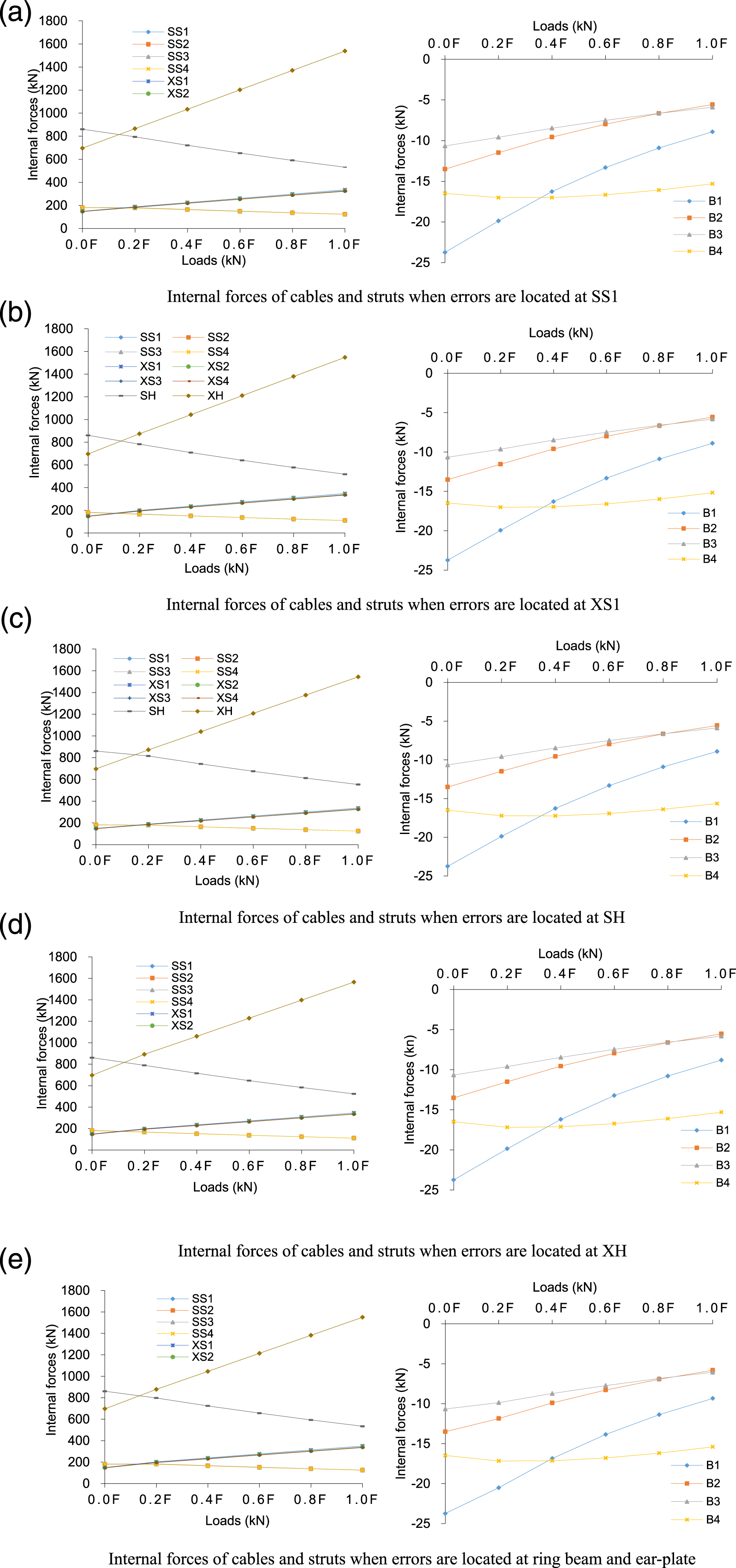
Form Figure 7, it can be observed that the change laws of internal forces for CSCTS are the same when the length errors of all kinds of elements are
Influences of manufacturing errors on CSCTS under half-span loads
It is known from the existing reference (Lu et al., 2021b) that tensile structures are more sensitive to half-span loads, therefore it is necessary to study the influences of manufacturing errors under half-span loads on mechanical behaviors. The external loads are the same as full-span loads Symbol “L” refers to loading zones and symbol “NL” refers to non-loading zones. The change laws of internal forces are shown in Figure 8 under half-span loads. The mechanical behaviors of upper chord cables are the same when the length errors are located at SS1 to SS3, therefore SS1 is taken as research objective to study the influences of length errors on the mechanical behaviors of CSCTS. Similarly, other elements are similar, and do no repeat it again. Influences of manufacturing errors on internal forces of CSCTS under half-span loads. (a) Internal forces of cables and struts when errors are located at SS1. (b) Internal forces of cables and struts when errors are located at XS1. (c) Internal forces of cables and struts when errors are located at SH. (d) Internal forces of cables and struts when errors are located at XH. (e) Internal forces of cables and struts when errors are located at ring beam and ear-plate.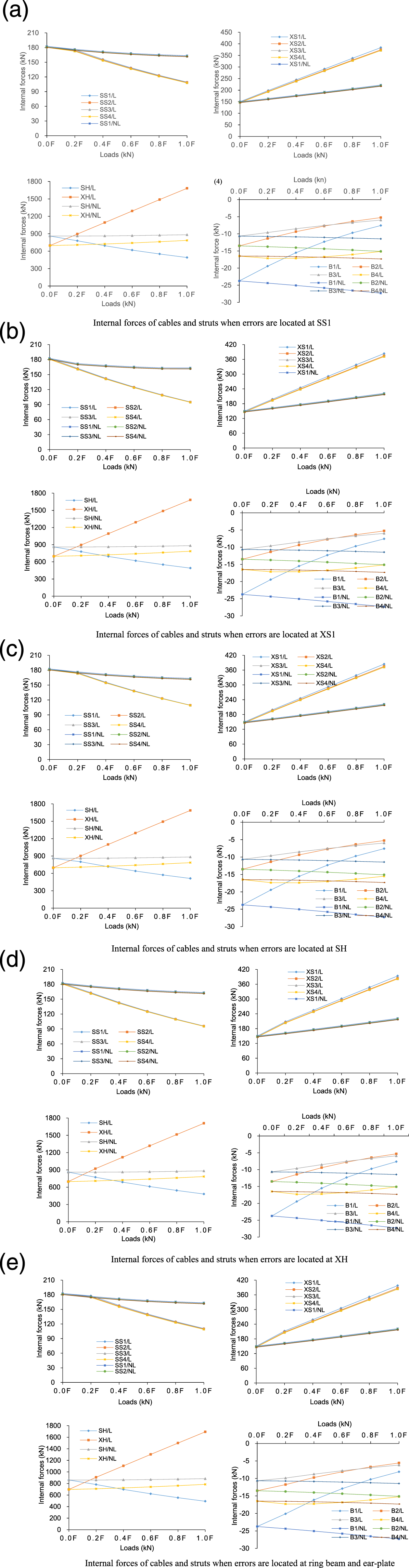
From Figure 8, the internal forces linearly increase with the increase of half-span loads, but the internal forces in loading zones are significantly larger than those in non-loading zones, which shows that CSCTS are more sensitive to half-span loads. When length error is located at SS1, the internal forces of SS1 to SS4 under loading zones are
Control criteria of cable length errors of crossed spoke cable-truss structure
As the span of CSCTS is large and there are many cables, and it is known from Figure 6 that errors have great effects on itself and have certain effects on other cables when adjusting the length of a single cable. If the cable length is adjusted in construction, it is necessary to ensure how to make the adjusted cable force distribution the same as design cable forces or meet the allowable errors. It is a multi-objective control problem (Shen et al., 2017) and needs several iterations to obtain final results. If cable length needs to be adjusted in construction site, it is equivalent to manual iterative calculation in mathematics, which will waste much time and even increase project cost and extend construction period. The construction method of un-adjustable cable length can avoid manually adjusting cable length (Tian et al., 2011).
When the construction method of un-adjustable cable length is used in design and construction, how to obtain accurate manufacturing length of cable (or control limits of cable length errors) is considerably important. The accurate degree of manufacturing length of cable directly determines the prestress distribution of the final forming state. And prestress distribution determines structural topology, mechanical property and structural reliability. If initial manufacturing length errors of cables are large, the difference between final forming state and design state is large, which has huge effects on subsequent use of structure.
Meanwhile, there is no uniform theory for calculating control limits of cable length errors at present, and Technical Specification for Cable Structure (JGJ 257-2012, 2012) is based on the ability of manufacturing accuracy, which does not consider the requirement of cable length errors for structural performance. Based on the reference (Lu et al., 2022), a method of solving cable length errors for CSCTS is used based on reliability theory and nonlinear programming theory.
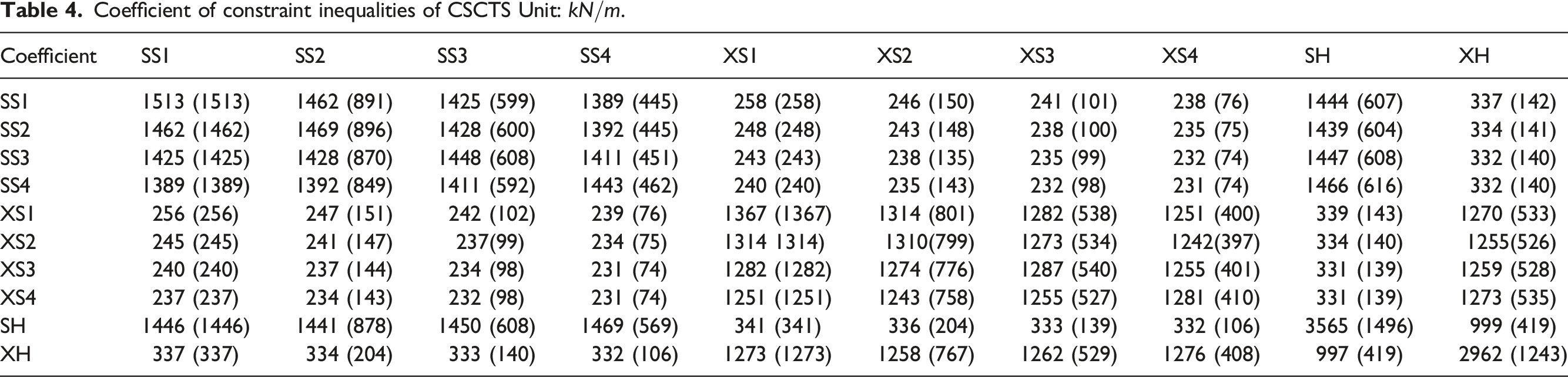
Solving coefficient of constraint inequalities of crossed spoke cable-truss structure
Cable length errors of CSCTS under two conditions.

Coefficient of constraint inequalities of CSCTS Unit:
Solving control criteria of cable length errors for CSCTS
Control criteria of cable length errors of CSCTS Unit:

From Table 5, it can be observed that the obtained control criteria of cable length errors for Condition 1 and Condition 2 meet the control criteria in Technical Specification for Cable structure (JGJ 257-2012, 2012). Meanwhile, when the construction method of un-adjustable cable length is adopted, the variations of cable forces can be controlled within 8% if the control criteria of cable length errors of Condition 1 or Condition 2 are used. The order of control accuracy for upper chord cables is SS1>SS2>SS3>SS4, which is the same order as lower chord cables. From Condition 1 and Condition 2, SS1, XS1 and XH are all the relative lower control criteria, therefore their control criteria should be stricter than others.
When initial manufacturing errors of cable length are the same, the solved control criteria of cable length errors are similar which is in the range of 0.70–0.79
Conclusions
Based on structural design and manufacturing error analyses of CSCTS, the main conclusions are as follows: (1) The structural design method of CSCTS is proposed, which can obtain structural reasonable shape and self-stress mode and is general for other cable-truss structures. (2) The sensitivity indexes are the same when the elongation or shortening of cables and struts are the same. The internal force variations increase proportionally when length errors increase proportionally. The internal force variations are basically the same under different prestress states for the same length errors. Manufacturing errors have great influences on CTF1 where the errors are located and have little influences on other CTFs. Ring cables belong to global sensitive members and chord cables belong to non-global sensitive members and struts belong to non-sensitive members. (3) The manufacturing errors with different positions do not change structural static behaviors under full-span loads, but half-span loads have more significantly influences on structural mechanical behaviors. Namely, the influences of manufacturing errors on mechanical behaviors should be considered under external loads. (4) The variations of cable forces can be controlled within 8% when the same or different control criteria of cable length errors are used. The reasonable manufacturing criteria can be adopted according to the requirements of manufacturing accuracy and project costs when construction method of un-adjustable cable length is adopted.
Footnotes
Acknowledgements
The authors would like to acknowledge the financial support of the National Natural Science Foundation of China (51878014) The authors declared that they have no conflicts of interest to this work.
Declaration of conflicting interests
The author(s) declared no potential conflicts of interest with respect to the research, authorship, and/or publication of this article.
Funding
The author(s) disclosed receipt of the following financial support for the research, authorship, and/or publication of this article: This work was supported by the Mechanical performance and key technology of application on Large-span Crossover Cable Truss- Membrane Roof; 51778017.
