



Abstract
It remains a significant challenge to quantitatively describe the corrosion of reinforced concrete (RC) structures under chloride penetration. Moreover, when considering uncertainties throughout the life cycle of corroded RC structures for assessing their safety, reliability, and optimal design, the complexity of the problem intensifies. To address these issues, this paper studies the time-dependent reliability analysis and optimal design of corroded RC beams. At first, the time-dependent reliability of beams is investigated by considering both the serviceability limit state (SLS), which corresponds to the corrosion initiation of the reinforced steel, and the ultimate limit state (ULS), associated with the bending failure of the beam. This analysis takes into account the time-dependent chloride diffusion coefficient and incorporates a stochastic process. The reliability is evaluated using the Monte Carlo Simulation (MCS) method and the cumulative distribution function (CDF) method. Subsequently, a time-dependent reliability-based design optimization (TRBDO) problem is formulated, and the PSO-MCS, a methodology incorporating a particle swarm optimization (PSO) algorithm and MCS is adopted to solve it. After optimization, the initial cost of the specific RC beam is reduced from 1351.879€ to 1247.075€, while the time-dependent reliability within [0, 100] years is improved from 0.6057 to 0.6508. The effectiveness of the CDF, MCS and PSO-MCS methods are demonstrated through reliability analysis and design examples of corroded RC beams.
Keywords
Introduction
Reinforced concrete (RC) structures, such as bridges (Li et al., 2022), buildings (Li et al., 2020a), dams (Moran, 1956), and pipelines (Kong and Pesinis, 2017), generally have complicated structural forms, high construction costs, and harsh working environments. Once an accident happens, it will cause adverse social impacts and enormous economic losses. Therefore, it is of vital importance to evaluate the performance of RC structures (Bagheri et al., 2020; Ben Seghier et al., 2021). In this way, reliability and safety of structures can be ensured. There are two ways to improve the performance of the structure. One way is to increase the behaviour of RC structures in the design stage (Beulah et al., 2018), another way is to repair the old structures during the operation stage (Beulah et al., 2021).
However, the corrosion of steel bars in concrete is a significant cause of failure in RC structures. This damage can be categorized into two types: concrete carbonation and chloride penetration (Li et al., 2018a; Liu and Fang, 2012; Nogueira and Leonel, 2013; Paul et al., 2018). In practical engineering, chloride penetration occurs at a much higher rate than carbonation (Xu et al., 2011). Therefore, chloride penetration is more critical in causing reinforcement corrosion and structural damage.
Chloride ions have two primary sources (Hong, 1999): the first is chloride added during the mixing and pouring process, such as calcium chloride and sodium chloride. The second source is the external environment during the service life of the structure, including deicing salts used in winter, seawater, and sea breeze. Chlorides can diffuse into the concrete due to concentration gradients. When the chloride concentration reaches a certain threshold at the depth of a steel bar, the protective film on the surface of the bar is damaged by water, oxygen, and chloride (Otieno et al., 2011; Shao et al., 2020; Stambaugh et al., 2018). Consequently, the steel bar starts to corrode. Corrosion of steel reinforcements can lead to concrete fracture through cracking, delamination, and spalling of the concrete cover, reducing the cross-sectional areas of both the concrete and reinforcements. This significantly diminishes the serviceability, strength, safety, and service life of concrete structures (Saassouh and Lounis, 2012).
The penetration of chloride ions in concrete can be described well by Fick’s second law. In 1972, Collepardi et al. (1972) proposed a method to calculate the chloride diffusion coefficient based on Fick’s second law. This method gained widespread use and subsequent improvements (Bader, 2003; Chatterji, 1995; Chen and Qian, 2017; Ding and Chen, 2019; Mangat and Molloy, 1994; Suryavanshi et al., 2002). The chloride diffusion coefficient plays a crucial role in the transport of chloride in concrete. Many diffusion models based on Fick’s second law assume a constant chloride diffusion coefficient (Amey et al., 1998; Collepardi et al., 1972; Kong and Pesinis, 2017; Nogueira and Leonel, 2013; Saassouh and Lounis, 2012). However, in practice, especially in marine environments, the diffusion of chloride ions into concrete is nonlinear and unsteady (Kim et al., 2016; Wu et al., 2017). Thus, the actual chloride diffusion coefficient is time-dependent rather than constant.
Due to the complex construction process, changeable service environment, and diverse load forms of RC structures, there are various uncertainties such as geometric dimensions, material properties, and environmental loads in the design, construction, and use of the structure (Li et al., 2023b). These uncertainties will seriously affect the performance of the structure, leading to fluctuations in its performance and even failure. Therefore, how to properly describe these uncertainties plays a pivotal role in practical engineering. Ding et al. (2023c, 2023e, 2023f, 2023g) proposed many methods to effectively quantify the uncertainty and get its statistical distribution, such as the multivariant joint probability density distribution (PDF) function based on copula theory (Ding et al., 2023e), the model based on Bayes’ theorem (Ding et al., 2023f), and the Angular-linear model (Ding et al., 2023g). In addation, Li et al. (2023c) developed the phase-type fitting method to approximate the PDF of the positive dataset.
Owing to the heterogeneity of materials, complexity of environments, and uncertainties associated with them, it is necessary to employ probabilistic methods to study the corrosion damage of RC structures (Xiao, 1995). Furthermore, time-dependent reliability analysis of RC structures becomes necessary when considering the time-dependent chloride diffusion coefficient and stochastic characteristics of loads. With the development of machine learning methods (Ding et al., 2023b), it is possible to effectively construct the mapping relationship between the input parameters and the output responses, making the reliability analysis easier. Machine learning methods mainly include the radial basis function (Ding et al., 2023a), the neural network (Ding et al., 2023d), the Kriging surrogate model (Li et al., 2023a) and so on(Li et al., 2024).
In evaluating the structural reliability, two types of limit states are considered: the ultimate limit state (ULS) and the serviceability limit state (SLS) (Saassouh and Lounis, 2012). ULS focuses on safety, while SLS emphasizes applicability and durability (Li et al., 2020c). Both limit states need to be investigated. In addition to reliability analysis, the optimal design of RC structures is crucial for saving materials and striking a balance between safety and cost. Previous studies have examined the cost minimization problem of RC frame structures (Chutani and Singh, 2017) and considered seismic reliability and life-cycle costs for RC buildings (Chiu et al., 2013). It is essential to conduct an in-depth study on the optimal design of RC structures incorporating uncertain factors.
Considering the limitations of the aforementioned research, this paper aims to study the time-dependent reliability analysis and optimal design of corroded RC beams. The innovative points are threefold: 1) a reliability model of RC structures is formulated by considering the time-dependent chloride diffusion coefficient and incorporating a stochastic process; 2) the time-dependent reliability of RC structures is solved under both SLS (corrosion initiation of reinforced steel) and ULS (bending failure of the beam) scenarios; 3) the CDF method is developed to efficiently and accurately evaluate the time-dependent reliability.
Review of time-dependent reliability analysis
In engineering applications, it is common to encounter various uncertainties in the design, construction, and operation of structures. These uncertainties are often represented by random variables or stochastic processes. In the context of time-dependent reliability analysis, a general limit state function (LSF) that incorporates time factors can be formulated as G(

Therefore, the time-dependent failure probability, denoted as P
f
(0, T), within a time period [0, T] (where 0 ≤ T≤T
L
), is a monotonic increasing function with respect to T. This failure probability is defined as:


After reconstructing the stochastic processes Step 1: Generate N MC samples within the design space Step 2: Calculate the LSF values at each time node t
i
(i = 1, 2, …, s) using Step 3: Obtain the time-dependent failure probability P
f
(0, T) based on the statistical analysis of G(


Time-dependent reliability analysis of corroded reinforced concrete beams
Different LSFs can yield varying reliability results. In this section, we conduct time-dependent reliability analysis for corroded RC beams considering both the SLS and the ULS.
Time-dependent reliability analysis with serviceability limit state
The primary focus of this paper is on the corrosion of RC beams caused by chloride ion attack, where the penetration of chloride ions in concrete is described using Fick’s second law (Saassouh and Lounis, 2012):

In the case of a constant chloride diffusion coefficient D, and with the following initial condition and boundary condition, the Crank’s solution (Crank, 1975) can be obtained:


However, in practical applications, the chloride diffusion coefficient may vary over time. A power law is commonly recommended to describe the time-dependent behavior of the chloride diffusion coefficient (Li and Ye, 2018):


As mentioned in reference (Saassouh and Lounis, 2012), the SLS refers to the normal use of a structure and includes considerations of excessive deformation, vibration, and local damage (e.g., cracking, spalling, corrosion, etc.). Once the chloride concentration at the location of the steel exceeds the chloride threshold level, the reinforcement starts to corrode, leading to cracking and spalling of the concrete cover. Thus, the LSF for corrosion initiation (i.e., SLS) can be formulated as follows (Yu et al., 2017; Zhang, 2018):

By setting G(

Since the parameters C
cr
, C
s
, c, and D
ref
are all random variables, T
i
is also a random variable. Therefore, the SLS can be rewritten as:

The time-dependent reliability can be computed using the MCS method. Note that in equation (16), the random variable T i and the time parameter t are completely separated in form, allowing for the evaluation of reliability using the cumulative distribution function (CDF) method as described below.
By substituting equation (16) into equation (2), we obtain:

It can be observed that the essence of the above formula is the CDF of T
i
. In other words, the time-dependent failure probability P
f
(0, T), can be evaluated through the CDF of T
i
, denoted as F
Ti
(t). Let Step 1: Generate N MC samples in the design space Step 2: Calculate the corresponding T
i
values using Step 3: Obtain the time-dependent failure probability P
f
(0, T), based on the CDF of T
i
(i.e., F
Ti
(t)).
In this regard, the number of function calls for the CDF method is N call = N. Compared with the MCS method (N call = s × N) described earlier, the computational costs can be significantly reduced.
Time-dependent reliability analysis with ultimate limit state
As is well known, the corrosion of reinforcement is followed by cracking and spalling of the concrete cover, leading to a reduction in the bearing capacity of the structure and eventual collapse.
Chloride-induced corrosion is typically characterized by highly localized corrosion, such as pitting corrosion. A corrosion rate of 1 μA/cm2 results in a section loss of 11.6 μm/year (Jones, 1992). The reduction in diameter of a steel bar can be expressed as follows:


Considering the influence of the water cement ratio W/C and the concrete cover depth c, the expression for i
corr
(1) can be empirically defined as follows:

The pit configuration of a steel bar is illustrated in Figure 1, and the cross-sectional area loss can be calculated using the following equations (Mahmoodian and Alani, 2015; Mohammadi Farsani and Keshtegar, 2015; Stewart, 2004; Val and Melchers, 1997): Pit configuration.


Here, D0 represents the initial diameter of the steel bar. The net cross-sectional area of a corroded rebar at time t can be calculated using the following equations:
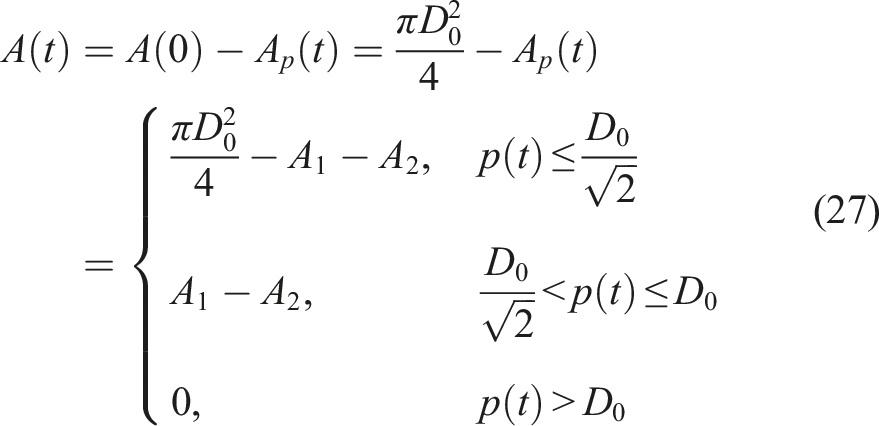
If the reinforcement layout comprises n
s
reinforcing bars with the same diameter D0, the remaining cross-sectional area of reinforcing steel at time t due to pitting corrosion of n
s
bars is:

The loss of cross-sectional area of reinforcing bars in a steel beam can lead to safety problems, and the LSF for the ULS can be written as follows:

Numerical analysis of time-dependent reliability with different limit state functions
Numerical simulations are conducted through the commercial software MATLAB (Ferreira, 2009), and all analyses are carried out using the same computer with a Intel(R) Core(TM) i7-4790K CPU processor at 4.0 GHz with 16 GB RAM. Different LSFs may lead to different reliability results. In this section, the numerical analyses for corroded RC beams with SLS and ULS are all considered.
Reliability analysis with serviceability limit state
Distribution of Random Parameters for the Analysis With SLS.

The age factor m in equation (13) is influenced by the water cement ratio W/C. For this example, we set W/C values of 0.3, 0.4, and 0.5, resulting in m values of 0.15, 0.4, and 0.65, respectively, as calculated using equation (13). The chloride diffusion coefficient D(t) is plotted in Figure 2 for D
ref
= 12 × 10−12 m2/s. The variation of D(t).
From Figure 2, it can be observed that D(t) decreases rapidly at the early stages and then decreases slowly over time. To ensure that D(t) decreases with time (Wu et al., 2017), the value of m should be limited to the range of 0-1. Gjorv (2011) suggested setting m to 0.4, which is consistent with empirical formulas (Lu et al., 2015). Therefore, we adopt m = 0.4 (i.e., W/C = 0.4) for this work. With this value, the equation (16) becomes:
Reliability analysis with ultimate limit state
Second, numerical analysis of reliability with ULS is presented, focusing on the bending failure of a beam. As shown in Figure 3, we consider a rectangular cross-section beam with width b, height h, and n
s
= 4 steel bars embedded in the concrete. A moment M
a
(t) is applied to the beam. Layout of a RC beam cross-section.
Distribution of Random Parameters for the Analysis With ULS.
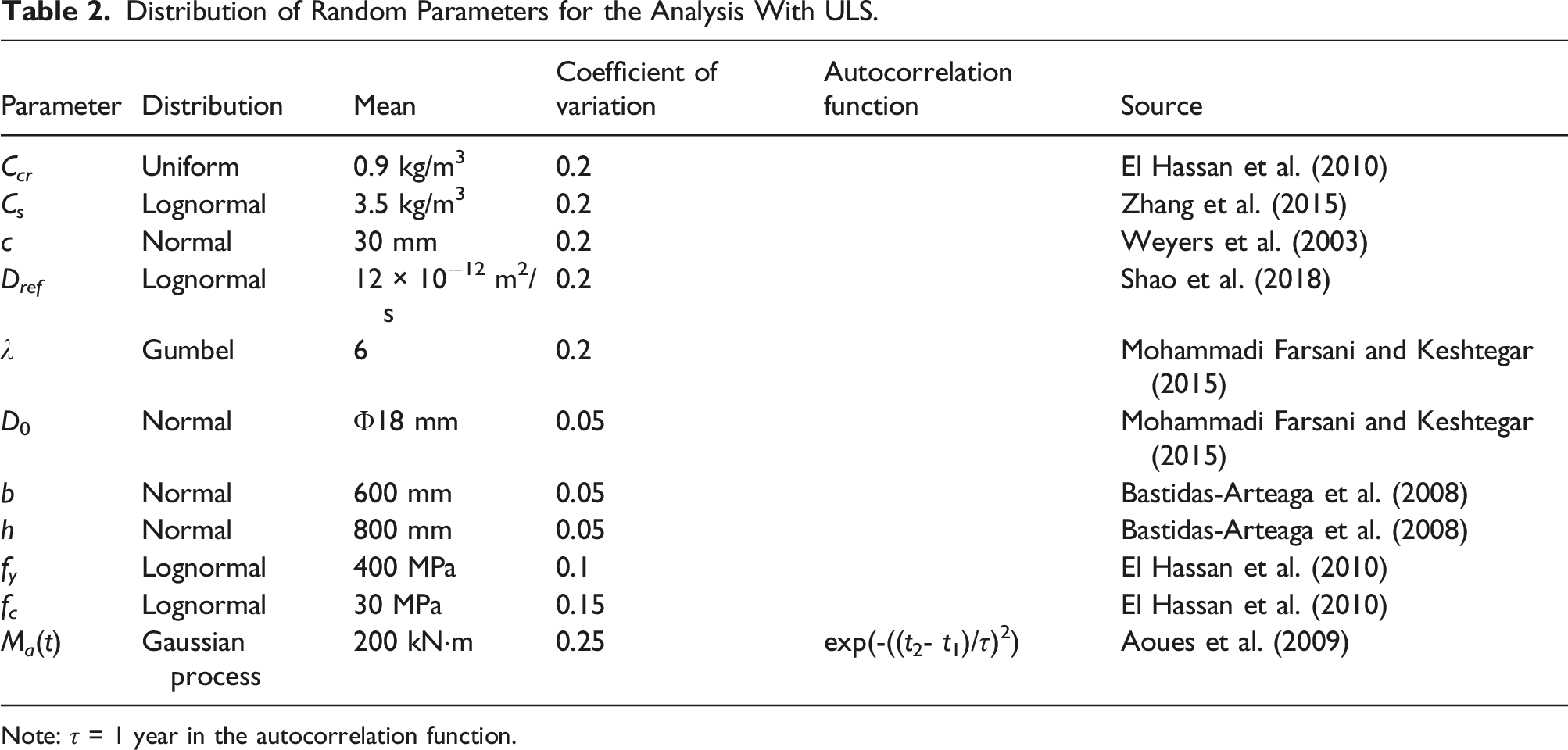
Note: τ = 1 year in the autocorrelation function.
The bending moment capacity of the RC beam is expressed by:


Results and discussion
Numerical analysis of reliability with serviceability limit state
Since
However, the CDF method utilizes N = 105 MC samples to calculate the corresponding corrosion initiation time T
i
, and the PDF can then be estimated using kernel density estimation, Gaussian fitting and lognormal fitting. These results are compared with the empirical PDF (i.e., the frequency histogram contour) in Figure 4. Comparison of different approximation methods for PDFs.
Figure 4 shows that the corrosion initiation time T
i
can be well approximated as a lognormal random variable, consistent with the situation described in reference (Mohammadi Farsani and Keshtegar, 2015). Therefore, T
i
is assumed to be a random variable following a lognormal distribution, where ln(T
i
)∼N(μ, σ2). The maximum likelihood estimate is used to estimate the parameters as follows: Comparison of the MCS and CDF methods for the analysis with SLS. Failure Probability Over different Time Intervals for the Analysis With SLS.

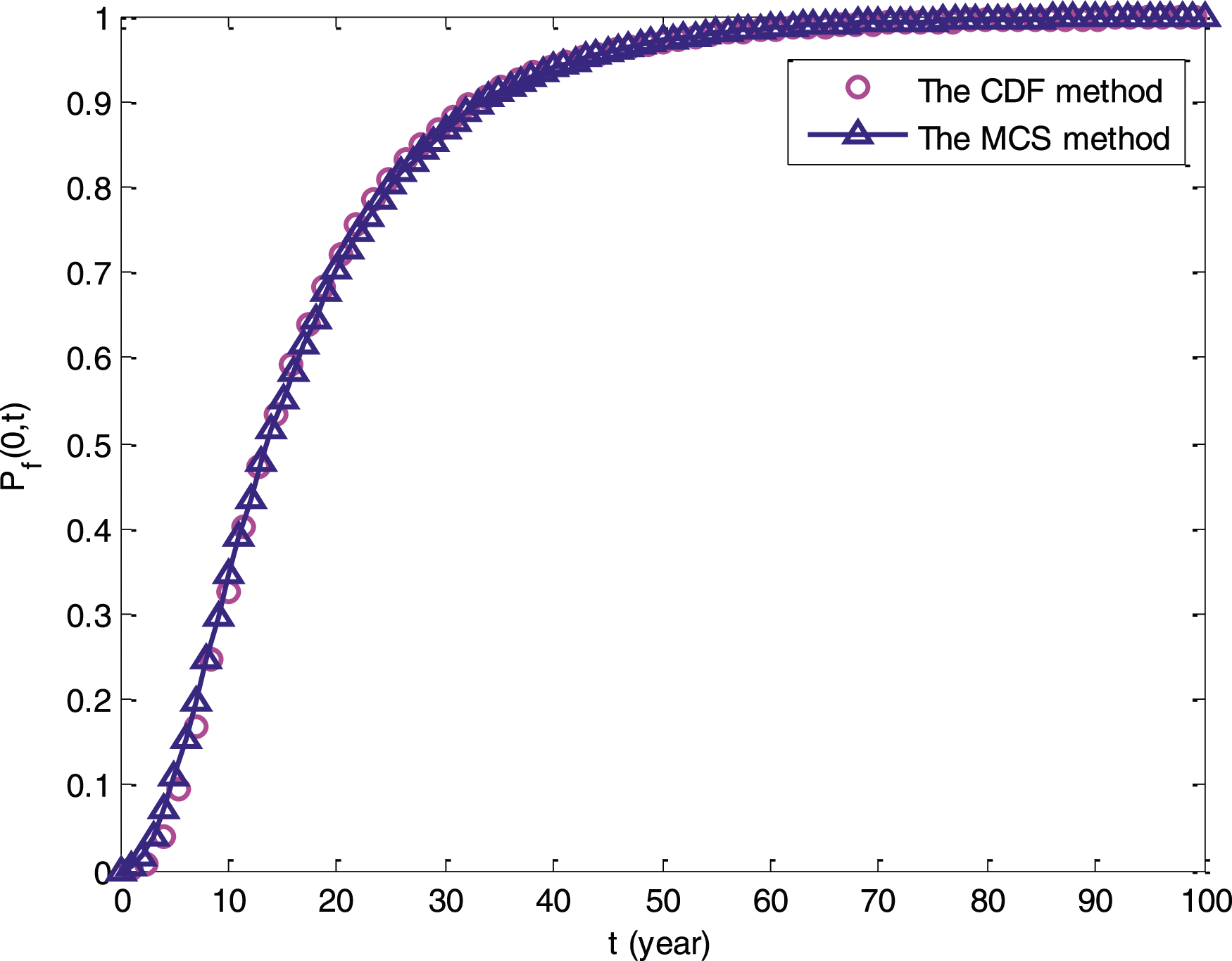
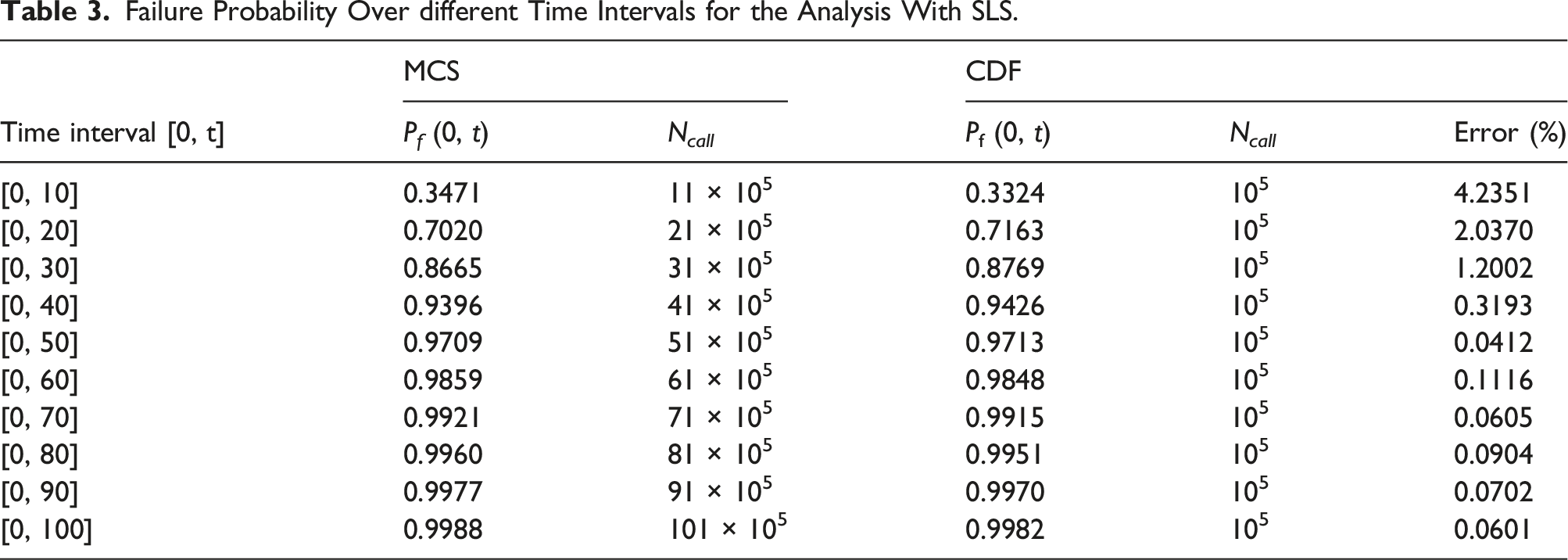
The results obtained from the MCS method are so accurate that can be considered as the reference. Compared with the MCS method, it is shown from Figure 5 and Table 3 that the CDF method can evaluate the time-dependent reliability in an accurate and efficient manner. The time-dependent failure probability within [0, 70] years is greater than 0.99, indicating that the initial corrosion of reinforced steel is highly likely to occur.
Numerical analysis of reliability with ultimate limit state
It can be seen from equation (32) that Trajectories of the stochastic process.
Let The results using the MCS method for the analysis with ULS.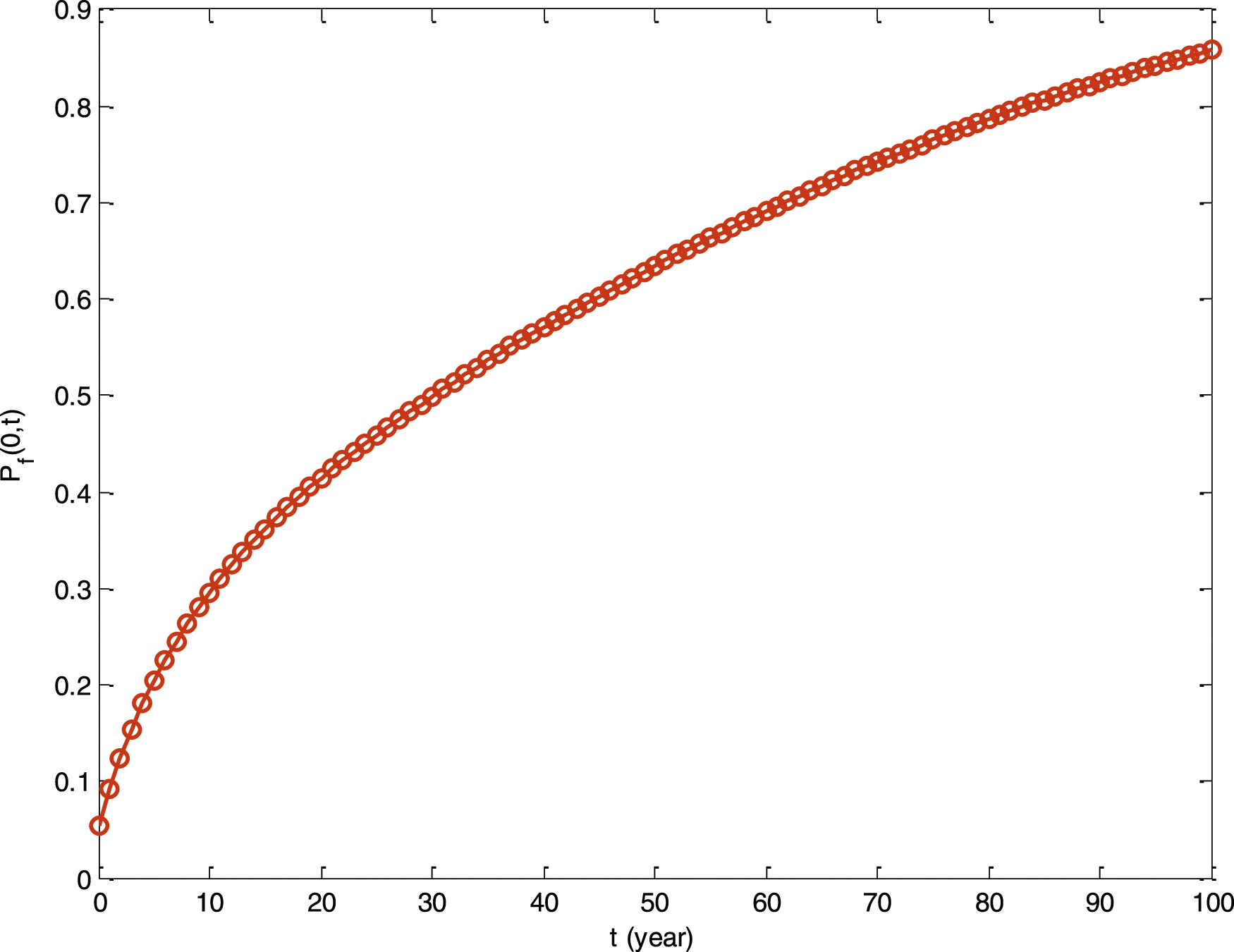
It is clear that the variation trends of time-dependent failure probability are consistent with reference (Mohammadi Farsani and Keshtegar, 2015). In addition, the results of ULS are compared with that of SLS, as depicted in Figure 8. Comparison of the results with SLS and ULS.
It is evident from Figure 8 that different LSFs (SLS or ULS) yield varying results in reliability analysis. Comparing the results, it can be observed that the SLS tends to be more conservative than the ULS. This means that when using the SLS criterion, the lifetime of RC structures may be underestimated. Although the reinforcement in the RC beam undergoes corrosion, it still retains its bearing capacity. Consequently, the time-dependent failure probability over the [0, 100] years is close to 1 with SLS, whereas it is approximately 0.85 with ULS. In the early stages, the time-dependent failure probability with ULS exceeds that with SLS. This difference arises from the fact that ULS takes into account the load effect on the structure, which introduces additional uncertainties into the analysis compared to SLS.
Time-dependent reliability-based design optimization of corroded reinforced concrete beams
The previous research discussed the time-dependent reliability analysis of corroded RC beams. However, in practical engineering, it is important to consider not only the safety but also the economic aspects of the structure. Therefore, the optimization design of RC structures plays a significant role in material savings and cost reduction while ensuring safety. In this section, the TRBDO of corroded RC beams is discussed.
A typical model of time-dependent reliability-based design optimization
Similar to a reliability-based design optimization (RBDO) problem, a typical TRBDO model incorporates the time factor and can be expressed as follows:
Time-dependent reliability analysis in time-dependent reliability-based design optimization
It is important to note that the LSF in equation (36) includes the design variables 

Equations (37) and (38) are essentially the same as equations (6) and (7) mentioned earlier.
Description of PSO-MCS algorithms
In this paper, the particle swarm optimization (PSO) algorithm (Kennedy and Eberhart, 2001) is utilized as the optimization algorithm due to its simplicity in program implementation and fewer adjustable parameters. In PSO, iterative optimization is carried out using a group of random particles that represent potential solutions. Each particle possesses two vectors: position and velocity. It adjusts its flying pattern based on individual experience and information sharing. Each particle updates its own velocity and position using the following equations:

For TRBDO problems, the PSO-MCS method (Li and Chen, 2019) consists of the following steps: Step 1: Initialize a particle swarm of size np and set the initial positions and velocities. Each particle represents a feasible design point within the design space. Step 2: Calculate the time-dependent reliability of each particle using the MCS method. Determine whether or not the reliability constraint is satisfied. If the reliability constraint is not met (δ = 1), apply a penalty function method by adding a large penalty value M to the objective function, i.e., f( Step 3: Evaluate the fitness value of each particle to determine the historical best position of each particle (pBest) and the global best position of the entire particle population (gBest). Step 4: Update the velocity and position of particles using equations (39) and (40). Step 5: If a stopping criterion is met (usually a preset precision or a specified number of iterations), terminate the algorithm and output the optimal solution. Otherwise, return to Step 2.
The flowchart of the PSO-MCS algorithm is shown in Figure 9. It is worth noting that after a certain number of iterations, particles will automatically move away from regions that do not satisfy the constraint, leading to the achievement of an optimal solution. Flowchart of the PSO-MCS algorithm.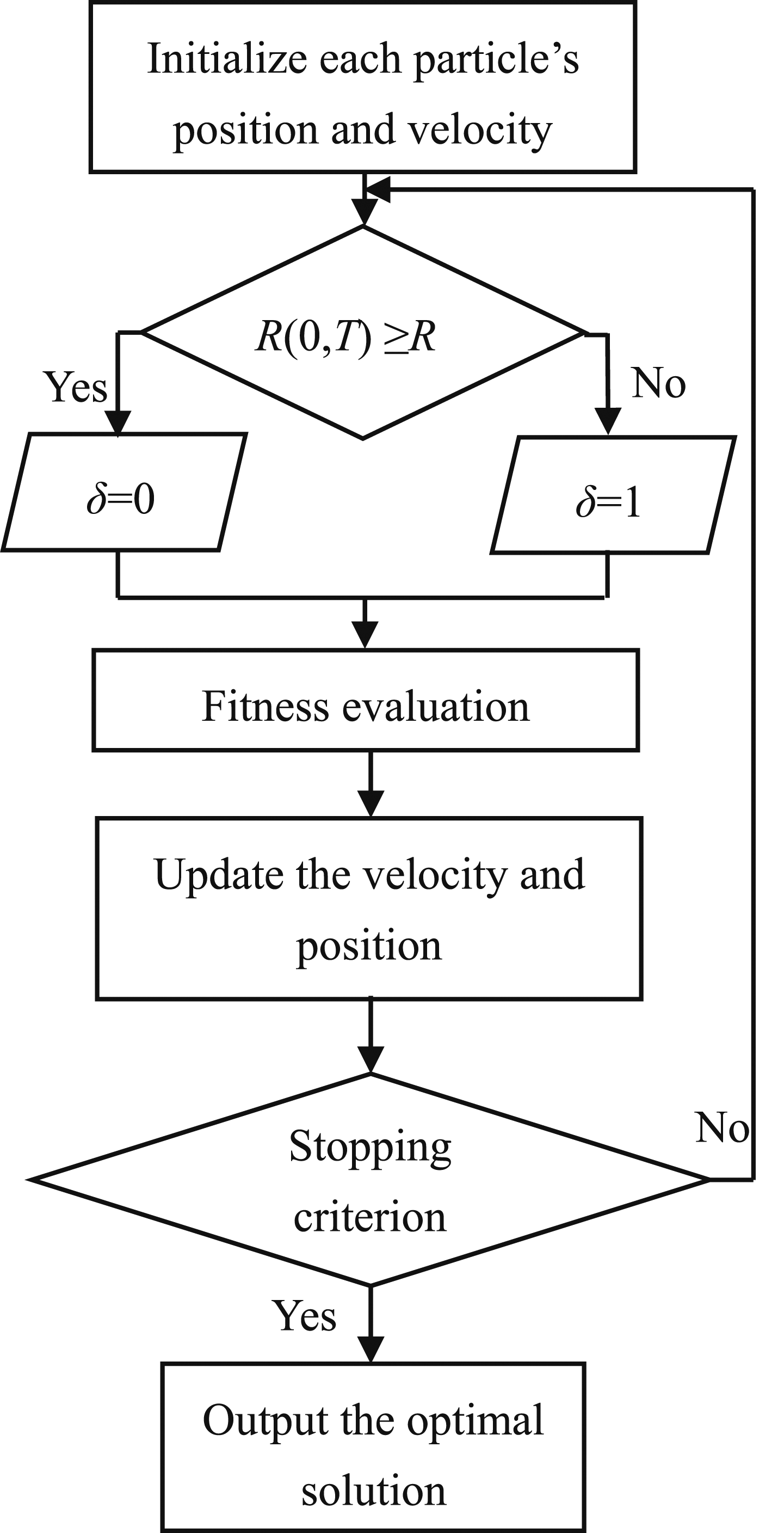
A time-dependent reliability-based design optimization example
A TRBDO problem for the RC beam is shown in Figure 10. The length of the beam is L = 6 m, and the cross section is rectangular with width b and height h. The number of steel bar inside the concrete is n
s
= 4. And the beam is subjected to a moment M
a
(t). A RC beam.

Deterministic Parameters.


Distribution of Random Parameters for the TRBDO Example.

Note: τ = 1 year in the autocorrelation function.
To discretize the time interval, Δt = 1 year is used, resulting in a total of s = 101 time nodes. The EOLE discretization strategy is applied to reconstruct the stochastic process. The first 98 dominant eigenvalues are considered to satisfy equation (5), which gives p = 98. Thus, 98 uncorrelated standard normal variables [Z1, Z2, …, Z98]T are used to reconstruct M
a
(t). And then,
Comparison of Results Before and After Optimization.

Table 6 provides a comparison of the results before and after optimization. It can be observed that the reliability of the optimized RC beam is improved, satisfying the reliability constraint. The initial cost is reduced by 7.696%, while the bending moment capacity is improved. This improvement is attributed to the increase in the initial diameter of the steel bar D0, which enhances the bending performance of the beam. The iterative process is illustrated in Figure 11. Iterative process of the PSO-MCS algorithm.
Conclusions
In this study, the time-dependent reliability analysis and optimal design of corroded RC beams are investigated. The time-dependent reliability is analyzed considering both the corrosion initiation of reinforced steel (SLS) and the bending failure of the beam (ULS). The time-dependent chloride diffusion coefficient and a stochastic process are all incorporated into the analysis. Furthermore, a TRBDO model for RC beams is developed and a PSO-MCS algorithm is then employed to solve the TRBDO problem. The MCS method is used to compute the time-dependent reliability, while the PSO algorithm searches for the optimal design point.
The following conclusions can be drawn: (1) The CDF method is proved to be effective in calculating the time-dependent reliability. (2) The reliability results obtained using SLS are more conservative compared to those obtained using ULS. This is because the reinforcement in an RC beam still retains bearing capacity even it is corroded. (3) After optimization, the initial cost of the specific RC beam is reduced from 1351.879€ to 1247.075€, while the time-dependent reliability within [0, 100] years is improved from 0.6057 to 0.6508. (4) In the TRBDO example, the optimized RC beam exhibits reduced cross-sectional area but increased initial diameter of the steel bar, resulting in improved bending performance.
Due to the fact that this work focuses on the establishment and solution of the reliability model for RC structures, only the results using numerical simulation are obtained. In the next study, the results are supposed to be gained through experiments or real examples. And the numerical results need to be compared with experimental or practical results.
Footnotes
Declaration of conflicting interests
The author(s) declared no potential conflicts of interest with respect to the research, authorship, and/or publication of this article.
Funding
The author(s) disclosed receipt of the following financial support for the research, authorship, and/or publication of this article: This work was supported by the National Natural Science Foundation of China (nos. 52275266, 11832013 and 11572134), Hubei Provincial Department of Education Science and Technology Research Project (no. Q20221714), and the Opening Foundation of Hubei Key Laboratory of Digital Textile Equipment (nos. DTL2023019 and DTL2022012).
