




Abstract
Retaining walls are important structural systems used in the construction of highways. With asset management methods for retaining wall inventories lagging those developed for highway bridges, there is a need to develop risk management methods for these critical structural systems. A major challenge is the vast inventories of retaining walls that asset managers must manage and the inherent limitations of visual inspections. This study proposes an asset management framework for retaining walls based on risk assessments using structural monitoring data. First, a long-term wireless monitoring solution is proposed to measure wall tilt and strain over long periods of time. Second, an analytical framework is developed to separate wall thermal responses from lateral earth pressures responses with the latter used to extract estimated lateral earth pressure distributions. A statistical distribution of lateral earth pressures are used in a reliability assessment of the wall to provide a measure of failure probability that can be combined with failure consequences to estimate asset risk. To illustrate the proposed methodology, a reinforced concrete cantilever retaining wall panel is selected for long-term structural health monitoring. A wireless structural health monitoring system is installed to measure the tilt, strain, and temperature response of the wall continuously over 15 months. The study reveals the wall exhibits strong diurnal and seasonal variations offering insight into wall behavior under operational conditions. Hypothesized levels of corrosion in the steel reinforcement at the base of the wall are explored to estimate the wall reliability. Even under the assumption of 20% reinforcement section loss, the monitored wall was found to have a reliability index well above 3.0.
Introduction
The construction of highways in dense urban areas and sloping terrains often requires retaining wall systems. In the United States alone, more than 160 million square feet of new wall area are constructed every year within the national highway and road network (FHWA, 2008). This results in massive inventories of retaining wall structures that must be managed by state and local transportation departments. Over the past 50 years, transportation departments have developed highly effective asset management methods that ensure the safe and cost-efficient operation of their structural assets, especially highway bridges and pavements. These methods include extensive use of visual inspection and in some cases structural monitoring and analytical modeling (Uddin et al., 2013; Yanev, 2007). In the U.S., the Moving Ahead for Progress in the 21st Century Act (MAP-21) passed by Congress requires transportation agencies adopt risk management strategies for all their transportation assets (FHWA, 2014). MAP-21 has transformed how bridges are managed including the use of risk matrices to assign bridges to low-, medium-, and high-risk categories based on failure consequences (FHWA, 2017). Given the success of risk management methods for bridges and pavements, and the recent mandates of MAP-21, transportation agencies are developing risk assessment methods for geotechnical systems including earth retaining structures (Vessely et al., 2019). The first step of geotechnical asset management is the development of databases to store an inventory of earth retaining structures and inspection methods to visually assess system conditions on a frequent time basis.
Today, several transportation agencies across the globe have developed an inventory and inspection program for retaining wall systems (Athanasopoulos-Zekkos et al., 2020). Most of these programs adopt visual inspection methods to assess the physical condition of the retaining wall including the detection of movement and deformation of wall structures and the geotechnical system they support. Inspectors trained in visual inspection methods carry out inspections with primary and secondary wall elements (e.g., structural form, surface coating, backfill material, drainage system, foundation) and assign a condition rating like that done to rate bridge elements. The United States National Parks Service guides inspectors to offer condition narratives for each wall element with a translational framework to map narrative statements to a condition rating between 0 and 10 (DeMarco et al., 2010). Some state agencies like the Nebraska Department of Roads (NDOR) and Colorado Department of Transportation (CDOT) use a rating system identical to what is used for bridges assigning a 0 to 9 rating (Jensen, 2009; Walters et al., 2016) while others like the Oregon Department of Transportation (ODOT) simplify their ratings into “good”, “fair”, and “poor” ratings (ODOT, 2007). Visual inspection intervals range from every 2 years as in the case of VicRoads in Australia (VicRoads, 2014) to every ten years as is the case with the US National Park Service (DeMarco et al., 2010); but 5 years is the most common interval (e.g., Alaska, New York City, Oregon, Pennsylvania). While inventory and inspection programs are an essential step toward the development of risk assessment methods for retaining wall structures, alone they are not sufficient due to the lack of quantitative data required to accurately assess the risk inherent to a retaining wall system using information specific to its in-situ performance. Only structural monitoring can offer quantitative evidence of retaining wall in-situ performance.
With structural monitoring evolving into a cost-effective tool for monitoring the performance and condition of bridges (Flanigan et al., 2020; Frangopol et al., 2008; Fujino and Siringoringo, 2011; Zonta et al. 2007, 2014), asset managers responsible for retaining walls have more recently explored monitoring methods to assist them. Most data collection methods focus on assessing the movement of walls. Manually applied surveying methods such as the use of total stations and global positioning system (GPS) receivers are widely used to measure wall movements over time. Vehicle-mounted sensors including GPS, laser scanners, and cameras have also been explored to offer a more efficient approach to spatially mapping retaining wall geometries with repeated surveys used to track long-term wall deformations (Kalenjuk et al., 2019; Yen et al., 2011). Specifically, LiDAR and photogrammetry offer three-dimensional point cloud data sets with sub-centimeter resolutions (Kim et al., 2009; Oskouie et al., 2016). Mobile mapping methods based on LiDAR have been validated to accurately map 150 linear miles of wall surface profiles a day (Yen et al., 2011). However, a limitation of these methods is that they only provide information at one point in time (i.e., at the time of the scan) and fail to show continual behavior under diurnal and seasonal environmental variations. To provide measurements continuously over time, permanent sensors installed on a retaining wall (or in the backfill behind the wall) are necessary (Koerner and Koerner, 2011). Sensors installed onto retaining walls for long-term monitoring are typically tiltmeters (also termed inclinometers) that provide a measure of the rotation of the wall away from the system backfill (WSDOT, 2011). Strain gages including discrete gages and distributed gages have also been explored to measure the strain response of retaining walls (Bridge Diagnostics Inc (BDI), 2006; Wu et al., 2022). The availability of cost-effective instrumentation for monitoring retaining walls opens opportunities to more objectively assess their behavior and health.
In this paper, a comprehensive risk assessment framework is proposed for the asset management of retaining walls based on long-term structural health monitoring (SHM). A reinforced concrete (RC) cantilever retaining wall is selected as the primary wall type in the study given that it is one of the most ubiquitous types of retaining wall designs. The study proposes the use of modular wireless sensor networks to serve as a rapid-to-deploy structural monitoring solution that can monitor the response of the retaining wall structure over any measurement period (including indefinitely). Tilt and strain are measured to observe the strain and angle of the wall surface while surface temperature is also measured to associate strain responses to thermal loads. The study prioritizes sensor installation locations on the retaining wall face due to ease of installation and does not explore sensors in the backfill soil system which would be costly to place. An analytical framework is proposed to process wall tilt and strain measurements to disaggregate strain responses from thermal loads from those based on lateral earth pressures before using the flexural wall response to estimate the profile of lateral earth pressures on the back of the wall. Lateral earth pressures on the backside of the wall at each data sample result in a statistical lateral load demand model with diurnal and seasonal variations included. The framework then utilizes the estimated lateral earth pressures to estimate the probability of failure of the monitored wall using Monte Carlo simulations based on assumed distributions of structural and soil properties that define the structural capacity of the retaining wall system. Using the wall plan and profile drawings that include soil boring data, concrete grades, steel grades, types of soil stratum, construction layouts, and component measurements, material statistical distributions were referenced from well-established sources (ACI, 1997; Arrayago et al., 2020; Bournonville et al., 2004; Chu, 1991; Coduto, 2001; Koloski et al., 1989; Mirza and MacGregor, 1979; Mokhtar et al., 2013; NAVFAC, 1986). The probability of failure (and corresponding reliability index) is calculated for assumed levels of deterioration (e.g., corrosion of steel reinforcement) that are informed by the age of the wall and from visual inspection. The probability of failure can then be combined with the consequences of failure to quantitatively assess the risk of the retaining wall system. The study applies the proposed risk assessment framework to assess the reliability of a 30-year-old RC cantilever retaining wall along the I-696 highway corridor in southeast Michigan. The paper is organized as follows: first, the monitoring system and the retaining wall design are described followed by a description of the analytical framework used to assess the system reliability; next, the results of the monitoring campaign are presented followed by an assessment of the monitored wall reliability; finally, the paper concludes with a summary of the contributions made by the study (including key results) and description of future extensions of the proposed risk assessment framework.
Methodology: Long-term monitoring of retaining wall systems
I-696 reinforced concrete (RC) cantilever retaining wall system
A single panel of a reinforced concrete cantilever retaining wall system along the I-696 freeway in the metropolitan region of Detroit, Michigan is selected for this study. I-696 is a 28-mile east-west highway that connects I-96 and Farmington Hills, Michigan with I-94 and St Clair Shores, Michigan in the northern suburbs of Detroit. Constructed in three stages from 1961 to 1979, the highway is excavated below ground level in many sections with extensive use of retaining walls to support West Eleven Mile Road that exists on both sides of the highway. The Michigan Department of Transportation (MDOT) is the owner of the highway and all its structural assets including retaining walls. MDOT identified a segment of the reinforced concrete (RC) retaining wall system (Figure 1(a)) along eastbound I-696 in the vicinity of Central Park Boulevard; this segment was selected due to visual inspections identifying high levels of relative displacement between adjacent wall panels (Figure 1(b)), high deflections at the top of the wall as is evident with deformation of the Eleven Mile roadway (Figure 1(c)), and high amounts of persistent drainage emanating from the lower portions of the wall surface (Figure 1(d)) (Jansson, 2007). This segment of the retaining wall system was designed in 1986 and is now over 30 years old. (a) I-696 RC cantilever retaining wall system; (b) relative displacement between wall panels; (c) road surface deformations on Eleven Mile Road; (d) drainage at the wall base.
The cantilever RC retaining wall system consists of 20 ft (6.1 m) wide panels with varying panel heights due to an exit ramp servicing vehicles exiting eastbound I-696 to reach Eleven Mile Road which is supported at the top of the wall. The wall segment selected for this study has a wall height of 28.5 ft (8.7 m) and is supported by a 3 ft (0.91 m) thick footing (Figure 2). On the far-side (F.S.) of the wall, there exists a two-layer backfill soil system that consists of a 13 ft (4.0 m) deep medium compacted sandy soil at the top of the soil column resting upon a 12.6 ft (3.8 m) deep medium compacted silty-sand soil stratum. The soil conditions of the lower silty-sand soil stratum of the backfill soil are less pervious than the top sandy soil layer. On the wall near-side (N.S.), the sloped I-696 road surface ranges from 3 ft (0.91 m) to 4 ft (1.2 m) above the top of the footing. It is also noted that the wall N.S. has three horizontal strips of 3 in (7.62 cm) wide corrugated indentations of varying heights; these indentations are only of aesthetic value and play no role in the structural behavior of the wall (MDOT, 1986). Dimensions and structural details of the I-696 retaining wall panel: (a) front elevation showing sensor locations; (b) vertical and (c) horizontal cross-sections.
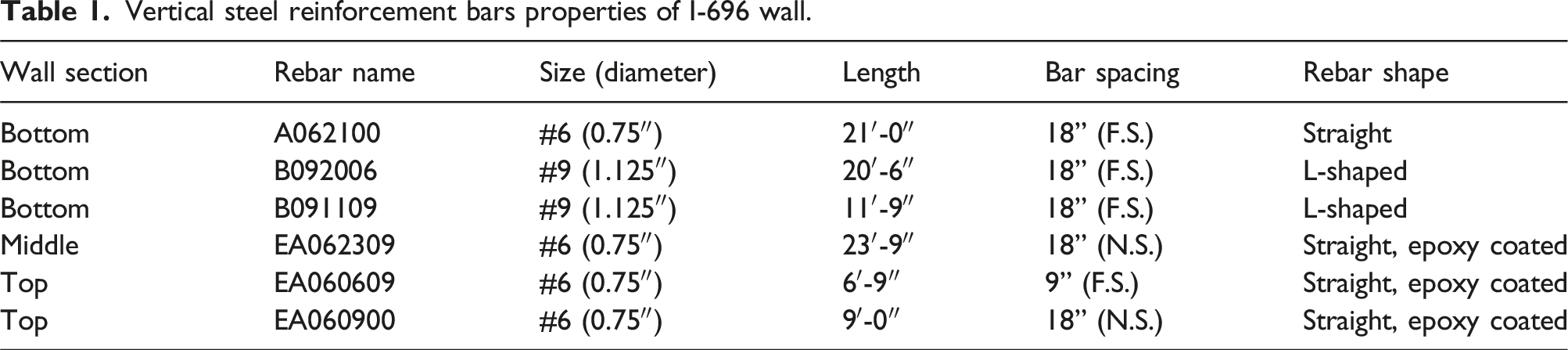
The construction of the wall panel occurred in multiple stages with the footing cast first. Next, the primary retaining wall was cast as two sections with a cold joint between the sections. The primary wall has a total height of 18.6 ft (5.7 m) with a tapered section with a 3 ft (0.91 m) bottom thickness to 1.8 ft (0.55 m) top thickness. The last stage of construction was the placement of a 9.9 ft (3.0 m) tall parapet wall with a constant thickness of 1.5 ft (0.46 m). At the street level, the far-side (F.S.) surface of the parapet wall is bricked to enhance the wall aesthetic along Eleven Mile Road. Both horizontal and vertical steel reinforcement bars were used in the wall construction as shown in Figure 2(c).
Vertical steel reinforcement bars properties of I-696 wall.
I-696 wireless monitoring system
A wireless structural monitoring system is selected for long-term monitoring of the I-696 retaining wall segment (Admassu et al., 2019). Since their inception in the mid-1990s (Straser et al., 1998), wireless structural monitoring systems have matured and today are a proven cost-effective solution for long-term monitoring of civil engineering structures including bridges (Pakzad et al., 2008), buildings (Kurata et al., 2005), and wind turbines (Swartz et al., 2010). The wireless monitoring system is designed using the Urbano wireless sensor node (Flanigan and Lynch, 2018) which is architecturally based on the Narada wireless node (Swartz et al., 2005) that has been widely used for long-term monitoring of bridges (Flanigan et al., 2020; Hou et al., 2020; Kurata et al., 2013; Zhang et al., 2017). Urbano was designed to operate on less battery energy than Narada and relies on the use of 4G cellular modem (Nimbelink Skywire) to transmit its data to the Internet. Cellular communications are attractive because they eliminate the need for on-site base stations while offering precise time synchronization of the node based on the GPS clock maintained by the cellular provider at the cell tower. The cellular modem consumes 616 mA (referenced at 3.3 V) when transmitting, 48 mA when idle, and 8.6 mA when in low-power mode. The seemingly high-current associated with transmitting is offset by the high data rates supported by the radio including a 5 Mbps upload rate. When the radio is needed, Urbano is designed to turn the radio on for bursting out data and then placing it back into sleep mode to minimize battery energy consumption when not transmitting (Admassu et al., 2022). At the core of Urbano is an 8-bit microcontroller (Atmel ATmega2561) clocked at 8 MHz and powered by a 3.3 V power supply. The microcontroller has 256 kB of flash memory for program storage and 8 kB of SRAM for data storage. Volatile memory is further expanded with an additional 512 kB of SRAM (Cypress CY62148EV30) included in the node design. The 8-bit microcontroller includes a multi-channel 10-bit analog-to-digital converter (ADC) capable of a maximum sample rate of 200 kHz. The ATmega2561 alone draws 7.3 mA when active, but 4.5 µA when in power-save mode.
To monitor the behavior of the I-696 wall segment, three sensing transducer types are selected and integrated with Urbano: tiltmeter to measure wall tilt, long-gage strain gage to measure thermal and flexural strain, and thermistor to measure wall temperatures. These three transducers are selected to offer insight into different aspects of the wall behavior in its loading environment. To measure tilt, a 9-axis absolute orientation sensor (Bosch BNO055) well suited for static tilt measurements is adopted to measure the pitch, roll and yaw of the wall. The internal BNO055 accelerometer has an acceleration measurement range of 2g with a resolution of 1 mg (Bosch, 2016). The three static accelerations measured by the BNO055 sensor are used to estimate the tilt of the sensor with a resolution of 0.01°. The BNO055 sensor is interfaced to the wireless node using a serial interface with the Urbano microcontroller. The microcontroller is programmed to query the three static acceleration measurements of the sensor: A
x
, A
y
, A
z
with x, y, and z directions corresponding to vertical along the wall face (in the direction of gravity), orthogonal to the wall plane, and horizontal along the wall face, respectively (as shown in Figure 4(a)). The tilt of the wall along the z-direction can be estimated in radians using the x- and y-accelerations:
An additional feature of the BNO055 is that it includes temperature compensation providing thermally stable measurements between −40°C (−40°F) and 125°C (257°F). To improve the accuracy of the tilt measurement, Urbano is programmed to read 100 consecutive acceleration measurements at 100 Hz with the collected measurements averaged before tilt, θ z , is autonomously calculated by the node using equation (1).
To create a strain sensor to measure the thermal and flexural strain response of the wall, four 350 Ω metal foil strain gages (Omega KFH-6-350-C1-11L1M2R) are bonded to a 1 ft (0.30 m) long, 2 in wide (5.1 cm) and 0.25 in (0.64 cm) thick aluminum plate in a cross configuration (as shown in Figure 3(a)). Two strain gages aligned with the main axis of the aluminum plate (with resistances denoted as RF1 and RF4) are interfaced to opposite sides of a Wheatstone bridge while the other two gages are oriented orthogonal to the main axis (with resistances denoted as RF2 and RF3) are interfaced to the other two opposite sides of the Wheatstone bridge (Figure 3(b)). This configuration enhances the sensitivity of the strain response along the length of the plate while using the two gages orthogonal to the plate’s longitudinal axis to thermally compensate the bridge circuit. The gages in the Wheatstone bridge are powered using a 3.3 V source (Vin) with the bridge output voltage (Vout) fed into a standard instrumentation amplifier (Analog Devices AD623) whose internal gain is set to 1000 resulting in Vstrain (=1000*Vout). The amplified output of the amplifier, Vstrain, is connected to the Urbano 10-bit ADC for data collection. This full bridge setup allows longitudinal strain in the plate, ε, to be calculated as: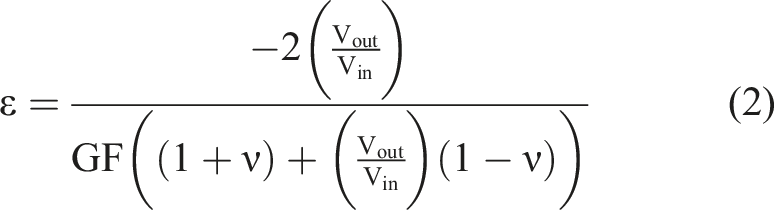
The last sensor used to monitor the I-696 retaining wall panel is a standard, waterproof thermistor (TDK Group B57020M2). The thermistor is interfaced to a voltage divider circuit to convert resistance to a voltage that is read by the Urbano 10-bit ADC. The Urbano node is programmed to estimate the strain and wall temperature based on the voltages read from the signal conditioning circuits used for the aluminum plate strain sensors and thermistor. Long-gage strain sensor: (a) long-gage aluminum plate with four active metal foil strain gages attached; (b) full-bridge circuit interfaced to Urbano.
The Urbano wireless sensor node is packaged in a water-tight NEMA-rated enclosure prior to deployment on the I-696 retaining wall systems. As shown in Figure 4(b), inside each enclosure is an Urbano node, signal conditioning circuits, solar charge controller, and a 12V (2.9 A-hr) sealed rechargeable lead acid battery (Powersonic PS-1229). The enclosures also included the Bosch BNO055 bonded to the enclosure’s bottom surface shielding it from direct sunlight. The node enclosure is attached to the wall surface using four threaded bolts anchored into the wall as shown in Figure 4(a). The aluminum plate strain sensors and thermistors are attached to the wall with wires from these sensors fed into the enclosures through watertight glands and attached to the Urbano node. The thermistor is epoxied to the wall surface while the aluminum plate strain sensor is attached using two threaded bolts anchored into the wall. The thermistor and the strain gages on the strain sensing plate are both covered with a waterproof epoxy-like coating to ensure rain and sunlight do not affect the measurements. Each node is powered by a 12V (10 W) solar panel (Acopower HY010-12M) attached to a light pole above the retaining wall (Figure 4(c)). (a) Urbano wireless sensor units 2 and 3 in Figure 2(a) and an aluminum plate strain sensor; (b) interior view of the NEMA enclosure showing Urbano node, solar charge controller, BNO055 sensor, and lead acid rechargeable battery; (c) solar panels used to power nodes.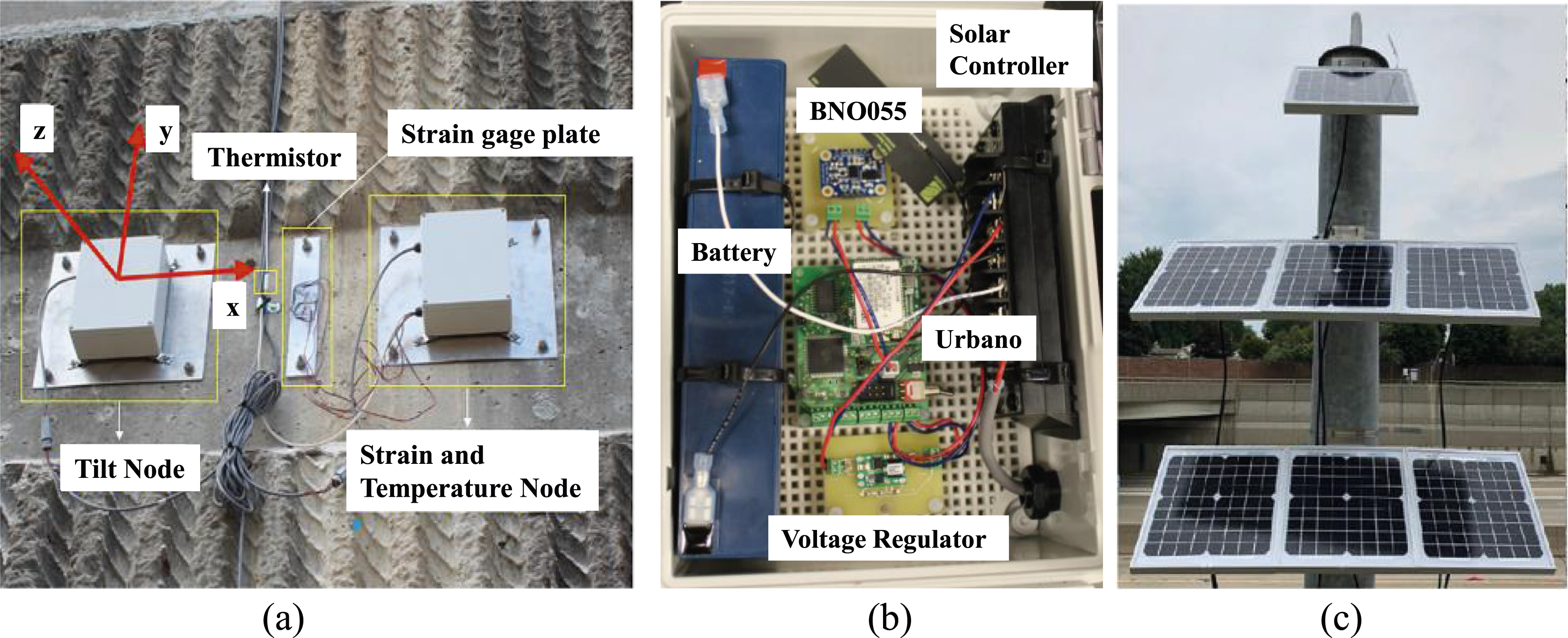
A total of four Urbano wireless sensor nodes are deployed along the center line of the I-696 retaining wall segment on August 25, 2018, during a warm and dry day; the locations of the four nodes are denoted in Figure 2(a). To measure wall tilt at the top (θ top ) and mid-height (θ mid ), Node 1 is installed at 24 ft (7.3 m) above grade and Node 2 at 13.5 ft (4.1 m) above grade, respectively. To measure wall strain at mid-height (ε mid ) and bottom (ε bot ), Node 3 is installed 13.5 ft (4.1 m) above grade while Node 4 is installed at 3.5 ft (1.1 m) above grade, respectively. A thermistor is interfaced to both Nodes 3 and 4 to measure the surface wall temperature (T mid and T bot , respectively) in addition to strain. The Urbano wireless nodes are designed to operate on a schedule with each node programmed to collect data every hour; when not sensing, the nodes remain in a low-power state to preserve battery energy. After data is sampled by each node, the nodes are programmed to communicate data to a cloud server using the cellular modem integrated with each node. In this study, the I-696 wall is monitored from August 2018 to February 2020.
Methodology: Analytical framework for reliability assessment
Model of wall behavior to extract lateral loads
The primary objective of the analytical framework is to process the measured response of the instrumented retaining wall to estimate the system reliability using user-defined limit states. A challenge for this task is the complex nature of the wall behavior. Specifically, the observed wall behavior will primarily be in response to both thermal variations and lateral earth pressures. The monitoring system is designed to produce response data that would allow the wall strain response to thermal and lateral earth pressure loads to be disaggregated as separate response components. Specifically, the thermal and flexural strain components will be denoted as ε
temp
and ε
flex
, respectively, with total strain, ε, the sum of the two components: ε = ε
temp
+ ε
flex
. Absolute strain cannot be measured using the instrumentation described previously because there are residual strains inherent in the wall system at the time of the installation of the strain sensors. Hence, measured changes in strain, Δε, as referenced from the start of the monitoring campaign and are associated with changes in wall temperature, ΔT, in addition to changes in the lateral earth pressures on the far-side of the wall over the period of monitoring:
Thermal strain changes,
In theory, the relationship between thermal strain change and temperature is defined as:
Wall tilt measurements, Active lateral earth pressures behind the monitored wall due to surface surcharge loading, hydrostatic pressure, and backfill pressure.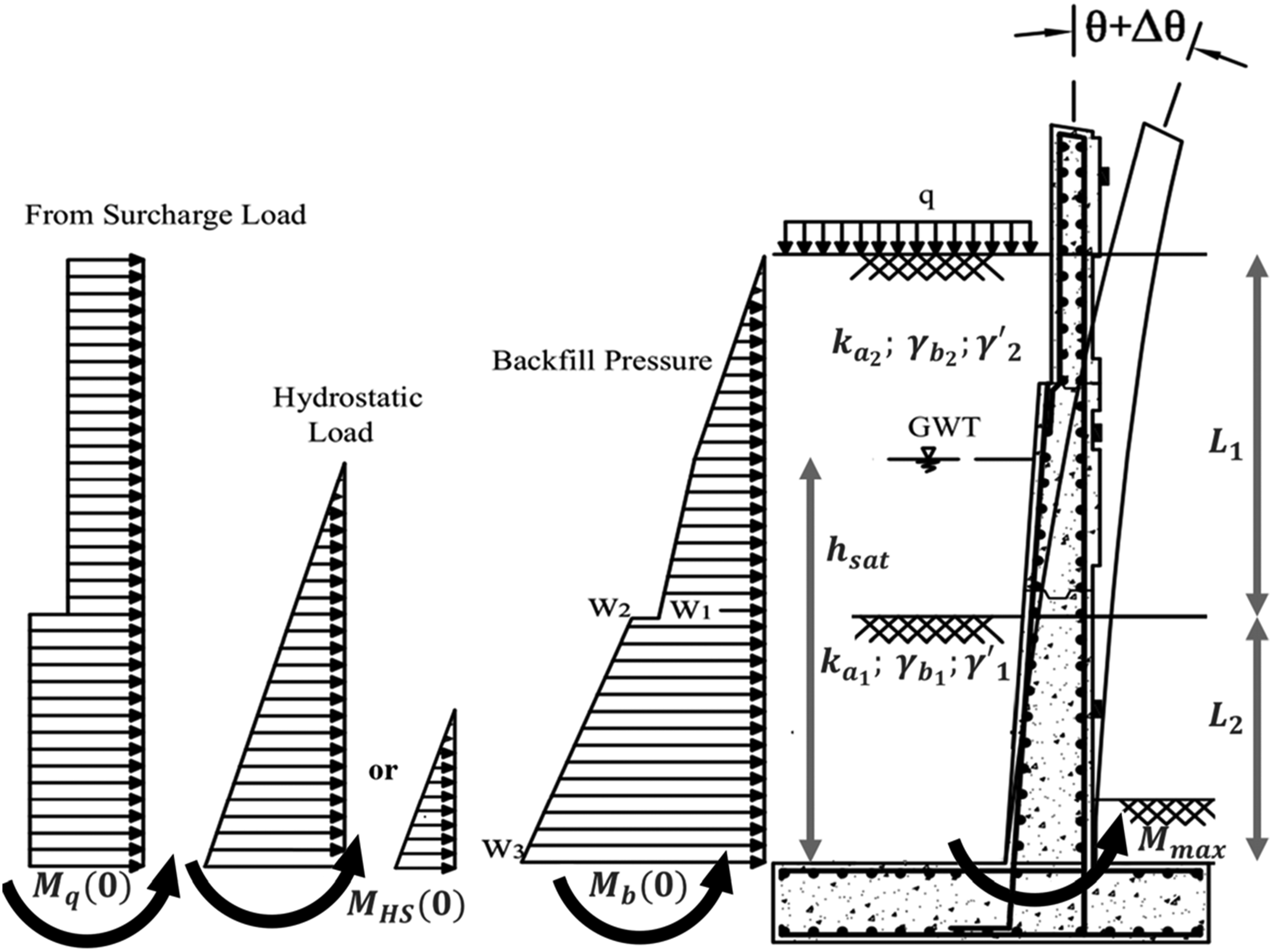
To develop a simple mechanical model of the retaining wall, it is modeled as a Euler–Bernoulli beam model with the interaction between adjacent wall panels ignored to ensure model simplicity. The beam is assumed to be in static equilibrium governed by the moment balance:
For a given loading profile, q and h
sat
, the vertical profile of lateral earth pressures is established and the moment distribution, M(x), calculated by standard equilibrium principles. The wall rotations, 

Given the age of the retaining wall system, the material properties of the concrete need to account for age, especially in the selection of the concrete modulus of elasticity. The effective modulus of the concrete is determined based on the documented 28-days compressive strength of the concrete (

Given the age of the wall (33 years), the effective modulus,
With respect to the soil backfill, the soil boring elevation drawings document the backfill as a two-layer system with a 13.9 ft (4.2 m) thick layer of medium compacted sand on top of a 9.6 ft (2.9 m) thick layer of medium compacted gray silt and fine sand. In the absence of site-specific information, based on (Coduto, 2001; NAVFAC, 1986), the medium compacted sand is assumed to have a bulk density of γ
b2
= 119.2 lb/ft3 (1909.9 kg/m3) and submerged density of γ
2
' = 65.7 lb/ft3 (1051.8 kg/m3) while the medium compacted gray silt and fine sand layer is assumed to have a bulk density of γ
b1
= 126.1 lb/ft3 (2020.6 kg/m3) and submerged density of γ
1
' = 72.6 lb/ft3 (1162.6 kg/m3). Rankine’s theory is used to determine the pressures on the far-side of the wall, a methodology also favored by state transportation agencies including AASHTO and FHWA. The generalized form of Rankine’s earth pressure coefficient, k
a
, for each layer is (Chu, 1991):

To simplify the analysis, permutations of q and 
With the optimal load profile estimated, the flexural strain response, Load estimation and thermal strain extraction from measurement data.
Reliability methods for retaining wall performance assessment
At the core of quantitative risk assessment is a structural reliability assessment using monitoring data. Reliability assessments calculate the probability of exceeding a defined scalar limit state function, G(
The probability of failure, 
Reliability methods are integral to the design of earth retaining structures including retaining walls that are designed using load and resistance factor design (LRFD) codes such as those associated with AASHTO. Researchers have explored reliability methods to advance the design of retaining walls. For example, (Low, 2005) explored the use of the Hasofer–Lind reliability index and the first-order reliability method (FORM) to design retaining walls to target reliability index values. (Basheer and Najjar, 1996) developed a reliability framework to optimize the design of reinforcing ties used in the design of reinforced earth retaining walls. (Goh and Kulhawy, 2005) studied the use of neural networks to define nonlinear limit state functions that define unacceptable excessive ground deformations associated with braced retaining walls used in excavation projects. More recently, there has been research devoted to expanding the role of reliability from the design phase of a structure to that of asset management, especially of bridges. For example, (Zonta et al., 2007) proposed a decision support system for bridge managers based on reliability methods using visual inspection ratings and associated data. The seminal study by (Frangopol et al., 2008) explored the inclusion of long-term strain data in estimating the reliability of bridge components based on the use of FORM to estimate the reliability index of an instrumented truss element. Similarly, (Flanigan et al., 2020) proposed the use of strain data to assess the reliability of fatigue-critical structural elements in a railroad truss bridge.
At the core of the reliability assessment method proposed herein (Figure 7) is the use of the Euler–Bernoulli beam model previously developed to determine the demand response, D, of the retaining wall to the observed lateral earth pressures and thermal loads estimated from the monitoring data. A Monte Carlo approach is taken to perform the reliability assessment given the computational simplicity of the Euler–Bernoulli beam model. First, for a given state of measurement Analytical framework of reliability analysis using probabilistic models for system properties.
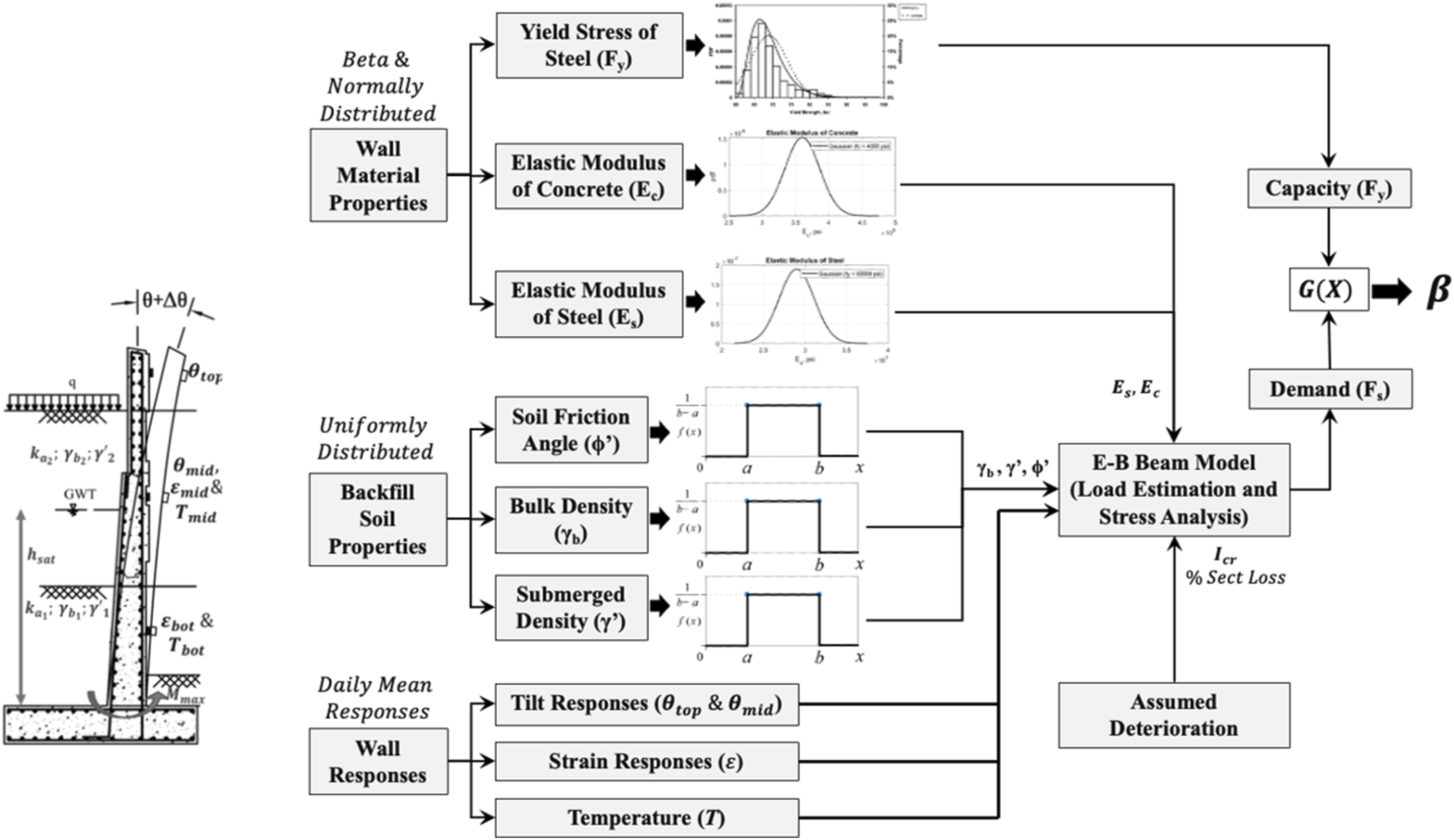
A primary failure mechanism of cantilever retaining walls is the corrosion of the steel reinforcement at the base of the wall with lateral earth pressures producing an overturning moment, M
b
(0), that exceeds the flexural capacity of the base cross-section. In the case of the retaining wall studied in this work, evidence of continuous water drainage at the base of the wall makes corrosion of the steel reinforcement a long-term concern. Hence, this study considers the limit state function as the difference in the demand response, 
This is just one of many possible limit state function that the wall owner may want to consider; the reliability assessment framework is capable of accommodating other limit state functions. For each iteration of the Monte Carlo analysis, the strain in the steel reinforcement is calculated based on,
With respect to the random variables,
For the limit state function used in this study, a statistical distribution of F y is assumed based on the comprehensive statistical modeling of steel reinforcement properties by (Bournonville et al., 2004). For the ASTM A615 Grade 60 steel reinforcement used at the base of the wall, a normal distribution is assumed. Based on (Bournonville et al., 2004), the mean yield strength of Grade 60 steel is 69 ksi (475 MPa) with a standard deviation between 4.3 ksi (29.6 kPa) and 5.0 ksi (34.5 kPa); this study selected 5.0 ksi (34.5 kPa) for the standard deviation.
Results
Long-term behavior of retaining wall
The cantilever retaining wall panel was monitored continuously from August 2018 to February 2020. Figure 8 provides a continuous time history of the measured wall tilts ( Daily mean responses of the I-696 retaining wall panel with daily mean precipitation added (August 2018 - February 2020).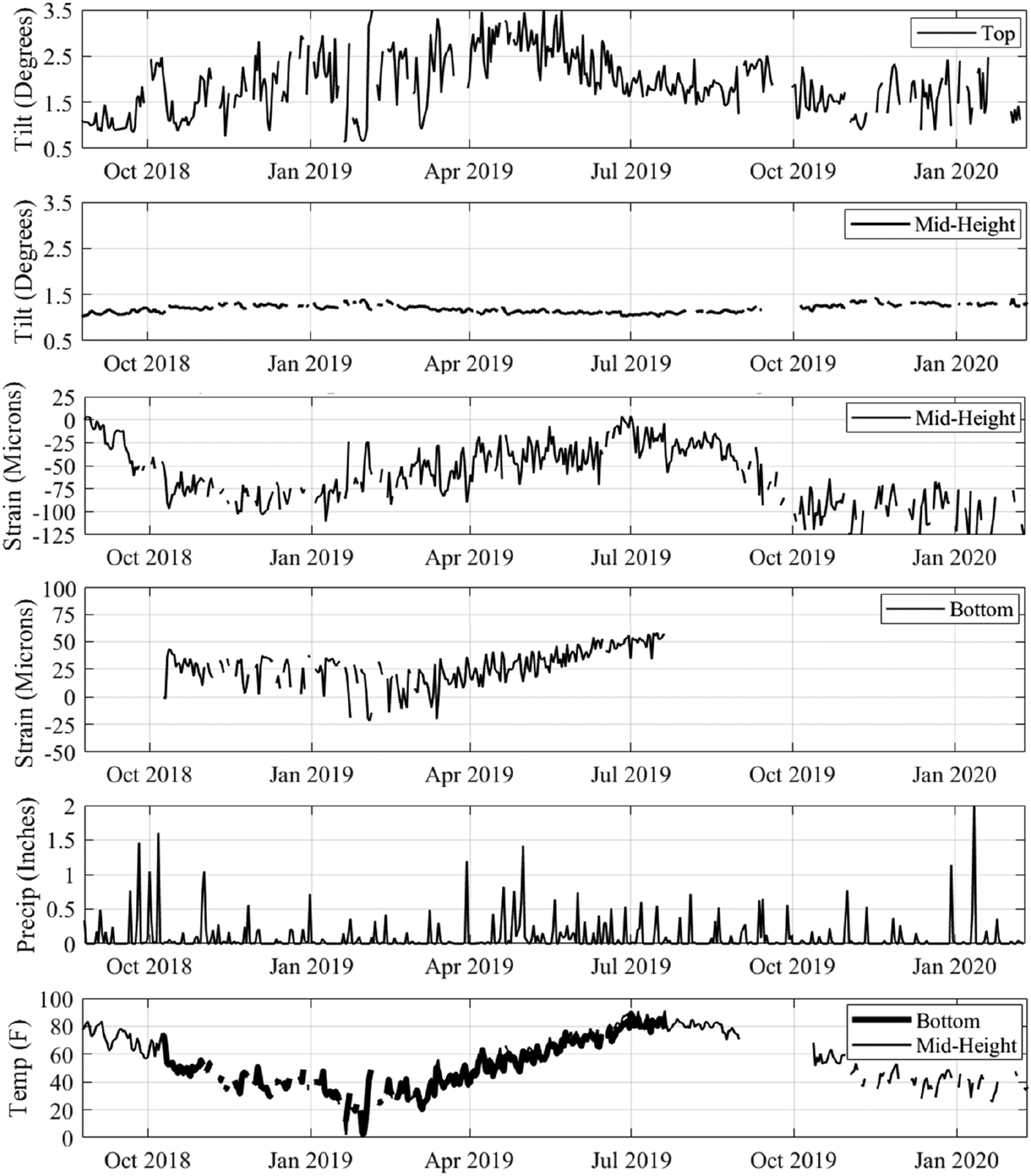
The gaps in data observed in the time history plots (i.e., wall responses in Figure 8, the plots of estimated tilt, surcharge load, and saturation level in Figure 13, and reliability indices in Figure 15) are attributed to two main factors. The first is that wireless sensor units can have low battery charges due to the slow rate of recharging the battery by the solar panels during cloudy or very cold days. If the battery charge is low, the cellular modem is kept off. Second, the cellular network signal in the wall location is sometimes not strong enough for the Urbano nodes to communicate to the 4G network necessary to transfer data to the cloud-based database. One solution is to use slightly larger batteries and solar panels; another is to buffer data in local memory to report to the database when the network signal is strong enough.
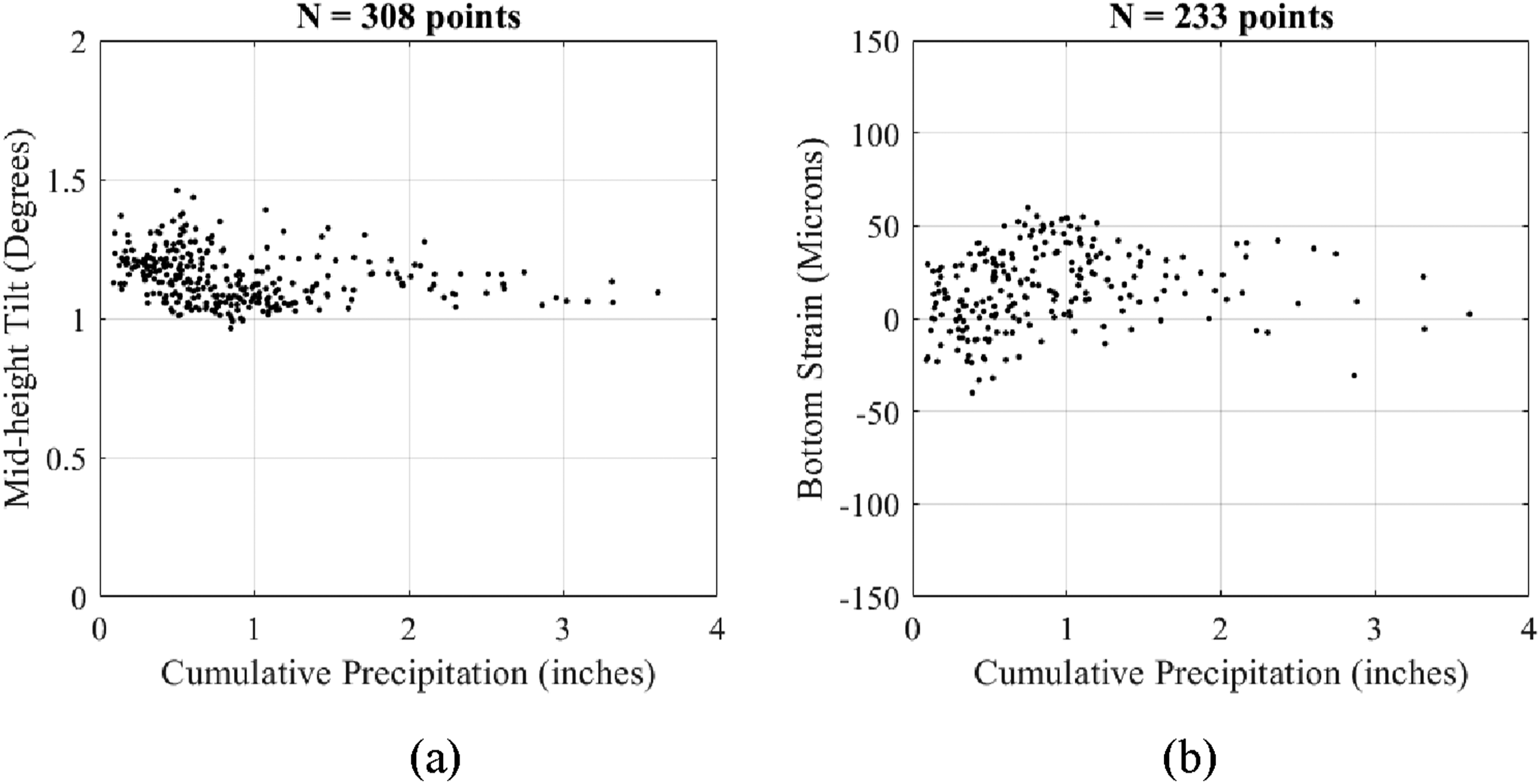
The tilt history of the top portion of the wall system demonstrates a greater variation in daily mean tilt as compared to the mid-height tilt. Specifically, the top tilt varies from 0.5 to 3.5° while the mid-height tilt has a much smaller variation between 1.0 and 1.45°. The top-level tilt sensor was installed upon the thin parapet wall just 2 ft (0.6 m) below the wall top (Figure 2(a)). The wide variation in tilt of the parapet wall was attributed to the fact that maximum rotations of the wall due to lateral earth pressures will be at the top of the wall. Also contributing is the lower flexural rigidity of the parapet wall due to a lower thickness and lighter steel reinforcement. During certain periods, repeated days of precipitation seem to influence the top wall tilt possibly due to the build-up of hydraulic pressure in the top stratum of soil. For example, continuous days of rain from late September 2018 into early October 2018 induce a noticeable upper tilt of the top portion of the wall (going from 1.0 to 2.5°); after the rain ceases, the wall returns to 1.0°. Comparatively, the daily mean tilt of the lower portion of the wall is less sensitive to precipitation with little variations in daily mean wall tilts during periods of rain. This may be attributed to the high flexural rigidity of the wall; it may also be explained by the lack of variation in the hydrostatic pressures in the lower soil stratum behind the wall.
From late November 2018 to January 2019, the top tilt has a high level of day-to-day variation as the mean tilt increases slowly. It is also noted that the wall’s daily mean top tilt dramatically varies from mid-January 2019 to mid-February 2019 when the wall temperature is near or below freezing (32°F (0°C)). In the last few days of January 2019, the wall reaches a temperature of 0°F and a few days later a temperature of 42°F; during this period, the daily mean top wall tilt varies from 0.5 to 3.5° suggesting freezing of the backfill soil may be adding additional lateral earth pressures. By May 2019, the wall reaches a maximum daily mean top tilt of 3.5°. After May 2019, the tilt at the top of the wall has less day-to-day variation and the mean trend-line decreases to about 1.5° by July 2019. It is hypothesized that the daily mean top wall tilt trend-line slowly increases from November to May due to lowering ambient temperatures and their effects on the backfill soil resulting in greater lateral earth pressures. Comparing the daily mean top tilt trendline with the wall temperature time history, the two appear to be correlated with a 30 to 45 days lag; this may be attributed to thermal inertia of the backfill.
The daily mean strain responses at the wall mid-height and bottom capture changes in strain of the wall near-side; as previously mentioned, the absolute state of strain is unknown with measured strain always being relative to the start of monitoring in August 2018. Taking compressive strain to be of a negative magnitude, the daily mean wall strain histories exhibited a trend correlated to the wall temperature. The mid-height strain varied 125 με over the 15 months while the bottom strain varied only 75 με.
The causality between environmental parameters and the wall behavior are studied using response scatter plots with linear regressed behavioral models fit. Plotted in Figure 9 are scatter plots of lower wall responses (i.e., bottom strain, Thermal behavior of the monitored retaining wall: (a) mid-height tilt, (b) mid-height strain, and (c) bottom strain (August 2018 – February 2020).
While the top tilt exhibits sensitivity to precipitation, the lower portion of the retaining wall is relatively insensitive to precipitation supporting the hypothesis that the lower portions of the wall backfill are normally saturated. Recall, this hypothesis was supported by visual observation of steady weeping in the wall panels in their lower sections, even during the dry summer months. As shown in Figure 10, the mid-height tilt and bottom strain of the wall panel are plotted as a function of cumulative precipitation. Cumulative precipitation is intended to model the time it takes for rainwater to permeate the soil and develop sustained hydrostatic pressure in the wall backfill. After periods of no precipitation, the cumulative precipitation model also assumes drying of the soil resulting in the alleviation of hydrostatic pressure. Here, it is assumed the cumulative rain, CR, is: Precipitation induced response of the I-696 retaining wall: (a) mid-height tilt and (b) bottom strain (August 2018 – February 2020).
The behavior of the top portion of the wall panel, especially the parapet portion of the wall system, is observed to be sensitive to cumulative precipitation in the non-winter months while sensitive to temperature in the winter when there is less precipitation in the form of rain. Figure 11 plots the wall top tilt as a function of precipitation from August 25 to November 30, 2018 and April 1 to October 11, 2019 revealing a relatively linear relationship between top tilt and cumulative precipitation during the non-winter observation period. The figure also plots the top wall tilt as a function of wall temperature in the winter (January 1 to March 30, 2019) revealing a fairly strong (R
2
= 0.66) linear relationship of 0.05° per °F due to thermal expansion of the soil applying backfill lateral pressure. Tilt of wall top as a function of: (a) cumulative precipitation (8/25/18-11/30/18), (b) temperature (1/1/19-3/30/19), (c) cumulative precipitation (4/1/19-10/11/19).
Load modeling on the retaining wall
To check the measured tilts, a theoretical analysis with the Euler-Bernoulli beam model is performed to ascertain the theoretical smallest and largest tilt profiles using the mean properties of the random variables, Deflected shapes of the cantilever wall under theoretical and actual conditions.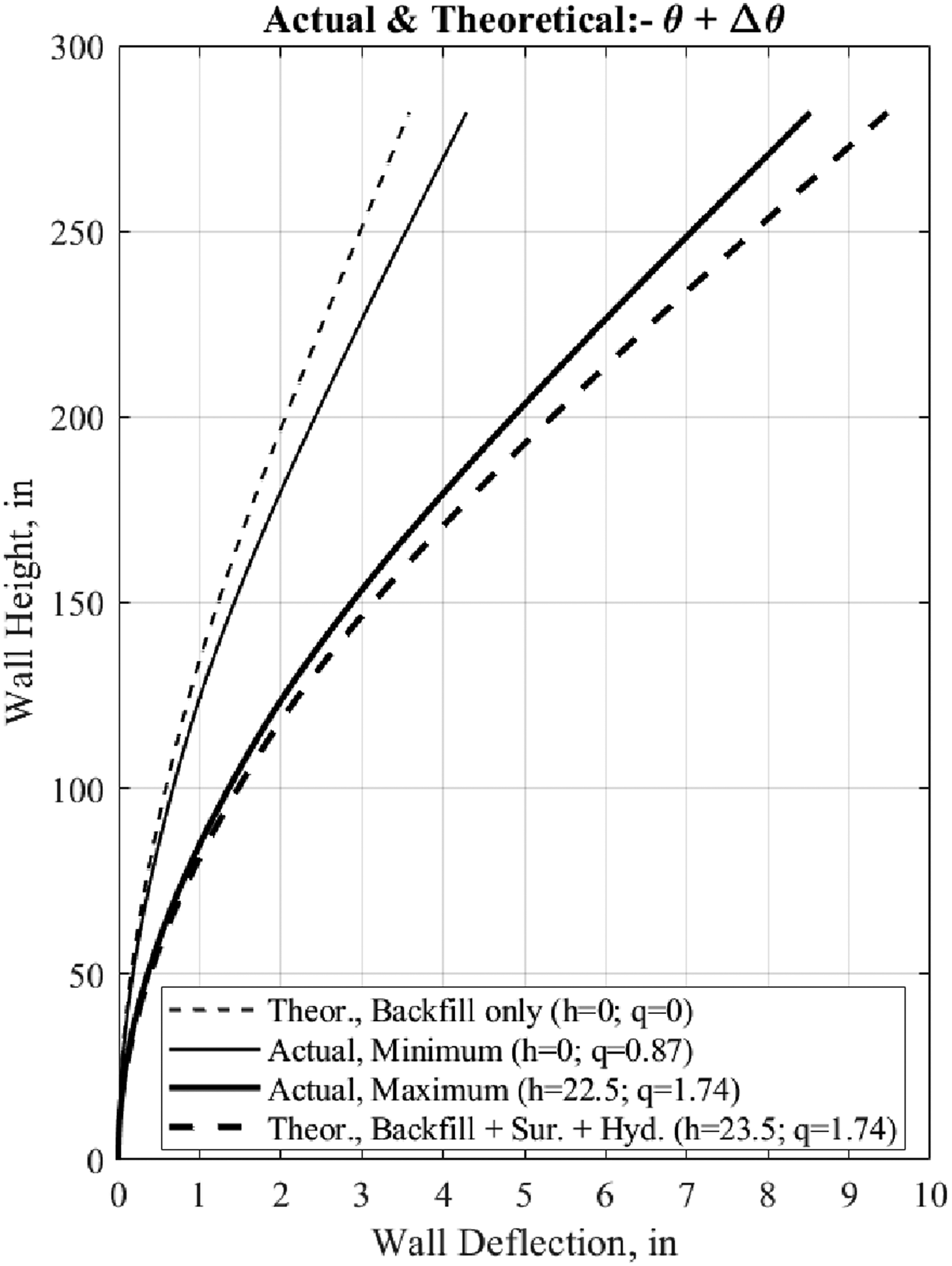
The Euler-Bernoulli beam model is also used to estimate the surcharge pressure, q, and level of groundwater table, h
sat
from the top and mid-height tilts ( Daily mean response of tilt and estimation of surcharge load, q, and water saturation level, hsat, based on I-696 retaining wall tilt measurements over 1 year of monitoring. Three states of steel section loss of the tensile reinforcement considered: 0, 10 and 20%.
With load parameters extracted for each daily wall response, the flexural strain, Scatter plot showing thermal strain response versus temperature change.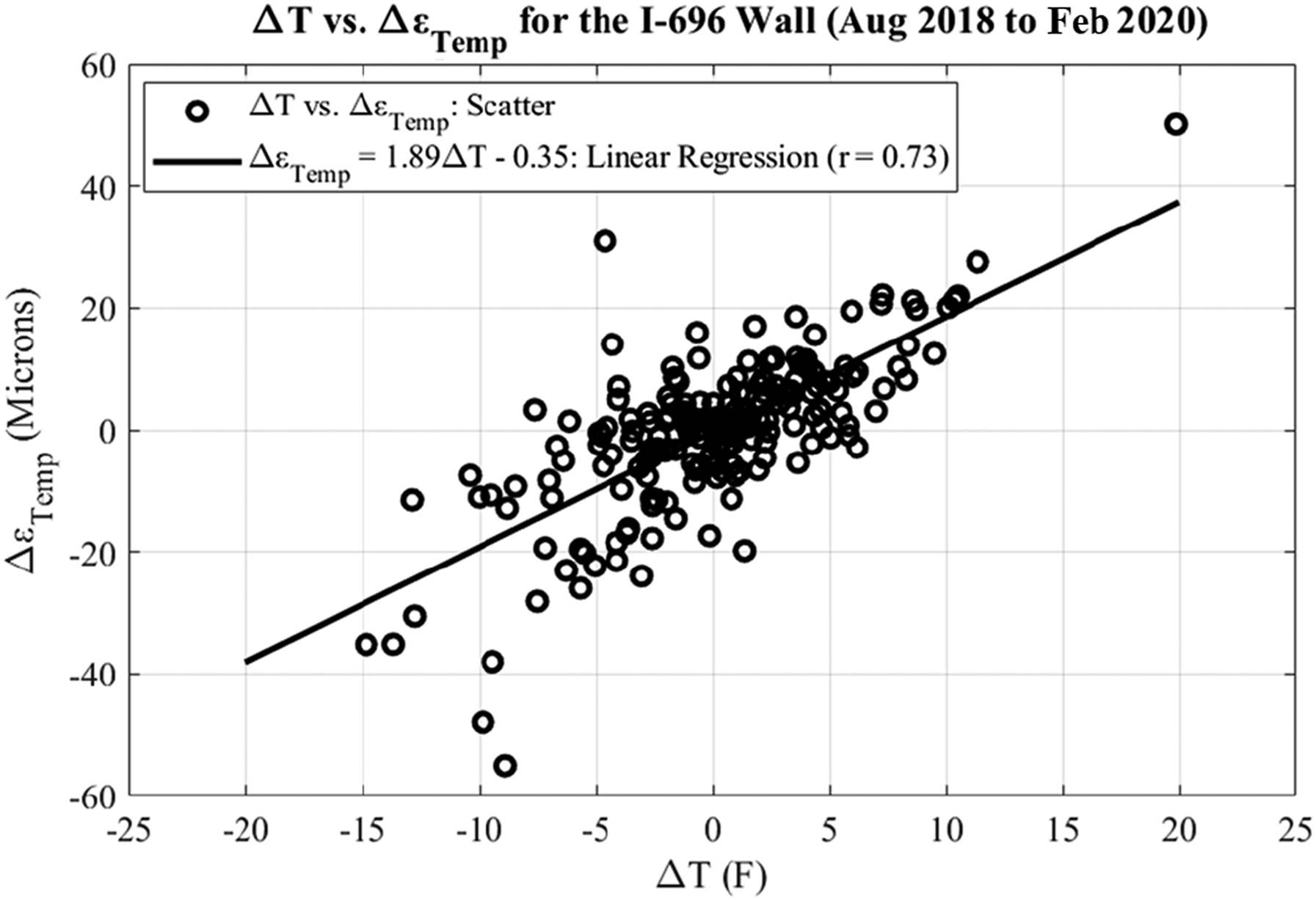
Reliability and risk analysis
The reliability analysis summarized in Figure 7 is applied to the mean response,
The work of (Andrade and Alonso, 1996) is used to estimate the possible level of corrosion expected for a 33-year-old retaining wall with a moderate corrosion rate. If it is conservatively assumed that carbonation and chloride ingress occurred on the first day of construction and a moderate corrosion rate (e.g., 0.5
To perform a reliability analysis for each day of measurement, the Monte Carlo strategy samples the random variables of the model for a given level of assumed steel reinforcement corrosion (e.g., 0, 10, or 20%). The beam model is formed including the calculation of the neutral axis location, 
The first term within the parentheses corresponds to the flexural strain in the lower tensile steel reinforcement bars. The second term estimates the flexural strain based on the effective coefficient of thermal expansion, Daily variation of the reliability index (β) values of the I-696 retaining wall system for 0%, 10% and 20% corrosion states of the steel rebar on the wall tension side.
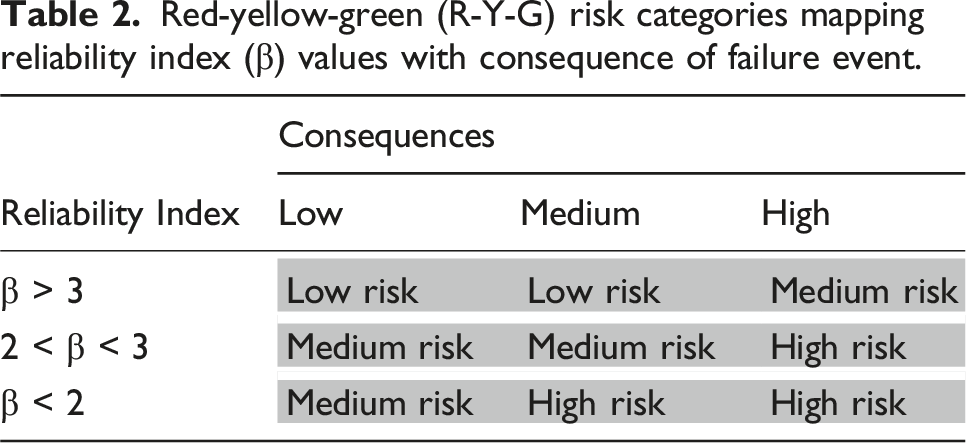
Risk assessment considers the reliability index (providing the probability of exceeding a defined limit state) and the consequences associated with exceeding the limit state with risk is simply the probability times the consequence of exceeding the limit state. Clearly, the probability of failure estimated for each day of monitoring can be used to assess the wall risk. However, the estimation of the consequences of failure remains difficult for the wall owner to do. More practical is for the owner to define if the consequences are low, medium, or high as opposed to defining precisely in the form of failure cost. Similarly, the likelihood of failure can be binned into three categories based on two levels of the reliability index: β
low
and β
high
. In this study, the upper threshold, β
high
, is set to 3 which corresponds to the level of safety sought in retaining wall designs by LRFD. In consultation with the retaining wall owner (i.e., MDOT), the lower threshold, β
low
, is set to 2. This established three categories of failure likelihood: low (
Red-yellow-green (R-Y-G) risk categories mapping reliability index (β) values with consequence of failure event.
Conclusions
In this paper, a quantitative approach that informs risk-based asset management decision making for retaining wall systems is presented. The approach uses long-term structural monitoring data for the reliability analysis and risk assessment of retaining wall assets. It was motivated by MAP-21 that requires transportation officials to adopt risk management strategies for all highway structures including retaining walls. As a result, an illustrative example of analysis was conducted using monitoring data of a more than 30-year-old classical reinforced concrete (RC) retaining wall system along the I-696 freeway corridor in Southfield, Michigan. The monitoring system installation adopted tiltmeters to measure wall tilt, long-gage strain gages to measure thermal and flexural strains, and thermistors to measure wall temperatures. Specifically, should tilt or strain be measured on irregular basis (for example, manually) or on a short-term basis (say a few weeks or months), the maximum wall response may not be observed. This work shows that short-term variations of the wall tilt and strain can be significant; a more accurate view of wall behavior requires at least 1 year of monitoring to see the full range of seasonal variations. The proposed method does not aim to propose long-term monitoring of all retaining walls; rather, it relies on visual inspections to identify retaining wall systems with levels of distress that warrant structural monitoring to be undertaken. The work develops an analytical framework to process measurement data to identify the reliability of the wall for user-defined limit states. The analytical framework first employs tilt measurements to estimate the lateral pressures on the far-side of the retaining wall using a discretized Euler-Bernoulli beam model of the wall. Estimated lateral pressures are then used to estimate flexural strain using tilt measurements. This allows measured strains associated with thermal loading to be separated from the total strain response. The thermal and flexural response of the wall is then used within a Monte Carlo simulation where wall material and soil properties are randomly sampled from assumed distributions to estimate the probability of exceeding the defined limit state (i.e., probability of failure). This allows the reliability index of the monitored wall to be assessed for each measurement. The work defines an approach to using the reliability index with a qualitative assignment (i.e., low, medium, high) of the consequence of failure to qualitatively assign the retaining wall risk for the asset manager’s decision-making.
Based on the collected wall response data, the I-696 retaining wall system exhibited strong dependence on environmental parameters, most notably temperature. The wall showed higher drifts on its top section as compared to the mid-height. The top section drifts were seasonal with maximum drift in the summer and lower levels of drift experienced in the winter. However, long periods (i.e., multi-day) of rain in the spring season introduced substantial daily and weekly variations in the tilt of the top wall section. Tilt at mid-height of the wall were insensitive to rain and linearly correlated to the wall temperature. To analyze the reliability of the monitored wall, a limit state based on the stress level in the steel reinforcement at the wall base and on the wall tensile (i.e., far-side) side was compared to the yield stress during the Monte Carlo analysis to estimate the probability of failure. While the level of corrosion of the base tensile steel reinforcement is unknown, the work explored the assumption of 0, 10 and 20% section loss with 20% section loss likely a highly conservative assumption of corrosion for a wall of this age. The reliability index ranged from 4.8 to 9.0, 3.8 to 8.1 and 3.2 to 7.7 for the 0, 10 and 20% section loss assumptions. A reliability index above 3.0 is desired based on current practice associated with LRFD-based design codes. Given the high consequences associated with this retaining wall supporting a service road, the risk level is defined as moderate based on the risk assessment framework proposed.
In the future, the general reliability-based asset management framework presented herein can be refined and extended. First, the methodology can be refined by revisiting the assumptions made in the paper. For example, the assumption of a uniform temperature distribution through the thickness of the wall should be revisited with modeling used to assess how a temperature gradient could be considered. Other assumptions about the properties of the soil on the wall backfill can be reviewed to enhance the accuracy of the lateral earth pressure models. The methodology can be extended to other wall types (e.g., tie-back (caisson) supported retaining walls, mechanically stabilized earth (MSE) walls, gravity walls) while protocols that identify which walls in an inventory warrant instrumentation could simultaneously be considered. Finally, additional sensors could be explored to reduce uncertainties inherent to the reliability assessment of the monitored wall while nondestructive evaluation technologies could be used to assess the state of corrosion in the reinforcement to ensure a more accurate reliability analysis is completed.
Footnotes
Acknowledgments
This research project was sponsored by Michigan Department of Transportation (MDOT), Structure Management Section (SMS) under MDOT Project Number 131529-OR15-114. In addition to funding, the authors are grateful to the MDOT team that helped to install the sensors on the retaining wall. The methods, procedures, results, and conclusions of this paper are solely those of the authors and do not represent MDOT.
Declaration of conflicting Interests
The author(s) declared no potential conflicts of interest with respect to the research, authorship, and/or publication of this article.
Funding
The author(s) disclosed receipt of the following financial support for the research, authorship, and/or publication of this article: This work was supported by the Michigan Department of Transportation; 131529-OR15-114.
