




Abstract
Modular integrated construction (MIC) has gained more popular attentions from both researchers and engineers due to its advantages of construction efficiency and environmental friendliness. The paper conducted a comprehensive review study on different structural systems for MIC including fully modular structure (FMS), mixed modular structure (MMS) and in-fill modular structure (IFMS), the architectural, structural and constructional characteristics are discussed in detail for each modular structure with typical applications. Afterwards, one innovative IFMS based on sparse-component frames (IFMS-SCF) was proposed and comparative analyses were provided between IFMS-SCF and previous modular structures. Results reveal that different modular structures vary greatly in their principal lateral resisting structures, applicable height, construction efficiency and architectural flexibility. IFMS-SCF can be one promising structural system used for high-rise MIC with enhanced construction efficiency and great potential in the brand-new residence style.
Keywords
Introduction
Typical issues for the traditional on-site construction of envelope system.

In order to overcome the adverse effects from traditional construction methods in the current prefabricated buildings, more researchers and engineers started to explore the modular integrated construction (MIC). With modular construction, structural components, envelope systems, pipelines as well as wires, and interior decorations are created and integrated in volumetric modules, then the modules will be transported to the site and assembled in one building block approach (Fedous et al., 2019). The main procedure of MIC is illustrated as Figure 1. As one innovative substitutive technology, MIC is expected to reduce on-site labour efforts, shorten construction periods and minimize environment pollution as well as resource waste. The main construction procedure of MIC.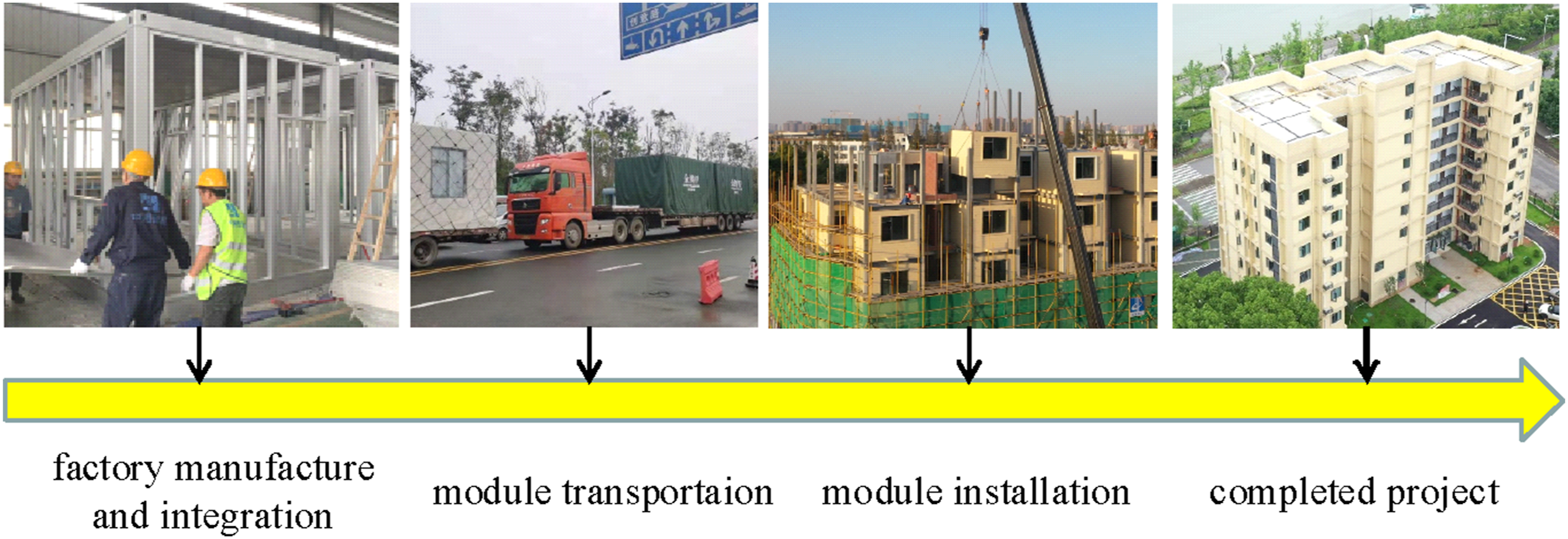
According to the differences in the structural contribution of modules or the principal lateral resisting structure(LRS), MIC can be categorized into three different structural systems: fully modular structure (FMS), mixed modular structure (MMS) and in-fill modular structure(IFMS) (see Figure 2). FMS are fully composed of stacked modules, MMS are stacked modules connected to independent frames or cores, while IFMS are installed by filling modules in main steel frames. Three different structural systems of MIC: (a) FMS; (b) MMS (with steel braced frame); (c) MMS (with reinforced concrete core); (d) IFMS.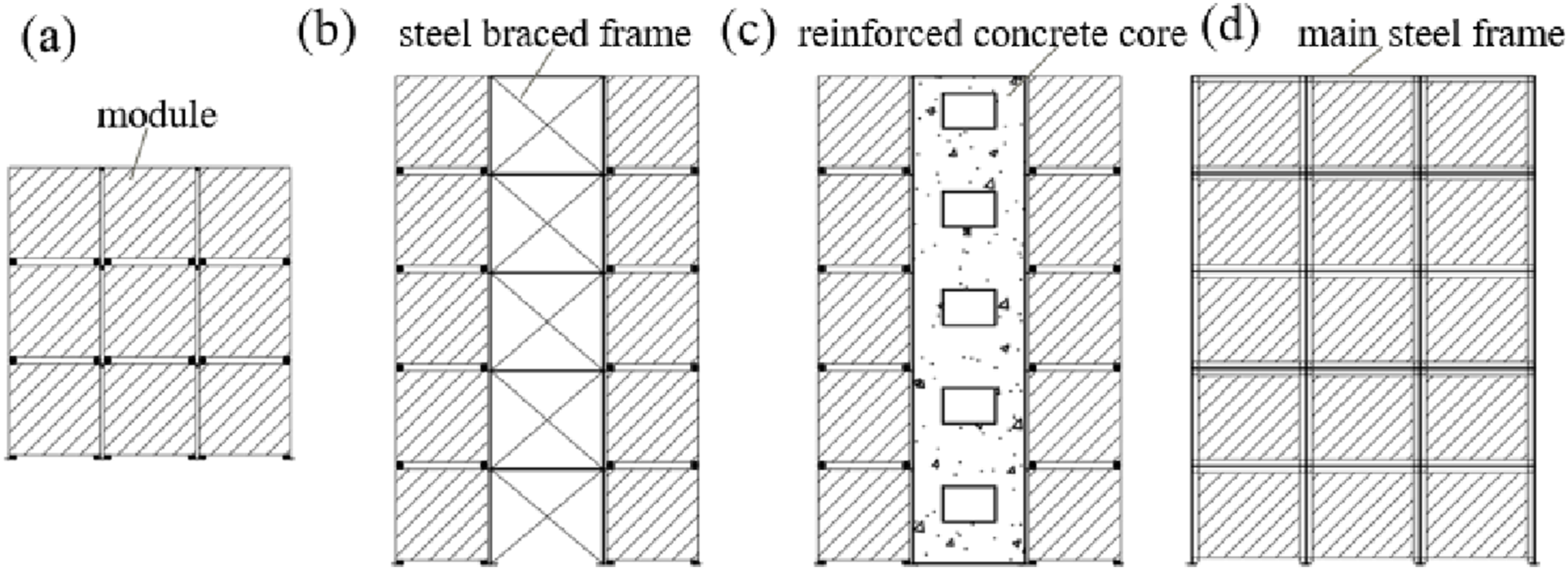
In this paper, the above three structural systems for MIC will be firstly introduced and discussed with typical applications; afterwards, one innovative in-fill modular structure based on sparse-component frames (IFMS-SCFs) used for high-rise buildings will be introduced, and then different structural systems will be compared in terms of principal LRS, applicable height, construction efficiency and architectural flexibility; finally, potential technology issues over the IFMS-SCF will be summarized and discussed.
Different structural systems of MIC and typical applications
Fully modular structure
Fully modular structures (FMSs) are completely assembled from factory modules including both structural and non-structural components, in other words, FMSs can be regarded as vertically stacked 3D modules and also defined as stacked module structures. In varieties of MIC cases, different types of material (steel, concrete, steel-concrete composite, and timber) can be used in modules; according to the transferring paths of vertical loads, modules can be also corner-supported or wall-bearing ones.
Steel modules
In current applications of worldwide MICs, the fully modular structure assembled from steel modules (i.e., FMS-S) is most commonly used for low-rise modular buildings. To improve the mechanical behavior as well as the installation speed, inter-module connections (IMCs) have become one of critical issues of MIC for researchers and engineers, especially for those connecting steel modules. The different innovative IMCs were proposed (see Figure 3) and studied through many series of static tests, quasi-static tests and numerical simulations, including IMCs with welded end-plates, bolted IMCs with welded cover plates, ceiling-bracket-type IMCs, fully bolted IMCs with gusset plates, innovative IMCs with bolts and shear keys, blind bolted IMCs, VectorBloc IMCs, beam-to-beam bolted IMCs, rotary IMCs, post-tensioned IMCs, self-locking IMCs, and so forth. Different types of IMCs for connecting steel modules: (a) IMCs with welded end-plates (Annan et al., 2009); (b) bolted IMCs with welded cover plates (Deng et al., 2018); (c) ceiling-bracket-type IMCs (Lee et al., 2018); (d) fully bolted IMCs with gusset plate (Deng et al., 2023; Lyu et al., 2022); (e) innovative IMCs with bolts and shear keys (Chen et al., 2023; Shi et al., 2023); (f) Blind bolted IMCs (Shi and Li, 2023); (g) Vector Bloc IMCs (Dhanapal et al., 2019, 2020); (h) beam-to-beam IMCs (Chen et al., 2017b); (i) rotary IMCs (Chen et al., 2019, 2020); (j) post-tensioned IMCs (Lacey et al., 2019a; Sanches et al., 2018); (k) self-locking IMCs (Chen et al., 2021; Dai et al., 2019).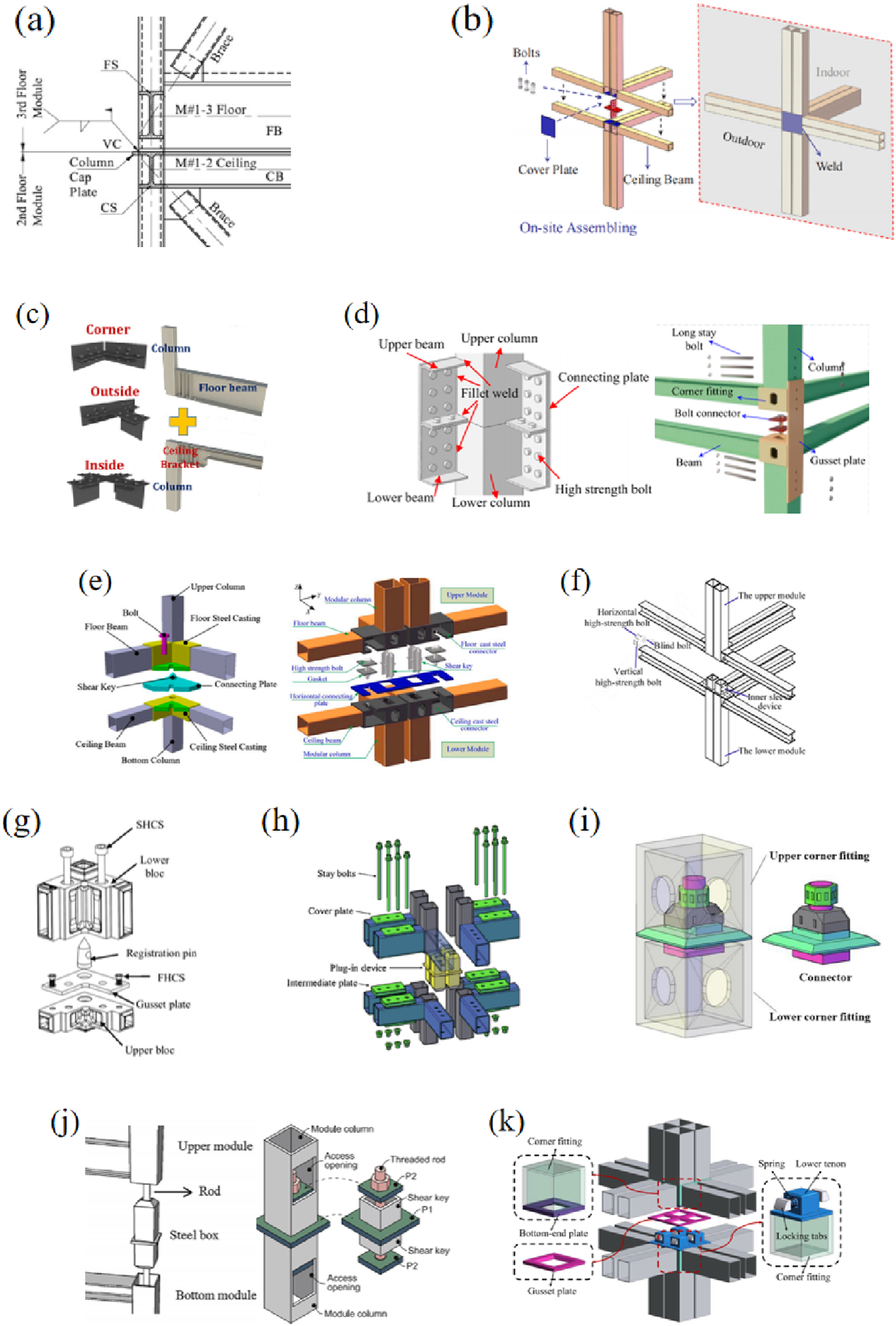
The above connections are essentially categorized into two types of connections based on different design concepts. First one are structure-oriented connections including welded connections (Figure 3(a) and (b)) or bolted connections (Figure 3(d) and (h)) with strong bolt groups aiming at improving their structural behaviors especially under seismic actions. Another one are installation-oriented connections by easy-to-install bolts (Figure 3(e) and (f)), or other innovative connecting parts (Figure 3(i)–(k)) that give first priority to the convenience of installation even with weaker structural resistance. In fact, inter-module connections are designed or selected considering how to balance the demands of structural performance and installation efficiency.
As for FMS-S, mainly steel connections need be implemented among corner fittings of adjacent modules and will be finished in much faster onsite installation compared with traditional prefabricated frames. In practice, many proposed IMCs fail to meet the connectivity requirement due to lack of operation space for more complex module assemblies, but the modules will be quickly assembled onsite without reserving operation holes at the interior walls or floor diaphragms after self-locking IMCs are invented (Chen et al., 2021; Dai et al., 2019). Nevertheless, the global stability and the lateral performance of FMS-S depend entirely on the lateral stiffness of individual modules and the load-transferring ability of IMCs, thus much larger cross-sections will be designed for the bottom modules and the corresponding IMCs in mid-rise and even high-rise MICs. In order not to impair the standard manufactures and economical design of MICs, FMS-S is predominately used for low-rise, emergency or temporary buildings.
Upon the wide-spread outbreak of COVID-19 in Jan, 2020, Huoshenshan and Leishenshan hospitals were completed within 9 and 12 days respectively with the great help of FMS-S, minimizing the waiting time for patients to be rescued (see Figure 4). In the projects of emergency hospitals, assembled type light steel houses with thin-walled steel components were adopted as modules and then deeply investigated to guide more similar applications. The application of FMS-S in low-rise emergency hospitals: (a) ATLS modular houses (Wang et al., 2021a; Zhang et al., 2020); (b) emergency hospitals for COVID-19 (Chen et al., 2022; Luo et al., 2020).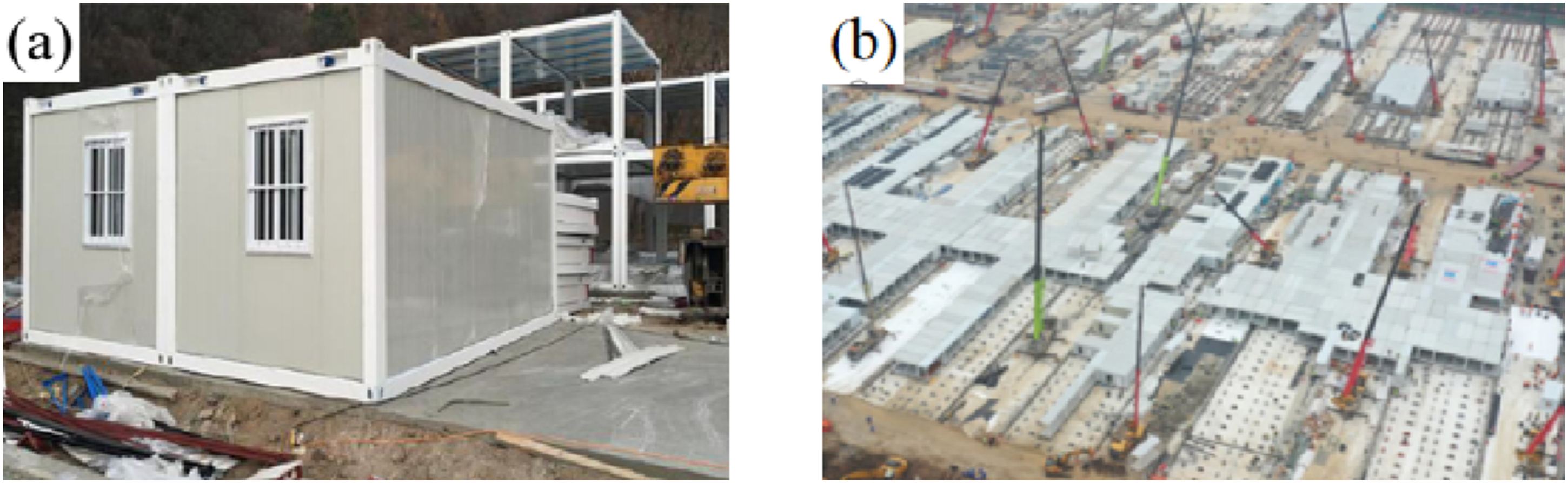
Timber modules
Timber is one environmentally friendly building material and contributes to controlling greenhouse gas, therefore, timber modules are used in many projects in European countries when engineering timber technologies have been developed including glued laminated timber(GLT) and cross laminated timber(CLT) (Carvalho et al., 2020). For timber modules, IMCs are usually screws, dowels, or notches (see Figure 5(a)). Such connections may be more suitable to connect timber modules with higher installation speed by previous punching and embedding in factories, considering better machinability of timber components compared to concrete or formed steel. For example, one three-storey comprehensive school in Frankfurt, Germany was constructed from 90 timber modules with the typical size of 7 m × 3 m × 3.14 m (Bhandari et al., 2023) (see Figure 5(b)); the part of Xiangshan international kindergarten in Hunan, China was also assembled with timber modules as one pilot project for prefabricated timber building (see Figure 5(c)). However, the manufacture and the transportation of timber modules will depend greatly on the geographical environment and relevant regulations about timber material, the applications of timber modules are comparatively limited compared with other material (Fedous et al., 2019), especially in multi-storey or high-rise buildings. The application of timber modules in low-rise buildings: (a) IMCs for connecting timber modules (screws, dowels, or notches); (b) Reidberg-Kalbach comprehensive school; (c) Xiangshan international kindergarten.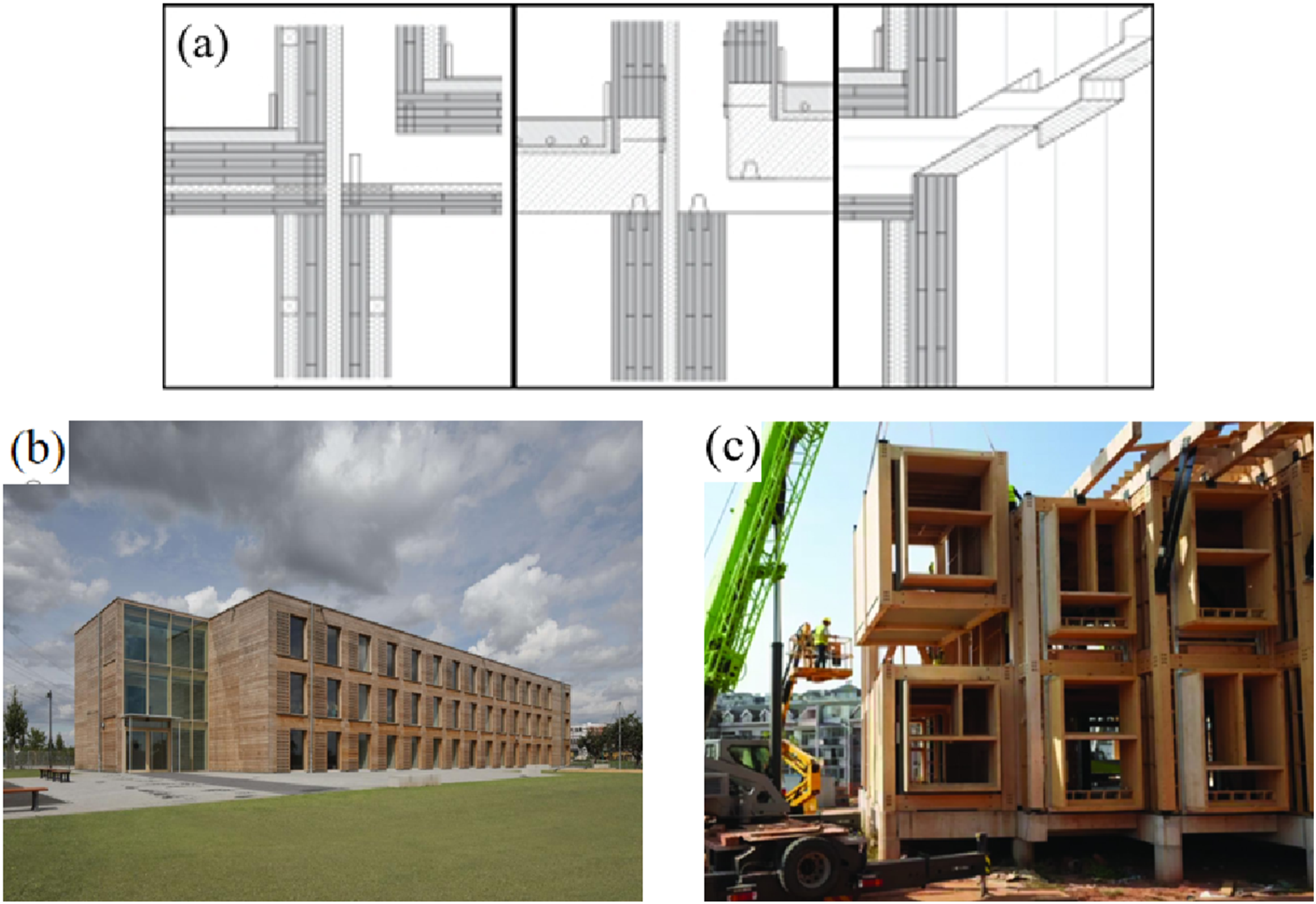
Concrete modules and steel-concrete composite modules
To promote the FMS in mid-rise and high-rise buildings, concrete modules and steel-concrete composite modules with greater lateral stiffness are studied and adopted in Singapore, Australia and HongKong, China. Besides that, IMCs for connecting adjacent floor slabs (see Figure 6(a)) and integrating module walls (see Figure 6(b)) in concrete modules by cast-in-situ joints with lapped steel bars are also invented and studied (Pan et al., 2022; Wang et al., 2020, 2021b). IMCs for connecting concrete modules: (a) horizontal IMCs between adjacent floor slabs; (b) vertical IMCs between adjacent walls.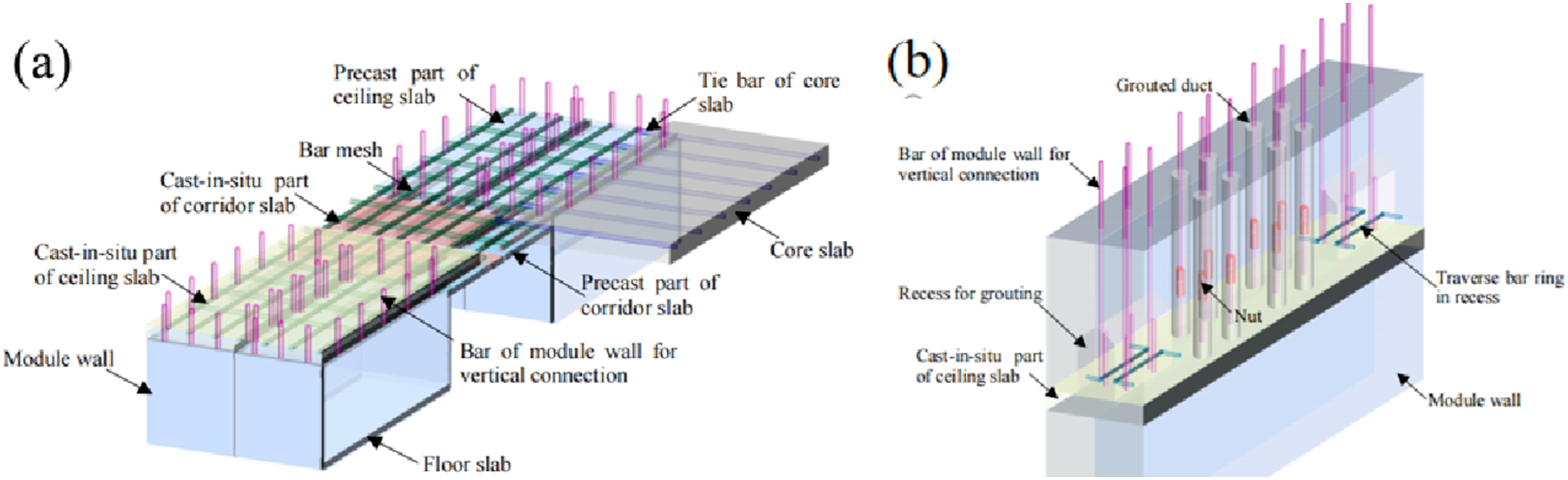
Liew et al. put forward one innovative composite modules with steel-concrete composite beams and columns, the beam height can be reduced when greater span is obtained; the column width and thickness could be designed as the uniform values from bottom to top modules by using the concrete-filled steel tubular columns and altering strength grade of concrete. As to such composite modules, grouted sleeve IMCs and pretensioned IMCs were proposed and investigated through experiments and numerical simulations Figures 7 and 8. Steel-concrete composite modules and corresponding IMCs: (a) steel-concrete composite modules (Liew, 2018; Liew et al., 2019); (b) grouted sleeve IMCs (Dai et al., 2020, 2021); (c) pretensioned IMCs (Chen et al., 2017a). The application of concrete or composite modules in high-rise buildings: (a) disciplined services quarters for the fire services department, Hong Kong (Xu et al., 2020); (b) SOHO Tower in Darwin, Australia (Irwinconsult, 2014).
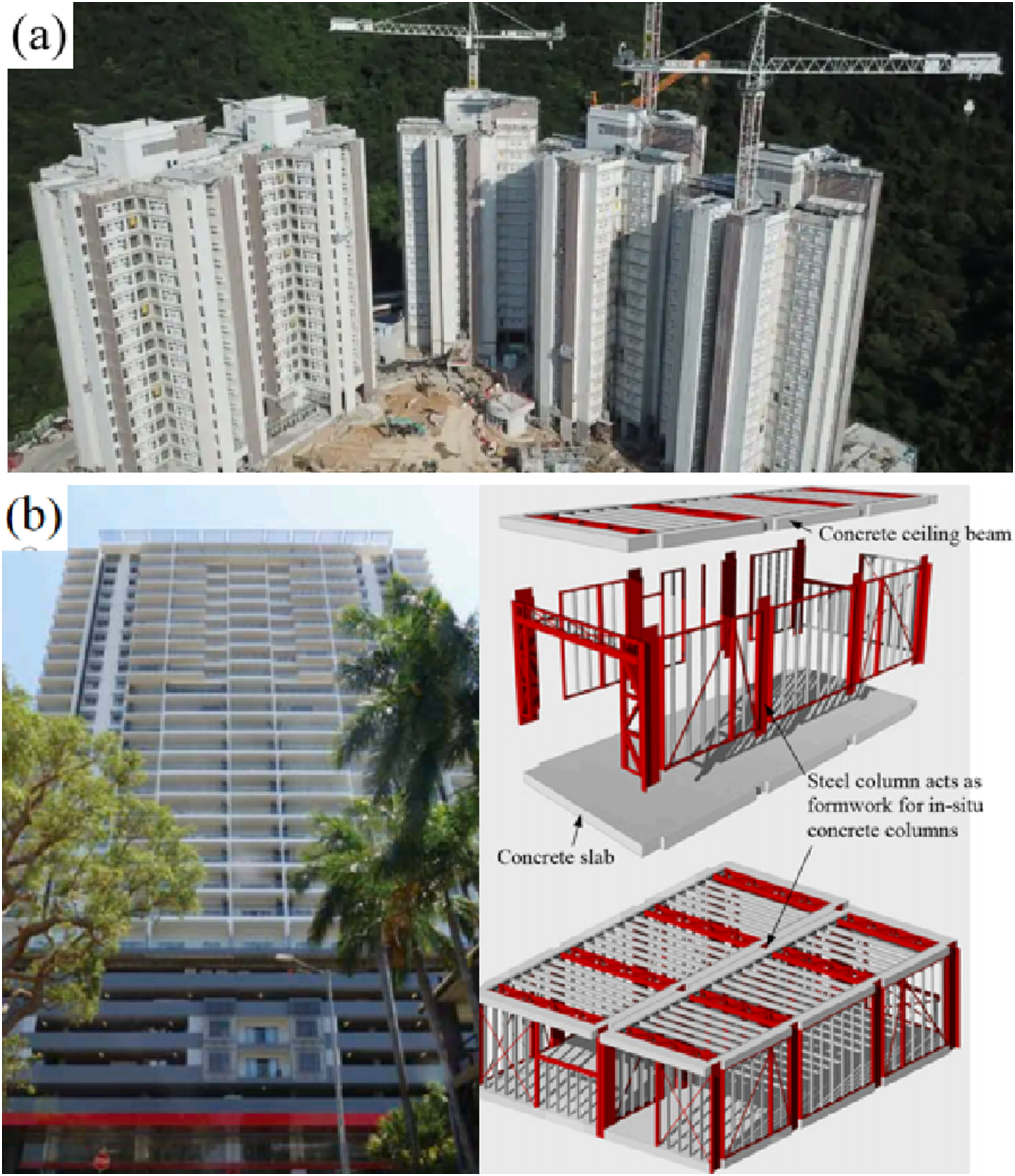
For FMSs with reinforced concrete modules and steel-concrete composite modules (i.e., FMS-RC and FMS-SCC), the applicable height could be improved by RC or SCC modules, however, the grout need be poured for completely forming IMCs and thus lengthen the on-site construction period compared with light steel modules.
The Disciplined Services Quarters for the Fire Services Departmental at Pak Shing Kok, Tseung Kwan O was the first pilot project in Hong Kong using MIC method, where 3726 concrete modules were adopted to accommodate 648 residences for several buildings with 16 or 17 floors (Xu et al., 2020). In addition, according to one survey on the sustainability of different modular constructions in Hong Kong, different modular constructions could reduce considerate waste disposal by 46%–87% and material delivery by 25% compared with traditional buildings (Pan and Zhang, 2023), however, the speed construction and the onsite labor of the RC modular building are found to be inferior to the steel modular building.
Currently, one typical application of FMS-SCC is SOHO Tower in Darwin, Australia; the project is 29-storey modular construction where the bottom 9-storey podium was constructed as reinforced concrete structure while the above stacked modules were the steel-concrete composite modules (with the sizes of 10 m × 4.2 m × 3.9 m, weighing 22 t) with steel columns as formwork for pouring concrete (Irwinconsult, 2014).
In practical high-rise applications, RC/SCC modules were stacked and then connected with reinforced concrete shear walls or cores, therefore, more cases will be introduced in following sections about mixed modular structures. Besides that, the architectural layouts of large storey height and large bay could not be provided by FMS when the width and the height of individual modules will be limited due to transportation and hoisting requirements.
Mixed modular structure
For current mid-rise and high-rise MICs, the mixed modular structure(MMS) is one most common strategy that stacked modules are laterally supported by independent steel braced frames or reinforced concrete cores (i.e., MMS-SBF or MMS-RCC). Obviously, the principal lateral resisting structure is the steel braced structure or the reinforced concrete core with larger stiffness while modules mainly resist the gravity as well as the superimposed vertical loads.
Shanglinyuan apartment in Tianjin is one typical multi-storey modular building using MMS-SBF in China (see Figure 9(a)). The project consists of two buildings, and each one is assembled from 157 steel corner-supported modules (see Figure 9(b)) with the steel braced frames as stairwells, elevator shafts and lobbies. The seismic performance of modules and the load-transferring mechanism of rotary IMCs were studied through the experiments on two-storey modular frame (Liu et al., 2020, 2021). Zhengjiang Gangnan Road public rental housings in Jiangsu are 10 18-storey high-rise buildings constructed as MMS-RCC (see Figure 9(c)). The modules adopted in this project were designed as wall-type ones, and the stability behavior of steel multi-column walls were also investigated by a series of axial compression tests (Hou et al., 2020; Khan et al., 2021, 2022). Another typical MIC application in Hong Kong is one student residence at Wong Chuk Hang Site for the University of Hong Kong (HKU) where over 800 modules were installed and connected to in situ concrete cores to provide 1224 dorm rooms for students in HKU in two 17-storey buildings. The typical applications of MMS-SBF and MMS-RRC in mainland China and Hong Kong: (a) typical mutil-storey MMS-SBF in Tianjin (Liu et al., 2020, 2021); (b) typical high-rise MMS-RCC in Jiangsu (Hou et al., 2020; Khan et al., 2021, 2022); (c) typical high-rise MMS-RCC in Hong Kong (Archispace, 2022).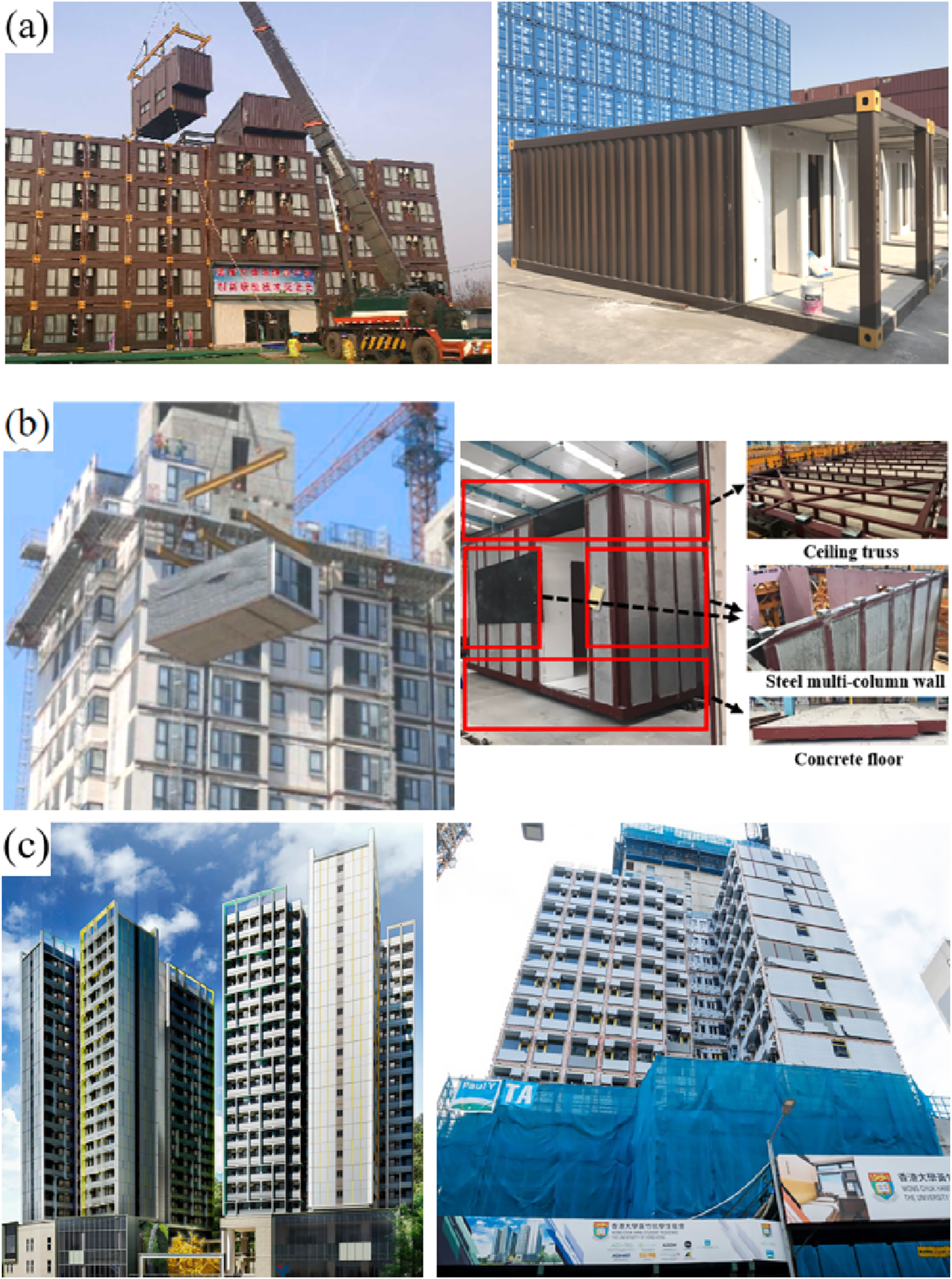
With the mixed modular structures, more high-rise and even ultra-high modular buildings were built in UK, USA, Australia and Singapore (Lacey et al., 2018; Lawson and Richards, 2010; Thai et al., 2020). Here will be some typical projects completed in recent 10 years. Croydon Tower project (London, UK; completed in 2020) consists of one 44-storey and one 38-storey high-rise MIC including 546 houses (see Figure 10(a)). The bottom of Croydon Tower was constructed as one-storey RC podium, and then 38 steel modules (with 95% finishes) per storey were stacked and connected to two RC cores. Despite that the majority of lateral loads can be shared by the two cores, the width of modular column from the bottom to the top varies from 300 mm to 150 mm due to great difference in vertical loads (Bulidings, 2019). Apex House (London, UK; completed in 2017) is one 29-storey MIC used as student dormitory including one square RC core (7.5 m wide and 300 mm thick) and 8 types of steel modules (totally 679 modules and connected by welded IMCs) (Builtoffsite, 2019) (see Figure 10(b)). In many practices, weld connections were used between steel modules and steel braced frames/RC cores, thus Ping et al. proposed one innovative fully bolted module-to-core(M2C) connection(see Figure 11) to improve the construction speed and then conducted FE analyses to explore the mechanical performances of the innovative M2C connections under monotonic and cyclic loads (Ping et al., 2022). The typical high-rise applications of MMS in UK: (a) Croydon Tower; (b) Apex House. Diagram for the innovative M2C connections.

B2 tower in NewYork, USA is one 32-storey modular building consisting 363 apartments (see Figure 12); the project was constructed as MMS-SBF; totally 930 steel modules were stacked on the bottom concrete perimeter walls and steel plinths, then connected to steel braced frames as main lateral structure (Skyscrapercenter, 2019). Despite that each steel module is 65% lighter than the concrete one, however, the construction still lasted for about 4 years and the completion time was delayed to the year 2016 considering disputes between the developer and its partner. The typical high-rise applications of MMS in USA.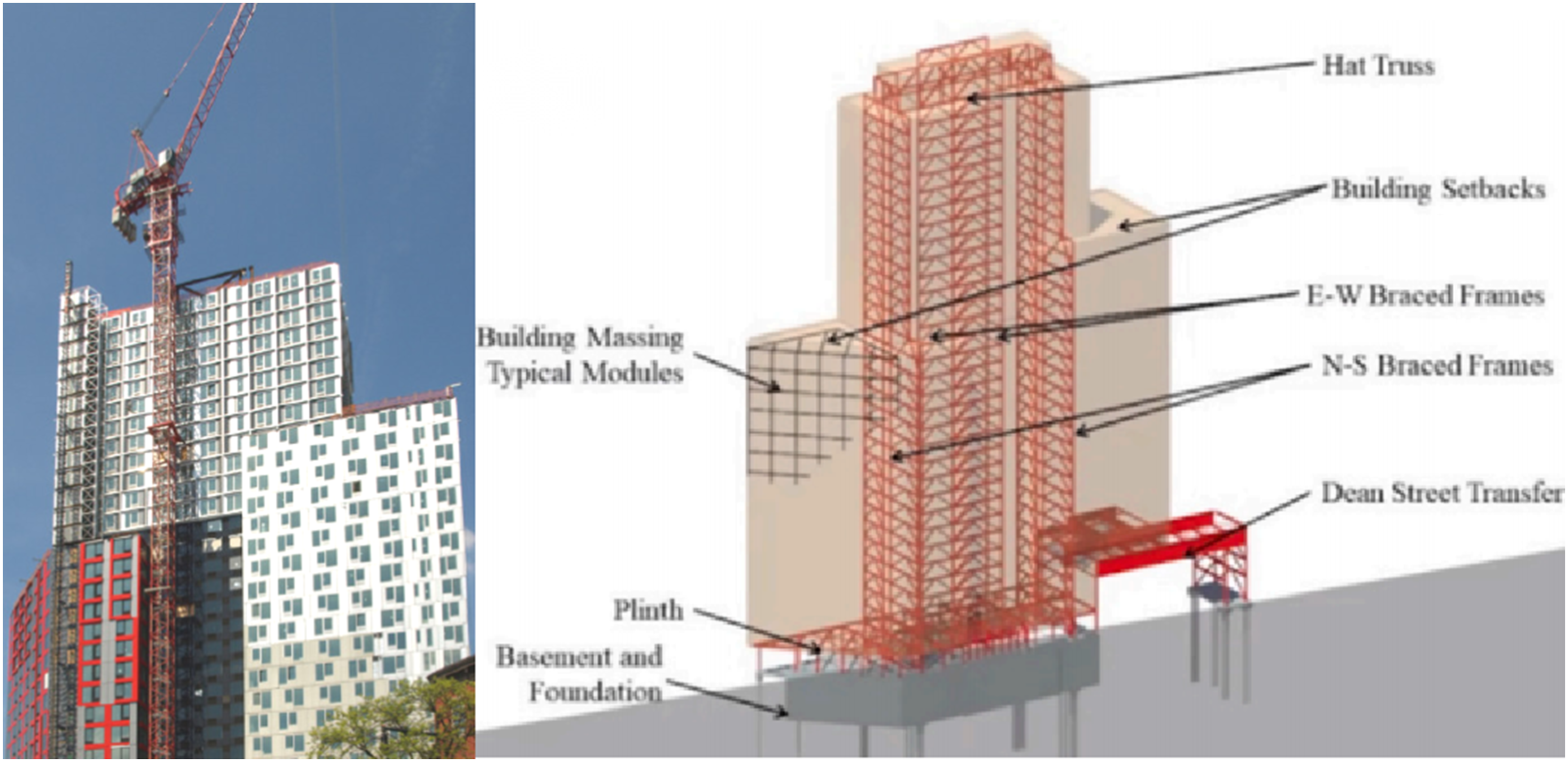
The Hickory group in Australia invented one Hickory Building System (HBS) combining 3D concrete modules and panelized load bearing walls, corridor slabs and cores through on-site wet joints (see Figure 13(a)). In practical applications, the sizes and the weight of module could reach up to 17 m long and 26 tonnes respectively; HBS proved to shorten about 30%–50% construction time compared traditional method and minimize the resource waste (Hickory, 2019). Typical applications using HBS (i.e., one type of MMS-RCC) in Melbourne, Australia include Collins House (60-storey; constructed for 29 months and completed in 2019), Atira Student Accommodation (44-storey; completed in 2018) and LaTrobe Tower (44-storey; constructed for 19 months and completed in 2016) shown Figure 13(b) and (c). The typical high-rise applications of MMS in Australia: (a) HBS system; (b) Collins house; (c) A.S. accommodation; (d) LaTrobe tower.
Clement Canopy is one typical high-rise MMS-RRC constructed in Clementi, Singapore and completed in the year 2019 (see Figure 14(a)) and consists of two 40-storey buildings that accommodate 505 families (Dezeen, 2019). 48 different types of concrete modules with 85% finishes (totally 1899 modules) were adopted in the project and connected to RC cores with the wet M2C joints shown in Figure 14(b). According to the survey, the construction period can be shortened by 30% and the on-site waste be reduced by 70% with MIC compared with the traditional construction method. The typical high-rise application of MMS in Singapore: (a) clement canopy; (b) concrete modules and wet joints.
Given that envelope systems, internal decorations and pipelines are integrated in modules, the construction period for above high-rise building are usually saved; however, compared with FMS, modular buildings using MMS will consume more time for erecting the extra steel braced frames or RC cores, especially when concrete modules and wet joints were commonly adopted. Notably, MMS-SBF or MMS-RCC not only provide enough lateral stiffness for high-rise MICs but ensure larger room space using traditional frames or cores without strict size limitations.
In-fill modular structure
No matter whether FMS or MMS is used, the bottom modules and IMCs should undertake all vertical loads from the above stacked modules, so there may be inevitable increase in the member size as well as the weight of modules. To this end, in-fill modular structure (IFMS) is proposed as one alternative design plan in high-rise buildings without vertically stacking modules. In one IFMS, the main frames are designed as principal structures to bear vertical loads and resist wind as well as seismic actions, while the in-filled modules are expected to mainly satisfy self-bearing capacity; moreover, the connections between modules and main frames (i.e., M2MFCs) should just transfer in-filled modules in the storey to main frames.
In the 1970s, Disney’s Contemporary Resort (one 14-storey hotel building in USA, see Figure 15(a)) was constructed by inserting modular guest rooms into the steel frames like dresser drawers (Yesterland, 2010). Though the concept of un-plugging and re-furnishing rooms failed to come true after the completion, the project could be regarded as the early prototype of IFMS. One 12-storey student apartment building in Korea was also built as IFMS; the reinforced concrete structures played the role as primary structure, the bottom three storey were used as shopping malls while 67 light steel modules were filled in the rest stories as apartment rooms (Park and Ock. 2016). The teachers’ residence building in Hunan Agriculture University is the first in-filled modular building with administrative approval (see Figure 15(b)); 388 steel modules were filled in the 8-storey steel frame structure by two lorry-mounted cranes, the on-site construction lasted for not more than 7 months, and then the project came into service in May, 2022. The typical applications using IFMS: (a) Disney’s contemporary resort (1971); (b) Teachers’ residence building in Hunan agriculture university.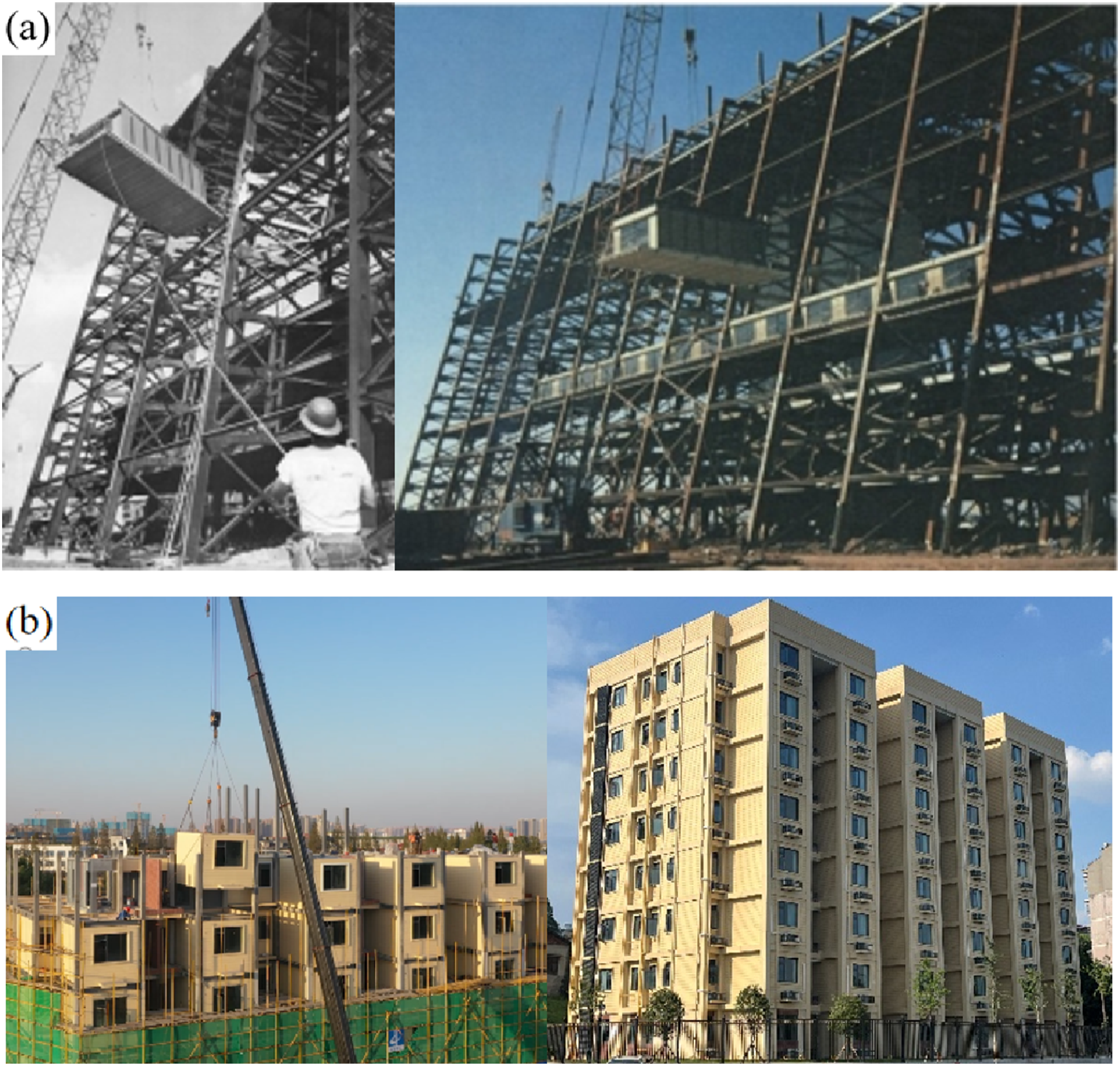
With no doubt, IMFS could break through the restriction that only light steel modules are unable to satisfy the structural requirement in high-rise MICs, and light steel modules with much smaller cross sections of intra-module components could contribute a lot to reducing the technology difficulty during factory manufacture, transportation and on-site hoisting. However, for current IFMSs, one storey of modules need be filled in one storey of frames, increasing the installation tasks of frame columns and beams as well as the total number of M2MFCs, and then the advantages from integrated modules will be partly neutralized. In addition, the relative researches and the reviews on the connections for MIC mostly focus around IMCs (Lacey et al., 2019b; Srisangeerthanan et al., 2020), but the in-depth investigations about M2MFCs are almost blank and high-rise IFMSs are thus very limited compared with other types.
Innovative IFMS based on sparse-component frames
Definition of the innovate structural system for MIC
In order to make better use of the benefits from high-level industrialization as well as integration of MIC and extend modular applications to high-rise buildings, one innovative IFMS based on sparse-component frames (IFMS-SCF) is conceived in this paper. Unlike traditional IFMS, the main structure is transformed into the frame with much larger storey height (commonly designed as 6 m) and longer span (i.e., greater column spacing), then two storey of modules are installed as per one storey of main frame structure (see Figure 16(a)). Definitions of IFMS-SCF in terms of structural level and construction process: (a) conceptual diagram for new modular systems; (b) on-site construction procedure in one storey of frame.
Considering the innovative modular structure is essentially one advanced IFMS, the standardization of steel modules and IMCs and M2MFCs could be more easily obtained; the construction cost and time can be effectively controlled for module manufacture, transportation as well as hoisting. Moreover, the sparse components lead to reduced on-site labour for erecting columns/walls, installing beams and filling modules with fewer M2MFCs for IFMS-SCF (see Figure 16(b)), then the construction efficiency could be improved compared with traditional IFMS. Last but not least, planar positions without in-filled modules could be designed as public outdoor floor to provide shared activity space among adjacent two storey of modules, then the brand-new architectural style Sky Communities or Sky Island Apartments can be realized by MIC methods(see Figure 17). New architectural style provided by IFMS-SCF: (a) the conceptualization of sky communities or sky island apartments; (b) 3D diaphragm for 10-storey buildings using new modular construction.
Comparative analyses of different structural systems for MIC
Different structural systems used for MIC and comparative analyses.
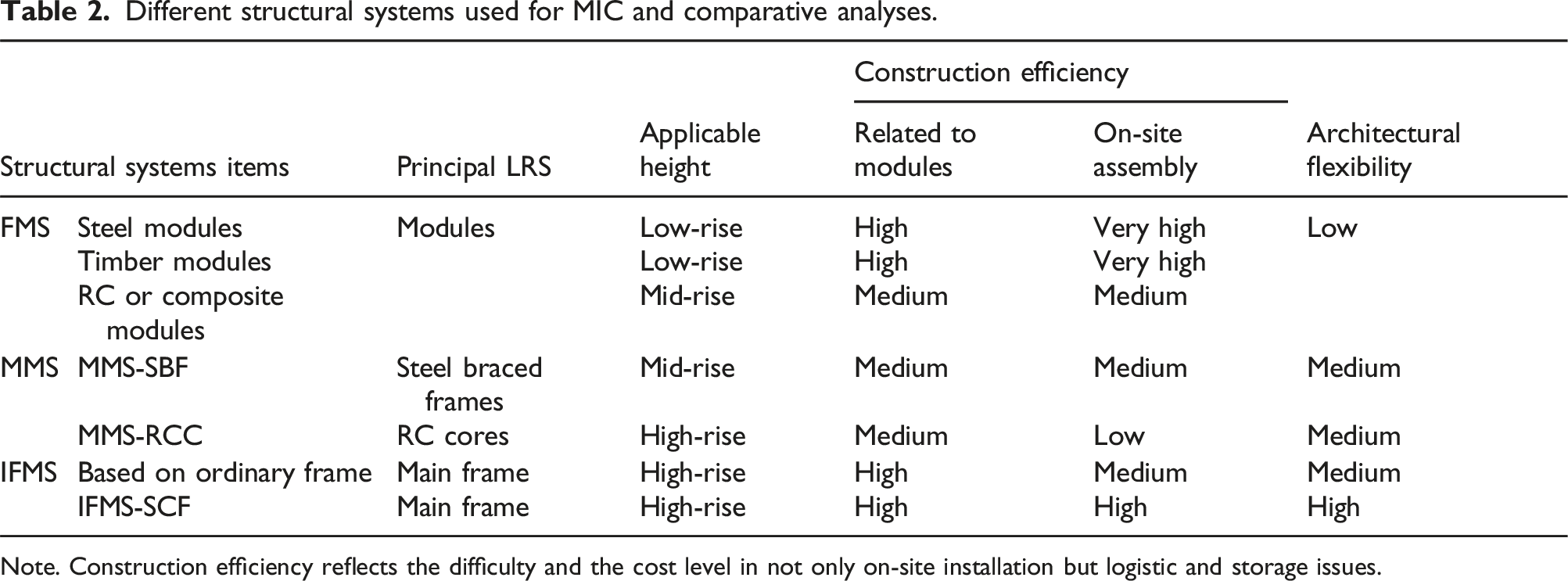
Note. Construction efficiency reflects the difficulty and the cost level in not only on-site installation but logistic and storage issues.
Obviously, FMSs using steel modules or timber modules are the top-priority for low-rise buildings that are urgently needed since very high construction speed can be obtained when only modules are assembled in one building-block way. In fact, such projects are very commonly used in the project departments or emergency hospitals where the storey number is no more than 3. The adoption of module structures in such projects is mainly due to the very high demands in shortening the construction period, for an example of the emergency hospital with over 300 modules, all modules could be installed within only 10 days (Chen et al., 2022). However, FMS will be no more suitable if the applicable height tend to be mid-rise or even high-rise with greater material consumption and worse economical benefits, except that RC or composite modules are adopted at the cost of more construction time. Besides that, the architectural layouts of FMS may be the least flexible considering the size limitations of individual modules.
In current mid-rise or high-rise modular applications, MMS will be one very common design strategy for enhancing the global lateral stiffness, the applicable height can extend to high-rise and even ultra-high MICs when modules are vertically stacked and laterally supported by independent RC cores, demonstrated by typical applications including Croydon Tower (44-storey), La Trobe Tower (44-storey), Clement Canopy (40-storey) and so on. However, larger cross sections may be designed for bottom modules and IMCs to carry on more vertical loads, aggravating the difficulties in producing, transporting or hoisting modules. Moreover, on-site construction will be prolonged when more wet joints are used for combining modules and RC cores, for example, the 1899 prefabricated concrete modules with 48 different shapes were installed using core-based method in Clement Canopy, and the project construction lasted for about 2 years. Despite that much longer periods are expected for MMS, MMS-SBF or MMS-RRC can be more flexible in planar arrangements than FMS with those independent braced frames or cores as the public space linking adjacent modules.
IFMS can be considered as one alternative approach towards high-rise MIS, but the applications of this structural systems are still limited. As for IFMS, modules and IMCs can be simplified and optimized compared with FMS and MMS, facilitating mass manufacture and long-distance transportation of modules. For example, for one IFMS project in Hunan Agricultural University, 388 light-weight steel modules were filled in the 8-storey steel frames, where the mass per area can be saved by 80% compared with traditional concrete buildings. However, as a matter of fact, on-site installations could be a little labouring for IFMS based traditional frames in practice, so the above 8-storey IFMS project lasted for half an year since the installation of every storey of modules should be alternated with the erection of the main steel frame structures. To overcome the above drawback, as for the advanced IFMS (i.e.,IFMS-SCF), the construction efficiency can be almost doubled with obviously reduced frame components, beam-to-column connections as well as M2MFCs. Furthermore, the shared activity platform can be designed for adjacent two stories of modules, then higher architectural flexibility can be created compared with aforementioned modular structures.
Last but not least, as for different structural systems, logistic and storage issues are mainly derived from the individual module weight as well as the usage percentage of concrete material. On one hand, larger weight of the individual module will lead to higher demands of transportation as well as on-site hoisting; on the other hand, when more concrete material are used, the storage and the curing of concrete should be considered carefully, bringing out more difficulties for the construction. As a result, FMS with steel or timber modules, or light-weight modules used in IFMS will be favorable factors for faster construction and lower cost; on the contrary, the concrete modules or necessary in situ concrete cores will bring out considerable increases in logistic and storage expenses.
Discussion over technology issues for IFMS-SCF
Based on comparative analyses of different structural systems for MIC, IFMS-SCF may be one ideal structure solution for high-rise MICs considering both construction efficiency and architectural flexibility. However, there should be more attentions on some key technology issues of this system to further its comprehensive performances and promote its applications in the future. (1) The SCFs actually evolve from ordinary frames by removing columns, beams and floor diaphragms, so the slender characteristics of columns and beams may result in mega-column-mega-beam structures, increasing the amount of steel per unit area and reducing head space in interior modules. Therefore, it will be critical to achieve the economical design of IFMS-SCF by properly incorporating the effects of in-filled modules and enhancing the total lateral stiffness with necessary steel braces, shear walls or even RC cores. For example, the module stiffness may be exploited by obtaining equivalence between in-filled modules and simplified braces during structural analysis and design (see Figure 18(a)). (2) As for stacked modules in FMS or MMS, the pipelines or wires in adjacent modules should be also vertically connected; it may be difficult for inspection and repair during the service stage, and the risks of water leakage at the connection joints will be increased. Instead, primary pipelines and wires could pass through different stories of main frames at public tube wells and outside the modules in IFMS-SCF, and the leakage-proof difficulty can be potentially avoided. Hence, it does matter how to ensure primary pipelines and wires horizontally linked to modules instead of going through the ceilings and the floors in the adjacent modules. Figure 18(b) presents one possible solution of laying pipelines for the new structural system. (3) IFMS-SCF is mainly composed of SCF and in-filled modules. On the one hand, large gaps may be created if adjacent two modules installed on the beams are separated by the frame columns, leading to higher cost for installing extra partition walls and sealing treatments. To eliminate the above gaps, it is worthy of investigation how to coordinate planar positions between frame columns and in-filled modules. As Shown in Figure 18(c), the modules are arranged in one proper layout, then their connections to main frame beams and columns can ensure no inappropriate interior gaps between horizontally adjacent modules. For more complex architectural planes and column grids, the difficulty in the module arrangement will be inevitably increased. Key technology issues for IFMS-SCF: (a) illustration for the module equivalence used in the structural design; (b) illustration for the possible solution of laying pipelines; (c) illustration for the proper planar layout of modules.

On the other hand, the inappropriate construction sequence of frame columns, beams and modules may lead to longer construction time and increased chances of collision between SCF and modules. To this end, the installation procedures of modules and SCF should be carefully considered and assisted by monitoring and detection based on BIM platform in order to improve the construction speed without unexpected damages in modules during the installation.
Conclusion
In this paper, three types of different structural systems for MIC including FMS, MMS and IFMS are sequentially introduced and discussed along with some typical applications around the world. Then one innovative IFMS based on sparse-component frame (IFMS-SCF) was proposed and comparative analyses were conducted between IFMS-SCF and other modular structures. Results reveal that different modular structures vary greatly in terms of principal LRS, applicable height, construction efficiency as well as architectural flexibility. Finally, key technologies on IFMS-SCF were also summarized and discussed. After the review, more significant insights can be given to the applications of modular buildings, and more future works will be directed for the innovative IFMS-SCF.
Main conclusions were drawn and given as below: (1) FMS can be the top priority for low-rise MICs that are urgently needed. MMSs can be one common strategy for mid-rise and high-rise MICs by combing stacked modules and independent LRS, while IFMS will be another options for high-rise MICs in which standard light steel modules are universally used. (2) FMS will provide fastest on-site construction since only modules are hoisted and assembled; the construction period of MMS will be prolonged especially when more wet joints are used for inter-module and module-to-core connections. Current IFMS based on traditional frames may be also more time-consuming when too many modules are connected to main frames in every storey. (3) FMS may be of poor performance in various architectural arrangements considering that the width and the height of individual modules are restricted. On the contrary, the building layouts tend to be more flexible in MMS and IFMS with independent LRS. (4) IFMS-SCF can be one promising structural system used for high-rise MIC with enhanced construction efficiency and great potential in the brand-new residence style by providing abundant public activity space for adjacent modules. Nevertheless, there still remain some technology issues for better use of this new system.
The comparative analyses over different modular structures in this paper will be mainly in view of their different structural characteristics and the principal construction method. In real practice, for one specific individual project, more complex factors such as the manufacture level of module factories, the number of construction workers, the digital management level, and even the local policies for acceptance inspection will be also significant for the construction efficiency. Such above factors are independent of the structure systems to a certain extent. Therefore, more case studies for MIC will be worthy of in-depth discussion in the future.
Footnotes
Declaration of conflicting interests
The author(s) declared no potential conflicts of interest with respect to the research, authorship, and/or publication of this article.
Funding
The author(s) disclosed receipt of the following financial support for the research, authorship, and/or publication of this article: This research was sponsored by Natural Science Foundation of Hunan Province (Grant No. 2023JJ40271).
