



Abstract
This paper proposes a magnetorheological damper with large damping force, and the damper has the function of preventing the precipitation of magnetorheological fluid. The damping force calculation model and hysteresis model at high velocity are obtained through theoretical derivation. First, a magnetorheological damper with radial damping gaps is designed and fabricated. Secondly, the dynamic characteristics of the designed magnetorheological damper at high velocity are tested. When the velocity increases to a certain range, the damping force increases nonlinearly. Considering the shear thinning effect of magnetorheological fluid at high velocity, a damping force calculation model of the magnetorheological damper at high velocity is established based on the Herschel-Bulkley model. A hysteresis model is proposed through the damping force calculation model. Finally, the accuracy of the two models is verified by comparing the models with experimental results.
Introduction
Magnetorheological dampers have been used in many fields because of their ability to change damping. At present, many scholars have done a lot of research on how to increase the damping force and theoretical modeling. The main methods to increase the damping force are to increase coils, add permanent magnets, and improve magnetic field utilization. Yang 1 increases the damping force by increasing the number of coils. Olivier 2 added permanent magnets to the damper. Yan, 3 Hu, 4 and ET Maharani 5 improve the magnetic field utilization of the damping gap. The damping force range increased by the above design method is very limited, and it is difficult to output a large damping force to meet the needs of current heavy vehicles. In addition, none of the designed dampers has the function of preventing precipitation.
The model of a magnetorheological damper includes a damping force calculation model and a hysteresis model. The damping force calculation model is mainly based on the Bingham model 3 and the Herschel-Bulkley model. 6 Compared with the Bingham model, the Herschel-Bulkley model can describe the shear thinning phenomenon at high velocity. In addition, many scholars have also studied hysteresis models for vibration control. 7 There are many models describing the characteristics of hysteresis, including the Bouc-Wen model, 8 the Dahl model, 9 the Magic Formula, 10 and the Tanh model. 11 However, these models cannot describe the nonlinear growth of the damping force at high velocity and the asymmetric hysteresis characteristics.
Based on the above background, this paper studies how to design a magnetorheological damper with a large damping force range and the function of preventing magnetorheological fluid precipitation. According to the characteristics of a magnetorheological damper at high velocity, the damping force calculation model and hysteresis model are studied respectively.
Principle of the magnetorheological damper
Figure 1 (a) and Figure 1 (b), respectively, show the schematic diagram of the hydraulic cylinder and the damping generator. The hydraulic cylinder and the damping generator are connected through the high-pressure hose. Figure 2(a) shows the schematic diagram of the one-way valve. Figure 2(b) shows two different types of disks.
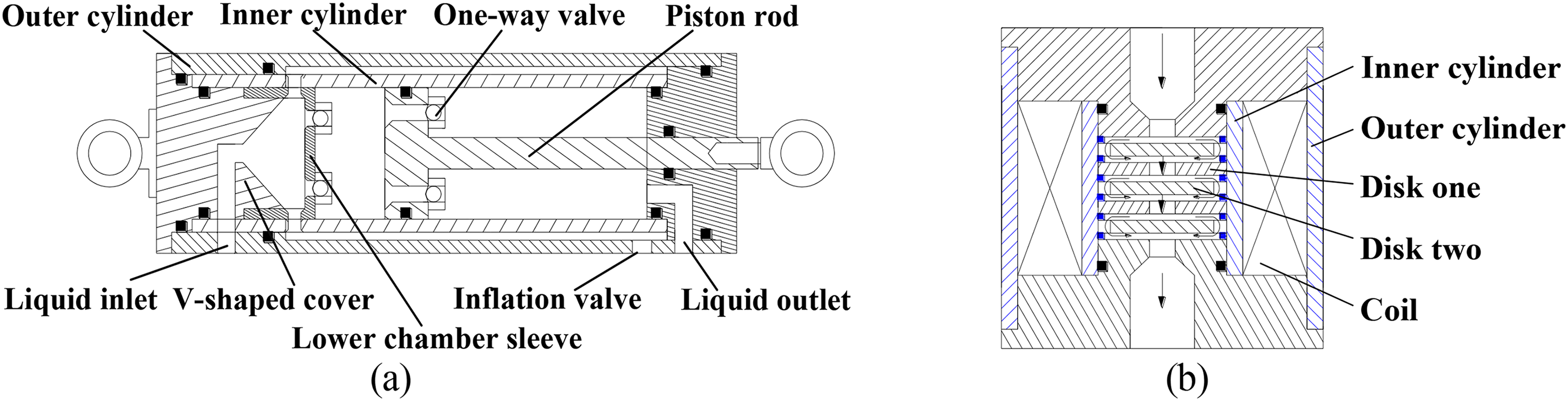
The principle of magnetorheological damper. (a) Schematic diagram of the hydraulic cylinder. (b) Damping generator.
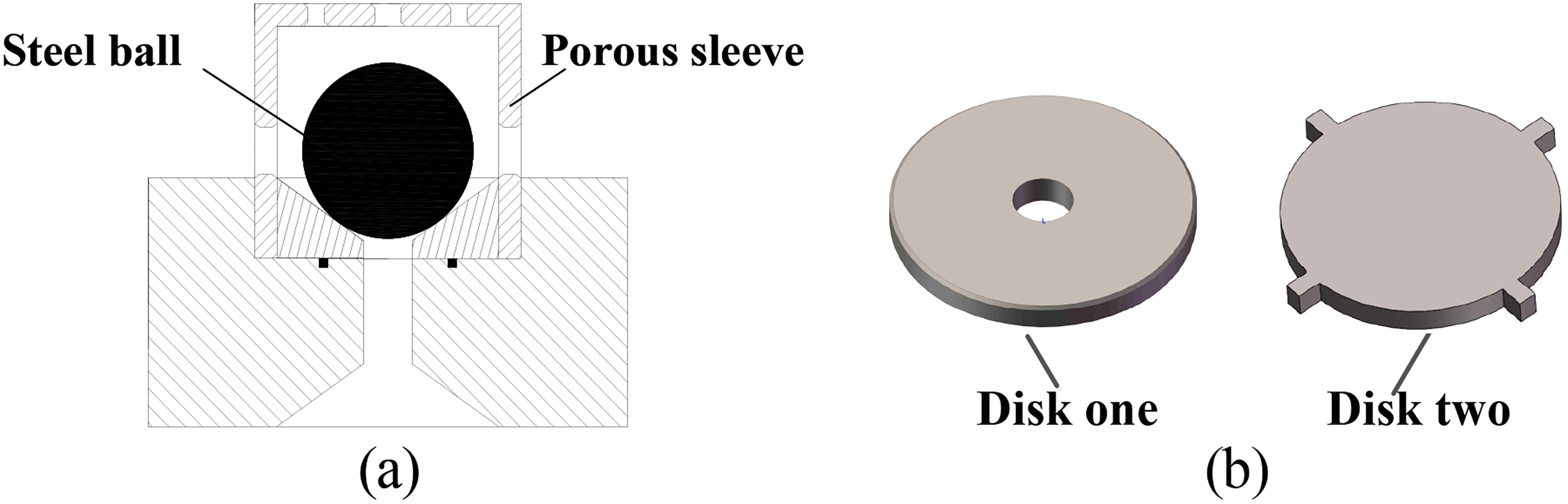
Schematic diagram of structural components. (a) Schematic diagram of one-way valve. (b) Two types of disks.
The one-way valve structure designed in Figure 2(a) consists of a small steel ball and a small sleeve. There are a number of small holes around and at the top of the sleeve. The uninterrupted unidirectional flow of the magnetorheological fluid and the rational design of the hydraulic cylinder ensure that the magnetorheological damper has the function of preventing the precipitation of the magnetorheological fluid.
Experimental analysis
According to the principle of the magnetorheological damper, a prototype is designed and manufactured. The equipment used is a PWS-200 electro-hydraulic servo testing machine. The characteristics of MRF(MRF-G28) are shown in Figure 3(a). The load applied is the sine displacement excitation, and the applied current is 0A, 1A, 2A, and 3A. The prototype of the damper and the experimental setup are shown in Figure 3(b).
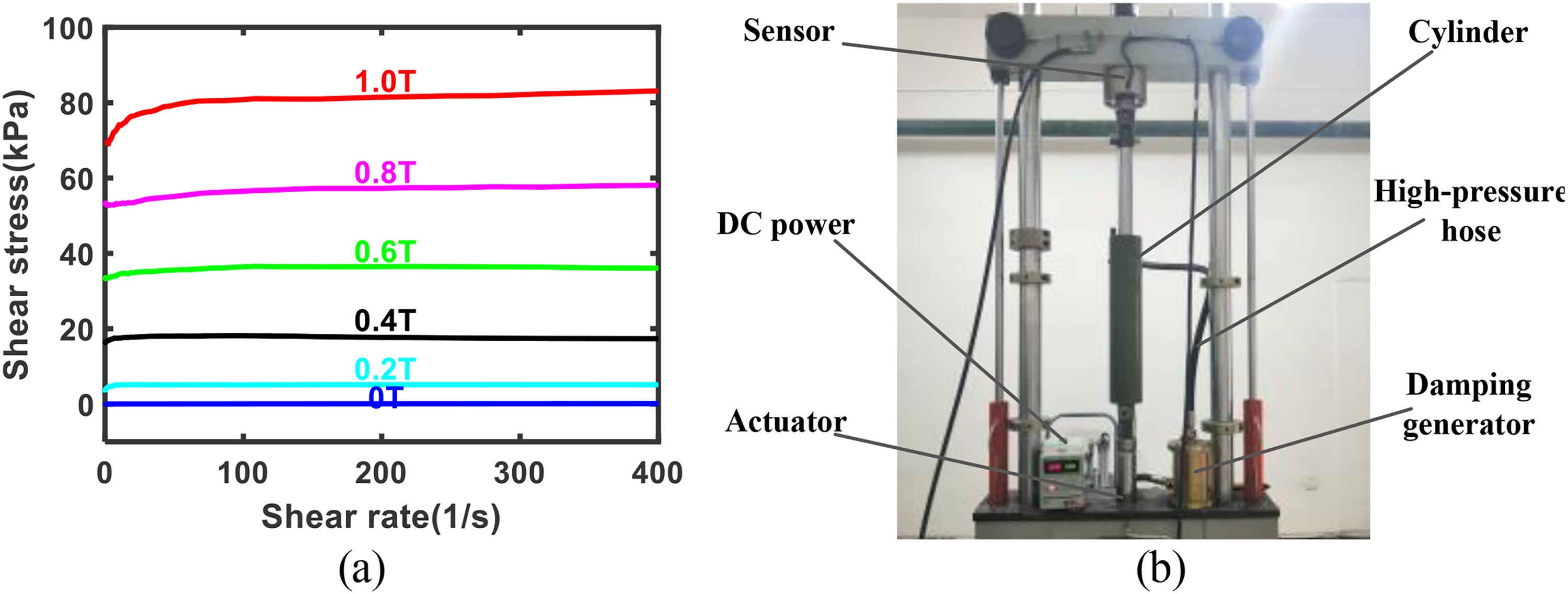
Characteristics of magnetorheological fluid and experimental setup. (a) Shear stress versus shear rate. (b) Experimental setup.
The experimental results from Figure 4(a) show that the designed magnetorheological damper has a good magnetorheological effect. The sharp corner in the upper left corner in Figure 4(a) is mainly caused by the deformation of the iron pin connecting the damper and the fixture to create a gap. Figure 4(b) shows that when the maximum velocity exceeds 0.45 m/s, the maximum damping force exceeds 24kN. Furthermore, the damping force grows nonlinearly at high velocity.
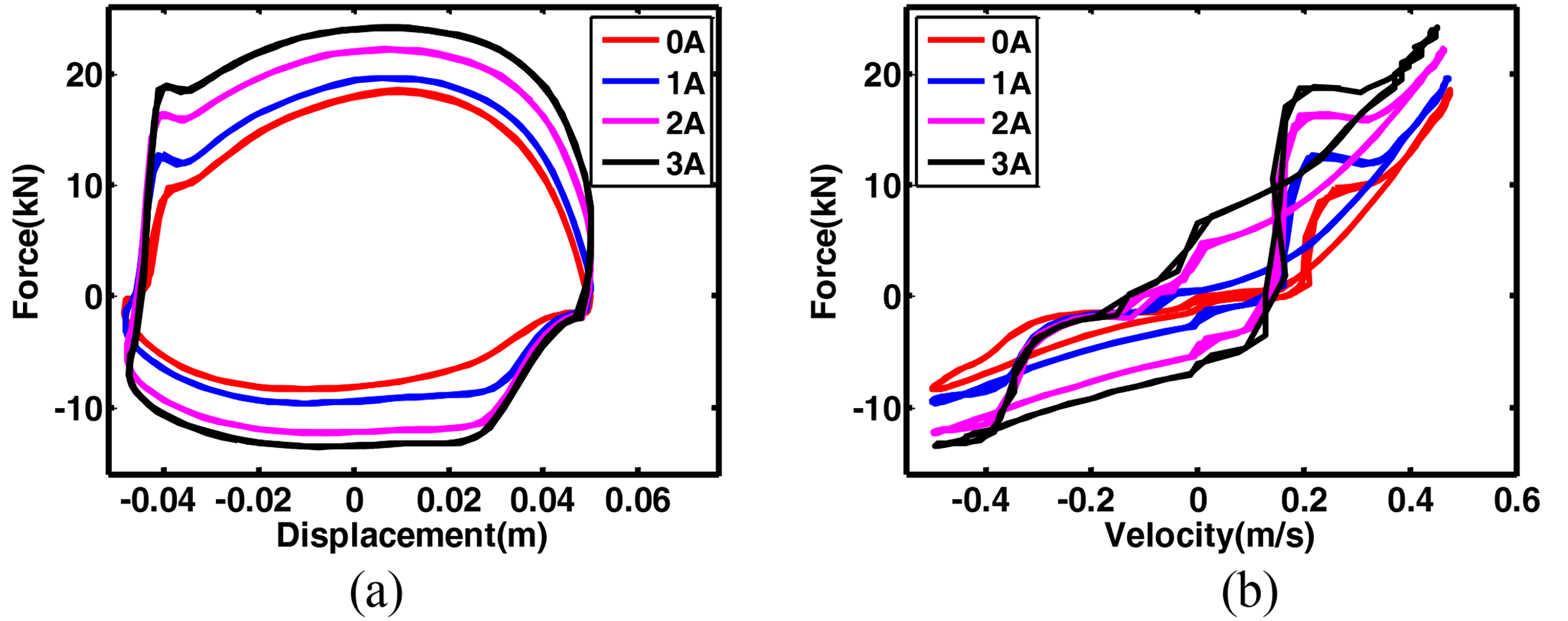
Damping force characteristics (1.67 Hz, 0.05 m). (a) Damping force versus displacement. (b) Damping force versus velocity.
Theoretical modeling
The damping force of the radial damping gap
Based on the Herschel-Bulkley model, the relationship between volume flow and pressure drop gradient is:

When

The damping force of the radial damping gap includes viscous damping force and controllable damping force. Considering the nonlinear growth of damping force at high velocity, the damping force calculation model is proposed as follows:

Damping force caused by minor losses
When the flow rate of the liquid is high, the minor losses cannot be ignored. Figure 5 shows the distribution of radial damping gaps.
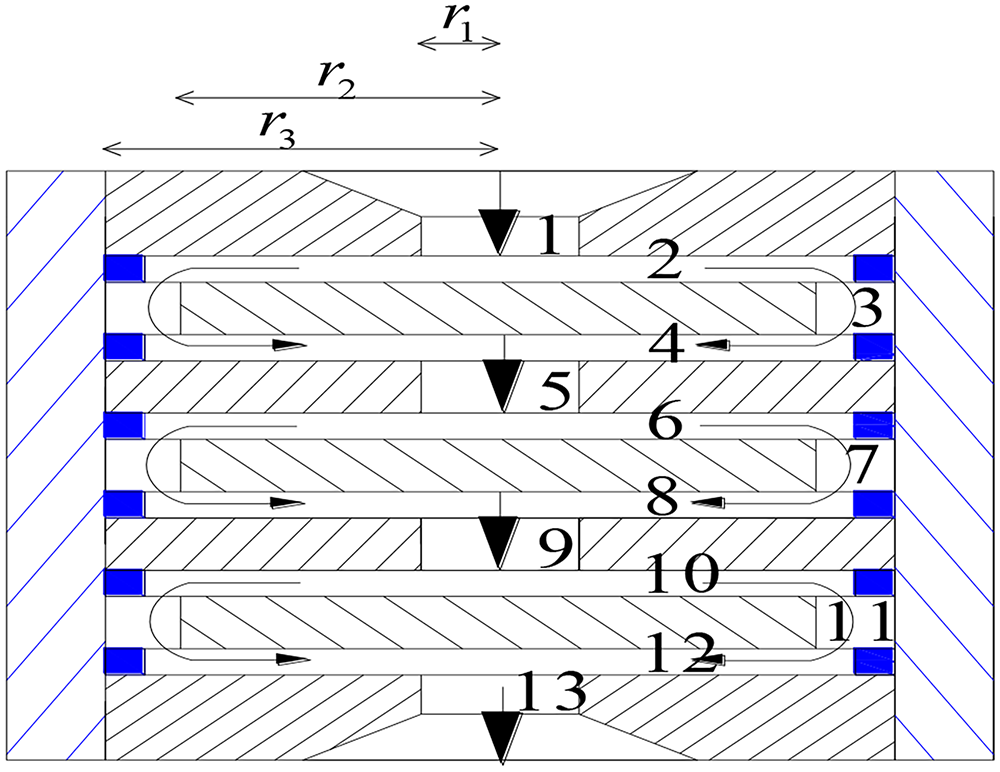
Distribution diagram of radial damping gaps.
The pressure drop caused by the minor losses is:

The damping force caused by all minor loss pressure drops is:

The damping force of the high-pressure hose
When the velocity is high, the fluid in the high-pressure hose is no longer in a laminar flow state. Therefore, the Darcy-Weisbach formula can be used for calculation.

The damping force of the magnetorheological damper
The damping force of the magnetorheological damper is:

The total damping force can be simplified in the form of a parameterized power function. The simplified model is as follows (

Establishment of hysteresis model
Considering that the existing hysteresis model cannot describe the asymmetric hysteresis characteristics, nor can it describe the nonlinear growth of the damping force at high velocity. Therefore, a new hysteresis model is proposed.

Validation of the established model
Figure 6(a) shows the comparison between the established damping force calculation model and the experimental results. In order to verify the accuracy of the proposed hysteretic model, the Tanh model 11 is first improved by using the hysteretic multiplier in equation (9) so that it can describe the hysteretic characteristics with asymmetry. Then, the improved Tanh model and the proposed hysteresis model are compared with the experimental results, respectively. The comparison results are shown in Figure 6(b).
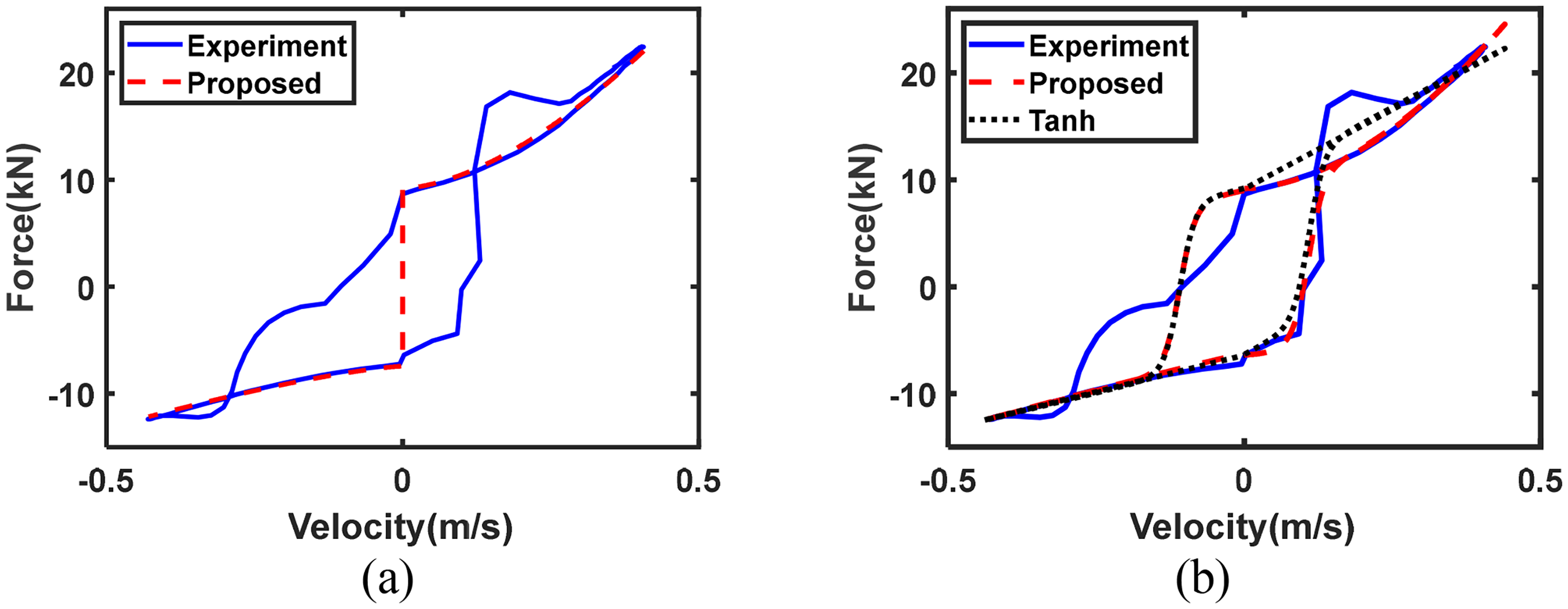
Comparison with the experimental results (1.4 Hz, 0.05 m, 3A). (a) Damping force calculation model. (b) Hysteresis model.
The comparison results in Figure 6(a) show that the damping force calculation model is in good agreement with the experimental results. In Figure 6(b), the comparison results between the two models and experiments show that the proposed hysteresis model can well describe the hysteresis characteristics when tension and compression are asymmetric. The proposed model can also describe the nonlinear growth of the damping force at high velocity well. Compared with the Tanh model, the root mean square error (RMSE) of the proposed model is reduced by 12.5%.
Conclusions
This paper studies the structural design and modeling of magnetorheological dampers. Based on the principle of the damper structure, a prototype is designed and made. The dynamic characteristics of the designed magnetorheological damper are tested. When the velocity of the piston exceeds 0.45 m/s, the maximum damping force of the damper exceeds 24kN. Considering the shear thinning effect of magnetorheological fluid, the magnetorheological damper is modeled based on the Herschel-Bulkley model. Based on the damping force calculation model, a hysteresis model is proposed. The proposed hysteresis model can describe the hysteresis characteristics with asymmetry of tension and compression, as well as the nonlinear growth of the damping force at high velocity. The established model is compared with the experimental results to verify its accuracy.
Footnotes
Acknowledgments
This research was supported by the major scientific and technological innovation project of Shandong Province (Grant No. 2019JZZY020215).
Funding
The author(s) received no financial support for the research, authorship, and/or publication of this article.
Declaration of conflicting interests
The author(s) declared no potential conflicts of interest with respect to the research, authorship, and/or publication of this article