



Abstract
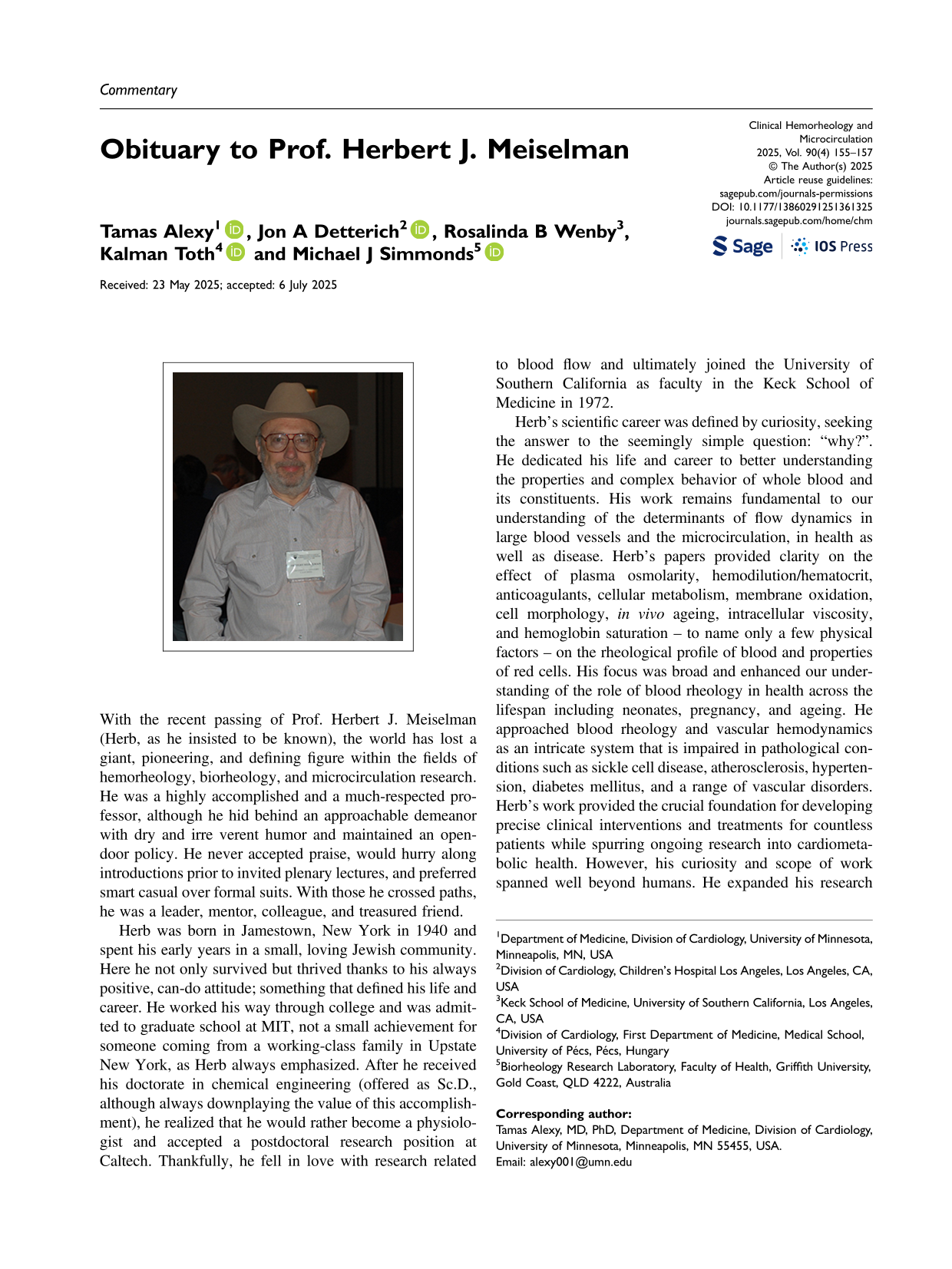
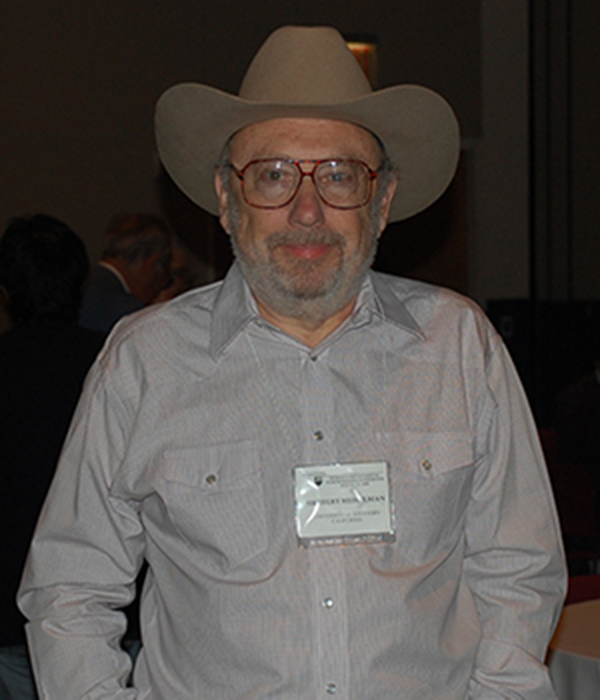
With the recent passing of Prof. Herbert J. Meiselman (Herb, as he insisted to be known), the world has lost a giant, pioneering, and defining figure within the fields of hemorheology, biorheology, and microcirculation research. He was a highly accomplished and a much-respected professor, although he hid behind an approachable demeanor with dry and irre verent humor and maintained an open-door policy. He never accepted praise, would hurry along introductions prior to invited plenary lectures, and preferred smart casual over formal suits. With those he crossed paths, he was a leader, mentor, colleague, and treasured friend.
Herb was born in Jamestown, New York in 1940 and spent his early years in a small, loving Jewish community. Here he not only survived but thrived thanks to his always positive, can-do attitude; something that defined his life and career. He worked his way through college and was admitted to graduate school at MIT, not a small achievement for someone coming from a working-class family in Upstate New York, as Herb always emphasized. After he received his doctorate in chemical engineering (offered as Sc.D., although always downplaying the value of this accomplishment), he realized that he would rather become a physiologist and accepted a postdoctoral research position at Caltech. Thankfully, he fell in love with research related to blood flow and ultimately joined the University of Southern California as faculty in the Keck School of Medicine in 1972.
Herb's scientific career was defined by curiosity, seeking the answer to the seemingly simple question: “why?”. He dedicated his life and career to better understanding the properties and complex behavior of whole blood and its constituents. His work remains fundamental to our understanding of the determinants of flow dynamics in large blood vessels and the microcirculation, in health as well as disease. Herb's papers provided clarity on the effect of plasma osmolarity, hemodilution/hematocrit, anticoagulants, cellular metabolism, membrane oxidation, cell morphology, in vivo ageing, intracellular viscosity, and hemoglobin saturation – to name only a few physical factors – on the rheological profile of blood and properties of red cells. His focus was broad and enhanced our understanding of the role of blood rheology in health across the lifespan including neonates, pregnancy, and ageing. He approached blood rheology and vascular hemodynamics as an intricate system that is impaired in pathological conditions such as sickle cell disease, atherosclerosis, hypertension, diabetes mellitus, and a range of vascular disorders. Herb's work provided the crucial foundation for developing precise clinical interventions and treatments for countless patients while spurring ongoing research into cardiometabolic health. However, his curiosity and scope of work spanned well beyond humans. He expanded his research to include a wide range of mammals and literally travelled to all corners of the world to study the characteristics of their blood: this included kangaroos, Tasmanian devils, and echidnas from Australia, seals from Antarctica and whales from the Arctic, to name only a few. But beyond personally performing many of the experiments aiming to significantly overcome our knowledge gaps, he had broad reach as a pioneer in spearheading guidelines and setting the standard in hemorheology-related research – he literally wrote the Handbook of Hemorheology and Hemodynamics and was a primary contributor to the current guidelines for hemorheological laboratory techniques. Herb's work was essential to the development and validation of novel devices used around the world in both research and clinical laboratories. The breadth of his accomplishments are highlighted by his authored books, book chapters, over 300 peer-reviewed manuscripts published in leading journals of the field and countless presentations at national and international conferences. Unique in today's environment, Herb's research was continually funded by grants from the NIH as well as the NHLBI. He served on numerous NIH study sections, the American Heart Association Scientific Advisory Board, and was president for the International Society for Clinical Hemorheology. He received the Poiseuille Medal for lifetime research achievements in the fields of hemorheology and microcirculatory physiology, and also the Fåhraeus Award for advancing biorheology – the two most prestigious awards in the field of biorheology and microcirculation.
Nobody who knew Herb would ever describe him as a lone wolf in the research arena or in his personal life. With his open personality and constant jokes, he quickly befriended colleagues and peers from around the world. This not only prompted fruitful collaborations, but many developed into deep friendships that lasted for a lifetime; the late Prof. Oguz Baskurt from Turkey stands out among all, so much so that some in his circle called the duo “Oguzbert Meiselkurt” owing to their joined-at-the-hip nature. Herb had a hard time visiting any country without having deep connections and could always be found seeking out good local restaurants and usually offending waitstaff (in good nature). It was not uncommon for Herb to skip formal invitations to share food with his friends and colleagues while travelling.
Herb conceived a laboratory without precedent, and it became known on every continent becoming the yardstick as the leading research lab in the field of hemorheology. Many visiting scholars to the lab became extremely successful scientists and physicians that went on to develop well-funded laboratories; it is without question that Herb's model impacted the success of these collaborators. Beyond his leadership and scientific accomplishments in his field, Herb was deeply committed to the education and mentoring of the younger generation. He served as an active faculty mentor to numerous graduate students, post-doctoral candidates, as well as junior faculty at the University of Southern California and delivered lively lectures to medical students on circulatory physiology and blood flow. But reaching beyond, he supported and shaped the careers of many young scientists from around the US and the world. The famous “Meiselman lab” hosted scholars from over 25 countries and became the “destination laboratory” for researchers aiming to join (and indeed those already established in) the blood rheology field. Herb's open door policy extend to his home: many were greeted at the “Meiselman Manor” upon landing in Los Angeles, and among intense scientific endeavor, perhaps the real work was keeping up with Herb's insatiable desire to explore local treasures, including Pho 79, Chinese Friends, Langer's Deli in downtown LA (pastrami on rye, without exception), and his favorite Mexican restaurant. To this day, his personal impact remains, although his unwavering support and scientific mentorship was balanced with his quick wit and personality; he had a knack for creating stories about those he cherished with unusual scenarios, whether it be a lonely emu or comparisons of his trainees with racehorses. Despite all of Herb's strengths, one of his few flaws was discovered when visiting Hungary: he simply could never acquire a taste for the specialty eyeopener drink Uniqum despite some homegrown encouragement. At other times, he was deeply serious and would share his views on the value of fundamental liberties of open society – he would vocally support rights, such as the ability to speak freely, even for those with views he may openly detest. Undoubtedly, this mix of leadership, warmth, and guidance ignited his mentee's curiosity and their dedication to continue on the “right path,” which remains timely in the current climate.
Herb's exceptional scientific contributions and leadership could only be outshone by his dedication as a loving husband and father. He met his wife Karin in junior college, and they were immediately infatuated. It was true love at first sight that lasted a lifetime. Notwithstanding, it only took Herb some 60 years to admit to Karin that she was his first girlfriend. Their love of travel was sparked as newlyweds, when they celebrated their new life with a 60-day European tour visiting 10 countries. Along the way they acquired a new Porsche 356SC, a now classic vehicle that was meant to only last their trip, but which found its way back to the US at its conclusion. Herb had an eye for beauty. After a cross-country road trip along Route 66, Herb and Karin settled down in a beautiful home in the charming community of Altadena, where visitors were welcomed to Newcomb's Ranch Roadhouse, occasionally in the Porsche, but always to share chili and cornbread. Herb and Karin continued to travel regularly during their careers, but their focus shifted slightly from “Europe on five dollars a day”, elevating to a life of finding charming art, tasty food, and good wine. The Meiselman residence was quite easy to spot from the distance given the massive antenna that Herb attached to the roof. Beyond serving as an eyesore for their neighbors, it was a necessary tool that enabled Herb to communicate with HAM radio operators from around the world. Visitors often had the privilege to spend a few nights at the residence not only sharing the roof with Herb, but also a room with a massive set of HAM radios, amplifiers, and a multitude of QSL cards as evidence that his radio's worked. They continued to live in Altadena until Herb's passing. He is survived by Karin, his wife of 61 years, his children, Sharon and Ben Meiselman as well as three grandkids. Herb is sorely missed, but his legacy, impact, and irreverent humor are timeless.
Footnotes

Author contributions
All authors contributed to the preparation, review, editing, and final approval of this manuscript.
Funding
The author(s) received no financial support for the research, authorship, and/or publication of this article.
Declaration of conflicting interests
The author(s) declared no potential conflicts of interest with respect to the research, authorship, and/or publication of this article.