



Abstract
Background
Nutrition risk is common in Alzheimer's disease and is associated with symptoms of dementia, cognitive decline, institutionalization, and mortality. Family caregivers who increasingly manage nutrition needs of persons with dementia (PWD) experience high caregiver burden, low health literacy, and nutrition risk. Few interventions for informal caregivers have included nutrition.
Objective
To inform design of a future caregiver nutrition intervention.
Methods
This cross-sectional study used a convergent mixed methods approach to 1) assess nutrition status among PWD and caregiver dyads (measures in common included Mini Nutrition Assessment, skin carotenoid, and handgrip strength), and 2) interview caregivers to identify needs and barriers for nutrition intervention. We hypothesized caregiver nutrition literacy is associated with PWD nutrition risk. Data collected in nutrition assessment and interviews were analyzed separately then side-by-side for comparison.
Results
Of 50 dyads, 48% had at least one individual exhibiting nutrition risk, and nutrition status categories (χ2 = 6.25, p = 0.012) between caregivers and PWD were related. Caregiver nutrition literacy was associated with 1) PWD factors including nutrition risk (rho = 0.244), body mass index (BMI) (rho = 0.421), handgrip strength (rho = 0.283), and skin carotenoid (rho = 0.351), and 2) Caregiver factors including nutrition risk (rho = 0.304), diet quality (rho = 0.304), and BMI (rho = 0.333). Interviews with 18 caregivers found caregivers prioritize PWD nutrition, provide more PWD nutrition care since diagnosis, experience social isolation, and would attend nutrition interventions if PWD are included.
Conclusions
Nutrition risk was more common among caregivers when PWD demonstrated nutrition risk. Factors present in individuals within the dyad were associated with partner nutrition risk. Future research should identify effective approaches for intervening on dyadic nutrition risk.
Introduction
More than 11 million people in the US provide 26.3 h on average per week of unpaid care to persons with dementia (PWD), placing substantial burden on family caregivers. 1 While many consider caregiving a rewarding role, nearly 60% of PWD caregivers rate the emotional stress of caregiving as high or very high, 1 and a review of 45 systematic reviews found “clear support” that being a PWD caregiver increases risk to psychological and physical health. 2 Among these health risks, limited data suggest between 20–64% of caregivers of PWD experience malnutrition or are at risk for malnutrition (also known as “nutrition risk”).3–5 Nutrition risk arises from inadequate nutrient intake leading to loss of lean tissue, with or without loss of subcutaneous fat, and resulting in decreased functional status and quality of life and increased frailty, institutionalization, morbidity and mortality.6,7
Beyond preventing malnutrition, a healthy diet is foundational to well-being and a key factor preventing nutrition-related chronic disease and cognitive decline. 8 However, caregivers often forego self-care due to caregiving activities and prioritization of the PWD's health. 9 In fact, PWD nutrition and feeding issues are chief concerns for caregivers who assume multiple tasks associated with feeding.10,11 In one telehealth intervention where caregivers submitted video recordings of challenging care situations for expert feedback, eating challenges were among the top five topics for which caregivers sought help.12,13 These concerns are well justified since malnutrition occurs in an estimated 29–54% of PWD, and unintentional weight loss alone is associated with decreased quality of life, Alzheimer's disease progression, institutionalization, and mortality.4,11,14,15 Managing responsibilities for meeting the nutrition and feeding needs of PWD may negatively impact caregiver nutrition. Some caregivers have reported feeling guilt in balancing food decisions between their PWD's nutrition needs that are in conflict with their food preferences, feeling a loss in the emotional significance of mealtimes, feeling unappreciated and undervalued, and engaging in emotional eating.11,16 Thus, a dementia diagnosis can have detrimental effects on nutrition for both PWD and caregivers. 11
It is unclear what caregiver factors are associated with PWD nutrition risk and how well-equipped family caregivers are to navigate the role in meeting their own nutritional needs and supporting the nutritional needs of the PWD. It is estimated that 65–75% of caregivers have inadequate health literacy, effectively decreasing their ability to make informed health-related decisions. 17 Low health literacy among caregivers is associated with lower care ability, higher hospitalization rates, longer lengths of stay, and poorer self-care. 17 To our knowledge, nutrition literacy has not been studied among caregivers of PWD, but research on care abilities of caregivers suggests a relationship may exist with PWD nutrition outcomes. In one study, caregivers recognized only severe malnutrition, 18 and another reported caregivers with high burden had PWD with significant weight loss at 3 months follow up. 19 Outside of the dementia caregiving context, nutrition literacy predicted a healthy, Mediterranean-style diet in adults with nutrition-related chronic disease, and caregiver nutrition literacy was associated with higher quality diets in young children.20–22
Given these nutrition risks experienced by PWD and caregivers, it is surprising that few nutrition interventions directed at caregivers have been reported. Those involving dementia caregivers were focused on nutrition outcomes of the PWD and did not report nutrition outcomes of caregivers.16,23,24 Thus, the overall purpose of this study was to inform the design of a future nutrition intervention inclusive of caregiver desires. The objectives of this study were to test the hypothesis that caregiver nutrition literacy is related to PWD nutrition status, and to identify 1) caregiver characteristics that are related to PWD nutrition status, and 2) the nutrition-related needs, barriers, and facilitators of caregiver-PWD dyads.
Methods
Study design
This cross-sectional study used a convergent mixed methods approach using both quantitative data collected from caregivers and PWDs and qualitative data collected from caregivers through surveys and formal interviews to address study objectives. 25 All data were collected between November 2022 and December 2023.
Setting and participants
Participants were recruited by the Outreach, Recruitment, and Engagement core at the University of Kansas Alzheimer's Disease Research Center (KU ADRC) using various outreach methods (patient registry, community registry, ADRC cohort participants, social media posts, and word of mouth). Interested participants had two opportunities for participation: 1) Nutrition status assessment and 2) Caregiver interviews. Contact information of interested individuals was shared with the research team for eligibility screening. Eligibility and participant interest were collected via phone calls by a trained research team member.
Participation in the nutrition status assessment portion required eligibility of the dyad, including both the caregiver and the PWD. Inclusion criteria for PWD were adults diagnosed with Alzheimer's or related dementia, residing at home with a caregiver or domestic partner, and weight recorded in the medical record in the previous year. PWD were excluded if they had frontotemporal dementia, alcohol-related dementia, Huntington's disease, schizophrenia, manic-depressive disorder, or active participation in nutrition intervention research. Inclusion criteria for caregivers were 18 years or older, English speaking, primary caregiver responsible for food planning, and no clinical cognitive impairment. All physical measures were collected in person at the ADRC and self-administered surveys were collected in person or online (per participant preference), requiring only one in-person visit to the research facility. Caregivers and PWD each received $50 for their participation.
All caregivers participating in the nutrition status assessment portion were invited to participate in interviews. Interviews were performed using a University-issued HIPAA compliant Zoom account with user-specific authentication, encryption, and securely stored audio recordings (Zoom Video Communications, Inc, 2023). Caregivers received $25 for the interview.
Ethics
All study procedures were approved by the University's Institutional Review Board (IRB). Informed consent was collected from all participants or their legally authorized decision-makers. Surrogate decision-makers, who were legal guardians, signed informed consent on behalf of PWD, and PWD signed assent. This trial was registered at ClinicalTrials.gov (NCT05536830).
Quantitative measures collected among caregivers and PWD
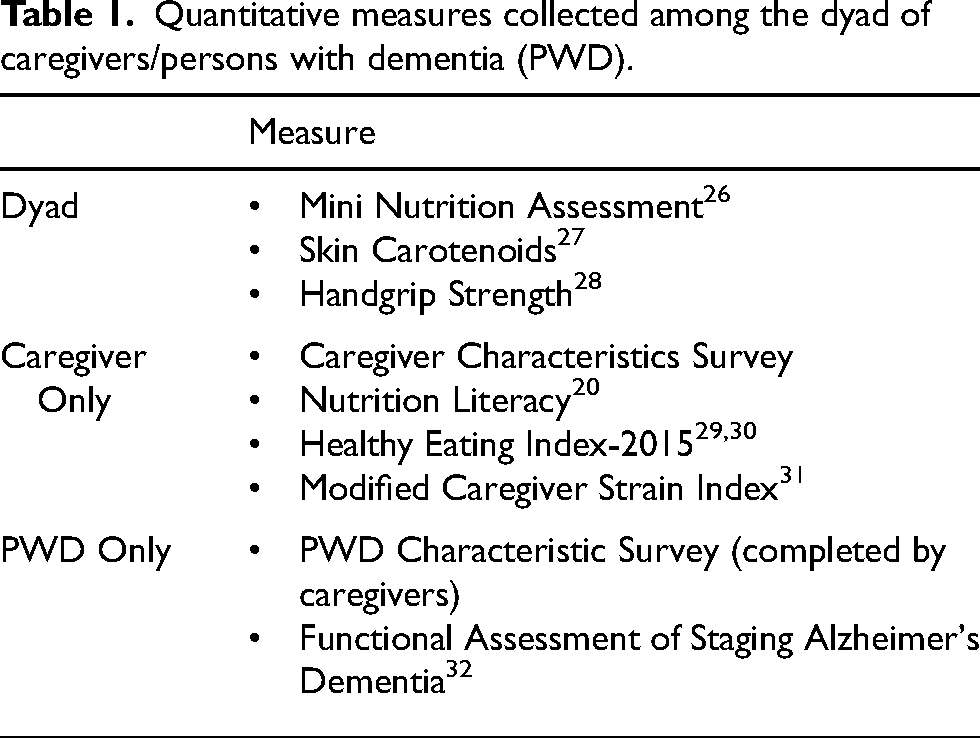
The following quantitative measures were collected in either the caregiver, PWD, or both. Table 1 summarizes the measures that were collected from the dyad and measures that were collected in the caregiver or PWD only.
Quantitative measures collected among the dyad of caregivers/persons with dementia (PWD).
Demographic characteristics of the dyad
Caregivers completed a demographic survey to self-report biological sex, age, education, race, ethnicity, marital status, household income, employment status, relationship to PWD, years spent caregiving, and hours spent caregiving per week. Caregivers also completed a survey to report demographic characteristics of PWD including biological sex, age, education, race, ethnicity, and marital status.
Nutrition status of the dyad
Nutrition status was measured in both the caregiver and PWD using the 18-item Mini Nutrition Assessment (MNA, full version). The MNA is a validated 18-item tool for identifying malnutrition in older adults, comprised of anthropometric measures, nutrition-related lifestyle questions, dietary intake, and self-perceived health. 26 Scoring is as follows: Normal (24–30 points), At risk of malnutrition (17–23.5 points), or Malnourished (<17 points). Use of the MNA is recommended for malnutrition assessment in community-dwelling older adults by the Academy of Nutrition and Dietetics and for PWD by the European Society for Parenteral and Enteral Nutrition.15,33 As part of the MNA, height (to nearest 0.01 cm) and weight (to nearest 0.1 kg) were measured by trained research dietitians using a stadiometer and calibrated digital scale. The average of three measures of height and weight were used to calculate body mass index (BMI) (m2/kg).
Skin carotenoids of the dyad
To complement assessment of dietary intake within the MNA, we also measured caregiver and PWD skin carotenoid content as a non-invasive estimate of fruit and vegetable intake. The Veggie Meter® (Longevity Link Corporation) uses gentle pressure applied to the pad of the fingertip to put in close contact with light to detect and measure carotenoid molecules in the skin. Three, 15–20 s measurements are taken and averaged for the recorded score. This approach is highly correlated with tissue carotenoid content. 27
Diet quality of the caregiver
Diet quality of caregivers was assessed through the HEI-2015 using methods developed by the National Cancer Institute. 29 Caregivers completed the validated, web based food frequency questionnaire, the Diet History Questionnaire III (DHQ III), to collect diet intake. 30 Nutrient data from the DHQIII was used to calculate HEI-2015. Total score for HEI-2015 has a range of 0–100.
Handgrip strength of the dyad
Functional status is a commonly considered criterion in the diagnosis of malnutrition. 34 Thus, we measured caregiver and PWD functional status by hand-grip strength using a calibrated Jamar hand dynamometer on the participant's dominant hand. 28 An average of three measurements was calculated for caregivers and PWD 35 and transformed into z scores using normative standards for age and biological sex previously established with NHANES data. 36 Because normative standards range 18–85 years, measures collected in four individuals exceeding 85 years were standardized using the 80–85 year reference values.
Nutrition literacy of the caregiver
We measured caregiver nutrition literacy using the Nutrition Literacy Assessment Instrument (NLit) previously validated in a diverse sample of 429 adults. 20 The NLit includes 42-items in multiple-choice format that objectively (i.e., assess knowledge and/or skill) measure six subscales of nutrition literacy: 1) nutrition and health, 2) energy sources in food, 3) household food measurement, 4) food label and numeracy, 5) food groups, and 6) consumer skills. Scores are interpreted as ≤ 28 is “likelihood of poor nutrition literacy,” 29–38 is “possibility of poor nutrition literacy,” and ≥ 39 is “likelihood of good nutrition literacy.” 20
Caregiver stress
Caregiver stress and burden was measured by the Modified Caregiver Strain Index (MCSI) in which caregivers self-report perceived strain related to their caregiver roles. Items were scored “yes” (2), “sometimes” (1), or “no” (0); higher scores indicated higher perceived caregiver strain. The MSCI previously demonstrated internal and test-retest reliability in 158 caregivers. 31
Dementia staging of the PWD
Dementia staging was measured using the Functional Assessment of Staging Alzheimer's Dementia (FAST). FAST is a validated scale composed of 7 major functional levels concerning activities of daily living across the spectrum of Alzheimer's disease. 32 Caregivers and PWD were interviewed by a research team member to elicit information concerning ability of the PWD to perform specific activities of daily living. Answers determined the appropriate stage: Stage 1 (normal), Stage 2 (normal older adult), Stage 3 (early dementia), Stage 4 (mild dementia), Stage 5 (moderate dementia), Stage 6 (moderately severe dementia), and Stage 7 (severe dementia).
Caregiver perspectives on nutrition needs
An iterative, mixed methods approach was used to collect the perspectives of caregivers on their caregiving nutrition needs. All caregivers participating in the nutrition status assessment portion of the study completed a 24-item survey that was developed by the research team to solicit feedback from caregivers on their food and nutrition experiences and needs. Topics of questions were based on published interview guides and previous findings10,37,38 and included caregiver nutrition roles (2 multiple choice items), confidence in performing food-related caregiver roles (10 Likert-scale items), changes in PWD food behaviors since diagnosis (5 multiple choice, 1 short answer), the effect of caregiving on self-care (1 multiple choice, 1 short answer), and eating away from home (4 short answer items). From answers to survey questions, the research team developed an interview guide to further explore select topics in individual interviews with caregivers.
Statistical methods
All measures were analyzed for descriptive statistics (frequencies, means, and standard deviations). Spearman's rank correlation and chi-squared tests were used to investigate relationships between caregiver and PWD measures as well as within caregivers and PWD. To evaluate the role of caregiver biological sex, we used independent t-tests to investigate differences between sexes for caregiver NLit total score, MNA, HEI-2015, BMI, skin carotenoid and PWD MNA, BMI, and skin carotenoid. We assessed all model assumptions using residual analyses, including QQ plots and residual histograms. All quantitative data analysis was performed in SPSS Statistics, Version 27 (IBM Corp., Armonk, NY, 2020) with statistical significance set at p < 0.05 and near-significance set at p < 0.10. Transcripts from all interviews were analyzed using the constant comparative method 39 and data triangulation 40 to identify recurring themes. Three researchers coded transcripts separately and met to discuss major themes. After data were compiled, a side-by-side comparison of nutrition status data, survey data, and interview data was performed.
Results
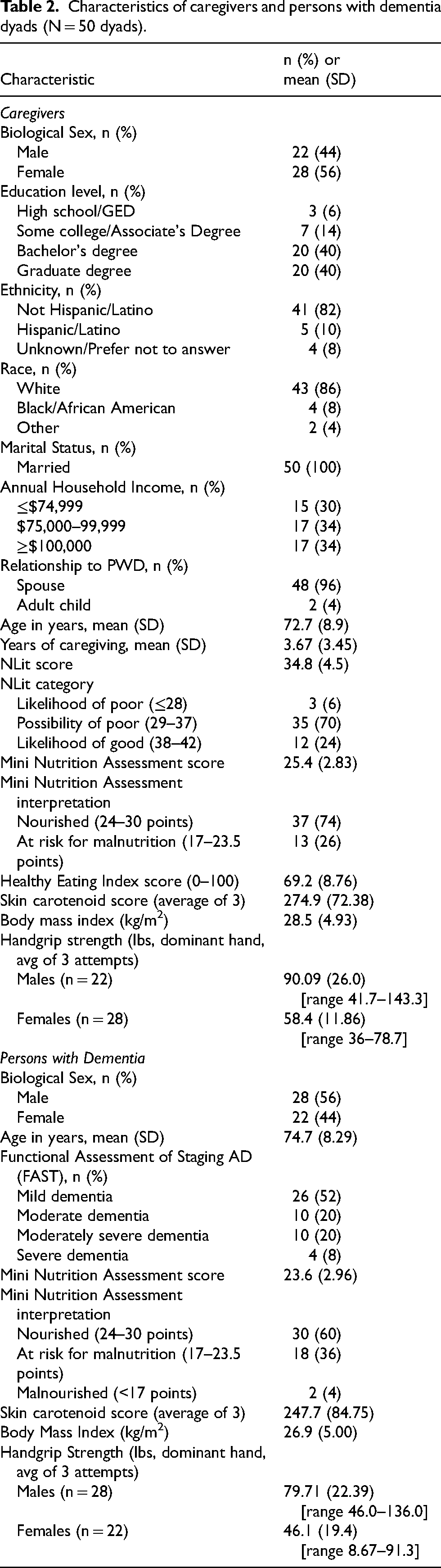
A total of 50 caregiver-PWD dyads enrolled in the nutrition status assessment portion of the study. Descriptive statistics for demographic and nutrition-related characteristics of caregivers and PWD are presented in Table 2. Most caregivers self-identified as spouses to the PWD (n = 48, 96%) and a slight majority reported female biological sex (n = 28, 56%). Approximately half of PWD had mild dementia, but all stages were represented. Nutrition literacy in caregivers was “possibly poor” on average with a score of 34.8 ± 4.5 points on the NLit. Caregivers had HEI-2015 diet quality scores of 69.2 ± 8.8, which is higher than the median score of 60 for US adults ages 60 years and older. 41
Characteristics of caregivers and persons with dementia dyads (N = 50 dyads).
Relationships between caregiver and PWD measures are presented in Table 3. Of 50 dyads, 48% had at least one individual who was malnourished or at risk for malnutrition: 1) Nine dyads with both caregivers and PWD who were malnourished or at risk for malnutrition; 2) Four dyads with only caregivers at risk for malnutrition; and 3) 11 dyads with only PWD who were malnourished or at-risk for malnutrition. PWD MNA was inversely related to FAST dementia staging (rho = −0.33, p = 0.018). MNA scores (rho = 0.40 p = 0.005) and nutrition status categories (χ2 = 6.25, p = 0.012) between caregivers and PWD were related. Caregiver nutrition literacy was related to caregiver MNA (rho = 0.30, p = 0.03), diet quality (rho = 0.30, p = 0.03), and BMI (rho = 0.33, p = 0.02).
Correlation matrix (Spearman Rho) between nutrition-related characteristics in dyads of caregivers and persons with dementia.

p < 0.1; *p < 0.05; **p < 0.01.
Comparing nutrition measures between caregivers grouped by biological sex, male caregivers had lower nutrition literacy (−2.8 ± 1.2 NLit score, p = 0.03,), diet quality (−6 ± 2.4 HEI, p = 0.015), and stress (−3.4 ± 1.5 MSCI, p = 0.03) than female caregivers; while their female care recipients had lower BMI (−3.7 ± 1.3, p = 0.008) and worse nutrition risk (−2.5 ± .8 MNA, p = 0.002) than male care recipients. Caregiver MNA was not different between sexes (p = 0.63).
Caregiver survey responses concerning their nutrition-related roles and needs are described in Table 4. Caregiver confidence in performing various nutrition-related tasks was high for both males and females. Male caregivers reported an increased frequency of eating away from home for both caregivers and PWD, while female caregivers reported decreases.
Caregiver responses to survey of caregiving nutrition needs.

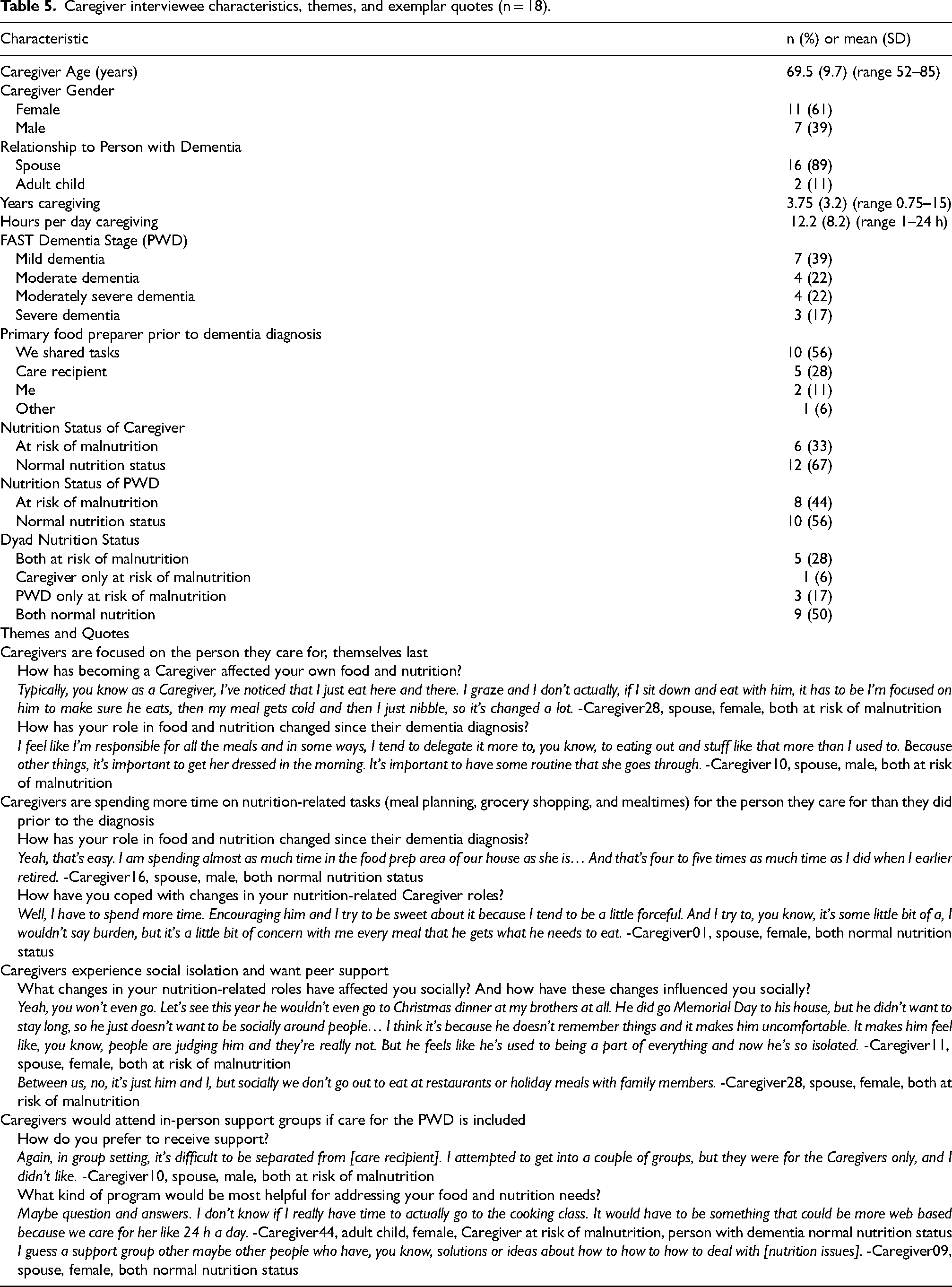
Eighteen caregivers participated in the interview portion of the study. Table 5 includes participant characteristics, themes and exemplar quotes. Interviews found the following 4 themes: 1) Caregivers are focused on the person they care for, themselves last; 2) Caregivers are spending more time on nutrition-related tasks (meal planning, grocery shopping, and mealtimes) for the PWD than prior to the diagnosis; 3) Caregivers experience social isolation and want peer support; and 4) Caregivers would attend in-person support groups if care for the PWD is included.
Caregiver interviewee characteristics, themes, and exemplar quotes (n = 18).
Discussion
The results of this mixed-methods study add a dyadic perspective to existing literature on the nutrition status and nutrition needs of informal caregivers and PWD. While rates of malnutrition risk were similar to other studies that investigated caregiver or PWD nutrition risk separately, the present study reports a new finding that approximately half of dyads experienced nutrition risk in at least one member. This dyadic perspective is important because both caregiver and PWD factors were associated with nutrition risk in the respective partner, suggesting bidirectional effects likely impact nutritional status of both individuals and the dyad overall.
Our data also suggest caregiver nutrition literacy is a factor that influences both caregiver and PWD nutrition status. Relationship between caregiver nutrition literacy and diet quality was anticipated based on our previous validation of the NLit tool. 20 Higher nutrition literacy was related to higher BMI in both caregivers and PWD. Although both caregivers and PWD had average BMIs classified in the overweight category, evidence suggests overweight BMI in adults ≥65 years is associated with lower mortality risk.42,43 Caregiver nutrition literacy was the only factor measured in the present study with significant relationships with all PWD nutrition measures. Although nutrition literacy has not been previously measured in caregiver interventions, nutrition literacy interventions generally improve diet quality, 44 and interventions in PWD that have included caregiver-focused nutrition education have increased PWD nutrition status compared to control.3,24 Thus, improving nutrition literacy among caregivers may have downstream positive effects on nutrition outcomes for PWD and caregivers.
Results of the present study suggest male caregivers may be less knowledgeable of the nutrition needs of their spouses with dementia. Others have also reported lower nutrition literacy among older adult males compared with females. 45 Nutrition literacy and diet quality were lower among male caregivers, and male caregivers reported an increased frequency in eating out after the dementia diagnosis. Greater difficulty in meeting PWD nutrition needs by male caregivers has been attributed to acquiring a new food-related role, 46 however, changes in nutrition-related roles in this study were equally experienced by male and female caregivers. Regardless of cause, these data indicate that male caregivers are an important demographic to engage in the intervention design process, especially considering that nutrition interventions often enroll a higher percentage of females and females are more likely to experience dementia.
The relationship between cognition and malnutrition in the present study is consistent with previous evidence that malnutrition prevalence is higher in those with dementia 4 ; however, a lack of causal research has been conducted to investigate the directionality of this relationship. Nutrition risk may predict dementia severity with one study reporting those with malnutrition were four times as likely to reach severe dementia. 47 Likewise, one systematic review purports poor nutritional status may contribute to a decline in cognition but cites a lack of high-quality studies. 48 Improving diet quality in older adults with elevated risk for dementia has been shown to benefit cognition. 49 Thus, it is also reasonable to hypothesize that nutrition interventions may improve or preserve cognitive function in dementia, yet this remains unclear given a limited number of such clinical trials. Since PWD are clearly at a greater risk of malnutrition, future well-powered studies should focus on investigating whether nutritional intervention can improve or preserve cognitive function in those with dementia.
The purpose of the present study was to uncover the nutritional needs of caregivers as they support PWDs to inform future intervention design, but it quickly became apparent in caregiver interviews that they were uninterested in nutrition interventions designed for caregivers alone. Consistent with others’ findings, caregivers prioritized the nutritional needs of PWD over their own. 50 Even when prompted, many would not acknowledge nor were aware of their own needs. While caregivers expressed feelings of social isolation and interest engaging with other caregivers, they felt they could not participate in a nutrition intervention if they could not bring their PWD along. Results of the nutrition assessment portion of the study complement these findings, highlighting that nutrition risk is more common within the dyad than nutrition risk within caregiver or PWD alone. These findings align with the Actor-Partner Interdependence Model which describes the mutual influences of individual and partner effects to synergistically impact outcomes. 51 Our findings build on others who point to the need for dyadic nutrition intervention for community-dwelling dyads living with dementia to effectively and efficiently meet nutrition needs of both groups. 50
The strengths of this study include use of validated psychometrics and robust measures of nutrition status conducted in both caregivers and PWD. Our mixed methods approach allowed for triangulation of data to understand the nutritional needs of dementia dyads more deeply than is possible through qualitative or quantitative methods alone. However, our findings also have important limitations. The sample size was relatively small and comprised of mostly high SES, which limits generalizability. Even still, we found high prevalence of nutrition risk among these participants, which is likely higher among the general population of community-dwelling older adults with dementia and their caregivers, given that food insecurity is a major contributor to malnutrition among older adults. 7 Likewise, although 18 interviews is consistent with recommendations to achieve content saturation, not all perspectives are likely represented. Finally, we used a validated food frequency questionnaire to inform the calculation of caregiver diet quality because this approach minimizes respondent and researcher burden while measuring usual diet intake over a one-year period, however, we acknowledge that self-report methods are prone to bias.
In sum, malnutrition risk was prevalent in this sample of community-dwelling PWD and caregiver dyads. This finding is important because nutrition screening is not currently standard practice in outpatient settings. Furthermore, in a healthcare system that focuses on the patient presenting for care (PWD), the caregiver's nutrition risk is likely hidden. Future research should identify effective dyadic nutrition interventions to increase quality of life for families living with dementia.
Footnotes
Acknowledgments
The research team would like to express our heartfelt gratitude to all research participants who contributed their time and insights to this study. Your willingness to share your experiences and perspectives made this work possible. Special thanks to student graduate research assistants who were integral to data collection for this study including Rachel Archer, MS, RD, Emma Montgomery, MS, RD, and Fernanda Cantu Corona.
ORCID iDs

Author contributions
Heather Diane Gibbs (Conceptualization; Data curation; Formal analysis; Funding acquisition; Investigation; Methodology; Project administration; Resources; Supervision; Validation; Writing – original draft); Matthew K Taylor (Conceptualization; Data curation; Formal analysis; Methodology; Writing – original draft); Rebecca Mount (Data curation; Formal analysis; Investigation; Project administration; Supervision; Writing – original draft); Cheryl Gibson (Conceptualization; Investigation; Methodology; Writing – review & editing); Austin Sullivan (Data curation; Investigation; Writing – original draft); Kristine Williams (Conceptualization; Investigation; Methodology; Writing – review & editing); Debra K Sullivan (Conceptualization; Methodology; Writing – review & editing).
Funding
The author(s) disclosed receipt of the following financial support for the research, authorship, and/or publication of this article: This work was supported by grants from the National Institute of General Medical Sciences (P200 GM139733) and from the National Institute on Aging awarded to the University of Kansas Alzheimer's Disease Research Center, the University of Kansas School of Medicine, and the Landon Center on Aging (P30 AG072973).
Declaration of conflicting interests
The author(s) declared the following potential conflicts of interest with respect to the research, authorship, and/or publication of this article: Heather Gibbs and the University of Kansas are owners of the NLit copyright and receive royalties for its use. Matthew Taylor received funding from the National Cattlemen's Beef Association (2020–2022) and the Avocado Nutrition Center (2023–2026). Debra Sullivan received funding from the National Cattlemen's Beef Association (2024), the National Pork Board (2024–2025), the Egg Nutrition Center (2020–2023), and the US Highbush Blueberry Council (2021–2024). All other authors declared no potential conflicts of interest with respect to the research, authorship, and/or publication of this article.
Data availability
The data supporting the findings of this study are available on request from the corresponding author.