



Abstract
Background
Alzheimer's disease dementia (AD) is a debilitating progressive neurodegenerative disease. Life experiences are hypothesized to build cognitive reserve (CR), a theoretical construct associated with delayed onset of AD symptoms. While CR is a key moderator of cognitive decline, operationalization of CR is varied resulting in inconsistencies within the literature.
Objective
This study explored the relationship between life experiences used as proxies of CR and risk of AD diagnosis and death following diagnosis.
Methods
We explored results based on 30 different published CR operationalizations, including two standardized questionnaires and an investigator-developed lifecourse indicator. Using data from the Memory and Aging Project, we applied Cox proportional hazard models to evaluate the impact of operationalization on time to outcomes.
Results
Hazard ratios, indicating instantaneous risk of AD or death for a standard deviation increase in the CR proxy utilized as a predictor, ranged from 0.80–1.40 for AD diagnosis and 0.80–1.29 for death following diagnosis. Among nine predictors that showed a significant reduction in risk of AD, there was a decrease of between 12% and 20%. Two predictors were associated with reduced risk of death, with 13%–20% reduction, while three predictors were associated with 18%–22% heightened risk of death following diagnosis.
Conclusions
Model results were highly sensitive to CR operationalization. Based on the variation in results, composite measures that incorporate multiple lifecourse variables may still be the most comprehensive and faithful representation of CR. Attention to methodology and refining of measurement are needed to make use of CR and promote healthy aging.
Introduction
Alzheimer's disease (AD) is a debilitating neurodegenerative disease that impacts approximately 32 million adults worldwide. 1 Further, due to the aging of the population, that burden is expected to greatly increase in coming years.2,3 Individuals with this condition show notable cognitive impairment, such as memory difficulty. 4 Disease-related brain pathology, including reduced volume, degeneration of neurons, and abnormal protein deposits, particularly neurofibrillary tangles and plaques, is hypothesized to underlie cognitive decline evident in persons with AD dementia.5–8 However, research has shown that lifestyle factors can delay the onset and progression of cognitive decline.9,10 Specifically, factors throughout one's life, including education, physical activity, and late-life cognitive activities, may build a resilience to symptoms of AD,3,11,12 known as cognitive reserve (CR).13,14 CR has been proposed as a modifying factor partially responsible for individual differences in the delay between disease-related brain pathology and symptoms of AD dementia, such that those with higher CR show resilience to AD, maintaining better cognitive performance than would be expected based on the degree of pathology.12–15 However, due to its theoretical nature, CR is rarely measured directly, posing problems for operationalization and research. 14 Given potential benefits of gathering life experiences that may contribute to CR for individuals, their families, and burden on the healthcare system, an investigation of the impact of inconsistencies on the field of public health's understanding of resilience to AD dementia symptoms is necessary.
CR theory is well-established, with epidemiological studies consistently showing that higher CR is associated with reduced risk of dementia in later life.13,16–18 Additionally, those with higher CR also show a pattern of accelerated cognitive decline and death following symptom onset.15,18–20 This is likely related to the ability to compensate for pathology in high CR, whereby pathology is at an advanced stage by the time an individual presents with clinical symptoms.20,21 That is, the presence of severe pathology leads to faster decline and death after symptom onset compared to those with lower CR who may have clinically manifested the neuropathology earlier in the disease course. As such, CR is hypothesized to delay the onset of clinical manifestation of disease without reducing the overall rate of health decline.13,15,21,22 Based on these findings, as well as the reduced quality of life of patients with AD, there is an urgent need to elucidate experiences and lifestyle factors which contribute to CR such that prevention and early interventions can be maximally effective.
Given its theoretical nature and, therefore, the difficulty in direct measurement, the literature most commonly assesses CR through the use of life experiences or exposures, known as CR proxies, to individually, collectively, or cumulatively operationalize CR. Such socio-behavioral proxies are experiences that are hypothesized to contribute to the development CR, while not able to directly assess CR.14,21 However, despite evidence of the benefits of CR related to the onset of clinical manifestation of AD, measurement differences across studies have produced inconsistent results when operationalizing life experiences relevant for building CR.23–25 The field employs a wide range of proxies, which, although inclusive, may result in the noted inconsistency in evidence for the beneficial effect of various experiences for later health outcomes. 23 The use of standardized questionnaires reduce variance across the field and offer a more systematic measurement of CR; 26 however, inconsistencies exist in included items across standardized questionnaires. For example, two common questionnaires, the Cognitive Reserve Index questionnaire (CRIq) 27 and the Lifetime of Experience Questionnaire (LEQ), 28 differ with the CRIq focusing on the culmination of experiences (e.g., total years of education, types of labor, and activities) 27 while the LEQ asks participants to recall activity engagement at three different life timepoints: young adult (13–30), adult (30–65), and older adult (from 65 on). 28 Therefore, while dissemination of experiences that, if modified, may help to protect against AD is of the utmost importance,3,29 the application of the CR hypothesis may be limited due to methodological inconsistencies in the operationalization of CR.
The purpose of the present study was to systematically explore potential variation to the relationship between life experiences as proxies of CR and timing of AD dementia diagnosis and death following diagnosis. We used the framework of the CR hypothesis to investigate time to diagnosis of AD dementia, as well as time to death following AD diagnosis. Using different operationalizations of CR through the use of different life experiences to predict these outcomes, we explored results based on the life experiences that have been investigated in the published literature, in addition to two questionnaires and a lifecourse indicator. We expected to find differences in the association between the life experiences and timing of AD dementia and death based on CR operationalization, such that the level of risk of AD and death would vary.
Methods
Participants
Data was obtained from participants of the Rush Memory and Aging Project (MAP). MAP is an ongoing cohort study of participants living in retirement communities in Illinois, United States. 30 Recruitment for the study began in 1997 and had enrolled 2131 participants through January 2021. Inclusion criteria for MAP consists of the following: adults must be 65 years of age or older; without known dementia at enrollment; agree to annual/yearly clinical evaluation, cognitive testing, and blood draw; and agree to organ donation (spinal cord, muscle and nerve, and brain).
The study aims to investigate risk factors for neurodegenerative conditions, combining both retrospective assessments of lifecourse events with prospective cognitive testing and disease diagnoses. At enrollment, participants underwent cognitive testing and completed surveys regarding demographics and life experiences, or exposures, at timepoints throughout their life, including at present (late life), and retrospectively. These life exposures were used as predictors in the present study. Participants also underwent yearly follow-up assessments which included clinical assessment for AD dementia. MAP has been approved by the Institutional Review Board of Rush University Medical Center.
Predictors of Alzheimer's disease dementia and death
Proxies
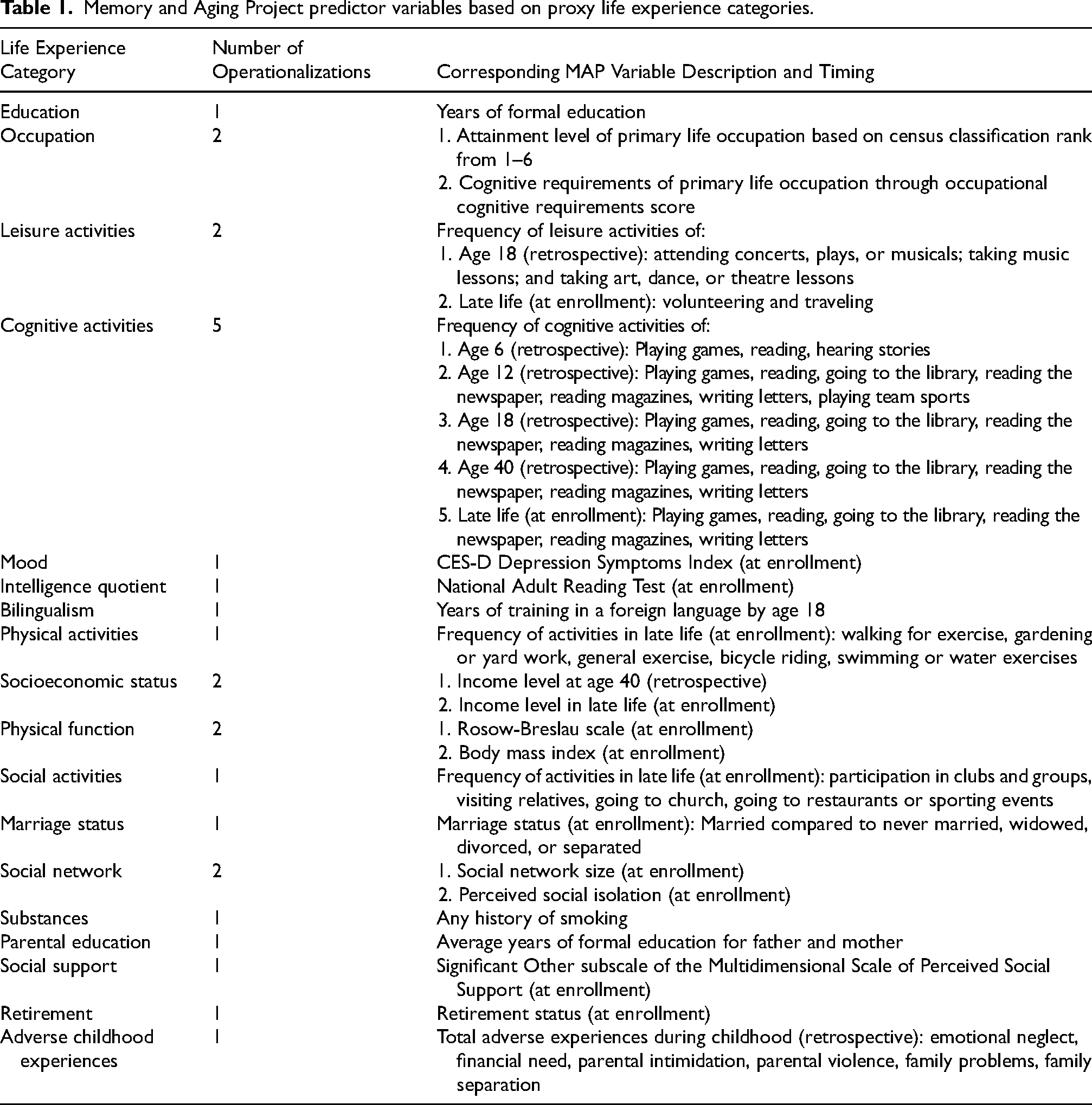
Twenty categories of exposures which have been previously utilized in the literature as life experience proxies of CR or predictors of late-life cognitive decline were obtained through a search of published literature between January 1990 and December 2021, as described elsewhere. 23 We used observed variables of similar experiences in MAP as predictors (Table 1). MAP did not have measures for two categories, nutrition and novelty, resulting in 18 categories of life experiences in the current study: education, 25 occupation,25,31,32 leisure activities,27,28 cognitive activities,33–36 mood (CES-D Depression Symptoms Index),37,38 intelligence quotient (IQ)25,39 (National Adult Reading Test),40,41 bilingualism, 28 physical activities (National Health Interview Survey),29,42 physical function,43,44 socioeconomic status,33,45 social activities,28,46 marriage status, 47 social network, 28 substance use, 29 parental education, 48 social support (Significant Other subscale of the Multidimensional Scale of Perceived Social Support assessing family and friends support),49–52 retirement status, 53 and total adverse childhood experiences (Childhood Trauma Questionnaire).54–57 Additionally, we also included multiple operationalizations of these life experiences, where available in MAP. The proxy of occupation included an assessment of attainment level32,58 and the cognitive complexity of the occupation (occupational cognitive requirement score, OCRS);59,60 the proxy of physical function included mobility (Rosow-Breslau scale) 61 and body mass index (BMI); and the proxy of social network included network size and perceived social isolation. Finally, leisure activities, cognitive activities, and income were collected at multiple ages. Late life timepoints were collected at enrollment. In total, 27 variables representing 18 categories were included, details of which are provided in Table 1. All variables were coded such that higher values indicated a better score or better health (e.g., more mobility, less symptoms of depression, fewer adverse childhood experiences, higher continuous BMI because lower BMI has been associated with greater risk of dementia in older persons).62,63
Memory and Aging Project predictor variables based on proxy life experience categories.
Questionnaires
As two additional predictors, we used variables in MAP to create composite scores based on the CRIq 27 and the LEQ.28,64 We produced composite scores based on types of experiences that are included in each questionnaire. The CRIq-based score was composed of years of education, job attainment level, number of children, and frequency of various activities. Activities were coded on a binary scale (0 = once a month or less; 1 = more than once a month) and included participation in leisure activities at age 18, seeing relatives in late life, frequency of participation in groups and clubs in late life, going to church in late life, going to restaurants and sporting events in late life, traveling in late life, volunteering in late life, and reading magazines and newspapers at the age with the highest frequency.
The LEQ-based score was a composite of scores from three age groups: ages 13–30 was composed of years of education, taking music lessons (yes or no), and frequency of reading (including newspapers and magazines); ages 30–65 was composed of job attainment level and frequency of reading (including newspapers and magazines); and age 65 and older was composed of retirement (yes or no), frequency of participation in groups and clubs, frequency of volunteering, frequency of going to restaurants and sporting events, frequency of visiting relatives, frequency of traveling, frequency of physical activities, and frequency of reading (including newspapers and magazines). Frequency variables were coded on a scale of 1–5 (1 = once a year or less; 2 = several times a year; 3 = several times a month; 4 = several times a week; 5 = every day or almost every day). We weighted the variables based on the scoring guide for the CRIq 27 and a validation of the LEQ in an American population 64 before summing the variables into composite scores.
Lifecourse score
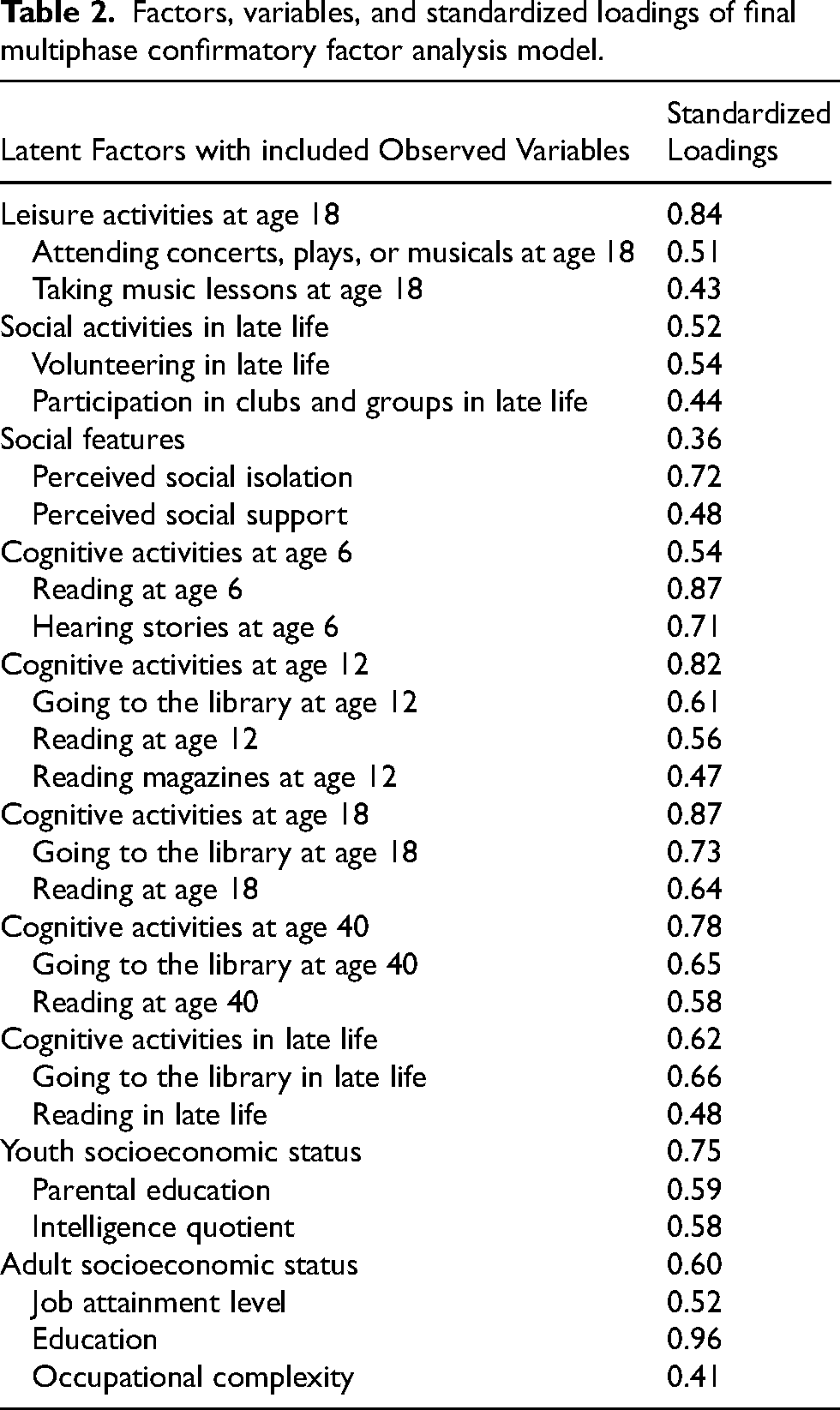
A lifecourse score was computed through confirmatory factor analysis (CFA) using observed variables from MAP. Additional details are provided elsewhere. 23 Briefly, 54 observed variables were grouped into six dimensions based on prior uses of MAP variables in the literature: Leisure Activities, Social Characteristics/Activities, Physical Characteristics/Activities, Cognitive Activities, Socioeconomic Status (SES), and Demographics/Personality.30,65–68 Each dimension went through multiple iterations in which a single variable was removed until all remaining variables had a factor loading (λ) ≥ 0.4. 69 Models were evaluated based on recommended indices: chi-square (χ2), the robust version of the Comparative Fit Indices (CFI), the robust version of the Root Mean Squared Error of Approximation (RMSEA), and the Standardized Root Mean Square Residual (SRMR). 70 In ensuring that the final model for each dimension were improvements over the preliminary models, better model fit was indicated by levels closer to one for CFI (i.e., ≥ 0.95) and levels closer to zero for RMSEA (i.e., ≤ 0.07) and SRMR (i.e., < 0.08). The final combined model had adequate fit with χ2(158) = 434.190, CFI = 0.956, RMSEA = 0.035 (90% confidence interval: 0.031 to 0.038), and SRMR = 0.030.70–75 The 22 observed variables within 10 latent factors of the final model are provided in Table 2. Standardized loadings show the strength of relationship between observed variables and latent factors, as well as between latent factors and the overall latent CR construct. Each participant was assigned a unique lifecourse indicator score based on their observed variables and standardized loadings of the factors of the CR construct. All analyses were conducted with the Lavaan package (version 0.6–12) in R software version 4.2.1. 76
Factors, variables, and standardized loadings of final multiphase confirmatory factor analysis model.
Alzheimer's disease dementia diagnosis
At yearly assessments, participants were given a diagnosis of no cognitive impairment or AD dementia. 30 The diagnosis was based on scores obtained on cognitive tests, a neuropsychologist's clinical assessment, and a clinician's diagnostic classification based on criteria put forth from the National Institute of Neurological and Communicative Disorders and Stroke and Alzheimer's Disease and Related Disorders Association.77,78 We used age at first diagnosis of AD dementia as the time of event for AD dementia diagnosis. Exact age at death was known and used for time of event in death models.
Study outcomes
We evaluated the association of life experience proxies of CR operationalizations on two primary outcomes: 1) time from birth to AD diagnosis and 2) time from AD diagnosis to death. The unit of measurement was in years.
Data analysis
We applied Cox proportional hazard models. The proportional hazards assumption was tested using Shoenfeld residuals and showed no evidence of violation. 79 The sample in the model of time from AD dementia diagnosis to death was restricted to participants who were diagnosed with AD. Participants who were not diagnosed with AD dementia by the end of the study period were right censored at their last observed visit.
A total of 30 predictors (27 proxies, 2 questionnaires, and 1 lifecourse score) were assessed in separate models. These CR proxies were coded such that higher values indicated higher CR. Continuous predictor variables were standardized to a mean of 0 and a standard deviation of 1. Therefore, the hazard ratios (HR) were interpreted as the instantaneous risk of AD dementia or death for a standard deviation increase in the value of the life experience proxy for CR. HRs for categorical variables were interpreted as the instantaneous risk of AD dementia or death relative to the reference category. All models adjusted for sex, race, and copies of APOE4, given that carriers of the APOE4 allele are at high risk of AD. 80 Models with diagnosis of AD dementia as the event adjusted for age at study entry, while models with death as the event adjusted for age at diagnosis. Additionally, death is a competing risk in the development of AD dementia because individuals who die from another cause prior to developing AD are no longer at risk. Failure to account for death as a competing risk can lead to bias estimates. We used Fine and Gray subdistribution proportional hazards models to calculate subdistribution HRs to account for death as a competing event in the models with AD dementia as the event.81,82 Analyses were performed with SAS software version 9.4, using two-tailed significance tests and p-values < 0.05 considered statistically significant.
Results
Baseline characteristics
In this study, 672 of the 2131 (31.53%) participants were found to have mild cognitive impairment or AD dementia at their baseline study assessment and were excluded from our analyses. We also excluded participants with no follow-up (N = 93, 4.36%). The final sample consisted of 1366 participants ≥ 65 years of age at baseline, evaluated as cognitively healthy (at baseline), and who returned for at least one annual visit after their baseline assessment. Characteristics of the final analytic sample are provided in Table 3. Mean age at study entry was 79.5 (SD = 6.51). The sample was comprised predominantly of women (76.50%) and participants who identified as Non-Hispanic White (91.29%) with an average of 15 years of education (SD = 3.25). All participants were considered either operative and service workers (9.69%), managerial workers (53.19%), or professional workers (37.12%) through census classification rank for occupational attainment and, therefore, operative/service workers and professional workers were each compared to the reference category of managerial in the analyses. Less than half of the participants had any history of smoking (41.14%) and 20.68% had 1 or more copies of ApoE4. Participants were followed for an average of 8.1 years (SD = 4.63). Over the course of an individual's follow-up, 273 (19.99%) were diagnosed with AD dementia, with an average age of diagnosis of 89.6 years (SD = 6.07); of those diagnosed with AD dementia, 208 died (76.19%), with an average age of death of 92.88 years (SD = 5.53).
Sample characteristics.

Risk of Alzheimer's disease dementia
The point estimates and 95% confidence intervals (CI) for the life experience predictors are presented in Table 4 and displayed in Figure 1A. The results showed that risk of AD dementia varied based on the life experience proxy of CR that was used, with HR estimates ranging from 0.80 to 1.40. Of the 30 predictors, nine were significantly associated with risk of AD dementia, showing lower risk with higher value of the CR indicator. Collectively, among proxies that showed a significant reduction in risk for a standard deviation increase, there was a decrease in risk of AD dementia of between 12% and 20%. Higher values on composite scores for the LEQ (HR = 0.83; 95% CI: 0.72, 0.97; p = 0.015) and the lifecourse score (HR = 0.88; 95% CI: 0.77, 0.99; p = 0.046) showed significantly lower risk of AD dementia. Additionally, more cognitive activities in life late (HR = 0.80; 95% CI: 0.70, 0.91; p = 0.001), more social activities in late life (HR = 0.81; CI: 0.71, 0.92; p = 0.002), more years of language training (HR = 0.82; CI: 0.69, 0.98; p = 0.031), higher IQ (HR = 0.86; CI: 0.76, 0.98; p = 0.022), less perceived social isolation (HR = 0.86; CI: 0.75, 0.98; p = 0.029), more cognitive activities at age 40 (HR = 0.87; CI: 0.76, 0.99; p = 0.031), and higher parental education (HR = 0.87; CI: 0.77, 0.99; p = 0.037) showed significant risk reduction.
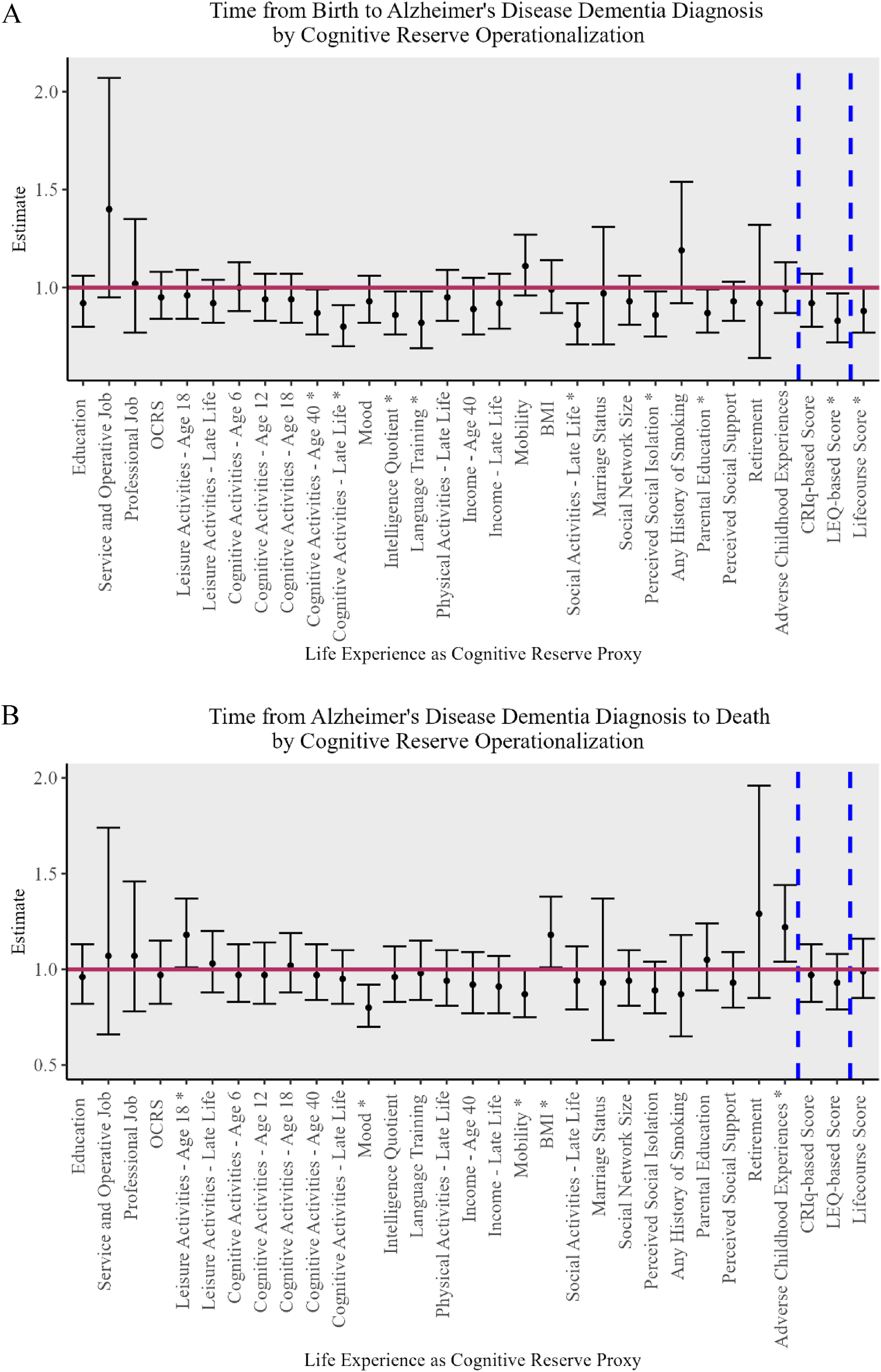
Point estimates and 95% confidence interval results from Cox proportional hazards models for (A) time to Alzheimer's disease dementia diagnosis and (B) time to death following Alzheimer's disease dementia diagnosis. Dotted lines separate proxy categories from measurement through questionnaires and lifecourse score. * Indicates estimates significantly different from 1. Continuous variables are coded such that higher values are associated with favorable scores that are hypothesized to build higher cognitive reserve. Values <1 are interpreted as lower risk of diagnosis or death for a standard deviation increase in cognitive reserve operationalization or by comparison to the reference category. OCRS: occupational cognitive requirements score; BMI: body mass index; CRIq: Cognitive Reserve Index questionnaire; LEQ: Lifetime of Experience Questionnaire.
Results of Cox proportional hazard models for time to Alzheimer's disease dementia diagnosis and time to death following diagnosis.
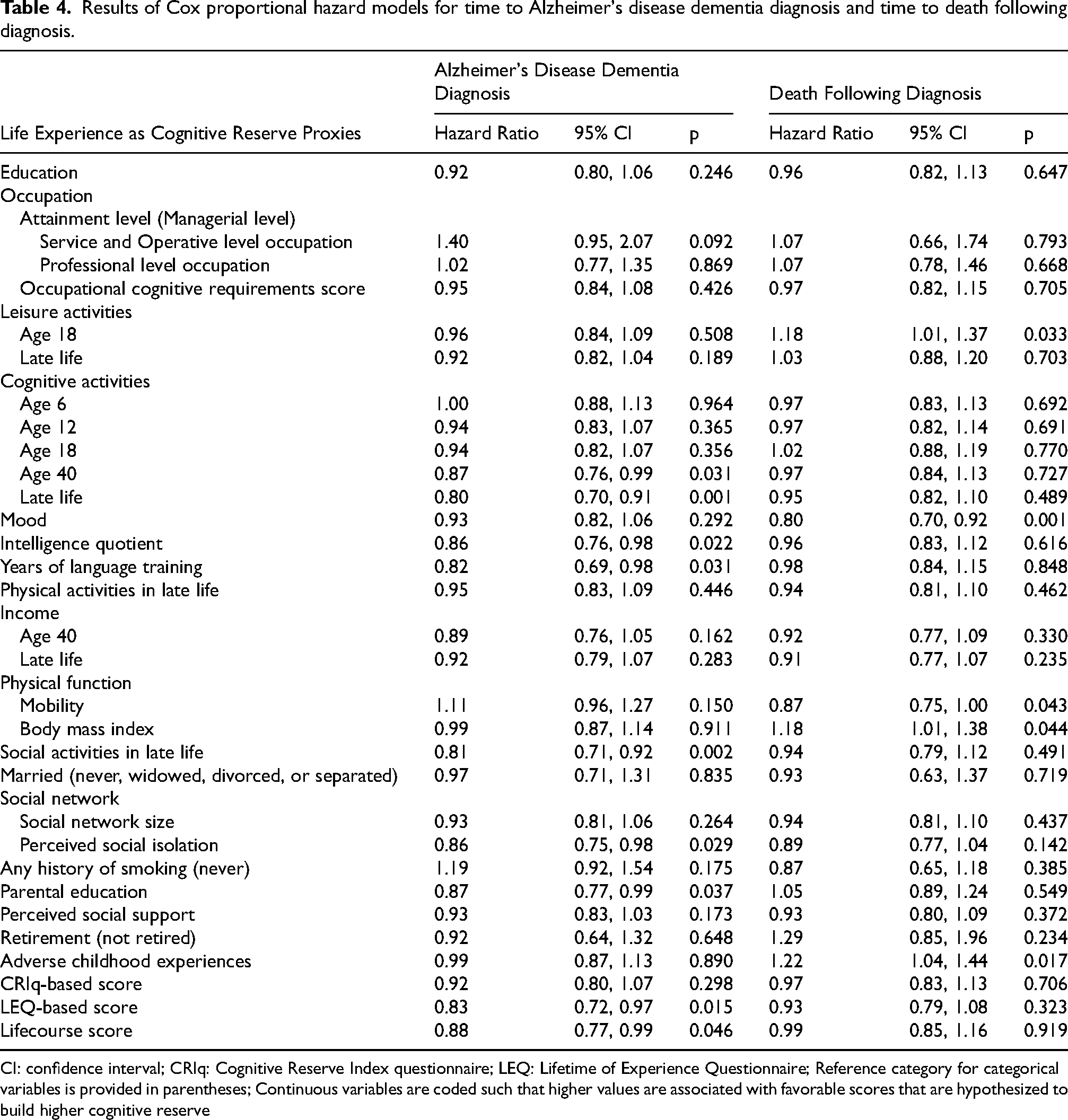
CI: confidence interval; CRIq: Cognitive Reserve Index questionnaire; LEQ: Lifetime of Experience Questionnaire; Reference category for categorical variables is provided in parentheses; Continuous variables are coded such that higher values are associated with favorable scores that are hypothesized to build higher cognitive reserve
Risk of death for those with Alzheimer's disease dementia
Point estimates and 95% CI for death following AD dementia diagnosis (Table 4) are shown in Figure 1B. Five of the 30 predictors were significantly associated with death following AD dementia diagnosis. HR estimates ranged from 0.80 to 1.29. Mood (HR = 0.80; 95% CI: 0.70, 0.92; p = 0.001) and greater mobility (HR = 0.87; 95% CI: 0.75, 1.00; p = 0.043) were associated with lower risk of death following AD dementia diagnosis with a standard deviation increase in the value of the life experience proxy of CR. Three of the five significant predictors showed greater risk of death: more leisure activities at age 18 (HR = 1.18; 95% CI: 1.01, 1.37; p = 0.033), higher BMI in late life (HR = 1.18; 95% CI: 1.01, 1.38; p = 0.044), and fewer adverse childhood experiences (HR = 1.22; 95% CI: 1.04, 1.44; p = 0.017) were associated with heightened risk of death following AD dementia diagnosis.
Discussion
The purpose of this study was to explore the relationship between operationalization of life experiences relevant for building CR and time to incident AD dementia diagnosis and death following AD dementia diagnosis. The results showed support for our hypothesis that changing the operationalization would impact conclusions. That is, model results were sensitive to the life experience used as operationalization and utilized as a predictor. Given that CR and the relevant life experiences for building CR have been chosen and applied differently across studies in the literature, this study provides further evidence that variations in CR arise from the experiences of choice and that methodological inconsistencies present a significant challenge in the CR literature, impacting the field's understanding of key experiences for building CR. 23 Therefore, these findings have important implications for research on lifestyle factors that contribute to the development CR, including heightened awareness from researchers of the sensitivity of results to operationalization and recommendations for future research.
The study was able to investigate and compare 30 different life experiences as operationalizations of CR that have been utilized in the published literature. 23 Based on the CR proxy of interest, we observed variation in results. Nine operationalizations were associated with reduced risk of AD diagnosis. More later-life activities, including social activities and cognitive activities (age 40 and in late life), as well as less perceived social isolation in late life were protective for diagnosis. However, the significant reduction in risk of diagnosis from average years of parental education, higher IQ, and years of training in a foreign language by age 18 hinders an argument for primary relevance of late-life experiences. It may also be the case that the findings for later-life activities are the result of reverse causality, such that individuals with dementia symptoms may disengage from these activities. 83 The significant predictors of the LEQ-based score and the lifecourse score incorporate experiences throughout the lifespan.14,26 That is, in an effort to address the relative limit of individual proxies, we incorporated this cumulative lifecourse-based score as an alternative operationalization. This is a similar approach to that taken by Xu and colleagues (2019) who developed a lifespan CR score, an accumulation of multiple variables representative of lifecourse experiences: education; early-, mid-, and late-life cognitive activities, and late-life social activities.67,68 Their results showed that a higher lifespan CR indicator score reduced risk of cognitive decline outcomes. The present study expanded the life experiences that could be included in a lifecourse CR indicator, incorporating more observed variables (rather than pre-created composites) than previous studies. Future work can build on this approach, integrating the degree of complexity through multiple lifecourse experiences that may appropriately characterize the development of CR.
While we did not have an explicit hypothesis related to rate of decline, the CR hypothesis would have expected time to death models to show higher CR to be associated with greater risk of death following AD dementia diagnosis.15,19,20 This pattern was only evident for three operationalizations: more leisure activities at age 18, higher BMI, and fewer adverse childhood experiences. However, neuropathology is a key component of the CR hypothesis. 14 That is, adherence to the hypothesis that CR is a modifying factor between neurological changes and cognitive decline symptoms would necessitate the inclusion of a measure of in-vivo neuropathology in our models.21,25,68,84 The present study did not have adequate access to these measures for the patient population. Therefore, while, in this study, more leisure activities at age 18, higher BMI, and fewer adverse childhood experiences were associated with greater risk of death following diagnosis, this study was not designed to support or refute the CR hypothesis. Rather, various life experiences which have previously been considered proxies of CR may produce different results for diagnosis and death following diagnosis, indicating the necessity of awareness of the sensitivity of results to methodology.
The findings in this study have practical implications and offer foundations for future research. Researchers studying life experiences that may contribute to the development of CR should be conscientious that their results may differ based on operationalization. These results point to a relative lack of utility of many proxies individually. While we cannot conclude that other operationalizations, including the LEQ-based score or lifecourse score are better options because identifying important life experience was not within the scope of the study, results from this study offer foundational considerations for future research. Based on the variety of findings, composite measures that incorporate multiple lifecourse variables deserve continued consideration in future research. Taken together, a lifecourse approach may still be the most comprehensive and faithful approach to examining life experiences that may contribute to the development of CR.85–87
There are limitations of the study to consider. As previously noted, the study was unable to include a measure of in-vivo neuropathology. Neuropathology is rarely incorporated into studies of CR. 67 Therefore, the field's understanding of CR would benefit from emphasizing the importance of a measure of neuropathology in order to most accurately understand the utility of CR as the field moves forward in defining important life experiences. Due to the exploratory purpose of the study, the findings can be used to offer considerations for future research regarding CR operationalization, but the study cannot directly examine the CR hypothesis. Also due to the exploratory nature, predictors were included individually in the models. While this approach was deemed appropriate for the current study, which did not have hypotheses related to significance of any specific life experiences, study results should be used to guide future research rather than to draw conclusions about any specific life experiences. Such conclusions would require alternative study design and adjustment for Type 1 error. The study is, therefore, also not designed to produce casual statements. The associations presented here (notably for late-life activities) may be the result of reverse causality, with individuals withdrawing from activities as the disease progresses. 83 This may be particularly relevant if an individual was diagnosed early in follow-up, as their lower activity frequency at enrollment may be the result of disengagement. Additional bias may be introduced into CR operationalization by recall bias, given that participants are asked at age 65 or older to report types and frequencies of experiences from as young as 6 years old. Therefore, experiences reported in late life may be more accurate than those of early ages. We also did not have access to variables regarding participants’ health, such as cardiovascular disease, diabetes, and other comorbidities, and, therefore, could not control for these confounders.88–90 Furthermore, while MAP is an impressively comprehensive cohort study that is opportune for studies about CR and risk factors for neurodegenerative diseases, 91 there are naturally additional ways that CR could be operationalized, such that our analysis cannot capture everything and may also differ from the intended definition of a proxy in the published literature based on variable availability (e.g., years of language training rather than bilingualism). Finally, generalizability may be a concern for this study as participants were clustered in the same geographic location in the United States, are predominantly women, and largely identify as Non-Hispanic White.
The present study offers a systematic and extensive examination of the variety of life experience that are hypothesized to contribute the development of CR and the effect of operationalization on timing of neurodegenerative disease diagnosis and death. The main finding was that the results are highly sensitive to the choice of proxy. This finding provides evidence to support the idea that the inconsistencies that plague research on socio-behavioral experiences as proxies of CR are the result of use of different operationalizations across studies. That said, life experiences, hypothesized to build CR, offer a key approach towards prevention or delay of AD dementia symptoms among an aging population. While many of the experiences evaluated here are not modifiable, such as parental education and adverse childhood experiences, knowledge of the risk reduction from those that are modifiable can produce earlier intervention. For example, knowledge that late life activities may delay AD dementia symptoms can allow people to try to increase the frequency in which they engage in activities. This information can also be used by the field to produce models to predict a person's risk based on relevant life experiences. Understanding of risk would allow earlier provision of resources, such as cognitive or social activity interventions or encouragement to maintain engagement with meaningful activities. As such, CR remains a valuable approach for explaining individual-level differences in the timing of presentation of symptoms of AD. Consequently, attention to methodology, reigning in of the use of a wide variety of operationalizations, consideration of the lifecourse approach, and collaborative movement towards consensus measurement and definition of CR may be imperative shifts to best make use of life experience as proxies of CR and promote healthy aging.
Footnotes

Ethical considerations
MAP has been approved by the Institutional Review Board of Rush University Medical Center.
Author contributions
Kerry A Howard (Conceptualization; Data curation; Formal analysis; Visualization; Writing – original draft); Lauren M Massimo (Conceptualization; Methodology; Supervision; Writing – review & editing); Brian Witrick (Formal analysis; Methodology; Validation; Writing – review & editing); Lu Zhang (Methodology; Supervision; Writing – review & editing); Sarah F Griffin (Methodology; Supervision; Writing – review & editing); Lesley A. Ross (Methodology; Writing – review & editing); Lior Rennert (Conceptualization; Methodology; Supervision; Writing – review & editing).
Funding
The authors disclosed receipt of the following financial support for the research, authorship, and/or publication of this article: Portions of this work were supported by the South Carolina Alzheimer's Disease Research Center.
Declaration of conflicting interests
The authors declared no potential conflicts of interest with respect to the research, authorship, and/or publication of this article.
Data availability
The data analyzed for this study are available from Rush University Medical Center and applications requesting data can be submitted to the Rush Alzheimer's Disease Center. Datasets generated and analyzed for the current study are available from the corresponding author on reasonable request and with permission of the Rush Alzheimer's Disease Center.