



Abstract
Background
The prevalence of Alzheimer's disease is increasing in Japan, highlighting the need to establish evidence-based strategies for its prevention.
Objective
We aimed to evaluate the effectiveness of a multimodal community-based intervention for Japanese older people with lifestyle-related diseases and to identify challenges in implementing such interventions to prevent dementia in local communities.
Methods
An 18-month randomized controlled trial was conducted among individuals aged 65–85 years with lifestyle-related diseases (hypertension, hyperlipidemia, diabetes, overweight/underweight, smoking), residing in a single apartment complex. Participants were randomly assigned to a multimodal intervention group (group-based physical exercise, nutritional guidance, management of lifestyle-related diseases, and cognitive training) or a control group. The primary outcome was the change in the composite score derived from seven neuropsychological tests. The trial was registered (UMIN000041887: September 24, 2020).
Results
Of 224 screened individuals, 198 were randomized (99 in each group), and 175 (88.4%) completed the 18-month assessment. There was no significant difference between the intervention and control groups in the primary outcome (change in composite test score: 0.25; 95% confidence interval 0.16 to 0.33 versus 0.29; 95% confidence interval 0.20 to 0.38, respectively; p = 0.463). However, a subgroup analysis of participants with mild cognitive impairment showed a significant intervention effect on changes in logical memory, for both immediate (p = 0.041) and delayed recall tasks (p = 0.043).
Conclusions
This multimodal intervention program demonstrated no effectiveness in mitigating cognitive decline. Further research is needed to develop more effective strategies and to better define target populations.
Introduction
The global increase in the number of people living with dementia has created an urgent need for effective prevention strategies.1,2 Despite advances in disease-modifying drugs, pharmacological treatments remain limited due to the multifactorial nature of dementia.3,4 Modifiable risk factors, including lifestyle-related diseases such as hypertension, 5 hyperlipidemia, 6 diabetes, 7 obesity, 8 and smoking 9 have been identified as key contributors.
Therefore, multimodal interventions combining physical, cognitive, and lifestyle modifications have demonstrated beneficial effects. 10 The Finnish Geriatric Intervention Study to Prevent Cognitive Impairment and Disability (FINGER) trial,11,12 a 2-year randomized controlled trial (RCT) involving 1260 participants, reported significant improvements in cognitive function. However, given the diversity in lifestyle and behavior across different populations, it is essential to test the effectiveness of such interventions in varied settings. The World-Wide FINGERS (WW-FINGERS) Network aims to adapt and implement these interventions globally. 13
While many studies have explored interventions for individuals with lifestyle-related diseases, most are tightly controlled and not community-based. To ensure the feasibility of dementia prevention in real-world settings, further research is needed to develop effective strategies and identify populations that can benefit from such interventions. This study aimed to evaluate the efficacy of a community-based multimodal intervention in preventing cognitive decline among older adults with lifestyle-related diseases, and to assess the feasibility of implementing such programs at the community level.
Methods
As part of the WW-FINGER network, the Japan-Multimodal Intervention Trial for the Prevention of Dementia (J-MINT) study14–16 was conducted between 2019 and 2022. This multicenter, open-label RCT targeted 531 older adults across multiple sites in Japan to evaluate the effectiveness of a multimodal intervention aimed at preventing dementia and scaling up dementia prevention programs nationwide. In addition to the J-MINT study, two related studies, J-MINT PRIME Kanagawa and J-MINT PRIME Tamba,17,18 were conducted to explore the feasibility of implementing multimodal interventions in community-specific settings. The J-MINT PRIME Kanagawa study, the focus of this report, targeted residents of a single housing complex in Yokohama, while the J-MINT PRIME Tamba study was conducted in Tamba City, Hyogo Prefecture. Each of these studies enrolled approximately 200 participants.
Combined with the J-MINT study, these datasets include over 900 participants, forming a comprehensive foundation for large-scale analyses aimed at informing sustainable, nationwide dementia prevention programs. While the studies share a common protocol framework, they were independently conducted with differences in inclusion criteria and intervention frequency to address the specific needs of their respective settings. The current study adopts the shared core protocol, with adaptations made for the Kanagawa community to ensure feasibility and relevance.
Study design
The J-MINT PRIME Kanagawa trial was an 18-month, community-based, open-label RCT of a multimodal intervention aimed at preventing the progression of dementia in older people with lifestyle-related diseases (Figure 1). Patients were assigned in a 1:1 ratio to either an intervention group or a control group. The intervention group received an intervention that addressed four domains: lifestyle-related disease management, physical exercise, nutritional counselling, and cognitive training. The control group received pamphlets on dementia prevention and a health education lecture once every 6 months to provide basic knowledge about dementia and lifestyle-related diseases. The participants in both groups were evaluated at baseline and at 6, 12, and 18 months. All interventions and evaluations were provided in the Yokohama Wakabadai Danchi housing complex.
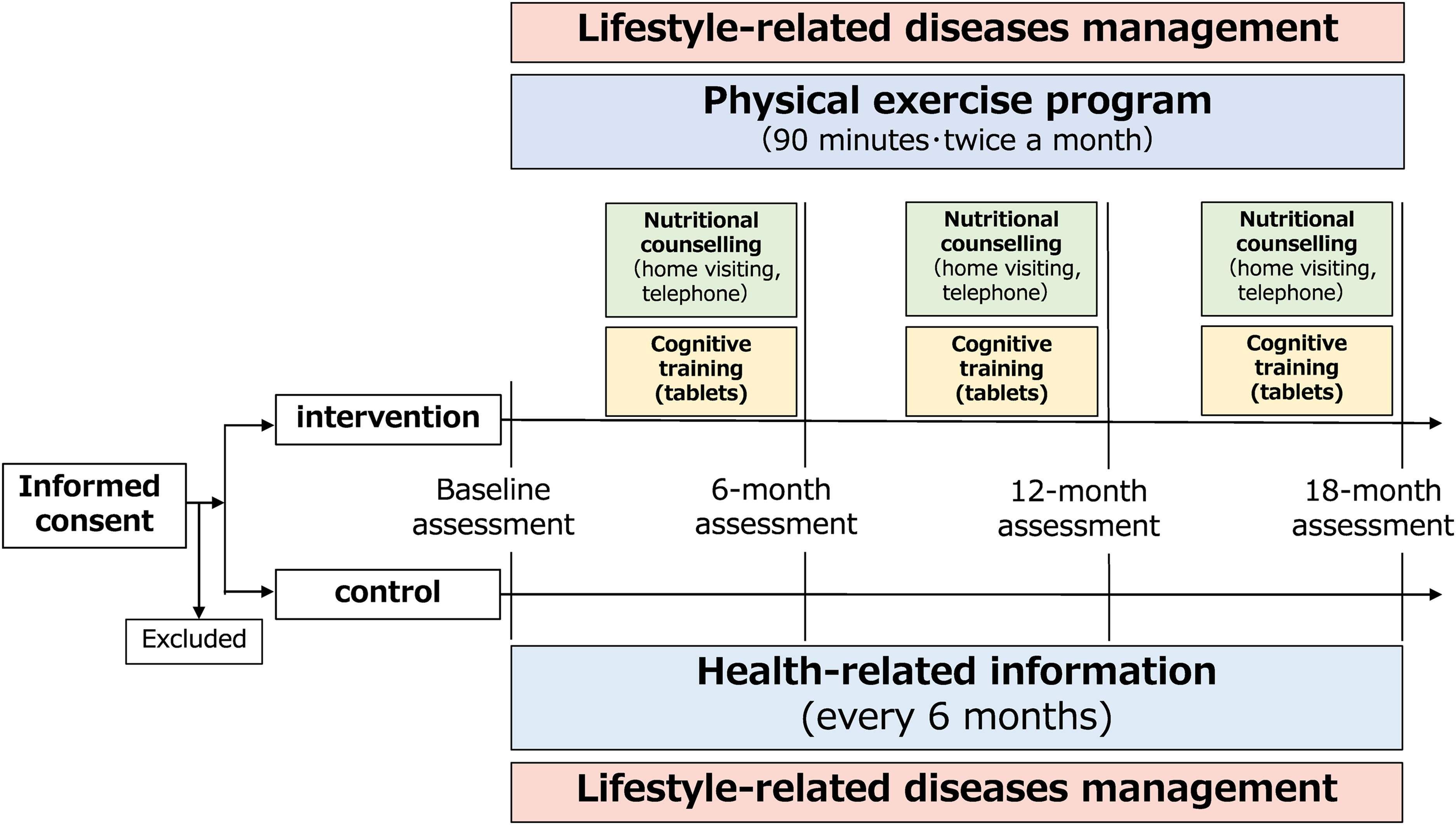
Study flow of the J-MINT PRIME Kanagawa trial.
Participants
The inclusion criteria were as follows. Participants had to be a resident of Yokohama Wakabadai Danchi, aged 65–85 years at the time of registration, receiving treatment for a lifestyle-related disease, or have two of the following characteristics associated with lifestyle-related diseases: (1) body mass index ≤20 or ≥25 kg/m2; (2) receiving treatment for diabetes or fasting blood sugar level >7 mmol/L or hemoglobin A1c > 6.5% (National Glycohemoglobin Standardization Program value); (3) receiving treatment for dyslipidemia, or triglycerides ≥1.69 mmol/L or low-density lipoprotein cholesterol ≥3.62 mmol/L, or high-density lipoprotein cholesterol <1.04 mmol/L; (4) receiving treatment for hypertension, or systolic blood pressure ≥140 mmHg, or diastolic blood pressure ≥90 mmHg; (5) history of smoking. Body mass index (BMI) ≤ 20 kg/m² was included as a criterion to identify individuals at risk of malnutrition, based on the Japanese public health guidelines. 19 This threshold reflects evidence linking BMI ≤ 20 with increased risks of nursing care needs and total mortality in older adults, making it a practical indicator of nutritional risk in this population.
The exclusion criteria were as follows: (1) participants who needed to restrict their physical exercise owing to severe physical functional impairment; (2) Mini-Mental State Examination (MMSE) score of <24 20 ; (3) previous diagnosis of dementia; (4) a certificate for long-term care facilities; (5) inability to speak Japanese; (6) inability to undergo cognitive tests; or (7) deemed ineligible for enrollment by the responsible investigator or co-investigators.
Settings and locations
Yokohama Wakabadai Danchi is a large-scale housing complex developed and constructed during Japan's so-called bubble economy era in the late 1970s to 1980s. It comprises approximately 74 buildings within a large residential area of approximately 90 hectares, and is one of the largest housing complexes in Yokohama. In Japan, such housing complexes are frequently used as units for dementia prevention and other public health activities. This makes them particularly suitable for organizing community-based interventions, as they already support social interaction, health promotion, and community-building among residents. The residential complex includes a range of public and commercial facilities, such as grocery stores, clinics, and community centers. These shared facilities facilitate social connections and regional support, which are especially beneficial for older adults. The surrounding area contains parks and sports facilities, which enhance the residential environment. Approximately 13,500 residents in 6700 households live in the complex; as of 2022, 53.6% of the residents were aged >65 years old. In this study, participants were selected from this housing complex because such complexes are often used as units for dementia prevention activities in Japan. The existing infrastructure for organizing community-based interventions, coupled with pre-existing social networks and support systems among residents, makes these complexes an ideal setting for such research.
Before recruiting participants, newsletters were distributed and information sessions held several times for older residents of the housing complex to inform them of the purpose of the study. Preliminary survey questionnaires were subsequently distributed to residents who wished to participate. After obtaining written informed consent from participants, the completed questionnaires were collected. Based on the questionnaire results, screening health examinations were conducted for residents who met the inclusion criteria, and they were asked to provide their consent to participate in the study. The study was approved by the research ethics committee of the Department of Medicine, Yokohama City University. Information about the study is registered in the University hospital Medical Information Network-Clinical Trials Registry system and published on the Internet (clinical trial registry number: UMIN000041887: September 24, 2020). The study conforms to the provisions of the Declaration of Helsinki.
Randomization and blinding
Based on age, sex, and MMSE score information obtained at screening, participants were randomly assigned to two groups in a 1:1 ratio using a minimization method with stratification criteria: (1) age, 65–74 or 75–85 years, (2) sex, female or male, and (3) MMSE score, 24–27 or 28–30. The researchers enrolled participants in an electronic data capture (EDC) system, and an external organization performed the dynamic allocation using an algorithm that was blinded to the researchers and participants. Naturally, all of the study participants and research staff were not blinded to the intervention conditions; however, research staff members assessing the primary outcome data were blinded to intervention conditions during outcome assessment. At the time of analysis, the intervention conditions were coded to ensure that the statistical analyst was blinded to the intervention conditions.
Intervention procedures
Management of lifestyle-related diseases
Diabetes mellitus, hypertension, and dyslipidemia were managed according to clinical practice guidelines in Japan. Specifically, diabetes was managed based on the 2017 Treatment Guideline for Elderly Patients with Diabetes Mellitus by the Japan Diabetes Society (JDS)/Japan Geriatric Society (JGS) Joint Committee, 21 hypertension based on the Japanese Society of Hypertension Guidelines (JSH 2019), 22 and dyslipidemia based on the Japan Atherosclerosis Society Guidelines (JAS 2017). 23
In the intervention group, public health nurses and dietitians provided additional guidance based on these guidelines. All participants, regardless of group, received feedback on blood test and brain CT results, with recommendations to consult their primary care physicians. Intervention group participants’ primary care physicians were also notified about their participation in the study and asked to provide precautions regarding exercise as needed. Participants with untreated conditions were advised to seek medical attention based on test results, and follow-up surveys assessed whether treatment was initiated.
Physical exercise program
The exercise program consisted of (1) aerobic exercise, (2) dual-task exercise, (3) strength training, and (4) group meetings, each lasting 90 min, twice a month for 18 months.
While the J-MINT study implemented weekly sessions, we chose a bi-weekly schedule to make the program more accessible for community-based participants, particularly those with limited motivation or exercise habits. We anticipated that many participants would have lifestyle-related diseases and limited or no exercise habits. Therefore, we designed the program to be feasible and sustainable, reducing barriers to participation and minimizing dropout. The bi-weekly frequency was selected to facilitate consistent engagement while avoiding the burden of weekly sessions for those not accustomed to regular physical activity.
By adopting this approach, we aimed to explore the feasibility of sustainable dementia prevention activities in a real-world setting, ensuring greater long-term participation and providing insights into the practical implementation of such programs.
Furthermore, the exercises classes were held in the Yokohama Wakabadai Danchi housing complex, within the residential area itself, and the venue was located at a maximum distance of only about 5 min by car, even from the furthest point in the area. This proximity was an intentional design to make participation as convenient as possible, prioritizing accessibility for all residents.
To accommodate participants with varying physical fitness levels, the exercise program was divided into two intensity levels. The lower-intensity program was designed for participants with limited physical capabilities or chronic health conditions and emphasized gentle aerobic exercises and low-impact strength training. The higher-intensity program targeted participants with greater physical fitness and included more challenging aerobic and strength exercises. This stratification ensured that participants could engage in activities appropriate for their abilities while minimizing the risk of injury or excessive strain.
To ensure participants’ safety, they received a medical checkup before the exercise program. The checkup included blood pressure measurement, pulse rate measurement, and an interview. The results of the medical checkup were used to determine if any of the following discontinuation criteria applied: (1) systolic blood pressure of ≥180 mmHg at rest, or diastolic blood pressure of ≥110 mmHg, (2) resting pulse rate of ≥110 beats/min or ≤50 beats/min, (3) abnormal heartbeat, or (4) worsening of chronic symptoms such as joint pain. If a participant had any of these conditions, they did not participate in the exercise intervention that day.
Participants receive weekly exercise videos and messages on a tablet to encourage home-based muscle strengthening, aerobic exercise, and dual-task training. In addition, they were instructed to track their daily steps, heart rate, and sleep using the tablet, which synchronizes with the smartwatch activity monitor.
Nutritional guidance program
Nutritional counselling by visiting or calling the participants at their homes was provided by Sompo Health Support, Inc., which has a nationwide network of public health nurses, nutritionists, and other professionals in Japan and provides health guidance to numerous companies. The nutritional guidance program consisted of a 60-min individual interview with a health consultant (public health nurse, nurse, registered dietitian) at the first month, at 7 months, and at 13 months. After the interview, a 10-min phone follow-up was provided once a month. Individual interviews were conducted on a one-to-one basis in a group meeting venue at the housing complex; participants who were unable to attend the group meeting were interviewed in their home. This nutritional guidance protocol was based on the Dietary Reference Intakes for Japanese (2020), which offers recommendations for nutrient intake, specifically for older adults aged 65–74 and 75 and older (Ministry of Health, Labour and Welfare, 2020). 24 It also incorporates findings from previous cohort studies and clinical trials that highlight the impact of dietary diversity on the physical and cognitive health of elderly individuals.25–30 Oral hygiene instructions were provided at the baseline and reinforced during follow-up face-to-face interviews. Participants were encouraged to visit a dental clinic when necessary, and their visit status was confirmed at each follow-up interview. Additionally, oral exercise guidance was offered using materials from the Manual for Oral Function Improvement by the Ministry of Health, Labour and Welfare, as well as leaflets from the Japan Society of Gerodontology.
Cognitive function training
Tablets were distributed to the participants and cognitive function training was provided with the software program Brain HQ (Posit Science Corp., CA, USA). Participants were engaged in tablet-based cognitive training for at least 30 min per day, four or more days per week, during intensive training periods within the 18-month intervention (Months 4–6, 10–12, and 16–18). Brain HQ provides training on information processing, attention, memory, and visuospatial cognition. As this program runs on a tablet, dropouts owing to operational difficulties were expected. Therefore, an intermittent training approach was implemented, consisting of three-month intensive training periods followed by three-month rest periods. This approach aimed to reduce participant burden, as daily use of tablet-based training for a prolonged period could be challenging. Participants also received a personal summary sheet every three months, which provided feedback on their task performance and progress over time. Additionally, support was provided by giving participants instructions on how to use the tablet at the start of the training and establishing a free consultation desk during the study period. These measures aimed to minimize dropouts and ensure continued engagement in the program.
Control group
The control group received pamphlets on dementia prevention to encourage healthy behavior, and a lecture about dementia and how to improve lifestyle-related diseases was provided every 6 months. Participants suspected of having a lifestyle-related disease after the health checkup were encouraged to visit their family doctor or hospital. It was made clear that there were no restrictions on participants engaging in personal exercise or cognitive training if they wished to.
Assessments
Primary outcome measure
The primary outcome was the change from baseline at 18 months in the global composite score on seven neuropsychological tests that measured the following functions: global cognitive function [MMSE] 20 ; memory (Logical memory I and II subset of the Wechsler Memory Scale-Revised [WMS-R] 31 and the Free and Cued Selective Reminding Test [FCSRT]) 32 ; attention (Digit Span of the Wechsler Adult Intelligence Scale [WAIS]-III) 33 ; and executive function/processing speed (Trail Making Test [TMT], 34 Digit Symbol Substitution Test [DSST] subset of the WAIS-III, and Letter word fluency test). 34 The composite score was generated by averaging the Z scores of the full analysis set (FAS) population for each neuropsychological test, standardized by the baseline mean and standard deviation (SD) for each test.
Secondary outcome measures
The secondary outcome measures were the change in global cognitive function (composite score) from baseline to the 6- and 12-month follow-ups, change in each cognitive function test score from baseline to the 6-, 12-, and 18-month follow-ups, change in each component of the comprehensive functional assessments, including activities of daily living (ADL), from baseline to the 6- and 18-month follow-ups, change in frailty from baseline to the 6- and 18-month follow-ups, number of medications used, and onset of dementia: according to the criteria of the National Institute on Aging-Alzheimer's Association (NIA/AA) workgroups. 35
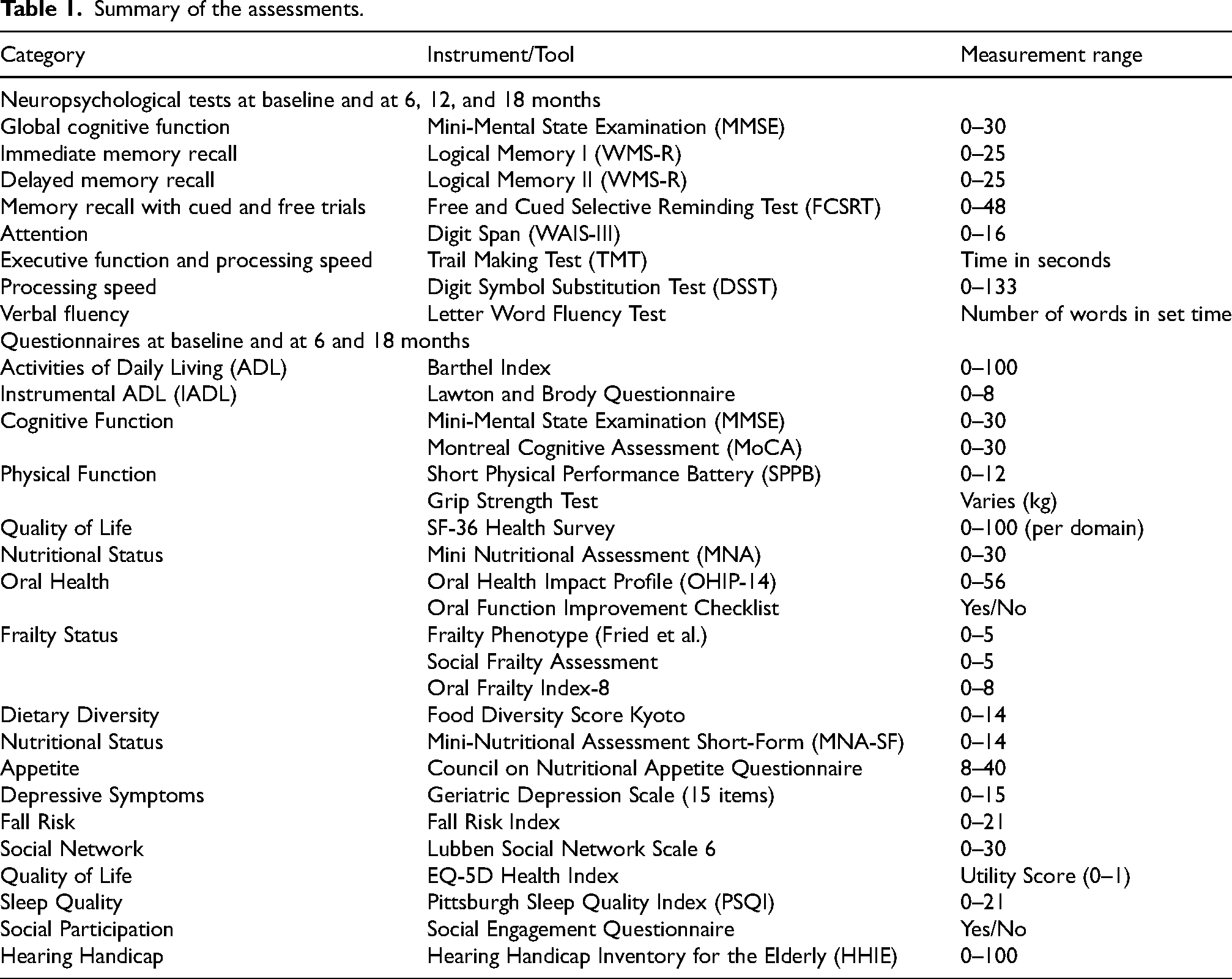
Participants were asked to complete self-report questionnaires on comprehensive functional assessments, health behaviors, and attitudes towards intervention studies at baseline and at 6- and 18-months follow-ups. The questionnaires included items on lifestyle factors related to dementia risk, such as exercise habits, sleep, medication and medical history, cognitive activities, social activities, subjective cognitive impairment, hobby activities, friendships, eating habits, and disease history; basic ADL 36 ; instrumental ADL 37 ; frailty status, including physical frailty, 38 social frailty, 39 and oral frailty 40 ; dietary diversity 41 ; nutritional status 42 ; appetite 43 ; depressive symptoms 44 ; history of falls and fall risk 45 ; social isolation 46 ; health-related quality of life 47 ; sleep quality 48 ; social participation 49 ; and hearing loss Table 1. 50
Summary of the assessments.
A subpopulation analysis was also conducted. All participants were evaluated for the presence of mild cognitive impairment (MCI) using the National Center for Geriatrics and Gerontology Functional Assessment Tool (NCGG-FAT),51,52 which is an established screening tool for older adults at high risk of incident dementia. Participants were determined as having MCI if they had age- and education-adjusted cognitive decline with an SD of ≥1.5 from the reference threshold for one or more of the following cognitive domains: memory, attention, executive function, and processing speed.
Physical measurements
Data on participants’ height, body weight, body mass index, body composition, calf circumference, blood pressure, and pulse rate were collected. As indicators of physical performance, handgrip strength and walking speed were measured and the five times sit-to-stand (5STS) test was performed. Additionally, participants underwent blood and urine tests at baseline and 18-month follow-up, and computed tomography evaluations at baseline. To obtain an objective measure of heart rate, number of daily walking steps, activity amount, and sleep status, “Fitbit” smartwatches were distributed to participants.
Infection control and intervention during the coronavirus disease 2019 (COVID-19) pandemic
The study was scheduled to begin in 2020, so some protocol modifications were made owing to the effects of the COVID-19 pandemic. To prevent COVID-19 infection through study participation, closed or crowded places and close contact were avoided during the intervention. When the Japanese government declared a pandemic-related state of emergency, intervention domains involving direct contact, such as physical exercise and face-to-face nutritional counselling, were changed to online interventions using tablets purchased using research funds and lent to participants. Some of the participant recruitment was delayed by 6 months owing to the declaration of the state of emergency.
Adverse events and serious adverse events
To ensure the safety of the intervention, all adverse events (AEs) and serious AEs were monitored throughout the study. Information collected about AEs included onset date, severity, treatment, consequences, and causation. Serious AEs were immediately reported to the principal investigator, the institutional review board, and the co-investigators.
Sample size
In the FINGER study, the change in the primary outcome, the total Z score on the comprehensive neuropsychological test battery in an intervention program that combined physical exercise, nutritional management, and cognitive tasks, was 0.20 (SD 0.51) for the intervention group and 0.16 (SD 0.51) for the control group, so the between-group difference in the amount of change was 0.04. As the present study included older participants with lifestyle-related diseases, who were assumed to have a higher risk of dementia and limited prior exposure to exercise and nutritional guidance, we initially estimated the intervention effect size to be approximately twice as large (Δ = 0.1) as in the FINGER study. For α = 0.05, β = 0.20, and a power of 80%, the required sample size is 100.7 participants per group. This requires a total of 201.4 participants, so the number of participants enrolled at baseline was set at 200. Assuming that approximately 20% of participants would drop out during the study period, we recruited approximately 240 participants, approximately 120 in each group.
Statistical methods
The FAS, which included all participants who had undergone at least one program in the intervention, or (for the control group) had received a pamphlet on dementia prevention, and had at least one effectiveness assessment after baseline assessment, was used for the primary and secondary analyses. Safety analysis was performed on the safety analysis set, which was defined as the set of participants enrolled and randomized in the study and who underwent at least one intervention program or pamphlet distribution after baseline assessment.
The change in cognitive function (composite score) for each participant between baseline and at 18 months was determined, and groups were compared using mixed-effects models for repeated measures. In addition, the between-group difference in the mean change in cognitive function (composite score) and its 95% confidence interval (CI) were calculated.
Continuous values were analyzed in the same way as for the primary endpoint. For incidence rates, between-group comparisons were performed using the chi-square test, Fisher's exact test, or generalized estimating equations. CIs for incidence rates were calculated using the Clopper–Pearson method.
The frequency and proportion of AEs and their 95% CIs were calculated. CIs were calculated using the Clopper-Pearson method.
No interim analysis was performed in this study. A two-sided p-value of <0.05 was considered to indicate statistical significance. In the secondary and exploratory analyses, multiple testing was not accounted for to maximize statistical power. Statistical analyses were performed using SAS version 9.4_M6 (SAS Institute Inc.).
Results
Between October 2020 and April 2021, 224 individuals were screened and 198 were randomly allocated to the intervention group (n = 99) or the control group (n = 99; Figure 2). Six people in the intervention group withdrew after randomization because of fear of COVID-19 infection (n = 3) or lack of time or motivation (n = 3). One person in the control group withdrew owing to lack of motivation. A total of 93 participants started the intervention and 98 started the control. One participant in the intervention group and two participants in the control group did not participate in any assessments after baseline and so were excluded from the FAS; thus, 92 participants in the intervention group and 96 in the control group were included in the FAS. Seven participants in the intervention group dropped out for the following reasons: lack of time or motivation (n = 3), medical problems (n = 3), or death (n = 1). Six participants in the control group dropped out because of lack of time or motivation (n = 5) or death (n = 1). A total of 175 (88%) participants (85 in the intervention group and 90 in the control group) completed the 18-month assessment. Dropout rates were not significantly different between the intervention (14 participants, 14%) and control (9 participants, 9%) groups (p = 0.267).

CONSORT diagram of participant flow through the trial. CONSORT: Consolidated Standards of Reporting Trials; COVID-19: coronavirus disease 2019.
The intervention and assessments were completed by January 2023. Four of the 198 allocated participants withdrew their consent for the use of their data, so the intention to treat analyses included 194 participants. Two individuals (one in the intervention group and one in the control group) died during the study; neither death was related to the intervention or enrollment.
Baseline characteristics are shown in Table 2. The intervention and control groups were similar at baseline. The mean age of the intervention group was 76.3 (SD 4.4) years and that of the control group was 76.5 (SD 4.9) years. The mean number of years of education was 13.8 (SD 2.5) years and 13.9 (2.3) years, and the mean MMSE score was 28.6 (SD 1.6) and 28.6 (SD 1.4) in the intervention and control groups, respectively. As the presence of lifestyle-related disease was one of the inclusion criteria, all participants had lifestyle-related diseases or abnormal test values.
Baseline characteristics of participants.

Analysis was conducted for the full analysis set, which included all participants who had undergone at least one intervention program or text distribution and at least one post-baseline assessment.
BMI: body mass index; NCGG-FAT: National Center for Geriatrics and Gerontology Functional Assessment Tool; MCI: mild cognitive impairment; MMSE: Mini-Mental State Examination; SD: standard deviation.
Definitions: Age, at time of obtaining consent; Hypertension, receiving treatment for hypertension, or systolic blood pressure ≥140 mmHg or diastolic blood pressure ≥90 mmHg; Diabetes, receiving treatment for diabetes, fasting blood sugar level >126 mg/dL or hemoglobin A1c > 6.5% (National Glycohaemoglobin Standardisation Program value); Dyslipidemia, receiving treatment for dyslipidemia, triglycerides ≥150 mg/dL, low-density lipoprotein cholesterol ≥140 mg/dL, or high-density lipoprotein cholesterol <40 mg/dL; MCI, age- and education-adjusted cognitive decline with a SD of ≥1.5 from the reference threshold for one or more of the following cognitive domains: memory, attention, executive function, and processing speed.
For the primary outcome, there was no significant difference between the intervention and control groups in the change in the neuropsychological test composite score (0.25; 95% CI 0.16 to 0.33 versus 0.29; 0.20 to 0.38, respectively; p = 0.463) (Figure 3 and Supplemental Table 1). We also noted no significant intervention effect for the secondary cognitive outcomes of scores on cognitive function tests of logical memory (immediate recall 0.72; 95% CI 0.53 to 0.91 versus 0.64; 95% CI 0.44 to 0.84, respectively; p = 0.515; delayed recall 0.70; 95% CI 0.51 to 0.89 versus 0.74; 95% CI 0.54 to 0.94, respectively; p = 0.724).

Change in cognitive function during the 18-month intervention. FAS: full analysis set; MCI, mild cognitive impairment. Figure 3 shows the adjusted mean change in cognitive performance from baseline to 6, 12, and 18 months (higher scores indicate better performance). Error bars are 95% confidence intervals. Mixed-model repeated-measures analyses were used to assess between-group differences in changes from baseline to 18 months using data from all participants with at least one post-baseline measurement (FAS, n = 188) and from participants with MCI (n = 36). A significant difference was found when testing the null hypothesis that the adjusted mean of the intervention group minus the adjusted mean of control group would be zero. While secondary and exploratory analyses were initially conducted without correction for multiple testing to maximize statistical power, additional Bonferroni correction analyses were performed to ensure robustness. After applying the correction, differences in immediate and delayed recall in the MCI subgroup were no longer statistically significant, emphasizing the need for cautious interpretation of these exploratory findings.
However, a subpopulation analysis of the MCI group (i.e., participants with an SD of ≥1.5 from the reference threshold on one or more NCGG-FAT cognitive domains) showed a significant intervention effect for changes in logical memory, for both immediate (0.45; 95% CI 0.45 to 1.40 versus 0.21; 95% CI −0.34 to 0.76, respectively; p = 0.041) and delayed recall tasks (0.71; 95% CI 0.30 to 1.12 versus 0.11; 95% CI −0.35 to 0.57; p = 0.043) (Figure 3 and Supplemental Table 2). For secondary and exploratory analyses, multiple testing was initially not accounted for to maximize statistical power. However, to ensure the robustness of the findings, additional analyses with Bonferroni correction for multiple comparisons were performed. After applying the correction, the observed differences in immediate and delayed recall in the MCI subgroup did not reach statistical significance, emphasizing the need for cautious interpretation given the exploratory nature of the analysis.
To assess age-related differences, we conducted a subgroup analysis by dividing participants into two age groups: 65–75 years (Supplemental Table 9) and 76–85 years (Supplemental Table 10). For the composite cognitive score, participants in the 76–85 years subgroup demonstrated significantly greater improvement in the control group compared with the intervention group at 12 months (mean difference 0.10; 95% CI −0.04 to 0.20 versus 0.24; 95% CI 0.15 to 0.34; p = 0.03). However, after applying Bonferroni correction for multiple comparisons, this difference was no longer significant. These findings, being exploratory in nature, should be interpreted with caution, and their clinical relevance remains uncertain.
To explore whether the intervention effect differed according to baseline BMI, we performed an additional interaction analysis (see Supplemental Table 11). No significant interactions were observed for the composite cognitive score (group × BMI < 20: p = 0.905; group × BMI ≥ 25: p = 0.796). A significant interaction was found only for logical memory (delayed recall) in the BMI < 20 group (p = 0.008).
Participation adherence to the intervention domains is shown in Table 3. Mean participation in the nutrition domain (n = 90) was 13.8 out of a total of 15 possible sessions (92.1%). Mean participation in physical exercise (n = 92) was 29.4 times out of a total of 39 times (75.4%). Mean participation in cognitive training (n = 90) was 34.5 days out of the recommended total of 156 days (22.1%).
Intervention adherence.
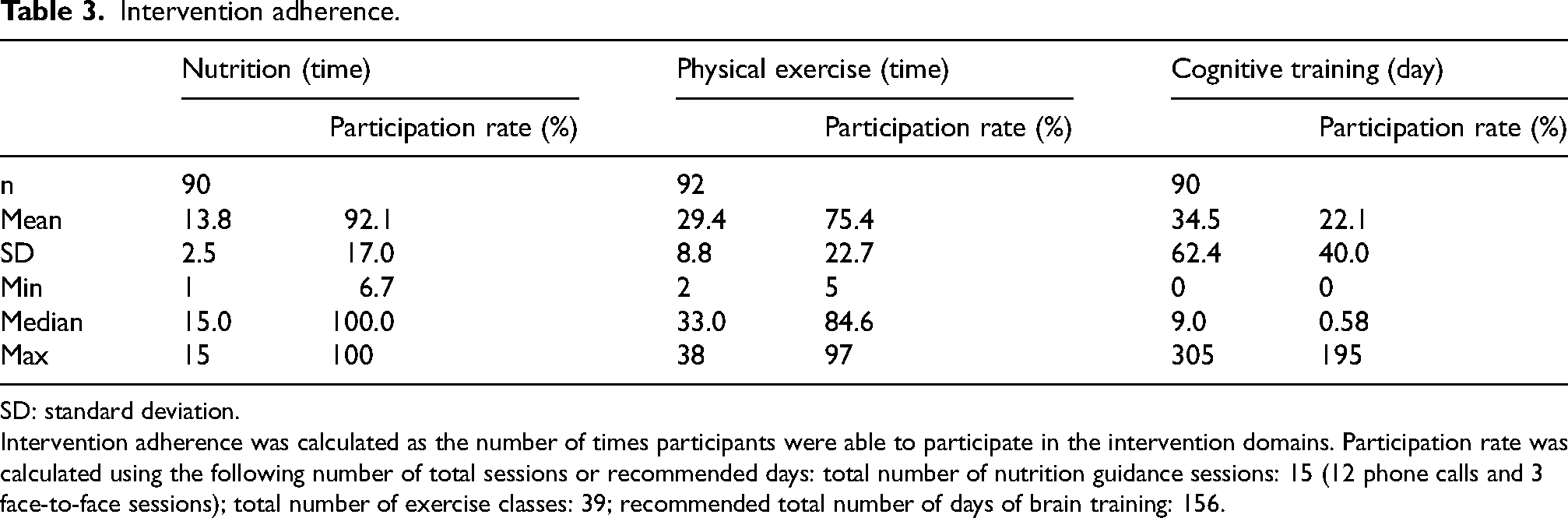
SD: standard deviation.
Intervention adherence was calculated as the number of times participants were able to participate in the intervention domains. Participation rate was calculated using the following number of total sessions or recommended days: total number of nutrition guidance sessions: 15 (12 phone calls and 3 face-to-face sessions); total number of exercise classes: 39; recommended total number of days of brain training: 156.
For the secondary outcomes (Supplemental Table 3–8), oral frailty (intervention group 31.4% versus control group 47.8%, p < 0.05), dietary diversity (intervention group 1.14 versus control group −0.06, p < 0.001), and health-related quality of life (intervention group 0.003 versus control group −0.01, p < 0.05) showed significant differences at the 18-month assessment. Regarding dementia onset, two participants in the intervention group were diagnosed with dementia (probable AD dementia) and none in the control group; however, the between-group difference was not significant (p = 0.238). No serious intervention-related AEs were reported.
Discussion
This study evaluated an 18-month multimodal community-based intervention program for older adults with lifestyle-related diseases in Japan. The results showed no significant differences in cognitive function composite scores or individual item score changes between the intervention and control groups for all participants. However, there was a significant difference in changes in logical memory for participants with MCI. To our knowledge, this is the first report on the implementation of a large-scale community-based multimodal intervention program aimed at preventing progression of cognitive impairment in older people with lifestyle-related diseases in Japan.
Regarding the primary outcome measure, there were no significant differences in cognitive function changes between the intervention and control groups for all participants. These results are consistent with the results of the J-MINT study 16 and the Multidomain Alzheimer Preventive Trial (MAPT), 53 both of which found no clear differences in cognitive decline risk between intervention and control groups. Multiple factors may have contributed to these outcomes, including differences in intervention frequency, adherence, and participant characteristics. For example, unlike the FINGER study, which implemented weekly sessions of strength training (1–3 sessions) and aerobic exercise (2–5 sessions), this study conducted bi-weekly exercise sessions. While lower intervention frequency may have attenuated the overall effects, it is also possible that certain subgroups, such as individuals with greater cognitive vulnerability, were more responsive to the intervention. Future studies should explore how intervention frequency, participant characteristics, and adherence interact to influence outcomes in multimodal programs.
The present study found significant differences in changes in logical memory between the intervention and control groups in the MCI subgroup. This finding aligns with previous research that demonstrated the effectiveness of multimodal interventions in individuals with greater cognitive vulnerability. For example, a study using the NCGG-FAT scale reported improvements in logical memory, MMSE scores, and mobility following a 40-week non-pharmacological intervention in participants with MCI (defined as a decline of ≥1.5 SD). 54 Similarly, the J-MINT study suggested that multimodal interventions were more effective in participants with cognitive decline, particularly those with a decline of ≥1.5 SD on the NCGG-FAT. 16 The current results emphasize the potential benefits of targeting individuals with MCI for multimodal interventions. Early intervention in individuals with mild cognitive decline may maximize the effectiveness of such programs, as intervening too late could limit their impact, while starting too early might require prolonged adherence and follow-up, 4 which can be challenging in community-based settings. However, it should be noted that after applying Bonferroni correction, the observed differences in logical memory were no longer statistically significant. This highlights the need for cautious interpretation of the findings and suggests that larger sample sizes or more focused interventions may be required to confirm these effects. Encouraging participation of individuals with early cognitive decline is another critical aspect, as these populations are often less likely to engage in preventive programs. 55 Future efforts should consider strategies to improve recruitment and retention in this group, as doing so may enhance the overall effectiveness of multimodal interventions and provide greater insight into their long-term benefits.
The multimodal intervention in this study was designed to address common health risks in older adults through nutrition counseling, physical exercise, and cognitive training. The interventions included tailored approaches, such as stratifying exercise intensity by physical fitness levels and providing individualized dietary advice based on participants’ weight and energy intake. However, further refinements, such as subdividing interventions by BMI or age groups, may improve their effectiveness by addressing the diverse needs of participants. In our supplementary analysis, we examined whether baseline BMI modified the intervention effect. Although no significant interaction was observed for the composite cognitive score, a significant interaction was found in delayed logical memory among participants with BMI < 20. This result should be interpreted with caution due to the small sample size in this subgroup (n = 20), but it may suggest that individuals at the lower or higher ends of the BMI spectrum could respond differently to multimodal interventions. While such individualized approaches could offer benefits, they pose logistical challenges in real-world settings due to resource constraints. Integrating digital tools, such as wearable devices and AI-driven platforms, could provide personalized guidance and reduce the reliance on human resources. At the same time, periodic in-person interactions remain essential, as they not only enhance adherence but also foster social engagement, which may independently contribute to cognitive and motivational benefits.
The lower cognitive training compliance rates for some intervention domains could be explained by factors such as lack of computer-based training or supervision, highlighting the need for supervised interventions (particularly for those featuring unfamiliar technologies) for older participants. Additional research is needed to challenge barriers to the implementation of interventions. Such barriers include adherence, cost burden, difficulty in determining the appropriate target population, lack of instructors, health management, and IT equipment support.
There were several study limitations. First, the estimated intervention effect size in the sample size calculation was based on the assumption that older participants with lifestyle-related diseases, who had limited prior exposure to exercise and nutritional guidance, would exhibit larger improvements compared to participants in the FINGER study. However, this assumption may have been overly optimistic. Additionally, the frequency of supervised exercise sessions in our study was significantly lower compared to the FINGER study. While participants in our study were encouraged to perform home-based exercises and had access to instructional videos via tablets, the lower frequency of structured, supervised sessions may have reduced the overall effectiveness of the intervention. The reduced frequency of supervised exercise sessions, combined with the high educational attainment and MMSE scores of many participants, both of which are protective factors against dementia, likely attenuated the observed intervention effects. Moreover, adherence to cognitive training was low in some participants, possibly due to unfamiliarity with the technology and the lack of direct supervision, which highlights the need for enhanced support systems in future studies.
Second, the relatively low number of participants screened and enrolled, despite the large population within the residential complex, limits the generalizability of the findings. Several factors contributed to this discrepancy, including the stringent inclusion criteria, the voluntary nature of participation, and challenges in engaging this demographic. Additionally, the COVID-19 pandemic likely exacerbated these issues by discouraging non-essential outings and reducing participant motivation during the recruitment period.
Third, although a significant difference in changes in logical memory was found in the MCI subgroup, the small sample size of this group (n = 36, 18.2%) limits the robustness and generalizability of these findings. The analysis was exploratory, and no corrections for multiple testing were initially applied to maintain statistical power for secondary outcomes. While sensitivity analyses with corrections for multiple comparisons were added, further confirmatory studies with larger sample sizes are required to validate these findings.
Fourth, the absence of genetic measurements in our study protocol may have limited our ability to detect subgroup effects influenced by genetic factors, such as APOE ε4 and other variants. J-MINT demonstrated that APOE ε4 carriers benefit more from multimodal interventions, highlighting the importance of genetic stratification in understanding differential intervention effects. Additionally, pharmacogenetic studies suggest that lipophilic statins may influence cognitive outcomes in APOE ε4 carriers and in individuals with certain CETP and LDLR polymorphisms.56–58 These findings emphasize the need for future studies to incorporate genetic measurements to identify subgroups that might derive greater benefits from targeted strategies. Furthermore, stratification by non-genetic factors, such as age and BMI, was also not conducted. For example, participants with low (≤20) or high (≥25) BMI may have differing nutritional and exercise needs, and age-related variations in intervention effects are also possible. Tailoring interventions based on these factors, along with collecting detailed pharmacological data such as statin types, may enhance their effectiveness in future studies. In our supplementary analysis, we explored potential interaction effects by BMI category. While no significant interactions were observed for the composite cognitive outcome, a significant interaction was found in delayed logical memory among participants with BMI < 20. This exploratory finding should be interpreted with caution due to the small sample size but may suggest the relevance of BMI-based stratification in future intervention studies.
Fifth, the social interaction provided by in-person intervention sessions may itself have contributed to the observed effects. Face-to-face interactions, such as those during exercise or nutrition counseling sessions, could independently enhance motivation and cognitive outcomes through increased social engagement. While this aspect represents a potential strength of the intervention, it also complicates the interpretation of whether the effects were due to the program content or the interactions themselves. Future studies should explore the balance between human and digital interventions, leveraging tools like AI and wearable devices to provide scalable and personalized support while retaining the benefits of social interaction.
Finally, as all participants resided in the same housing complex, there is a possibility of contamination between the intervention and control groups due to information sharing. This limitation should be considered when interpreting the results, as it may have attenuated differences between the groups.
In conclusion, this 18-month intervention in Japan showed no significant differences in cognitive function for all participants. Nevertheless, subgroup analyses for MCI participants exhibited that community-based multimodal intervention programs for older people with lifestyle-related diseases may be potentially effective in preventing cognitive decline. However, longer-term observations of the relationship between cognitive function and lifestyle habits in these participants are needed. To address this, observations on some of the participants are continuing following the completion of this trial.
Supplemental Material
sj-docx-1-alz-10.1177_13872877251344222 - Supplemental material for Japan-multimodal intervention trial for the prevention of dementia in older people with lifestyle-related diseases: A community-based, 18-month, randomized controlled trial
Supplemental material, sj-docx-1-alz-10.1177_13872877251344222 for Japan-multimodal intervention trial for the prevention of dementia in older people with lifestyle-related diseases: A community-based, 18-month, randomized controlled trial by Keiko Ide, Shunsaku Mizushima, Kyoko Saito, Hiroko Suzuki, Yuhei Chiba, Kie Abe, Asuka Yoshimi, Akitoyo Hishimoto, Taro Yamanaka, Takashi Sakurai, Hidenori Arai, Masataka Taguri, Shoko Suzuki and Toshinari Odawara in Journal of Alzheimer's Disease
Footnotes
Acknowledgements

ORCID iDs
Ethical considerations
The study was approved by the research ethics committee of the Department of Medicine, Yokohama City University (B200402001).
Consent to participate
All participants provided written informed consent prior to participating.
Author contributions
Keiko Ide (Investigation; Visualization; Writing – original draft); Shunsaku Mizushima (Investigation; Visualization; Writing – review & editing); Kyoko Saito (Investigation; Methodology; Writing – review & editing); Hiroko Suzuki (Investigation; Resources; Writing – review & editing); Yuhei Chiba (Investigation; Writing – review & editing); Kie Abe (Investigation; Writing – review & editing); Asuka Yoshimi (Investigation; Writing – review & editing); Akitoyo Hishimoto (Investigation; Supervision; Writing – review & editing); Taro Yamanaka (Investigation; Writing – review & editing); Takashi Sakurai (Conceptualization; Funding acquisition; Methodology; Project administration; Supervision; Writing – review & editing); Hidenori Arai (Conceptualization; Funding acquisition; Methodology; Project administration; Supervision; Writing – review & editing); Masataka Taguri (Formal analysis; Writing – review & editing); Shoko Suzuki (Formal analysis; Writing – review & editing); Toshinari Odawara (Conceptualization; Data curation; Funding acquisition; Investigation; Methodology; Project administration; Supervision; Writing – review & editing).
Funding
The author(s) disclosed receipt of the following financial support for the research, authorship, and/or publication of this article: This study was supported by the Japan Agency for Medical Research and Development (AMED) under grant number JP21de0107002h0003. The funding source did not participate in the design of this study and did not play any part in the study procedure, analyses, or submission of results.
Declaration of conflicting interests
The author(s) declared the following potential conflicts of interest with respect to the research, authorship, and/or publication of this article: Shoko Suzuki is an employee of Daiichi Sankyo and has worked for the company since April 2024. The remaining authors declared no potential conflicts of interest with respect to the research, authorship, and/or publication of this article.
Data availability statement
Supplemental material
Supplemental material for this article is available online.
References
Supplementary Material
Please find the following supplemental material available below.
For Open Access articles published under a Creative Commons License, all supplemental material carries the same license as the article it is associated with.
For non-Open Access articles published, all supplemental material carries a non-exclusive license, and permission requests for re-use of supplemental material or any part of supplemental material shall be sent directly to the copyright owner as specified in the copyright notice associated with the article.
