



Abstract
Background
Cognitive impairment is increasingly prevalent in younger populations. The interplay between environmental exposures like noise and genetic susceptibility in dementia etiology remains unclear. This study investigated the combined effects of work-related cumulative noise exposure (WCNE) and genetic polymorphisms on cognitive performance.
Objective
To examine the relationships among WCNE, genetic factors (APOE rs429358/rs7412 and PS-1 rs165932), and lower cognitive performance (LCP), and to analyze the potential interaction.
Methods
This study included 523 workers from a health surveillance cohort in western China. WCNE was assessed for each participant. Genotyping was performed for APOE (rs429358/rs7412) and PS-1 (rs165932) polymorphisms. Cognitive function was evaluated via Mini-Mental State Examination (MMSE) and Montreal Cognitive Assessment (MoCA). The individual and combined effects of WCNE and genetic factors on LCP were analyzed.
Results
APOE rs429358/rs7412 were not significantly associated with LCP. The PS-1 rs165932T allele (PS-1T) was associated with LCP (p < 0.05). The adjusted odds ratios (aORs) for LCP (evaluated by MMSE and MoCA) in the PS-1T group were 2.443 (95% CI: 1.149–5.195) and 2.065 (95% CI: 1.091–3.906), respectively. Age and WCNE had an interaction effect on the LCP for both MMSE and MoCA (p < 0.05), while PS-1T had an effect modification on the relationship between WCNE and LCP (p < 0.05).
Conclusions
These findings highlight the urgent need to identify and mitigate noise exposure risks in vulnerable populations. These findings also provide evidence for further mechanistic studies exploring how noise, aging, and genetic susceptibility contribute to cognitive impairment through underlying biological mechanisms.
Introduction
Dementia, which is characterized by cognitive impairment, is a global public health problem. It mainly includes Alzheimer's disease (AD) and other types of dementia, and primarily affects individuals aged 60 and older.1,2 According to a World Health Organization (WHO) report, approximately 55 million people worldwide live with dementia, and this number is projected to nearly triple, reaching 139 million by 2050. The cause of dementia has not yet been fully elucidated, but it is widely attributed to a combination of internal and external environmental factors. Genetics is one of the more established risk factors. The amyloid precursor protein gene (APP) on chromosome 21, 3 the presenilin 1 gene (PS-1) on chromosome 14, 4 the presenilin 2 gene (PS-2) on chromosome 1, 5 and the tau gene on chromosome 17 6 have been implicated in familial AD. Sporadic AD is strongly associated with the apolipoprotein E gene (APOE) on chromosome 19. 7
Although specific genetic factors are associated with an elevated risk of dementia, they do not fully account for its occurrence. External environmental factors also play a significant role. Recent studies have shown that noise exposure is associated with cognitive impairment and long-term exposure can impair the structure and function of the nervous system.8,9 Other studies on environmental noise pollution have also suggested a link between noise exposure and cognitive impairment.10,11 Notably, a longitudinal cohort study revealed that for every 10 dBA increase in noise exposure, the risk of mild cognitive impairment (MCI) and AD increased by 36% and 29%, respectively. 12 However, that study did not examine whether these risks differed between familial and sporadic AD. Furthermore, accumulating evidence indicates a significant association between hearing loss and dementia, with epidemiological studies estimating that a substantial proportion of hearing loss may be attributable to noise exposure. 13 Emerging research suggests that targeted hearing interventions may help mitigate cognitive impairment in older adults with high-risk profiles for dementia. 14
Evidence suggests that external noise exposure may interfere with the expression of AD-associated genes and interact with genetic factors to contribute to AD-like pathological changes. 15 Studies have shown that combined noise exposure and APOE ε4 allele can lead to Aβ deposition and exacerbate AD-like pathological changes by activating mammalian target of rapamycin (mTOR) signaling. 16 The SNPs (rs429358 and rs7412) are located at the 112th (cysteine, Cys) and 158th (arginine, Arg) amino acid residues of exon 4, and comprise three alleles, ε2, ε3, and ε4. Each APOE subtype is differentially involved in the deposition and clearance of amyloid-β (Aβ) in brain tissue, lipid transport and metabolism, neuronal signaling, tau phosphorylation and the regulation of neuroinflammation. 17 Several studies have shown that APOE can bind to Aβ42 and induce the formation of monolayer fibrils. APOE ε4 has the highest affinity for Aβ42 and promotes amyloid plaque formation, whereas ε2 has the lowest affinity and is generally considered protective. 18 PS-1 is the most representative gene in the presenilin family. It primarily effects the function of γ-secretase, leading to the overproduction and aggregation of Aβ42. 19 Among the pathogenic mutations of PS-1, the SNP at the 16th base (rs165932) located in the 3’ intron of exon 8 has received significant attention. It consists of two alleles, allele G and allele T. Wragg reported that the PS-1 rs165932 mutation is also associated with sporadic AD, with an adjusted odds ratio (aOR) of 1.97 (95% CI: 1.29–3.00) for AD in subjects carrying the T allele compared with the reference group. 20 However, some studies have suggested that the PS-1 rs165932 mutation is not significantly associated with AD in certain populations.21,22 Senescence accelerated mouse-prone 8 (SAMP8) mice have also been used to study the interaction effects of genetics and noise exposure. 23 Studies have shown that noise exposure can accelerate cognitive impairment and AD-like pathological changes in SAMP8 mice.24,25
Based on the evidence presented above, we speculate that since genetic factors often play a significant role in the development of dementia, it is worthwhile to examine whether noise exposure accelerates neuropathological changes mediated by genetic risk factors, or whether individuals carrying certain genetic risk variants are more susceptible to noise-induced cognitive impairment and neuropathological alterations. This study aims to elucidate the relationships among work-related cumulative noise exposure (WCNE), genetic factors (APOE rs429358/rs7412 and PS-1 rs165932), and lower cognitive performance (LCP) in occupational populations. Furthermore, we intend to analyze the potential interaction or effect modification among these risk factors. Clarifying this etiological link from an epidemiological perspective will provide critical evidence to support long-term dementia prevention strategies.
Methods
Research subjects
The research subjects were selected from an occupational health surveillance cohort at a large machinery and equipment manufacturing enterprise in western China. Using a stratified random sampling technique based on departmental structure and workforce size, participants were recruited from various departments, including administration, auxiliary materials, and two separate general assembly units. The study was conducted from May 2021 to April 2022.
The inclusion criteria were as follows: 1) frontline or auxiliary production personnel; 2) at least 18 years of age with a minimum of 6 months of work experience; 3) no history of severe trauma, physical disability, or non-noise-induced hearing impairment; 4) clear communication ability without language barriers; 5) voluntary informed consent provided after receiving detailed study information. The exclusion criteria were as follows: 1) history of exposure to heavy metals such as manganese, lead, or copper; 2) current or previous use of medications associated with neuropsychiatric symptoms, whether temporary or permanent; 3) neuropsychiatric symptoms resulting from trauma, surgery, or other secondary causes; 4) diagnosis of schizophrenia, substance abuse, or intellectual disability; 5) history of encephalitis or meningitis; 6) other hearing disorders including tympanic membrane perforation, cerumen, otosclerosis, Meniere's disease, or otitis media; 7) other neurological conditions known to cause cognitive impairment, such as epilepsy, cerebral infarction, or stroke.
A total of 710 potential research subjects were initially identified, of whom 74 were excluded on the basis of the exclusion criteria. During the study, an additional 22 subjects dropped out due to failure to complete all the cognitive function assessments, and 91 withdrew during the sample collection phase. After rigorous screening to exclude invalid cases, the final cohort consisted of 523 subjects who met all the study requirements. The flowchart in Figure 1 illustrates the participant inclusion process.
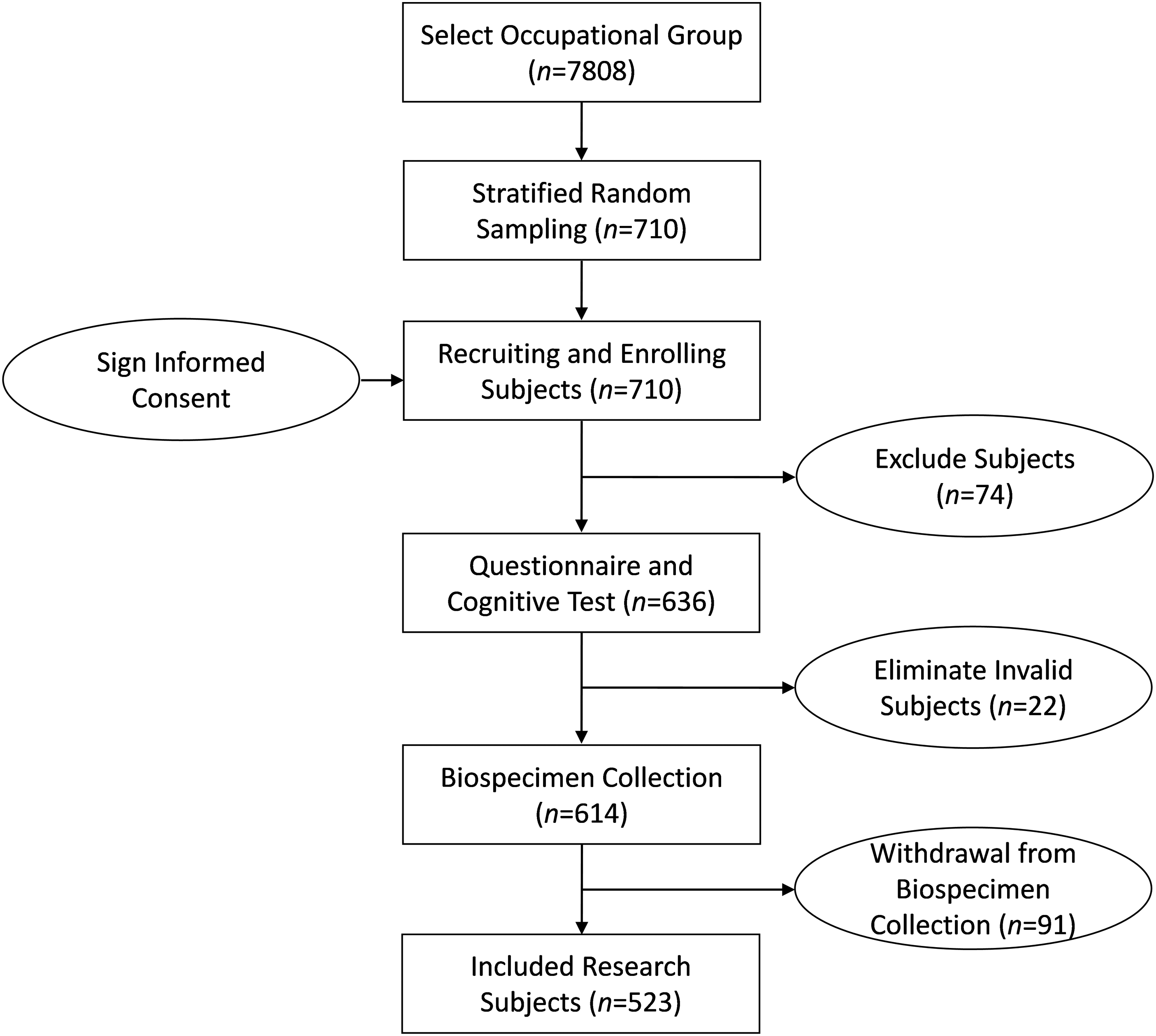
Flow diagram of the research subjects.
Demographic and occupational features
A customized questionnaire was used to collect data on the subjects’ demographic profiles, lifestyles, and job characteristics. The demographic details included age, sex, marital status, and education level. Lifestyle factors included smoking and alcohol consumption. Occupational aspects covered a record of job changes with corresponding durations of service, daily exposure time, work shift patterns and previous exposure to hazardous elements. After standardized training, the investigators assisted the subjects in completing the self-report questionnaire to ensure accuracy and completeness.
Measurement of equivalent noise pressure level
Two key instruments were used in this study: the SVANTEK SV 971 handheld sound level meter and the SVANTEK SV 104IS personal noise dosimeter, both of which are manufactured in Warszawa, Poland. These meters were uniformly configured with an A-weighting filter, a 3 dB exchange rate, and slow time-weighting. Spectrum analysis was performed at 1/1 octave using a Z-level filter with a linear detector mode. The SVANTEK SV34 sound calibrator (114 dB, 1000 Hz) was used to calibrate the sound level meter in accordance with high-precision standards. The entire noise measurement and analysis process followed the National Standard of China to ensure compliance and reliability. In complex noise environments, individual sampling was conducted over an extended period to cover the entire workday. For workplaces with simpler noise profiles, fixed-point sampling was used as a supplementary method to provide additional insights and ensure comprehensiveness in the noise assessment.
Calculation of WCNE
Based on the equal-energy principle of noise exposure, the WCNE for each individual was calculated by incorporating noise levels measured at different locations and weighted by the corresponding working durations (cumulative days).
26
A detailed career history was collected via questionnaire to account for potential position changes and internal job transfers, with information on job titles, duties, and duration for each role. Where information was incomplete or missing, supplementary verification was carried out via direct interviews or telephonic follow-ups to ensure comprehensive and accurate data collection. The WCNE was calculated using the equation specified below.

WCNE, work-related cumulative noise exposure (dB.time).
Biological sample collection and genotyping
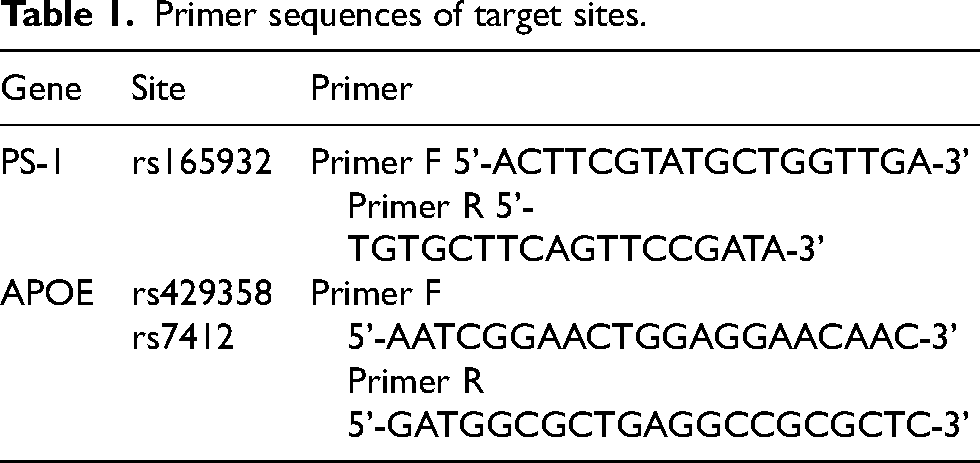
The SNPs APOE rs429358/rs7412, and PS-1 rs165932 were genotyped in 523 research subjects via the SNaPshot genotyping method. The primer sequences of the target sites are provided in Table 1. Venous blood samples (2 mL) were collected from the antecubital vein of each subject under resting conditions. Blood was drawn into tubes containing sodium ethylenediaminetetraacetic acid (EDTA) as an anticoagulant to preserve the integrity of the DNA. Genomic DNA was extracted via the QIAamp DNA Blood Mini Kit (Qiagen GmbH, Hilden, North Rhine-Westphalia, Germany) according to the manufacturer's protocol. SNP genotyping was performed via Snapshot technology (Shanghai Yisheng Biotechnology Co., Ltd). PCR amplification was as follows: pre-denaturation for 5 min (95°C); denaturation for 20 s (94°C), annealing for 20 s (55°C), and extension for 40 s (72°C) as one cycle, and extension for 10 min (72°C) after 35 cycles. Product purification: reaction at 37°C for 15 min and 80°C for 15 min. Extension reaction: pre-denaturation at 94°C for 1 min, denaturation at 94°C for 10 s, annealing at 52°C for 5 s, and extension at 60°C for 30 s for a total of 30 cycles, and then stored at 4°C. Sequencing: The extended products were denatured at 95°C for 3 min and subsequently subjected to capillary electrophoresis after an ice-water bath. The experimental results were analyzed using GeneMap 4.0 software. Sample genotyping was achieved by determining the incorporated base based on the fluorescence color of the peak, with the specific SNP site identified by its corresponding fragment size.
Primer sequences of target sites.
Cognitive function test
Cognitive function was evaluated with the Chinese version of the Mini-Mental State Examination (MMSE) 27 and the Montreal Cognitive Assessment (MoCA). 28 The MMSE is designed to measure orientation, memory recall, attentional processes, numeracy skills, and linguistic abilities, 29 while the MoCA provides a more comprehensive evaluation encompassing attention, executive functioning, memory, language proficiency, visual-spatial organization, abstract reasoning, and orientation. 30 The maximum score for both instruments is 30. Based on the expert consensus of different versions of the scales,31,32 we defined the LCP group as those with MoCA scores ≤ 26 or MMSE scores ≤ 27. The remaining participants were classified into the higher cognitive performance (HCP) group.
Statistical analysis
All the statistical analyses were performed via STATA 14.0 software, with the significance level (α) set at 0.05. The Hardy-Weinberg equilibrium test was used to assess genetic balance, ensuring that the observed genotype frequencies in this study were consistent with those expected under the principles of genetic equilibrium. The Kruskal-Wallis test was used to compare the cognitive function scores across subgroups defined by gene characteristics. Multiple linear regression analysis was used to model the relationships between external environmental exposure factors, gene polymorphisms and cognitive function levels. The associations between gene polymorphisms and LCP were initially assessed via the chi-square test, followed by multivariable logistic regression analysis to establish a comprehensive risk model. Interaction effect and effect modification were analyzed via the interaction contrast (biological interaction) command package. Statistical interaction (second-order) refers to the joint effect of two variables on an outcome deviating from the sum of their individual effects under an additive model, or from their product under a multiplicative model. Effect modification refers to the variation in the effect of an exposure on an outcome across different levels of a third variable (the effect modifier). 33 The individual effect, interaction effect or effect modification of WCNE and the target variable were presented in a 2 × 2 table. A multiplicative interaction was considered present if the combined odds ratio (OR11) was greater than or equal to the product of the individual ORs (OR10 × OR01). An additive interaction was indicated if OR11 exceeded the sum of the individual ORs minus one (OR10 + OR01−1). 34 The relative excess risk interaction (RERI = OR11−OR01−OR10 + 1) is used to indicate the relative effect size of the attributable interaction. The attributable proportion (AP = RERI/OR11) indicates the proportion of the attributable interaction effect in the joint effect. A synergy index (SI) greater than 1 indicates a positive interaction, a value equal to 1 suggests no interaction, and a value less than 1 signifies a negative interaction. The SI is calculated as (OR11−1)/(OR10 + OR01−2) under an additive model, and as OR11/(OR10 × OR01) under a multiplicative model.33,35 Furthermore, a sensitivity analysis confined to male participants was conducted to verify the robustness of the results against potential sex-related confounding.
Results
Basic characteristics of the research subjects
The study included 523 subjects ranging in age from 19 to 59 years, with a mean age of 35.5 ± 9.79 years. The majority were male (95.6%, 500/523), while 4.4% (23/523) were female. In terms of marital status, 30.4% (159/523) were single and 69.6% (364/523) were married. With respect to education, 58.5% (306/523) had a college degree or higher. Among the research subjects, 61.4% were current smokers, 74.8% consumed alcoholic beverages, 5.92% reported a positive family history of AD and related dementias, and 24.7% had a noise exposure dose ≥ 127.8 dB.time. The baseline characteristics of the research subjects are summarized in Table 2. The sensitivity analysis restricted to the male participants (n = 500) yielded results consistent with the primary analysis (Supplemental Table 1).
Basic characteristics of the research subjects.

WCNE: work-related cumulative noise exposure; MMSE: Mini-Mental State Examination; MoCA: Montreal Cognitive Assessment.
Relationship between APOE and PS-1 gene polymorphisms and LCP
Stratification by allele presence revealed no significant differences in the distribution of APOE (ε2, ε3, ε4) or PS-1 rs165932 G alleles between the HCP group and the LCP group. However, a statistically significant disparity was identified in the distribution of the PS-1 rs165932T allele (PS-1T) across different subgroups categorized by MMSE and MoCA scores (p < 0.05, Table 3). The sensitivity analysis yielded results consistent with the primary analysis (Supplemental Table 2).
Allele distribution in different cognitive function groups.

HCP group: higher cognitive performance group; LCP group: lower cognitive performance group; MMSE: Mini-Mental State Examination; MoCA: Montreal Cognitive Assessment.
Regression analysis of influencing factors of the LCP
According to the logistic regression models (Table 4), age and education level were statistically associated with cognitive performance in both the MMSE and MoCA models (Model 1, p < 0.05). Compared with the younger reference group, the participants aged ≥ 35 years had significantly higher odds of LCP, with adjusted odds ratios (aORs) of 3.321 (95% CI: 1.960–5.626) for the MMSE and 3.031 (95% CI: 1.921–4.782) for the MoCA. Similarly, those with an education level of junior high school or below had aORs of 2.634 (95% CI: 1.265–5.484) on the MMSE and 3.990 (95% CI: 1.747–9.114) on the MoCA compared with the group with a bachelor degree or above. In contrast, the APOE ε2, ε3, and ε4 alleles were not significant in the multivariate model. A significant association was observed for noise exposure (≥ 127.8 dB.time) with aORs of 7.355 (95% CI: 3.389–15.960) on the MMSE and 4.874 (95% CI: 2.465–9.638) on the MoCA compared with the reference group (Model 3). In the fully adjusted model (Model 5), the PS-1T allele remained statistically significant (p < 0.05), with aORs of 2.443 (95% CI: 1.149–5.195) on the MMSE and 2.065 (95% CI: 1.091–3.906) on the MoCA. The associations remained substantively unchanged in the sensitivity analysis (Supplemental Table 3).
Logistic regression of WCNE, gene polymorphism and LCP.

LCP: lower cognitive performance; WCNE: work-related cumulative noise exposure; PS-1 G: PS-1 rs165932 G allele; PS-1T: PS-1 rs165932T allele; MMSE: Mini-Mental State Examination; MoCA: Montreal Cognitive Assessment. Model 2 adjusted for sex, age, education level, and marital status. Models 3 to 5 adjusted for sex, age, education level, marital status, smoking, drinking, napping, and night shifts.
Age-WCNE interaction in the LCP
Using a cutoff of 127.8 dB.time, the subjects were categorized into an exposure group (≥ 127.8 dB.time) and a reference group (< 127.8 dB.time) to analyze the age-WCNE interaction effect on LCP (Table 5; Figure 2). For the MMSE, the combined effect of age and WCNE (OR11) was 13.291 (95% CI: 6.396–27.617), which exceeded both the additive (OR10 + OR01−1 = 2.772) and multiplicative (OR10 × OR01 = 3.524) thresholds, indicating interaction on both scales. The single effects of WCNE (OR01) and age (OR10) were 1.704 (95% CI: 0.679–4.278) and 2.068 (95% CI: 1.090–3.923), respectively. All interaction metrics (RERI, AP, and SI) were all statistically significant (p < 0.05). After stratification by age (< 35 versus ≥ 35 years), the adjusted OR for the older group was 6.434 (95% CI: 3.457–11.976), confirming a significant interaction effect between age and WCNE on LCP assessed by the MMSE. For the MoCA, a similar pattern was observed. The combined effect (OR11) was 9.615 (95% CI: 4.828–19.148), greater than the additive (3.513) and multiplicative (5.056) thresholds. The single effects of WCNE (OR01) and age (OR10) were 2.068 (95% CI: 0.988–4.326) and 2.445 (95% CI: 1.426–4.193), respectively. The RERI, AP, and SI were also significantly different (p < 0.05). Age stratification yielded an aOR of 3.927 (95% CI: 2.116–7.288) for the ≥ 35 years group, indicating a significant interaction effect on the MoCA as well. The results of the sensitivity analysis were consistent with those of the primary model, further supporting the robustness of the association (Supplemental Table 4).
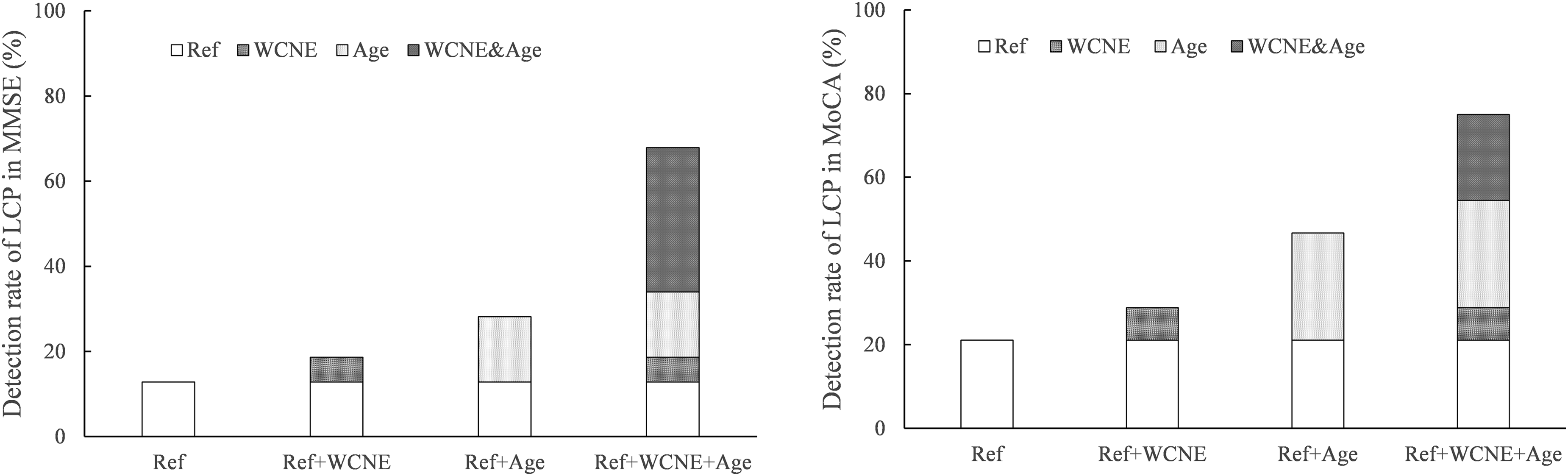
Age–WCNE interaction effect on the LCP. LCP: lower cognitive performance; WCNE: work-related cumulative noise exposure; MMSE: Mini-Mental State Examination; MoCA: Montreal Cognitive Assessment.
Relationship between age–WCNE interaction and LCP.
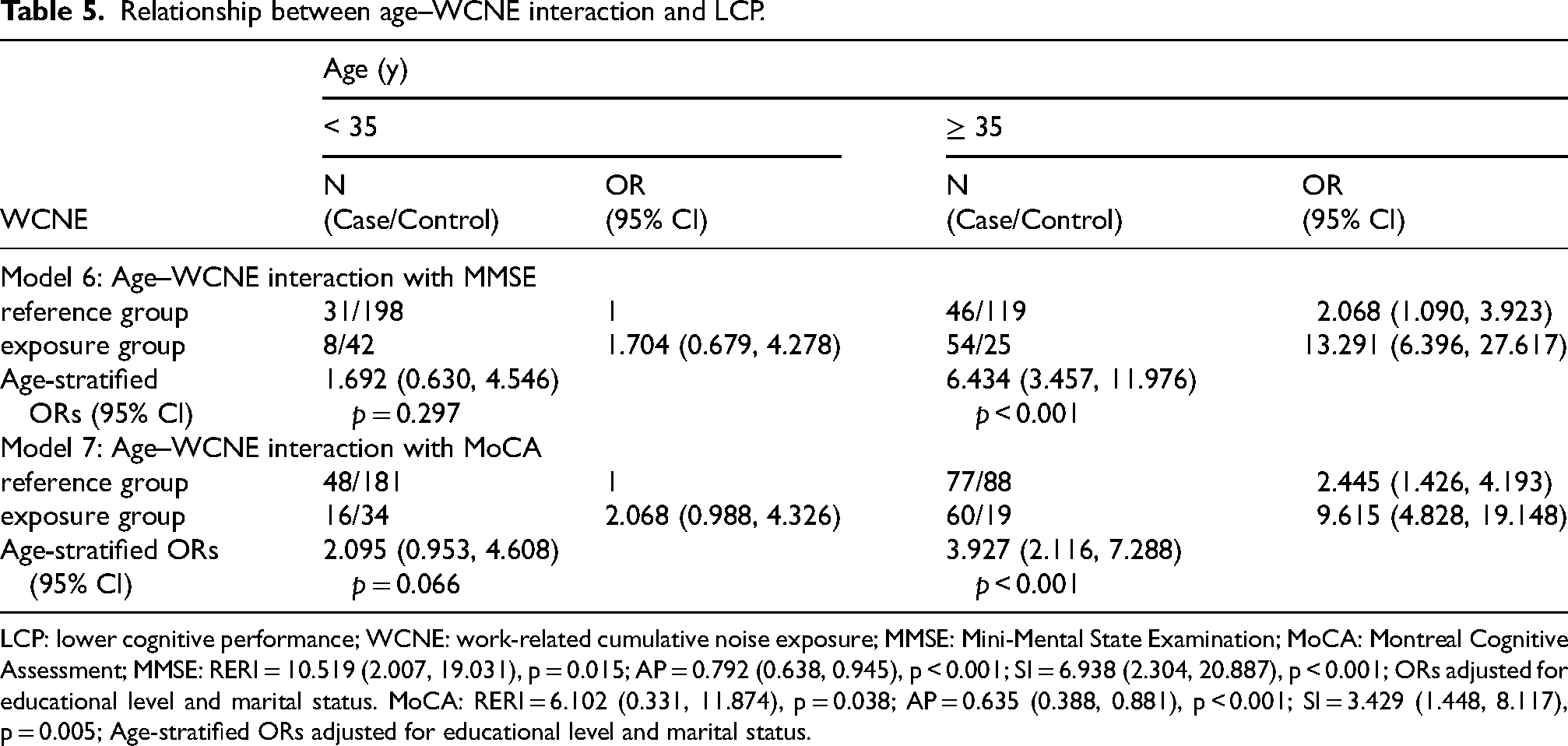
LCP: lower cognitive performance; WCNE: work-related cumulative noise exposure; MMSE: Mini-Mental State Examination; MoCA: Montreal Cognitive Assessment; MMSE: RERI = 10.519 (2.007, 19.031), p = 0.015; AP = 0.792 (0.638, 0.945), p < 0.001; SI = 6.938 (2.304, 20.887), p < 0.001; ORs adjusted for educational level and marital status. MoCA: RERI = 6.102 (0.331, 11.874), p = 0.038; AP = 0.635 (0.388, 0.881), p < 0.001; SI = 3.429 (1.448, 8.117), p = 0.005; Age-stratified ORs adjusted for educational level and marital status.
Genetic factors modify the effect of WCNE on LCP
Analysis of the WCNE and PS-1T allele interaction on the LCP assessed by the MMSE is shown in Table 6. The combined effect (OR11) was 7.125 (95% CI: 3.115–16.299), which exceeded the thresholds for both additive (4.033) and multiplicative (5.890) interaction. The single effects of WCNE (OR01) and PS-1 (OR10) were 3.182 (95% CI: 0.875–11.569) and 1.851 (95% CI: 0.843–4.065), respectively. However, the AP was not statistically significant (p = 0.109). After stratification by the PS-1T allele, the aOR of the T (+) group was 3.984 (95% CI: 2.326–6.823), suggesting a weak effect modification of PS-1T on the WCNE–LCP relationship in the MMSE model. For the MoCA, the combined effect (OR11) was 5.928 (95% CI: 2.897–12.131), which was greater than the additive threshold (4.939) but less than the multiplicative threshold (7.909). The single effects of WCNE (OR01) and PS-1T (OR10) were 3.923 (95% CI: 1.238–12.437) and 2.016 (95% CI: 1.052–3.862), respectively. None of the interaction indices (RERI, AP, and SI) were statistically significant, indicating that PS-1T had no effect modification on the relationship between WCNE and LCP in the MoCA model. The effect modification analysis is visualized in Figure 3. Findings from the sensitivity analysis were consistent with the primary model, which strengthens the evidence for a robust association (Supplemental Table 5).
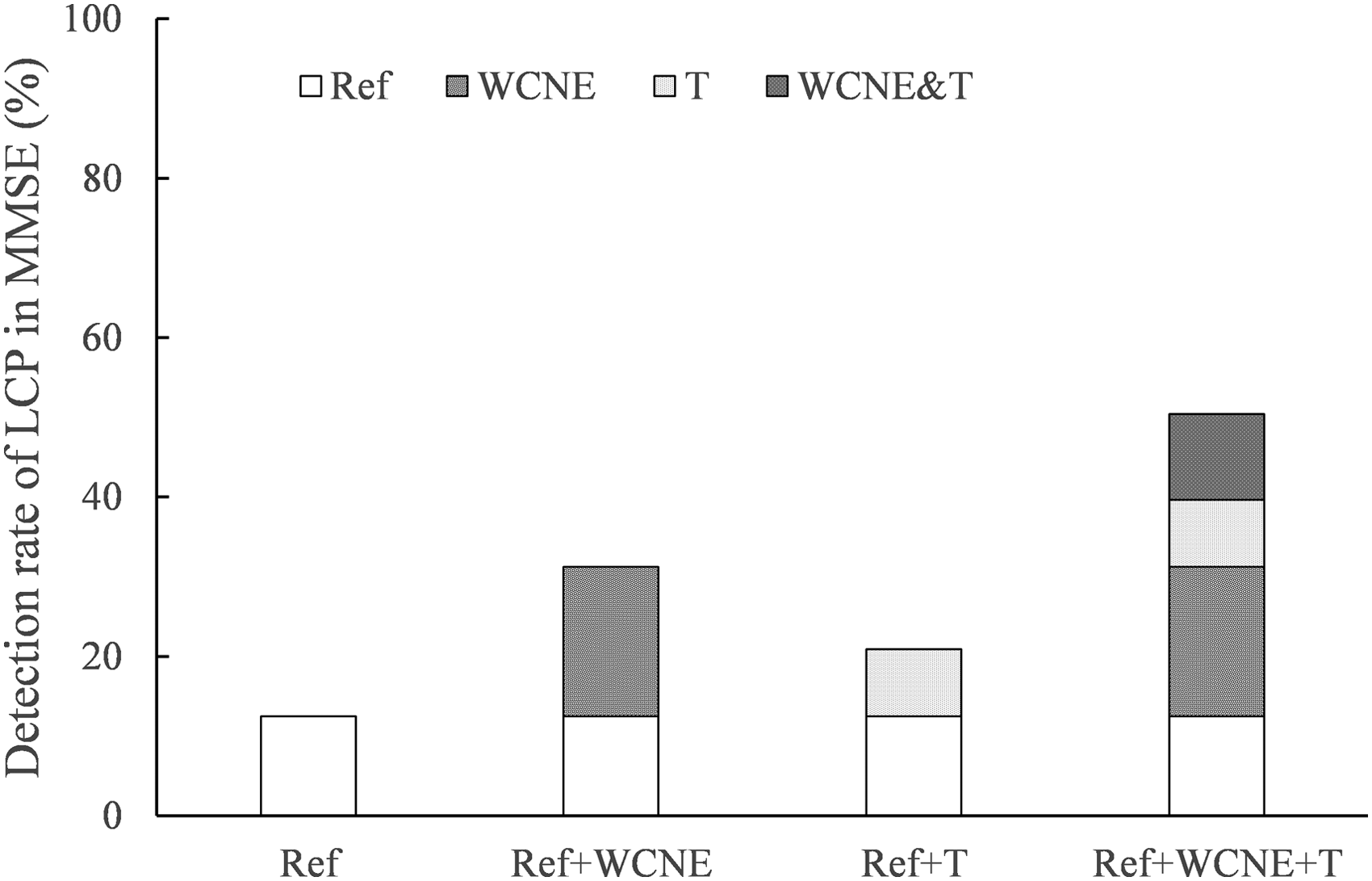
Effect modification of PS-1T on the relationship between WCNE and LCP. LCP: lower cognitive performance; WCNE: work-related cumulative noise exposure; T: PS-1 rs165932T allele; MMSE: Mini-Mental State Examination.
Effect modification of PS-1T on the relationship between WCNE and LCP.
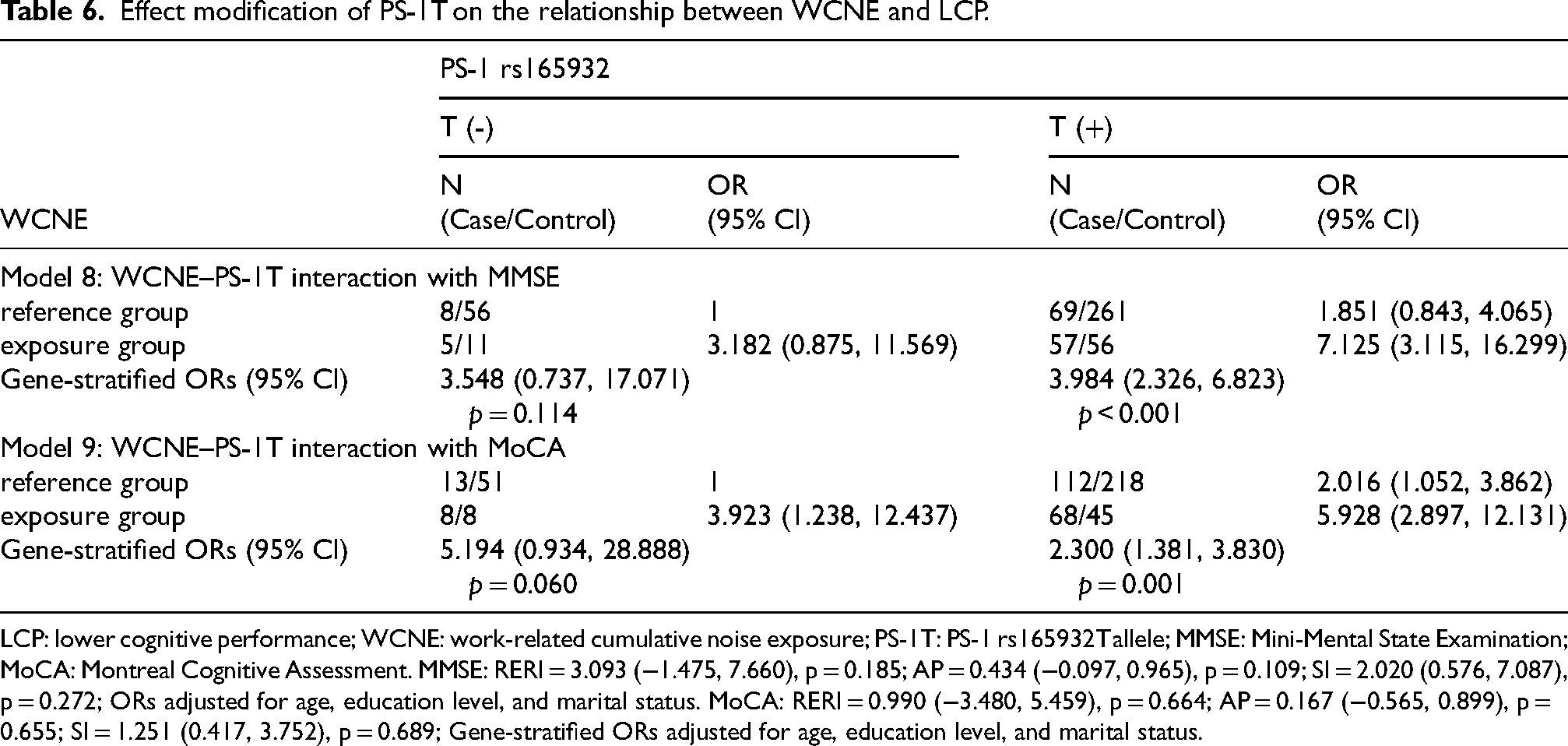
LCP: lower cognitive performance; WCNE: work-related cumulative noise exposure; PS-1T: PS-1 rs165932T allele; MMSE: Mini-Mental State Examination; MoCA: Montreal Cognitive Assessment. MMSE: RERI = 3.093 (−1.475, 7.660), p = 0.185; AP = 0.434 (−0.097, 0.965), p = 0.109; SI = 2.020 (0.576, 7.087), p = 0.272; ORs adjusted for age, education level, and marital status. MoCA: RERI = 0.990 (−3.480, 5.459), p = 0.664; AP = 0.167 (−0.565, 0.899), p = 0.655; SI = 1.251 (0.417, 3.752), p = 0.689; Gene-stratified ORs adjusted for age, education level, and marital status.
Discussion
Genetics factors are recognized as significant contributors to cognitive impairment. 19 This study revealed that the PS-1 rs165932 polymorphism is associated with LCP in occupational populations. Even prior to advanced age, individuals carrying the PS-1T allele presented a significantly higher risk of LCP compared with reference group. The PS-1 gene is the most common genetic risk factor for AD. In early-onset AD, PS-1 mutations are the most prevalent, with disease onset typically occurring between 30 and 50 years of age in mutation carriers. 36 Additionally, the specific mutation at the PS-1 rs165932 locus confers a greater than 2.38-fold increased risk for late-onset AD. 4 Similarly, Belbin et al. demonstrated that the allele T accelerates cognitive impairment in sporadic AD patients. 37 This study further confirmed the consistency of this association in occupational populations. However, no significant effect of the APOE rs429358/rs7412 polymorphisms on LCP was observed in this study. The literature indicates that APOE is strongly associated with late-onset AD. 38 Approximately 40% to 50% of late-onset AD cases have specific APOE polymorphism.7,20 In contrast, evidence regarding the relationship between APOE and early-onset AD remains limited. This lack of association may be attributable to the relatively younger age of our research subjects (mean age 35.5 ± 9.79 years).
Environmental exposure has been implicated in increasing dementia risk through multiple pathways. Notably, among the modifiable risk factors for dementia, noise exposure has emerged as a significant contributor to increased dementia risk, with epidemiological evidence linking chronic noise to accelerated cognitive impairment and aberrant neurodegenerative pathways.39–41 The findings of this study demonstrate an association between WCNE and LCP, supporting the notion that noise exposure is linked to cognitive impairment. As an environmental stressor, noise may contribute to an accelerated impairment in cognitive function even before old age. Several mechanisms have been proposed to explain noise-induced cognitive impairment, including gene-environment interactions, psychosocial stress pathways, glutamate-mediated excitotoxicity, disruption of the microbiota-gut-brain axis signaling, and chronic neuroinflammatory cascades. 15 However, consistent empirical evidence supporting these mechanisms remains limited.
Despite the relatively young age of the research subjects, this study still revealed a correlation between increasing age and cognitive impairment. Aging is a well-established risk factor for dementia and related neurodegenerative disorders. The physiological changes associated with aging may contribute to progressive cognitive impairment. For example, studies have shown that acetylcholine levels in elderly individuals are approximately 30% lower than those in young adults, whereas the reduction is more pronounced in dementia patients, reaching 70 to 80%. 42 Similarly, the level of melatonin (MT), an endogenous free radical scavenger, is significantly reduced in patients with AD. 42 In contrast, clinical evidence indicates that MT supplementation therapy can positively improve cognitive function in individuals with dementia.43,44 In addition, age-related neurovascular changes can lead to reduced cerebral blood flow and hypoperfusion, which may further trigger neuroinflammatory responses and neuronal apoptosis. 45
The interaction analysis performed in this study revealed a significant interaction between age and WCNE. These findings suggest that noise exposure may synergize with age-related pathways, potentially hastening cognitive impairment. This process likely involves multiple interconnected biological mechanisms. Evidence indicates that noise exposure can induce changes in functional neuroplasticity through pathways such as glutamate-mediated neuroexcitotoxicity and chronic neuroinflammatory cascades. 15 These synergistic impairments may accelerate age-related neurodegenerative processes, including oxidative stress and telomere wear. Furthermore, the dysregulation of the hypothalamic-pituitary-adrenal axis (HPA) caused by noise exposure may exacerbate these effects through chronic elevation of corticosterone, resulting in a vicious cycle of neurodegeneration.39,46 Notably, noise-induced hearing loss has been linked to an increased risk of dementia. 13 Hearing loss can induce neurological adaptations, including altered neuroplasticity in central auditory pathways and dysregulated postsynaptic excitability. 47 These pathological adaptations could exacerbate age-related neurodegenerative cascades through multiple pathways: 1) increased cognitive load from degraded auditory input, 2) accelerated hippocampal atrophy via reduced neural stimulation, and 3) chronic neuroinflammation triggered by auditory cortex dysfunction. 15 However, the proposed mechanisms require further experimental investigation to be confirmed.
This study provides evidence for an effect modification between noise exposure and the PS-1 rs165932 mutation. Specifically, the PS-1T genotype modified the association between WCNE and LCP as measured by the MMSE. This finding is further supported by experimental studies. Noise exposure exacerbates cognitive impairment in APP/PS-1 transgenic mice and promotes AD-like hippocampal pathology.48,49 From the perspective of pathogenic mechanisms involving genetic factors, PS-1 mutations can lead to dysfunction of γ-secretase, resulting in the overproduction of Aβ in brain tissue. 50 Additionally, PS-1 plays neuroprotective roles by inhibiting neuroexcitotoxicity and mitigating oxidative stress; its mutation may therefore exacerbate neuronal vulnerability and cell death. 51 Noise, which acts as an external stressor, has the potential to expedite neurodegeneration in individuals with genetic susceptibility. On the one hand, noise exposure can alter the redox state of the body via the HPA axis46,52 and corticotropin-releasing factor signaling. 53 On the other hand, noise has been shown to upregulate the N-methyl-D-aspartate receptor subunit NR2B and increase glutamate expression,54,55 which is closely associated with neuroexcitotoxicity. It can thus be hypothesized that noise exposure may contribute to cognitive impairment by inducing neuroexcitotoxicity and oxidative stress. Moreover, PS-1 mutations could disrupt the inherent inhibitory functions against these processes, potentially accelerating noise-induced neuropathological changes.
This study systematically examines the interplay among noise exposure, genetic susceptibility, and LCP to reveal the risk of developing LCP in the workplace. This study has several limitations: First, the limited study duration restricted cognitive assessments to the baseline measurements, thereby precluding longitudinal tracking of cognitive functional changes in occupational populations. Second, the exclusive focus on the LCP limits the systematic assessment of downstream clinical outcomes, such as MCI or dementia. Third, the percentage of females represented in the study was notably low (4.4%). While this proportion aligns with the sex distribution in the target occupational population, it significantly limits the generalizability of the findings. This limitation is particularly concerning given the well-established sex-specific differences in the pathogenesis and clinical manifestations of neurodegenerative dementias. Future directions: First, a longitudinal cohort study design would enable more robust investigations into the temporal dynamics and cumulative effects of noise exposure on dementia onset and progression. Second, future research should prioritize elucidating the mechanistic pathways linking noise exposure to genetic susceptibility in the context of cognitive impairment.
Conclusions
In summary, this study demonstrated no statistically significant associations between the APOE rs429358/rs7412 polymorphisms and LCP in occupational populations. Conversely, PS-1T was significantly positively associated with LCP. Notably, age and WCNE had interaction effect on LCP, and PS-1T showed evidence of effect modification on the relationship between WCNE and LCP. In the absence of effective treatments, epidemiological studies on environmental-genetic interactions are critical for developing preventive strategies against neurodegenerative dementia. First, the findings highlight the urgent need to identify and mitigate noise exposure risks in vulnerable populations, particularly among elderly individuals. Second, the findings provide a basis for further mechanistic studies exploring the biological pathways through which noise exposure, aging, and genetic susceptibility synergistically influence cognitive impairment.
Supplemental Material
sj-docx-1-alz-10.1177_13872877251413707 - Supplemental material for Association of work-related noise exposure with cognitive performance: Effect modification by PS-1 rs165932
Supplemental material, sj-docx-1-alz-10.1177_13872877251413707 for Association of work-related noise exposure with cognitive performance: Effect modification by PS-1 rs165932 by Lei Huang, Jing Zhang, Shushan Zhang, Yajia Lan, Qin Zhang and Yang Zhang in Journal of Alzheimer's Disease
Footnotes
Acknowledgements
We would like to thank all the subjects in this study and all those who provided help with this study.

Ethical considerations
This study was approved by the Ethics Committee of West China School of Public Health/West China Fourth Hospital, Sichuan University (HXSY-EC-2021035). We confirmed that this research was performed in accordance with the relevant guidelines and regulations of the Declaration of Helsinki. The investigators explained the purpose and specific circumstances of this study to the subjects during the study process.
Consent to participate
All the subjects were informed and voluntarily participated in the study (signed informed consent).
Consent for publication
Not applicable
Author contribution(s)
Funding
The authors disclosed receipt of the following financial support for the research, authorship, and/or publication of this article: This study was supported by the Sichuan Science and Technology Program of the Science and Technology Department of Sichuan Province (grant numbers No. 2023NSFSC1736, No. 2024NSFSC0490, No.2022YFS0422).
Declaration of conflicting interests
The authors declared no potential conflicts of interest with respect to the research, authorship, and/or publication of this article.
Data availability statement
The datasets used in the present study are available from the corresponding author upon reasonable request.
Supplemental material
Supplemental material for this article is available online.
References
Supplementary Material
Please find the following supplemental material available below.
For Open Access articles published under a Creative Commons License, all supplemental material carries the same license as the article it is associated with.
For non-Open Access articles published, all supplemental material carries a non-exclusive license, and permission requests for re-use of supplemental material or any part of supplemental material shall be sent directly to the copyright owner as specified in the copyright notice associated with the article.
