



Abstract
Background
Depressive symptoms in older adults have become a major public health problem. Interventions targeting physical function and motoric cognitive risk syndrome (MCR), a pre-dementia (such as Alzheimer's disease) syndrome, may offer promising new avenues for addressing this problem.
Objective
We aim to explore the relationship between self-perceptions of aging (SPA) and depression among community-dwelling older adults and analyze whether physical function plays a mediating role in this association and whether motoric cognitive risk syndrome (MCR) can moderate this mediating effect.
Methods
From March to November 2023, 861 community-dwelling older adults in Xinxiang City, China were investigated for their SPA, depression, physical function and MCR status. Descriptive statistics, analysis of variance and correlation analysis were performed on the data, and Mplus8.3 was used to construct a moderated mediation model.
Results
SPA is positively correlated with depression, with physical function playing a mediating role between SPA and depression, accounting for 16.2% of the total effect. The results of the interaction term between SPA and MCR were significant (β = −0.089, p = 0.009), indicating that MCR moderates the relationship between SPA and physical function.
Conclusions
This study reveals the mediating role of physical function and the moderating role of MCR. It suggests that attention should be paid to the physical and mental management of community-dwelling older adults with negative self-perceptions of aging, reduce the risk of MCR, to prevent and alleviate the depressive symptoms.
Keywords
Introduction
Depression is one of the most prevalent psychological issues among older adults, affecting approximately 10–15% of community-dwelling older adults. 1 Notably, China has the second-highest incidence of depression globally, 2 with about one-third of elderly individuals experiencing depressive symptoms to varying degrees. 3 The persistent presence of depressive symptoms increases the likelihood of major depressive disorder, resulting in a lower quality of life, 4 higher suicide rates, 5 and elevated non-suicide mortality risks, such as an increased likelihood of death from cardiovascular diseases. 6 Currently, China has entered a moderately aging society and faces significant challenges in addressing depression among older adults. As people age, the degeneration of individual functions will affect their emotions, physical conditions, social activities and so on. A series of subjective attitudes and emotional responses to age-related changes, known as self-perceptions of aging (SPA), can influence health outcomes in older adults through psychological, physiological, and behavioral pathways. 7 Greater positive SPA is consistently linked to healthier long-term outcomes, improved self-rated health, less obesity, better performance in daily activities, enhanced cognitive function, and decreased depression. 8 But more negative SPA can increase the risk of social withdrawal, which may lead to loneliness and higher levels of depressive symptoms. 9 However, whether other factors are involved in the pathway linking SPA and depression warrants further exploration.
The internalization of stereotypes and the rise in various diseases contribute to negative perceptions of aging among individuals. According to the bio-psycho-social medical model, SPA not only impacts the psychological status of older adults but also predicts their future self-reported physical functions. A previous cohort study showed that more positive SPA predicted better physical function 2 years later (rather than the other way around) and that self-efficacy may mediate this association. 10 Individuals with a positive view of aging may possess greater self-efficacy, which motivates them to actively acquire and use more effective coping behaviors to achieve better physical function. However, elderly people with a negative perception of aging tend to underestimate their physical abilities, which may lead to suboptimal utilization of a person's physical potential, resulting in the loss of some potential, preventable physical functions and independence. 11
With advancing age, the physical function of older adults usually declines to varying degrees due to the series of effects of natural aging.12–14 Low-level physical function may be an early indicator of severe depression or persistent depression. A longitudinal study demonstrated that with each 1-point increase in Short Physical Performance Battery (SPPB), the risk of persistent severe depressive symptoms decreases by 28%. 15 Therefore, when negative emotion has an effect on depression in older adults, physical function may also play a role.
Previous studies indicate that elderly people often experience both subjective cognition complaints (SCC) and slow gait speed (GS), which is the motor cognitive risk syndrome (MCR), a pre-dementia (e.g., for Alzheimer's disease) syndrome. 16 Compared to their peers, older adults with MCR have worse physical functioning 17 and may also face mental health issues, with depression being a common symptom in older adults with MCR. 18 The synergistic effect of the inconvenience caused by the decrease in walking speed and subjective cognitive complaints in elderly people with MCR will increase the internalization of stereotypes, intensify the negative effects of SPA, and exacerbate the decline in physical function. At this stage, effective intervention measures can slow or reverse the decline in physical condition and cognitive function in elderly patients with MCR.19,20 Therefore, this study aims to explore the role of MCR in the relationship between SPA and physical function and hypothesizes that MCR plays a moderating role in this relationship.
In summary, this study constructs a moderated mediation model to examine whether physical function mediates the relationship between SPA and depression, and whether this mediation process is moderated by MCR. The study aims to provide more theoretical support for improving the physical functions and mental health of the elderly during the aging process, intervene as early as possible in the pre-dementia stage, thereby fostering a state of body-mind-spirit balance and promoting healthy aging among older adults in the community.
Methods
Study population
Using a convenience sampling method, a total of 861 older adults from five community health service centers in Xinxiang City, Henan Province, China—including Yangguang Community, Binhu Community, Chengcheng Community, Xinglong Community, and Luotuowan Community-were selected as study participants between March 2023 and November 2023. All participants were drawn from the population of older adults who took part in annual community health examinations at community health registration centers. A cross-sectional survey was administered to elderly participants via on-site interviews. The inclusion criteria for participants were as follows: age ≥65 years, informed consent and voluntary participation. Participants will be excluded if they meet any of the following conditions: (1) patients with critical illness or bodily weakness are unable to cooperate; (2) with dementia or severe mental disorders by a physician; or (3) they have severe visual or hearing impairments that hinder normal communication. All participants provided informed consent, and the study was approved by the Ethics Committee of Xinxiang Medical University (XYLL-20230003).
Definition of MCR
MCR is defined as a pre-dementia syndrome, which refers to the coexistence of slow gait speed (GS) and subjective cognitive complaints (SCC) without dementia and mobility disability. Dementia is defined according to the MMSE scale criteria, 21 and mobility disability is judged by self-reported difficulties in dressing, eating, bathing, toileting, transfer and continence. 22 Subjective cognitive complaint is defined by a positive answer to “Do you currently have a problem with your memory?”. 23 Slow gait speed is defined by measuring the normal walking speed over a distance of 4 meters, which is one standard deviation or more below the established age-and sex-specific mean in the study population (Table 1). 16
The cutoff value of slow GS.

Assessment of self-perceptions of aging
Adults’ perceptions of their aging were assessed using the brief aging perceptions questionnaire (B-APQ). The Chinese version of the scale was translated and validated by Hu Na, 24 including five dimensions of negative consequences and control, positive consequences, timeline-chronic, positive control and emotional representation. The B-APQ consists of 17 items scored on a 5-point Likert type scale, and the positive dimension was reverse coded. The score ranged from 17 to 85, and higher scores indicated more negative SPA.
Assessment of depression
The 15-item Geriatric Depression Scale (GDS-15) was used for assessment. This scale was simplified by YESAVAGE and SHEIKH from the original Geriatric Depression Scale. 25 It consists of 15 items, such as whether the participants have felt satisfied with life, happy most of the time, helpless, or bored over the past two weeks. Responses to the items are given as “yes” or “no.” A “yes” answer scores 1 point, while a “no” answers scores 0 points. The total score ranges from 0 to 15, with higher scores indicating more severe depressive symptoms.
Assessment of physical function
The SPPB scale reflects the physical functional status, which includes 3 timed components: three balance stances, a 4-meter usual pace walk, and five repeated chair stands. 26 Each component time was scored on a scale of 0 to 4, with a total score of 0 to 12. Higher scores indicate greater physical function. The balance test required the subjects to stand with two feet side by side, a semi-tandem position, and a tandem position for 10 s each. The subjects who completed the first two items were scored 1 point each, and those who completed the full foot distance standing were scored 2 points. For the walking speed test, the individual is asked to walk a distance of 4 m in a designated area. The five repeated chair stands require participants to cross their arms on their chest and complete a total of five times from sitting to standing up and then sitting down to record the time.
Measure of social demographic characteristics
Demographic variables included age, gender, education level, marital status, living arrangement (living with family, living alone, and living in a nursing home), source of living (Is there a fixed monthly pension?), body mass index (BMI), smoking history, drinking history, and chronic diseases (including cerebrovascular diseases, kidney diseases, cardiovascular diseases, vascular diseases, eye diseases, nervous system diseases, respiratory system diseases, rheumatoid arthritis, biliary tract diseases, hypertension, diabetes, and hyperlipidemia). BMI is calculated by dividing weight by the square of height and expressed as kg/m2. Chronic diseases mainly include hypertension, diabetes, cardiovascular disease, cerebrovascular disease, and so on.
Statistical analyses
SPSS 25.0 was used for data analysis. Assess data normality using kurtosis and skewness (The absolute values of skewness and kurtosis were below 3 and 10, respectively). Measurement data that conforms to a normal distribution were expressed as mean ± SD, while count data was expressed as frequency and percentage. T-tests and analysis of variance (ANOVA) were used to compare the scores of SPA, physical function, and depression among groups with different characteristics. Used Pearson correlation analysis to explore the correlation between variables. Finally, we constructed a structural equation modeling (SEM) using Mplus8.3 and used the bootstrap method to verify the significance of the mediation effect by randomly sampling 5000 times. Gender, age, BMI, and education level were statistically controlled as covariates. A p-value < 0.05 was considered statistically significant.
Results
Demographic characteristics of community-dwelling older adults
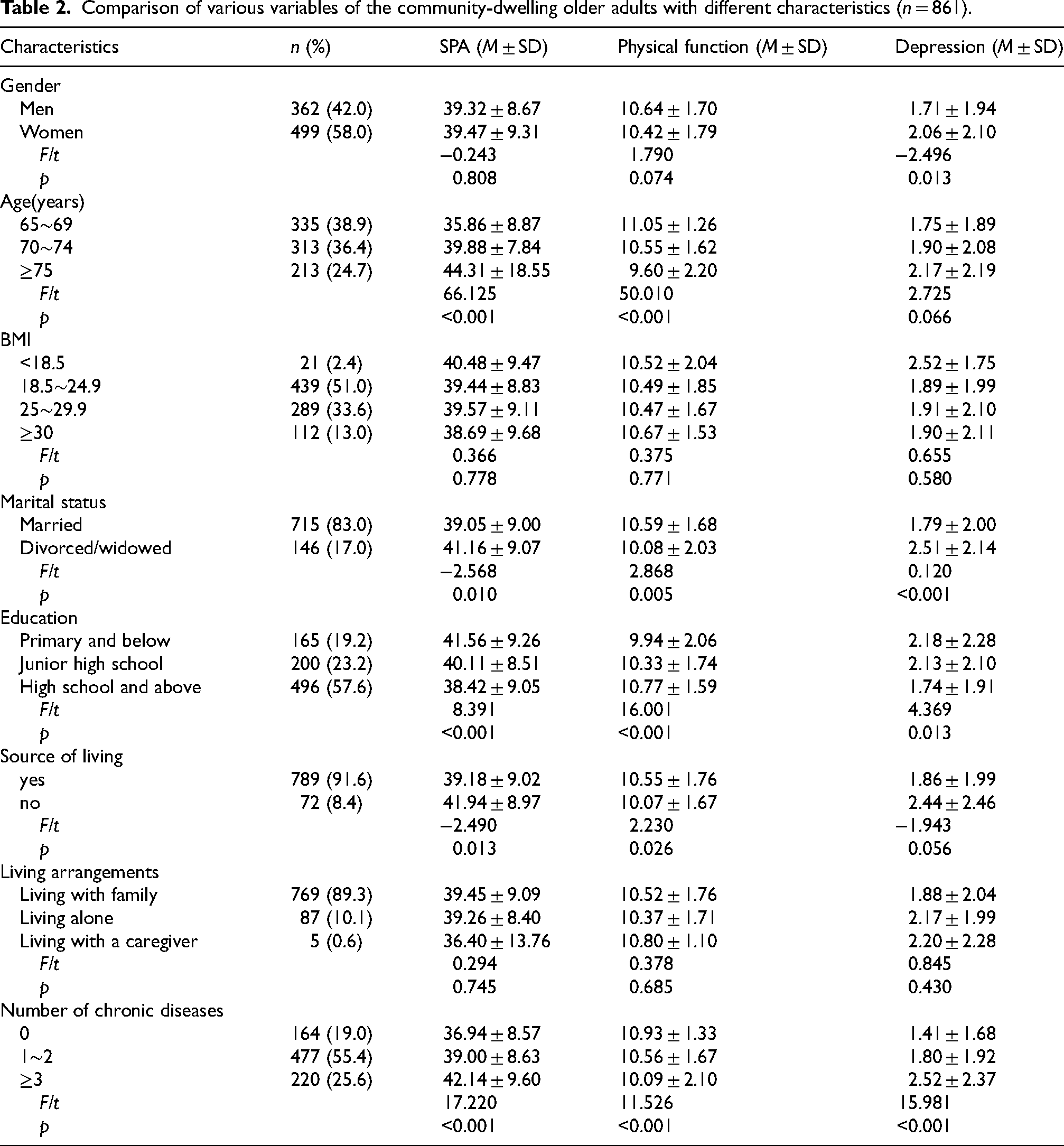
A total of 861 community-dwelling older adults were included in this study, with an average age of 71.69 ± 4.99 years. Among them, 114 elderly people were diagnosed with MCR, and the prevalence rate was 13.2%. Among older adults with MCR, 70 were female, accounting for 61.4%. As age increases, SPA, physical function and depression all show a downward trend, and all three exhibit poorer states in females and those with lower educational levels. Detailed general demographic statistics results are shown in Table 2.
Comparison of various variables of the community-dwelling older adults with different characteristics (n = 861).
Descriptive statistics and correlation analysis of variables
In this study, the average scores for SPA, physical function, and depression were 39.41 ± 9.04, 10.51 ± 1.75, and 1.91 ± 2.04, respectively. Physical function was negatively correlated with both SPA and depression (r = −0.474, p < 0.01; r = −0.339, p < 0.01), SPA is positively associated with depression (r = 0.399, p < 0.01).
Mediation role of physical function
A mediation effect model was constructed using Mplus8.3 with SPA as the independent variable, physical function as the mediating variable, and depression as the dependent variable. The maximum likelihood method (ML) was used for fitting tests, and all variables were centralized. The model fits well with the data: χ2/df = 5.037, CFI = 0.989, TLI = 0.916, RMSEA = 0.068 and SRMr = 0.023. The bootstrap test was conducted with 5000 random samples to test the mediating effect and calculate the 95%CI. The results showed that after controlling for age, gender, BMI, and education level, SPA still had an indirect impact on depression through physical function, and the mediating effect was 0.058 (95%CI = 0.035∼0.086, p < 0.001), accounting for 16.2% of the total effect. The direct impact of SPA was 0.359 (95%CI = 0.282∼0.437, p < 0.001), as shown in Table 3.
Analysis results of mediating effect of physical function.

Test of moderated mediation model effect
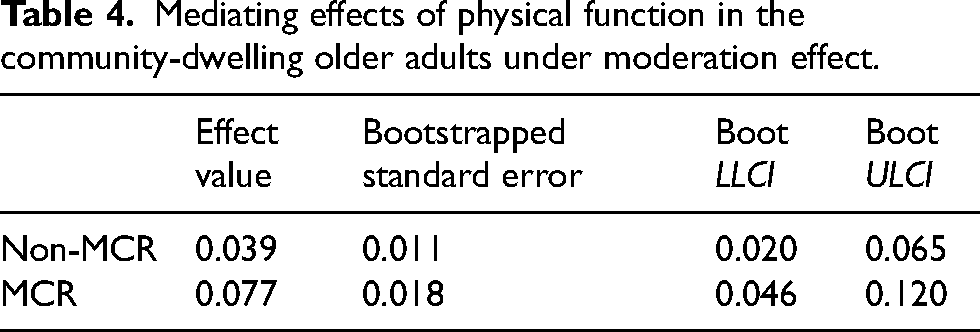
The relationship between SPA and physical function may be influenced by MCR. To verify whether the first half of the mediating effect between SPA and depression was moderated by MCR (Figure 1), the data were processed again using Mplus8.3. The results of the interaction term between SPA and MCR were significant (β = −0.089, p = 0.009), indicating that MCR moderates the relationship between SPA and physical function. To more clearly demonstrate how MCR moderates this relationship, a simple slope test was performed (Figure 2). The results showed that SPA had an impact on physical function regardless of whether older adults were diagnosed with MCR or not. However, compared to non-MCR elderly individuals (simple slope = −0.182, 95%CI = −0.263∼−0.097, p < 0.001), those with MCR showed a lower level of physical function (simple slope = −0.359, 95%CI = −0.458∼−0.269, p < 0.001). This indicates that to some extent, the mediating role of physical function in the relationship between SPA and depression in elderly individuals with MCR is on the rise, which can exacerbate the decline in physical function and increase the incidence of depression. It can be seen that MCR can regulate the first half path of self perceived aging → physical function → depression, as shown in Table 4.
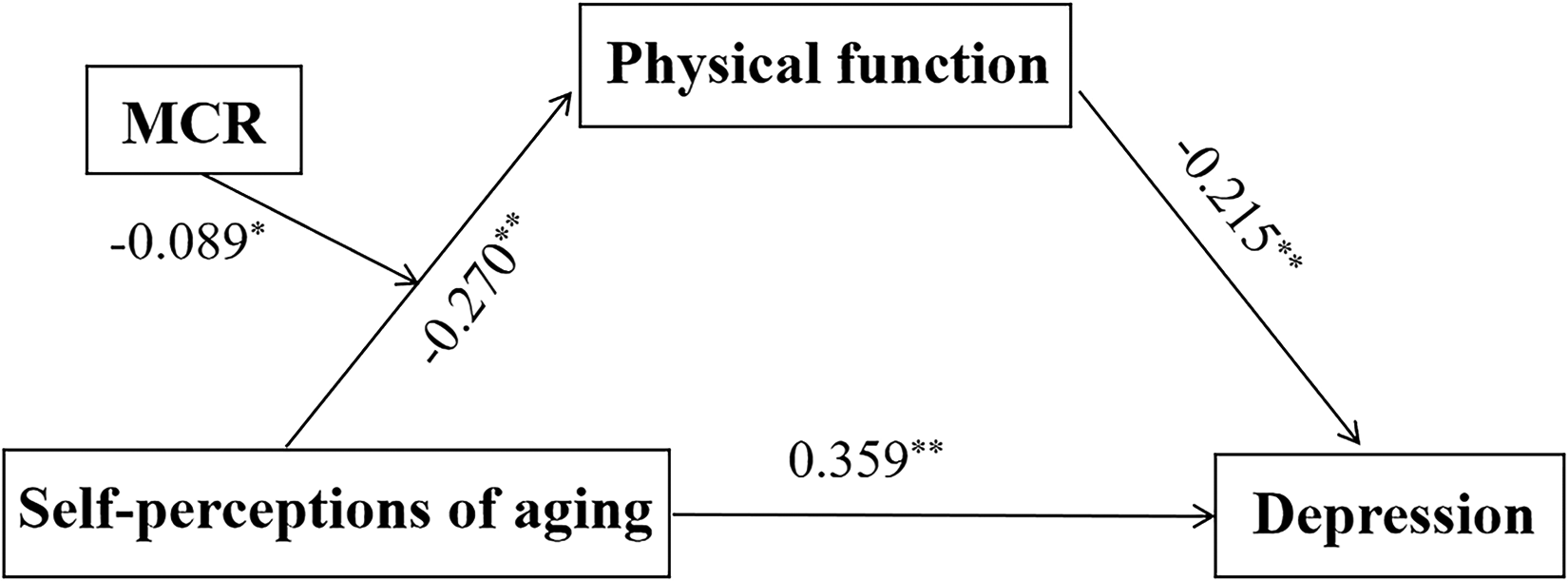
Moderated mediation model.

Moderating effects of the MCR between self-perceptions of aging and physical function.
Mediating effects of physical function in the community-dwelling older adults under moderation effect.
Discussion
The relationship between self-perceptions of aging and depression
The average score of SPA in this study was 39.41 ± 9.04, and females showed a more negative perception of aging, which was lower than that of community-dwelling older adults in Xu's study. 27 This may be because most elderly people live in cities in this study, have a higher education level and have fewer types of chronic diseases, which can actively mitigate the physical and psychological impacts of aging and counteract the internalization of stereotypes. The different perceptions of age among elderly people may have different impacts on their mental health. In our study, SPA showed a positive association with depression levels, which is consistent with previous research. 28 A more positive SPA can contribute to future changes in depressive symptoms. Additionally, positive SPA is often accompanied by higher self-efficacy, 29 which makes depression less likely to occur. 30 And they are more confident or motivated to take positive coping styles to relieve stress, thereby reducing depression and other negative emotions. On the contrary, older adults holding negative aging perceptions have lower sensory control, which predisposes them to subjective cognitive decline and is associated with stronger and more depressive symptoms.31,32 Especially in the digital age, the gap between the values, thoughts, and lifestyles of older adults and young is widening, and they are often stereotyped as forgetful, useless, lonely, and unattractive, which can easily lead to depression. Older adults with positive attitudes about their aging are more likely to better counter outside comments and perceptions, regulate their negative emotions, and maintain good behavior and lifestyle to promote health. The relationship between SPA and aging-related outcomes is complex and changes dynamically with life experience. Therefore, it is necessary to identify negative aging perception and its negative impacts, and timely adjust to positive aging perception for the prevention and control of depressive symptoms in older adults.
The mediating role of physical function between self-perceptions of aging and depression
Physical and mental health are an interactive process. Physical function of community-dwelling older adults shows a downward trend with the increase in age and is worse among females, widows, and those with lower education level. In this study, older adults with positive aging perception showed better physical function. In Westerhof's study, SPA was shown to have a significant impact on a range of health markers, including functional health, physical illness, and health-related quality of life. 33 Moreover, psychological variables such as SPA are better predictors of physical health outcomes, and elderly people are more likely to interpret physical illnesses as direct signs of aging. 34 In a longitudinal study, negative perceptions of aging were found to be a strong predictor of decline in cognitive and physical functioning. 35 Due to the activation of stereotypes, individuals with negative aging perceptions believe that health problems are the inevitable consequences of aging and that health practices are futile. They also have a biased understanding of their bodily functions, believing that they cannot learn or complete beneficial physical activities, resulting in lower levels of physical function. In addition, older adults with negative aging perceptions are susceptible to social isolation, 36 which is an independent risk of further decline in physical functioning. 37 When individuals with younger psychological age and more positive SPA have more confidence in their ability to cope with age-related changes and expect better results, they tend to engage in preventive health behaviors and reinforce these behaviors, such as increasing physical activity, in order to have better physical function.
The mediation effect analysis results show that SPA may have a negative impact on depression through physical function. In this study, there was a negative correlation between physical function and depressive symptoms, consistent with previous research. 38 Older adults with better physical function exhibit a more active state in various physical activities, and high-level physical activity is of great significance in preventing blood lipid abnormalities. 39 And previous study has found that abnormal lipid metabolism has a certain impact on the process of depression. 40 In addition, the decline of physical function caused by aging, including changes in muscle endurance, balance control and slow gait speed, is inevitable, and poor physical function may limit the complex daily activities of older adults, increase their dependence on the outside world, lose the sense of autonomy, increase psychological pressure leading to negative emotions. 41 However, long-term exercise intervention promotes improvement in depressive symptoms while improving physical function and body composition. 42 When older adults begin to face a decline in physical function or disability, they are most likely to experience poor mood and plummeting mental health, gradually reducing their normal social participation, 43 becoming closed off, and gradually showing a tendency to depression. Conversely, good physical performance in older adults may increase outdoor activity time and opportunities for social interaction, which is beneficial to their mental health and helps prevent and manage depression. Therefore, good physical function may be one of the prerequisites for participation in social activities and maintaining a healthy psychological state.
The moderating role of MCR
Older adults with MCR may exhibit higher levels of aging awareness. 44 The prevalence of MCR in this study was 13.2%, which is in line with the national average. 45 In addition, older adults with MCR may exhibit worse physical function (including gait and balance performance) than those without MCR. 46 The present study found that the enhancement effect of SPA on physical function was significantly higher in the MCR elderly group than in the non-MCR group. Slow gait and subjective cognitive decline are coexisting issues in elderly individuals with MCR. Decreased gait speed is considered a result of aging, and with the decrease in activity caused by decreased gait speed, physical function also shows a downward trend. In addition, previous studies have found that elderly people with subjective cognitive decline are also prone to negative emotions and physical functioning. 47 When both are present simultaneously, it may show or even exacerbate negative SPA, reducing their willingness to actively seek health and predisposing individuals to decline in physical function. In Bortone's research, it was also found that MCR is associated with poorer physical function and status, manifested as increased fatigue, low muscle strength, low physical activity, and increased levels of CRP and IL-6. 48 In contrast, the good physical or cognitive condition of the non-MCR older adults make them more confident to face the changes and stresses brought by aging. These individuals generally have a more positive perception of aging and are more likely to take action to cultivate healthy behaviors and achieve a good functional state. 49
MCR with the advantage of convenient evaluation, is reversible and can maintain a stable state or achieve certain improvement within a certain period. 50 Therefore, it can serve as a screening pathway or intervention target, which can play its advantages in the community and detect older adults with MCR symptoms in time, so that intervention can be carried out in the preclinical stage to delay or reverse the deterioration of cognitive function and physical function and promote healthy aging.
Research significance and limitations of the research
The results of this study suggest that the impact of SPA on depression may be mediated by physical function, while the moderating role of MCR clarifies when and how this mediating mechanism becomes stronger or weaker, thereby extending and refining the mediation model. Investigation into the moderating role of MCR highlights the critical importance of interventions during the window of opportunity presented by the MCR. These findings provide a new perspective for developing intervention strategies targeting depression in older adults.
The limitations of this study should be addressed. First of all, the cross-sectional study method limits the causal relationship between variables. Future longitudinal studies will provide strong causal evidence. Second, in addition to the confounders mentioned in this study, there may be more confounding variables that affect the results, such as daily physical activity, frailty, social support, etc., and these omissions may affect the interpretation of the study results. Finally, this study focused solely on urban older adults in plain regions of China, who generally have favorable sociodemographic characteristics. Future multi-center studies should be conducted to include a broader range of participants to enhance the generalizability of the research results.
Conclusions
In summary, this study has revealed distinct pathways underlying the association between SPA and depression. Positive SPA, as an important resource, can protect the body from damage after serious health events and has a negative impact on depression through physical function. Therefore, in the health management of community-dwelling older adults, more attention should be paid to the psychological changes in the aging process of older adults on the premise of maintaining good physical function, focusing on the coordinated development of the body, mind and soul. At the same time, MCR can be used as a convenient screening tool to reverse the progression of adverse outcomes in the preclinical phase.
Footnotes
Acknowledgements
We would like to express our appreciation to all participants in this study and thank all investigators who participated in data collection.

Ethical considerations
The study was approved by the Ethics Committee of Xinxiang Medical University (XYLL-20230003).
Consent to participate
All participants provided informed consent.
Consent for publication
Not applicable
Author contribution(s)
Funding
The authors disclosed receipt of the following financial support for the research, authorship, and/or publication of this article: This work was supported by Postgraduate Education Reform and Quality Improvement Project of Henan Province (YJS2024JD25); and Graduate Research Innovation Support Program of Xinxiang Medical University (YJSCX202313Z).
Declaration of conflicting interests
The authors declared no potential conflicts of interest with respect to the research, authorship, and/or publication of this article.
Data availability statement
The data supporting the findings of this study are available upon request from the corresponding author. However, the data used in this study are not publicly available due to privacy or ethical restrictions.