



Abstract
Background
The lipid accumulation product (LAP) index, a sex-specific indicator of abdominal lipid accumulation, has emerged as a predictor for cardiometabolic disease. However, its association with dementia has been rarely explored in population-based studies.
Objective
We sought to investigate the associations of LAP index with all-cause dementia, Alzheimer's disease (AD), and vascular dementia (VaD) as well as with serum inflammatory cytokines among rural-dwelling older adults in China.
Methods
This cross-sectional study included 5670 participants (age ≥ 60 years), with data available in 1851 individuals on serum inflammatory cytokines (interleukin-6, tumor necrosis factor-α, and monocyte chemoattractant protein-1). Dementia and subtypes were diagnosed following the international criteria. The LAP index was calculated as [waist circumference (cm)-65] × triglycerides (mmol/L) for men and [waist circumference (cm)-58] × triglycerides (mmol/L) for women. Data were analyzed using multiple logistic and linear regression models.
Results
Of the 5670 participants, dementia was diagnosed in 305 persons (194 with AD and 100 with VaD). As a continuous variable, the LAP index was associated with multivariable-adjusted odds ratios of 1.28 (95% confidence interval: 1.01–1.61) for all-cause dementia, 1.40 (1.05–1.86) for AD, and 1.12 (0.75–1.66) for VaD. As a categorical variable, the highest (versus lowest) quintile of LAP index was associated with multivariable-adjusted odds ratios of 1.91 (1.17–3.12) for dementia, 2.18 (1.19–3.99) for AD, and 1.88 (0.78–4.53) for VaD. A higher LAP index was significantly correlated with serum inflammatory cytokines (p < 0.05).
Conclusions
High LAP index is linked with dementia and AD in older adults and chronic systemic inflammation might represent a plausible biological pathway.
This is a visual representation of the abstract.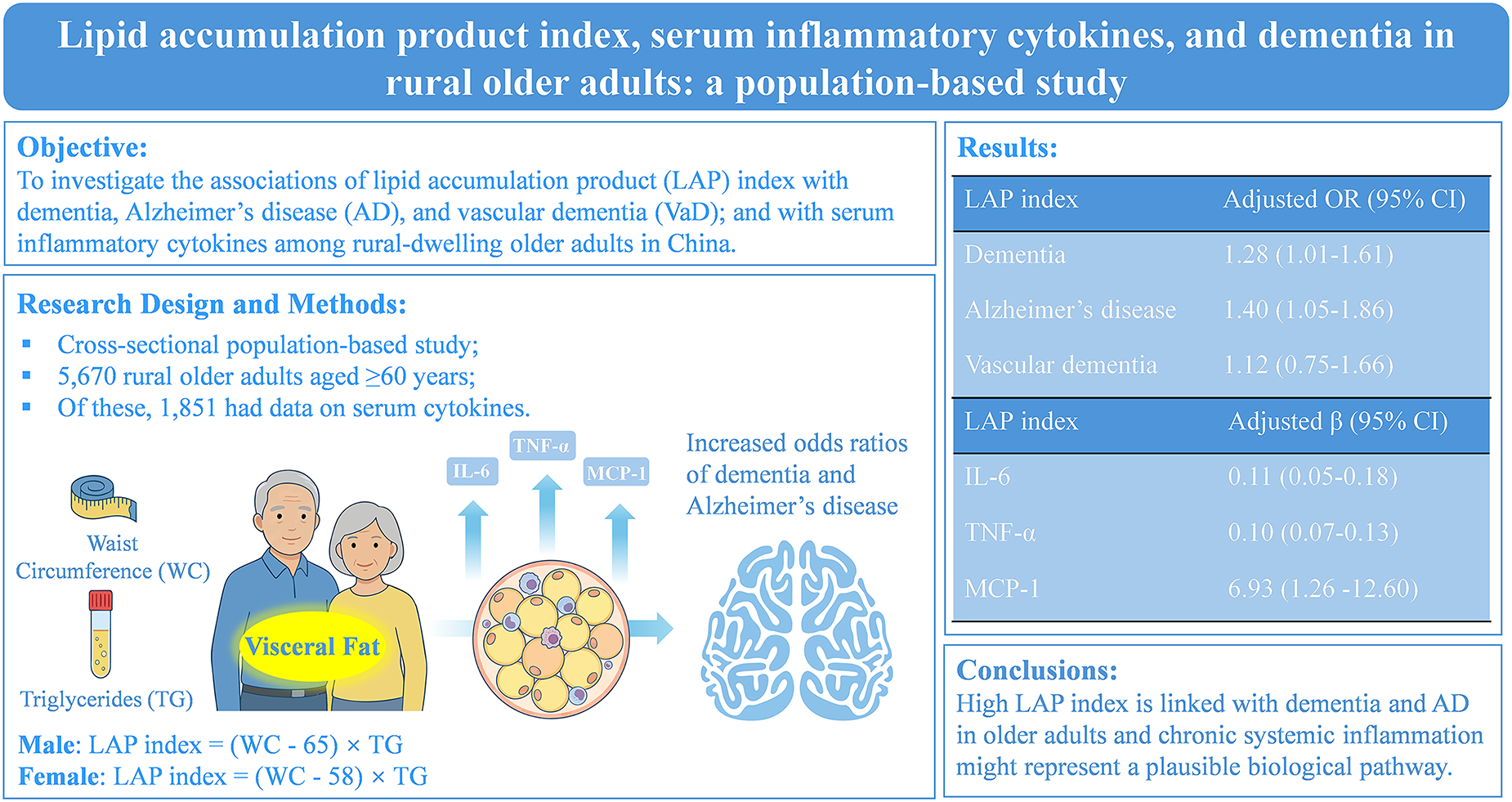
Introduction
Along with global population aging, dementia has emerged as a major public health challenge. Dementia not only poses a major threat to the well-being of older adults 1 but also exerts considerable health, social, and economic costs on individuals, families, and societies. 2 Given the limited availability of effective treatments for dementia, 3 ascertaining risk factors of dementia for preventive interventions to maintain cognitive health in older people is urgently needed. 1 Of those modifiable risk factors for dementia, central obesity, characterized by excessive visceral adipose tissue (VAT) accumulation, has garnered increasing attention. 4 Mounting epidemiological evidence indicates that elevated VAT levels are associated with impaired cognitive function.5,6 Additionally, excess VAT is closely linked to an unfavorable cardiometabolic profile, including diabetes, hypertension, and dyslipidemia, 7 all of which have been linked with dementia. 8 Beyond metabolic regulation, VAT could function as a dynamically active endocrine organ capable of secreting various adipokines such as adiponectin, leptin, interleukin-6 (IL-6), tumor necrosis factor-α (TNF-α), and monocyte chemoattractant protein-1 (MCP-1), which could exert both direct and indirect impacts on structures and function of the brain.9,10
Computed tomography (CT) and magnetic resonance imaging (MRI) are recognized as the gold-standard methods to quantify VAT in clinical practice. 11 However, their utility in large-scale epidemiological research of the general population is constrained by high costs, lengthy acquisition times, and exposure to ionizing radiation (specifically with CT), particularly in resource-limited settings such as remote rural areas. 12 Traditional anthropometric indicators (e.g., body mass index [BMI] and waist circumference [WC]) offer practical, low-cost alternatives for assessing adiposity, but these metrics cannot distinguish VAT from subcutaneous fat deposits.13,14 The lipid accumulation product (LAP) index, which is calculated as (WC [cm]-65) × triglyceride (TG) in mmol/L for men and (WC [cm]-58) × TG in mmol/L for women, has emerged as a promising indicator of abdominal lipid accumulation. 13 By integrating anthropometric and biochemical measurements, the LAP index captures both anatomical and metabolic alterations caused by the deposition of visceral fat.15,16 Notably, population-based studies have previously shown that the LAP index outperforms conventional anthropometric indices (e.g., BMI and WC) in predicting diabetes, 17 the metabolic syndrome, 18 and cardiovascular disease. 19 These attributes support its potential utility as an accessible and reliable surrogate marker for VAT accumulation in large-scale population studies.
Current epidemiological evidence linking the LAP index to cognitive dysfunction remains limited. A community-based study in Xi’an, China indicated that an increased LAP index was related to accelerated cognitive decline only among females with normotension. 20 To date, population-based studies have yet to explore the relationships of the LAP index to dementia and main subtypes of dementia.
Thus, in this community-based cross-sectional study, we aimed to investigate the associations between LAP index and dementia, Alzheimer's disease (AD), and vascular dementia (VaD) as well as with serum inflammatory factors among rural older adults in China. Our hypothesis was that an increased LAP index, as a surrogate for VAT accumulation and dysregulated lipid metabolism, might be correlated with dementia, and that systemic inflammation might represent a plausible biological pathway.
Methods
Study design and participants
This community-based cross-sectional study used data that were derived from the baseline examinations of the ongoing Multimodal Interventions to Delay Dementia and Disability in rural China (MIND-China), 21 a participating project of the World-Wide FINGERS Network. This global network aims to apply, test, and optimize the Finnish FINGER-like intervention model for risk reduction and prevention of dementia across cultures and settings. 22 At baseline, the MIND-China project targeted all registered residents ≥ 60 years who resided in the 52 villages of Yanlou Town (n = 7698), Yanggu County, western Shandong Province. In March-September 2018, 5765 residents (74.89% of all eligible individuals) completed the baseline assessments, as previously described. 21 Of these, 49 individuals were excluded owing to a history of severe mental disorders that could potentially confound the diagnosis of dementia, 23 34 participants were excluded due to missing data on WC (n = 33) or TG (n = 1), and 12 participants were excluded due to extreme values of TG (> 15 mmol/L, n = 2) or WC (i.e., WC ≤ 65 cm in 9 men and ≤ 58 cm in 1 woman) in line with the criteria proposed in the original study that developed the LAP index. 16 Thus, the analytical sample included 5670 individuals for examining the associations between LAP index and dementia.
Of the 5670 participants, serum inflammatory cytokines were measured in 1852 persons; of these, 1 participant was excluded due to values below the detection limit, leaving 1851 persons for the analysis involving serum cytokines. Participants in this serum cytokine subsample was selected through the cluster (village)-based sampling from all 52 villages of Yanlou Town, plus persons who were diagnosed with dementia from all the villages that were not randomly selected and who had blood samples available, as previously reported. 24 Figure 1 shows the flowchart of the study participants.
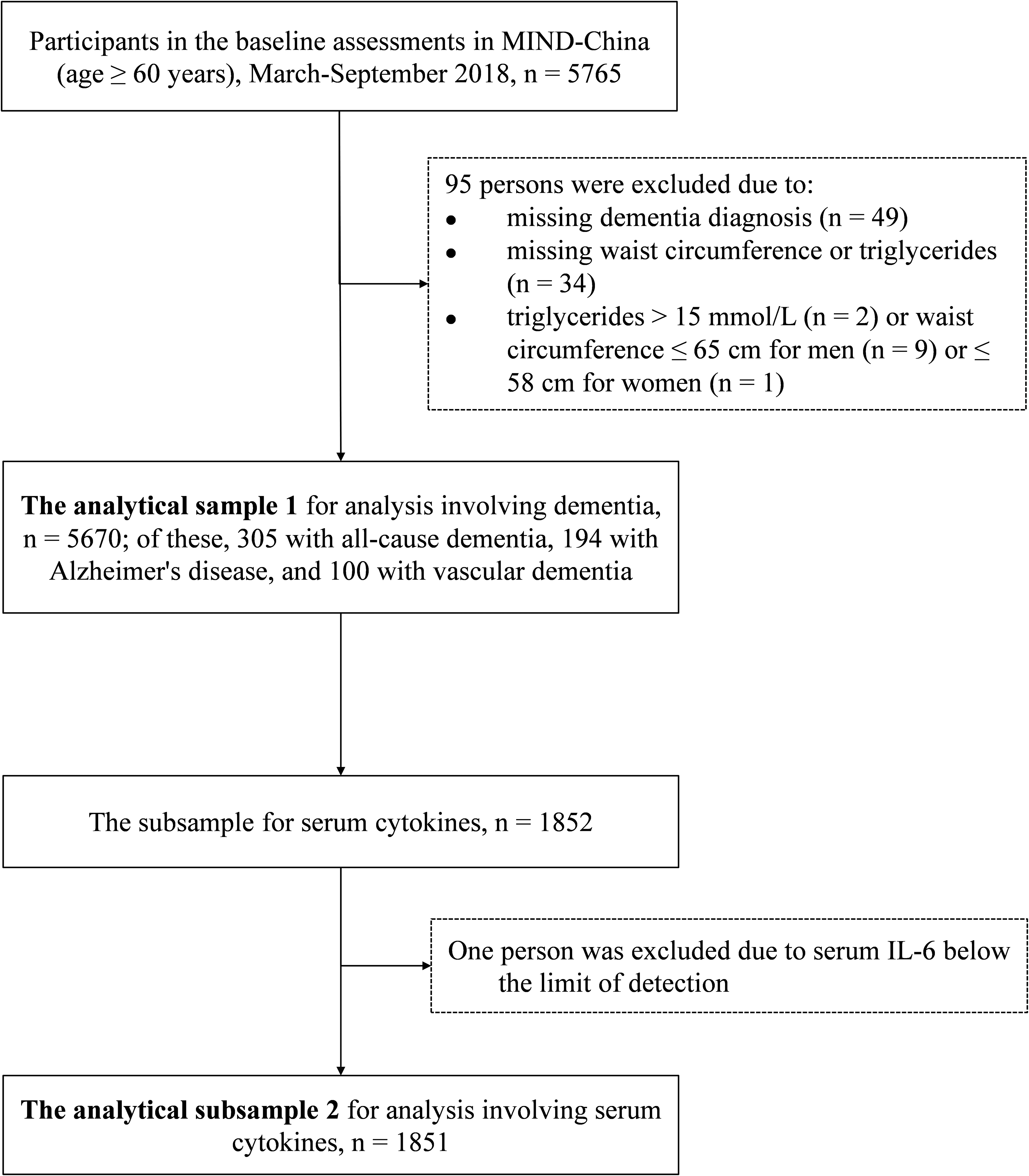
Flowchart of the study participants. IL-6: interleukin-6; MIND-China: Multimodal Interventions to Delay Dementia and Disability in rural China.
Participants included in the cytokine sample (n = 1852) were younger (mean age, 70.25 versus 71.22 years, p < 0.001) and had a higher proportion of females (60.58% versus 55.61%, p < 0.001) than those not included. However, there was no significant difference in educational level between the two groups (p > 0.05) (Supplemental Table 1).
The MIND-China protocol received approval from the Medical Ethics Committee of Shandong Provincial Hospital in Jinan, Shandong, China (Approval No.: 2018-014). Prior to the assessments, written informed consent was obtained from participants or their legal proxies in cases where the participants had cognitive impairment. The MIND-China project was registered in the Chinese Clinical Trial Registry (Registration No.: ChiCTR1800017758; Date of registration: 13 August 2018).
Data collection
A standardized data collection procedure was followed by trained medical staff to collect data through face-to-face interviews, clinical examinations, neuropsychological testing, and laboratory analyses. 21 Briefly, data were collected following a structured questionnaire, which included social demographic characteristics, lifestyle factors, health conditions, current medication use, and cognitive function. All medications were categorized and coded in accordance with the Anatomical Therapeutic Chemical (ATC) classification system. 25
After over five minutes of rest, arterial blood pressure was measured in the right arm with a validated electronic sphygmomanometer (HEM-7127J, Omron Corporation, Kyoto, Japan). An electrocardiograph (CM300, COMEN, Shenzhen, China) was used to collect resting twelve-lead electrocardiography (ECG) data, which were subsequently analyzed by a qualified physician. For WC assessment, a tape measure was placed horizontally at the midpoint between the lower rib and the iliac crest in standing subjects, achieving a precision of 0.1 cm. Height and weight were recorded with participants in light clothing without footwear. Peripheral blood specimens were obtained after an overnight fast. The lipid profile was measured with an Automatic Biochemical Analyzer (CS-600B, DIRUI Corporation, Changchun, China) at the Yanlou Town Hospital laboratory. Multiple polymerase chain reaction amplification (iGeneTech Bioscience Co., Ltd, Beijing, China) was employed for apolipoprotein E (APOE) genotyping. 26
LAP index
The LAP index was computed using sex-specific formulas: for males, [WC (cm)-65] × [TG (mmol/L)]; for females, [WC (cm)-58] × [TG (mmol/L)]. 16 Exclusion criteria were applied in line with the recommendations as follows 16 : males with WC ≤ 65 cm, females with WC ≤ 58 cm, or any participants with blood TG >15 mmol/L.
Clinical diagnosis of dementia, AD, and VaD
The clinical diagnosis of dementia was based on the criteria outlined in the Diagnostic and Statistical Manual of Mental Disorders, 4th Edition, criteria, 27 in which a standardized three-step protocol was followed as described previously. 21 In brief, first, the well-trained clinical staff and interviewers conducted regular clinical examinations and neurocognitive assessments, during which data on medical history, cognitive function, and the activities of daily living were collected and documented following the structured questionnaires. Second, the neurologists with special expertise in dementia diagnosis and clinical management reviewed all records from the initial evaluations to establish a preliminary diagnosis for individuals suspected of having dementia. Finally, for those with suspected dementia or insufficient initial information for the judgement of their dementia status, the neurologists performed additional face-to-face interviews with the participants and their informants to reach a clinical diagnosis of dementia. We further classified dementia into AD and VaD based on respective diagnostic criteria. Specifically, AD was clinically diagnosed following the National Institute on Aging-Alzheimer's Association criteria for probable AD dementia. 28 VaD was clinically diagnosed following the National Institute of Neurological Disorders and Stroke and the Association Internationale pour la Recherche et l’Enseignement en Neurosciences criteria for probable VaD. 29
Measurements of serum cytokines
As previously reported, 21 peripheral blood specimens were collected in the morning after an overnight fast, followed by centrifugation to obtain serum. Subsequently, serum samples were subdivided into aliquots, preserved at −80°C, and thawed immediately prior to quantitative analysis. IL-6, TNF-α, and MCP-1 were measured with Meso Scale Discovery V-PLEX Proinflammatory Panel. 30 We measured serum rather than plasma (with anticoagulants like EDTA or heparin) cytokines because anticoagulants may inhibit or induce cytokine synthesis, thus altering cytokine levels. 31 Two quality control samples were used to assess the intra- and inter-plate coefficients of variation. The intra- and inter-assay coefficients of variation for both quality control samples were below 15%.
Assessments and definitions of covariates
Demographic factors, lifestyles, health conditions, and APOE genotype, known to be potentially associated with both LAP index and cognitive outcomes, were considered potential confounders in the analysis. The assessments and definitions of these factors were conducted using the approaches described previously.21,32 In brief, educational level was categorized into no formal schooling, primary school, and middle school or above. Smoking status and alcohol consumption were dichotomized into current versus non-smokers or non-drinkers, respectively. Leisure-time physical inactivity was defined as participation in any recreational physical activity less than once weekly. BMI was derived from objectively measured height and weight using the formula: BMI = weight (kg) / height (m2). Hypertension was defined for participants with systolic/diastolic blood pressure ≥ 140/90 mmHg or current utilization of antihypertensive medication (ATC codes C02, C03, and C07-C09). Diabetes mellitus was identified via a self-reported history of diabetes, a fasting blood glucose level ≥ 7.0 mmol/L, or the use of hypoglycemic agents/ insulin (ATC code A10). Hypercholesterolemia was defined as fasting total cholesterol ≥ 6.2 mmol/L or current administration of lipid-lowering drugs (ATC code: C10). Coronary heart disease (CHD) was determined based on self-reported history of the disease or ECG examination, including angina, myocardial infarction, coronary angioplasty, and coronary artery bypass grafting. Clinical stroke was determined through self-reported history and neurological evaluation. The APOE genotype was dichotomized into ε4 allele carriers versus noncarriers.
Statistical analysis
The characteristics of study participants were reported as frequencies (%) for categorical variables and median (interquartile range) for skewed-distributed continuous variables. The characteristics of participants by dementia status were compared using the chi-square test for categorical variables and the Mann-Whitney U test for skewed continuous variables. The restricted cubic splines with three knots positioned at the 10th, 50th, and 90th percentiles were employed to flexibly model and visualize the relationship patterns between the LAP index and dementia, AD, and VaD. Potential non-linearity was evaluated using the likelihood-ratio test by comparing the model with a single linear term against the model including both linear and cubic spline terms. If the likelihood-ratio test showed no evidence of nonlinearity (p for nonlinearity > 0.05), we examined the linear associations between the LAP index and dementia disorders by modeling the LAP index both as a continuous variable and as sex-specific quintiles, using binary and multinomial logistic regression models, as appropriate. In the serum cytokine subsample, multivariable linear regression models were employed to examine the associations between the LAP index and serum inflammatory cytokines (TNF-α, IL-6, and MCP-1). IL-6 and TNF-α were natural log-transformed to reduce skewness. The main results were reported from two models: Model 1 was adjusted for age, sex, and education; Model 2 was further adjusted for smoking, alcohol consumption, physical inactivity, CHD, stroke, diabetes, hypertension, hypercholesterolemia, BMI, and APOE genotype. We assessed multicollinearity among predictor variables by calculating the variance inflation factor. All variance inflation factors were below 3, suggesting no substantial multicollinearity.
We used IBM SPSS Statistics for Windows, version 25.0 (IBM Corp., Armonk, NY) and R 4.5.1 (R Core Team. R Foundation for Statistical Computing, Vienna, Austria. https://www.R-project.org) for all analyses. A two-tailed p value of 0.05 or less was considered statistically significant.
Results
Characteristics of study participants
The median age of the 5670 participants in the analytical sample was 70 years (age range: 60–99; interquartile range: 67-74), 57.32% were women, and 40.49% had no formal school education. Of these, 305 participants (5.38%) were diagnosed with all-cause dementia, including 194 (3.42%) with AD, 100 (1.76%) with VaD, and 11 (0.19%) with other types of dementia. Compared to the dementia-free participants, those with dementia were older; more likely to be female; less educated; less likely to be obese, smoke, and drink alcohol; and more likely to have diabetes, CHD, and stroke. However, participants without and with dementia did not significantly differ in the distribution of APOE genotype, physical inactivity, hypertension, and hypercholesterolemia, or in the levels of TG, WC, and LAP index (all p > 0.05) (Table 1).
Characteristics of study participants by dementia status.
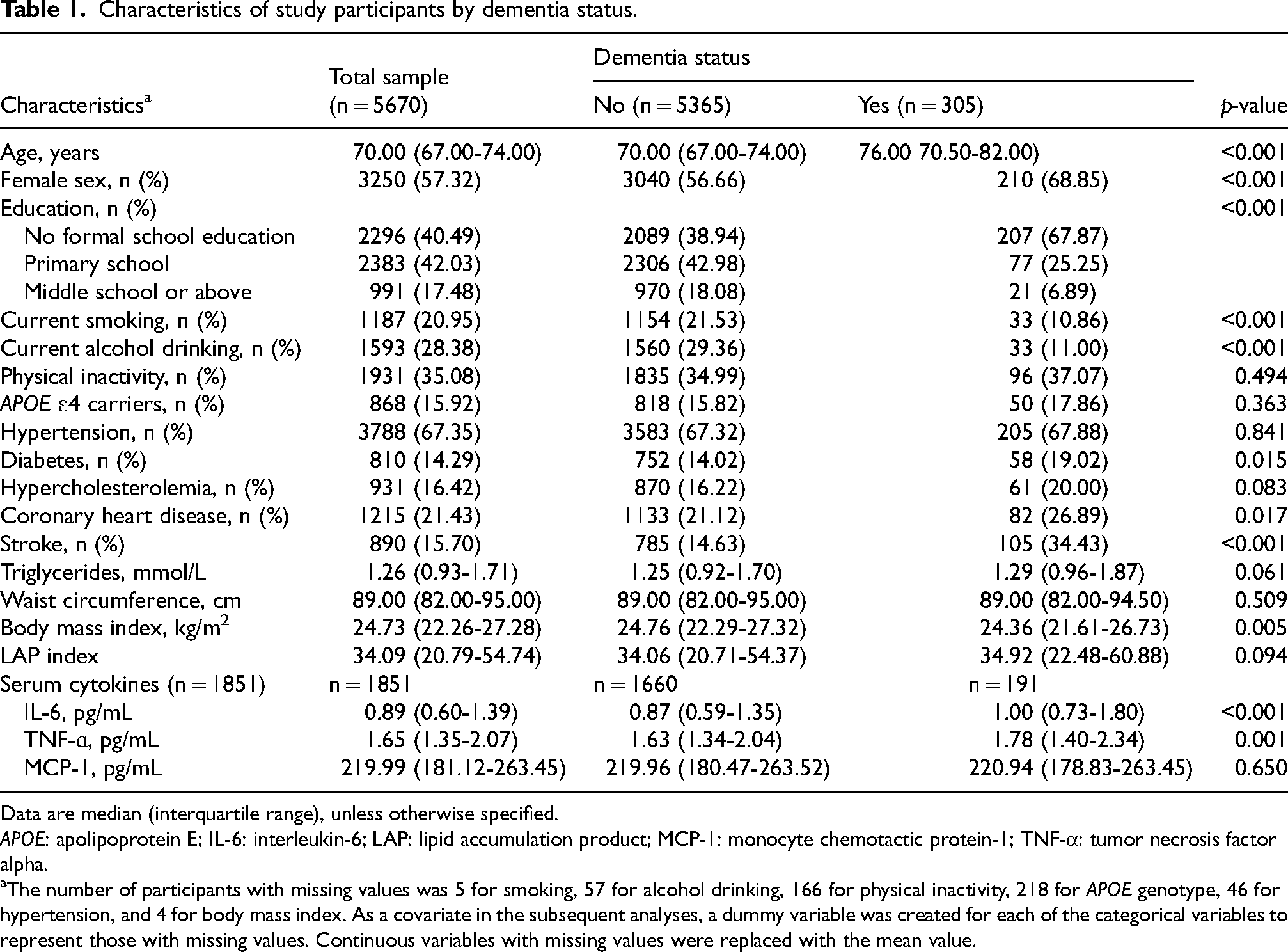
Data are median (interquartile range), unless otherwise specified.
APOE: apolipoprotein E; IL-6: interleukin-6; LAP: lipid accumulation product; MCP-1: monocyte chemotactic protein-1; TNF-α: tumor necrosis factor alpha.
The number of participants with missing values was 5 for smoking, 57 for alcohol drinking, 166 for physical inactivity, 218 for APOE genotype, 46 for hypertension, and 4 for body mass index. As a covariate in the subsequent analyses, a dummy variable was created for each of the categorical variables to represent those with missing values. Continuous variables with missing values were replaced with the mean value.
Associations of the LAP index with dementia and subtypes (n = 5670)
The restricted cubic spline curves showed linear associations between the LAP index and the odds ratio (OR) of dementia, AD, and VaD (all p for nonlinearity > 0.05) (Figure 2). Thus, in the subsequent analyses, the LAP index was analyzed both as a continuous variable and a categorical variable (quintiles), with the first quintile being used as the reference group. As a continuous variable, the LAP index was associated with a 21% elevated likelihood of all-cause dementia in the demographic-adjusted model (OR, 1.21; 95% confidence interval [CI], 1.02–1.45; p < 0.05); the associations remained statistically significant after additionally adjusting for multiple potential confounders (OR, 1.28; 95% CI, 1.01–1.61; p < 0.05) (Table 2). The LAP index showed no significant association with AD in the demographic-adjusted model, but further controlling for additional potential confounding factors, the LAP index was significantly associated with a 40% increase in the likelihood of AD (OR, 1.40; 95% CI, 1.05–1.86; p< 0.05). The LAP index was significantly associated with VaD in Model 1, but this relationship was diluted and became statistically non-significant in Model 2 (Table 2).
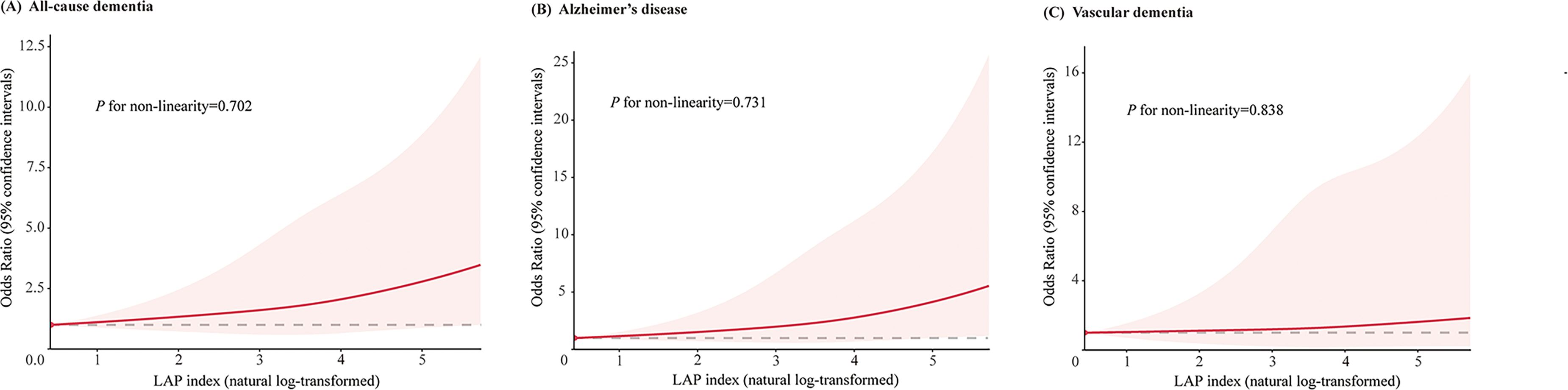
Associations of the LAP index with (A) all-cause dementia, (B) Alzheimer's disease, (C) and vascular dementia. LAP: lipid accumulation product. Solid lines represent adjusted odds ratios and shaded areas indicate 95% confidence intervals derived from restricted cubic spline logistic regression models that were adjusted for age, sex, education, current smoking, alcohol consumption, physical inactivity, coronary heart disease, stroke, diabetes, hypertension, hypercholesterolemia, body mass index, and APOE genotype. In the analysis, LAP index was used as an independent variable and dementia status as a dependent variable.
Associations of the LAP index with all-cause dementia, Alzheimer's disease, and vascular dementia (n = 5670).

LAP: lipid accumulation product.
Data were odds ratios (95% confidence intervals) derived from logistic regression models. Model 1 was adjusted for age, sex, and education; Model 2 was additionally adjusted for current smoking, alcohol consumption, physical inactivity, coronary heart disease, stroke, diabetes, hypertension, hypercholesterolemia, body mass index, and APOE genotype.
The LAP index as a continuous variable was natural log-transformed.
*p < 0.05, **p < 0.01, ***p < 0.001.
When the LAP index was analyzed as sex-specific quintiles, the highest (versus lowest) quintile was significantly associated with all-cause dementia in both the demographic- and multivariable-adjusted models (Table 2). Similarly, the highest (versus lowest) quintile of the LAP index showed a significant association with AD in the fully-adjusted model (OR, 2.18; 95% CI, 1.19–3.99; p for trend = 0.015). Besides, the highest (versus lowest) quintile was significantly associated with VaD in the demographic-adjusted model (OR 3.65, 95% CI, 1.87–7.14; p for trend = 0.001), but the association was attenuated and became statistically non-significant after further adjusting for other examined confounders (Table 2).
Associations of the LAP index with serum cytokines (n = 1851)
In the subsample with serum cytokine data (n = 1851), controlling for demographic factors, a higher LAP index was significantly associated with elevated serum IL-6 (β-coefficient = 0.15; 95% CI, 0.10–0.20), TNF-α (0.08; 0.06–0.11), and MCP-1 (6.01; 1.38–10.64). These associations remained statistically significant in model 2 when additionally controlling for multiple potential confounders. When the LAP index analyzed as sex-specific quintiles, the highest (versus lowest) quintile demonstrated analogous associations with elevated serum IL-6, TNF-α, and MCP-1 in both the demographic- and multivariable-adjusted models (Table 3).
Associations between the LAP index and serum inflammatory cytokines (n = 1851).
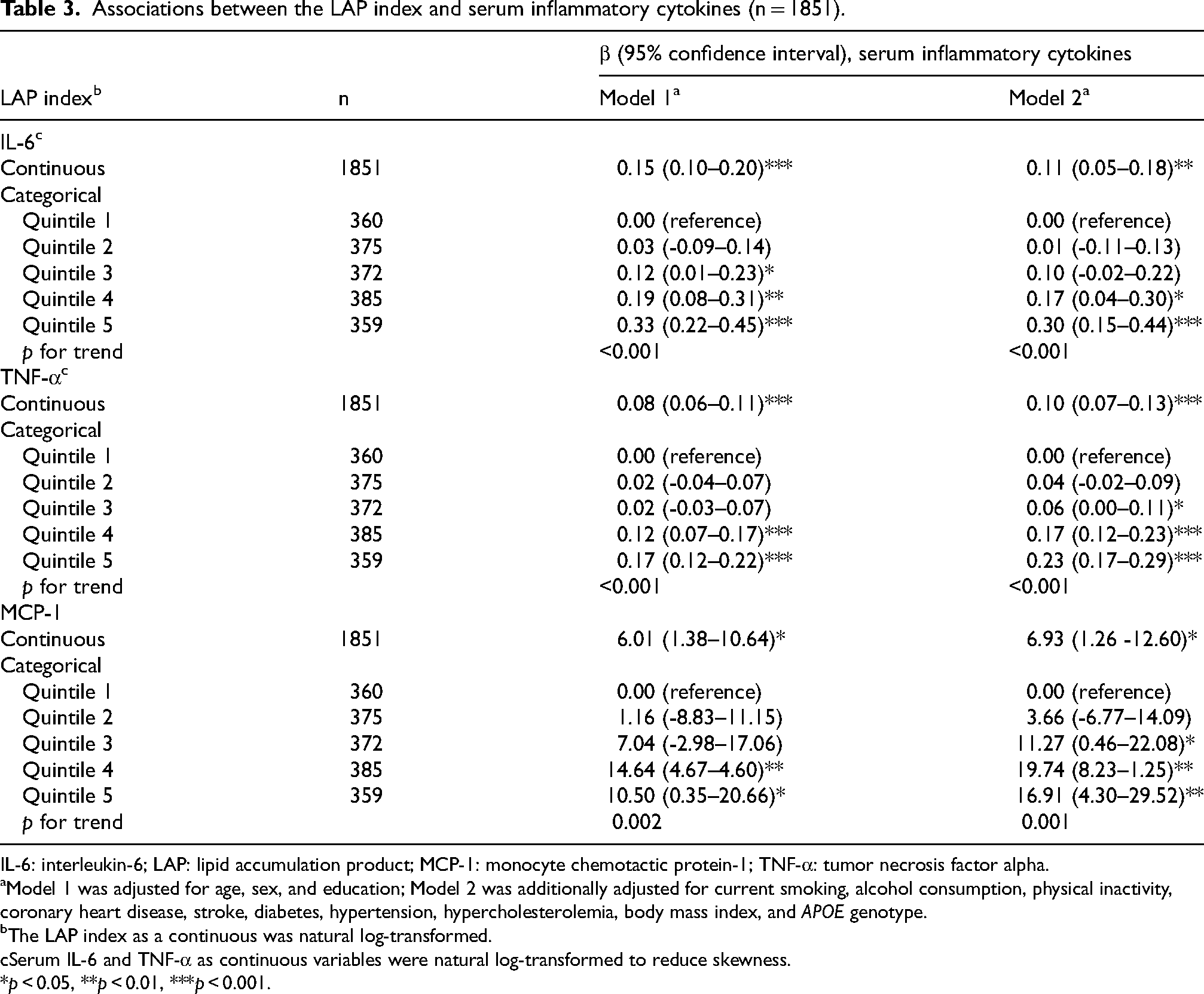
IL-6: interleukin-6; LAP: lipid accumulation product; MCP-1: monocyte chemotactic protein-1; TNF-α: tumor necrosis factor alpha.
Model 1 was adjusted for age, sex, and education; Model 2 was additionally adjusted for current smoking, alcohol consumption, physical inactivity, coronary heart disease, stroke, diabetes, hypertension, hypercholesterolemia, body mass index, and APOE genotype.
The LAP index as a continuous was natural log-transformed.
Serum IL-6 and TNF-α as continuous variables were natural log-transformed to reduce skewness.
*p < 0.05, **p < 0.01, ***p < 0.001.
Discussion
Our large-scale population-based study of rural-dwelling older adults in China revealed that (1) a higher LAP index was associated with an increased likelihood of all-cause dementia and AD independent of a range of potential confounders and (2) a higher LAP index was notably associated with elevated levels of serum inflammatory cytokines. These results suggest that chronic systemic inflammation might represent a plausible biological pathway underlying the observed association between abdominal lipid accumulation, as indicated by a high LAP index, and dementia or AD.
To the best of our knowledge, this was the first population-based study that investigated the associations of the LAP index with dementia and subtypes of dementia as well as serum inflammatory cytokines. Our research extended the findings from previous studies that largely focused on cognitive outcomes such as mild cognitive impairment and global cognitive scores (e.g., the Mini-Mental State Examination)20,33,34 by showing evidence for the association of a higher LAP index with increased likelihoods of dementia and AD. Furthermore, our findings were aligned with imaging-based studies that reported associations between a higher VAT and poorer cognitive performance, 5 which together supported the biological plausibility of the LAP index as a surrogate indicator of abdominal lipid accumulation for poor cognitive function and dementia in older people.
It is noteworthy that the LAP index was significantly associated with an increased likelihood of AD when further adjusting for multiple potential confounders, especially with regard to BMI, suggesting the major confounding effect of BMI in their cross-sectional association. This is aligned with the frequently reported obesity paradox that a higher BMI is across-sectionally associated with a reduced likelihood of AD in older adults.35,36 This finding underscores the necessity of adequately controlling for BMI and other metabolic confounders when examining the association of abdominal lipid accumulation with dementia disorders.
Several pathophysiological mechanisms may underlie the observed associations between the LAP index and dementia and AD. First, VAT accumulation promotes macrophage infiltration and the release of proinflammatory cytokines (e.g., TNF-α, MCP-1, and IL-6), thereby triggering a state of chronic systemic inflammation and oxidative stress. 37 These inflammatory mediators function by binding to their cognate receptors on cerebral microvascular endothelial cells and activating downstream signaling cascades such as the NF-κB pathway, thereby causing downregulation and disorganized distribution of tight junction proteins and further impairing blood-brain barrier integrity. 38 Increased blood-brain barrier permeability facilitates the infiltration of peripheral inflammatory factors into the central nervous system, 39 which triggers microglial activation, sustained neuroinflammation, synaptic dysfunction, and ultimately driving cognitive decline. 40 Second, excessive abdominal adiposity is strongly linked to insulin resistance, which may exacerbate AD pathology by promoting amyloid-β deposition and tau hyperphosphorylation. 41 Third, elevated VAT levels are closely linked to cardiometabolic disorders such as hypertension, diabetes, and CHD, all of which are associated with dementia and AD.42,43
Given that VAT could modulate brain structure and function partially via secreted adipokines,9,44 we hypothesized that the LAP index would be associated with dementia through key inflammatory factors (i.e., IL-6, TNF-α, and MCP-1) released by excess VAT. In support of this hypothesis, our data did show the associations of the LAP index with these cytokines. This is in line with the reports from previous studies that visceral adiposity measures (e.g., WC and BMI) were associated with serum inflammatory biomarkers such as IL6, TNFα, and C-reactive protein.45,46 The concordance of these results across diverse populations strengthens the view that visceral adiposity is a driving factor of systemic inflammation, which could be further linked with cognitive phenotypes (e.g., dementia).
A major strength of our study refers to as the population-based design that engaged a large sample of rural-dwelling older adults in China. Notably, a substantial percentage of this population had no or very limited schooling education. Such a sociodemographic group has long been markedly understudied in research of abdominal adiposity and dementia. However, our study does have some limitations. First, given the cross-sectional nature of the study design, the observed associations cannot be interpreted as a causal relationship, and may be subject to selective survival bias, which might result in an underestimation of the true correlations. Second, although the LAP index is a reliable surrogate marker for abdominal adiposity and lipid metabolic dysfunction, the imaging modalities (e.g., CT or MRI) remain the gold-standard approach for quantifying VAT. Finally, our study sample was drawn exclusively from a single rural region in western Shandong province, which may limit the generalizability of our research findings to more diverse or heterogeneous populations.
Conclusion
This population-based study of rural Chinese older adults revealed that abdominal adiposity, as indicated by high LAP index, was independently associated with elevated likelihoods of all-cause dementia and AD, and was significantly correlated with elevated serum IL-6, TNF-α, and MCP-1, supporting the hypothesis that inflammatory pathways may represent a plausible biological mechanism linking abdominal adiposity with dementia or AD in older adults. Future prospective cohort studies are warranted to clarify the potential causal associations between the LAP index and cognitive phenotypes as well as the underlying neuropathological mechanisms, with the ultimate goal of developing preventive interventions to delay dementia and cognitive decline.
Supplemental Material
sj-docx-1-alz-10.1177_13872877261427765 - Supplemental material for Lipid accumulation product index, serum inflammatory cytokines, and dementia in rural older adults: A population-based study
Supplemental material, sj-docx-1-alz-10.1177_13872877261427765 for Lipid accumulation product index, serum inflammatory cytokines, and dementia in rural older adults: A population-based study by Yun Liu, Zhifeng Shang, Jiafeng Wang, Tingting Hou, Cuicui Liu, Yajun Liang, Lin Cong, Yongxiang Wang, Na Tian, Yifeng Du and Chengxuan Qiu in Journal of Alzheimer's Disease
Footnotes
Acknowledgements
The authors would like to thank all the participants of the MIND-China project as well as staff at Yanlou Town Hospital and the MIND-China Research Team at the Department of Neurology, Shandong Provincial Hospital affiliated to Shandong First Medical University for their collaboration in data collection and management.
ORCID iDs

Ethical considerations
The data collection procedures for the MIND-China study were approved by the Ethics Committee on Human Experimentation at Shandong Provincial Hospital affiliated to Shandong First Medical University in Jinan, Shandong, China.
Consent to participate
Written informed consents were obtained from all participants.
Consent for publication
Not applicable
Author contribution(s)
Funding
The authors disclosed receipt of the following financial support for the research, authorship, and/or publication of this article: The MIND-China Project on which this work was based was supported in part by grants from the Brain Science and Brain-Like Intelligence Technology Research Projects of China (grant no.: 2021ZD0201808), the Natural Science Foundation of Shandong Province (grant no.: ZR2024MH023 and ZR2021QH240), the Taishan Scholar Program of Shandong Province, China (grant no. tsqn202312347), the National Natural Science Foundation of China (grant no.: 82200980), Shandong Provincial Key Research and Development Program (grant no. 2024CXPT085), the National Key R&D Program of China Ministry of Sciences and Technology (grant no.: 2022YFC3501404 and 2017YFC1310100), the Integrated Traditional Chinese and Western Medicine Program in Shandong Province (grant no.: YXH2019ZXY008). C Qiu received grants from the Swedish Research Council (grant no.: 2020-01574), the Swedish Research Council for Health, Working Life and Welfare (program grant no.: 2023-01125, PI, M Kivipelto; work-package PI, C Qiu), and the Swedish Foundation for International Cooperation in Research and Higher Education (grant no.: CH2019-8320). The funding agencies had no role in the study design, data collection and analysis, the writing of this article, and they did not impose any restrictions regarding the publication of the report.
Declaration of conflicting interests
The authors declared the following potential conflicts of interest with respect to the research, authorship, and/or publication of this article: Yifeng Du and Yongxiang Wang are Editorial Board Members of the Journal of Alzheimer’s Disease but were not involved in the peerreview process nor did they have access to any information regarding its peer-review. All other authors declare that they have no competing interests.
Data availability statement
The datasets used and/or analyzed during the current study are available from the corresponding author upon reasonable request and approval by the Steering Committee of MIND-China.
Supplemental material
Supplemental material for this article is available online.
References
Supplementary Material
Please find the following supplemental material available below.
For Open Access articles published under a Creative Commons License, all supplemental material carries the same license as the article it is associated with.
For non-Open Access articles published, all supplemental material carries a non-exclusive license, and permission requests for re-use of supplemental material or any part of supplemental material shall be sent directly to the copyright owner as specified in the copyright notice associated with the article.
