



Abstract
Background
Neuropsychiatric symptoms (NPS) are among the most challenging manifestations of dementia. Currently available assessment tools often fail to fully capture their complexity. Thus, novel approaches are needed.
Objective
The present study aimed to explore the application of a diary-based assessment of NPS in patients with dementia attending a memory clinic and compare this novel approach with the Neuropsychiatric Inventory (NPI) in terms of scores, time efficiency, and influence of potential confounders.
Methods
All consecutive outpatients with dementia and NPS attending the Center for Cognitive Disorders and Dementia, Sapienza University of Rome, were considered for enrollment. Caregivers completed a specially designed NPS diary for one month. Subsequently, a standard NPI (sNPI) was administered, and two diary-based NPIs (dNPI-R1 and dNPI-R2) were independently reconstructed by trained raters. Scores were compared using repeated-measures ANOVA and Cochran's Q test. Multivariate regression models were conducted to examine the impact of covariates. In addition, the NPS diary was qualitatively analyzed, and caregivers provided structured feedback.
Results
Forty patient-caregiver dyads completed the study procedures. The sNPI yielded higher scores and longer administration time than dNPIs. Diary-based assessments showed high inter-rater reliability and were less influenced by caregiver burden.
Conclusions
The NPS diary offered an ecological, caregiver stress-resistant, reliable, time-efficient, and feasible evaluation of NPS. It allowed a detailed description of NPS, including temporal fluctuations, triggers, and resolution strategies. Integration of this complementary modality with standard evaluations allows a more comprehensive assessment of NPS in dementia.
Keywords
Introduction
Neuropsychiatric symptoms (NPS) of dementia constitute a heterogeneous group of psychological reactions, psychiatric manifestations, and behavioral disturbances that can be observed in patients with dementia of any etiology. 1 These disturbances encompass a wide spectrum of clinical manifestations that may involve mood, perception, behavior, and basic physiological functions such as sleep and appetite.2,3 Due to their high prevalence, NPS constitute a core manifestation of dementia. 4 The clinical relevance of NPS lies in their impact on patients, caregivers, and the healthcare system, being closely linked with adverse outcomes such as increased rates of hospitalization and institutionalization, worse cognitive and functional performance, and reduced quality of life for both patients and caregivers.5–7
NPS represent a challenge in the management and care of people living with dementia. Owing to their polymorphic phenotypic expression, marked inter- and intra-individual variability, and tendency to manifest with large fluctuations over time, NPS rank among the most challenging manifestations of dementia in their detection, characterization, and management. 8 In routine clinical practice, NPS are usually assessed using validated scales and questionnaires, with the Neuropsychiatric Inventory (NPI) being one of the most commonly used. 9 However, standard evaluations and currently available tools may fail to fully capture the complexity and impact of NPS and are often influenced by several biases. 10 For instance, commonly used tools are limited by their reliance on predefined symptom lists,11,12 potential caregiver-related biases (e.g., distress, exhaustion, anxiety, and cultural influences), 13 insufficient consideration of environmental triggers, retrospective design prone to recall bias, and inability to detect temporal fluctuations. 14 In other words, many currently adopted instruments may be limited in their ability to reflect the heterogeneity of NPS, the uniqueness of patients, and the variability in caregiver profiles and reporting abilities. Based on these limitations, novel modalities need to be explored.
In this regard, a promising complementary aid may be constituted by diaries. This approach is already widely and successfully adopted in different medical settings to monitor variables characterized by inner variability (i.e., headache, blood pressure, glycemia, asthma).15–19 A more comprehensive understanding and monitoring of these parameters and symptoms over time, rather than through a single-point assessment, is critical for informing clinical decision-making. In this context, NPS may represent an ideal target for a diary-based evaluation approach. 20 The ability to identify and adequately characterize these symptoms is indeed an essential element for optimizing their management.
The present study aimed to explore the feasibility and clinical value of a diary-based approach for the detection and characterization of NPS in patients with dementia. An NPS diary was developed for caregiver completion to enable temporal mapping and free-text description of symptoms. This novel tool was then compared to the standard NPI (sNPI) regarding scoring, time efficiency, and sensitivity to potential confounders, using a cross-sectional approach.
This tool differs from previously proposed diary-based instruments 21 in that it was conceived for home use by informal caregivers and structured to provide a more flexible, narrative-oriented description of NPS in daily life. In accordance with the principles of Ecological Momentary Assessment (EMA), 22 capturing behaviors within their natural environment and close to their time of occurrence may mitigate retrospective recall and caregiver-related biases. Based on this rationale, we hypothesized that this diary-based approach would enable an ecological, straightforward, and reliable assessment of NPS. Enabling caregivers to record patients’ behaviors in real time and freely describe their phenomenology and contextual features, rather than anchoring responses to predefined and structured questions, the diary may yield deeper insights into NPS, ultimately supporting more personalized and effective management.
Methods
Setting and participants
The study was conducted at the Center for Cognitive Disorders and Dementia (CCDD) of the Department of Human Neuroscience, Sapienza University of Rome. All dyads composed of a patient with dementia and their primary caregiver, consecutively attending the CCDD for a routine outpatient visit between September 2024 and January 2025, were considered for inclusion. Eligibility was based on the following inclusion criteria: i) diagnosis of dementia according to the National Institute on Aging-Alzheimer's Association (NIA-AA) criteria for all-cause dementia 23 ; ii) presence of at least one NPS reported by the caregiver through an unstructured clinical interview; iii) availability of a reliable caregiver able to providing detailed information about NPS (i.e., living with or daily visiting the patient for at least 16 h), with adequate reading and writing abilities to complete the diary; iv) psychoactive drugs (i.e., neuroleptics, antidepressants, benzodiazepines, cholinesterase inhibitors, memantine) at stable doses during the observation period.
Procedures
During the visit, caregivers received a paper-based NPS diary from a neurologist, along with standardized oral instructions and practical examples to complete it daily at home. These instructions were also summarized in a brief written note accompanying the diary. Caregivers were additionally provided with the study team's contact details to address any questions that might arise during the month-long completion period. A follow-up appointment was scheduled after one month, when the diary was returned to the clinician. A sNPI was administered to the primary caregiver by a trained neuropsychologist. Two different diary-based NPIs (dNPI-R1 and dNPI-R2) were independently reconstructed by two trained neurologists based on the information provided by caregivers in the diary. To ensure the independence of ratings, R1 and R2 were blinded both to each other's assessments and to the sNPI results for the entire duration of the procedure.
Data collection
Information about the age, sex, and education of patients and their primary caregivers was collected during the visit. Additional data included the nature of the caregiver-patient relationship and the number of hours spent together daily. Dementia subtypes were clinically diagnosed according to current international criteria.22–26 Global cognition was assessed with the Mini-Mental State Examination (MMSE), 27 a widely used 30-point screening tool that evaluates orientation, memory, attention, language, and visuospatial construction, with higher scores indicating better cognitive performance. Functional independence was assessed using the Katz Index of Independence in Activities of Daily Living (ADL) 28 and the Lawton-Brody Instrumental Activities of Daily Living (IADL) Scale. 29 The ADL evaluates six basic self-care functions (e.g., bathing, dressing, toileting, feeding), with each item scored as 0 (dependent) or 1 (independent), yielding a total score from 0 to 6, and lower scores indicate greater functional impairment. The IADL assesses eight more complex daily tasks (e.g., telephone use, shopping, transportation, medication, financial management) with total scores ranging from 0 to 8, where lower values reflect poorer functional independence. Dementia severity was rated using the Global Deterioration Scale (GDS), 30 a seven-stage, clinician-rated instrument describing cognitive and functional decline spanning from normal cognition (stage 1) to severe dementia (stage 7).
Neuropsychiatric inventory (NPI)
The NPI 9 is one of the most used instruments in clinical practice for assessing NPS in dementia and is largely considered a gold standard tool for measuring and monitoring their frequency and severity.9,31 The NPI-12 is based on the retrospective evaluation of the previous month across twelve behavioral domains: 1) delusions; 2) hallucinations; 3) agitation/aggression; 4) depression/dysphoria; 5) anxiety; 6) euphoria/elation; 7) apathy/indifference; 8) disinhibition; 9) irritability/lability; 10) aberrant motor behavior; 11) sleep and nighttime behavior disorders, and 12) appetite and eating disorders. The presence or absence of symptoms is assessed through a general screening question within each domain. When present, symptoms are rated according to their severity (from 1, “mild”, to 3, “severe”) and frequency (from 1, “occasionally”, to 4, “very frequently”). Each item's score is calculated by multiplying frequency and severity (i.e., frequency × severity), and a total NPI score is obtained by summing all item scores, with a possible range from 0 to 144. Higher scores indicate greater severity of NPS.
Neuropsychiatric symptoms (NPS) diary
The NPS diary was specifically developed for this study by a team of neurologists with expertise in dementia care. Its structure was informed by the findings from a previous study exploring the usability of similar diary-based tools, 20 which guided refinements to the layout and instructions before its implementation. Reconstruction of NPI scores from the diary was undertaken as a pilot and exploratory procedure, drawing on methodological principles adopted in previous research. 21
The NPS diary featured a legend where each NPS from the NPI was assigned a unique letter of the alphabet. These letters were incorporated into a table, with columns representing the days and rows corresponding to hours. Caregivers were instructed to mark the letter associated with the observed NPS in the corresponding box for the specific day and time of occurrence. Furthermore, each episode was documented in a grid, designed to allow a more detailed description. This section was organized into six columns: 1) Legend: indicating the letter corresponding to the symptom; 2) Date: specifying when the episode occurred; 3) Description: providing a narrative account of the event; 4) Severity: rated as “mild,” “moderate,” or “severe”; 5) Triggering factors: noting any potential precipitating elements; and; 6) Resolution: describing how the episode was managed or resolved. An example of the diary can be found in the Supplemental Material.
Based on the legend, the narrative descriptions, the reported severity, and the observed frequency of each NPS, the two raters independently assigned a severity score (from 1, “mild,” to 3, “severe”) and a frequency score (from 1, “occasionally,” to 4, “very frequently”) to every symptom. Following standard NPI scoring rules, each item score was then calculated by multiplying frequency × severity, and the total dNPI score was obtained by summing all item scores, yielding a possible range from 0 to 144, with higher values indicating greater overall severity of NPS.
Zarit burden interview (ZBI)
Caregivers completed a Zarit Burden Interview (ZBI) 32 to measure caregiving burden. The ZBI is a validated and widely used instrument for assessing stress and perceived burden among caregivers of patients with dementia. It evaluates the emotional, physical, and social impact of caregiving through a 22-item questionnaire. Each item is rated on a 5-point Likert scale from 0 (“never”) to 4 (“almost always”). Total scores range from 0 to 88, with higher values indicating greater caregiver burden.
Diary evaluation questionnaire
The diary evaluation questionnaire was inspired by a previously published study on a similar diary. 33 It was adapted to this study to gather caregiver feedback on the diary's usage. Administered in a self-report format, it comprised eight items, each requiring a response of “Yes”, “No,” or “Don't know”.
The questionnaire examined various aspects of the caregiver's experience, including: 1. Overall Satisfaction: assessing general contentment with the diary; 2. Perceived Usefulness: evaluating how effectively the diary helped in understanding the patient's symptoms and their potential causes; 3. Facilitation of Communication: determining the extent to which the diary enhanced interactions with the physician; 4. Impact on Caregiver Stress: exploring whether the diary increased (item 4) or reduced (item 5) caregiver burden; 5. Appropriateness of Time Commitment: assessing whether the time required for diary completion was considered reasonable to its benefits; 6. Ease of Completion: evaluating the perceived difficulty of filling out the diary; and 7. Willingness to Continue Use: inquiring whether caregivers would be inclined to use the diary beyond the study period. The complete questionnaire is included in the Supplemental Material.
Statistical analysis
The Shapiro–Wilk test was used to assess the normality of continuous variables. Descriptive statistics of the patient and primary caregiver characteristics were calculated and reported as absolute frequencies (n) and percentages (%) for categorical variables, as means and standard deviations (SD) for normally distributed continuous variables, and as median and first and third quartiles [Q1 – Q3] for non-normally distributed variables.
Dyads who completed the study procedures were compared with those who did not using Fisher's exact test for categorical variables, the Student's t-test for normally distributed continuous variables, and the Mann–Whitney U test for non-normally distributed continuous variables.
Total scores, single-item scores, and administration time for the sNPI, dNPI-R1, and dNPI-R2 were compared using one-way repeated-measures analysis of variance (ANOVA). Mauchly's test was used to assess the assumption of sphericity; when violated, the Greenhouse-Geisser correction was applied. Effect sizes were estimated using eta squared (η2). Post-hoc pairwise comparisons with Bonferroni correction were performed to explore differences between each assessment method.
Each NPI item was considered clinically relevant if the score was ≥4, based on a previously reported cut-off.4,34 Cochran's Q test was used to compare the prevalence of clinically relevant symptoms across the three assessment modalities. When significant, post-hoc pairwise McNemar tests were conducted to explore specific differences between assessments.
Multivariate linear regression models were conducted separately for each version of the NPI (e.g., sNPI, dNPI-R1, and dNPI-R2) and for each item, to examine the impact of a set of covariates (e.g., age, sex, education, MMSE, caregiver age, caregiver sex, caregiver education, ZBI). Covariates were selected a priori based on a predefined conceptual framework informed by previous literature on determinants of NPS. Demographic variables and cognitive status were included given their established association with NPS prevalence and severity. 2 In addition, caregiver demographic characteristics and caregiver burden were incorporated to account for potential reporting bias and burden-related emotional influences on symptom ratings.31,35 Models were adjusted for multiple comparisons using the Bonferroni correction.
Inter-rater reliability for total scores was assessed using single-measure intraclass correlation coefficients (ICC). ICCs were computed both collectively for all three raters (sNPI, dNPI-R1, dNPI-R2) and in pairwise comparisons to clarify patterns of agreement.
For the diary evaluation questionnaire, responses were summarized using descriptive statistics. The absolute number (n) and percentage (%) of responses for each answer option were calculated for all items.
Statistical significance was set at p < 0.05. All analyses were performed using RStudio v.2024.12.0 (Build 467) for macOS (Posit Software, PBC, 2024).
Qualitative assessment
Qualitative information derived from the diaries was examined using a descriptive, narrative approach. All entries were first reviewed in their original (i.e., Italian) language and then translated into English for reporting. The most representative and informative excerpts were selected and quoted verbatim to illustrate key findings.
Results
Study population
A total of 48 patient-caregiver dyads were considered eligible for inclusion and received the NPS diary. Eight dyads (16.7%) did not complete the study procedures. Specifically, four caregivers (8.3%) withdrew their consent after initially agreeing to participate, two (4.2%) returned incorrectly completed diaries that could not be used for analysis, and one dyad (2%) discontinued due to the patient's death. Caregivers who discontinued were found to spend fewer hours with the patient (18 [16–24] versus 24 [24–24], p < 0.05) compared to those who completed the study. No other between-group differences were found (all p > 0.05). Patients’ characteristics by completion status, together with a comparison between dyads who did and did not complete the study, are reported in the Supplemental Material.
In total, data from 40 (83.3%) dyads were analyzed. Among patients, 20 (50%) were female, the overall median age was 80.5 years [75.8–85], and the median education was 12 years [8–17.3]. Alzheimer's disease was the most common diagnosis, accounting for 18 (45%) participants. Overall, patients exhibited moderate to severe cognitive impairment, as reflected by a mean MMSE score of 16.4 (SD 6.7). Based on GDS ratings, most patients (20, 50%) were classified as having moderate dementia (e.g., GDS 4). A substantial proportion of patients were receiving psychoactive medications at the time of assessment. Neuroleptics were prescribed in 18 (45%) patients, and antidepressants in 16 (40%) patients. Regarding anti-dementia treatments, 19 (47.5%) patients were receiving memantine, and 16 (40%) were treated with cholinesterase inhibitors.
Most caregivers were partners (26, 65%) and female (28, 70%). On average, caregivers spent a median of 24 [24–24] hours per day with the patient. Overall, caregivers reported mild to moderate levels of caregiver stress, as indicated by a median ZBI score of 35 [25.5–52.5]. Sociodemographic and clinical characteristics of the sample are reported in Table 1.
Patients’ and caregivers’ sociodemographic and clinical characteristics. Data are reported as n (%), mean (SD), or median [Q1–Q3].
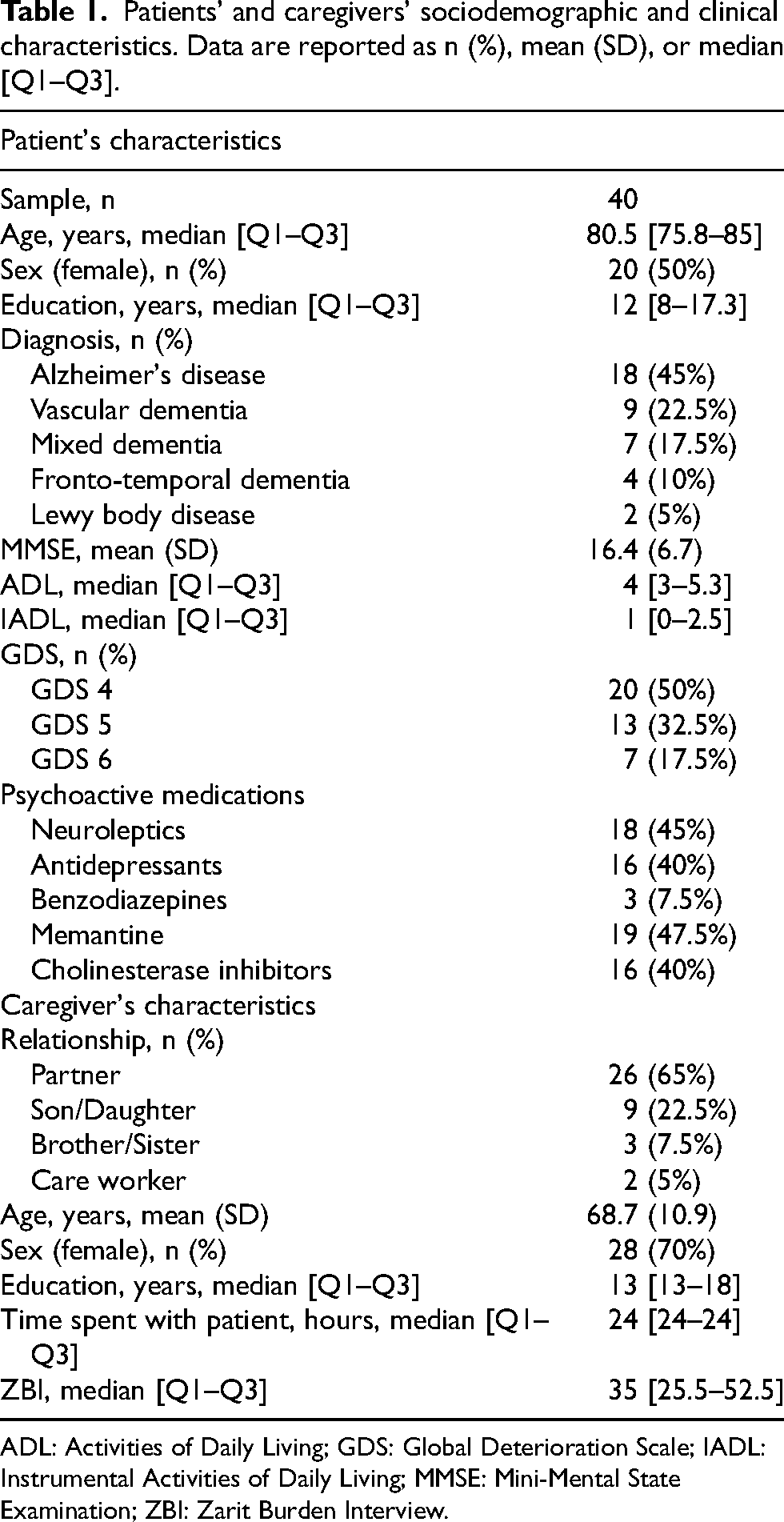
ADL: Activities of Daily Living; GDS: Global Deterioration Scale; IADL: Instrumental Activities of Daily Living; MMSE: Mini-Mental State Examination; ZBI: Zarit Burden Interview.
Total score
One-way repeated-measures ANOVA revealed significant differences in total NPI scores across assessment methods. The sNPI showed a significantly higher mean total score (34.8, SD 21.0) compared to both diary-derived scores (dNPI-R1: 16.6, SD 8.7; dNPI-R2: 18.1, SD 13.4), with a large effect size (η2 = 0.25, p < 0.001). Post hoc pairwise comparisons confirmed that sNPI scores were significantly higher than both dNPI-R1 (p < 0.001) and dNPI-R2 (p < 0.001), while no difference emerged between the two diary-based versions (p = 0.42) (Figure 1).
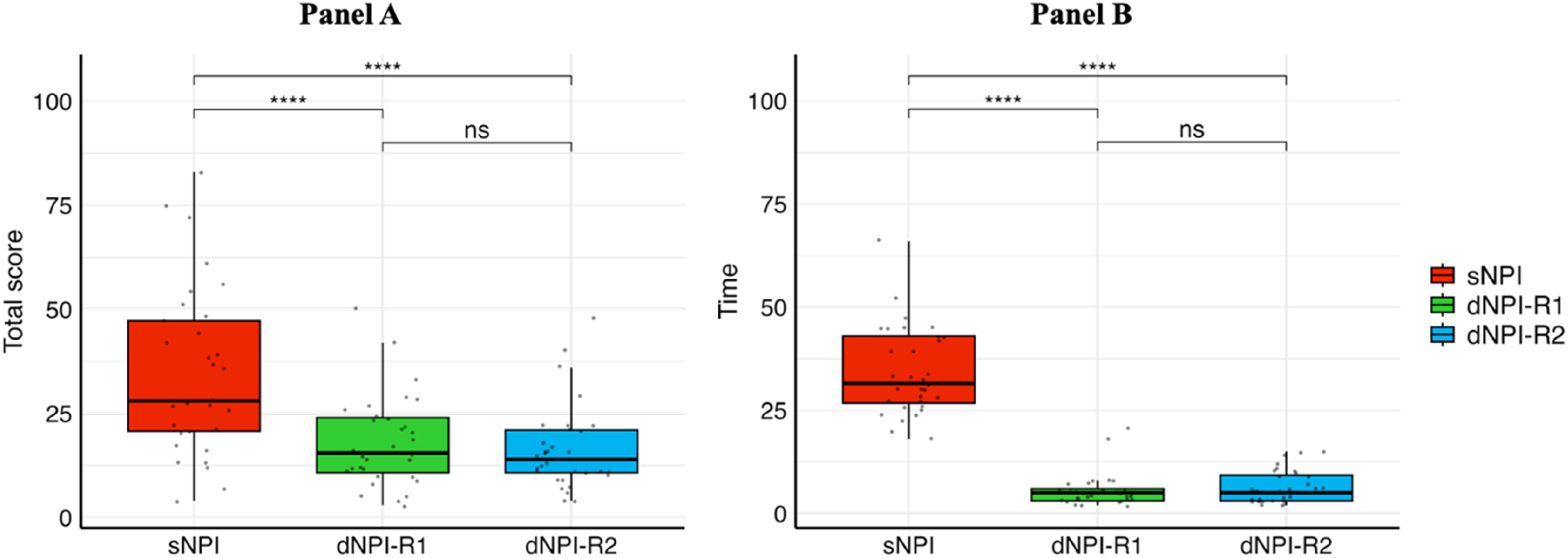
Box-plot showing one-way repeated-measures ANOVA with post hoc Bonferroni-corrected pairwise comparisons for total score (A) and assessment time (B). Data are reported as mean (SD). In the adopted coding, **** corresponds to p < 0.0001. dNPI-RI: Diary-based Neuropsychiatric Inventory Rater 1; dNPI-R2: Diary-based Neuropsychiatric Inventory Rater 2; sNPI: Standard Neuropsychiatric Inventory.
Time
Assessment time differed markedly between the standard and diary-derived NPIs. The mean time required to administer the sNPI was 34.1 min (SD 10.6), significantly longer than both diary-based versions (dNPI-R1: 5.1, SD 3.8; dNPI-R2: 6.2, SD 4.5), with a large effect size (η2 = 0.8, p < 0.001). Post hoc comparisons confirmed that administration time for the sNPI was significantly longer than for both dNPI-R1 (p < 0.001) and dNPI-R2 (p < 0.001), while no significant difference emerged between the two diary-based versions (p = 0.66) (Figure 1).
NPI items
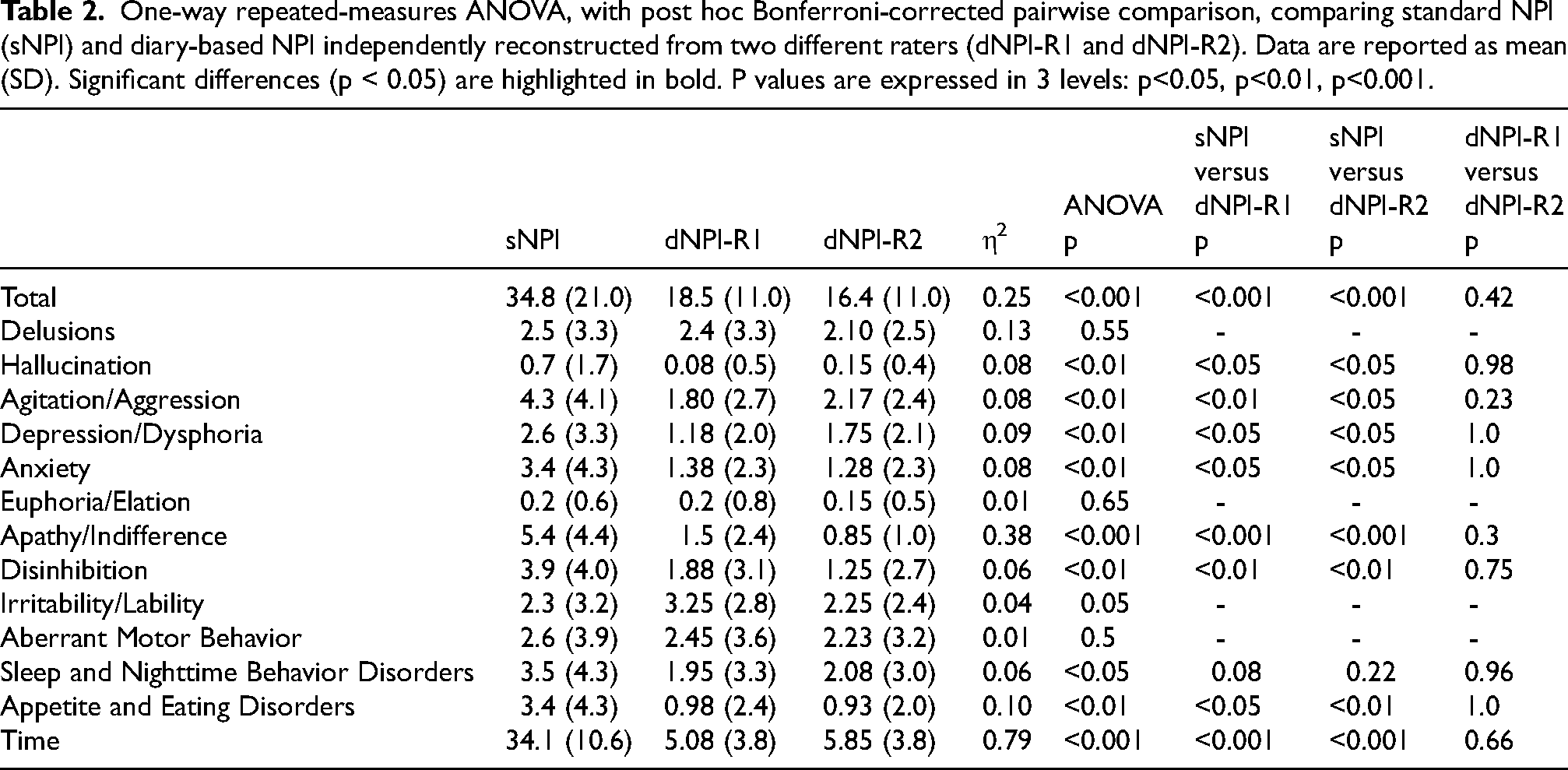
Significant differences across methods were observed in several NPI items. The most pronounced discrepancy emerged in apathy/indifference scores, with the sNPI yielding substantially higher scores (5.4, SD 4.4) compared to both diary-based versions (dNPI-R1: 1.5, SD 2.3; dNPI-R2: 1.3, SD 2.3; η2 = 0.3, p < 0.001). Other domains with significantly higher scores in the sNPI included hallucinations, agitation/aggression, depression/dysphoria, anxiety, disinhibition, sleep and nighttime, and appetite and eating disturbances, with small to medium effect sizes (η2 = 0.06–0.13). No significant differences were found for delusions, euphoria/elation, irritability/lability, and aberrant motor behavior. Post hoc pairwise comparisons confirmed that the differences were driven by higher scores in the sNPI, except for sleep and nighttime disorders, where no differences were observed after Bonferroni correction. All comparisons between dNPI-R1 and dNPI-R2 were non-significant (all p > 0.05). A detailed overview of the mean with SD of the scores, along with effect sizes and corresponding p-values, is provided in Table 2.
One-way repeated-measures ANOVA, with post hoc Bonferroni-corrected pairwise comparison, comparing standard NPI (sNPI) and diary-based NPI independently reconstructed from two different raters (dNPI-R1 and dNPI-R2). Data are reported as mean (SD). Significant differences (p < 0.05) are highlighted in bold. P values are expressed in 3 levels: p<0.05, p<0.01, p<0.001.
Clinically relevant NPI items
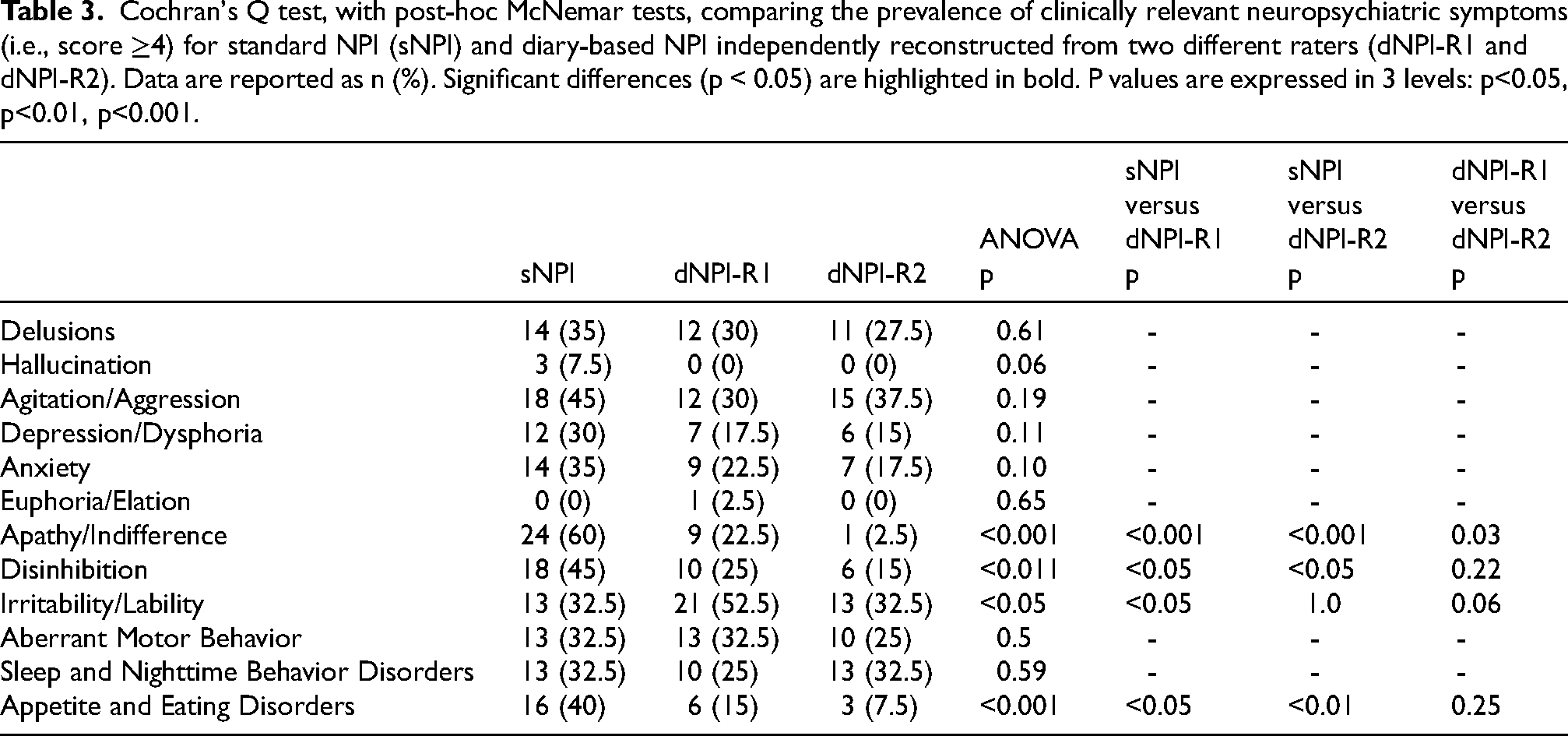
When considering the prevalence of clinically relevant NPI items (i.e., score ≥4), the greatest differences across assessment methods were observed for apathy/indifference, which was reported as clinically relevant in 24 patients (60%) based on the sNPI, but only in 9 (22.5%) and 1 (2.5%) cases based on dNPI-R1 and dNPI-R2, respectively (p < 0.001). Similarly, significant differences were found for disinhibition, irritability/lability, and appetite/eating disorders. For apathy/indifference, disinhibition, and appetite/eating disturbances, post-hoc analyses revealed that differences occurred between the sNPI and both dNPI-R1 and dNPI-R2, with a higher number of clinically relevant symptoms detected by the standard assessment. An exception was irritability/lability, for which the highest prevalence was observed in dNPI-R1 (21, 52.5%), with a significant difference emerging only between sNPI and dNPI-R2 (p < 0.05). No significant differences were found between dNPI-R1 and dNPI-R2 for any item, and no other differences were observed for the remaining domains. A complete overview of prevalence rates and statistical comparisons is provided in Table 3.
Cochran's Q test, with post-hoc McNemar tests, comparing the prevalence of clinically relevant neuropsychiatric symptoms (i.e., score ≥4) for standard NPI (sNPI) and diary-based NPI independently reconstructed from two different raters (dNPI-R1 and dNPI-R2). Data are reported as n (%). Significant differences (p < 0.05) are highlighted in bold. P values are expressed in 3 levels: p<0.05, p<0.01, p<0.001.
Effect of covariates
Multivariate linear regression models revealed that caregiver burden, as measured by the ZBI, was significantly associated with higher sNPI total scores (B = 0.66, 95% CI [0.24, 1.08], p < 0.05, BH-adjusted). No significant associations with other covariates (e.g., age, sex, education, MMSE, caregiver age, caregiver sex, caregiver education) emerged for the total score of sNPI. No significant associations were observed for both diary-based versions. No significant associations with all the investigated potential confounders were found for assessment time.
Similarly to total score, ZBI scores were positively associated with sNPI agitation/aggression (B = 0.15, 95% CI [0.08, 0.23], p < 0.01, BH-adjusted) and aberrant motor behavior scores (B = 0.12, 95% CI [0.05, 0.20], p < 0.05, BH-adjusted). Positive associations were also found between ZBI and sNPI apathy/indifference (B = 0.10, 95% CI [0.01, 0.20], p < 0.05) and irritability/lability (B = 0.08, 95% CI [0.02, 0.14], p < 0.01), although these results did not remain significant after correcting for multiple comparisons (all p > 0.05, BH-adjusted). Once again, no significant effects were observed for diary-based NPI items.
Inter-rater reliability
The total scores’ inter-rater reliability was assessed using single-measure ICC. When considering all three raters together, agreement was low (ICC 0.175–0.371, all p < 0.05). Pairwise analyses revealed low agreement between the sNPI and both dNPIs (sNPI vs dNPI-R1: ICC 0.037, p > 0.05; sNPI vs dNPI-R2: ICC −0.011, p > 0.05). Conversely, the two diary-based NPIs showed high inter-rater reliability (ICC 0.790, p < 0.001).
Diary evaluation questionnaire
Twenty-six caregivers (65%) reported being overall satisfied with their experience using the diary. Twenty-four (60%) believed the diary helped them to better understand the patient's symptoms, and 29 (72.5%) indicated an improvement in communication with the neurologist. For most of the respondents (30, 75%), diary use did not result in increased stress or burden, while its use led to a reduction of stress in 10 (25%). Most caregivers (26, 65%) considered the time required to complete the diary daily to be proportional to the potential benefits, and 32 (80%) reported no difficulties in completing it. Notably, 27 caregivers (62.5%) were willing to continue using the diary outside of the study period. The results of the diary evaluation questionnaire are illustrated in Figure 2 as a bar chart.
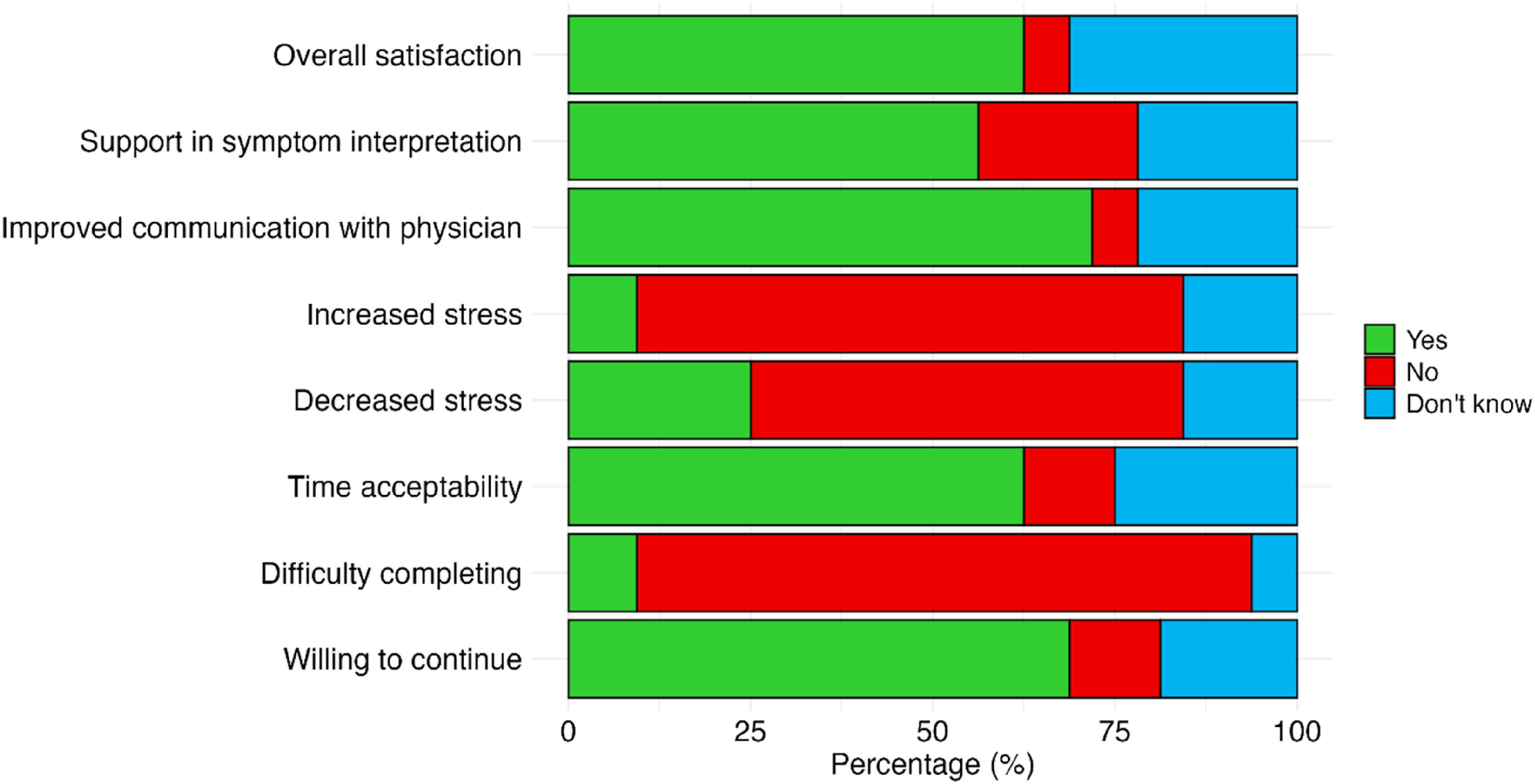
Caregivers’ responses to the diary evaluation questionnaire. Answers are reported as a percentage (%).
Qualitative assessment
In addition to the quantitative differences observed, the diary enabled a qualitative assessment of NPS, yielding valuable insights.
For instance, it uncovered three cases of sexual behavior disorders that were not identified through the sNPI. Examples included episodes in which “he (i.e., the patient) repeatedly asked for sexual activity during the day and at night, undressed, and touched himself, attempting to touch me (i.e., the partner)”, “he (i.e., the patient) put on my (i.e., the partner's) underwear and walked around the house wearing my clothes”, and “he (i.e., the patient) masturbated in the living room”.
Moreover, the diary captured instances of a sundowning syndrome. In one diary, nine separate episodes were recorded between 8:00 PM and 4:00 AM, each marked by the onset of different NPS (e.g., delusions, wandering, and anxiety), while no such events were reported during the day.
In another case, the NPS diary helped to clarify the primary and most relevant symptom. Despite high scores in several NPI items (e.g., agitation/aggression, depression/dysphoria, anxiety, apathy/indifference, irritability/lability), the diary revealed that every reported episode was consistently described as anxiety-related (“upon arriving in front of her residence, she (i.e., the patient) experienced a panic attack during which she was unable to stand, and it was very difficult to help her return home”; “she (i.e., the patient) experienced a sensation of chest tightness and shortness of breath accompanied by thoughts of impending death”). These consistent descriptions allowed anxiety to be identified as the core NPS.
The diary also facilitated the identification of potential triggers, including delusional episodes linked to television content (“he (i.e., the patient) says that he needs to get a new television because everyone knows what we are saying” and “he (i.e., the patient) expected that television presenters would provide him with money”).
Furthermore, it provided a platform for documenting resolution strategies, which were often spontaneous or prompted by caregiver intervention (“he (i.e., the patient) calms down when I (i.e., the son) distract him and talk to him in a slow and reassuring tone”).
Discussion
The main aim of the present study was to explore the potential added value of implementing an NPS diary in clinical practice by testing its use in patients with dementia attending a tertiary memory clinic. This objective was pursued by comparing two diary-derived NPIs, reconstructed by two independent raters, with a sNPI. Additionally, caregiver impressions were collected through a structured evaluation questionnaire, and the diary was evaluated from a qualitative perspective.
Overall, the comparison between sNPI and dNPI revealed consistently higher scores in the standard assessment. dNPI appeared less influenced by caregiver burden, both in total score and across individual items. It proved to be a time-saving tool for raters and demonstrated good inter-rater reliability. It was appreciated by caregivers, who reported high levels of satisfaction and perceived it as helpful in understanding the patient's symptoms and improving communication with the physician. Furthermore, the diary allowed for a better exploration of non-canonical symptoms (e.g., sexual behavior disorders), temporal patterns, potential triggers, and resolution modalities that are not covered by the standard NPI.
The difference between sNPI and dNPI was consistent across many of the NPI items, including hallucination, agitation/aggression, depression/dysphoria, anxiety, apathy/indifference, disinhibition, sleep and nighttime behavior disorders, and appetite and eating disorders. Conversely, similar scores were observed for delusions, euphoria/elation, irritability/lability, and aberrant motor behavior. When restricting the analysis to clinically relevant symptoms, the differences between the standard assessment and the diary-based reconstructions appeared attenuated. In this framework, significant discrepancies persisted only for apathy/indifference, disinhibition, irritability/lability, and appetite/eating disturbances. Notably, regression analyses revealed that total scores, as well as agitation/aggression and aberrant motor behavior items from the sNPI, were significantly influenced by caregiver stress, as measured by the ZBI, whereas no effect was detected in the dNPI. These findings suggest that standard assessment may be more influenced by caregiver stress, while diary-based approaches offer a potentially more objective alternative. Taken together, these findings indicate that the sNPI and dNPI offer distinct but complementary perspectives on NPS. While the sNPI yields higher scores, more sensitive to caregiver burden, the dNPI provides lower scores and perhaps a more objective evaluation of patients’ symptoms. The diary-based approach appears to provide a more conservative and potentially less biased estimate of NPS, reducing the risk of overestimation commonly seen in retrospective assessments. 11 These findings are consistent with the principles of EMA, 22 whereby the prospective recording of behaviors in the natural home environment and in close temporal proximity to their occurrence helps reduce recall-related distortions and reporting biases. Nevertheless, the dNPI may underestimate certain symptoms due to its reliance on daily caregiver observation and reporting, which requires a higher degree of engagement and sustained compliance from caregivers. Therefore, the combined use of both approaches may represent the most effective strategy for achieving a comprehensive and balanced evaluation of NPS.
The diary emerged as a time-saving and practical tool. Administration of the sNPI required significantly more time for raters compared to diary-based versions. This finding reflects greater engagement of the caregivers, who were responsible for the time-consuming daily reporting over one month, rather than an absolute reduction in overall time burden. However, most caregivers perceived the time commitment as proportionate to the benefits gained. Overall, these results indicate that the diary-based approach may serve as a time-efficient complement to standard assessments from a rater's perspective, with a redistribution of effort toward caregivers without significantly increasing perceived burden.
The reconstruction of the dNPI by two independent raters allowed exploration of the instrument's reliability. The two assessments showed high concordance, with no significant differences in total scores or items, both considering the overall score or prevalence of clinically relevant symptoms. This finding indicates good inter-rater consistency and supports the reliability of the dNPI when independently reconstructed by different clinicians.
The use of the diary requires active cooperation from caregivers. Nevertheless, overall satisfaction was high, with many caregivers reporting that it was helpful to better recognize the patient's symptoms and communicate more effectively with the physician. The diary was generally perceived as easy to use, and most caregivers expressed willingness to continue its use beyond the study period. Its impact on caregiver-related stress was variable, with no consistent trend toward either increase or reduction. These findings suggest that, from the caregiver's perspective, the diary represents a feasible and acceptable method for monitoring NPS. Furthermore, the act of completing the diary itself may represent a supportive strategy for the caregiver, reinforcing the perception of being actively involved in the care process and fostering a sense of continuity beyond the formal clinical encounter.
From a qualitative perspective, the diary provided precious insights into the characterization of NPS. It enabled the identification of non-canonical symptoms, not included in the standard NPI, such as sexual behavior disorders, 36 and facilitated the detection of temporal fluctuations and specific phenomena like sundowning. 37 In cases presenting multiple symptoms, the diary helped to clarify the predominant disturbance and supported the identification of potential triggers and the annotation of resolution strategies. These qualitative insights reflect the added value of EMA approaches and are particularly relevant in the context of personalized care, as a more detailed understanding of symptom timing, precipitating factors, and resolution dynamics may support the development of tailored pharmacological and non-pharmacological interventions.
Despite the valuable insights derived from the comparison between the two modalities, the present study was not designed to formally establish psychometric validity or measurement equivalence, nor to demonstrate interchangeability of scores. Given the substantial differences in score reconstruction methods, retrospective structured interviewing for the sNPI and prospective narrative-based recording for the dNPI, the overarching aim of the study was to propose a complementary instrument rather than to provide an alternative. For this reason, comparisons should not be interpreted as indicators of formal equivalence, but rather as an exploration of the distinctive characteristics and potential added value of this novel modality. The NPS diary should not be viewed as a replacement for standard clinical tools, but rather as a complementary instrument capable of adding ecological and contextual information, thereby enriching the overall evaluation of NPS in dementia.
This study contributes to a growing body of research aimed at identifying complementary tools for improving the assessment of NPS in dementia. Among these, the NPI-Diary 21 and the BPSD-SINDEM scale 38 represent notable examples. The NPI-Diary 21 was developed as a structured tool based on NPI-derived items, designed for use in institutional settings and aimed at improving reliability by enabling repeated and systematic observations by multiple staff members. Although this instrument offers a more standardized and staff-friendly alternative to the NPI, it remains tied to fixed symptom categories and is mainly suited for professional caregivers. The BPSD-SINDEM scale 38 was conceived as a structured, multi-component instrument incorporating both clinician-rated and caregiver self-reported modules. Despite involving caregivers directly, it remains a structured instrument anchored to fixed item categories and designed for administration during clinical visits, with a limited observation window. Unlike these approaches, our NPS diary allows for real-time and free-form descriptions of NPS, offering an ecological and flexible approach. By allowing caregivers to narratively document behaviors as they occur, the NPS diary fulfills the need for reliable assessment while also adding value through detailed, contextualized descriptions. This qualitative, narrative-driven format may offer additional perspective on the phenomenology of NPS and their contextual dynamics, potentially supporting more individualized management approaches.
Some limitations should be acknowledged. First, a potential recruitment bias may have occurred, as only “reliable” caregivers, based on clinicians’ judgment, were considered for inclusion. In addition, although the proportion was relatively low, not all dyads completed the study procedures, thereby favoring the selection of caregiver profiles more suitable for diary completion. Although this selection process may reduce generalizability, it reflects real-world clinical scenarios, where the applicability of tools must often be adapted to the characteristics of individuals’ profiles. In clinical practice, caregivers of patients with more severe dementia, those with lower educational attainment, or non-spousal caregivers may indeed experience greater difficulties in completing a daily diary. However, in the present study, only spending less time with the patient emerged as a limiting factor to study completion; other characteristics did not appear to influence adherence. Further research is warranted to assess the feasibility of diary use in diverse populations and to determine which caregiver-patient profiles are most suitable for the clinical implementation of the diary. Second, the short follow-up period did not allow for the assessment of the diary's long-term feasibility. While caregivers reported high satisfaction and willingness to continue using the tool over one month, it remains uncertain whether this level of engagement would be sustained over extended periods. In a prolonged use scenario, factors such as caregiver fatigue, competing responsibilities, or declining motivation could negatively affect adherence and data completeness. On the other hand, the use of this instrument may be referred to as time-specific needs (i.e., description of new manifestation, monitoring during drug initiation), whether for a long consecutive period. This should minimize the prolonged use risk. Third, the context of a specialized memory clinic may not fully reflect routine care in primary or community-based dementia services, potentially limiting the generalizability of the findings. Nonetheless, it allowed the diary to be tested in a consecutive and well-characterized cohort of patients with dementia of various etiologies and severities. Fourth, the inclusion of only patients with at least one NPS reported at baseline limited the opportunity to evaluate the diary's ability to detect overt or previously unreported symptoms. This criterion was adopted to ensure the presence of clinically relevant disturbances and to assess convergence with the standard NPI. Future studies should consider including patients regardless of NPS presence to better evaluate the diary's sensitivity in identifying novel or underreported manifestations. Fifth, the study was conducted among Italian native patients, thus not accounting for potential cultural influences on the use and performance of the diary. Sixth, the diary-based NPIs were reconstructed by only two clinicians from the same institution, which may not fully reflect variability across raters and could result in lower reliability in other clinical contexts. Seventh, the relatively low prevalence of certain clinically relevant symptoms (e.g., hallucinations, euphoria) may have limited the ability to detect differences between assessment methods. Eighth, the relatively small sample size limited our ability to examine the potential influence of relevant variables, such as the specific diagnosis or the nature of the caregiver-patient relationship. Future studies with larger cohorts will be required to clarify the role of these factors and allow for adequately powered stratified analyses. Ninth, the qualitative information gathered through the diary was not analyzed using systematic qualitative methods, and no formal mixed-methods integration was possible. Additionally, details on the reasons underlying the low level of satisfaction (i.e., albeit reported by only 2 participants, 5%) were not systematically collected. Future research employing structured qualitative approaches (e.g., content analysis or thematic analysis) and expanding the range of qualitative information collected may offer valuable insights into the phenomenological characterization of NPS and the usability of the diary from the caregiver's perspective. Finally, although the tool was tested in patients with dementia, NPS also occurs in individuals with mild cognitive impairment, a population not addressed in the present study. Future studies are warranted to assess whether the use of the diary may enhance the clinical management of NPS and contribute to more tailored pharmacological and non-pharmacological strategies. Further research involving larger and diverse samples, multi-center designs, and longer follow-up periods will also be essential to validate and extend these findings.
This study may represent a preliminary step toward the development of an electronic version of the diary, leveraging recent advances in digital health technologies. Such tools are increasingly adopted by patients and caregivers to share clinically relevant information with healthcare professionals in real time. An NPS e-diary could enhance caregiver compliance through user-friendly interfaces, reduce the risk of incomplete data, and potentially alert clinicians when symptoms become particularly severe or acute.
Conclusion
The NPS diary emerged as an ecological, caregiver stress-resistant, reliable, time-efficient, and feasible tool for the assessment of NPS in clinical practice. It enabled a detailed characterization of these distressful symptoms, particularly concerning overlooked manifestations, temporal patterns, potential triggers, and resolution modalities. By allowing a free description of the observed behaviors over time, the diary supports a more personalized and comprehensive evaluation of NPS. The integration of this complementary approach with standard clinical evaluations and commonly used tools may allow for a more comprehensive characterization of NPS, supporting clinicians in selecting more appropriate and individualized management strategies.
Supplemental Material
sj-docx-1-alz-10.1177_13872877261443922 - Supplemental material for A diary-based approach to improve neuropsychiatric symptom assessment in dementia: A cross-sectional comparison with the neuropsychiatric inventory
Supplemental material, sj-docx-1-alz-10.1177_13872877261443922 for A diary-based approach to improve neuropsychiatric symptom assessment in dementia: A cross-sectional comparison with the neuropsychiatric inventory by Marco Toccaceli Blasi, Martina Salzillo, Simona Buscarnera, Filippo Nuti, Caterina Stanziale, Chiara Pecorari, Daria Agata Ottone, Emanuela Salati, Fabrizia D’Antonio, Marco Canevelli and Giuseppe Bruno in Journal of Alzheimer's Disease
Footnotes
Acknowledgements
We would like to thank all the participants and their relatives whose data were used in this study, as well as all the staff of the Center for Cognitive Disorders and Dementia, Department of Human Neuroscience, Sapienza University of Rome, for their support and collaboration.

Ethical considerations
The study was approved by the local ethics committee of the Policlinico Umberto I University Hospital (CE:6692).
Consent to participate
Patients and caregivers (or legal guardians when necessary) provided written informed consent for allowing the utilization of the collected data for research purposes.
Consent for publication
Not applicable.
Author contribution(s)
Funding
The authors disclosed receipt of the following financial support for the research, authorship, and/or publication of this article: This work was supported by Sapienza University of Rome, “Avvio alla Ricerca–Tipo1 2023” grant (Principal Investigator: Marco Toccaceli Blasi).
Declaration of conflicting interests
The authors declared the following potential conflicts of interest with respect to the research, authorship, and/or publication of this article: Fabrizia D’Antonio and Marco Canevelli are Associate Editors of the Journal of Alzheimer's Disease. Still, they were not involved in the peer-review process of this article, nor had access to any information regarding its peer-review. The remaining authors declared no potential conflicts of interest with respect to the research, authorship, and/or publication of this article.
Data availability statement
The data supporting the findings of this study are available on reasonable request from the corresponding author. The data are not publicly available due to privacy or ethical restrictions.
Supplemental material
Supplemental material for this article is available online.
References
Supplementary Material
Please find the following supplemental material available below.
For Open Access articles published under a Creative Commons License, all supplemental material carries the same license as the article it is associated with.
For non-Open Access articles published, all supplemental material carries a non-exclusive license, and permission requests for re-use of supplemental material or any part of supplemental material shall be sent directly to the copyright owner as specified in the copyright notice associated with the article.
