



Abstract
As complex challenges such as climate change and social inequality become more and more politically salient, eco-social policies are emerging as suitable public policy tools to pursue integrated environmental and social objectives. In spite of this, the sustainable welfare literature has been, at least until now, dominated by prescriptive studies, paying little attention to the politico-institutional conditions required for these policies to emerge. Against this background, this article aims to help filling this gap, by proposing a set of four theoretical expectations pointing to possible causal drivers and mechanisms behind the adoption of this particular kind of policies. It does so by harnessing the most established welfare state theories and reflecting on their potential and limitations when applied to the study of eco-social policies. Selected theoretical strands – functionalism, historical institutionalism, interest-based and ideas-based theories – are first reviewed and then applied to the specific object of the study, with a view to deriving the four expectations by deduction. The ultimate aim is to generate a politico-institutional theory of eco-social policies, which can guide future empirical research. The article argues that eco-social policies can be expected to emerge in strong environmental states and/or in weak welfare states, in which equally powerful labour and green interests engage in political exchanges, or where advocacy coalitions form around ambiguous ideas, such as ‘just transition’. The article concludes by arguing that only an actor-centred approach based on empirically observable policy preferences can help us to craft minimally sufficient causal inferences about the emergence of eco-social policies.
Keywords
Introduction
With the ongoing ecological crisis, Western welfare states are expected to face severe challenges, as new social risks of environmental origin emerge and grow. To respond to such risks, a novel type of policy instrument may be needed: eco-social policies. The latter can be defined as public policies pursuing integrated social and environmental goals. Although they are arguably still rare, several countries have already adopted some experimental eco-social policies, notably to achieve a just transition. Nevertheless, the main strand of literature investigating eco-social policies, ‘sustainable welfare’, has so far concentrated more on normative, rather than empirical, research goals, and a bridge still needs to be built between sustainable welfare and the mainstream empirical political theory of the welfare state.
Against this background, the present contribution aims to propose an original set of theoretical expectations to interpret the emergence of eco-social policies, shedding light on the institutional and political conditions that can favour or hinder their adoption. It does so by harnessing four mainstream welfare state theories and reflecting on their potential (and limitations) when applied to the study of eco-social policies. From each theory – structural-level functionalism, historical institutionalism, as well as interest-based and ideational actor-centred theories – the article deductively derives an original causal expectation identifying a possible explanatory factor and mechanism behind the adoption of eco-social policies. The aim is to provide tentative and provisional working hypotheses, to be applied by future empirical research. For this reason, the rationale of the article is theory-generating. In this view, some reflections are provided about the possible limitations of the four theoretical approaches, as well as on the extent to which these limitations can be overcome in order to derive a minimally sufficient and parsimonious argument.
Concerning the structure of the article, Section 2 reviews the state of the art of the literature on eco-social policies, while Section 3 defines the research object and presents the aims and expected contribution of the article. Section 4 concerns the four welfare theories, which are first reviewed in general and then applied to the specific case of eco-social policies. Section 5 enlists some major limitations for each theoretical approach, with a view to proposing a parsimonious theory. Finally, Section 6 concludes.
The state of the art: a largely uncharted field
Social and environmental policies and challenges can be seen as connected by a bi-directional nexus (Laurent, 2015), generating new eco-social risks (Gough et al., 2008). A notable example is the intertwinement between social inequality and climate change. The latter is expected to exacerbate the former, creating a ‘double injustice’, whereby the responsibilities and impacts of climate change are unequally distributed (Walker, 2012). This becomes a ‘triple injustice’ if we consider that climate policies can further contribute to aggravating inequalities, due to their socially regressive nature (Büchs et al., 2011; Gough, 2017). Notably, policies needed to effect a transition to a low-carbon economy (Sovacool et al., 2021) are expected to bring about considerable employment and distributional challenges, including job redundancies and displacements, as well as losses in income and assets for vulnerable households in territorially marginalized communities unable to keep up with this transition (Galgóczi, 2022).
To tackle these novel risks, several scholars have started to refer to the concept of ‘eco-social policies’. Building on green critiques of the welfare state (Fitzpatrick and Cahill, 2002; Matthies, 2017), ‘sustainable welfare’ is emerging as the predominant approach for the study of eco-social policies (Hirvilammi and Koch, 2020). Sustainable welfare aims to create welfare theories, systems and policies compatible with principles of environmental sustainability (see the introduction to this Special Issue). In this sense, sustainable welfare ‘is oriented towards satisfying human needs within ecological limits, from an intergenerational and global perspective’ (Koch et al., 2016: 704). However, a critical analysis of this literature reveals that its empirical applications are still limited. Sustainable welfare studies are indeed characterized by a striking tendency towards normativity (Mandelli, 2022a; Cotta, forth.), hence a preference for prescribing ideal eco-social policies (e.g. Bohnenberger, 2020; Bonvin and Laruffa, 2022; Büchs, 2021; Gough, 2017; Gough, 2019; McGann and Murphy, 2021), as opposed to empirically describing and explaining actual policies.
However, normative projects exist only in the framework of the institutional-political processes by which they are designed, legitimized, and implemented (Meadowcroft, 2011). From an institutional perspective, a relatively recent academic debate has focused on the connections between the welfare state – defined as a state that aims to provide ‘decommodification’ and ‘destratification’, hence guaranteeing socially acceptable standards of living and (re)distributing resources and opportunities equally among the population (Esping-Andersen, 1990) - and the environmental (or eco) state – defined as ‘a state that possesses a significant set of institutions and practices dedicated to the management of the environment and societal–environmental interactions’ (Duit et al., 2015: 5). Besides studies highlighting their similarities and differences (Gough, 2016; Meadowcroft, 2005), some scholars have attempted to juxtapose the performance of the eco and welfare states, mapping so-called ‘worlds of eco-welfare states’ (Hasanaj, 2023; Zimmermann and Graziano, 2020). While some of these contributions (Koch and Fritz, 2014; Zimmermann and Graziano, 2020) found evidence to confirm a ‘synergy hypothesis’, whereby strong social-democratic welfare models should also perform strongly with respect to environmental protection (Dryzek et al., 2003), others instead rejected this idea (García-García et al., 2022). These tentative results show that it may be too early to speak about proper eco-welfare states.
While the current knowledge provides us with, at least tentative, empirical insights into eco-welfare institutions, studies focusing on real-life eco-social policies are still relatively rare, as well as largely exploratory and/or descriptive. Examples can be found at the national level (both in European countries (Hvinden et al., 2022) and in the Global South (Carmi, 2016)), the supranational level (at both EU (Crespy and Munta, 2023; Mandelli et al., 2023; Petmesidou and Guillén, 2022; Sabato et al., 2021) and global levels (Kaasch and Schulze Waltrup, 2021)), and the local level (Bertho et al., 2021; Brandl and Zielinska, 2020; Khan et al., 2020). Little attention in this emerging literature has been paid to socio-political actors’ behaviour and preferences and to how these affect the policymaking process. In fact, recent publications have preferred to focus on ‘eco-social divides’ in the electorate's attitudes (Gugushvili and Otto, 2021): some of these studies investigate whether citizens supporting social policies also support environmental ones (Fritz et al., 2021; Fritz and Koch, 2019; Otto and Gugushvili, 2020), while others search for potential trade-offs (Armingeon and Bürgisser, 2021; Jakobsson et al., 2018). All of these studies focus on public opinion, whereas, to the author's knowledge, contributions examining the partisan and interest-group politics of eco-social policies are still lacking. One notable exception is a branch of industrial relations, known as ‘labour environmentalism’, which investigates trade unions’ varied positions on the so-called ‘jobs vs. environment dilemma’ (Kalt, 2021, 2022; Räthzel and Uzzell, 2013; Stevis and Felli, 2015; Thomas and Doerflinger, 2020). However, even these studies do not properly belong to the realm of political science, since they do not examine trade unions’ (potential) influence on the policymaking process.
Object and aim of the article
From an empirical perspective, eco-social (or socio-ecological) policies can be defined as public policies explicitly pursuing both environmental and social policy goals in an integrated way (Mandelli, 2022a). Thus, policy integration is the defining feature of eco-social policies, meaning that these policies do not address environmental and social objectives in isolation, but rather aim to reconcile them by tackling eventual trade-offs, namely the social risks of environmental origin. Integration implies that eco-social policies are constructed either by adding a social dimension to environmental policies or, alternatively, by greening welfare measures (Mandelli, 2022a). Their integrated nature makes it so that eco-social policies can often be found within broader governmental strategies comprising a bundle of different policy instruments. However, we define as eco-social only the portion of these strategies that explicitly addresses the socio-ecological nexus. Moreover, like other integrated policies, socio-ecological policies are likely to manifest as a mix of multiple separated, yet interconnected, instruments, rather than a single policy entity. Some examples of eco-social policies are vouchers for sustainable food; labour market policies for redundant workers in transitioning industries; investment in energy-efficient social housing; free public transport; green investments through pension funds; energy bill reductions for vulnerable consumers; and carbon-neutral healthcare services.
As it emerges from the literature review, despite their ground-breaking efforts, existing sustainable welfare studies currently fall short of discussing what the state is doing – i.e. the policy outputs that it supplies - they merely look at what it is (or should be) achieving – i.e. its policy outcomes. Conversely, this article adopts the above-mentioned output-based definition of eco-social policies, based on the explicit features of a policy. This allows us to define as eco-social not only those policies that fulfil the ideal criteria of sustainable welfare (Büchs, 2021), but also policies that may instead achieve sub-optimal outcomes. Although eco-social policies are still arguably rarely implemented and far from ideal, some countries have already experimented with this new policy field, for instance by adopting eco-social policies to address the social risks of decarbonization, with a view to achieve a ‘just transition’ (Mandelli, 2022b). With the worsening of the climate crisis and the consequent upgrade in countries’ decarbonization ambitions, we can reasonably expect that eco-social policies will continue to proliferate in the coming years.
A clear mismatch is evident between the widespread normativity of sustainable welfare and the empirical diffusion of eco-social policies in the real world; this calls for appropriate explanations. Beyond existing exploratory studies, explanatory research is required to understand the drivers behind and barriers to the emergence of eco-social policies, shining a spotlight on the usually neglected political and institutional dimensions of sustainable welfare. Against this background, this article aims to lay the first stone in the construction of an empirical political theory of eco-social policies, with the aim to guide future research. It does so by formulating a set of four expectations, identifying potential causal drivers and mechanisms behind the adoption of and cross-country variation in such policies. In particular, the article aims to respond to the following research question: Which drivers (and mechanisms) favour the adoption of eco-social policies?
Despite the already-mentioned gaps in the literature, the foundational assumption of this study is that there is no need to reinvent the wheel. Instead, as a research strategy, this article resorts to four of the arguably most established welfare state theories and uses them to explain the emergence of eco-social policies (the explanandum). These theories are structural-level functionalism and historical institutionalism, and actor-centred theories based on interests and ideas. Welfare state theories have been chosen here for two principal reasons. First, sustainable welfare scholars have, to date, largely refrained from engaging with political science theories, which are normally used to explain policy developments. Second, given that eco-social policies are a sub-type of social policies, it seems safe to assume that, if duly adapted, welfare theories can be best placed, among alternative political theories, to answer the research question above. The added value of this strategy is that it reconnects the sustainable welfare literature to its roots in the academic debate on the welfare state, while also striving to contribute to the latter debate by focusing on its long-ignored environmental dimension.
How welfare state theories can apply to the adoption of eco-social policies: four institutional-political expectations
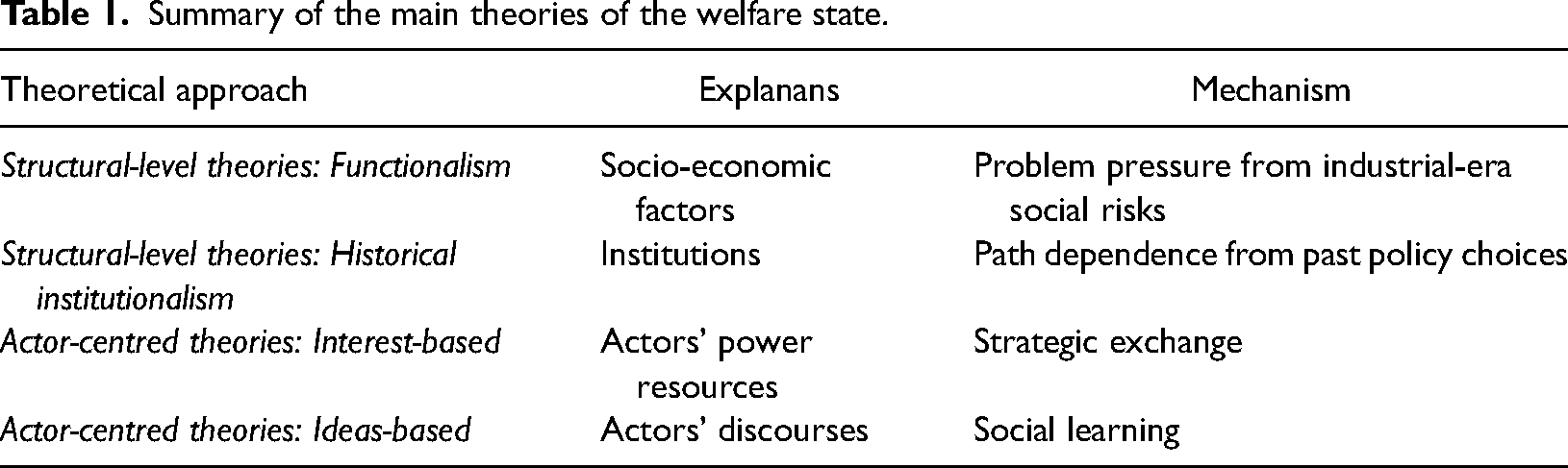
Table 1 briefly summarizes the four welfare state theories selected for this study. In this section, first, the state of the art for each of these theories is briefly presented. Then, based on this review, the article deduces four expectations about the explanandum, entailing both a causal factor (explanans) and a mechanism.
Summary of the main theories of the welfare state.
Functionalism and a third wave of eco-social risks
Functionalist theories of the welfare state traditionally underline the causal power of socio-economic factors (Myles and Quadagno, 2002). Functionalists were originally linked to the ‘logic of industrialization’ (Wilensky, 1975), which explains the unprecedented expansion in welfare provisions that occurred in Western countries between 1945 and 1975 as a consequence of the several societal distortions related to the (mal)functioning of industrial capitalism, which in turn generated pressures for the state to intervene. Beyond the ‘old risks’ of the ‘golden age’ of the welfare state, a new wave of unprecedented social risks emerged in the 1990s (Bonoli, 2005). These new risks derived from epochal socio-economic changes, including the transition to a globalized service economy and changes in demographic and family structures. Thus, from a functionalist perspective, welfare state expansions originate through problem pressures from risks that are exogenous to the political system.
With the current ecological crisis and governments’ increasing efforts to deliver on a green transition, Western welfare states may be facing a third generation of social risks, sometimes referred to as ‘eco-social risks’ (Hirvilammi et al., 2023). New social risks of environmental origin are characterized by substantially different features if compared to other social risks (Gough et al., 2008; Johansson et al., 2016). First, they are expected to be unpredictable not just individually, but also collectively: in the case of climate change, there are, it is thought, ‘uncertainties over the probability distributions of likely outcomes’ (Gough et al., 2008). Moreover, eco-social risks are also peculiar in their scale and scope, in that they entail intertemporal problem pressures (Jacobs, 2011), with both salient short-term and less salient long-term consequences, as well as global, yet locally differentiated, implications.
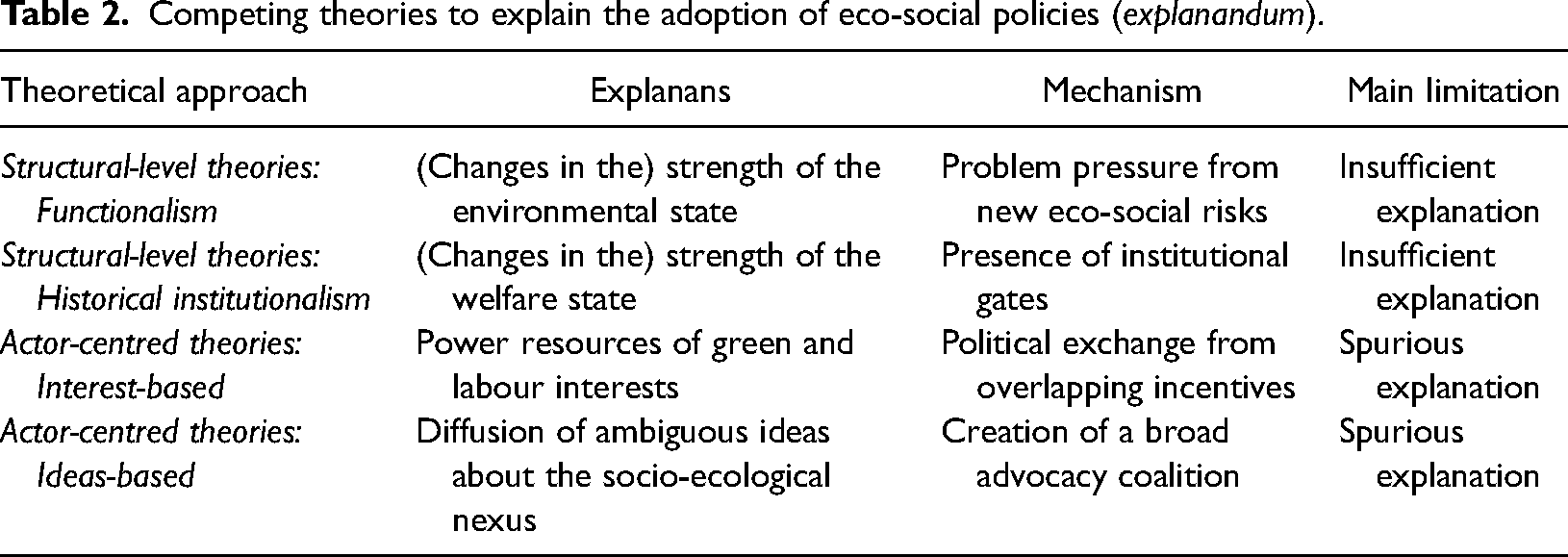
Since functionalism has been quite useful to explain the initial phase of welfare states development, it can also prove equally suitable for the study of eco-social policies, which are currently just slowly and timidly emerging. From this perspective, the new wave of eco-social risks is crucial. Importantly, these risks are generated not only directly, as by-products of ecological distress, but also indirectly from the regressive effects of environmental policies (Gough et al., 2008). Therefore, if compared to traditional functionalist theories that mostly concentrate on exogenous risks, eco-social risks are instead likely to originate also from changes that are endogenous to the institutional system. Focusing on this particular kind of risks, we are able to formulate a functionalist theory of eco-social policies centred around endogenous institutional developments. More specifically, the argument is that a government's high or increasing commitment to fight environmental degradation can change existing socio-economic conditions and consequently create new eco-social risks, due to the regressive effects of environmental policies. There is therefore pressure on the government to address these risks through eco-social policies. In this functionalist theory of eco-social policies, the (increasing) strength of the environmental state – understood in terms of the scale and robustness of public policies devoted to environmental protection – is the explanans, while the causal mechanism consists in the creation of new eco-social risks and in the consequent problem pressure that these exert. Expectation #1: an (increasingly) strong environmental state favours the adoption of eco-social policies because it generates new social risks, which change existing socio-economic conditions, ultimately exerting a pressure for policy intervention.
Historical institutionalism and institutional gates
Neo-institutionalism, as the label suggests, arose in the 1980s (March and Olsen, 1984) as a theoretical plea to pay attention to the constraining and/or enabling role of institutions in structuring the policymaking process. In the neo-institutionalist school of thought, a particularly popular variant for the study of social policies has been historical institutionalism. The kernel of this approach is to conceive of political developments as processes that unfold over time, following a ‘path-dependent’ trajectory. In this view, public policies are understood as institutions, meaning that each policy choice increases the probability that the next choice will resemble or reinforce the previous one (Pierson, 2000, 2004; Pierson and Weaver, 1993). Reversing the initial policy choice would imply facing high fixed costs, which makes it convenient to stick to the original paradigm (Myles and Pierson, 2001). Accordingly, from a historical institutionalist perspective, policy change is rare and, so, this approach is more suited to explain institutional resilience and policy inertia (Streeck and Thelen, 2005). Change, in this view, comes as a ‘punctuated equilibrium’ (Krasner, 1984), whereby exogenous shocks can give rise to ‘critical junctures’ and inaugurate a new path (Capoccia, 2016), but subsequently, path dependence makes this new paradigm immediately self-reinforcing (Pierson, 2000). Nevertheless, in recent decades, prompted by an increasing body of empirical evidence showing that welfare states have actually changed substantially over the years, historical institutionalists have started to question the assumptions of punctuated equilibrium, by stating that change can also be ‘incremental’, hence gradual and endogenous (Mahoney and Thelen, 2010; Streeck and Thelen, 2005). An important takeaway from incrementalism is that, whenever institutions are less resistant to change, an ‘institutional gate’ can open, providing space for divergence from previous policy choices (Jessoula, 2009).
At first glance, a theoretical approach such as historical institutionalism, so concerned with policy legacies, might seem inappropriate to explain eco-social policies, which are still uncommon or, at best, in their infancy. However, even in the absence of a policy legacy, one can assume that existing welfare institutions, despite having been designed for other purposes, may already be suited to adequately cover the new social risks deriving from ecological crises. If this is the case, then we can expect that there would be no need for new eco-social policies. Responses to other present-time risks – such as those connected to the Covid-19 crisis – have demonstrated that countries with strong welfare (sub)systems tend to face new risks by relying on existing policies (with a few adjustments), while less developed welfare states often adopt novel creative instruments in times of crisis (Béland et al., 2021).
Therefore, we can hypothesize that the more established a welfare (sub)system is – in terms of coverage and generosity (explanans) – the less likely it will be for an institutional gate to open, a mechanism without which there would be no opportunity for new eco-social policies to emerge. Such a gate can be instead predicted to open when the strength of the welfare state is low or decreasing, hence when existing social policies are incapable by themselves to respond to new risks of environmental origin. In sum, if we imagine the welfare state as a box, the idea is that the less this is already filled up, the more space there will be for new policies to enter the box. It follows that one should not expect to find eco-social policies in strong Nordic welfare states. To understand this point, the example of energy poverty in Sweden is very telling: by its own admission, the Scandinavian country ‘makes no distinction between energy poverty and poverty in general’, stating that ‘there are no targeted [eco-social] policies to deal with it. The issue is addressed within social policy’ (Government of Sweden, 2020: 39). Thus, in this case, the opportunity to introduce new eco-social policies is simply missing because the welfare state as it is already responds well enough to new risks. While, at first glance, this argument seems to contradict the above-mentioned ‘synergy hypothesis’ about the exceptionality of social-democratic welfare regimes, actually this is not necessarily the case, because the latter hypothesis refers to countries’ eco-social outcomes, rather than their policy outputs, with which, instead, this article is concerned. Expectation #2: an (increasingly) strong welfare state hinders the adoption of eco-social policies because it prevents institutional gates from opening.
Interest-based theories and green-labour political exchanges
While functionalist and neo-institutionalist theories focus on the structural drivers behind policy changes, actor-centred theories in the welfare state literature show that agency, and hence politics, matters (Myles and Quadagno, 2002). According to Stoppino (2001), the political arena of modern democracies can be understood as a space dominated by supply-side political parties – competing electorally for government office and then having the possibility to supply public policies once in office – and demand-side societal groups – which can formally organize themselves as interest groups in order to demand public policies. Interest-based theories assume that the behaviour of political parties and organized interest groups will reflect the material interest of the constituencies that these actors claim to represent. In this view, diverging interests between societal groups can be transferred into the political arena through the political activation of ‘cleavages’ (Rokkan, 1970). The class cleavage was the first to receive attention in the welfare literature, notably with Korpi's (1983, 2006) ‘power resource theory’, according to which left-wing parties and trade unions are expected to represent the interests of the working class – hence demanding generous welfare benefits – whereas the centre-right and business organizations would give a voice to higher-income voters – demanding lower taxes and lower social expenditure (Schmidt, 1996). Thus, from a traditional interest-based perspective, the government's partisan composition, or ‘government colour’, matters the most in policymaking (Hibbs, 1977). More recent developments in this theoretical strand highlight that, to best represent the interests of their societal bases, parties and societal groups often act following a strategic logic. This is the case of political exchange, an interactive form of policymaking in which political consensus is reached when socio-political actors trade their power resources to achieve their goals (Molina, 2006; Natili, 2019; Pizzorno, 1977; Stoppino, 2001).
To build an interest-based theory of eco-social policies, we first and foremost need to understand which actors could be interested in the adoption of these specific policies. We can assume that two groups will be particularly relevant. On the supply side, single-issue green parties (Folke, 2014; Müller-Rommel, 1989) and left-libertarian parties (Huber et al., 2021), alongside the environmental movements and organizations in which these parties are rooted (Carter and Little, 2021), can be expected to be the principal promoters of ambitious environmental policy reforms (Siderius, 2023). The entry of these actors into the partisan arena is generally the result of the activation of a new cleavage, pitting material against post-material interests (Inglehart, 1984; 1990) beyond the capital-labour divide (Thomassen, 1999). This cleavage is often described using the acronym ‘GAL-TAN’ (Green-Alternative-Libertarian versus Traditional-Authoritarian-Nationalist) (Hooghe et al., 2004). Therefore, unlike for social policies – where a heterogeneous constellation of political cleavages is likely to hinder change (Ferrera, 1993) – the activation of new cleavages can actually provide environmental interests with power resources that they would otherwise not have in mono-dimensional left-right political spectrums (Dalton, 2009).
Besides green interests, eco-social policies can also be expected to capture pro-welfare interests, which, as seen above, are traditionally connected to the ‘labour’ side of the class cleavage. In particular, the societal groups most exposed to direct and indirect eco-social risks can be expected to play a crucial role in the politics of eco-social policies, since they clearly have a stake in the adoption of these policies. These groups include low-income households and vulnerable consumers, marginalized communities, but also workers and companies undergoing industrial restructuring (Galgóczi, 2022; Green and Gambhir, 2020). According to the power resources theory, these disadvantaged societal groups should be represented in the partisan arena primarily by left-wing political parties (Korpi, 1983). Moreover, on the demand side, as labour environmentalism shows, trade unions can see their interests jeopardized by the industrial restructurings connected to green transitions. Crucially, workers’ unions often have the capacity – unlike other societal groups – to mobilize multifaceted power resources in response to such transitions (Kalt, 2022).
Against this background, we can derive a third theoretical expectation that presents power resources and the exchange between different strategic incentives as, respectively, the causal driver (explanans) and mechanism in a novel interest-based theory of eco-social policies. In this view, the adoption of eco-social policies is a function of the (material and political) power resources held by two groups of actors, comprising both parties and interest groups: on the one hand, green interests seeking support for the introduction of environmental policy reforms and, on the other hand, labour interests seeking not to pay the distributional costs of such reforms. If one of the two groups holds significantly stronger power resources than the other, then the stronger group would be better off exercising its powers to block or veto the actions of the weaker group. If, instead, both groups hold overly weak power resources, we can expect them to lack the voice needed to promote their claims effectively. In these cases, either the position of one of the two groups would prevail over the other, or a stalemate situation would prevent the emergence of eco-social policies. Only when both green and labour interests hold (relatively) equally high power resources can eco-social policies be expected to surface. In this case, the two groups have an overlapping strategic incentive that leads them to engage in a political exchange, since green interests would need political support to get environmental reforms approved, while labour interests, threatened by the possible eco-social risks deriving from these reforms, would be incentivized to ask for economic support. Expectation #3: a situation of equally high power resources for actors representing green and labour interests favours the adoption of eco-social policies, because it generates an overlapping incentive for these two groups to engage in political exchange.
Ideas-based theories and the ambiguous ‘just transition’ narrative
Beyond the assumption that socio-political actors are only driven by their strategic interests and power ambitions, several welfare scholars have investigated the explanatory role of ideas as drivers of policy change (Béland, 2005), ultimately constructing an alternative strand of neo-institutionalism, known as ‘discursive’ or ‘ideational’ institutionalism (Schmidt, 2008). Ideational approaches focus on policy evolution and put the spotlight on actors’ evolving discursive framing of policy problems and solutions. At the basis of such approaches is the assumption that political action is driven by ‘puzzling’, that is by actors’ cognitive and normative orientations towards social problems and their possible solutions (Heclo, 1974). In this view, policy change is seen as a product of ‘social learning’, hence an endogenous process of knowledge construction and re-construction which often occurs in a situation of uncertainty or in periods of crisis (Blyth, 2002; Hall, 1993). One important variation of social learning is ‘international benchmarking’, whereby domestic actors can discover new policy solutions by borrowing them from exogenous experiences, either by emulation of other countries or through the discursive pressure of international institutions (Hemerijck, 2005). Particularly relevant in the European context has been the role of the European Union as a crucial ideational instigator of national reforms in the welfare field (Moreno and Palier, 2005), through a process referred to as ‘Europeanisation’ (Graziano, 2004).
Turning to the politics of eco-social policies, we should reflect on the characteristics that an idea needs to have in order to structure the power relations between relevant actors (Carstensen and Schmidt, 2016). In particular, what can be predicted to matter is the power of ideas to build coalitions (Béland and Cox, 2016). In this view, the dissemination of ideas through the discourses of domestic or international policy entrepreneurs can ‘bring together actors whose perceived interests or policy preferences had previously placed them at odds with one another’ (Béland and Cox, 2016), hence triggering the formation of an ‘advocacy coalition’ (Sabatier and Jenkins-Smith, 1993). In our case, we can expect that the discursive dissemination of ideas that present social and environmental objectives as linked by a synergic relationship (explanans) will trigger the formation of a wide coalition of actors (mechanism), ultimately leading to the adoption of eco-social policies.
Several studies show that, for an idea to become a ‘coalition magnet’ (Béland and Cox, 2016), hence for a broad range of actors to coalesce around that idea, it has to be ambiguous enough to become ‘polysemic’, or contested, hence appealing to a wide variety of actors, which assign different meanings to the same concept (Béland and Cox, 2016, Palier, 2005). This can be predicted to be especially true for eco-social policies: the ‘jobs vs. environment dilemma’ example shows that, when actors’ narratives are too specific, discursive struggles are likely to become contentious, pitting environmental against social discourses (Kalt, 2021). Therefore, the ambiguous nature of an idea – which can be assessed by checking whether various actors frame the same idea differently – should lead to the formation of heterogeneous advocacy coalitions. Ambiguous ideas can bring various agents to acknowledge the socio-ecological nexus, while also preventing the potential conflicts that could instead emerge if conceptual barriers were too strict and, hence, not adaptable to actors’ specific policy priorities.
What the idea of sustainable development did to reconcile environmental and economic objectives, ‘just transition’ could do for the socio-ecological nexus. In the mid-2000s, the idea of a just transition, first elaborated by the North American trade union movement in the 1980s, underwent a resurgence and global diffusion (Stevis et al., 2020). At its core, this idea centres around the social justice implications of climate change and decarbonisation. However, with increased popularity, it is also evolving into a contested concept (Stevis et al., 2020), with multifaceted applications in different contexts (Wang and Lo, 2021) and multidimensional interpretations (Stevis and Felli, 2020). Precisely in light of its contested nature, just transition – which is now promoted by powerful international epistemic entrepreneurs such as the United Nations and the European Union – has the potential to bring together a variegated group of actors around a single narrative (Jessoula and Mandelli, 2022). Expectation #4: The (national or international) discursive diffusion of ambiguous ideas that present social and environmental policy objectives as interconnected and mutually reinforcing – such as just transition – favours the adoption of eco-social policies because these ideas function as magnets for the formation of broad advocacy coalitions.
From theoretical limitations to a parsimonious empirical theory of eco-social policies?
While each of the four theoretical expectations presented above provides insightful hints about the politics of eco-social policies, these expectations all present major limitations. This section summarizes such limitations and, building on them, attempts to derive a parsimonious empirical theory of eco-social policies. This means crafting a minimally sufficient argument to explain the adoption of eco-social policies, comprehensively accounting for all the important drivers and discarding redundant ones.
Starting from structural-level theories, critics of functionalism have long argued that the mere presence of social risks, although potentially necessary, is not enough by itself to account for policy emergence (Graziano and Jessoula, 2018). Indeed, studies about countries’ responses to the new risks which have emerged since the 1990s have shown that, while such risks undoubtedly created pressure to enact a ‘functional recalibration’ of the welfare state (Ferrera et al., 2000), beyond the expectations of functionalism, problem pressure did not always result in recalibration (Hemerijck, 2013) and countries’ responses to new risks have differed considerably (Armingeon and Bonoli, 2006). Besides this general critique, another possible limitation may also be identified in the way in which functionalism is applied to the case of eco-social policies, as in Expectation #1. The emphasis there is on the regressive social implications of a strong(er) environmental state. However, an environmental state that engages in considerable efforts to mitigate ecological harms might actually presumably reduce some of the adverse social risks associated with environmental decline. Thus, if we factor in the role of the environmental state not only in producing eco-social risks, but also in possibly preventing these risks, then it no longer seems so obvious what the ultimate net effect of problem pressure will be.
Much like functionalism, historical institutionalism is a structural-level theory, which can, at best, provide necessary causal arguments to interpret the development of public policies. Indeed, while recognizing the importance of institutional constraints and opportunities, most scholars adopting a historical institutionalist perspective currently point to the essential role of socio-political actors as the only possible agents of change (Scharpf, 1997). When an institutional gate opens, it is always up to the actors to decide whether or not to politicize such a gate. It follows that even a small institutional gate, where the welfare state is not too weak, could actually lead to the adoption of eco-social policies, as long as powerful actors have the incentive or willingness to politically exploit it. Actually, where welfare institutions are strong, it might even be easier for socio-political actors to promote a process of incremental or cumulative changes (Streeck and Thelen, 2005), since we can assume pro-welfare actors to be more powerful in stronger welfare states. It follows that the presence of an institutional gate might not even be necessary for eco-social policies to emerge, as predicted above by Expectation #2.
Summing up, both functionalist and historical institutionalist accounts can, at best, lead us merely to identify necessary conditions. Indeed, even in the presence of eco-social risks or institutional gates, without actors taking action in the policy process to channel functional pressures and/or to politically exploit institutional gates, we cannot reasonably expect eco-social policies to emerge by themselves. Moreover, as explained above, one could even question whether a strong environmental state and a weak welfare state should be presented as strictly necessary conditions. Therefore, only actor-centred theories can lead us to a minimally sufficient explanation. Summarizing the expectations derived from the two actor-centred approaches, we can predict that eco-social policies will emerge when convergence is reached between either the strategic interests or the discourses of key socio-political actors. Although they have more robust explanatory power than structural-level arguments, actor-centred approaches still present notable limitations worth taking into account.
First, with respect to interest-based theories, many scholars have criticized the assumption of the power resource theory, arguing that policy preferences are more complex and less linear than this theory predicts and should not, therefore, be taken for granted (Jensen, 2014; Sartori, 1990). In our case, for instance, this means that one should not necessarily assume that promoting ambitious environmental reforms is just the remit of green and new-left parties, or environmental groups. Several studies have shown, rather, that, with the growing polarization and fragmentation of the party system, not only can new single-issue or pro-environment parties enter the political arena, but the partisan competition to capture green interests can increase, potentially leading also traditional parties to promote progressive environmental claims (Dryzek et al., 2003; Spoon et al., 2014), sometimes even including conservative political forces (Hess and Renner, 2019). Furthermore, power resources and sectoral interests cannot always comprehensively explain the formation of actors’ policy preferences, since other factors may also be influential, notably including ideological orientations (Kalt, 2022).
Second, ideational theories also have important limitations (Natili, 2019). Unlike interest-based theories, ideas-based approaches have the advantage of framing policy preferences as dynamic phenomena, avoiding ascribing a priori predetermined positions to certain actors. Nevertheless, empirical evidence shows that, despite international discursive pressure to do so, several countries often fail to enact reforms in line with ‘international benchmarking’ (Jessoula and Madama, 2018). More in general, ideational theories do not tell us much about the dynamics of coalition building, nor do they reflect on how, concretely, ideas are transformed into public policies, especially when such ideas are ambiguous and can be approached in different ways. Although ideational approaches assume a quasi-automatic correspondence between the diffusion of a widely supported discourse and the adoption of a public policy, it is not hard to think of cases where what a government promises (the discursive level) does not translate into what it actually does (the policy level).
Therefore, while it is clear that only an actor-centred approach can provide a minimally sufficient explanation for the adoption of eco-social policies, it remains to be asked whether one should adopt an interest- or an ideas-based perspective, especially in light of the limitations of these two perspectives. Nevertheless, what it is important to underline here is that neither ideas nor interests have a direct causal effect on the adoption of eco-social policies. What actually matters for both actor-centred theoretical strands are the policy preferences of socio-political actors, which could be determined by ideas, interests, or by some combination of the two. Put differently, the causal relationship between interest, ideas, and the adoption of eco-social policies is spurious, since it is mediated by the preferences of socio-political actors. Thus, to derive a minimally sufficient explanation of the emergence of eco-social policies, it is enough to reconstruct actors’ empirically observable preferences, without necessarily resolving the everlasting chicken-or-egg political science problem that pits ideas and interests against each other as the main determinants of political behaviour.
By adopting this agnostic approach to actor-centred theories, we do not have to assume that policy preferences are linearly derived and constrained by material interests – we could therefore also expect other actors, besides green and left-wing parties and trade unions, to play important roles in the politics of eco-social policies. We can also overcome the main limitations of ideational theories, which for instance cannot explain why discursive diffusion often does not lead to any policy changes. What both interest-based and ideas-based expectations have in common is that for eco-social policies to emerge it is sufficient for different socio-political actors, holding enough power resources and/or guided by ambiguous narratives, to converge – through an advocacy coalition and/or a strategic exchange – into the promotion of a policy preference that combines social and environmental policy objectives. Therefore, what matters for the adoption of eco-social policies are actors’ convergent policy preferences on the socio-ecological nexus. This parsimonious strategy, based on actors’ observable preferences, can be an ideal one to navigate this largely unexplored empirical field.
Conclusions
This article has sought to lay the first stone in the construction of a politico-institutional theory of eco-social policies, i.e., public policies that pursue integrated social and environmental goals. Specifically, the aim was to propose a series of deductively derived expectations to explain the emergence of eco-social policies, by harnessing four mainstream welfare state theories. Table 2 summarizes the expectations generated from the four theoretical approaches considered, pointing out, for each of them, a causal factor (explanans), a causal mechanism, and the principal limitation.
Competing theories to explain the adoption of eco-social policies (explanandum).
The article suggests that eco-social policies can be expected to arise in strong environmental states and in weak welfare states, when green and labour interests with equally high power resources engage in political exchanges, or when a broad advocacy coalition forms around ambiguous ideas, such as ‘just transition’. All four of the theoretical approaches investigated here allow us to shed light on relevant aspects of the politics of eco-social policies. Nevertheless, only an actor-based approach focused on empirically observable policy preferences – irrespectively of whether these are determined by interests or ideas – can provide a minimally sufficient parsimonious explanation of the adoption of eco-social policies. In this view, we can expect these policies to emerge when several relevant socio-political actors converge in embracing preferences that combine social and environmental objectives.
This article aspires to contribute to filling the gaps in the emerging sustainable welfare literature, by shifting the focus from normative to empirical political theories, hence highlighting the institutional-political determinants behind eco-social policies. The aim is to provide useful insights for future research in this field, which is likely to proliferate in the coming years, especially faced with a worsening climate crisis and a growing public commitment to achieve a green and just transition. Since the causal expectations proposed here were constructed merely deductively, case and comparative studies are needed to test and refine these expectations, as well as to check for their external validity, i.e. the extent to which they could apply to various contexts. Importantly, these arguments have been developed building on mainstream welfare state theories, which were notoriously primarily designed to describe Western welfare states. More research will be needed to check whether any of these expectations can also apply to Global South countries.
Footnotes
Acknowledgements
The author would like to thank the guest editors and anonymous reviewers for their valuable comments. Furthermore, for their useful suggestions regarding earlier drafts of this paper, the author would also like to thank Marcello Natili, Matteo Jessoula, Mary P. Murphy, Oscar Molina, Paolo Graziano, Ekaterina Domorenok, Luca Cigna and Katharina Zimmermann.
Author's note
During the production process of this article, the author has changed his institutional affiliation. He is now Postdoctoral Fellow at the Laboratory for Interdisciplinary Evaluation of Public Policies at SciencesPo, in Paris, France.
Declaration of conflicting interests
The author declared no potential conflicts of interest with respect to the research, authorship and/or publication of this article.
Funding
The author received no financial support for the research, authorship and/or publication of this article.
