




Abstract

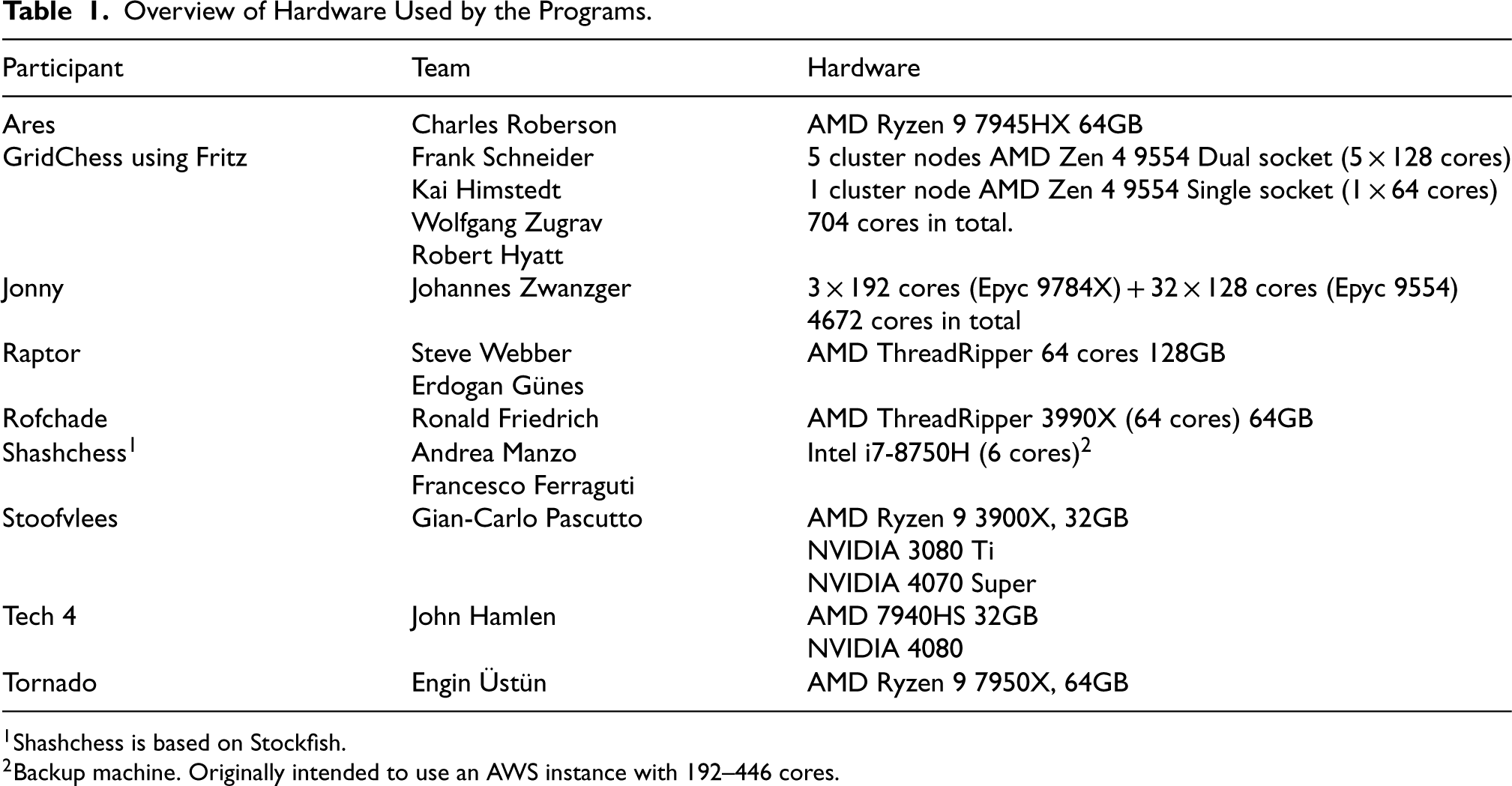
On October 21 the computer tournaments moved to the hall of the conference center of Santiago de Compostela. Here the participants were using their own hardware (see Table 1).
Before the start of the first round of the WCCC it became clear that the WiFi connection in the tournament hall was not reliable. The tournament organization asked for wired internet (as we had similar experiences in previous editions where we played alongside a major conference) but that was unfortunately not installed. As a frequent interruption of connectivity would influence the games significantly the organization insisted on having it installed immediately. With a few hours delay we could finally start the games.
A Start With Technical Troubles
The troubles with internet connectivity implied that the start of the first round was delayed significantly. And once most connections were working (there were issues with getting SSH connections working) the games could start. However, for one program (Shashchess) the connectivity was still not working correctly. As there was no hope for a fix for this specific connection and the games were already delayed quite a long time, Shashchess was asked to move to their backup solution with the promise that they could move it to their primary machine once this was working. Unfortunately, they were not able to use their intended connectivity and had to use their backup machine for both WCCC and WCSCC.
Round 1
Tech 4—Gridchess looked like going towards a draw for a long time. When Gridchess gave a knight for three pawns it managed to slowly improve its position and ultimately won the game.
Ares—Stoofvlees showed a scenario encountered in the previous tournament. Having an equal position for a major part of the game Ares chose the wrong plan of defending a pawn instead of increasing the pressure on the enemy king. Thereafter the game slipped away.
Rofchade—Tornado was a draw although Rofchade managed to create connected passed pawns in the endgame. This advantage was not enough to win the game since differently colored bishops prevented the advance of the pawns. The exchange sacrifice by Rofchade was sufficent for a draw but nothing more.
Shashchess—Jonny saw its share of drama. After a delayed start, Shashchess was playing on a 6-core notebook instead of the intended AWS instance (see footnote under Table 1). While one team member was trying to get the connection working, the other member was already operating. But lack of experience caused the clock next to the board to diverge from the clock of the engine, meaning that it took too much time to play its last moves. Two seconds after time was up the drawing move with the final repetition was made. An almost certain draw turned into a loss instead.
Overview of Hardware Used by the Programs.
Shashchess is based on Stockfish.
Backup machine. Originally intended to use an AWS instance with 192–446 cores.
Round 2
Tornado—Shashchess was a draw despite both programs trying for more. Shashchess gave its queen for two rooks and later a knight for three pawns. Despite the material imbalance, the game was still a draw.
Stoofvlees—Rofchade was an uneventful draw.
Gridchess tried its best against Ares, but Ares defended carefully and this time achieved the draw.
Raptor-Tech 4 was the only decisive game in this round. In a position with mutual pressure Tech 4 chose the wrong plan and had to capitulate.
Round 3
In Ares—Raptor the black side had a small advantage in the majority of the game. Until Ares decided to retreat its king to keep defending the extra pawn it had in the uneven colored bishop ending (with rooks). That was the losing decision. The king was put in a cage and eventually had to surrender. (
The other games this round were all draws (Rofchade—Gridchess, Shashchess—Stoofvlees and Jonny—Tornado)
Round 4
One decisive game in this round. In Tech 4—Ares the black player overpowered white in the endgame
Round 5
In Jonny—Gridchess it looked like it would be a decisive game as Jonny had a nice position and a small material plus after the opening. However, the small advantage petered out in an uneven colored bishops ending without any chance for either player to go for more.
Rofchade—Tech 4
In Tornado—Stoofvlees the white player chose an unfortunate book-line and gave a significant advantage to Stoofvlees. Stoofvlees still had to work quite a bit for the win and managed to force resignation of Tornado when the game reached a tablebase-lost endgame.
Shashchess-Raptor was a long game where both programs tried to win. Shashchess managed to win a pawn in the transition to a queens ending, but both programs already knew it was going to be a draw.
Round 6
This round saw two uneventful draws (Gridchess—Tornado
Round 7
Jonny—Tech 4
Shashchess—Ares
Let us see the diagrammed position.
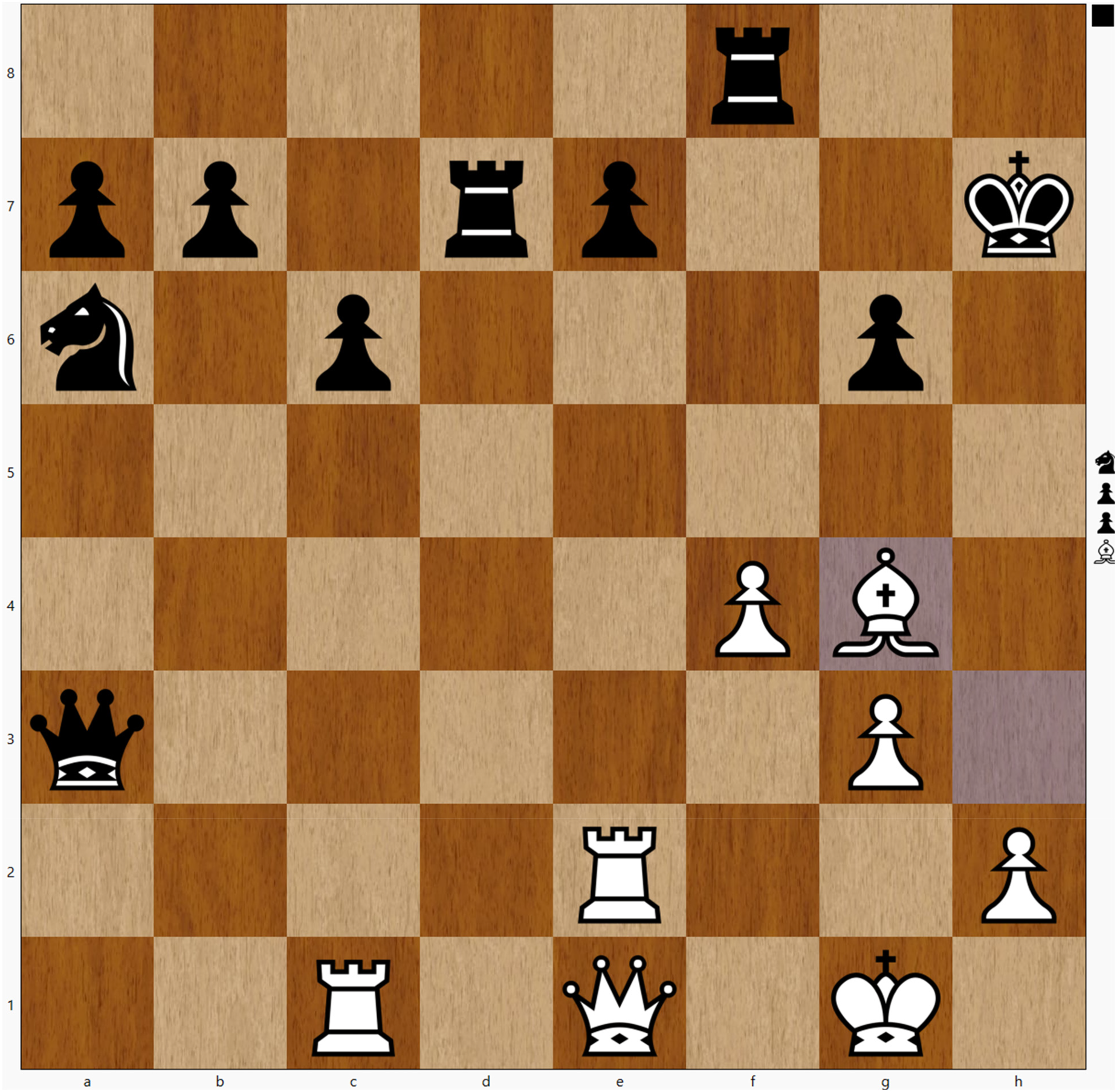
Shashchess—Ares: Position After 42.Bxg4
Agreed, the activity of the white pieces is superior, but the three connected passers of black should count for something as well, right? Anyway, 20 moves later black was mated.
In Tornado—Raptor
The last game in this round (Stoofvlees—Gridchess) was an uneventful draw
Round 8
Raptor—Stoofvlees
Tech 4 sacrifices a pawn in the opening against Tornado and initially had sufficient compensation (and more) for it. But when the game progressed the advantage decreased. When it decided to exchange a passive rook of Tornado for one of its own active ones Tornado (
Ares played a very aggressive game against Jonny, but left too many weaknesses in his own position. After a series of exchanges Jonny trapped the white bishop that was left on h7 and won the game after many more moves.
With one round to go Jonny (playing Rofchade next) and Raptor (playing Gridchess) shared first place with 5 points, with three programs just ½ point behind: Stoofvlees (playing Tech 4), Rofchade (playing Jonny) and Shashchess. As Shashchess already played all games, only Stoofvlees and Rofchade had chances of joining the leaders for first place.
Round 9
Ares (black) played a dubious line in the Ruy Lopez against Tornado (white). Tornado made the most of it and smoothly brought the game home. (1-0)
Stoofvlees had to beat Tech 4 to have a chance to join the leaders. Tech 4 played aggressively for space but left its pieces uncoordinated. Stoofvlees took over and won the game. If both Jonny and Raptor did not manage to win their games Stoofvlees would be (shared) first.
Jonny (white) had to beat Rofchade (black) for an attempt to take sole lead in the tournament. Rofchade's Berlin defence made that very hard if not impossible. A draw was the logical result.
The final game was Gridchess versus Raptor. As Raptor needed a win for the sole lead it deployed the King's Indian. As usual in a KI the engines showed a significant advantage for white, but usually that starts to evaporate at some point in the game when the compact black position starts expanding. That did not really happen in this game. Gridchess played on the queen-side, sacrificed the exchange to create connected passers and seemed to have enough advantage (despite the material deficit) to claim the win. But miraculously that did not happen. And when it gave back the exchange the hated 0.00 score indication was showing as well.
This lead to the following standing:
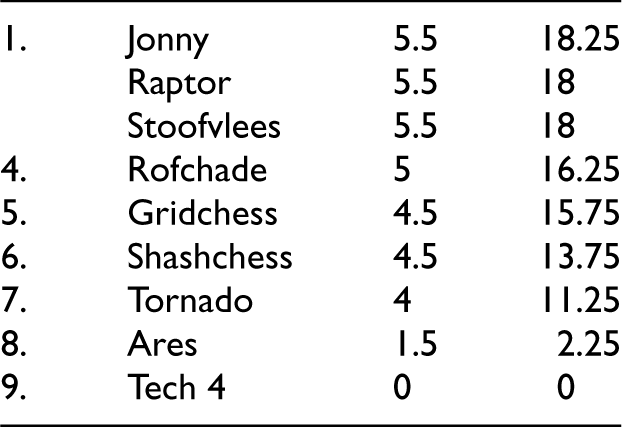
This meant a 3-way tie for first place as SB points are officially not used as a tiebreaker, but only to select the two highest placed participants who will then be playing playoff games. Obviously, that method fails here so it was decided to play a 3-player double round robin with preset positions. As the number of games would be relatively high this also meant that the players (and the arbiter) would have to skip the CHESS event that was held simultaneously.
The preset position unfortunately did not give the wanted break in the number of draws. All games were a draw. Then a second double round robin was played with shorted time control. Again all games were a draw, after which play was suspended for the day as the venue was closing.
Next day, at breakfast, the players decided among themselves that they did not want to continue and wanted to share the prize instead, which was accepted by the organization.
Hence,