Abstract

The 2025 edition of the Computer Olympiad took place under particularly unusual circumstances. On the one hand, the official interface of the competition, the Ludii platform, encountered new technical issues, preventing the competition from being conducted under satisfactory conditions. On the other hand, Jonathan Schaeffer stepped down as president and was succeeded by Jaap van den Herik, who subsequently asked us to organize this new edition of the Computer Olympiad. For these reasons, we undertook the development of a replacement system for Ludii, specifically designed for the competition and named the Discord Computer Olympiad (DCOI).
Despite its relatively unintuitive interface, largely due to limited resources and development time, DCOI nevertheless enabled the competition to take place. Ludii will of course remain the preferred platform for future editions once its issues have been resolved. DCOI can be regarded as a viable fallback solution, and is even competitive with Ludii in certain respects for the purposes of the Computer Olympiad (notably greater stability and time efficiency once its tools are mastered). Its main limitation lies in its lack of ergonomics, in particular the absence of graphical interfaces for match visualization in many games, and the inability to submit moves through a graphical interface (the only available options being automated IPC communication or manual textual input). Because the development of DCOI took significantly longer than initially anticipated, the competition had to be postponed by 4 months.
Turning now to the competition itself, we first observe a decrease in participation. This is likely due to 2 main factors: timing, as the event did not take place during a holiday period and was scheduled just before the Christmas break; and the technical difficulties with Ludii combined with the limited usability of DCOI, which likely discouraged some participants.
Regarding the results of the 2025 Computer Olympiad, the program Athénan once again obtained by far the highest number of gold medals, with 9 titles.
Athénan (Cohen-Solal, 2020, 2025, 2026; Cohen-Solal & Cazenave, 2023c) is a zero-knowledge deep reinforcement learning algorithm that has learned to play a wide range of games. Unlike AlphaZero-like algorithms (Silver et al., 2018), Athénan is based on the Descent framework (Cohen-Solal, 2020). During training, it relies on a variant of Unbounded Minimax (Korf & Chickering, 1996), called Descent Minimax, rather than Monte Carlo Tree Search, to construct the partial game tree used both for action selection and data generation. In this approach, the most promising sequences of moves are iteratively extended until terminal states are reached. During evaluation, another variant of Unbounded Minimax is used, incorporating in particular a generic solver (Cohen-Solal, 2026) and selecting the safest action when comparing alternatives (Cohen-Solal, 2025).
Moreover, in contrast to AlphaZero, Athénan does not rely on a policy network but only on a value network, which eliminates the need to encode actions explicitly. In addition, all data generated during the search process is used for learning. As a result, significantly more data is produced per game (Cohen-Solal & Cazenave, 2023c), enabling faster training without requiring massive parallelization, unlike AlphaZero. Athénan can also exploit end-of-game heuristic evaluations, such as game score or game length, to improve its level of play. Further enhancements are described in (Cohen-Solal, 2020).
Athénan’s performance over recent editions has been consistently strong: 11 gold medals in 2024 (Cohen-Solal & Cazenave, 2024), 16 in 2023 (Cohen-Solal & Cazenave, 2023a), 5 in 2022, 11 in 2021, and 5 in 2020 (Cohen-Solal & Cazenave, 2021). It is now the defending champion in 20 games (9 newly won titles and 11 previously uncontested ones).
In 2025, Athénan won 9 gold medals in the following games: Breakthrough, Clobber, Hex
Athénan’s main competitor in this edition was again the MiniZero program (Wu et al., 2024), which reimplements the Gumbel AlphaZero algorithm (Danihelka et al., 2022). Gumbel AlphaZero is a variant of AlphaZero that biases action selection by sampling among the top candidate moves using a Gumbel distribution, combined with policy and value estimates (and Q-values in the final selection phase). In addition, MiniZero incorporates domain-specific knowledge in certain games; for instance, in Connect6 and Gomoku, threat-space features are explicitly encoded as input.
MiniZero participated in 11 games and obtained 3 gold medals. Athénan and MiniZero faced each other in 10 of these games, with MiniZero winning 2 titles: Outer-Open-Gomoku and Connect6. Overall, MiniZero appears to have improved compared to the previous edition. The 2 other gold medals at the Computer Olympiad were won by MeowCaTS (Mahjong) and Yahari (Chinese Dark Chess).
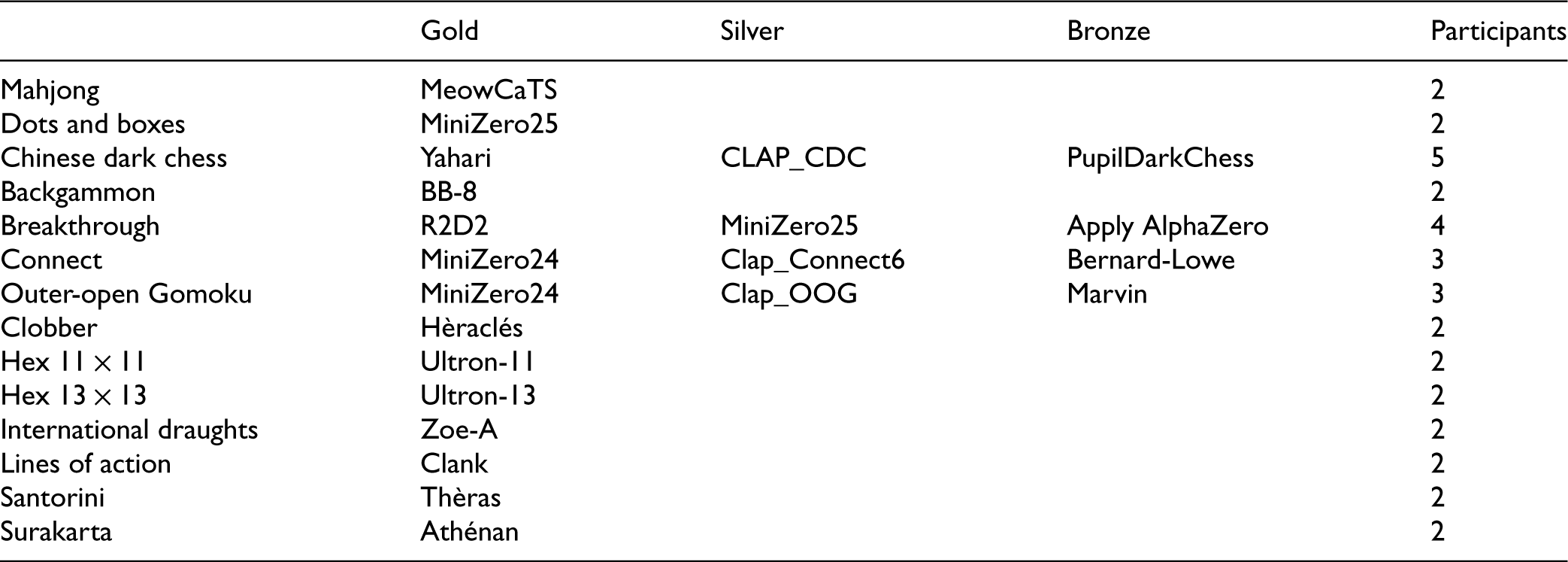
The complete results of the competition are presented in the following table:
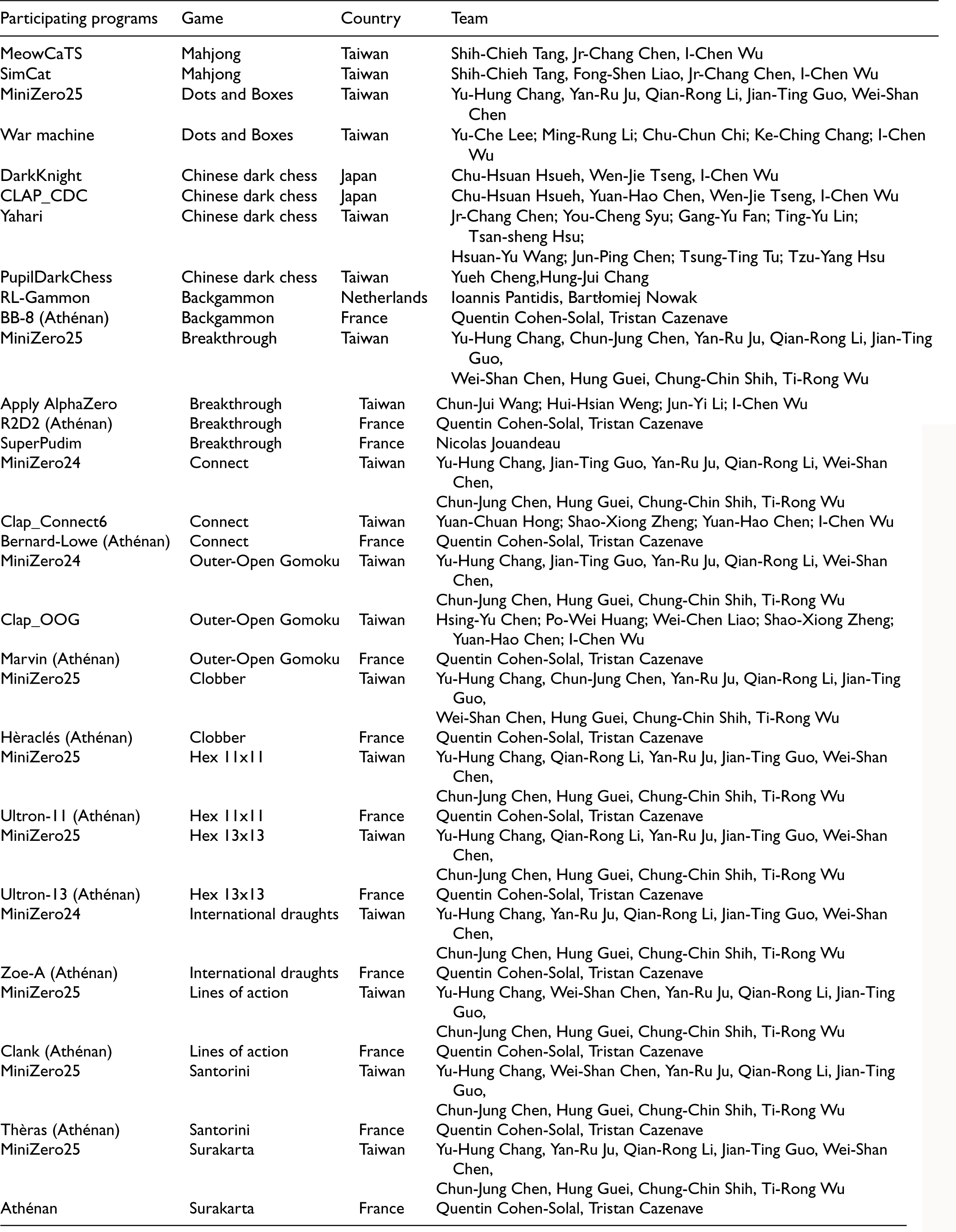
The details of the participants are provided in the following table: