



Abstract
In Bangladesh, despite increased participation in the labour market in recent decades, women are still lagging behind men by a significant margin, with the former being concentrated chiefly in low-paid agriculture as well as in the lower stages of the occupational ladder. With the help of the latest labour market data of 2016–2017 coupled with 2011 census data, this article attempts to examine gender segregation through sectoral and occupational lenses. Our econometric estimation of different sectors (agriculture, manufacturing, construction and service) reflects the importance of gender-centric factors such as care burden and marital status along with local employment opportunities in constraining women’s labour market engagement. Besides, decomposition analysis highlights that unfavourable returns to endowments play a crucial role in females’ concentration in relatively low-productive sectors. Sectoral and occupational segregation indices reflect a high degree of segregation between men and women. Thus, against the backdrop of the concentration of women in low-skilled jobs and a low-productive sector, this article expects to provide important policy insights for boosting female employment in relatively high-productive sectors and high-paid occupations while utilizing the structural shift in the labour market of Bangladesh.
Introduction and Background
Notwithstanding the high rates of growth of more than 7% over the last four pre-pandemic years (World Bank, 2020) and remarkable progress in several human development indicators, there remains an argument that Bangladesh has been unable to translate the growth experience into its labour market. For example, employment elasticity of growth is showing a falling trend in recent years, indicating a declining capacity of growth to generate employment. 1 However, the most significant change that has occurred in the labour market in the last two or three decades is perhaps the rising participation of women, with the female labour force participation (FLFP) expanding from around 8% in the mid-1980s to more than 36% in 2016–2017 (Bangladesh Bureau of Statistics [BBS], 2018). Given the country’s patriarchal and conservative social structure, such a trend in FLFP is certainly impressive. Yet women’s labour market participation in Bangladesh should be analysed more critically for several reasons. From a merely numerical point of view, despite the increase, women’s participation rate is still much lower than that of men’s, and the rate of growth of the participation rate has also slowed down in recent years. As a result, women’s labour market participation rate has been within the range of 33% to 36% for the last 10 years or so. On the other hand, although the share of women in high-productive jobs (i.e., professional and managerial jobs) has increased during the 2005 to 2016 period (BBS, 2018; International Labour Organization [ILO], 2022), in terms of quality of work, they are still found to be concentrated in low-paid and low-productive activities—with a significant percentage working as unpaid family workers—thus reflecting the inferior position of women in comparison to men (Raihan & Bidisha, 2018).
As high as 59.7% of women are also found to be engaged in the agriculture sector—which is low-paid, low-productive and often suffers from a high degree of income volatility (BBS, 2018). With the structural transformation of the economy, the share of women’s employment in agriculture has come down over time, from as high as 68% in 2005–2006 to 59.7% in 2016–2017, while in the industry and service sectors, the percentages have gone up from 12.5% to 16.8% and from 19.3% to 23.5%, respectively. However, one crucial feature of this transformation is its gendered nature—the shift in sectoral transformation has been much stronger for men, leaving women lagging behind men in the labour market. Besides, it is not only from a broad sectoral perspective but also from more detailed occupational choices that women’s inferior position can be observed there. The latest data from the Quarterly Labour Force Survey (QLFS) of 2016–2017 shows only 10.70% of managerial positions being held by women, whereas the corresponding figure for professional jobs is around 32.5%—which strengthens the argument in favour of not only sectoral but also occupational segregation of women (BBS, 2018; ILO, 2022).
Despite the importance of such broad sectoral and occupational gender segregation, to our knowledge, no study has attempted to examine it for Bangladesh. With the help of the latest labour market data of Bangladesh, first, this article has attempted to examine the determinants of female participation in different economic sectors in the Bangladeshi labour market; second, the article aims to decompose sectoral employment by gender into explained and unexplained components. Finally, the article estimates wage-based occupational segregation by gender. Against the backdrop of stagnant participation of women in the labour force, on the one hand, and their concentration in low-skilled jobs, on the other hand, it expects to provide important policy insights for boosting female employment while utilizing the structural shift of the economy.
The remainder of the article is structured as follows: The second section examines relevant prior literature; the third section describes the data and outlines the empirical strategy of the study; the fourth section offers key summary statistics regarding the labour market of Bangladesh; the fifth section presents and discusses the empirical results; and the sixth section concludes the article by providing policy recommendations.
Literature Review
This study primarily focused on reviewing the literature concerning gender gaps in participation, employment and wage in the labour market of Bangladesh. While looking at the literature on FLFP in Bangladesh, one interesting aspect can be observed—despite the constraints of social norms and customs, poverty has been a push factor for labour force participation (LFP) of women. For example, Cain et al. (1979) explored the relationship among social class, male dominance and women’s work. They demonstrated that despite the presence of powerful norms of female seclusion, due to poverty and family responsibilities, the potential resistance of patriarchy was reduced to some extent and more women started to get involved in paid work. Kabeer and Mahmud (2004), with the help of information from 1,322 working women, made a comparison of socio-economic characteristics, wages and working conditions and found the importance of poverty in the case of employment of women in the export-oriented industries of Bangladesh. A study conducted on the trends, drivers and barriers of FLFP by Rahman and Islam (2013) revealed that women’s participation in casual jobs was positively correlated with poverty and negatively correlated with motherhood, marital status and educational attainment. Verick (2018) attempted to explore the complex relationship between FLFP and development. The author found that women’s LFP in developing countries (including Bangladesh) was not only driven by poverty but also by the type of shock coping mechanism that they might have applied. The study also revealed the importance of access to education in the case of employment and found a positive relationship between reservation wage and educational attainment. In addition to poverty, several other works of literature explored the importance of other socio-cultural factors in determining FLFP. In this context, research by Salway et al. (2003) on the urban poor of the Dhaka city revealed that socio-cultural factors such as marriage and motherhood were the critical factors associated with lower rates of employment for women. Jaim and Hossain (2011) explored the trend of participation of women in agriculture using four consecutive rounds of Labour Force Survey (LFS) from 1995 to 2005 and longitudinal data from 1988 to 2000. They found that due to more involvement of men in non-farm jobs, there had been a male labour crisis in the agricultural sector which influenced women to be more involved in the managerial activities of crop production.
Several studies have been conducted on the gender disparity in the labour market of Bangladesh. Ahmed and McGillivray (2015), using three rounds of LFSs, explored changes in the gender wage gap and the drivers behind these changes over a decade. Devising decomposition techniques like Wellington decomposition and some variants of Blinder–Oaxaca decomposition, they found that over the 1999–2009 period, the wage gap decreased by around 31% and education contributed the most to this wage gap reduction. Ahmed and Maitra (2015), using unconditional quantile regression models, showed that women were paid less than men throughout the entire distribution, and the gap was found to be higher at the lower end of the distribution. Chatterjee et al. (2015) investigated the decline of FLFP in rural India while considering both the demand and supply side in the analysis. The study used several probit regressions to capture the structure of employment at the rural–urban level and found that if local job opportunities are taken into account, the place of residence as an explanation of FLFP becomes unimportant. Anjum (2016), using LFS data from 2005–2006, used various decomposition techniques, including Olsen and Walby (2004) decomposition, and found that the gender earnings gap is lower in the public sector than in the private sector.
Using LFS data from two rounds, Mahmud and Bidisha (2018) tried to identify the factors behind labour supply decisions of women in Bangladesh. They concluded that compared to the twentieth century, when poverty acted as the driver of women’s LFP, in later years of the first decade to the twenty-first century, gender-based norms/characteristics became the dominant factors. Raihan and Bidisha (2018), while exploring the stagnation of FLFP in Bangladesh, also found the critical impact of gender-centric factors. In addition, their study also emphasized the impact of demand-side factors, for example, sluggish growth of the Readymade Garments (RMG) sector, technological change while explaining the stagnation of FLFP in Bangladesh. Siddique and Hossain (2018), using Mincerian ordinary least squares (OLS) regression and its Blinder–Oaxaca decomposition, found that gender wage discrimination is higher at the lower end of the distribution for the urban workers. Rahman and Al-Hasan (2019) devised Blinder–Oaxaca decomposition and quantile regression-based decomposition techniques to explore the gender wage gap in informal employment in Bangladesh. They found that the wage gap is higher in the lower deciles, and women receive 14.4% lower wage on average than men in informal employment. This study used the QLFS conducted in the 2015–2016 period. In another study, Rahman et al. (2019), using seven rounds of LFS data, explored informal employment dynamics and the factors behind selecting the type of employment. They found that the wage penalty between formal and informal wage employment was around 65%, and between formal paid and informal self-employed employees, it was about 225%. In a relatively recent study, while using four rounds of the LFS, Rahman and Al-Hasan (2021) investigated the trend and determinants of the gender wage gap in Bangladesh by deploying quantile regression and a variant of Blinder–Oaxaca decomposition. They found that the selectivity corrected gender wage gap in Bangladesh is about 5%, and at the top of the distribution, the gap tends to be higher.
From the methodological point of view, several indices and decomposition techniques have been used to investigate gender-based inequality in occupational status and wage distribution. In a seminal work, Oaxaca (1973) examined wage differentials between men and women within the same occupation due to differences in characteristics as well as differences in returns to characteristics, where their decomposition technique estimated and assessed the degree of discrimination against female workers in the United States. Blinder–Oaxaca decomposition, however, has two limitations. First, it has been devised for a situation where the sample could be subdivided into two mutually exclusive groups; thus, it does not let us perform the decomposition using a common coefficient vector. Second, Blinder Oaxaca decomposition cannot be applied in cases of more than two groups of the population. Third, the parametric technique makes the ‘out-of-support’ assumption, which fails to restrict comparison between men and women of shared characteristics and ultimately overestimates the coefficients effects component of decomposition due to the said misspecification (Ñopo, 2008). Such a high dependence on the assumption of linearity across the entire distribution of support tends to introduce biases by overlooking possible non-linearities in characteristics effect (Pakrashi & Frijters, 2017). In this context, Borooah and Iyer (2005) formulated a decomposition technique addressing the first two limitations and estimated intercommunity differences in the enrolment of boys at schools in India. In another research work, Borooah (2005) explored inequality and poverty, in terms of caste-based discrimination, among the households of India. He applied a decomposition method that decomposed the income differences between Hindu (caste) and Scheduled Castes (SC) and Scheduled Tribes (ST) into a ‘discrimination effect’ and an ‘attributes (residual) effect’. The former effect accounted for the part of the difference which depended on the household being an SC or ST. On the other hand, the latter accounted for the fact that there are systematic differences in income-generating profiles among the Hindu and the SC/ST. On the other hand, a non-parametric decomposition method, based on matching individual characteristics, has been developed by Ñopo (2008) to address the third limitation. This method presents the gap attributable to differences in the distribution of characteristics between matched men and women, as well as separate estimates for the unmatched men and women. The author noted that the issue of non-overlapping common support is more likely to arise in developing economies and when gender segregation based on the nature and status of jobs is prevalent, as is the case in Bangladesh.
A number of indices have also been applied in the literature to understand the gap in labour market experiences between men and women. In this context, Duncan and Duncan (1955) devised a gender-based occupational segregation index that assessed whether there was more than the expected number of participants of a particular gender in a particular occupation. In particular, this index shows the proportion of employed men or women who would have to change their occupations to equalize the occupational distribution. Another method to assess the extent of differentiation for the distribution of ranked categories is the Index of Net Differences, introduced by Lieberson (1976). This method is often considered superior to understanding occupational segregation due to its flexibility in application: it can be applied when the ordered distribution has a different distributional form in each group. Later Lewin-Epstein and Semyonov (1992) and Semyonov and Jones (1999) modified and applied this index. The former assessed the degree of occupational differentiation between Arab men and women, whereas the latter attempted to explore differences between gender-based occupational segregation and gender-based occupational inequality.
Data and Methodology
Data Description
This article is based on the QLFS 2016–2017 and LFS 2010 of Bangladesh, conducted by the BBS. These are nationally representative surveys containing information on key labour market variables along with socio-demographic factors.2, 3 We additionally use district-level sectoral employment shares from Integrated Public Use Microdata Series, International (IPUMS-I), which is a 5% sample subset of the Bangladesh Population and Housing Census 2011, also conducted by BBS (IPUMS-I, n.d.; Minnesota Population Center, 2019).4, 5
Empirical Methodology
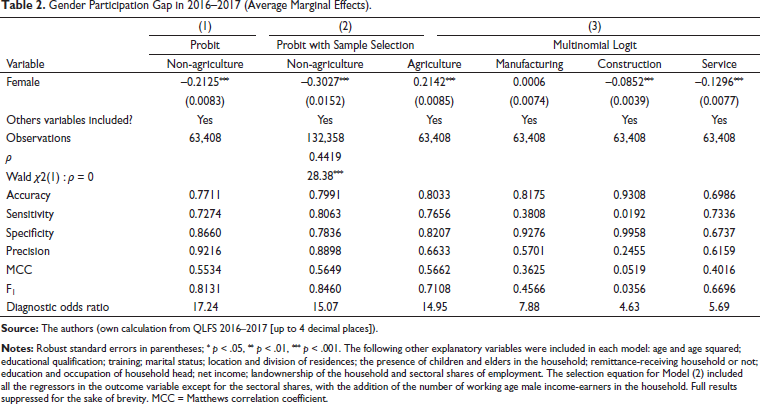
Due to the heavy concentration of women in relatively low-paid and low-productive agriculture, it is crucial to understand both demand- and supply-side factors constraining their participation in non-agricultural activities. 6 In addition to simple descriptive statistics of gender-disaggregated labour market status, we have applied several econometric techniques for getting better insights into gender segregation. To this end, we estimated a probit regression of non-agricultural vs agricultural employment, along with a probit with correction for sample selection (Van de Ven & Van Praag, 1981), as the sector of employment can only be observed for the employed and there might be systematic differences between those in employment and those without. Not taking into account these biases would give rise to inconsistent and biased estimates (Heckman, 1976). We included the number of working age male income-earners in the household as an added independent variable in the selection equation for identification. Next, we applied the parametric Blinder–Oaxaca decomposition, disaggregating differences in employment probability (∆) into an explainable part due to differences in observable characteristics (∆ x ) and an unexplainable component due to differences in coefficient effects or returns to characteristics (∆0). This was followed by the matching-based non-parametric Ñopo (2008) decomposition, which takes into account the differences in the distribution of individual characteristics: there are men with combinations of traits not shared by any women and vice versa. The suggested matching criterion makes use of only discrete variables and does not rely on any parametric assumptions regarding them. The overall difference (∆) is decomposed into four components rather than two: (a) ∆ x : part of the gap that can be attributed to differences in the distribution of individual characteristics between men and women over the common support; (b) ∆M is the portion of the gap that can be explained by differences in the characteristics between two groups of men: the unmatched and matched to women’s characteristics; (c) ∆F is the part of the gap that can be explained by differences in the characteristics of between two groups of women: the matched and unmatched to men’s characteristics; and (d) ∆0 is the unexplained part of the gap due to differences in returns to characteristics between men and women over the common support—attributed as unobservable characteristics, discrimination or both—just like Blinder-Oaxaca. Notably, the summation of the first three components corresponds to the ‘explained’ part of the Blinder-Oaxaca decomposition. Following Chatterjee et al. (2015), we have incorporated the sectoral share of employment in our model to depict the possibility of different types of local employment opportunities from the individual’s perspective. Besides, this has the benefit of avoiding a probable endogeneity problem. Model diagnostics have been presented based on confusion matrices obtained with the help of the Stata command ‘goodfit’.
There can be differential effects of the various factors considered for being in a more specific employment sector, too, once we further dissect the rather broad category of non-agricultural activities. Hence, a Multinomial Logit (MNL) model on sectoral employment for both men and women has been estimated for four broad sectors, namely (a) agriculture, (b) manufacturing, (c) construction and (d) service. The analysis has proceeded further by decomposing the results following Borooah (2005), where differences in the probability of being in different sectors are decomposed while considering the change in those average probabilities if (a) women were given the coefficients (or returns) of men and vice versa, and (b) women were given the endowments of men and vice versa. 7
Given the concentration of women in the agriculture sector and under-representation in the manufacturing and service sectors (see Table 4), it is worth investigating the sectoral employment pattern. In this context, we constructed horizontal segregation indices (Index of Dissimilarity), a variant of which is commonly used in the literature (see, for instance, Semyonov & Jones, 1999; Tzannatos, 1999) to understand the sectoral status of gender segregation. In addition to sectoral segregation, women are under-represented in high-skilled occupations (Table 3). Therefore, the degree of occupational segregation in the labour market has also been analysed next through the Index of Dissimilarity
(D, in short). This segregation index can be calculated in the following manner (Duncan & Duncan, 1955):

where Fi is the number of women in the ith sector/occupation; F is the total number of employed women in the labour force; Mi is the number of men in the ith sector/occupation; and M is the total number of employed men in the labour force.
In addition to occupational choices, it is argued that women lag behind men in terms of earnings. Therefore, in the final stage, we attempted to understand the rank-based occupational distributions between men and women, with the assumption being higher-paying jobs are ‘better’ jobs. For that, we measured vertical segregation using an Index of Net Differences (ND, in short).
8
ND has been estimated in the following manner (Lieberson, 1976):

where M and F are the relative frequency distributions of men and women, respectively, and i and j denote rank-ordered occupational categories from lowest to highest. ND considers the ordinal nature of occupations and helps measure vertical segregation (Semyonov & Jones, 1999). 9
Descriptive Analysis
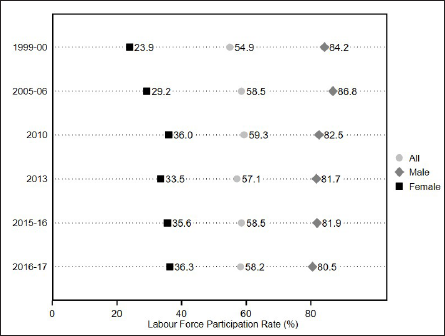
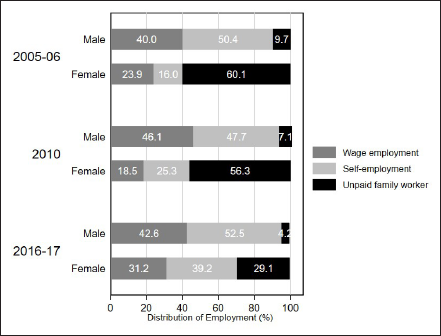
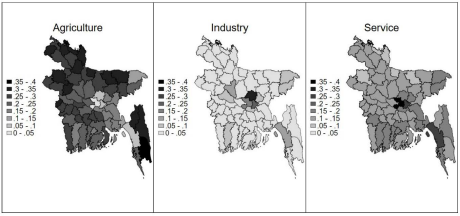
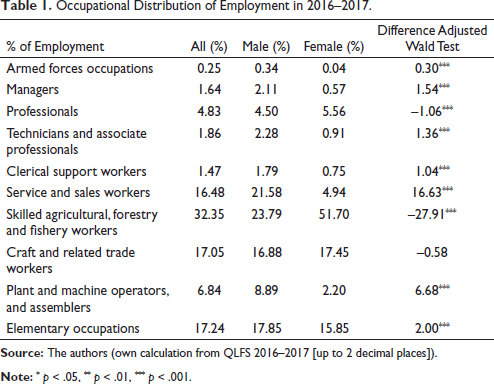
As discussed, the most significant change over time in the labour market of Bangladesh is probably the rise of participation of women: FLFP has increased from around 24% in 1999–2000 to 36% in 2010 (Figure 1)—with the participation of men being constant at around 80%. However, since 2010 we do not observe much improvement, and in 2016–2017 the Labour Force Participation Rate (LFPR) of women stood at around 36.3% only. We observe significant differences across the types of employment too. For example, as high as 29.1% of employed women are found to be engaged as unpaid family workers (Figure 2). Therefore, women are in an inferior position to men not only in terms of mere participation but also from the point of view of the quality of employment. Table 1 additionally shows that in terms of occupational choices, women’s representation is significantly less than men’s in high-paid and high-skilled managerial positions. In contrast, in presumably less-productive occupations like unskilled agriculture, a considerably more significant proportion of women are found to be engaged. From a sectoral point of view, despite ongoing structural transformation in the economy, as shown in Figure 3, as high as 59.7% of women are still found to be in the agriculture sector as opposed to 32.2% of men. Figure 4, in this context, depicts the sectoral distribution of employment based on geographical locations and reveals the concentration of industrial employment in districts containing major cities and the widely distributed presence of agricultural employment across different regions of the country. It is, therefore, crucial to understand the sectoral employment pattern of both sexes in greater detail, and we proceeded to do this while applying suitable econometric tools.

Occupational Distribution of Employment in 2016–2017.
Econometric Analysis
Gender Participation Gap in 2016–2017 (Average Marginal Effects).
Participation in Non-agricultural Employment (Average Marginal Effects from Probit).
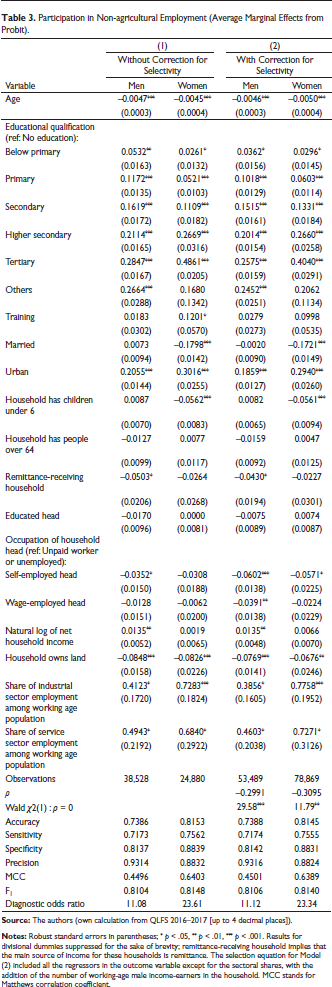
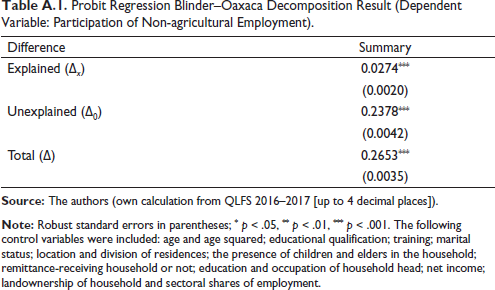
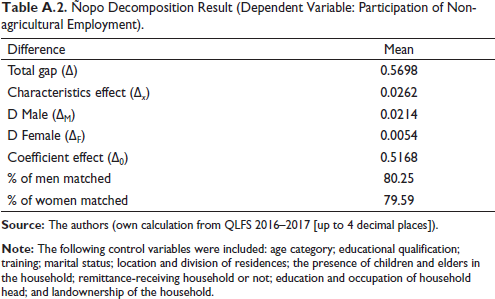
Given the gender difference in non-agricultural employment probability, in the next step, we applied the parametric Blinder–Oaxaca Decomposition of participation in the non-agriculture sector. The result of decomposition analysis reflects the dominance of the unexplained part (89.66%) in explaining the gap (Table A.1). Results from the matching-based non-parametric Ñopo decomposition also support this: About 90.70% of the gap is due to the unexplained element, ∆0 (Table A.2). While 10.33% of the overall gap was attributed to the difference in characteristics in Blinder–Oaxaca decomposition, once we restrict the comparison over the common support in Ñopo decomposition, ∆ x contributes to only 4.60% of the overall gap. Moreover, in Ñopo decomposition, a similar percentage of the gap (3.76%) arose due to differences between unmatched and matched men, suggesting that there were men in the sample with sets of characteristics that are highly rewarded in the labour market and for whom no female counterpart could be found possessing the same combinations of characteristics—thereby justifying the use of this matching-based method and the need for improving the endowment set of women. It is worth pointing out here that the overall gap (∆) in both decompositions differs due to using dummies of age categories—instead of the continuous variables of age and age squared—and omission of the remaining continuous variables (i.e., household income and sectoral employment shares) in Ñopo decomposition. Regardless, either approach reaches the same conclusion that observable characteristics cannot explain the majority of the gender gap.
Determinants of the Choice of Sector of Employment (Average Marginal Effects from Multinomial Logit).
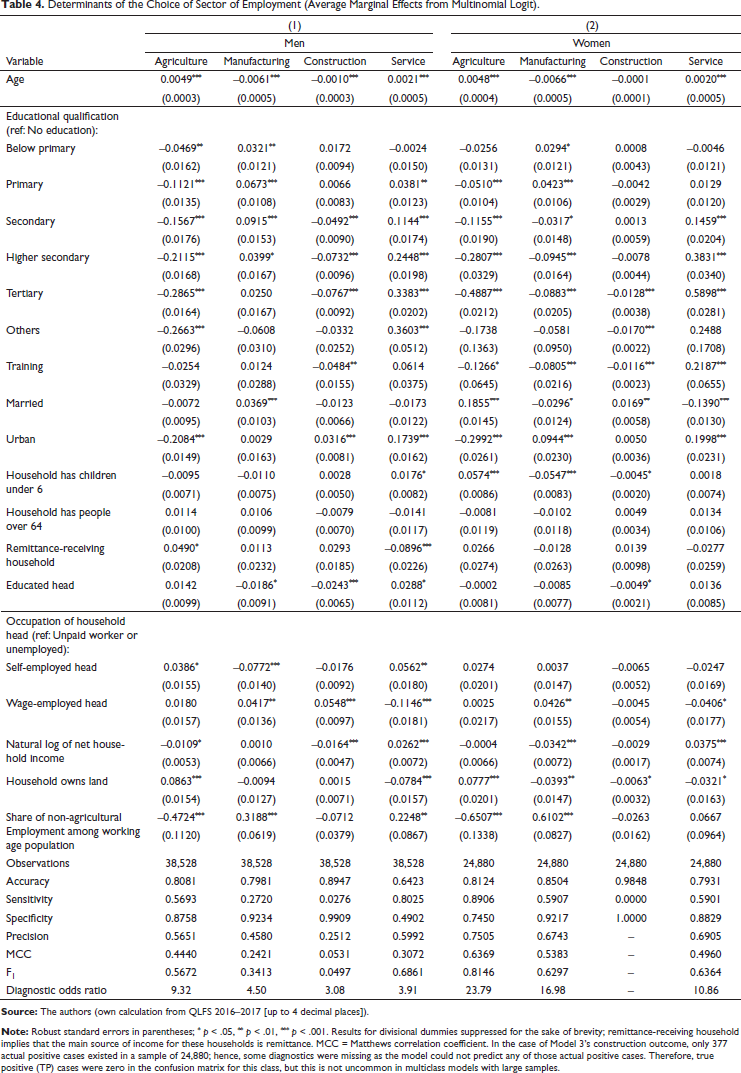
In order to get a better insight into the factors behind such differences in sectoral employment, the results of MNL estimates have been decomposed, revealing the importance of the coefficient effect (returns to endowments) or the dominance of unexplained factors. For example, if women were treated as men, their presence in the agricultural sector would have fallen to 29.16%; in contrast, their presence in the manufacturing, construction and service sectors would have risen to 21.80%, 10.73% and 38.32%, respectively. On the other hand, if men were treated as women, their presence in the agricultural and manufacturing sectors would have risen to 44.79% and 22.07%, respectively; in contrast, their presence in the construction and service sectors would have fallen to 1.61% and 31.52%, respectively. The dominance of the coefficients effect is also apparent from either point of view (Table A.3).
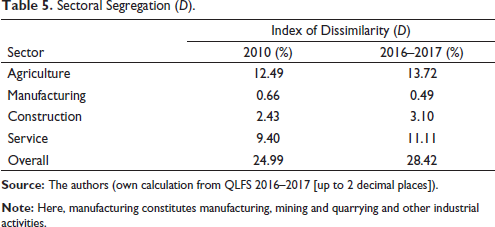
Sectoral Segregation (D).
Occupational Segregation (D).
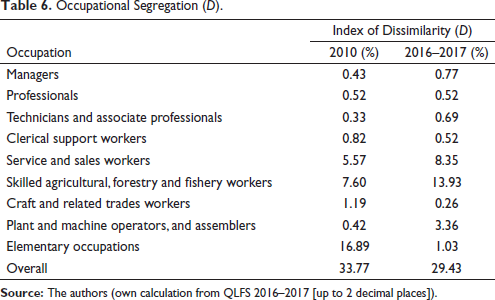
As pointed out above, a limitation of horizontal segregation measures is that they do not reveal the direction of segregation, rather only the magnitude; neither do we get the segregation measured on an ordinal scale, that is, if the concentration occurs in a ‘better’ or a ‘worse’ job/sector. We, therefore, applied a vertical segregation measure based on wage-based ranking. In this regard, intending to understand and compare women’s labour market status with men, in Table A.4, we showed the results of wage-based occupational rank for both sexes. According to the vertical segregation measure Index of Net Differences (denoted by ND), on average, men’s occupational rank will exceed women’s 28.37% more often than women’s occupational rank will exceed that of men. Also, the probability of men being ranked higher is greater than that of women, so women also fall behind in the occupational hierarchy based on earnings. It is also evident in the data that women have disproportionate representation in the lowest-paying category and lacklustre representation in higher-paying jobs (except for the ‘Professionals’ category).
Conclusion
Against the backdrop of the concentration of women in low-productive jobs as well as in the lower stages of the occupational ladder, this article attempted to understand the factors behind their inferior position in the labour market. Both simple and selection bias-corrected probit estimations of non-agricultural employment along with MNL estimation of different sectors (i.e., agriculture, manufacturing, construction and service) reflect the importance of gender-centric factors (presence of children, marital status), household factors (landholding), higher secondary and tertiary-level education, and availability of local job (share of sectoral employment) in determining women’s employment status. Decomposition analysis highlights that mainly ‘unexplained’ factors rather than inferior endowments constrain women to enter non-agricultural ‘superior’ employment. Besides, our MNL decomposition reveals that if women were given similar returns to their endowments as that of men, their sector-wise participation would change in favour of relatively high-paid service and industry sectors and fall in the low-paid agriculture sector. Both sectoral and occupational segregation indices reflect a high degree of horizontal segregation between men and women, where the sectoral segregation index has risen over time. In terms of vertical occupational segregation and ranking based on earnings, the probability of men being ranked higher is greater than that of women—hence, women also fall behind in the earnings-based occupational hierarchy.
Based on our analysis, since ‘gender factors’ are the dominant constraints for women in attaining a superior position in the labour market, more gender norm-centric policies should be given emphasis: for example, ensuring day care facilities, extending the provision of maternity and post-maternity leave, and introducing flexible and part-time working hours. Bringing the private sector into such processes through appropriate incentive packages can turn out to be effective in ensuring a gender-sensitive work environment. Following Tzannatos (1999), supporting care work through social safety net programmes, like in many developed countries, can be another strategy to consider. Assuring a gender-friendly environment in educational institutes and workplaces can prove to be instrumental for greater involvement of girls and young women at the secondary and tertiary levels of education, and thereby at higher stages of the occupational ladder. For spreading the benefits of structural transformation, newer sectors within non-agriculture should be sought and policy incentives should be directed towards that end through related education and training. In this regard, sectors such as care service, IT, catering and restaurant and nursing can be converted into potential sectors for female employment (Raihan & Bidisha, 2018).
Appendix
Probit Regression Blinder–Oaxaca Decomposition Result (Dependent Variable: Participation of Non-agricultural Employment).
Ñopo Decomposition Result (Dependent Variable: Participation of Non-agricultural Employment).
Multinomial Logistic Regression Decomposition Result.

Occupational Wage Inequality (ND).
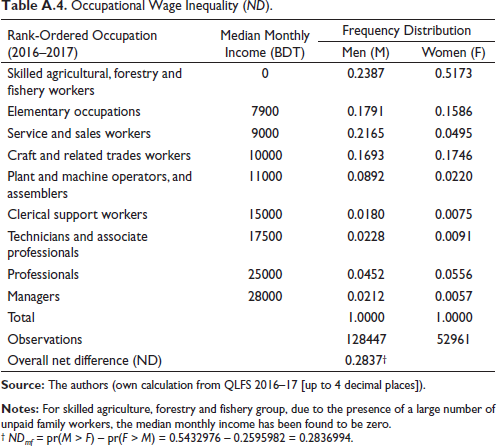
† NDmf = pr(M > F) – pr(F > M) = 0.5432976 – 0.2595982 = 0.2836994.
Footnotes
Acknowledgements
We would like to thank Professor Vani K. Borooah, Professor Emeritus Moshe Semyonov and Dr Hugo Ñopo for responding to our methodological queries. We are also grateful to Dr Fernando Rios-Avila for his coding suggestions. Usual disclaimers apply.
Notes
Declaration of Conflicting Interests
The authors declared no potential conflicts of interest with respect to the research, authorship and/or publication of this article.
Funding
The authors received no financial support for the research, authorship and/or publication of this article.
