




Abstract
How does the price of energy affect the extent of production fragmentation in India’s manufacturing industries? The prevailing literature has engaged with production fragmentation and trade in middle products for a long time, but the relationship between energy prices and production fragmentation is less understood. This article deals with firm-level panel data of India’s manufacturing industries between 2005 and 2018 to estimate the impact of rising energy prices on the outsourcing decisions/production organization of the manufacturing firms. The article also uses a number of covariates, including wages, welfare expenses, sales, profit after tax, dividend rate, foreign exchange earnings and an interaction term between energy prices and foreign exchange earnings. The empirical results of this article indicate that larger firms tend to outsource production in part to smaller firms in order to cope with rising energy prices and keep their profitability intact. Static and dynamic panel estimates with a variety of robustness analyses support the main conjectures.
Introduction and Literature Review
Production fragmentation can be defined as disaggregating a product into its constituent parts, components and accessories (PCAs). The PCAs are produced by different countries based on their comparative advantages, with each country specializing in a particular stage of the production sequence. This leads to the slicing up of the value chain, thus creating cost advantages for the firms through marginal differences in costs, resources, markets and logistics. Athukorala and Yamashita (2006) defined international fragmentation production as ‘cross-border dispersion of component production/assembly within vertically integrated production processes, with each country specializing in a particular stage of the production sequence’.
One of the most important and identifiable patterns of international fragmentation is outsourcing. The term ‘outsourcing’ has been used in scientific publications for the first time since the early 1980s. Outsourcing is a business practice where companies contract an outside supplier to produce goods and services on their behalf (Bhagwati et al., 2004). More and more countries are outsourcing some stages of their production process, with growing trade in intermediate goods. This signals the deepening structural interdependence of the world economy (Ando 2006; Athukorala & Yamashita, 2006). Outsourcing can be defined as ‘the practice of having certain job functions done by another individual/enterprise, instead of getting it done internally’. It has become a normal practice for companies to outsource a certain segment of their requirements or some manufacturing jobs to third parties. It is also not feasible or economical for certain large product manufacturing companies (e.g., car manufacturers) to produce all the parts and components required for manufacturing the entire product. So, these companies resort to outsourcing. Many companies tend to outsource their entire manufacturing process and simply add their brand name to the final product. Apart from the cost-saving motive of outsourcing, firms tend to outsource in order to optimize their labour resources and efficiently use them. Outsourcing also helps to save on expenditures on recruitment and training of a workforce by bringing in aboard expertise.
Radlo (2016) explored the literature studies and found that even in the 1980s, very few articles used the term outsourcing, but in the early 1990s, the term ‘outsourcing’ started gaining much popularity. In his study, he goes on to distinguish several concepts: production fragmentation, outsourcing and offshoring. There is often a slight confusion between the terms outsourcing and offshoring. Offshoring means getting the work done by a third party in different countries (which means outside the country or border), while outsourcing refers to getting the work done by a third party either domestically or abroad. Thus, outsourcing is a much broader concept.
On the contrary, production fragmentation is a phenomenon in which the production processes are divided into separate components that are produced by different companies, either sharing common ownership or having different entities and being located in one or more countries. With increased fragmentation in production processes, firms tend to outsource certain segments of the production sequence in order to save costs and stay competitive in the international product market. Like outsourcing is related to domestic production fragmentation, offshoring is a phenomenon related to international production fragmentation. In this article, the outsourcing aspect of production fragmentation has been taken into consideration.
Over the last few decades, industrial production in India has witnessed a growth of more than 50-fold. It has been observed that the industries that are dependent on natural resources for their source of energy are more polluting in nature and growing at a large scale. Air and water pollution by gases or heavy metals is severely affecting human health. In the last few decades, researchers across the developed and developing nations have expressed their growing concerns for the rising environmental damage due to a greater degree of openness in capital flows and trade in PCAs (see Kar & Devleena, 2016 for the direction of the impact of the most-favoured-nations tariff on emissions in developing countries). The increasing participation of several industries in trade has led to increased competition, which in turn has compelled the firms to reorganize their production structure and involve themselves in several cost-saving production processes. The government of several countries has taken several environmental policies in the form of emission taxes, emission caps, abatement costs, and so on, to curb the rising air and water pollution. To evade such taxes and to cut the cost of production, the formal firms tend to take part in the process of production fragmentation and outsource the dirty stages of production to their informal counterparts.
In fact, it has been observed that the rich countries have stricter environmental regulations compared to the poor countries. Thus, the majority of the wealthy countries tend to outsource a huge chunk of their carbon emissions overseas rather than producing it domestically. The developing nations, which face relatively laxer environmental regulations, produce these dirty goods (pollution-intensive goods) on behalf of the developed countries. This led to the migration of energy-intensive industries or production processes from developed nations to their developing counterparts. This relates to the popular pollution haven hypothesis (PHH), which argues that with liberalization, developing countries tend to specialize in pollution-intensive commodities. The reason behind the above argument is that developed countries generally have more stringent environmental regulations compared to their developing counterparts. Thus, pollution-intensive industries migrate from the developed to the developing countries in order to save on production costs for dirty commodities (Cole, 2004; Copeland & Taylor, 2003; Eskeland & Harrison, 2003; Xing & Kolstad, 2002). If we consider the total global emissions arising out of the production of total world output and take into account the amount of emissions taking place for producing things to meet the consumption needs of the wealthy nations, then the total carbon footprint for the developed nations actually increased over time. Thus, the countries that have claimed to be meeting their climate goals are actually not making any progress to improve the environment since they are simply outsourcing their emissions overseas.
Such arguments motivate us to think about how the environment plays an important role in determining the level of economic activity. Environment is often considered as a factor in production since all economic activities involve the environment in their production process. Thus, if the government regulates the usage of environmental inputs or changes the prices of such inputs, the scale or composition of economic activities is likely to be affected. While some effects of international production fragmentation have been dealt with in the existing literature, such as those on productivity, wages, investment patterns and generally production reorganization at the firm level, very few studies have considered the impact of changes in energy prices on firm-level outsourcing decisions. It is expected that with rising energy prices, the larger firms will tend to outsource some parts of their production processes to the smaller firms, 1 since smaller firms can produce these at a lower cost. It can also be noted that the bigger firms come under the supervision of governmental regulations and have to adhere to stringent laws with respect to factors of production.
The objective of this article is to show how rising energy prices hurt formal firms and how they tend to outsource more in order to cut back on other costs of production. Another dimension is that rising fuel costs hamper the profitability of larger firms, thus restricting their ability to carry out other productive activities. Coming to the link between such outsourcing activities and the environment, it can be argued that the production processes that have been outsourced to the smaller sectors are expected to be more pollution-intensive, and the increase in outsourcing may generate more pollution. However, since we do not have any explicit abatement costs or a carbon market in India, we leave this argument to be scientifically tested in the future. The outsourcing may also be dispersed geographically rather than being located in a visible enclave. But these are open to further empirical verifications since we do not have data to support these conjectures presently. To scientifically test the relation between energy prices and the outsourcing activities of firms, the following hypothesis has been framed, and the research question is validated using an empirical analysis.
Hypothesis: Energy price is an important determinant of the outsourcing intensity of manufacturing firms.
The above hypothesis has been empirically tested in this article, and the empirical analysis suggests that with increases in the prices of energy inputs (e.g., prices of power, fuel and water), the intensity of outsourcing by Indian manufacturing firms tends to increase. Energy prices are expected to play a major role in decisions regarding production organization since India is considered the world’s third largest energy consuming country (India Energy Outlook, IEA 2021). According to the report, India’s energy use has doubled since 2000, with more than 80% of their energy demand being fulfilled by coal, oil and biomass.
With increasing production fragmentation over the last few decades, firms tend to outsource several parts of their production. This outsourcing is often influenced by several factors. One of the most important factors is the ‘cost’ factor. The costs incurred in the production of goods and services comprise several types. Apart from the factor prices and the traditional input costs, firms in recent times have been charged with higher prices for using the environment as an input for their production process. Many industries suffer from rising energy costs while product prices tend to drop. In order to survive, firms tend to outsource some parts of their production activities to smaller units. The reason may be that the larger firms fail to substitute energy use with other inputs of production. If firms can substitute energy with something else, then they tend not to outsource even if energy prices rise. However, many formal firms will not be able to reduce labour costs or interest charges in the face of rising energy prices. This may be one of the reasons why they might outsource to firms outside their ambit, thereby substituting higher energy prices for lower labour costs, for example. The production of the informal sector could be a case in point. However, we do not know if abatement costs are also borne by the informal sector because we do not have adequate information on this account. It will be tested in future research whether the rise in the price of energy has a substitution impact on other factor inputs or not. In this current study, we only put emphasis on the relationship between energy prices and outsourcing intensity. So, we try to establish the fact that how firms attach importance to the price of energy while making their outsourcing decisions is separate from other factors.
Data and Empirical Specification
For the empirical analysis, firm-level panel data has been collected from the PROWES Database (by CMIE). The period of this empirical analysis ranges from 2005 to 2018. 2 This empirical analysis uses data on outsourcing activity by Indian manufacturing firms. In this article, we have selected firms from India’s four industries, namely, the chemical industry, machinery industry, metal industry and textile industry. There are several reasons behind the selection of these industries for our empirical study. First, these industries are responsible for generating a significant amount of pollution in the Indian economy. Second, the employment generated by these four industries is also huge and plays a significant role in meeting the basic needs of people and also improving the quality of life. Finally, and most importantly, the number of firms enrolled in these four industries is huge compared to the firms enrolled in other industries in the PROWES database. The availability of so many observations was helpful to carry out this empirical analysis. Although the primary interest of the study rests on investigating the effect of changes in energy prices on the outsourcing decisions of the firms while controlling for firm-specific factors. In order to capture such firm-specific effects, six control variables have been considered: salaries and wages, welfare and training expenses, sales, profit after tax, dividend rate, foreign exchange earnings and an interaction between energy prices and forex earnings. 3 Although there are several articles that have used the CMIE database to observe relationships between outsourcing and some economic variables, none of them used energy prices (power, fuel and water charges) as one of the control variables.
The regression model has been set up as follows:

where, energy costit is the charge that the firms pay for the use of non-renewable energy sources such as power and fuel.
εit is the random error term.
Variable Description
For the purpose of the study, the following variables have been considered:
Profit after tax = Total income + Change in stocks – Total expenses.
where, total income denotes the gross income from the sale of industrial goods, income from financial services, income from non-financial services, income from the prior period, extra-ordinary transactions and other forms of income. On the contrary, the change in stocks incorporates the net increase in closing stocks of finished goods, work-in-progress and semi-finished goods. Finally, the total expenses comprise several expenses that the firm has to incur, including raw materials, the purchase of finished goods, stores and spares, and packaging. This variable has been considered in this study to take care of the firm’s profitability criterion.
The following econometric specification has been used for the purpose of this study:

where outsourceit depicts outsourced manufactured jobs by ith firm at period ‘t’. powerit is the main exogenous variable (which stands for power, fuel and water charges) for firm ‘i’ at period ‘t’ and finally Xit includes the set of six control variables, namely, salaries and wages, staff welfare expenses, sales of companies, profit after tax, dividend rates, total foreign exchange earnings and the three interaction terms between power and wages, between power and profit after tax, and between power and forex earnings. The full structural form specification to answer the above hypothesis is as follows:

where the variables are defined as follows:
5
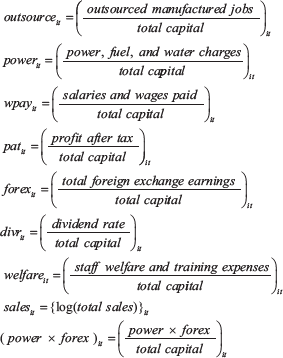
We estimate Equation (2) using fixed-effects regression model, 6 where α it represents the industry’s fixed effects. The error terms are given as ε it . Furthermore, it is important to report the functional nature of the empirical relation, and therefore, the identification is of concern, which performs the best under strict exogeneity of factors affecting the dependent variable. Indeed, one of the foremost challenges that an empirical study with panel data can potentially face is that of presenting a clear identification strategy with regard to the empirical analysis. Identification issues can arise due to reverse causality, omitted variable bias, or both. For Equation (2), one can argue that outsourcing decisions taken by firms may affect energy prices through increased demand for energy rather than energy prices driving the need for production reorganization. Thus, we offer results from dynamic panel regressions to rule out possible endogeneity biases.
In standard applications, the identification strategy uses multiple estimation methods with greater emphasis on the panel fixed effects. It is well known that time-invariant factors like geographical location, stock of natural resources, and cultural and social capital can affect both production and outsourcing decisions taken by several entities. Fixed-effect estimates can take into account these (slow-moving) time-invariant factors and ensure that our estimates are only capturing the variation across firms in the industry. Besides, considering only the right-hand side variables, especially the potentially endogenous ones in contemporaneous terms, will not solve the endogeneity problem. Lagged explanatory variables are less likely to be influenced by or correlated with the error term. So, in the dynamic model we offer for Equation (2), we accommodate this specification. We show that the lagged structure retains the estimates under fixed effects. 7 Difference or System GMM analysis takes care of robustness for our benchmark model. The dynamic panel estimators, as adopted subsequently, use internal instruments generated via moment conditions and employ several lags of the endogenous covariates. Generally, this reduces the sample size in the process. However, at the firm-level analysis, the model functions well given the available data points.
Empirical Results and Discussion
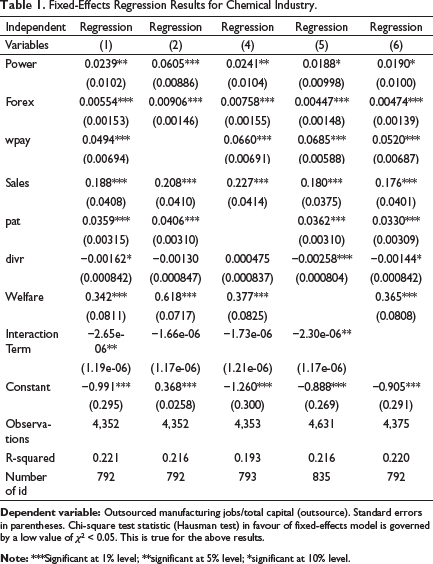
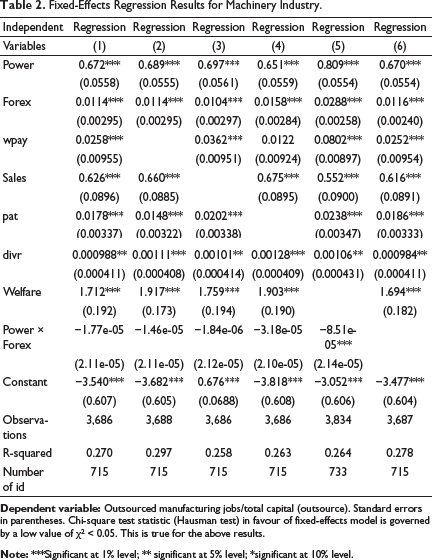
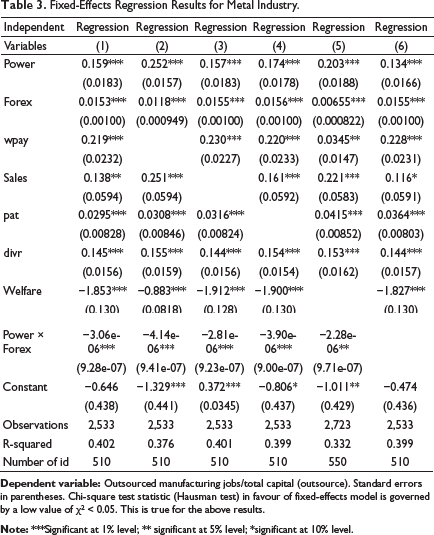
The empirical results for the fixed-effects regression analysis of all four manufacturing industries are presented in Tables 1–4 (separate regression tables have been used for different industries). Each table represents six separate regression models for all industries. This estimation strategy has been taken to check the marginal contribution of each additional variable across specifications, rather than using all variables in all specifications.
Fixed-Effects Regression Results for Chemical Industry.
Fixed-Effects Regression Results for Machinery Industry.
Fixed-Effects Regression Results for Metal Industry.
Fixed-Effects Regression Results for Textile Industry.
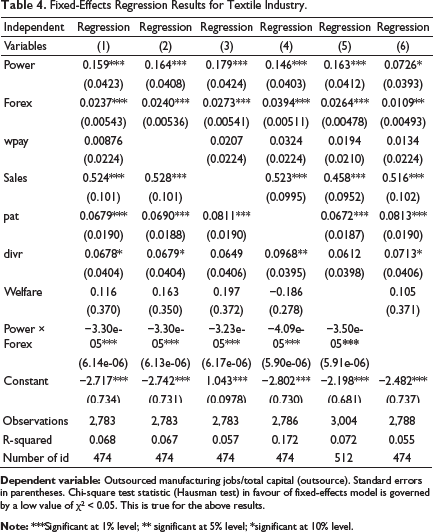
In all the six regressions presented here, we find that the coefficient associated with outsourcing is positive and statistically significant for all the four industries. This indicates that irrespective of the industries to which the firms belong, the formal and larger firms are expected to increase their outsourcing intensity with the rise in energy prices. This validates our hypothesis that formal firms, which are under the purview of government regulations, outsource production in part to smaller firms in order to cope with rising energy prices and increase their profitability. The formal firms will not be able to reduce labour costs or interest charges in addition to rising energy prices. This may push the formal firms to outsource outside their ambit in order to substitute higher energy prices with lower labour costs. This can be one of the reasons for the outsourcing of activities to the informal sectors. We add important covariates along with the ‘power’ variable, such as forex earnings, wages, total sales, profit after tax, dividend rate and welfare expenses. 8 All the variables have been deflated by total capital, as discussed above. The ‘wpay’ variable is positive and significant, and it holds true for all the industries, implying the fact that with a rise in factor cost (in this case, labour cost), firms’ outsourcing intensity rises since they outsource some segments of the production process in order to save on the cost of production. The same logic may apply to the positive sign attached to the ‘welfare’ variable. It can be argued that it is profitable for firms to outsource those production processes that involve greater costs of training and other welfare expenses. The firms with higher profits are found to outsource more since higher profitability indicates that they are more efficient, which drives them further to outsource in order to maintain the high level of profits. In previous literature, it has been argued that the firms that are involved in outsourcing are generally more profitable. Thus, the more productive firms are busy in organizing the production process, designing several marketing models, and making decisions regarding product packaging, advertising, and so on, rather than carrying out certain production processes in-house. Similarly, the ‘sales’ variable is positive and significant, implying that larger firms have higher outsourcing intensity. A higher value of foreign exchange earnings indicates greater integration of the firms into the international market, which in turn is seen to instigate firms to outsource higher volumes of production processes in order to cope with the greater scale of production and high demand for their products (both domestic and foreign demand). This may justify the positive significant coefficient for the ‘forex’ variable. A recent study by Chakraborty and Sundaram (2019) empirically validated that a rise in import competition leads to a greater outsourcing intensity for Indian firms. On the contrary, the dividend rate variable carries a negative sign for the chemical industry but a positive sign for all other industries.
Besides the usual covariates, we have introduced an interaction term. In the interaction term, we chose to interact energy prices with the total foreign exchange earnings of the firms in the various industries. The coefficient is expected to capture the net effect of a rise/fall in the power variable on outsourcing for a firm at a given level of foreign exchange earnings, or conversely, the net effect of foreign exchange earnings on outsourcing at a given level of energy prices. Technically, the coefficient of the interaction term captures the joint effect of energy prices and forex earnings on outsourcing intensity. It is possible that the overall impact is neutralized or even reversed under interaction effects because structurally it comes from the following relation (3), where the variable Interaction is a product of [(power)
it
*(forex)
it
] determining the marginal impact of a one-unit rise in one variable on the intensity of outsourcing at a given value of the other variable:



where k ∈ i = 1,2…n and j ≠ i.
Here, β1 is the direct coefficient of power on outsourcing and γj is the coefficient of the interaction term, which shows that the power charges of a manufacturing firm should rise if the degree of openness of the firm increases. γj can be positive or negative depending on the direction in which power and forex earnings interact and have their effects on the outsourcing decision of a firm. The net impact should depend on the relative strengths of β1 and γj.
From the fixed-effects regression results, it can be seen that the interaction term is negative and statistically significant. The negative sign of the interaction term del(outsource)/del(forex) = (coefficient of forex) + (mean power cost) × (coefficient of interaction) implies that for a given average value of power expenses, as the foreign earnings rise, firms tend to outsource less, perhaps because the export market demands compliance and certificates from environmental authorities, which outsourcing to smaller, uncontrolled units does not support. So, firms under this criterion should keep a larger output in-house, hence the negative interaction effect, which is statistically significant.
Dynamic Panel Estimations
We acknowledge that the outsourcing intensity of firms in selected India’s manufacturing industries may be affected by many other factors that are not part of the set of covariates in this exercise, mainly owing to limitations in the availability of data. The omitted variables as well as the lack of strict exogeneity among chosen variables are typically reasons behind endogeneity biases in the above regressions. Therefore, in order to rectify potential endogeneity and omitted variable bias, we use a dynamic panel data (DPD) methodology. In this methodology, the lagged dependent variable is treated as one of the independent variables to solve for the omitted variable issue by acting as a proxy. But it has been observed that the lagged dependent variable may be correlated with the individual-specific effects, which ultimately lead to biased estimates for the parameters (Arellano & Bond, 1991). The dynamic panel estimators, as described below, use internal instruments generated via moment conditions and employ several lags of the endogenous covariates. One drawback of this approach is that it reduces the sample size considerably. Nevertheless, the chief advantage of using this method in our analysis is that it takes into account the dynamic nature of trade performances for the countries. Consequently, by using the Generalized Method of Moments (GMM) technique, we try to minimize potential biases arising from the endogeneity problem. This also helps us find consistent estimators.
It is well known that there are two methods, namely, difference GMM (Arellano & Bond, 1991) and system GMM (Blundell & Bond, 1998), commonly applied for analyzing panel data in a dynamic setting. When OLS-based estimation technique is applied to a dynamic setting, the estimates can be biased and inconsistent. The reason may be due to the existence of a correlation between the lagged variables and the error term. In that case, a GMM estimation technique is the most appropriate method. In the difference GMM method of estimation, the inclusion of the differenced term of the endogenous variable (which is used as an instrument to eliminate the endogeneity problem) solves the above problems and provides consistent estimators.
In the difference GMM (DGMM) model, a system of equations is considered (one per time period), and the lagged variables are generated by the method of moments, which are used as instruments, and each equation consists of unique instruments. The estimator is a better estimator compared to the Anderson-Hsiao estimator since, according to Arellano and Bond (1991), the DGMM estimators takes into account all potential orthogonality conditions (Baum et al., 2003). But it is of utmost importance to check the externality conditions of the instruments and test whether the instruments are valid or not. Therefore, the Sargan test is used for validating this exercise in order to ensure that the instruments that are generated internally in the DGMM estimation process meet the over-identification restrictions.
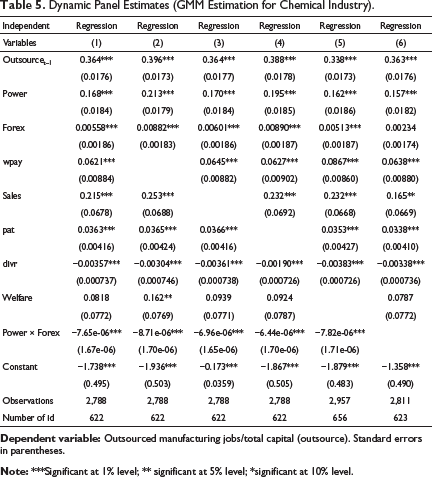
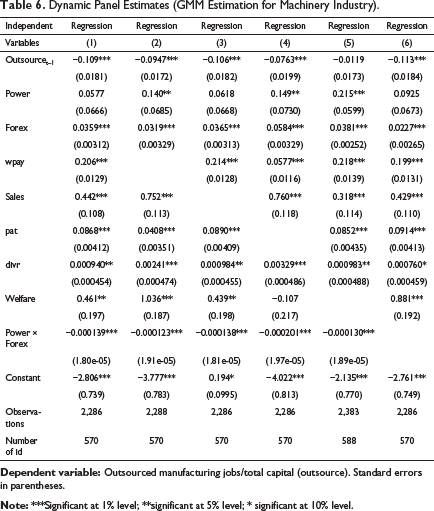
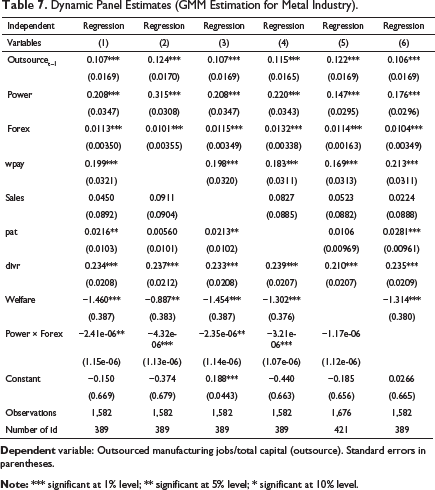
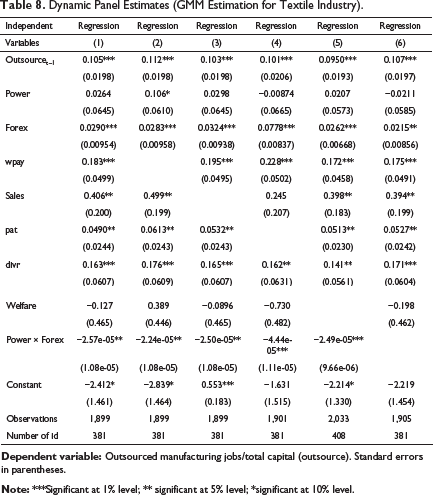
Finally, it is worth mentioning that one problem with the difference GMM technique is that the finite properties are poor when the sample size is small. When the time points of the analysis are smaller, the estimates calculated by this technique are biased downward. Apart from this, the Arellano and Bond (1991) estimates help to a great extent to solve the endogeneity problem and also check for the robustness of the findings. In Tables 5–8, the results of the GMM specification are reported. The results show that the estimates obtained under FE remain valid even after accounting for the correction of potential endogeneity. In other words, following the incorporation of the instruments power charges, they show a positive (and statistically significant) relationship with outsourcing intensity, and the covariates maintain their direction and significance exactly as in the previous results. Overall, the dynamic panel estimations provide resounding support to the results obtained under the static fixed-effects estimates and prove that outsourcing intensity is significantly affected by energy prices when controlled for a set of important covariates.
Dynamic Panel Estimates (GMM Estimation for Chemical Industry).
Dynamic Panel Estimates (GMM Estimation for Machinery Industry).
Dynamic Panel Estimates (GMM Estimation for Metal Industry).
Dynamic Panel Estimates (GMM Estimation for Textile Industry).
Concluding Remarks
The rise in global volumes of trade and greater integration into the world market helped many countries grow at a rapid pace, but it proved detrimental to the environment. Human actions have played a significant role in environmental degradation, leading to severe environmental issues like growing greenhouse gas emissions (resulting in global climate change and environmental pollution). Such degradation of the environment results in distorting the balance of the ecosystem and affecting human life and property (Meehl et al., 2000). Thus, environmental pollution caused by human actions has been receiving greater attention from researchers across the world. Many developing countries have already witnessed the devastating effects of environmental damage (e.g., the hazardous-level air pollution in China in recent years has led to a rapid increase in the number of cases of lung damage in the population). Thus, while dealing with globalization, trade, production fragmentation and an increase in economic activities, one must also address and examine the environmental implications of such activities.
The previous literature on industrial organization and outsourcing considered the cost-saving and productivity motives of firms as one of the reasons behind producer-driven fragmentation but did not consider the impact of changes in costs related to energy use on the process of production fragmentation. In this study, the gap has been addressed, and the relationship between price of energy and outsourcing intensity is empirically tested. With the help of Indian firm-level panel data for four industries, namely, chemical, machinery, metal and textile between 2005 and 2018, it is found that there is a significantly positive relationship between energy prices and outsourcing intensity. This signifies that the firms attach importance to the energy cost when taking outsourcing decisions. Since outsourcing is considered one of the forms of fragmentation, it can be argued that a rise in energy costs leads to a greater degree of production fragmentation. A possible explanation for this may be that rising energy prices disproportionately affect larger firms, which in turn erodes their profitability. The rising fuel costs may compel larger firms to cut back on other production costs such as labour costs, interest charges and abatement costs. On the contrary, the smaller firms face lower input costs because of lenient labour laws and are also often exempted from carrying out certain abatement activities because these are less monitored and outside the radar of enforcement. The formal firms fail to substitute energy input with other inputs; thus, they take the channel of outsourcing to save on other input costs. The relocation of certain production processes may lead to the generation of more pollution due to the fact that the smaller firms are equipped with inferior abatement technologies. Apart from the relation between energy price and outsourcing intensity, we delve into the relation between other covariates and the dependent variable. For example, we find that wages, sales, profit after tax, dividend rate, forex earnings and welfare expenses in most of the alternative empirical specifications are positive and statistically significant.
Finally, the interaction term addresses a very important issue. The negative interaction term suggests that for a given value of energy price, with a rise in foreign exchange earnings, firms tend to outsource less since increased integration into the world market demands compliance and certificates from environmental authorities. Thus, outsourcing to smaller firms that do not follow environmental standards would restrict the larger firm’s ability to meet the desired environmental standards and participate in the international market. So, the firms that witness larger foreign exchange earnings should produce the major portion of the production process in-house and hence the negative and statistically significant interaction effect. The government of such developing countries needs to understand this issue and make attempts to solve the rising environmental problems. It is advisable to enforce stricter environmental regulations and supervise both the larger and smaller firms as well as the informal firms so that they receive environmentally friendly FDI and do not involve themselves in dirty stages of production. Enforcing stricter environmental regulations only on the large firms will not help the cause since the large firms can easily find a way out by outsourcing the pollution-intensive production processes. This reorganization of production and fragmentation in production processes really negate the attempts made by the environmental authorities to reduce overall emissions. The global pollution will reduce only if countries across the world take initiative in adopting cleaner technology while producing environmentally intensive commodities.
Appendix A
Hausman Specification Test
Chemical Industry
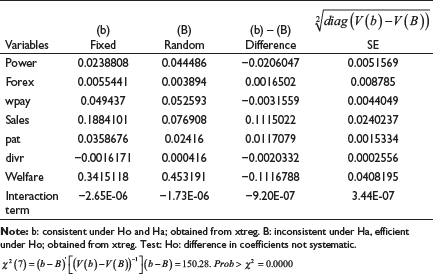
Here, we can see that the p-value is less than .05; thus, we reject the null hypothesis, which implies that the fixed-effects model is preferred.
The Hausman tests have been conducted similarly for all the other industries, and the results are in favour of fixed-effects model. For brevity, we have only given the test results for chemical industry.
Footnotes
Acknowledgements
The authors are grateful to an anonymous referee of the journal for comments on an earlier version of the article. The usual disclaimers apply.
Declaration of conflicting interests
The authors declared no potential conflicts of interest with respect to the research, authorship and/or publication of this article.
Funding
The authors received no financial support for the research, authorship and/or publication of this article.
