




Abstract
This investigation examined how wives of senior politicians perceived their role as the spouse of a politician, and how this perception affected their lives. Ten wives of Israeli senior politicians participated in the study. Semi-structured, in-depth interviews were conducted individually, with topics and issues specified in advance. Results demonstrated an inherent structural conflict between the personal and the public aspects of the role of ‘politician’s wife’. The lifestyle of the participants influenced their perception of their roles and they reported a selection by preference of the roles that best fit their existing lifestyle. Four different attitudes relating to the women’s roles and lifestyles emerged from their personal stories. Findings were interpreted in terms of the preference approach.
The major conflicts that women experience are often related to choices relating to career and family. For example, some women consider child raising as their primary role, and therefore perceive their children’s success as part of their own self-fulfillment. For these women career is not ranked as their top priority (Rudick, 1989). Today the idea of a woman giving up her career to be a ‘full-time wife and mother’ sounds old-fashioned, yet a reasonable compromise is not always found. Therefore, it may seem necessary to delay, modify or give up one of the alternatives (Frone, 2002; Jacobs and Gerson, 2004).
According to Hakim’s (2000, 2004) review of the literature, once genuine options are open to them, women have three different lifestyles to choose from: work-centered, adaptive and home-centered. Work-centered women – still in the minority despite the massive entry of women into higher education and into professional and managerial positions – are focused on competitive activities in the public sphere in their various careers, or in sports, politics or the arts (see also Eagly and Johannesen-Schmidt, 2001). Adaptive women – the largest group – combine employment outside the home with family, and do not give priority to either one. They strive to enjoy the best of both worlds. These women are interested in a balance between work and family, and family-friendly employment benefits that favor working mothers; they will gravitate towards careers, occupations and employers offering these advantages. The third group, home or family-centered women, give priority to their private and family life. This group is a minority, given the current political and media focus on working women and high achievers in the Western world (Hakim, 2006).
Hakim presented these ideas in what she called the preference theory, which attempts to explain and predict women’s choices with regard to the job market and running a home. Preference theory is historically informed, multidisciplinary, prospective and not retrospective in orientation, and applicable to all developed societies. Further, it predicts diversity in lifestyle choices and even a polarization of lifestyles among both men and women, the result of the diversity in women’s sex-role preferences and the three related models of women’s roles.
Several researchers elaborated on Hakim’s (1995, 1998) initial notions. Crompton and Harris (1998, 1999) further developed Hakim’s depiction of three lifestyles, and argued that women may take one of six routes in combining paid employment and family life. According to this conceptualization, a woman may be ‘domestically oriented’ (prioritizing her domestic life over work and/or career), a ‘satisficer’ (attempting to combine success in both family life and employment/career, but without maximizing either), a ‘maximizer’ (seeking to maximize her goal of achievement in both employment/career and family life), a ‘careerist by choice’ (consciously putting employment/career ahead of her domestic life), a ‘careerist by necessity’ (adopting an ‘employment first’ strategy, more out of necessity than out of choice), or an ‘undecided’ (unclear style). These authors claim that women may experience transitions over their life-course and change their occupational path accordingly, in response to radical life changes such as occupational restructuring, self-development, death of a close family member or friend, crisis or family composition changes.
Although Hakim’s theory is often cited in other theories concerning the women–work–family relationship, it has been the subject of controversy as well. For example, in their 1999 critique, Procter and Padfield claimed that the polarization of work orientations between one of two categories, work-centered and home-centered, as reported by Hakim, is descriptively inadequate. Also, Gin and a group of researchers (Gin et al., 1996) from nine different institutions and universities in the UK disagreed with Hakim over the reasons for the persistence of gender inequality in full-time employment. Moreover, they argued that her claims are not adequately backed by references. Bruegel (1996) wondered how Hakim treated attitudes and work orientations of some women as given, but did not deal with the core question of how these are formed and developed. In other words, she criticized Hakim for reading preferences into outcomes, without considering how circumstances frame preferences.
Several years later, Tomlinson (2006) proposed that factors in care networks, employment status, and the country’s welfare policy dimensions often influence women’s decision-making about reconciling work and family life along their life-course. This author revealed that the majority of women followed trajectories that were situated between the extremes of domestically oriented women and career-centered women. Unlike Hakim’s typology, which termed all women with fluctuating orientations towards work and family life as ‘adaptive’, Tomlinson’s typology aimed at expanding this category, replacing the ‘adaptive’ group with four distinctive trajectories: care networks, work status, welfare policies and work–life balance preferences. These trajectories are relatively flexible, and women may alternate between them. As changes take place, women’s likelihood of making strategic, reactive or compromised choice transitions are altered. Tomlinson suggested six work–life balance trajectories for women; ‘domestic’, ‘satisficer’, ‘satisficer-future career’, ‘child-before-career’, ‘career-before-child’ and ‘maximizer’.
An interesting group for investigation is the wives of public figures, who, in a sense, combine their family life with their work as a ‘manager’s/politician’s’ wife (Gutin, 2000; Kanter, 1977; Watson, 1999). The term ‘the wife of’ is commonly heard in regard to women who are married to public figures: Not only does the family–work conflict still exist, but there may also be a conflict between the woman’s duty to her husband’s work and to her own career (Kanter, 1977). These women are expected to dedicate their lives to their husbands who serve in public positions. Thus, a woman in such a position actually serves as ‘the wife of’ – an additional, unpaid job – because throughout the years of her husband’s managerial, public, and/or political career, often consisting of most of their married life together, her efforts are invested in choices involving a variety of challenges that are not always rewarded (Kanter, 1977).
In the past, the first lady in the USA was supposed to be ‘only’ the President’s wife, and therefore she assumed a series of public and informal duties that, by definition, were based on public consensus rather than on legal status. Over time, several investigations of types of constraints of the role of US first ladies have been published (e.g. Burrell, 1997; Tuchman et al., 1978; Watson, 1999; Wekkin, 2000), with every change in public consensus causing variations in their role definition and in the voters’ expectations of them (Eksterowicz and Paynter, 2000).
The influence and activism of the first lady’s office has increased in the US, and the role has become more professional and integrated with the President’s work. It also has become subject of scientific investigation (e.g. Eksterowicz and Paynter, 2000). In Israel, the only up-to-date written guide that could apply to the conduct of politicians’ wives comes from the Ministry of Foreign Affairs, and it reads as follows: ‘Joining the Ministry of Foreign Affairs is an exclusive life choice, and the partner of the employee will do his/her best to make it successful’ (Ministry of Social Affairs Regulations, 2004: 5). Although these regulations were in fact written for professional diplomats, the wife of any public figure is expected to be ‘representative’. In the past, the role of Israel’s ‘first ladies,’ such as Aliza Begin or Sonja Peres, has been discussed in the popular press (e.g. Blum, 1999), but no official, systematic, scientific guidelines about women have been published (Halperin-Kaddari, 2004), and little data exists concerning public figures’ wives.
Therefore, in this article we have attempted to assess how wives of Israeli public figures perceive their role and duties as ‘the wife of’, and how such perceptions affect their lives in terms of the preference approach.
Method
Participants
The wives of ten Israeli public figures, aged 45–59, participated in this study. The selection of the participants was made according to their husbands’ positions of seniority: three senior ministers in the Israeli government, three Knesset (Parliament) members and four mayors of major cities in the center of Israel. Twelve potential participants were approached and ten agreed to participate. All the women were born and raised in Israel except for one. Each of the participants married her husband when he was already active in public work, and he developed his career and advanced in status during their married life. All the husbands were in political positions for more than 25 years. All the participants were employed before they got married; three stopped working after they married. Only three developed an independent career. They each had between two and four children.
War and peace are everyday concerns in Israel. These wives were in agreement with the views of their husbands on how these matters affected them and their children. All except one were in agreement with the views of their husbands on significant public issues, such as the peace process with the Palestinians, economics and education, and all had the same political party affiliation as their husbands. They represented all major political parties except the religious parties; none belonged to a religious party. The participants lived in different regions around the country. The sample is small by definition, due to its origin from the very top public figures in the country at the time of the study. Therefore, our aim was to record a range of possible stories, so as to tap as many thoughts, attitudes, and feelings as possible; we felt, as Reinhardt (1992) expressed, that diversity among the interviewees would be facilitative.
Interview
The study applied a qualitative interview and evaluation method (Patton, 1990; Rubin and Rubin, 1995; Russell, 2005). Semi-structured, in-depth interviews were conducted in order to gather data from the participants, with topics and issues specified in advance in an interview guide outline. Specifically, questions were aimed at exploring how the wives perceived their role, and how they dealt with this role in their lives. In line with Russell’s guidelines for in-depth interviews, three types of questions were used: main, probe and follow-up questions. The main questions were used to initiate the conversation. They were derived from the research purposes and were prepared before the interview, in order to guide the interviewees towards the focus of the study. The probe questions served to deepen and clarify the interviewer’s understanding of different issues pertaining to the participants, and to enhance the richness of the data being obtained. During the conversation, spontaneous questions were also evoked, which enabled more time to be allocated to subjects raised by the interviewee. Follow-up questions were used to help pursue topics developed in the interview process, allowing flexibility in the conversation and contributing to the openness of the interviewee’s stories.
In order to determine content validity, the questions were examined by two psychologists and one sociologist; all were experts having an extensive gender-orientation research background. These experts made sure that the questions were clear and that they covered the appropriate content area.
Procedure
The interviews were conducted face-to-face by the first author at a location chosen by the interviewee. Except for one participant who preferred to have the interview in her office at work, all the others preferred to be interviewed at home. After the interviewer had arrived at the designated location, she engaged in some light conversation with the participant while preparing the recording device in order to relieve any tensions. Each participant was given the personal business card of the interviewer, and was told that if she regretted something she said, she would always be able to retract it from the transcript. Confidentiality and anonymity were assured throughout the entire study. The interviews lasted between 60 and 90 minutes each, and were tape-recorded in order to enable a complete, verbatim transcription of each interview to be made at a later date.
Data analyses
The aim of the analysis was to build an organized system of categories, from the unstructured data that emerged, representing the women’s perceptions (Tesch, 1990). Each of the ten interviews was transcribed verbatim and was analyzed on a line-by-line basis. Meaningful core themes were identified and sorted, through this inductive and thematic analysis, into categories. The trustworthiness of the data was assured throughout the following three phases. First, participants were asked to review their transcripts for verification, and were given the opportunity to add, delete or rework data which they felt did not accurately reflect their intended meaning (Patton, 2002). Second, common features among the categories were compared and grouped into distinct sub-categories (Boyatzis, 1998). This phase was completed by the first two authors of this study. Discussions were held by these two authors in regard to the sub-categories until full agreement was reached and category charts were created. Finally, classification consistency was verified in a random sample of 15 percent of the meaning units. An independent researcher familiar with qualitative research analysis categorized units into the themes and categories provided, and high agreement was demonstrated (29 of 34 meaning units, or 85 percent).
Results
The text included in the interview transcripts was divided into four categories, each with four to ten sub-categories. A category chart was created from all themes emerging from this first analysis (see Table 1).
Chart of categories – first order
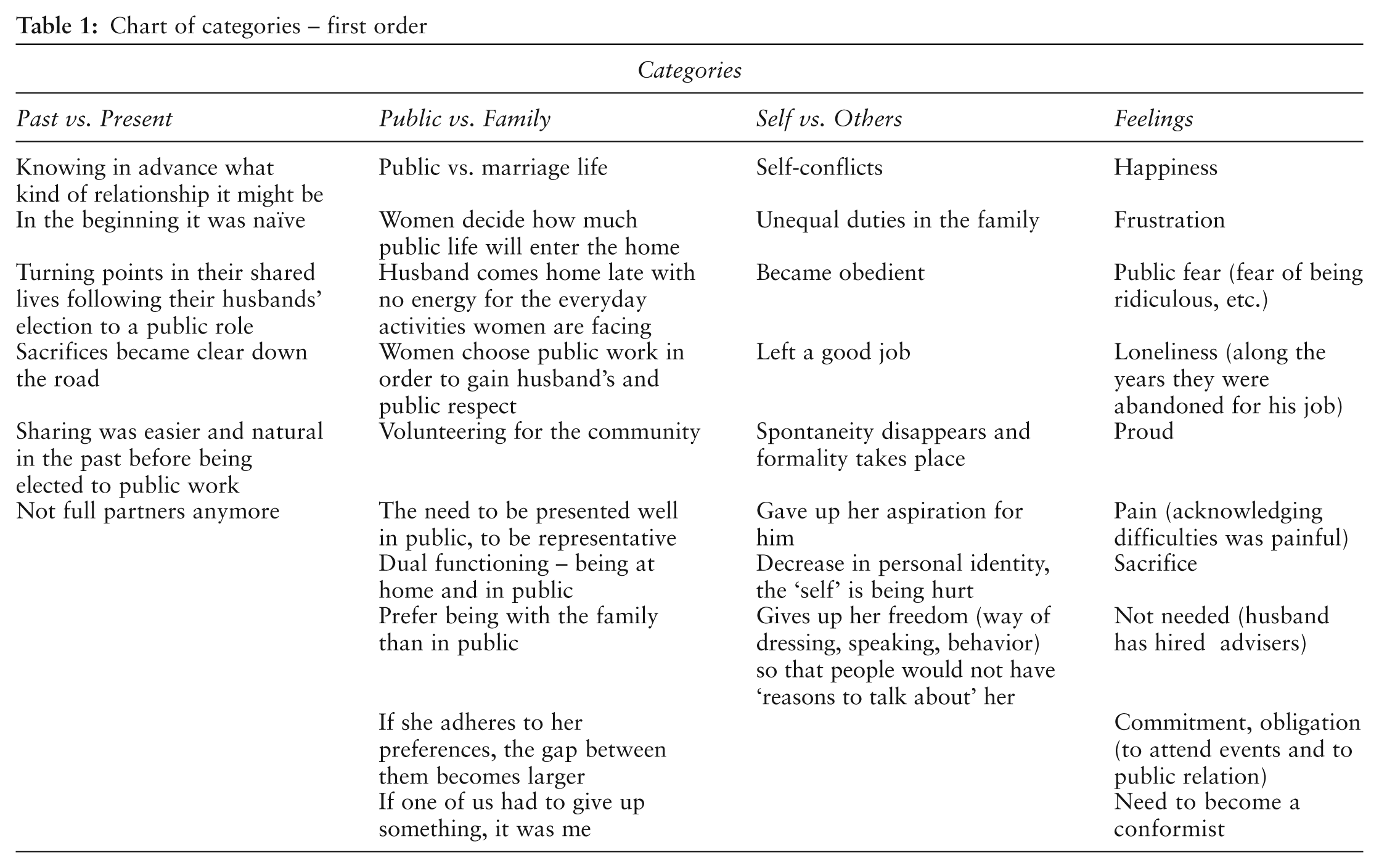
Four main themes were common to the reports of all the participants in the interviews: past versus present, public life versus family life, self versus others, and the feelings associated with these dualities. In the following transcriptions from the interviews, the four themes are presented in greater detail. The interviewees were given numbers to protect their anonymity, and the transcripts were translated from Hebrew to English.
Past versus present
When I met him, and even when he was my boyfriend, he was always busy with other things. He was never concerned only with his job or studies. There was always some other activity, some public activity, and when we got married it was clear that there would be more things in our lives besides our relationship and our family. (No. 1)
I have to cope with things that I didn’t have to before, it was easier when he wasn’t a public figure and we did things together. (No. 2)
The participants chose to marry their husbands fully aware that the top priority of these men was their public role and profession. Eight out of the ten women said they knew they were marrying a man who dedicated himself, first and foremost, to a political/public role. All of them knew and acknowledged the fact that their future husband was working in the public field, was paving his way in that field, and would not let married life get in the way of reaching his goals. Nevertheless, they did not think this would create a problem in their everyday life. On the contrary, the viewpoint of all participants was that after getting married, their husbands would now be ‘equipped’ with a wife who would stand by him and publicly support him.
Public versus family/privacy
I do not like being exposed to the public … my natural territory is my personal territory. (No. 3)
There is no equal sharing in the internal and external domains. The husband is busy with his public work and the woman is busy in the house. The decision regarding how much of the public work will enter the home is a very personal decision, and depends on the woman’s character as well as her willingness to accept or to draw the line regarding how much her privacy may be invaded.
His work and efforts enter the home. Now you have to change your life too. (No. 2)
My husband works very hard. He starts in the morning and comes back at 11:00 o’clock at night. He doesn’t have the strength to listen again about.… Sometimes it reaches the point of fights and arguments. (No. 4)
Most of the interviewed women presented life with their husbands as a life of marital harmony, but claimed that in order to maintain this harmonious relationship they had to find activities to do for themselves separately from their husbands.
Self versus others
I wasn’t frustrated because I made the decision beforehand that I would not leave work and I would volunteer because I enjoy contributing to the community. (No. 5)
I told him I cannot be alone for so long, you must give up something. So he said, I understand you, I think I will give something up, but I won’t be happy. I left my job because I thought that was the way of the wife of a public figure. (No. 4)
In such a way, women might gain their husband’s attention and appreciation, along with the opportunity to showcase talents. They also might gain self-actualization and earn appreciation from the public, which becomes aware of these women as existing as their own entity, not only as dependent women who are representative companions of their elected husbands.
Associated feelings
As the years go by I realize that what I give up for him, not by choice, leaves me alone in the battlefield. (No. 2)
There are people that are bothered by this, but not me. I have my own world. I enjoy being alone. (No. 4)
In-depth analysis of Table 1, along with a second sorting, revealed four possible styles of behavior, as seen in Table 2.
Chart of categories – second sorting – wives of politicians: four types
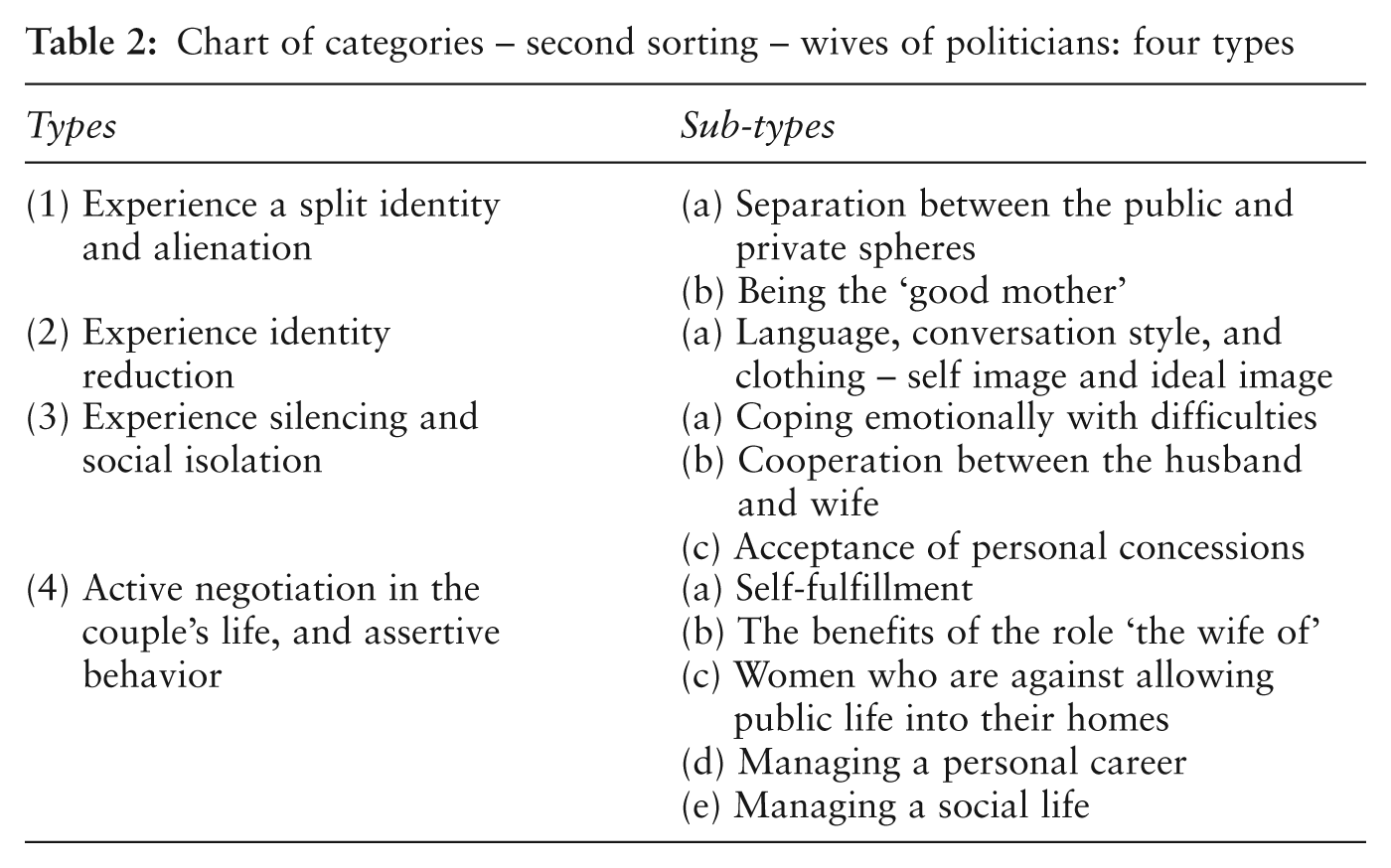
Divided identity
Some of the interviewees experienced a split or divided identity. This occurred, for example, when they examined their role in motherhood versus career. Some perceived their role as ‘keeper of the family’, meaning that they had to continue functioning in order to maintain a stable home life. This was a decision that was derived from the fact that there was no other choice in order to maintain marital harmony.
I was always the perfect mother. I worked by myself, and I coped by myself as much as I could. I was very independent. As his wife, I have to stand by him and help him in every situation.… It is important to me that my husband will succeed in his job. (No. 5)
Some experienced a split identity due to the conflict between public and private life.
The need to be representative
I was always the woman at home. It wasn’t easy. Now, when we go out and people start talking or asking something, I have to think about what to say. I have to think twice about how to respond. (No. 7)
The decision to give up her priorities for his
When I act differently in clear recognition of my priorities, which are sometimes in contrast to his, I have a problem with myself and with my husband. Therefore, I sometimes decide to change priorities. (No. 1)
Diminished personal identity
I do the cooking, cleaning, and the housework, and I am with our daughter. My husband and I do not experience full partnership any more, especially not public experiences. (No. 7)
Today, elected figures tend to use publicity advisers and public relations people who are part of their regular team. In order to succeed image-wise, they employ advisers to instruct them how to appear in public. Three of the interviewed women work with their husbands’ publicity advisers. These advisers become the women’s ‘guides’. By doing so, they become aids in smoothing and minimizing the personal effects of the feelings of diminution. The publicity advisers establish the role of the elected public figure’s wife.
Language, conversation style, and clothing – self image and ideal image
Being ‘the wife’ changes me a lot. By nature I am very liberal. I can come to an event that has representatives from all over the world in jeans and a t-shirt. Today I cannot allow myself to do this, because I think I have to honor the position. My husband is always formally dressed; I can’t think of myself like that. (No. 2)
Women who are married to partners in public roles take upon themselves a commitment to following a proper dress code, to entertaining important figures and their wives, and to agreeing to let the media enter their private sphere.
Silencing that leads to isolation
There was a case on Independence Day, it was decided that the chairs would be brought in and everybody would sit down. The crowd appeared and sat down. And the police blocked the area with the chairs. I came a little later, and I wanted to enter … but the policeman told me, I don’t know you and you are not going to enter. (Silence). And I couldn’t talk to [my husband] because he was busy and had a lot of people around him. He didn’t even see me. So I just went, left the place. (No. 5)
Coping emotionally with difficulties
Nine participants shared personal and painful stories with us, by their own choice. Those who chose to tell their stories admitted that they felt the same pain that accompanies a painful event that happens in their shared lives. They do not display their pain in public. They carry their pain everywhere they go but do not show it. They believe that even the public, who examines public figures with a magnifying glass, cannot see the pain.
Cooperation between the husband and his wife
I help him especially in things that he needs me for. Of course I am naturally curious and interested in all kinds of things that I hear and am involved in when I help. (No. 1)
According to traditional public perception, for the man in a public role his family is his shelter. Thus, a woman who wants to be ‘truly supportive’ to her politician husband should provide the traditional, domestic aspects of motherhood and child-raising, as well as keeping a well-run home.
Acceptance of personal concessions
I know that, for example, I gave up doing an MA because of the big investment that I had in time. I had two little children and another one on the way. (No. 1)
Some of the participants are accepting and do not make demands. These women, who accept the role of mother, go about nurturing the home and taking care of the children. This role causes them to be subject to a binding structure, with no ability to break out or do what they desire. They will always be reminded of their moral obligation in the absence of a nearby father figure for their children. Their female-maternal principles will bring them back to the binding structure that was forced upon them, without any other choice. Finding themselves backed into a corner, they feel totally responsible, and dedicate their time and energy to this role at the expense of their personal desires.
Wives who negotiate the choice
My husband received a new job, and he wanted very much for us to move and live in another city. And I told him that it ends here. I stayed here alone – not clear what is happening, with the children, and he was not home. He would come only once every two weeks. My mother was very ill then, and I was pregnant, and we went through a very difficult period, but I decided that we need stability, and we stayed. (No. 1)
Whatever the choices these women made in their lives, they included coping through negotiation. For them, negotiation took place with the husband at home, as well as with the public sphere (e.g. when they accompanied him to events).
Self fulfillment
I received my Master’s degree in art and art history, when my boys were already grown. Many times I would talk about getting a PhD with my husband because I thought that I was a good student, and I could get a PhD. (No. 4)
Many women experience an awakening towards mid-life, when the children are almost grown and a void begins to form – including self-imposed demands to add more interests to their lives. Such women often have the need to prove to themselves that they are capable of self-fulfillment, in order to win renewed appreciation from themselves as well as their surroundings.
The benefits of the role ‘the wife of’
All in all, there are positive things in this matter. I am in a certain status that is also fun. You are popular in society and people look at you differently and treat you differently. (No. 8)
The role of a public figure’s wife allows the ‘wives of’ to connect freely to the larger system and to those who maintain key positions, without having to fear that doors will slam in their face. Their status allows them to reach any public authority, and to skip the bureaucracy that ordinary citizens have to encounter.
Women who do not allow public life to enter into their homes
There is a big division within the house. Public service is carried out in the streets. I kept my personal identity. (No. 10)
I have my privacy … there are very clear instructions that my personal territory is not to be entered. (No. 3)
The boundary that separates private from public life is blurred once the husband is elected to public office. Every couple personally determines their own lifestyle, including the framework and boundaries regarding work being allowed to enter their private homes, or leaving work only to the public area. For the woman, when she becomes the wife of a public figure, the problem with the boundaries between the private-personal sphere and the public one becomes increasingly difficult, because by definition the public will try to invade every aspect of the couple’s lives. It seems that the key to success in separating these spheres depends substantially on the woman, who, for example, plays a major role in the decision regarding what can be given up for the sake of the public.
Managing a personal career
Sacrifice? No! Sacrifice in terms of giving up my career – definitely not. In this role of his – no! And in no other role. (No. 9)
I was working here before I met him. I know everybody is sure I am here because of him and I feel a need to explain, and it’s very important to me to show first of all what I am, in my own right. (No. 6)
Today both work and family are central issues among most adults. When women are not financially independent, it affects their identity and the self-satisfaction they feel. Women who are married to public figures still cope with the issues regarding their right to their own career. As can be seen from the above citations, anger and bitterness are expressed that are associated with the difficulties in managing their own individual career. Although all the participants of this study worked before they got married, only three of them developed an independent career. These three women appear to perceive their role as politicians’ spouses as more home-centered, and not perform public duties. Nevertheless, all the participants have made compromises that are reflected in the feelings that they express.
Managing a social life
I have a ‘soul’ friend who is to me, and I am to her, a source of strength and help. When I want to escape or disconnect, and I want somebody to be with me and listen to me, then I call this friend. (No. 1)
Some of the interviewees said that they had a group of friends, a number of people they know, with whom they felt comfortable and could speak naturally, without being formal and without having to think about every word they say.
Discussion
In this investigation, an attempt was made to understand how the wives of Israeli public figures perceived their role and duties as ‘the wife of’, and how such perceptions affected their lives. In line with the basic contentions of the preference theory (Hakim, 1998, 2000, 2004, 2006), we argued that women make their choices and decisions according to their preferences for and perceptions about their role (see also Crompton and Harris, 1998, 1999) – in this case, of the wife of a public figure. However, as Tomlinson (2006) argued, while perceptions certainly influence preferences, it is inaccurate to position either perception or preferences as the sole determinant of a women’s behavior style. Rather, work status, work–life balance, family considerations and personal preferences intersect, and together they structure women’s decisions about being ‘the wife of’ at different stages across their life-course together. In line with Giddens (1991), Tomlinson (2006) also offered an account of how transitions form trajectories over the life-course, and how a woman’s style of behavior is susceptible to change across her life. Along the basic notions of the preference approach, we attempted to outline the different behavior styles of the women participating in the present study, and how these styles evolved over time, recognizing the fluctuating family and public orientations of these women over the life-course.
Four different styles that characterize participants’ behavior were identified in this study: (1) women who defend their own and their families’ privacy from being any part whatsoever of public life; (2) women who are happy to take over the position of ‘the wife of’ and willingly choose to do so; in such cases, no inner conflicts are evident; (3) women who report making sacrifices in order to maintain their married life. Such women are ‘paralyzed’ – managed by social constraints that are forced upon them, being pushed into continuous activity inside the home. In the status ‘the wife of’, such women may avoid being present at social events, which may in fact detach them from the public. This may indicate a reduction of personal identity, even if this choice is made with full awareness; (4) women who give up a large part of their self-fulfillment, consequently harming a part of their self identity/actualization. In such cases, the woman lives in a constant conflict between her husband’s career and her own aspirations, and between the public and the family. Her emotional life is loaded, and a ‘split’ identity (see Butler, 1993, 1999) is evident. Despite the personal decision regarding how much to allow the public to enter into her home, such a woman is captive in the life of the public role, with little or no ability to control her own life. This leads to a conflict between personal vulnerability and the desire to have a harmonious relationship with her husband, as well as to difficulties in bridging the gap between her husband’s public work and her own personal life.
It should be noted that styles 1 and 2 are quite similar to the ones previously revealed by Hakim (2000) and Crompton and Harris (1998), respectively. Style 3 reflects similar thought patterns to those of Crompton and Harris’ (1998) ‘careerist by necessity’, even if the behavioral outcome is quite the opposite. However, the fourth lifestyle behavior, which we label ‘divided identity’ – even if interpreted, at least in part, in terms of Butler’s (1993, 1999) work – has not been presented either in prior studies conducted within the framework of the preference approach or research conducted on role constraints of US first ladies, which used different typologies (e.g. Burrell, 1997; Watson, 1999; Wekkin, 2000). Furthermore, these four styles of women’s behavior do not necessarily represent four types of women, but rather – as the preference approach asserts – different behavior at different times and contexts according to each woman’s perceptions, feelings and thoughts, caused by the inherent structured contradictions she experiences.
This work discovered the strength hidden in the public figure’s role, including the possibilities given to public figures’ wives to act and to influence the public system. At the beginning of all the interviews, the women presented a picture of women who were happy with what they had – motherhood at home, and being dedicated wives of politicians, just as society expects they would be considering their status. However, when looking back over the years, they admitted that they could not have known in advance how all aspects of their lives would be affected by living alongside their politician husband. From the moment the husband is elected to office, and during the time that he continues in his position, her life changes. Thus, being a senior politician’s wife in Israel is in fact a kind of a ‘life’s work’, being ‘married to the job’.
For example, nine of the ten women had professions. All had studied and advanced their education on their own, without their husband’s help, and were accepted for employment and promoted at work without using their husbands’ political connections. Their professions gave them a positive self-image and a sense of independence. Even if these women were very successful professionally, the main emphasis was on their role and public image as ‘the wives of’. From the interviews, it seemed that the complex, multiple, conflicting and undefined duties of being ‘the wife of’ created a special situation in their lives that needed careful self-observation in order for them to understand how they wanted to live their lives and to be satisfied with the choices they made.
Dual attitudes, which reflected self-conflict, were revealed in most of the interviewees and resulted from the ambiguity embedded in the role of a politician’s wife. On one hand, these women received the title ‘the wife of’, which gave them status in and rights and obligations to national and/or local communities, as long as their husbands were in office. On the other hand, no formal instructions existed which regulated this role, therefore each woman interpreted it – and her resulting duties in this position – in line with her own individual perceptions. Moreover, it seems that the interpretation regarding the role of the public figure’s wife is transferred ‘from generation to generation’, that is, from women previously in that role to the current ones.
Our study revealed that senior public figures’ wives initially thought that this elevated status would provide them with the chance to experience something which is different from the usual ‘grey and mostly difficult’ day-to-day life, as one of the wives in our study put it. Most of them reached the status of public figures’ wives in their mature adulthood, when their children where already grown and independent. In this period of their lives, they believed that their status would provide them with a stage to promote their own issues and achieve a genuine, significant breakthrough in their lives. However, our interviews revealed women who were often ‘paralyzed’, divided and isolated. Some of them had no strength to resist, and surrendered to the life events. Only a few knew how to truly actualize themselves despite the difficulties, and were able to fulfill themselves in their private world. Some of them had a feeling of being an ‘eternal victim’; in fact, the women often accepted the role of being ‘the woman beside her man’ as their fate. Moreover, from the experiences reported in their stories, it was evident that if it had been possible, they would have chosen a different way of life – one in which their husbands would take a bigger part in the household and in raising the family, and most important, would really include them in their lives – to prevent the often reported feelings of ‘being alone and/or lonely’ in the marital relationship.
To summarize, the present investigation demonstrated an inherent contradiction between the personal and the public aspect embedded in the role of being a senior politician’s wife in Israel. Four different attitudes related to their role and lifestyle emerged from their personal stories. It seems that until the role of being a wife of a public figure is more clearly specified, these women will continue their struggle of balancing between the personal and public aspects of their lives.
This research will hopefully encourage new work on ‘women’s roles’ in the new world of emerging possibilities. What is the effect on women and the ‘spousal role’ when the women is the senior politician or major figure in the public realm? What differences and similarities may be seen if the couple is ‘same-sex’? Such variation from the traditional can only be expected to increase in the years to come, and insights from such new research will expand our store of knowledge about sex roles, in public life and other domains.