



Abstract
This article uses information from a large administrative database (N = 3941) to outline five ideal typical pathways into adult homelessness. The pathways are called ‘housing crisis’, ‘family breakdown’, ‘substance abuse’, ‘mental health’ and ‘youth to adult’. Then we explain why people on some pathways remain homeless for longer than others. People on a housing crisis or family breakdown pathway do not form strong friendships in the homeless subculture or accept homelessness as a way of life. Their homelessness is shorter. In contrast, people on the substance abuse and youth to adult pathways often become involved in the homeless subculture and engage in social practices that make it difficult to exit from homelessness. Their homelessness is longer. People on the mental health pathway also experience long-term homelessness, but they do not endorse homelessness as a way of life. They remain homeless because they have few exit options.
Pathways or careers?
Social scientists have employed two competing metaphors to refer to homelessness as a process, and to identify some of the changes that homeless people experience. On the one hand, authors such as Snow and Anderson (1993), Hutson and Liddiard (1994), and Chamberlain and MacKenzie (1998, 2006) have used the analogy of a homeless career to identify stages in the process of becoming homeless. On the other hand, authors such as Anderson and Tulloch (2000), Crane (1999), Fitzpatrick (2000) and Clapham (2003) have used the metaphor of a homeless pathway to draw attention to changes in the biographical identity and material circumstances of homeless people (for a critique of this literature, see Fopp, 2009).
In everyday language, the term ‘career’ is used to refer to an individual’s progress along a particular occupational trajectory. However, social scientists have used the term ‘career’ more broadly to refer to the transitional stages involved in the development of any form of biographical identity (Becker, 1963; Goffman, 1961). It was Snow and Anderson (1993) who first applied the career metaphor to homelessness. They pointed out that the homeless do not have careers in the conventional sense of the term, but the utility of the metaphor is that it draws attention to homeless ‘stages’ and the factors that influence movement along the career trajectory.
Hutson and Liddiard (1994) developed an ideal typical model of the youth homeless career, identifying ‘early’, ‘middle’ and ‘late’ stages. In the final phase, many young people sleep rough for long periods of time. Hutson and Liddiard (1994: 127) stress that ‘young people do not always progress through these stages in a systematic way’. However, they talked about homelessness as a ‘downward spiral’, and said that for some homelessness is a ‘progressive decline’. The metaphor of a ‘career’ implies a destination, and some have interpreted this to be chronic homelessness.
Social scientists have used both the metaphor of a career and a pathway to think about homelessness as a process, but the metaphor of a pathway is preferable because there can be pathways out of homelessness. Nonetheless, in the literature there is a tendency to develop complicated models of homeless pathways. For example, in a study of 25 teenagers in Glasgow, Fitzpatrick (2000) identified six pathways through homelessness; and in a study of 40 teenagers in Melbourne, Mallett et al. (2010) identified four pathways. In a widely quoted study, Anderson and Tulloch (2000) identified 23 homeless pathways. This was an important analysis, but the model was too complicated to be useful for policy and planning purposes. We believe that a simple analytical framework is needed for thinking about homeless adults, who we define as 21 or older.
This article has two aims. First, from all the diversity and complexity of homeless people’s lives, we identify five ideal typical pathways into adult homelessness, using a modified version of the analytical scheme proposed by Johnson (2006). The pathways are called ‘housing crisis’, ‘family breakdown’, ‘substance abuse’, ‘mental health’ and ‘youth to adult’.
An ideal type is a construct that abstracts key features of a phenomenon, so that the core characteristics of a social arrangement (or institution) can be seen more clearly (McKinney, 1966). Ideal types are a useful way of looking at ‘infinitely differentiated and highly contradictory phenomenon’ (Weber, 1949: 96) and are a practical means by which social scientists can ‘make the characteristic features of … [a] relationship pragmatically clear and understandable’ (Weber, 1949: 40). The five ideal typical pathways in this article are not causal models. Individuals are always actively engaged in making decisions about their lives, but homeless pathways draw attention to structural and cultural factors that may limit the opportunities that people have.
We also distinguish between homeless ‘biographies’ and homeless ‘pathways’. A homeless biography is an account of an individual’s journey through homelessness, whereas a homeless pathway is an analytical construction which maps an ideal typical route through homelessness. As Ford et al. (2002: 2463) note:
Only in exceptional circumstances will a particular (homeless) biography coincide perfectly with a particular ideal type pathway.
We classified people into five different pathways, but this does not mean that their journeys through homelessness resembled an ideal typical pathway in all respects.
Our second aim is to investigate the length of time that people remain homeless and to show that people on different homeless pathways bring with them experiences and expectations that influence their duration of homelessness. We use this argument to develop a critique of the social adaptation account.
The social adaptation thesis contends that people often become long-term homeless because they adapt to homelessness as a way of life (Auerswald and Eyre, 2002; May, 2000; Sosin et al., 1990). This argument was first developed in the United States, where homelessness is often defined more narrowly than in Australia. The social adaptation thesis suggests that homeless people form friendships with other homeless people who teach them strategies to survive homelessness. This account is also known as the ‘cultural identification thesis’ (Piliavin et al., 1996) or the ‘social acculturation account’ (Wallace, 1965).
We argue that the social adaptation account helps to explain what happens to people on the substance abuse and youth to adult pathways, but it misunderstands what happens to people on the housing crisis, family breakdown and mental health pathways. People on these pathways bring with them different expectations, which shape how they make sense of their lives as well as affecting the duration of their homelessness.
Methodology
The research was carried out at two high-volume services in Melbourne that work with people who are homeless or ‘at risk’. The agencies work with a cross-section of adults, but women escaping domestic violence were under-represented because they often go to specialist services.
A case file was kept on every client and we obtained permission to read these case files from our university ethics committee. At one agency the protocol was that clients must give written consent for us to examine their case file. At the other agency the protocol was that clients could opt out of the research by signing a form. The case files could not be de-identified because they were currently in use, but clients’ names were not recorded and each record was allocated a code for identification purposes.
The number of homeless people depends on the definition of homelessness that is employed. We used the ‘cultural definition of homelessness’ which the Australian Bureau of Statistics (ABS) uses to enumerate the homeless population (Chamberlain and MacKenzie, 2008). This well-known definition includes people sleeping rough, staying temporarily with friends or relatives, using emergency accommodation and living in boarding houses. We examined 5526 case histories from January 2005 to June 2006 and we had information on 4291 homeless people.
There were more men than women in the sample (70 percent compared to 30 percent). Just under half of the homeless (48 percent) were aged between 21 and 34; another 30 percent were aged 35 to 44 and 22 percent were 45 or older. Nearly everyone (97 percent) was either unemployed or not in the labour force. Most people were single (82 percent), 8 percent were with a partner and 10 percent were in a family (at least one adult aged 18 or older and one child aged 17 or younger).
The databases at both agencies were compiled by many different workers over long periods of time. It might be argued that housing workers are not trained social scientists and their records cannot be used to ascertain pathways through homelessness. In fact, the housing workers at these agencies were good at recording details about clients’ housing histories and immediate needs. Workers knew from experience that it is inappropriate to ask clients to re-tell their stories each time they come to a service. Records were kept so that they remembered what clients had told them, and so that they could work with clients who had previously been assisted by someone else.
At a client’s first contact, staff endeavoured to make a broad assessment of the various factors that resulted in the person becoming homeless. It was recorded if a person has been evicted for non-payment of rent, or left home because of domestic violence, or if mental health or substance abuse issues had been involved. Housing workers also asked people their age when they first became homeless. If they were 18 or younger, this was coded as a youth to adult pathway. For the remainder of the sample, we used information from the initial assessment, sometimes combined with information from other parts of the case history, to assess each person’s pathway into homelessness. In cases where it was difficult to make this decision, the case was discussed by the research team and a judgement was made as to which pathway was the best fit.
Staff also asked clients whether they had any previous episodes of homelessness and the length of time they had been homeless. In many cases, the staff member had recorded a specific length of time such as ‘three weeks’ or ‘two years’. However, the main issue was incomplete information and we underestimate the length of homelessness experienced by some people.
We also undertook 65 in-depth interviews to supplement our analysis. Agency staff recruited people who were or had been homeless and were willing to participate in the study. Approval was obtained from our university ethics committee. A cross-section of homeless people using the agencies was interviewed and they matched the main sample in terms of basic social characteristics such as age, gender and household type. On average the interviews lasted an hour and they were tape-recorded and transcribed for qualitative analysis. People’s names and various personal details have been changed to ensure confidentiality.
We illustrate the five ideal typical pathways using quotations from the interviews, rather than case notes, because interviews convey people’s experience in their own words. Often, we use only one or two quotations to illustrate a particular point. However, it must be remembered that the selection of interview data was informed by reading more than 5000 case files, including at least 450 case files on each pathway.
Five pathways
Our five ideal types build on a large body of existing research (see, for example, Auerswald and Eyre, 2002; Australian Research Centre in Sex Health and Society, 2001; Booth et al., 2002; Chamberlain and MacKenzie, 2006). The first pathway is housing crisis. People on this pathway experienced a financial crisis that precipitated their homelessness. These crises took many forms. Low-income households often experience financial hardship and have to decide which bills to pay. Andrea’s situation was typical. She had to:
pay all of these bills. I had no food. There were school costs … there was not enough money to pay everything.
For others it was the loss of a job, or the collapse of a small business, that brought on the financial crisis. A common response was to try to reduce household expenses, but low-income households often have little scope to make savings. Most people fought to maintain their housing using a variety of strategies such as borrowing money from family and friends, using credit cards, leaving bills unpaid and selling household goods. However, some families were overwhelmed by a series of problems, or a sustained ‘reversal of fortune’ (Rossi, 1989: 94). What characterized the experiences of people on the housing crisis pathway was that their poor financial position eventually resulted in homelessness.
The second pathway is family breakdown where there were two typical patterns. The first is where family breakdown occurred because of domestic violence. In most cases, it was women and children who left the family home. For many women verbal abuse preceded the onset of physical violence, but when partners became violent, relationships based on affection and cooperation were transformed into relationships based on fear and coercion. June told us, ‘He was my first true love, but holding on to him was killing me.’ Some women returned home after their partners had promised that there would be no more violence. However, in many cases, the violent behaviour recurred and the women left home permanently.
The second form of family breakdown did not involve domestic violence. Typically, the relationship failed and one partner left the family home. Egon was ‘in shock having no Mrs and kids any more’. In other cases, relationships faltered as a result of ongoing economic pressures.
The third pathway into homelessness was because of substance abuse. Problematic substance use involves drug use dominating a person’s life at the expense of other activities and negative mental and/or physical side effects (see Johnson and Chamberlain, 2008a). Many people on this pathway started using drugs in their late teens or early 20s, but sustained a casual habit for some years. It was only when ‘recreational’ substance use turned into substance ‘abuse’ that people encountered difficulties.
People with substance abuse issues often find it difficult to maintain employment and it is common for them to lose their jobs. When this happens, they use a range of strategies to secure alternative income. Some sold off household goods to raise money. Sandra said, ‘You start selling everything … I sold my car, everything you can imagine.’ Borrowing money from friends and relatives was a common practice, but these sources soon dried up. Tony said: ‘Eventually, no-one would lend me money.’
Over time, people on the substance abuse pathway became increasingly focused on raising money, ‘scoring’ and ‘using’. By now, most were at acute risk of homelessness. Some diverted rent money to fund their addiction and eventually lost their tenancies. After losing his flat, John said, ‘I didn’t care … I didn’t realize I was one of them.’
The fourth pathway into homelessness was precipitated by mental health issues. However, those who were aged 24 or younger when they first became homeless had different experiences from those who were aged 25 or older. For younger people, previous research has found that parents are the ‘single most important’ source of support that enables young people with mental illnesses to remain housed (Hawkins and Abrams, 2007: 2033). However, families can find it difficult to deal with their children’s behaviour. Tamara told us:
Mum couldn’t cope with me … she would come home and just see me getting worse. It was really tense and there were heaps of problems.
Tensions between family members often increased and some young people were evicted:
The situation at home got so bad that my whole family wanted nothing to do with me … like they even changed the locks. (Tamara)
The second pattern on the mental health pathway occurred when people were 25 or older. This group first developed mental health issues in their late teens or early twenties, but had received ongoing family support while their parents were alive. They often became homeless in their thirties, forties or fifties, following the death or incapacity of an elderly parent. After Amelia’s parents died, her brother and sister-in-law:
didn’t want me to stay with them. They had their reasons, I suppose. You could tell they were worried about having me there … they thought I might do something crazy.
When people with mental health issues have no family members to support them, then homelessness often follows.
The final pattern is the youth to adult pathway. The adults on this pathway were aged 21 or older, but they had first become homeless when they were 18 or younger. Forty-two percent of those who made the transition from youth to adult homelessness had been in the state care and protection system. They had traumatic family experiences, including sexual and physical abuse, parental drug addiction and family violence.
Young people who were not in state care left home for more diverse reasons. For some young people, conflict at home emerged as they challenged what they perceived to be excessive parental control. In other cases, the primary focus of conflict was between a step-parent and a young person. In some cases violence or abuse was also involved:
My mum would have loved to help me out, but it was my step-father who made the rules and if mum didn’t listen she got hit. Mum tried to defend us kids, but he was an arsehole.
Table 1 shows that the youth to adult pathway was the largest entry pathway, accounting for 35 percent of the homeless. Nineteen percent of the homeless entered the population because of a housing crisis and most of the people on this pathway were poor. Seventeen percent of the homeless were on a substance abuse pathway and 16 percent were on a mental health pathway. Popular media commentaries imply that substance abuse and mental illness are the major causes of homelessness (Zufferey and Chung, 2006), but our data do not corroborate this interpretation. The smallest proportion were on the family breakdown pathway (11 percent), but this figure would be higher in the overall population, because women escaping domestic violence were under-represented in this sample.
Pathways into adult homelessness

Table 2 uses three temporal categories to investigate the length of time that people remain homeless. For the purposes of this research, short-term homelessness was classified as less than three months. With regard to long-term homelessness there is an emerging academic convention in the United States and Australia that 12 months is an appropriate threshold and we adopted this approach (Chamberlain and Johnson, 2002; US Department of Housing and Urban Development, 2007). This left a middle period lasting between 3 and 11 months that we refer to as medium-term homelessness. The idea of a transitional zone is important because it addresses the problem of being classified in the short-term population one day and in the long-term population the next.
Pathways into adult homelessness by duration of homelessness
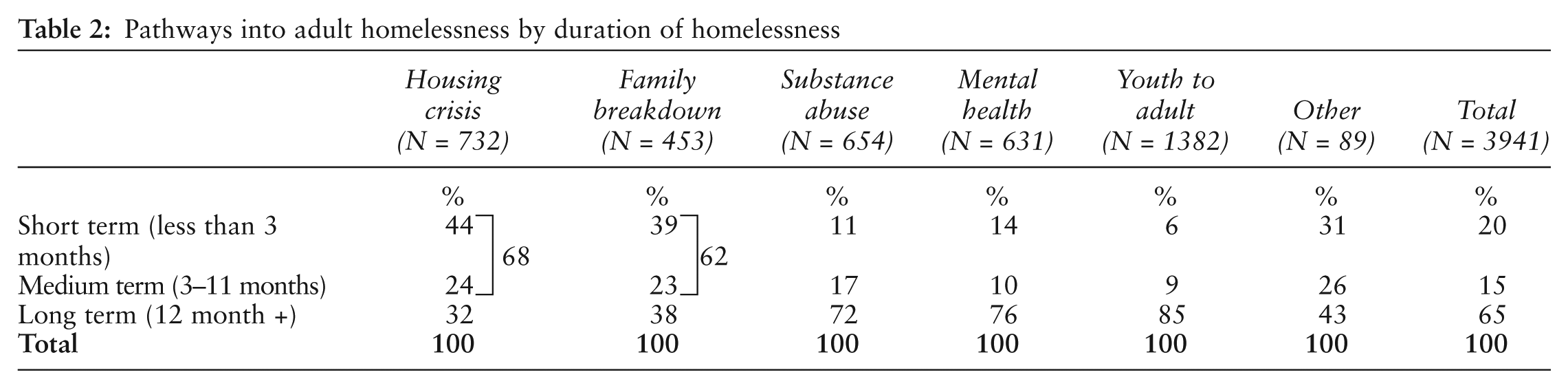
We attempted to calculate people’s cumulative duration of homelessness, but we have already seen that the main issue when coding duration was incomplete information. Our findings underestimate the duration of homelessness experienced by some people. Nonetheless, Table 2 shows that there were two patterns. Among those on the substance abuse, mental health and youth pathways, about three-quarters were in the long-term population. In contrast, about one-third of those on the housing crisis and family breakdown pathways were long-term homeless.
Explaining duration
The social adaptation account contends that homeless people gradually come to accept homelessness as a ‘way of life’, because they develop friendships with other homeless people and this provides a sense of belonging that is often missing in their lives (Grigsby et al., 1990: 52; Wallace 1965). Boarding houses are an important site where homeless people engage with other homeless people, as are refuges and other forms of emergency accommodation (Fitzpatrick, 2000; Hirst, 1989; Johnson and Chamberlain, 2008b; Mallett et al., 2001). In these sites, people learn strategies from each other that help them to survive homelessness. Substance abuse can also be a strategy for coping with a stressful environment. The social adaptation thesis contends that people become long-term homeless because they adapt to homelessness as a way of life.
Our main contention is that social adaptation account helps explain what happens to people on the substance abuse and youth to adult pathways. However, we think the social adaptation account misunderstands what happens to people on the housing crisis, family breakdown and mental health pathways. People on these pathways bring with them different experiences and expectations and make sense of homelessness within a different frame of reference. Next we illustrate this argument using data from the 65 in-depth interviews. It has already been pointed out that our selection of the interview data was informed by reading 5000 case files.
Housing crisis and family breakdown
People on the housing crisis and family breakdown pathways often reported that it was a ‘dreadful shock’ becoming homeless. June and her infant son: ‘went to a friend’s place for week … then to a caravan park. That was probably the scariest place I’ve ever been in.’
People on these pathways often assumed their homelessness would last just a few weeks, but this was rarely the case. Those on the housing crisis pathway were usually in debt so they did not have sufficient funds to rent a property in their own right, and they often faced a range of practical issues such as where to store their furniture. Those leaving home because of family breakdown often left behind all their possessions. June had left home because of domestic violence:
I had nothing … I’d given all my money to him … I had no furniture, no kitchen things. I didn’t have many clothes.
Dale lost his accommodation because of a housing crisis. For a while, he slept in a park and ‘learnt the ropes’ from other rough sleepers. However, Dale did not identify with other homeless people. For a while he lived in a boarding house, but he kept ‘himself to himself’ and did not make friends with other residents:
Most of them were just alcoholics, druggies, no brains, no nothing. They were quite happy with their situation … I always had an aim.
People on the housing crisis and family breakdown pathways were reluctant to form friendships with others who were homeless. They perceived ‘homelessness’ to be a stigmatized identity in the wider society, and they did not want to be publicly recognized as ‘homeless’. Some established routines that minimized their involvement with other homeless people. Others engaged with homeless services, but they did not identify with other homeless clients. Attempts to re-establish ‘normality’ in their lives often involved them expressing stereotypes about homeless people. Terry commented that he was ‘not one of them’ because of:
the way I dress and the way I conduct myself. Homeless people tend to dress down and not to be clean.
Dale said:
I always had a shower and a shave every day. I kept up appearances … always neat and tidy. Most people would never have thought I was homeless.
The social adaptation account contends that people gradually come to accept homelessness. However, we found that people on the housing crisis and family breakdown pathways had a range of strategies designed to minimize the possibility they could be identified as homeless and they did not form close friendships with other homeless people. One consequence was that relatively few engaged in recreational substance use which often locks people into homelessness. People on the housing crisis and family breakdown pathways had to overcome significant obstacles to get out of homelessness, but most managed to do this if they were given appropriate assistance. They did not adapt to homelessness as a ‘way of life’.
Substance abuse and youth to adult
People on the substance abuse pathway moved into the homeless subculture quickly. This occurred because most started to engage with other homeless substance users. Through these relationships they secured information about what services are available, where to secure food and other basic material items.
People on the substance abuse pathway use boarding houses on a regular basis. Boarding houses are an integral part of the system of emergency accommodation in Australia’s major cities. In boarding houses, people learn about the rules and practices that structure interactions within the homeless subculture, and between homeless people and mainstream institutions.
Boarding houses also provide easy access to drugs. In boarding houses, there is widespread acceptance of illicit drug use as a normal recreational activity and drugs are ‘hard to avoid’. As one boarding house resident put it, ‘If I wanted drugs, all I had to do was walk down the corridor and knock on the door.’
Physical violence and intimidation are common in boarding houses and some people on the substance abuse pathway started to sleep rough to get away from the conditions in boarding houses. Others slept rough because they could not afford boarding house accommodation.
When people on the substance abuse pathway started to sleep rough they often used squats. In squats, substance abuse is widespread:
It was an old nursing home … walls ripped out, floorboards pulled up … people were shooting up … yeah, it was a huge ‘shooting gallery’.
Squats provide a space where people can engage in drug use with relatively little fear of being caught, but they are dangerous places. Stephen said:
You don’t know [if] someone’s going to come in and get you. I slept with one eye open and a knife under my blanket.
The compounding impact of these experiences makes getting out of homelessness a complex process. People on the substance abuse pathway are primarily concerned with raising money, ‘scoring’ and ‘using’. Things like finding work or conventional accommodation tend to fall by the wayside. As a result many remain homeless for long periods of time. Although people with substance abuse issues represent a minority in the overall homeless population, they are disproportionately represented among the long-term homeless.
One-third (35 percent) of our sample had made the transition from youth to adult homelessness and most had experienced traumatic family breakdowns. When they became homeless, they usually engaged with other homeless people because it provided them with a sense of belonging. Once Kylie left home, she was soon involved with:
a whole network of people.… You always found somewhere to sleep. You had a community around you.
The homeless subculture provided them with a ‘place’ and a sense of camaraderie with other people in similar circumstances. Palik said, ‘You knew where the squats were so you always found somewhere to sleep … people you shared values with, ideas, dreams.’ Many young people rejected the stigma attached to homelessness in the wider society, and started to engage in practices common within the subculture. One such practice was substance abuse.
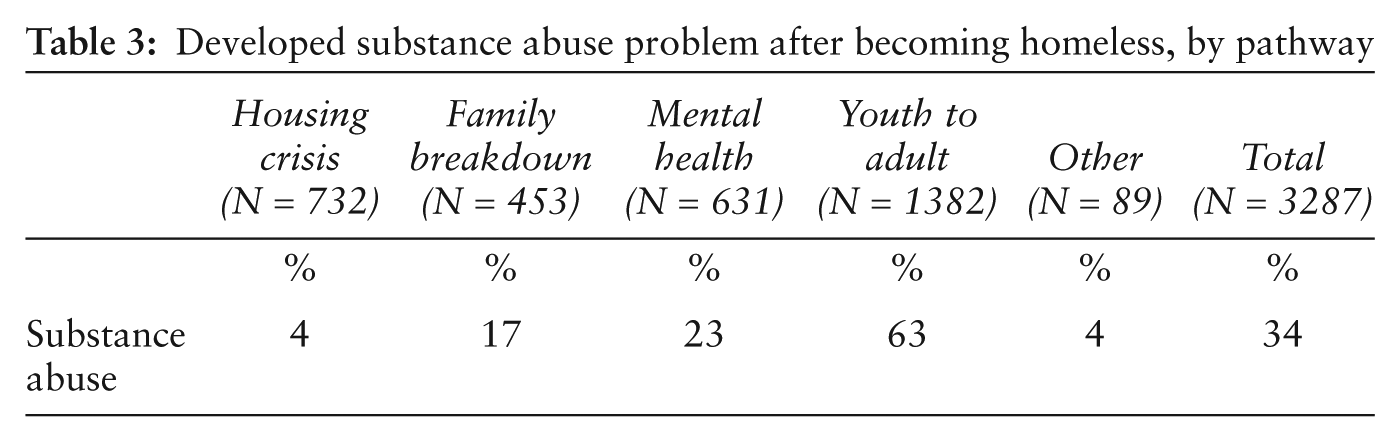
Table 3 shows that people who developed substance abuse problems after becoming homeless were unevenly distributed across the sample. Only 4 percent of those on a housing crisis pathway subsequently developed a substance abuse problem, compared with 17 percent on the family breakdown pathway and 23 percent on the mental health trajectory. However, 63 percent on the youth to adult pathway developed substance abuse issues after becoming homeless.
Developed substance abuse problem after becoming homeless, by pathway
For some young people drug use was a form of ‘initiation’ or a ‘rite of passage’ into the homeless subculture (Auerswald and Eyre, 2002; Fitzpatrick, 2000; Hartwell, 2003). For others, drug use became a way of dealing with the reality of homelessness. Researchers commonly refer to this as a ‘coping response’ (Kennedy and Fitzpatrick, 2001; Reid and Klee, 2000). Eileen said, ‘I started using junk just to blot it all out.’ For Andrew drugs were a:
classic way to hide … [they] take your mind off everything else because the one thing you’ve got to do each day is make sure you get your hit.
The social adaptation account contends that people come to accept homelessness as a ‘way of life’ (Grigsby et al., 1990; Wolch et al., 1998). In our view, this proposition is not substantiated empirically with regard to people on the youth to adult and substance abuse pathways. We found that 88 percent of those on the youth to adult pathway had had two or more episodes of homelessness, as had 86 percent of those on the substance abuse pathway. Most people on these pathways did not have a continuous experience of homelessness, but rather one that was periodically broken by ‘exits’ and then a subsequent housing breakdown. People try to get out of homelessness if they think the opportunity is available.
The thrust of the social adaptation account is right: the longer people on the substance abuse and youth pathway are homeless, the more difficult it becomes for them to get out of homelessness. However, the social adaptation account overstates the extent to which people on the substance abuse and youth to adult pathways normatively accept homelessness as a ‘way of life’. People pragmatically accept their situation and their ‘acceptance’ is ‘continually being constructed and reconstructed over time’ (Zufferey and Kerr, 2005: 346). This pragmatic acceptance can change rapidly once people perceive that alternatives are available and then they want conventional accommodation.
Mental health
People on the mental health pathway often experienced long-term homelessness. By the time people on this pathway became homeless they had few, if any, social networks and most went straight into boarding houses. People with mental health issues were often denigrated as ‘crazies’ by other boarding house residents, or ‘picked on’ because of their vulnerability. For example, Rosa felt:
very scared … a number of blokes tried to come on to me for sex. It was awful.
Brian said:
I was paranoid and scared. I was just worried that someone was going to hurt me.
Over time, people developed strategies to help them get by, including routines to minimize their exposure to other homeless people. Heinz said:
I would go to the local library.… They have free internet and free newspapers. I could read in there.
Some people employed strategies such as avoiding communal kitchens at meal times. Other strategies included sleeping rough if violence in the boarding house got out of hand. According to Thompson et al. (2004: 289), the development of these survival strategies can further ‘alienate the individual from … their social networks’. Not only does this reduce the quality of their life, but it can also ‘exacerbate existing disorders’ (Perese, 2007: 289).
Homeless people with mental health problems withdrew in order to reduce the possibility of being exploited or assaulted, but they also withdrew to differentiate themselves from other homeless people. According to Heinz:
I had absolutely nothing in common with them.… They were all druggies and alcoholics.… They had either got out of jail or were going to jail.
Or, as Rosa put it:
I had nothing in common with those people. I tried to have nothing to do with them.
In the homeless literature, the social adaptation thesis emphasizes that people remain homeless because they adapt into the homeless subculture. However, what the social adaptation thesis has missed is that different homeless groups respond to the homeless subculture in different ways and with different consequences. In the case of those entering on the mental health pathway, they are marginalized by other homeless people because of their mental health status. They develop routines that emphasize their outsider status and they often have no close friends. People in this group do not endorse homelessness as a ‘way of life’. They remain homeless because there are few exit options for them, and there is insufficient support to assist them out of the homeless population.
Conclusion
This article has argued that we need a simple analytical framework for thinking about the homeless population overall and we have identified five ideal typical routes into adult homelessness: housing crisis, family breakdown, substance abuse, mental health and youth to adult. We have also argued that people on different pathways relate to the homeless subculture in different ways and have different strategies for dealing with the fact that homelessness is a stigmatized identity in the wider society. This helps to explain why people on some pathways remain homeless for longer than people on other pathways.
However, for some research and policy purposes, the five pathways identified in this paper could be divided into various sub-pathways. For example, a range of factors can bring on a housing crisis, including job loss, relationship breakdown and business failure. For some purposes, one might investigate whether these different trigger points identify meaningful sub-pathways within the housing crisis category. Similarly, one might investigate whether teenagers who come from different family types negotiate the youth trajectory differently.
It is important to recognize that people on different pathways do not have identical experiences. As we have pointed out, a homeless biography is an account of an individual’s journey through homelessness, whereas a homeless pathway is an analytical model which maps an ideal typical route through homelessness so that the core characteristics of the pathway can be seen clearly. Homeless pathways draw attention to the structural and cultural factors that may constrain the choices that people can make, but individuals are always engaged in making decisions about their lives and reflecting upon their experiences.
There is also temporal diversity within each of the pathways. It was clear from Table 2 that some people on each pathway have a long-term problem with homelessness and some have a short-term problem.
People’s entry pathways are not the only factors that explain why people remain homeless for different lengths of time. Other factors that affect the duration of homelessness include: the number and type of services that are available in particular communities; the material resources that those services have at their disposal; whether or not the services have early intervention and prevention strategies in place; and the character of the local labour and housing markets.
The purpose of our ideal types was not to explain all aspects of reality but to provide an analytical framework that makes the endless diversity of individual cases comprehensible. We have argued that when people become homeless they have to deal with other people in similar circumstances (the homeless subculture) and to deal with the fact that homelessness is a stigmatized identity in the wider society. They also have to negotiate the different social practices that structure the homeless subculture. The different ways that people respond to these contextual factors are mediated by their biographies and by their pathways into homelessness.
People on a housing crisis or family breakdown pathway rarely identify with other homeless people and they do not form strong friendships with them. They perceive homelessness to be a stigmatized identity in the wider society and they try to ‘pass as normal’ (Kaufman and Johnson, 2004: 812). Their homelessness is often shorter. People on the substance abuse and youth to adult pathways are much more likely to engage with other homeless people and invert the stigma attached to homelessness in the wider society. Their homelessness lasts longer. People on the mental health pathway also experience long-term homelessness, but they are often marginalized in the homeless subculture and have no close friends. They do not accept homelessness as a way of life, but they remain homeless because they have few housing options. Of course, people on the same pathway can respond to similar events in different ways and with different consequences. Nonetheless, homeless pathways go some way towards explaining why some people remain homeless for longer than others.
Footnotes
Acknowledgements
We thank the homeless people we interviewed. We also thank the staff at the Salvation Army Crisis Services (St Kilda) and HomeGround Services for their assistance.
Funding
Financial support for the research came from an Australian Research Council Linkage grant (LP0560760).