




Abstract
As young people’s internet use shapes their experiences of education, work and personal relationships, their portrayal as ‘Digital Natives’ suggests that they are invariably better positioned than preceding generations to capitalize on such changes. Recent debates in internet use research undermine this view. While acknowledging socio-demographic differences in use, theorists disagree as to whether these reflect disparities in internet access, processes of social stratification, or users’ rational assessment of risks and opportunities. Incorporating these views, this article develops a framework for investigating differences in academic and social internet use by using data from 6444 high school students in Queensland, Australia. The results show that different factors structure students’ entry into these use pathways. Since social use depends on one’s home access context, remote students with poorer access spent less time on this activity, whereas students at independent and Catholic schools were heavier academic users, because they possessed the requisite academic orientation.
The learners in our schools today – Digital Natives – are different from the learners of yesterday. Digital is their native language – a global language in which they are fluent. In contrast, for our education system and most teachers, digital is at best, a second language … (Director-General of Education, in State of Queensland 2004: 2)
Social researchers and policy makers regularly conceptualize young internet users as an homogeneous group who are capable of integrating new media into their everyday lives. These claims typically acquire a generational flavour: those born today are ‘Digital Natives’ (Prensky, 2001), and members of a ‘Net Generation’ (Tapscott, 1998), who, in stark contrast to their parents, are surrounded by opportunities to engage in new, technology-mediated forms of social participation. Such opportunities are reconfiguring social life in a number of domains, including education and work, civic and political engagement, social interaction and relationships, and everyday time use. As debate centres on how internet use shapes outcomes in these areas, some researchers maintain that young people will invariably fare better than earlier generations who, it is claimed, find the language of effective internet use relatively impenetrable (Palfrey and Gasser, 2008).
Variation in youth internet use is already recognized and documented by scholars in the US (Hargittai, 2010), the UK (Bennett et al., 2008) and in Australia (Kennedy et al., 2008; Lovell and Baker, 2009). On the basis of such research, the notion that young people are uniformly well positioned to capitalize on the internet’s diffusion routinely attracts criticism. Many argue that it relies on a simplistic view of internet access – typically higher among youth – as the only factor relevant in shaping the outcomes these adolescents experience when they go online. It is true that in advanced Western societies internet access has spread rapidly among the youth population. By 2009, access rates stood at 86% in Australian households with children under the age of 15, compared to just 66% in childless households (ABS, 2009a). By the time they begin primary school (aged 5–8), over half of all Australian children have been online, and when they enter high school (aged 12–14) nearly all have done so (ABS, 2009b). However, critics maintain that good access does not guarantee the regular, competent and rewarding use assumed by the Digital Native rhetoric.
Rather, the capacities young people develop for internet use reflect their varied and ongoing engagement with this medium. Researchers characterize this in terms of the quality and context of young people’s internet access, the frequency, duration, motivations and purposes of their use, and their perceptions of its impact. Some theorists treat differences in these factors as indicative of broader processes of social stratification (DiMaggio et al., 2004; Hargittai, 2008), while others emphasize the agency with which young people tailor internet use to meet their needs and avoid risks (Livingstone and Helsper, 2007). Buckingham (2008: 14) dismisses the portrayal of young people as creative, savvy and effective users, observing that most youth internet use amounts to ‘mundane forms of communication and information retrieval’. Recent statistics show that 94% of Australian children aged 12–14 use the internet for study and 60% use it to communicate with their friends, whereas only 24% create online content such as blogs or websites (ABS, 2009b). Yet communicating online still involves the active production of content, just as using the internet for information still requires critical user input. Lovell and Baker’s (2009) qualitative study of digital content production among Australian university students finds that young people approach such tasks with differing levels of digital literacy and confidence; as a result, they perceive the possibilities of new media use in varying ways. Economists argue that the growing use of such media represents a skill-biased technological change which accounts for the rising income inequality seen in post-industrial societies (Autor et al., 1998). In this context young people’s capacity for even basic forms of internet use may open up educational and occupational pathways that would otherwise remain closed to them.
In this article we contribute to the debate on these issues by addressing two related questions:
What are the relevant factors for explaining whether or not young people engage in basic forms of internet use?
How do individuals differ on these key factors?
To explore these questions we analyse variation in the time adolescents spend on academic and social internet use. This analysis is based on data from a large sample of 6444 high school students in Queensland, Australia.
Explaining differences in adolescent internet use
The literature on internet use among adolescents is dominated by three main theoretical perspectives: universal diffusion, cumulative advantage/disadvantage and opportunity/cost.
According to diffusion theory, an innovation diffuses fastest among individuals of higher status, economic resources and educational qualifications, until a saturation point is reached, after which it ‘trickles down’ to less advantaged segments of the population, universalizing as it becomes cheaper and more widely available (Rogers, 2003). Early diffusion studies in the US employed the idea of a ‘digital divide’ between those with and without internet access (NTIA, 1995). Those with internet access benefited from the information they received via global computer networks. Whether or not one had access was influenced by a range of socio-demographic characteristics such as age, gender, income, education, language, ethnicity, geographic location and family composition (van Dijk, 2005). Research from Australia and the US provided support for this argument, indicating that early disparities in internet access were in decline and that some structural differences, such as gender, had disappeared entirely (Compaine, 2001; Curtin, 2001–2; Ono and Zavodny, 2003).
More recently, the universal diffusion perspective has been critiqued for several reasons. The presumption that internet access alone entails certain benefits, regardless of what users are actually doing online, is now largely obsolete. The proliferation of new forms of internet access and use also means there is now no clear endpoint in the diffusion process. Norris (2001) argues that socio-demographic disparities potentially increase, rather than normalize, as successive digital innovations diffuse. Using the example of broadband versus dial-up access, she notes that people in higher levels of social strata, who tended to adopt dial-up earlier, were better positioned to upgrade to broadband earlier. As such, more durable disparities between internet users may arise if initial advantages in access are over time converted into new advantages in terms of skills and experience.
To identify such disparities and investigate their broader social implications, theorists now acknowledge the differentiated nature of internet access and use. Access differs according to cost (DiMaggio et al., 2004), connection speed (Norris, 2001), location of access (Hassani, 2006) and exclusivity of access (Hargittai, 2008). Similarly, internet use varies in frequency and duration (Livingstone and Helsper, 2007), purpose (Zillien and Hargittai, 2009) and difficulty (Hargittai, 2010). Researchers also note that differences in users’ skills, needs, motivations and preferences help explain why some individuals are more likely than others to use the internet. Nguyen (2008) accounts for this by drawing on McQuail’s (2000) structural approach to media audience formation. He employs the notion of ‘media orientation’, as ‘an affinity for certain media, specific preferences and interests, habits of use, expectations of what the media are good for’, to explain why online news use varies (McQuail, 2000: 386; Nguyen, 2008).
Building on Norris’s earlier example, some researchers suggest that differentiated internet use reflects a process of cumulative advantage by which status and class hierarchies are reproduced. Hargittai (2008) argues that a user’s resources, preferences and capabilities influence the nature and effectiveness of their use, rendering some people’s use more advantageous than others. Effective use enhances one’s existing human, financial, social and cultural capital, whereas unskilled or misguided use ‘may outright disadvantage the uninformed’ (Hargittai, 2008: 940). Drawing on Bourdieu’s (1984) theory of ‘distinction’, Hargittai and Hinnant (2008) argue that, when entering into online activities, users are governed by their underlying, status-specific tastes. These ensure that internet use is always conducted in a way that reinforces the same unequal distributions of capital. There are two main problems with this account. First, given the lack of systematic, longitudinal research into the effects of internet use, it relies on assumptions about these effects (Livingstone and Helsper, 2007). Second, not only does this view attribute a high degree of causal efficacy to users’ preferences, but it also grounds these so directly in the social structure as to render individual agency virtually absent from the decision-making process (Elster, 2007). The result is a static view of internet use pathways that only admit users with certain resources, skills and preferences, and of users who only engage in those uses which reinforce their socio-structural location.
Theorists have softened this account of internet use and its outcomes by acknowledging how users tailor their use over time. Livingstone and Helsper (2007) characterize adolescent internet use as presenting both risks and opportunities, which are context-specific and thus difficult for researchers to generalize about. What distinguishes their account from the cumulative advantage approach is the role it assigns to choice; users are seen as rational actors choosing from a feasible set of actions which remain possible after a variety of constraints (i.e. logical, physical, economic, social, etc.) are taken into consideration (Elster, 1997). Drawing on Giddens’ (1984) concept of ‘structuration’, Kalmus et al. (2009: 71) identify how ‘rules and resources’ structure young people’s opportunities for internet use, such as parental restrictions on use, material resources at home and school, and the availability of time. Yet users’ choices may, over time, restrict, modify or expand the opportunities they face. Using data from the UK Children Go Online project, Livingstone and Helsper (2007) analysed the extent to which 1263 young people aged between 9 and 19 engaged in a diverse range of online activities, while controlling for socio-demographic and contextual factors. They found that ‘going online is a staged process, with systematic differences between those who take up more, and those who take up fewer opportunities’ (Livingstone and Helsper, 2007: 683).
In their article, Livingstone and Helsper (2007: 683–4) identify four kinds of users, based on the online opportunities they pursued. ‘Basic’ users (16% of the population) focused narrowly on information-seeking use, which Kalmus et al. (2009) describe as ‘school-favoured’ use. ‘Moderate’ users (29% of the population), supplemented this with communication and entertainment, such as email and online games. ‘Broad’ users, (27% of the population), added in more ‘resource-bound’ activities such as downloading music and watching movies, as well as peer-to-peer engagement through instant messaging. Finally, ‘all-rounders’ (27% of the population) did all these activities as well as more interactive or creative forms of use, such as website creation, forum discussions, or taking part in online polls. Each stage of use coincided with increased frequency of use. Older adolescents were typically more advanced in their use; having been users for longer meant they had the experience needed to take up more online opportunities. This account suggests that individuals experiment with those avenues of use that are open to them once structural factors are taken into consideration. Those users who become familiar with a wider variety of online activities, and weigh up the benefits and costs of each, may be better positioned to tailor their use in ways that meet their needs while avoiding risks.
The perspectives reviewed here show a progression in how researchers characterize one’s chances of capitalizing on internet use, beginning with a focus on disparities in access, then on the social structure which internet use permeates, and finally on the rationality of the user. These constitute varying responses to the research questions posed earlier:
What are the relevant factors for explaining whether or not young people engage in basic forms of internet use?
How do individuals differ on these key factors?
Figure 1 shows a framework for researching these questions. The process of engaging in basic forms of internet use, referred to in question (1), is depicted at the bottom of the diagram. It shows that use outcomes, beneficial or otherwise, require the opportunity to engage in some kind of use. Our analysis will focus on differences in time spent on both academic and social forms of use. Not only are these the most common types of adolescent internet use in Australia (ABS, 2009b) but they are also significant in the context of the literature; the cumulative advantage perspective views them as contrasting, status-specific types of use, whereas the opportunity/cost approach regards them as gateways to more advanced forms of engagement.
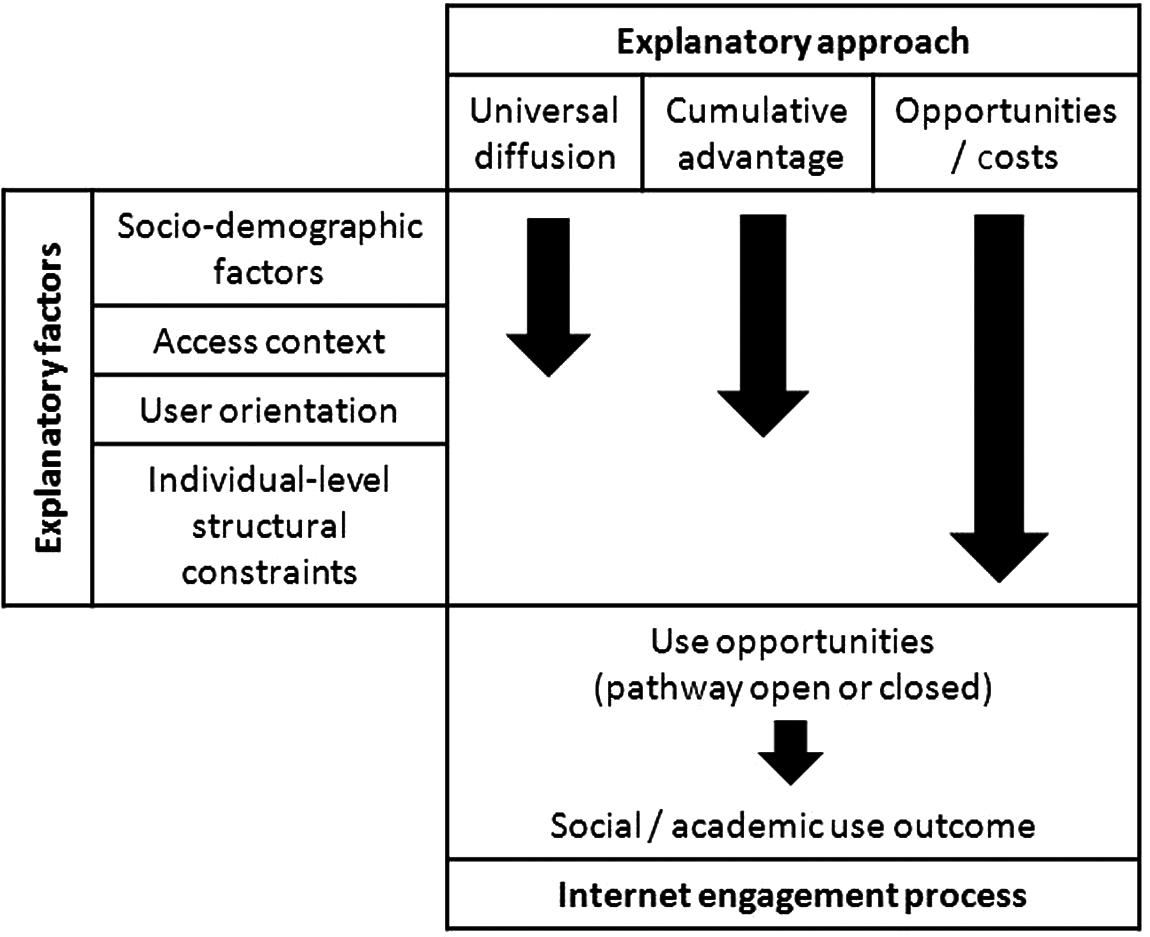
Framework for explaining differences in internet engagement
The top of the diagram shows the three main ways researchers have conceptualized the engagement process referred to in question (1) and on the left are four types of factors they identify as relevant for explaining how this process varies. For each approach, the centre arrows indicate which of these key factors is considered sufficient to explain differences in internet use. As noted earlier, socio-demographic variation in youth internet use is widely documented, and this is reflected in all three approaches. For the universal diffusion approach these differences are largely explained by one’s access context. For the cumulative advantage perspective, an additional factor is involved – one’s structurally determined orientation towards the use in question. For the opportunity/cost perspective, socio-demographic differences which cannot be explained by these factors indicate that there are individual-level structural constraints which users take into account when weighing up the risks and benefits of their use. Question (2) asks about differences between individuals on each of these key factors. Only by answering this question can the analysis identify which of these factors is most relevant in explaining whether young people engage in basic types of internet use.
Data
The data come from wave 1 of the ‘Our Lives’ project, a longitudinal cohort study that sampled Queensland high school students in Year 8 in 2006 (aged 12–13). As well as their internet use, students were surveyed about their goals, values and interests, their social networks, and their academic and social participation. The study employed a two-stage cluster sampling approach, with students contacted via their schools. State-wide, 208 out of 478 schools participated in the project. After excluding 71 schools to which access was denied by the relevant authorities, the overall school response rate was 51%. The student response rate within schools was 34%, yielding an overall sample size of 7031. Post-stratification weighting has been employed to correct an initial over-representation of females and independent school students. The sample is representative of students in urban, regional and remote Queensland. Respondents were excluded if they were missing data on any variables in the analysis where the size of missing data was too small to warrant imputation or controlling for missing data. This produced an analytic sample of 6444 students.
Dependent variables
To test the proposed framework this article analyses the time respondents spent using the internet for basic informational and social purposes. Students were asked ‘How many HOURS PER WEEK, on average, do you spend doing the following?’ The two activities focused on here are ‘Using the internet to email or chat with friends’ and ‘Using the internet to help with your homework’. Respondents selected from the following five response categories: 1 = ‘None’; 2 = ‘1–3 hours’; 3 = ‘4–6 hours’; 4 = ‘7–9 hours’; and 5 = ‘10 or more hours’.
Figure 2 displays the frequency distributions on both dependent variables. 1 Overall, most respondents spend 1–3 hours per week chatting or emailing (40%) or studying online (56%). While more students report not using the internet at all for social uses (26%) than for academic uses (17%), heavier users (i.e. 7–9 or 10+ hours) are more common among those who use the internet socially.
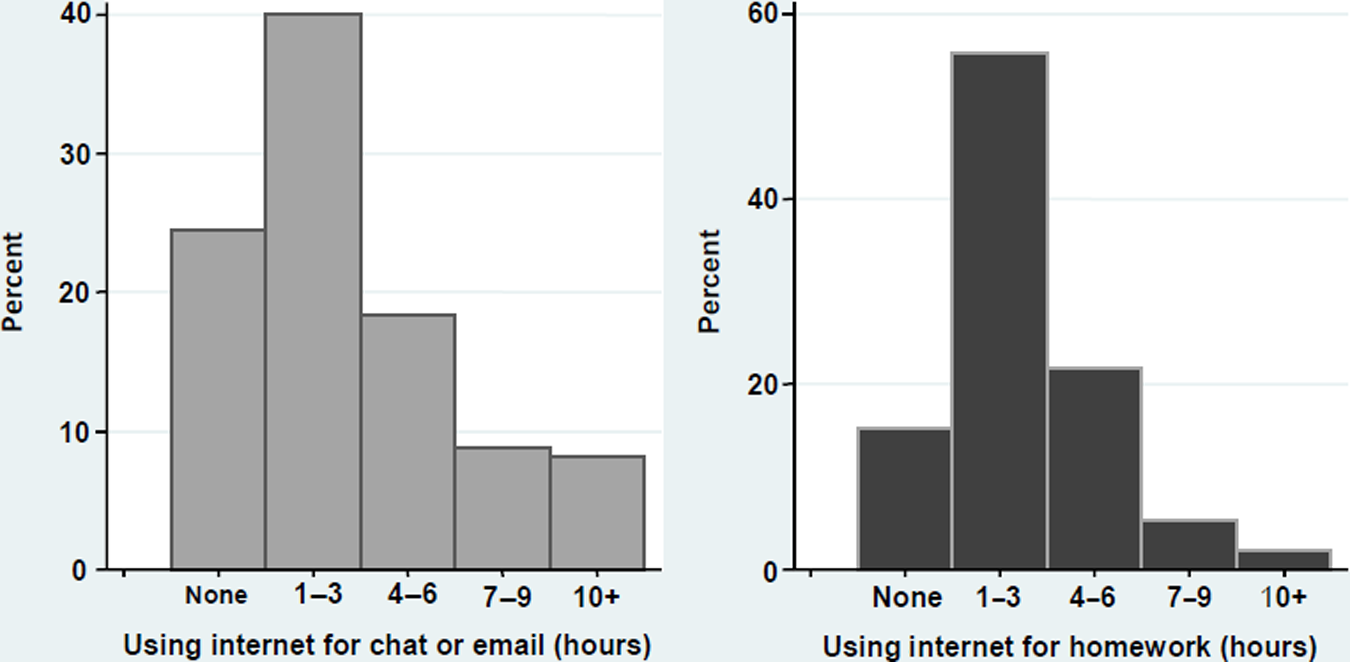
Hours per week spent online
Socio-demographic characteristics
Previous research suggests that respondents’ online time use will vary depending on their socio-demographic characteristics. Model 1 in this analysis examines whether the time a student spends chatting or studying online differs according to their gender, school sector, geographic region, and family living arrangement, as well as their parents’ education and occupation. Parental occupation was controlled for using the ANU4 occupational prestige scale. To apply this measure, students’ responses to open-ended occupational questions were initially coded using the Australian Standard Classification of Occupations (ASCO), and then assigned the corresponding score between 0 and 100 on the ANU4 scale. A high amount of missing occupational data was accounted for by scoring these observations as 0 on the scale and flagging them with a dummy variable. All other socio-demographic measures are controlled for using dummy variables, and the omitted reference categories have been included in the output. A students’ geographic region was based on their school’s location and coded using the Australian Standard Geographic Classification (ASGC). For parental education, cases where respondents did not answer or selected ‘don’t know’ were controlled for with a dummy variable that combined these observations.
Access context and user orientation
The review of prior literature showed that the contexts in which the internet is accessed may influence internet use. Model 2 in this analysis takes into account two measures of access context. The first is the home internet connection type, coded 1 = broadband or 2 = dial-up. The second is whether a student has exclusive access to a home computer (1 = yes) or shares with others.
The compatibility of internet use with students’ broader values and interests is also likely to affect their online time use. Model 3 explores how respondents’ orientations towards academic and social activities offline affect the time they spend doing such things online. A respondent’s ‘social orientation’ was gauged by the time they spent ‘Hanging out with friends outside of school’ and the number of close friends they had. Time spent hanging out with friends is measured in the same manner as the dependent variables. Number of close friends is measured with a question asking, ‘Apart from family members, how MANY friends do you have?’ Five response options were given: 1 = ‘None’; 2 = ‘1–3 friends’; 3 = ‘4–6 friends’; 4 = ‘7–9 friends’; and 5 = ‘10 or more friends’. This question was asked for ‘Friends in general’ and ‘Close friends’, but this analysis focuses on close friends only. A student’s ‘academic orientation’ is controlled for with a measure of the time they spent ‘Doing homework’, and with an index gauging students’ dispositions towards academic engagement. This latter measure sums up respondents’ scores on these questions: ‘How important to you is being a good student?’/‘How confident are you that your teachers won’t let you down?’/‘How much trust do you have in your school?’/‘How important to you is being a member of your school community?’ Since these measures range from 1 to 4 or 1 to 5, the lowest a respondent could score on the composite measure was 4, indicating a weak disposition, and the highest they could score was 19, indicating a strong disposition. This measure has a Cronbach’s alpha of 0.7314, indicating a satisfactory level of internal reliability. Sample distributions on all measures are shown in Table 1.
Distribution of measures*
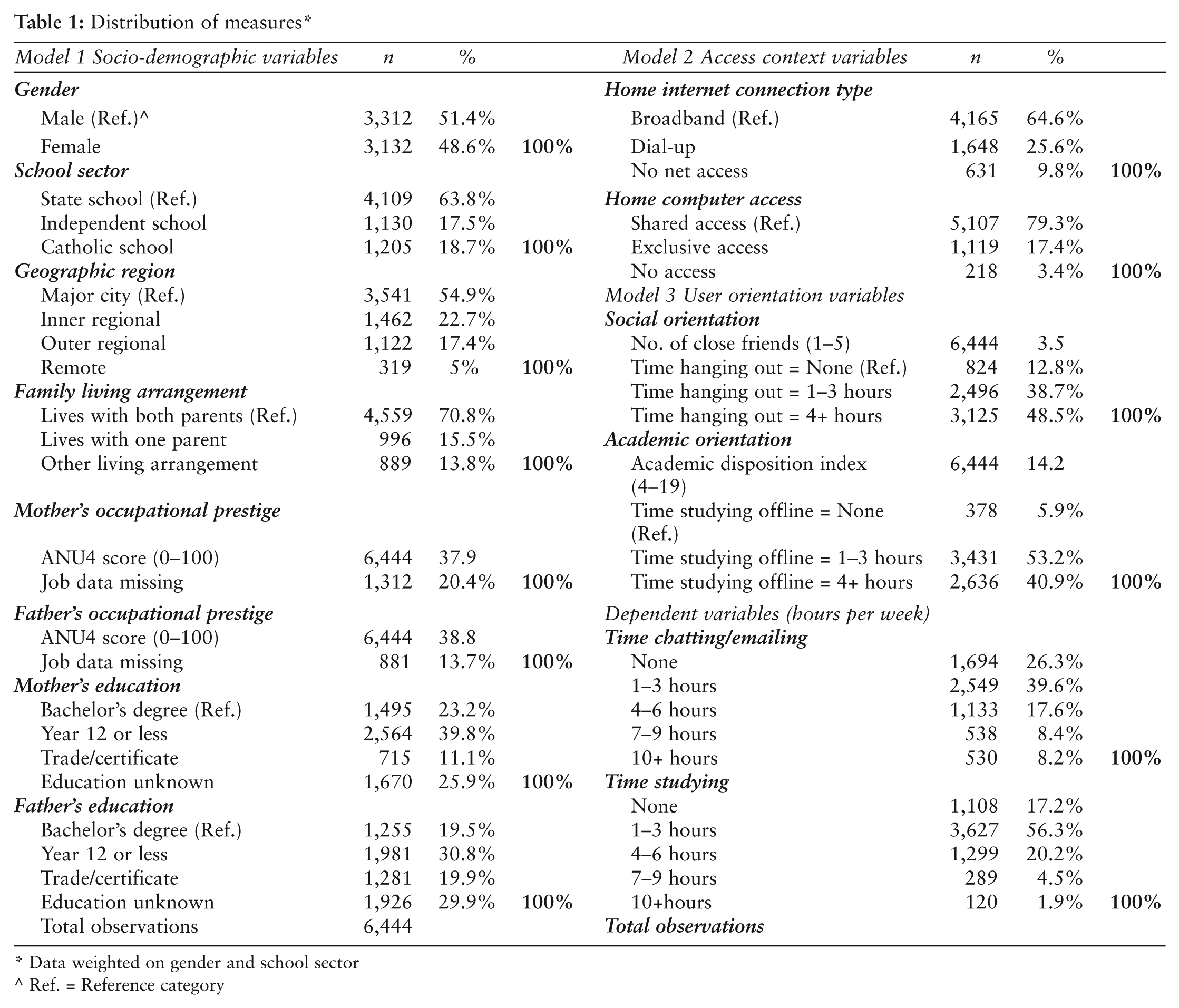
Data weighted on gender and school sector
Ref. = Reference category
Analytic approach
To test the proposed framework (Figure 1), we estimate three models for each dependent variable. Each model introduces a factor identified earlier in the literature as relevant for explaining why internet use varies. Model 1 identifies which time differences are attributable to socio-demographic factors, as theorized by all three explanatory approaches identified in Figure 1. Model 2 introduces the access context measures emphasized under the universal diffusion approach. Model 3 includes user orientation measures in accordance with the cumulative advantage approach. The role of individual-level structural constraints, central in the opportunities/costs perspective, is not directly measured; rather, it may be inferred by the presence of socio-demographic effects which remain unexplained by the previous factors.
The dependent variables are constructed in ordered intervals with upper and lower thresholds. This reflects the need to minimize the recall error that can arise when respondents are asked to place a specific numeric value on their time use. Values are ‘censored’ in that they fall within known ranges (i.e. 1–3 hours, 4–6 hours and 7–9 hours) or beyond a known threshold (i.e. 10 or more hours). We therefore employ a form of censored regression known as ‘interval regression’, which uses Maximum Likelihood Estimation (MLE) based on the known thresholds in which values can fall to provide more robust parameter estimates than would be obtained by ordinary least squares regression (Wooldridge, 2003). This analysis was performed in STATA (version 11) using the INTREG command. Interval regression coefficients are interpreted in the same way as OLS coefficients. In this case, 1 unit of the dependent variable is equal to 1 hour per week. The effect of each variable is also displayed in minutes by multiplying its coefficient by 60. To allow for the possibility of within-school clustering – arising from the two-tiered nature of the sampling process – we specify that the estimation of standard errors for all models take into account this intragroup correlation. While this option does not impact the coefficient estimates, it does allow for more robust tests of significance.
Results
Social internet use
Model 1 (Table 2) regresses time spent using the internet for chat or email on the socio-demographic variables. McKelvey and Zavoina’s R-squared shows how much variation in time use is explained by each model. Model 1 explains 2.3% of the variation, with gender and geographic region displaying the strongest associations, net of other factors. On average, girls spend 49 minutes longer (0.819, p <0.001) online per week than boys, and regional and remote respondents spend less time chatting or emailing than their urban counterparts. Those living in an inner regional area spend an average of 15 minutes less per week than those in major cities, while those in outer regional and remote areas spend 32 minutes less and 51 minutes less per week respectively. Students in Catholic schools use the internet less than those in state schools while students whose mothers are unemployed or outside the labour force spend less time than those with employed mothers.
Interval regression of time spent chatting or emailing online (1 unit = 1 hour per week)#
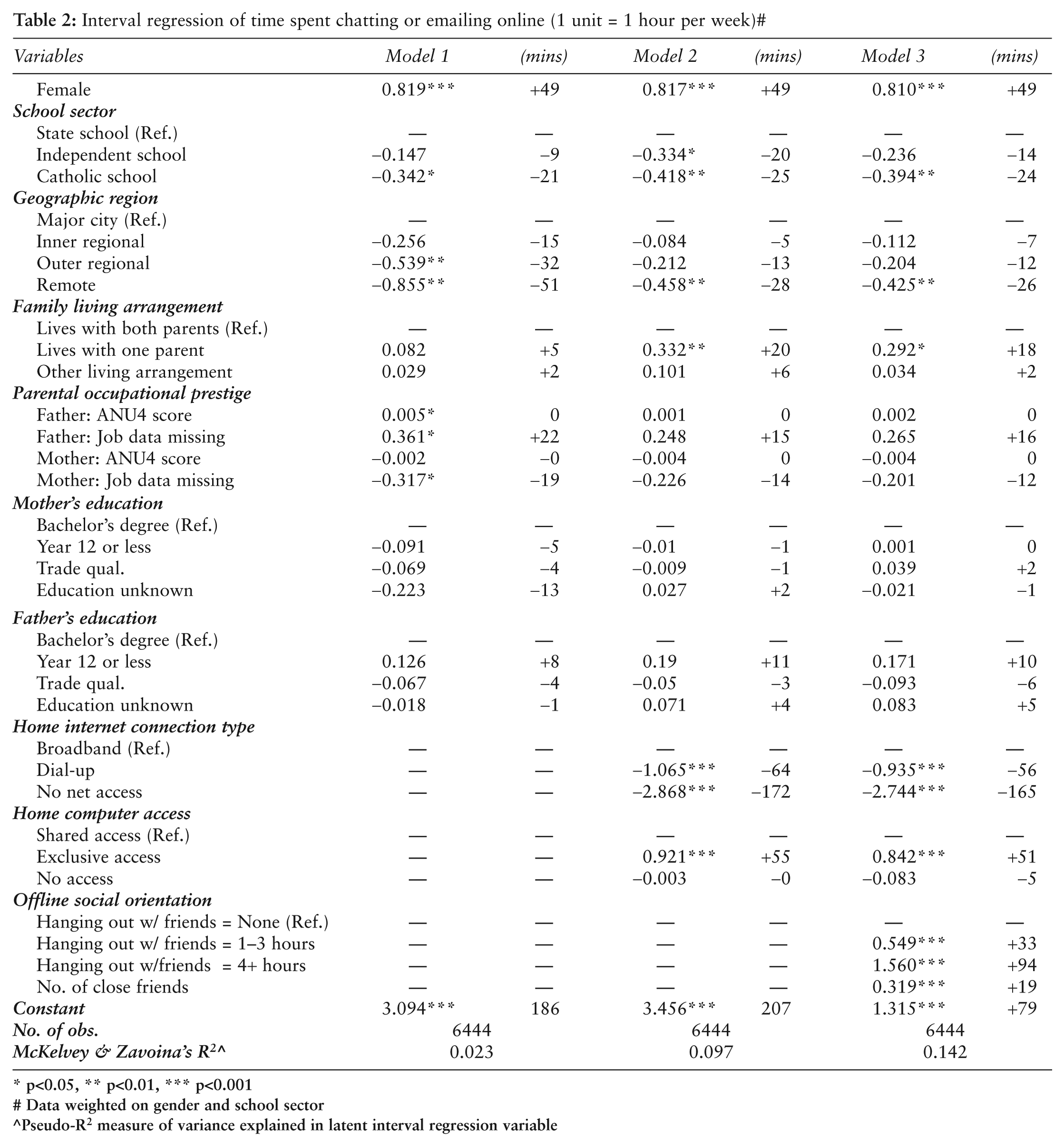
p<0.05, ** p<0.01, *** p<0.001
Data weighted on gender and school sector
Pseudo-R2 measure of variance explained in latent interval regression variable
When Model 2 controls for access context, the total variance explained increases to 9.7%. Connection type and exclusivity of access strongly influence social internet use. Unsurprisingly, students with dial-up access on average spend 1 hour and 4 minutes less per week on chat or email than those with broadband access, while having no home access predicts a 2 hour and 52 minute decrease. Students who enjoy exclusive access spend 55 minutes longer per week than those with shared access. When these factors are included, the net effect of geographic region roughly halves. Furthermore, the negative effect of attending an independent school increases. In Model 3, the social orientation variables increase the total variance explained to 14.2%. The more close friends a student has, and the longer they spend with friends outside school, the longer they are likely to spend chatting or emailing. Social orientation also accounts for the negative effect of attending an independent school and having a mother who is unemployed or not in the labour force.
Academic internet use
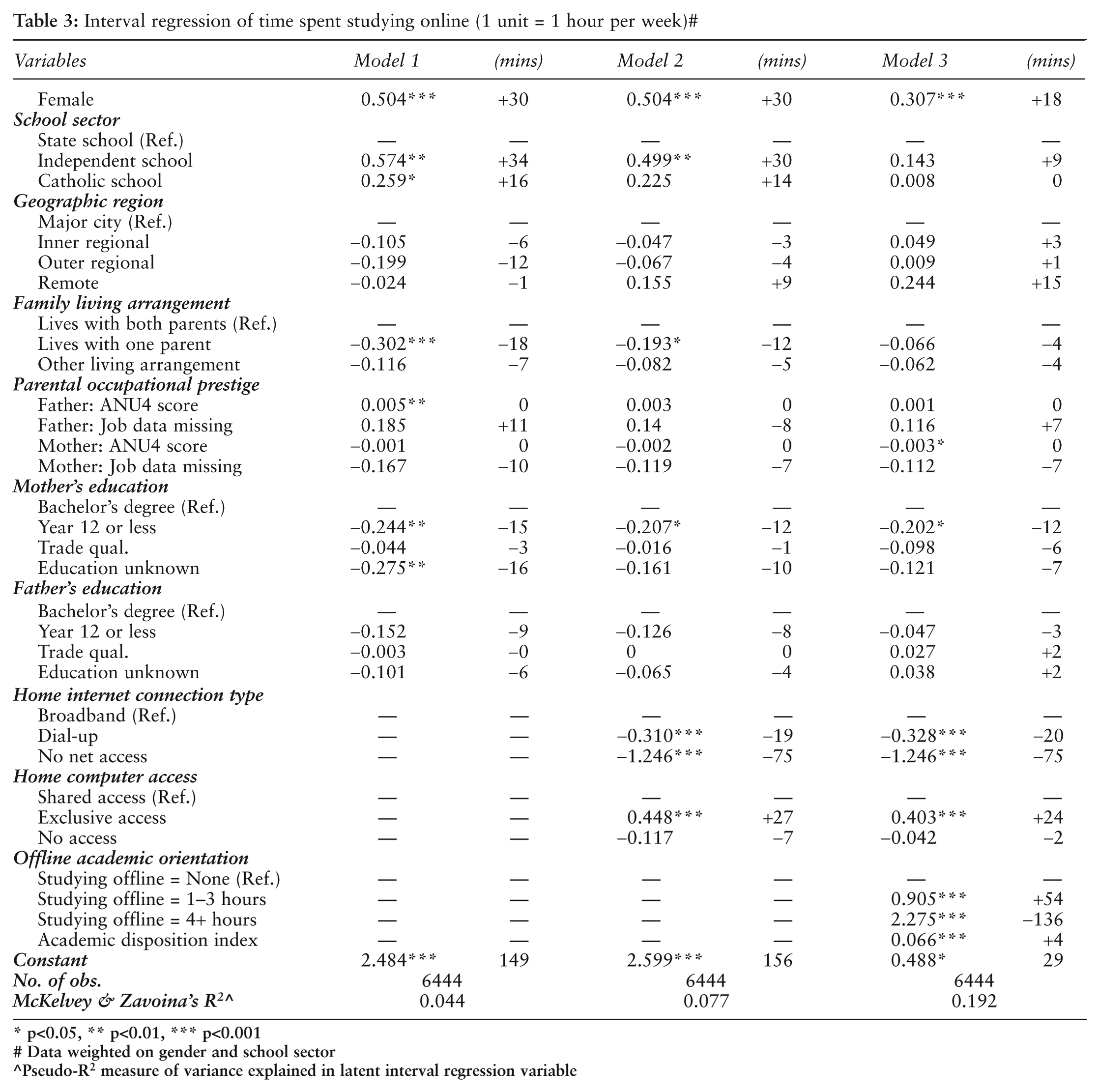
Model 1 (Table 3) regresses time spent using the internet for homework on the socio-demographic variables. It accounts for 4.4% of the total variation in time use, with gender, school sector and family living arrangement displaying the strongest associations. Females study online for an average of 30 minutes per week longer than males. Compared with students in state schools, independent and Catholic school students report studying online for 34 minutes more and 16 minutes more per week respectively. A student living with one parent spends an average of 18 minutes less per week studying online than if they were living with both. For every 10 point increase in their father’s occupational prestige, a student spends 3 minutes longer studying online. Living in a major city, or having a mother with a bachelor’s degree, also predicts increased use.
Interval regression of time spent studying online (1 unit = 1 hour per week)#
p<0.05, ** p<0.01, *** p<0.001
Data weighted on gender and school sector
Pseudo-R2 measure of variance explained in latent interval regression variable
Model 2 factors in access context and the total variance explained rises to 7.7%. The effect of connection type and exclusivity of access on academic use, though strong, is not as influential as it was on social use. Relative to those with broadband, students with dial-up spend 19 minutes per week less studying online, and those with no home access spend 75 minutes per week less. Having exclusive rather than shared access means students spend 27 minutes more studying online per week. Including access measures leads to decreases in the effect of family living arrangement, father’s occupational prestige and mother’s education. However, user orientation explains much more of the variance in academic internet use than it did for social use. In Model 3, the academic orientation variables raise the total variance explained to 19.2%. The stronger a student’s academic disposition, and the longer they spend doing homework offline, the more time they spend studying online. Controlling for a student’s academic orientation negates the effects of school sector and family living arrangement, while reducing the effect of being female.
Discussion
In this article we developed and tested dominant explanations for why internet use varies. In general we find that participants in this study are more likely to use the internet for academic (i.e. homework) rather than social (i.e. chatting) reasons. This is consistent with national trends for this age group (ABS, 2009b). However, the ABS does not measure online time use for specific purposes. These results show that students’ social use is more time-consuming than their academic use. For some, simply having enough time could be a decisive factor shaping their use. As students grow older and their academic and social involvement increases, these online practices may also compete against other important activities for students’ limited time.
The regression analyses indicate that students’ entry into these two kinds of use is structured by quite different criteria. Having fast, exclusive internet access at home impacts more on the time students spent chatting or emailing than the time they spent studying. When using the internet to communicate with friends, students require more time and greater privacy than when they use it for information. If a student lacks the means to engage in academic internet use at home, they can usually do so at school. However, school restrictions on non-academic internet use may impede those who want to engage in social use and lack the means to do so at home (Notley, 2009). This also coheres with the idea that less resource-intensive forms of use take precedence in the staged process by which young people go online (Kalmus et al., 2009).
By contrast, user orientation was more salient for academic use than for social use. Students saw ‘school-favoured’ internet use as fitting into their broader academic practices, which may again reflect the influence of parents and teachers. Their sense of how social internet use fits into their emerging personal relationships perhaps owes more to peer influence, or students’ own experimentation with such use. This illustrates the role of norms that sanction some forms of use ahead of others, thereby structuring the process of going online. The cumulative advantage approach suggests that internet use is capital-enhancing when it adheres to status-specific tastes that attract broader social and cultural rewards. Yet children who only learn to comply with officially sanctioned uses may find themselves at a disadvantage in settings where those sanctions no longer apply, and where their usual patterns of use attract new risks and benefits. Becoming competent across a broad range of uses allows individuals the flexibility to adapt to a wider range of circumstances. As argued by the opportunity/costs approach, it requires users to evaluate whether the cost of experimenting with unsanctioned use is worth the reward. Some users have the resources to withstand such a cost, while others do not. Social use may be rewarded outside school, but only if one has higher social capital to begin with. The positive association found between offline sociability and online interaction supports claims that social internet use can supplement face-to-face interaction in the process of social capital formation (Wellman et al., 2001).
Since these two use pathways had different entry criteria, they were open to some students and not others. Students in regional and remote areas, many of whom fell short of the necessary access criteria, spent less time chatting or emailing than those in major cities. For these students, the universal diffusion approach, with its focus on access, is relevant. By contrast, independent and Catholic school students, who displayed the requisite academic orientation, were more inclined than state school students to recognize and pursue the benefits of online study. This suggests that differences in academic use could be a function of broader processes of social reproduction, as indicated in the cumulative advantage approach.
Finally, some socio-demographic differences could not be accounted for by a user’s orientation or their access context. In accordance with the opportunity/cost approach, this suggests that individual-specific structural factors may enter into some students’ time use considerations. For instance, for students at Catholic schools, who spent less time chatting or emailing, stronger parental mediation of internet use at home may need to be taken into account. Males, who spent less time on both social and academic use, may need to balance these forms of use with other recreational internet uses.
Conclusion
The findings presented in this article make an important contribution to research on youth internet use both in Australia and internationally. They demonstrate that young people differ in their chances of capitalizing on the academic and social opportunities presented by the internet’s diffusion. Furthermore, they show that each of the main ways in which researchers have viewed these differences have a role to play in explaining them. As scholars increasingly critique the Digital Native myth, a key lesson is that young people do not speak the digital language until, like preceding generations, they learn how to do so. As seen here, this process varies in important ways; explaining such variation is critical if we are to understand how today’s adolescents are choosing to go online, and where, over time, these choices can take them.
There are several limitations to this research. First, it is difficult to accurately gauge a user’s orientations and perceptions using a quantitative survey. Future research needs to incorporate qualitative analysis of the intentions that underpin young people’s internet use. Second, the terrain of youth internet use has changed substantially since 2006, when this data was collected. For instance, the use of mobile internet and social networking sites has increased dramatically (ACMA, 2010). However, subsequent waves of data collected in 2008 and 2010 include measures designed to address these developments. Longitudinal analysis using these recent waves of data is also needed to assess how internet use pathways change over time, and the role of individual-specific structural constraints in this process. The research presented here shows that adolescents differ with respect to the factors that govern their entry into such pathways. As such, it serves as a baseline from which this necessary longitudinal analysis can proceed.
Footnotes
Acknowledgements
The authors would like to thank Dr Belinda Hewitt for her generous assistance and support in producing this article.
Funding
We wish to acknowledge the generous support of the Australian Research Council (DP0557667).