




Abstract
Multivariate analyses of national survey data show that social background has an important influence upon environmental attitudes and behaviour in Australia. The tertiary educated consistently adopt a pro-environmental stance across a range of behaviours, including reducing their consumption, initiating lifestyle changes and voting for the Australian Greens. Men are less likely than women to see global warming as a serious threat and less likely to change their behaviour to protect the environment. However, men are far more likely than women to favour nuclear over coal-fired power, even after controlling for a range of other social background effects. While younger people claim they are willing to pay extra taxes or higher prices to reduce global warming, it is older people who are consuming less and changing their lifestyles because of their environmental concerns. A partisan divide over environmental issues and (in)action on climate change is demonstrated empirically, while conservative political leaders are shown to have an influence upon Green voting.
Concerns over environmental protection have long been prominent in Australian politics and civil society. Australia is a relatively post-materialist country (Inglehart, 1997; Tranter and Western, 2003) where concern over quality-of-life issues is expressed as support for preservation of the ‘natural environment’, particularly wild rivers, old-growth forests and marine habitats. Successful environmental campaigns such as Terania Creek in the late 1970s and the Franklin River in the early 1980s spawned an enduring environmental movement that, in turn, empowered Green representation in state and federal politics. Recently, debate over the impact of human-induced global warming has occupied centre stage in political debates (Pietsch and McAllister, 2010), with the federal Labor government’s proposed carbon tax dividing the Australian electorate along partisan lines.
Crook and Pakulski (1995) and Pakulski et al. (1998) argue that environmental issues in Australia can be classified into two broad categories: a ‘green’ cluster that includes public concerns over the logging of forests (particularly ‘old-growth’ forests) and the preservation of wildlife, and a ‘brown’ cluster comprising issues such as air and water pollution and the disposal of waste products. Mass media have tended to concentrate upon ‘brown’ issues while protest-oriented environmental groups have focused their campaigns around ‘green’ issues. High-profile examples of the latter include the forest protest campaigns in northern New South Wales and the Daintree in Queensland. The support base of green and brown issue clusters also differs. As Pakulski and Tranter (2004: 225) found, concern over environmental issues tends to be stronger among younger, tertiary educated, secular, left of centre and urban dwelling Australians. Public concerns over the impact of human-induced global warming and climate change have become increasingly important in Australia, although in recent years there gas been competion with concern over drought and widespread flooding. 1
Social and political bases of environmental support
Support for the environment tends to be divided on the basis of age, gender, education, place, social class and value priorities (e.g. Inglehart, 1995; McAllister and Studlar, 1999; Pietsch and McAllister, 2010; Tranter, 1996). Inglehart (e.g. Inglehart and Welzel, 2005) argues that the values held by citizens of advanced industrialized countries have been shifting to become increasingly ‘post-materialist’ since the end of the Second World War. Post-materialists prioritize free speech and greater say in political decision-making compared to ‘materialists’ who focus on economic and physical security. In Australia and elsewhere, post-materialists also tend to be more concerned than materialists about environmental issues, and are more likely than materialists to vote for Green political parties, join environmental groups and engage in environmental protests (Inglehart, 1990; Tranter, 2010, 1996; Tranter and Western, 2003). According to Inglehart (1997), younger people in many advanced industrialized countries are more likely to hold post-materialist values and, as a consequence, are more concerned about the natural environment than older generations. Similar patterns of value-based support are apparent in Australia, with post-materialists over-represented as members of environmental groups (Pakulski and Tranter, 2004), although in the Australian case, the impact of post-material values as a predictor of environmentalism may be attenuated, as generational differences in value priorities are weak (Tranter and Western, 2003).
Social background factors are also important correlates of environmental support. Women tend to have ‘significantly more general environmental concern than men’ (Zelezny et al., 2000: 444–5) and ‘play more prominent roles in grass-roots mobilisations’ (Rootes, 2004: 617). In Australia, women are more likely than men to participate in environmental demonstrations, although not to join environmental groups (Tranter, 2010). In class terms, the ‘new middle class’ of social and cultural professionals is allegedly the most pro-environmental (Kriesi, 1989), although as Rootes (1995: 227) maintains, tertiary education is the key concept that underpins ‘new class’ support for the environment. Mertig and Dunlap (2001) found class location to be only weakly associated with environmentalism, but tertiary education is important in Australia (Tranter, 1997). Those who place themselves on the left of the political spectrum also tend to be more supportive of environmental issues and are more likely to engage in environmental protests than those on the right (Tranter, 1996).
The influence of political leaders – specifically how major party leaders shape public opinion on environmental issues – is an under-explored area that will be examined empirically here. Identification with a particular political party acts as a ‘simplifying function’ on complex political issues, with party leaders providing cues that ‘guide the political thought and action of the party identifier’ (Miller, 1976: 23). For Campbell et al. (1960: 133), party identification is a ‘perceptual screen through which the individual tends to see what is favorable to his partisan orientation’. Even though the partisan de-alignment thesis suggests partisan loyalties are weakening (Dalton, 1996), partisanship remains a powerful predictor of voting behaviour in many countries including Australia (Bartels, 2000; Bean, 1997).
Whether individuals are interested in or detached from issues, ‘cue taking is likely to be a more common means of evaluating political issues than substantive assessment of competing evidence and arguments’ (Gilens and Murakawa, 2002: 21). The cues provided by party leaders in relation to environmental issues such as climate change, at least partly structure the attitudes and behavioural intentions of voters. As Zaller (1992: 266) maintains:
the greater a person’s level of habitual political awareness, the more likely she is to receive these messages. Also, the greater a person’s level of awareness, the more likely she is able, under certain circumstances, to resist information that is inconsistent with her basic values or partisanship.
In the United States, Dunlap and McCright (2008: 28) found a substantial gap in opinion between major party supporters over the issue of global warming and claim that this divide is due to ‘skepticism among Republican and conservative elites’ and ‘leading conservative media figures’. As in the USA (Dunlap and McCright, 2008; Hamilton, 2008), there is a strong partisan divide in Australia over commitment to action on climate change, with Labor and Greens supporters broadly in favour while Coalition identifiers are much less willing to act (Tranter, 2011).
In this research I examine the social and political bases of environmentalism in Australia. Employing multivariate analyses of national survey data, I show how social background (e.g. age, sex, education level, social class, location) and value orientations are associated with pro-environmental attitudes and behaviours. Several research questions are examined. These include, to what extent do Australians perceive global warming as a serious threat to their way of life, and how willing are they to pay higher taxes or more for electricity or fuel, or to change their consumption practices in order to reduce global warming? Australia is highly reliant upon coal-fired power and embracing renewable energy on a large scale is not a viable alternative in the short to medium term. With this in mind, how much support is there for a nuclear alternative, as opposed to coal-fired power? Finally, I consider a strong behavioural measure of environmental support, by examining the social and political bases of Green voting, and the extent that Labor and Coalition party leaders influence Green voting in the Australian Senate.
Data and method
Two sources of data are examined here. The 2009 AuSSA (Australian Survey of Social Attitudes) is the fourth in a series of national surveys of Australian adults (Evans, 2009). The sample was selected using a stratified systematic approach from the Australian electoral roll to be approximately proportional to the population in each state. Data were collected between 2 December 2009 and 28 February 2010 using a mail-out, mail-back strategy for a response rate of 37 percent and final sample of 1718 cases. The second data source is the Australian Election Study (AES) series, administered by Ian McAllister, Clive Bean and others at the Australian National University and collected at each federal election since 1987. The election survey data analysed here are from the 2007 AES (Bean at al. 2008; response rate 40%; 1,873 cases) and 2010 AES (McAllister et al. 2011; response rate 42%; 2,214 cases). 2
Dependent variables
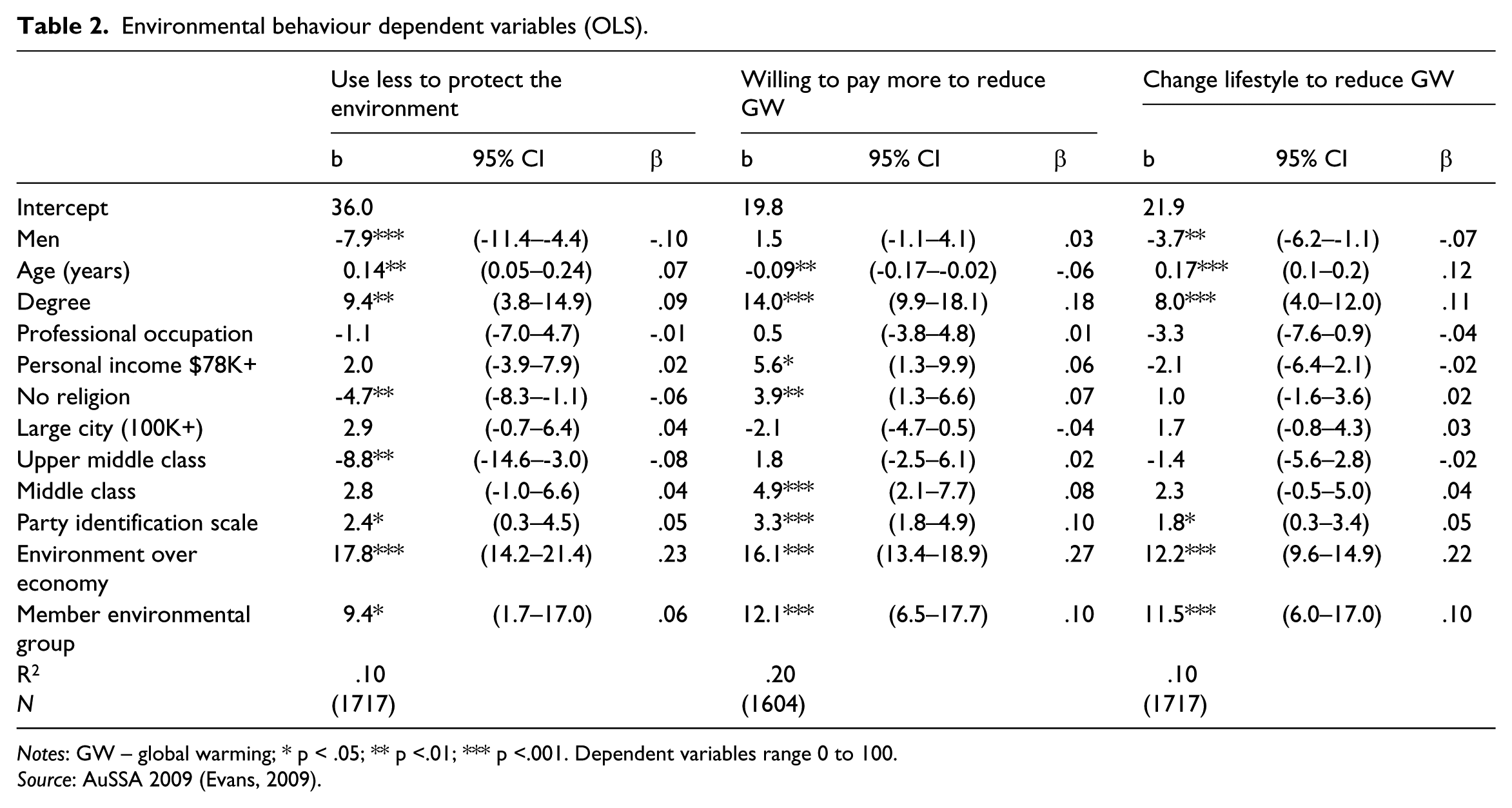
Several dependent variables are analysed below. Three dependent variables are constructed by combining three sets of related questions from the 2009 AuSSA. The first ‘use less’ dependent variable is a measure of consumption, constructed by adding responses to the three questions: ‘Do you personally … use less water; use less electricity; recycle more … now than you did 5 years ago because you are concerned about the environment?’ The second ‘willing to pay’ dependent variable measures willingness to pay more in order to reduce global warming. It is constructed by adding responses to the following three questions: ‘In order to reduce global warming, would you be willing to … Pay higher personal taxes; Pay more for electricity; Pay higher fuel prices?’ The third ‘change lifestyle’ dependent variable is a measure of the lifestyle changes respondents have made in order to reduce global warming. It adds responses to the following four questions: ‘Some claim that changing our lifestyles can reduce the impact of global warming. What aspects of your lifestyle have you changed to reduce your impact upon global warming? Drive car less, Recycle more, Consume less red meat, Reduce power consumption.’ These three composite dependent variables are modelled using ordinary least squares (OLS) regression, with non-standardized coefficients (b), 95 percent confidence intervals for the regression coefficients and standardized coefficients (β) presented in Table 2.
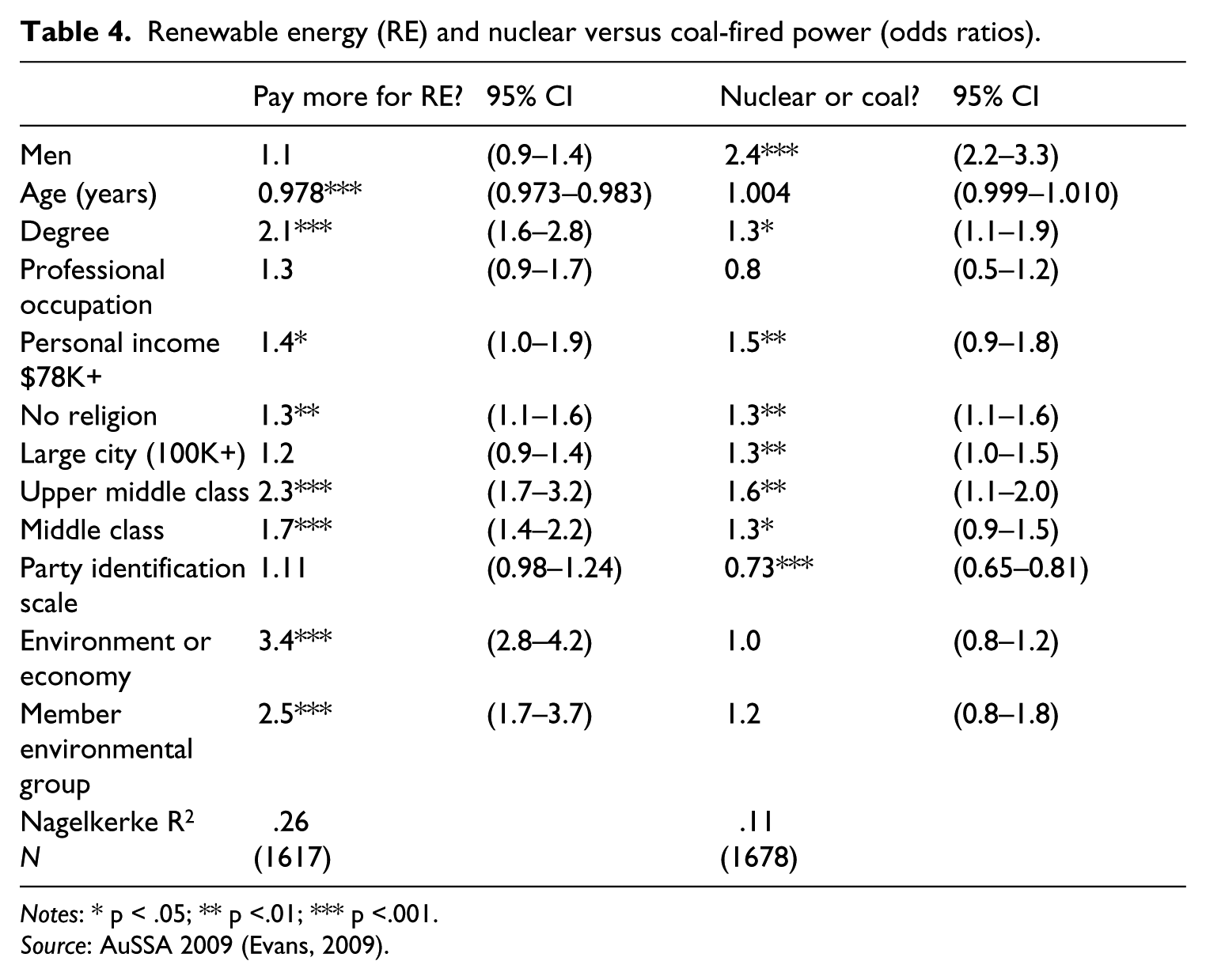
Also drawing upon AuSSA data, two ordinal dependent variables are analysed in Table 4 with ordinal logistic regression. The first is constructed from the question: ‘How much extra would you be prepared to pay on top of your existing energy bill for power generated from renewable sources?’ with responses classified as 0 percent, 1–5 percent, 6–10 percent, 11+ percent. The second variable models support for nuclear over coal-fired power and is derived from the question ‘If you had to choose between energy produced by coal-fired power or energy produced by nuclear power, which would you choose?’ (responses: Definitely coal, Probably coal, Not sure, Probably nuclear, Definitely nuclear).
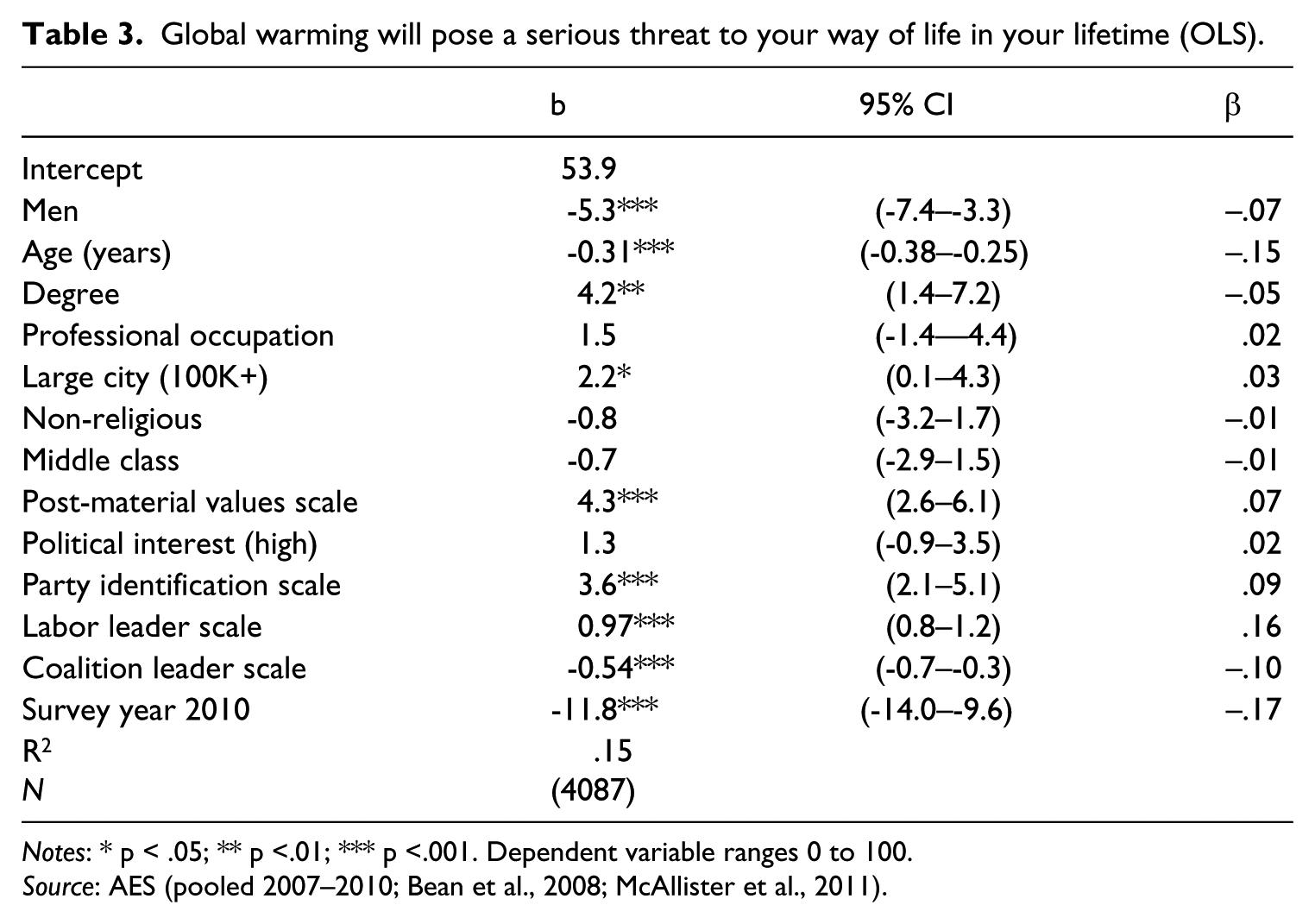
Using pooled data from the 2007 and 2010 AES (Tables 3 and 5), two dependent variables measure the perceived threat of global warming and voting for the Australian Greens in the Senate (1 = Green; 2 = other parties). While voting data for the Greens are available for almost all AES surveys since 1990, I restrict the analysis to 2007 and 2010 as these surveys both include the important question ‘Do you think that global warming will pose a serious threat to your way of life in your lifetime?’ The support base of the global warming dependent variable is modelled in Table 3, 3 while in Table 5 the global warming question is used as an independent variable to predict voting behaviour. As discussed below, the 2007 and 2010 AES surveys contain identical leader evaluation questions, allowing these data to be pooled, thereby increasing the sample size and maximizing the inferential qualities of the results.
Independent variables
Several independent variables in the regression models are dummy (1/0) variables, so are interpreted in relation to their respective reference categories (e.g. sex, tertiary education, income, location), although there are several exceptions. Inglehart’s (1997) post-materialist values are measured using the four questions that form his short values index in the AES, 4 although these values questions were unfortunately not included in the 2009 AuSSA. For the AuSSA data, one question serves as a proxy measure of the values index. Respondents were asked if ‘Protecting the environment should be given top priority even if it causes slower economic growth and some loss of jobs’ or ‘Economic growth and creating jobs should be given top priority, even if the environment suffers to some extent?’ Pro-environmental responses here approximate, to an extent, ‘post-materialist’ values and economic growth responses approximate ‘materialists’.
A scale is used to measure political partisanship (1 = Coalition; 2 = other or no party; 3 = Labor), and leader evaluation scales are included for Coalition and Labor leaders in the AES. 5 Two additive (composite) scales are constructed from multiple items designed to measure Labor and Coalition leader characteristics in the 2007 and 2010 AES (i.e. the leader is competent, compassionate, sensible, a strong leader, honest, knowledgeable, inspiring, trustworthy). 6 The leader scales are highly reliable (Alpha .93 for both scales). Descriptive statistics for all dependent and independent variables are presented in the Appendix.
Data are modelled with OLS regression 7 and binary and ordinal logistic regression in the multivariate models using SAS version 9.2. Logistic regression is preferred here when the dependent variables have either a binary or an ordinal structure, as it produces more accurate parameter estimates and statistical test results than techniques such as OLS (see Agresti and Finlay, 1997). Odds ratios are presented in the logistic tables to facilitate the interpretation of the logistic regression estimates along with 95 percent confidence intervals for all regression results.
Univariate results
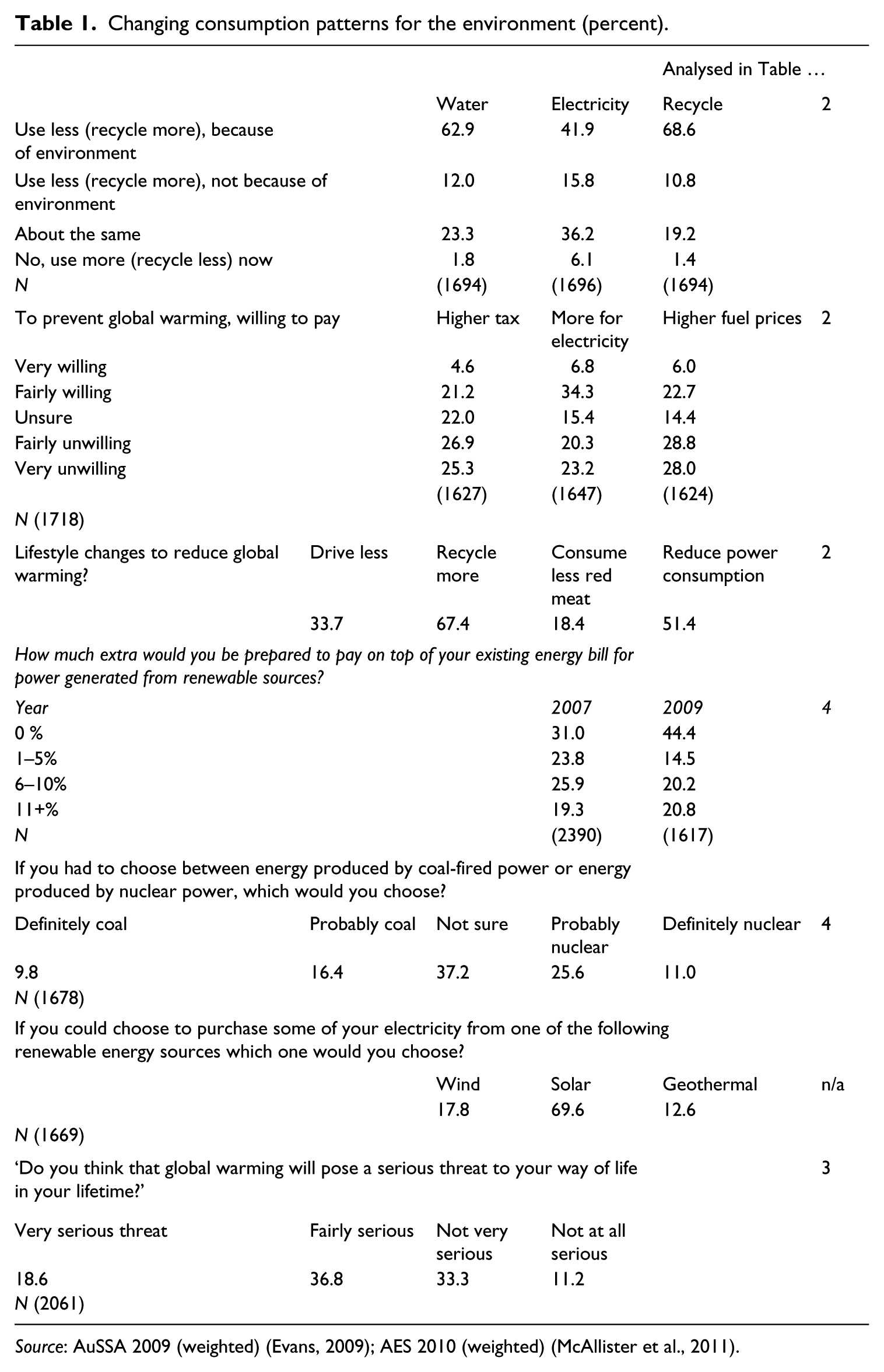
Percentage responses are presented for a range of attitudinal and behavioural variables from the AuSSA and AES (Table 1). The aim is to assess Australians’ willingness to address environmental concerns and change their consumption patterns in order to protect the environment and to ameliorate the impact of global warming.
Changing consumption patterns for the environment (percent).
Source: AuSSA 2009 (weighted) (Evans, 2009); AES 2010 (weighted) (McAllister et al., 2011).
When asked whether they have changed their consumption patterns in the last five years because of concerns about ‘the environment’, a clear majority claim to recycle more and to use less water, with 42 percent also using less electricity. These lifestyle responses comprise strong evidence of public responses to environmental problems, although in this instance, the focus is more broadly defined as ‘the environment’. Attitudinal questions that refer to willingness to pay for ‘environmental protection’ have also been considered previously (e.g. Ivanova and Tranter, 2008; Pietsch and McAllister, 2010). Related questions here are designed to focus more narrowly upon willingness to change behaviour in order to reduce global warming. A sizeable proportion (26 percent), claim to be willing or very willing to pay higher tax to reduce global warming, with 29 percent paying higher fuel prices. The response to the electricity question is even higher, with 41 percent stating they are willing to pay more. Australians were also asked how they had changed their lifestyles to reduce global warming, with 67 percent claiming to recycle more, 51 percent reducing their electricity consumption and around one-third driving less.
A question administered in both the 2007 and 2009 AuSSA asked how much extra people would pay for energy produced from renewable sources? After only two years there has been a significant shift on this issue, with the proportion unwilling to pay any extra for renewable energy rising from 31 percent to 44 percent. This may indicate an overall decline in the demand for renewable energy, perhaps in response to the global financial crisis. It could also reflect changing public opinion following the failure of the Copenhagen conference on climate change, while the end of the long drought in Australia may have alleviated some fears about the immediacy of climate change. A more optimistic interpretation is that the proportion of people paying extra money for renewable energy has increased between 2007 and 2009, and those already paying extra are unwilling to pay even more. Either way, a clear majority of Australians (70 percent) favour solar power over wind (18 percent) or geothermal power (13 percent).
However, most electricity in Australia is ‘dirty energy’, produced by coal-fired power stations, while alternative energy sources such as solar and wind power do not currently produce energy on a large scale (Department of Climate Change, 2009). One unpopular alternative is to harness Australia’s abundant uranium resources to produce power from nuclear energy. When pushed to make a choice between nuclear and coal, the nuclear option is favoured by 37 percent of respondents compared to coal at 26 percent, although more than one-third of respondents remain undecided. I now turn to the multivariate analyses in order to explore the support bases of Australian environmentalism, analysing a range of dependent variables with regression techniques.
Multivariate results
The results of ordinary least squares (Tables 2 and 3) and logistic regression analyses (Tables 4 and 5) describe the social and political bases of environmental attitudes and behaviour in a multivariate context. In Table 2, three dependent variables are examined. The first ‘use less’ dependent variable measures the extent that respondents use less water or electricity or recycle more than they did five years ago because of their environmental concerns. The second ‘willing to pay more’ dependent variable combines responses to three questions that measure willingness to pay higher taxes; willingness to pay higher prices for electricity; and willingness to pay higher fuel costs if such actions would reduce global warming. The third dependent variable measures the extent that respondents ‘change their lifestyle’ in order to reduce global warming (i.e. by driving less, recycling more, eating less red meat, consuming less power). In Tables 2 and 3, regression coefficients (b), 95 percent confidence intervals for the regression coefficients and standardized regression coefficients (β) are presented for these dependent variables that range from 0 to 100.
Environmental behaviour dependent variables (OLS).
Notes: GW – global warming; * p < .05; ** p <.01; *** p <.001. Dependent variables range 0 to 100.
Source: AuSSA 2009 (Evans, 2009).
Global warming will pose a serious threat to your way of life in your lifetime (OLS).
Notes: * p < .05; ** p <.01; *** p <.001. Dependent variable ranges 0 to 100.
Source: AES (pooled 2007–2010; Bean et al., 2008; McAllister et al., 2011).
Renewable energy (RE) and nuclear versus coal-fired power (odds ratios).
Notes: * p < .05; ** p <.01; *** p <.001.
Source: AuSSA 2009 (Evans, 2009).
Social and political bases of Green voting (odds ratios).
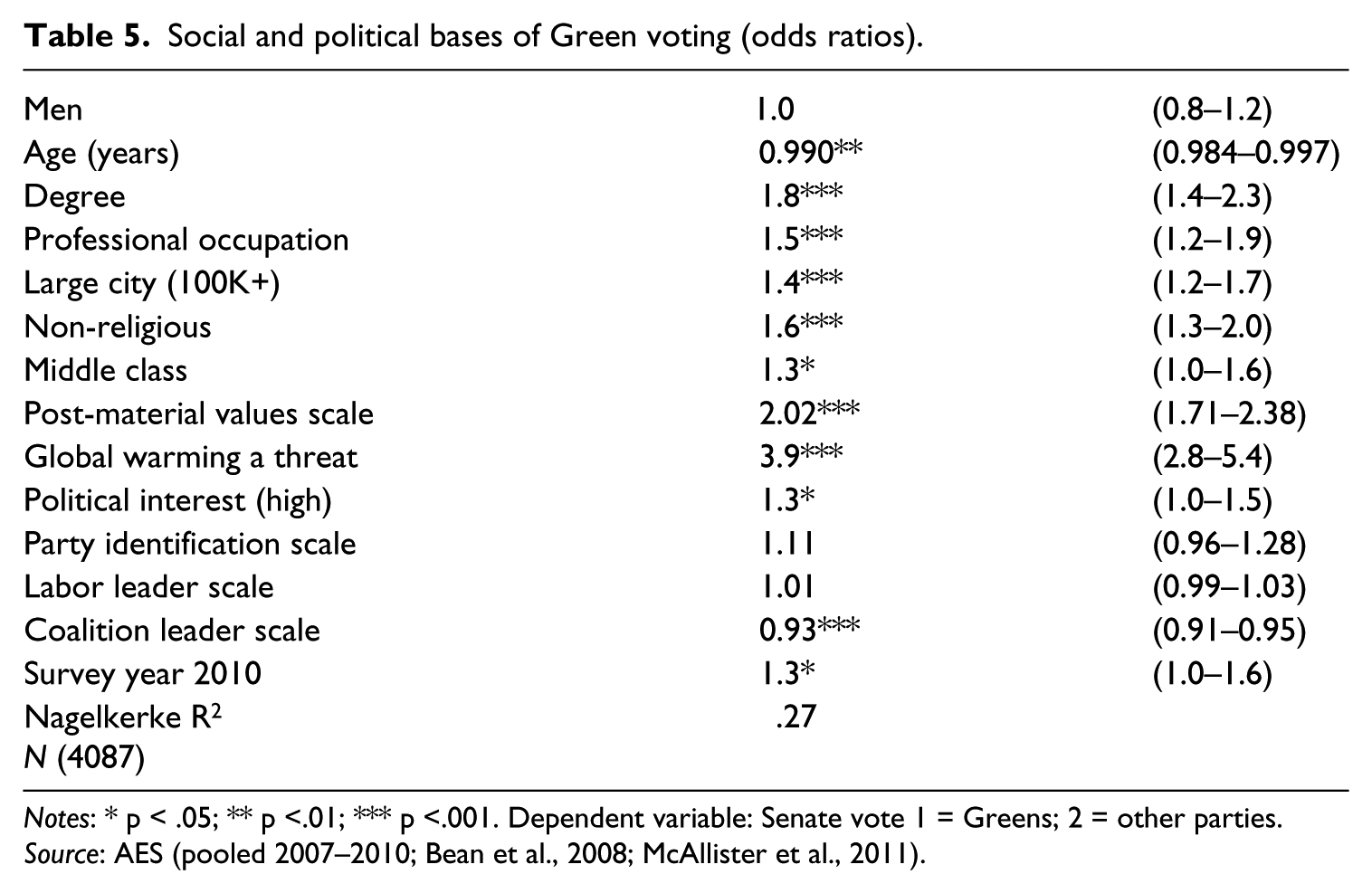
Notes: * p < .05; ** p <.01; *** p <.001. Dependent variable: Senate vote 1 = Greens; 2 = other parties.
Source: AES (pooled 2007–2010; Bean et al., 2008; McAllister et al., 2011).
Paying more and consuming less to reduce global warming
The OLS regression results indicate that women are more likely than men to have changed their consumption patterns for environmental reasons, scoring 8 points less than women on the ‘use less’ dependent variable and 4 points less on the ‘change lifestyle’ dependent variable (Table 2). The age results indicate that younger people are willing to pay extra in order to reduce global warming, but older people are more likely to have reduced their impact upon the environment and changed their lifestyle. Tertiary education is a consistent predictor of pro-environmental behaviour on all three dependent variables, as are environmental group membership and post-material values. For example, tertiary graduates score 14 points higher than non-graduates on the 0–100 willing to pay more measure. Other independent variables show less consistent results, although the self-assessed ‘upper middle class’ score 9 points lower than the working class reference category on the ‘use less’ dependent variable. Party identification also has an effect, with the positive results suggesting that Labor identifiers exhibit environmentally friendly responses to a greater extent than their Coalition counterparts, controlling for social background.
The threat of global warming
Using pooled AES data from the 2007 and 2010 surveys and OLS regression I examine attitudes toward global warming in Table 3. It is apparent that men are less concerned than women that global warming will pose a serious threat within their lifetime. However, younger people are far more concerned than older people. Higher education is associated with increased concerns, as is living in a large city, although these effects are relatively modest. Post-materialists score higher on the 0–100 dependent variable than materialists and Labor identifiers are more concerned than Coalition supporters. Controlling for other independent variables, positively evaluating the Labor leader is associated with greater concern over the risk of global warming, while the opposite pattern is apparent for the Coalition leader. This indicates, that even controlling for social background and political partisanship, major party leaders appear to shape voter attitudes on environmental issues.
Renewable energy: nuclear or coal-fired power?
Odds ratios (OR) from logistic regression models are presented in Tables 4 and 5. 8 The results suggest that having a tertiary education (OR 2.1) increases the likelihood of paying extra for renewable energy by 2.1 times compared to non-graduates. Controlling for income and other factors, younger people are more willing to pay than older people (OR 0.978), while upper middle (OR 2.3) and middle-class identifiers (OR 1.7) are more likely than working-class people to say they would pay extra for power from renewable sources. Not surprisingly, prioritizing the environment over the economy increases the propensity to pay extra for renewable energy (OR 3.4), with environmental group members are approximately 2.5 times (OR 2.5) more willing to pay than non-members.
The results for the second dependent variable in Table 4 suggest that controlling for age, education, occupation, class and other social and political background effects, men (OR 2.4) are more than twice as likely as women to favour nuclear over coal-fired power! Further, the tertiary educated (OR 1.3) along with those on higher incomes (OR 1.5), the non-religious (OR 1.3), city dwellers (OR 1.3) and the self-identified middle classes all favour the nuclear option over coal. A political divide is also apparent here, with the OR of less than 1 (0.73) for party identification indicating that Coalition partisans are more likely than Labor identifiers to favour nuclear energy. There is a weak tendency for environmental group members to favour the nuclear option, although this result is not significant at the 95 percent level. However, other analyses (not shown here) indicate that female environmental group members are 1.7 times more likely than female non-members to favour nuclear over coal-fired power controlling for age (p < .05), 9 although when education is controlled this effect is no longer significant at the 95 percent level. It seems that the nuclear versus coal question poses a dilemma for many people, particularly for women.
Green voting and the influence of political leaders
A strong behavioural indicator – voting for the Australian Greens in the Senate – is examined in Table 5. No gender differences are apparent on this dependent variable. However, younger people, the tertiary educated, professionals, city dwellers, the non-religious and the self-assessed middle class are likely to vote Green in the federal upper house, while post-materialists are more supportive than materialists, as Inglehart and Welzel (2005) predict. Not unexpectedly, believing that global warming will pose a serious threat within one’s lifetime substantially boosts the Green vote. Even when all other independent variables are held constant, those who view global warming as a threat (OR 3.9) are four times more likely than the non-threatened to vote Green in the Senate.
High political interest is associated with Green voting, although the party identification independent variable is not significant at the 95 percent level. Positive evaluations of the Labor leader do not increase the likelihood of voting Green, controlling for other factors. However, those who evaluate Coalition leaders in a positive way are far less likely to vote Green in the Senate (OR 0.93), even after controlling for their political party affiliation, social background, value orientations and attitudes toward global warming. These findings suggests that the leaders of major political parties not only influence their own partisans, but may also, to an extent, structure minor party voting patterns in Australia.
Discussion
‘The environment’ is now a mainstream political issue in Australia, although a shift in issue priorities has occurred with the institutionalization of the environmental movement and routinization of environmental concerns (see Pakulski et al., 1998; Rootes, 2004). Pollution was the most urgent environmental issue in 1990, ahead of soil degradation and the greenhouse effect (Bean et al., 1990). Two decades later, human-induced climate change is the environmental issue. Yet public support for taking action to address this emotive and divisive issue actually declined between 2006 and 2010 (Hanson, 2010). This is at least partly because, as Tanner (2011) has argued, contemporary mass media tend to trivialize and sensationalize important social and political issues. Elements of the mass media have certainly provided a platform for climate-change sceptics, who have enjoyed considerable coverage in recent years, even in the face of the overwhelming peer-reviewed evidence presented by climate scientists (Anderegg et al., 2010; IPCC, 2007).
This research provides empirical evidence of the social and political bases of environmentalism in Australia. Confirming earlier studies (e.g. Rootes, 1995; Tranter, 1997, 2010), tertiary education is a consistent predictor of pro-environmental attitudes, and, even more importantly, of environmental behaviours. Graduates are more willing to pay higher taxes, more for electricity and higher fuel prices in order to reduce the effects of global warming. They also claim to have reduced their consumption of water and electricity and to be recycling more than they did five years ago, and are more likely than non-graduates to vote for the Greens. With the proportion of tertiary educated Australians increasing, the environmental movement appears to have a relatively secure support base. 10
This research also supports aspects of Inglehart’s value change thesis. Highly educated post-materialists are claimed to support ‘left libertarian’ parties such as the Greens in Europe (e.g. Müller-Rommel, 1990). Consistent with previous Australian (e.g. Tranter, 1996, 2010; Tranter and Western, 2009; Western and Tranter, 2001) and other studies (e.g. Inglehart, 1990, 1997; Inglehart and Welzel, 2005), this study shows that post-materialists are more likely than materialists to be concerned about global warming and to vote for environmental parties. These politically interested and engaged citizens – the ‘cognitively mobilized’ as Inglehart (1997) calls them – form another important pillar of the environmental movement, and fill leadership roles in environmental organizations and Green parties in advanced industrial democracies (Dalton, 1994).
Social class may have weakened as a determinant of voting (Pakulski and Waters, 1996), as has political party identification (e.g. Dalton et al., 1984), although this research demonstrates that they are both still important correlates of environmentalism. Yet, as in the United States (Dunlap and McCright, 2008), there is a partisan divide in Australia over the prioritization of environmental issues and commitment to action on climate change (Tranter, 2011), with Coalition identifiers broadly against and Greens and Labor supporters in favour. 11 Increasingly sceptical mass media attacks on the validity of climate-change science (including rampaging shock-jocks), have fuelled doubts that climate change is human-induced. Such doubts continue to be exploited by conservative political leaders in Australia, who in turn influence environmental attitudes and behaviour. 12
Serious attempts to alleviate global warming require substantial reductions in emissions from fossil fuel consumption. While many environmentalists advocate major reductions in consumption as a viable means of reducing greenhouse emissions, pursuing such an approach would be politically problematic and unlikely to be supported by major political parties in the short to medium term. As this research shows, support for renewable energy, particularly solar power, is high. However, questions remain over the best way to generate power on a large scale, in a geo-political milieu where the issue of carbon emissions remains critical.
The nuclear disaster in 2011 at the Fukushima Daiichi nuclear power plant in Japan is likely to have further alienated public opinion on the issue of nuclear power and slowed the expansion plans of the nuclear industry in many countries. Prior to Fukushima, when the data analysed in this research were collected, a political divide was apparent over this issue in Australia. Liberal Prime Minister John Howard commissioned a ‘nuclear taskforce’ to consider the option of increasing nuclear power production (Macintosh, 2007) and, although uranium mining and nuclear power remain highly sensitive issues that most politicians wish to avoid, Coalition partisans clearly favoured nuclear over coal-fired power when the AuSSA data were collected in 2009. 13 Substantial gender-based differences are apparent over this issue, with men much more likely than women to favour nuclear energy over coal-fired power, perhaps reflecting their greater confidence in ‘science’ and the technological ‘fix’ for solving problems such as the disposal of nuclear waste.
How high the risks associated with contemporary, state-of-the-art nuclear power plants actually are, is open to debate. Placing such potential risks (and risk perceptions) to one side, nuclear energy is a far ‘cleaner’ option in terms of greenhouse emissions than coal or gas (Sovacool, 2008), with carbon-fired power the largest single contributor of greenhouse gas emissions in Australia (Department of Climate Change, 2009). In the absence of major lifestyle changes, and with existing alternative energy technology far from capable of generating energy on a large enough scale to seriously supplement coal-fired power, a rethink on the option of nuclear power may well be necessary in the near future. If (when?) this occurs, we might expect similar histrionic media coverage, and attacks upon the credibility of the scientific community to those currently raging over the issue of climate change.
Footnotes
Appendix: Descriptive statistics
| Data source | AuSSA |
AES |
|||
|---|---|---|---|---|---|
| Mean | Std | Mean | Std | Range | |
| Dependent variables | |||||
| Use less | 60.0 | 37.4 | – | – | 0–100 |
| Pay more for environment | 41.9 | 29.7 | – | – | 0–100 |
| Change lifestyle | 44.8 | 27.7 | – | – | 0–100 |
| Global warming a threat | – | – | 57.90 | 35.57 | 0–100 |
| Pay more for renewable | 4.44 | 1.68 | – | – | 1–6 |
| Nuclear or Coal | 2.87 | 1.13 | – | – | 1–5 |
| Green vote in Senate | – | – | 1.86 | 0.35 | 1–2 |
| Independent variables | |||||
| Men | 0.45 | 0.50 | 0.46 | 0.50 | 0/1 |
| Age (years) | 51.31 | 16.88 | 54.49 | 16.32 | 18–94; 18–100 |
| Degree | 0.26 | 0.44 | 0.23 | 0.42 | 0/1 |
| Professional occupation | 0.21 | 0.41 | 0.21 | 0.41 | 0/1 |
| Income ($78K+) | 0.15 | 0.36 | – | – | 0/1 |
| Large city (100K+) | 0.59 | 0.50 | 0.54 | 0.49 | 0/1 |
| Non-religious | 0.42 | 0.50 | 0.23 | 0.42 | 0/1 |
| Upper middle class | 0.15 | 0.36 | – | – | 0/1 |
| Middle class | 0.47 | 0.50 | 0.50 | 0.50 | 0/1 |
| Post-material values scale | – | – | 1.84 | 0.60 | 1–3 |
| Global warming a threat | – | – | 0.58 | 0.36 | 0–1 |
| Political interest (high) | – | – | 0.39 | 0.49 | 0/1 |
| Party identification scale | 1.98 | 0.83 | 1.98 | 0.88 | 1–3 |
| Labor leader scale | – | – | 5.59 | 3.01 | 0–10 |
| Coalition leader scale | – | – | 4.78 | 3.30 | 0–10 |
| Environment or economy | 0.65 | 0.48 | – | – | 0/1 |
| Environmental group member | 0.08 | 0.27 | – | – | 0/1 |
| Survey year 2010 | – | – | 0.54 | 0.50 | 0/1 |
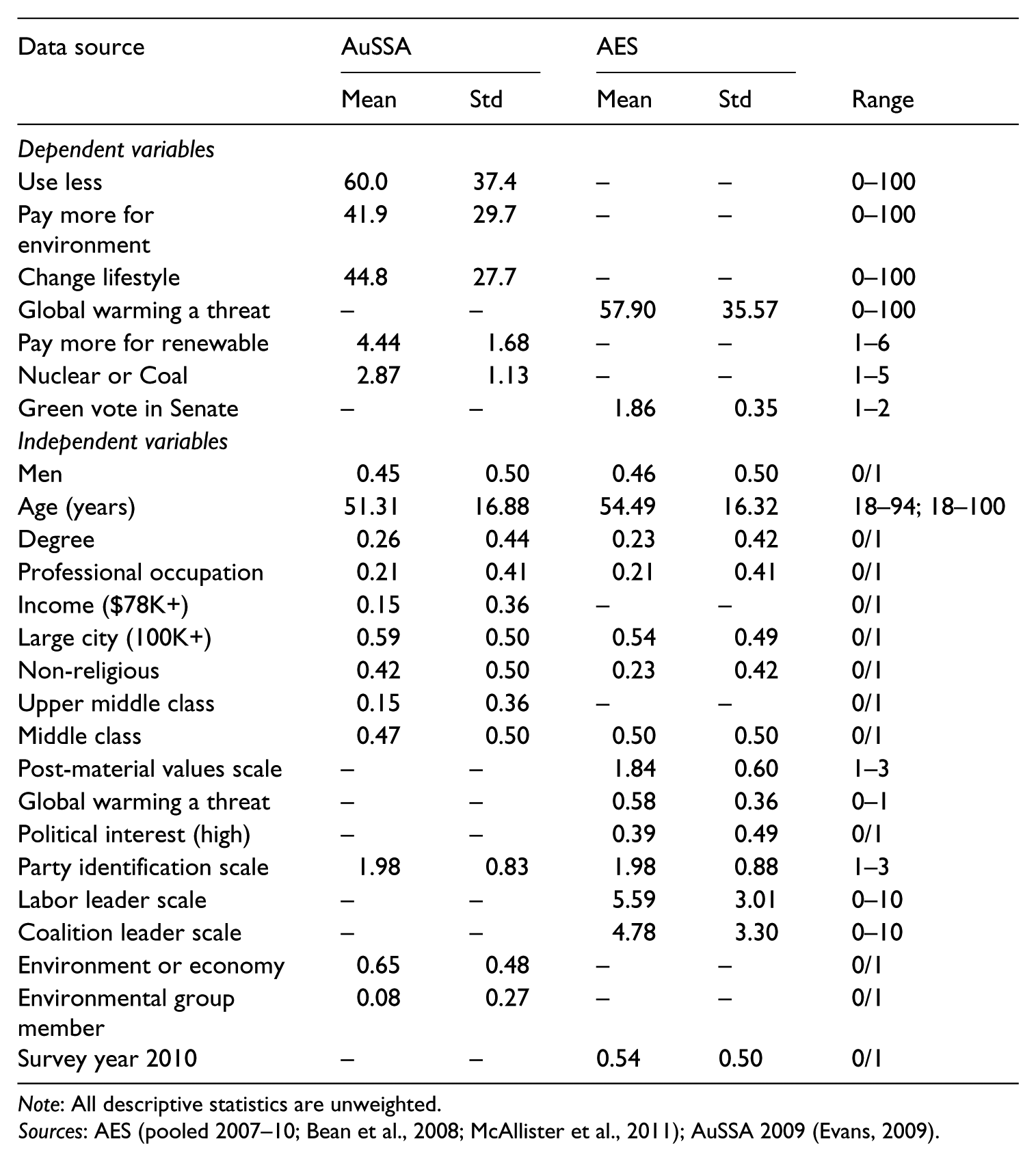
Note: All descriptive statistics are unweighted.
Sources: AES (pooled 2007–10; Bean et al., 2008; McAllister et al., 2011); AuSSA 2009 (Evans, 2009).