




Abstract
This article discusses the process of adjustment for repatriates into their country of origin and considers their ethno-lingual identification. This article also presents the results of a sociolinguistic survey among Kazakh repatriates, in particular the questions connected with the influence of language on the process of ethno-lingual identification and the role of language competence in readapting to the country of origin.
Keywords
Ethnic migration in the Republic of Kazakhstan: statistical data
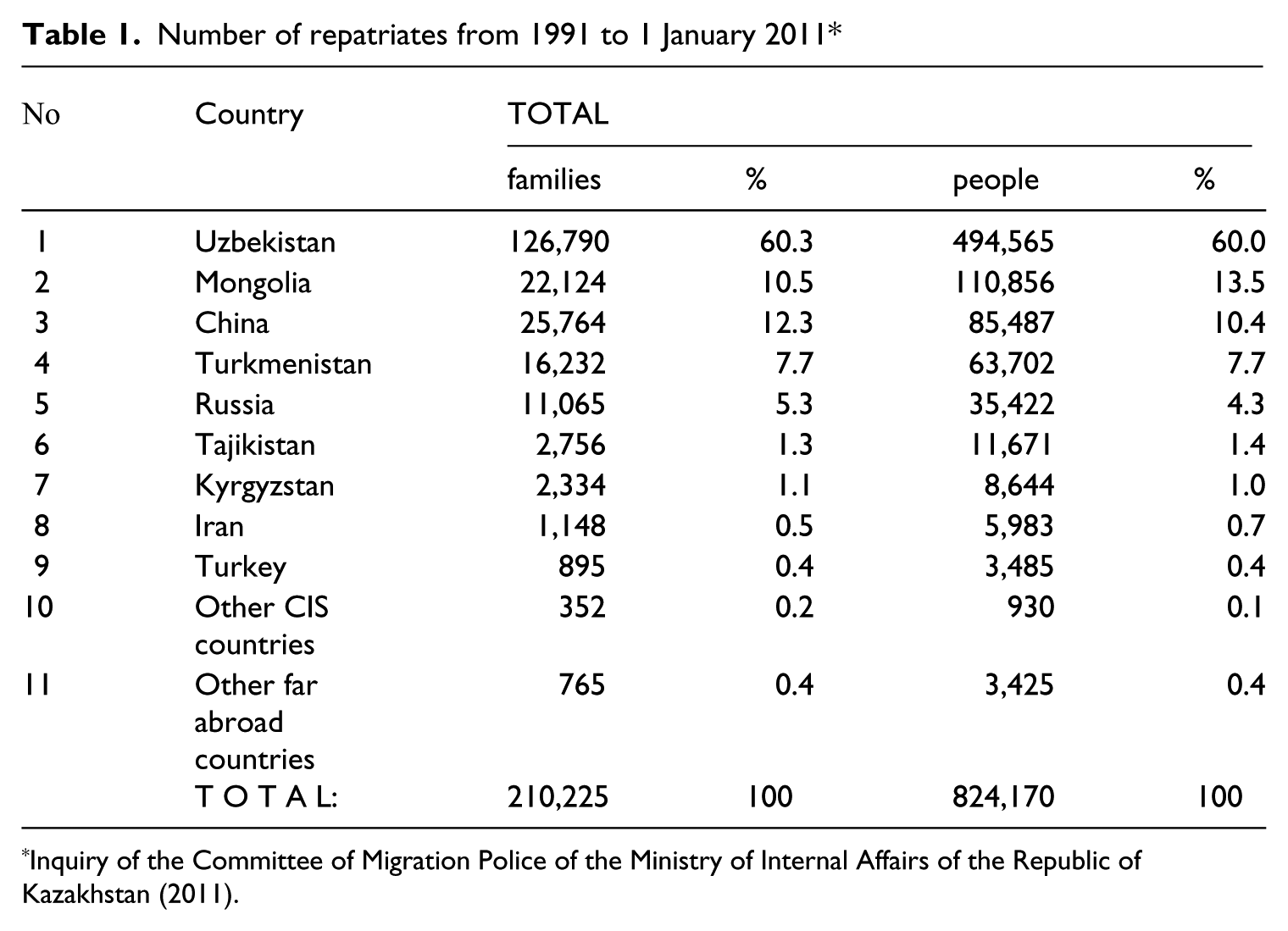
The Republic of Kazakhstan became independent in 1991 and began repatriating ethnic Kazakhs. According to official documents, since independence the Republic of Kazakhstan has become home to 824,170 ethnic Kazakhs (Inquiry of the Committee of Migration Police of the Ministry of Internal Affairs of the Republic of Kazakhstan #14, 2011); the immigrants are mainly from Uzbekistan, China, and Mongolia (see Table 1).
Number of repatriates from 1991 to 1 January 2011*
Official documents describe these immigrants as ‘oralmans’, which translated from Kazakh means ‘people that returned’ or ‘returnees’. According to Kazakh law, oralmans are defined as ‘foreigners or individuals without citizenship or Kazakh nationality who, when Kazakhstan obtained its independence, resided abroad and who came to Kazakhstan seeking a permanent residence’ (Law of the Republic of Kazakhstan ‘On Migration of Population’, 1997).
The majority of oralmans come from the countries in the Kazakh diaspora: Uzbekistan (126,790 families or 494,565 people), China (25,764 families or 85,487 people), Mongolia (22,124 families or 110,856 people), Turkmenistan (16,232 families), Russia (11,065 families), and Tajikistan (2,756 families) (Table 1).
On the whole, since independence the number of repatriates in Kazakhstan has increased significantly, and as a result, oralmans have become not only ‘an influential force’ in a multi-national country, but also contributors to social development. Repatriates play a significant role in the political, economic and cultural development of the country. The issues surrounding the adjustment of repatriates to their new lives and their integration into Kazakh society are of great interest .
Methods of research
To analyse the ethno-lingual identification of repatriates, this study has used a number of sociological research methods, including polls, in-depth interviews, observation and ‘ethno-autobiography’.
The authors administered a questionnaire which included 282 questions and touched upon the following topics: social-demographic characteristics; attitude toward the Kazakh and Russian languages; choice of language in various situations and frequency of its use; opinions about the necessity of proficiency in the Kazakh and Russian languages; level of proficiency in languages; social contacts; and some additional topics.
The survey was administered between January 2009 and December 2010, and 1000 people between the ages of 16 and 60 responded. The poll involved repatriates to Kazakhstan from China, Mongolia, Uzbekistan, Tajikistan, Turkmenistan and Russia. The authors randomly selected and surveyed 600 oralmans from Uzbekistan, 135 from Mongolia, 104 from China, 77 from Turkmenistan, 53 from Russia, and 31 form Tajikistan. The authors also conducted in-depth interviews with an additional 65 respondents.
The researchers also used methods that considered the life of small primary and secondary groups in which personality, models of social identification and the basis of ethnic identification arise. Urazaliyeva, for example, constructed the term ‘ethno-autobiography’ and used this construction as a method to analyse students’ formation of ethno-lingual identification. The students were asked to write a composition answering the question ‘Who am I?’ (I am a Kazakh,Tatar, Russian, Ukrainian, Jew, Chechen, etc.) and ‘What does it mean to me? This technique allowed the researchers to understand the formation of an ethnic identification of personality in a unique age group described as ‘children of perestroika’ in Russian and Kazakh society (Urazaliyeva).
It was important to follow up on repatriates’ language identification, the linguistic factors that influence the successful adjustment of repatriates, and analyse informants’ attitudes toward language; 130 repatriates from age 16 to 60 took part in this follow up.
The results of sociolinguistic research
Responses to the questionnaire showed that one of the main reasons that oralmans chose to repatriate to Kazahkstan was that they were Kazakhs (38%). This can be clearly seen in their autobiographical texts: My name is Nazerke. I was born in China. I moved to Kazakhstan in 2007. My parents decided to stay in China. I am a Kazakh, and therefore I came back to my homeland … The first time I came to my homeland was 27 October 2011. From the first days I have been really very happy because I am a Kazakh and I was given the beautiful Kazakh name Meruert … ‘I am a Kazakh dying and surviving a thousand times’ – as our poet writes. So am I – I am a Kazakh, I have Kazakh blood, therefore I came back to my homeland … As our ancestors said: ‘It is better to be an ordinary person in the Motherland than to be a sultan outland.’ My name is Kokuly Esenkeldy. I was born in 1991 in the Bayan-Ulgi region in Mongolia. Having gotten an education I returned to my Motherland … I am a repatriate from China. When asked why I returned to Kazakhstan I was, of course, feeling patriotic in my heart. It is natural that citizens living in other countries should come back to their Motherland. Kazakh people should live and grow up in Kazakhstan, on the Kazakh land. Home for Kazakhs is not China, not Mongolia. It is land conquered by our ancestors …
The respondents also highlighted family circumstances (38%), which included getting accessible and quality education; searching out a better life; and a wish to be closer to relatives who lived in Kazakhstan (Figure 1).
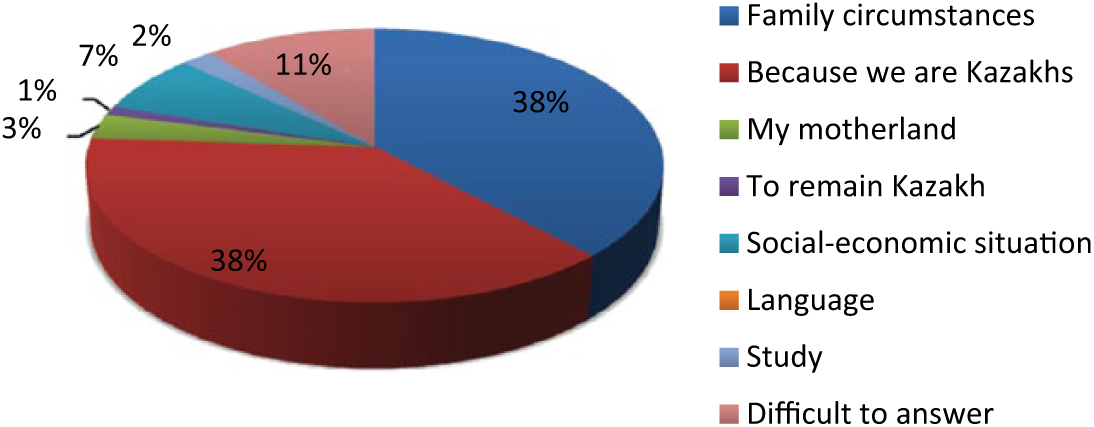
Reasons for moving to Kazakhstan
Ethnic and language identification in correlation with the repatriates’ native language
In the survey questions on defining national identity, repatriates single out proficiency in the native language (96%), cultural traditions (90%), religion (72%) and psychological recognition of oneself as a representative of one or another nationality (mentality, behaviour, culture, etc.). But not all repatriates think that residence and the ability to cook national dishes influence an individual’s national identification (Figure 2).
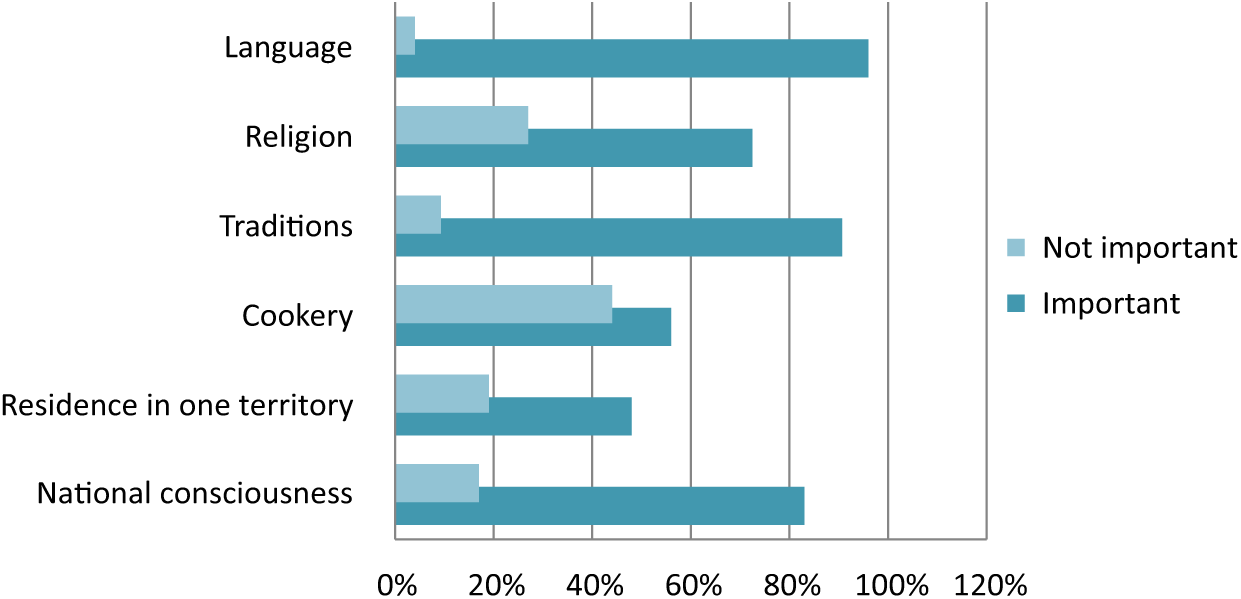
What is important in defining national identity?
An essential element here is the fact that for repatriates, the formation of ethnic identity comprises a few important elements and the most important and meaningful among them is linguistic identification. The results of the survey showed in fact quite a homogeneous or uniform relation between nationality as an attribute of personal and ethnic identification and native language as the basic, mandatory attribute of linguistic identification.
Responses to the questionnaires showed that 96% of respondents considered Kazakh as their mother tongue, 0.7 % Russian, 0.7% Tajik and 2.6% answered that they had two native languages – Kazakh and Russian as well as Kazakh and Tajik (Figure 3). Therefore, for the group of respondents who considered Kazakh as their mother tongue, the notion of ‘mother tongue’ did not have any ambiguity or uncertainty. For them language is inseparably connected with the ethnos/nation. It means that lingual identification stems from an ethnic identification. The Kazakh-speaking group of respondents revealed a high level of mono-linguistic ethnic identification. Some respondents still had certain difficulties concerning identification: whether they should consider their mother tongue as the language of the nationality of their mothers or fathers, whether they should identify themselves as a dominant cultural group, and whose cultural values they shared. In this (Russian-speaking and Tajik-speaking) environment, linguistic identity, which is chosen or acquired by an individual repatriate, may coincide or not with ethnic identity.
My father is a Kazakh and my mother is an Iranian.… At the moment I consider Kazakh as my mother tongue.… Though at the same time I understand only southern Kazakh, which is very similar to Uzbek.… I speak Russian, Uzbek, and understand Kazakh.… I would rather say that I have two mother tongues.… First of all, it is Russian, because I attended a Russian-speaking kindergarten and was in a Russian-speaking school.… And as we moved to my historical Motherland then Kazakh is also my mother tongue now.… As me and my family now live here we try to learn the language … (Akmal, aged 59, moved to Kazakhstan in 2009 from Uzbekistan)
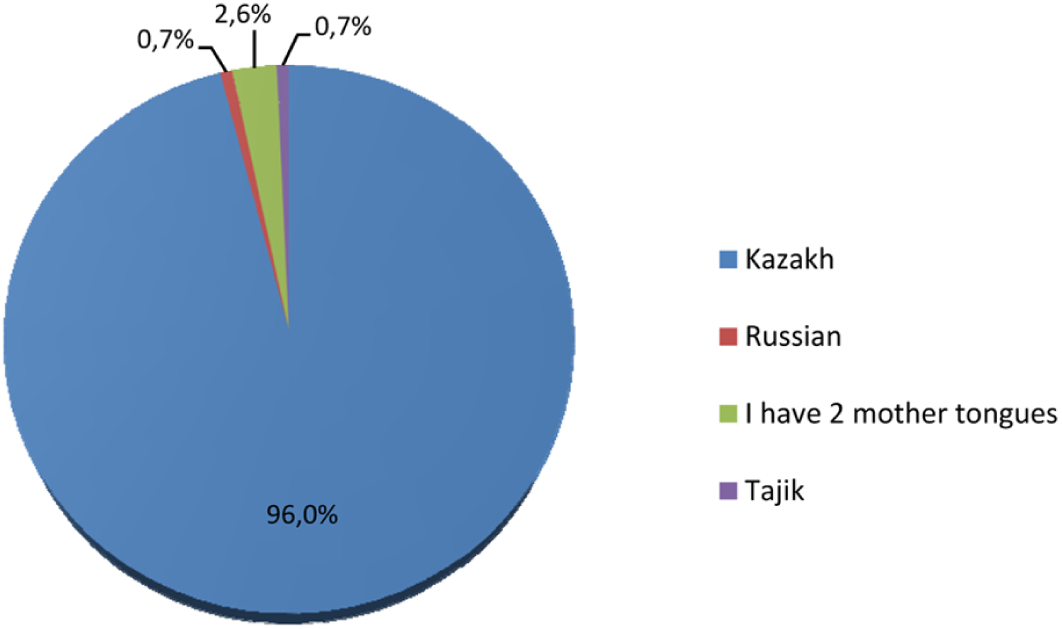
Repatriates’ identification of their mother tongue
It is evident that answers to the questions concerning one’s mother tongue cannot provide us with a true picture of repatriates’ language proficiency. These answers again show language as a factor that unites a people and demonstrates the level of self-awareness of an ethnic group. M.N. Guboglo emphasized in his work that the notion ‘mother tongue’ should be referred to as a psychological category that indicates belonging to a certain nation or nationality (1984: 263). This approach gives us an opportunity to study it in two ways: first, as a relatively independent ethnic determiner and, second, as a component of ethnic self-consciousness or, even more globally, of ethnic consciousness.
The influence of bilingualism on the process of integration of repatriates in Kazakhstan
The process of successful repatriation into Kazakh society is undoubtedly dependent upon a great number of factors. The most important factor, and the one that will be expanded on, is the current linguistic situation in Kazakhstan. Contemporary linguists characterize the language situation in post-Soviet Kazakhstan as exoglossic, unbalanced, diglossic and demographically unbalanced (Suleymenova et al., 2007). Its main feature is that there is a peculiar language situation in a country that is traditionally characterized in linguistics as bilingualism.
Bilingualism is an extremely complex phenomenon that requires interdisciplinary study. Though in everyday speech the word ‘bilingual’ usually refers to a person who knows two languages equally well, in most cases a bilingual is characterized by the fact that one of the native languages usually appears to be the main one. But competence in a second language is very wide: from basic knowledge to full and free competence.
The linguistic situation in Kazakhstan originally emerged from the functioning of Kazakh–Russian, National language–Kazakh, and National language–Russian bilingualism caused by the historical domination of Russian and the integration of the Russian–Kazakh–National language trilingualism and dominant Russian. It is significant to note that Kazakhstan covers a varied geographical landscape that results in many regional linguistic situations. It is connected first of all with the nature of bilingualism, both Russian–Kazakh and/or Kazakh–Russian.
This, in turn, determines domination of Kazakh–National language and National language–Kazakh (for example, Kazakh–Uigur or Uigur–Kazakh) or National language–Russian and Russian–National language (likewise, Russian–Uigur or Uigur–Russian) bilingualism in different regions. Bilinguilism is a positive phenomenon: it enriches the lingual picture of a bilingual’s world and widens a person’s verbal repertory. However, the balance between the Kazakh and Russian languages in the process of historical development was broken.
According to the Constitution of the Republic of Kazakhstan, the state language is Kazakh and this is confirmed in the law ‘About Languages in the Republic of Kazakhstan’ (Article 4) (Constitution of the Republic of Kazakhstan, 1995). In implementing language policy, the state intended to create conditions for making the Kazakh language the state language in all spheres of public life. According to official state documents (Constitution of the Republic of Kazakhstan, the Concept of Language Policy of the Republic of Kazakhstan, etc.), administration of state and public bodies and organizations, office work, judicial proceedings, the activities of diplomatic missions, official correspondence and communication, development of culture, teaching in the system of higher and secondary education, the media, etc., are carried out in the state language. Consequently, the Kazakh language is a strong language in both demographic and functional respects. There is a growing understanding by the non-Kazakh population of the necessity for and importance of proficiency in the state language (which increases their ability to succeed and work in public administration and government). All the work that is directed towards the implementation of the constitutional status of the Kazakh language is accompanied by measures to create conditions for the development of other languages rather than displacing any of them from particular language areas of the country or their role in providing information.
The Russian language plays an important role in Kazakh society. The influence of Russian-speaking culture is conditioned by a wide political, economic, cultural and scientific space. As a result, the Russian language has become not only a means and method of getting new knowledge, but also an incentive for intralingual development. Thus, Russian remains the language that is spoken by the majority of the population. Proficiency in Russian is connected not so much with its communicative function as a means of getting information and communication but with its broadcasting function. Under the influence of Russian, word meanings in the Kazakh language have evolved and changed, and the lexis of the Kazakh language is constantly developing and being enriched by means of morphological, syntactic, and semantic word-formation. However, there is not any strong influence on the national specifics of the Kazakh language – borrowings are made in accordance with the phonetic and morphological norms of the Kazakh language, so its development is carried out by its own internal rules. In certain regions of the Republic the Russian language is used more widely than is Kazakh.
Consequently, the integration of ethnic Kazakhs into a new society inevitably leads to contact of the two languages: Kazakh and Russian. The nature of resettlement of ethnic Kazakhs is compactly diffusive. Repatriates most densely reside in the regions of East Kazakhstan, South Kazakhstan, Karaganda, North Kazakhstan, Akmola, Pavlodar and Almaty. The resettlement of repatriates is compactly dispersed and ethnic Kazakhs have close contacts with representatives of other ethnic groups. Kazakh–Russian /Russian–Kazakh bilingualism is widespread.
The immigration of ethnic Kazakhs to Kazakhstan introduces the problem of learning a second language, the acquisition of which directly depends on different extra-linguistic factors (the method of language acquisition; social, professional, and demographic belonging of a bilingual; his/her educational level; the influence of the ethnic environment, etc.). Therefore, for many repatriates, proficiency in Russian is a critical part of the adjustment and integration processes. It is extremely difficult for repatriates from China, Mongolia and Tajikistan in the northern part of the Republic, where Russian is the dominant. The result is predictable conflict: repatriates are estranged by the larger society and create localized communities with a solitary world-view rather than communicating actively with the local population to adjust to new standards. When asked whether they experienced difficulties based on lack of knowledge of the Kazakh or Russian language, roughly one-third of respondents pointed out challenges with the Kazakh language and slightly more than one-third mentioned Russian (Figure 4).

Did you have any difficulties because of ignorance of the Kazakh or Russian languages?
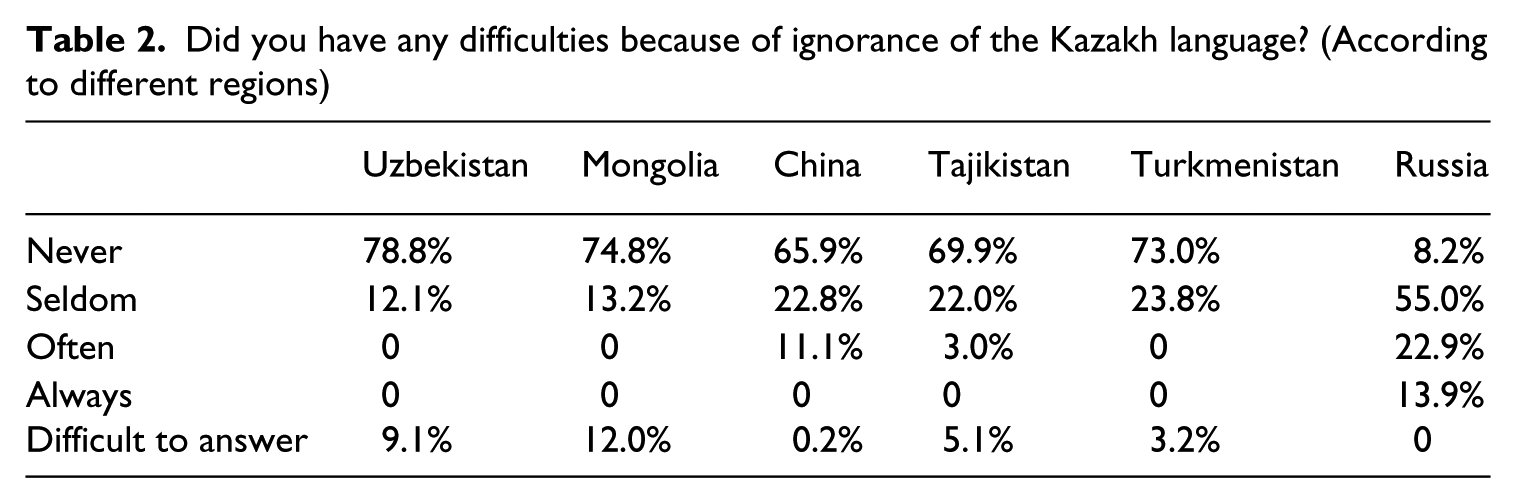
At the same time, repatriates from Uzbekistan (79%), Mongolia (75%), China (66%), Tajikistan (70%) and Turkmenistan (73%) didn’t face any difficulties because of the lack of knowledge of the Kazakh language (Table 2). We assume that for this category of respondents the problems mainly appeared with the written form of the Kazakh language. It is more difficult for repatriates from Russia: nearly one-third of them have problems.
Did you have any difficulties because of ignorance of the Kazakh language? (According to different regions)
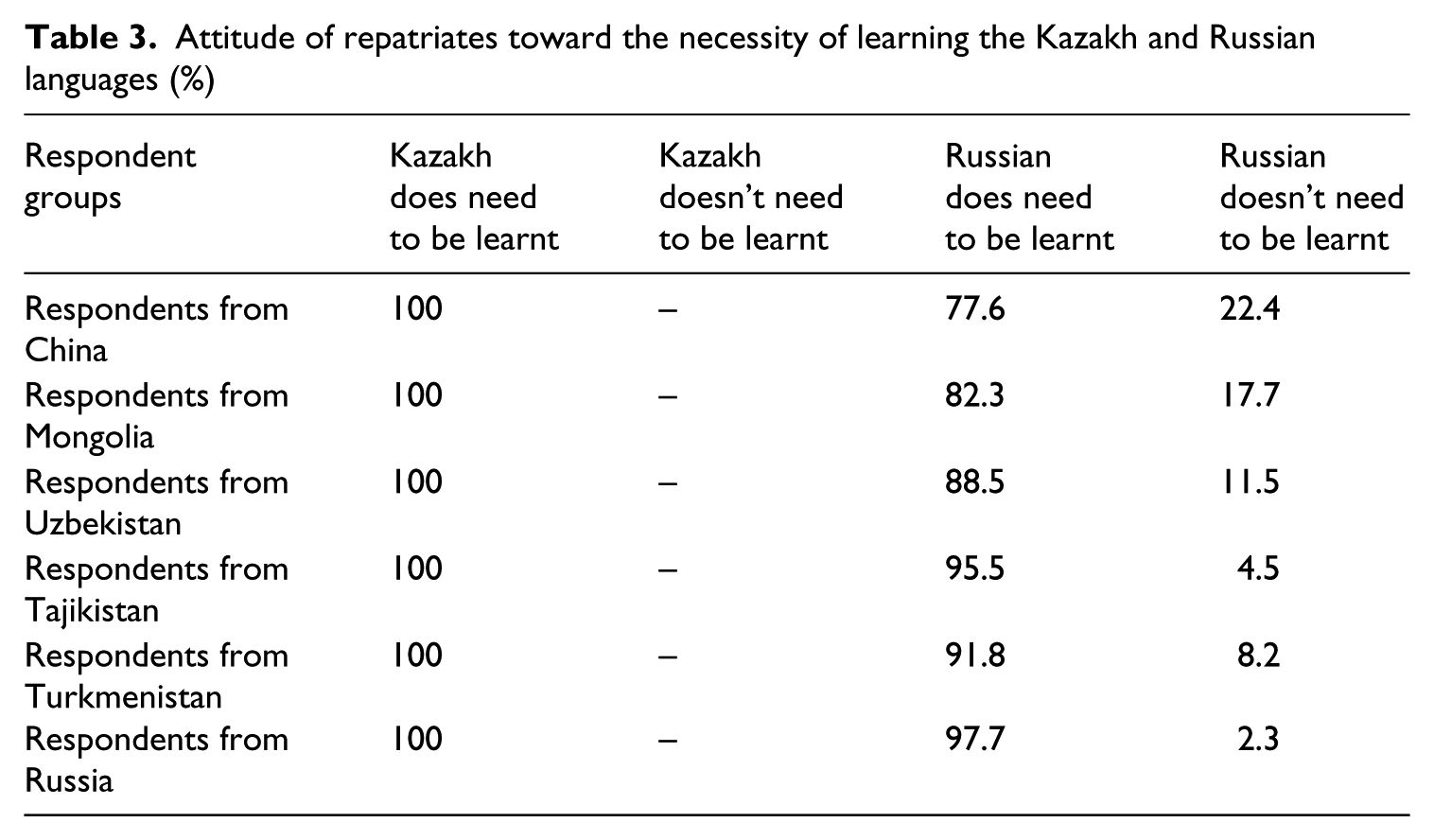
Attitude toward language/languages is one of the most significant indicators of lingual identities.The authors asked respondents about their attitudes toward the necessity of studying Russian and Kazakh.
Table 3 indicates what repatriates think of the necessity of studying Kazakh or Russian. The data show that respondents realize the necessity of learning the language, regardless of the country they have come from and their level of language proficiency, thus showing a high level of ethnic and language self-awareness. Assessing the Kazakh language, the respondents allocate such characteristics of the Kazakh language as valuable (98%), important (97%), ease (95%) and usefulness (97%). Thus, the fact that the Kazakh language is easy to study according to repatriates from Uzbekistan, Mongolia and Turkmenistan is evidently explained by the similarity of languages belonging to the Altaic language family.
Attitude of repatriates toward the necessity of learning the Kazakh and Russian languages (%)
At the same time, about one-third of respondents do not consider Kazakh to be widespread, developed and modern. The maturity and popularity of the language, in the judgement of respondents, is measured by academic books and fiction, mass media (TV, magazines and newspapers), and by the internet resources they use (Figure 5). The status of the Kazakh language is determined by the level of proficiency of ‘non-Kazakhs’. As one of the respondents noted: ‘In Kazakhstan, even those who are not ethnic Kazakhs know the language. This demonstrates the prestige and usefulness of the language …’ (student, 22, Astana).
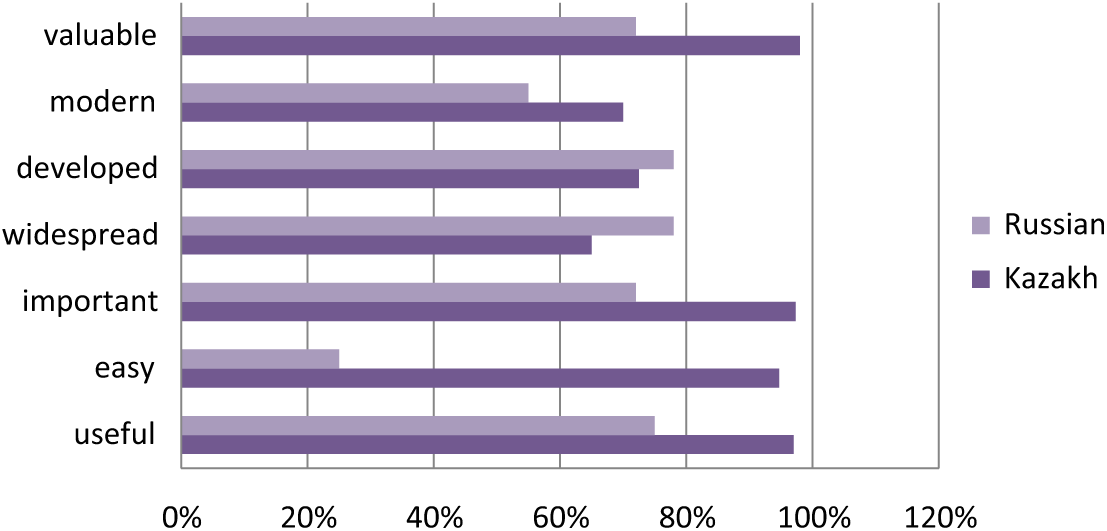
Characteristics of the languages
The necessity of learning Russian is realized in different ways: 22% of the respondents from China, 18% from Mongolia, 11% from Uzbekistan, 8% from Turkmenistan, and a small number of respondents from Tajikistan and Russia (4% and 2%, respectively) had a negative attitude to this. At the same time the respondents made a special mention of such important parameters as the maturity, modernity and popularity of the Russian language.
These data confirm Kazakhstani linguistic scientists’ notion that linguistic consciousness and self-consciousness, for both Kazakh and Russian, can become contradictory in poly-ethnic states where there is mass bilingualism. At least two linguistic consciousnesses or two linguistic personalities can be present, and they can conflict with one another in an open or suppressed way (Suleymenova, 2010).
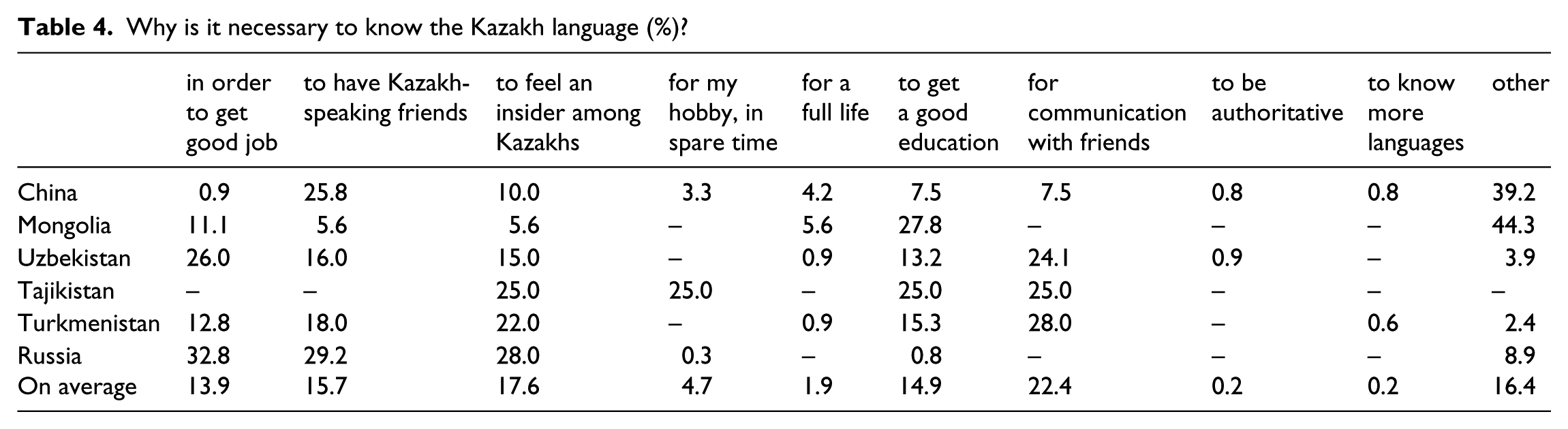
It was important for the researchers to determine the necessity for proficiency in Kazakh and Russian. According to the Russian repatriates, studying Kazakh is necessary to get a good job (33%), to have Kazakh-speaking friends (29%), and to feel accepted among Kazakhs (28%) (Table 4). Repatriates from Uzbekistan believe that with proficiency in Kazakh they can find good jobs (26%), chat with friends (24%), have Kazakh-speaking friends (16%), feel accepted among Kazakhs (15%) and get a good education (13%). Respondents from Tajikistan indicated that a good command of the Kazakh language is the key for getting a good education (25%) and successful adapting to the Kazakh-speaking population: that is, having Kazakh-speaking friends (25%), feeling accepted by Kazakhs (25%) and chatting with friends (25%). Repatriates from Mongolia identified the necessity of the Kazakh language to get a good education (28%), get a good job (11%), to feel accepted by Kazakhs (6%) and find Kazakh-speaking friends (6%). The respondents also felt that knowledge of the language makes life more full (6%). Respondents from China claim that they know the Kazakh language because of a desire to have Kazakh-speaking friends (26%) and feel accepted by Kazakhs (10%). Most repatriates from Turkmenistan noted that the Kazakh language is necessary to communicate with friends (28%), get a good education (15%) and good job (13%), have friendships with Kazakh-speaking people (18%) and feel accepted by Kazakhs (22%).
Why is it necessary to know the Kazakh language (%)?
Despite the fact that most of the respondents communicate in their families in Kazakh, Russian is the language of interaction with state institutions. According to the results of our research, repatriates believe that ignorance of the Russian language creates difficulties in employment (56%), getting reliable and relevant information (34%), in obtaining appropriate benefits (32%), getting an education (23%), etc.
About half of the respondents from Uzbekistan (53%) and China (46%), and approximately one-third of repatriates from Mongolia (30%) and Tajikistan (33%) answered in the affirmative to the question as to whether they had any difficulties because of lack of knowledge of Russian (Table 5). This is confirmed in the autobiographical texts: I was born in China. We moved to our Motherland in 2008. After arrival we were surprised by many things. Though Kazakhstan is a Kazakh land a lot of Kazakh people can’t speak the Kazakh language. We understood that the Russian language has a dominant position in Kazakhstan. It was difficult for us. At school, in shops we had problems because we couldn’t explain what we wanted to another Kazakh. When you tell him in Kazakh he doesn’t understand you … In 2008 I moved to Taldykorgan from China. At first I had difficulties.… Now language and other problems remained behind. In the future I will work for the development of Kazakhstan … The local Kazakhs do not speak Kazakh. Everybody speaks Russian. We cannot communicate with them to be more close …
Did you have any difficulties because of ignorance of the Russian language (%)?
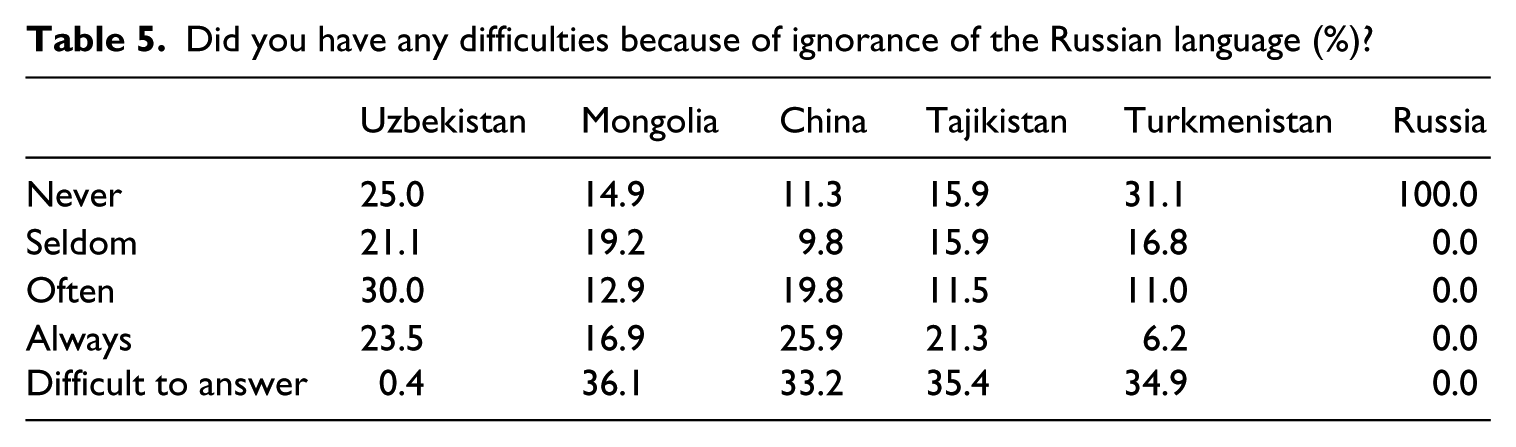
Some 17% of the respondents from Turkmenistan had problems with the Russian language. All the Russian repatriates participating in the survey had no problems with the Russian language. The necessity of learning the Russian language was perceived positively by most repatriates involved in the survey. For example, immigrants from China believed that knowledge of the Russian language helps to get a good job (44%) and quality education (21%). Among the main reasons for learning Russian, Mongolian Kazakhs point out ‘getting good work’ (30%) and ‘in order to know more languages’ (13%). The oralmans who arrived from Uzbekistan noted that because of the Russian language they could get a good job (22%) and quality education (34%); they noted that Russian language proficiency is necessary for full life in a poly-ethnic Kazakhstan (19%).
Repatriates from Tajikistan believe that knowledge of the Russian language will help them to find good jobs (32%) and the oralmans from Turkmenistan are of the same opinion (40%). The repatriates from Russia who are fluent in the Russian language argue that knowledge of Russian makes it possible to get good job (23%), Russian-speaking friends (13%), a quality education (25%) and communicate with friends (26%) (Table 6).
Why is it necessary to know the Russian language (%)?
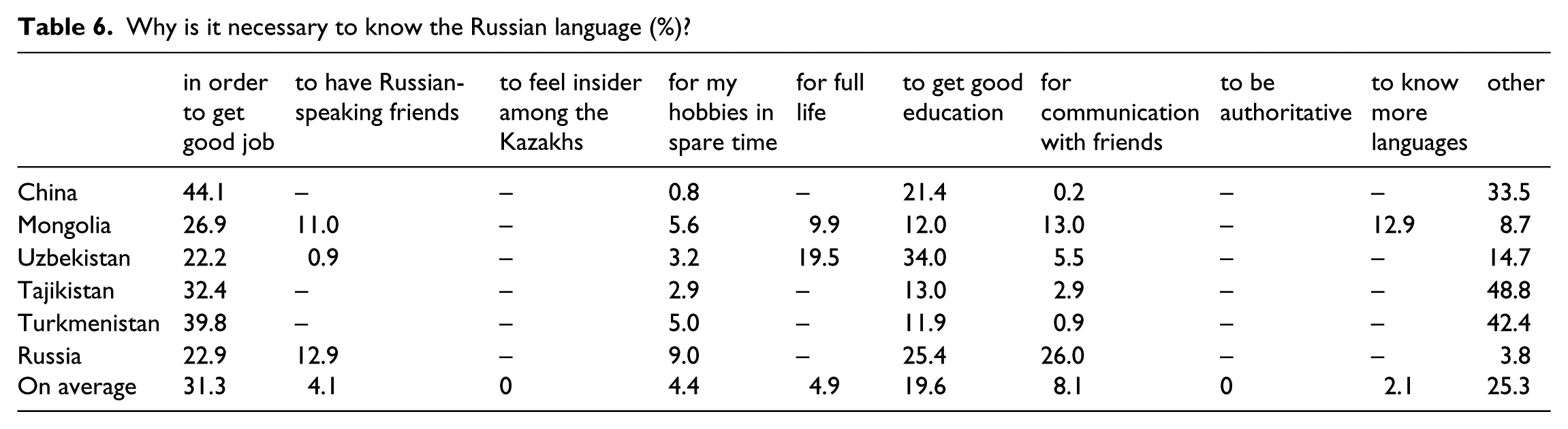
As can be seen from Table 6, among the main reasons for knowing the Russian language are ‘to have good job’ and ‘to get a good education’. It is evident that the communicative function of the Russian language is still strong; it is actively used in such spheres of communication as state bodies, business communication and education.
Conclusions
The process of successfully integrating repatriates into Kazakhstani society is undoubtedly dependent upon a great number of factors. The most important factor, and the one that will be expanded on, is the language situation in Kazakhstan, the activity of Kazakh state bodies toward ethnic Kazakhs within the country and abroad, the mass media and education. Mass media have great potential to influence the lives of people and society through the formation of language personality, language and the social-economic situation in the countries where Kazakhs resided before repatriation, etc.
There is a distance between repatriates and native Kazakhs that can be reflected in such basic components as culture, mentality, and verbal and non-verbal behaviour. The aspects which have been examined attempt to define the ethno-linguistic identity of repatriates (proficiency in the native language, level of linguistic competence, nature and use of language, attitude toward languages), and are designed to reveal the level of linguistic self-sentiment of ethnic Kazakh people. The data show that the integration of lingual identity of respondent repatriates is a complex and poly-semantic process, defined by linguistic, socio-historical, psychological, and cultural characteristics.
Certainly, in our opinion, while acquiring a language in natural conditions of bilingualism, the connection between linguistic and social aspects appears to be extremely close. Their interaction is evident. A good command of the Kazakh (Russian) language and also social activity supports the successful adjustment of repatriates – factors that accelerate the process of fast and qualitative language acquisition.
The research showed that cultural and social priorities as well as orientation of the Kazakh–Russian sociocultural space, determine the communicative behaviour of repatriates. In conclusion, it is possible to state that the questions of repatriates’ adaptation and their integration into Kazakh society demand careful and deep study. The results of such research help to inform government policy on repatriates and also suggest a number of measures for improving their lives.
Footnotes
Funding
This research received no specific grant from any funding agency in the public, commercial, or not-for-profit sectors.