



Abstract
This article considers the part played by typologies in analysing career transition. It identifies three strands of typological thinking in seeking to understand this phenomenon. These are typologies as method, as a method–theory bridge, and as a theoretical mode of sociological thinking. The discussion explores ways in which each of these approaches to career transition may contribute insights or may simply complicate analysis. Positive and negative examples of career transition typologies are used to illustrate typology creation and usage. The argument presented is that while each strand can contribute sociological insights, it is the theoretical use of typologies that is paradigmatic, not method-driven typologies, for contemporary career transition inquiry.
Career transition receives only modest sociological scrutiny, though workplace issues clearly occupy sociological attention. Instead, a broad applied literature reveals the central place typologies have occupied in theorizing career transition. What help does typological thinking provide in studying career transition from a sociological perspective? Theorizing the late-modern workplace has foregrounded analyses of credentialism, skills commodification, consumer society, corporate restructuring, downsizing, changing gender participation patterns, responsibilization discourses, and patterns of skilled migration. Career transition is implicit in all these areas. Job loss has high public salience without necessarily being understood in career transition terms. Intentional career transition, especially among professionals, is increasingly significant but less publicly discussed than job loss. Thus, career transition takes many forms: voluntary and involuntary, planned or reactive, and among professional as well as non-professional workers.
Discussions about career transitions in academia, particularly in the 1980s and 1990s, were permeated with typological thinking, most obviously within career development, human resources and other fields significantly informed by psychological disciplinary links. For the most part, such typologies did not engage theoretically with broader social and socio-economic processes in contemporary workforce and society. Examples to follow illustrate how this has been an important limitation in the rigour of non-sociological analysis in applied fields of management, vocational psychology, organizational change, career development, and life coaching disciplines, and even some sociological writing as well (Hodkinson, 1998b; Strangleman, 2007). This discussion is premised on the need for critical awareness that, in creating typologies, researchers are as much constituting occupational categories as they are reading them off the evidence.
The proliferation of career transition typologies can be better understood by locating them within their historical time and national space, in their 20th-century applied career theory context. Kazuyuki and Kuo-lin (2006) sketch a history of United States career theorizing as parochial to one nation and one era, though acknowledging these ideas have dominated western career development thought. Key United States career transition theorists fit a broad arc corresponding to social theory more generally across the 20th century. First, Frank Parsons’ early-century ‘trait-and-fit’ formal career decision-making model, proclaimed ‘ideal career choice [is] based on matching personal traits, such as abilities, resources, personality, with job factors like wages, environment and so on to create vocational success’ (Kazuyuki and Kuo-lin, 2006: 21).
Second, around mid-century two career transition theories emerged that have been major influences both in and outside United States career analysis ever since. Holland’s (1959) career theory of six personality types assumed ‘an individual’s personality expressing his or her occupational interests, and characteristics, could be identified by preferences for school subjects, extra-curricular activities, hobbies, and work’ (Kazuyuki and Kuo-lin, 2006: 23). The third dominant model was Super’s career development theory. This also went through a number of revisions and extensions since it was originally formulated in 1957: ‘life could be divided into several age-related stages [in which] given tasks should be accomplished’. Super asserted very specific age ranges, employing notions of ‘maturity’ and ‘planfulness’, sometimes called a life-span approach (Kazuyuki and Kuo-lin, 2006: 26–7).
Continuing valorizing of these career perspectives demonstrates a lack of conceptual development. These views reflect, in applied domains focused on career development, outdated normative assumptions about maturity, traits, developmental stages and ‘appropriate tasks’. They also reflect ongoing structural-functional theoretical commitments from the mid-century United States, which contemporary social theory, even allowing for diverse perspectives, has long ago moved beyond. Pavalko’s reissue in 1988 of his sociological text on professions (first published in 1971), with almost no recognition of the enormous career and social theory changes of the intervening two decades is an egregious example of this intellectual truncation.
Out of this mid-century situation, career transition work shifted to using typologies in the 1970s and 1980s, some empirically based and some conceptual (e.g. Holland, 1985; Louis, 1980; Murray et al., 1971; Thomas, 1980). The widely referenced and still-current career transition typologies of Bridges (1980) and Schlossberg (1981, 1984) were also developed at this time. Such work, from a present-day perspective, can be seen as a groundswell reaction to the inadequacies of theories that dominated the career development field at that time, particularly Super’s (1953, 1957) developmentalist career stages and maturity model of adult development, and Holland’s (1959) trait theory of personality types.
Attention to career typologies avoided head-on confrontation with these dominant theories (Levinson, 1980: 265) while creating some space for western scholars to begin exploring obvious changes occurring around them post the oil-shocks of the 1970s: the expansion of tertiary education, the presence of women in professional labour-markets, reduced job security, the economic rise of Japan, plus other late-modern changes unfolding, all of which made the dominant models less and less accurate portrayals of career paths and transitions. Levinson (1977) and others also used notions of ‘life-course’ to bridge existing literature to something more relevant, but this concept, too, has tended to receive rather than generate critical engagement about gendered and racialized career paths (Burns, 2009). The concept of boundary-less careers challenged the usefulness of career typologies, just as these had earlier attempted to avoid the problems of previous developmental and trait models (Arthur et al., 1999; Hall, 1996). It included experiences and ideas from outside the United States or European global centres, usefully identifying new shifts in workforce and careers but often struggling to offer critical assessment of the changes described (Strangleman, 2007). This literature proposed that careers should not be seen as coherent and essentialized but as fluid and changeable. This acknowledged changing labour-force dynamics but left implicit how mid-century constructions of a bounded career had come about and the contested process of change to the present day. Aside from identifying these shifts, the apparent ‘promotional’ description of such new framing of careers also contributed to individualization/responsibilization discourses around careers as much as emancipating them from the rhetoric of bounded careers.
Sociological analyses in recent decades opened up new theoretical approaches to career change as part of late-modern theorizing and critique (e.g. Beck, 1992; Castells, 2009; Giddens, 1990). Significant sociological possibilities exist in career theory too (Hodkinson, 1998a, 1998b). Iellatchitch et al. (2003) explore Bourdieu’s habitus concept as a vehicle for integrating analysis of the structural and personal, the combination of which is so problematic in writing about career and career transition. There is continuing applied usage of Bridges’ (1980) and Schlossberg’s (Goodman et al., 2006) transition typologies, as well as new efforts to integrate typological work and other theories (Ibarra, 2004: 39). Adherence of applied career disciplines to circumscribed psychologically informed models is unfortunate and sufficiently remarkable to be worthy of further sociological investigation in itself within a history of ideas framework. More recent typologies incorporate multiple careers, career renewal and similar concepts aimed at better engaging with the complexities of contemporary career transition. Ibarra (2004), for instance, reframes Super’s ‘plan and execute’ career notion with experimental forms of choice, challenging the often essentialized and unitary self of psychological discourse.
In such milieux an important new role for sociological theory is to apply distancing concepts such as antipodeanity (Beilharz, 1997), just as it has previously used lenses of gender and ethnicity to critique common career beliefs. Significant new understandings are created by doing this; foremost among these is the issue of avoiding the local values and discourses of one society – the United States – being simply projected outward to uncritically frame the experience of other nations. This remains an important issue, even granting historical and socio-economic overlaps between the United States and societies such as Australia.
The discussion below is organized around three practices of typology construction to test the sociological relevance of typologies for contemporary analysis of career transition. Three representative sociological texts demonstrate each approach: Babbie (2010), Layder (1998) and Beilharz (1997). Analysing how these respectively treat typologies as method, as a method–theory bridge, and as a theoretical mode of sociological thinking leads to considering their cumulative value for career transition research.
Babbie: typology as research method
Typologies have a long history in sociology and other social scientific disciplines. Durkheim’s (1997) pioneering research itemizing types of suicide over 100 years ago, and the continuing debate it generates, is an obvious example of the contribution typologies can make. Attention has sometimes focused on Durkheim’s four types themselves; at other times attention has focused on how these types are produced by the intersection of two variables, social integration and normative regulation; and sometimes new empirical data has been the focus of debate. Treating typologies as single or multiple-category research tools is an issue at large, even before considering generalizability questions such as the ecological fallacy and over-generalization raised about Durkheim’s work.
For some sociologists coercive use of typologies to constrain data and render it ‘neat and tidy’, seen particularly in psychologically oriented research and some quantitative sociology, has left a ‘bad press’ for typologies in almost any form. Mishlev (2007: 200) states: ‘We have all learned to be wary of typologies, and justifiably so. Once proposed, they tend to be treated as cast in concrete.’ While acknowledging the problems of methodological abuse, it is worth recalling some basic considerations that should be borne in mind in using typologies. Like all concepts and methods they have certain capacities and certain limitations. Babbie (2010: 181–3) observed that researchers often come at typology creation when they have been working to construct a scale or inventory (one-variable instruments). In some instances a combination of variables may yield a better solution to explaining a phenomenon, or contribute to its simplification and understanding.
However, in many cases, staying with categories or values within individual variables, or aggregating them, means that creating a typology is unnecessary. Babbie commented that misguided persistence leads to the creation of so called one-variable typologies (also Kluge, 2000). This allegedly ‘weaker’ version of the concept of ‘type’, rather than the ‘stronger’ version of typology as the cross-over of at least two variables with nominal attributes, is surprisingly common. While serving useful classificatory functions, such types do not fit Babbie’s (2010: 181) definition of a typology as, ‘The classification (typically nominal) of observations in terms of their attributes on two or more variables.’
Babbie’s (2010: 182) general template of two-variable interaction producing four types showed that ‘inherent in typological analysis’ is the issue that, ‘Whenever the typology is used as the independent variable, there will probably be no problem.… It is extremely difficult, however, to analyze a typology as a dependent variable’; which variable within the type is being influenced, and by how much? Further, what interactive effects are there between the variables?
This is a practical matter as well as having wider epistemological implications. Practices that breach such conventions coerce data into typological configurations, which is the antithesis of methodological consistency and undermines theory generation and testing of ideas. Johnson’s (1972) work, discussed below, offers a contrasting mode to such reductionistic efforts. Even within ostensibly one-dimensional types it is nevertheless possible to unravel a rich hinterland of personal, historical and other sociological factors of causation and discourse such that the proposed types confer a substantial theoretical advance in simplifying and organizing research data and interpreting complexity.
Typologies used as method have several advantages and disadvantages. On the positive side they provide a valuable tool to organize and condense data into understandable units; they work from the data itself; and they provide methodological consistency to the variety encountered in the evidence. On the other hand, disadvantages include arbitrary choices of dimensions or variable categories; being driven from the data they may at times not be informed by theoretical ideas; and the requirement for exclusive types/categories, rather than opening up interpretive explanatory possibilities may be reductionistic.
Outdated example: Thomas (1980)
Thomas (1980: 173) explicitly aimed to provide a typology of midlife career transitions. His proposals were based on 1–2 hour interviews with 73 mid-career transitioning men from middle-or upper middle-class family backgrounds. Previous work by Murray et al. (1971) was used to divide respondents according to two variables: ‘amount of pressure from self’ and ‘external pressure from the environment’ affecting a career transition event (Table 1).
Midlife career transition (Thomas, 1980).

Thomas was clear in identifying two variables in constructing his typology on the standard template: Measures of personal desire for change and external pressure to leave were dichotomized to produce a typology of career changers: Drift-outs, Drop-outs, Force-outs, and Bow-outs. The four types were found to differ on a number of variables, including: amount of education completed, additional schooling undertaken to change careers, time taken to make the change, radicalness of change, and the importance of personal values in deciding to leave their former careers. (1980: 173)
Thomas’s method is clear, but his findings are dated by his over-generalizations about career transition, taking it for granted that transition is about male, white, high socio-economic work-life trajectories. Today a study such as this would make each of these – gender, ethnicity and class – primary aspects in the analysis, rather than ignoring them. Further to these assumptions, the study was predicated on career coherence derived from the organizational context of the study. A host of other reformulations of career change also appeared in that period, for example Schein’s (1978) five ‘career anchors’. This interest in seeing motivation within a typological framework to analyse career transition raises important possibilities. For Mills (1940), individual ‘vocabularies of motive’ must be understood within relevant cultural and structural sociological explanations, not just be personally interpreted without historical framing. Thomas’s typology is clear, even if his assumptions are today problematic.
Unsatisfactory example: Louis (1980)
In the same year Thomas’s article appeared, Louis (1980: 332–3), referring to even earlier typologies, set out a ‘typology … still under development’ of career transitions. She used ‘type’ to refer to studies by others of ‘particular types of transition (e.g. retirement, entering a first job)’ (1980: 330), but also for the categories in her proposed typology of ‘Varieties of Career Transition’ (1980: 332).
Louis (1980: 332) described the contribution she hoped a career transition (CT) typology could make: Why develop a typology of career transitions? A typology of career transitions offers several potential practical and theoretical benefits. A systematic enumeration of CTs could be used to predict, analyze, and facilitate the experiences of individual transitioners. A typology of CTs could also provide a framework … [for] integrating and generalizing findings from relevant research not previously linked to the research literature; it could as well aid in detecting theoretical and empirical gaps in knowledge.
The results of Louis’ work, however, amounted to little beyond identifying nine types, with these divided into two larger categories, collectively constituting the typology. She did not use the term ‘type’ for her two main categories called inter-role transitions and intra-role transitions, even supposing she intended them to be the two intersecting variables (Table 2). Neither is it clear whether she meant them to be two nominal categories or values on one dimension called something like ‘organizational–non-organizational roles’. Nine next-level categories/types were too many to be a useful tool of simplification. Heavy reliance on role as descriptive rather than explanatory mechanisms did not seem especially suggestive of further research or theoretical reconstruction. However, it must have struck a chord, given how many times her work has been cited since 1980 for this supposed career transition typology (e.g. Blau, 2000).
Typology contribution to career transition (Louis, 1980).

Louis’ two categories of role did not offer much with regard to consolidating or simplifying combinations for career transition, as Table 2 makes apparent. Further, the differing number of transition ‘types’ within each role category compounded this difficulty, as did the lack of any sense that the overall classification covers all instances of career transition. Just how these were to be joined or otherwise understood is not clear. Many of the categories or types specifically related to each other, but overlapped in various ways. Her discussion covered organizations, professions and career concepts, trying to elucidate the idea of career transitions. A more useable response to labour-market changes would require a more distinct order or clearer explanatory mechanisms.
What is important to draw from Louis’ work, despite the rather dated use of role (Costello, 2005: 236), is, first, an emerging awareness of the proliferation of new kinds of career transition; second, the significance of transitions for individuals and the workforce in general, even if this is without sociological framing; third, the need for any career transition model to be relevant to issues of gender and ethnicity is negatively apparent to contemporary readers, given the barest of reference to gender in Louis. Today these would be considered basic gaps in accounting for the range of career-work transitions and effects on individual and family life-course.
Typology-making as methodological practice represents one style of thinking about organizing data; it is not primarily innovative, although new ideas might emerge from research data by this means. It relies on responding to results or ideas, and is reactive in constructing them from what the data presents, or is perceived to present, something that is not a fault per se, but with a longer time perspective significant limits as a research tool are revealed in owning its socio-cultural assumptions.
Layder: typology as method–theory bridge
In contrast to Babbie’s methodological concerns with typologies, Layder (1998: 73–7) addresses how they offer one way (of a number of ways) to help bridge social theory and method. From analysis of ‘data with theory in mind’ Layder (1998: 79) proposes getting a ‘firmer grasp of the connections between theoretical ideas (concepts, frameworks, typologies) and the empirical materials (the data, information) that they represent’.
Developing typologies (or building typological models) alongside data analysis is a very useful means by which the theoretical imagination is fired during the research process itself. Typologies are systematic classifications of types of social phenomenon as they fall within a particular category.… Having the objective of building a typology (of whatever is the primary focus of the research) at the start of the research gives direction and impetus to theoretical thinking for a number of reasons.
Advantages Layder (1998: 73) identifies in a typological approach are, first, ‘it forces the researcher to begin to ask questions about the data and the social phenomenon to which the data refers’. Second (1998: 73–4), ‘typology-building allows the researcher to engage in theoretical elaboration and thus to think in terms of chains of reasoning rather than simply in terms of one-to-one correspondences between concepts and data’.
The general benefit Layder (1998: 74) sees in typologies is set against a methodological focus on the one hand, and the breadth of theory on the other: Overall, the development of typologies can clarify thinking, suggest lines of explanation and give direction to the theoretical imagination.… a stepping stone to and from general theory.… Very often these theoretical advantages of typology-building are missed by those who view it as a self-sufficient strategy, devoid of potential connection with formal or general theory.
Layder (1998: 74) is alert to the importance of combining action/behavioural typologies with structural/systemic elements: ‘Any comprehensive depiction of the social world will automatically utilize concepts relating to both behavioural and systemic aspects since social practices are an amalgam of the mutual influences of lived experience and systemic aspects of social life.’ He reinforces at some length this basic sociological agency–context articulation that is absent in much of career theory writing. For him this influences not only theory construction but helps guide research practice as well.
It is important too that the bridging intent of typological use does not over-promise. Cautions include: recognizing the theoretical value can still be missed if typologies are primarily data-driven strategies; misleading coherence represented in small-scale data, or the apparent order in presenting results in tables which may fail to discern wider implications; and, finally, in career transition typologies, the structural–personal divide has proved over many years extremely hard to bridge.
Useful example: Oplatka (2001)
Research by Oplatka (2001: 10–11) illustrates Layder’s research–theory bridging focus (Table 3). Oplatka’s ‘life-story method aimed to explore and develop a typology’ of mid-career women school principals in Israel.
Four types of self-renewal process among women principals were revealed emerging from two axes – the first is mode of crisis in midcareer (burnout v lack of self-fulfilment), and the other is the mode of internal change (basic v incremental change). Every type got a name according to the characteristics of its renewal process, names that connect the researcher’s imagination and the systematic analysis.
Career renewal (Oplatka, 2001).
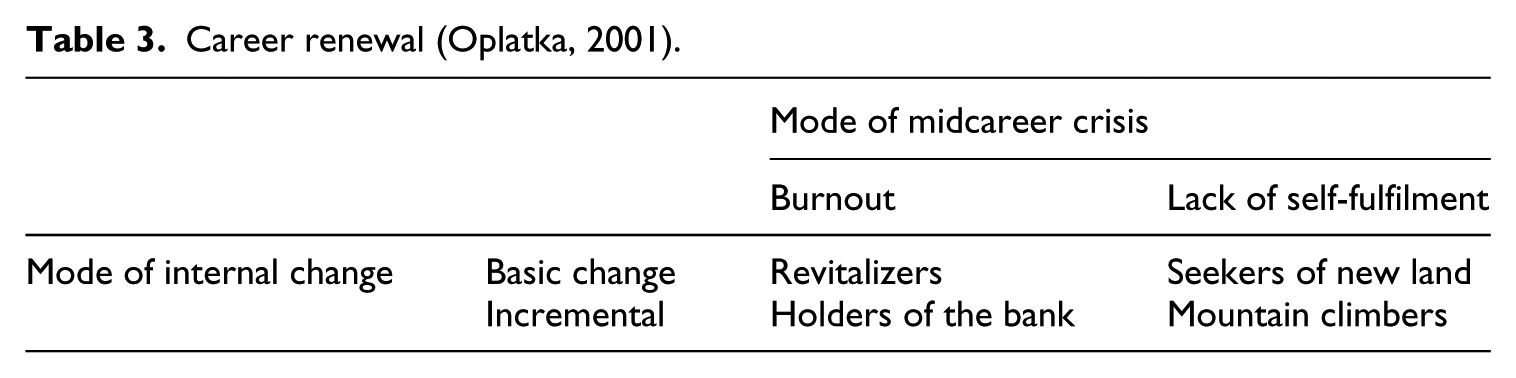
This conforms to Babbie’s two-dimensional typology ideal, but uses an exploratory narrative approach, eventually identifying four mid-career types described as: revitalizers, seekers of new land, mountain climbers, and holders of the river bank, which are then elaborated more fully. This research is about within-profession career transition. Neither single-variable types nor completely exclusive categories are offered.
Useful example: Layder (1998)
Layder (1998: 75–6) reflects on his own research with actors to illustrate the data–theory bridging capacity of typologies. His initial focus was just actors. However: it became apparent that interviewing actors would not furnish me with information about the labour-market in acting and for this I needed to interview others in the business (casting personnel, personal managers) and to use other sources of data (such as surveys on employment and earnings and studies of ownership and control of the media). This gave me some indication of the systemic aspects of the occupation – the settings and contexts in which actors’ careers are working out in a larger sense. However, to give a much fuller picture of the nature of the wider career context it was necessary to situate the acting profession in relation to other kinds of occupation and career. Thus, by asking questions about how and why a career in acting is similar to, or different from, other kinds of occupational careers … I began to develop a typology of occupational career structures.
Layder studied the literature on occupational careers, finding ‘quite a lot of material on bureaucratic and professional careers but little on craft-like occupations like acting’. From this he developed a tentative career typology of ‘three main types, bureaucratic, collegiate and market careers’ (1998: 76).
My initial analysis suggested that the concepts of power and control and the issues that flow from them, such as which groups in the occupation are able to control career status movements … were important in distinguishing between types of career structure. However, until I began researching careers in acting, I had no real way of understanding the form of control in this career.
Apart from the theoretical use of what emerged as Layder’s ‘shared control’ concept this clearly is a very different conception of typology than Babbie offers. The research data from interviewing actors was itself insufficient to help him frame what was taking place. Layder pushed out to a wider context; other occupations and career changes. While Oplatka’s approach has similarities to Babbie’s, he links data to theory using types reflexively in deploying an exploratory narrative method. Layder’s account shows the rich complexity of theory and data interacting, and he then positions typologies as one way of theorizing this connection: a process of mutual influence between theoretical ideas and concepts and the collection of data in an ongoing manner. Thus typology building is yet another strand of a multi-strategy approach that can feed into theory elaboration and development in a cumulative sense. It actively encourages a dialectical interplay between ‘emergent’ theorizing based on the discovery (collection) of data and information and the use of extant theoretical materials derived from different sources. Each influences and tempers the other. (Layder, 1998: 77)
Linking theory and data in a dialectical manner opens new uses for typological analysis.
Troubled example: Hodkinson (1998b)
Hodkinson reflected on recently completed school-to-workforce empirical career transition research (Hodkinson, 1998a; Hodkinson et al., 1996), articulating the notion of ‘careership’ (Hodkinson and Sparkes, 1997). Subsequently Hodkinson (1998b: 559) re-assessed how the process of theory construction occurred, asking himself, ‘Where did it come from?’ Hodkinson had synthesized his readings before and during the research into a two-dimensional typology between (1) researcher and participant, and (2) determinism to voluntarism in career choice. This produced four ideal-type positions, and his article worked through important issues in career transition, applying an interpretive understanding to his empirical–theory interface. In summary (1998b: 565): From a hermeneutic perspective, it is clear that the ideal-types presented earlier are fundamentally flawed. Not only does none of them individually make sense in relation to the research findings, but the very attempt to fragment the hermeneutical nature of research, through the construction of logically derived ideal-types, was mistaken.
As an exercise in bridging between method and theory, Hodkinson showed the process functioning as it should in academic inquiry. As a substantive result, useful for sociological theory and empirical inquiry it was, by his own account, unsatisfactory. This does not undermine his approach, nor the ‘careership’ concept his research generated, but distances it from the particular typological formulation with which he experimented. The method–theory bridge approach to typologies ultimately turns on the validity of the respective methodological and theoretical sides of the bridge.
Beilharz: sociological typologies good to ‘think with’
The third part of the argument here is that typology as theory is not the precise application of technique to abstract ideas, but finds its most effective place as an interpretive tool looking at all kinds of data that affect career transition, from historical and society-wide through personal vocabularies of motive and decision-making in individual career transition (Mills, 1940), thereby offering theorists and researchers something to ‘think with’ (Beilharz, 1997: 193).
Useful example: Johnson (1972)
Johnson (1972) developed his now-classic sociological theory of professionalism in terms of a single-variable typology based on production and consumption of professional services. He identified three types (Table 4): first, where the producer has all or most influence in defining the producer–consumer relationship; second, where the consumer has all or most influence in defining the producer–consumer relationship; and third, where an intervening party mediates the producer–consumer relationship, imposing its definition of the situation onto the interaction. An example of the first is in optometry; an example of the second is engineering; and an example of the third is social work where government mediates supply and consumption of social work services. A fourth type, heteronomy, another intermediate form of control, was later identified (Johnson, 1980) where the two parties, producers and consumers, more evenly contest the definition of the relationship.
Professional careers and typology (Johnson, 1972).
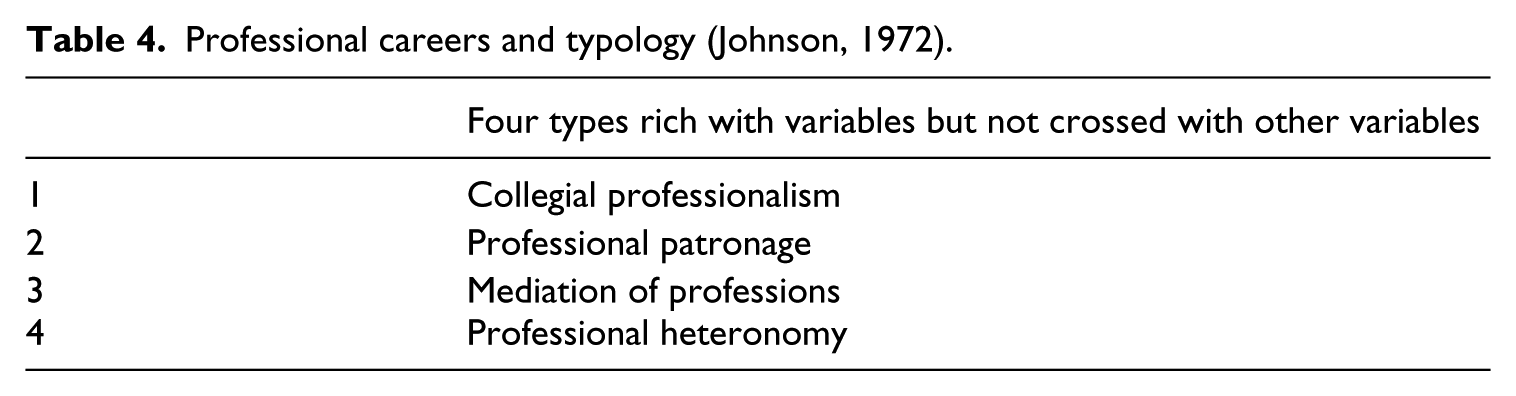
The parsimony of Johnson’s typology stands in stark contrast to Holland’s described below. Holland’s failure to discover the theoretical limits of his own work additionally contrasts with Hodkinson’s reflexive efforts.
Failed example: Holland (1996)
Holland (1996: 402) after several decades’ work, addressed his own earlier career choice typology scholarship (Holland, 1985), stating ‘it has become increasingly clear that the explanatory power of the typology would benefit from the incorporation of a person’s beliefs about career stability and career changing’. He criticized past measures as typologically ‘indirect or remote assessments of potential actions’, preferring something like qualitative interviews ‘asking people about their beliefs and strategies’. From an antipodean perspective, his focus obscures the sociological realities of late-modern change which renders his types problematic amid ongoing labour-force changes, leading to endless theory revision and ‘updating’. Holland’s tabulated correlations between variables named as vocational identity, career ‘worries’ and similar, can seem to a disciplinary outsider as examples of circular logic even before the limited cultural specificity of Holland’s earlier personality typology categories is taken into account.
In his article Holland drifted through a discussion of his original typology and its revision, towards his final table with its correlations between the ‘Big five personality factors’ and ‘vocational identity’ (1996: 404). He then disarmed even his own typological efforts on the article’s very last page, but not in the reflexive manner of Hodkinson. Sociological alarm at the circularity of Holland’s reasoning might record: first, his own phrases about his personality/trait typology in the article such as, ‘theoretical worries’ (1996: 401), ‘typological revisions’ (1996: 402), ‘unfinished business’, ‘speculations about revisions’ of earlier typologies, and ‘workplace change’ (1996: 404). Second, Holland observed, ‘I have neglected the hexagonal model and classification system’ for two reasons, apparently; ‘The research about the hexagonal model does not lend itself to a brief summary. The research about the classification is easier to comprehend, but this information bores most people.’ These pragmatic reasons signal theoretical as well as practical limits to using such typologies and psychological constructs as theory. Third, an antipodean viewpoint, such as that found in Beilharz problematizes statements such as Holland’s remark that ‘the hexagonal model gets more support in the United States than it does in other countries’. Holland utters it, but he does not seem to realize the ethnocentric limitations of his own thinking. Fourth, the underlying sociological labour-force changes that frame career transition will not completely go away whatever internalist scholarly edifice Holland (1996: 404) or others attempt to build over them: Even as revisions of the typology have given it additional explanatory power, new theoretical worries have surfaced. Many writers have reported that stable careers will not be the norm in the future – and that one’s job will not be a major source of fulfilment.… If these forecasts come true, career theories may soon lack phenomena to explain.
Holland slighted these as ‘Chicken-Little scenarios’ of negativity (1996: 404). This is inadequate scholarship in anyone’s terms, but highlights the dual limits of Holland’s own conceptual platform and his disciplinary context. Sadly, Holland’s example has taken the discussion all the way back to the cautions implicit in Babbie, Layder and now the present Beilharz section.
In his article Holland attempted to bring in some sociology, some theory (‘workplace change’, 1996: 404) to his typology, but the hermetic seal from these dual constraints has not been broken. It cannot be broken from within. Rather, the productive use of typologies is to tentatively frame, explore, test and simplify ideas. If a two-by-two typology works neatly, well and good, but that should not be the primary strategy of sociological use, as has been explored here from several angles.
Not all instances of broad typological thinking are unproductive in the way that Holland’s work is, or productive in the manner of Johnson. On the one hand, Johnson does not fit the two-variable model Babbie outlines, but in describing instances of his three main types, he incorporates specific historical, institutional and relational forms into his analysis. The multiplicity of variables and the discursive plurality in these types raise rich explanatory possibilities. By contrast to this one-variable approach, Holland uses a profusion of categories and types (also a problem in Louis’ work), and ends up creating a typological tangle that is unable to provide explanatory traction.
Typological thinking beyond career transition
Johnson is a sociologist, and his single-dimension typology overcomes alleged weaknesses in that format by creating a simple typology from several variable-dense types he identifies, located as they are within historically specific processes. Holland, on the other hand, is not a sociologist and he makes mistakes that mid-20th-century United States sociology was also making in the analysis of careers and professions under trait and structural-function perspectives. While sociology moved on, as has sociology of professions (Johnson’s work helping that shift), and is today enjoying a renaissance in career research activity, Holland however has not, and the vocational field struggles to be theoretically relevant. Trait typologies have uses but can only ever be one component in an overall explanation.
Two views from outside career transition, one sociological (Beilharz, 1997), the other from linguistic anthropology (Bauman, 1986), help get inside the theoretical benefits of typological thinking. Beilharz (1997: 73) reflects on typology in the work of Australian art critic Bernard Smith, in exploring antipodean social theorizing: That Smith was a typological thinker is already evident in his views on civilisations, imperialisms and surrealisms. His is not the compulsory or brutal typology of some heavy-handed model-building sociology; he associates, and cross-refers, thinks through similarity and difference, sympathy and conflict. The types at work in Smith’s thinking are not the schematic two-by-two boxes which force all history into pre-existing schemata; they are the looser types of precedent, of déjà-vu, of recycling, return, re-formation, transformation, of context rather than abstract logic.
This is a complex and multi-level statement. What called forth this excursus while evaluating an art historian’s corpus?
Beilharz had just been describing the second theme in Smith’s 1960 European Vision and the South Pacific, ‘that the predominant mode in nineteenth-century landscape painting arose from the need to discover and evoke what was typical’, resulting in ‘art history that was at once too exclusively European and ahistorical’ (p. 73). In these excerpts prior to the above quote on typological thinking, the word ‘typical’ on first reading appears simply as part of Beilharz’s commentary on Smith’s work. Then suddenly this material about typologies in sociology is placed before the reader, inscribing the ‘typical’ of the prior paragraph with a deeper potency.
This is not an abhorrence of typologies, a refusal to use them. On the contrary, it avoids a mode of disagreement that is primarily opposition to common usage. That kind of typology is unhelpfully driven by the unacknowledged ideas/ideology of the typology-maker, and resulting ‘schematic two-by-two boxes’, that exercises coercive prior power over the evidence and complexity before them. We earlier saw Hodkinson self-consciously walk away from such coercion. Events, time and place are central to any discussion of typologies and other social theoretical tools. United States workplace discourses, practices and particular sets of beliefs about career progression constitute a socio-culturally located mix of data and aspiration that becomes a reified reality (Evetts, 1992) because of that nation’s pre-eminent economic position in the 20th-century globalizing world. When viewed in the long run of time (Beilharz might say, ‘civilizationally’) it is simply particular, singular and local. Career transition history insights are, as are other areas of typological application, not just obscured, however, but read out of history by the will-to-power that goes with such great imperial and modern economy projects.
While Beilharz and Smith use types to think about historical fact and process, Bauman (1986: 11) engages types to problematize truth at the personal level. In researching oral narratives he develops a three-fold typology for analysing collected tales of coon-hound stories between rural traders and buyers of dogs that centres on ‘lying’ in telling stories. Bauman leads into his analysis by reflecting how types help or hinder analysis. He observes that folklorists started with Socrates’ assertion that, ‘There are two kinds of tales, one true and the other false’, but Bauman identifies ‘increasing unease about the empirical basis and reliability of such truth-value criteria’ (1986: 11). He draws inferences for analysing folk story data, problematizing truth affirmations: if one may extend the point, considerations of truth and belief will vary and be subject to negotiations within communities and story-telling situations. This would suggest that if we are interested in the place of narrative in social life, it is the dynamics of variability and negotiation that we should investigate; the issue should be transformed from a typological comparative to an ethnographic one.
Truth-value typologies for Bauman (1986: 11–12) are ‘no more empirically productive than … [they] have proved to be in other cultural spheres’.
Other spheres, such as career transition, we might infer. Thus, Bauman like Beilharz does not reject types per se. What he does is challenge one long-standing piece of received wisdom that has constituted a typological framing for his field. He argues that supposedly neutral classificatory systems in themselves are not necessarily ‘empirically productive’ in any field. Bauman’s challenge in his own field is therefore highly relevant to the present overview of typological work around career transition. Bauman’s call is for just such empirically sensitive inquiry out of which typological reflection is built and explored, not imposed. As Mishlev (2007: 200) remarks: ‘Despite the potential for misuse, some scheme of work to clarify alternative analytic strategies – a typology – would seem to be a necessary first step for comparative analysis.’
Conclusion
This discussion has traced applied career transition literature, identifying typological use from methodological to theoretical applications, revealing both satisfactory usage and appalling use. Sociological engagement with career transition typologies needs to heed the cautions of social theory rather than the imperatives of psychological construction of results or organizational models.
The implication of the foregoing discussion is that rather than taking the methodological kind of typology as the benchmark, theoretical deployment of typology is the paradigmatic mode for how typologies should be used. Two-by-two constructs, if done well, are, then, simply special and restricted instances of the general principle. If done poorly they fail at their first hurdle of relating broad ideas, and hence add little, or simply complicate understanding. Theory-led use of typologies is diametrically opposite to researchers inappropriately using the two-by-two method for typological theorizing, and ‘failing’ it because career transition ‘reality’ did not fit the boxes. Examples considered here moved the discussion toward this overall conclusion. Mishlev (2007: 200) comments: No typology is definitive, because an array of objects … could be sorted along various dimensions; any typology is a set of ‘fuzzy categories,’ each with blurred boundaries and more or less prototypical examples; and criteria and rules for inclusion reflecting a mix of theoretical considerations, cultural constructions, and contextual constraints.
Thus career transition typologies can be proposed – or discerned – at each level, from method to theory, including a bridging use that draws on both. Research not specifically organization-focused, nor based in the United States, nor taking place within an applied psychology/vocational career discipline, may avoid some mis-steps discussed here. However, recognizing typology as paradigmatically a theoretical construct is the best defence against the faults that have bothered sociologists. This can be seen in Layder, Johnson and Hodkinson, but Louis and Holland stand as warnings about limitations of typological over-reach when method is the primary driver with insufficient sociological framing.
Sociologists are understandably chary of interdisciplinary involvement when psychological hegemony in vocation/career related disciplines repeatedly mis-recognizes such framing. The purportedly universal ‘truths’ of a United States national reading of evidence compounds psychological disciplinary self-assurance, but is less persuasive in other national-cultural contexts (Beilharz, 1997).
Typologies provide one way to anticipate findings, or to simplify and organize evidence, and these, after all, are the tasks of analysis and explanation. Nesting types within or outside other forms of social analytic devices may offer the most explanatory value. That is, more hermeneutic than categorical usage may be the best way forward to avoid the concretizing that typologies bring to situations for which they are not entirely appropriate. This respects both the practical method orientation to creating types, as well as acknowledging the theoretical complexity and richness involved in career transition – biographical, interactional, educational, cultural, familial, economic – multiple processes and identities continually created and re-constructed. Applying typological creation/testing iteratively, as recommended by Layder and Beilharz, seems desirable.
The gallery of good and poor career transition typological use examined here serves as a benchmark for further research in the career field. Holland’s complex example has four lessons; First, Holland wrote as a leading scholar in the applied career field, not a neophyte. He tried and failed to synthesize and overcome his own typological shortcomings. Second, seeing this as Holland actually performs this process on the journal page is highly revealing and instructive. Third, for the argument presented here, this is not dismissible as an historical example, but highlights the current sociological challenge necessary to such prevailing discourses. Fourth, more than simply not succeeding in the task he has set himself, Holland’s article demonstrates him giving up academically his attempt at overcoming personality/trait approach limitations because he cannot handle the complexities of ‘workplace change’ as society itself changes.
Emergent simplification of complexity is at the heart of Beilharz’s view of typological thinking. While the purpose of typologies is to reduce and simplify complex phenomena, or at least gain a window into them, typologies are counter-productive if they are reductionistic. Simplifying is a gain, being simplistic is a theoretical loss. There is no glib, mechanistic solution to which typologies are the answer, nor can the creation of types automatically produce meaning and interpretive significance. The sociological task cannot be short-circuited by easy heuristics. It remains the case that sociological assumptions that are brought, or not brought, to the work of typologically classifying and thinking about career transition at both macro-sociological and personal levels will continue to be important keys to opening new avenues of contemporary inquiry.
Footnotes
Funding
This research received no specific grant from any funding agency in the public, commercial, or not-for-profit sectors.