




Abstract
New government education policies stress both social justice and economic imperatives. The tensions between these goals for universities are familiar themes for critique. The diversity, and shift in cultural capital among university students is also a concern. The authors of this article teach sociology at an Australian university with a comparative over-representation of students with low levels of cultural capital in academic literacy: research, reading and writing skills. In this article we outline and discuss the approach and outcomes of a pilot online program ‘Leap into Sociology’, developed to help sociology students increase their academic literacy in sociology. The program is, like other academic skills support programs, premised on an understanding that the development of academic research and writing skills needs to be ‘embedded’ in discipline units to be most useful for students. Our discussion considers these challenges in relation to current tensions in higher education work and policy contexts.
There has never been a golden age when universities were free from social and political imperatives. However, especially since the late 1980s, Australian universities have been transformed from elite and relatively independent institutions to businesses serving the interests of social and economic policy. In that process our working modes, roles and identities have also been transformed (Marginson, 2000). Integral to the ‘new university’ has been the huge growth of participation in higher education. In 1950, 1 in 267 Australian residents was enrolled in university, compared to 1 in 18 in 2010 (Norton, 2012: 20). The expansion of universities has been accompanied by a stress on access and equity, in the service of various broader policy agendas. In the 1980s, a national equity framework entitled A Fair Chance for All (1990; see Bradley, 2008: 36) accompanied widespread ‘reforms’ to the sector, including the introduction of the HECS (Higher Education Contribution Scheme) system. The recent Australian Government Review of Higher Education (the ‘Bradley Review’) married an economistic narrative about Australia’s poor international competitive status due to a low number of graduates proportional to population, to a nation-building and social inclusion agenda. Along with a general push to increase national participation in higher education, the Bradley Review sets targets for access, success, retention and completion for a range of ‘equity groups’; for low SES students it sets an access rate of 20 percent of undergraduate university enrolments, and a completion rate which is close to that of high SES students (Bradley, 2008: 45).
Increased participation in higher education has been accompanied by a relative decline of Commonwealth funding which, despite the introduction of fees, has squeezed jobs and increased class sizes and teaching loads (McIntyre and Marginson, 2000: 66). In the ‘new university’, academic identity and styles of work and relationships are now shaped and managed highly strategically. At the same time, to come to the impetus behind this article, the dramatic shift in the numbers and composition of our student population has resulted in students attending university with relatively low levels of cultural capital, including academic literacy. These challenges have moved from the horizon to the very centre of our daily teaching experience. As we name and confront this ‘elephant in the room’, new tasks have been added to our roles; we are asked to become pedagogically reflexive.
Given the inherent tensions of this situation, there has been a tendency to characterise our ‘diverse’ students as being intellectually ‘deficient’, but it can be argued that the sheer size of the challenge requires a new ‘definition of the situation’ moving away from the idea of student deficits toward a different understanding of the tasks of university teaching and learning with some attempt to reframe our role as teachers in that light (Lawrence, 2005). However critical we might be of this ‘deficit’ discourse it is reasonable to assume that sociology academics would concur with Devlin and McKay’s (2011: 3) position that all our students, once given access to higher education, should be given a chance for success and achievement.
Bearing in mind the tensions and difficulties outlined above, the discussion which follows offers an account of some specific efforts to provide equity in academic literacy in sociology for diverse students. From a pedagogical perspective our interest is in developing ways of teaching academic knowledge and skills to an increasingly diverse student body. In understanding the background to discussions of academic literacy and ways of improving it we need to acknowledge a complex relationship between cultural capital, SES and academic achievement; as such our article reviews the interrelationship of these concepts. Our main focus is our experiences working with an integrated, multi-disciplinary team to implement ‘embedded’ academic literacy strategies in sociology teaching, including the ACU online program ‘Leap into Sociology’ (LIS). In this article we draw on an evaluation of LIS and student questionnaire data to support the idea of a ‘learning and teaching movement’ in Australian sociology, and critically reflect on the implications of this for the teaching of sociology in Australia.
Literature review
Cultural capital, academic achievement and socioeconomic status
Cultural capital references the cultural resources of a given society, the knowledge of dominant ideas, values, norms and behaviours, and how these are transferred to an individual from preceding generations. For Bourdieu (2007) cultural capital underlies the reproduction of power and social relations in society; educational systems are seen to perpetuate these relations. Cultural capital, as hypothesised in cultural reproduction theory, is an important factor in student educational success (Jaeger, 2011: 281). According to Bourdieu (2007) cultural capital arms the individual with sufficient knowledge and practical skills to acquire a feel for ‘the game’ in specific social fields. Within cultural reproduction theory, success in the higher education field is conveyed through an ‘invisible pedagogy’ (Bernstein, 2003: 124) by which a parent, generally middle class, transmits an elaborated ‘communication code’, both oral and written, harmonising with the communication code valued in university. This code may include literary knowledge and comprehension (Dabaghi and Mohammadi, 2012; Gaddis, 2013; Jaeger, 2011), derived from family literary resources. Of particular interest for this article is the argument proposed by Lareau and Weininger (2003: 580) that cultural capital is fused with technical skills or ‘ability’ and that, rather than being distinct from cultural capital, such ability is transmitted through family. In fact Bourdieu (2007: 85) originally made the point in regard to academic ability that ‘ability or talent is itself the product of an investment of time and cultural capital’. Of course cultural capital goes well beyond this to perceptions, expectations of achievement, and into the realm of the family experience of higher education (Roksa and Potter, 2011). However our interest is in the form of cultural capital which relates to the ‘ability’ of students to engage with academic literacy skills. Before exploring this in depth, we need to examine the nexus between cultural capital, academic achievement and socioeconomic status (SES), which are all implicated in discussions of academic literacy.
It is a central contention of Bourdieu’s (2007) theory that differences in cultural capital are integral to definitions of class. Thus some correlation of ‘low’ cultural capital in all the dimensions noted above with ‘low SES’ status is taken as well established (Devlin and McKay, 2011). However, we argue that the gap in cultural capital relating to expectations of teachers and the capacities of students extends beyond class differences to other generational and cultural shifts. Nor does it follow, as we will argue below, that the increasingly poor academic literacy skills of our undergraduate students are due to an increase in low SES students.
Sociological study of the link between SES and educational achievement and academic success is not new. Notwithstanding the classic work of Bowles and Gintis (1976), which strongly implicated education in mediating the intergenerational influence of class, early educational research found the relationship between SES and academic achievement is insignificant (DiMaggio, 1982; Sewell and Shah, 1967) provided the student has reasonable academic ‘intelligence’. To this end DiMaggio (1982) proposed a cultural mobility hypothesis that students from culturally ‘disadvantaged’ backgrounds are more motivated to invest in cultural capital due to their ‘deficits’; moreover these students can exercise considerable personal agency to achieve strategic educational outcomes (Gaddis, 2013).
Despite the evidence that low SES does not necessarily of itself correlate with low academic achievement, research in the UK since 2005 has tended to emphasise improving the experience and achievement of low SES students at university; Australian research and policy has also begun to focus on this (Devlin and McKay, 2011; Devlin and O’Shea, 2012). At our university, which has relatively low Australian Tertiary Admission Rank (ATAR) university entry scores for most courses, the proportion of low SES is not significantly greater than that at other universities which require higher ATARs. We would challenge public discussions which conflate low ATAR, low SES and low cultural capital, and encourage the extension of this debate to other factors. For example, students are increasingly engaged in different forms of cultural practice involved with information technology; and it has been argued that the link between SES, access, academic achievement and attrition relates more to issues of affordability (Devlin and O’Shea, 2012; Rothman, 2003; Stokes and Wright, 2012).
As argued above, the relation between SES status and academic success is complex. While there is an acknowledged association between low ATAR and low SES (Devlin and O’Shea, 2012), higher ATAR low SES students have been found to have comparable success rates, once at university, with other students (Devlin and O’Shea, 2012: 385; O’Shea et al., 2011). Academic success for low ATAR students has been demonstrated through transitioning strategies at the university level; for example Lynch and Werth (2007: 14) attributed the comparative success of low-entry, first-year management students at the University of Southern Queensland to transitioning strategies, including teaching scaffolded skills in writing, and locating the teacher as a ‘supportive social presence’.
Researchers have proposed a program of ‘inclusion’ for low SES students which includes transitioning strategies and accommodating student needs (Devlin and McKay 2011; Devlin and O’Shea 2012). Based on what is reviewed in this section, we would propose a program of ‘inclusion’ for all students – irrespective of SES – with academic literacy needs, and whose cultural capital requires some ‘growth’. This means not only offering students specific assistance and support but also addressing institutional barriers to success. We could also consider ways of adapting to the new generation’s context, in a way which respects students’ cultural understandings and knowledge.
Embedding academic literacy in sociology teaching
This discussion has assumed that academic literacy is a key aspect of the cultural capital which students bring to university. For the purposes of this discussion, academic literacy encompasses a continuum of researching, reading and writing skills, from basic skills such as catalogue searching, reading strategies, writing ‘mechanics’ such as grammar, sentence construction and spelling, right through to reflective thinking and writing, reading critically to evaluate evidence, developing thesis statements and meta-argument, applying formal academic writing conventions such as editing and referencing of work, and adhering to standards of academic integrity (Ciabattari, 2013; Kennedy-Clark, 2012). Embedding academic literacy refers to the process of building academic research, reading, and writing into the curriculum and linking it to discipline content and assessment (for example Salamonson et al., 2010: 413). In the United States (US) sociologists of teaching refer to similar programs as ‘writing across the curriculum’ or ‘writing in the disciplines’ (Ciabattari, 2013; Kolb et al., 2013) and emphasise developing ‘a culture of good writing’ in sociology (Stokes et al., 2002: 38 cited in Ciabattari, 2013: 63).
North American sociologists of teaching (e.g. Ciabattari 2013; Hudd et al. 2013; Kolb et al. 2013) argue that, notwithstanding the examples discussed above, sociology teachers rarely include writing as a specific learning outcome. Rather sociology teachers assume that assigning written work will, in itself, improve critical thinking and foster analytical skills in sociology (Ciabattari, 2013). Based on interviews with sociology teachers in the US Hudd et al. (2013: 37) note the ‘writing as thinking’ paradigm is common; that sociology teachers adopt the role of ‘cognitive coaches’, assisting students to write as a means of contributing to knowledge in the discipline. What is clear from US-based studies is that sociology teachers see the actual mechanics of writing as something learned ‘elsewhere’, and as less important than developing content-specific outcomes. An important point in relation to this, which also applies to the Australian context, is that most sociology students are not embarking on a sociology career, in fact they are not even likely to be undertaking a sociology major (Zipp, 2012: 304). Yet sociology teachers teach as if our students are on a road to higher degree research.
Our interest in embedding academic literacy in sociology teaching emerged organically from our developing awareness that, with an increase in ‘non-traditional’ students, including secondary school leavers with lowered ATAR scores and students transitioning from ‘pathway’ programs, more sociology students are commencing university studies with limited knowledge or skills across the continuum of academic literacy. We have come to support the argument that ‘we cannot simply require writing, we must also teach it’ (Hudd et al., 2013: 33).
We acknowledge scholars such as Baynham (1995) and Freire and Macedo (1987), who argue that literacy is a cultural construct which privileges a certain form of literacy associated with cultural elites. While mindful of this critique, we also accept that the cultural capital embodied in academic literacy is strategically critical in achieving professional employment as well as intrinsically valuable. We would argue then, as stressed above, that it is part of our role as teachers to help all students, once they have entered tertiary education, to ‘role as teachers to help all students, once they have entered tertiary education’ to accrue their cultural capital.
Leap into sociology
We have been embedding academic literacy in our sociology teaching since 2010; our early efforts supported a ‘scaffolding’ approach to teaching literacy, a series of dedicated library sessions and assisted workshops on essay writing. Our informal evaluation of these efforts noted how students modelled very well almost every aspect which the skills workshops had covered: appropriate research questions and in-text referencing of sources, well worded, skilful incorporation of paraphrased and summarised material with the voice of the author, a generally cogent structure and development of argument or narrative incorporating sociological perspectives.
This ‘success’ encouraged us to formalise an integrated program of embedded academic literacy in sociology teaching. Integral to this was the development between library and academic staff of a new ACU online information literacy program, ‘Leap into Learning’ (LIL). The development of LIL is premised on the understanding that students transitioning from secondary school to university require foundational literacy skills and knowledge to help them navigate academic work, thereby increasing their potential to succeed at university. According to Bourbos et al. (2012: 3) the heightened need for information literacy instruction and increased student numbers has encouraged several Australian universities to develop online ‘literacy’ programs with multimedia and educational activities with built-in quizzes, as a mandatory part of student coursework.
Such ‘new media’ use has increased markedly over the last 15 years. Many of our students have grown up with information and communication technologies (ICT) in the home, even low SES students are found to have reasonable access to ICT (Tondeur et al., 2011), with digital literacy common for young people from diverse backgrounds. Despite a lessening of the ‘digital divide’, the children of professionally employed, middle-class parents are strongly encouraged at home to use ICT for educational purposes, enhancing their ICT cultural capital in the process (Tondeur et al., 2011). As such the values of professional parents are mirroring those of the higher education system (Koivusilta et al., 2007). Our argument here is that, through introducing an online program of embedded academic skills work in sociology, we are not just harnessing the cultural capital of digitally literate young students, but also ‘growing’ the cultural capital of those students less familiar with online learning.
LIL comprises five online modules, specifically:
Module 1: Navigating the library webpage and a unit outline.
Module 2: Understanding academic information sources and online searches.
Module 3: Searching for scholarly information in databases and subject guides, and assessing the credibility of online sources.
Module 4: Conventions of academic writing and referencing.
Module 5: Academic integrity and plagiarism.
‘Leap into Sociology’ (LIS) refers to a sociology specific version of LIL, with dedicated modules, activities and database links for sociology students. Each module incorporates podcasts and vodcasts featuring academic staff and students, tasks and activities on the topic, a discussion in the learning environment online (LEO), ‘captivate’ demonstrations uploaded to a library YouTube channel, and randomised quiz questions.
Following efforts to embed academic literacy as described above we undertook a process and outcome evaluation of first-year student engagement with LIS; detailed results from the 2012 evaluation are reported in an ACU internal report (Black and El-Chami, 2013). Our interest is in determining if embedded academic skills work not only enhances literacy skills of first-year sociology students, but also assists in ‘bridging’ the cultural capital gap for students from diverse backgrounds. Did students improve academic literacy in sociology? Did LIS assist students in transitioning to university work?
Process evaluation
The process evaluation results reported in this article relate to the findings from three evaluation methods, namely an online survey with 22 first-year sociology students; a comparative analysis of scores on a ‘test’ administered pre-LIS to two groups of sociology students, and post-LIS to two comparable groups of sociology students; and a qualitative ‘think-aloud’ protocol involving observation of two sociology students as they worked through LIS. Students involved in the ‘think-aloud’ observation signed informed consent forms; also, in transcriptions from audio recording, they are referred to by pseudonyms.
The online survey assessed engagement with LIS through investigating improvement in academic literacy and overall ‘usability’ from a student perspective. We found 95.5% of students perceived LIS modules to be valuable for aiding the development of academic literacy; 86% perceived an improvement to research and referencing skills; 91% believed they had gained new knowledge; and, importantly for cultural capital accruement, 73% of students planned to re-use LIS. For the second method we administered a written task to two student groups before they completed LIS modules, and administered the same task to comparable groups after completing the LIS modules. The task was administered as a stand-alone activity and did not form part of assessment. After comparing scores between groups on the written task, we found that LIS had a demonstrable impact on students’ test score when a module contained new material; however there was no significant difference between group scores on ‘content’-specific questions relating to skills already covered in class.
Lastly, the ‘think-aloud’ protocol allowed students to express their thoughts and concerns while working through LIS. Salient themes from the qualitative analysis include credibility in program content as established through sociology lecturers featuring in instructional videos; helpful guidance in research and, as shown in the following account from Alice, the acquisition of new skills and knowledge: I didn’t know about Google Scholar, never heard of it. That was really good. Yeah, now I know how to use Google Scholar. Which is really cool, ’cause if I need to use a database I can just do it straight from home and Google will help me find it which is really good. (Alice, ACU sociology student)
Another desirable feature of LIS for students is in reinforcing prior learning; students also found the program accessible. We acknowledge that, as teachers of the two students, there is an inherent power relationship which may have impeded spontaneous ‘thinking’. Nevertheless we are encouraged by similar research exploring cognitive processes of e-learning, with at least one study (Cotton and Gresty, 2006) supporting our observation that a ‘think-aloud’ protocol offers a particularly nuanced understanding of student engagement with e-learning processes.
Outcome evaluation
In this section we present findings from an outcome evaluation based on 2013 data in which we associated student ‘academic achievement’ with SES and cultural capital items to elaborate academic outcomes from embedded academic skills work in sociology. It should be noted that 2013 results are based on different student groups from the 2012 evaluation; like the 2012 students, however, they are first-year sociology students. To determine improvements to academic literacy in sociology at a group level we used ANOVA to compare mean scores between SES groups before and after implementing embedded skills work. To make this determination we compared the mean scores for a written assessment task administered in week three of the semester with a composite score comprising students’ overall assessment results at the end of semester one, 2013.
Based on the classification system used by Universities Australia and while acknowledging the limitations of this measure (CSHE, 2008: 6), SES was measured through student residential postcode. We designated four SES classifications mapping postcode to the SEIFA (Socioeconomic Indexes for Areas) Index of Education and Occupation, 2011, specifically high SES, high-medium SES, low-medium SES and low SES. 1 Here we note that although ACU reports an increasing proportion of low SES students in the School of Arts and Sciences from 11% in 2007 to 16.68% in 2012, using postcode of residence as our measure we found only 5.5% 2 of our first-year sociology cohort can be classified as ‘low SES’ with the majority of our sociology students being ‘high’ (52%) and ‘medium’ (42%) SES.
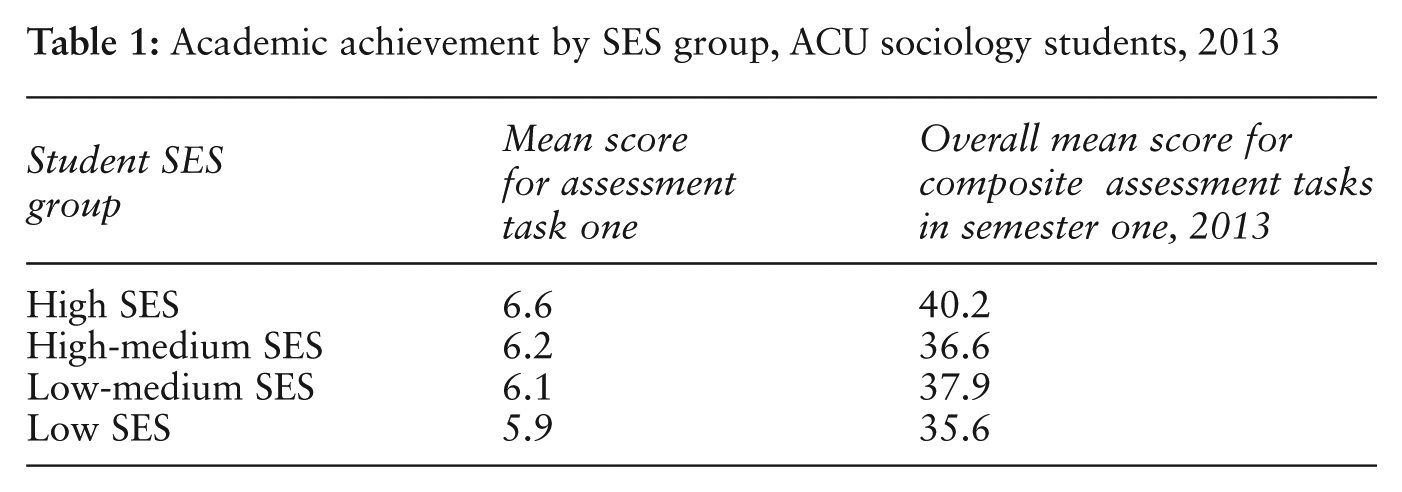
Data presented in Table 1 show a linear association between SES and academic achievement with high SES students achieving higher (composite) end-of-semester scores than low SES students. Here, it is notable that low-medium SES students achieved relatively high end-of-semester assessment scores than for assessment task one at the beginning of the semester.
Academic achievement by SES group, ACU sociology students, 2013
Furthermore, in order to assess our contribution to ‘growing’ cultural capital, ‘academic achievement’ was associated with four items from a ‘reading engagement’ survey administered within ethics approval for an ‘ACU first-year at university project’. As a crude measure of cultural capital, the items in the reading engagement survey assess attitudes to, and orientation to reading. While the results from this survey will be reported elsewhere, notably we found a moderate association between reading and high academic achievement, also a moderate association between low academic achievement scores and reading online material only.
Critical reflection
The analyses reported in the previous section suggest that embedded academic skills work, in particular LIS, has improved academic literacy in sociology for low-medium SES students. Furthermore, library data provide clear evidence that students have become intensive users of the SOCIndex database since doing LIS, and anecdotally we have observed that students reference scholarly sources and model other features of good writing practice in their written work. We were also interested to see if embedded skills work, particularly LIS which embraces the ICT cultural capital (Tondeur et al., 2011) embodied by young students, is readily appropriated by students as a means of acquiring literary cultural capital for sociology studies. Our findings suggest that this has occurred for some students, and the majority of students reviewed LIS favourably as a program which assists learning and skills acquisition, and is usable and accessible.
An important part of LIS program implementation and one which we believe eases students into a feel for the academic ‘game’ is the provision of library drop-in sessions for those students with difficulty in completing the modules. Moreover, completing LIS modules in a supervised library session ensures that students complete the modules in full and in the context of their on-campus interactions with teachers and advisers. We caution that LIS does not replace a sociology teacher and our experience, concurring with the work of Bernstein (2003), is that a formal embedded academic literacy program works best when implemented as part of an integrated teaching ‘team’.
Our evaluation data support literature linking SES and academic achievement with a notable improvement in academic achievement scores for low-medium SES students after completion of embedded academic literacy skills work in sociology. These findings are consistent with those supporting cultural mobility such as DiMaggio (1982) and Katsillis and Rubinson (1990). Our outcome evaluation data from a survey of reading engagement show that academic achievement is associated with not just SES but also cultural capital items on reading. To this end cultural capital theorists (see Gaddis, 2013: 10) suggest that students are more likely to succeed academically if they fully engage with literacy, particularly reading. We consider that providing all students with opportunities to become academically literate, and enabling this through the use of familiar technologies, has assisted in ‘growing’ students’ cultural capital. This is, in fact, essential to the rationale for ‘embedded’ academic literacy teaching. In line with this we also support linking academic literacy programs to class assessment tasks, so that even reluctant students have opportunities to fine tune their literacy.
We have noted the argument that cautions against the ‘deficit’ model of student capacity; there is also the view that student ‘diversity’ means compromising our ideas about ‘standards’. It is true that we come into teaching with a huge set of unstated expectations which are built on our own competences and cultural capital; these are on the whole a product of the ‘elite’ model of education. When we talk about ‘standards’ we are talking about an elite, middle-class, professional discourse, to which we have been inducted and which we see ourselves as having to impart to students. In the past we have not expected to make these explicit, but now we are pressured to do so. However it is possible to shift our thinking about ‘deficits’ and to open ourselves to new ways of teaching and learning, without giving up the reality of the fact that university education is in large measure about all people being able to share in the ‘know how’ which up to now has been a middle-class, elite and professional preserve.
To promote the integration of discipline-specific content with academic literacy requires a pedagogical shift in sociology, and embracing what American sociologists term a ‘teaching and learning movement’ (see Howard, 2010). By comparison, Australian sociology is only just beginning to develop a teaching and learning culture. Not everyone agrees that this is an appropriate route for sociology academics to take. The embedded literacy projects detracted from time which would have been devoted to sociology content and, for the teachers concerned, required new repertoires of knowledge and skills, as well as investments of time and energy. Some would perhaps argue also, as noted above, that we are being asked to ‘compromise’ our ‘academic standards’, and take time away from engaging with discipline content in order to become remedial academic literacy coaches. Traditionally, academics are not pedagogically trained; they are practitioners and scholars in a discipline; teaching is how the discipline’s body of knowledge and practice is interpreted to the next generation; teaching emerges from research practice. To be asked to focus on the pedagogy of academic literacy seems a ‘bridge too far’, especially since most of us have already reframed the academic content of our discipline far more stringently than we would like.
While most sociology academics, as noted, would want to promote social justice in whatever ways are available to us, and have some commitment to being good teachers, it is equally important to recognise our own limitations and the principles of work justice for intellectual workers. The work described in this article is incredibly time and labour intensive. The challenges of implementing literacy programs in sociology teaching, particularly in relation to time, are cited by at least one other team of sociologists involved in literacy initiatives (Ciabattari, 2013: 66) and we do not underestimate the importance of time in the ‘driven’ work culture of today’s universities. The problem is intensified by the growing casualisation of the academic workforce, and an environment where academic staff (especially casual and sessional staff) feel excluded from university culture.
Conclusion
While we embrace the need to embed academic literacy in sociology in our teaching, our commitment draws us, as we have argued, into broader questions highlighted in our earlier discussion about the way in which political and policy shifts shape institutional practice, and in turn, how this demands changes in our disciplinary identities.
The neoliberal project at Australian universities incorporates an ‘equity’ agenda, both in terms of building participation in higher education broadly and targeting the inclusion of specified under-represented population groups. We have noted that, along with the increased workloads and profound redefinition of roles and identities for academics as teachers, researchers and administrators, academic literacy as well as other aspects of cultural capital among students has become a ‘centre stage’ issue in our daily work. Most sociology academics will have some commitment to the broader equity agenda (while perhaps critiquing some of its premises and the neoliberal project generally). Most sociology academics also want to promote ‘inclusive’ curricula and pedagogy, also in the interests of social justice. Our work has focused on helping students improve cultural capital through improving academic literacy, and this will include students from low SES groups, notwithstanding the fact that, as we have noted, the issue of ‘academic literacy’ should not be considered primarily an SES issue.
To conclude then, we would argue that the types of projects undertaken at our university, because they have demonstrated success in their goals, should become an integral part of sociology teaching and, to this end, the development of a teaching and learning culture in Australian sociology is desirable. It will not be everyone’s favoured area, but could take its place as a specialisation and would find its way into other academics’ work practice as needed.
It is clear, however, that there are structural and practical issues about ‘reskilling’ which would need to be addressed in view of the already unmanageable loads for many university staff. We also stress that this issue takes us to the heart of the tensions between old and new roles of universities and academics, in relation to the demands of teaching an increasingly large and diverse student population. The outcomes of these tensions are difficult to predict and may indicate a further restructuring of the higher education system, with, for example, a division of labour between teaching-focused and research-focused staff, and between undergraduate and graduate teaching institutions. But in the meantime we have the task of addressing in our teaching the needs of our students. In our sociology teaching we would argue that such an approach means incorporating academic literacy into the sociology curriculum, and making it part of the content with scheduled lecture and tutorial sessions, and furthermore embedding the ‘skills’ part of this work in sociology content and knowledge.
Footnotes
Funding
This research received no specific grant from any funding agency in the public, commercial, or not-for-profit sectors.