



Abstract
Many studies have examined issues of youth and public spaces; however, less attention has been devoted to seniors and their navigation and experience of community spaces, particularly in relation to their sense of inclusion in, or exclusion from, consumptive spaces. This article explores the everyday experiences of seniors in four Australian shopping centres, two in Melbourne and two in Hobart. Based on a survey of 260 seniors (the majority aged 75 years or more), respondents’ perceptions of this environment are considered, including the reasons for visiting the shopping centre, and the challenges of accessing and negotiating the shopping centre ‘terrain’. The research findings indicate that how seniors engage with and navigate the shopping centre is influenced not only by the nature of the space itself, but also by their personal historical and cultural experiences. Where and why seniors choose to ‘hang out’ in shopping centres has implications for research into the social landscapes of ageing, along with public policy and shopping centre procedures. There is a need to consider both the social and physical well-being of older people in the shopping centre locus, and to take positive steps towards improving and enhancing their experience in an environment that is often used to provide a range of experiences that go beyond mere ‘retail therapy’.
While ostensibly designed as a ‘commercial’ space, the contemporary shopping centre is much more than this – it is a crucial nodal point for many different types of community activities beyond consumption. Older people from diverse social backgrounds use mall and shopping centre spaces in a multitude of different ways, including the simple pleasures associated with sitting and ‘doing nothing’ (Lloyd and Auld, 2003; White, 2007). This article reports on research that examines how seniors use and experience shopping centres. Description and analysis of seniors in shopping centres offers insight into the daily lives of older people, including the negotiation of consumptive spaces along with their individual and social negotiation of the terrain of ageing. It also highlights the issues and concerns specific to this section of the population that social scientists, shopping centre managers and urban planners should be aware of in developing suitable site amenities and avenues for social participation.
Ageing, social space and commodification
The shopping centre has evolved over time into a key commercial and social institution of late modernity. What happens within the context of the shopping ‘experience’ (such as the dynamics of consumer shopping patterns), how different people use or ‘inhabit’ shopping centres (the types and extent of activities they engage in) and how ‘community’ is socially constructed within these public spaces (for example, in accordance with a particular consumerist ethos) have attracted considerable scholarly attention (see, for example, Bloch et al., 1994; Myers and Lumbers, 2008; Piacentini et al., 2001; Voyce, 2006). Likewise, the regulation of shopping centres, and public spaces more generally, has been of considerable interest to those concerned with issues of security, crime, citizenship and social control (Staeheli and Mitchell, 2006; White, 2012). An extensive literature exists that critiques shopping centres and malls (on account of their consumerist ideology, for example), as well as analysing the social, economic and environmental dimensions of life within such places (including issues pertaining to social exclusion). Our intent in this article is not to repeat these criticisms and insights. Rather, it is to consider the specific dynamics of shopping centre use amongst older people and the practical issues and dilemmas that arise from this.
As significant sites of mass public space, shopping centres and malls have become important community meeting places. They involve a wide range of users (for example, different age groups, from different socio-economic and cultural backgrounds) and uses (such as buyers, sellers, places to ‘people watch’). This is well recognised not only in the literature but also by shopping centre owners and managers. For some, the challenges and benefits offered by the shopping centre are intertwined with a wider social project of community engagement, the impetus for which stems in part from the variety of users and uses already evident.
In acknowledging the multiple users and uses of shopping centres, researchers and practitioners around Australia have begun to adopt innovative approaches, premised on the idea that creating a positive social environment is more conducive to improved community–shopping centre relations than, for example, enforcing strict security measures or aiming for an exclusive customer profile. The basic principles of this type of management strategy are social inclusion, safe spaces, and community participation in regulation. In this sense, shopping centres are viewed as ‘community spaces’ that emphasise ‘social inclusion’ rather than exclusion of any particular social group. Further, these consumptive spaces are managed to create a physical environment that provides for a convivial atmosphere and a strong sense of safety and comfort for all patrons and users. Finally, innovation in management styles, has led to increased community participation that involves a range of input from community members as well as those directly associated with the shopping centre (White et al., 2001).
These approaches to shopping centre management and the regulation of these types of social spaces reflect wider changes occurring in other ageing landscapes, especially the residential terrain (Hanson, 2001). Rather than adapt to the changing social and demographic needs of communities on an ad hoc, special needs basis, Hanson (2001: 33) advocates a macro-approach that ‘starts from the assumption that accessibility is a right for everyone’. This requires that public and private spaces are designed for the specific age-related needs of most users. Recent studies on local neighbourhood environments and older people, for example, explore the specific requirements that make a neighbourhood that is activity-friendly for seniors, such as physical amenities (like park benches) and social opportunities (such as having forums within which to interact with others) (Day, 2010; Lockett et al., 2005).
Assumptions are sometimes made that older people engage in activities in public spaces in more defined, restrictive ways than young people, that their only identification is as ‘consumers’, and that somehow older people are relatively homogeneous as users of public space. However, as various research studies have demonstrated, the meaning of ‘shopping’ varies greatly in terms of motivation, experience, emotion and satisfaction (Tauber, 1972; Weinblatt et al., 2000). Indeed, going to the supermarket does not necessarily mean the pursuit of shopping at all; it can be an activity of pure leisure that does not require purchasing anything except a cup of coffee perhaps (Novak, 2006; Weinblatt et al., 2000).
The feeling of connection, the sense of excitement and the exhilaration of being in and around others is not unique to young people (Gilleard and Higgs 2005; Scharf and Smith 2004; Phillipson et al., 1998). Part of what makes public spaces such as shopping centres so attractive is the sheer diversity of people, and activities, within them (Warpole and Greenhalgh, 1996; Degen et al., 2008). ‘People watching’ is a pastime keenly engaged in by many, and it requires little in the way of money or action to do so. What we watch however, are those with whom we have relatively little or no direct contact except when we venture into the commercial cathedrals of contemporary capitalism. As such, older people, just as the young, are active creators of social networks in consumption-mediated spaces such as shopping centres.
The ways in which older people use shopping centre spaces are bound up with considerations of the physical, social and regulatory environment of such places. The overall environment will either facilitate or discourage seniors in using these social spaces, and will largely determine the kinds of activities available. Older people’s perceptions of the shopping centre are determined by factors such as whether it is easy to access, safe, comfortable and enjoyable. These factors are social in nature, and dependent upon the architecture of the public space. Conversely, due to individual health problems or frailty, some older people are particularly sensitive to the physical environment. Specific categories of older people, such as seniors with dementia for example, have special needs and may experience shopping centres as places that are inhospitable because they are disorienting, difficult to interpret and navigate, threatening or distressing (Blackman et al., 2003). Issues of access and comfort are especially acute for these populations of seniors.
The vast majority of seniors, however, are not in poor health. Most are also ‘health- and/or time-rich’ and therefore their definition of ‘convenience’ shopping varies considerably from the sort of convenience shopping sought by their ‘time-poor’ counterparts (White et al., 2001); although the shopping experience will nonetheless be mediated by personal preference and the heterogeneity of the ‘mature market’ (Myers and Lumbers, 2008). For these users of public space, the key issues revolve around the kind of environments most likely to foster convivial relationships, places where they can meet up with friends and family, find protection from the elements, and generally ‘hang out’. For this, they need venues that are centrally located, on or near major transport routes, and that are perceived to be interesting, exciting, welcoming and safe. The overall environment will also most certainly shape the specific occupation of ‘hanging out’, and the emotions that older people experience in different locations (see Degen and Rose, 2012; Degen et al., 2008; Williams et al., 2001).
In contrast to the view that medical or physical disabilities limit or place barriers on the participation of older people in consumptive spaces, Goldsmith argues that a lack of critical awareness about the varying uses and/or users has led to some people being disabled architecturally (cited in Hanson, 2001: 30). Architectural disability can be a factor in participation when the design and construction of spaces give rise to ‘hazards and barriers that make the built environment inconvenient, uncomfortable or unsafe for everyone to use, and may even prevent some people from using it at all’ (Hanson, 2001: 30; see also Day, 2010). Combatting architectural disability (Goldsmith, 1997, cited in Hanson, 2001) requires more extensive knowledge about the ways in which particular spaces are used by people across their individual life course, and as a consequence of their social characteristics. Equally, as Blaikie (2005) suggests, it requires us, ‘the un-aged’, to consider the social geography of a landscape to which we are only visitors. This means we must become critically aware of the ways that our view of ageing divides the social terrain not only in terms of actual experiences (access etc.) but also our ability to only partially imagine the contours of the geography of the third and fourth ages. In the following discussion, the conceptualisation of consumptive spaces and ageing is provided as a means to frame the research study discussed in this article.
Commercial interests, consumptive practices and communities of interest
As Phillipson et al. (1998) in the UK and Estes (1993) in the USA have documented, over the last 40 years the ageing population ‘problem’ has been addressed primarily through a neoliberal discourse of individual responsibility. At the same time, the ageing process itself has been subject to market economics, especially in relation to health care and income security. The issue of economic vulnerability in the third and fourth ages continues to dominate the critical social gerontology agenda (Aberdeen and Bye, 2011; Asquith, 2009). In relation to consumptive spaces – as opposed to consumptive capacities more generally (see for example, Scharf and Smith, 2004) – however, there has been little discussion of the conflicts that emerge between commercial interests, social spaces and communities of interest.
In particular, there is a need to question whether older people from different social backgrounds have the financial capacity (and, perhaps, as a consequence, social rights) to inhabit ‘commercial’ spaces such as shopping centres and malls (particularly, if homeless or destitute). Further, there are temporal dimensions to the efficacy of habitation, such as whether the length of time, time of day, or day of week in which they occupy such spaces lead to perceptions of ‘over-staying their welcome’ on the part of shopping centre managers and security staff in such places. Cultural differences in how diverse ethnic groups perceive and use public spaces (as a place for shopping, socialising, or multiple and varied uses depending upon the day, time and occasion) are also important to consider. What is of research interest is whether the social environment is restrictive or whether it allows for open access to a wide variety of potential participants. Likewise, a broad range of activities – recreation, leisure, exercise, meeting people, hanging out, employment, buying things – may be evident. Conversely, the tension between commercial interests and non-commercial occupations may result in a more narrow range of activities; ones that are more squarely linked to the consumptive process itself.
Architectural disability, physical disability and participation
The physical trappings of particular sites – including such things as lighting, clear or obscured sight lines, availability of ramps, locations of toilets and presence of surveillance cameras – contribute to feelings of safety. The presence of hazards (such as high kerbs, large shop displays and heavy traffic), particularly in regards to perceived walkability, can likewise influence the sense of well-being (see Day, 2010). It is expected, additionally, that the style and nature of security provision will influence perceptions and behaviour. Indeed, travel to and through specific social spaces is partly dictated by perceptions of safety, and how best to avoid these spaces if they are considered unsafe.
Nevertheless, the ambiguities of public space are such that some kind of ‘creative tension’ at the street level in terms of unusual people and unusual happenings is itself a source of pleasure for many people. In some cases, particular categories of older people are themselves perceived to be problematic from the point of view of inclusion, because of begging and drinking behaviour, and homelessness. Further, people vary greatly in terms of physical and mental health, and certain health-related problems associated with the ageing process (for example, relating to eye-sight, or general mobility) can impact upon the ability of people to access and use certain spaces. Again, in addition to safety considerations, the architecture and design of public spaces needs to be investigated so as to ascertain optimal models for social inclusion. Environmental factors might also include efforts to make people of varying ages comfortable through provision of certain types of music, provision of adequate seating, bold signage, stable floors and appropriate lighting. Thus the physical and social setting may be crucial to whether or not older people will feel comfortable in utilising mass public spaces, and what kinds of activities are available to them if they do so. Walking practices, for example, tend to vary according to specific built environment (Degen and Rose, 2012), and this has important implications for the bodily mobility of the elderly in different settings.
Social exclusion, social citizenship and social space
The terms ‘inclusion’ and ‘exclusion’ have come to dominate the social and public policy agenda. Yet what is meant by each of these terms – let alone the best mechanisms through which to remedy the disadvantage stemming from exclusion – continue to be the subject of intense debate. In terms of the human rights agenda posited by Hanson (2001), Scharf and Smith’s (2004) framework for operationalising exclusion best captures the dimensions of the social process. They adapt Burchardt et al.’s (1999, cited in Scharf and Smith, 2004: 164) five domains of social exclusion to account for the age-specific characteristics of consumption activity, savings activity, production activity, political activity and social activity. This approach accounts for the ways in which each of the activities changes in the third and fourth ages, and enables us to clearly link the individual ageing process to a range of social and consumptive practices, which, in general literature about exclusion, are central to social citizenship and, as a consequence, the use of social spaces such as shopping centres.
How and where older people ‘hang out’ is largely a matter of social justice, which ultimately pertains to how we as a society deal with issues of social disadvantage and inequality. As Day (2010) emphasises, environmental justice must also consider age as a significant factor along with other socio-demographic signifiers such as race and class. This means that the ways by which older people can be excluded from and within urban environments (and, for present purposes, shopping centres) are indeed pertinent to social justice. From the point of view of the regulatory environment, the specific protocols guiding security and police service interventions, as well as the physical infrastructure itself, have a major bearing on how diverse groups of older people feel about consumptive spaces, and how they imagine their use of these spaces.
It comes as no surprise that, despite extensive research into notions of ‘ageing in place’, and ‘ageing and place’ (and therefore, belonging), few studies have imagined that consumptive spaces are worthy of analysis in terms of the social geography of ageing (where studies have been undertaken, these have generally concentrated on developing typologies of the elderly as ‘shoppers’). Homes, neighbourhoods, workplaces, even communities are the focus of this work. While the general trope of postmodernity is one of a transition from production to consumption, this does not appear to apply to the everyday practices of those in their third and fourth ages (except in the rare cases of rich superannuants and world cruises, or, conversely, the more common, age-specific consumption of commodities such as health care). Just as developed nations such as Australia find themselves deeply embedded in a changing global economic process, they also find themselves in the midst of a transformative demographic process. Yet the landscapes of ageing imagined to date have yet to include consumptive spaces such as shopping centres.
Importantly, the relevance of innovative building design and management strategies for older people has yet to be determined by research into the actual experiences of seniors in shopping centres. Such research can provide a platform upon which to develop policies best suited to the particular needs and interests of older people, while simultaneously building universally accessible social spaces. There is a need to audit just how and under what circumstances older people from many different backgrounds use public spaces, and to map the environmental aspects that dictate the use of that space. Allied with these tasks is the vital importance of identifying those values and principles that should inform public policy in this area.
Seniors and shopping centres: the research design
This project aimed to explore the way older people utilise community public spaces. The project was specifically concerned with examining community relationships in significant sites of mass public space such as shopping centres and malls, and was meant to draw on the extensive and heterogeneous lived experiences of seniors. The project was essentially a pilot study, providing an opportunity to scope key issues and developments relating to the use of shopping centres by seniors, and the response of shopping centre managers (and other personnel) to emergent needs in this area. It is hoped that the project will facilitate the future development of guidelines for developing a ‘seniors friendly’ approach to the management and development of community public spaces.
Research for this project was undertaken in four shopping centres and malls in Melbourne and Hobart. The research methods used for this project resemble the methodology utilised in a similar youth and public space project conducted in 2000 (White et al., 2001). Our experience in research of this kind is that a low-key, friendly and casual approach to the research makes it inviting for everyone concerned, and that a grounded approach of this nature encourages people to participate. The research was conducted in the shopping centre environment, with a contact point that was visible but not intrusive. Participants were encouraged to have their say in ways that made sense to them and with which they were most comfortable. Some completed surveys themselves, others participated in a guided completion of the survey, others still just wanted to talk. In the case of the latter participants, notes were taken and later transcribed into the known variables of the survey. Two hundred and sixty people completed the survey.
The research team (including two in their mid-60s) visited each site at least twice. Observations were carried out at each site vis-a-vis general social dynamics, physical layout and design, transportation and parking, and the participation of older people. Discussions were held with centre management at each shopping centre about services, facilities and issues pertaining to older patrons. Research diaries were kept to document these site visits and meetings.
Surveys were carried out at each site through proactive approaches to a wide variety of people, usually where they were sitting, standing or walking. The interviewers were identified with name tags stating that they were from the University of Tasmania, and overt permission was granted by senior management at each site to undertake the survey. Security officers were notified about the activities of the survey team ahead of time.
Spending time at the shopping centre
For many older people it is the ordinary pleasures associated with public space use (for example, the development of human relationships and social networks, and engagement in non-commercial activities) that attract them to consumptive spaces such as shopping centres and malls. This is confirmed in the results of our survey in the four different shopping centres.
Research sites
Discrete observation of seniors at the four shopping centres divulged much in the way of the diverse nature of their ‘comings and goings’.
Hobart shopping centre # 1
This was a two-storey shopping centre that is a regional centre for people living on Hobart’s Eastern shore. In this shopping centre, the feelings of welcome and comfort were very much determined by the response of centre management to concerns (mainly relating to mobility both inside and outside of the centre, and lack of appropriate seating inside and outside of shops within the centre) with an attitude identified by some as dismissive. Some seniors engaged in ‘people watching’ said that they were sometimes asked to ‘move on’. Mostly seniors were there to shop, occasionally enjoying socialising with friends and family.
Hobart shopping centre #2
This was a single-storey shopping centre that caters to people in a defined geographical area in a modest- to low-income area. The seniors at this shopping centre displayed an interest in the ‘politics’ of who owned the various shops, some expressing concern that ‘Priceline’ was American-owned. They were generally proud of the shopping centre and spoke in positive terms about its importance as a gathering spot to meet up with ‘mates’. The space was akin to a community hub, with some describing it as ‘alive’ (stimulating) and a corporeal part of their everyday lives.
Melbourne shopping centre #3
This is a large, two-storey regional shopping centre that services a number of neighbourhoods in the northern suburbs of Melbourne. This was an undercover, climate-controlled space (distinctive because of its ‘whiteness’ – ceilings, walls, chairs, tables, lights) which presented images of seniors drinking coffee (either alone as they ‘people watched’, or with family and/or friends), shopping for sundry items such as bread and milk, or engaging in a family outing. The lack of complaint about most aspects of the shopping centre was a noticeable feature.
Melbourne shopping centre #4
This is an outdoor market area that provides for mainly food shopping in a northern suburb of Melbourne. The open air atmosphere of the Melbourne market revealed clues as to the different ethnicities and dynamics of this space, illustrated by five men of Polish origin sitting together and talking (having recently completed a game of cards). The seniors tended to be culturally varied, with close relationships between stallholders and their customers, largely based on ethnic backgrounds and special foods unobtainable elsewhere. A significant feature of discussions with seniors here was their lack of complaint, even with regard to the physical attributes of the market that could have been considered disadvantageous (for example, uneven surfaces underfoot).
Results
As can be seen in Table 1, aside from shopping itself, and despite small variations in responses, the participants generally identified social activities – such as meeting family and friends, going to a movie, people watching and sharing a meal or hot drink – as key reasons for going to the shopping centre. The varied purposes for being at the shopping centre are shown in Table 1. These are not ‘secondary’ activities. Rather, they indicate that the shopping centre is a prime site for interaction, communication and social outings. As noted by others (Degen et al., 2008), consumption, as consumption, plays a much smaller role in shopping centres than some commentators would have us believe.
Purpose for being at the shopping centre.
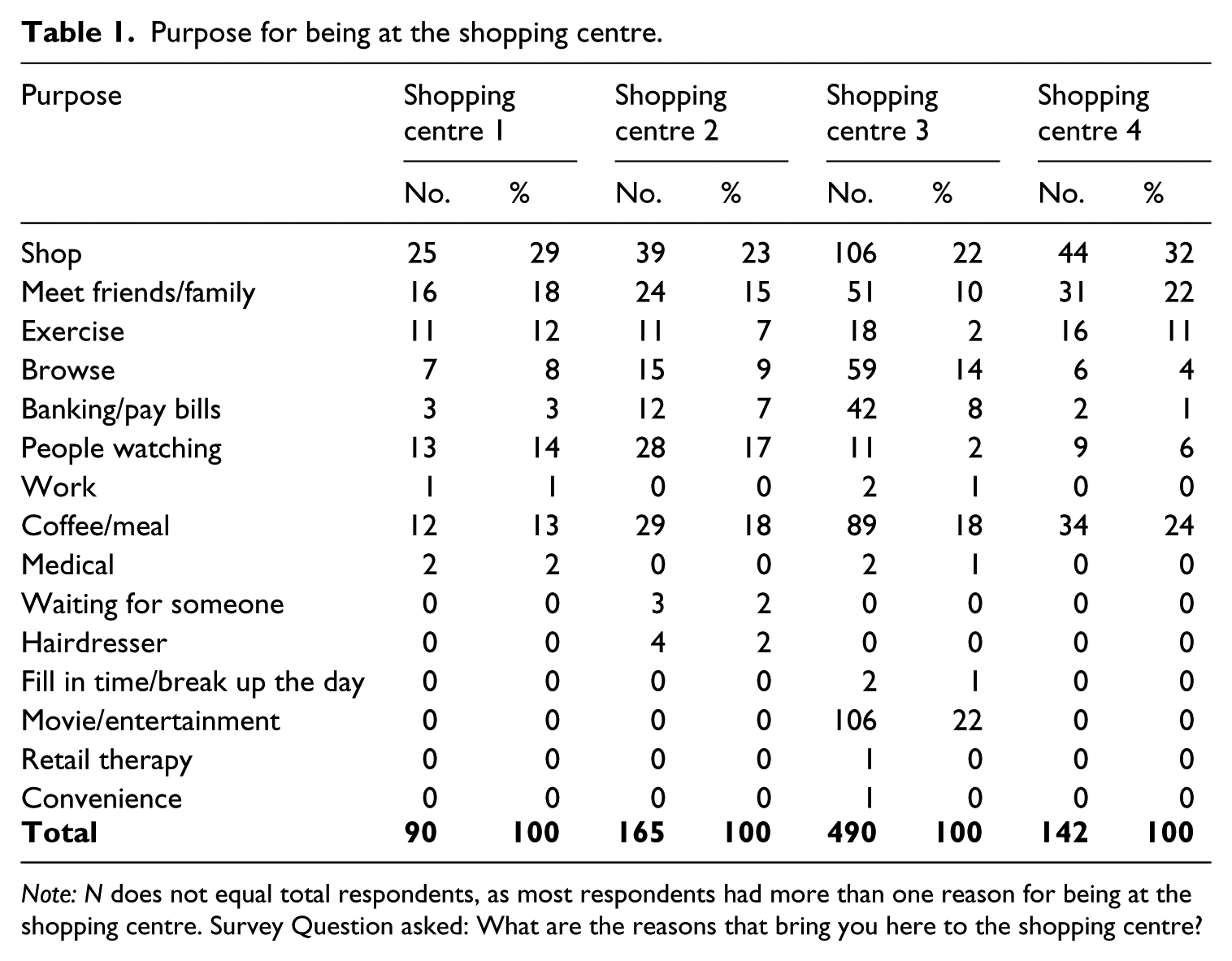
Note: N does not equal total respondents, as most respondents had more than one reason for being at the shopping centre. Survey Question asked: What are the reasons that bring you here to the shopping centre?
Physical exclusion
The majority of respondents found the general amenities to be good. However, across all sites similar concerns were raised, all of which had to do with mobility in one form or another. Mobility refers both to how respondents get to the shopping centre (the majority utilised cars as the main mode of transport), and how they travel about within the shopping centre (a significant proportion of respondents reported moderate or limited levels of mobility, and some people were physically impaired). The main issues raised by respondents highlighted the distinction made by Goldsmith (cited in Hanson 2001) between physical or medical disability and architectural disability. For most respondents, the key issues related to car parking, floors, seating, and escalators (Table 2).
Key issues for older people in shopping centres.
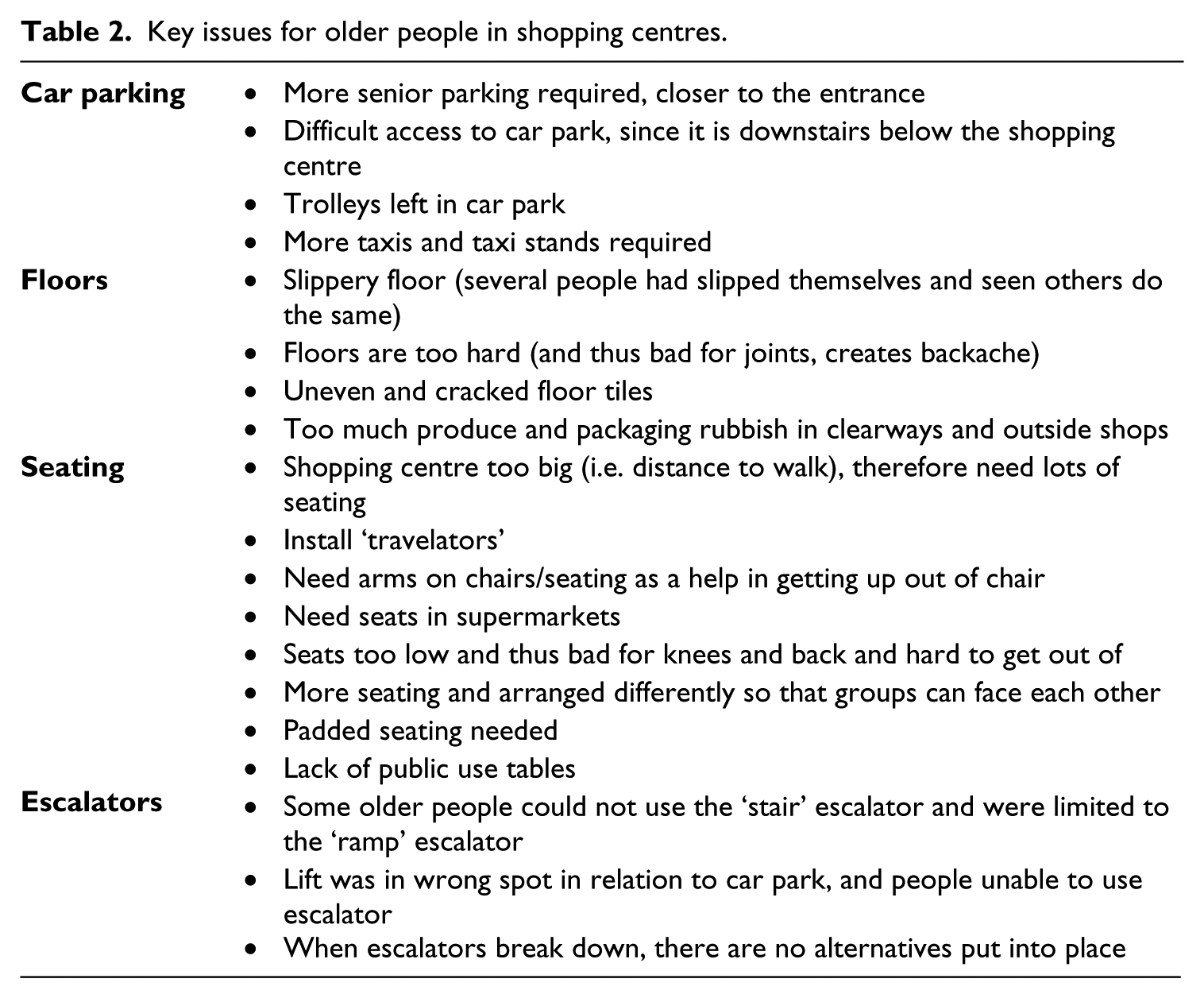
These issues are by no means new or unique, as indicated in recent work on urban design and architecture as these pertain to older people’s uses of public (Burton and Mitchell, 2006: 145) and residential space (Hanson, 2001).
Social inclusion
In contrast to the popular representation of older people as fearful of young people, when asked, respondents said that were not afraid and that young people were not a problem (one commented that the teenagers are their grandchildren). However, several people referred to having their handbag stolen and hearing of other friends who had suffered the same. Generally though, security was seen to be good and safety and comfort issues had more to do with physical aspects of the amenity and the attitude of staff towards them as users of the space. Some of the respondents commented that they prefer to be in the shopping centre when there were no crowds or when it was less crowded. For example, one participant in the research said s/he had learned to leave the centre before school ends. This strategy accords with Day’s (2010: 2667) observation that older people segregate themselves in time, not space. This is due to a variety of reasons such as enjoying the relative peace and quiet of the early morning through to being in the shopping centre at a time when they are most likely to run into their peers. Respondents indicated that there were two key issues relevant to their feelings of welcome and safety. Beyond the provision of public use tables and seating, participants identified the type of management and service, and signage to be important in feeling included in this social space.
Importance of type of management and signage.
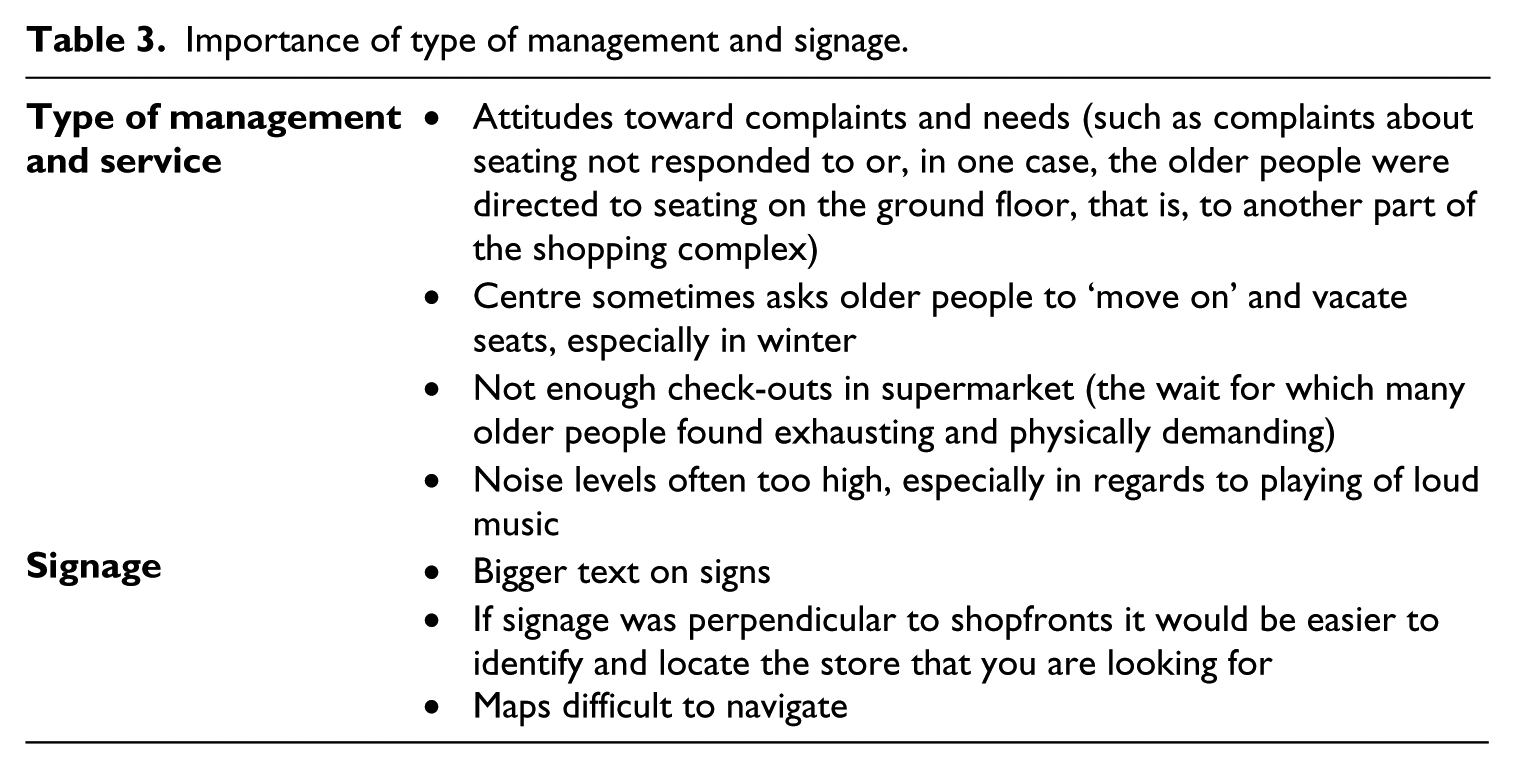
Feelings of being welcome and being comfortable in the centre were determined by the attention of centre management to issues such as enhancing mobility, initiating seniors’ clubs and seniors’ activity days, ensuring meaningful and well publicised seniors’ discounts, and generally listening to what older people had to say (whether this was in the form of a complaint, or consisted of advice about how to improve things, such as providing a public TV or other entertainment in the complex). Activities such as safety walks (walks organised at the centre before opening its doors to the public), can also contribute to the sense of community.
Conclusion
This study has found that the consumptive space of shopping centres were used for a wide variety of activities, many of which are not related to consumption or the commercial activity of the centres as such. Common problems experienced by older people in shopping centres included difficulties of getting to and getting around the shopping centre, due to things such as inadequate parking, the size of the shopping complex, slippery floors and poor seating arrangements. Further, feeling welcome and safe in the shopping centre environment is greatly shaped by centre management’s acknowledgement of seniors as a specific group with specific needs. Social disadvantage related to public space is not reducible, then, simply to a matter of inconvenience. Inclusive or exclusive policies and practices are constructed through the interplay of physical elements, staff–patron relations, and wider social interactions within the shopping centre environs.
Positive ageing as a concept provides a useful framework within which to consider things such as where seniors ‘hang out’ and the issues associated with this use of social space. However, as Asquith (2009) and Aberdeen and Bye (2011) point out, while positive ageing as a principle may appear to be progressive, how it is given life in policy and practice can create great schisms in the individual and social experiences of ageing. For a future planning and research agenda, the goal should be to construct positive community spaces that are comfortable, secure, interesting and socially inclusive. The basic principles of such an agenda ought to be based on social inclusion (diversity is good) and safety and security for everyone. At a policy level, this can best be achieved through active participation of seniors, as public space consumers, in the planning and design of consumptive spaces. It can also be assisted by the creation of senior-friendly and elderly-friendly spaces within shopping centres (based upon notions of age-related ‘difference’ rather than ‘exclusion’). In the end, the pleasures and enjoyment of community, and of community spaces, rest upon a foundation of social diversity and on the availability of many different ways to access and occupy such spaces.
An important aspect of any research and policy development in this area is to challenge stereotypical notions of seniors and the elderly in regards to how they occupy public spaces. In Blaikie’s (2005) terms, this would involve us opening our minds to the contours of the ageing landscape despite being only visitors to that ‘foreign land’. There is also a need to acknowledge the notion of interdependence across generations, cultures, families and communities. Social relationships in consumptive spaces, as this study has shown, are important to the practices of social citizenship in a late-modern consumption economy. Our research also reinforces the idea that attention has to be given to how older people actually experience particular spaces rather than assuming the effects of these on their behaviour and sense of place (see also Degen and Rose, 2012). One of the most unattractive and physically difficult sites to navigate in our study, for instance, was nonetheless experienced as convivial and inviting by its elderly users, due to its ethno-cultural inclusiveness.
Generally speaking, shopping centre proprietors are principally concerned with retail mix, rental returns and efficient customer movements to and from their retail outlets. Sometimes this can lead to an overall disregard for tangential pursuits, such as the development of human relationships and social networks, and engagement in non-commercial occupations. For many older people, it is the latter reasons which attract them to public spaces such as shopping centres and malls. As such, the use of shopping centres by seniors, and the response of shopping centre managers (and other personnel) to emergent needs in this area, are issues worthy of consideration. Such analysis, for example, may well facilitate the development of guidelines for developing a ‘seniors friendly’ approach to the organisation and development of community public spaces.
Participation in events at shopping centres, or in activities associated with shopping centre life, can be an important way for older people to improve social connection and thereby diminish social isolation and loneliness, which in turn has major implications for health and well-being (Cox, 2006; Lewis, 1990; Office of the Deputy Prime Minister, 2006). This research supports the notion that, in western societies, the shopping centre is a major site for group interaction for young and old alike; in this respect, then, its role in social life is more than consumptive. It is also about social ritual, congregation, meeting up with friends and family, recreation, entertainment and simply ‘hanging out’ (Degen et al., 2008; Lewis, 1990; Rudman, 2005; White, 2007). It also highlights a clear message to shopping centre managers: be aware of and take into consideration the needs and wishes of their older clients for they too deserve a place and role within consumptive and social practices. For centre managers, the key issue is to understand why some seniors come to their shopping centres and others do not, and also what they do there when they do come in (see Myers and Lumbers, 2008). A community-orientation to public space issues generally, and shopping centre management specifically, is one that builds upon the idea that fostering positive social relationships is the key to safe, secure and healthy relations and practices at an everyday level.
Footnotes
Funding
This paper is based on research funded by the Australian National Seniors Productive Ageing Centre. Particular thanks and acknowledgement goes to Bill Kosky for his many insights into research design and interpreting contexts and results.