



Abstract
In this article we review migration policies that have evolved in the eastern neighbourhood of the European Union, that is, in Russia and the Commonwealth of Independent States. We ask how they compare with those that have been adopted by European Union member states and migrant settler countries such as Australia. We also use this regional perspective to comment on the application of the systems methodology in migration studies.
Keywords
This special issue of the Journal of Sociology is largely concerned with comparisons between migration management and migrant settlement policies of ‘new world’ immigrant settler countries such as Australia and ‘old world’ Europe, once the source of mass emigration but relatively recent attractor of large-scale immigration. In this article we focus on the eastern neighbourhood of the European Union (EU), in particular on the Russian Federation (RF), other member states of the Commonwealth of Independent States (CIS) 1 – a loose community of former Soviet republics that emerged from the ashes of USSR – and Georgia.
The eastern neighbourhood of the EU is an area of contested influence between the RF, which hopes to retain and consolidate its regional hegemony, and the EU, which since the late 1990s has tried to forge closer relations with countries that were once republics of the USSR, especially Armenia, Azerbaijan, Belarus, Georgia, Moldova and Ukraine. 2 At the time of writing, however, Ukraine and Armenia, under pressure from Moscow, declined to sign the EU-drafted (bilateral) Association Agreements, while Moldova and Georgia gave a preliminary nod. It is feared that Russia could apply economic and political pressure to deter CIS member states from forging very close links with the EU, and to thwart the EU membership aspirations of some states (CEPS, 2013).
One way that Russia could lean on potential recalcitrants is to tighten its immigration policy, that is, make it difficult for their nationals to work and/or settle in the RF, which is currently one of the main destinations for regional labour migrants. In particular, Russia could send home tens of thousands of illegal workers. This is a serious threat for many CIS nations as migration to the RF has been a vent for surplus labour at home and a significant source of migrant remittances. Russia and, more recently, Kazakhstan attract most of those seeking new opportunities for work and/or settlement in the region, while other CIS countries have experienced significant migrant outflows (Abazov, 2009; Chudinovskikh, 2012; and Chudinovskikh and Denisenko, 2013; Heleniak, 2012; Ivakhnyuk, 2008). The eastern corridor for irregular migrants from Asia and Africa entering the EU also runs through this region. Thus, migration-related challenges are as important to the east of the EU as they are along its Mediterranean borders.
It has been argued that these CIS-centred migration flows form a distinct Eurasian migration system, which operates in parallel to that centred on the EU (Ivakhnyuk, 2003, 2008). Thus, we ask in this article in what sense the CIS represents a multinational migration system and, if so, what kind of system?
To address this question, the following section briefly reviews the ‘systems approach’ as applied to migration phenomena. We argue that the systems methodology used in migration literature treats migration systems somewhat mechanically as statistically robust clusters of migration corridors between countries, differentiated from other migration corridors mostly in terms of the scale, direction and persistence of migrant movements over time. However, this quantitative (statistical) approach tends to overlook the importance of nation-states and extra-national bodies such as the EU or the CIS as entities controlling movements of people through their borders and, in particular, determining the terms of migrant entry and settlement. Small-scale activity along migration corridors may not only reflect the weakness of push and pull forces driving cross-border migrants but also the ability of sending and/or destination countries to impede people’s mobility. In our view, the systems approach to international migration should also account for institutional factors that influence the scale, scope and direction of cross-border mobility, and determine the terms of migrant departure, arrival and settlement. In this regard we support Bakewell’s criticism that the conventional systems methodology applied in migration studies has paid scant attention to (system) initial conditions, internal mechanics, feedback loops, institutional components and migrant agency (Bakewell, 2013).
From the institutional perspective, each sovereign state (whether an origin or destination country) can be represented as a uni-national migration system while groups of countries may form multinational migration systems should they choose to manage migrant mobility and integration jointly rather than separately. A multinational system may therefore refer to a cluster of migrant corridors that are jointly managed by the states concerned, even if migrant flows along these corridors are small and/or intermittent. As the purpose of this special issue of the Journal of Sociology is to reflect on differences between nation-states and multinational entities in the way they manage migrant mobility and integration, we also outline a simple framework to make such comparisons possible.
In the third section we ask in what sense CIS member states comprise a multinational Eurasian migration system that operates parallel to the EU-centred European system. While each CIS member state, and Russia in particular, can be represented as a uni-national migration system, in what way, if any, do these countries jointly form a multinational migration system?
Systems approach
The ‘systemic thinking’ or ‘systems approach’ goes back to von Bertalanffy’s General Systems Theory (GST) (von Bertalanffy, 1950, 1968; see also Chisholm, 1967; Mesarović, 1964). In a nutshell: The method proposed by systems theory is to model complex entities created by the multiple interaction of components by abstracting from certain details of structure and component, and concentrating on the dynamics that define the characteristic functions, properties, and relationships that are internal or external to the system.… In its broadest conception, a ‘system’ may be described as a complex of interacting components together with the relationships among them that permit the identification of a boundary-maintaining entity or process. (Laszlo and Krippner, 1998: 48)
Initially, the GST was applied to self-regulating or self-correcting phenomena as found in nature. In many such applications, there is regulatory feedback which takes the form of a mechanism correcting deviations from the system’s equilibrium state (homeostasis). Thus, human migration can be represented as a feedback/adaptive mechanism with people responding to pull/push incentives to move (e.g. Simmons and Guengant, 1992). Another approach is to view migrant flows as systems where, for example, nation-states are represented as migrant departure and destination nodes connected by links representing migrant corridors. It is the latter approach that appears to dominate the migration systems literature.
Statistical approach
Mabogunje (1970) is the acknowledged originator of the systems approach to migration. His contribution was to view the rural–urban migration through the lenses of GST. Kanaroglou et al. (1986a, 1986b) and Plane (1987) applied the systems approach to international migration. While all these approaches emphasized the interrelated and dynamic nature of migration flows they were not very specific about the institutional framework within which migration movements occurred. To broaden the systems perspective, Fawcett (1989) defined international migration systems not only in terms of migration flows but also apparent links between countries that are likely to influence movements of people between them (i.e. state-to-state relations, cultural affinity, family and personal networks, migrant agency). These links also include regulatory type activities.
Kritz et al. (1992) defined migration systems as clusters of intensive (i.e. large-scale) and durable migrant activity. For countries to belong to the same migration system, they must not only forge strong migration links but also share similar levels of development, common cultural background and exhibit a degree of policy convergence. Similarly, Boutang and Papademetriou (1994: 20) defined a migration system as ‘a particular combination of types of population flows between countries of departure and arrival, perhaps extending over several generations, along with the rules regulating these flows, and their administration’.
Faist (2000) arranged links between migrant source and destination countries along a continuum from weak to strong, with only the strongest links creating conditions for migrant flows of significant magnitude to occur and form migration systems. Like Kritz et al. (1992), he defined migration systems as clusters of strong migration activity, which in turn could be explained in terms of the strength of ties between source and destination countries. Jackson and Moch (1989) convey the essence of this approach by representing migration systems as clusters of (statistically) robust links between countries, defined in terms of mass, direction and durability of migrant flows that connect two or more nation-states and involve ‘clustered moves’ between sending and receiving areas that last for a period of time and are ‘distinct from non-clustered multi-directional moves’ (Hoerder, 1999: 6).
The weakness of the statistical approach is that the system’s definition depends on arbitrary thresholds of scale and durability of migration flows, with too little attention given to initial conditions, internal mechanics, feedback loops, institutional context and migrant agency (Bakewell, 2013). For a migration system to be recognized, a minimum flow of people between origin and destination is a necessary but not a sufficient requirement, that is, at least one migration corridor must be active with flows above some threshold value.
In our view, it is also possible for a migration system to be restricted to a single nation, either a destination or source state. So a system may exist even if there is little or no movement along its migration corridors, that is, even when all potential migration corridors are inactive. For example, an oppressive migration regime may stop its nationals leaving the country and restrict/deter entry of non-nationals (e.g. North Korea).
Institutional approach
As an alternative to the statistical approach, Okólski (1994) defines the uni-national migration system as the collection of legal regulations, organizational structures and administrative procedures focused on migration-related phenomena specific to that state. He argues that the characteristics of state-specific migration systems are normally responsible for the observed diversity of migration patterns. While Okólski’s approach is not cast in GST terms, it recognizes explicitly that migration-related phenomena are regulated by states and that each sovereign nation-state can be represented as a distinct migration system focused on particular set of migrant activities, which require specific legal, organizational and administrative functionalities and institutions. This uni-national perspective could easily be broadened to include groups of countries linked by international treaties and agreements, or extra-national entities such as the EU or the CIS vested with overarching administrative and legal powers to act on behalf of member states. This is echoed by Nogle (1994), who also observes that the (multi-state) system definition is incomplete unless each country’s role in that system is well described.
In this institutional framework, strong migration ties between countries may involve joint application of border controls and repatriation arrangements to reduce/deter migrant mobility. An effective migration system may be associated with little actual movement of people. Also, it can no longer be assumed, as it was in the 1960s and 1970s, that the ‘melting pot’ effect is all that is needed for new arrivals to blend easily into the host society. Arguably, the management of migrant integration is just as important as the management of border-crossing activities. Thus, in our view, the systems approach should reflect how countries combine cross-border mobility management with migrant integration regimes.
Figure 1 provides a simple framework for charting ‘national’ differences in migration management and migrant integration. In this stylized representation, each migration system combines two institutional dimensions: the first dealing with cross-border mobility of people and the second with in-country migrant integration. In Figure 1, migration management regimes (horizontal axis) vary from weak, where the state takes a largely hands-off approach to border management, to strong, where it specifies strict conditions for migrant mobility and is capable of enforcing its border controls. In reality, most countries maintain some form of migration management, even if visa-free regimes allow people of selected nationalities temporary free entry. Similarly, many states are signatories to international conventions specifying conditions for the handling of asylum seekers and refugees, return of bogus and/or failed applicants, and so on. Thus, in our stylized representation, most developed countries cluster together as they operate broadly similar migration management regimes. 3
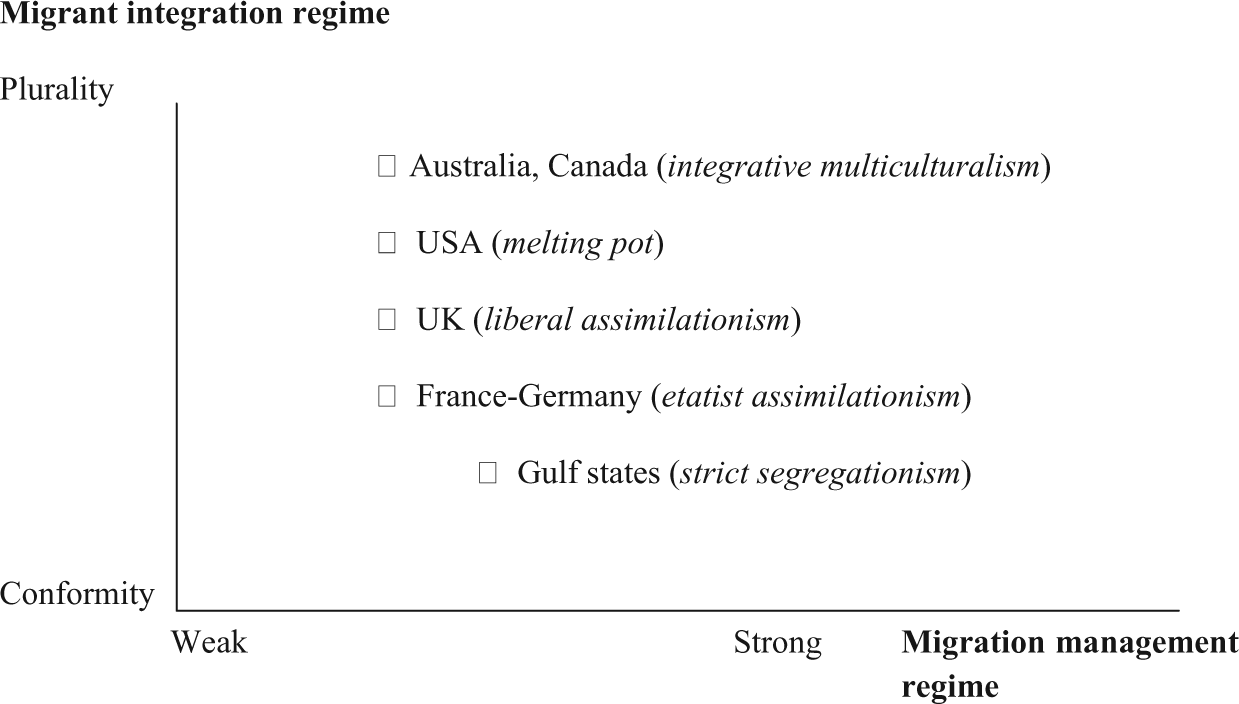
Migration management and migrant integration regimes: stylized differences between countries.
However, there is considerable diversity between states with regard to migrant integration requirements: the vertical axis in the figure representing the continuum of migrant absorption regimes ranges from demands for strict conformity to full acceptance of social plurality. As Pakulski observes elsewhere in this volume, integrationist strategies embraced by settler countries such as Australia or Canada aim at smoothing immigrant absorption into all key dimensions of integration: political, economic/occupational, social/community and cultural/lifestyle. There is considerable tolerance of distinctive values, traditions, religious beliefs, cultural identities and lifestyles. The cultivation of culturally distinct ethnic communities is, thus, regarded as legitimate and welfare-enhancing. We refer to this approach as the integrative multiculturalism.
On the other hand, integration regimes adopted by many EU member states expect migrants to blend and assimilate, even though they recognize that effective assimilation takes time and may fail. Thus, Pakulski notes, assimilationist tolerance is limited to superficial (lifestyle rather than value-normative) and temporary differences, and EU integration regimes vary mainly in terms of state involvement in the assimilation process, for example, this is less direct in the UK (liberal assimilationism) and more direct in countries such as France or Germany (etatist assimilationism). 4
In Figure 1, the US is shown as the melting pot regime, which allows for high tolerance of enduring diversity and does not expose migrants to strong assimilationist pressures but stops well short of the Australian-style integrative multiculturalism. The stylized Gulf State model is given as an example of strict segregationism, where immigrants, who account for the largest proportion of in-country population, are not allowed to settle for good and are segregated into different layers of temporal migrant community (Shah and Fargues, 2011).
Migration management and migrant integration east of the EU
The USSR was governed as a uni-national and a largely closed migration system with its people’s mobility restricted and controlled by the state both within the USSR and across its external borders (Abazov, 2009: 4). In reality, exit visas were not available to most citizens and freedom of movement of workers and residents was restricted by law. 5 Nevertheless, the volume of voluntary and forced intra-union migration was substantial. 6 In 1989, over 54 million people, 18 percent of the USSR’s population, lived outside their republics of birth (Abazov, 2009: 4).
The political and economic implosion of the USSR was followed by its dissolution in 1991 and the emergence of former Soviet republics as independent nation-states. The ensuing institutional turmoil triggered large-scale migration of people who seized the opportunity to move where they previously could not, for example, to relocate to their country of birth or titular homeland (Tishkov, 1997). There were also large-scale migrations of ethnic groups, which feared being stranded in states dominated by other ethnic groups (e.g. migration of the Russian-speaking population from Central Asia and Caucasus to Russia, Ukraine and Belarus). New nation-states also had to develop their own institutional fabric and seal their national borders.
The CIS
The CIS was founded in December 1991 when the Agreement on the Establishment of the CIS was signed by the RF, Belarus and the Ukraine. The agreement sanctioned the creation of a new commonwealth, with membership open to all ex-USSR republics and potentially other nations. It remained the main constituent document of CIS until 1994, when the CIS Charter was adopted. The latter formalized the concept of CIS membership. 7 Chapter 19 of the Charter foreshadows the free movement goods, services, capital and labour within the CIS area. However, an earlier agreement on visa-free movement of CIS nationals was signed in 1992. 8
The 1990s saw large migration flows between CIS countries. Between 1992 and 1999, the net inflow of migrants from the CIS seeking permanent residence in Russia was 3.7 million people while Kazakhstan lost over 1.236 million and Kyrgyzstan 242,000 (Chudinovskikh and Denisenko, 2013). Significant imbalances in migrant flows between CIS countries continued in the 2000s. Russia’s net gain from the rest of the CIS was over 1.821 million people, but its net deficit with non-CIS countries was 257,000. Belarus gained 92,000 net from the rest of CIS. Other CIS countries and Georgia had negative net balances with the CIS region (Ukraine 523,000), and mostly negative net balances with non-CIS countries. Overall, the number of migrants seeking permanent residence in CIS countries declined in comparison with the previous decade but the number of circular, short-term and often illegal labour migrants to, within and from the region increased, with the majority of them seeking work in Russia (Chudinovskikh and Denisenko, 2013). Russia became the magnet for CIS migrant labour and the growing number of illegal labour migrants suggests that it was either unable or unwilling to control these inflows effectively.
The region also became more integrated with the rest of the world, with about a quarter of migrants from CIS countries departing for non-CIS countries in the 2000s. For example, emigration to non-CIS countries accounted for almost half of Russian emigration, 40% in Ukraine, 35% in Belarus and 30% in Moldova (Chudinovskikh and Denisenko, 2013).
Eurasian migration system
Ivakhnyuk (2003, 2008) sees migrant flows in Eastern Europe as two neighbouring but largely self-contained migration systems:
European Migration System (EMS) comprising migrant flows within and centred on the EU and including the central and East European borderland of the EU: the Baltic republics of the FUSSR (Estonia, Latvia and Lithuania), Poland, the Czech Republic, Slovakia, Hungary and Rumania; and
Eurasian Migration System (EAMS) centred on the RF and including all CIS countries and Georgia but excluding the former Soviet republics which are now member states of EU. Thus, ‘the migration system established by the former Soviet Union continued to exist in the CIS, and the Russian Federation became its focal point’ (Chudinovskikh, 2012: 253).
In another article we applied the systems methodology (see Jackson and Moch, 1989) to test the empirical relevance of the EAMS concept (Brunarska et al., 2013). We asked whether the cross-border mobility of people within the post-Soviet region was sufficiently CIS-centred to form a distinct system of migration, as opposed to being a part of much wider array of intra- and extra-regional migrant flows. We used estimates of migrant flows between, to and from CIS countries, and numbers of foreign-born people in CIS states and in key destination countries (for migrants from the region) to identify the main corridors along which migrants moved within, from and to the region in the late 2000s. We then tested the hypothesis that migrations within the region were sufficiently different in terms of their scale and mechanics from extra-regional migrant flows to label them ‘EAMS’. We used network analysis to identify significant regional migration corridors and an econometric gravity model to discern influences which could best explain the observed direction and intensity of migrant flows along these corridors.
Our findings suggest that quantitative data alone do not support the EAMS hypothesis. As the mobility of people from and to the region is relatively high, the statistical distinctiveness of the intra-regional migration processes is questionable, or at best weak. We therefore argue that the existence of the post-Soviet migration system should not be treated axiomatically; the region is increasingly integrated into the international division of labour; and the mobility of people to, from and within the CIS area appears to reflect this trend. Clearly, the region is a part of the global migration system. It is the drawing of unambiguous systemic boundaries around regional flows that is questionable.
However, our scepticism regarding the EAMS concept does not mean that there are no distinct regional migration patterns. Two CIS countries, the RF and Kazakhstan, are net importers of labour migrants from the region, and Russia also attracts significant numbers of intra-regional settlers. Ukraine and Moldova are significant net exporters of labour migrants to Russia and the EU, but nearly all CIS countries, especially in the former Soviet central Asia and Belarus, are suppliers of migrant labour to Russia (see Chudinovskikh and Denisenko, 2013). Thus, there are significant clustered moves along certain migrant corridors within CIS, even if the region as a whole is increasingly embedded in the international division of labour, and some migrant corridors to destinations outside CIS (e.g. Germany, Israel, Italy, USA) are significant (Chudinovskikh and Denisenko, 2013).
The CIS migration system
That said, can we refer to the CIS as a multinational migration system given its institutional functionalities? In the early 1990s, there was some urgency for the CIS to address migration-related matters jointly rather than uni-nationally. At the time, the post-Soviet citizenship of many CIS residents was ambiguous; the newly created state borders were porous, thus encouraging uncontrolled flows of migrants; and regional conflicts produced waves of refugees and internally displaced people. However, the CIS was largely unable to confront these problems: multilateral documents were signed but not ratified, or ratified but not implemented. The then answer to this question would have been ‘no’.
By the late 1990s most CIS members had matured as nation-states and bilateral agreements between them became the main vehicle for the coordination of cross-border migration management. In 1998, a multilateral agreement to cooperate in combating illegal migration was signed and, in 1999, Belarus, Russia and Kazakhstan signed an agreement on the acquisition of the Russian citizenship by naturalization. Bilateral agreements helped to repatriate some Soviet-era migrants, clarify rights of CIS citizens to own property in other CIS countries, and rules regarding work and access to social security, and so on. The 2000s saw a string of additional multi- and bilateral agreements – such as the 2005 agreement on cooperation in labour migration management or the 2008 convention on the legal status of migrant workers and their families. 9 Nearly all CIS countries have in place bilateral agreements protecting their legal labour migrants in other CIS states and some bilateral agreements have facilitated migrant repatriation programmes to Russia and Kazakhstan (Chudinovskikh and Denisenko, 2013). Most CIS countries have also acceded to international migration conventions, such as the 1951 Convention on the Status of Refugees and the 1967 Protocol Relating to the Status of Refugees.
Overall, some progress has been made in shaping the CIS as a multinational structure aimed at addressing some problems of migration management jointly rather than uni-nationally. In contrast to the EU, however, it remains a loose and largely ineffective (legacy) alliance of former Soviet republics. While individual member states are free to engage bilaterally to sort out matters of mutual importance, the CIS appears to offer little leverage to smaller migrant-sending countries in their periodic attempts to secure better treatment of their nationals in Russia. The most apparent weakness of CIS with regard to mobility management pertains to its minimal influence over migrant integration policies of member states. And, while in the early 1990s Russia could have hoped to use the CIS as a vehicle for consolidating its regional influence, at the time of writing, it does not appear to harbour any such illusions.
The institutional weakness of the CIS became apparent when Russia and Belarus effectively bypassed the CIS structure to form the Union State in 1996. This evolved further when they were joined by Kazakhstan to form the tripartite Customs Union and the Single Economic Area with free movement of residents and workers as of January 2012. This is a major step on the way to the creation of the Eurasian Union as the eastern counterpart of the EU. Finally, in June 2012, Russia reaffirmed both its regional hegemony and its lack of interest in strengthening the CIS when it unveiled its new migration policy, which is more restrictive in its provision of access to the Russian labour market for CIS workers (e.g. strong preference for highly skilled migrants rather than CIS nationals) and has been made more flexible by widening the scope for legal temporary and circular migration. 10
In Figure 2 we use our earlier stylized framework to show CIS member states and Russia in particular as weak segregationist regimes. By and large, CIS nationals are allowed to enter other CIS states visa-free, although those wishing to work and stay long-term must seek work and residence permits. This applies in particular to the RF, where most CIS migrants, especially those from central Asia, do not blend easily with the locals and many of them work illegally (Chudinovskikh and Denisenko, 2013). In Russia, for many migrants – mostly young semi-skilled males working illegally on, say, construction sites – this irregular status is preferable as black market wages are tax free. There are populist demands for migrants to leave, with media reports of police and vigilante harassment of illegals. But the Russian labour market would implode without the CIS migrant labour, as the Russian population is shrinking and ageing (Iontsev and Ivakhnyuk, 2013). Thus, the authorities appear to be in two minds about the net social benefit of illegal migrant employment and overstay. Turning a blind eye to illegal employment also means taking no responsibility for (economic) migrant welfare, while corrupt elements in the state administration and employers derive rents from migrant vulnerability.
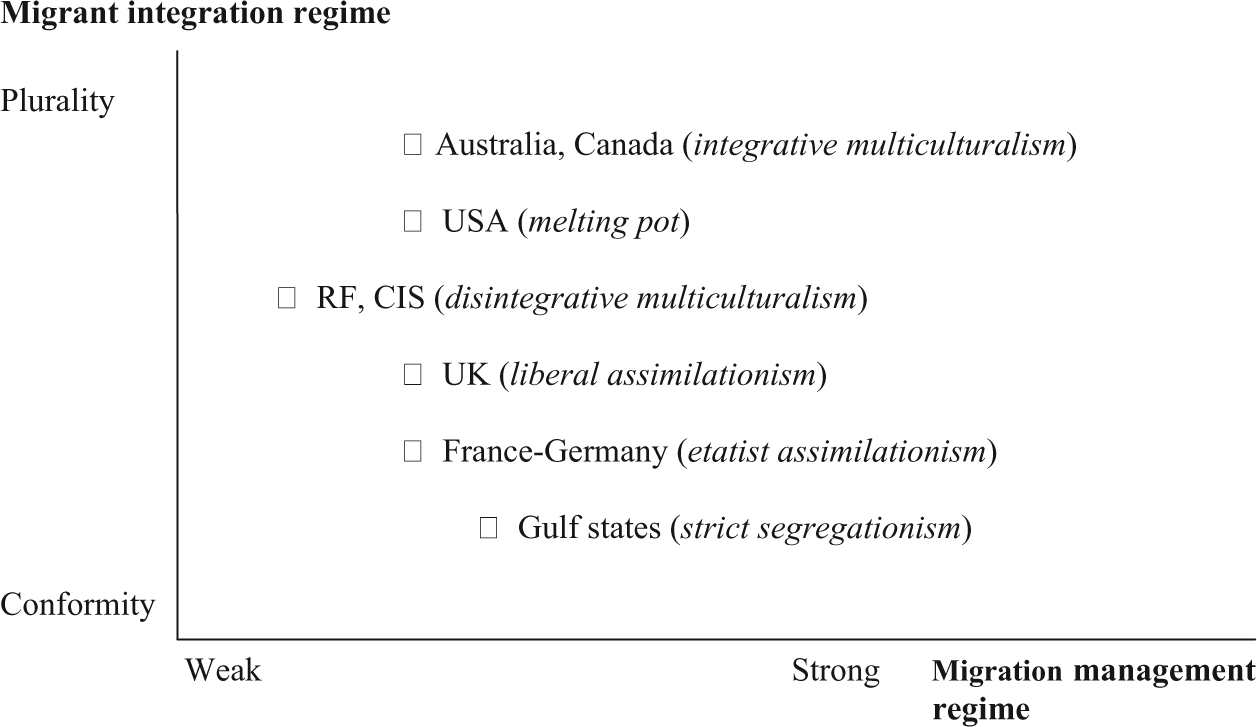
Migration management and migrant integration regimes: the EU’s eastern neighbourhood.
In general, migrant segregation in the CIS region, and especially Russia, is a product of both the locals’ disinclination to absorb newcomers and migrant reluctance to blend with them, amplified by the state’s unwillingness to be more proactive to increase migrant assimilation and/or acceptance. 11 To coin a phrase, this weak form of migrant segregation could be labelled ‘disintegrative multiculturalism’: the de facto recognition of the presence of culturally distinct migrant communities but no commitment to facilitate and smooth their absorption into political, economic/occupational, social/community and cultural/lifestyle dimensions of the host community.
Conclusion
Although the majority of CIS migrants are CIS-bound, CIS member states are increasingly embedded in the international division of labour and thus linked by migrant corridors to the rest of the world. No doubt, CIS countries remain bonded together by their shared Soviet legacy. But, in contrast to the strictly directed migration regime of the old USSR, the CIS is more of an institutional façade, with its member states lacking the political willpower to act jointly and increasingly looking away from the alliance. Thus the CIS has very limited means to implement its modest objectives. The RF remains the centre of gravity for intra-CIS migrant flows and, if it wished, it could have better controlled people crossing its borders. To date, however, it has chosen to tolerate large numbers of illegals. Russia appears to have little interest in supporting the CIS and has elected to form stronger ties with Belarus and Kazakhstan as a template for other CIS countries to consider. This form of Eurasian common market membership, with its free movement of residents, workers and capital, is likely to be used as a carrot to persuade other CIS states to remain within the Russian sphere of influence. The threat of returning irregular migrants will be the stick with which to beat other nations if they decline to toe the line.
Clearly it is possible for nations to turn a blind eye to large-scale irregular migration and the lack of migrant integration, and get away with it for a while. Time will tell, however, whether the short-term social benefit of disintegrative multiculturalism will be more than offset in the long run by cumulative social problems associated with the poorly integrated and increasingly alienated migrant minorities.
Footnotes
Funding
This article was prepared within the framework of the CARIM-East research project, co-funded by the European Commission and the Polish Ministry of Science and Higher Education, and carried out by the European University Institute, Florence, Italy in partnership with the Centre of Migration Research, the University of Warsaw, Poland.