




Abstract
This article stages an examination of the complex imbrication of contemporary civil society with war and militarized violence. I ground my investigation in the context of the increasing cooption of civil sites, practices and technologies by the United States military in order to facilitate their conduct of war and the manner in which drone warfare has now been seamlessly accommodated within major metropolitan cities such as Las Vegas, Nevada. In the context of the article, I coin and deploy the term civil militarization. Civil militarization articulates the colonizing of civilian sites, practices and technologies by the military; it names the conversion of such civilian technologies as video games and mobile phones into technologies of war; and it addresses the now quasi-seamless flow that telewarfare enables between military sites and the larger suburban grid and practices of everyday life. In examining drone kills in the context of Nellis Air Force Base, Las Vegas, I bring into focus a new military configuration that I term ‘drone casino mimesis’.
The development of telewarfare as a modality of war that, through the use of networked technologies, enables the conduct of war from places geographically remote from actual sites of militarized conflict, has led to the increasing imbrication of contemporary civil society with war and militarized violence. In working to bring to light the complex relations that hold between civil society and the exercise of militarized violence, my concern is twofold: to interrogate the apparent disjunctions that common-sense understandings of civil society and war reproduce between the two categories and, relatedly, to expose the dense lines of connection that are mutually self-constitutive between these seemingly binarized categories. I ground my investigation in the context of the increasing cooption of civil sites, practices and technologies by the United States military in order to facilitate their conduct of war and the manner in which drone warfare has now been seamlessly accommodated within major metropolitan cities such as Las Vegas, Nevada. My analysis of the inscription of civil sites, practices and technologies within the regime of US drone warfare works to bring into focus what I will term modalities of civil militarization that effectively blur the line between the military apparatuses of state and civilian life. Civil militarization articulates the colonizing of civilian sites, practices and technologies by the military; it names the conversion of such civilian technologies as video games and mobile phones into technologies of war, and it addresses the dialogic exchanges between military sites, such as drone Ground Control Stations in which drone kills are conducted, and the larger suburban grid and practices of everyday life that tie drone operators to their everyday conduct of war. In examining drone kills in the context of Nellis Air Force Base, Las Vegas, I bring into focus a new military configuration that I term ‘drone casino mimesis’.
Drone telewarfare as a modality of suburbanized military violence
Over the last decade, the US government has significantly expanded its military drone program. It has now become an indispensable component in its conduct of wars in Afghanistan, Pakistan, Yemen, Somalia and Syria. The routinized nature of the contemporary drone wars is perhaps best captured by the US government’s naming of its drone-kill list as the ‘disposition matrix’ (Cobain, 2013). As I have discussed elsewhere (Pugliese, 2015: 225), the drone disposition matrix has profound Bourdieusian resonances. In the US context, killing-at-a-distance via drones has now congealed, in Bourdieusian terms, into a ‘durable disposition’ (Bourdieu, 2011: 82), that is, into a habitual tendency that is undergirded by a military-industrial infrastructure or matrix. Situated in both US domestic and international contexts, this durable disposition matrix effectively articulates the contours of a drone habitus that is constituted by a series of routinized practices.
The drone habitus is perhaps best exemplified by the contemporary enmeshing of gaming technologies within the operational field of war. In the context of the drone habitus, the lines between the civilian and the military become blurred and often indistinguishable. This blurring can be seen by the parenthetical suspension of the ‘real’ and the ‘live’ that is produced by the new tele-techno economies of war that transmute killing into the stuff of video games. These tele-techno mediations work to generate a type of causal disconnect, and consequent disavowal, of the US-based drone operators’ relation to the killing that transpires on the ground in ‘remote’ Afghanistan, Pakistan or Yemen. Lt. Col. Matt Martin, a former drone pilot, remarks on how drone warfare ‘makes killing “too easy, too tempting, too much like simulated combat, like the computer game Civilization”’ (quoted in Mulrine, 2011). Philip Alston and Hina Shamsi (2011) have drawn critical attention to what they term the ‘“Play Station mentality” that surrounds drone killings. Young military personnel raised on a diet of video games now kill real people remotely using joysticks.’ A Predator sensor operator, Staff Sgt. Nicolette Sebastian, explains how the drone ‘operation is a lot like Play Station … “Oh, it’s a gamer’s delight”’ (Morlock, 2007). James Der Derian (2009: xxvii) appositely terms this hybrid construct of visual spectacle and war the ‘military-industrial-media-entertainment network’.
The ‘Play Station mentality’ is, in fact, something the US military is using in its recruitment drives:
The military is absolutely capitalizing on it. There’s a game called America’s Army that was developed out of West Point, and it’s been used blatantly as a recruiting tool to draw teenage kids in to make the army look cool and to make it look bloodless … it’s a shoot-’em-up game where there’s never any blood. (Shachtman, 2009)
Moreover, the crossover between computer games and the lethal technologies that enable drone kills is clearly evidenced by the fact that ‘Bored drone pilots sometimes smuggled simple computer games onto the drone operating systems – chess, Solitaire, Battleship’ (Currier, 2015). Another drone pilot ‘recalls playing Pinball and Solitaire during their time flying missions’ (Woods, 2015: 186). The drone console here becomes interchangeable with that of a computer game, as drone pilots upload their own civilian computer games into the same system. One is transposed onto the other. One informs and enables the other.
The use of gaming technology in the actual design of drone flight controls is not accidental: ‘the flight controls for drones over the years have come to resemble video game controllers, which the military has done to make them more intuitive for a generation of young soldiers raised on games like Gears of War and Killzone’ (Mulrine, 2011). In other words, operating as a type of spectral palimpsest, the template of video games haunts and inscribes the actuality of a drone-kill. The geometric logic of chess, with its kings and pawns, and the grid of both Battleship and chess are transposed, via the technology of the drone video screen, onto the target fields of Pakistan or Yemen. The binary logic of computer gaming and its gridded framing of space establish the coordinates for the projected drone-kill. The planarity of the screen, the human ‘blobs’ that often result from the use of thermal imaging, and the use of decorporealizing language by the drone pilots (such as ‘dismounts’ and ‘squirters’ for human drone targets) – all effectively work to render the human targets into little more than video game figures caught in the crosshairs of a hovering drone.
The gaming dimensions of US drone kills are further evidenced by the naming of the US’ counterterrorism manual as its ‘Playbook’ (Miller et al., 2013) and the manner in which drone operators have been documented as playing video games on the same screens that they use to conduct their drone kills:
To stay focused, RPA [remotely piloted aircraft] crews have come up with games to kill time. The crews … play RPA bingo over the secure Microsoft Internet Relay Chat, a text-based messenger program used by the crews and support staff to pass information. ‘A pilot made cards and every time you saw something in your screen, a donkey, or a car, you got a bingo point.’ (Maurer, 2015)
Operative in these examples is the militarization of civilian technologies. The interchangeability of one with the other works to construct a continuum between military and civilian technologies. The historical roots of this techno-military-civilian continuum can be traced back, in the other direction, to the civilian adoption of a number of key military technologies, including the internet and the Global Positioning System (Cockburn, 2015: 56). Inscribed in the practice of playing bingo on drone-kill systems is, as I discuss below, a mimetic crossover between militarized killing and gaming practices.
The militarization of civilian technologies in the context of the drone program is continuing apace. The ongoing integration of the military domain into civilian spaces is exemplified by the fact that a person’s social media posting can now lead to the placing of that subject on the US drone-kill list. I draw attention here to the admission by the US military that it ‘bombed an ISIL [Islamic State of Iraq and the Levant] target in the Middle East based on a single social-media post’:
Airmen at Hurlburt Field, Florida, used social media posts by the insurgent group to track the location of an Islamic State group headquarters building. Twenty-two hours later, three joint direct attack munitions destroyed the target, said Gen. Hawk Carlisle, commander of Air Combat Command … ‘The [drone operators are] combing through social media and they see some moron standing at this command.… And in some social media, open forum, bragging about command and control capabilities for Da’esh, ISIL. And these guys go ‘Ah, we got an in.’ So they do some work, long story short, about 22 hours later through that very building, three JDAMS take that entire building out. Through social media. It was a post on social media. Bombs on target in 22 hours. (Everstine, 2015)
The scope of the military–civilian continuum that I have been mapping can be amplified by examining the establishment of drone Ground Control Stations (GCS) in the midst of US metropolitan cities. Situating drone GCSs in proximity to suburban areas works to reinforce the continuum between militarized killing practices and the civil practices of everyday life. One drone pilot, for example, talks ‘about dropping a bomb on a village in Afghanistan one minute, the next minute he’s at home giving his daughter blueberry pancakes’ (Shachtman, 2009). ‘You have some guy sitting at Nellis and he’s taking his kid to soccer. It’s a strange dichotomy of war’ (Singer, 2009: 331). This strange dichotomy of war is enabled by a parenthetical logic that brackets off causal relations through a series of tele-techno mediations that, in turn, transmute the ‘real’ into video game simulacra. The parenthetical logic that is operative here is evident in the description, by a former drone pilot, of a drone strike that killed two civilians: ‘During one operation, he was piloting a drone that was tracking an insurgent. Just after he fired one of the aircraft’s missiles, two children rode their bicycles into range. They were both killed. “You get good at compartmentalizing”’ (Mulrine, 2011).
The ensconcing of war operations, and the everyday deployment of lethal drone attacks, within US cities such as Las Vegas, Nevada, gestures to a mutation in the conduct of war. The manner in which drone operators can exterminate human targets during their assigned combat sessions, via their ensemble of tele-mediating technologies and military hardware, and then go home to take the kids to soccer, works to normalize war as something that is effectively part of the civilian continuum of everyday practices. This continuum of practices is facilitated by the terms used to describe this new form of war: for example, the US military officially terms drone warfare ‘telewarfare’; the screen media that display the atomization and incineration of bodies by drone missiles are called by the military ‘Kill TV’; the material violence inflicted on human targets becomes ‘kinetic activity’, as though killing were just another form of gym exercise; and the human targets of drones are reduced, in turn, to yet another abstract kinetic term: ‘dismounts’. ‘Dismounts’ effectively abstracts the human drone targets of the materiality of their subjecthood: they are objectified and reduced to digitized and trackable movement without flesh-and-blood bodies. The use of this type of abstracting language is further exemplified by the manner in which a suspect who has been tracked by the drone’s surveillance system, because that system has locked on to the suspect’s mobile phone, is described as ‘detaching’ once he or she has been struck by the drone’s missile: ‘Immediately after a strike it should be possible to detect whether the target detached at the time of strike.… This is a good indication that the correct target has been struck’ (quoted in Shane, 2015). In other words, the violent act of killing a human target who is fielding a phone call is here reduced to a mere break in communication, as though the target killed by the drone strike has simply hung up on a phone call.
The drone habitus, its casino logic and gaming mimesis
The parenthetical logic that underpins the video game dimensions of drone killings helps facilitate the transition from exterminatory combat operations to civilian sites and practices. In the words of an air force colonel of a drone squadron: ‘It teaches you how to compartmentalize it [the reality of war]’ (quoted in Singer, 2009: 367). The everyday returns to civilian locations of ‘home’, after a series of technologically mediated killings in another country, can be seen to be inscribed by the forces of technological dis/location that drive the operations of drones. Drone operators have remarked on how the trip home from their GCS enables them to transition from the battle field to their civilian abodes, with the hour’s drive back to their home giving them:
that whole amount of time to leave it behind. They get in their bus or car and go into a zone – they say: ‘For the next hour I’m decompressing, I’m getting re-engaged into what it’s like to be a civilian.’ (quoted in Associated Press, 2008)
Getting ‘re-engaged into what it’s like to be a civilian’, however, is no simple process once it is contextualized in the military–civilian continuum that I have been mapping. The detrimental effects of telewarfare on drone pilots have been well documented. The remarkable imaging capabilities of drone cameras, for example, ‘allow pilots to see in “great vivid detail the real-time results of their actions. That is an incredible stress on them”’ (Mulrine, 2011). Moreover, the very practice of shifting backward and forward ‘between war and family activities’ means that a drone operator becomes, ‘in effect, perpetually deployed’:
Having our folks make that mental shift every day, driving into the gate and thinking, ‘Alright, I’ve got my war face on, and I’m going to the fight,’ and then driving out of the gate and stopping at Walmart to pick up a carton of milk or going to the soccer game on the way home – and the fact that you can’t talk about most of what you do at home – all those stressors together are what is putting pressure on the family, putting pressure on the airman,’ said Colonel Cluff [Commander of the US Air Force’s 432 Wing, Creech Air Force Base, Nevada]. (quoted in Drew and Philipps, 2015)
The stress of being in a state of perpetual deployment is described by one retired drone pilot as ‘brutal, 24 hours a day, 365 a year’ (quoted in Drew and Philipps, 2015). The experience of a drone operator being in a state of perpetual deployment complicates and undermines, at least for some drone operators, the compartmentalizing logic that is otherwise seen to inscribe drone operations. The concept of perpetual deployment works to delineate exactly what is new about the contemporary drone habitus: the virtual blurring of the categories of the military and the civilian. In one of its mental health diagnosis reports on drone operators, the US military has formally acknowledged the detrimental effects of this virtual blurring of once distinct categories. It has identified the ‘lack of deployment rhythm and of combat compartmentalization (i.e., a clear demarcation between combat and personal/family life)’ as a key contributor to drone operator stress (Otto and Webber, 2013: 3). Another military medicine paper reports the following findings:
The telewarfare environment poses unique stresses to Airmen today, including 24/7 continuous operations in a nearly immersive, combat-related environment … high levels of fatigue, burnout, and combat-related stress have been validated and are likely to continue despite advances in AI [artificial intelligence] technologies. Telewarriors are combatants. The forward edge of the battle is not just their main base building, but potentially their own home. (Fisher, 2011: ii–iii, emphasis added)
Articulated in this military medicine report is the nub of what is unique to the discursive formation and practice of telewarfare: the ineluctable inscription of civilian spaces, practices and technologies within the disposition matrix of tele-mediated war in which killing practices are visually amplified by the very immersive dimensions of the imaging technologies. There is nothing unique about the location of military bases within metropolitan cities and civilian centres. What is new is that the conduct of telewarfare has brought the forward edge of the battle area into the very civilian spaces of everyday suburbia. The practice of military killing is now exercised on a daily basis from military bases situated within the locus of the urbis. Nellis Air Force Base (AFB), for example, is situated in suburban Las Vegas (Figures 1 and 2).
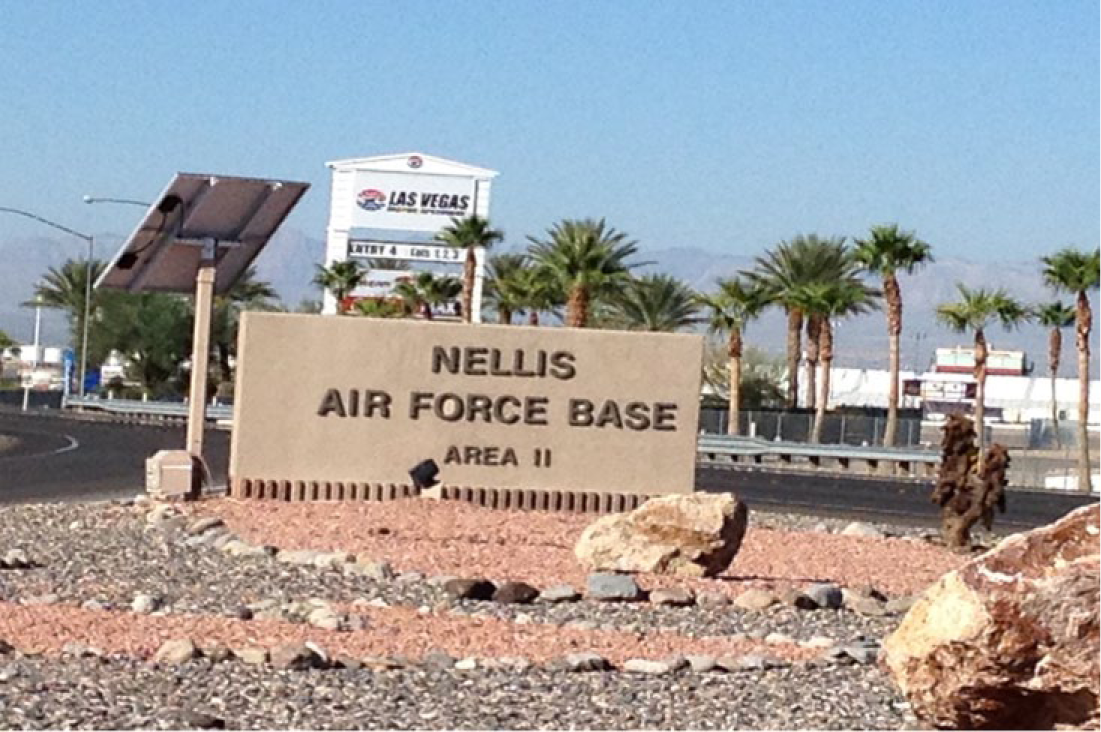
Nellis AFB, Las Vegas, Nevada.

Suburban front garden directly opposite Nellis AFB, Las Vegas.
Facing directly opposite the Nellis AFB, on Las Vegas Boulevard, are suburban homes and gardens (Figure 2). The idyllic simulation of a pastoral setting captured in Figure 2 sits directly opposite Nellis AFB: a family of Bambi-like deer, reposing in a suburban front garden, face-off the killing machinery and practices of telewarfare situated across the street behind Nellis AFB’s high-security fence (Figure 3).
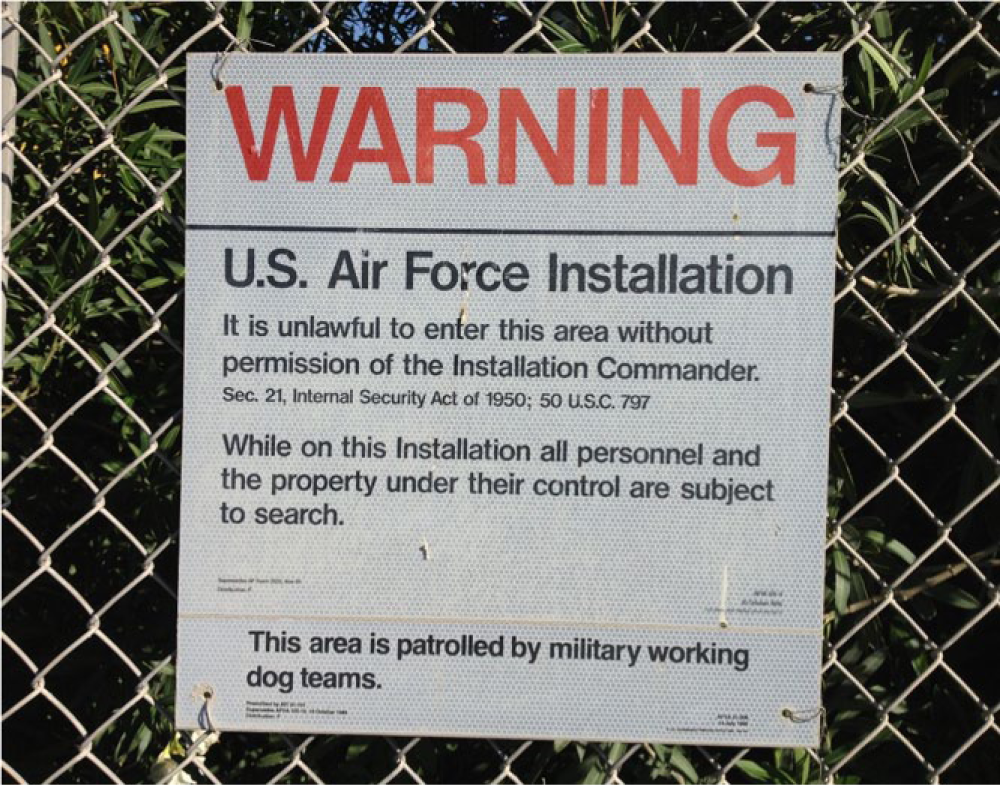
Security fence, Nellis AFB, Las Vegas.
On the same street on which Nellis AFB is situated, signs alert passers-by that there are ‘Children at Play’ (Figure 4).

‘Children at Play’, directly opposite Nellis AFB, Las Vegas.
Even as American children, ensconced in the safety of their suburban homes, play juvenile versions of computer games for entertainment, across the street drone operators sit in their cubicles unleashing drone Hellfire missiles on unsuspecting targets, killing both terror ‘suspects’ and civilians, including, as I document below, children. Sighting this sign, ‘Children at Play,’ as I walk the suburban streets contiguous to Nellis AFB, I reflect on how the tensions and contradictions that inscribe these spaces might be reconciled by the drone operators, who may kill children in a village in Afghanistan during the course of their day’s work and who then go home to their own children, safely at play in the suburban lots of Las Vegas. I can only begin to reconcile these tensions and contradictions by situating them within geopolitical relations of racialized power that overdetermine the semantic range of a singular term, ‘children’, and that, ultimately and fatally, as I demonstrate below, work to liquidate the very meaning of the term in particular geopolitical contexts.
The geopolitical conditioning of the term ‘children’ governs the very applicability and valency of the word as it is racially embodied in relation to its differentially positioned subjects. In the US context, white children qualify, tautologically, as children (in contradistinction, for example, to black American children who can be killed with impunity by the police). In the lands of the Global South, there are disjunctions between the signifier ‘children’, its signifieds, ‘minor, youth, juvenile’, and its real-world referents: the children of colour who actually inhabit the drone-targeted lands of the Global South. In other words, even as it is the one term, ‘children’, that works lexically to identify both sets of subjects, its linguistic coherence is internally (semantically/racially) fractured and externally (referentially/geopolitically) divided. Consequently, the conditioning power of the term’s geopolitical qualification will determine whether or not internationally recognized regimes of human rights, rights of the child and laws of war (with their principles of discrimination, of civilian targets, and proportionality, with respect to the harm that may be inflicted upon a civilian population in order to gain a military advantage) will also accrue to the target subjects of the Global South.
In the context of these discursive circuits that effectively operate to secure disjointed outcomes and differentially dis/abled subjects, geopolitical qualifiers produce material relations of structural asymmetry that effectively preclude identical categories – an American child or a Pakistani child – from possessing either equal value or applicability. The grammatically subordinate role of the geopolitical adjective, as descriptive supplement to the noun, is, in fact, charged with an inordinate power. Couched in deconstructive terms, the very supplementary status of the geopolitical adjective – as what should, grammatically, be serving a merely secondary, accretive function – works to override and substitute the semantic value of the noun ‘child’, producing and determining differential bio- and necropolitical outcomes. Biopolitically, it is the racialized geopolitical qualifier that governs, in Foucault’s terms, who shall live and who can be let to die – with impunity. Geopolitically, the term’s semantic kernel (‘child’) is so unstable that, in the end, it works to render the term irrelevant and inapplicable to the drone-targeted children of the Global South. In the context of US drone surveillance and strikes on ‘suspects’, the racialized geopolitical supplement so volatilizes the noun ‘child’ as to symbolically and literally vaporize it (‘vaporize’, I underscore, is the very term used to describe successful drone kills [see Woods, 2015: 265]). For example, in one US drone massacre of civilians in Uruzgan Province, Afghanistan, the declassified logs of the drone operators evidence the elastic and shifting parameters of the lexeme ‘child’. I cite from the log:
(4) (U) At 0538D … the Screener [drone video analyst] identified a child or two children in the vicinity of the SUV. However, when queried at 0738D by the ODA JTAC about earlier reports of children, the Predator crew discusses with the Screeners, and the Screeners change the assessment to ‘adolescents.’ Although there was no agreed definition of ‘adolescents’ the Predator pilot reports to the JTAC ‘We’re thinking early teens … adolescents.’ … SrA the primary Screener at the time, said she believed an adolescent to be 7–13 years-old, and ‘in a war situation they’re considered dangerous.’ … Ultimately, the distinction between children, adolescents and MAMs [military-age males] disappeared. The Predator crew immediately before the strike was ordered, only identified military capable war-fighting age males as being on the [targeted] convoy. (McHale, 2010: 000023–000032)
This drone log chronicles the geopolitical precarity of the term ‘children’ as it runs the gamut of its range of possible significations until, finally, it is voided by the drone operators and fatally replaced by MAMs: ‘Ultimately, the distinction between children, adolescents and MAMs disappeared.’ In the course of the sequenced analysis of the drone video feed, children become ‘dangerous’ adolescents who then morph into military-aged males who, regardless of the fact that their identities are not known, finally become ‘legitimate’ drone targets. In other words, the supplementary power of the racialized geopolitical qualifier works to nullify the categorical status of the Afghani children caught in the crosshairs of drones precisely as children. The necropolitical violence of the geopolitical qualifier is graphically illustrated by another US massacre that entailed a US drone strike on a seminary for boys in Chenegai, Federally Administered Tribal Areas (FATA), Pakistan. The drone strike killed up to 80 civilians, including: ‘[one] seven-year old, three were 8, three 9, one was 10, four were 11, four were 12, eight were 13, six were 14, nine were 15, nineteen were 16, twelve were 17, three were 18, three were 19 and only two were 21-years-old’ (Woods, 2015: 95). Here, the power of the racialized geopolitical qualifier works effectively to transmute these FATA children into what US drone pilots refer to as ‘fun-sized terrorists’ who need to be indiscriminately mowed down like ‘grass before it grows too long’ (quoted in Hussain, 2015).
Situated on the same boulevard as Nellis AFB, just beyond the perimeter of the base, are the urban icons of everyday consumer culture: McDonald’s, 7 Eleven and so on (Figure 5). Their contiguity to Nellis AFB establishes relations of continuity between the military-industrial-media-entertainment network and the larger consumer infrastructure that works to service and support it.

Suburban outlets in proximity to Nellis AFB, Las Vegas.
Critically examining the nexus between the city of Las Vegas and the incorporation of a military base within its urban fabric, clear relations of exchange come into focus. The distinguishing attributes of the city of Las Vegas – city par excellence of gaming, chance and simulation – all converge at Nellis AFB, only to become militarily inflected. Las Vegas’ neon-lit simulations of Venice, Paris and Bellagio, the pivotal role that gaming plays in the economy and cultural identity of the city, and the make-or-break, do-or-die role that chance and probability play in its casinos – all find their equivalent at Nellis. In the context of Nellis’s drone cubicles, the reality, for example, of a surveilled village in Afghanistan is rendered as mere neon-green simulation on the drone pilot’s screen; the honed-skills of video gaming are deployed for the actual drone kills; in fact, some members of US drone squadrons have left positions working in the casino industry and have re-trained as drone operators in bases just outside Las Vegas, such as Creech AFB (Maurer, 2015). As one drone operator remarks, ‘When I go to work, it’s Game Face On,’ with drone targets referred to as ‘customers’ of this lethal gaming practice (quoted in Woods, 2015: 173, 169). As Figures 6 and 7 illustrate, there are mimetic relations of exchange between Las Vegas’s and Nellis’s gaming consoles, screens and cubicles.

Game on: gaming cubicles in a Las Vegas casino.
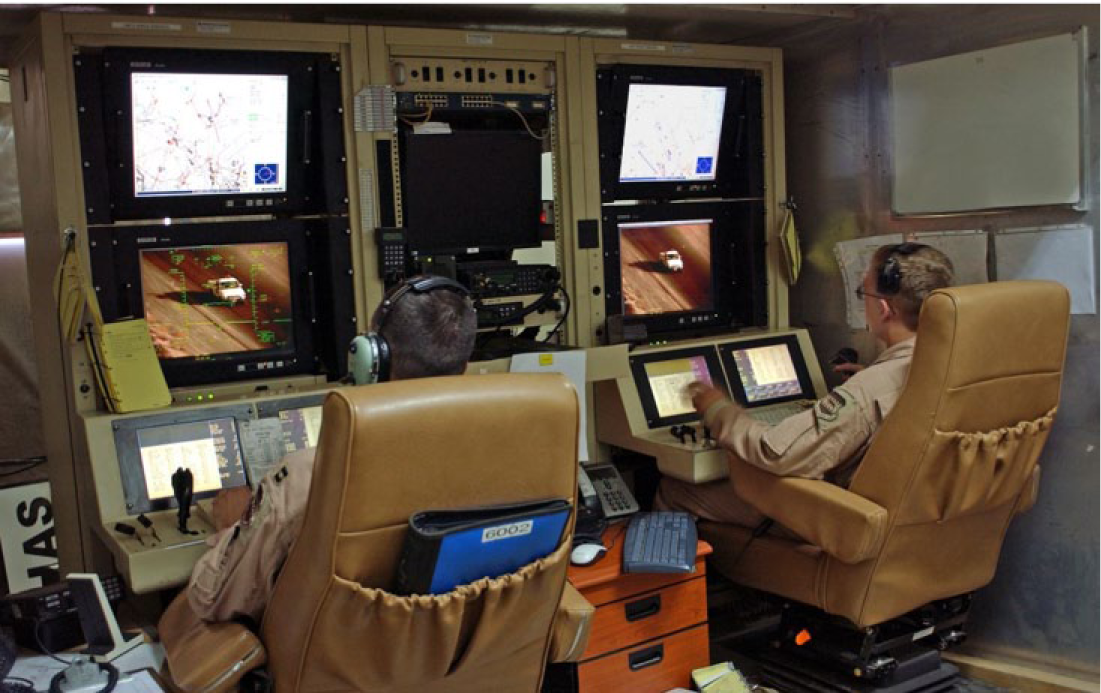
‘Game face on’: gaming cubicles at a US drone Ground Control Station.
Iconographically and infrastructurally, casino gaming and drone technologies stand as mirror images of each other. My argument, however, is not that both these practices and technologies merely ‘reflect’ each other; rather, I argue that gaming practices and technologies effectively work to constitute and inflect drone practices and technologies on a number of levels. Casino drone mimesis identifies, in new materialist terms, the agentic role of casino and gaming technologies precisely as ‘actors’ (Latour, 2004: 226) in the shaping and mutating of both the technologies and conduct of war. Situated within a new materialist schema, I contend that the mounting toll of civilian deaths due to drone strikes is not only a result of human failure or error – for example, the misreading of drone video feed, the miscalculation of targets and so on. Rather, civilian drone kills must be seen as an in-built effect of military technologies that are underpinned by both the morphology (gaming consoles, video screens and joysticks) and the algorithmic infrastructure of gaming – with its foundational dependence on ‘good approximation’ ratios and probability computation. Drone-kill algorithms sort, classify and select for screeners and pilots what they term as a suspect ‘pattern of life’ (Pugliese, 2011: 943–4). Generated by algorithms, drone-targeted suspect ‘patterns of life’ emerge as networked and disembodied assemblages of flagged and, as I discuss below, colour-coded data that are computationally presented as suspect in advance of the fact of either their named identities or affiliations actually being known. Networked and brought into video visibility through an array of algorithmic formulae, they fulfil Kathrine Hayles’ (2006: 160) summation of digitized, posthuman life which, ‘in its most nefarious forms’, is reduced to a mere ‘informational pattern that happens to be instantiated in a biological substrate’.
Viewed in this context, these military algorithms, and their networked tele-techno assemblages, must be seen as a priori agents in the lethal process of drone targeting and kills. Prior to the moment of an actual drone-kill, a constellation of computational processes governed by algorithmic formulae have already predetermined what can count as a killable, because suspect, drone target: as I discuss below, this may include a Jirga (a traditional gathering of male elders) or MAMs (as discussed above). Drone algorithms, in other words, decompose civilian subjects into suspect ‘patterns of life’ (in a biological substrate) that are then recomposed, by drone operators, into killable targets. The fatal drone strike, finally, ensures the literal decomposition of what were once human subjects into mere necropolitical substance. Operative here are two distinct, but intertwined, modalities of agency and power: one that is structurally overdetermined by the very typologizing dictates of the algorithmic formulae that process, screen and select the data; and another that is aleatory because the algorithmic formulae proceed to aggregate and typologize random, non-military events or figures (for example, a wedding or funeral procession – all documented targets of fatal drone strikes) into suspect ‘patterns of life’. In effect, what unfolds here is a lethal combination of contradictory forces that are at once overdetermined and aleatory and that are inscribed by both a priori and a posteriori logics: a priori, the drone algorithm detects its suspect target in advance of any intelligence that in fact proves its suspect status and, a posteriori, after a fatal drone strike, the human operators ‘discover’ their error and revise their findings – that is, that the identities of the victims were never actually positively identified as legitimate targets and that they have in fact killed civilians.
In this ‘Playbook’ game of ‘death by metadata’ (see Pugliese, forthcoming), the aleatory and gaming dimensions that I have drawn attention to are evidenced by the fact that, on innumerable occasions, a named suspect has been reported as having been killed by a drone multiple times. The key findings in the sardonically titled report, You Never Die Twice: Multiple Kills in the US Drone Program, include:
Twenty-four men were reported killed or targeted multiple times in Pakistan. Missed strikes on these men killed 874 people. They resulted in the deaths of 142 children.
Seventeen men in Yemen were reported killed or targeted multiple times. Missile strikes on these men killed 273 others and accounted for almost half of all confirmed civilian casualties and 100% of all recorded child deaths.
In targeting Ayman al Zawahiri, the CIA killed 76 children and 29 adults. They failed twice and Ayman al Zawahiri is reportedly still alive.
In the six attempts it took the US to kill Qari Hussain, a deputy commander of the Tehrik-e-Taliban Pakistan (TTP), 128 people were killed, including 13 children. (Reprieve, 2014: 2)
This is only a sample of Reprieve’s findings. Reprieve’s documented cases of the drone killing of innocent civilians and children in Afghanistan, Pakistan and Yemen underscore the lethal role that chance plays in the US drone casino gaming program. In his analysis of what he terms the ‘coming of age’ of ‘network-centric warfare,’ Antoine Bousquet (2009: 237, 200) coins the term ‘chaoplexity’ (as integrating both chaos and complexity theories) in order to elucidate ‘an understanding of war in which uncertainty, unpredictability and change are central’. Drone warfare exemplifies the new modality of network-centric warfare as it is foundationally reliant on the tele-techno interlinking of drones, tracking, identification and visualization software, and pilots at their GCS consoles. The chaoplexity of drone warfare is infrastructurally predicated on the algorithmization of probability stakes in both the tracking and killing of suspect ‘patterns of life’ and, thus, on the inscription of chance as an ineluctable system effect of its operational logics.
The arbitrary and aleatory nature of US drone kills is further evidenced by the US military’s use of transmitter chips in order to track, target and kill ‘suspects’ whose identities often remain unknown. In testimony reported in Living Under Drones, Habibur Rehman, a 19-year-old Pakistani, was reportedly executed:
for allegedly dropping US-provided ‘transmitter chips’ at local Taliban and Al Qaeda houses, signaling specific targets for CIA drone strikes. In a videotaped ‘confession,’ Rehman admitted to ‘throwing the chips all over’ because the money was good. The story bred fear and suspicion throughout Waziristan, where residents are ‘gripped by rumors that paid CIA informants have been planting tiny silicon-chip homing devices’ that attract drones. Many of the Waziris we interviewed spoke of the constant fear of being targeted with a chip by a neighbor or someone else who works for either Pakistan or the US, and the fear of being falsely accused of spying by local Taliban. (IHRCRC and GJC, 2012: 27)
The throwing of transmitter chips ‘all over’, and the consequent targeting of individuals who, unbeknownst to themselves, are carrying these chips, underscores the random, arbitrary and anonymous nature of US drone kills. The US military’s use of cell phones and transmitter chips is predicated on the geolocation technology’s foundational dependence on an algorithmic formula that provides a calculus of ‘risk probability’ for a designated target whose identity remains unknown. In other words, this algorithmic program works to transmute difference into serial sameness and interchangeability: the drone targets are thus rendered as anonymous, disposable and fungible objects that fail to qualify in terms of the legal category of personhood and its attendant rights. The random throwing of ‘chips’ and the use of such terms as ‘risk’ and ‘probability’ underscore the gaming dimensions of drone kills and their arbitrary casino-like logic.
The drone habitus’ perpetual deployment and its perpetual targets
Telewarfare’s blurring of the categories of civilian and military results from the practice of locating war operations in civilian sites and the demand for perpetual deployment on the part of the US military’s telewarriors. The military medicine report, cited above, continues:
Telewarfare operations are continuous, and lack a deployment rhythm compared to traditional combat operations. Unlike theater combatants who prepare for weeks or months physically, psychologically, and emotionally, telewarriors are continuously embroiled in the combat milieu.… Unlike their deployed counterparts, they do not come ‘home’ from battle; they go to battle everyday as part of their job. Thus today’s telewarriors face a unique and unprecedented combat role, while at the same time subject to the daily rigors of home life. (Fisher, 2011: 2)
Articulated in the fact that, in their state of perpetual deployment, telewarriors ‘do not come “home” from battle’ is the notion that there is no longer a home, as such, for combatants to go back to, precisely because the home, and its civilian spaces and practices, has been so colonized by the logic of virtual war as to have become coextensive with the locus and conduct of war: ‘For the telewarrior, the forward edge of the battle area (FEBA) may be his or her home’ (Fisher, 2011: 2). Consequently, the report concludes that ‘Today’s telewarrior faces the specter of being a combatant at home’ (Fisher, 2011: 2). The spectre of being a combatant at home is animated by the virtualizing logic of telewarfare that effectively inscribes civilian technologies (video games), practices (gaming), and sites (suburbia) into the military continuum. The indices that mark and identify the mutation of war into a type of practice that is now clearly coextensive with the category of the civilian proliferate across the body of this military medicine report. Remarking, for example, on the manner in which telewarfare enables the virtual superseding of geographical limitations, the report concludes that, ‘Finally, this global capability is designed to permit combat-related operations in non-hostile shirtsleeve environment from fixed “main-base” facilities’ (Fisher, 2011: 4). The non-hostile shirtsleeve environment of a military base situated in suburbia is now the site where the most hostile of war acts can be both performed and consumed on two virtually interlinked fronts: in the context of the military base where the actual drone kills are executed and in the civilian consumption of drone-kill videos on YouTube. The concept of ‘shirtsleeve combatants’ bespeaks the civil idiom of the ordinary office worker conducting innocuous duties within the confines of her or his mundane workplace. The civil tag of the ‘shirtsleeve environment’ cannot, however, work to attenuate the violence of the killing activity that telewarriors are compelled to perform and to watch on their screens:
One member relayed their experiences thus: ‘in a fighter jet you … drop a 500-lb bomb and then fly away, you don’t see what happens … but when a Predator fires a missile you watch it all the way to impact, and … it’s very vivid; it’s right there and personal. So it does stay in people’s minds for a long time.’ (Fisher, 2011: 25)
In other words, because of their state of perpetual deployment and their exposure to the vivid images of drone kills, some drone operators must necessarily, despite their attempts at ‘compartmentalization’, carry the spectrality of these killing images across and into the spaces of their civilian lives.
If the practice of the return to a safe home is, for telewarriors, necessarily fraught by the virtual blurring of home and base, of the military and civilian, then this same blurring is still more exacerbated in the countries targeted by these same drone operators. In the target countries of the Global South – Afghanistan, Pakistan, Somalia or Yemen – the figures of both the home and the civilian are vulnerable and exposed to the anomic violence of drones and the ever-present risk of obliteration of home, friends and family. For the subjects of the Global South, the home is always already a militarized site of round-the-clock drone surveillance. If, in the context of US drone GCSs, its telewarriors are in a state of perpetual deployment, then the inhabitants of the targeted lands of the Global South live lives inscribed by the ever-present threat of being perpetual targets – regardless of their non-combatant, civilian status.
Asymmetrical regimes of decapitation and the politics of (un)representability
What the above-cited example illustrates is not the blurring of the lines between the civilian and the military; rather, what is operative here is the effective dissolution of the very difference between the two categories. In effect, this example evidences how, in the targeted lands of the Global South, the civilian is always already militarized before the fact: any civilian act may be scopically surveilled and analysed through the militarizing grid of the US’s all-encompassing rubric of ‘imminent threat’. These new drone visibilities, Derek Gregory (2011: 193) notes, ‘produce a special kind of intimacy that consistently privileges the view of the hunter-killer, and whose implications are far more deadly’. The militarization of civilian spaces in the drone-targeted countries of the Global South works to render civilians as prey; it thereby forecloses the possibility for these civilians to live their lives precisely as civilians. Seemingly banal civilian practices such as using a mobile phone or simply going to market – any of these civilian practices place their subjects at risk of being killed. Once caught in the crosshairs of a drone’s surveillance camera, any community gathering is re-signified as a gathering of ‘suspects’ and is thus vulnerable to a lethal strike:
One of the most troubling community-wide consequences of the fear of gathering is, in several interviewees’ views, the erosion of the Jirga system, a community-based conflict resolution process that is fundamental to Pashtun society. Khalil Khan, the son of a community leader killed in the March 7, 2011 Jirga strike, explained that ‘everybody after the strike seems to have come to the conclusion that we cannot gather together in large numbers and we cannot hold a Jirga to solve our problems.’ (IHRCRC and GJC, 2012: 98)
The report, Living Under Drones, draws attention to the devastating impact of US drones on the lives of civilians in Pakistan:
US drone strike policies cause considerable and under-accounted-for harm to the daily lives of ordinary civilians.… Drones hover twenty-four hours a day over communities … striking homes, vehicles, and public spaces without warning. Their presence terrorizes men, women, and children, giving rise to anxiety and psychological trauma among civilian communities … the strikes have undermined cultural and religious practices related to burial. (IHRCRC and GJC, 2012: vii)
Another report, Death by Drone, by the Open Society Justice Initiative (OSJI, 2015: 16), documents the drone killing of Yemeni civilians and the destructive impact of these kills on the very fabric of civilian life. In his testimony, the uncle of a Yemeni drone victim brings into focus the impact of US drone strikes on the everyday lives of Yemeni civilians:
We were all shocked by the incident. A group of qat vendors and farmers, including a woman and child, who had nothing to do with any [militant] group were killed.… They were coming home carrying home necessities and food for their families. Why did America kill them? What was their crime? (OSJI, 2015: 86)
Nasser Mabkhout, a witness to this lethal drone strike, describes the aftermath:
There were only seconds between the first and second strikes.… I saw a big explosion immediately after the aircraft launched the shells.… I saw the dead bodies scattered in and around the car, some of them beheaded. I couldn’t differentiate between the bodies of the dead. (OSJI, 2015: 85, emphasis added).
Evidenced in these testimonies are acts of lethal barbarity performed by the US state that fail to make western media headlines. Whereas the beheadings of western hostages by the likes of ISIL or al-Qaeda gain widespread coverage and work to underscore the depravity and barbarism of these terror networks, the beheadings of Yemeni, Afghani or Pakistani civilians by US drones remain invisibilized: they simply fail to figure in the reportage of mainstream western media. Effaced and dematerialized, they remain, in film theory terms, space-off, that is, they are dispatched by the politico-media apparatuses of the West to the geopolitical space outside the frame of representation.
The discursive conditions of enunciation that undergird media production, with their unspoken normative codes and tacit knowledges, fundamentally determine what can or cannot be represented. Unrepresentable within the representational regimes of mainstream western media, the documented cases of US drone beheadings of civilians remain marginalized to the reports of non-governmental organizations. These cultural economies of (non-)representation pivot on the very operations of the geopolitical qualifier that I outlined above. The geopolitical qualifier is always already invested by an a priori raciality that is determined by the geographical coordinates that inscribe, encompass and biopolitically hierarchize its designated subjects. The Global South, as geopolitically inflected epithet, tautologically signifies racialized bodies of colour that can be killed with impunity. Here geopolitics and race are fused through a series of inferred biopolitical values and discursive constraints that predetermine what sort of lives will be valued and how, if at all, the coloured targets of US drone violence will be represented. And I mobilize the term ‘coloured’ here in terms of both its racialized understanding and its symbolically charged deployment in the context of actual drone kills. For example, US drone teams call their drone-kill targets ‘bugsplat’, a term that is racio-speciesist in its reduction of bodies of colour to entomological waste (Pugliese, 2013: 195); at the same time, the term is overlaid by a militarized colour-coding system that critically determines the kill value of the target. In the words of one former US intelligence official:
You say something like ‘Show me the Bugsplat.’ That’s what we call the probability of a kill estimate when we are doing this final math before the ‘Go go go’ decision. You would actually get a picture of a compound, and there will be something on it that looks like a bugsplat actually with red, yellow, and green: with red being anybody in that spot is dead, yellow stands a chance of being wounded; green we expect no harm to come to individuals where there is green. (Quoted in Woods, 2015: 150)
Described here is a mélange of paintball and video gaming techniques that is underpinned, in turn, by the probability stakes of casino gaming: as the same drone official concludes, ‘when all those conditions have been met, you may give the order to go ahead and spend the money’ (quoted in Woods, 2015: 150). In the world of drone casino mimesis, when all those gaming conditions have been met, you spend the money, fire your missiles and hope to make a killing. In the parlance of drone operators, if you hit and kill the person you intended to kill ‘that person is called a “jackpot”’ (Begley, 2015: 7). Evidenced here is the manner in which the lexicon of casino gaming is now clearly constitutive of the practices of drone kills. In the world of drone casino mimesis, the gambling stakes are high. ‘The position I took,’ says a drone screener, ‘is that every call I make is a gamble, and I’m betting on their life’ (quoted in Fielding-Smith and Black, 2015). The fatal effects of these ‘bets’ and ‘gambles’ on civilian lives are evidenced by a whistleblower, known as ‘the source’, who remarks that: ‘Anyone caught in the vicinity [of a target] is guilty by association.… When a drone strike kills more than one person, there is no guarantee that those persons deserved their fate.… So it’s a phenomenal gamble’ (quoted in Scahill, 2015: 22). The extraordinary latitude that is in-built into this phenomenal drone gamble is demonstrated by the fact that the US military calculates the success rate of its drone kills by focusing exclusively ‘on killing jackpots, and ignores the strategic and human consequences of killing large numbers of bystanders’ (Devereaux, 2015: 32, emphasis added).
The gross asymmetries of power that inscribe and frame the US military’s drone strikes are evidenced by the fact that the US government actually terms its drone targeting and assassination of ‘suspects’ and ‘militants’ precisely as a ‘decapitation campaign’ (Miller, 2015, emphasis added). In other words, al-Qaeda, ISIL and the US military all perform acts of decapitation of civilians. The key difference is that one uses a sword, while the other deploys drone missiles. Thwarting the possibility of a general system of exchange between these two modalities of killing civilians, and the ethico-juridical condemnation of both practices, is the imperial weight and power of the US and its monopoly on both the practices and the discourses of legitimate violence. In this schema, it is ISIL’s use of the sword that works to frame its operatives as, in the words of Australia’s former Prime Minister, Tony Abbott, both ‘barbaric’ and ‘medieval’ (Daily Telegraph, 2014). In this Orientalist schema, the West arrogates the signifiers of modernity, as exemplified by high-tech military arms such as drones, and, by definition, self-evidently occupies the ground of a superior moral and ethical base. ISIL’s religious extremism is juxtaposed against the enlightened secularity of the West; effectively, this fabled secularity can only be secured by disavowing the embedded Judeo-Christian values that underpin the West’s own ethico-moral frame. Up against the secular ethico-modernity of the West, ISIL is framed, in the words of the US President, Barack Obama (2014), as an organization that ‘has no place in the 21st century’ because of its record of ‘killing innocent, unarmed civilians in cowardly acts of violence’. He concludes that: ‘we will continue to confront this hateful terrorism and replace it with a sense of hope and civility’. The West’s scripting of ISIL as backward, medieval and barbaric is, in fact, contradicted by ISIL’s famed and canny use of 21st-century technologies, such as social media, in order to promote their campaigns and to secure recruits.
Telewarfare’s normalization of military violence as urbanized practice
The transposition of the conduct of state-sponsored violence from offshore areas to large metropolitan cities, and the consequent obliteration of a soldier’s ‘deployment rhythm’, engenders, I contend, the normalization of telewarfare’s violence precisely as a form of quotidian, urbanized practice inscribed within an increasingly blurred military–civilian continuum. Within the locus of the civilian (for example, the city of Las Vegas), the execution or mutilation of a civilian in Yemen assumes a normative status as it is now experienced within the unexceptional spaces and sites of everyday metropolitan life. Under the jurisdiction of this regime of civil militarization, both the agents and targets of US drone strikes can be seen to be embedded in locations that no longer offer a clear differentiation between the categories of the civilian and the military: on the one hand, for the US drone operators, the ‘forward edge of the battle area’ now becomes coextensive with their own home, as the practices of military killing are exercised from sites that are enmeshed within their suburban lives; on the other hand, the drone-targeted civilians of the Global South can be seen to be riveted to the structure of an ubiquitous surveillance and lethal militarization, where what is denied is the promise of an ‘elsewhere’, that is, the civilian spaces that should, under laws of war, offer refuge from the threat of military violence.
Through the emergence of telewarfare, military culture has now become so thoroughly constitutive of civic spaces and civilian life that it can no longer be decisively separated off as an autonomous and categorically isolated entity. The capillary reach of tele-mediated militarization, fuelled by the colonizing forces of the military-industrial-media-entertainment network, and virulent neoliberal demands for the privatization of government-run entities, is working to make untenable a military/civilian binary: the one is now thoroughly imbricated with the other. The location of sites of military killing within the very urban fabric of civilian life underscores how a civilian infrastructure is now constitutive of a militarized economy of violence that cuts across seemingly discrete categories. The intensification of the militarization of civilian sites, practices and technologies demonstrates the manner in which the military-industrial-media-entertainment network operates by diffuse strategies and modalities that are now critically dependent on non-state actors. The diffusion of these strategies and modalities of militarized violence across diverse civil sites functions to attenuate the point of origin of this same violence. In a sober reflection on the seeming binary state/civil society, Michel Foucault (2002: 372) writes that ‘the reference to this antagonistic pair is never exempt from a sort of Manicheism, afflicting the notion of state with pejorative connotation at the same time as it idealizes society as something good, lively, and warm.’ As my analysis of Nellis GCS in suburban Las Vegas evidences, this Manicheism is untenable.
The ‘metapower’ of the state, Foucault (2002: 372) adds, ‘can only take hold and secure its footing where it is rooted in a whole series of multiple and indefinite power relations that supply the necessary basis for the great negative forms of power.’ In the US context, the manifestation of the great negative forms of power can clearly be seen in that conglomerate of state and private interests otherwise known as the military-industrial-prison complex. Private firms now run over 100 prisons in the US; they hold a prison population of over 62,000 inmates. Working in conditions tantamount to slave labour, the detainees, who are mostly Black and Hispanic, produce ‘100% of all military helmets, ammunition belts, bullet-proof vests, ID tags, shirts, pants, tents bags, and canteens … [and] 46% of body armor’ (Pelaez, 2014). Here, the liberal democratic state’s administration and maintenance of civil law and order can be seen to be deeply implicated in the production of various, but interconnected, modalities of violence that are at once racial, penal, juridical, economic and military. The ensemble of non-state actors – that includes drone manufacturers (General Atomics and Lockheed Martin), mining (American Mineral Fields) and high-tech companies (Northrop Grumman, Raytheon and InvenSense) (see Fielding-Smith and Black, 2015) – that are constitutive of the US’s drone disposition matrix discloses the manner in which the production of militarized violence is rooted in a whole series of intertwined power relations that problematize clear dividing lines between two seemingly distinct categories: state/non-state, civilian/military.
These intertwined relations are further evidenced by the fact that, even though it is only the military that is authorized to conduct drone strikes, video analyses of drone feed and the take-off, landing and maintenance of drones have been outsourced to private contractors. The collusion between state and non-state entities in the production of invisibilized modalities of military violence – that assume a civilian front and thus cannot be read, for example, as constitutive of the state’s military apparatus and its economies of violence – supplies the necessary basis for the great negative forms of power. What is brought into sharp focus here is the unpalatable (and thus disavowed) predication of certain modalities of the civil on the very violent relations it appears to stand in opposition to. Situated in, and exercised from, the civil, law-abiding and urbanized contexts of large metropolitan cities such as Las Vegas, the state’s military violence is now practised as a form of quotidian telewarfare that works to neutralize it and render it as ‘remote’ – precisely by secreting it in an elsewhere invariably located in the ‘ungoverned’ and ‘barbaric’ geographies of the Global South. At play in the US state’s drone casino mimesis program is the gamification of war. Drawing on the very words of a number of drone pilots to describe their killing operations, in the exercise of drone telewarfare, as a veritable ‘gamer’s delight’, the stakes are asymmetrical, the gambles are ‘phenomenal’ and the ‘jackpots’ are, for the targeted civilians of Afghanistan, Pakistan and Yemen, fatal.
Footnotes
Acknowledgements
I am profoundly grateful to Susan Stryker for taking me on the journey to Las Vegas and Nellis despite her painful physical injury. Her selfless act of friendship made this essay possible. My thanks to Constance Owen for her brilliant and enduring research assistance.
Funding
This research received no specific grant from any funding agency in the public, commercial, or not-for-profit sectors.
Author biography
Joseph Pugliese is Research Director of the Department of Media, Music, Communication and Cultural Studies, Macquarie University, Sydney, Australia. Selected publications include the edited collection Transmediterranean: Diasporas, Histories, Geopolitical Spaces (Peter Lang, 2010) and the monograph Biometrics: Bodies, Technologies, Biopolitics (Routledge, 2010). His most recent book is State Violence and the Execution of Law: Biopolitical Caesurae of Torture, Black Sites, Drones (Routledge, 2013).