




Abstract
While there is evidence of the cultural scripts lesbian, gay, bisexual and transgender (LGBT) older people use in making sense of their lives, little attention has been given to how these scripts are themselves produced. This article examines cultural representations of LGBT ageing and older people in 40 UK and Australian websites. It is argued that these sites form part of a cultural imaginary about LGBT ageing and older people accessed by policy makers and service providers. Employing membership categorization analysis, the study revealed attributes attached to LGBT ageing categories that related to constraint and celebration narratives. It also uncovered anomalies within the text of 23 websites where celebration and constraint attributes were juxtaposed, although in 15 websites only celebration representations were apparent. The findings highlight the complexity of some representations of LGBT ageing and older people, and the limitations of framing LGBT ageing and older people in homogenous ways.
Keywords
In both the UK and Australia, the experiences of lesbian, gay, bisexual and transgender (LGBT) older people have been attracting increasing attention from researchers (e.g. Cronin and King, 2010; Harrison, 2006; Hughes 2007; Robinson, 2015), governments (e.g. Australian Department of Health and Ageing, 2012) and non-governmental organizations (NGOs) (e.g. Knocker et al., 2012). It has been argued that a barrier to addressing the needs of LGBT older people is their invisibility not only within specific service settings, but also within society (e.g. King, 2016; Traies, 2016). Yet with increased cultural recognition – in part arising from the efforts of baby boomers to effect change (Robinson, 2015) – questions arise about what kinds of representations of LGBT ageing and older people are acceptable, and what potentially are not. Concerns about the marginalization of non-normative LGBT identities and practices in the context of ostensibly inclusive LGBT-affirming policies and institutions have been expressed, for example in relation to UK local government (Richardson and Monro, 2013) and NGOs in Australia (Hughes, 2016).
One of the challenges relates to the construction of the LGBT category and its variations. While understandable in terms of furthering a political agenda and cultural recognition – a necessary fiction (Jones, 2016; Weeks, 1995) – grouping diverse identities, attractions, relationships and community affiliations into one ‘LGBT’ category clearly has disadvantages. These include the apparent conflation of gender and sexuality, as well as the ostensible treatment of the subcategories – L, G, B and T – as stable entities. Yet the extent to which individuals relate to and attach these labels to themselves varies according to a range of factors, including socio-cultural context, point in the life course, and generational cohort (Jones, 2016). Concerns have also been expressed that the unique experiences of lesbians (Traies, 2016), bisexual people (Jones, 2016) and transgender people (Trevor and Boddy, 2013) as well as others become subsumed within the LGBT acronym.
There are also questions about the broad narratives about LGBT ageing and older people that are represented publicly. Robinson (2011) noted the coexistence of narratives in gay male culture that both denigrated and respected the social position of older gay men. Further, King (2016) discerned ostensibly contradictory narratives relating to LGBT ageing: one highlighting marginalization, loneliness and inequality (typified as a ‘constraint’ narrative), the other emphasizing celebration, agency and autonomy (typified as a ‘celebration’ or ‘empowerment’ narrative). Simpson (2014) also highlighted the tendency in the LGBT gerontology literature to present ageing experiences in binary terms: with diverse experiences treated as evidence of either social exclusion or successful ageing (mastery over stigma). If public representations of LGBT ageing reify the experience of social exclusion or a constraint narrative, what might this mean for the development of social policy and social services? Alternatively, what might it mean if LGBT older people are portrayed as well connected socially and empowered, with little consideration of those who do not feel this way or, at least, not all of the time?
In this article we use ideas about cultural scripts and the imaginary developed in the work of Gagnon and Simon (1973) and extended by Jackson and Scott (2010). We argue that this approach has implications not only at a micro-political level (i.e. how older LGBT individuals think about their own lives) but also in more institutionalized ways, in terms of the construction of social policy and service provision. The project was grounded in a symbolic interactionist account of sexuality and gender (see Jackson and Scott 2010) and employed membership categorization analysis (MCA, see King, 2010) to examine website content. MCA is an ethnomethodological technique that can be applied to both interactional and static text (Housley and Fitzgerald, 2015). As such it examined the representations of LGBT older people and LGBT ageing in the public domain.
Cultural scripts and the imaginary
While eclipsed in popularity by Foucault and subsequent queer theorists, such as Sedgwick and Butler, one of the foremost accounts of the social construction of sexuality and gender was provided by Gagnon and Simon (1973) (Jackson and Scott, 2010). Their symbolic interactionist approach relied on the concept of scripting: ‘the production of behavior within social life’ (Simon and Gagnon, 1986: 98). Scripts operate reflexively between intrapsychic, interpersonal and cultural levels. According to Gagnon (1990: 35):
sexuality is more than individual behavior … what happens in the sexual arena in any society is a consequence of culture and the structure of sexual and nonsexual opportunities which exist prior to any individual. Sexual scripts, as do all scripts, exist at the levels of the individual, the interactional and the cultural.
Not only was their approach anti-essentialist, it also resisted conflating gender and sexuality – by looking separately at reproductive conduct, gender conduct and sexual conduct (Gagnon, 1990) – while recognizing their complex interconnections. Although this approach, like Foucaldian ones, does not fully engage with the material and structural aspects of power and inequality (Jackson and Scott, 2010), it does facilitate research into the cultural artefacts that influence, in a dynamic rather than deterministic way, interpersonal and individual experiences. While the application of their approach has been limited in ageing studies, there is considerable potential for it to inform a sociology of ageing and sexuality as suggested by Plummer (2011) and King (2016).
Increasingly symbolic interactionism, such as that articulated by Gagnon and Simon (1973), is informing research on the internet in understanding how subjectivity is negotiated in the digital realm (Brickell, 2012). Social media, in particular, offers unique insights into how people present their identities and social relationships to others. More static representations of identity also appear online through the presentation of web content (Web 1.0 rather than 2.0) and can be analysed to provide insight into the resources people interact with reflexively to make sense of their selves, relationships and communities (e.g. Brickell, 2012). While researching static web material may not assist an examination of the interplays between intrapsychic, interpersonal and cultural expressions of gender and sexuality, as Brickell’s example demonstrates it may provide insight into the cultural scripts – ‘the instructional guides that exist at the level of collective life’ (Simon and Gagnon, 1986: 98) – that individuals relate to in expressing their gender and sexuality. In effect, such material forms part of the cultural imaginary about LGBT ageing and older people, for LGBT individuals as well as policy makers and service providers/practitioners who are seeking to understand their lives.
Like all information, how online information is interpreted by individuals varies according to a number of factors, including how credible the information and its source appear (Metzger and Flanagin, 2013). Reputation, name recognition and authority (e.g. whether the source is an official authority) are key heuristics employed by web users to ascertain the credibility of information (Metzger and Flanagin, 2013). While all online material is culturally based, online credibility plays a role in influencing which cultural cues individuals engage with reflexively. Information on government websites, those of well-known community organizations or those of trusted private sector providers may be given more attention as cultural scripts that inform the imaginary, as opposed to information on the sites of relatively unknown individuals or groups. In both Australia and the UK there are respected organizations, such as Stonewall UK, that present information on LGBT ageing and older people on their websites not only for general public consumption, but also for specific use by policy makers and service providers.
In this project we wanted to critically examine the cultural messages about LGBT ageing and older people conveyed by these kinds of websites. Websites hosted by governments, NGOs and private companies that present information about LGBT ageing and older people form a cultural imaginary about, in this case, ageing, gendered sexualities. This is important because a diversity of people – not only LGBT older people, but also service providers, practitioners and policy makers – relate to this cultural script reflexively to inform their imaginary about LGBT ageing. This has implications for how LGBT ageing and older people are presented, culturally, in political discourse at all levels of government and community relations. Thus, our primary research question was: what qualities are connected to LGBT ageing and older people categories and are these consistently maintained or are they sometimes transgressed? While the work of Gagnon and Simon (1973) is useful in understanding cultural scripts and how they are engaged with reflexively, it does not really provide insight, in methodological terms, into how these cultural scripts are (re)produced and transformed in use. To help answer our research question, we drew on MCA. This approach facilitates an analysis of identity and group categories, the qualities or attributes that are connected to them, and the way these are reinforced or undermined.
Membership categorization analysis
MCA is a method of analysing talk and text that arose from the conversation analytic approach articulated by Sacks (1995). This approach treats identity not as a product of the essential characteristics of the individual, but rather as emerging from interactional work (Fitzgerald et al., 2009). MCA’s focus is on how people categorize themselves and others, and how they connect various activities and attributes – referred to as predicates – to these categories (King, 2010). These predicates may include beliefs, knowledge, entitlements and obligations and be presented in a way that adds a moral value to the category (Reynolds and Fitzgerald, 2015). While Sacks incorporated both MCA and sequential conversation analysis (CA) in his approach, it was the latter – with its focus on analysing the sequential properties of interaction – that proved more popular (Stokoe, 2012). Yet, according to Stokoe (2012: 279), MCA is needed because of its analysis of ‘constructed reality; of culture, identity and morality; of inference and meaning; of the analysis of interactional and textual materials, and its ethnomethodological spirit’ (emphasis in original).
In this project, MCA was applied to the textual material of websites, rather than the interactional properties of face-to-face or online conversation. Sacks (1995) advocated the empirical examination of membership categories, membership category devices (collections of categories) and predicates within specific cultural contexts to illuminate tacit understandings and cultural knowledge. His classic example, from the opening lines of a children’s story, was how the categories of ‘mommy’ and ‘baby’ relate to the membership categorization device of ‘family’ (Sacks, 1995). In the beginning of the story: ‘The baby cried. The mommy picked it up’, the predicates would be identified as crying, and picking it up. These relate to our cultural understanding that babies cry and mothers pick up babies. Even though we don’t know the ‘mommy’ was this particular baby’s mother and that she picked the baby up because it cried, we make these assumptions based on our cultural knowledge. The categories ‘mommy’ and ‘baby’ can also be considered as a standard relational pair in that one suggests the other (Housley and Fitzgerald, 2015) within a culturally prescribed gender system.
In our study we sought to identify membership categories and membership categorization devices related to LGBT ageing and older people and, more specifically, the predicates connected to these categories in the text. We also mapped the predicates (qualities) of the membership categories related to LGBT ageing and older people across the websites. We were interested in how the predicates varied across a range of websites, which could be differentiated by the website’s hosting organization, target group and country of origin. The MCA approach involves an analysis of when the usual connections between categories and predicates are breached (known as anomalies) and when these breaches are troubled and the usual connections restored (known as repairs). Given repairs are unlikely to be found in static text, rather than interactive text or talk, we focused our analysis on the anomalies apparent within the website content.
Method
Sampling
Our decision to focus on Australia and UK was based on a view that the public recognition and service and policy response to LGBT ageing is at a similar point of development compared to some other English-speaking countries that have a longer history in this area (such as the United States) or others that are smaller (e.g. New Zealand) and that would have made comparisons difficult. In order to generate an appropriate sample of website material, we searched Google Australia and Google UK using a series of key terms that related to the categories we were studying. These included combinations of: LGBT, lesbian, gay, bisexual, transgender, trans; and ageing, older, old, elderly, seniors. We also searched within ageing or aged care organizations’ websites for: LGBT, lesbian, gay, bisexual, transgender, trans; and within LGBT organizations’ sites for ageing, older, old, elderly, seniors. This search generated 20 Australian sites and 26 UK sites that had content on LGBT ageing and older people. All sites selected were publicly accessible (i.e. not password protected) as our focus in this study was the public representations of LGBT ageing and LGBT older people. Four of the Australian sites and two of the UK sites were excluded because they were Facebook pages. The Facebook sites were substantially different from the other sites in that they were interactional in nature (e.g. with ‘friends’ liking and commenting on various posts), whereas the other sites were primarily static presentations of content. Thus the final number of sites included in the study was 40, comprising 24 UK sites and 16 Australian sites.
In order to manage the data, we sampled pages within these sites based on their primacy within the overall site. Specifically we sampled the front pages of LGBT-ageing specific sites, and the first page of LGBT ageing content on ageing or aged care organizations’ sites and on LGBT organizations’ sites. Thus, 40 web pages were examined, comprising a total of 18,210 words. As the research involved the identification and analysis of publicly available documents, ethics approval to carry out the study was not required.
Analysis
Computer-assisted qualitative data analysis software has been identified as suited to MCA (King, 2010). In this study, website data were imported into NVivo 10 and, following King (2010), membership categories related to LGBT ageing and LGBT older people were identified through a word frequency query within NVivo. This was a general query search to identify the most frequently occurring words, with the exception of very common English words (such as prepositions). These were then examined by the first author (Hughes) in terms of their presentation within the text. Predicates linked to membership categories were identified and coded. They were identified by examining the qualities or attributes reflected in the verbs, adverbs, adjectives and phrases surrounding the categories. For example, the predicate we coded ‘isolation or loneliness’ was evidenced in the websites by terms and phrases such as ‘experience isolation’, ‘growing old without family or friends’, and ‘lack of family support in older age’. The predicates were then grouped into higher order themes. The second author (King) examined a sample of the coding conducted by Hughes and confirmed the accuracy of the codes allocated.
The first step in the analysis was mapping the predicates across website content. In order to get a sense of the distribution of predicates, they were analysed in relation to their frequency and presence according to key website characteristics. These included the type of organization hosting the website (classified as government, large NGO, small NGO, community network, and peak body or professional association). They also included the website’s focus (LGBT ageing; general LGBT; general ageing), as well as the country of origin (Australia or the UK). This was facilitated by matrix analysis within NVivo.
The second step involved qualitative thematic analysis of the website content, including an examination of the positioning of different predicates concerning LGBT ageing and LGBT older people categories. This related to the MCA approach of identifying anomalies through a detailed reading of the data, and drawing interpretation based on that particular category (King, 2010). This involved looking for disjunctions and transgressions within the text, specifically the ways in which categories and their linked predicates changed across the text. This was important because it gives insight into how certain information – including contradictory information – is incorporated into an overall theme of representation.
Findings
LGBT ageing and older people categories
The majority of the 40 websites (65.0%) were hosted by small NGOs or community networks (Table 1). Large NGOs hosted 11 sites (27.5%), and there were only two peak body or professional association sites (both Australian) and one government site (also Australian). Just over a quarter (27.5%) were general ageing sites (e.g. a provider of residential aged care), while 45% were LGBT-ageing specific sites (e.g. a social group for LGBT older people). A greater proportion of the latter sites were based in Australia compared to the UK.
Website characteristics by country of origin.
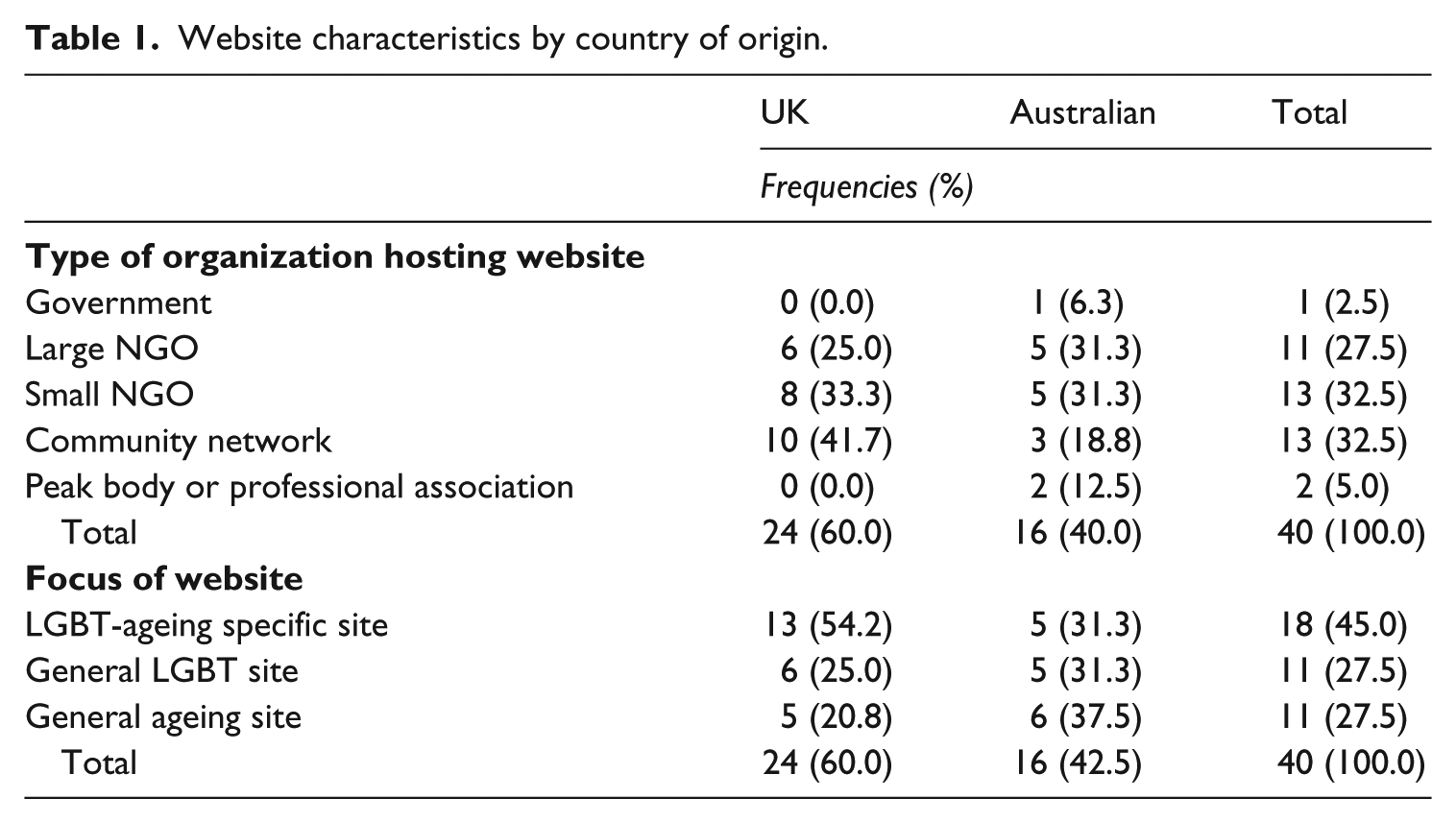
We identified 180 different membership categories in a total of 560 instances across the 40 webpages. A membership category was determined by a word or group of words that identified the text as relating to LGBT ageing or LGBT older people. Where a group of words related to a human subject they were treated as one membership category (e.g. ‘LGBT people aged 50 and over’); where the words related to a non-human subject then only the descriptive term was treated as the membership category (e.g. LGBTI [lesbian, gay, bisexual, transgender and intersex] issues was treated as ‘LGBTI’). The most frequent membership category was ‘LGBT’ (26 instances across 9 webpages), followed by ‘older LGBT people’ (18 instances across 8 webpages), ‘same-sex partner’ (17 instances across 5 webpages), and ‘LGBTI people’ (15 instances across 5 webpages). Ninety-one categories (50.6%) were only referred to once (e.g. ‘transvestite’, ‘LGBTI clients’). Of the 180 membership categories, 114 (63.3%) represented a collection of labels, either written out in full or as acronyms (e.g. LGBT), rather than individual labels (e.g. lesbian). Some collections of labels were presented in other ways, such as ‘rainbow folk’, ‘diverse genders, bodies, sexualities and relationships’, and ‘minority sexual group’.
There were variations in how the membership categories were used within the different webpages. In some cases, there was slippage in meaning in the juxtaposition of different membership categories. For example, in one webpage, there was an apparent misattribution of intersex and transgender people as being a sexual minority:
Not all issues highlighted here are valid for all GLBTI individuals but awareness of greater risk factors or propensity to some illnesses is needed. Being part of a minority sexual group influences patterns of health. In health consultations, not all GLBTI individuals will volunteer their sexual orientation or identity. (Community network, general ageing site, Australian)
In other webpages different subcategories of the membership category were lost or forgotten in the text. For example:
Older LGB people may feel out of place in traditional support groups. In these settings, people will tend to talk freely about their husband, wife or children. However, many gay people fear that others will react with shock, awkwardness or even rudeness if they talk openly about their partner or family. (Large NGO, general ageing site, UK)
In this case lesbian and bisexual people in the ‘older LGB people’ category have either been forgotten in the third sentence or subsumed within another membership category of ‘gay people’. In other cases, attempts were made to explain the language used to ensure the membership category was seen as inclusive. In the following webpage the membership categories of ‘older – and old – lesbian, gay, bisexual and trans people’ and ‘LGBT community’ were used consistently, albeit with a note at the bottom of the page:
* The term ‘Trans’ refers to people who consider themselves to be Transgender, Gender Variant, Gender Queer, Cross Dresser, Transvestite or any other non-standard gender identity. (Small NGO, LGBT-ageing specific site, UK)
There were also some variations across different types of webpages. All the acronyms including ‘I’ for intersex people (e.g. ‘LGBTI people’, ‘GLBTI individuals’) were employed in Australian sites (as has become the practice in Australia). And all the webpages employing membership categories that might be considered colloquial or pejorative (e.g. ‘older dykes’, ‘Asian or Aboriginal gays or trannies’, ‘transvestite’) were from LGBT-specific or LGBT-ageing specific sites.
Qualities and distribution of predicates
In total, 49 different predicates were identified as relating to the various LGBT older people and ageing categories; they were present in 314 instances across the 40 webpages. As noted, these were words or phrases that were connected to the categories and that provided a sense of the disposition of the categories within the context of the text. Detailed reading of the predicates and their relationships to the categories revealed that, except in a small number of cases, two broad orientations to LGBT older people and ageing were evident in the data: optimistic, positive or hopeful representations of LGBT older people and ageing (summarized as celebratory predicates); and representations of LGBT older people and ageing as facing isolation, discrimination or risk (summarized as constraint predicates). These orientations reflect the narratives previously discussed in the literature (King, 2016; Simpson 2014).
Celebratory predicates were apparent in 50.6% (159/314) of the total instances of predicates across the 40 web pages. One of the most common predicates was classified as friendly or supportive, for example:
[Name of organization] is an informal and friendly social group for gay and bisexual men aged 40 and over, which meets fortnightly in a relaxed safe space. (Community network, LGBT-ageing specific site, UK)
Other common celebratory predicates were diversity and celebration or recognition, both evident in the following example:
Understanding and celebrating the diversity of genders, bodies, sexualities and relationships of older Australians. (Small NGO, LGBT-ageing specific site, Australian)
Constraint predicates, however, were nearly as common as celebratory ones, comprising 42.4% (133/314) of all instances of predicates. One of the most common constraint predicates was framed as stigma or discrimination, for example:
There have been decades of inequitable treatment for LGBTI people; many LGBTI people have suffered stigma, family rejection and social isolation; and many LGBTI people have had a life experience of fear of rejection and persecution, coupled with the impact of potential or actual discrimination. (Government, general ageing site, Australian)
Another common constraint predicate was isolation or loneliness:
Older LGB people are more likely to be single and more likely to live on their own than heterosexual people. They are also much less likely to have children or regularly see family members. If people do not have a partner or family to support them as they get older, they are more likely to need to use social care services for help. (Large NGO, general ageing site, UK)
There was also a small number of predicates that were not clearly representative of either narrative. Five predicates that did not reflect celebratory or constraint narratives – need, emerging or changing, experiences, privacy, quality of life – were identified across 22 instances (7.0% of the 314 instances). For example, in relation to need, one website reported that:
[Name of organization] is committed to ensuring that the needs of people from LGBTI (Lesbian, Gay, Bisexual, Transgender and Intersex) communities are met in all aspects of service provision, information, support and education. (Large NGO, general ageing site, Australian)
Matrix analysis mapped the predicates across website characteristics (Table 2). In terms of country of origin, there was very little difference in the proportion of celebratory predicates in the text of websites based in Australia (50.3%) compared to the UK (49.7%), although there was a greater proportion of constraint predicates evident in the UK sites (54.9% compared to 45.1%).
Website characteristics by predicates.
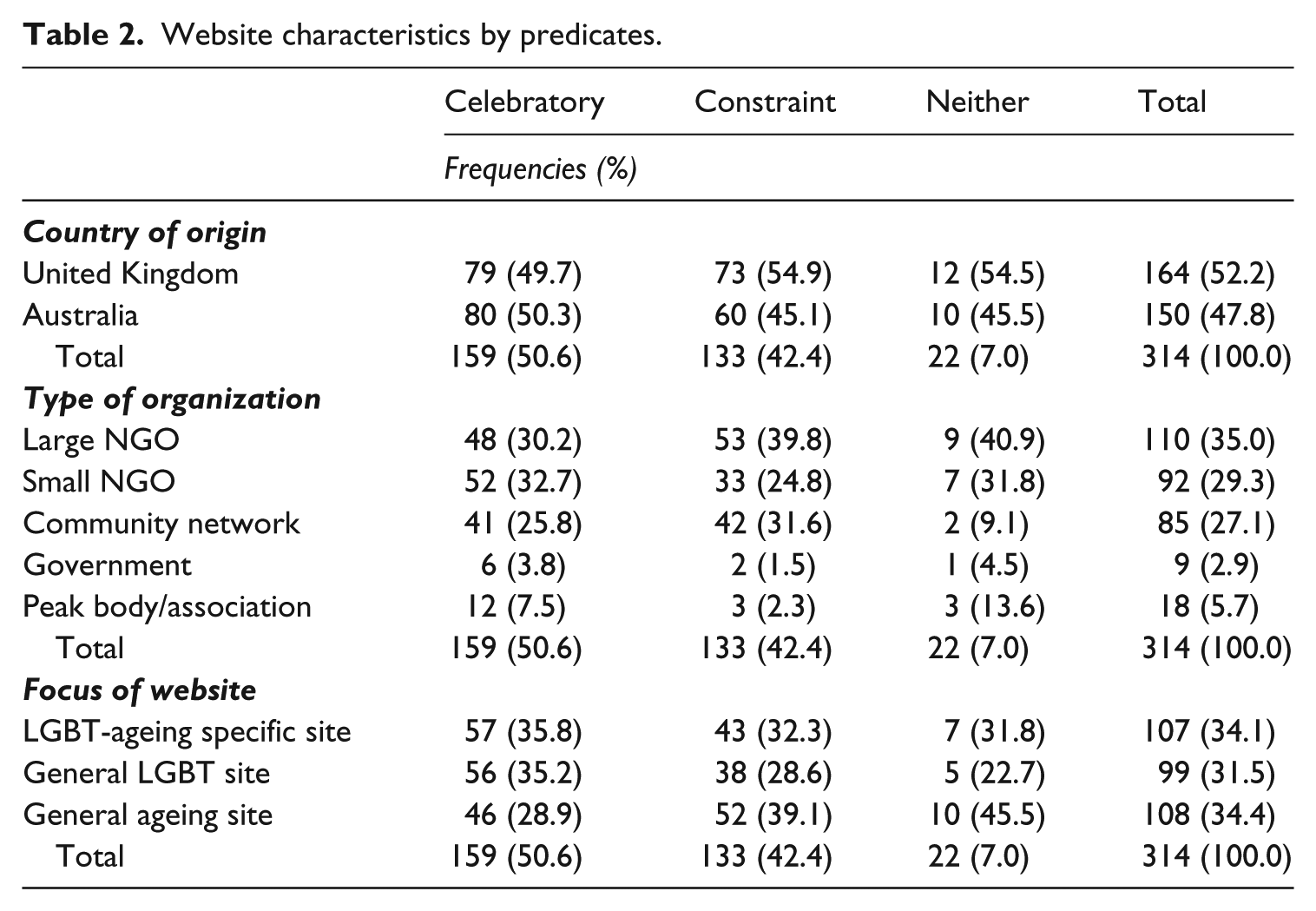
Small differences were also apparent between the types of organization hosting the site. Setting aside the government and peak body or professional association sites (due to small numbers), celebratory predicates were proportionately more common in sites hosted by small NGOs (32.7%) and large NGOs (30.2%) than community networks (25.8%). Interestingly though, the greatest proportion of constraint predicates was found in large NGOs (39.8%) compared to community network sites (31.6%) and small NGO sites (24.8%).
With respect to the focus of the site, celebratory predicates were proportionately more common in LGBT-ageing specific sites (35.8%) and general LGBT sites (35.2%) than general ageing sites (28.9%). Conversely, the proportion of constraint predicates was greater in general ageing sites (39.1%), compared to LGBT-ageing specific sites (32.3%) and general LGBT sites (28.6%).
Anomalies
We looked for anomalies – disjunctions and transgressions – through a close reading of the text and the way celebratory and constraint predicates were positioned in relation to each other. Of the 40 webpages, 23 (57.5%) contained a mix of celebratory and constraint predicates. Fifteen webpages (37.5%) featured only celebratory predicates. It is notable that just one webpage comprised only constraint predicates, and just one included predicates that were not representative of either celebratory or constraint narratives.
With regard to the 23 pages with a mix of predicate types, there were some instances where celebratory predicates seemed overwhelmed by the preponderance of constraint ones. This highlighted the importance of looking at the sequential unfolding of categories and their attributes across a text. For example:
As the older generation of the LGBT community requires our help and support, we need to be there for them. Many of these same older LGBT people fought for the rights of the community that we enjoy today but are: • 3 times more likely than their heterosexual counterparts to be single and live alone • less likely to have children and far more likely to be estranged from their families • significantly more likely to experience damaging mental health problems. As a result, older LGBT people are far more reliant on formal care services, however, due to the scars from decades of discrimination and social exclusion they are far more likely to feel anxious about accessing them. (Small NGO, LGBT-ageing specific site, UK)
In this extract, the celebratory predicates of support and rights that are attached to the membership categories of ‘the older generation of the LGBT community’ and ‘older LGBT people’, appear overpowered by the remaining text and the predicates of social isolation and loneliness, estrangement, mental illness, scarring, discrimination and anxiety. The overall negative impression is further emphasized by the fact that the text and the accompanying image are shaded in a bright red.
On some occasions constraint predicates were more carefully balanced with celebratory ones. For example:
The project aims to reduce discrimination by providing LGBTI training and support to aged care services. By understanding people’s preferences we can facilitate greater social connectivity, improve social inclusion and evolve services to meet the needs of our LGBTI seniors. (Large NGO, general LGBT site, Australian)
Here the constraint predicate – discrimination – was balanced by the celebratory ones – social connectivity and social inclusion. In some cases even more obvious attempts were made to balance the competing representations of LGBT older people and ageing:
Many of the issues relating to planning for later life will of course be very similar whether you are lesbian, gay, bisexual or heterosexual. However, there are some things that might need different attention. On the positive side, this is because the legal context is changing in a mainly very helpful way in relation to gay people. On the negative side, there may be some difficulties you are facing in relation to others’ assumptions or prejudices that could require a distinct approach. (Large NGO, general ageing site, UK)
In this case there is a clear juxtaposition between the celebratory predicate of legal progress and the constraint predicates of difficulties, assumptions and prejudices. In other cases the celebratory predicates were specifically tied to the constraint ones – that is, they were strategies devised to combat negative experiences. For example:
[Name of organization] has been formed to raise community awareness and help local authorities, care providers and carers to address the fears and discrimination that may be experienced by older and old LGBT people and carers by overcoming prejudice in care, stopping negativity, protecting those who are vulnerable and encouraging openness about specific LGBT needs. (Community network, LGBT-ageing specific site, UK)
Thus the constraining experiences of fear, discrimination, prejudice and negativity were to be countered by raising awareness, providing help and protection, and encouraging openness about needs. In an advertisement for LGBT-friendly funeral care on one webpage, a series of graphics and accompanying text also juxtaposed celebratory and constraint predicates, such as:
Those in civil partnerships believe they have the most rights compared to other relationship groups. When arranging a funeral 1 in 10 have experienced poor treatment in the past due to their sexual orientation. Gay people should be treated with the same respect as everybody else and that’s all we’re asking. (Small NGO, general LGBT site, UK)
The intent here seemed to be promotion of a product that would address negative experiences. These findings suggest that many of the websites studied reflected something of the complex interplay between narratives of constraint and celebration in the representation of LGBT older people’s lives.
Discussion
This project sought to answer the question: how do representations of LGBT ageing and LGBT older people vary between websites presenting LGBT ageing content? The research involved membership categorization analysis to examine the qualities (predicates) of LGBT ageing and LGBT older people categories and to map these qualities across different websites. It also sought to examine the ways in which these qualities were supported or challenged in the text through identification of disjunctures or transgressions of the dominant representation. In this way the project was concerned with the production of ‘culture in action’ (Baker, 2000) as related to LGBT ageing and older people, albeit through the specific lens of website content. These representations are important in the formation of cultural scripts – a cultural imaginary – about LGBT ageing and LGBT older people. They are ‘resources for subjectivity’ (Brickell, 2012: 32), not only of LGBT older people themselves, but also for younger LGBT people as they contemplate their own ageing. They also provide scripts for understanding LGBT ageing and older people for non-LGBT people, including non-LGBT policy makers and service providers.
It was notable in the analysis of membership categories that diverse labels were used across the webpages – with half of the categories only being apparent once across the 40 webpages. Nearly two-thirds of the categories grouped different identities, relationships and communities together – such as in the category ‘LGBT older people’. There were examples of reduction or slippage in meaning where, for instance, transgender people were referred to as a ‘minority sexual group’, or where lesbian and gay people were subsumed under ‘gay’. These findings underscore the concerns of previous writers (e.g. Jones, 2016; Traies, 2016; Trevor and Boddy, 2013) that aggregation under one LGBT acronym may obscure diverse identities, relationships and communities. Traies (2016), for example, documents the very specific patterns in older lesbians’ relationships, friendships and connections with lesbian identity – essential knowledge for social policy makers and service providers – that can be lost by being subsumed under the LGBT acronym.
The analysis used to ascertain the predicates related to LGBT ageing and LGBT older people identified two broad groupings: celebratory predicates that reflected qualities such as diversity, rights, recognition and celebration; and constraint predicates that emphasized the isolation, risks and discrimination faced by LGBT older people. There was also a small number of predicates that did not reflect these wider narratives.
These patterns reflected King’s (2016) argument that the public representation of LGBT ageing reflects narratives of both celebration or empowerment and constraint. It must be stressed that King’s (2016) narratives were not imposed or interrogated a priori of the data. If we were to have speculated in advance of data collection about the likely distribution of these narratives then we would have suggested that constraint narratives would have predominated. However, this was not the case for this sample of Australian and UK websites.
These predicate groups were found across most of the different types of websites analysed. However, constraint predicates were proportionately more common in websites based in the UK, in sites hosted by large NGOs and in sites targeting the general older population. While the study design means that it is not appropriate to generalize these findings, they do raise questions about how LGBT ageing and older people are represented in different countries and by different organizations. For example, if a preponderance of constraint images of LGBT ageing and older people exists within large NGOs and general ageing NGOs, then what does this mean for those who rely on these organizations as sources of authoritative information?
With respect to the anomalies that were evident in the text, in some cases celebratory predicates were overwhelmed by the focus on constraint predicates. In other cases, their presentation was more balanced, with some websites clearly juxtaposing positive and negative representations. In these sites there appeared to be an awareness of the need to balance potentially negative stereotypes of older people as marginalized and isolated, with more positive representations akin to successful ageing. In other cases, celebratory predicates were presented as a means by which constraint representations and experiences can be addressed – for example, by promoting social support and inclusion to address isolation and marginalization.
These findings highlight the multi-faceted cultural representation of LGBT ageing and older people and the ways in which dominant narratives coexist and interrelate. Yet, despite these more complex representations, it is important to restate that nearly 40% of websites analysed only presented celebratory representations of LGBT ageing and older people.
The introduction of equality strategies in UK local government, and the identification of LGBT older people as a ‘special needs’ group in Australia appear to suggest greater acceptance and inclusion of LGBT people in the mainstream of public life, and a renewed focus on addressing discrimination in policy making and service provision. Despite these positive trends, it is important to examine the ways in which LGBT ageing and LGBT older people continue to be represented to ward against the imposition of overly positive or overly negative stereotypes. Arguably, the presentation of LGBT older people as happy, diverse and well supported can be as problematic as their presentation as marginalized, lonely and discriminated against. As some of the websites analysed in this study sought to demonstrate, the lives of LGBT people are more complex than this and an understanding of this complexity is important for general public awareness, and essential for informed policy makers and service providers. The findings from our study support the work of other researchers, such as Robinson (2011, 2015) and Simpson (2014), who point to the nuances and ambiguities in and across LGBT ageing narratives.
Previous research has investigated how LGBT older people experience and articulate their gender and sexuality, and has revealed the complex, diverse and ambiguous ways people make sense of identity categories (e.g. Cronin and King, 2010; Hughes, 2007; Rosenfeld, 2003). While this research provides evidence of the cultural scripts older LGBT people use, what has been missing is an interrogation of the cultural scripts themselves. The gap therefore has been in the formation of the scripts within cultural texts, such as online texts. This study sought to partly address this gap in the literature by examining the cultural representations of LGBT ageing and LGBT older people across Australian and British websites.
While there is certainly more scope to expand research on these cultural scripts, arguably what is also needed now is a detailed examination of how these cultural scripts are utilized and regenerated through interaction. Clearly there is potential for the use of conversation analysis, again utilizing MCA, to examine the interactional production of an imaginary about LGBT ageing and older people through analysis of face-to-face interactions as well online interactions (e.g. via Facebook, Twitter or discussion forums). Given the findings of this study, an examination of the interplay between celebratory and constraint representations of LGBT ageing and older people in interactional contexts would appear to be important. Framed in this way, existing studies of service providers’ discrimination towards older LGBT clients take on a somewhat different tone. Instead of focusing on the interactional production of inequality we argue for a turn to the construction of their own scripts: an examination of the ‘cultural in action’ that underpins their own cultural imaginary and manifests in interactions.
Conclusion
The presence of LGBT ageing and LGBT older people categories in UK and Australian websites demonstrates that these categories are not as invisible as they were in the past. However, as King (2016) argued, there is a diversity of views about these public representations, not least from LGBT older people themselves. In this study it was found that some websites reflected this complexity by balancing celebratory and constraint representations of LGBT ageing and LGBT older people. Others promoted a largely celebratory picture of these categories, while in others these positive representations were overwhelmed by negative ones in the form of constraint predicates. Both overly positive and overly negative representations risk framing these categories in homogenous ways. For policy makers and service providers there is clearly a danger in drawing conclusions about the diversity and complexity of LGBT older people’s lives based upon the dominant representations reflected in website content. However, this is inevitably challenging when these websites are hosted by reputable and influential organizations and that would usually be considered authoritative sources of information on LGBT ageing.
Footnotes
Funding
The author(s) received no financial support for the research, authorship, and/or publication of this article.