




Abstract
Young adults in Australia, and in many other advanced countries, are more likely to be highly educated but less likely to be in full-time employment than their parents were. Although insecure employment has long been a feature of labour markets, increased labour flexibility in recent decades has resulted in insecure employment becoming entrenched. In this article, we draw on data from young people in their early twenties to examine the interrelationships between work and life. Although we focus on the association between precarious employment and sense of personal control, we also examine the interrelationships between sense of personal control, education, relationships and health. Rather than experiencing a short period of insecure employment before transitioning into permanent jobs, young people now experience a ‘new adulthood’ characterised by extended periods of insecurity, undermining their sense of personal control. Our aim is to identify what it takes to make a secure, healthy and meaningful life.
Introduction
This article expands our understanding of the impact of social conditions on an important aspect of young people’s lives – their sense of control over their present and future. The analysis contributes to contemporary debates about the relevance of young people’s subjective understandings of their situation, and extends previous research by examining both the individual and collective associations between sense of personal control and employment, education, relationships and health. It draws on two Australian longitudinal data sets, Life Patterns and Our Lives, offering the possibility of a multifaceted empirical analysis across multiple areas of life with the additional rigour of drawing on two independent studies. We conduct analysis of data collected from the Life Patterns participants when they were aged 22/23 years and from the Our Lives participants when they were aged 21/22 years.
Young adulthood in Australia (as in many countries) has undergone significant transformations in recent decades (Benson and Brown, 2011; Buchmann and Kriesi, 2011). A key element of this transformation is the shift to near universal post-secondary education, with the consequence that significant proportions of young people remain in education until their early to late twenties. A second aspect of this transformation is the emergence of precarious labour markets (Furlong et al., 2017). This means that, despite being the most educated generation yet, young people are faced with a ‘hostile’ labour market characterised as ‘precarious’ (Price et al., 2011). An increasing proportion of jobs are short-term, contract-based and part-time, therefore, many young people experience difficulties in finding full-time secure jobs related to their educational credentials (Chauvel and Schröder, 2014; Furlong et al., 2017). Furthermore, the increasing proportions of young job seekers with higher levels of educational credentials has resulted in credential inflation (van de Werfhorst, 2009) whereby, a job that required an intermediate qualification in the past now requires a higher education qualification (for example, nurses and teachers).
While some researchers have pointed to an ‘extended’ period of transition from education to work and by implication from youth to adulthood (Arnett, 2014), others have highlighted a deeper shift that has changed the nature of adulthood itself (Cuervo and Wyn, 2016). This approach, focusing on both conditions and young people’s responses highlights the ways in which precarious work has mimicked the early labour market experiences of young adults in the 1950s and 1960s, when part-time and short-term work progressed naturally to full-time and relatively secure work (especially for the credentialed). This natural progression is not necessarily the case today and it is, perhaps, more accurate to see a ‘new adulthood’ being shaped relatively early as young people begin to manage the insecurity, juggling of jobs and struggle to balance work and life priorities from their early twenties.
These conditions and the challenges they pose for young adults are of central concern to this article. Our aim is to contribute to the literature by drawing on synergies between sociological and psychological approaches to understand the relationship between the individual subjectivities of young people and the conditions they face (and sometimes shape). In our analysis of young people’s experiences and views, we use the concept of personal control (Mirowsky and Ross, 2007) to give traction to the sense of ontological security or insecurity (Giddens, 1991; Laing, 1961) associated with contemporary social formations. Our analysis shows that there is a complex interrelationship between insecure work and other life spheres: education, relationships and health. For young people, it is not just about jobs – it is about the whole of life in a situation where ‘a sense of control’ over life is being eroded.
Young people in times of precarity
Although Australia has experienced 26 years of continuous economic growth (Austrade, 2017), unemployment rates for young people remain high and under-employment has grown substantially (ABS, 2017). In 1993, 19% of people aged 15–24 years were unemployed and 11% were underemployed. In the Australian context, under-employment is defined as being employed part-time but seeking to work longer hours. In 2017, the unemployment rate was 12% and the under-employment rate was 20%. Thus, after a long period of sustained economic growth, it was more difficult for young people to gain full-time employment in 2017 than it was during the last recession. Furthermore, the total under-utilisation rate (the sum of the unemployment and under-employment rate) of those aged 15–24 years was more than double that of the general working population (32% compared to 14.5%). Around one-fifth of employees are casuals, temporary workers who are not entitled to paid leave and may be dismissed without notice (ABS, 2013).
Although higher education continues to offer some protection against unemployment, recent graduates are less likely now than in previous generations to be in full-time employment or in work utilising their skills (Karmel and Carroll, 2016; MacDonald, 2011) as competition for a diminishing number of graduate entry positions intensifies. Thus, as MacDonald (2011) notes, for many young people, extended academic careers simply delay the transition into unemployment/ under-employment. Graduates face a labour market that tends to ‘underutilise’ employees, offering fewer hours than they want and, as a result, lower earnings. Those who are underutilised in the labour market also receive fewer benefits and entitlements, such as paid holidays or sick leave, as well as lower levels of superannuation savings compared to their counterparts in full-time work. As Campbell and Price (2016) note, many of the work rights achieved in the mid-20th century have now been reversed as employers have sought, and won, greater flexibility in workplace contracts. Increasing insecurity in the context of under-utilisation underpins claims that precarity is now central to class divisions within society (Standing, 2011).
The growth of insecure work has implications for young people’s current and longer-term economic and social well-being. Research shows that unemployment and under-employment are associated with lower levels of well-being (Buffel et al., 2017; Heyes et al., 2017). Gallie and colleagues (2017) found that temporary workers were more likely than those employed on permanent contracts to report feelings of insecurity. A state of precariousness can either be limited to some aspects of life, or expanded across the whole of a person’s life, forming an existential condition of vulnerability that moves well beyond the boundaries of work to define broader conditions and perceptions (Neilson and Rossiter, 2005). A poor-quality job characterised by non-standard conditions or hours and/or insecurity with fewer employment rights is one of the aspects of precarity, however, the broader definition of precarity refers to life worlds that are ‘inflected with uncertainty and instability’ (Waite, 2009: 416). Precarity includes insecurity in living arrangements and personal relationships (Neilson and Rossiter, 2005: 2). These life spheres are interrelated. For example, job insecurity can affect housing security; having to relocate for work can affect personal relationships; and housing insecurity can impact the ability to work.
Across the Western world, there is a pervasive feeling among young people that social and economic conditions have deteriorated in relation to those that their parents enjoyed in their youth. Research in the European Union has resulted in young people being labelled the precarious generation (Kretsos, 2010). In the UK, young people are deeply pessimistic about social mobility and seriously concerned about job security, housing affordability and university fees debt (Social Mobility Commission, 2017). In the context of deregulated labour markets in Australia (Tyler et al., 2011; Pusey, 2003) and the growing cost of post-secondary education, a recent Australian study found that of the young people between 18 and 29 years of age who were surveyed, only 22% believed their lives would be better than those of their parents (FYA, 2015). Recent data from the Household Income and Labour Dynamics in Australia (HILDA) survey reveals that home ownership rates among young people aged 18 to 39 years are in decline while mortgage debt for that same age group has almost doubled in real terms since 2002 (Wilkins, 2017).
These changes bolster the view that youth, in general, can be treated as the core of a new precarious class (Standing, 2011). Yet some nuance is required. According to Campbell and Price (2016: 326), structural and personal resources can ameliorate the impact of precarious work; therefore they caution against the temptation to ‘leap freely from precarious work to precarious workers (precarious lives)’ that characterises approaches such as Standing’s, and others’, theorising of the ‘Precariat’ or precarious generations. The growth of insecure work over the last three decades, as part of broader, global economic shifts (Furlong et al., 2017) has drawn attention to the ways in which changing social conditions alter, to greater or lesser extents, subjective assessments of security and autonomy.
Within sociology, the concept of ontological security/insecurity has been central to theorising the impact of recent social changes on subjectivity. Giddens (1991) developed this concept, taken from psychology (Laing 1961), for use in sociological theory, particularly in his work on selfhood in ‘late modernity’. It contrasts a position of being more able, or not able, to take identity and autonomy largely for granted. Ontological security is a coping resource for managing risk and anxiety, and for navigating interpersonal relationships. As Giddens (1991) argues, ontological security is a more important resource when selfhood is a project and contemporary structural formations militate against a sense of security. Similar analyses of social change and self-making projects were developed through the 1990s and 2000s by Bauman (2001), and Beck and Beck-Gernsheim (2002). Randle et al. (2017) argue that the changing structural conditions we summarised in this section are associated with a sense of insecurity. In the following section, we focus specifically on sense of personal control, as a marker of ontological security, as a means of deepening our understanding of the distinctive nature of young adulthood in these uncertain times.
Sense of personal control
Individuals differ in the level of control they perceive themselves as having over their lives. The concept of ‘mastery’ in life-course research has been widely used to measure and explain such differences and their implications (Caputo, 2003; Clench-Aas et al., 2017; Dwyer et al., 2011; Hitlin and Johnson, 2015; Reynolds et al., 2007; Surjadi et al., 2011). According to Pearlin and colleagues (2007: 164), mastery refers to having a ‘sense of control over those circumstances that importantly bear on the life of the individual’. Mastery is a concept with both sociological and psychological features, shaped as it is by ‘both social structural realities and the social psychological perception of those realities’ (Hitlin and Kwon, 2016: 434). It is this structural emphasis which resonates most with sociological focus on the cumulative effects of insecurity in young people’s working conditions and related life domains for their ‘sense of personal control’ (the term that we henceforth use in this article). This concept is closely related to the concepts of locus of control, agency, autonomy and ontological security generally found in the sociological literature.
Mirowsky and Ross (2007: 1339) argue that having a higher level of a sense of personal control ‘provides motivation to meet challenges’ and allows individuals to ‘guide their lives in preferred directions’. As Slagsvold and Sørensen (2008) explain, there are two elements to personal control: (1) the belief that one’s environment is controllable; and (2) the belief that one possesses the abilities and capacity to exert such control (akin to self-efficacy). They argue that the combination of these beliefs underpins self-confidence and prevents individuals from experiencing feelings of helplessness.
Previous empirical research shows that an individual’s sense of personal control is contingent on a range of characteristics (including gender, age and family background) and circumstances (including health, education and employment). Gender is consistently shown to be related to sense of personal control, with males reporting higher levels than females (Clench-Aas et al., 2017; Lewis et al. 1999; Mirowsky and Ross, 2007; Pearlin et al., 2007; Tyndall and Christie-Mizell, 2016). Some researchers have found that this gender gap is more pronounced in older age groups and may be explained by gender inequalities in employment, income, domestic responsibilities, and health (Ross and Mirowsky, 2002, 2013; Slagsvold and Sørensen, 2008).
Various studies have found that family background is strongly associated with sense of personal control (Clench-Aas et al., 2017; Lewis et al. 1999; Pearlin et al., 2007). For example, those with highly educated parents report a higher sense of personal control than those with less educated parents (Lewis et al., 1999; Mirowsky and Ross, 2007). For young people, having a high level of parental support is positively associated with sense of personal control. Supportive relationships enable the individual to make decisions and act on those decisions with self-confidence (Ross and Mirowsky, 2013). Low levels of perceived personal control are also correlated with poor physical health and mental health (Caputo, 2003; Hitlin and Johnson, 2015; Ross and Mirowsky, 2002, 2013; Tyndall and Christie-Mizell, 2016). Feelings of vulnerability and helplessness brought about by illness may compromise a person’s belief that they have power to care for themselves and make autonomous choices.
Higher levels of education are associated with a higher sense of personal control (Lewis et al. 1999; Mirowsky and Ross, 2007; Pearlin et al., 2007; Ross and Mirowsky, 2013; Tyndall and Christie-Mizell, 2016). Knowledge and skills, such as problem solving and critical thinking, acquired through education encourage students to evaluate options, make choices and act decisively (Mirowsky and Ross, 2007; Ross and Mirowsky, 2002; Slagsvold and Sørensen, 2008) increasing their sense of control over their life circumstances. Furthermore, education may indirectly influence an individual’s sense of personal control through its broader role in shaping employment chances, socioeconomic status, and overall health and well-being (Pearlin et al., 2007).
Studies examining the association between employment and a sense of personal control consistently find that employed persons are more likely to enjoy a higher sense of personal control than those who are not employed (Tyndall and Christie-Mizell, 2016). The status of one’s job is also important: those with high-status jobs that afford them a good income, job satisfaction, favourable conditions and security, have a higher sense of personal control than those in lower status jobs or precarious employment (Mirowsky and Ross, 2007; Tyndall and Christie-Mizell, 2016). McGann and colleagues (2016) found that non-standard forms of employment such as short-term contracts or casual employment undermined the ability of workers to exercise autonomy. Moreover, these workers reported feeling less valued in the workplace. Insecure workers have little control over their hours of work and thus their income, which negatively impacts on their psychosocial health.
There is also some evidence that perceptions of personal control vary over the life course (Lewis et al., 1999; Mirowsky and Ross, 2007; Surjadi et al., 2011). As young people transition from adolescence into adulthood, their level of perceived personal control generally increases; the onset of parenthood, however, is associated with declining levels of perceived personal control (Pearlin et al., 2007; Ross and Mirowsky, 2013; Slagsvold and Sørensen, 2008; Tyndall and Christie-Mizell, 2016). Other factors associated with changes in sense of personal control include involuntary job loss and instability in personal relationships (Pearlin et al., 2007). Researchers tend to agree, however, that despite these life events resulting in short-term fluctuations in levels of sense of personal control, overall trajectories are generally stable from the early twenties onward (Mirowsky and Ross, 2007; Reynolds et al., 2007).
Summing up, young people entering a labour market with relatively high levels of precarious employment are increasingly unable to find permanent jobs and are likely to spend several years working in jobs that are either short-term or casual. These circumstances are likely to affect their sense of personal control over meaningful aspects of their lives, such as when they will move out of the family home, when they will commit to longer-term relationships and feeling confident of their future. Research on sense of personal control highlights the intersections between different aspects of life, with flows of influence between employment situation, relationships, physical health and mental health. By drawing on data from young people aged in their early twenties, our research contributes to this complex field by exploring the associations between employment status and sense of personal control, and the ways in which education, relationships and health intersect these associations at a point in time that researchers identify as being pivotal for levels of sense of personal control over the life course. Specifically, our research questions ask: Does sense of personal control vary according to employment status? Does education, family formation and/or health mediate the association between employment status and sense of personal control?
Data and methods
Our analyses are conducted on complementary data from two major Australian cohort studies: the Life Patterns project and the Social Futures and Life Pathways (‘Our Lives’) project. These two projects are conducted independently by two different teams of researchers, one based at the University of Melbourne and the other based at Monash University. There is enough overlap in the questionnaires to allow us to combine data from the two projects. By merging data from both projects, we have a sample of young people who were living in Queensland, New South Wales (NSW), the Australian Capital Territory (ACT), Victoria and Tasmania while at secondary school.
The Life Patterns project is a longitudinal study of two cohorts of young Australians. We use data pertaining to the most recent cohort who were recruited in 2005/06 from 77 secondary schools across Victoria, NSW, the ACT and Tasmania. All students in the selected schools who were due to complete secondary school in 2006 were invited to participate. The initial questionnaire was completed by 3977 students. Follow-up surveys were conducted on an annual basis. Participants have the option to either complete and return the paper questionnaire or access and complete the online version. For this article, we use wave 7 of the data, collected in 2012 when the respondents were aged 22 to 23 years (n = 710). For further details, see Cuervo and Wyn (2011).
The Our Lives project is single-cohort longitudinal study of young Australians who grew up in Queensland. In 2006, 7031 Year 8 students from 213 secondary schools across Queensland were recruited. The first survey wave involved a hard copy self-completion survey, later waves have progressively utilised online self-completion and telephone interviewing. For this article, we mainly draw on data from wave 5, which was conducted in 2015 when the participants were aged 21 to 22 years (n = 2157). For further details, see Skrbiš et al. (2016).
The main difference between the two samples, apart from the geographical location, is that the Life Patterns cohort completed secondary school in 2006 whereas the Our Lives cohort completed secondary school in 2010. We combine the waves of data collected four years after the participants completed secondary school. Students in Queensland generally completed five years of secondary school and graduated at age 17. Students in Victoria, NSW, ACT and Tasmania generally completed six years of secondary school and graduated at age 18. Thus, our Queensland participants were aged 21/22 years and the other participants were aged 22/23 years. Although we do not claim to have a nationally representative sample, our data nonetheless incorporate the ACT and four states which together account for 81% of the Australian population.
Variables
The outcome variable for the analysis is the sense of personal control scale. This measure is based on the responses to seven items adapted from the Pearlin et al. (1981) sense of mastery scale. Respondents were asked how much they agreed or disagreed with a series of statements such as ‘There is really no way I can solve some of the problems I have’, ‘I have little control over things that happen to me’ and ‘I can do just about anything I really set my mind to do’. The internal coherence of the scale was tested independently for each project and returned a Cronbach’s alpha of 0.7734 for the Our Lives project data; and of 0.7840 for the Life Patterns project data.
Our key explanatory variable is employment status. Research indicates that the association between employment status and levels of perceived sense of control is dependent upon the type of employment (Mirowsky and Ross, 2007; Tyndall and Christie-Mizell, 2016). Therefore, to examine whether being in precarious employment is associated with lower levels of sense of personal control, we divide participants into four groups: employed full-time (reference category); employed part-time; employed on a casual basis; not employed. Initially, we also included a second indicator for employment: occupation. However due to collinearity with employment status (both variables have a not employed category), we dropped the occupation variable from the analysis. Furthermore, given that we are examining the outcomes of young people just four years after they finished secondary school, it is more than likely that some (for example, tradespersons) are in their career jobs, whereas others (for example, those still studying) are not working in their preferred career occupations.
We also include indicators of the other three domains that researchers find are associated with levels of perceived personal control: education, family status and health. In the education domain, we include two measures: highest level of education at age 21/23 and level of current study at age 21/23. The highest level of education has three categories: school only; VET (Vocational Education and Training) qualification; and university qualification. The current study variable has three categories: not studying; studying for a VET qualification; and studying for a university qualification. Research shows that level of perceived sense of control is positively associated with level of education (Mirowsky and Ross, 2007; Slagsvold and Sørensen, 2008; Tyndall and Christie-Mizell, 2016). This generation of young Australians have shown a willingness to continue in education and gain higher level credentials to improve their chances in the labour market and, more importantly, their chances of securing their preferred job (Wyn et al., 2017).
For the family status domain, we examine two variables: marital status and living arrangements. Marital status has three categories: single (includes separated and divorced); in a relationship; and de facto/married. The living arrangements variable has four categories: living with parents; living in a shared house/college; living with a partner; and living alone. Living alone has become more common among young adults with high levels of education who are employed in high-income professional occupations (Hughes, 2014). According to Hughes (2014), living alone is associated with an increased sense of agency and a desire to maintain one’s autonomy.
In the health domain, we include two variables: physical health and mental health. These variables are based on questions asking respondents about their general physical and mental health and have been recoded into two categories: healthy and unhealthy. Previous research shows that sense of control is negatively associated with poor health (Caputo, 2003; Clench-Aas et al., 2017; Tyndall and Christie-Mizell, 2016).
We include four control variables: gender; family background; source of data; and response mode. The only indicator of family background common to both data sets is parental education. This variable is based on the highest level of education of either parent and has four categories: < Year 12; Year 12; VET; and University. Due to the relatively large number of explanatory and control variables and the small number of missing values on each of these variables, we include dummy variables to indicate missing values rather than drop cases with missing values on individual variables. Unless significant, the missing categories are omitted from the analytic output. Table 1 provides the descriptive statistics of the combined samples and the mean value on the sense of personal control scale for each category of each variable.
Descriptive statistics.
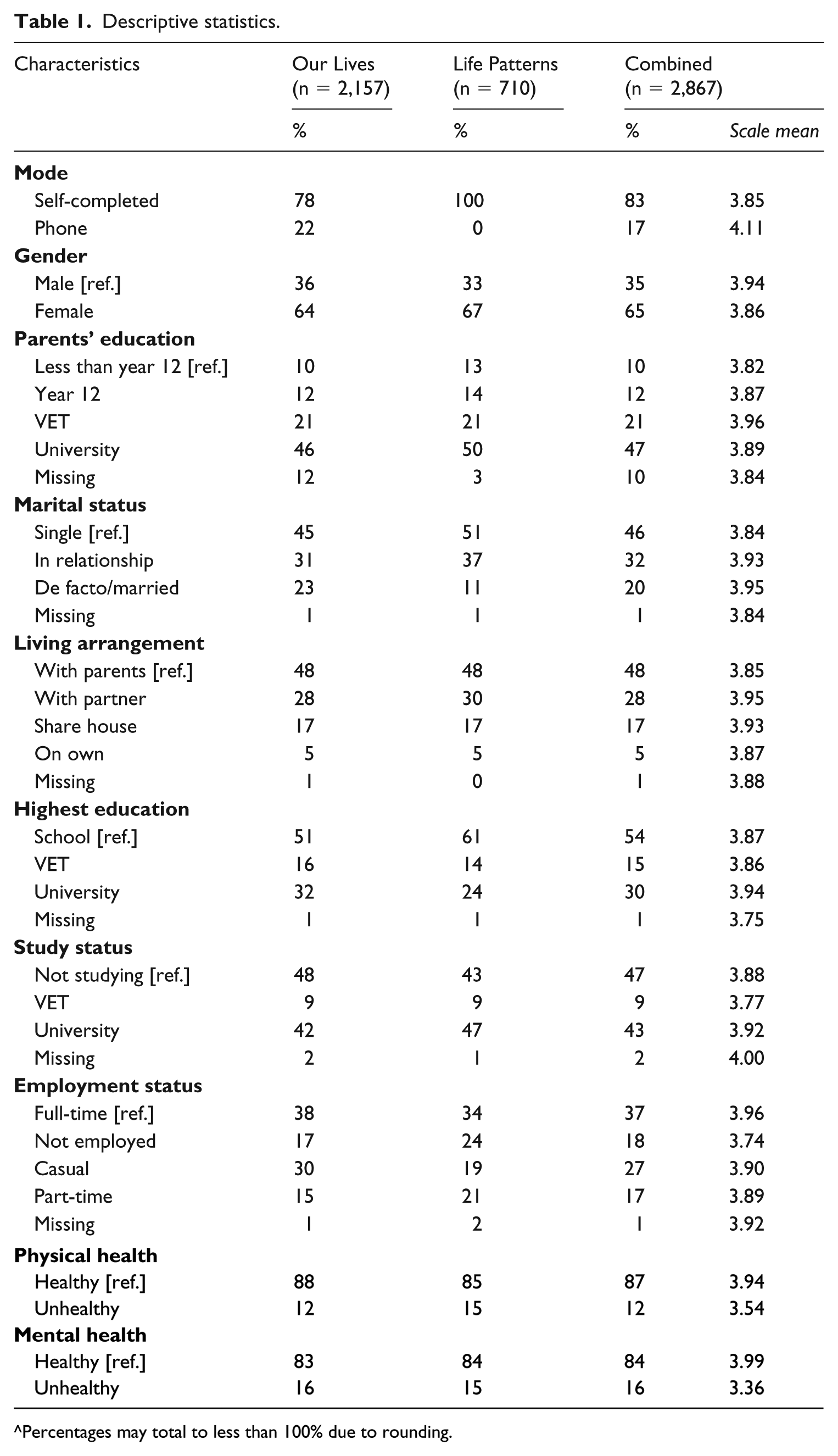
^Percentages may total to less than 100% due to rounding.
Analytical strategy
In this article, we are principally interested in the association between sense of personal control and employment status. We are also interested in whether the association between employment status and sense of personal control is mediated by indicators of three other life domains: education, relationships and health. Given that the personal control scale is a continuous variable ranging from 1.00 to 5.00, we construct four OLS (ordinary least squares) regression models, one for each domain. For example, we construct the model to examine the association between employment status and sense of personal control by estimating the coefficients for each category of the employment status variable, gender, parental education, response mode and source of data.
We then select the most salient measures of each domain for a set of OLS regression models to examine whether each of these domains has an independent effect on sense of personal control. In our first model, we include employment status, source, response mode, gender and parental education. In the second model, we additionally include highest level of education, current study and marital status. In the third model, we additionally include physical and mental health status.
Results
Associations between sense of personal control and four life domains
The first series of regressions (Table 2) investigates domain-specific influences on young people’s sense of personal control. Each one-unit increase on the sense of personal control scale indicates a higher level of personal control. Thus, each coefficient can be interpreted as the amount of change in personal control associated with a one-unit change in the explanatory variable, net of all other influences in the model.
OLS regression estimates for domain-specific influences on personal control.
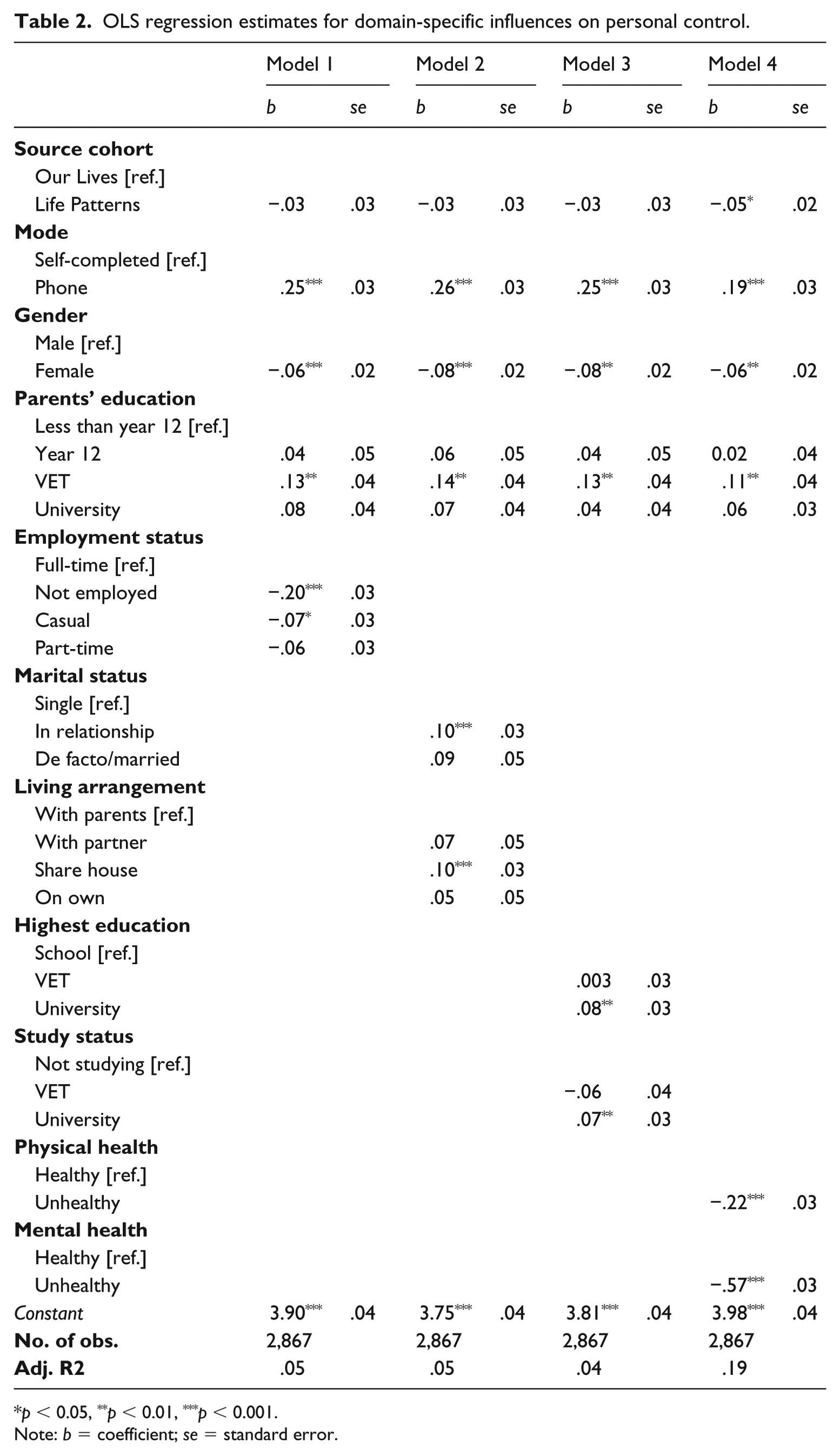
p < 0.05, **p < 0.01, ***p < 0.001.
Note: b = coefficient; se = standard error.
Model 1 examines the association between young people’s sense of personal control and employment status with gender, parental education, mode and source included as control variables. Compared with individuals who were employed full-time, those who were employed on a casual basis and those who were not employed had a lower sense of personal control. As predicted in the literature, females reported lower sense of personal control than males. In addition to gender, the controls for parental education and response mode were also correlated with sense of personal control. Respondents whose highest level of parental education was a vocational degree displayed higher sense of personal control than those with less educated parents. Consistent with prior research on social desirability bias and mode effects for sensitive survey questions (Tourangeau and Yan, 2007), respondents were more likely to display higher sense of personal control scores if they were surveyed by a telephone interviewer than if they completed the survey themselves either online or in hardcopy format. Aside from this effect, sense of personal control levels did not differ significantly between the two cohorts after accounting for the other measures in Model 1. This supports our assumption that the two samples are broadly comparable for the purposes of this analysis. The coefficients for the gender, parental education and response mode remained similar across Models 1 to 4.
In Model 2, two study measures were examined: the highest level of study respondents completed since leaving school and the level of current study, if any. On both measures, university education was an important predictor of sense of personal control score. More specifically, having completed a university degree was associated with a higher sense of personal control than having completed no post-school study. Furthermore, those who were currently studying for a university degree also displayed higher sense of personal control than those who were not studying at all.
The results of Model 3 show that relationship status and residential situation are both significantly correlated with sense of personal control after controlling for socio-demographic, cohort and mode effects. Compared to those who remained single, young people who were in a relationship, de facto, or married reported a slightly higher sense of personal control. While respondents who were living in a share house were found to have higher sense of personal control than those still living at home, there were no similar associations for those living on their own or with a partner.
Lastly, Model 4 shows that, of all the predictors examined, young people’s self-reported mental and physical health displayed the strongest association with their sense of personal control. The adjusted R-squared value indicates that these measures also explain the largest proportion of the total variation (around 19%). Respondents who rated their physical health as poor (i.e. unhealthy) averaged 0.22 lower on the sense of personal control scale than those reporting better health. Meanwhile, young people who reported poor mental health displayed sense of personal control scores that were on average lower by 0.57, or around 12%, than those who rated themselves as mentally healthy. With the inclusion of these self-reported health measures, the effect of response mode was slightly reduced. This is most likely because the under-reporting associated with telephone completion for the sense of personal control items was also present for the measures assessing mental and physical health, which are similarly prone to social desirability bias.
Integrated model examining sense of personal control across four life-course domains
After confirming that measures of each domain are associated with sense of personal control, we next examine whether the association between employment status and sense of personal control is mediated by measures from the other three domains (Table 3). Given an underlying correlation between marital status and living arrangements, we opted to exclude the less salient predictor of the two (living arrangements) from these models. All other factors examined in the previous models were retained. Model 1 begins by accounting for young people’s employment status on their sense of personal control scores, net of the control measures. In Model 2, we additionally include education, study status and marital status. When young people’s education, study status and marital status are also taken in account, the negative coefficients for not working full-time are more pronounced than when we modelled employment status separately. Strong differences emerge in the sense of personal control levels of casual and part-time employees when compared against respondents with full-time employment. These changes indicate that the conjunction of young people’s work and study arrangements have stronger implications for their sense of personal control than would be apparent if they were examined in isolation from each other. Finally, with the addition of the physical and mental health measures in Model 3, the total variance explained rises to around 20%. Although the coefficient estimates for these measures themselves change very little in the comprehensive model, they appear to partially mediate the associations for employment status, marital status, highest completed level of education and mode of completion. At least one-third of the correlation between low sense of personal control and not being employed appears to be attributable to the lower self-reported mental and physical health of these respondents. The association between employment status and sense of personal control remains even after controlling for education, marital status and physical and mental health.
OLS regression models of combined life domain influences on personal control.

p < 0.05, **p < 0.01, ***p < 0.001.
Note: b = coefficient; se = standard error.
Discussion and conclusion
Our analysis draws on a legacy of life-course research with the aim of understanding the way in which individual biographies intersect with social conditions. We have built on the synergies between sociological and psychological contributions within this field to analyse the interrelationships between employment, education, relationships, health and sense of personal control. Our examination of the associations between sense of personal control and these various domains, both individually and collectively, contributes to the extant literature.
The concept of sense of personal control draws on interdisciplinary life-course scholarship that seeks to explain how subjective dispositions and orientations influence individual development over time. However, the term is closely related to the sociological concepts of agency and autonomy, providing a lens into broad theoretical conceptualisations of the impact of social change on ontological security (Giddens, 1991). As we have identified above, psychological research documents the close relationship between having a low sense of personal control and psychological distress, poor mental health and poor physical health (Lewis et al., 1999; Mirowsky and Ross, 2007). Although levels of sense of personal control fluctuate somewhat due to certain life events, overall trajectories are remarkably stable after the attainment of adulthood (Mirowsky and Ross, 2007; Reynolds et al., 2007).
From a sociological perspective, the concept of precarity highlights the important, cumulative, and in this sense variable, impact of current conditions (especially high youth unemployment, under-employment and under-utilisation) on young people’s sense of ontological security (Giddens, 1991) and on the ways in which young people make sense of their lives and their worlds. Given the relatively high under-utilisation rate for young Australian workers, it is likely that a large proportion of this generation have experienced precarity, raising the spectre of the ‘scarring’ of large sections of the current generation of young adults (Chauvel and Schröder, 2014). A sociological approach focuses on the ways in which economic and structural insecurity and the fragmentation of institutional structures impacts on young people’s subjectivities (Furlong and Cartmel, 1997; Furlong et al., 2017; Standing, 2011). Drawing on both sociological and psychological traditions offers insights into the relationship between the conditions under which young people are living and how they make sense of their lives. It allows for a finer grained analysis of the conditions in which precarious structures create precarious lives and of how some resources mediate this process; both going beyond the blanket concepts that place young people into a precarious generation or a precariat class and showing that the impacts of insecure work appear to be cumulative and widespread (Campbell and Price, 2016).
In answer to our first research question, ‘Does sense of personal control vary according to employment status?’, our results show that young adults experiencing insecurity in the labour market are more likely to have a lower sense of personal control. Young adults who have a relatively strong sense of personal control are most likely to be in secure employment, to be in a long-term relationship and to have higher levels of education than their counterparts with lower levels of sense of personal control. The association between sense of personal control and precarious employment was robust, with those in casual employment reporting lower levels of sense of personal control than those in full-time work.
In answer to our second research question, ‘Does education, family formation and/or health mediate the association between employment status and sense of personal control?’, our results show that after controlling for education, study status, marital status, physical health and mental health, the association between employment status and sense of personal control remains. This finding strongly supports concerns about the generational impact of sustained precarious work (Chauvel and Schröder, 2014; Reynolds et al., 2007). Reynolds and colleagues (2007) also found that labour market conditions play an important role in the development of an individual’s sense of personal control (see also Tyndall and Christie-Mizell, 2016). The interrelationships between precarious work and other life spheres mean that they influence each other and, as Pearlin and colleagues (2007: 165) note, ‘successful experiences inspire the belief that one possesses the power to effectively control one’s life’ whereas negative experiences undermine one’s belief in one’s power. Our findings support this observation. As McGann and colleagues (2016: 773) note, non-standard employment has a destabilising effect on the ability of workers to ‘exercise autonomy and control over their lives more generally’.
In conclusion, our analysis provides strong evidence for the erosion of a sense of personal control among young Australians in this generation. Closely linked to precarious working conditions, young people’s sense of control is also linked to other life domains – education, relationships and health. This means that the precarity that young people experience in the labour market has a negative effect on many lives, and has especially negative implications for the mental health of a generation. The precarity of the labour market, and the sense of ontological insecurity that challenges young adults today is not something that they will ‘grow out of’ through a presumed ‘transition’ process. New social and economic conditions have heralded a new adulthood, with which the young people in the Our Lives and Life Patterns studies are engaged. Our analysis has enabled us to ‘join the dots’ to gain an insight into the multifaceted interrelationships between work and life – and into what it takes to make a secure, healthy and meaningful life.
Footnotes
Acknowledgements
We would like to thank our colleagues: Helen Cahill, Julia Cook and Josie Reade.
Funding
The author(s) disclosed receipt of the following financial support for the research, authorship, and/or publication of this article: The Life Patterns research program is funded by the Australian Research Council (ARC) (DP460101611/DP1094132/DP0557902/DP0209462/A79803304). The Our Lives research program is funded by the ARC (DP0557667/DP0878781/DP130101490/DP160100360).
