




Abstract
Gender is constructed from social and cultural meanings that dynamically shift and vary. Previous work has assumed that the constructions of masculinity in Australia are like those in other Western societies, and typically focus on qualities such as physical strength, courage and sometimes military engagement. This study explores whether these assumptions hold, by conducting telephone interviews among 617 Queensland men, aged 18 years and above, across all geographical parts of Queensland. This survey was administered in 2013, as part of the Queensland Social Survey series. The study explores the diverse meanings associated with being a ‘real man’ given by the survey participants. Three main dimensions emerged from the thematic analysis: physicality; personality and character; social roles and relationships. The study confirmed that masculinities are dynamic and complex. Responses revealed a surprising emphasis on character and morality 44.5% (n = 684) as defining manhood, as against physical qualities 13.7% (n = 153).
The ‘Aussie bloke’ is an archetype of the Australian male, stereotypically a rough, rustic and uncouth man, who is ready to ‘roll up his sleeves’ and ‘give things a go’ (Lee, 2011). The ‘true-blue Aussie larrikin bloke’ is typically portrayed in the Australian media by popular icons, such as Steve Irwin and Paul Hogan, as tough, enjoying outback life, spending free time with male friends in the pubs, and in Bellanta’s (2012: 185) work as a ‘binge drinking, mischief making, fun-seeking, non-conforming, law-less, raunchy and hyper-masculine male’ (Carrington, 2012). The Australian cultural identity is arguably built on hardy masculine foundations (Lee, 2011), and for those less conversant with Australian cultural icons, the term ‘larrikin’ – a derivative of the English phrase ‘lark about’ – has held meanings that have changed significantly since the 1800s (Bellanta, 2012; Carrington, 2012). In recent times, a ‘larrikin’ is an informal term for a fun-loving young male who may not adhere to social conventions, enjoys bending the rules, but is nevertheless likeable and socially accepted (Ludowyk et al., 2000). By convention, the typical ‘Aussie bloke’ is assumed to have some degree of ‘larrikinism’. There is historic affection for a ‘larrikin’ and equally there is scorn for a man who is a ‘wowser’ or a ‘whinger’ (Stollznow, 2003). A ‘wowser’ is an Australian term that implies an ‘obtrusively puritanical person’ (Merriam-Webster, 2017). However, these long-standing historical portrayals may well be dated and this raises the question: what characteristics do modern Australians consider as typifying a ‘real man’?
Emphasis has almost certainly been shifting from past gender role benchmarks to new configurations (de Vaus, 2004). This shifting trend may explain the complex and rich ways men construct masculinities identified in this research, although it is acknowledged that there have always been many versions of masculinity. In the past century, Australian society has witnessed technological advancements, increased cultural diversity and a high literacy rate, and a highly urbanised cosmopolitan society has emerged (de Vaus, 2004). These changes have likely created a shift in many of the masculine stereotypes of the past century. Unflattering terms, such as ‘bogan’, meaning uncouth, unsophisticated and unruly, are now readily used to describe behaviours that have in the past conformed to masculine stereotypes, such as being a ‘larrikin’ (Pini et al., 2012). Therefore, it is salient to explore how masculinities are constructed in contemporary Australia.
To derive a theoretical definition of masculinities is perhaps easier and more straightforward than in practice. Thus, rather than hypothesizing or attempting to measure causality based on pre-existing criteria for masculinity, we opted to explore respondents’ own definitions by asking for three characteristics that came to mind that, in their opinion, made someone a ‘real man’. Our aim is to derive better understandings of contemporary manhood inductively, and to showcase the eclecticism of participants’ responses, thereby highlighting the complexity of meanings and the multidimensional understanding of masculinities held by men in Queensland. The complexity, richness and diversity of meanings identified by this study showed a clear departure from the early literature (Courtenay, 2000, 2003; Mahalik et al., 2003, 2006, 2007, 2008). The gaps and weaknesses of previous academic work may also stem from the types of analysis, tools and scales used that may have relied too heavily on narrow stereotypes (Thompson and Bennett, 2015; Wade, 2015). The qualities described by participants supported the existence of multiple masculinities, and are consistent with the fluid nature of gender (as distinct from biological sex) discussed extensively in the literature (Connell, 2005, 2015).
Our study draws upon socio-constructionist frameworks, that is, ‘the knowledge of everyday life, structured in terms of relevances, some of which are determined by an individual’s own pragmatic interest, others by his general situation in the society’ (Berger, 1966: 59). The field of masculinity and critical studies of men has not only witnessed significant growth in the last few decades (Kahn, 2009) but also significant cultural and theoretical changes (Anderson, 2012).
Anderson (2012), argued that ‘a new cultural zeitgeist requires new ways of theorizing masculinities’. His evidence was based on the changing nature of young men’s masculinities in competitive organized team sports. He observed cultural shifts on sports grounds, which have failed to be captured by existing theories of hegemonic masculinities. Similarly, Hearn (2004) pointed out the ambiguity in ‘hegemonic masculinity’, which describes men as both a ‘social category formed by the gender system, as well as a dominant collective and individual agents of social practices’. He argued that in order to employ the notion of hegemony in the critical analysis of men, there is a need to unpack ‘masculinity’, and to examine the hegemony of men in unrestricted ways. Wetherell and Edley (1999) noted that despite the significant theoretical insight embodied by the concept of hegemonic masculinity, it is limited in its account of how men position themselves as gendered beings. In addition, other scholars have highlighted the ‘need to develop theoretical frameworks that can grasp changes, complexities, ambivalences, ruptures and resistance’ (Christensen and Jensen, 2014). Using empirical examples from Scandinavian society, Christensen and Jensen (2014) identified the contradiction that arises from maintaining an in situ understanding of patriarchal oppression, and simultaneously postulating theories on ‘nuance and complex understanding of masculinities, and shifting gendered power relations’. They noted that, although being male and white is central to hegemonic masculinity in Denmark, ethnic minority men were often marginalized ‘because they are imagined to have excess masculinity, and are patriarchal and non-equality oriented’. They showed that neither hegemonic masculinity nor subordinate masculinity is ‘set in concrete’ (Christensen and Jensen, 2014). It is however notable that, in reshaping the concept of hegemonic masculinities, Connell and Messerschmidt (2005) highlighted that hegemonic masculinity is not immune to change with time, and ‘a more humane, less oppressive means of being a man might become hegemonic, as part of a process leading to abolition of gender hierarchies’. However, Christensen and Jensen’s (2014) work shows that a version of masculinity that embraces equality with women cannot always be assumed as thoroughly positive.
Some scholars have questioned the concept of masculinity altogether. MacInnes (1998: 2) described masculinity as a creation of modernity, established through politicization of the pre-modern patriarchy. He explored historical events that may have led to the invention of masculinity in order for people to make sense of their lives. In our study, very few participants questioned the existence of masculinity, instead conceptualising it as a given, but in rich and unexpected ways.
Recent studies on masculinity in Australia, such as Waling’s (2014) narrative analysis of contemporary lifestyle magazines consumed by Australian male audiences, resonate with some of the findings of our study. The most congruent with our study were the more benign narratives, such as a strong moral grounding, wholesome family values and both physical and psychological strength, dubbed the ‘triumph-over-tragedy narrative’ (Waling, 2014). These narratives align with some of the character and personality traits given by our participants.
Determining the exact impacts of the narratives explored by Waling (2014) on the magazine audience was not within the scope of her work. Similarly, determining whether many of the seminal theories postulated in men’s studies hold among Australian men requires an assessment of an individual’s perception of the subject of masculinity. This assumption is based on the work of Mills (1959), who stated that ‘neither the life of the individual nor the history of a society can be understood without understanding both’ (1959: 3). This study attempts to understand the perception of masculinity among Queensland men by exploring characteristics, events and the gendered meanings given to them by these men. We aim to derive evidence that can fill the theoretical gaps identified by existing literature (Hearn, 2004; Wetherell and Edley, 1999), and extend existing empirical theories by unpacking Australian men’s own accounts of their social position.
Methods
This study was conducted in Queensland, Australia, as part of the 2013 Queensland Social Survey (QSS13). The survey was administered by the Population Research Laboratory (PRL) of the Institute for Health and Social Science Research at Central Queensland University. The questionnaire was administered using a CATI (Computer-Assisted Telephone Interviewing) system. The State of Queensland was stratified into two areas for the purposes of telephone interviewing: (1) highly populated, urbanised south-east Queensland; (2) the remainder of Queensland, which was inner and outer regional, and remote. The target population of the survey was all persons 18 years or older, living in a Queensland dwelling unit who could be contacted by a direct-dialled, land-based telephone service.
Telephone numbers of potential participants were randomly selected using a database of landline telephone numbers to ensure respondents had an equal chance of being selected. The phone number database was sampled using postcode parameters and washed to remove non-residential and non-working numbers. For the present study, only data from male respondents were used. A two-stage selection process was utilised: (1) selection of households and (2) selection of the respondent’s gender within each household. The questionnaires were pilot-tested by trained interviewers who administered them across 99 pre-selected Queensland homes.
Interview methods
The modified electronic questionnaire for the QSS13 round 2 and the telephone database were loaded onto the CATI system. Interviews were conducted over 20 stations between 29 October 2013 and 28 November 2013. The CATI system randomly allocated telephone numbers to the interviewing stations. The system operated over a local area network, which facilitated exchange of information between interviewers and their supervisor stations.
The full QSS13 included a range of health and welfare questions for both men and women; however, the present article only reports the responses from men concerning their perceptions of masculinity derived from the following questions:
We would like you to think about what in your opinion, makes someone a ‘real man’.
Could you tell me
How important is it to you
Data management and analysis
Interview responses were entered into the computerised QSS database. The CATI system features an automatic routing of questions and built-in checks for inconsistencies. The supervisors conducted a quality check to validate the accuracy of the interviewer’s entries.
Preliminary analysis of the data was conducted at the PRL to determine the estimated standard error, response rate and sample representativeness. The Australian Bureau of Statistics census data were used for comparison to determine representativeness. Weighting factors were also determined based on the index of dissimilarity. Qualitative analysis was conducted by inductively interpreting and coding participants’ responses to the open-ended questions into domains, categories and sub-categories. Codes considered to have related meanings were grouped, and the domains were determined from the patterns and associations between the categories.
The following sequential process was undertaken to derive categories and domains:
reading and re-reading the transcripts, while trying to make sense of the participants’ concepts of masculinities;
extracting the participants’ exact phrases and words;
examining the participants’ statements for assumptions and implied meanings, and extrapolating meanings that related directly to their responses;
grouping codes and inferred meanings into clusters of categories;
writing concise descriptions of domains, and exemplifying them with recurring and meaningful phrases used by participants within each cluster;
to ensure interpretive rigor, three additional authors critically reviewed the transcripts and analysis.
Results and discussion
A total of 593 participants gave at least one valid response, and 1535 different responses were analysed in total. Analysis yielded a range of interpretations with multiple dimensions. These interpretations were grounded in three principal domains: physical qualities; personality and character; and social roles and relationships. Of the responses given, 13.7% (n = 153) were coded under the physical qualities domain and 44.5% (n = 684) under the personality and character domain. The social roles and relationships domain comprised several overlapping categories (10.4%, n = 159).
It is important to note that categorisation into a single domain was unusual as the domains ‘bled’ into each other. For example, ‘strength’ might refer to physical strength, strength of character, strong leadership and/or committed relationships. Likewise, physical constitution might be a prerequisite for certain roles and might be used as an expression of character or role relationships. This ‘bleeding’ also has the effect that a single characteristic could be coded under several domains or that the characteristic was difficult to code because it was generic (e.g. ‘strength’).
Responses are labelled with their respective alphanumeric participant code. Non-identifying alphanumeric codes were allocated to each participant during the data collection process. Each code starts with a character ‘RM’ followed by four digits. Each domain or category is first characterised by its corresponding descriptive frequency. This descriptive frequency gives a numerical indication of the spread of domains, categories and responses. Further narratives were used to contextualise and describe the domains, and excerpts from the participants’ responses were used as supporting evidence for the narratives.
Domain 1: Personality and character
Nearly half of the responses (44.5%, n = 684) were coded as the domain of ‘character’. While the meanings explored in this domain were layered and interwoven with other domains, the surprising emphasis on character and personality traits, depicted here by positive personality traits and character, reflects debates on multiple masculinities. This domain encompassed two main sub-categories: implied character that was reflected in roles and actions (164 comments); and expressed character (520 comments). Expressed character referred to responses where the participant explicitly put character into words, and was not necessarily attached to a particular role or action. Conversely, implied character is based on the choice of roles and actions that the respondent offered as examples of ‘real men’ but where that choice implies a certain character trait or belief as a pre-condition.
Participants whose responses referenced ‘personality and character’ either mentioned a distinct virtue or implied it as part of a compound feature of other domains. For example, 91 participants mentioned the term ‘honesty’, while others described ‘calmness’ and ‘selflessness’. In addition to attributes expected of a ‘real man’, some respondents made a similar point in terms of what ‘real men’ should not do, for example: ‘never hits a woman or a young child’ (RM1019).
Character was also reflected in comments such as caring (50 comments). The idea of caring, for example, was extended to family (11 comments), neighbours, and friends and others (5 comments). There were also some who described caring in general terms, without reference to a specific person or group (34 comments). Table 1 provides examples of responses given by participants that were classified as ‘personality and character’. These responses are consistent with fluidity of masculinities, while also serving as a lens for examining the perceptions of masculinities among the study participants.
Categories, frequencies and exemplars of personality and character domain.

Expressed personality and character
This group generally includes comments about positive traits and sacrificial acts, which, regardless of what motivated the act, were raised as examples of what constitutes a ‘real man’. Responses such as those given by RM0270 and RM0134 were framed in the context of a positive attitude. Respondent RM0270 stated that a ‘real man’ to him was ‘someone who has the ability to compromise for the good of everyone’, while RM0134 said: what defines a ‘real man’ is ‘attitudes – to put into society not take out all the time’. Other participants highlighted specific attributes such as courage, which were sometimes in the context of defence and protection. Respondent RM0682 talked about being courageous, and participant RM0358 stated that being a ‘real man’ means ‘being fair all the time’.
RM0957 stated that being a ‘real man’ implied ‘having good manners, and being considerate for those in need, or disadvantaged’. This response may indicate changing masculine expectations, which are in contrast to the societal benchmarks described by previous studies on masculinities (Courtenay, 2000, 2003; Mahalik et al., 2006, 2007, 2008). According to our findings, there seems to be a notable, perhaps surprising emphasis on good manners as being a manly quality in contemporary Australian society.
Participants also talked about expressing emotions. Different forms of emotions were described and, in line with the multiple natures of masculinities, emotional expectations described by participants varied. For example, participant RM0167 said: being a ‘real man’ to him was the ‘ability to show emotions sometimes’. Men are stereotypically expected to be less emotionally expressive (Roisín, 2012), however evidence from our study contradicts this assumption. Likewise, in a clear departure from the normative masculine ideals of stoicism (i.e. endurance of pain or hardship without the display of feelings and without complaint), the comments: ‘admit weakness when not coping’ (RM0719); ‘admitting feeling down or unwell’ (RM0466) both suggest emotional expressiveness and the acknowledgement of limitations.
Moral values
Some responses reflect moral values and standards. While this category is not rigid, values classified within it appeared to broadly represent sets of principles that guide choices between right and wrong. Examples included honesty, truthfulness and integrity. Honesty and truthfulness may have some unique link with the Australian colloquialism, ‘fair dinkum’ (an Australian slang phrase confirming authenticity), and is often used to verify honest interactions (Courtney, 1996). Perhaps surprisingly, 15% (n = 91) of participants discussed honesty as an important characteristic of a ‘real man’.
Character implied in actions
Responses classified in this group represented intentional acts that were often positive and had a direct effect on others, such as family, friends or the general community. For example, kindness was mentioned in varying contexts, encompassing goodwill and forgiveness. An example was the response given by RM0644, who said a ‘real man’ is someone who is ‘kind to everybody, no matter how he is treated by others’.
Violence is a trait more associated with men than with women in many societies (Staniloiu and Markowitsch, 2012). Participant RM1156 said a ‘real man’ to him was someone who ‘never takes a weapon to a fight’; he was also of the opinion that a ‘real man’ ‘never throws the first punch’. While responses such as this seem to take an association between manhood and fighting for granted, it was showing restraint in a fight and not initiating it that was considered to define a ‘real man’.
Social pressure and a desire to conform to social expectations often entails a need to validate manliness (Cheryan et al., 2015). This appeared to be both acknowledged and challenged in the statement by subject RM1029, who said a ‘real man’ in his opinion ‘does not need to do bloke things, to get the respect of other men’. Responses such as those from this participant, highlighted what a ‘real man’ does not mean. In addition, responsibility was raised extensively, and was associated with being a ‘real man’. Comments on responsibility were discussed by 43 respondents. The response of participant RM0889 is an example; he believed a ‘real man’ is ‘someone living up to responsibility and accepting them’.
Selflessness and helping others featured in several participants’ responses. Participant RM0165 explained selflessness and fairness, by stating that a ‘real man’ was ‘someone who is able to do the right thing and do something good to help someone out’. Likewise, participant RM0472 stated that a ‘real man’ means ‘being prepared to step up for someone else in their time of need’. Respondent RM0660 discussed selflessness from an everyday life perspective, citing a racist attack as an example. He stated that a ‘real man’ was ‘somebody who is prepared to stand up for others, for example, people who may be the victim of racist attacks’.
Domain 2: Roles and relationships
Roles
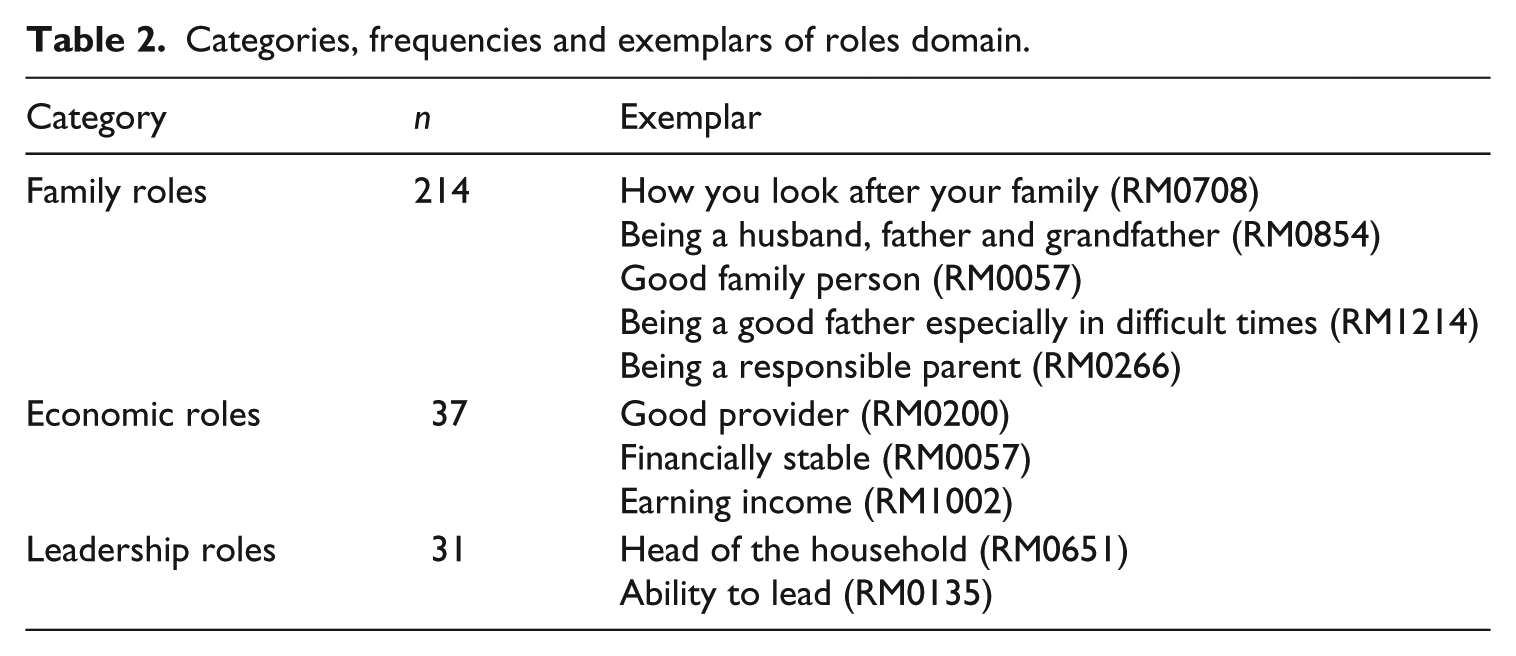
There were 282 responses classified as the domain of ‘roles’. The responses were classified into three broad clusters encompassing family roles (214 comments), economic roles (37 comments) and leadership roles (31 comments). Table 2 gives an overall perspective of the categories, frequencies and exemplars of the role subdomain.
Categories, frequencies and exemplars of roles domain.
Family roles
Parents generally have the task to raise their children to be productive and responsible adults based on community expectations in many societies (Hill et al., 2004). According to LeVine’s (1988) model of parental behaviour, parental roles are executed in a bid to achieve three main objectives, irrespective of culture. The first objective is ensuring the health and survival of the child, the second is to raise children to achieve economic independence, and the third is to help the child achieve cultural socialisation.
The approach to parenting and sharing of paternal and maternal roles, however, is not carved in stone; it varies within society over time and with the socioeconomic circumstances of individual families (Hill et al., 2004). Parenting approaches and sharing of parental roles are important ways of ‘doing gender’. The most common traditional gender role arrangement in many societies is the paternal breadwinning and maternal care system (Scott-Samuel et al., 2015). The father is expected to make material provisions, while the mother cares for the physical and moral welfare of their children (Uhlmann, 2006: 12). Shifting gender constructions have reshaped these expectations, especially in multicultural societies such as Australia, in which considerable variation has been found in the perceptions of gender roles (Richardson, 1993; Uhlmann, 2006: 12).
The patriarchal system is central to the discussion of masculinities and family roles, which affects both men and women (Scott-Samuel et al., 2015). Expectations on men to conform to this model means that men are under constant pressure to perform certain stereotypical roles (Pleck, 1974). Analysis of the responses within the family roles in the present study, revealed a wide range of meanings associated with being a ‘real man’ that were related to various expected roles in a family setting; these are explored below.
Provide for the family
Many participants talked about the need to be the breadwinner for the family. This finding is in line with other studies that have explored masculinities in other parts of the world. Some of these studies showed that women are traditionally responsible for domestic chores and carers of the children according to social norms (Lamb et al., 1987; Walby, 1989). However, these patriarchal arrangements are also less likely in contemporary situations where couples are both highly educated, or when they have both been previously married (de Vaus, 2004). The patriarchal trend still exists in Australia, as can be seen from some of the responses in the present study. Several participants talked about providing for the family as a traditional role of the father. In some responses, this traditional role overlaps with economic roles. The response by RM0125 that a ‘real man’ was ‘someone who takes pride in and provides for the family’ may serve to reveal the participant’s perception of the family as a structure that needs to be built by a male provider.
Being a good father
In this study, ‘being a good father’ featured prominently in participants’ responses. The ‘good father’ emerged as a core category capturing such roles as sharing household tasks, care-giving, and nurturing children. A ‘good father’ often transcended the mere traditional patriarchal breadwinning roles. Participants described a father who shared some of the roles of nurturing his offspring with his wife. This finding differed from studies elsewhere that emphasised an orthodox form of masculinity that eschews egalitarian family roles, and the tendency for men to indulge in sexual risk-taking behaviour (Santana et al., 2006).
Overall, many respondents who alluded to ‘being a role model’ as part of defining a ‘real man’ implied the need for the father consistently to portray a good character for their children to emulate. This may be more in keeping with parenting in modern-day Australia, as opposed to the more stereotypical parenting roles, where the mother’s primary responsibility is to nurture the children’s social, intellectual, cognitive and moral development (de Vaus, 2004). Several participants talked about family roles by simply stating that a ‘real man’ was someone who ‘looks after the family’ (RM0296, RM0810, RM0373, RM0498, RM0585, RM0726, RM0732). As with ‘caring for the family’, some of these responses contained more specifics, such as overseeing children, or attending to the needs of his spouse. Respondent RM1207 went further by stating that a ‘real man’ is someone who is ‘looking after himself and his family’ (RM1207). He specified the need for the man to be responsible for his own well-being, in addition to that of the family.
Economic roles
Orthodox conceptions of gender roles typically place men in a position of dominance from an institutional or social perspective (Brod and Kaufman, 1994). This institutional structure can put men under pressure to conform in order to validate their masculine status, although this ‘institutional power’ may not translate directly to an individual man’s perception of himself. In addition, success is often judged by social criteria, such as social position, income, education and financial status (Bandura, 1994). Fitting into this orthodox gender power structure sometimes requires the achievement of career success and becoming the higher income earner within the household; these assumptions were reflected in the views of some participants. Responses in this category are further categorised in the sub-categories below.
Financial control
The ability to manage finances was among the criteria used to define a ‘real man’. This is somewhat interwoven with the family/provider domain. Men have traditionally perceived their patriarchal role as being able to make financial provision for their family, and many men think it is important to be the lead income earner (Uhlmann, 2006). The phrase ‘sensible with money’, as stated by respondent RM0833, exposes one of these assumptions. The statement assumed that men are financial custodians and managers, and relates to expectations of men being the family provider and breadwinner. Financial stability is a likely outcome of managing finances effectively, or of being ‘sensible with money’ (RM0833), as discussed earlier. Being ‘financially stable’ was highlighted by participant RM0057 as a measure of success and reflected the ability to provide for the family.
Leadership roles
This category highlighted the overlapping and interlinked nature of meanings. For example, leadership is arguably about relationships as well as being a role. Likewise, some comments in this section overlapped with the relationship domain, while others aligned with family and financial roles. Leadership has been associated with manhood (Crites et al., 2015), and this is also reflected in the views of some participants, who simply stated that ‘leadership’ was what made a ‘real man’ (RM0615, RM0616, RM0932, RM0941, RM0967).
Respondent RM1036 stated ‘leading by example’. This general principle may have meant different things depending on the context. Within the family, for example, leading by example is often an important expectation for the child’s upbringing, presumably the male child (Hill et al., 2004). Whereas in the context of the workplace, leading by example can be important to achieving goals and targets. While the response from participant RM1036 may seem devoid of any rigid assumptions, the underlying assumption is that being a man equates with being a leader. This same assumption featured in many of the responses concerning leadership roles.
Even though women are perfectly capable of leadership and decision-making, stereotypical prejudices against women often ensure that men are more likely to be considered for leadership positions, often on the premise that they can make difficult decisions (Carnes and Merz, 2017; Heilman, 2015). Such a bias is implied in the response that a real man has the ‘ability to make decisions’ (RM0655).
Another participant’s definition of a ‘real man’ was ‘somebody who can show some leadership’ (RM0629). Prolonged use of this reductive narrative has entrenched a binary concept that women lack desirable leadership qualities expected of men, such as firmness and decisiveness (Carnes and Merz, 2017). There is evidence that inequality between men and women in leadership roles is especially common in politics. For example, limited female representation has been a subject of debate in the Australian Federal Parliament in recent times (Sawer, 2015). Other responses in the ‘leadership’ category alluded to roles in the patriarchal family system, for example: a real man was someone who ‘can take leadership of the family’ (RM0862).
Finally, the response of ‘head of household’ (RM0651) confirms the ongoing existence of the patriarchal system, at least in parts of Australian society. These patriarchal roles generally encompass being the breadwinner as previously discussed, and performing protective and leadership roles within the family, while the woman was cast as the nurturer and responsible for domestic work. Changes in recent years have ushered in a shift in these practices wherein women and men play increasingly equal active roles in running the family, finances and paid work (de Vaus, 2004).
Relationships
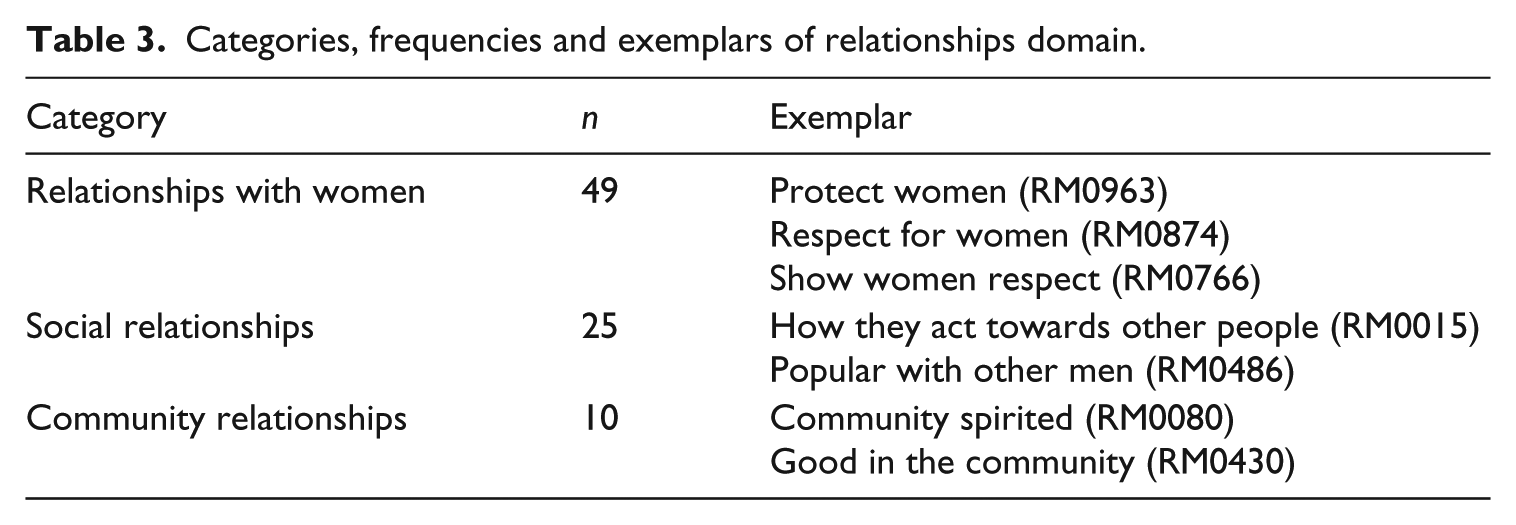
There were 7.2% (n = 111) responses coded as ‘interpersonal relationships’. Because the responses highlighted different forms of relationships, the domain was further divided into relationships with women (49 comments), relationships through sports (27 comments), social relationships (25 comments), community relationships (10 comments), and relationships through drinking (9 comments). Table 3 gives an overall perspective of each cluster classified within this domain.
Categories, frequencies and exemplars of relationships domain.
The respondents’ comments in each category of the domain of relationships were diverse, and crafted in different shades and dimensions, with some being explicit while others implicit. Some alluded to the kind of relationship to be avoided, while others were affirmative of the kind of relationship expected of men. Based on these, the categories and exemplar comments are explicated.
Relationships with women
Several participants defined a ‘real man’ using relationships with women as a yardstick. The benchmarks included social interactions with women, sexual orientation, and a general disposition towards women.
Interactions with women
Many respondents talked about interactions with women. These responses referred to some form of courtesy and manners towards women, especially in public places. Some highlighted common etiquette, such as ‘helping a woman open the door’ (RM0872). Examples of other responses are: ‘behaviour – courteous to women’ (RM0134) and ‘looking after, the ladies, opening doors, etc.’ (RM0122).
The response by RM0805 was that a ‘real man’ is a ‘gentleman as far as the opposite sex is concerned’. This response further reflected the diversity of perceptions that governed masculinities, some of which were as subtle as basic etiquette towards a woman, and/or disregard for similar etiquette with their male counterparts. Indeed, men showing similar etiquette towards other men may be seen as being soft, and even tagged as homosexual (Plummer, 2014).
Social and community relationships
Social interaction is a lifelong feature of masculine identity. As young boys approach adolescence, they identify with their peers, shifting away from childhood parental bonding (Plummer and Geofroy, 2013). Young male adolescents typically attempt to prove themselves worthy of future manhood by engaging in peer-driven activities (Plummer, 2013). Once adolescents grow older, they generally take more interest in the community (Mankowski and Maton, 2010). Their masculinities entail the need to gain recognition, status and acceptance among peers. Various forms of social interaction at different stages of life are deployed to meet these needs. Particular styles of interpersonal relationships and interactions are sometimes seen as evidence of manliness (Mankowski and Maton, 2010). The response ‘being able to exist socially’ by RM0721 exemplifies the importance of social interaction for defining manhood.
The community embodies a social unit with common interests, and provides a platform to socialise, engage with peers and sometimes to exert authority and leadership. Playing community roles can provide avenues to conform with and affirm masculine gender expectations. Being able to help in community projects may offer a chance to demonstrate self-efficacy and social competence and shows what a ‘real man’ can do for his community, as implied by RM0080’s statement on being ‘community spirited’.
The community may also provide a geographical focus to volunteer, interact, socialise, and play sports, as mentioned by participant RM0871 who stated that doing ‘community work, and volunteering’ makes a ‘real man’.
Communication and interaction style
The excerpt from RM0312 of ‘someone that looks you in the eye when conversing’ suggests gendered patterns of non-verbal communication with others. Some of these fine details tend to constitute important benchmarks, through which masculinities may be judged and enacted (Plummer, 1999). Whether in a social or work setting, how one interacts with others is often considered important to develop relationships and friendships. The ability to do these is used to validate gender. This was summarised in the response given by subject RM0738, who said what defines a ‘real man’ is ‘general knowledge of awareness to converse with people’.
Domain 3: Physical qualities
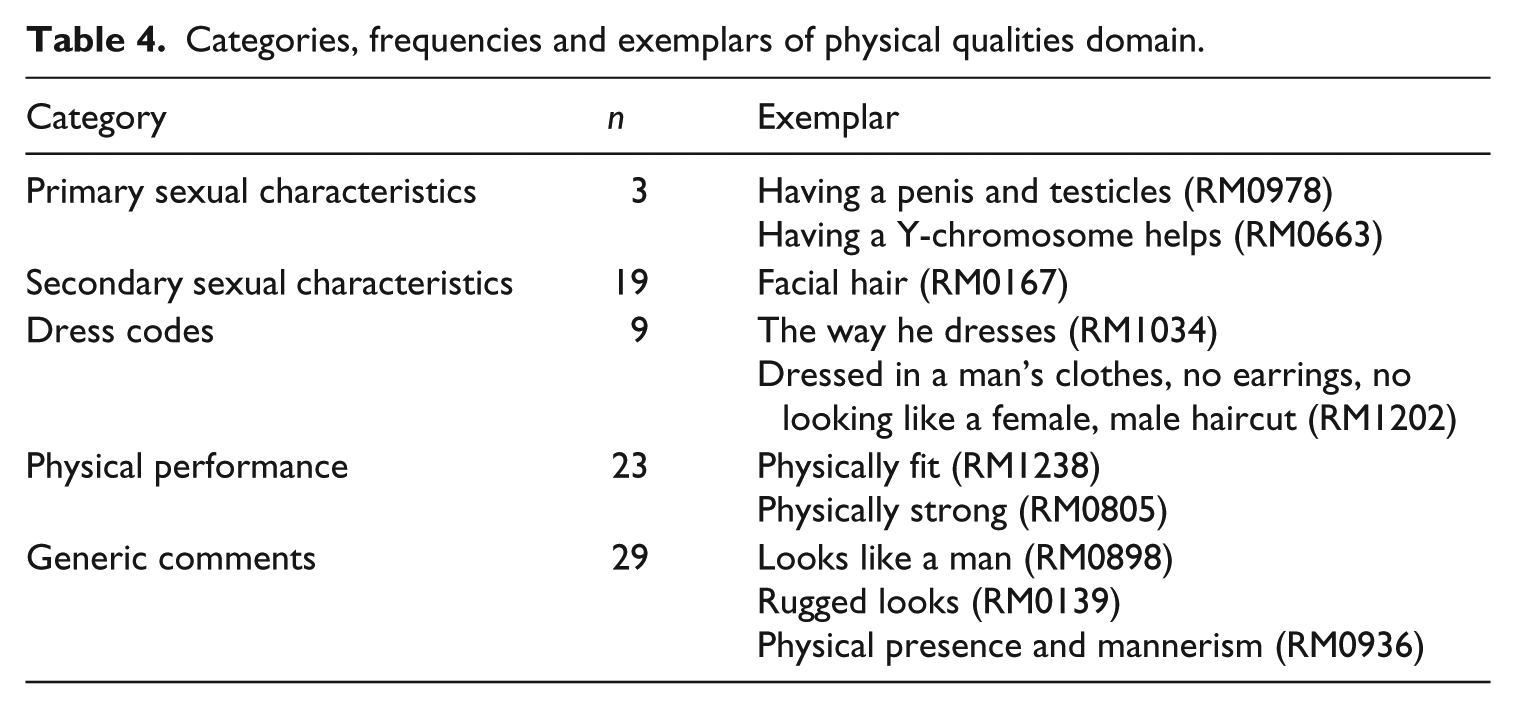
Just over 10% of responses (10.4%, n = 159) were coded as ‘physical qualities’. Characteristics coded as ‘physical qualities’ were diverse and covered a range of meanings. They were further aggregated into five main subdomains: (1) physical qualities based on primary sexual characteristics; (2) those based on secondary sexual characteristics; (3) dress codes; (4) physical performance, and (5) generic comments. As with other domains, this system of clustering demonstrates the systematic convergence and ‘bleeding’ of meanings into other clusters.
Table 4 gives an overview of participants’ comments in each of the categories of the physical qualities domain, and it reflects the diversity of expectations placed on men.
Categories, frequencies and exemplars of physical qualities domain.
Primary sexual characteristics
Participants referred to physical features that differentiate males from females that were present at or around birth, such as the external genitalia. These physical features were used by participants as characteristics that identify ‘real men’. The definitions given in this category often showed a lack of differentiation and there was a ‘bleeding’ of meaning between biologically determined sex and socially constructed gender by the participants. For example, participants gave responses about genitalia, stating: ‘having a penis and testicles’ (RM0978); and ‘as long as he’s got all his bits’ (RM0956).
Secondary sexual characteristics
Some participants described physical features that usually accompanied puberty, such as facial hair, broad shoulders and musculature. Comments on musculature further contextualised the more generic comments about ‘looks’. Respondent RM0415 believed that a ‘real man’ is defined by his musculature; he simply said ‘broad shoulders’ makes someone a ‘real man’. Other respondents also highlighted musculature; for example, participant RM0732 said ‘muscular appearance’. Several other participants, including respondents RM0279, RM0462, RM0744, RM0705, RM0903 and RM1011, were all of the opinion that the presence of ‘muscles’ made someone a ‘real man’. As with musculature, participant RM0247 referred to ‘body shape’.
These responses also raised the possibility that perceptions about body shape and size are underpinned by social pressures that emphasise the importance of being muscular in being ‘seen’ as a ‘real man’. A study among school boys in South Africa showed that there was a significant association between masculine body image, psychological well-being and conformity to masculine ideology, with some variations across different races and age groups (Jarred, 2011). In addition to body image and self-esteem, other factors may explain the emphasis on muscles, such as a desire to assert dominance, show strength, or a desire to project a protective image.
Features, such as facial hair and grooming of facial hair, were other ways participants recognised a ‘real man’. Respondent RM0354 commented on facial hair by stating that ‘a bloke that has a well-trimmed beard and moustache’ is a ‘real man’. This participant’s response may be interpreted as double layered. Having a beard and moustache may be the first step to validating manliness. The importance of grooming facial hair, however also implies a need to be ‘in control’ of the masculine image being projected thus reinforcing the gender-driven symbolism of the body (Jarred, 2011).
Dress codes
The responses in this sub-category highlighted the dressing patterns that respondents believed to be appropriate for Australian men in Queensland. For example, some participants described masculine apparel, and that men were not expected to wear a gown or a skirt. These responses also referred to other accessories, such as earrings, and not wearing colourful clothes or fabrics that come in stereotypically female colours, such as pink, or clothes with imprints of certain patterns such as flowers. For example, participant RM1202 said masculinity to him was ‘being dressed in a man’s clothes, no earrings, not looking like a female, male haircut’.
Physical performance
A frequently cited response in this category was physical fitness. Other qualities include strength (RM0135), stamina (RM0233) and tenacity (RM0354). A noteworthy masculine precept highlighted in this sub-category was the need to push the limits of disability and injury (RM0354); this can be interpreted in diverse ways, both positive and negative. An example of pushing the limits of disability or injury includes men who suffer injury and disability from extreme events such as sky-diving but subsequently attempt to return to the same sports even before full recovery (Pain and Kerr, 2004). The response by participant RM0354 in relation to pushing the limits of disability were as follows: ‘Tenacity – a disabled person who doesn’t let that get in their way of achieving their goal’. Studies have shown that in addition to sports performance, body image and self-esteem can be driving factors for physical fitness among men who endorse hegemonic masculine ideologies (Connell, 1995; Drummond, 1995; Jarred, 2011). Respondents RM0892 and RM0825 stated that masculinity means ‘being fit and healthy’ (RM0892) and ‘keeping fit and active’ (RM0825).
Generic comments
Connell (1983) stated that ‘many central concerns of men and their masculinity are associated with physical size, shape and body capabilities’. She suggested that to learn to be a male is to project a physical presence that displays latent power and that hegemonic masculinity transforms male bodies into symbolic tools (Connell, 1995; Connell and Messerschmidt, 2005). Participants in the present study gave several generic responses in reference to looks and ‘physical presence’ without explaining what ‘physical presence’ actually was. Participants RM0898 and RM0954 talked about looks by stating that ‘looking like a man’ is what makes someone a ‘real man’. Generic comments were those that required further contextualisation, for example, ‘physical presence’ stated by participant RM0303 and RM0609.
Conclusions
This study surveyed what it meant to be considered a ‘real man’ in contemporary Australia. An intriguing and diverse range of responses were provided. These fell into three broad domains: (1) physical quality; (2) personality and character; (3) roles and relationships. A feature of this analysis was how much the various categories overlapped and ‘bled’ into each other. This may have been because one category was conceptually related to others as parts of a larger gender construct. For example, ‘strength’ applied to physical strength, strength of character, wealth, and strong relationships. In addition, many complex constructs were predicated on more elemental characteristics; for example, ‘relationships’ were constructed on ‘roles’ and ‘roles’ on ‘character’ and ‘character’ was reflected in physical presentation and so on. Thus, from the analysis, it was concluded that a feature of masculinity was a sense of coherence between how someone looks, how they think and how they act, and these coherences were conveyed through the responses given by the respondents, such as those from RM0786 who first stated that a ‘real man’ means: ‘parenting in a managerial sense, be there for family, wife; to be a mentor and father type figure, to give positive direction and guidance. Overall supportive of society, family and business; also to have a good work ethic.’ His further response was that: ‘action speaks better than words’. This coherence was reflected and summed up in more encompassing responses, such as those elicited from participant RM0786 who stated that: ‘A real man is someone who has got all his bits, and a good provider, you should just be able to do that naturally by having a good job.’ This sense of coherence, despite the diversity and multiplicity of gendered meanings, was consistent with these responses of being part of or measured against a larger constructed gender ‘complex’ and that there was some sort of overarching set of ‘hegemonic standards’ and taboos that inform and act as benchmarks for the performance of various masculinities.
The complexity of the discourses in the present study contrasted with discourses in some previous studies which we believe may have been overly simplistic and stereotypical (Courtenay, 2000, 2003; Mahalik et al., 2003, 2006, 2007, 2008). This contrast reflects an interesting paradox, that the lived reality of gender is complex and diverse, but there is constant pressure to simplify, stereotype and overly reduce this complexity, even in academic circles.
The cross-sectional design of this study meant that it was not possible to draw empirical conclusions about processes such as social change, nor about which style of masculinity predated which, nor whether a version of masculinity was fluid or situational. However, two conclusions stand out: first, there was surprisingly more emphasis on good character than on physicality in what defines a ‘real man’; and, second, that masculinity was conceptualised in much more rich and complex terms than hegemonic stereotypes and past studies would suggest.
Footnotes
Funding
The author(s) received no financial support for the research, authorship, and/or publication of this article.