




Abstract
The contradictory work environments of new economies in late modernity are associated with a range of emotional experiences, requiring diverse emotion management strategies. Late modernity offers the capacity to pursue happy, safe, rewarding, and meaningful work for the privileged few; a potential trade-off between stressful meaningful and boring precarious work for a greater number; and the prospect of non-meaningful, precarious work for many in the new economy characterised by short-term contracts, gig work, precarity, and anxiety. This study draws on data from the 2015–16 Australian Social Attitudes Survey to examine workers’ emotions in various combinations of meaningful and precarious employment, and the degree to which these emotions are managed. It finds that it is best to have secure meaningful work, worst to have highly precarious work, and slightly better to have safe but alienating than risky meaningful work, in terms of avoiding often hidden negative emotions.
New economies – characterised by terms such as the Fourth Industrial Revolution, Industry 4.0, and the Platform Economy – promise greater choice, flexibility, opportunity, and remuneration for workers. Perhaps most importantly, they promise happiness: from performing work and securing outcomes that are meaningful; from interacting with colleagues and the working community in a fulfilling way; from the enjoyment of the rewards of work; and, for some, from escaping poverty. Although industrial happiness and satisfaction is praised by economists (Di Tella et al., 2003; Helliwell et al., 2020), criticised by cultural theorists (Ahmed, 2010; Cieslik, 2015), and empirically linked to employment in non-precarious jobs (De Neve and Ward, 2017), the broader question of how workers are responding emotionally to the changing forms of work remains unanswered (Patulny et al., 2020).
The question of emotion becomes paramount in a time when the pursuit of meaning and self-fulfilment through work has become more pressing for some, and the trap of precarious work more daunting for others. Meaningful work – that is, work that is interesting, enables the full use of abilities, helps others, or is socially engaging (Lips-Wiersma and Morris, 2011; Sutherland, 2012) – is likely associated with a range of pleasant emotional experiences: hope, confidence, assertiveness, and happiness. The scarcity of meaningful work that is also well paid – CEO positions, specialist doctors, tenured academics – and the subsequent competitive difficulty in obtaining it, can generate substantial stress and complex emotional labour requirements that might undermine wellbeing.
The pursuit of meaningful work has arisen in tandem with a rise in precarious forms of labour. Precarious work refers to uncertain, unpredictable, and insecure employment, where social benefits and statutory entitlements are limited, and where workers bear much of the risk (Kalleberg, 2018). In a neoliberal era of globalised production and consumption, most particularly post-Global Financial Crisis, worker precarity has become prominent. This shift has accelerated with the rise of the Platform Economy, characterised by unpredictable forms of modern labour (Howcroft and Bergvall-Karebon, 2019) and has become a politically charged concern (Arnold et al., 2013). It likely leads to difficult emotional experiences – stress, anxiety, depression – and a substantial need to manage emotions at work and home.
Some workers also face the gloomy prospect of work that is both precarious and meaningless. The increasing prevalence of work that is insecure, dead-end, and unfulfilling represents an extreme contradiction to the rhetoric of the pursuit of happiness, wellbeing, and pleasant emotions – key features of the happiness imperative that characterises late modernity (Davies, 2015). Unpleasant labour is likely to require considerable emotional labour which workers may not be proficient in performing. Unpleasant labour may raise new issues of social stratification, as the emotional experiences and management capacity of people in different positions is not only based on education, economic and cultural capital, but also engrained and habitual emotional capital (Cottingham, 2016).
As no study has yet addressed workers’ emotions and emotion management combining late modern conditions of meaningful and/or precarious work, we ask the following over-arching research questions:
(1) Which emotions are experienced by those working in (non-)meaningful and/or precarious/secure work; and
(2) What are the key strategies used by such workers to manage these emotions?
The article draws on current scholarship to conceptualise meaningful and precarious work and identify research gaps; most particularly, the need for a comprehensive analysis of emotions experienced and managed within meaningful and precarious work situations. This study draws on data from the 2015–16 Australian Social Attitudes Survey (AUSSA) to examine the emotions experienced and managed by workers in four categories of work: secure meaningful (meaningful and non-precarious), risky meaningful (meaningful and precarious), safe but alienating (non-precarious and non-meaningful), and highly precarious (precarious and non-meaningful). To our knowledge, this is the first study to examine such associations using representative population survey data
Meaningful and precarious work
Meaningful work
The concept of meaningful work has attracted considerable recent attention from researchers in business and organisational studies, psychology, cultural studies, and sociology, partly in response to claims that modern work is increasingly depersonalised, routine, and devoid of purpose (Chalofsky, 2003; Graeber, 2018).
Meaningful work includes characteristics that pertain to individual fulfilment: doing interesting work, having opportunities to use one’s abilities (Sutherland, 2012), ‘developing the inner self’, and ‘expressing [one’s] full potential’ (Lips-Wiersma and Morris, 2011: 655). Conceptualisations of meaningful work also include a strong orientation towards others, having friendly people to work with (Sutherland, 2012), achieving ‘unity with others’, ‘serving others’ (Lips-Wiersma and Morris, 2011: 655), and undertaking work that benefits the common good (Allan et al., 2020). Thus, meaningful work cannot be reduced to self-interest or ‘having the right attitude’ (Bowie, 1998). While not suggesting that work is meaningfully and emotionally deterministic, we note a certain irony in late modern productive conditions limiting the capacity of many forms of work to be fulfilling (Bauman, 2000), even while individuals are encouraged to find their own sense of meaning – or more appropriately, their zeal for enterprise – within such conditions.
Benz and Frey (2008) highlight the importance of autonomy in the workplace as more than an individualised attitude; it demands a specific kind of relationship with the workplace’s routines, values, and power structures. Spicer (2011) describes an authenticity trap, whereby employers encourage workers to incorporate their true selves into their work, so as to co-opt their energy and creativity, and capitalise on their social and cultural capital. For employees, it can result in a lack of separation between work and non-work life, a loss of privacy and independence (Spicer, 2011), and the emotional dissonance that comes with excessive surface and deep acting (Hochschild, 1983 [1979]). Meaningful work, after all, can simply represent the management of meaning according to company priorities (Lips-Wiersma and Morris, 2009).
Meaningful work (or its absence) can have a direct impact on emotional wellbeing (Kossek et al., 2014). This is likely associated with emotional qualities such as stress, anxiety, and frustration, which directly impact wellbeing. Meaningful work also becomes a phenomenon to be managed as part of one’s emotional labour. It is in the employment interests of workers and the productivity interests of employers to find ways for workers to manage their emotions so as to cope with – or even find new meaning in – non-meaningful working situations.
Meaningful work can also indirectly impact emotions through interacting with precarity. Workers may abandon jobs out of boredom, frustration, and the emotional dissonance of meaningless work (Kubicek and Korunka, 2015), as much as because of short-term contracts and low pay. Furthermore, social support is common to both meaningful work and precarity. Positive emotional wellbeing is linked to good social support from co-workers and supervisors (Kossek et al., 2012), and to work cultures that value a positive – not exploitative – cross-over between work and the employees’ non-work lives (Bailyn, 2011; Kossek et al., 2001).
Precarious work
We define precarious work as paid employment characterised by high levels of employee risk, uncertainty, and unpredictability (Kalleberg, 2009, 2018). Following Standing (2011), precarity is associated with descriptors such as atypical, alternative, peripheral, marginal, and non-standard work (Rodgers, 1989; Vosko et al., 2003). It is linked to flexibilisation (Tompa et al., 2007), casualisation, informalisation (Arnold et al., 2013), and high employee risk (Kalleberg and Hewison, 2013; Tompa et al., 2007), whether for casual or contract workers, or full-time workers who are subject to eroding working conditions (Kossek et al., 2014). Precarity undermines secure living wages, autonomy, capacity development (Worth, 2016), and is further defined by other qualities many workers lack: adequate work health and safety, long-term stability, union representation, regular and predictable hours, fair workloads, access to non-repetitive tasks, and work–life balance (Jonna and Foster, 2016).
Late modern work precarity has spread since the 1970s to all sectors of the economy, including the middle class (i.e. professional and managerial jobs) (Kalleberg, 2009, 2018). Its expansion has come through technological advancements empowering employers to seek locations with cheap labour; an increased labour pool and job competition through Russia, China, and India’s growing participation in the global economy; and the normalisation of layoffs during restructuring operations (Kalleberg, 2009).
Precarity is linked to a range of detrimental emotional health and wellbeing outcomes for workers (Kalleberg, 2009, 2018). These include reductions in: worker enthusiasm and engagement (Schaufeli et al., 2006), positive identity-related emotions (Radloff, 1977), job satisfaction (Hackman and Oldham, 1976), and life satisfaction (Kossek and Ozeki, 1998), and an increase in depressive symptoms (Kossek et al., 2012; Radloff, 1977). Emerging studies implicate the spatially and temporarily fragmented nature of gig work in the experience of stressful emotions at work (Berger et al., 2018), greater loneliness (Subramony et al., 2018), and the erosion of social networks and organisational supports conventionally used to express grievances (Padios, 2017). While this body of scholarship collectively indicates that precarity and low autonomy are likely associated with negative emotional outcomes, there has been no systematic examination of the connections between emotions, emotion management and precarious work across various occupations.
Precarity almost certainly requires heavy emotional labour, particularly among creative workers in cultural industries (Hesmondhalgh and Baker, 2008), and professions demanding a high degree of service and pastoral care, such as teaching (Patulny et al., 2019). It is also prevalent among independent and gig workers, and workers who lack organisational or professional experience and support (Petriglieri et al., 2019). Gross et al. (2018) found that musicians experiencing financial stress from precarious work were also frequently managing depression in their own time: a negative outcome in itself, and an additional problem for already stressed creative workers.
Given that precarity has expanded to incorporate the high-wage and low-wage white-collar jobs central to service industries (Kalleberg, 2009), and that different social strata may experience and manage emotions in different ways (Hochschild, 1983 [1979]), it is pertinent to consider connections between precarity, social stratification, and emotions in more depth.
Managing meaning and precarity: stratification and emotions
There are important crossovers between social stratification, precarity, and emotion. Workers in retail, hospitality, and child-care sectors – the most precarious groups – may also face unique concerns derived from their historical and cultural social standing, in terms of the way emotions are experienced, understood, expressed, and managed. Using various conceptualisations of stratification – from Marxist conceptualisations of class based in ownership of the means of production, to Bourdieussian constructs of cultural, economic, social and emotional capital (Cottingham, 2016) – research has convincingly demonstrated a relationship between status and emotion. Kraus et al. (2009), for example, find that workers of lower social status may be more emotionally sensitive to hierarchy, reading emotions in their superior order-givers as cues to their standing in the workplace (Collins, 2004).
The ability and effort required to manage emotions is also connected to stratification. Attainment of higher social status by virtue of one’s emotion management (EM) capabilities has long been recognised (Hochschild, 1983 [1979]; Kemper, 2007), and one’s social-emotional skills, such as self-control, have been linked to improved socio-economic attainment (Moullin, 2017). Class-based EM rules are sometimes explicitly and historically defined (e.g. etiquette books; see Wouters, 1995a, 1995b), and the capacity to manage emotions – often tacitly realised in one’s emotional capital (Cottingham, 2016) – may indicate and reinforce social distinctions. Different strata may also enact different EM strategies. More precarious labour may involve more ‘surface acting’ (Hochschild, 1983 [1979]), which requires less skill and emotional self-awareness than deep acting, in line with lower levels of cultural and emotional capital, but which also represents a more debilitating and stressful form of EM (Naring et al., 2006).
Despite connections between work conditions, emotions, and EM, in the literature cited, there is a lack of comprehensive analysis of the emotions experienced within meaningful and precarious work, and no research on EM in these contexts that uses population survey data.
Data and methods
To address the limitations of existing research, this study draws on data from the 2015–16 Australian Social Attitudes Survey (AUSSA) to examine emotions experienced by workers from varying educational backgrounds and precarious employment situations, and the strategies and success with which workers engage in EM. A mail-out survey of a randomised sample of 5000 Australian adults selected from the Australian Electoral Roll was run over a calendar year from 2015 to 2016 in four (seasonal) waves, with a cleaned final sample size of 1,211 respondents (540 men; 615 women; 56 unspecified). The final working sample of 999 respondents resulted from a survey response rate of approximately 26%, which is typical for many contemporary social surveys. Survey weights were created and applied to correct for imbalances in age, gender, and employment status. The sample was further cut down to exclude self-reported retired persons, as our research focus is on current workers.
Measuring precarious and meaningful work
AUSSA had a series of eight 5-point scale questions pertaining to how much respondents agreed with a range of statements about their work. The first four items relate to the perceived precarity of the work, in terms of high employee risks (Kalleberg and Hewison, 2013), eroded conditions (Kossek et al., 2014), and reduced income and low autonomy (Worth, 2016): (1) My job is secure; (2) My income is high; (3) My opportunities for advancement are high; (4) I can work independently. These questions do not capture organisational/systemic qualities, such as casualisation and informalisation (Arnold et al., 2013), but do capture individual perceptions of the consequences of such changes.
The next four items relate to whether work is perceived to be meaningful according to several theoretical criteria: interesting, fulfilling, and social (Sutherland, 2012), helpful (Allan et al., 2020), and authentic (Benz and Frey, 2008). The AUSSA questions capture most of these: (5) My job is interesting; (6) In my job, I can help other people; (7) My job is useful to society; (8) In my job, I have personal contact with other people. They omit the aspect of authenticity, but – when coopted for corporate aims – this quality is a problematic construct to measure anyway (Spicer, 2011).
The coherence of these theoretical constructs is further assured through reliability testing. A Cronbach’s alpha reliability test showed reasonable reliability across all items (a = 0.701), but a factor analysis revealed a two-factor solution in line with the theoretical distinctions raised above. We thus aggregated the first four items into a scale capturing job security and conditions, with low scores indicating high levels of job precariousness, and the second four into a scale capturing meaningful work, with low scores indicating the work is largely perceived to be non-meaningful. From these, we created four categories of work, to which we applied the labels below. Examples of common occupational types for each category are provided from running crosstabs of each category against ANZSCO (2013: v1.2, Level 1) categories from the dataset.
(1) Secure meaningful – workers who report an above-average score on both the secure work conditions and work meaningfulness scales, who are thus subject to neither alienating and non-meaningful, nor insecure and poorly paid working conditions. Examples include: health professionals (e.g. doctors and specialists); business, HR and marketing professionals; numerical/other clerical workers (including public servants).
(2) Risky meaningful – workers who report a below-average score for secure work conditions, and an above-average score for work meaningfulness, representing a mixed level of precarity where one is at constant risk of losing work that one cares about. Examples include: carers and aides (including NGO/charity/social workers); sales workers; education professionals (including contract/casual academics) and health professionals (such as nurses and allied health professionals).
(3) Safe but alienating – workers who report an above-average score for secure work conditions, but a below-average score for work meaningfulness, representing a mixed level of precarity where one works in a safe and secure job with little emotional commitment. Examples include: business, HR, marketing professionals; engineering and IT technicians; office managers, program administrators; and numerical clerks.
(4) Highly precarious – workers who report a below-average score on both the secure work conditions and work meaningfulness scales, and are thus highly precarious from having reduced attachment to work altogether. Examples include: construction trades workers; sales, clerical and administrative workers; automotive and engineering trade workers; road/rail drivers; and clerical workers/receptionists.
Measuring emotional wellbeing and EM
There is now a well-established tradition of measuring emotions through scaled emotion measures in numerous surveys (US GSS, HILDA, World Gallup Poll, etc.). See our previous work (Patulny, 2015; Patulny et al., 2017, 2019) for a more detailed discussion of the issues and robustness of surveying emotions. The 2015–16 AUSSA survey included a number of measurements of emotional experience and EM, which will serve as the dependent variable for this study. These included several questions about recalled emotions experienced in the last week:
The most common or primary emotion of any sort (e.g. happiness, anxiety, stress) – responses were classified as being either ‘positive’ or ‘negative’ in valence; 1
general life satisfaction (on a scale of 0 to 10);
the most common stigmatised emotion – from a select range of emotions that can be labelled as stigmatised, in terms of being difficult to discuss and commonly under-reported (including anger, shame, guilt, jealousy, envy, embarrassment, fear, or none of these);
the most common secondary positive emotion (phrased as ‘emotions that are often described as “positive”’);
EM of this positive emotion the last time it was felt (did they feel it naturally, or have to make themselves feel it?);
the most common secondary negative emotion (phrased as ‘emotions that are often described as “negative”’); and
EM of this negative emotion the last time it was felt (did they show it, hide it, or change it into something else?).
There are multiple ways of conceptualising emotional valence; in our study, emotional valence refers to the hedonic tone, or pleasure and displeasure, of the experienced emotions (Patulny et al., 2019).
Analysis
In addition to various descriptive analyses, a series of weighted regressions calculated with robust standard errors were run on each of the dependent variables to establish the presence of significant differences while controlling for other factors. To capture the effect of work types on emotional outcomes, a series of logistic regressions with odds ratios were calculated to predict the relative increase/decrease in the odds of experiencing or managing emotional experiences based on work type.
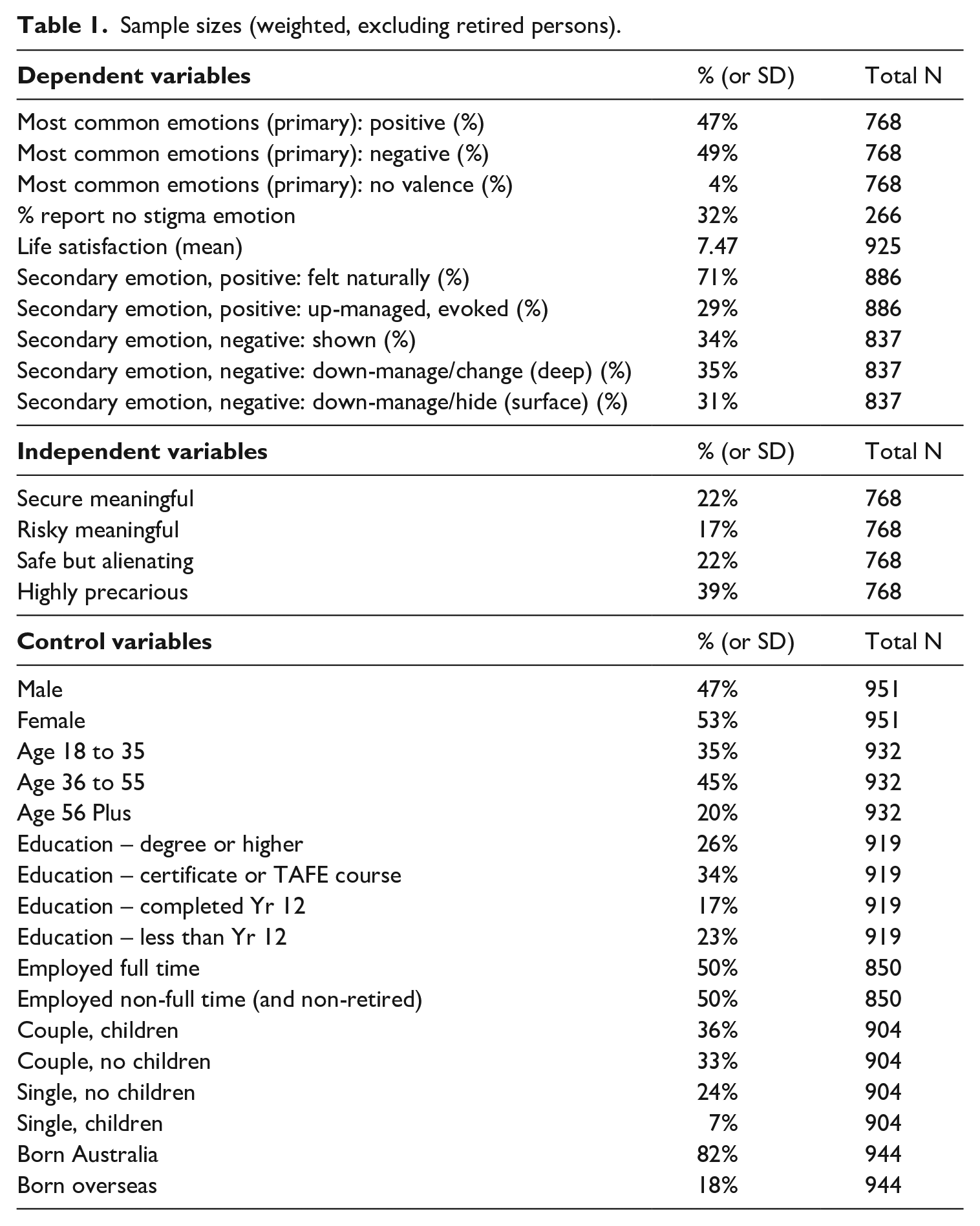
Binary dummy variables were included to control for key variables representing social stratification. Given the diversity in the way stratification is conceptualised within existing scholarship (e.g. class, capital), and that employment status is only a single indicator of class location (Alberti et al., 2018), we included standard modes of operationalising status based on measures of gender, age, and educational background, as well as employment (see Table 1). Binaries categories were omitted for being male, middle aged, having TAFE/Certificate level education, and being a non-full-time worker. In addition, binary dummies were included for marital/child status (omitting couples with children) and being born overseas. The final list of variables, and their proportions in the sample, can be seen in Table 1.
Sample sizes (weighted, excluding retired persons).
Results
The results are divided into three main parts. The first addresses the primary and stigmatised emotions associated with different subtypes of meaningful and precarious work and their management. The second section examines secondary positive emotions and how these are managed by each type of worker. The third explores the secondary negative emotions by worker type, and how these are managed by each type of worker.
Emotions associated with meaningful and precarious work
We start by examining the emotions associated with meaningful and precarious work. For each work category, we look at the most common type of primary (any) emotions experienced, and the most common type of ‘stigmatised’ emotions experienced (see Table 2).
Most common primary (any) and stigmatised emotions experienced in the last week by work type.
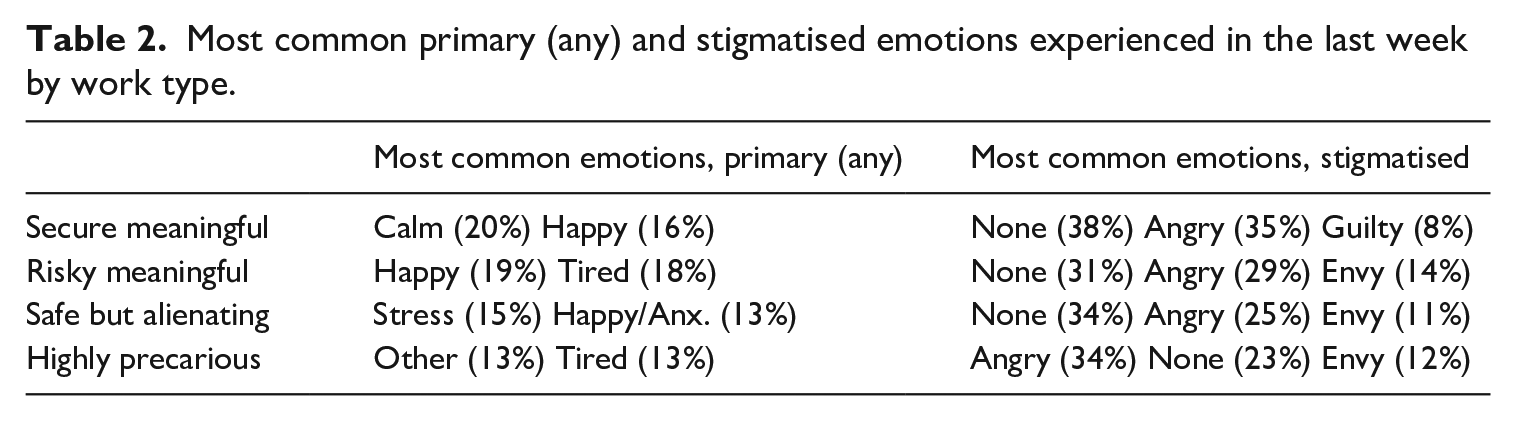
Table 2 shows the ubiquity of happiness as a commonly reported primary emotion for every category of worker except highly precarious. Our previous work (Patulny et al., 2017) shows that happiness is the most commonly reported primary emotion in the general population. This could reflect several possibilities; people’s generally good latent levels of wellbeing; that people unreflectively put happiness forward as a culturally appropriate default response to being asked how they feel; that the familiarity of the term means it is conflated with other emotions (e.g. satisfaction, confidence); or that it is heavily up-managed to evoke happiness in accordance with feeling rules to be happy. Whatever the case, its absence as a primary emotion is a telling sign of reduced or tenuous wellbeing. It denotes social structural conditions that are so difficult they not only overcome a ‘latent’ positive sense of wellbeing, but also both the cultural imperative to (unthinkingly) believe and say we are happy, and to up-manage and evoke happiness if we are not.
In looking first at the most desirable jobs – secure meaningful work – we find that those performing this work report high levels of emotional wellbeing, with calm or happiness as their primary emotions. The prominence of happiness suggests that meaningful, non-precarious work either supports latent happiness, attracts naturally happier people, or attracts people who work hard to maintain and up-manage their happiness. Up-management of positive emotions will be assessed in the next section, and it is difficult to rule out happier people self-selecting into desirable jobs, but the evidence so far suggests that meaningful, non-precarious work does not erode wellbeing, and likely supports it. These workers are the only group to register two pleasant emotions as most likely to be primary. This group is also most likely to report not experiencing any kind of ‘stigmatised emotion’. They are, however, also the most likely worker type to report the stigmatised emotion of anger, which again can be associated with working in high-pressure jobs. A small number 2 in this group report experiencing guilt as their most common stigmatised emotion; as will become evident, this forms an interesting contrast to those emotions experienced by other worker types.
In looking at the risky meaningful category, a wider range of emotions is reported. Workers in this category are most likely to report happiness, but also tiredness, as primary emotions, which would align with the difficulties of managing (and trying to maintain) interesting but precarious work. Like those working in the most desirable jobs, this group is most likely to report: (1) no stigmatised emotion, and then (2) anger, with the next most commonly reported stigmatised emotion being (3) envy.
A wide range of emotions is similarly reported by workers in the safe but alienating category. They are most likely to report stress, or else either happiness or anxiety (equally likely), as primary emotions. Safe but alienated workers show that same pattern for stigmatised emotions: none, anger, envy. These findings are similar enough to risky meaningful workers to suggest that trading precarity for non-meaningful work does not guarantee an escape from emotional stress (if anything, stress becomes a more common emotion), or the need for support, comfort, and care that comes with it.
Workers in the highly precarious category report reduced emotional wellbeing. Far from happiness, their most common emotions are tiredness and ‘other’, the latter denoting an inability or confusion in naming or labelling their emotions. Unlike the other groups, this group is more likely to report anger as a stigmatised emotion than ‘none’, which is second most likely, and then envy, which is third. The lack of any positive primary emotions and the pre-eminence of stigmatised anger demonstrate emotional profiles that are more easily associated with lower levels of wellbeing.
Next, we consider what proportion of the common primary emotions reported by each worker category can be described generally (i.e., in most social circumstances) as pleasant or ‘positive’ (e.g. happiness, love, calm, interested) versus unpleasant or ‘negative’ emotion (e.g. depression, anger, sadness). We also look at the proportion that did not experience any kind of stigmatised emotion, and compare this to more conventional measures of (generalised) life satisfaction (see Figure 1).
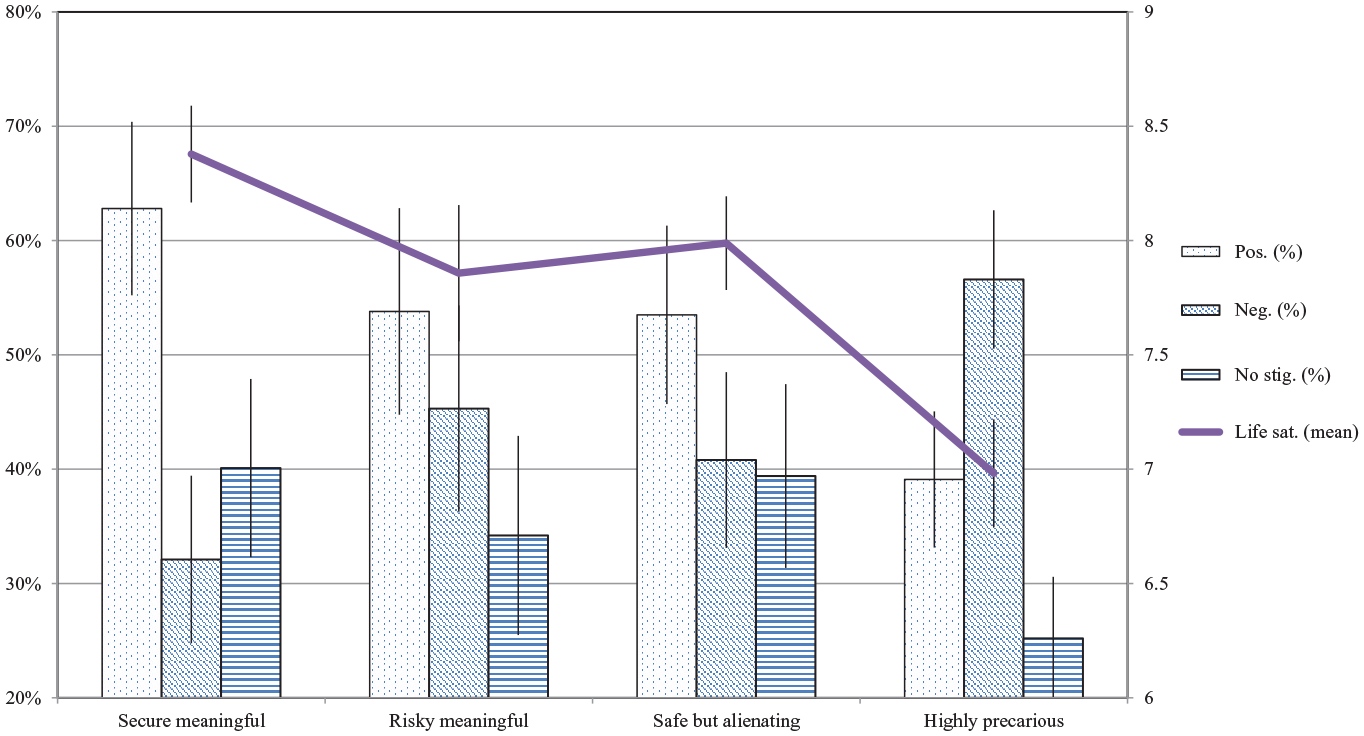
Positive and negative emotions experienced in the last week, and life satisfaction, by work type.
The results align with the qualitative assessment, showing that secure meaningful workers report emotions associated with positive wellbeing, while highly precarious workers do not. Workers in the former group are significantly more likely to have experienced a positive primary emotion; experienced no stigmatised emotion; and have a significantly higher mean life-satisfaction score than any of the other groups. Workers in the highly precarious group are the mirror image: significantly more likely to have experienced a negative emotion; least likely to have experienced no stigmatised emotion; and have significantly lower mean life-satisfaction score than any of the other groups.
The two ‘middle’ groups have similar emotional profiles; safe but alienated workers have slightly higher life-satisfaction scores, but also higher chances of experiencing a stigmatised emotion (though neither difference is significant). One important difference is that safe but alienated workers are significantly more likely to experience a positive rather than negative emotion, while risky meaningful workers are not, primarily because of the greater likelihood of experiencing negative emotions. This implies that while ‘less-interesting-but-safer’ work is no less likely to produce positive emotions than meaningful precarious work, it somewhat insulates workers from experiencing as many negative emotions.
We next look at how these results change while controlling for socio-economic factors, such as education, family status, migrant status, through logistic regression analysis. The results are displayed in Table 3, first without controls (the first three rows), and then with controls thereafter.
Logistic regressions: odds ratios of positive and negative emotions experienced in the last week, and life satisfaction, by work type.

Notes: Two-tailed test: *p < .05; **p < .01; ***p < .001. (2) All regressions are weighted to correct for sampling bias; each also includes the demographic controls mentioned in the data description.
Several findings emerge as significant that support the general story revealed so far. Highly precarious work is a significantly worse predictor of life satisfaction regardless of controls. It is also a significantly worse predictor of both positive primary emotions and having ‘no stigmatised emotions’, and a significantly greater predictor of negative primary emotions, when controlling for either age (older and younger), education (i.e. degree or higher; Year 12 or lower), or family status (i.e. single people and childless couples). These findings confirm that highly precarious work is associated with poor emotional experiences, but shows that this effect is concentrated among middle-aged, middle-income, coupled families in particular, rather than those on lower incomes or a particular gender.
The only other significant finding to emerge from these models is that risky meaningful work is a worse predictor of reporting no stigmatised emotions, once education and family status are controlled for. This confirms that risky meaningful work is slightly more likely to be associated with negative emotional experiences than is safe but alienating work but adds the caveat that this effect is concentrated among middle-class, coupled family units.
Positive emotions and their management
In addressing secondary positive emotions, we first examine which ones are most commonly reported: visible in Figure 2 below, beneath each worker type. We then examine the degree to which these positive emotions are managed: that is, evoked as opposed to occurring naturally. We report on both the proportion of secondary positive emotions that are felt naturally versus evoked/up-managed (the dashed and solid lines respectively), and then these proportions when depicted as a share of the proportion of primary positive emotions (the stacked bars, patterned diagonally for ‘natural’ and dotted for ‘evoked’), so as to give an indication of the general magnitude of up-management undertaken by each worker group to arrive at their emotional experiences.

Management of positive emotions experienced in the last week by work type
A further point should be made here about happiness. While the absence of happiness as a primary emotion might be an indicator of reduced or tenuous wellbeing, the inordinate presence of happiness as a secondary emotion might also be an indicator of the same thing. It could denote a lack of awareness, consideration, and valuing of other positive emotions, because they are not reflected upon (happiness as default), or they are crowded out as people work hard to manage their positive emotions and always stay happy.
Secure meaningful workers are most likely to report happiness or pride as secondary positive emotions. The prominence of happiness as both a secondary and primary emotion reinforces previous claims that such work supports rather than erodes wellbeing. Furthermore, putting calm ahead of happiness as primary shows a wider presence, awareness, and allowance of positive emotions than other worker types, and the reporting of pride as a secondary positive emotion accords with being proud of their interesting and well-rewarded accomplishments.
All other worker categories report happiness as their most common secondary positive emotions; in combination with happiness as the most common primary emotion for the former – but not the latter group – this suggests that meaningful work does not erode happiness in a way that non-meaningful work does, however safe it might also be. Risky meaningful and highly precarious workers are also likely to report ‘love’ as common secondary positive emotions, while safe but alienated workers report ‘care’. For any of these groups, this might suggest that the stress and fatigue in the job is accompanied by vulnerability and the need for love, care and support. Alternatively, these jobs may in themselves include large amounts of care work, or else be undertaken by workers who balance such work against caring roles at home (i.e. predominantly female workers).
In terms of managing positive emotions, a fairly clear pattern is evident across worker types. Although all groups are significantly more likely to feel their positive emotions naturally than evoke them, the largest gap between natural and up-managed emotions is for secure meaningful workers, whereas the smallest is for highly precarious workers.
Safe but alienated workers are also significantly more likely to up-manage their positive emotions than are risky meaningful workers. This adds a caveat to the findings (see previous section) that safe but alienated workers are no less likely to experience positive emotions; it appears that this is true only because this group is more likely to work at and manage their emotions. This is most visible when the proportions of unmanaged and up-managed work are each multiplied by the proportion of positive primary emotions. The safe but alienated group is more likely than the risky meaningful group to experience a positive primary emotion, but a large proportion of this positive emotional experience is up-managed (larger than for any other group). Managing ‘boring but safe’ work is more emotionally labour intensive, it would seem, than previously realised.
These results are mirrored, but lose significance in the differences, when tested in regression analysis and controlling for socio-economic characteristics (see Table 4). Keeping in mind the reduced sample sizes and need for caution in asserting the strength of these differences, it also shows that differences are not attributable to socio-economic characteristics such as income, education, family status, or migrant status; the relationships (coefficients and magnitudes) remain mostly unchanged despite controls.
Logistic regressions: odds ratios of management of positive emotions experienced in the last week, by work type.
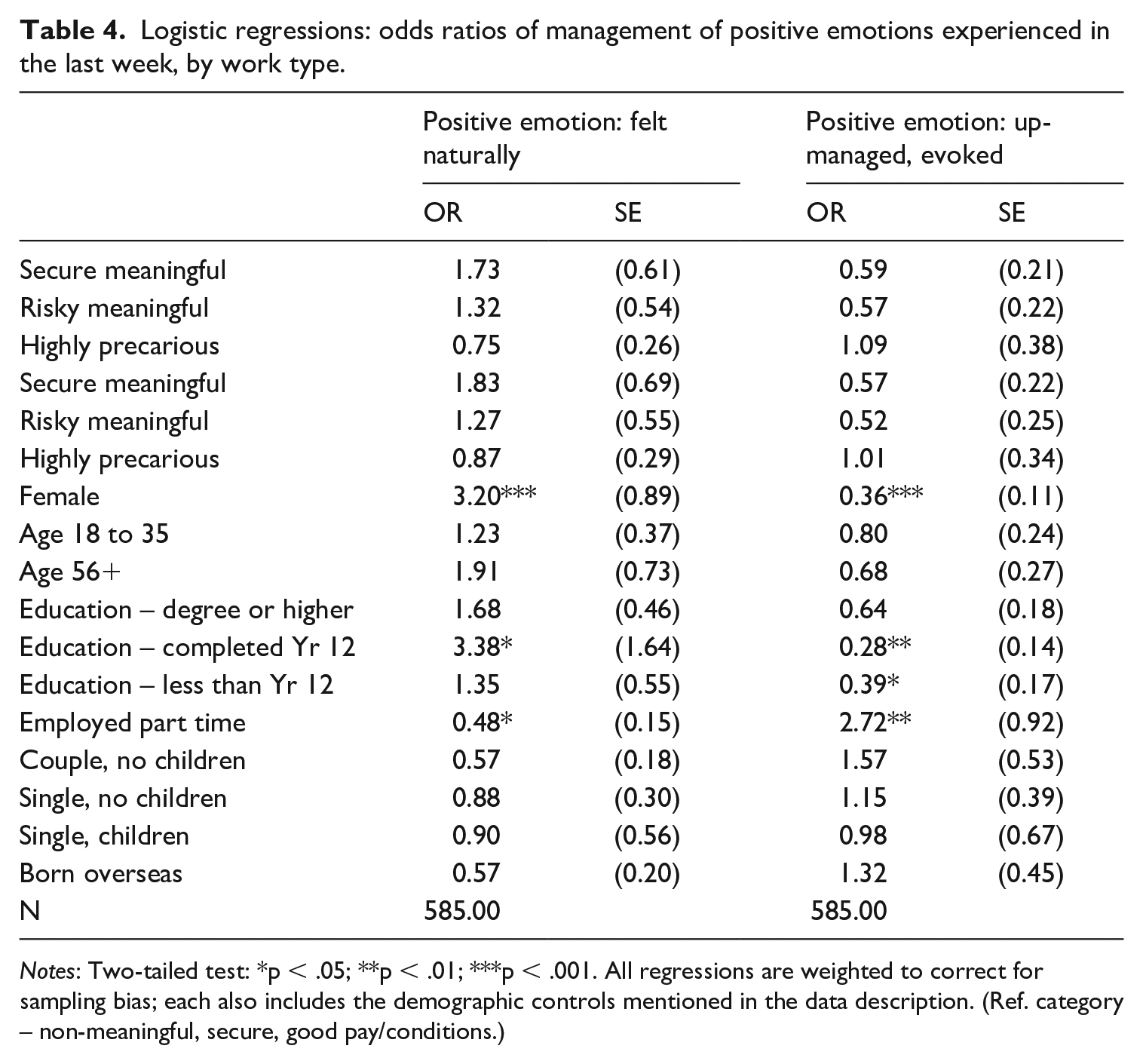
Notes: Two-tailed test: *p < .05; **p < .01; ***p < .001. All regressions are weighted to correct for sampling bias; each also includes the demographic controls mentioned in the data description. (Ref. category – non-meaningful, secure, good pay/conditions.)
Negative emotions and their management
Figure 3 shows the secondary negative emotions experienced and managed by each worker type, including whether they are shown, hidden (surface acted), or changed (deep acted). We report on both the proportion of secondary negative emotions that are managed (the solid dashed and dotted lines, for shown, changed/deep-acted and hidden/surface-acted emotions respectively), and then these proportions when depicted as a share of the proportion of primary negative emotions (the stacked bars, patterned diagonally for ‘shown’, horizontal for ‘changed/deep-acted’, and dotted for ‘hidden/surface-acted’).

Management of negative emotions experienced in the last week by work type.
In terms of unpleasant emotions, secure meaningful workers are most likely to report frustration or tiredness as secondary ‘negative’ emotions; emotions that are also easily associated with working hard in rewarding but challenging jobs. Risky meaningful workers are more likely to report stress or tiredness as a secondary negative emotion, again aligning with the stresses of such work. Safe but alienated workers are most likely to report stress or tiredness as secondary negative emotions. Highly precarious workers are more likely to report frustration and stress as secondary negative emotions, in keeping with their difficult work environments.
The pattern of the management of negative emotions also supports the depiction of emotional privilege associated with more meaningful and less precarious work. Secure meaningful workers are most likely to show and least likely to hide their negative emotions. This is a clear indication of an emotional privilege enjoyed by this group; they are less likely to experience negative emotions, and they are least socially obligated to hide them when they do feel them, and experience the potentially debilitating effects of prolonged surface acting (Naring et al., 2006).
By contrast, highly precarious workers – in addition to being the workers most likely to experience negative emotions – are also the least likely to be able to show them, and exhibit high rates of both hiding and changing emotions (most likely: frustration and stress). This contrast becomes clearer when looking at managed emotions as a proportion of negative primary emotions (the stacked bars), which shows that while both groups show a similar amount of negative emotion, highly precarious workers experience, hide, and change a far greater amount of negative emotion than do secure meaningful workers.
Of interest, the other two working groups also experience high levels of EM, with risky meaningful workers most likely to hide their emotions, and safe but alienated workers most likely to change their emotions. When looking at it as a share of primary negative emotions, this translates to a slightly greater quantum of hidden emotion (surface acting) for meaningful, precarious workers, and changed emotion (deep acting) for non-meaningful, non-precarious workers. The more debilitating nature of surface acting raises concerns for those meaningful, precarious workers who are more likely to hide their emotions. We turn next to regression results (see Table 5).
Logistic regressions: odds ratios of management of negative emotions experienced in the last week, by work type.
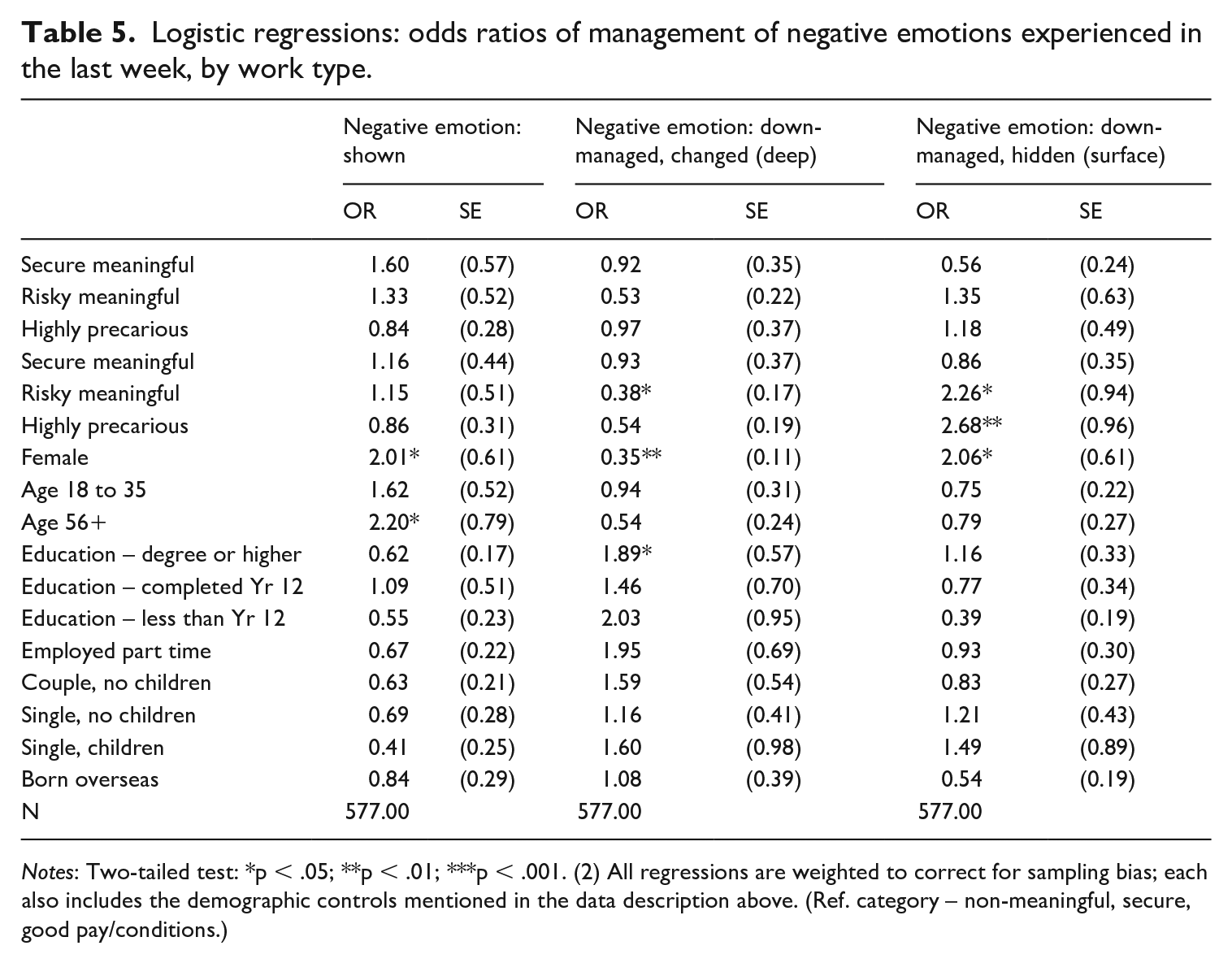
Notes: Two-tailed test: *p < .05; **p < .01; ***p < .001. (2) All regressions are weighted to correct for sampling bias; each also includes the demographic controls mentioned in the data description above. (Ref. category – non-meaningful, secure, good pay/conditions.)
Regression results show two significant associations concerning the management of negative emotions. The first is that risky meaningful work is associated with a reduced chance of changing (or deep acting) negative emotion, when controlling for education in combination with either age or migrant status; or among middle-class, middle-aged workers born in Australia. The second significant association is that both forms of precarious work – meaningful and non-meaningful – are associated with a greater chance of hiding, or surface acting, negative emotion. Meaningful precarious work is significant when controlling for either female or education status in combination with part-time employment or migrant status; in other words, it is concentrated among either male or middle-income, full-time workers born in Australia. Non-meaningful precarious work is significant when controlling for education, or for part-time employment combined either with being female or with age: in other words, among middle-income, middle-aged, full-time male workers.
These findings largely confirm the descriptive results around negative emotions mentioned earlier, in that precarious work is more strongly linked to surface acting, though they suggest that such associations largely pertain to predominantly lower middle-class workers (with trade and certificate qualifications).
Conclusion and discussion
In this study, we set out to examine the association between meaningful work, precarity, and emotional experiences and management. 3 Our results reveal that secure meaningful work is clearly associated with a range of positive emotional experiences – with happiness and pride, more positive, less negative, fewer stigmatised emotions, and greater life satisfaction – while highly precarious (less meaningful) work is associated with negative emotional experiences and an absence of happiness, fatigue, less positive, more negative, more stigmatised angry emotions, and lower life satisfaction. Furthermore, risky meaningful and safe but alienating work represent somewhat of an emotional middle ground; the descriptive statistics show risky meaningful work is slightly more likely to be associated with negative emotions. It is also interesting to contrast the guilt of secure meaningful workers and with the envy of other categories of workers, as possible relative mirrors and reflections on each other’s positions. Regressions confirm the poor emotional experiences associated with highly precarious work, as well as the slightly negative emotional experiences associated with risky meaningful work, are more concentrated amongst middle-aged, middle-income, coupled family units, than those of lower social standing (poorly educated, single parents, etc).
In terms of managing positive and negative emotions, secure meaningful work demands the least emotional management; these workers undertake the least up-managing of positive emotions. They are also the least likely to hide and most likely to show negative emotions such as anger. Highly precarious work presents the opposite scenario, involving the most up-managing, the most hiding, and the least freedom to display negative emotions. Such surface acting is partly in the nature of low-skill service work, but is counter to the supposedly emotionally-open and authentic stereotype of low-skilled working-class people. Safe but alienating workers do more up-managing of positive emotions; and risky meaningful workers do more hiding of negative emotions. These relationships are more tenuous in regression, but are not attributable to class and socio-economic characteristics; surface and deep acting appear to be more relevant to those of middle age, (educated) with middle incomes working in precarious, non-meaningful work.
There are several implications here. This is the first time that such associations have been identified using representative population survey data, and our regression analyses also confirms that such work effects are not limited to conventional socio-economic divisions. While the existing literature on precarity, meaningful work and emotions continues to make alignments with classical sociological conceptions of class linked to income, education and different forms of capital, this research – by controlling for key socio-economic characteristics – suggests a new form of stratification is emerging.
While somewhat related to classic markers of social difference, our findings show stratification based on job security and meaning hold independent emotional significance. Our findings contradict past research suggesting that upper middle-class workers are more emotionally controlled, and lower/working-class people less so (Kemper, 2007; Moullin, 2017). They demonstrate that emotional control is more a form of privilege and less a constraint, habit, or form of emotional capital (Cottingham, 2016). Those working in the best jobs are allowed to display their anger and frustration in a way that working-class figures are not. This area requires more research, particularly on how these emotions are experienced and managed in interactions between workers (and bosses) in different hierarchal positions; Lively’s (2002) study of how legal aides absorb their bosses’ anger and other negative emotions is an excellent example of important research in this area. Given that the present study reveals management disparities across whole sections of the population, these dynamics should be made much more transparent, the informal supports that enable them (friends and family) should be made explicit, and targets and equity initiatives should be developed.
Finally, it is important to recognise that while highly precarious workers experience more intense emotional difficulties and management requirements, we should not drive a wedge between different strata of workers. Solutions to precarity are social and organisational. This is demonstrated in the rise of organised anti-precarity groups, which offer an example of how formerly stratified workers across social classes have united together to lobby for workforce change (Ross, 2008). The aim of these groups is to forge alliances across the service, creative and knowledge classes, who share the same social condition of being reliant upon earning a living wage, as opposed to owning the means of production (Foti, 2006; Shukaitis, 2007).
Footnotes
Funding
The author(s) received no financial support for the research, authorship, and/or publication of this article.
Notes
Author biographies
 ) is an associate professor of Sociology at the University of Wollongong. His research spans over 70 publications and ARC Grants (DP: 2009–11, LP: 2015–18) on gender, social disconnection and networks, unemployment, emotions, and loneliness. He co-founded the CERN and TASA-SEA research networks, and was lead editor of the 2019 collection Emotions in Late Modernity (Routledge, coedited with Olson, Bellocchi, Khorana, McKenzie and Peterie).