




Abstract
This exploratory study examines factors influencing support for treaty-making among parents and caregivers of Indigenous youths in Australia. Despite calls for Indigenous–state treaties for more than half a century, empirical evidence on attitudes towards contemporary treaty-making remains remarkably limited. Using data from the Longitudinal Study of Indigenous Children (n = 682), over 80% of respondents rated treaty as ‘very important’ increasing to 95% when including moderately important. Binary logistic regression indicates that significant predictors of strong treaty support include treaty knowledge, Indigeneity, and understanding of one's family, history, and culture, while many standard socioeconomic variables were non-significant. Despite high levels of expressed importance, overall treaty understanding was comparatively low. This disjuncture suggests that views on treaty may reflect a range of relational and experiential influences. At the same time, the association between knowledge and support indicates that improving access to balanced, historically grounded information may support informed engagement with treaty processes.
Introduction
Over the past decade, modern treaty-making has emerged as a promising institutional process that could recognise Indigenous 1 self-determination and provide a measure of justice in contemporary Australia (Williams & Hobbs, 2020). Aboriginal and Torres Strait Islander people and nations have long called for treaties to recognise their inherent rights and status and outline ‘mutually agreed terms for our relationship with the Australian government’ (Dodson, 2016, p. 181). Successive governments have resisted, refusing to open negotiations, let alone to strike formal agreements that would confront the ongoing structure of colonisation.
Recent developments suggest a partial shift in political posture. In Victoria, the First Peoples’ Assembly has led a structured negotiation process with the state, resulting in the first formal treaty on this continent (Statewide Treaty, 2025). At one point, it appeared likely that additional treaties would soon be layered across the continent: in early 2023, all governments except Western Australia had committed to talking treaty (Hobbs, 2024). At the time of writing, however, most of these initiatives have stalled or been dismantled. This reversal underscores both the structural persistence of Indigenous injustice and the fragility of legal and political processes that remain contingent on non-Indigenous political will (Hobbs, 2025).
At the same time, support for treaty processes among Indigenous nations cannot be assumed. Many communities may express concern that state-based treaties, like the Victorian agreement, will ‘inevitably reinstate colonial law’ (Watson, 2014, p. 2). These concerns are compounded by the absence of a national treaty tradition, which leaves both Indigenous and non-Indigenous Australians without a clear or widely shared understanding of what a ‘treaty’ might involve in practice.
Australians’ attitudes towards and understanding of treaties, and their awareness of what such agreements might involve or mean, are therefore critical to the success of treaty processes (Prehn, Carlson et al., 2026). As part of their obligation to renew relationships with First Peoples and finalise treaties, governments will need to engage the public and develop educational initiatives to promote awareness, understanding, and ownership. These initiatives will need to be directed to both non-Indigenous and Indigenous communities. When developing programmes for Indigenous peoples, however, there is a risk that governments may adopt tokenistic or top-down campaigns that fail to reflect Indigenous priorities and worldviews. Such programmes might overlook the fact that support for treaties within Indigenous families and communities is not only a policy issue, but also a question of self-determination, cultural continuity, and intergenerational responsibility (Rigney et al., 2021).
This raises the question: how should treaty educational programmes for Indigenous communities be developed, and who should conduct such programmes? Parents and other primary caregivers of Indigenous youth offer an especially valuable perspective in answering this question; their views are shaped not only by personal experience but also by their responsibilities as cultural custodians and community leaders (Walter et al., 2017). Understanding how these caregivers interpret and support treaty processes provides insight into the broader social and cultural foundations needed to sustain just and enduring treaty relationships.
Situated within this context, this study utilises data from the Longitudinal Study of Indigenous Children (LSIC) to explore factors shaping strong support for treaties among primary caregivers of Indigenous youths. Using an Indigenous quantitative methodology (Walter & Andersen, 2013) and weighted binary logistic regression, this article examines levels of treaty importance. Because 80% of participants viewed treaty as ‘very important’, responses were grouped to distinguish strong support from all other views. 2 While the LSIC provides a large, culturally grounded national dataset, it captures only a limited range of political and relational variables pertaining to treaty. The analysis should therefore be read as indicative rather than comprehensive, reflecting how available data can illuminate but not fully explain the complex foundations of Indigenous political engagement. This approach highlights both the promise and constraints of working with existing datasets, with the LSIC being the only publicly accessible survey containing treaty-related questions identified by the authors at the time of writing.
Our findings indicate that: treaty understanding, Indigenous status, knowledge of one's history, family, and culture, and remoteness are significant predictors of strong support for treaties. In contrast, formal education and socioeconomic status (SEIFA) were not statistically significant in the final model, while age, gender, and income did not meet the criteria for inclusion. These results suggest that relational and epistemic dimensions, particularly cultural grounding and informed political literacy, are more influential than standard sociodemographic indicators in shaping treaty attitudes. The study contributes new evidence to inform culturally grounded treaty education, engagement, and policymaking in Australia.
Surveying the treaty landscape
Unlike Aotearoa New Zealand, the United States, and Canada, no formal treaty or treaties were negotiated between Indigenous nations and the British Crown (Rigney et al., 2022; Williams & Hobbs, 2020). Instead, British colonisation proceeded on the legal fiction that the continent was ‘a tract of territory practically unoccupied, without settled inhabitants or settled law’ (Cooper v Stuart 1889: 292). This foundational failure to negotiate the terms of settlement continues to reverberate in the present. While the High Court of Australia's decision in Mabo v Queensland (No 2) (1992), rejected terra nullius as a basis for denying Indigenous land rights, it left intact the Crown's assertion of sovereignty, and Australian law continues to deny recognition of Aboriginal and Torres Strait Islander peoples’ inherent rights to sovereignty and self-determination.
A treaty relationship recognises the inherent sovereignty and authority of both parties. Yet, perhaps constrained by its history, the Commonwealth government continues to resist longstanding calls from both Indigenous and non-Indigenous peoples for formal recognition (Appleby & Davis, 2018). Responsibility for treaty-making has therefore fallen to state and territory governments, producing a fragmented and uneven national landscape (Hobbs, 2024). Although, by early 2023, every jurisdiction except Western Australia had committed to exploring treaty, the failure of the Voice referendum marked a significant turning point. Since then, most processes have stalled or been abandoned, with only one jurisdiction continuing to make substantial progress.
These developments reflect variations in political will, the strength of Indigenous advocacy and mobilisation, and the historical relationships between First Peoples and individual jurisdictions. To situate this context and these dynamics, Table 1 outlines the key generalised phases of treaty-making, focusing primarily on Australia and supported by modern treaty models in Canada (Williams & Hobbs, 2020). These phases range from activism and infrastructure establishment to long-term implementation.
Generalised modern indigenous-state treaty stages and phases.
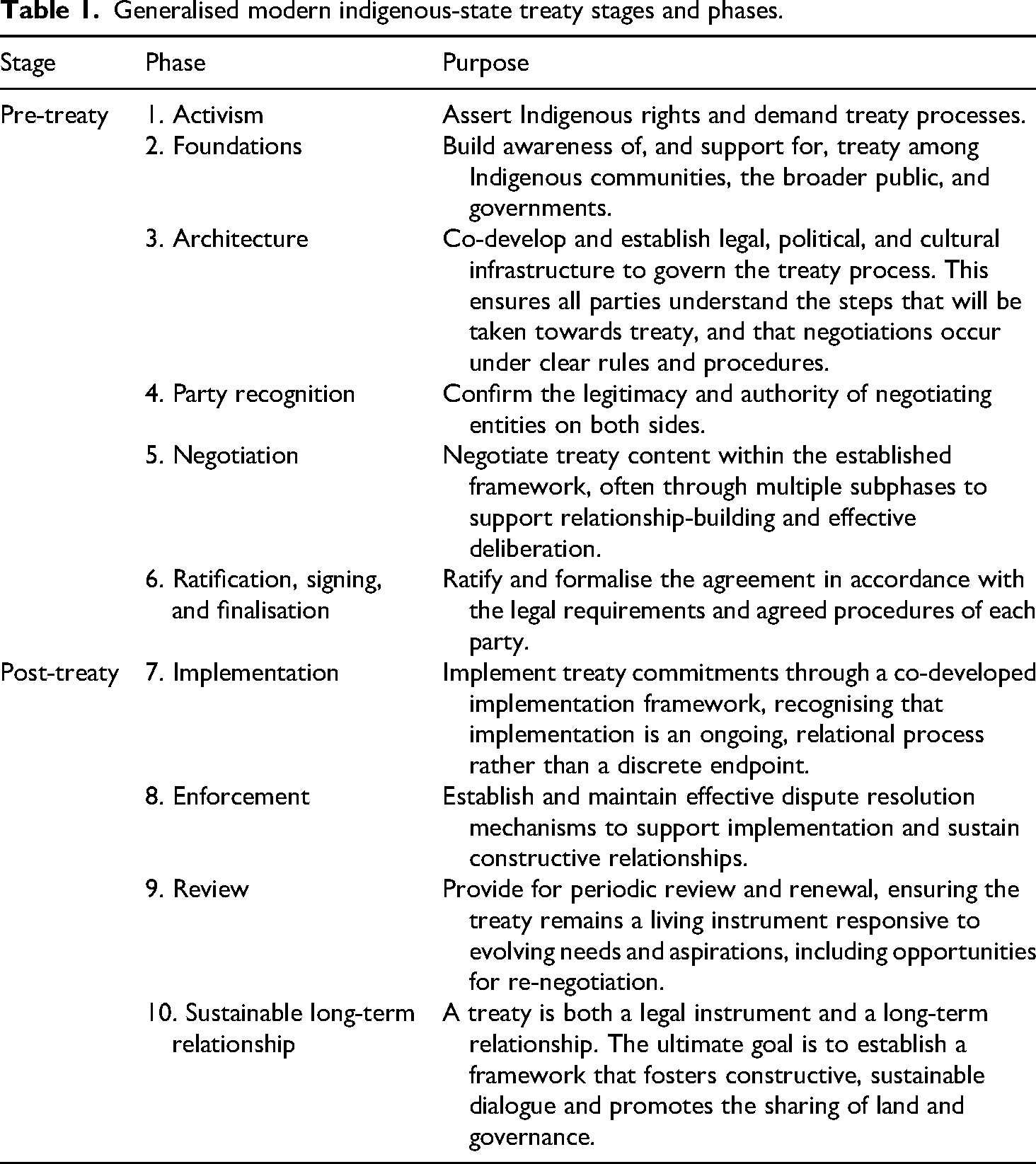
This staged model highlights that treaty-making is not a singular event but an evolving, relational process. It begins with grassroots activism and advocacy, moves through the co-development of treaty institutions and architecture, and culminates in formal negotiations and long-term governance. Because treaties are political processes, their realisation requires sustained political will and Indigenous leadership at every stage. As we noted, progress across Australia is limited (Hobbs, 2024). Table 2 presents the status of treaty processes by jurisdiction as of mid-2026.
Phase of treaty processes by jurisdiction (mid-2026).
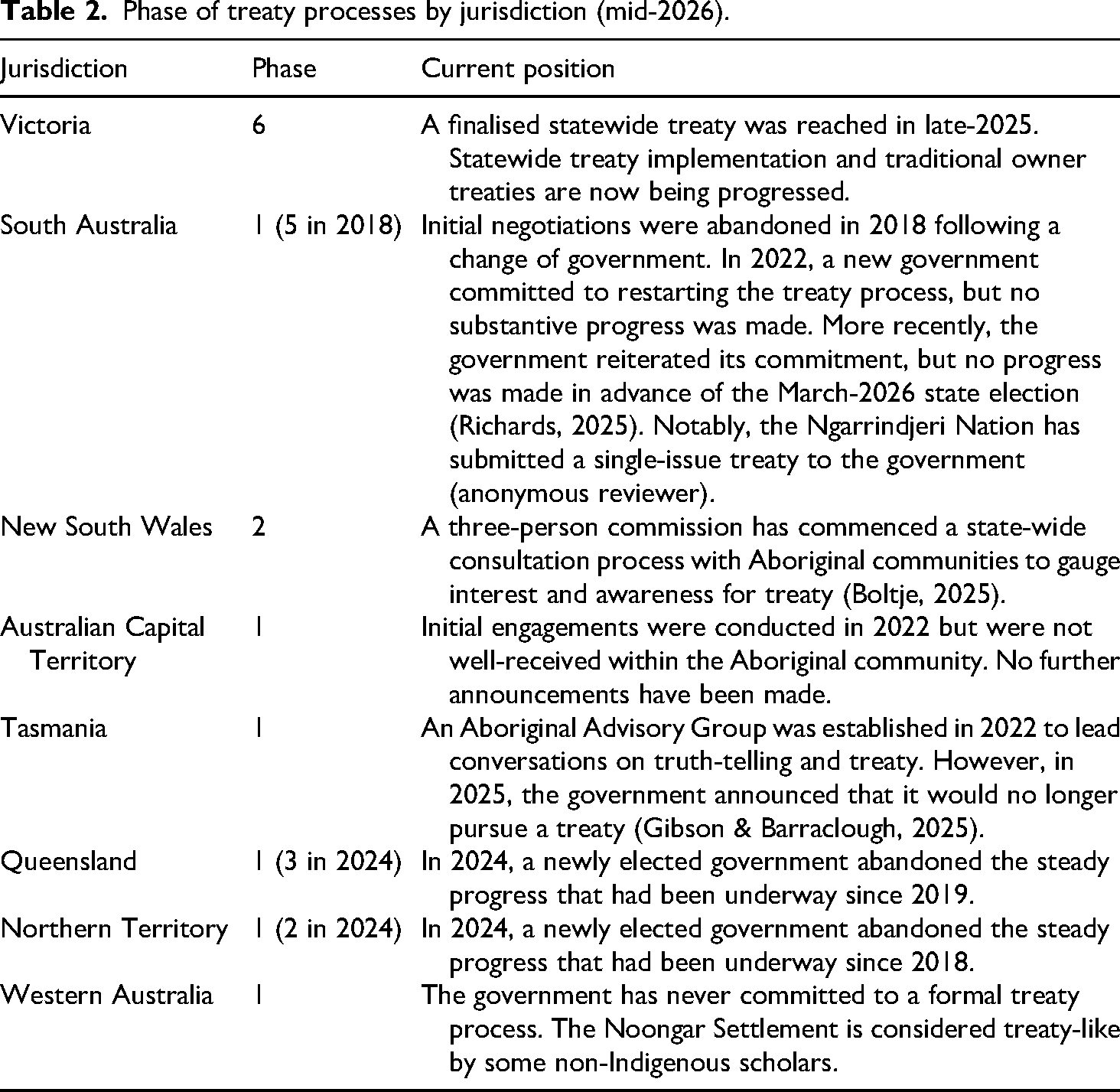
This snapshot reveals that progress towards treaty across Australia is uneven and shaped by an uncertain political environment (Hobbs, 2024). In jurisdictions like Victoria, strong Indigenous advocacy, along with political will, has thus far protected the process, allowing it to develop and continue towards settlement (Atkinson & Stewart, 2024). In other jurisdictions, however, slow and steady progress has been derailed, deprioritised, or dismantled. Recognising this reality is essential for identifying the conditions that enable or constrain treaty-making. It also highlights the benefit that could be attained through national coordination, not to mention a more substantial commitment to treaty-making. Treaties are intended to redress historical injustices, support Indigenous nation-building and thereby contribute to a more meaningful closing of the well-documented health and socioeconomic gap (Productivity Commission, 2024). In Australia, they also serve as ‘a belated act of nation-building’, strengthening relationships between Indigenous and non-Indigenous Australians (Williams & Hobbs, 2020, p. 18). They should not be so easily put aside.
Support for treaty: political, cultural, and educational drivers
Australians’ attitudes towards Indigenous-state treaties are largely unknown, primarily due to the absence of meaningful survey data. This is despite a long history of calls for treaty (Clark et al., 2019). The knowledge gap partly reflects the state's epistemic control, which has historically disregarded the data and knowledge needs associated with treaty and many other Indigenous matters (Lovett et al., 2021). In Canada and Aotearoa New Zealand, educational exposure to Indigenous histories and rights has been shown to support more informed engagement with treaty processes (Tupper, 2012). Studies suggest that curriculum content, particularly when co-designed or led by Indigenous peoples, can significantly enhance understanding and participation regarding treaty among both Indigenous and non-Indigenous learners (Tupper, 2011, 2014; Walker, 2016). In contrast, treaty education remains largely absent from Australian formal curricula, and there is minimal research exploring its impact.
Within Indigenous communities, support for treaties is often interconnected to justice and self-determination. Scholars have observed that a treaty is seen not only as a recognition of rights but also as a means of (re)building Indigenous nationhood based on cultural law/lore, kinship, and relational authority (Rigney et al., 2021, 2022). In this sense, treaty support is often driven less by materialist considerations and more by Indigenous polity, cultural obligation, and intergenerational responsibility (Rigney et al., 2026). Understanding these drivers requires moving beyond conventional attitudinal models and centring Indigenous knowledge and value systems (Andersen et al., 2025). Recent scholarship also emphasises the significance of trust and accountability in influencing support for treaty institutions (Atkinson & Stewart, 2024). In Victoria, for instance, the legitimacy of the treaty process depends on whether institutions uphold cultural safety, transparency, and respect for Traditional Owner decision-making (First Peoples Assembly of Victoria & The State of Victoria, 2022). While often overlooked in non-Indigenous quantitative models, these factors are essential to understanding how and why Indigenous peoples engage with treaty as a transformative, future-oriented project.
The role of cultural knowledge and relationality
Cultural determinants, including family and kinship, history and tradition, and beliefs and values, are increasingly recognised as protective factors in Indigenous health (Verbunt et al., 2021), wellbeing (Williamson et al., 2020), and identity formation (Martin, 2017). However, their role in shaping political consciousness and support for treaty remains underexplored in the literature. Indigenous standpoint theory provides a valuable foundation for understanding how cultural knowledge informs political perspectives. Scholars such as Torres Strait Islander Professor Martin Nakata (1998) and Goenpul Distinguished Professor Aileen Moreton-Robinson (2013) argue that an Indigenous standpoint emerges from embodied, lived relationships to land, kin, and community. It is through these relationships that political claims acquire greater meaning, and through cultural continuity that such claims are sustained across generations.
Support for treaty is thus informed by deep cultural and relational commitments (Graham & Brigg, 2023). For the parents and primary caregivers of Indigenous youths, cultural knowledge serves as both a lens and a foundation, shaping their understanding of the meaning of sovereignty, the ongoing structure of colonisation, and the responsibilities associated with self-determination (Lovett, 2017; Martin, 2017). Unlike non-Indigenous understandings that often emphasise institutional reform, treaty support grounded in cultural knowledge is relational, affective, and historically located.
This link between identity and political mobilisation is well established in non-Indigenous contexts, where relational knowledge enhances engagement with Indigenous governance and treaty institutions (Carlson & Frazer, 2016; Warrior, 2018). Cultural knowledge also intersects with formal education in critical ways (Lowe et al., 2021; Prehn, Hobbs et al., 2026). While formal schooling has the potential to promote treaty awareness in Australia (Prehn, Carlson et al., 2026), like it does in Aotearoa New Zealand (Huygens, 2016) and Canada (Tupper, 2014), informal cultural transmission through Elders and community leaders, communal events, and storytelling often strengthens political understanding within Indigenous families and communities (Johnson, 2019). For primary caregivers of Indigenous families, the ability to pass on cultural knowledge is deeply tied to their vision of what treaty could enable: the renewal of greater self-determination, community control, cultural strength, and a just relationship with the state
Non-Indigenous logics in survey design
Despite recent advances in Indigenous social research led by Aboriginal scholars such as Lovett et al. (2020) and Wells et al. (2023), many mainstream surveys and statistical models remain rooted in non-Indigenous worldviews (Walter et al., 2021). These worldviews privilege so-called ‘objectivity’ and quantifiable individualised and western socioeconomic indicators as the default explanatory tools (Walter & Andersen, 2013). While relevant in specific contexts; income, formal education, and employment metrics often fail to capture the full range of political and cultural dimensions of Indigenous lived experiences. 3 When applied uncritically, they risk reinforcing deficit narratives, obscuring the structural and historical forces that shape Indigenous attitudes, and erasing Indigenous perspectives (Andersen et al., 2025).
There is a growing call within Indigenous methodologies to ‘unsettle’ standard social research practices by developing statistical measures that reflect Indigenous worldviews (Andersen et al., 2025; Lovett et al., 2020). This includes recognising that knowledge is relational, data are never neutral, and histories of surveillance and extraction shape participation (Williamson et al., 2021). These calls connect to broader critiques of neoliberal datafication, understood as the process through which social life is converted into quantifiable information, obscuring relationships and detaching lived experience from its cultural and human context (Kukutai & Cormack, 2019). Drawing on Indigenous-led datasets such as the LSIC (to an extent, see Bodkin-Andrews et al., 2024), Mayi Kuwayu (Lovett et al., 2020), and Kulay Kalingka (Wells et al., 2023) can offer a corrective, provided that analysis is grounded in decolonial and Indigenous-centred approaches (Walter & Suina, 2019).
We argue that by applying statistical tools to Indigenous political questions without critically adapting them to Indigenous worldviews, researchers risk misinterpreting the drivers of treaty support. This study addresses that challenge by integrating Indigenous standpoint theory with quantitative methods (Walter & Andersen, 2013). It includes cultural and relational indicators, among others, to explain the importance of treaties rather than relying solely on non-Indigenous-derived socioeconomic metrics.
Methodological approach
This study draws on Palawa Distinguished Professor Maggie Walter and Métis Professor Chris Andersen's (2013) Indigenous Statistics, which reclaim quantitative data analysis as a valid and powerful tool for advancing Indigenous interests. Rather than treating statistics as neutral or universal, this approach foregrounds Indigenous social realities, values, epistemes, and standpoints 4 in the creation, selection, interpretation, and use of data. It challenges the deficit framing often seen in non-Indigenous quantitative research (Andersen et al., 2025) and instead centres Indigenous agency, knowledge systems, and political aspirations. In an era shaped by datafication and algorithmic power, statistical patterns do more than describe reality; they help create it (Prehn, Carlson et al., 2026). Indigenous methodologies redirect this power towards relational accountability and self-determination. This study interprets statistical patterns not just as technical findings but as culturally and politically meaningful expressions of how Indigenous families relate to questions of treaty.
In applying this methodology, the study also aims to align with broader principles of Indigenous Data Sovereignty (IDSov), 5 which demand that Indigenous peoples govern the data that describes them (Kukutai & Taylor, 2016). From the choice of the dependent variable (treaty importance) to the recoding of independent variables such as cultural knowledge and income, all analytical decisions were Indigenous-led and shaped by the research aim: identifying strengths-based, relational factors that influence treaty support. While the LSIC is not explicitly designed for political attitudinal research, Indigenous-led methods enable meaningful insights from variables that speak to culture, understanding, and context (Walter et al., 2017). The exploratory nature of this study reflects the current absence of prior models in this space, positioning this research as a starting point for more nuanced, Indigenous-led treaty analysis.
The Longitudinal Study of Indigenous Children
This study draws on Wave 13 (2020–2021) of the Longitudinal Study of Indigenous Children (LSIC), also known as Footprints in Time. The LSIC is administered by the Australian Department of Social Services and was developed in close consultation with Aboriginal and Torres Strait Islander leaders and communities (Walter et al., 2017). It follows two cohorts of Indigenous children and their families over time, focusing on child development, cultural identity, family relationships, and social outcomes. The study employs a purposive, non-random sampling design that prioritises geographical diversity and cultural representation rather than statistical representativeness. As such, LSIC remains one of the most comprehensive and contextually grounded longitudinal datasets on Indigenous families in Australia.
LSIC's Indigenous-majority Data Governance Committee is particularly significant (Walter et al., 2017). It plays a central role in ensuring that the dataset is accountable to Indigenous priorities. Due to this governance structure, LSIC includes one of, if not the only, publicly accessible quantitative measures of attitudes towards treaty-making among Indigenous and non-Indigenous peoples in Australia. This makes LSIC uniquely valuable for exploratory political and cultural analysis grounded in Indigenous standpoints.
Variables and recoding decisions
Dependent variable: treaty importance (apl45_5)
Treaty importance.
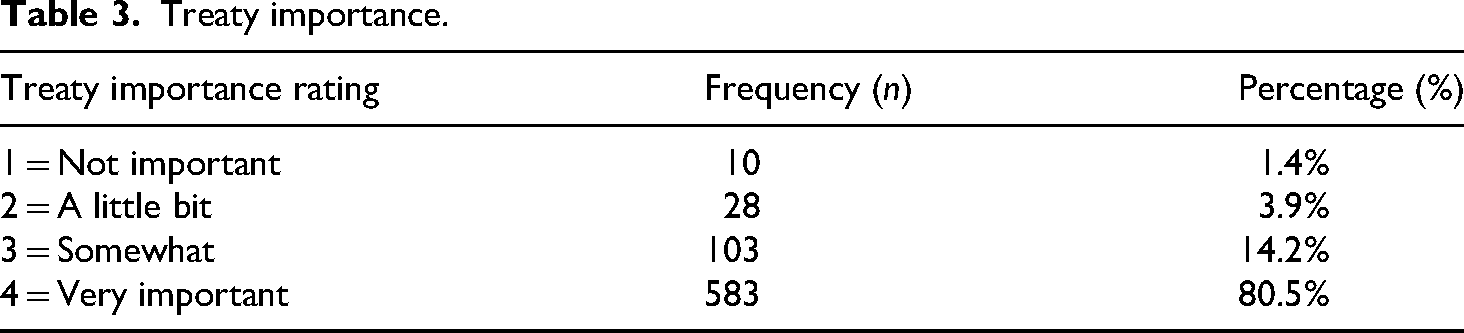
The dependent variable, treaty importance, was initially measured on a four-point ordinal scale, ranging from ‘not important’ to ‘very important’. However, the distribution was highly skewed: over 80% of respondents selected ‘very important’, while fewer than 6% selected ‘not important’ or ‘a little bit’. This pronounced skew, combined with the small number of cases in the lower categories, presented a challenge for traditional ordinal or linear regression modelling, which assumes adequate variation across response levels and approximately equal intervals between them.
Treaty importance recoded.

This recording allowed for the use of weighted binary logistic regression more robustly to model the factors associated with strong support for treaty. While collapsing the variable involved some loss of nuance, it enabled more stable estimates and interpretive clarity. It should be noted that the case weighting is applied in the final binary logistic regression model and is detailed later (see Table 8). The binary outcome aligns with the study's central aim: to identify the social, cultural, and cognitive factors differentiating those who express the highest level of treaty support from those who do not. This approach is especially relevant given the policy and political significance of understanding the characteristics of committed treaty supporters, particularly within the broader context of treaty-making in Australia.
Independent variables
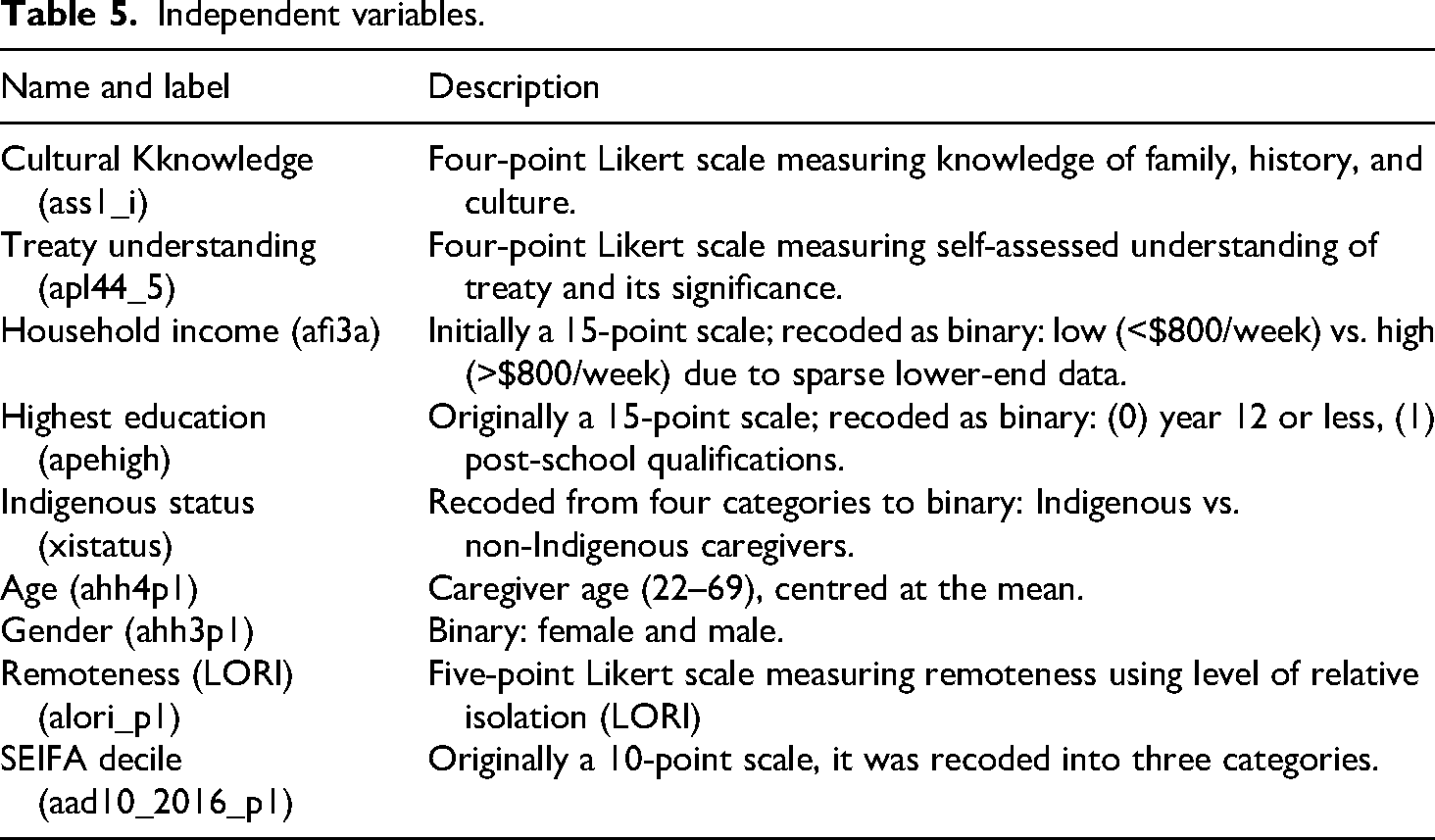
Independent variables.
Analytical strategy
The analysis proceeded in three stages:
Descriptive statistics of the sample (n = 774).
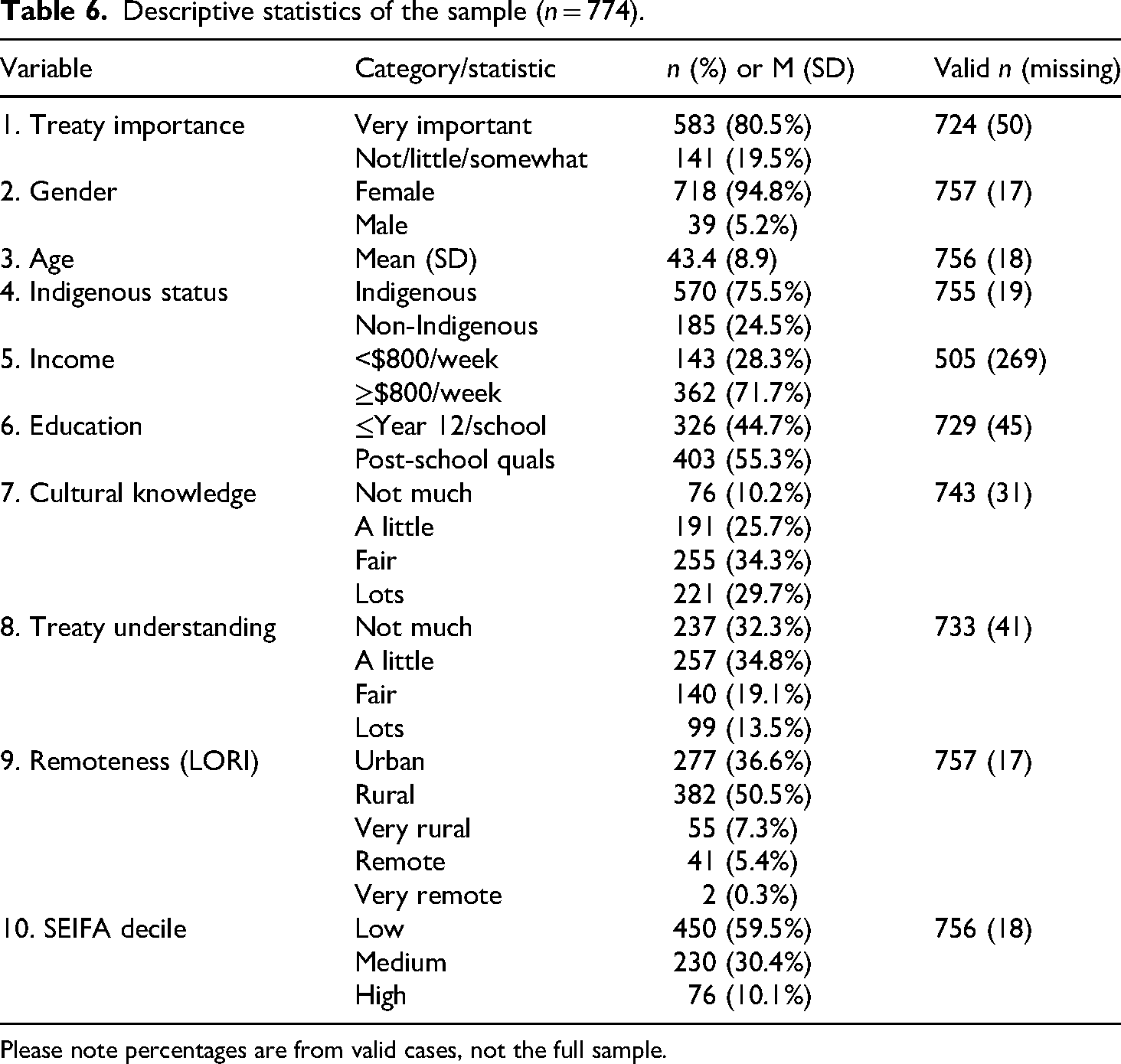
Please note percentages are from valid cases, not the full sample.
Bivariate associations with treaty importance.
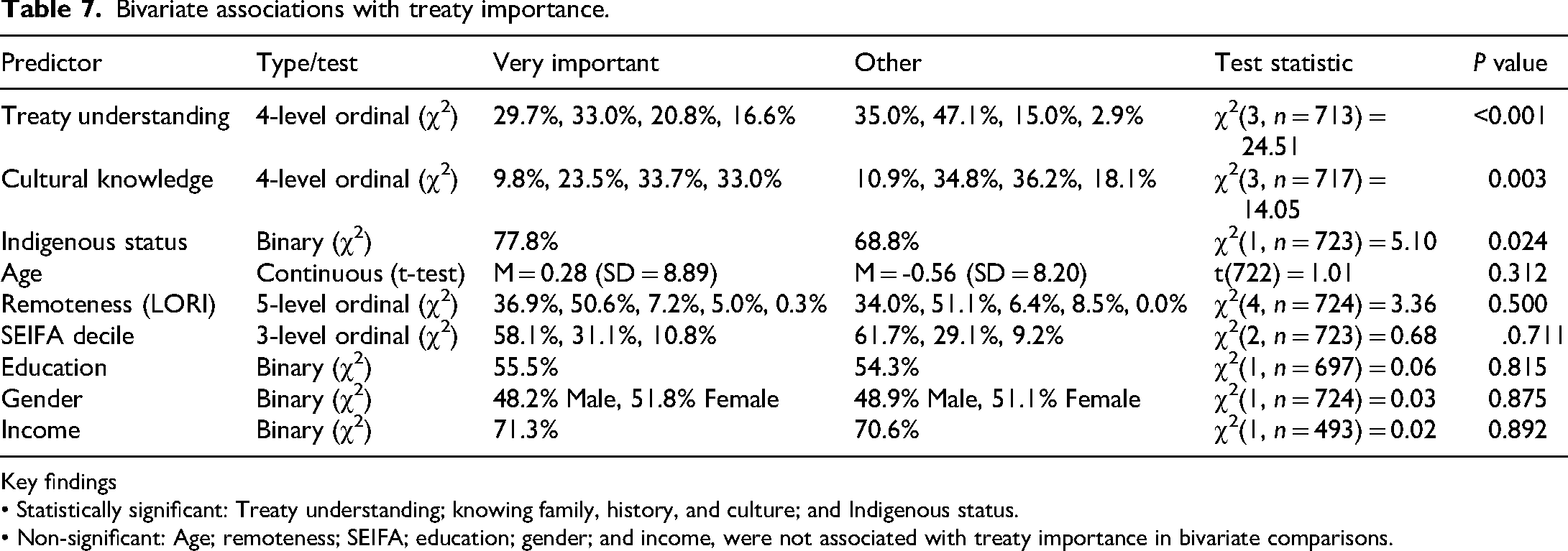
Key findings
• Statistically significant: Treaty understanding; knowing family, history, and culture; and Indigenous status.
• Non-significant: Age; remoteness; SEIFA; education; gender; and income, were not associated with treaty importance in bivariate comparisons.
Distribution of recoded treaty importance before and after weighting.
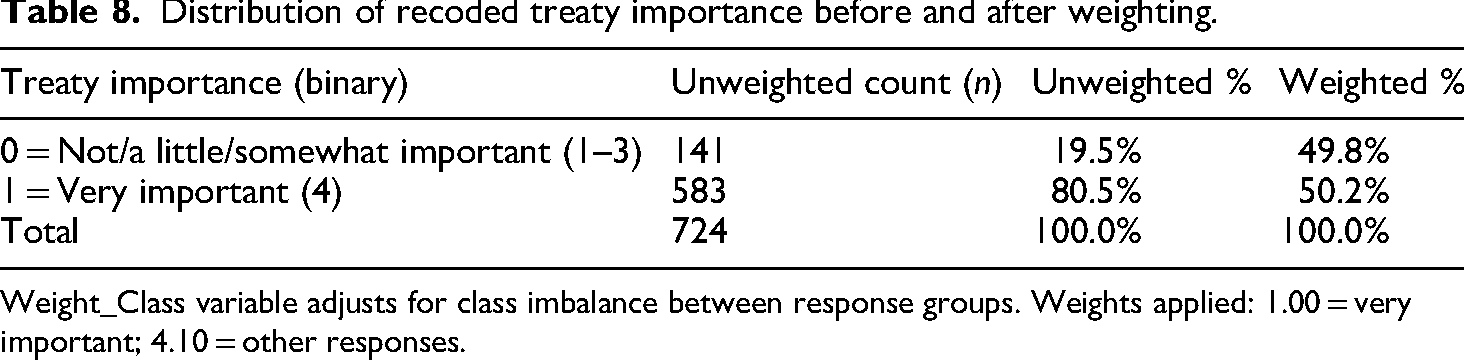
Weight_Class variable adjusts for class imbalance between response groups. Weights applied: 1.00 = very important; 4.10 = other responses.
Binary logistic regression predicting likelihood of rating treaty as ‘very important’ (n = 682).
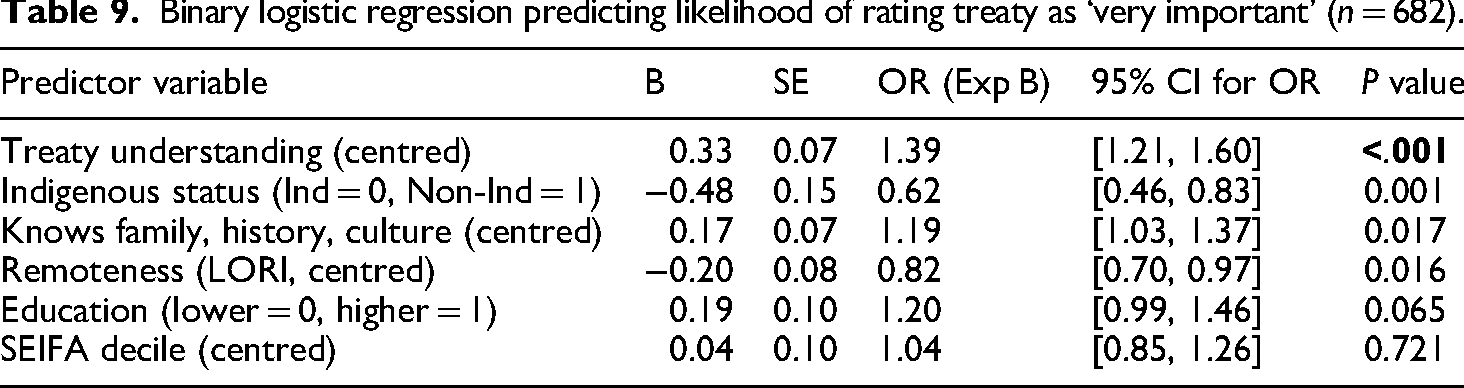
Model fit statistics.
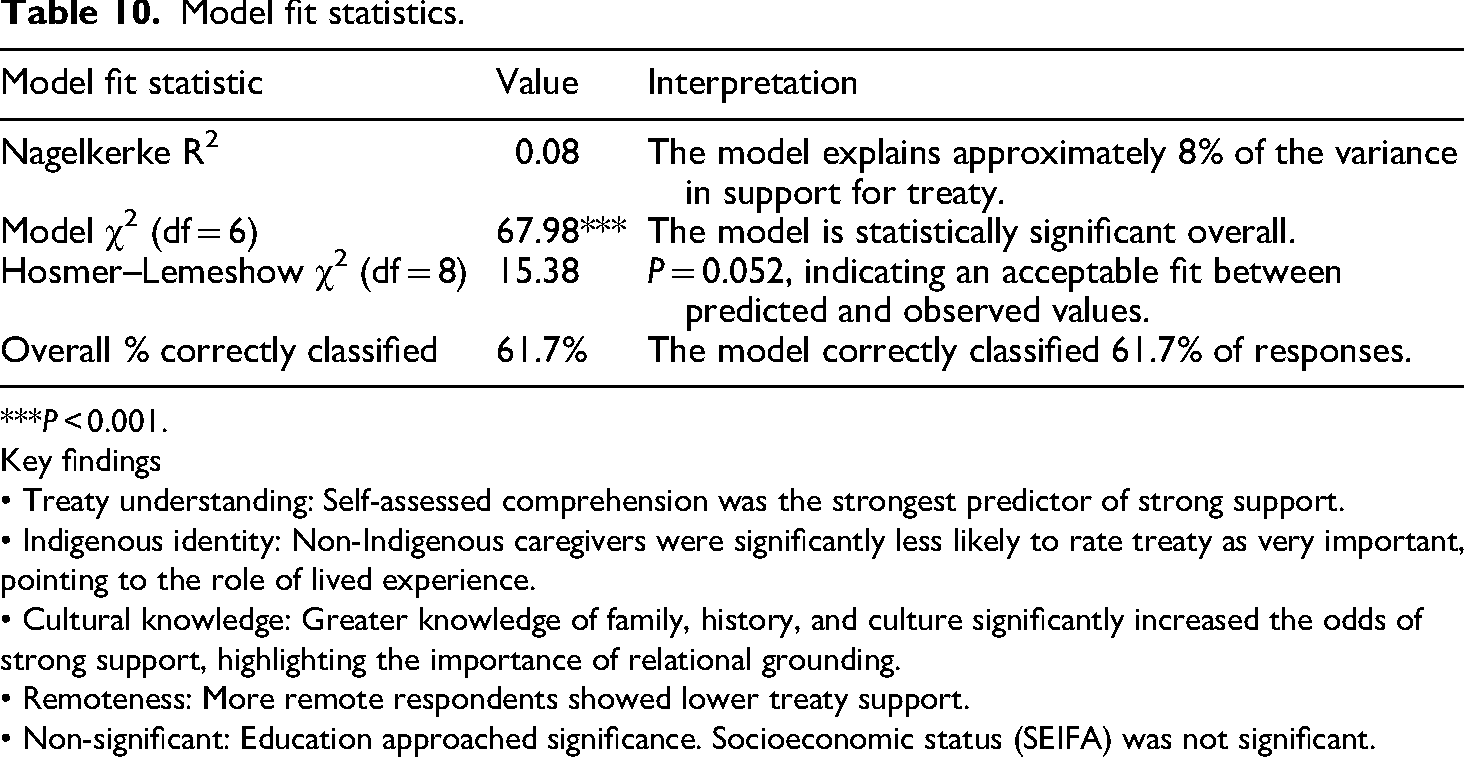
***P < 0.001.
Key findings
• Treaty understanding: Self-assessed comprehension was the strongest predictor of strong support.
• Indigenous identity: Non-Indigenous caregivers were significantly less likely to rate treaty as very important, pointing to the role of lived experience.
• Cultural knowledge: Greater knowledge of family, history, and culture significantly increased the odds of strong support, highlighting the importance of relational grounding.
• Remoteness: More remote respondents showed lower treaty support.
• Non-significant: Education approached significance. Socioeconomic status (SEIFA) was not significant.
Results
Sample characteristics
The sample characteristics are illistrated in Table 6 below.
Bivariate associations
Logistic regression results
To construct the binary logistic regression model (see Table 9) predicting the likelihood of rating treaty as very important, variable selection was informed by both statistical and theoretical considerations. Bivariate analyses identified three key predictors: treaty understanding, knowledge of family, history, and culture, and Indigenous status. These were retained in the multivariate model because they align conceptually with relational and political drivers of treaty support. Three sociodemographic variables: educational attainment, remoteness (LORI), and socioeconomic status (SEIFA), were also included to account for structural influences that may shape attitudes independently or interact with cultural and political knowledge. While not all sociodemographic variables were statistically significant, their inclusion strengthened a more holistic, contextually grounded model.
Given the class imbalance, with over 80% rating treaty as ‘very important’, a case-weighting adjustment was applied to mitigate potential bias. The ‘Weight_Class’ variable assigned greater weight to the underrepresented group (those rating treaty as less than ‘very important’). Table 8 shows the distribution of the binary outcome before and after weighting, illustrating the effect on class proportions and model stability (see Table 10).
Summary of findings
This study examined predictors of strong treaty support among primary caregivers of Indigenous families. Although more than 80% rated treaty as very important, the use of case weights enabled a more balanced analysis. The final model revealed that relational and epistemic factors, including treaty understanding, Indigenous identity, and cultural knowledge, were strong predictors of approval. These findings suggest that treaty support is shaped more by relational grounding, lived experience, and political awareness rooted in Indigenous worldviews than by sociodemographic advantages.
Remoteness was negatively associated with treaty support, suggesting that distance from information and policy networks may limit engagement, despite strong cultural continuity in remote communities. Education had only a marginal influence, and socioeconomic status (SEIFA) was not a significant factor. Together, these findings reveal the limits of non-Indigenous-derived measures for understanding Indigenous political orientations. Support for treaty appears grounded in relational knowledge systems and culturally informed political literacy, emphasising the need for policy and education initiatives that engage Indigenous ontologies, values, and epistemes to foster meaningful, culturally resonant participation in treaty processes.
Discussion
This study investigated the drivers of strong treaty support among primary caregivers of Indigenous youths, guided primarily by Indigenous standpoint theory (Walter & Andersen, 2013) and informed by principles of IDSov (Walter & Suina, 2019). In the absence of substantial prior quantitative research on this topic, especially from within Indigenous communities, the analysis was necessarily exploratory. Rather than seeking a universal model, it aimed to illuminate patterns that reflect the realities and priorities of Indigenous families navigating a dominant non-Indigenous political landscape. The findings contribute to Indigenous sociology, political science, and treaty-related discussions in Australia.
While this study centres on Indigenous families, it also highlights the importance of engaging non-Indigenous people. The analysis revealed non-Indigenous primary caregivers were significantly less likely to rate treaty as ‘very important’, even when raising Indigenous children. This suggests that proximity to Indigenous family life does not automatically translate into relational or political alignment. Because treaty is fundamentally a relationship between self-determining political entities (Hobbs & Williams, 2018), its advancement requires shifts in non-Indigenous understanding, accountability, and co-ownership. Efforts building treaty support, therefore, demand education and engagement strategies that deepen awareness of the relational, ethical, and historical foundations of treaty-making among non-Indigenous Australians.
Relational knowledge and treaty support
The final model revealed that the strongest predictors of treaty support were relational and epistemic, including cultural knowledge, treaty understanding, Indigenous identity, and reduced remoteness. These findings indicate that support for treaty is not driven by civic awareness or demographic status alone but is grounded in specific ways of knowing shaped by kinship, Country, and cultural continuity (Martin, 2008; Moreton-Robinson, 2020). Relational knowledge encompasses this dynamic, referring not only to what people know but also to how knowledge is formed through ongoing relationships with family, community, and place (Graham & Brigg, 2023; Verbunt et al., 2021; Williamson et al., 2020).
Although cultural knowledge was a strong positive predictor, participants in more remote areas were less likely to express strong treaty support. Remoteness, therefore, does not necessarily correspond with higher treaty literacy or political engagement. Many remote communities maintain profound cultural continuity, yet they remain structurally excluded from policy conversations and information flows about treaties (Rennie et al., 2021). This highlights the need to distinguish between cultural strength and access to political processes, and to ensure that engagement opportunities are accessible to all communities. It also reflects what Watson (2014) identifies as the enduring limits of state recognition: Indigenous self-determination and cultural authority persist, while political inclusion remains conditional. Addressing this disparity requires investment in communication, translation, and digital infrastructure to enable relational participation in treaty processes.
Treaty-making, then, is not an abstract political agreement but a relational and cultural responsibility. The significance of Indigenous identity and spatial location in this study suggests that political commitments are shaped by lived experience and proximity to land-based struggle (see Norman, 2015). Civic education initiatives aimed at building treaty support must therefore be grounded in relational ontologies, culturally relevant practices, and Indigenous values, rather than in abstract legal or procedural messaging.
Decolonising surveys
While identity and geography were predictive, conventional structural variables, such as education and socioeconomic status (SEIFA), were not significant. Education approached statistical significance but did not cross conventional thresholds, suggesting that formal schooling may not directly correspond to treaty literacy and attitudes (Prehn, Carlson et al., 2026). Likewise, SEIFA, a non-Indigenous designed index of area-based advantage, offered little explanatory value. These results echo long-standing critiques that non-Indigenous metrics often fail to reflect Indigenous realities and reproduce deficit-based assumptions (Walter, 2016; Williamson et al., 2021).
The implications are twofold: first, they call for caution when interpreting political attitudes using ‘mainstream’ demographic indicators (Walter et al., 2021). Second, they reaffirm the value of Indigenous-led analytical frameworks that prioritise cultural, relational, and place-based dimensions of political life. Rather than reducing political consciousness to income or education levels, models of treaty support must reflect the distinct political histories and knowledge systems of Indigenous peoples, communities, and nations.
Implications for treaty education and engagement
These findings hold critical implications for treaty education, engagement strategies, and participatory policy design (Walter et al., 2021). Treaty support, as shown, is most powerfully shaped by cultural knowledge, political understanding, and relational positioning. This means that government-led awareness campaigns or generic civics programmes are unlikely to shift attitudes meaningfully unless they are developed in partnership with Indigenous communities and embedded in culturally relevant, place-based approaches.
Treaty education should centre Indigenous voices, histories, and priorities, drawing on kinship ties and intergenerational storytelling to build treaty literacy from within. Importantly, higher support among urban and rural respondents challenges remote-centric assumptions of Indigenous people and highlights the importance of leadership from both urban, rural, and remote communities in sustaining treaty dialogue (Porter, 2018). These findings also emphasise that Indigenous-led initiatives, such as truth-telling, cultural revitalisation, and language recovery, are foundational to building public legitimacy for treaty-making, thereby affirming the approach taken thus far in Victoria.
Ultimately, this study highlights the limitations of non-Indigenous measures in capturing Indigenous political agency. Governments and institutions must recalibrate their measurement and engagement tools to reflect Indigenous epistemes, ontologies, and axiologies. In line with IDSov principles, future data collection should involve Indigenous-led metrics that value cultural continuity, relational accountability, and self-determined indicators of political transformation (Andersen et al., 2025; Lowe et al., 2021). Only then can treaty processes reflect the depth and diversity of Indigenous political worldviews.
Limitations and future research
While this study identified several key predictors of strong treaty support: cultural knowledge, treaty understanding, Indigenous status, and remoteness, the model's explanatory power was modest (Nagelkerke R2 = 0.08). This suggests that although relational and cultural factors are important, much of the variation in attitudes towards treaty remains unexplained. Available variables in LSIC capture only a portion of the political, historical, and intergenerational dimensions that shape Indigenous engagement with treaty processes.
Future research should build on this foundation by developing Indigenous-designed measures that more accurately reflect political identity and centre treaty-making. Mixed-methods and longitudinal approaches would deepen understanding of how treaty attitudes evolve over time and across different community contexts. It will also be important to explore how diverse meanings of ‘treaty’ circulate within Indigenous communities, particularly as contemporary agreements in Australia diverge from historic precedents in places such as North America and Aotearoa New Zealand. Research grounded in IDSov principles will be essential to ensure that future work continues to advance cultural relevance, epistemic integrity, and community benefit.
Conclusion
This study examined the treaty attitudes among parents and caregivers of Indigenous youths. Over 80% of respondents rate treaty as ‘very important’ increasing to 95% when including moderately important. The final binary logistic regression model identified treaty understanding, cultural knowledge, Indigenous status, and less remoteness as significant predictors of strong treaty support. Notably, being Indigenous significantly increased the likelihood of strong support for treaties, emphasising the centrality of lived experience in shaping attitudes. Conventional metrics such as income, formal education, and socioeconomic status (SEIFA) were not significant, reaffirming the limitations of non-Indigenous derived variables in explaining Indigenous political engagement.
These findings suggest that support for treaty is more strongly associated with relational knowledge systems and identity than with traditional socioeconomic status or formal education. They have clear implications for treaty education, policy design, and participatory processes: initiatives should be place-based, culturally anchored, and co-designed with Indigenous communities. At the same time, the lower levels of treaty support among non-Indigenous caregivers, despite their proximity to Indigenous family life, highlight the urgent need to engage non-Indigenous Australians in relational, historically grounded treaty education. Future research should develop Indigenous-led measures of political engagement and centre IDSov principles to ensure culturally relevant, ethically sound, and community-beneficial knowledge production as treaty processes evolve.
Footnotes
Acknowledgements
We thank the families and communities participating in the Longitudinal Study of Indigenous Children (LSIC), also known as Footprints in Time. Your stories, time, and experiences make this research possible. We especially honour Elders, parents, and caregivers who continue to carry and share cultural knowledge despite the ongoing conditions of settler colonialism.
We gratefully acknowledge the Indigenous-majority Data Governance Committee, which guides the LSIC. Their guidance ensures that the LSIC aligns with Indigenous Data Sovereignty principles to the extent possible within a non-Indigenous government and remains accountable to Aboriginal and Torres Strait Islander peoples. Their critical governance has made LSIC the only publicly accessible dataset in Australia that includes quantitative questions about treaty and Indigenous political perspectives.
Further, we acknowledge the many generations of Aboriginal and Torres Strait Islander peoples who have fought and continue to fight for justice, truth, and treaty. Your resistance and resilience are the foundation of this work.
Harry Hobbs gratefully acknowledges the support of the Australian Research Council: ‘A Made in Australia Model for Indigenous-State Treaty-Making’ (DE240100454).

Funding
The authors received no financial support for the research, authorship, and/or publication of this article.
Declaration of conflicting interests
The authors declared no potential conflicts of interest with respect to the research, authorship, and/or publication of this article.