



Abstract

In a recent column in Hufvudstadsbladet, Finnish journalist Sylvia Bjon reflects on the stagnation of Nordic cooperation. She refers to Finland's current president Alexander Stubb's infamous cursing (“what a load of crap”) while attending a Nordic council meeting as a minister in 2011 (Bjon, 2025).
Rather than a faux pas, Bjon (2025
Despite repeated promises and long-running discussions in the Nordic cooperation, most of the problems that affect regular citizens, such as access to social benefits, disability services or professional qualifications across borders, are declared unsolvable. In this light, Stubb's profanity becomes a healthy and truthful reaction to a system stuck in self-satisfied inertia.
But there was a time when Nordic cooperation had real content and substance. Plans were drawn for committees and joint projects. Nordic-funded councils and secretariats were established, in which the cooperation was coordinated and developed and conferences, meetings and symposia were organized. One of these councils was the Nordic Council for Alcohol and Drug Research.
The Research Council
In December 1974, the Nordic Council's Ministers in the Social and Health Field decided that the Nordic alcohol and drug research cooperation was to be evaluated by a committee. At the time, the existing cooperation bodies were primarily the Nordic Council for Alcohol Research (Nordisk Nævn for Alkoholforskning (NNFA)) and the Nordic Cooperation Body for Drug Research (Nordisk Samarbetsorgan for Drogforskning (NSFD)).
Eight Nordic scholars were given the task to examine the experiences the existing Nordic cooperation in the alcohol and drug research field during the period 1975–1978. These eight individuals were Chief Medical Officer H. E. Knipschildt (DK), Director H. Friis (DK), Docent K. Mäkelä (FIN), Professor H. Wallgren (FIN), Professor N. Christie (NOR), Professor J. Lundevall (NOR), Head of Bureau J. Ording (SWE) and Professor C. O. Jonsson (SWE). Master of Social Sciences Torben Lund Jensen (DK) served as the secretary of the group.
The result is a report that was published in 1978 (Wallgren et al., 1978) (Figure 1), focusing on how the existing cooperation was organized and administered. Having taken stock of an exceptionally long series of comparative research projects carried out between 1974 and 1975, the committee concludes that there remains a clear and ongoing need for such collaboration. The previous collaboration committees (NNFA and NSFD) should be merged into a new council – the Nordic Council for Alcohol and Drug Research (NAD) – covering research on alcohol, narcotics, psychoactive medicines, solvents, and related substances, with particular emphasis on socially oriented research. The primary goal of this new council was “to promote and develop Nordic alcohol and drug research cooperation, with a specific emphasis on social science-oriented research” (Wallgren et al., 1978: p. 84).
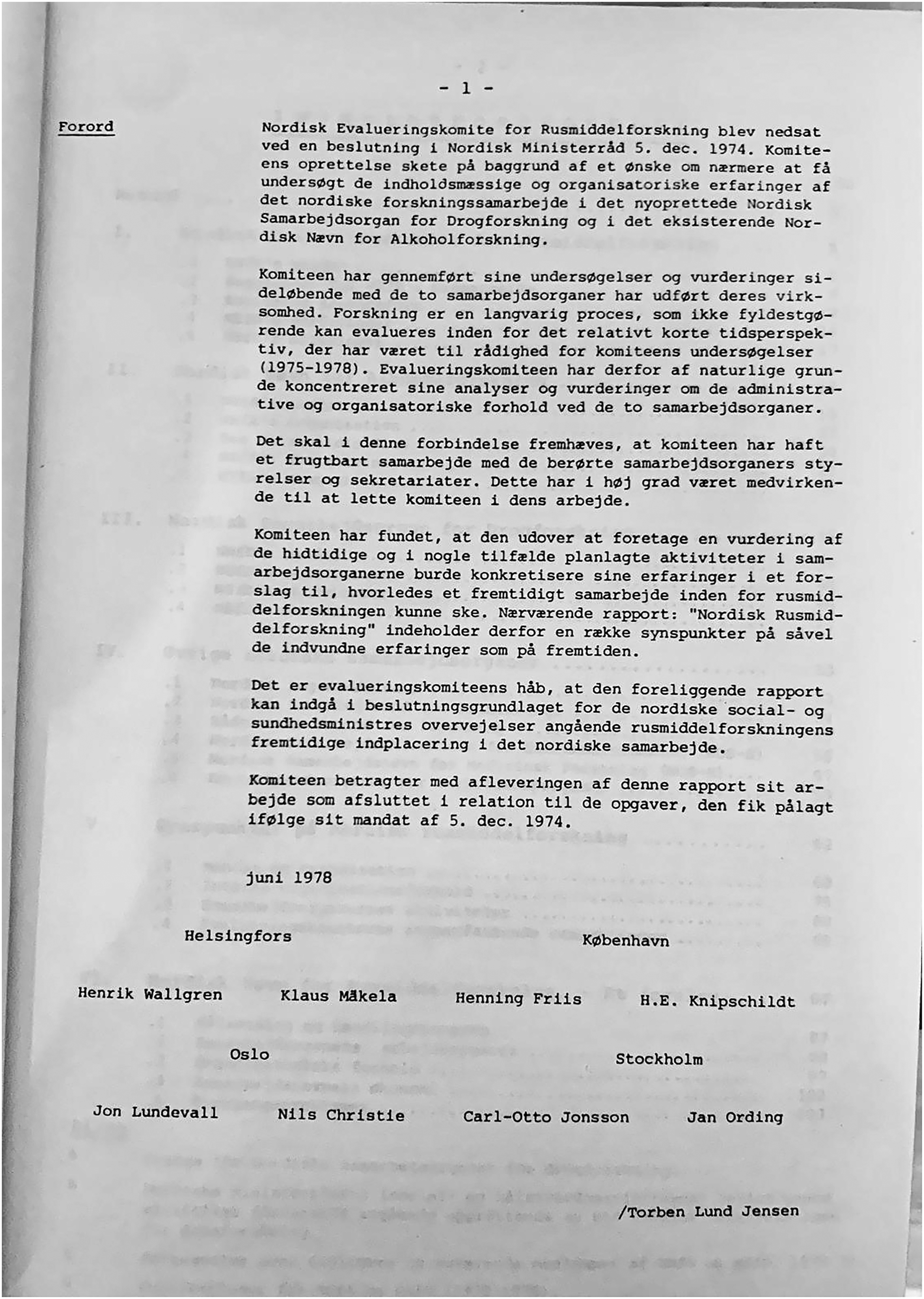
The foreword to the report ‘Nordic Drug Research’ (Wallgren et al., 1978).
In its report, the committee drafts a structured framework that would promote socially oriented research and systematic knowledge exchange among the Nordic countries; to coordinate research projects, share experiences, and address common challenges such as addiction, misuse, and effective intervention strategies (Wallgren et al., 1978).
The new council would consist of a board with representatives from each participating country, appointed for 4-year terms, and national contact persons to ensure smooth communication and coordination. Its responsibilities would include disseminating information, organizing conferences and workshops, initiating joint research projects, and providing practical support for applications and project planning. The plan also entailed research stipends to encourage mobility and collaboration among Nordic researchers and travel grants for short-term stays in other Nordic countries, aimed at fostering scientific exchange and supporting the early stages of project development before national funding was secured.
Financially, the proposal estimates an annual budget for the secretary of NAD of approximately 747,000 to 942,000 Norwegian kroner for the years 1979–1981, which should correspond to approximately NOK 4 M in today's values, equivalent to EUR 337,000. This budget was estimated to cover salaries, travel, office expenses, and project financing.
A Productive Secretariat
The council and secretariat of NAD was set up and the secretariat functioned in Helsinki, Finland until 2009 when the Nordic Welfare Centre (NVC) was founded and the office was merged into this organization. During the 30 years of its existence, NAD arranged hundreds of conferences, symposia, workshops, seminars and PhD research courses. It also published over 50 scientific books and was a co-publisher and financial supporter of this very journal, the Nordic Studies on Alcohol and Drugs, of which many of the projects that the council coordinated resulted in special issues. I served myself as a project coordinator at this productive secretariat between 2005 and 2011, and it is absolutely mind-blowing to think back on how much NAD produced, given the rather small annual budgets it had until the very end.
Today, the alcohol and drug research environments in the Nordic region have shrunk. In 2023, the Nordic Welfare Centre (NVC) quietly decided to discontinue the well-attended biannual Nordic Assembly for Alcohol and Drug Research (NADRA). Also, many other circumstances have changed. A researcher's work assignments looks very different today than even 10 or 20 years ago. There are expectations to produce massive amounts of work in short timeframes, combined with numerous administrative and teaching obligations. There might be much less room to meet, exchange ideas and coordinate joint initiatives. However, there are some small research comparisons that are still up and running: the Nordic ESPAD-group meets on a regular basis; the popular scientific platform PopNAD gathers the Nordic alcohol statistics. Also, the Nordic Gambling Research Network – Gambling in Context (GAMIC) seems to maintain its cooperation. Furthermore, this journal is still up and running.
A glimmer of hope appeared also at a conference organized by the Centre for Social Science Research on Alcohol and Drugs (SoRAD) at Stockholm University a couple of years ago (Lindeman, 2024). Nordic researchers seem still eager to meet and collaborate: we operate in close proximity to each other, and it does not require huge sums to travel for a day or two to another Nordic capital.
Bjon (2025) concludes her column by stating that Nordic cooperation needs more discomfort, not less: genuine pressure and unease can produce real results. Her line of reasoning is that, without some sense of urgency, the Nordic cooperation risks remaining well-meaning talk. Well, ironically enough, the good news is that there is no shortage of urgency when it comes to how the Nordics’ populations are developing regarding habits surrounding substance use, gambling, digital screens, mental health and the large number of related societal issues. Our welfare states have grown and each country is trying to solve the same puzzle of financing, orginizing and synchronizing welfare services.
Perhaps it is time to make a fresh plan for how we should cooperate in the future?
In This Issue
In our first issue of 2026, the Nordic substance use and policy research demonstrates its strength. Tsupari and Hupli (2026) have studied the justifications that Finnish psychedelic drug users employ and see that they frame their use in a way that is largely influenced by the new wave of psychedelic research, self-experienced benefits and ideals of individualism. Andersen (2026) looks for transactional logics in how Danish drug users see themselves in relation to the state's social investment in taking care of their problems through welfare service provision. Ramstedt et al. (2026) have inquired into how different circumstances shape the level of alcohol prevention carried out in Swedish municipalities. There study shows, for example, that left-wing governance, larger populations and younger demographics are consistently linked to higher alcohol prevention levels. A Botswanan study of how the alcohol industry attempted to affect the populations drinking habits and alcohol-related messages during the COVID-19 pandemic has been conducted by Sebeelo (2026). Volke and Nielsen (2026) studied what shapes professional judgement and decision-making in Danish outpatient alcohol counselling. The focus of the study by Berg et al. (2026) is the life course perspective on concurrent psychological distress, heavy episodic drinking and daily cigarette smoking from adolescence to midlife. The results underscore the need to account for the dynamic relationship between substance use and mental health over the life course, as well as the influence of early sociodemographic conditions on the development of these patterns.
