



Abstract
Background:
Rectal cancer treatment in Nordic countries has traditionally differed, especially regarding neoadjuvant treatment. The aim of this review is to give an overview of the current rectal cancer guidelines in the Nordics and compare these to international guidelines.
Methods:
Oncologists and colorectal surgeons from the Nordic countries (Denmark, Finland, Norway, and Sweden) and the Netherlands were invited to participate in this narrative review. Two consensus meetings were held to agree on the content. All authors provided recommendations from their national guidelines. In addition, recommendations from the European Society of Medical Oncology (ESMO) and from the US National Comprehensive Cancer Network (NCCN) guidelines were extracted.
Results:
Several differences between the included guidelines were identified. The radiological “sigmoid take-off” definition for the upper margin of the rectum has been adapted in Denmark and the Netherlands, whereas the other guidelines rely on distance from the anal verge on rigid sigmoidoscopy. Indications for direct surgery vary considerably, where the NCCN guidelines recommend more aggressive neoadjuvant treatment, primarily total neoadjuvant therapy (TNT), the Nordic and European guidelines open for direct surgery more often, and reserve especially TNT for high-risk cases. European countries more often recommend short-course radiotherapy, whereas NCCN maintains chemoradiotherapy as the mainstay. Whereas intentional and opportunistic organ preservation is an established part of the Dutch, NCCN, and ESMO guidelines, its use is mostly restricted to clinical trials in the Nordics. The Nordics and the Netherlands are restrictive in terms of adjuvant treatment, which is frequently recommended in ESMO and NCCN. Whereas neoadjuvant immunotherapy is recommended for mismatch repair-deficient/microsatellite instability-high (dMMR/MSI-H) rectal cancer in NCCN, this use is off-label in Europe and not routinely recommended.
Conclusion:
Although all guidelines rely on the same evidence, there are considerable differences, especially in the indications and type of oncologic treatment, both in the neoadjuvant and in the adjuvant setting.
Social media summary
How do Nordic rectal cancer guidelines compare internationally? We review Nordic recommendations alongside Dutch, ESMO, and NCCN, focusing on definitions, neoadjuvant choices, and organ preservation.
Introduction
Colorectal cancer is the third most frequent cancer in the Nordic countries, with rectal cancer accounting for about one third of the cases. Incidence rates have developed slightly differently, with a marked reduction in Denmark (Fig. 1) 1 . Rectal cancer treatment has evolved considerably through several decades from a purely surgical treatment to a multimodal approach. However, there are substantial differences in treatment traditions between the countries, especially considering oncological management.

Trends of colon and rectal cancer incidence in the Nordics derived from NORDCAN1.
When chemotherapy (ChT) and radiotherapy (RT) were introduced as (neo-)adjuvant treatment during the 1980s, the focus was primarily to reduce unacceptable local recurrence rates and secondarily to improve overall survival.2,3 Slightly later, total mesorectal excision (TME) was introduced, which also reduced local recurrence rates and probably improved survival. 4 It soon became clear that with TME, the main advantage of additional neoadjuvant RT or chemoradiotherapy (CRT) lay in a further reduction in local recurrence rates, whereas improvement in overall survival was limited. The TME trial confirmed that in patients operated with TME, neoadjuvant RT additionally reduced the risk of local recurrences by about half without significantly improving survival; a survival gain was only seen in stage III, where the absolute reduction in local recurrence rate was numerically the largest.5,6
Over the past 40 years, local recurrence rates have dropped from more than 30% to under 5%. Age-standardized relative survival has improved from below 40% to more than 70% in all Nordic countries, likely due to a combination of improvement in treatment, health care, and general health. Nevertheless, there have been considerable differences between the guidelines and practices in the Nordic countries, reflected, for example, in the use of RT/CRT7–11(Fig. 2A).9,10,12 –20 Likewise, the role of adjuvant ChT in rectal cancer is still controversial. 21 In several countries, adjuvant ChT has been assigned using the same indications as in colon cancer, whereas in others, including the Nordic countries and the Netherlands, oncologists have been more reluctant to use this.22–24

National trends in irradiation, survival, and local recurrence rates.
With improved survival, the quality of life (QoL) in cancer survivors has gained more importance in the treatment planning. Especially the combination of radiation and radical surgery is known to negatively affect QoL and bowel function of rectal cancer patients. Organ preservation either by local excision of early cancers 26 or by non-operative strategies in patients with clinical complete response (cCR) after neoadjuvant treatment 27 has, therefore, gained popularity. Several studies have investigated the safety of watch-and-wait (W&W) in patients with cCR and local excision followed by W&W in patients with near cCR after neoadjuvant treatment.28,29 The recent introduction of TNT initially had the goal to improve survival by decreasing the risk of distant metastasis in locally advanced stages. 30 TNT refers to the delivery of all planned oncological treatment components—both radiotherapy and multi-agent systemic ChT—before surgical resection. This approach primarily aims to eradicate subclinical distant metastases more efficiently than the conventionally used postoperative ChT. In addition, it intensifies the treatment of the primary tumor to potentially increase response rates. The observation that TNT leads to a higher rate of cCR has led to its use also in earlier stages with the primary goal to achieve cCR. 31 Currently, one must distinguish between intentional organ-preserving strategies, where the primary goal of the neoadjuvant treatment is to achieve cCR, and opportunistic organ-preserving strategies, where cCR is the result of the neoadjuvant treatment given for advanced tumors with the primary goal of downstaging and decreasing the risk of recurrence and metachronous metastatic disease.
The
Methods
This invited review article was initiated by the colorectal section editors in the Scandinavian Journal of Surgery. Experts from all Nordic countries were invited to participate in the review. On an initial consensus meeting in 2024, the group decided to include the national guidelines from the Netherlands as a European comparison outside the Nordics. The Netherlands was chosen due to its long-standing leadership in rectal cancer research. Furthermore, at the time of the initial meeting, the European Society of Medical Oncology (ESMO) guidelines had not yet been updated. The National Comprehensive Cancer Network (NCCN) guidelines 32 on rectal cancer from the United States were utilized as a comparison, and later also, the updated version of the ESMO guideline was also included. 33 The recommendations from all Nordic guidelines were extracted by representatives from each country, as all national guidelines are written in the native language. The main recommendations for neoadjuvant therapy or surgery alone were compiled, as were the recommendations for adjuvant treatment (Tables 1 to 3), before writing a summary of the findings. Each paragraph was drafted by one to four authors before it was reviewed and accepted by the whole group. The article is based on the latest version of the national guideline from each country.34–38
Definitions and recommendations for curative primary treatment (direct surgery, non-operative treatment, and neoadjuvant regimens).

Guideline publication year in brackets.
All TNM stages are given according to the eighth version of the UICC TNM classification.
TD = tumor deposits; EMVI = extramural venous invasion; LVI = lymphovascular invasion; LN = lymph node; LLN = lateral lymph node (lymph nodes outside the MRF); MRF = mesorectal fascia; CRM = circumferential resection margin; AV = anal verge; APR = abdominoperineal resection; PR = peritoneal reflection; MMR = mismatch repair; dMMR = deficient mismatch repair; pMMR = proficient mismatch repair; MDT = multidisciplinary team; RT = radiotherapy; CRT = long-course chemoradiotherapy (25 × 2 Gy + consolidation chemotherapy); SCRT = short-course radiotherapy (5 × 5 Gy); TNT = total neoadjuvant therapy; ChT = chemotherapy; cCR = clinical complete response; nCR = near complete response; UICC = Union for International Cancer Control; TNM = tumor–node–metastasis classification system.
Refers to the latest update of this chapter.
Measured with rigid proctoscope.
The 15 cm is the clinical definition. The radiological definition is the sigmoid take-off.
Low risk defined as absence of these high-risk features: LVI, high-grade adenocarcinoma, tumor budding, deep submucosal invasion (Haggit 4, Sm3, or >1000 µm), <1 mm margin.
Not recommended outside a trial in NL.
High-risk features = cT4, cN2, cMRF+, cEMVI+, cLLN+
Intentional = neoadjuvant treatment with the objective to achieve clinical complete response and organ preservation, although there is no other indication for neoadjuvant treatment; Opportunistic = organ preservation secondary to clinical complete response after neoadjuvant treatment given according to guidelines aiming to downstage the tumor.
after additional 4–8 weeks from SCRT and CRT or 6–10 weeks from CRT+ brachytherapy.
Also considered in frail patients with an indication for long-course treatment but not suitable for CRT or TNT.
Also preferred for T4 locally unresectable or medically inoperable.
When considering neoadjuvant ChT, the inclusion criteria of the PROSPECT study should be used. Watch and wait cannot be recommended in case of a cCR.
Re-evaluation every 2 to 3 months.
Possibility of several neoadjuvant TNT regimes within the same disease staging.
Surgical considerations in rectal cancer.
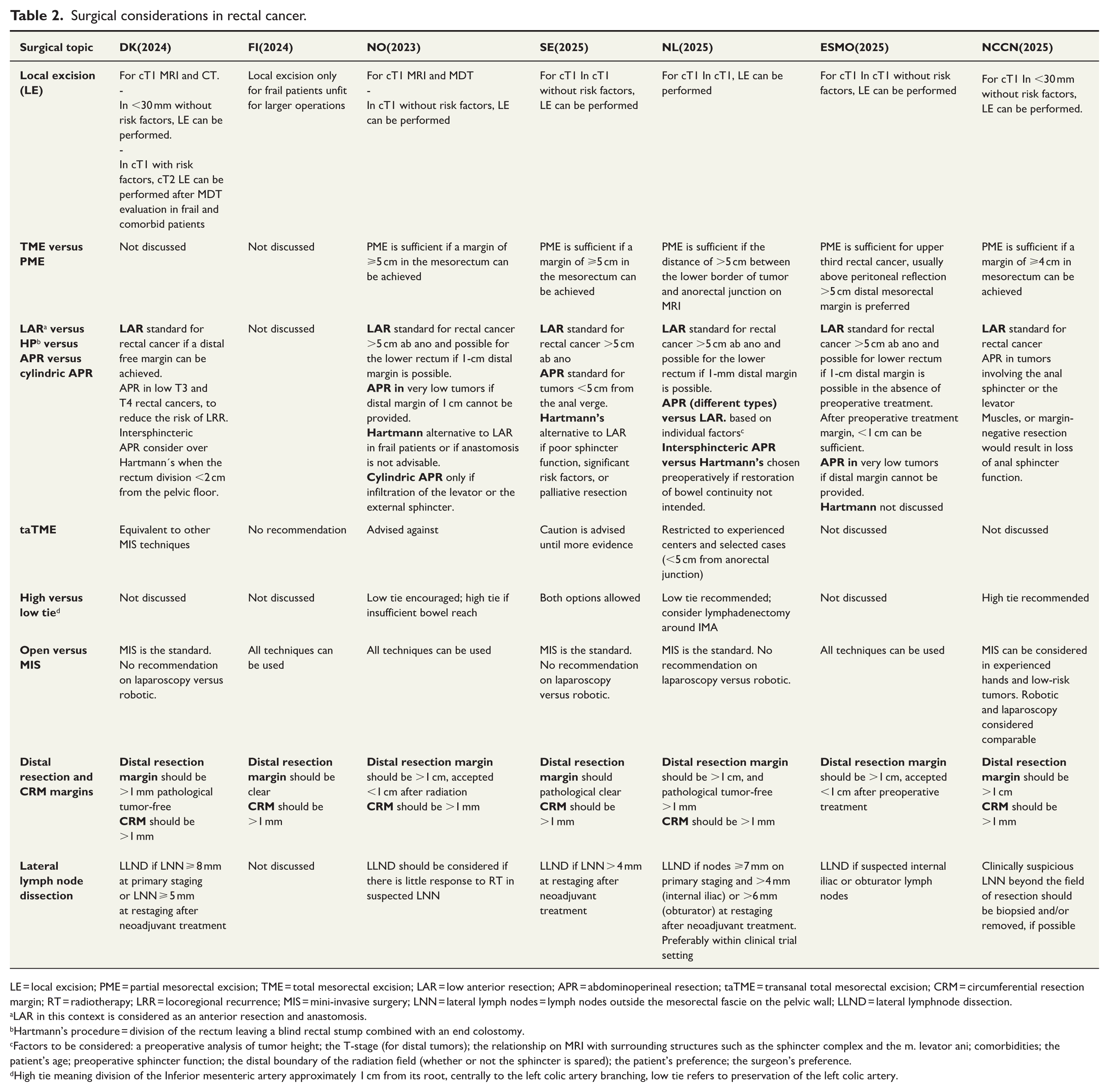
LE = local excision; PME = partial mesorectal excision; TME = total mesorectal excision; LAR = low anterior resection; APR = abdominoperineal resection; taTME = transanal total mesorectal excision; CRM = circumferential resection margin; RT = radiotherapy; LRR = locoregional recurrence; MIS = mini-invasive surgery; LNN = lateral lymph nodes = lymph nodes outside the mesorectal fascie on the pelvic wall; LLND = lateral lymphnode dissection.
LAR in this context is considered as an anterior resection and anastomosis.
Hartmann’s procedure = division of the rectum leaving a blind rectal stump combined with an end colostomy.
Factors to be considered: a preoperative analysis of tumor height; the T-stage (for distal tumors); the relationship on MRI with surrounding structures such as the sphincter complex and the m. levator ani; comorbidities; the patient’s age; preoperative sphincter function; the distal boundary of the radiation field (whether or not the sphincter is spared); the patient’s preference; the surgeon’s preference.
High tie meaning division of the Inferior mesenteric artery approximately 1 cm from its root, centrally to the left colic artery branching, low tie refers to preservation of the left colic artery.
Adjuvant treatment depending on previous neoadjuvant treatment, and pathological stage.
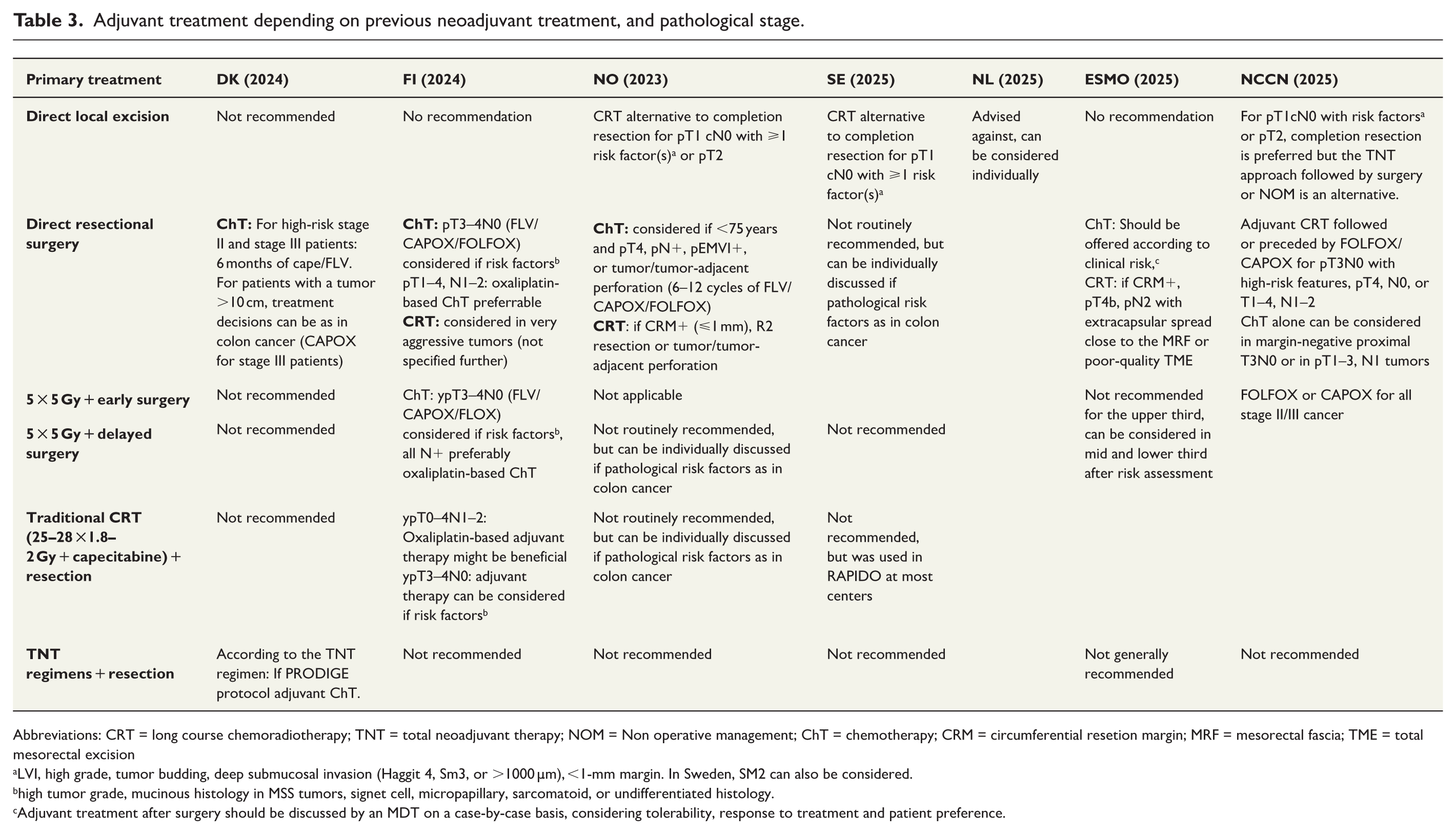
Abbreviations: CRT = long course chemoradiotherapy; TNT = total neoadjuvant therapy; NOM = Non operative management; ChT = chemotherapy; CRM = circumferential resetion margin; MRF = mesorectal fascia; TME = total mesorectal excision
LVI, high grade, tumor budding, deep submucosal invasion (Haggit 4, Sm3, or >1000 µm), <1-mm margin. In Sweden, SM2 can also be considered.
high tumor grade, mucinous histology in MSS tumors, signet cell, micropapillary, sarcomatoid, or undifferentiated histology.
Adjuvant treatment after surgery should be discussed by an MDT on a case-by-case basis, considering tolerability, response to treatment and patient preference.
Results
Definitions
When interpreting outcome data on rectal cancer treatment, it is essential to be aware that the definitions of the rectum differ in different countries and between trials. Most Nordic countries and NCCN still define the upper limit of the rectum as 15 cm (18 cm in Finland) from the anal verge measured by a rigid sigmoidoscope, whereas the Netherlands and Denmark have converted to use the radiologically identified “sigmoid take-off” as the upper limit of the rectum (Table 1). ESMO has no separate statement on the definition in the latest guideline. Although the newer definition using the “sigmoid take-off” accounts for individual differences in anatomy, one needs to be aware that until recently, most publications on the treatment of rectal cancer were based on the 15 cm definition. Regarding MRI definition of mesorectal fascia (MRF) involvement, it is noteworthy that the Norwegian guidelines consider ⩽2-mm distance of primary tumor or tumor deposits (TDs) from the MRF as MRF involvement, whereas all other guidelines consider ⩽1-mm distance as MRF involvement regardless of whether this is from the primary tumor, TDs, or lymph nodes.
Neoadjuvant treatment—indication
The recommendations for neoadjuvant oncological treatment vary across the Nordic countries, the Netherlands, the ESMO, and NCCN guidelines (Table 1). The ESMO guidelines reflect the differences between the European countries and clearly state that no single standard therapy can be recommended. Consequently, ESMO describes different equivalent options for different scenarios and stages, encouraging case-by-case multidisciplinary team discussions and shared decision-making. The ESMO recommendations for the mid and lower third of the rectum are even divided according to whether the intention is organ preservation or surgery.
All included guidelines recommend direct surgery as a possibility for low-risk tumors with no threatened margins (MRF-). However, many landmark studies on neoadjuvant treatment were conducted before modern MRI-staging, thus making it difficult to select high-risk groups. The Mercury trial and the OCUM study have later demonstrated that the absence of high-risk features on MRI may help identify patients in whom pretreatment can be safely omitted.33,39 However, countries still interpret this knowledge very differently. There are considerable differences in the risk assessment depending on cT and cN stages.
In Norway, the Netherlands, and the ESMO guidelines, cT1 to any cT3 or upper cT4a tumors without involvement of the peritoneal reflection are considered low risk in the absence of MRF+ (defined as ⩽2 mm in Norway and ⩽1 mm in other guidelines), extramural vascular invasion (EMVI+), TDs, cN2, or lateral lymph node metastasis. In the other Nordic countries, low risk is limited to cT1–cT3b or high cT1–4a, while only cT1–2 or upper cT3 tumors are considered low risk in the United States.
Likewise, the cN stage has a different impact on risk assessment. Whereas Denmark recommends direct surgery only depending on cT stage, regardless of cN stage, most countries recommend neoadjuvant treatment for cN2 and TDs (cN1c). NCCN recommends neoadjuvant treatment for all cN1 and 2. ESMO opens for direct surgery regardless of N stage in all parts of the rectum but recommends then adjuvant ChT for pN+. There have historically been marked differences in the proportion of irradiated patients between all Nordic countries, and compared with NL, with no apparent impact on survival or local recurrence rates (Fig. 2)9,10,12–20,25. A clear difference in radiotherapy use was associated with rates of local recurrence between Norway and Sweden in the nineties but without difference in survival. 40
Neoadjuvant treatment—choice of regimens
There are several key differences in the choice of neoadjuvant regimen between countries. Whereas short-course RT (scRT) has been preferred to long-course chemoradiotherapy (CRT, 25–28 × 1.8–2.0 gray (Gy)+ concomitant ChT) in Sweden, CRT is still the mainstay neoadjuvant therapy choice in the United States (Table 1). All other included countries presently use both scRT and CRT, while ESMO regards them as equally justified. The traditional approach with early surgery after scRT (within 1 week) is still the standard of care in Finland and optional in Sweden, but not in use in any other country.
Similarly, the recommendations for the use of the different TNT regimens differ between the Nordics, the Netherlands, and the United States. While TNT is the first choice for all patients with an indication for neoadjuvant treatment in the United States, most Nordic countries, the Dutch, and ESMO guidelines make use of TNT, dependent on additional radiologic risk factors such as EMVI+, TDs, cN2, or lateral lymph nodes, as defined in the RAPIDO protocol. 41 The advantages of giving RT preoperatively instead of after surgery have been demonstrated in several trials decades ago,42–44 with a higher risk of local recurrences and increased toxicity in the postoperative groups. Preoperative scRT with 25 Gy in five fractions with surgery the following week has been compared with CRT followed by surgery 6–8 weeks later in two trials,45,46 with no differences in outcome and toxicities. Adoption of the short-course treatment schedule, with delayed surgery 4–8 weeks later, was shown to be feasible in the Stockholm III trial. 47
Following the pivotal trials, several studies have tried to intensify the neoadjuvant treatment regimens with no or only little improvement in oncological outcome. However, this changed when the focus shifted to providing all oncological treatments before surgery, combining full dose combination ChT with either scRT or CRT—so-called TNT. Two of the largest trials are the RAPIDO trial, where scRT was followed by 4 months of CAPOX/FOLFOX, 48 and the PRODIGE-23 trial with six series of FOLFIRINOX followed by CRT. 49 Both trials demonstrated a reduction in distant metastases of one third and a doubling in pathological complete response (pCR) rates in the TNT arms. 49 In addition to these two trials, the STELLAR trial comparing scRT + 4 CAPOX with CRT alone and the Polish II trial comparing scRT + 3 FOLFOX also with CRT alone did not find the same reduction in distant metastasis after TNT.50,51 However, both PRODIGE-23 and STELLAR reported an improvement in overall survival (OS). Furthermore, two other trials (OPRA and CAO/ARO/AIO-12) have tested the sequence of the different TNT elements, with CRT and CAPOX/FOLFOX, and found that in terms of disease-free survival (DFS) and OS, the sequences were similar. However, if organ preservation is a priority, TNT should commence with CRT followed by ChT. 52 The optimal TNT schedule is still undetermined, and whether to use short- or long-course radiotherapy, or to use double- or triplet ChT, is still under investigation.
In Sweden, after closure of patient inclusion in RAPIDO in June 2016, centers in 5/6 health care regions continued to treat patients with locally advanced rectal cancer with an abbreviated RAPIDO schedule, LARCT-US, consisting of scRT followed by 4 CAPOX or 6 FOLFOX instead of 6 and 9, respectively. Despite inclusion of more advanced tumors, reflecting routine care, the results of the TNT arm in RAPIDO could be replicated with the LARCT-US regimen after comparable follow-up. 53 Furthermore, after a median 6-year follow-up, unlike the RAPIDO trial, no increased risk of locoregional recurrences after LARCT-US could be detected. 54 The TNT schedule in LARCT-US is similar to the experimental arm in STELLAR, which showed statistically significant improvement in OS compared with CRT followed by adjuvant ChT. The use of external beam RT boost (9 Gy in five fractions) or an endorectal boost using contact X-ray brachytherapy (3 × 30 Gy to tumor surface in three fractions) to increase the probability of organ preservation is currently only recommended as an option by ESMO.
Recently, a trial has also investigated the omission of radiotherapy and giving preoperative ChT alone. This has been investigated in low- to intermediate-risk rectal cancers, 55 demonstrating that it is feasible to avoid radiotherapy in these patient groups. However, most patients included in those trials, even if designated “locally advanced” were patients that would be eligible for surgery with no neoadjuvant treatment in the Nordic countries.
Neoadjuvant treatment—restaging
Restaging after neoadjuvant treatment is advised to confirm tumor downgrading and to ensure the possibility of achieving an R0 resection, as well as to exclude the occurrence of metastases during the neoadjuvant treatment period. In addition, the growing interest in non-operative management after cCR has highlighted the need for restaging before planned surgery. All guidelines recommend chest computed tomography (CT), abdominal CT and/or MRI, and pelvic MRI as imaging modalities for restaging. Additional digital rectal examination and endoscopic evaluation are recommended in some guidelines before surgery, while both are mandatory before considering non-operative management where this is recommended. Positron emission tomography–CT is not considered for restaging in any of the guidelines. 56
The optimal timing of both restaging and time to surgery after neoadjuvant scRT and for surgery after CRT is not known. The aim of extending the interval is to provide sufficient time for tumor downstaging but without compromising surgical outcomes in non-responders. The implementation of W&W strategies in recent years complicates recommending only one optimal timing for restaging. The Nordic guidelines propose restaging at 4–8 weeks from the last radiotherapy fraction, both after scRT and CRT (Table 4). The Finnish guidelines do not include a specific statement for the timing of restaging. Detailed description across countries and guidelines is given in Table 4.
Response evaluation, timing of evaluation, and surgery are measured from the last radiation fraction or chemotherapy cycle.

ChT = chemotherapy; SC RT = short-course radiotherapy; LC CRT = long-course chemoradiotherapy; TNT = total neoadjuvant therapy; cCR = complete clinical response; W&W = watch-and-wait strategy.
In case of near complete response, additional 8 weeks of observation can be considered.
The timing of restaging has many aspects. While delayed evaluation increases the chance of cCR in good responders, it may impair prognosis in poor and non-responders. Furthermore, if adjuvant ChT is part of the routine treatment, delayed surgery after scRT or CRT may reduce the systemic effect of the adjuvant treatment. The interval from neoadjuvant treatment to response evaluation has been subject to very few randomized trials, where none have shown any favorable effects from a longer interval. Many retrospective studies have been performed, frequently claiming that an interval of 8 to 12 weeks to surgery after the last radiation fraction, usually preceded by restaging 1 to 2 weeks earlier is to be recommended.57,58 While delaying the response evaluation over 6 weeks harbors the risk of impaired prognosis for non-responders, an evaluation of potential complete response can frequently not be made before 12 weeks. 59 scRT was traditionally even followed by surgery the following week without restaging, as still performed in Finland. However, also after scRT a delay of over 4 weeks before surgery increases the chance of cCR and pCR without hampering long-term outcomes.60–63
Restaging after TNT regimens (RT followed by ChT) is recommended 1–2 weeks after completion of the last cycle of ChT in the Norwegian and Swedish guidelines. Finland has only a recommendation for the timing of surgery, and Denmark has no recommendation. In the RAPIDO trial, short-course radiotherapy was followed by six cycles of CAPOX or nine cycles of FOLFOX4, with restaging performed 1–2 weeks after the last cycle using MRI and CT, with surgery conducted 1–3 weeks later. 48 However, the timing of restaging varies across neoadjuvant treatment studies. 64 There are, however, indications that a first restaging, regardless of the number of planned cycles, should be obtained after three to four cycles to detect non-responding tumors and provide surgery at an earlier time in these cases. 65
Non-operative management (organ preservation)
Intentional organ preservation
The Dutch, ESMO, and NCCN guidelines recommend intentional non-operative treatment as an option in selected patients. Denmark also recommends this approach as an option but recommends inclusion in a clinical trial. In Sweden and Norway, intentional organ preservation is only recommended in a clinical trial setting, whereas Finland is planning to initiate an intentional organ preservation study (Table 1).
Opportunistic organ preservation
NCCN, the Dutch, the Danish, and the Swedish guidelines mention opportunistic non-operative approach as an option in patients with cCR at restaging after any neoadjuvant therapy. In Sweden, registration in a prospective registry is recommended. An opportunistic non-operative approach is not recommended in Norway, while Finland offers this presently in a prospective trial without any mentioning in the guidelines. The ESMO guidelines recommends that the intention of treatment (organ preservation or surgery) should be clarified before the start of the neoadjuvant treatment. It does not discuss the possibility of cCR in patients with intended surgery.
Local excision (LE) of tumors with near CR (nCR) to neoadjuvant treatment is recommended in the ESMO guidelines if organ preservation is intended and has been mentioned as an option in the NCCN guidelines as well. None of the Nordic guidelines mentioned this option and LE after nCR is only offered in ongoing trials in the Nordics. 28
Surgical management
LE of low-risk T1 tumors
Due to ongoing screening projects, tumors are more frequently detected at an early stage.66,67 Transanal endoscopic or LE both offer a possibility for organ preservation. All guidelines recommend no additional treatment after endoluminal removal of low-risk pT1 tumors (Table 1 and 2), defined as absence of any of the following high-risk features: lymphovascular invasion, high-grade adenocarcinoma, tumor budding, deep submucosal invasion (Haggit 4, Sm3, or >1000 µm), or <1 mm margin. However, preoperative staging challenges persist. High-risk T1 tumors or T2 tumors after LE are recommended further treatment with formal resection (alternative to this, CRT can be used in Norway and Sweden).68 –70
Resection techniques to ensure adequate margins
To ensure adequate margins in larger tumors, all guidelines recommend TME surgery as standard of care. This should be extended with en bloc resection of affected neighboring structures or organs in patients with locally advanced cT4b tumors when necessary (Table 2). TME was globally established as the standard principle in rectal cancer surgery since Mr Bill Heald’s description in 1982. 71 TME entails en bloc tumor removal along the MRF, while preserving pelvic autonomic nerves. Tumors involving the MRF or adjacent structures require extended resections, beyond TME, to achieve an R0 resection with clear margins.
Partial mesorectal excision (PME) is an option in high rectal cancers. To ensure an adequate distal resection margin in the mesorectum, the Norwegian, Swedish, Dutch, and ESMO guidelines recommend that PME should only be performed if a 5-cm margin in the mesorectum is achievable. NCCN recommends a 4-cm margin in the mesorectum with PME, whereas the remaining guidelines do not explicitly mention PME. If a minimum distal resection margin of more than 1 cm cannot be achieved by low anterior resection, abdominoperineal resection (APR) is recommended.36,72 The actual wording in the guidelines differs across the Nordics, the Netherlands, and the United States (Table 2). APR is also indicated for tumors invading the levator ani or external sphincter. Based on the findings of only one study, some guidelines state that <1-cm distal margin can be accepted in irradiated patients, while non-irradiated patients with <1 cm margin should be monitored more frequently than standard follow-up (Table 2).73,74 However, the RAPIDO trial reported increased locoregional recurrence rates after TNT (12% versus 6% after CRT) with follow-up data showing that a distal resection margin of less than 10 mm, as used mainly at a few Dutch centers, was a major risk factor for local recurrence in the TNT group but not in the CRT group. 75 This may suggest a distal margin of <10 mm is only safe in patients after CRT. Long-term follow-up of the Swedish LARCT-US, where narrow margins are seldom used, shows a much lower locoregional recurrence risk (6%) despite more advanced tumors requiring more extensive surgery. 76 A 10-cm oral bowel resection margin is considered sufficient. 74
Lymphadenectomy and level of vessel ligation
To ensure an adequate lymphadenectomy, several authors have recommended the division of the inferior mesenteric artery at its root centrally to the left colic artery (“high tie”). However, due to the close relation to the autonomic nerve plexus, this increases the risk of nerve damage. Furthermore, there is no evidence that shows improved survival with high tie.77,78 Whereas a high tie may facilitate left colon mobilization for anastomosis, preservation of the left colic artery may improve bowel circulation. Currently, only the NCCN and Dutch guidelines have a strong recommendation on the level of vessel ligation, where the NCCN recommends high tie while the Dutch guidelines recommend low tie (Table 2).
Surgical approach
All included guidelines agree that surgical approaches—whether open, laparoscopic, or robotic—should adhere to the same oncologic principles. Although a clear recommendation of minimally invasive surgery (MIS) exists only in the Netherlands, Denmark, and Sweden (Table 2), it has gained popularity due to its advantages over open surgery, including reduced blood loss, less postoperative pain, fewer surgical site infections, shorter hospital stays, and lower hernia risk, while providing comparable oncological outcomes.79,80 Consequently, the adoption of MIS, particularly robotic surgery, has increased significantly over the past decade.81–83 More than 80% of all rectal cancer patients are operated on MIS in all Nordic countries, except Finland (Sweden: 85%; Norway: 91%; Denmark: 95%; and d Finland: 60%). The choice of MIS approach varies across the Nordics, influenced by institutional resources and surgeon preferences. While robotic surgery has longer operative times compared with laparoscopy, recent studies claim that benefits such as lower conversion rates, fewer complications, and shorter hospital stays can be achieved in high-volume centers.84,85
Transanal TME (taTME) was introduced in 2010 to facilitate distal rectal dissection/transection and sphincter preservation. 86 However, currently taTME is not part of standard practice in the Nordics (Table 2), mainly as a result of an implementation study in Norway that showed an unexpected high incidence of multifocal local recurrences and a higher anastomotic leak rate.36,87 The Dutch guideline restricts the use of taTME to very few experienced centers, whereas taTME is not discussed in the ESMO or NCCN guidelines.
Stoma creation
In the Nordics, defunctioning stomas are traditionally created in patients who have received preoperative radiotherapy and/or undergo TME, reducing symptomatic anastomotic leakages (AL) and reoperations but not overall AL incidence.36,88,89 However, institutional variation exists across the Nordics in the use of defunctioning stomas. Several Scandinavian multicenter trials are currently evaluating the impact of defunctioning or permanent stomas on complications, QoL, and hospital stay, including the SELSA trial and NoStoma trial.90,91
The decision to create a permanent stoma in cases where an anastomosis is technically feasible depends ideally on shared decision-making between the surgeon and the patient. Current guidelines do not provide specific recommendations on when to opt for an anastomosis versus performing a Hartmann’s procedure or an intersphincteric APR. In the Nordic countries, permanent stomas appear to be more widely accepted compared with other regions. 92 In 2023, the proportion of patients receiving permanent stomas varied considerably between the Nordic countries (31% in Finland, 39% in Denmark, 42% in Norway, and 53% in Sweden).81–83,93
Lateral lymph nodes
Extramesorectal lateral lymph node metastasis (LLNM) in lymph nodes along the pelvic wall is well-documented, particularly in mid and low T3-T4 rectal tumors, with an incidence of 15%–20%. 94 Suspected LLNM along the internal iliac are classified as N+, while metastases in the obturator or external iliac regions are categorized as M1; both are associated with reduced cancer-specific survival, comparable to N2a–b. 95 Especially LLNM in the internal iliac region is considered a key driver of lateral locoregional recurrence in rectal cancer. 96
Historically, treatment paradigms for suspected LLNM have differed between the East and the West, including the Nordics, with the East advocating surgical removal and the West favoring CRT. 97 For T3–T4 tumors in the mid and lower rectum, internal iliac lymph nodes larger than 7 mm before neoadjuvant treatment and greater than 4 mm afterward carry a high risk of lateral recurrence if lateral lymph node dissection (LLND) is not performed.98,99 Studies suggest that one-third to two-thirds of suspected LLNM persist after neoadjuvant therapy, which may necessitate LLND in addition to TME, particularly if restaging imaging after neoadjuvant treatment demonstrates an insufficient response. Conversely, when initially suspicious lymph nodes shrink to less than 4 mm post-treatment, the risk of lateral local recurrence is significantly reduced, and LLND may not be necessary. 99 If LLNM is suspected on staging MRI, an indication for either TNT or CRT is present.100,53 All studied guidelines recommend neoadjuvant therapy if there is suspicion of LLND; however, the recommended regimen differs across countries (Table 1). While the decision on regimen follows other risk factors in Denmark, where scRT can be considered, the Norwegian, Finnish, and Dutch guidelines recommend either CRT or TNT. The Swedish and US guidelines recommend TNT. To illustrate the difficulty in diagnosing LLND during preoperative staging, only approximately one-third of lymph nodes are indeed metastatic in patients proceeding to LLND. 101 Hence, the recommendation on when to perform surgery given in Table 2 is based upon weak and rather vague evidence.
LLND should employ meticulous nerve-sparing techniques, concentrating on the obturator and internal iliac regions. 97 The procedure can be performed via open or MIS techniques. LATITUDE, a Nordic prospective observational study, will include locally advanced rectal cancers with or without LLND, focusing on 3-year cancer recurrence as the primary endpoint. 102
Adjuvant treatment
Compared with other guidelines such as those of NCCN and ESMO, the Nordic countries have always been and still are much more restrictive in recommending adjuvant ChT for rectal cancer, albeit not as firm as in the current Dutch guidelines, which argue completely against its use (Table 3). Postoperative ChT after rectal cancer surgery has, similar to that in colon cancer, been the topic of several studies, but the results have been unclear. This may be due to the more frequent use of preoperative treatment for rectal cancer, more symptomatic locoregional recurrences in the past when these trials were performed, and slightly fewer included patients. It is beyond the scope of this review to make another literature review; however, an old Cochrane analysis revealed a survival gain, 103 while two meta-analyses using more relevant studies did not show this.104,105 Several retrospective studies, also of randomized trials, have indicated a survival gain, 106 and this has meant that many guidelines recommend treatment as in colon cancer even if the evidence is not there. 107 Many rectal cancer patients carry a high risk of systemic recurrence, suggesting that there is a need for additional treatment;108,109 however, the evidence on its efficacy is lacking or at best limited, reflecting the discrepancies.
Precision medicine and Immunotherapy
None of the Nordic guidelines currently recommends routine use of any precision medicine in localized rectal cancer, although several guidelines, including Swedish, Danish, and the Norwegian guidelines, are currently rewritten to include postoperative low-dose aspirin for the treatment of localized PI3K-altered tumors as a result of the ALASCCA trial (Adjuvant Low-Dose Aspirin in Colorectal Cancer), which is already endorsed by NCCN. 110
In all Nordic countries, primary rectal cancers are tested for mismatch repair (MMR) function by immunohistochemical staining of MLH1, MSH2, MSH6, and PMS2 or microsatellite instability testing as per international guidelines. Previously, the purpose of MMR/MSI universal tumor screening was intended for screening Lynch syndrome, which has been shown to be cost-effective. 111 Due to the rapid advancement of immune checkpoint inhibition (ICI) therapy, information on MMR/MSI status now has a major therapeutic consequence already from the beginning of the treatment path, especially in stage IV setting. MMR/MSI testing is preferably performed on pre-therapy tumor biopsies, which yield better or as good results as analyzing the surgical specimen. 112 Especially in rectal cancer, in which surgical specimens may have undergone radiotherapy and major tumor regression, the initial biopsies are the best source of tissue for MMR/MSI testing. However, as opposed to right-sided colon cancer, dMMR in rectal cancer is a rare event of about 2%. 113
Neoadjuvant immunotherapy is not routinely recommended for localized mismatch repair-deficient (dMMR) rectal cancer in any current European guidelines, as the European Medicines Agency (EMA) has not approved ICI for this specific indication. Inspired by the high efficacy of immunotherapy in dMMR metastatic colorectal cancer and by impressive clinical and pathological CR rates observed in recent phase II trials of neoadjuvant PD-1 blockade (e.g. dostarlimab and sintilimab) in localized stage II/III dMMR/MSI-H rectal cancer, multiple clinical studies are ongoing to further evaluate this approach.114–116 Organ preservation and avoidance of CRT or surgery have been achieved in selected patients, 117 but longer-term oncologic outcomes and guideline endorsement await further data and regulatory approval in Europe. NCCN recommends that the preferred initial treatment for T3–4N any, T1–2N1–2 dMMR rectal cancer is immunotherapy (either dostralimab, nivolumab, or pembrolizumab can be used) and W&W in case of cCR. In Europe, the ESMO guideline is the only one that clearly endorses the use of dostarlimab in locally advanced disease, but states that this use is off-label. Currently, none of the other included guidelines clearly recommend the use of immunotherapy; however, it is often used off-label in conversion situations (Table 1).
Neoadjuvant or adjuvant ChT for localized rectal cancer, like colon cancer, is usually not combined with monoclonal antibodies or other targeted therapies that could be informed by next-generation tumor sequencing (NGS). NGS panels are usually reserved for metastatic colorectal cancers that are usually performed on biopsies from either the primary tumor or any metastases to inform on KRAS/NRAS and BRAF mutation status.
Discussion
This comprehensive review of Nordic rectal cancer guidelines shows that there are substantial differences in the management of rectal cancer, both within the Nordic countries and compared with other European countries and the United States. The use of ChT other than concomitant in CRT has long been limited in the Nordics compared with other countries, both in the neoadjuvant and in adjuvant settings. Regarding RT, the proportion of irradiated rectal cancer patients has over a long period of time been much higher in Sweden and Finland compared with Denmark and Norway (Fig. 2A). Noteworthy, this heterogeneity in therapeutic approach has not led to apparent differences in survival, or locoregional recurrence rates, which have improved constantly over time in all countries to presently being at the same low level (Fig. 2B).13–19,25 Consequently, the differences in RT rates have been reduced considerably with the most recent guidelines.
Neoadjuvant strategies for rectal cancer have evolved markedly in recent decades, particularly in the Nordic countries and the Netherlands, where clinical trials and registries have helped shape modern practice. TNT and, even more recently, immune checkpoint inhibitors in dMMR tumors have introduced promising options beyond traditional CRT. However, several challenges remain in implementation, interpretation, and generalization. Differences in national treatment recommendations for rectal cancer are often influenced by the country of origin of key clinical trials, especially randomized trials. This is particularly evident for rectal cancer, where the scRT schedule, apart from limited use in Moscow in the 1970s, was first explored in Sweden, and later extensively studied in Sweden and the Netherlands.2,6,47,118,48 While results were favorable, early implementation using outdated radiation techniques led to increased postoperative mortality, 119 temporarily limiting its uptake in other countries.
This variation contributed to differing approaches to (chemo)radiotherapy which has been most apparent between Sweden and Norway, where Norway’s initial preference for postoperative CRT was associated with higher local recurrence rates, although OS was unaffected. 11 Reluctance toward preoperative RT in Norway also stemmed from a desire to assess the impact of TME surgery alone on local recurrence, whereas in Sweden, there seemed to be a hesitation as to whether surgery alone could achieve acceptably low locoregional recurrence rates. The skepticism toward adjuvant ChT is reflected in a joint Dutch-Swedish randomized trial, which found no survival benefit. 120 This cautious stance persisted in the design of the RAPIDO trial, where adjuvant ChT was administered in Spain, the United States, and in all but one Swedish hospital, but not in the Netherlands.48,121
Shared decision-making is increasingly essential in several aspects of rectal cancer treatment, especially given the current lack of robust predictive models for treatment response. 122 While radiological and molecular markers are under investigation, clinicians and patients often must weigh the risks and benefits of neoadjuvant treatment or organ preservation without clear individual-level prediction tools. This uncertainty necessitates transparent communication, particularly when considering organ-preserving strategies. Interestingly, patient preference and shared decision-making are hardly mentioned in any of the Nordic guidelines. The ESMO guidelines mention shared decision-making once, whereas it is commonly mentioned for several aspects in the Dutch guidelines. Further formalization and evidence-based guidance are needed to support a true shared decision-making process.
From a surgical perspective, the shift toward intensified neoadjuvant strategies, particularly TNT, significantly impacts the timing of surgery especially in non-responders 59 but also in good responders where it even challenges the necessity of surgery. 123 This shift introduces a considerable risk of both overtreatment and undertreatment.124,125 Clinically, there is a widespread perception that neoadjuvant therapy increases surgical complexity, especially when surgery is delayed or performed outside standard time intervals, although this remains to be established. It is anyhow considered challenging to study systematically. 126
Designing treatment studies in rectal cancer is getting ever more complex due to many factors, including the increasing number of treatment modalities, the heterogeneous tumor biology with many subgroups, evolving definitions (e.g. for complete response), and variation in national protocols (e.g. in the use of scRT, CRT, or TNT and adjuvant ChT), which make comparisons difficult. While Nordic countries benefit from robust cancer registries, implementing trial outcomes and aligning them to real-world data is challenging. A major challenge lies in the choice of endpoints, as many studies prioritize short-term surrogates such as pCR, R0 resection rates, or MRI-defined tumor regression, which may not reflect long-term outcomes. On the contrary, OS may not always be the best tumor outcome in a population with a median age at diagnosis of about 70 years. QoL has long been neglected in clinical trials. However, with the continuing improvement in survival rates, QoL in cancer survivors and health economic aspects play a much more important role. Increasingly, Dutch and Nordic research emphasizes the inclusion of patient-reported outcomes, functional recovery, and recurrence-free survival, whether locoregional or systemic, aligning trial design more closely with what truly matters to patients.
Footnotes
Acknowledgements
None.
Author contributions
The study idea was conceived by J.K.S., P.B., and T.S. U.S. and J.K.S. coordinated the work. E.V.W. obtained the NCCN guidelines, while U.S. and J.K.S. obtained the ESMO guidelines. All authors contributed to the conception and design of the article. All authors drafted the article and/or revised it critically for important intellectual content, and all authors approved the final version for submission/publication.
Clinical trial registration
Not applicable.
Data availability
No new data were generated or analyzed in this study. All materials used consist of publicly available clinical guidelines (Nordic national guidelines, Dutch guidelines, ESMO and NCCN), accessible online via the respective organizations’ websites.
Declaration of conflicting interests
The authors declared no potential conflicts of interest with respect to the research, authorship, and/or publication of this article.
Funding
The authors received no financial support for the research, authorship, and/or publication of this article.
Ethical statement
Ethical approval was not required for this study because it is a narrative review of publicly available, published clinical guidelines and did not involve human participants, patient data, or identifiable personal information.
ORCID iDs

Reporting guidelines
Not applicable.