



Abstract
Background:
The global prevalence of obesity is rising and has been linked to increased perioperative risks in esophageal cancer surgery, while its impact on long-term survival remains uncertain. This study aims to examine the association between body mass index (BMI, kg/m2) and perioperative complications and long-term survival.
Methods:
This nationwide, population-based cohort study included all patients undergoing esophageal cancer resection in Sweden between 2006 and 2018. Data were obtained from the National Register for Esophageal and Gastric Cancer. Patients were categorized by BMI as underweight (<20), normal (20–24.9), overweight (25–30), or obese (>30). Logistic regression and Cox regression were used for adjusted analyses, reporting odds ratios (ORs) and hazard ratios (HRs) with 95% confidence intervals (CIs).
Results:
A total of 1494 patients (81.6% male) were included, and out of these, there were 227 (15.2%) patients with obesity. Patients with obesity had more comorbidities, more often adenocarcinoma, and underwent surgery more frequently during the later time period of the study. Compared with patients with normal weight, obesity was not associated with increased risk of surgical complications (OR = 0.92, 95% CI: 0.62–1.39), but obesity was linked to higher risk of non-surgical complications, including pulmonary embolism (OR = 1.64, 95% CI: 1.10–2.45). Obesity was associated with reduced all-cause mortality (HR = 0.75, 95% CI: 0.57–0.98).
Conclusion:
Patients with obesity undergoing esophagectomy did not have higher rates of surgical complications but faced an elevated risk of non-surgical complications. Obesity appeared linked to better long-term survival. However, residual confounding, including potential reverse causation from pre-diagnosis weight loss, cannot be excluded.
Keywords
Context and relevance
Obesity is common among patients undergoing esophageal cancer surgery, yet the impact of obesity on perioperative risk and long-term survival remains unclear. Understanding how body mass index influences outcomes is clinically important, as both obesity and cancer-related weight loss may affect surgical decision-making, complication risk, and prognosis. This study aims to assess these associations at a population level using a nationwide registry data.
Introduction
Obesity is a global epidemic with rising prevalence worldwide. 1 It contributes to increased morbidity and mortality from chronic diseases, including esophageal adenocarcinoma (EAC)2 –4 with a markedly increased incidence in high-income countries, in parallel with the obesity epidemic. 5 Visceral obesity promotes EAC through gastroesophageal reflux disease (GERD), 6 systemic inflammation, metabolic dysregulation, and dietary habits.7,8
Esophageal cancer remains an aggressive disease with historically poor outcomes. However, advancements in treatment, including multimodal approaches such as neoadjuvant chemoradiotherapy (nCRT) plus surgery and perioperative chemotherapy plus surgery, have improved survival rates and become standard of care.9,10 However, esophageal resection is highly complex and carries significant risks, including anastomotic leaks, respiratory complications, and cardiovascular events. 11
Several factors influence surgical outcomes in esophageal cancer in addition to the surgical technique used, including patient-related variables such as age, nutritional status, comorbidities (particularly cardiovascular and pulmonary diseases), and performance status. 12 Among these, obesity stands out as a modifiable risk factor that may exacerbate postoperative complications and adversely affect long-term survival. Increased abdominal and thoracic fat in patients with obesity can complicate surgical access, 13 and obesity has been linked to a higher risk of respiratory complications and anastomotic leaks.14,15 In addition, obesity is recognized as a major risk factor for poorer outcomes in various surgical procedures.16 –19 Furthermore, obesity has been associated with impaired immune function, delayed wound healing, and an increased risk of postoperative infections. 20 At the other end of the BMI spectrum, malnutrition is also a modifiable risk factor associated with more surgical complications, prolonged in-hospital stay, and postoperative mortality. 21
Despite the challenges obesity presents in surgery, evidence regarding its influence on survival and oncologic outcomes after esophageal resection remains inconsistent. Some studies report improved survival,22,23 while others indicate unchanged 14 or worsened survival. 24 Greater clarity is needed to inform clinical decision-making and optimize patient care. Given the growing prevalence of obesity and its potential impact on surgical outcomes, it is crucial to better understand how preoperative obesity affects the outcomes and prognosis of patients undergoing esophageal resection.
This study aims to investigate the relationship between preoperative obesity and surgical outcomes following esophageal resection for cancer. Specifically, it assesses postoperative complications, short-term mortality, and long-term survival in a national cohort of patients with esophageal cancer.
Methods
Design
This retrospective, population-based register study included all individuals who underwent esophageal cancer resection in Sweden between 2006 and 2018. During the study period, esophageal cancer surgery in Sweden underwent progressive centralization, with procedures increasingly concentrated to high-volume centers. Data were extracted from the Swedish National Register for Esophageal and Gastric Cancer (NREV). Established in 2006, NREV includes data recorded at diagnosis, during surgery, and at the first outpatient follow-up. A validation study has confirmed its high completeness, accuracy, and concordance. 25 Additional data from the Swedish Prescribed Drug Register, 26 Cause-Of-Death Register, 27 Cancer Register, 28 National Patient Register, 29 and the Longitudinal Integrated Database for Health Insurance and Labor Market Studies 30 were utilized to create a study-specific database for analysis. The cross-linking of registries was made possible through the unique 10-digit personal identification number given to all Swedish residents.
Population
Patients were identified from the registry using International Classification of Diseases, 10th Revision (ICD-10) codes for esophageal (C15) and cardia cancer (Siewert types I, II, and unspecified; C16.0A/B/X). The study included all patients who had undergone surgical resection for adenocarcinoma or squamous cell carcinoma, while other histological tumor types were excluded. Patients who had undergone endoscopic procedures or had missing data on preoperative weight and/or height were also excluded.
Exposure
The body mass index (BMI, [weight (kg)/height (cm) 2 ]) at the time of surgery was used as the primary independent variable. The cohort was further grouped according to BMI definition of underweight (BMI < 20 kg/m2), normal (BMI 20–24.9 kg/m2), overweight (BMI 25–30 kg/m2), and obesity (BMI > 30 kg/m2).
Outcome
The outcomes included postoperative complications, short-term mortality, and 5-year overall survival. Postoperative complications were defined as occurring within 30 days after the esophageal cancer resection and further divided into surgical (anastomotic leak/conduit necrosis, postoperative bleeding, thoracic duct injury, postoperative abscess, laryngeal nerve palsy, and other less frequently occurring surgical complications) and non-surgical complications (cardiovascular complications, pulmonary embolism, pneumonia, septicemia, and other less frequently occurring non-surgical complications).
Covariates
Sex, age group (<50, 50–59, 60–69, 70–79 and ⩾80 years), extent of lymphadenectomy (suboptimal (less than standard), standard (abdominal, paraesophageal, subcarinal, and right mainstem bronchus lymphnodes), and extended (standard plus additional lymph node stations; left main stem bronchus, paratracheal, and further nodes)), Charlson Comorbidity Index (CCI), 31 histopathology, clinical disease stage, 32 and treatment (upfront surgery, perioperative chemotherapy, nCRT) were included as covariates in the analysis of postoperative complications.
For survival analysis, the covariates included sex, age group, marital status (married/unmarried), education level (low < 9 years, intermediate 9–12 years, and high > 12 years), CCI, histopathology, pathological disease stage, 32 year of diagnosis (2005–2009, 2010–2013, and 2014–2018), and treatment (upfront surgery, perioperative chemotherapy, nCRT).
Statistical analysis
Independent samples t test and chi-square test were used as univariate analyses for continuous and categorical variables, respectively. Binary logistic regression was applied for adjusted analyses of postoperative complications and short-term mortality, and results were presented as odds ratios (ORs) with 95% confidence intervals (CIs). Kaplan–Meier with log-rank test was used for survival analyses. Multivariable adjusted survival analyses were performed using Cox proportional hazards regression, with results reported as hazard ratios (HRs) with 95% CI. All p values were two-sided, and p < 0.05 was considered statistically significant. All analyses were done using STATA© version 18.0 (StataCorp, College Station, TX, USA).
Ethics
The study was approved the Swedish Ethical Review Authority (2013/596-31/3 and 2016/1486-32).
Results
In total, 1494 individuals (81.6%; n = 1219 males) were included, and out of these, there were 227 (15.2%) patients with obesity. The remaining cohort was BMI categorized as underweight (8.6%), normal weight (38.6%), or overweight (37.6%). Median follow-up time was 28 months (range, 1–155 months). The mean BMI (SD) for the study population was 25.6 (4.41) kg/m2 (range, 15.2–50.2). Within the underweight BMI group, the mean BMI was 18.5 (1.19) kg/m2 (range, 15.2–19.9), and for the patients with obesity, mean BMI was 33.0 (3.01) kg/m2 (range, 30.0–50.2). The individuals with obesity were more often males, had more comorbidities (higher CCI score) at surgery, had more commonly adenocarcinoma, and underwent surgery more frequently in the later time period, Table 1. The majority of patients underwent right-sided thoracotomy (n = 1186, 79.6%) or thoracoscopic resection (n = 218, 14.6%), while smaller proportions underwent transhiatal resection (n = 57, 3.8%), or other approaches (n = 27, 2.2%). R0 resection was achieved in 86.0% (98/114), 87.7% (449/512), 90.7% (449/495), and 91.7% (188/205) of patients in the BMI categories underweight, normal weight, overweight, and obesity, respectively, among the 1326 patients (88.7%) with available resection margin data. Operative time differed significantly across BMI groups, with median operative times of 413 min (interquartile range (IQR), 320–520), 410 min (IQR, 335–485), 422 min (IQR, 360–510), and 431 min (IQR, 362–526) in the BMI categories of underweight, normal weight, overweight, and obesity, respectively (p = 0.002).
Baseline characteristics of the 1494 individuals operated for esophageal cancer between 2006 and 2018 in Sweden, stratified on body mass index (BMI).

Clinical T-, N-, and M-stage calculated according to the 8th edition of the AJCC/UICC Tumour Nodal Metastasis (TNM) classification system.
Postoperative complications and short-term mortality
Patients with underweight (BMI < 20 kg/m2) exhibited a significantly higher incidence of chylothorax (8.5%; 11/129) compared to other BMI groups, with multivariable analysis confirming a markedly increased risk (OR = 2.72, 95% CI: 1.11–6.64, p < 0.001). Conversely, patients with obesity (BMI > 30 kg/m2) demonstrated the highest rates of pulmonary embolism (5.7%; 13/227), with a significantly elevated risk (OR = 2.88, 95% CI: 1.15–7.20, p < 0.01). Non-surgical complications overall were more prevalent in individuals with obesity (34.8%; 79/227), who had a 64% higher risk compared to normal-weight patients (OR = 1.64, 95% CI: 1.10–2.45). Total surgical complications and short-term mortality (30 and 90 days) did not differ significantly between BMI groups (Table 2).
Postoperative complications and short-term mortality.

Multivariable logistic regression adjusted for sex, age group (<50, 50–59, 60–69, 70–79 and ⩾80), extent of lymphadenectomy (suboptimal, standard, and extended), Charlson Comorbidity Index (CCI), histopathology, clinical disease stage, and treatment (upfront surgery, perioperative chemotherapy, neoadjuvant chemoradiotherapy (nCRT)).
Any complication (individual patients may have experienced more than one complication).
Statistically significant bold p<0.05.
Long-term survival
In Kaplan–Meier survival analysis, the 5-year overall survival rate was 39.3% (95% CI: 36.5–42.1). When subdivided into the four BMI categories, the most favorable 5-year overall survival was observed in patients with obesity (53.1%, 95% CI: 45.3–60.3), followed by patients with overweight (40.7%, 95% CI: 36.2–45.1), patients with normal weight (35.3%, 95% CI: 30.9–39.7), and patients with BMI < 20 kg/m2 (28.4%, 95% CI: 20.1–37.4; Fig. 1).
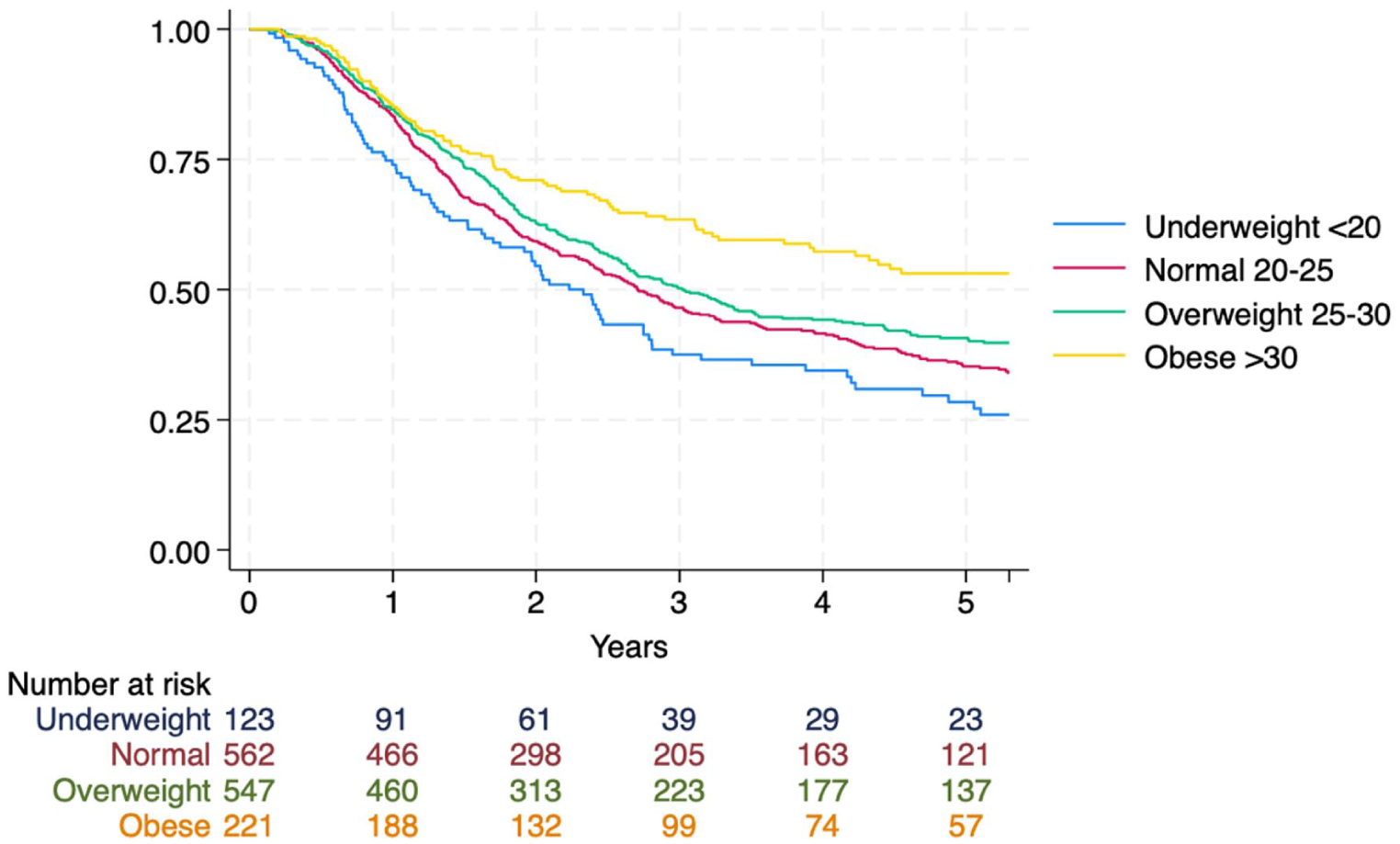
Long-term survival. Grouped on body mass index (BMI).
In the adjusted analysis, obesity was associated with a decreased risk of death by any cause compared to individuals with normal weight (HR: 0.75 (0.57–0.98)), while a BMI < 20 kg/m2 was linked to an increased mortality. Higher education level, pathological disease stage 0–II, and undergoing surgery in more recent time periods were also associated with improved overall survival, whereas male sex, advanced age, pathological disease stage IV, and nCRT were linked to worse overall survival (Table 3).
Overall survival.

Hazard ratios (HR) with 95% confidence limits (CI) from Cox Proportional hazards models in 1494 patients diagnosed with esophageal cancer for the outcome death by any cause.
Pathological disease stage calculated according to the 8th edition of the AJCC/UICC Tumour Nodal Metastasis (TNM) classification system.
In a sensitivity analysis restricted to patients with BMI ⩾ 20 kg/m2, excluding the underweight group given its distinct histopathological profile (50% squamous cell carcinoma), the association between obesity and improved overall survival remained robust (HR = 0.74, 95% CI = 0.56–0.97, p = 0.030), consistent with the primary analysis.
Discussion
This study highlights a complex relationship between obesity and outcomes after esophageal cancer surgery, with obesity appearing to be associated with improved long-term survival but an increased risk of non-surgical complications. This survival pattern aligns with prior evidence suggesting a potential protective effect of obesity in patients undergoing curative treatment for esophageal cancer. 22 At the same time, the elevated risk of non-surgical complications, such as pulmonary embolism, underscores the perioperative challenges associated with obesity and is consistent with previous studies linking obesity to higher risk of postoperative respiratory dysfunction.14,33 Consistent with the known challenges of operating on elderly patients with obesity, the proportion of octogenarians was lowest in patients with obesity (0.9%), suggesting that advanced age and obesity in combination may represent a threshold beyond which surgical candidacy is less frequently considered. Operative times were significantly longer in patients with obesity compared to normal-weight patients (431 versus 410 min, p = 0.002); however, given the uniformly long operative times across all BMI groups, this difference is unlikely to be of major clinical relevance in explaining the elevated thromboembolic risk observed in patients with obesity. Rather, obesity-associated prothrombotic physiology, including impaired venous return and chronic low-grade inflammation, likely represents a more important contributing mechanism. Unfortunately, details on prophylactic regimens are not recorded in the NREV registry, precluding any analysis of whether suboptimal or non-weight-adjusted prophylaxis partly explains this finding. This represents an important knowledge gap, and future studies with access to detailed pharmacological data are warranted to clarify the role of prophylactic practice in this patient group.
Interestingly, despite the surgical complexity and the known risks associated with obesity, no correlation was found between BMI and the risk of surgical complications, such as anastomotic leaks. This finding contrasts with some reports suggesting increased technical difficulty and higher rates of anastomotic leaks in individuals with obesity.13,23 This discrepancy suggests that advances in surgical techniques and perioperative care may mitigate some of the previously reported risks. The higher rate of chylothorax among patients with underweight may reflect several factors. Malnutrition and low body fat are associated with reduced tissue resilience and altered anatomical relationships in the thorax, potentially making the thoracic duct more susceptible to intraoperative injury. Furthermore, the higher proportion of squamous cell carcinoma in this group—a histological type more commonly located in the mid-thoracic esophagus, in closer proximity to the thoracic duct—may contribute to this finding. These observations warrant further investigation.
Obesity is often associated with lower socioeconomic status, which has been linked to worse outcomes following cancer surgery in previous studies, including in esophageal cancer.34 –37 Consistent with this, higher education level was associated with improved overall survival in the present cohort. However, obesity itself was not associated with worse survival, suggesting that the prognostic impact of obesity in this surgical setting is not primarily mediated through socioeconomic pathways. These findings highlight the complex interplay between socioeconomic factors, nutritional status, and clinical outcomes in esophageal cancer surgery.
An improved disease-free and overall survival in individuals with obesity undergoing esophageal resection has also been reported by others. 22 Interestingly, the survival advantage observed in individuals with obesity appears to be diminished in those with co-existing metabolic syndrome. 38 In addition, a study on visceral fat distribution found that a high visceral fat-to-subcutaneous fat (VFA/SFA) ratio was associated with worse relapse-free and overall survival after esophagectomy for esophageal squamous cell carcinoma. 24 These results suggest that abdominal fat distribution, rather than BMI alone, may be a critical factor influencing biological tumor behavior and patient prognosis. Specifically, excessive visceral fat is thought to exacerbate metabolic derangements, chronic inflammation, and immune dysfunction, potentially promoting cancer progression. While obesity is generally linked to increased mortality in many chronic diseases, its apparent advantages in the setting of esophageal cancer surgery may reflect a combination of factors, such as greater systemic energy reserves and potential differences in tumor biology. The numerically higher rate of R0 resection observed with increasing BMI may partly reflect differences in peritumoral fat distribution in the mediastinum. In patients with obesity, greater amounts of adipose tissue surrounding the tumor may facilitate wider circumferential resection margins (CRMs), thereby increasing the likelihood of achieving R0 resection. Conversely, patients with underweight and low peritumoral fat may have less tissue buffer between the tumor and adjacent structures, making oncological adequate margins more difficult to achieve. While speculative, this anatomical hypothesis could contribute to the observed survival differences across BMI groups and warrants further investigation.
The study has notable limitations, particularly the risk of reverse causation. First, because data on pre-diagnosis weight loss were not available in the registry, patients with advanced or aggressive disease who experienced substantial weight loss may have been misclassified into a lower BMI category. This could partly explain the observed survival advantage among patients with obesity, reflecting disease-related wasting rather than a true protective effect of obesity. Second, additional residual confounding factors cannot be fully excluded, including smoking status, choice of surgical approach, and the possibility that patients with obesity selected for surgery were generally fitter than patients with lower BMI. Third, the threshold for offering surgery to patients with severe obesity may also have differed across centers and over time. Although analyses were adjusted for the CCI, this measure may not comprehensively capture these factors. Fourth, the marked overrepresentation of squamous cell carcinoma in the underweight group (55.0% versus 10.1% in the obese group) may represent a source of residual confounding not fully captured by adjustment for histopathology and pathological stage. However, a sensitivity analysis restricted to patients with BMI ⩾ 20 kg/m2 yielded materially unchanged results, supporting the robustness of the primary findings. Fifth is the association between nCRT and poorer overall survival observed in this study, despite its well-established benefits in randomized trials. This discrepancy may be explained by stage migration: although pathological stage was adjusted for, tumor response was not, which may have influenced survival outcomes. Furthermore, the proportion of patients with obesity increased over the study period, from 13.5% in 2005–2009 to 19.9% in 2014–2018. This temporal shift coincides with improvements in neoadjuvant treatment efficacy, the centralization of esophageal cancer care, the introduction of minimally invasive techniques, and enhanced recovery pathways. 39 Although year of diagnosis was included as a covariate in all survival models, residual confounding from these contemporaneous advances cannot be fully excluded. The strengths of this study include its nationwide coverage and the high validity of the registry data for patients with esophageal cancer. In addition, the near-complete follow-up of patients was achieved through cross-linking with national population registries.
Conclusion
In this nationwide population-based cohort study, obesity was not associated with an increased risk of surgical complications after esophageal cancer resection. However, patients with obesity had a significantly higher risk of non-surgical complications, such as pulmonary embolism, underscoring the importance of tailored perioperative management in this group. Obesity was also associated with improved long-term survival, with an apparent exposure–response pattern in which higher BMI correlated with better 5-year survival. However, residual confounding, including potential reverse causation from pre-diagnosis weight loss, cannot be excluded.
Footnotes
Declaration of conflicting interests
The authors declared no potential conflicts of interest with respect to the research, authorship, and/or publication of this article.
Funding
The authors received no financial support for the research, authorship, and/or publication of this article.

Clinical trial registration
N/A.