




Abstract
Background
Statistical analysis is crucial in clinical research, but many clinicians lack training or support. StatiCAL, a free and intuitive tool, was created to address this gap without needing coding skills. This study evaluates its effectiveness and usability by analyzing physicians’ performance and perceptions during real-world statistical tasks.
Methods
We conducted a cross-sectional study evaluating StatiCAL’s usability and effectiveness. Surgical physicians analyzed a clinical dataset using StatiCAL after completing a background questionnaire. Usability was measured with the French SUS, and all analyses were independently verified in R.
Results
Fourteen physicians with limited prior experience in statistical analysis participated. All successfully completed the assigned tasks using StatiCAL, with an average completion time of 28 minutes. Interestingly, participants without prior experience completed tasks significantly faster than those with experience (p = 0.044). The average F-SUS score was 85.33, indicating high usability above the standard threshold.
Conclusions
StatiCAL showed high usability and effectiveness, allowing clinicians, regardless of prior experience, to perform accurate statistical analyses efficiently. Its intuitive interface supports broader access to biostatistics, encourages collaboration with specialists, and simplifies research workflows. Further studies with larger, more diverse populations are needed to confirm and expand these findings.
Introduction
In clinical research, and more generally in the field of scientific research, statistics play a crucial role in confirming results. 1 Conducting studies with rigorous statistical methodology is essential for publication.2–6 However, statistical skills - or access to an expert with these skills - are not widely available. 7 To address this gap, StatiCAL was developed as: a free, user-friendly statistical software solution and to meet the need for a tool dedicated to researchers and clinicians. The novelty of StatiCAL compared to other statistical software was discussed in our first published work. It enables users to perform various statistical analyses (descriptive, univariate and multivariate), conduct basic data management (variable manipulation, deletion, creation, and data filtering), and retrieve modified datasets along with detailed analysis reports. Moreover, the tool supports multiple file formats 8 (link to the software: https:// debds. Shiny apps. io/StatiCAL/).
The practicality of such a solution is key, and this aspect need to be evaluated to strengthen the tool relevance. However, we did not find similar usability studies for other dedicated statistical tools (R-Commander, SPSS, Stata, MEPHAS, R++, or EasyMedStat). Therefore, the objective of this work was to conduct a validation study to assess the reliability and effectiveness of our application. This step allows us to test our work under real-life conditions with naïve users who are unfamiliar with the application and do not necessarily have basic programming skills.
Materials and methods
Study design
This investigation employed a cross-sectional study design to evaluate the efficacy of StatiCAL, a novel, open-access, web-based biostatistics tool, among a cohort of physicians.
Tool description
StatiCAL is designed to parallel the functionalities of proprietary biostatistics software, offering a range of statistical analysis options without the need for user registration or fees. Its development in R programming language and architecture has been detailed previously in a first publication. 8 The tool distinguishes itself by its accessibility and ease of use, aiming to democratize biostatistical analysis for clinicians.
Preliminary testing of the StatiCAL tool was conducted in collaboration with the Department of Statistics and clinician-researchers to ensure its functionality and relevance to clinical practitioners.
Recruitment and participants
Participants were recruited via email invitations sent to residents, fellows, and senior surgeons in oral surgery, maxillofacial surgery, ENT (Ear Nose Throat) specialist, HNS (head and neck surgery), and plastic surgery. All invited individuals agreed to participate
Data collection instruments
Before engaging with the study, participants were provided with a comprehensive description of StatiCAL and access to an online tutorial, which was also available on the tool’s website. This preparatory phase was designed to familiarize participants with the tool and maximize the efficiency of its use during the study.
The study commenced with a 20-items online questionnaire administered via Microsoft Forms® to evaluate participants’ publication history, practical biostatistical knowledge, and programming skills. Questions covered authorship position, number and quality of publications, and formal training in statistics.
Participants then conducted a biostatistical analysis (Supplementary data 1) using the StatiCAL tool on a customized French version of the Head-Neck-CT-Atlas dataset, 9 tailored to align with the tool’s data organization requirements. The analysis encompassed univariate and multivariate analyses, including survival analysis, with tasks designed to reflect real-world biostatistical challenges.
Participants were asked to complete a comprehensive evaluation of their experience using the tool. This assessment was done through the French version of the F-SUS questionnaire (System Usability Scale), 10 a widely recognized questionnaire designed to measure the perceived ease of use of interactive systems.
Statistical analysis
Analyses were performed within StatiCAL and independently verified using R Studio by an expert in biostatistics. Categorical data were presented as relatives and absolute frequencies. Continuous data were presented with mean, median, min, max and standard deviation. Missing data were presented as absolute number and percentage. Chi² test or Fisher test, in the event of non-compliance with the Chi2 application conditions, were used to evaluate the data repartition between groups for categorical variables. T-test or Wilcoxon rank sum test, in the event of non-compliance with the T-test application conditions, were used to evaluate the distribution similarity of continuous variables. Pearson or Spearman coefficient, test, in the event of non-compliance with the Pearson correlation application conditions, were used to measure the dependency between continuous variables. All analyses adhered to a 5% alpha risk, with results presented at a 95% confidence interval using the R version 4.3.1 on a Windows platform.
Ethics and data anonymity
In compliance with French legislation, all participant data were processed anonymously, negating the need for ethical board approval.
Study duration
Between designing the study, recruiting participants, performing the practical work, and analyzing the results, the study lasted 6 months.
Results
Description of the population
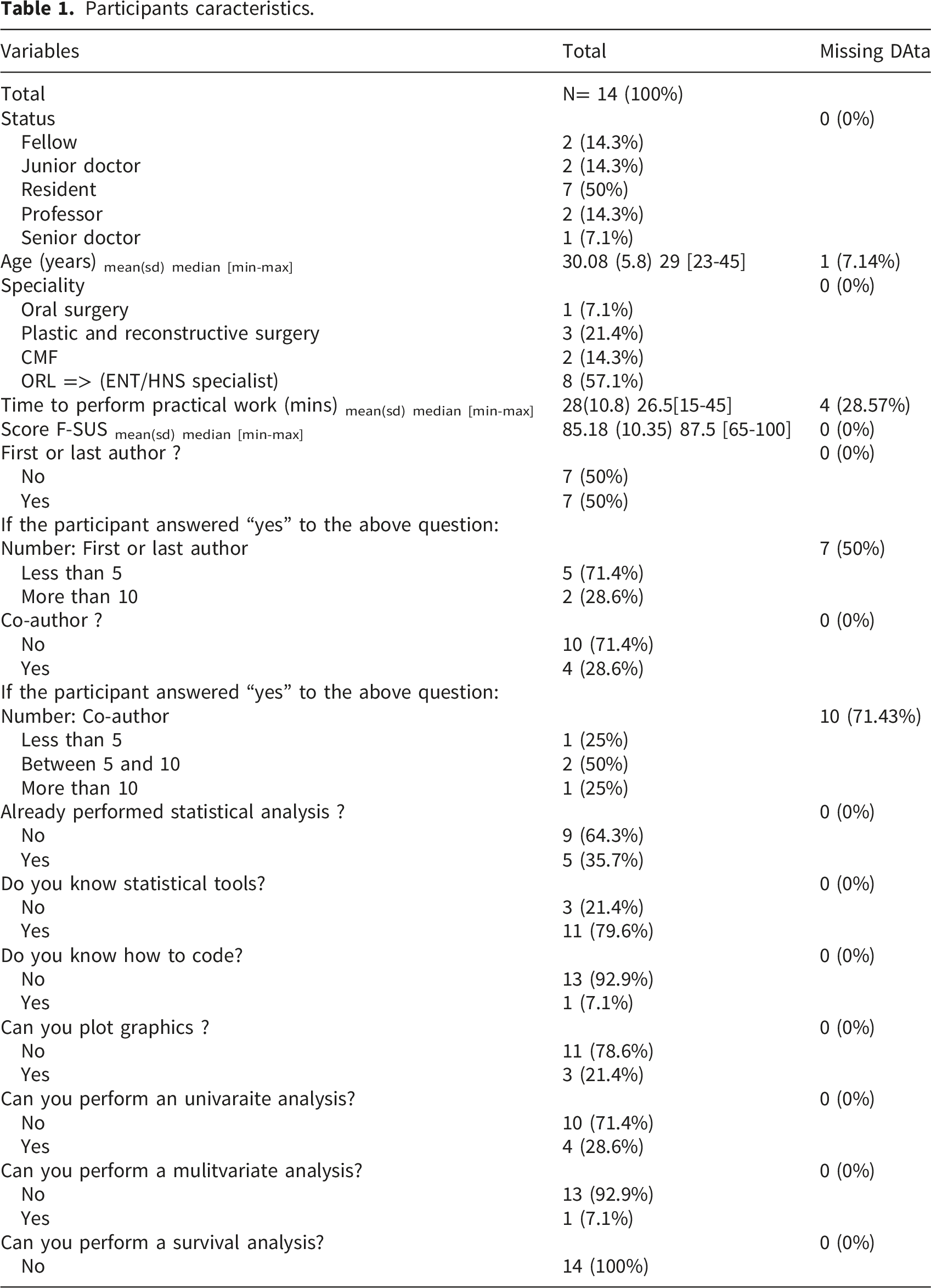
Participants caracteristics.
Statistical programming knowledge
Participants knowledge about statistical or programming tools.

Biostatistical analysis
Among the participants, 14 performed the analysis. All of them answered correctly the questions. The mean duration of the analysis was 28 ± 10.8 minutes with a range of 15 to 45 minutes (Table 1). In comparison, the expert statistician coded the analysis and report of the same work with R in 35 minutes.
Participant which didn’t already performed statistical analysis were faster than the other: 21 ± 8.02 minutes vs 35 ± 9.45 minutes (p = 0.044) (Supplementary data 2).
A tendency was observed in the correlation of age and duration of the analysis: r=0.64 (p = 0.063) (Supplementary data 3). The participant evaluated the tool with the F-SUS questionnaire, mean result was a score of 85.33 with a range of 65 to 100. (Figure 1). Position of StatiCAL in the SUS scale. Graph taken from the publication SUS: A Retrospective [10].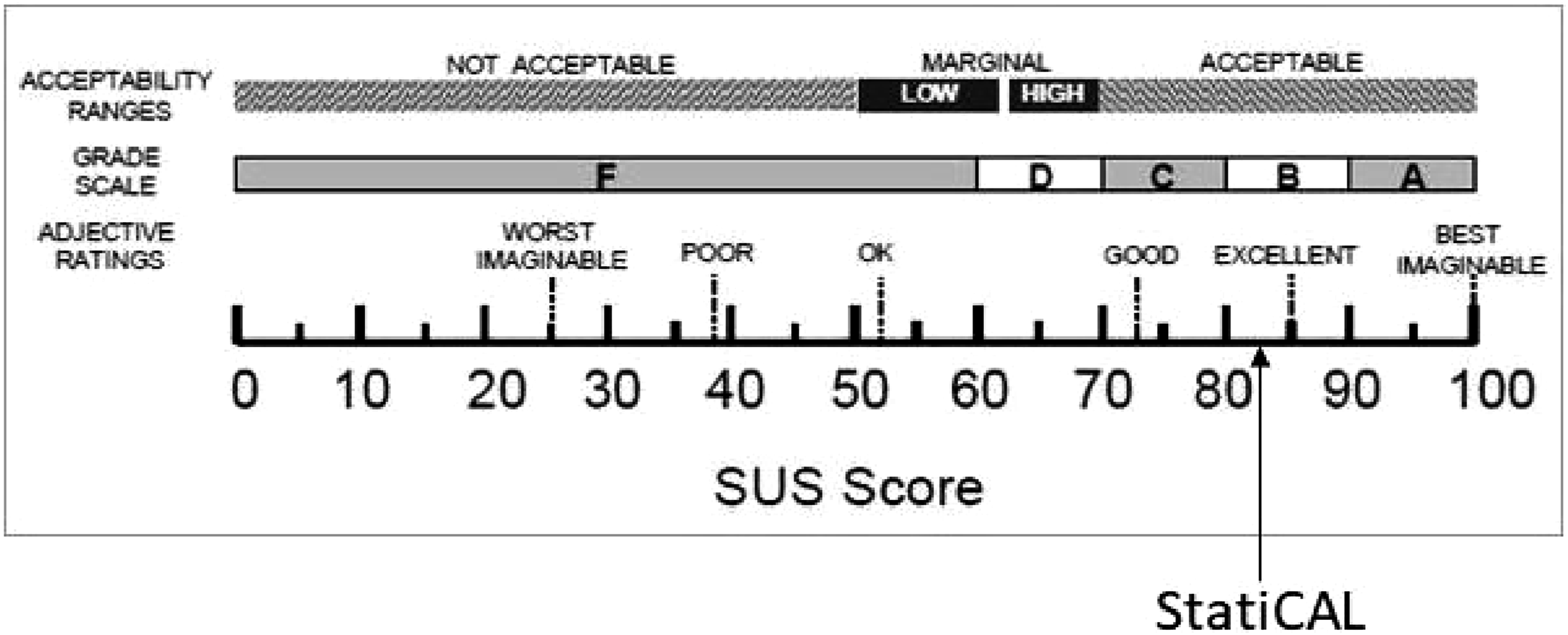
Discussion
StatiCAL was designed to simplify statistical analyses for researchers and clinicians. Our study demonstrated that clinicians, with elementary statistical training from medical studies and no programming experience, could perform accurate statistical analyses using the tool.
However, a formal validation of its utility was necessary to assess its broader applicability. The goal of this evaluation study was to test the tool with participants who had diverse levels of experience in statistical analysis, research, and the use of analytical tools. Our study population was highly heterogeneous, ranging from residents to professors. Almost none of participants had experience with statistical analysis programming. The high success rate among participants highlights StatiCAL’s effectiveness, moreover when the time to perform the analysis was faster for the participants than for the expert biostatistician on R. Although the work involved in using StatiCAL and coding in R is not identical, this comparison demonstrates that the usability of StatiCAL enables users to outperform an expert statistician on this specific task. This finding underscores the tool’s potential to bridge the gap between clinicians and complex statistical methodologies. It will also be essential to evaluate StatiCAL in routine research practice. Its efficiency and ease of use could facilitate preliminary analyses, enhance communication with expert biostatisticians, and reduce their workload, ultimately improving overall research workflow.
Interestingly, while half of the participants had experience as first or last authors, very few had been listed as co-authors. This likely reflects the fact that many clinicians engage in research primarily during personal academic projects, such as theses or university dissertations. They are less frequently involved in collaborative research teams. Consequently, investing time in learning statistical programming is often impractical for this population, reinforcing the need for easy-to-use tools like StatiCAL to apply their statistical knowledge effectively.
The F-SUS score further supports the usability of StatiCAL, with a mean score of 85.33 - classified as a rank B - high and the mean above the threshold of 68 which is considered as “above the average” 11 demonstrating that the tool is easy to use for every-body. To our knowledge, there is no other statistical tools which have been tested with similar methodology, making a rigorous comparison difficult. We believe that conducting such studies is crucial to confirming the value of these tools, 12 as many articles showcasing dashboards developed in clinical contexts have done, recognizing the importance of such evaluations.13–22 Mean SUS-score for those 10 tools was 77.6 and ranging from 67.6 to 89.7 showcasing the interest of StatiCAL.
However, this study has several limitations. The sample size was relatively small, which may limit generalizability. Additionally, the structured nature of the task did not fully reflect real-world statistical investigations, as participants were guided throughout the process.
Conclusion
This study highlights the usability and effectiveness of StatiCAL as a statistical tool tailored for clinicians with varying levels of statistical expertise. Our findings indicate that even users with minimal prior experience in statistical analysis were able to complete biostatistical tasks accurately and efficiently. Notably, participants without previous statistical experience performed the analysis faster than those with experience, suggesting that the tool’s intuitive design enhances usability, particularly for younger users familiar with digital tools.
StatiCAL provides a valuable solution for clinicians, enabling them to perform statistical analyses autonomously without requiring extensive prior knowledge in programming. By simplifying access to statistical analysis, we believe StatiCAL has the potential to enhance clinical research autonomy, promote collaboration between clinicians and statisticians, and ultimately contribute to more rigorous and accessible data analysis practices. However, taking into account the small sample size, future studies with larger and more diverse cohorts are needed to further validate its effectiveness, explore additional usability factors and conclusion of this article.
Supplemental material
Supplemental material - Statical: Evaluation of an open access biostatistics tool
Supplemental material for Statical: Evaluation of an open access biostatistics tool by Tanguy Pace-Loscos, Jocelyn Gal, Sara Contu, Renaud Schiappa, Emmanuel Chamorey, and Dorian Culié in Health Informatics Journal.
Supplemental material
Supplemental material - Statical: Evaluation of an open access biostatistics tool
Supplemental material for Statical: Evaluation of an open access biostatistics tool by Tanguy Pace-Loscos, Jocelyn Gal, Sara Contu, Renaud Schiappa, Emmanuel Chamorey, and Dorian Culié in Health Informatics Journal.
Supplemental material
Supplemental material - Statical: Evaluation of an open access biostatistics tool
Supplemental material for Statical: Evaluation of an open access biostatistics tool by Tanguy Pace-Loscos, Jocelyn Gal, Sara Contu, Renaud Schiappa, Emmanuel Chamorey, and Dorian Culié in Health Informatics Journal.
Footnotes

Ethical considerations
All procedures involving human participants in this study were conducted in accordance with the ethical standards of the institutional research committee and with the 1964 Declaration of Helsinki and its later amendments or comparable ethical standards. In accordance with French legislation, this study did not require formal approval from an ethics committee, as all data were collected anonymously and no intervention or collection of sensitive personal data was involved.
Consent to participate
Informed consent was obtained from all participants prior to their inclusion in the study, through their agreement to participate in the practical work, with explicit information that the data could be used for the current publication.
Author contributions
D.C. and T.P.L. conceived the projects. D.C. designed the practical work. T.P.L. realised the statistical analysis. D.C. and T.P.L. drafted the manuscript that was revised by J.G., S.C., E.C. and R.S. All authors read and approved the final manuscript. All authors take responsibility for the accuracy and integrity of the work.
Funding
The authors received no financial support for the research, authorship, and/or publication of this article.
Declaration of conflicting interests
The authors declare that they have no competing interests.
Data Availability Statement
The datasets generated and analyzed during the current study include: (i) a customized version of the Head-Neck-CT-Atlas dataset adapted for the practical statistical tasks using the StatiCAL tool, (ii) the results of the practical analyses performed by the participants, (iii) responses to the F-SUS usability questionnaire evaluating the tool, and (iv) questionnaire data describing participant characteristics, including statistical background and publication history. The practical analysis dataset was generated by modifying the original Head-Neck-CT-Atlas dataset to align with the data format requirements of StatiCAL, simulating real-world clinical research scenarios. All participant evaluations and characteristics were collected through online surveys administered via Microsoft Forms®. All datasets are available from the corresponding author upon reasonable request.
Supplemental material
Supplemental material for this article is available online.
Appendix
References
Supplementary Material
Please find the following supplemental material available below.
For Open Access articles published under a Creative Commons License, all supplemental material carries the same license as the article it is associated with.
For non-Open Access articles published, all supplemental material carries a non-exclusive license, and permission requests for re-use of supplemental material or any part of supplemental material shall be sent directly to the copyright owner as specified in the copyright notice associated with the article.
