




Abstract
In this article, we investigate a generalized Fornberg–Whitham (gFW) equation. Based on the Lax pair and Darboux transformation, one-soliton solution, breather solutions, lump solution, lump–1-strip, lump–periodic, manifold periodic, and rogue wave solutions for the gFW equation are obtained by choosing appropriate transformations and symbolic computation. In addition, we evaluate Ma breather, Kuznetsov–Ma breather and their corresponding rogue waves, generalized breather, and Akhmediev breathers. The obtained solutions reveal rich nonlinear wave phenomena such as localized structures, recurrence patterns, and energy concentration effects. These findings have direct applications in fluid dynamics, optical fiber communications, and plasma physics, where such nonlinear behaviors are prevalent. Moreover, the explicit construction of rogue waves and breather interactions provides insight into the prediction and control of extreme wave events in oceanography and nonlinear optics. The results further demonstrate the utility of analytical methods in exploring complex wave structures in integrable and near-integrable systems.
1. Introduction
Nonlinear differential equations (NDEs) play a central role in the theory of solitons and arise in a wide range of disciplines within applied mathematics and engineering.1–8 A fundamental aspect of this theory is the construction of analytical solitary wave solutions, which are essential for understanding the underlying dynamics of nonlinear systems. The continuous exploration of natural phenomena has further emphasized the importance of obtaining exact solutions of NDEs, particularly in the field of mathematical physics.9–12 In this context, soliton theory has emerged as a powerful and active area of research with significant applications in materials science, plasma physics, optical fiber communications, and other branches of physical sciences.13–17 Therefore, a variety of analytical techniques have been developed to construct exact solutions of proposed NDEs, including Bäcklund transformations,
18
Painlevé analysis and Lie symmetries,
19
spontaneous symmetry methods,
20
computational architectonics,
21
and conservation laws.
22
Moreover, several well-established approaches such as the extended tanh-function method,
23
Hirota bilinear scheme (HBS),
24
polynomial function method,
25
mapping techniques,
26
Lie symmetry analysis,27 and the CESTAC method
28
have proven effective in generating exact solutions. In addition, methods like symmetry bifurcation,
29
Kudryashov architectonics,
30
auxiliary equation methods,
31
the (G′/G)-expansion method,
32
semi-inverse techniques,
33
the
The theory of integrable systems relies significantly on the Lax equation, which is essential to explaining how nonlinear partial differential equations (PDEs) evolve. This paradigm, which was first presented by Peter D. Lax, represents a nonlinear equation as the compatibility condition of two linear operators, referred to as a Lax pair (LP). In addition to displaying the integrable structure of the underlying PDE, this precise representation makes it easier to produce precise solutions. Lax pairings enable the use of strong algebraic methods like the Darboux transformation (DT) and the inverse scattering transform. Specifically, the DT is a straightforward technique that uses a series of transformations on the corresponding LP to produce new solutions from existing ones.39–45 This method has demonstrated its importance in the larger study of nonlinear wave phenomena by being particularly successful in creating soliton, breather, and rogue wave solutions.
In this paper, our major intention is to get Lax pair, Darboux transformation, single-soliton solution, breather solutions, lump, lump 1-strip, lump-periodic, manifold periodic solution, rogue wave solutions of gFW-equation via choosing appropriate transformations and symbolic computation. In addition, we evaluate Ma breather, Kuznetsov–Ma breather and their corresponding rogue waves, generalized breather, and Akhmediev breathers. Therefore, gFW-equation is represented as,46–49

When k = −1 and m = 3/2 then Eq. (1) becomes the following Fornberg–Whitham equation,

Many researchers solved the prosed model particularly, Li et al. studied the entropy weak solution to a gFW-equation, 48 Camacho et al. worked on symmetries and conservation for proposed model, 46 Dai et al. evaluated the classifications and representation of single wave solutions to the gFW-equation 49 and Itasaka studied Wave-breaking phenomena to gFW-equation. 47 Saut et al. discussed wave breaking for the gFW-equation, 50 and Nazari explored new traveling wave solutions by solving the nonlinear space time fractal FW-equation. 51 Noor et al. discussed numerical investigation of fractional order FW-equations in the framework of aboodh transformation, 52 while Sartanpara et al. investigated the generalized time fractional FW-equation by using an analytic approach. 53
The novelty is we construct, for the first time, a systematic framework combining the Lax pair structure with the Darboux transformation for the gFW-equation, which has not been fully explored in the existing literature. We derive a wide spectrum of exact solutions within a unified analytical setting, including lump solutions, lump–1-strip, lump–periodic, manifold periodic waves, and multiple types of breather and rogue wave structures. The coexistence and interaction of these solutions in the gFW-system represent a novel contribution. We provide explicit constructions of higher-order and hybrid wave structures (such as lump–periodic and lump–stripe interactions), which reveal new dynamical behaviors not previously reported for this model. The study establishes connections between different classes of nonlinear waves (e.g., Ma breather, Akhmediev breather, and rogue waves) within the same mathematical framework, offering new insight into energy localization and transition mechanisms. Compared to existing studies that focus on isolated solution types, our work presents a comprehensive analysis of multiple nonlinear structures and their interactions, enhancing the understanding of complex wave dynamics in integrable and near-integrable systems.
The remaining structure of this manuscript is arranged as: In sec. 2, we compute the LP for governing model. In sec. 3, we will use Darboux theorem and DT on Eq. (2). In sec. 4, we will apply DT on the stated model to compute one-soliton solution. The sec. 5 provides a brief evaluations of lump wave results along with some 3D and contour illustrations. In sec. 6, we will use certain 3D and contour profiles to obtain lump 1-stripe solutions for the gFW-equation. We will assess lump periodic results in sec. 7, and evolution diagrams for different values of the different parameters used in the solutions will be displayed. In sec. 8, several 3D and contour demos will be used to enliven the brief production of rogue wave results. In sec. 9, the Manifold periodic solution will be explored. We shall build Ma-breather and its rogue wave for gFW-equation with their 3D plots in sec. 10. In the same way, we will use graphs to obtain KMB and its rogue wave for the gFW-equation. The sec. 11 will provide a brief explanation of the general breather approach. Akhmediev breathers for the suggested equation with their 3D, 2D, and contour shapes are included in sec. 12. Results and discussions of new solutions will be presented in sec. 13, along with a suitable comparison with previous work. Finally, concluding remarks will be written in sec. 14.
2. Lax pair
Consider,

2.1. Operator framework for NLEs
Consider an operator L that depends on Θ(x, t) and its derivatives Θ
x
, Θ
xx
, Θ
xxx
, …, Θ
t
, Θ
xt
, but not explicitly on the temporal variable t, such that39–45,54



Hence, solving for ψ(x, t) associated with λ requires that


here [M, L] = LM − ML, L t = ∂L/∂t, that will be true iff λ t = 0.
Hence, Eq. (8) is the Lax equation of Eq. (3) and [L, M], denotes the commutator.
2.2. Application of L

α denotes a scalar, and I = ∂0/∂x0 is the identity operator and ∂
n
/∂x
n
: n-th order total derivative operator. Then


Applying the operator L to a second operator yields another operator. Assume this second operator takes the form M = ψI.
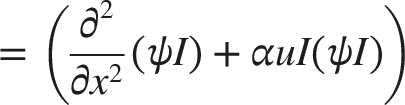
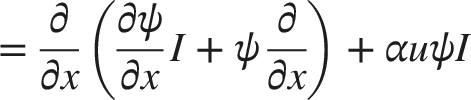
When n = 2


When n = 3

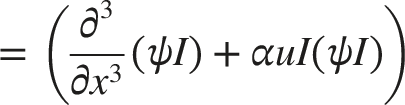

So, in general we have

The Lax pair (LP) corresponding to Eq. (1) is given as follows:



Now,


Now,



Now the following must hold,


and


Therefore we finally arrive at,

so we have,

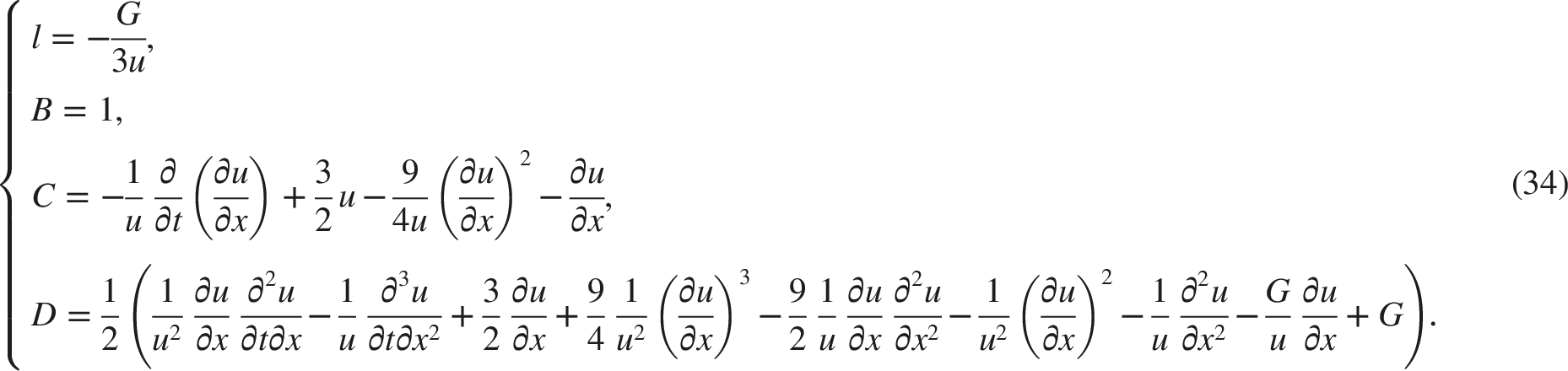
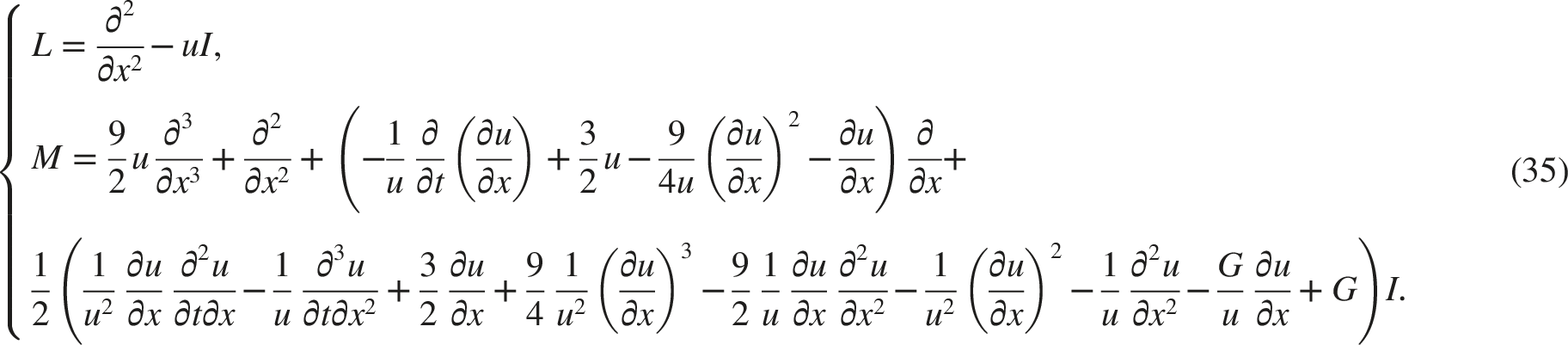
Thus, we have demonstrated that the operators L and M satisfy the Lax equation, implying that the proposed model represents the compatibility condition of the Lax pair given in Eqs. (17) and (18). Solving Eqs. (25) and (26), we obtain the values of l and D as follows:


Now, let G = −27/2, B = 1 in Eq. (27) via Eq. (31) and integrating the resulting equation (ignoring the constant of integration) we have,

so, finally we have α, B, C, D as follows,
Using above values of l, B, C, D in Eq. (17) and Eq. (18), then we obtain the LP as follows,
3. Darboux transformation (DT)

Such a formulation appears frequently in the literature as a Sturm–Liouville problem, where one seeks eigenfunctions and eigenvalues, with u acting as the potential function. In this article, we make use of the Darboux theorem:
3.1. Darboux Theorem
Consider ψ = ψ1(x) be a solution of SL-problem, for λ = λ1, suppose the DT,55,56

then (37) holds,

3.2. DT for Eq. (2)
To this concern, Eq. (30) can be assumed as,(2)


subject to the consistency condition:

while Eq. (39) and Eq. (40) is covariant under the DT hence,


and the consistency condition becomes as,

This implies that u 1 is a new solution of Eq. (2), which can be obtained from the original unknown solution u.
4. Single-soliton solution via darboux transformation
Using Eq. (35), Eq. (39) and Eq. (40),39–45,54


Via DT on ψ,

Then the system in Eq. (45) and Eq. (46) is covariant under the DT, then




λ = k2, we lett A(t)exp(kx) be the solution of Eq. (50), Eq. (51) and integrating it,


ψ1 is the solution of Eq. (50) and Eq. (51). Also,

ψ2 is the solution of Eq. (50) and Eq. (51), so there general solution will be

Now setting c1 = 1/2, c2 = 1/2, then we have

If we set c1 = 1/2, c2 = −1/2, then we have

Inserting Eq. (55) in Eq. (47) we have,

then

Now, put

5. Lump solutions (LS)
For LS of Eq. (2), we use,57,58

and get the following

Now f in Eq. (62) can be taken as,57,58


These parameters generates the LS

6. Lump with 1-strip solution (L1S)
To get L1S, we use the transformation,
49


These values exhibits the required solution,

7. Lump periodic (LP)
To get LP, we apply the transformation,
49


then

8. Rouge wave solutions (RWs)
To obtain the RWS, we employ the transformation provided in Eq. (4),
59

The parameters a i (1 ≤ i ≤ 7), along with k1, p1, and b1, are assumed to be arbitrary real constants. By substituting the function f into Eq. (62) and setting the coefficients of the hyperbolic terms, as well as those of x and t, to zero, we solve the resulting algebraic equations and obtain:

These parameters gives the RWS,

9. Manifold periodic solution (MPS)
To get MPS, we consider f as,
60

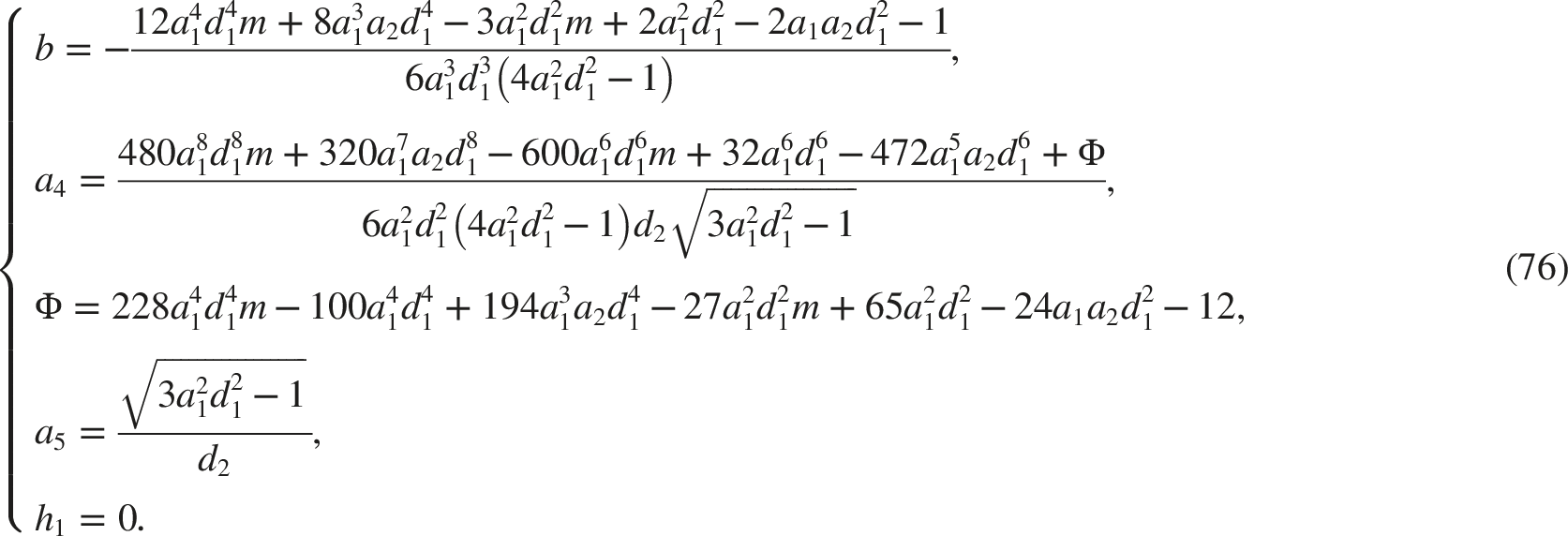
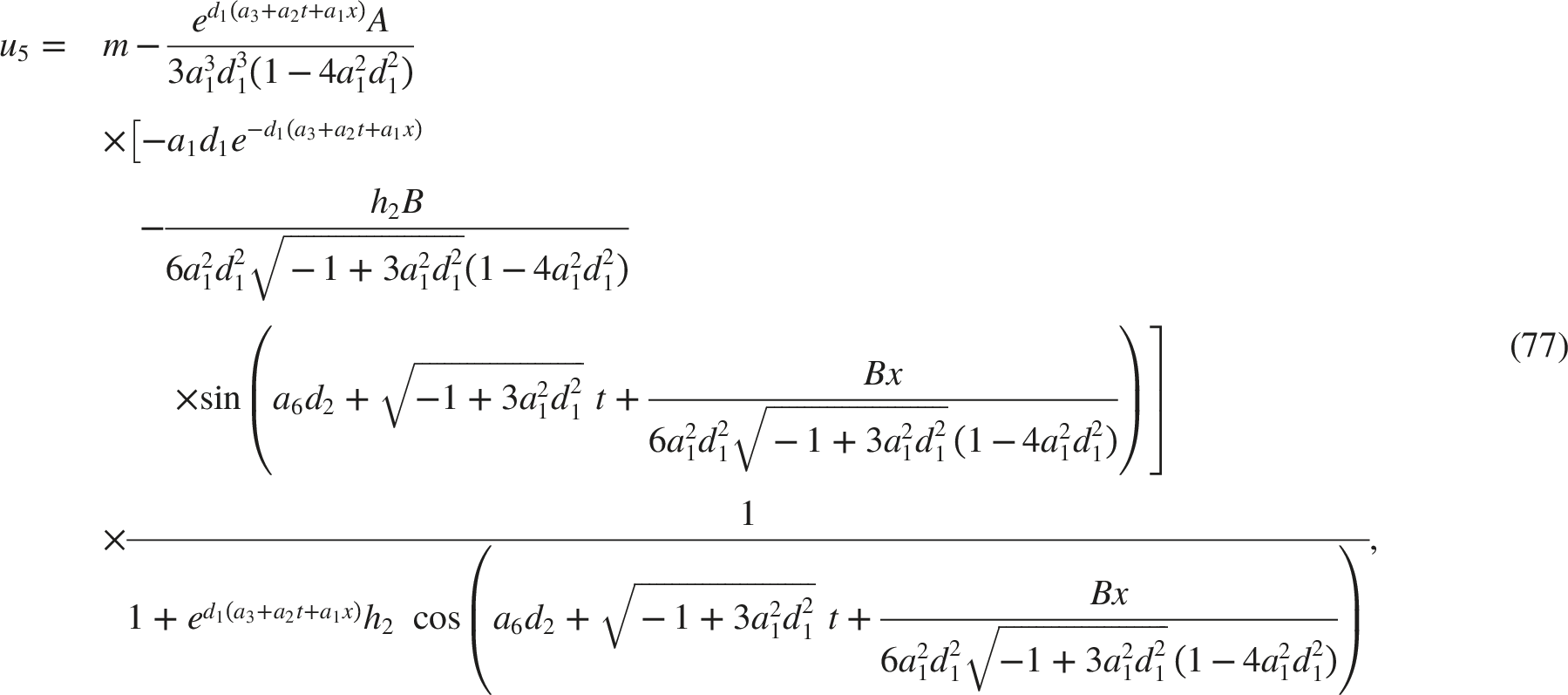
The quantities a i (1 ≤ i ≤ 6), h1, h2, and d1 are parameters to be determined. By inserting f into Eq. (62) and equating the coefficients of cos(⋅), x, and t to zero, we arrive at the following results:
These values exhibits the MPS,

10. Ma-breathers (MBs) and its relating rouge wave
For obtaining MBs, we assume f in the form,61


These values forms MB,

11. Kuznetsov–Ma breather (KMB) and its relating rouge wave
We use, f as follows,
61

Set I

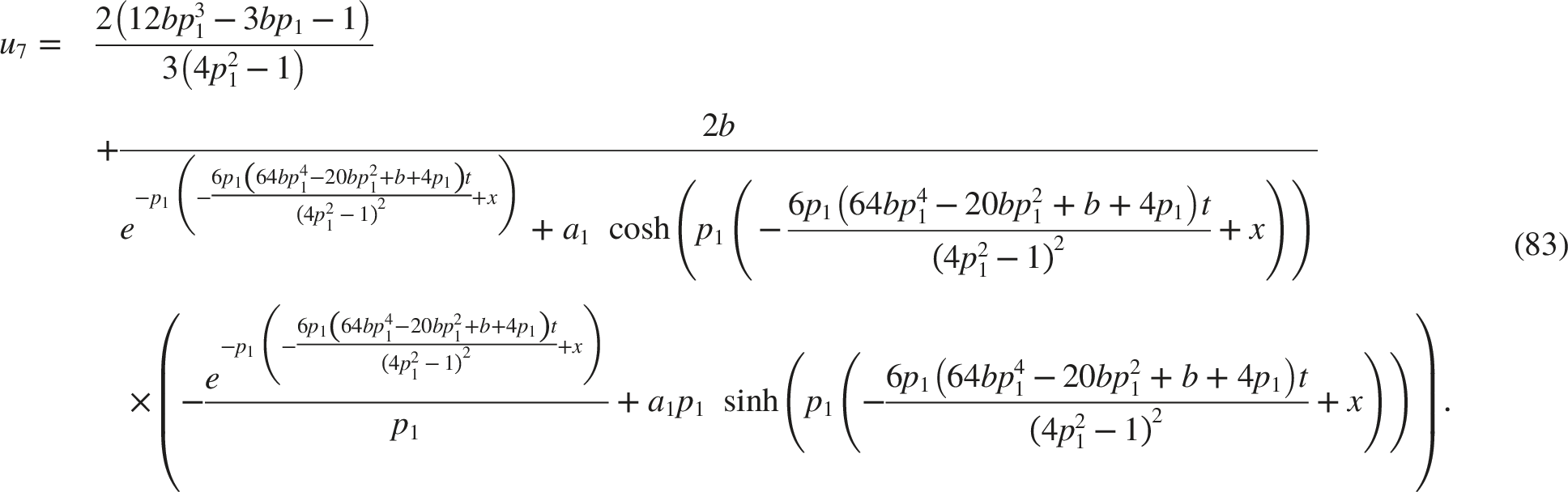
These parameters forms proposed solution,
12. Generalized breather (GBs)
In order to get GBs, we will use ansatz,
62


For GB, we use ϕ in Eq. (85),

The constants ρ, σ, and c are to be identified. Upon equating the coefficients of sinh, cosh, and exp terms to zero, the solution yields the following:
Set I

These values makes GB to Eq. (1),

13. Akhmediev breathers (ABs)
We assume ψ as follows,
63

Equating the coefficients of trigonometric and hyperbolic terms to zero and solving yields:

therefore ABs,
14. Result and discussions
Many researchers solved the prosed model particularly, Li et al. studied the entropy weak solution to a gFW-equation, 48 Camacho et al. worked on symmetries and conservation for proposed model, 46 Dai et al. evaluated the classifications and representation of single wave solutions to the gFW-equation. 49 and Itasaka studied Wave-breaking phenomena to gFW-equation, 47 Abidi et al. evaluated exact solutions for stated model via homotopy analysis and Adomian’s decomposition schemes, 64 Manafian et al. studied the modified gFW-equation for classification of the single traveling wave solutions, 65 Wei et al. evaluated wave breaking analysis for FW-equation, 66 Hormann et al. presented well-posedness,solution concepts for FW-equation. 67 and Ahmad et al. worked on numerical solutions for FW-equation. 68 But here in this work, we construct, for the first time, a systematic framework combining the Lax pair structure with the Darboux transformation for the gFW-equation, which has not been fully explored in the existing literature. We derive a wide spectrum of exact solutions within a unified analytical setting, including lump solutions, lump–1-strip, lump–periodic, manifold periodic waves, and multiple types of breather and rogue wave structures via choosing appropriate transformations and symbolic computation. The coexistence and interaction of these solutions in the gFW-system represent a novel contribution. We provide explicit constructions of higher-order and hybrid wave structures (such as lump–periodic and lump–stripe interactions), which reveal new dynamical behaviors not previously reported for this model. The study establishes connections between different classes of nonlinear waves (e.g., Ma breather, Akhmediev breather, and rogue waves) within the same mathematical framework, offering new insight into energy localization and transition mechanisms. Compared to existing studies that focus on isolated solution types, our work presents a comprehensive analysis of multiple nonlinear structures and their interactions, enhancing the understanding of complex wave dynamics.69–75
The exact solutions obtained in this work such as lump waves, breather structures, periodic waves, and rogue waves have clear physical interpretations. Lump solutions describe highly localized wave packets that can model energy concentration in fluids and optical media. Breather solutions (including Ma, Kuznetsov–Ma, and Akhmediev breathers) represent oscillatory modes that capture modulation instability and recurrence phenomena observed in optical fibers and water wave tanks. Rogue wave solutions, characterized by their sudden and extreme amplitude, are particularly relevant for understanding hazardous ocean waves and high intensity pulses in nonlinear optics. Moreover, the interaction structures such as lump–periodic and lump–stripe waves provide insight into complex wave superposition and energy exchange mechanisms, which are essential for predicting nonlinear wave evolution in realistic environments. From a practical perspective, these analytical solutions serve as benchmark models for validating numerical simulations and experimental observations. They also contribute to the prediction and potential control of extreme events, such as rogue waves in oceanography and signal amplification in fiber optics.
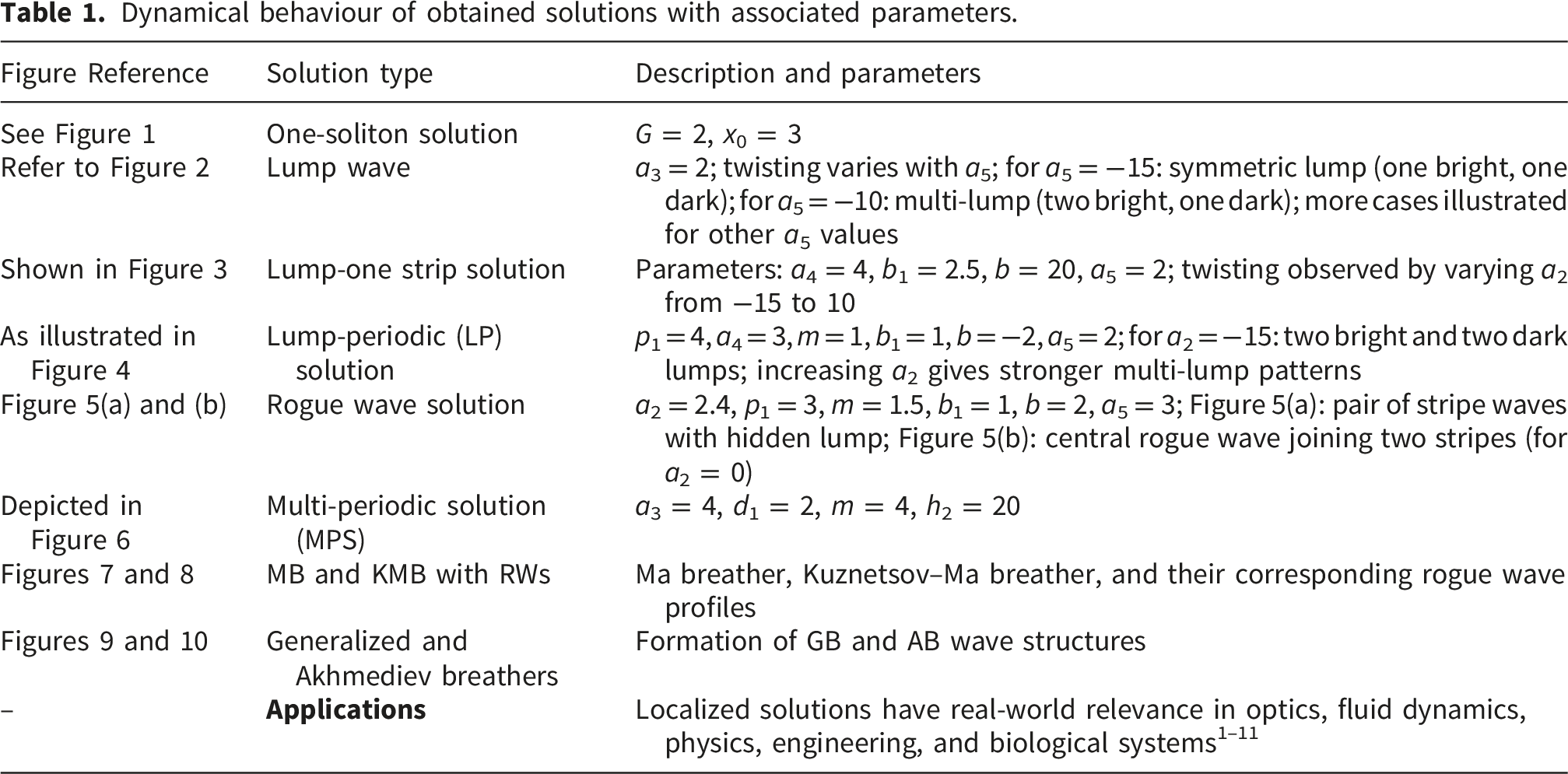
Figure 1 shows the 3D profiles for one-soliton solution in Eq. (60) by using the values of G = 2, x0 = 3. (a) Representing the 3D plots at λ = −10, (b) at λ = 0.1, and (c) and at λ = 10, respectively. Figure 2 depicts behaviour of the lump–stripe (LS) solution (Eq. (65)) for a3 = 2 under varying a5. (a) a5 = −15: weak lump on stripe background; (b) a5 = −10: enhanced lump–stripe interaction; (c) a5 = −5: localized peak intensifies; (d) a5 = 0: transition to asymmetric profile; (e) a5 = 5: oscillatory lump–stripe structure; (f) a5 = 10: stabilized localized peak; (g) a5 = −15: elongated contour along stripe; (h) a5 = −10: compressed elliptical structure; (i) a5 = −5: rotated localized contours; (j) a5 = 0: vertical stripe dominance; (k) a5 = 5: tilted lump formation; (l) a5 = 10: stretched and shifted contours. Figure 3 represents evolution of the lump with stripe solution for different values of a2. (a) a2 = −15: weak lump attached to stripe; (b) a2 = −10: interaction strengthens near interface; (c) a2 = −5: localized peak develops; (d) a2 = 0.5: localized peak develops; (e) a2 = 5: pronounced lump on stripe; (f) a2 = 10: shifted and stabilized structure; (g) a2 = −15: shallow contour with small depression; (h) a2 = −10: symmetric localized contours; (i) a2 = −5: asymmetric spreading pattern; (j) a2 = 0.5: localized peak develops; (k) a2 = 5: compact lump beneath stripe; (l) a2 = 10: extended interaction region. The 3D profiles for one-soliton solution in Eq. (60) are formed with the values of G = 2, x0 = 3. (a) Representing the 3D plots at λ = −10, (b) at λ = 0.1, and (c) and at λ = 10, respectively. Behaviour of the lump–stripe (LS) solution (Eq. (65)) for a3 = 2 under varying a5. (a) a5 = −15: weak lump on stripe background; (b) a5 = −10: enhanced lump–stripe interaction; (c) a5 = −5: localized peak intensifies; (d) a5 = 0: transition to asymmetric profile; (e) a5 = 5: oscillatory lump–stripe structure; (f) a5 = 10: stabilized localized peak; (g) a5 = −15: elongated contour along stripe; (h) a5 = −10: compressed elliptical structure; (i) a5 = −5: rotated localized contours; (j) a5 = 0: vertical stripe dominance; (k) a5 = 5: tilted lump formation; (l) a5 = 10: stretched and shifted contours. Evolution of the lump with stripe solution for different values of a2. (a) a2 = −15: weak lump attached to stripe; (b) a2 = −10: interaction strengthens near interface; (c) a2 = −5: localized peak develops; (d) a2 = 0.5: localized peak develops; (e) a2 = 5: pronounced lump on stripe; (f) a2 = 10: shifted and stabilized structure; (g) a2 = −15: shallow contour with small depression; (h) a2 = −10: symmetric localized contours; (i) a2 = −5: asymmetric spreading pattern; (j) a2 = 0.5: localized peak develops; (k) a2 = 5: compact lump beneath stripe; (l) a2 = 10: extended interaction region.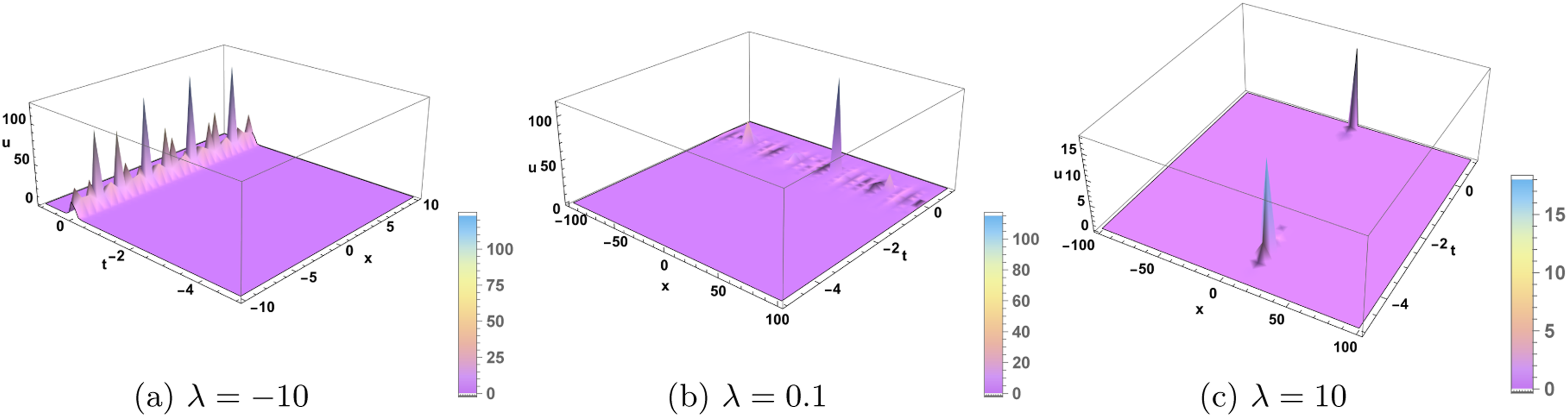
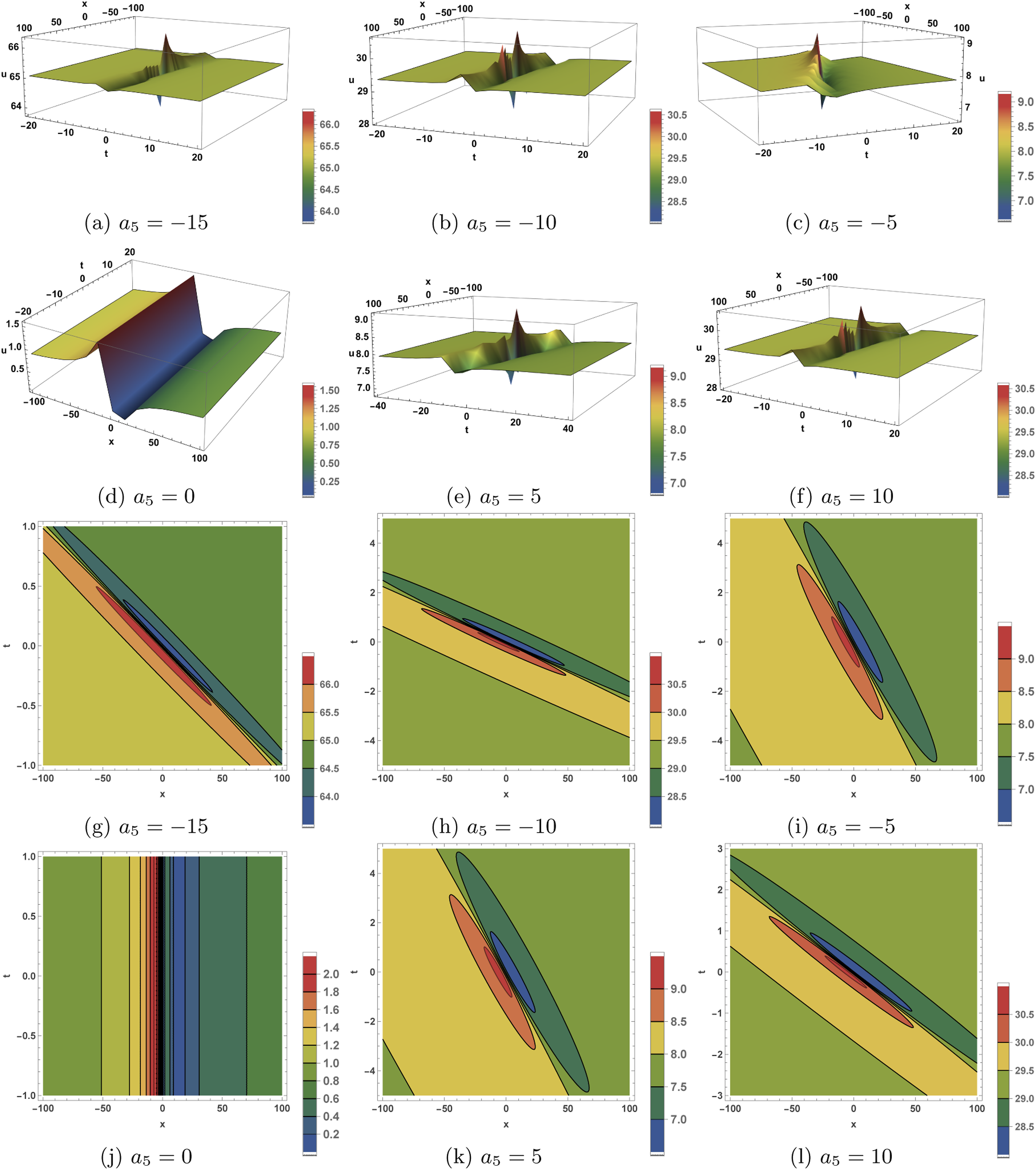
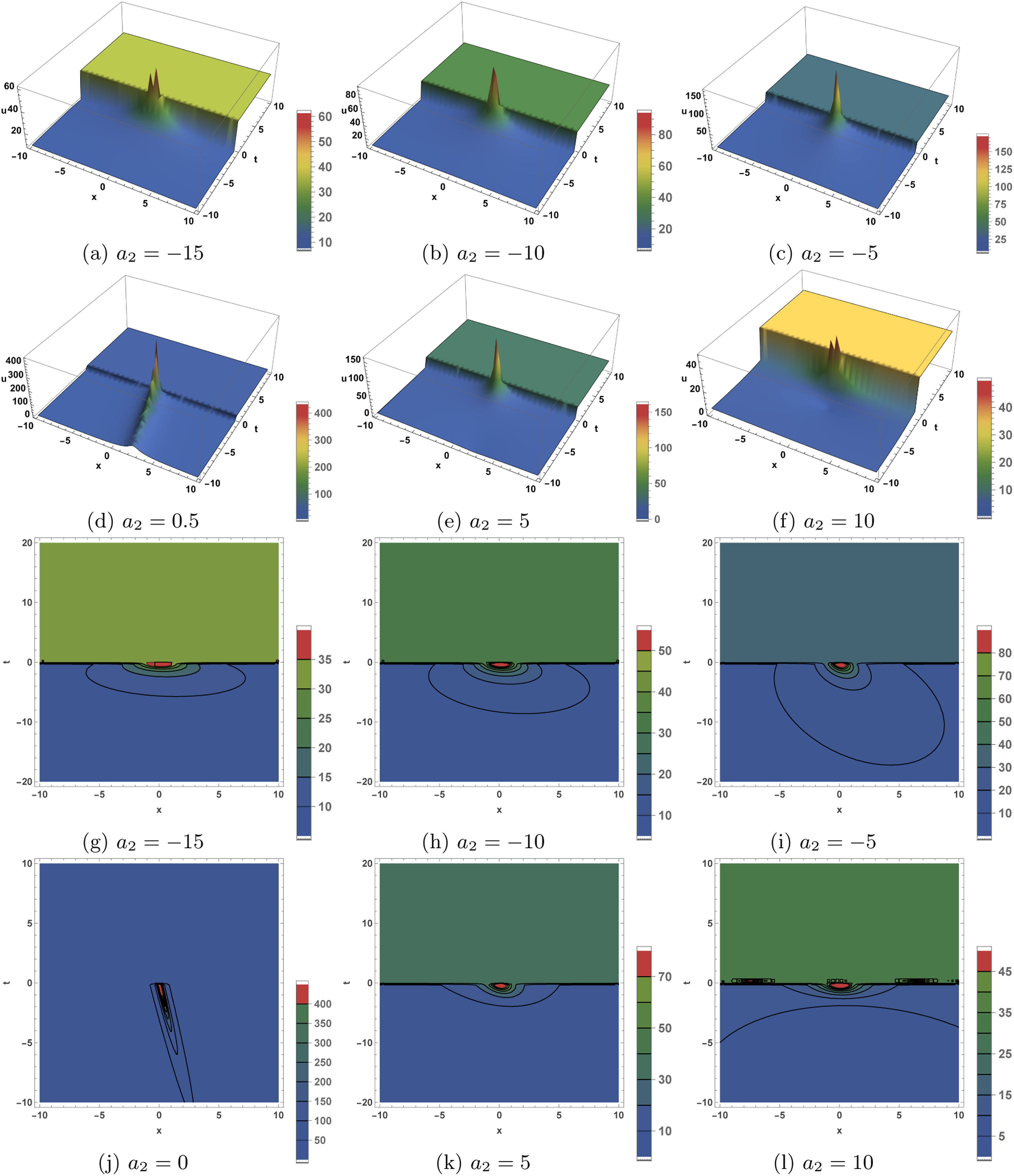
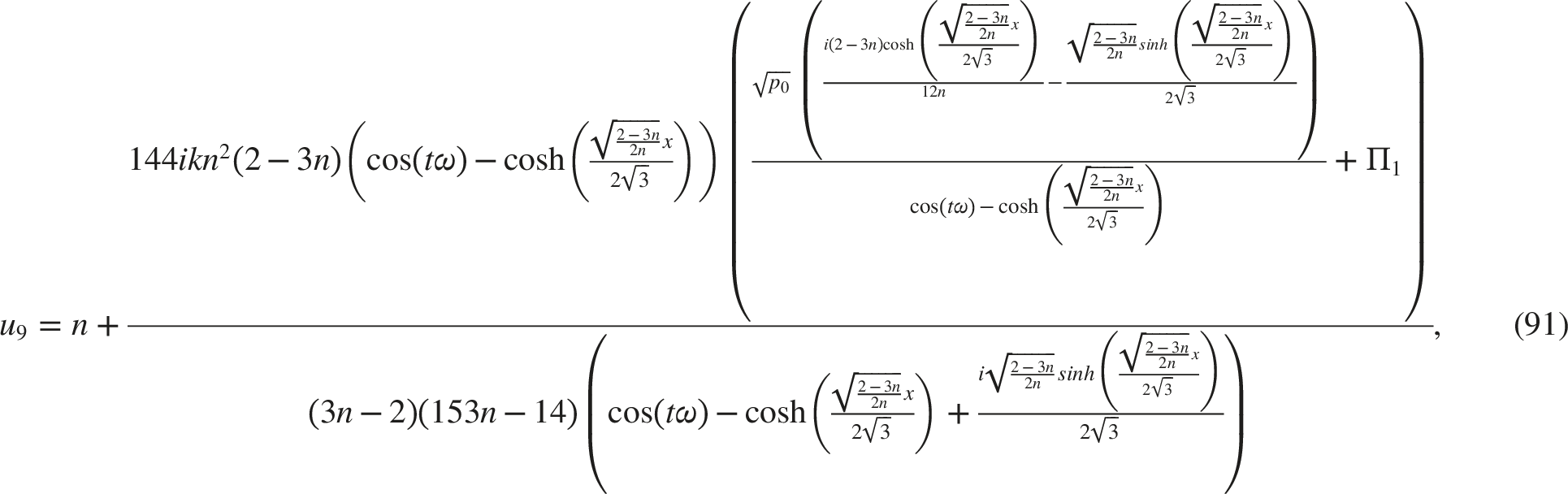
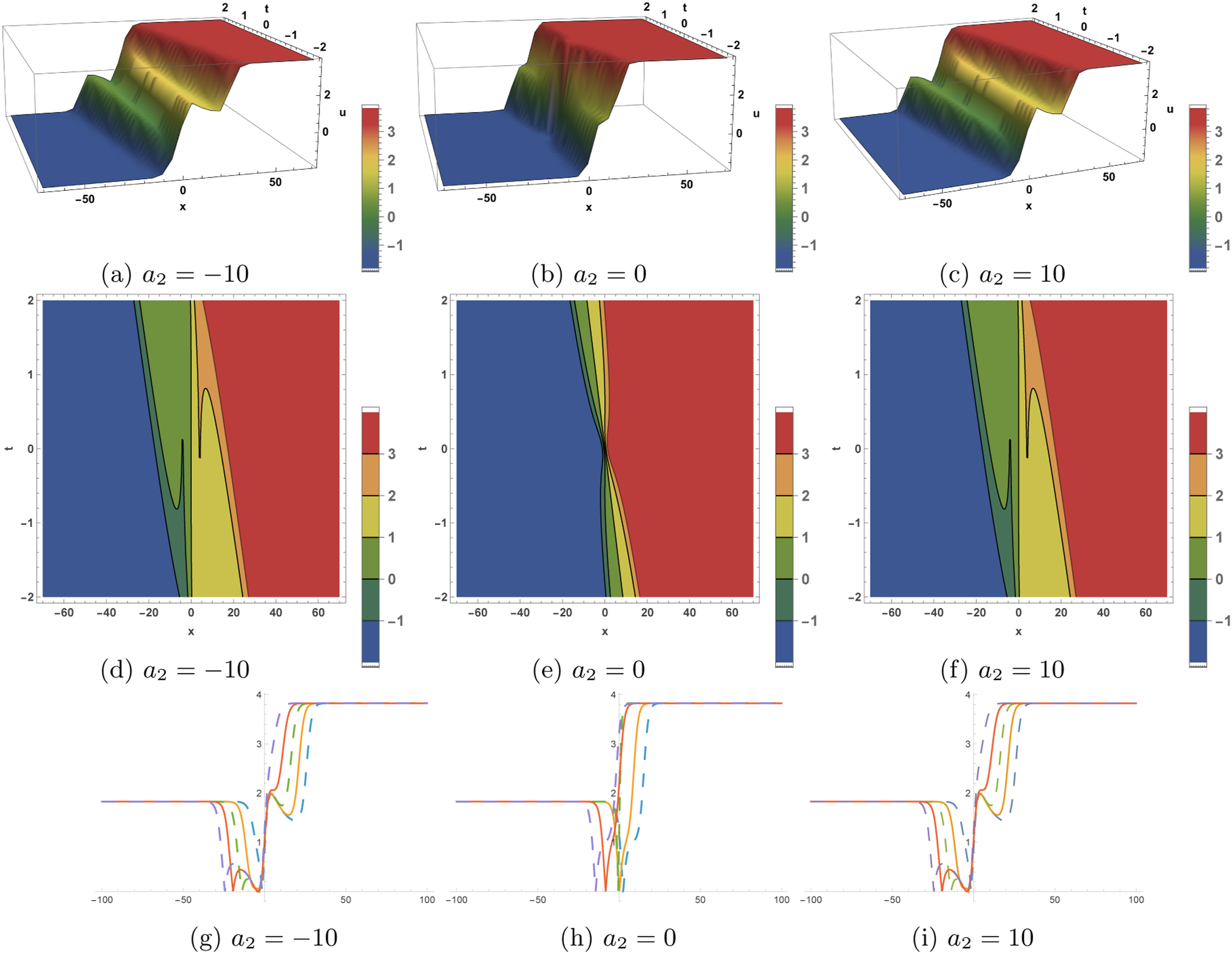
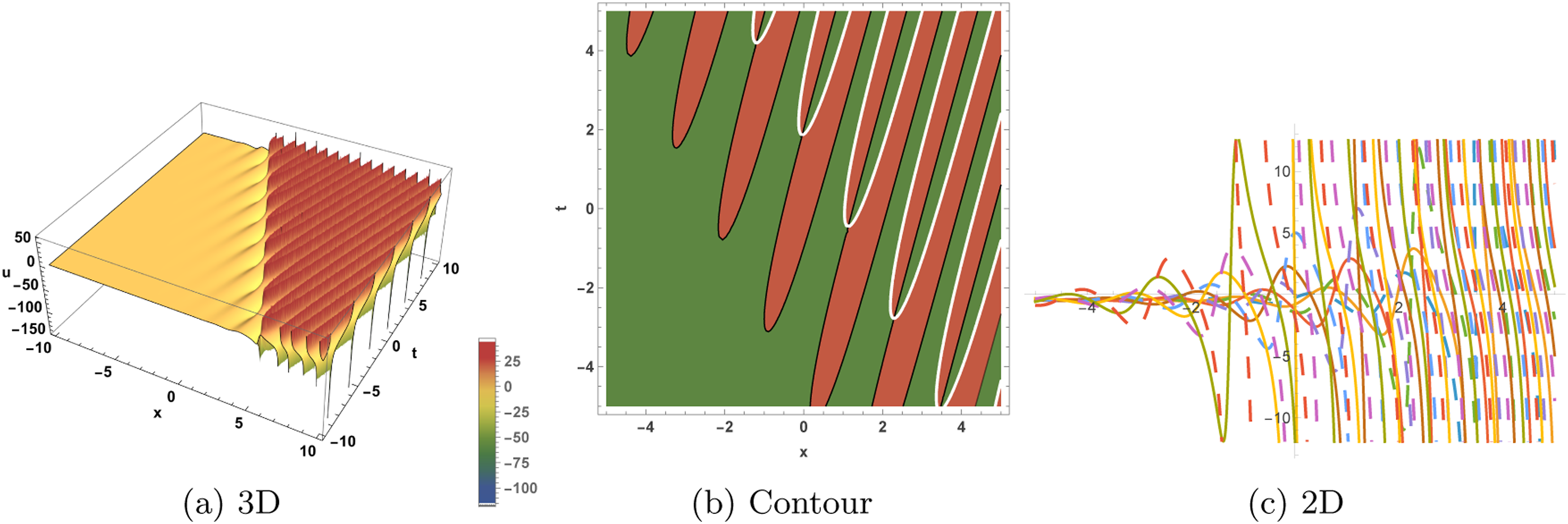
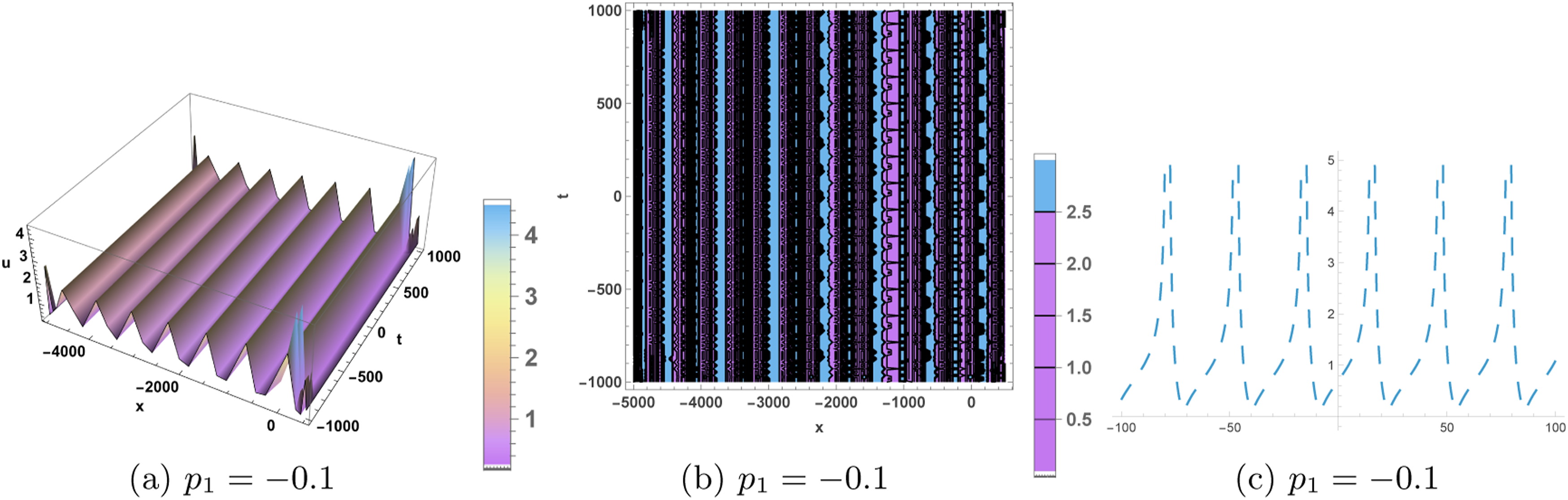
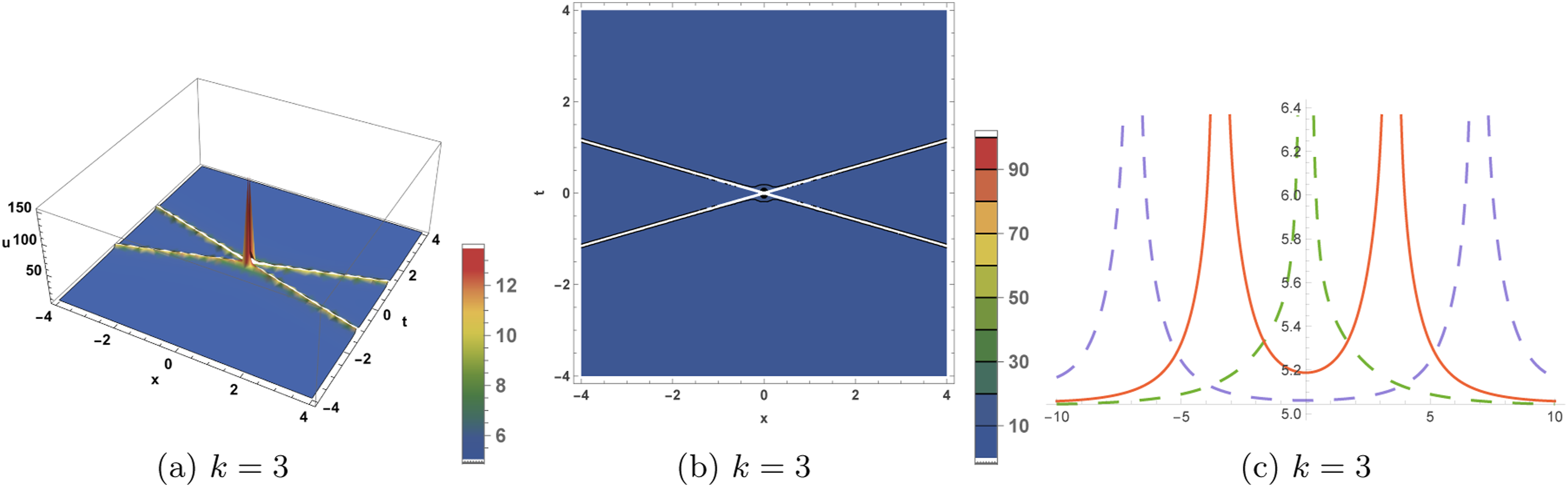
Figure 4 depicts the evolution for LP in Eq. (71) is made with p1 = 4, a4 = 3, m = 1, b1 = 1, b = −2, a5 = 2, showing the interaction between localized lump peaks and periodic wave backgrounds. The top panels (a–f) illustrate the 3D profiles, while the bottom panels (g–l) present the corresponding contour plots, highlighting the transition of periodic patterns and localization as a2 varies. Figure 5 displays evolution of rogue waves in Eq. (74) for different a2 values. (a–c) 3D profiles of u(x, t); (d–f) corresponding contour plots; (g–i) 2D views along x. a2 = −10, 0, 10 Parameters: p1 = 3, m = 1.5, b1 = 1, b = 2, a5 = 3. Figure 6 shows 3D, contour and 2D profiles of the manifold periodic solution u5(x, t) for the parameter values a1 = 1, a2 = 0.5, a3 = 0, d1 = 0.8, d2 = 1, a6 = 1, h2 = 0.5, and m = 1. (a) 3D shape at a1 = −30, (b) contour profile at a1 = −30, and (c) 2D profile at a1 = −30 respectively. Figure 7 represents 3D, contour and 2D shapes MB in Eq. (80) are formed with the value of b = 3. (a) 3D shape at p1 = −0.1, (b) contour profile at p1 = −0.1, and (c) 2D profile at p1 = −0.1 respectively. Figure 8 shows graphs for KMB (Eq. (83)) with b = 4, a1 = −5. (a) 3D shape at p1 = −0.1, (b) contour profile at p1 = −0.1, and (c) 2D profile at p1 = −0.1. Figure 9 interprets Graphs for GB in Eq. (88) with k = 10, b = 2, m = 1, σ = 0.5. (a) 3D shape, (b) contour profile, and (c) 2D profile respectively. Figure 10 displays 3D, contour and 2D shapes of AB in Eq. (91) are formed with the values of ω = 1, k = 3, m = 5, n = 10, p0 = 4. (a) 3D shape at k = 3, (b) contour profile at k = 3, and (c) 2D profile at k = 3 respectively. The evolution for LP in Eq. (71) is made with p1 = 4, a4 = 3, m = 1, b1 = 1, b = −2, a5 = 2, showing the interaction between localized lump peaks and periodic wave backgrounds. The top panels (a–f) illustrate the 3D profiles, while the bottom panels (g–l) present the corresponding contour plots, highlighting the transition of periodic patterns and localization as a2 varies. Evolution of rogue waves in Eq. (74) for different a2 values. (a–c) 3D profiles of u(x, t); (d–f) corresponding contour plots; (g–i) 2D views along x. a2 = −10, 0, 10 Parameters: p1 = 3, m = 1.5, b1 = 1, b = 2, a5 = 3. 3D, contour and 2D profiles of the manifold periodic solution u5(x, t) for the parameter values a1 = 1, a2 = 0.5, a3 = 0, d1 = 0.8, d2 = 1, a6 = 1, h2 = 0.5, and m = 1. (a) 3D shape at a1 = −30, (b) contour profile at a1 = −30, and (c) 2D profile at a1 = −30 respectively. 3D, contour and 2D shapes MB in Eq. (80) are formed with the value of b = 3. (a) 3D shape at p1 = −0.1, (b) contour profile at p1 = −0.1, and (c) 2D profile at p1 = −0.1 respectively. Graphs for KMB (Eq. (83)) with b = 4, a1 = −5. (a) 3D shape at p1 = −0.1, (b) contour profile at p1 = −0.1, and (c) 2D profile at p1 = −0.1 respectively. Graphs for GB in Eq. (88) with k = 10, b = 2, m = 1, σ = 0.5. (a) 3D shape, (b) contour profile, and (c) 2D profile respectively. 3D, contour and 2D shapes of AB and x-type wave in Eq. (91) are formed with the values of ω = 1, k = 3, m = 5, n = 10, p0 = 4. (a) 3D shape at k = 3, (b) contour profile at k = 3, and (c) 2D profile at k = 3 respectively.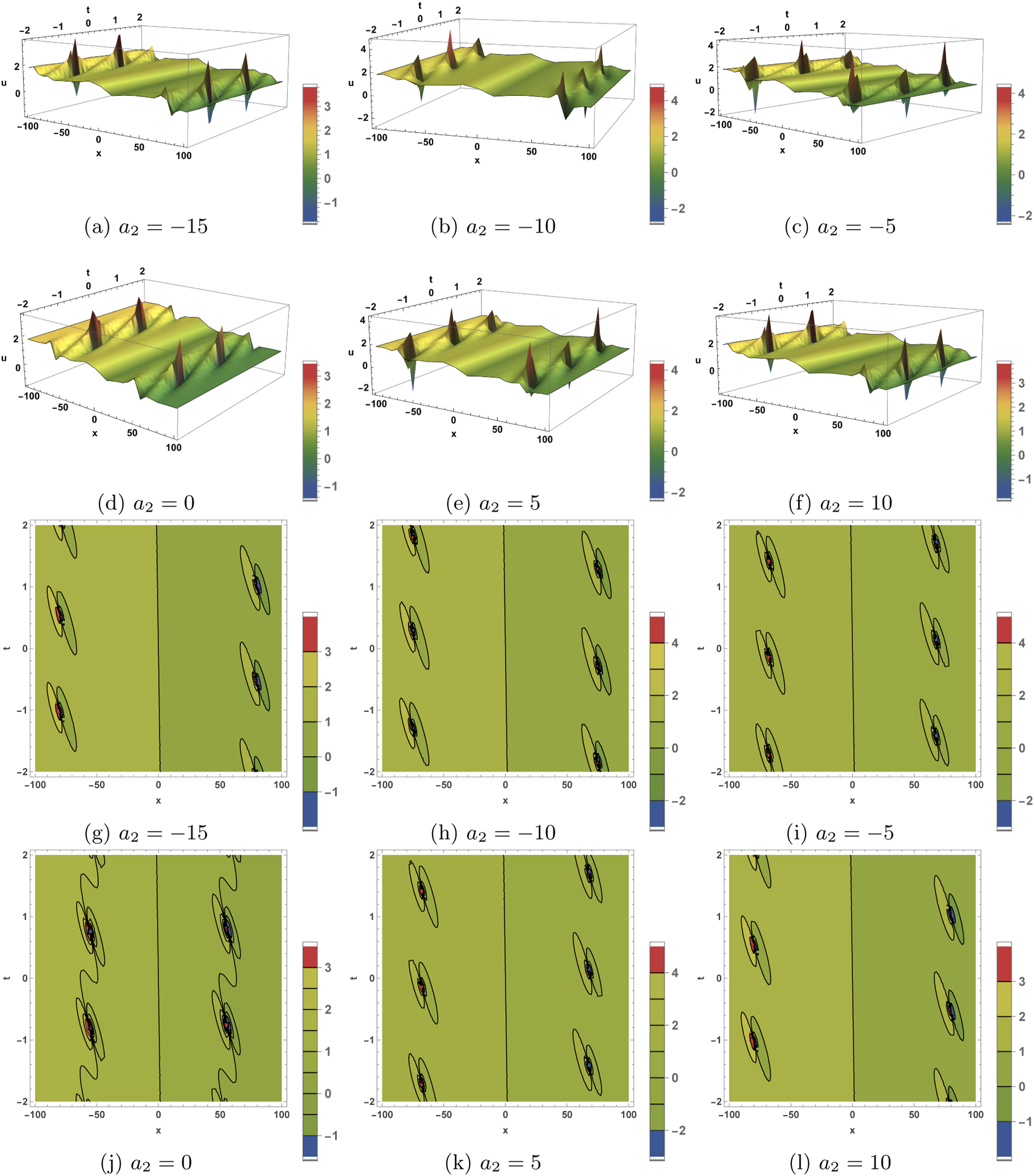


Dynamical behaviour of obtained solutions with associated parameters.
15. Concluding remarks
In this paper, we have derived a wide class of exact solutions to the generalized Fornberg–Whitham equation using the Lax pair structure, Darboux transformation, and appropriate variable transformations. The obtained solutions include one-soliton waves, breather solutions, lump structures, lump–1-strip, lump–periodic, manifold periodic, and rogue wave solutions. In particular, the existence of multiple-lump wave configurations under suitable parameter choices highlights the rich nonlinear dynamics supported by the model. Moreover, we have constructed Ma breathers, Kuznetsov–Ma breathers along with their corresponding rogue waves, as well as generalized and Akhmediev breathers. The influence of various parameters on the structure and evolution of these solutions has been illustrated through numerical visualizations, providing insight into their physical characteristics and interactions.
Despite these significant contributions, certain limitations remain in the present study. The analysis is primarily restricted to exact analytical solutions of an idealized and integrable (or near-integrable) form of the system, without considering dissipative effects, variable topography, or external forcing terms that are often present in real physical environments. Furthermore, the stability and robustness of the obtained solutions under perturbations have not been rigorously analyzed, and experimental validation or direct comparison with observational data is beyond the scope of this work.
Future research can address these limitations by extending the present framework to non-integrable, fraction gFW-equation and perturbed systems, incorporating physical effects such as viscosity, variable bathymetry, and stochastic forcing. In addition, stability analysis using spectral methods or numerical simulations would provide deeper insight into the persistence of these wave structures in realistic conditions. The development of data-driven approaches, such as machine learning techniques, may further enhance the prediction and control of extreme wave events. Finally, applying the obtained solutions to real world scenarios such as oceanic rogue waves, optical pulse propagation, and plasma wave dynamics would help bridge the gap between theoretical modeling and practical applications.
Footnotes
Ethical considerations
I declare that this manuscript represents my independent work and has been revised in accordance with the reviewers’ suggestions. Except for appropriately cited references, it contains no previously published material or contributions from other individuals or research groups.
Author contributions
Funding
The authors disclosed receipt of the following financial support for the research, authorship, and/or publication of this article: This work was supported and funded by the Deanship of Scientific Research at Imam Mohammad Ibn Saud Islamic University (IMSIU) (grant number IMSIU-DDRSP2602).
Declaration of conflicting interests
The authors declared no potential conflicts of interest with respect to the research, authorship, and/or publication of this article.