




Abstract
Police spokespersons exist at the core of organizational representation: they are selected to represent their agencies at all levels of engagement on all public platforms. Given their repeated exposure via traditional and electronic media, perceptions of spokesperson characteristics may impact perceptions of police and police organizations more broadly. Using online search queries of publicly available sources, we collected data for 612 spokespersons from 514 municipal police agencies across the United States. Our analyses reveal that spokespersons are overwhelmingly sworn, White men who are middle-aged and mid-rank. Our analyses also reveal some bivariate relationships between spokesperson characteristics (e.g., gender and employment status) and some variation among characteristics across states (e.g., Texas versus Ohio). By identifying and describing spokesperson characteristics at both national and state levels, we extend historical research regarding police spokespersons, contribute to the scholarly understanding of police representation practices, and theorize the relationships between spokespersons, organizations, and contemporary policing issues.
Introduction
The police play a particularly public role in contemporary society. Frequently observed on patrol, on television, and online, they penetrate a wide variety of social settings. Much of their (specific) responsibility for public outreach, however, falls upon the shoulders of their spokesperson(s). Police spokespersons (otherwise referred to as public information officers, press information officers, or press relations officers) are responsible for maintaining the “face” of their agencies by disseminating public information and managing press relations. For example, spokespersons participate in news interviews, manage social media accounts, write press releases, and engage with the public during community events. By nature of their duties, they often become defined as the representatives of their organizations and the first point of contact for official agency communication. This role has tremendous importance given the bureaucratic and hierarchical structure of most police agencies, where the flow of information is tightly controlled and typically released only through certain channels (which often involve the spokesperson). Although spokespersons have thus always been important in policing operations (Motschall and Cao, 2002; Surette, 2001; Surette and Richard, 1995), they have become increasingly important over the course of the past decade due to the legitimacy crisis that now exists in American policing and the resulting attention toward the police in both traditional and electronic media.
As a consequence of high-profile events involving police (e.g., the recent deaths of unarmed Black citizens at the hands of police and the associated backlash to such deaths), police agencies have increasingly found themselves in front of the media responding to claims and allegations about their policies, practices, and behaviors. As a function of the increased prevalence of these spokesperson–media interactions, and the sensitive topics in which such spokespersons have been tasked with addressing (e.g., race, use of force), the characteristics of the spokespersons themselves have become particularly salient in the broader policing equation. As very public representatives of their organizations, it is possible that spokespersons, and their characteristics, may impact citizens’ perceptions of their police agencies more broadly. For example, the appointment of predominately White male individuals to the role of spokesperson may implicitly suggest to the community that the police agency itself is largely White and male. Relatedly, the prevalence of different spokesperson characteristics may suggest different theories regarding the agency’s support for, and interest in, diversity practices. For example, the appointment of predominantly non-White and/or female individuals to the role of spokesperson may suggest to the community that the agency is more diverse in its membership and orientation, and more committed to the representation of their diverse community members, than the appointment of exclusively White and/or male spokespersons.
Considering that much exposure to the police occurs via spokespersons in the media, and spokesperson characteristics may be perceived as being deeply intertwined with the issues at the center of contemporary policing debates, like race, their characteristics may influence how citizens think about the policing institution writ large. Acknowledging their relevance to policing concerns, it is possible that police agencies may have shifted the demographics of their sworn membership, generally, and their spokesperson appointments, specifically, in attempts to enhance diversity and/or perceptions of diversity among their organizations. Such efforts would be consistent with the increasing pressure to diversify police agencies, which continues to engulf contemporary policing (Jordan et al., 2009; President’s Task Force on 21st Century Policing, 2015).
Given the important role of spokespersons in policing, and the rationale to suggest that spokesperson characteristics may have changed in recent years due to changes in the policing and media climate, there has been much need to validate previous research by exploring the characteristics of contemporary spokespersons. The present research, therefore, complements existing state-based, historical research by using a rigorous search process to document and describe the characteristics of current spokespersons from municipal police agencies across the United States. By way of contemporary validation, this research also provides insight into the characteristics of spokespersons now working amidst an era of electronic media, which has only recently attracted use among police officials and therefore has largely been absent from related, historical research. Our analyses reveal that spokespersons are typically sworn, White, middle-age, and mid-rank men. Our analyses also reveal some bivariate relationships between spokesperson characteristics (e.g., gender and employment status) and some variation among characteristics across states (e.g., Texas versus Ohio). We discuss the implications of our findings with respect to existing research, policing practice, and rhetoric regarding police diversity, representation, and organizational behavior.
Background
The role of the police spokesperson
On a daily basis, [police spokespersons] are organizational smoke detectors; in times of crises, they become fire extinguishers. (Surette and Richard, 1995: 329)
Commonly referred to as “crime news gatekeepers” (Surette and Richard, 1995: 327), spokespersons play a vital role in the functioning of police agencies. In order to disseminate information, spokespersons must establish and maintain communication with media personnel (Caeti et al., 2005; Chermak and Weiss, 2005; Cooke and Sturges, 2009; Mawby, 1999, 2002, 2014; McGovern and Lee, 2010; Meijer and Thaens, 2013; Motschall and Cao, 2002). Consistent with their position’s description, spokespersons report that their primary role is to handle media relations: as part of such role, they field media inquiries, participate in interviews, conduct news conferences, and write press releases, among other tasks (Motschall and Cao, 2002; Surette, 2001; Surette and Richard, 1995). These responsibilities are particularly important following critical incidents when public demand for information from the police exponentially increases (Caeti et al., 2005).
Although much of spokespersons’ media-relations work is reactive, many spokespersons also engage in proactive work in attempts to maintain active relationships with the media and get the good stories out first (Motschall and Cao, 2002). The types of activities that spokespersons conduct, however, often vary by the size of their agency. Past research has found that the larger the agency, the larger the communications unit, and the larger the communications unit, the more roles and techniques employed by their spokesperson(s) (Motschall and Cao, 2002). For example, larger agencies have been found to produce more press materials (e.g., newsletters) than smaller agencies because they have the resources available to generate them (Motschall and Cao, 2002). Some scholars argue that these findings suggest that police agencies are moving from a more paramilitary model of policing to a more open/service model of policing that encourages greater two-way communication with external audiences. Indeed, the principle of proactive dissemination of information without public-initiated request arguably fosters some degree of operational transparency. This concept of two-way communication is consistent with the principles of community policing which emphasizes community engagement (e.g., see Skogan, 2006) and broadens the net of police–media relations.
Police–media relations
Spokespersons are primarily responsible for managing official relations between their police agencies and media outlets. Previous research has found that this relationship between the police and the media is at least semi-symbiotic (Chermak and Weiss, 2005; Ellis and McGovern, 2016; Mawby, 1999; McGovern and Lee, 2010). Consistent with their role in disseminating information, the police report that the media provide opportunities for sharing information and managing threats to their environment. Consistent with their role in publishing news, the media report that the police provide the information that is required for them to produce stories. This bidirectional relationship positions both the police and the media to receive benefits from the symbiosis between them. 1 As expected, scholars have found that police spokespersons generally report that their relationships with the media are good and that both parties benefit from their collaboration (Ellis and McGovern, 2016; Mawby, 1999; McGovern and Lee, 2010; Surette and Richard, 1995), although this relationship can be compromised when contention or disagreement arises between them (Chermak and Weiss, 2005).
Despite seemingly equal reliance and reward for collaboration, however, the balance of power between the police and the media still ebbs and flows (Colbran, 2020; Cooke and Sturges, 2009; Ellis and McGovern, 2016; Mawby, 1999, 2014; McGovern and Lee, 2010). In fact, some scholars now argue that “the balance may have moved more in favour of the police and their ability to ‘manage’ the media” (Cooke and Sturges, 2009: 421) because of the police’s increasing ability to interact directly with the public and control their own flow of information. Through the use of electronic media, for example, the police can reduce their reliance on traditional media which would otherwise act as their conduit for information by directly disseminating their own information. Indeed, electronic media (which are often managed by spokespersons) are becoming increasingly important in the context of public–police relations because of their popularity among young, educated people as well as its ability to impact users’ confidence and satisfaction with the police (Ruddell and Jones, 2013). Electronic media are also becoming very popular among police (Crump, 2011; Heverin and Zach, 2010; Hu et al., 2018, 2020; Jeanis et al., 2019; Lieberman et al., 2013; Meijer and Thaens, 2013): 96% of surveyed police agencies in the United States now use social media in some capacity (International Association of Chiefs of Police, 2015).
For advocates who believe that traditional media help to function as a “watchdog” for police agencies, these findings regarding electronic media pose a problem: if the police no longer pass information through the media, then the police can control and monopolize the types and amount of information shared with the public. For example, by using applications like Twitter, the police can disseminate information by simply “tweeting” via their own and often widely followed accounts, and in doing so, bypass vetting and filtering of information that would otherwise be completed by third-party agencies who would historically share the information via their channels. Given the prominence and visibility that these new digital platforms now afford the police in the context of communications, the role of the spokesperson has become even more public and even more important in the broader context of police representation. If spokespersons are now responsible for maintaining an online presence in addition to their traditional media presence, then it is possible that the characteristics of spokespersons may have changed as a function of changes in duties associated with the digital age.
Police spokesperson characteristics
At the helm of police outreach activities are the spokespersons. A number of historical studies have examined the characteristics of individuals working within this role. For example, Surette and Richard (1995) surveyed police spokespersons in Florida, and found that, on average, they were college-educated, White men who were sworn officers and approximately 40 years of age. They also found that spokespersons tended to have some prior media experience (although most reported that they did not receive formal training until after becoming a spokesperson) and were often educated in criminology. When Surette (2001) re-examined the characteristics of spokespersons in Florida again in 1998, he found that their demographic characteristics had changed very little. In a later study conducted in 2000, Motschall and Cao (2002) found that, on average, spokespersons from their sample of mid-size police agencies were sworn, college-educated officers who were typically older than 40 years of age. Furthermore, the authors observed that the spokesperson position was commonly ranked higher than an entry-level position: 18% of spokespersons in their sample reported being ranked as sergeants and 47% reported that their positions were considered to be at the “management level”. Slightly more than 25% of their surveyed spokespersons also reported being civilian employees. These findings suggest two important points. First, there appears to be much stagnancy in the characteristics of police spokespersons: research has observed similar trends in demographics over time. Second, a distinction among spokespersons that may be fruitful for further research regards their employment status.
Despite sharing many demographic characteristics and being responsible for similar tasks, some heterogeneity still exists among police spokespersons. As alluded to at the conclusion of the preceding paragraph, spokespersons can be broadly divided into two employment categories: sworn officers and civilian employees. In a study of Florida police departments, Surette and Richard (1995) found that 60% of spokespersons were sworn officers and 40% were civilians. The authors also found that differences in employment status correlated with differences in characteristics and job satisfaction. For example, they found that civilian spokespersons were more likely to be female with more media-related experience and lesser salaries than their sworn counterparts, who were more likely to be male with less media-related experience and greater salaries. They also found that civilian spokespersons reported greater satisfaction with their positions than their sworn counterparts (although this finding was challenged by Surette, 2001), and that this relationship could be positively impacted by education, better relationships with the media, and higher perceived personal impact on one’s agency.
In addition to differences in employment status, police spokespersons can also differ in their professional affiliations. Surette (2001) found that spokespersons with professional affiliations were more likely to be civilian employees working in larger agencies with more interdisciplinary backgrounds (e.g., law, sociology) than their non-member counterparts, who were more likely to be sworn officers with criminal justice backgrounds, as described by Surette and Richard (1995). Spokespersons with professional affiliations were also more likely to have more expansive roles than their non-member counterparts, and arrange news interviews, reply to media inquiries, and respond to public requests more frequently than non-members.
Overview of the present research
Past research has been instrumental in describing police spokespersons, their role in policing operations, and their relationship with the media. However, as described at the outset of this article, much has changed in policing in recent years. Not only are police now much more active on social media and related electronic platforms, but they are also under much more scrutiny and public pressure to address problematic race relations. One central tenant that has derived from such scrutiny and pressure has regarded the diversification of police agencies (which remain primarily White and male even in the current era). Indeed, the President’s Task Force on 21st Century Policing (2015: 90) recently recommended that, law enforcement agencies should strive to create a workforce that encompasses a broad range of diversity including race, gender, language, life experience, and cultural background to improve understanding and effectiveness in dealing with all communities.
Historical research cannot account for these recent changes in the policing and media landscapes: although past studies can be used to help predict some characteristics of current spokespersons, contemporary research is required to empirically validate their findings. From a validation perspective, documenting and describing the characteristics of individuals currently serving in this public role is thus particularly important for understanding modern police representation practices and perceptions of police and their organizations, especially given the current climate in which a legitimacy crisis pervades police activities and the media’s coverage of such activities. Under the guise of this framework, this research investigates two primary questions. First, what is the typical employment status, rank, gender, race, and age of contemporary police spokespersons in the United States? Second, does variation exist among police spokespersons across states (e.g., Texas versus Ohio) and/or between characteristics (e.g., gender and employment status)? In order to investigate these questions, we construct and then interrogate a primary data set of police spokespersons from municipal police agencies across the United States.
Data
In order to explore the demographic characteristics of police spokespersons across the United States, we constructed a primary data set of spokesperson characteristics using a stratified search strategy. First, we identified cities in the largest counties in each of the 50 states, 2 which resulted in an initial sample of 1,815 cities in 242 counties. Next, we identified which cities included in this initial sample were policed by sheriff’s agencies so that such cities could be excluded from our analyses. 3 This exclusion resulted in a final sample of 1,377 eligible cities in 227 counties. Finally, we attempted to locate spokesperson data for the municipal police agencies in these eligible cities using the strategy outlined below. In total, we located data for 612 spokespersons from 514 municipal police agencies in 47 states (some agencies had multiple spokespersons). 4
Methods
Search strategy
A team of seven researchers began the data collection process by using Internet search engines to locate the full name of the spokesperson(s) for the municipal police agency in each city. Search terms included, [Agency] “Media Spokesperson”, “Press Information Officer”, “Public Information Officer”, “PIO”, “Public Relations Officer”, and “Spokesperson”. When searching for the identity of the spokesperson(s), researchers prioritized information from primary sources, such as official agency and city websites, press releases, and agency-sponsored social media accounts. In the event that spokesperson identities could not be found from primary sources, researchers used information from secondary sources, such as news and non-sponsored social media accounts. In the context of news, researchers reviewed online articles as well as news videos. In the context of social media, researchers reviewed accounts on Twitter, Facebook, Instagram, LinkedIn, and YouTube. Once researchers located a spokesperson’s identity, they then revisited their searches using the identified particulars to attempt to cross-validate the information using additional sources.
Once a spokesperson’s identity was validated, researchers attempted to locate additional information on them, including their rank and employment status. Such information was often derived from descriptions of their identity: e.g. [rank] name. If the spokesperson was identified as a rank, such information was collected to be included in the rank variable. And if the spokesperson had a sworn rank, their sworn status was assumed (e.g., Officer [name] would be considered sworn). If his or her identity was not paired with a rank, researchers conducted additional searches to assess if the spokesperson was sworn or civilian. At this point, researchers also attempted to locate a photograph of the spokesperson to validate their rank and employment status information as well as code for the subjective characteristics of gender, race, and age.
The search process for spokesperson photographs mirrored the initial search process for spokesperson identities. Once a photograph was located, researchers attempted to verify that the pictured individual was the spokesperson of interest by visually inspecting the name tag on their uniform (if present), the backdrop and caption of the photograph, as well as the text of the associated article and introductions in the associated video. Of the 612 identified spokespersons, we located photographs for 565. We saved the photographs or screenshots from videos of these spokespersons for subsequent coding (as outlined in the following section).
We argue that our approach to identifying and collecting data on spokespersons mirrors the process by which citizens would identify and collect data on the same spokespersons (whom they otherwise would not have access to survey, interview, etc.), although our approach was more systematic than that likely employed by the general public. If we could not identify the spokespersons via our rigorous search strategy, we argue that citizens would not likely be exposed to them either, and therefore, their characteristics would not exhibit the same potential perceptual effects as spokespersons who could more readily be identified via public search strategies.
Coding strategy
Once spokespersons were identified and their photographs were collected, a team of seven researchers coded the subjective characteristics of each spokesperson. The coders represented a diverse array of demographics: five identified as female, two identified as male, two identified as Asian, two identified as Hispanic, two identified as White, and one identified as Pacific Islander. During the coding process, photographs of each of the spokespersons were projected onto a large screen at the front of the room. Once projected, each coder independently classified the spokesperson’s gender, race, and age. Coders were kept blind to each other’s responses. After all the photographs were coded, the primary investigator then combined each of the independent coders’ responses and calculated their percent agreement and interrater reliability using the Kappa statistic in Stata. This statistic was appropriate given that all observations and coders were independent.
For gender, the percent agreement was 0.99 (p < 0.001) and the Kappa value was 0.97 (p < 0.001). For race, the percent agreement was 0.87 (p < 0.001) and the Kappa value was 0.68 (p < 0.001). Both values suggest high interrater agreement among coders and therefore we retained the modal response for our analyses. For age, which had a much larger array of potential response options, the percent agreement was 0.46 (p < 0.001) and the combined Kappa value was 0.2 (p < 0.001). As a consequence, we used the average of the age responses provided by the coders for our analyses (rather than the modal response).
Variables
We use five variables to measure characteristics of police spokespersons: (1) employment status, (2) rank, (3) gender, (4) race, and (5) age. Employment status is a nominal variable with two response categories (0 = sworn; 1 = civilian). Rank is an ordinal variable with seven response categories, with higher values indicating higher rank (1 = officer; 2 = corporal; 3 = detective; 4 = sergeant; 5 = lieutenant; 6 = captain; 7 = commander). Gender is a nominal variable with two response categories (0 = male; 1 = female). Race is a nominal variable with four response categories (1 = Asian; 2 = Black; 3 = Hispanic; 4 = White). Age is a ratio variable which represents the average of all coders’ independent judgments.
Results
The present research sought to assess the characteristics of police spokespersons across the United States. Most data regarding objective characteristics (e.g., employment status, rank) were obtained via official agency websites (51%) or news sources (42%). Most data regarding subjective characteristics (e.g., photographs for gender, race, and age assessments) were obtained via news sources (44%), social media (32%), or official agency websites (15%).
As shown in Table 1, our descriptive analyses reveal several interesting patterns. For example, 80% of spokespersons are coded as sworn. Of such sworn spokespersons (with rank information; n = 483), 25% are coded as officers, 2% are coded as corporals, 5% are coded as detectives, 30% are coded as sergeants, 24% are coded as lieutenants, 10% are coded as captains, and 3% are coded as commanders. In terms of demographics, most spokespersons are coded as male (75%) and White (79%). Following White, most spokespersons are coded as either Hispanic (11%) or Black (8%). Only 2% of spokespersons are coded as Asian. The mean age of coded spokespersons is 39.4.
Descriptive statistics of police spokespersons, aggregated to the national-level.

a Photographs of 47 identified spokespersons could not be located and therefore could not be coded for subjective characteristics.
Our bivariate analyses shed further insight into the relationships between spokesperson characteristics. For example, there is a strong positive relationship between employment status and gender (r = 0.473; p < 0.001), such that male spokespersons are more likely to be sworn whereas female spokespersons are more likely to be civilian. There are also negative correlations between spokesperson gender and rank (r = −0.227; p < 0.001) as well as age (r = −0.392, p < 0.001), suggesting that female spokespersons are likely to be of lower rank and age than their male counterparts. In terms of race, there is a small positive correlation between spokesperson rank and being White (r = 0.148; p < 0.01), suggesting that White spokespersons are likely to be of higher rank than their non-White counterparts.
As shown in Table 2, some geographic variation also exists among spokesperson characteristics. For example, spokespersons in Texas (where 70% are sworn) appear to be particularly diverse: 45% of spokespersons are coded as female, 29% of spokespersons are coded as Hispanic, and 26% of spokespersons are coded as Black. Spokespersons in Florida (where 65% are sworn) appear similarly diverse: 30% are coded as female, 15% are coded as Black, and 9% are coded as Hispanic. Spokespersons in Washington (where 74% are sworn) appear more diverse in terms of gender but less diverse in terms of race: 37% of spokespersons are coded as female and 90% are coded as White. Spokespersons in Ohio and Iowa, on the other hand, are particularly non-diverse. In terms of the former, 93% of spokespersons are coded as male and 97% are coded as White. In terms of the latter, 85% of spokespersons are coded as male and 92% are coded as White.
Descriptive statistics of police spokespersons, aggregated to the state-level.
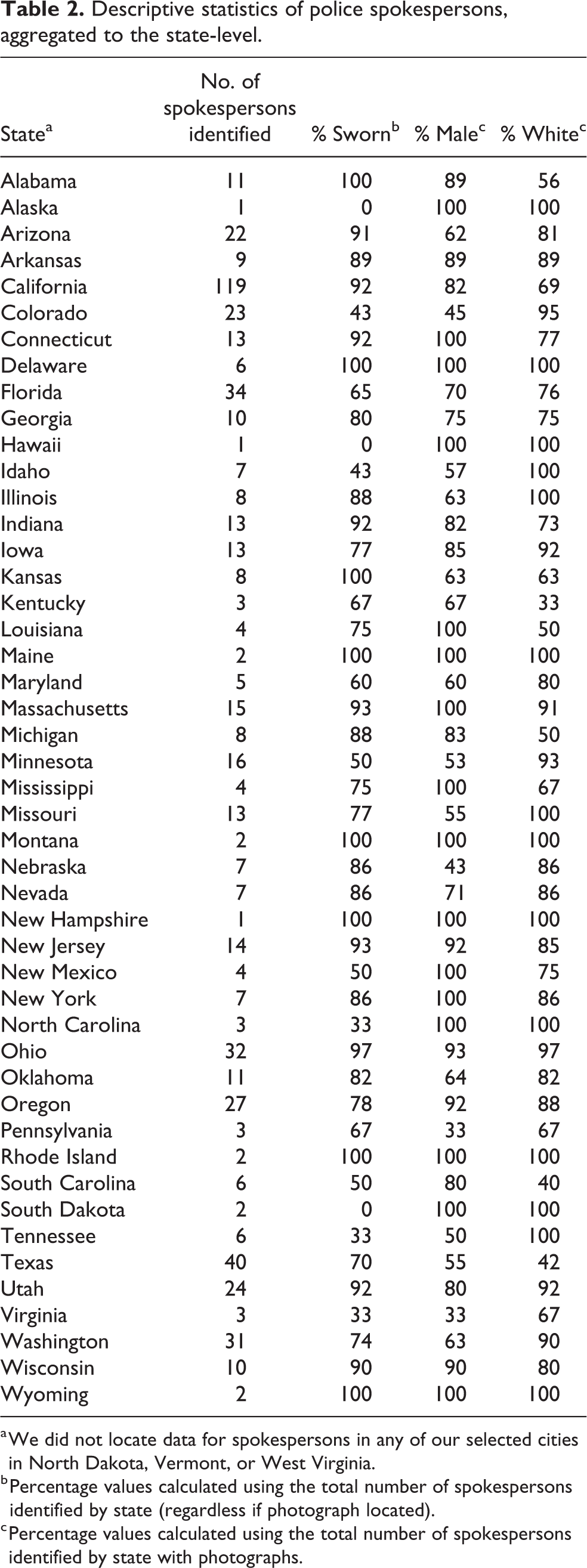
a We did not locate data for spokespersons in any of our selected cities in North Dakota, Vermont, or West Virginia.
b Percentage values calculated using the total number of spokespersons identified by state (regardless if photograph located).
c Percentage values calculated using the total number of spokespersons identified by state with photographs.
Discussion
Policing in the United States has experienced much change in recent years. Confronted with a legitimacy crisis, police agencies across the country have been tasked with identifying, addressing, and managing tense and often problematic relations with their communities, and particularly, minority communities. Much of this strain has been reflected in the increasing attention toward police in the media and the associated demand for the police to publicly address their problematic relations via their outreach strategies. In response to public concern, many law enforcement and government officials have advocated for the diversification of police agencies: as a function of discourse and policy, many agencies have tried to diversify their membership in order to make their organizations more representative of their communities. Many of these agencies have also tried to increase outreach to their communities regarding acknowledgment of their problematic practices and their attempts to reconcile them through the use of public campaigns and new forms of electronic media. Although these attempts may have succeeded in hiring and retaining more minority officers (although such success has arguably been limited; Reaves, 2015), the results from the present research suggest that they have not impacted representation practices.
Consistent with historical research (Surette and Richard, 1995), we find that White men continue to dominate the role of the spokesperson in municipal police agencies. Moreover, and again consistent with past research (Motschall and Cao, 2002; Surette, 2001; Surette and Richard, 1995), we find that spokespersons continue to be sworn, middle-aged, and mid-rank (although some variation does exist at the state-level). The consistency in spokesperson characteristics over time reaffirms the alleged stagnancy of policing operations. The gap between policy (e.g., active attempts to hire and retain minority officers) and practice (e.g., representation of those minority officers) continues to persist in contemporary policing, despite practitioners’ and policy-makers’ attempts to dissolve it. Although much in policing and the media’s coverage of such policing has changed, spokesperson characteristics have not. Considering the institutional power of the police, the persistence of White male representatives in increasingly diverse communities poses a number of unique challenges and questions for public–police relations.
Considering that many observations of the police occur via the media, these findings have relevance for broader policing debates. Few people in most places have much direct or formal contact with the police outside of the media. With that being said, the types of officers whom citizens may observe and interact with via the media are not random: most officers within most agencies do not act as spokespersons for their agencies. Indeed, many agencies restrict their officers’ ability to speak with the media, often instructing them to refer media outlets to their dedicated spokesperson(s) when requested to comment. Most agencies also explicitly charge their spokesperson(s) with managing their social media platforms (as evidenced by the proportion of spokesperson information located via social media as part of the present research), which are now salient conduits by which police engage with citizens. In doing so, spokespersons become important gatekeepers for their organizations.
As a result, citizens may derive judgments about police generally based on their spokesperson(s) specifically. For example, repeated exposure to minority spokespersons via the media may lead the public to potentially assume that agencies employ greater numbers of minority officers than actually employed. By contrast, repeated exposure to non-minority spokespersons may reaffirm the public’s belief that police agencies continue to be dominated by White male officers. Past research has demonstrated that merely observing police officers of different gender and racial identities absent contact and/or contextual information can impact public perceptions of them (Simpson, 2017). If police agencies wish to be representative of their communities, they must consider how their key representation role (i.e., their spokesperson) may influence citizens’ perceptions of their organizational representativeness.
From an organizational perspective, it is important to note that spokespersons may vary as a function of an agency’s demographic composition, which is an important area for future research. For example, one could predict a positive correlation between minority membership and a minority spokesperson: the greater number of minority officers employed by an agency, the greater the odds of having a minority spokesperson, and vice versa, by nature of probability. On the other hand, one could predict an inverse correlation between minority membership and a minority spokesperson: the fewer minority officers employed by an agency, the greater the odds of having a minority spokesperson if agency executives want to enhance the public visibility of their minority officers. Such hypotheses reaffirm the importance of studying the role of organizational membership on perceptions of police and practices of police more broadly. It is possible that representation of minority officers by police agencies may lead to greater interest in policing careers among minority citizens and vice versa. It is also possible that greater perceived representation of diversity within a police agency could change residents’ perceptions of such agency. In this vein, future research would benefit from more qualitative analyses of the mechanisms and organizational rationales surrounding spokesperson selection.
Limitations
This research exhibits several limitations. First, the coding of spokesperson demographics was subjective. Instead of surveying spokespersons directly, a team of researchers conducted online searches and reviewed photographs of spokespersons to derive judgments about their characteristics. Although such a technique may have introduced some measurement error into the analyses, we believe that such error may have been mitigated by two factors. First, the subjective coding process was completed independently and systematically by a diverse array of coders who represented multiple gender and racial identities. Moreover, the seven coders exhibited much agreement in their judgments of subjective characteristics, which suggests that their responses may be more reflective of the broader population than any one particular coder. Second, this approach mirrors the process by which citizens may derive conclusions about spokesperson characteristics: when observing a spokesperson via the media, citizens are unable to survey the spokesperson directly to confirm information and so they are forced to make similar perceptual categorizations without necessarily factual information. As such, we believe that our approach was well suited for our research questions.
Second, we excluded spokespersons from sheriff’s agencies for the present research. Although such spokespersons may exhibit different characteristics from their municipal counterparts, we did not believe that it was appropriate to include them due to differences in their organizational structures. Future research may benefit from analyses of sheriff’s agencies and their representation practices.
Third, we used a stratified search strategy: we included only cities from the largest counties within each of the states for possible spokesperson identification. As a consequence, the results from this research are limited to large(r) agencies; albeit such agencies are located throughout the country rather than just in a specific state (as often observed in historical research). It is possible that spokespersons from smaller agencies may exhibit different characteristics than larger agencies, although it is unlikely that many small agencies have dedicated spokespersons, thus minimizing the potential effect of such exclusion on the implications of our results. Our focus on police agencies in larger cities is also generally consistent with related research.
Conclusion
Police spokespersons exist at the core of organizational representation: they are selected to represent their agencies at all levels of engagement on all public platforms. Understanding the characteristics of the individuals selected for this particularly public position may thus provide utility for understanding perceptions of police organizations. Given their repeated exposure via traditional and electronic media, perceptions of spokesperson characteristics may impact perceptions of police characteristics more broadly, which could be important given that the role of the police spokesperson continues to be dominated by sworn, White, middle-age, and mid-rank men. Future research should continue to explore both the mechanisms surrounding spokesperson selection and the broader perceptual effects of spokesperson characteristics.
Footnotes
Acknowledgements
This project represents the culmination of work by an interdisciplinary team of faculty, graduate, postbaccalaureate, and undergraduate researchers. The authors would like to thank Amy Bennett, Joanna Fagan, Xiao Li, Guadalupe Martinez, and Tam Vu for their help collecting data. The authors would also like to thank Justin Burba, Brenda Garcia, Victoria Maldonado, Olga Pankiv, Sarai Schulthess, and Tristan Yang for their assistance coding photographs.
Declaration of conflicting interests
The author(s) declared no potential conflicts of interest with respect to the research, authorship, and/or publication of this article.
Funding
The author(s) received no financial support for the research, authorship, and/or publication of this article.
