




Abstract
The relationship between ethnic–racial cultural communities and the Finnish police is evolving, and relatively little research is available within the criminal justice system that highlights police practices and behaviour towards ethnic and racial cultural in Finland. There is also a lack of scientific certainty about how to assess ethnic and racial cultural’ experiences of fair, unfair and impolite treatment by the police. The available research suggests that the experiences of Black and other ethnic–racial cultural groups in the criminal justice system differs from that of the ethnic majority population, and this tends to increase the tense relationship between the police and ethnic–racial cultural communities. The data on which this article is based were collected between April 2013 and July 2015 among ethnic and racial cultural groups from three different sites to explore ethnic cultural perceptions of legal authority in Finland. The experiences of 205 people with a cultural ethnic background were used to examine ethnic–racial cultural views on four types of police behaviour—respect, fairness, politeness and courtesy—in deciding whether to trust or distrust the police. We compared adverse encounters between members of ethnic and racial cultural communities and the police using a mixed-methods approach to procedural justice in a questionnaire and face-to-face interviews. The study indicates that hostile police humour contributes to a negative attitude, fear and lack of trust towards the police, whereas every respectful interaction brings about a positive attitude.
Introduction
Over the past decades across Europe, various strategies have been used to conceptualise theoretical and normative responses to the challenges of value conflicts in ethnic–racial cultural and majority relations within society (Schwartz and Bardi, 2001; Schwartz and Bilsky, 1990). One recurring issue is the need to clarify the ethical principles held by public authorities and their representatives if they are to accommodate a specific recognition advanced by individuals from cultural communities (ethnic, religious, sexual and cultural) who have experienced certain disadvantages within society. Furthermore, disrespect is a complex issue that incorporates elements of several correlated constructs such as politeness and formality; when practised or miscommunicated, disrespect denotes distaste and dislike to those at whom it is directed. Moreover, Finnish society, like many others, nurtures a contradictory view of disrespect, in that citizens’ respect for a public institution such as the police traditionally depends on whether the agency is evaluated positively or negatively. Routine police work requires that officers instruct citizens to do things that they would rather not do; this is especially the case during street-level encounters between the police and cultural communities (Mastrofski et al., 2002).
In most cases, the societal norm is to treat people based on their social, cultural and economic status, although the police are held to a higher standard. This is why ethnic–racial cultural communities are sensitive to being disrespected by the police. Despite this, ethnic–racial cultural expect the police to respond with civility in any interaction or encounter.
The principles of respect, fairness and politeness go a long way in helping to build trust in any relationship with public officials, be it an interaction or encounter, and respect towards an individual can be a precondition for distributive policies in meeting the needs of ethnic–racial cultural groups. In addition, the equal distribution of respect to all in society should be at the forefront of fighting injustice due to discrimination and racial bias. Moreover, there has been a deterioration in relations between the police and ethnic–racial cultural communities, as exemplified by tension and mistrust between the police and ethnic–racial cultural communities from Europe to the USA (Brown and Benedict, 2002; Weitzer and Tuch 2006).
Social scientists have posited that principles that profess fairness and politeness can influence respect between the police and ethnic–racial cultural communities in a given country. According to Bosworth (2000), tension and challenges exist in the relationship between race, ethnicity and punishment, given the vast differences that exist in many societies. Thus, interactions between ethnic–racial cultural communities and the police, who are the gatekeepers of the criminal justice system, tend to be viewed as less favourable by members of those communities. In addition, differential treatment and a lack of respect towards ethnic–racial cultural reduce that group’s sense of procedural justice and fairness. When such behaviour is accepted, it can also lead to reduced willingness among members of ethnic–racial cultural communities to cooperate with the police. Disrespect can also increase resistance on the part of ethnic–racial cultural communities, making it difficult for the police to carry out their official duties (Mastrofski 2002). Finally, restrictive immigration policies in Finland tend to create an ideological climate in which cultural ethnic groups are seen as lazy, aggressive or a potential threat to Finnish cultural values (Egharevba, 2014 ; Egharevba and Hannikainen, 2005 ).
In other words, there is a need to address the disadvantages experienced by ethnic–racial cultural communities in terms of recognising their worth as equal citizens. According to Anderson (1999), recognition is a precondition of distributive processes in which all are equal in moral status, irrespective of economic or social status. The question is, what influences how and when specific behaviour is tolerated? Knowing these issues/challenges could help with the effectiveness and fairness of crime control, as stressed by scholars of political philosophy. Indeed, our understanding of specific recognition, as advanced by individuals who have most experience of disadvantages within society, such as ethnic cultural communities, should help our understanding of their experiences within the community. Achieving effectiveness and fairness also depends on police officer education and experiences in carrying out their legitimate duties, in as much as they will adhere to the highest standard in their professional code of conduct.
Having said this, what causes police officers to be impolite towards a particular group of people and what type of behaviour needs to be exhibited by such a person to avoid precipitating police disrespect? To answer these questions, we first need to understand the situational aspect of the police/citizen encounter. We should remember that police officers are uniquely bound to one another, sharing common beliefs and attitudes about their work, themselves and those they police. This is common in police organisational culture, of which solidarity, loyalty, isolation from the public, secrecy and stereotyping of citizens are part (Skolnick, 1975; Van Maanen, 1974). Police officers often socialise together, so there is a high degree of loyalty and solidarity in protecting their own, the so-called ‘blue wall of silence’. In particular, use of racial abuse in maintaining the racial hierarchy by linking those that are different to criminality devalues the lives of people from ethnic–racial cultural groups across Europe. This police practice restricts how ethnic–racial cultural groups in many countries are viewed, and is seen in unjust and bias street stops, searches, the use of racial profiling and being suspicious of ethnic–racial cultural groups at all times. These factors lead to racial preferences, given how long racism has been part of the social fabric of the police (Egharevba, 2009, 2017, 2018).
Another good example is the general feeling among ethnic–racial cultural communities that their presence is often taken as a threat to police officers, and some officers personify this as personal insecurity and inequality. This may not be the general view/opinion of all police officers. However, many are ready and willing to protect their biased and discriminatory attitudes as a reminder of who is the boss on the street. Some of these practices and behaviours tend to harden/amplify a general lack of trust and distrust of the police among ethnic–racial cultural communities (Perry, 2001; Punch, 2003; Weitzer and Tuch, 2006).
Another worrisome trend affecting ethnic–racial cultural community views of the police is the killing in the USA of Michael Brown (Ferguson, Missouri, 2014), Jemel Roberson (Oak Lawn, Illinois, 2018) and Tamir Rice (Cleveland, Ohio, 2014), in the UK of Richard Cottier (London, 2018) and Spencer Ashworth (Portishead, 2017), and Canada of James Daniel McIntyre (British Columbia, 2015), Ozama Shaw (Mississauga, Ontario, 2017) and Stacey Perry (Calgary Alberta, 2018). In all these cases, there is evidence of the misuse of excessive force by the police, and an abuse of police power and disrespect towards ethnic–racial cultural groups during police interactions (Durán, 2008). Available research shows that disrespectful police encounters with ethnic–racial cultural communities are problematic (Geller and Tuch, 1996), especially as such encounters and interactions with the police often result in physical and emotional harm and humiliation, contributing to ethnic–racial cultural groups having a negative attitude towards authority (Brown and Bennedict, 2002). It is not surprising that there remains a profound gap between ethnic–racial majority and cultural communities in terms of employment, wealth accruement, health care and educational attainment. Hence, the use of excessive force is understood by ethnic–racial cultural as evidence of police bias (Flanagan and Vaughn, 1996). Any negative attitude observed in an interaction between the police and an ethnic–racial cultural group tends to undermine any respect those communities may have for the police as an institution.
The aim of this article is to explore encounters between members of ethnic–racial cultural communities and the police within a framework of critical race theory (Delgado, 1982; Matsuda, 2018). We use a sample of illustrative cases and other behavioural science to gain insight into racial practices within the police organisation, and the effects of these interactions on members of ethnic–racial cultural communities. We specifically examine respect, fairness and politeness, and whether police use of discretion creates more challenges in their interaction with ethnic–racial cultural communities in terms of how law enforcement is understood by those being policed. The experiences of 205 people with an ethnic and racial cultural background are used to assess what they consider to be respectful and disrespectful police behaviour using the procedural justice model (Tyler, 2006). We explore the frequency of discourteous police behaviour (verbal or physical) in street-level encounters, and explore how these negative experiences contribute to ethnic and racial cultural group attitudes towards the police in general. This study was undertaken because a lack of this knowledge may hamper the pursuit of equality in Finland.
Cultural groups and police disrespect
The issue of respect for cultural groups and their relationship with the police should be viewed as ‘cultural denoting a social category applicable to groups of individuals living in a given community with traits (ethnical, religious sexual and cultural) that can be differentiated from or defined in relation to a given majority that resides in the same community either in’, i.e. geographical, political boundaries. In other words, a cultural group is one that does not share the grounded stability of public recognition within a specific context by having less power and lower social status than the majority group in terms of roles, positions and social control. The cultural group has limited access to material and non-material resources. New additions to this group are migrants, and ethnic and religious cultural with a history of discrimination and lack of adequate participation in the political process.
Police disrespect
Theoretically, the behaviour of the state’s legal agent is the focus of our analysis in what Donald Black (1980) terms ‘penal style’, a system of defining those that violate/disobey the law of the land and who deserve to be sanctioned. The degree of sanction attached to a given offence or disobedience is culture-bound, for example, cultural groups see themselves as having limited standing with police officers because of the in the ways in which the police treat ethnic cultural citizenst. This type of conduct leads to a lack of confidence in the police on the part of ethnic cultural as they continue to question the integrity of officers (Anderson, 2011; Durán, 2008; Tyler, 2006). Thus, we need to examine perceptions of disrespectful police behaviour among ethnic cultural in Finland. What is more disturbing is humour about Black citizens committing more crimes, thereby equating and rationalising the police voice through racial humour. The question is, how does racial humour function culturally and symbolically among police officers in terms of their behaviour in violent police–citizen encounters? To answer this, we need to focus on available research on racist humour within police culture. Bolton and Feagin (2004) define racist police humour as police jokes that negatively portray racial and ethnic cultural as inferior, aggressive and lazy, as well as being the object of symbolic and cultural ridicule and violence (Anderson 2015; Bolton and Feagin, 2004; Perez, 2017).
Furthermore, if we examine Bourdieu’s (2001) notion of symbolic violence, we would argue that racist humour in the police is a normative orientation of racism and racial abuse in policing, helping to foster the social acceptability of prejudice and discrimination among rank and file officers, thereby dehumanising and legitimising abuse of the rights of ethnic–racial cultural individuals within society (Galtung, 1990). Humour studies focus on inclusive jokes that bring about a positive effect of humour, for example, social affiliation (Billig, 2005; Morreall, 2009), whereas critical humour studies depict disparaging humour and ridicule the construction of social hierarchies and inequalities, in particular in race and gender (Lockyer and Pickering, 2005; Weaver, 2011). These studies are consistent with critical race theories, in recognising that racial jokes belittle those at whom they are directed (Delgado, 1982). However, in many police organisations, the use of racist language is prohibited. Our discursive use of abusive language in racial jokes seems to have received less scrutiny than the use of excessive force, violence and the abuse of police authority that constitute these outcomes (Chow, 1992). Racist humour is often categorised as ‘unserious’ speech that is detached from police behaviour (Waddington, 1999) or as a useful way of ‘letting off steam’. This type of practice is categorised as a mechanism of alienation and legal estrangement (Bell, 2016) that facilitates a well-known problem of police denial of equal protection and representation (Cashmore, 2010). The most recent research suggests that the cognitive and psychobiological effects of ‘affiliative’ humour and laughter can elevate levels of neuropeptide and opiates in the body, which in turn reduce stress, increase pain thresholds and facilitate group formation (Manninen et al., 2017).
Furthermore, in police work, a significant amount of time is devoted to the exercise of discretion. This becomes a challenge it is done in a way that ethnic cultural see as being at odds with their interests, and is aggravated by the over-representation of ethnic and racial cultural within the criminal justice system through the process of stop and search. This appears to be linked to perceptions of unequal treatment, a lack of respect and courtesy from the police, which tend to reduce the confidence ethnic cultural have in authority. It is almost impossible for the police to fight crime without the citizen cooperation. Hence, it is crucial to explore why individuals are willing to report a crime, provide information to resolve and prevent crime, and at the same time be prepared to testify in court as premised by procedural justice theory (Huq et al., 2017; Sunshine and Tyler 2003; Tyler, 2006).
Moreover, research on procedural justice suggests that these are normative reasons why citizens cooperate with the police. This cooperation is possible only when a citizen perceives the police as a legitimate institution. Of course, there are also risks and benefits to proactive support for the police, it all depends on the style of policing, how citizens are treated, and how decisions are made in police–citizen interactions and encounters (Murphy and Cherney, 2012; Sunshine and Tyler, 2003; Tyler, 2006). In this article, legitimacy is defined as a property of an authority that leads people to feel that the police or other institution is entitled to deference and obedience (Sunshine and Tyler, 2003).
Research also suggests that the police likely establish legitimacy through a mutually beneficial relationship between themselves and citizens by acting justly and reasonably (Tyler, 2006). In this regard, Tyler (2006) identified four process-based criteria that citizens use to measure the presence or absence of procedurally just police behaviour: voice, fairness, trust and respect. In most analysis of procedural justice, scholars have suggested that the four components are taken together. In this article, other elements, namely fairness, courtesy, politeness and respect, are analysed. The concept and importance of human dignity is difficult to deny because it is an idea that has application in a variety of lifestyles. Historically, the concept of human dignity can be observed in Stoic thinking, as developed by Thomas Aquinas’ medieval theory of natural law. Despite its ancient historical, anthropological and religious roots, this concept remains very relevant today.
Human dignity is the main philosophical foundation of human rights as enacted in the United Nations’ Universal Declaration of Human Rights. Having said this, social utopia’s ultimate aim is to bring about happiness, or at least to eliminate distress and those conditions that preserve or generate it. The theory of natural law ‘…brings about dignity, human rights juridical guarantees for the security or liberty of man, treating these as categories of human pride. Social utopia is accordingly oriented predominantly toward the elimination of human misery, and natural law is mainly geared toward the elimination of human degradation Lee, (2007)’. Thus, human dignity is the minimum value ascribed to an individual if that individual is to have self-worth. Only when the police come to this realisation, will courtesy be accorded to them and others that deserve the respect of ethnic cultural groups. For this reason, citizens from ethnic cultural groups put a great deal of effort into being polite and respectful during their encounters with public authorities, and their neighbours or colleagues.
People are bound to feel disconnected from public officials who treat them impolitely in violation of their rights as human beings. This results from an individualistic model of deviance centred on human failure as this allows the police to suspect, disrespect and even maltreat individuals based on their differences. It is of paramount importance that these types of behaviour are addressed promptly (Perry, 2001; Punch, 2003; Tiffen, 2004). In other words, police misconduct that occurs and is often repeated should be viewed as bad practice rather than an act of criminality.
Research by Porter and Warrender (2009) poses the question of why officers commit police deviance, what this entails and who it implicates. The most common answer is that there are bad apples within the police, i.e. a corrupt, dishonest and unethical individual commits misconduct for personal gain. At the same time, deviance can occur because of individual behaviour that is tolerated or practices that are well-established within police forces. According to Punch (2003), it is sometimes not the apple that is rotten, but the system (or a significant part of the system). Punch argues that deviance is systematic, ‘…In some way being encouraged and perhaps even protected, by some aspects of the system…’ (2003: 172). Here, ‘systems’ refers to both the formal structure—the police organisation, the criminal justice system and the broader socio-political context—and to an informal system of deal inducements, collection and understanding among deviant officers as to how corruption is organised, conducted and rationalised. Despite prolonged attention and media coverage of police misconduct, a serious question remains about how well or to what extent and nature transgressions are reported in the mass media, and to what degree reform has been initiated to tackle these practices in the Finnish police.
There is evidence to validate that ethnic cultural are inappropriately recipients of police disrespect and misconduct, and are more likely to form negative opinions of the police (Brown and Benedict 2002; Hust and Frank, 2000; Mastrofski et al., 2002; Warren, 2011; Wietzer and Tuch 2004). The result is that young Black men, and people of Asian, Chinese and Arab origin view the police less favourably than do White people. This is similar to a finding by Egharevba (2018) on police legitimacy in Finland that Africans tend to perceive racial disparities in police behaviour. However, the beliefs of friends, acquaintances and family members, and experiences within the legal system also have an impact on views of the police held by individuals from ethnic cultural communities. This is because friends and family members are intertwined, and within ethnic groups also acts as a pseudo-family for its members (Klein and Maxson, 2006). This kind of conduct has become more challenging in direct or vicarious experiences of ethnic cultural with aggressive police behaviour (Flanagan and Vaughn, 1996) given that positive attitudes towards authority are the foundation of police legitimacy (Tyler, 2006). Any use of force could contribute to feelings of a lack of legitimacy among citizens. In addition, negative police encounters marked by disrespect and abuse cause physical and emotional harm that amplifies negative attitudes toward the police.
Methods
The data analysed in this article were collected between 2013 and 2015 in three major Finnish cities (Helsinki, Tampere, and Turku) as part of a larger project exploring ethnic–racial cultural perceptions of the legal authorities in Finland, which will be published in due course. The three cities were chosen because of their large ethnic and racial cultural populations, and to systematically understand how ethnic–racial cultural interpret their experiences of police disrespect in Finland. Data were collected from Helsinki between June and September 2013, from Tampere between February and June 2014, and from Turku between July and September 2015. Cities were selected based on the size of their ethnic cultural populations. The migrant population in Finland is approximately 384,124 (7%) of a total population of 5,513,130 (Statistics Finland, 31 December 2017). Thus, the focus of this article is on ethnic cultural individuals with a foreign background who are also Finnish citizens and have a good knowledge of Finnish values and culture.
The questionnaire tested respondents’ experiences of four different areas of being treated respectfully, fairly, politely and courteously in their interactions and encounters with the police during the 12-month period before the research. There were 205 participants (106 male and 98 female). The ethnic groups were of Asian origin (n = 53; 26%) 1 , African (n = 71; 35%) 2 , Arab (n = 42; 21%) 3 and other Europeans (n = 39; 19%) 4 . Male and female experiences with the police differed. Participants were approached in social gatherings, churches, mosques, shopping malls and cafes. A trained researcher spent several days approaching suitable individuals, while paying attention to the language they used with their family, colleagues and friends. A person identified as being from an ethic cultural group was approached, and the aim and objectives of the research were outlined with a view to their volunteering for the research.
From the outset, people were told that their participation in the research was voluntary and their anonymity would be guaranteed. Follow-up contact was made to enquire about their interest in the project, and if the response was positive, their contact details were collected. Some 650 people with an ethnic cultural background were contacted, however, this article is based on data from 205 respondents, a response rate of 32%.
Measures
The core theoretical concepts of fairness, politeness, courtesy and respect were all measured. Perceptions of fairness were measured using a five-point Likert-type scale ranging from very often to never. Questions regarding negative emotions and disrespectful behaviour toward the respondents were answered yes or no. The frequency with which participants came into contact with different aspects of a police encounter was also measured. Some of the questions asked in the face-to-face interviews were:
Considering the way in which the police do their job, do you have excellent or mixed feelings about any police officers?
How satisfied are you with police efforts in resolving mugging and street crime, and preventing crime in Finland?
Do you think Finnish police are (more like others and less) honest in their work?
Responses were evaluated using a data-driven inductive strategy (Charmaz, 2014) in which we coded for involuntary personal experiences with the police, border guards at seaports and customs officials at the airport. Once coding was complete, it was clear that procedural justice theory could help us to explain some of the themes in the data. We also used qualitative hypothesis testing and employed a deductive strategy to develop a coding manual around the procedural justice framework (Fereday and Muir-Cochrane, 2006; Gilgun, 2011).
Characteristics of the respondents (N = 205).
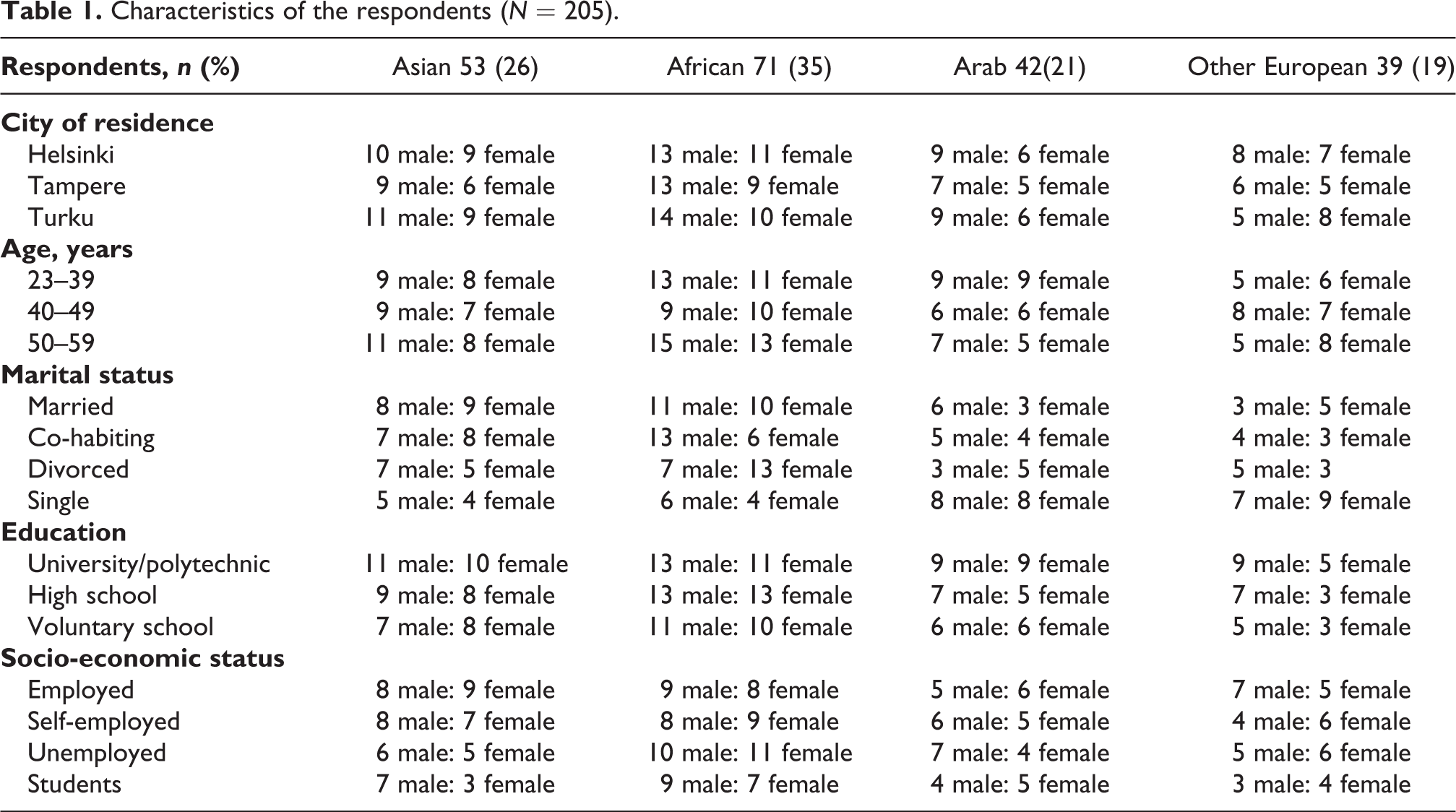
Our focus was on respect, fairness, politeness and courtesy. Procedural justice theory were used to understand the number of times ethnic cultural encountered: (1) respect—in terms of treatment while interacting with the police; (2) fairness—how a decision was made during an encounter or interaction with the police; (3) politeness; and (4) courtesy—how police behaviour influences whether a member of an ethnic cultural group trusts an officer’s sincerity and intentions. Once this was established, the data patterns were arranged into matrices to ensure that the designs could be identified and organised clearly and concisely (Maxwell, 2005) and were consistent with comprehensive data treatment (Silverman, 2006).
Participant age ranged from 23 to 59 years; this age range was chosen because it was assumed to be the active age for social, educational and employment capacity. Of the participants, 106 (52%) were male and 98 (48%) female. Seventy-three participants (36%) were from Helsinki, 60 (29%) from Tampere and 72 (35%) from Turku.
Findings
Tyler (2006) posited that citizens place great emphasis on how they are treated and respected during their interactions with the police. This is because people from ethnic cultural groups are most likely to feel very uncomfortable with treatment that involves the use of unnecessary language and aggression. Some concerns were raised in this research regarding how the police are impolite, unfair and partial in their dealings within respondents. Overall, 57 men (54%) and 44 (45%) women had experienced police impoliteness, unfairness and intimidation in their encounters with the police during involuntary stops. Going by these percentages, how ethnic cultural citizens feel about the police in terms of respect, the use of unnecessary language and speaking discourteously towards them is significant. These experiences suggest how uncomfortable police encounters with ethnic cultural citizens sometimes are. This is similar to findings in the USA (Slocum et al., 2012). Some respondents’ experiences of disrespectful police behaviour include: 68 men (64%) and 41 women (42%) who experienced use of unnecessary/abusive language; 70 men (66%) and 53 women (54%) who experienced abuse of police power, and 77 men (73%) and 48 women (49%) who raised concerns about the police speaking discourteously.
The percentage women in the study (49%) who felt that they had been spoken to discourteously is surprising. This seemed to stem from general beliefs that women can cope with more emotional and verbal assault and intimidation than men, or because the women in this study had far more interactions and encounters with the police without mentioning it to their husbands or family members. For example, one of the participants explained
R1: Our lives as cultural are full of challenges and problems, and the most hurtful of it all is that we have to face disrespectful behaviour from the police whose salary is paid from my taxes. (Female, Helsinki and Turku)
R2: Growing up in this country has been rough…with all the negativity, discrimination, as there is the notion that neekeri ‘Niggers’ cannot do certain kind of work by our supervisors or being always watched at the shopping malls, goes to show how disrespectful it has been here even among the police, security guards at the shopping malls and border guards. (Male and female, Turku and Tampere)
Other comments of interest were:
R3:…police often see us (ethnic and racial cultural) as troublesome individuals because our disadvantage in the country is enormous as the police anxiety level rises when they see a cultural as a potential criminal threat, it does not matter where we are seen. (Male and female, Turku and Helsinki)
Racism has affected how the Finnish police view ethnic cultural,
R4:…As we are often pointed finger at for being different while driving, it is often excruciating to think about it. (Male and female, Turku, Tampere and Helsinki)
From the beliefs held by these individuals, and as alluded to above, growing up in Finland in the early 1990s was difficult. Fewer people with an ethnic–racial cultural background resided in the country, and with a constant lack of work and stereotyping by the mass media most immigrants lived in fear. However, things have changed for the better for many ethnic cultural in Finland, with some reduction in battery and assault at the street level (Egharevba, 2004, 2005). However, there remain areas that need to be eliminated, mostly in terms of job discrimination and an indirect denial of one’s rights as a human being. Racial disparities in the criminal justice system exist, but we remain uninformed about racial discrimination within the police.
Moreover, racism still plays a significant role in the hiring of new workers and it can be difficult to get along with some co-workers, although with time things will change for better. On closer inspection, some younger people are more likely to be involved in criminal activity, but this should not be an excuse for judging ethnic and racial cultural negatively and racially profiling them. If this view held by the Finnish police is not contained it may trigger different reactions from those being policed because tension continues to build if not adequately addressed. Another critical issue among participants in this research is that the some of the reported experiences come from their social network, neighbours and family members, this was the case in 51% of Asian respondents (27 of 53), 33% of Arab respondents (19 of 42), 52% of African respondents (37 of 71) and 33% of other Europeans (13 of 39). In this study, the lowest number of those experiencing police unnecessarily/abusive language, discourteousness and abuse of police power are other Europeans. This may be because of similarities in race and outlook with the Finnish police. These percentages are critical findings for other researchers to explore in future research on police and ethnic cultural interactions in Finland.
Courteous and polite treatment
Ethnic–racial cultural and others are often concerned about their treatment during police interactions and encounters. Indeed, a respectful encounter with authority supports the premise that the police are just and fair. Police conduct/behaviour can demonstrate procedural justice within the context of: (a) treating citizens with respect and politeness, and (b) making decisions in open, neutral and transparent ways (Bradford, et al., 2014). The emphasis is on procedural justice theory which stipulates that the police should be viewed as a legitimate institution that uses its legal authority in directing and protecting citizens, irrespective of whether citizens obey such directives and only if the police act procedurally (Bradford et al., 2014). Citizens’ views and expectations about the proper use of police power come about only when police officers operate within the principles of respect and fair treatment and impartiality. According to Jackson (2018), respected norms create an institutional normative expectation that leads to respectful individual treatment and appropriate decision-making in any interactional setting. This helps to bring about a sense of belonging for citizens and that the police are legitimate and should, therefore, be obeyed (Jackson, et al., 2013; Tyler, 2006), while fairness and neutrality can go a long way in conveying to citizens that the police behave reasonably and respectfully towards all while exercising their power. This is because fairness and neutrality are some of the tools at the disposal of the police in affirming the equal dignity of all and strengthening social bonds between individuals or groups of citizens.
In this study, 32% of Asian respondents (17 of 53) felt that they had been treated with respect, compared with 36% of Arab respondents (15 of 42) R5: Many Finnish police do not embrace differences in their culture as the language itself is very impolite. Instead, they want us ‘cultural’ to act and behave like them. This has been my experiences in the past 15 years here, and it is still the same as we speak. (Male and female, Helsinki and Turku) R6: You cannot tell me what is right or wrong in the way you behave to us (cultural) because of our difference. I suppose your conducts are intended to prove a point that we are sub-human in the ways you belittle cultural and others in any involuntary stops and search on the street. (Male and female, Tampere and Turku) R7: What sort of behaviour is this? Being called Neekeri (Nigger), these name-callings are derogatory terms, and they need to be addressed in police vocabulary. Is this kind of name-calling not prohibited by the law in this country? To be called or identified by one’s colour of the skin or race is unacceptable to me. (Male and females, Helsinki, Tampere and Turku) R8: Respect should be accorded to all human beings equally, why are policemen/women still disrespecting me and my family, I don’t care whether you are in uniform or not you must show me some respect and I will respect you back…. (Male, Helsinki and Turku) R9: Why should a police officer threaten a fellow citizen both verbally and physically using the aggressive method by forcing me to the ground, while at the same time twisting my hands and ankle, what was my crime? It is because of my car. Is it a crime to ride in a new car in this part of the world? (Male and female, Helsinki, Tampere and Turku)
Although aggressive police behaviour can be construed as harassment and intimidation, as suggested by Brunson (2007) among others, this practice eventually works against the police because the recipient of this conduct is more likely to have a negative opinion of the police (Weitzer and Tuch, 2004). In our research, respondents of Asian, Arab and African origin alluded to these concerns about police misconduct. This was particularly the case among younger respondents as they perceive racial disparities in police behaviour at all times. These frustrations and anger tend to result in more tension in police and ethnic cultural relations; therefore, police authorities in Finland need to address these issues during training.
Discussion
In this research, our emphasis centred on exploring encounters between citizens from ethnic cultural groups and the police, using perceptions of appropriate behaviour and how these influence ethnic cultural views of being treated politely and respectfully. The data on which this article is based come from more extensive research on ethnic cultural perceptions of legal authority in Finland. First, we explore what respondents consider to be respectful and fair treatment during their encounters with the police, in addition to interpersonal concerns about police decision-making during the encounter. Second, we examine what criteria respondents use in judging what they consider to be fair and just treatment with regard to police legitimacy in general. We also explore courtesy and polite treatment that leads to complete compliance with police orders during involuntary stop and search incidents in Finland. Scholars have long suggested that procedural justice supports the legitimising of interpersonal treatment and encounters in citizen–police interactions (Tyler and Jackson, 2013). In Finland, there is the notion that the police recognise and respect the boundaries of their power, but this remains to be explored and examined. This is an essential component of the relationship between citizens and the police, and it is a crucial determinant of what citizens consider appropriate police behaviour (Tyler and Trinkner, 2018).
Our research suggests that citizens are sensitive to police behaviour that is not aware of the boundaries when dealing with ethnic cultural citizens, as this gives (citizens) a proper understanding of what is appropriate or inappropriate police behaviour during their encounters be it at the park or in the street. The respondents in this study believe that police conduct not only influences their judgement of the police, but also proves how they should evaluate/judge the legitimacy of authorities in carrying out social control. In most cases, when police conduct is criticised because of a specific behaviour, some officers feel a sense of betrayal in the core values that underlie their professional ethics, and their role in enforcing the law becomes a challenge (Tyler et al., 2014). It is important that the majority of participants in this study believe that the police have legitimacy only when they behave in a respectful and dignified manner when interacting with all citizens regardless of race/ethnicity.
Perceptions of respect, fairness and politeness were directly associated with respondents’ perceptions of legal legitimacy in Finland. In other words, ethnic cultural citizens look for certain conduct or behaviours in their interactions with the police to decide whether the action was respectful or disrespectful. Just as citizens value courteous behaviour in wanting to cooperate with the police, it was generally agreed that whenever the police behave reasonably, respectfully and politely, ethnic cultural citizens, in turn, feel a sense of responsibility to comply with the law, cooperate and volunteer information to help solve crimes. Our findings suggest that ethnic cultural citizens are willing to comply with police orders only when they believe the law being enforced is legitimate, bearing in mind whether the police consider enforcing such a law or regulation is just or unjust. Moreover, there is a strong link between legitimacy and compliance. According to Tyler (2009), police officers can foster better obedience through fair and respectful behaviour rather than relying on coercion, regardless of who the individual is. This is a real point of argument in the procedural justice literature.
Our findings support this very point, whenever the police overstep the limits of their authority, an unfair and unjust decision results. For example, when police or border officials seek out ethnic cultural in a biased and discriminatory way when conducting stop and search activities this supports feelings of being harassed and stigmatised in a way that is contrary to the police mandate of protecting all equally. Whenever this type of conduct persists, it should be condemned publicly and appropriately. Indeed, when this type of behaviour is analysed thoroughly, it can shed light on our understanding of the relationship that exists between the police and ethnic cultural within a country (Egharevba, 2014, 2017, 2018).
In conclusion, the police need to be aware that whatever behaviour is meted out to members of ethnic cultural groups has an impact on how members of those communities view the police, the entire criminal justice system, and the role of the law in the society more generally. In this study, concern was raised by participants as to individual police behaviour that is demeaning and disrespectful; there was not a single discussion of discourteous behaviour by European participants in the study. Because of the number of Europeans participating in this study it is not possible to conclude that some European citizens do not felt disrespected by the police in some way; however, the number of those responding to this question was too small for a comparison to be drawn. With a larger number of participants of white European origin the result may be different. At the same time, the other three participating groups (Asian, Arab and African) reported having witnessed the worst disrespectful treatment by the police. This finding suggests that there a racialised pattern of disrespect associated with ethnic origin in Finland.
This finding also indicated that there is an essential disconnect between the police and ethnic cultural citizens whose expectation is to receive fair, respectful and just treatment by the police at all times. Finally, we tried to explore a specific police behaviour that is perceived as challenging to ethnic cultural citizens’ relationships with the Finnish police. Further research should analyse other behaviours that may be seen as disrespectful or respectful, no matter how ubiquitous they may sound or look in a country.
Conclusion
In this study, we have tried to explore what respondents believe constitutes respectful, unfair and discourteous treatment, even though this is not without ambiguity. This is particularly challenging as many of the ethnic cultural come from different backgrounds and cultural settings, and what constitutes an insult or disrespect may differ from individual to individual. It is therefore suggested that the police need to be more careful about how specific language is used in the presence of ethnic cultural, as using any implicit language with a racial undertone, explicit language or being told to ‘shut the fuck up’ is offensive. Our findings stipulate that ethnic cultural are offended by name-calling such as ‘Neekeri’. Use of such terms is abusive or unnecessary in police work, as threatening citizens is not tolerated in the Finnish police.
Moreover, these research findings may have implications for our understanding of how ethnic cultural judge the police, as well as policy implications for how the police can improve their relationship with ethnic cultural in Finland. From the analytic point of view, this study goes beyond the traditional normative dimensions of an interaction that shape participants’ understanding of respect or disrespect. The research shows how a particular behaviour can become a barrier to the trust and cooperation that the police need to fight crime. Our findings are similar to those of other researchers in the UK, USA and Canada, especially on the use of offensive language by the police. However, the attitudes and orientation of ethnic cultural are also of particular concern as they believe that they are not taken seriously in Finland because of the way the police treat them. For this reason, it is advised that the authorities treat every issue raised in this study as significant as to do otherwise would be a mistake if the police want to build bridges with the ethnic cultural communities they serve. The extent of these processes remains for future research to explore.
Footnotes
Declaration of conflicting interests
The author(s) declared no potential conflicts of interest with respect to the research, authorship, and/or publication of this article.
Funding
The author(s) received no financial support for the research, authorship, and/or publication of this article.

Notes
Author biography