



Abstract
At a time when policing agencies are coming under increased scrutiny, the Finnish police are, reportedly, achieving very high levels of public trust. This article reports on the findings of research conducted into the Finnish approach to policing and considers whether and to what extent Finnish policing shows tendencies towards procedural justice. A mixed methods survey and focus groups approach was used to collect primary data that provided novel insight into the nature of policing in Finland from the perspective of police officers. The key findings of this research indicate that the Finnish police are operating in an apparently ‘accidental’ procedurally just manner. Rather than a fully planned implementation of procedural justice theory, a combination of cultural, legal and operational elements seems to have aligned to produce a form of policing that reportedly inspires high levels of trust and/or legitimacy in the general public. However, it was found that Finnish police officers are currently operating under high levels of fatigue and stress. Indeed, this may be compounded by the reported dissatisfaction with certain elements of the management structure and internal communication methods. Although many of the participants in this research appeared to have intentions very similar to those of procedural justice, it would seem that these are coincidental rather than an institutional application of procedural justice theory.
Introduction
The seemingly perpetual and universal clamour for an increase in police numbers is a familiar refrain in many parts of the world. Doing so, it is sometimes claimed in certain parts of the media and in political hustings, would enhance public safety and confidence in policing services and reduce crime (Hymas, 2020; Labour Party, 2017). However, a consideration of policing in Finland may cast doubt on this often oversimplified view of police effectiveness. Finland had the lowest number of police officers per capita in Europe in 2017 with 137 police officers per 100,000 people (Eurostat, 2019). Finland also scores a low 23.32 on the crime index (Numbeo, 2020). To provide perspective to these figures, Sweden scores 47.07 on the crime index (Numbeo, 2020) and has 198 police officers per 100,000 members of the population, and the Republic of Ireland scores 45.43 on the same index (Numbeo, 2020) and maintains a police force of 278 per 100,000 people (Eurostat, 2019). Although these figures alone do not tell the whole story, it is suggested that they are sufficiently divergent to warrant a further examination of policing in Finland.
In surveys of Finnish public attitudes towards the police spanning a period of 20 years, the Finnish police have repeatedly scored above 94% for public trust (Vuorensyrjä and Fagerlund, 2016, 2018). In these surveys, around 1,000 individuals aged between 15 and 79 and living in mainland Finland were interviewed about their opinions on the Finnish police (Poliisi, n.d.). At their lowest point since police biannual surveys began in 1999, a reported 91% of the participants in a survey expressed trust in the police. At its highest point in 2016, this figure was 98% (Vuorensyrjä and Fagerlund, 2016). In the most recent survey, conducted in 2020, the result returned to the 1999 level of 91% (Vuorensyrjä and Rauta, 2020). In 2011, the European Social Survey (ESS, 2011) published a report of collected comparative data on, among other things, trust and confidence in the police. The ESS report shows findings very similar to those of the survey conducted by the Finnish police. Because the ESS survey data has not been updated since 2011, a decision was made to rely on data collected by the Finnish police. The research presented in this article was conducted in part to consider how such high levels of public trust are achieved and if, or to what extent, the Finnish approach to policing shows tendencies towards procedural justice.
According to material produced by the Finnish Ministry of the Interior (2019), the Finnish police employ the practice of ‘soft policing’ (Ministry of the Interior, Finland, 2019). Although an order-maintenance or zero-tolerance approach to policing may be considered, by some, to send a no-nonsense message to the population that inappropriate behaviour will be dealt with in a swift and forceful manner, research has shown that, if used for extended periods, this form of policing can have a negative impact on the civil rights of the citizenry (Lincoln, 2004). There is also evidence to suggest that excessive use of force on the part of the police can lead to an escalation of violence; in allowing this to happen, the authorities are placing police officers in a position of opposition to the population they are intended to serve (Lieblich and Shinar, 2018; Wacquant, 2008). Indeed, a confrontational policing culture is unlikely to inspire public trust and an acceptance of police legitimacy. Although there are situations in which the use of coercive measures is unavoidable, there is evidence to suggest that the application of ‘soft policing’ involving a multi-agency approach to crime prevention rather than suppression may be not only more efficient, but ultimately more sustainable (Myhill and Quinton, 2011). In addition to reduced levels of confrontation, ‘soft policing’ can help provide both public trust and perceptions of police legitimacy (Ministry of the Interior, Finland, 2019).
Thibaut and Walker (1978) and more recently Skogan et al. (2014) among others, describe procedural justice in relation to courtroom proceedings and policing respectively, as a conscious effort to approach conflict resolution in a way that requires an open, unbiased and communicative approach, allowing both sides in a dispute equal opportunity for representation (Skogan et al., 2014). In adopting a procedurally just approach, authorities can, according to Sunshine and Tyler (2003), perform their duties from a position of legitimacy and trust. This article therefore also considers whether a style of policing that focuses upon trust, preventative and cooperative policing can result in something with characteristics similar to a planned procedurally just approach to policing.
Although there is a stated aim on the part of the Finnish authorities to utilise a preventative focus within policing activities (Ministry of the Interior, Finland, 2019), this should not be equated with notions of ‘going easy on crime’. Equally, this more conciliatory style of policing does not in itself necessarily indicate application of the principles of procedural justice. Indeed, during a literature review for this article, nothing was found that would suggest that the Finnish police have stated an aspiration to implement a specifically ‘procedurally just’ approach to their tasks. The Finnish approach to policing is to emphasise crime prevention in cooperation with social services and municipalities in preference to a suppression and control form of policing. Finland is not alone in this approach. Innes (2005) described what he called ‘soft’ or ‘non-coercive’ policing in the UK. Although not specifically stated to be procedurally just policing, there are certain aspects in common between what Innes was discussing, Finnish policing and the tenets of procedural justice. Innes’ ‘soft’ or ‘non-coercive’ policing comprises a visible police presence, persuasion, negotiation and community interaction (Innes, 2005). Likewise, the Finnish approach emphasises prevention, cooperation, interaction, visibility, equality and the prevention of polarisation and discrimination (Ministry of the Interior, Finland, 2019). The Finnish police have seemingly made consistent efforts to construct a less confrontational approach to their interaction with the population they serve, or at least understand the value of such an approach. The importance of effective communication and interaction with the general public is key to this policing approach (Ministry of the Interior, Finland, 2019).
The primary aim of this research, therefore, is to critically analyse the views and perceptions of Finnish police officers in terms of the nature of their work and role, and to assess whether or to what extent these working practices demonstrate a tendency towards a procedurally just approach. Before the analysis of this original data set of police perceptions of Finnish policing, the article begins with a brief introduction to the structure and model of policing in Finland, trust in the police and the principles of procedural justice.
Policing in Finland and procedural justice
Finland is currently divided into 11 police departments, ranging from the large and sparsely populated regions of Lapland and Oulu in the north to the considerably smaller, but more densely populated parts in the south such as Helsinki, Western Uusimaa and Eastern Uusimaa (Poliisi, 2019). The Finnish police currently number approximately 7,200 sworn officers and the Finnish population stands at 5.55 million (Official Statistics of Finland, 2022). These officers are organised and managed in a conventional ranking structure, ranging from a national police commissioner at the senior management level to junior constables starting their careers as police officers at the other end of the scale. Figures provided by the Police Authority's statistics group PolStat indicate that 19.5% of Finnish police officers are female (J. Helenius, personal communication, 5 February 2020). No statistical information is available on the ethnic background of officers within the police organisation (J. Helenius, personal communication, 5 February 2020). The role of the Finnish police is described in the Finnish judicial statutes. Officers are to uphold the law and maintain the peace, prevent, uncover and investigate criminal activity, and prepare evidence for the prosecutor (Fredman, n.d.). According to Rikander (2016), PolStat figures for 2015 show that of the 89,000 arrests in that year, 5770 involved the use of some kind of physical force on the part of Finnish police officers (Rikander, 2016).
There is currently no independent police oversight organisation in Finland. However, there is a national ombudsman that deals with complaints against the police and ensures police accountability. Where necessary, the ombudsman is empowered to implement initial investigations into complaints that come before him/her. In addition to the parliamentary ombudsman, there is a chancellor of justice who reports directly to parliament. As is the case with the ombudsman, the chancellor of justice has the authority to investigate complaints against government institutions, the civil service and the police (The Office of the Chancellor of Justice, n.d.). If deemed necessary, complaints can be transferred from either department to the other, depending on the area of expertise required.
Historically, Finland had little in the way of a national identity or a notion of homogeneous ‘Finnishness’ prior to the late 19th century (Paasi, 1997). There could be an argument that the social movement to create a national identity, in the lead-up to independence in 1917, may be a crucial point in the construction of the current understanding of Finnishness. According to Stenius (2012), this may go some way towards an explanation of why Finns appear to be accepting of authority and ‘law-abiding’ (Stenius, 2012). As part of the development of a national identity, the population of Finland was required to invest emotionally in the construction of Finnishness (Ollila, 1998). Although education and the army initially helped the Finnish population to create a national narrative from a relatively disparate population (Ollila, 1998), the police have now taken up the mantle of ‘guardian of the people’, at least in peacetime. It could be argued that this is more than simply public image, as it may have become part of the conditioning and societal positioning of policing in Finland. Durkheim (1915) notes that society in general needs to establish and affirm itself by way of common behaviour and ceremony, and that this behaviour is very similar to the ways in which religious belief and ceremony cause individuals to behave in relation to a common belief system, and presumably the common good. Indeed, it may be that such a recently unified and urbanised society considers trust in the police service almost as a civic duty (Durkheim, 1957), rather than a matter of personal preference or opinion. Reliance upon social institutions may have involved acceptance of a political and judicial establishment to which the Finnish people felt an emotional connection. It may therefore follow that there would be reason for the Finns to feel personally dissatisfied with and/or responsible for a police organisation that was considered to be deficient.
According to Rothstein and Uslaner (2005), honest government and a flat social hierarchy consisting of an engaged population, such as those found in the Nordic countries, can lead to increased levels of trust and social cohesion. If it is true that acceptance of the trustworthiness of government institutions has become part of what it is to be Finnish, it may also follow that an expression of trust in a part of the Finnish establishment, such as the police, is also an expression of the national and personal pride discussed by Ugelvik (2016). However, as society develops, new collective identities are likely to emerge and with them new perceptions of what constitutes trustworthy and appropriate policing (Loader and Mulcahy, 2003). Indeed, Reiner (1992) suggests that societies with more clearly differentiated social hierarchies pose particular challenges because the various elements of such societies can have diverging expectations.
The issues of trust and legitimacy are both key facets of procedural justice. Procedural justice within policing focuses upon public perceptions of police legitimacy and the impact of enhanced legitimate policing processes upon public cooperation, satisfaction and compliance, both immediate and in the future. Thibaut and Walker (1978) in their research on decision-making within a courtroom setting were the first to consider the importance of studying the process of achieving justice as a crucial factor within the philosophies of justice. This work has, however, expanded rapidly – for example in the work of Jackson et al. (2012), Sargeant (2017) and T Tyler (1990, 1994). Procedural justice theory has developed to become more focused on social interaction as procedures provide an environmental framework in which interaction can take place (TR Tyler and Blader, 2003). Where citizens are treated with respect, are reassured, are given a voice and their status is not demeaned, they feel that the processes involved are fair and legitimate. Police effectiveness then becomes closely connected to the perceived fairness of the encounter rather than the effectiveness of the outcome itself (Sunshine and Tyler, 2003).
Skogan et al. (2014) provide a definition of procedural justice stating four main points. These are: (1) Neutrality, requiring equality in the treatment of interested parties irrespective of when an event may have taken place; (2) Voice, this is the provision of the opportunity given to all interested parties to express their opinions on events; (3) Trust, those in a position of authority behave in a trustworthy manner and are to treat all interested parties with trust; and (7) Respect, is the requirement for politeness and respect to all interested parties. (Skogan et al., 2014: 324–325)
For procedural justice to function efficiently there is a need for those in a position of authority, be they police officers or others involved in dispute resolution, to conduct their duties from a position of trust and legitimacy. It should be noted, however, that the studies on Finnish attitudes towards the police cited earlier in the article are in relation to public trust in the police (Vuorensyrjä and Fagerlund, 2016; 2018; Vuorensyrjä and Rauta, 2020). For the purpose of our research, the terms trust and legitimacy are discussed in accordance with research conducted in the UK by Hough et al. (2010), who found that there are clear links between notions of trust, legitimacy and the position of the police in the eyes of the population under observation. Concepts of ‘trust’ and ‘legitimacy’, although not synonymous, do overlap to some extent (Jackson and Gau, 2015); the authors suggest that trust in the police is linked to an expectation, on the part of the public, that police officers will behave in a suitable manner. Jackson and Gau (2015) add that sustainable police legitimacy requires that the public trust that the police are, in fact, applying the authority that has been invested in them appropriately. During the planning stages of this study, it became evident that in addition to the overlap in the meanings of the terms ‘trust’ and ‘legitimacy’, described by Jackson and Gau (2015), there may be subtle conceptual differences in the use of these terms between the Finnish and English languages. To allow for these conceptual differences, a decision was made to combine ‘trust’ and ‘legitimacy’ as a single conceptual unit and to consider them in line with the description given by Jackson and Gau (2015). Reference is also made to public ‘satisfaction’ with policing. In this article, this term is primarily related to research conducted in Denmark, Ireland and Scotland, and is the result of local approaches to data collection. Although these studies are not directly comparable with the data collected in Finland, it is considered that their inclusion has helped to provide a degree of perspective to the Finnish approach to policing. For the purpose of this study, it was felt that it would be informative to confine discussion to primarily a consideration of Finnish police officers' perceptions of their role and position in Finnish society, and how they feel that they are achieving and maintaining the reported high levels of public trust and/or legitimacy, rather than to what degree the public may or may not be satisfied with the service provided.
Methods
The primary aim of this research was to critically analyse the views and perceptions of Finnish police officers as to the nature of their work and role, and to assess whether or to what extent these working practices may relate to a framework of procedural justice. To achieve this aim, an online survey was designed and distributed via the police intranet system, thereby making the survey available nationally to all serving police officers. The questions were structured around four general themes relating to joining the police, satisfaction with career choice, professional motivation and approaches towards policing tasks. This article concentrates on the final two themes. The survey was posted on the police intranet system alongside several posts in relation to operational activities and as such, may not have been immediately apparent to potential participants. Although the 352 responses represented only about 5% of the total police population, the addition of a qualitative element within the survey and triangulation by means of a focus group allowed for greater validity (Krueger and Casey, 2009). The closed questions within the online survey were supplemented by free-text questions allowing respondents to answer in their own words. The comment boxes provided over 122 pages, almost 42,500 words, of additional, primarily qualitative material. To supplement the extensive qualitative responses from the online survey, three focus groups (two in the capital area and one regional department in southern Finland) were conducted with 13 police officers of non-managerial rank, following the themes outlined in the online survey. As part of the anonymity assurance given to participants, no demographic data were collected. Individual focus group speakers and members of the focus groups were assigned an alphanumeric code. The code consists of the number of the focus group and the number of the speaker. For example, focus group 1, participant 2 is coded FG1P2. References to online survey responses were also assigned alphanumeric codes. For example, Q1, and Q2, refer to survey questions one and two respectively.
All survey and focus group materials were produced in the Finnish language and all focus groups were conducted in Finnish. This was done in part to encourage police officers to take part, but also to give them the opportunity to express themselves in their first language. There is a 5% minority of the Finnish population who speak Swedish as their first language. Because all Finnish police employees are expected to be able to communicate in both of the official national languages, it was felt that only providing material in Finnish was unlikely to adversely affect these research findings.
The two qualitative data sets were interrogated by way of a reflexive thematic analysis broken down into six stages, as discussed by Braun and Clarke (2019). For this research, the translation and transcription of qualitative data provided an opportunity to become fully familiarised with the collected data. Having completed the coding process, the codes were reassessed and organised into general themes. Eventually, as a result of the evaluation stage, a hierarchy of themes, some of which were rather unexpected, became apparent. Following further analysis, the themes evolved and developed into those reported in the following section.
Results
The pursuit of fairness and justice
There was little in the way of consensus among research participants as to either the nature of justice or how it is best served. For a small number of participants there was a notion of getting a conviction and what they referred to as a ‘good sentence’ as an indicator of justice being served. There was also mention of the satisfaction that was gained from having a suspect in custody. There may, however, be a risk that an over-zealous conviction- and sentence-oriented criminal investigation may be open to inappropriate behaviour, as documented in other parts of the world (Covey, 2013). Indeed, there was suggestion that if a case does not go to court, or if the suspect is not convicted or is ‘given too light a sentence’ (FG3P3), there may be cause for some detectives to feel that they have wasted their time and that results such as these can have a negative impact on staff motivation and that ‘getting a good conviction’ (FG3P3) can be important to them. Although attitudes such as these may not seem unreasonable, it may be particularly challenging to reconcile them with the principles of procedural justice, as described by Skogan et al. (2014).
At the other end of the continuum, 3 of the 13 focus group participants (FG2P2, FG3P3, FG3P1) stated that the judicial outcome of a case was of no concern to them. For them, it would seem that the investigation of events and accurate reporting of their findings was the best conclusion to a case. One participant commented to the effect that ‘The kind of police officer that is too adventurous is a risk to all other police officers. The kind that has … entail problems … that sees danger the whole time it just doesn’t work in our society’. (FG2P2). Another participant confirmed this approach, suggesting that ‘We can’t really start thinking too deeply if justice has been served or not. It is more a question for the general public’. (FG3P3). It was also pointed out that ‘You have to remember that in Finland the sentence is a matter for the courts. It's not our concern’. (FG3P1). By way of an illustration of this point, a participant remembered an occasion during their training, when they were taught that ‘Judges judge, but they can only judge the information they are given’. (FG2P2). Presumably, the intention of the lesson was to drive home the message that there is a separation between the police and the judicial system. From a procedural justice perspective, this could be considered a more appropriate attitude towards criminal investigation than seeking convictions and harsh sentences. The participants who made these observations also stated that, although they occasionally communicate with detectives in other departments, on the whole they are content with dealing with the tasks that are assigned to them.
Additional aspects related to notions of justice apparently of particular importance to multiple participants were what they referred to as ‘knowledge of right from wrong’ and ‘fairness’ (FG1P1, FG1P2, FG1P4, FG3P2, Q10). However, these attributes may need to be tempered with a degree of caution. If the participants were suggesting that a subjective knowledge of right from wrong is appropriate in policing, there may be cause for concern. Presumably, police officers are required to conduct their duties in accordance with the law, keeping reference to their feelings to a minimum. The same may be said of fairness. In relation to the subjectivity involved at some levels of policing, several participants mentioned the need for flexibility, common sense and life experience as valuable attributes in policing (FG1P2, FG1P4, FG1P6, Q8, Q9, Q11). One focus group participant used a term borrowed from ice hockey that has been translated as ‘game eye’ (FG1P6), meaning that it is important to be aware of the situation you find yourself in and be prepared to adapt and react accordingly. This may be a pragmatic approach towards policing in that it may positively contribute to communication in the initial stages of an interaction. However, a standardised, procedural approach may offer greater opportunities to provide demonstrable fairness.
Authority figure/position in society: a police perspective
A point that was explicitly referred to by one focus group and obliquely mentioned by others was the feeling of authority and power that being a police officer provides. In reference to this feeling, one participant mentioned the first time that they were on traffic duty and were required to direct the traffic on the main thoroughfare through the capital city. The participant recalled, ‘It was four o’clock rush hour and I was there telling people (drivers) to stop and wait. It was a wonderful feeling!’ (FG1P2). According to another participant, this feeling of authority is so seductive that it can be very difficult for retired officers to accept that they no longer have a badge (FG1P4). Brandl and Smith (2012) made very similar observations in their research into policing in the USA. They found that being a police officer actually forms part of a person's identity and that the sudden removal of social status and coercive authority as a result of retirement can be very stressful (Brandl and Smith, 2012). Other members of the focus groups mentioned the exhilaration they feel when they get the call to respond to an emergency. One participant noted that ‘No-one will admit to this out loud, but it gives you a special kind of power when you put on your uniform, an authority that no-one else in the country has’. (FG1P4).
For the police to maintain their authority, there is a need for public support for their actions (Jackson et al., 2018). It may be possible for a population to accept the authority of a policing agency, while at the same time not accepting that the agency is legitimately holding their position of power. For a policing agency to attain and maintain legitimacy, requires that organisation to manage the use of authority to comply with the social norms of the population being policed and to be seen by that population as even-handed. In Finland, this may be less of an issue than in some other countries because, at this time, there is a high level of trust in the police (Vuorensyrjä and Rauta, 2020). There may be an argument that the Finns and other Nordic populations are compliant and accepting of authority for a common good, as a result of what may be referred to as Nordic communitarianism (Brandal and Thorsen, 2018). In its simplest form communitarianism is an understanding that an individual's identity is constructed with reference to his/her relationship to the community in which he/she lives. Importantly, this ideology emphasises the interests of the community as a whole rather than those of the individual (Witoszek and Midttun, 2018). Although this construct would normally be confined to relatively small groups, such as family or immediate communities, it may be possible to argue that a country with such a strong national identity and small population may be demonstrating a form of extended communitarianism (Pylkkänen, 2007). From the data collected for this study, it would seem that although the Finnish police have an understanding of their position of authority within Finnish society, they see themselves very much as involved members of that society. They seem to feel that the apparent legitimacy of the Finnish police organisation comes from being connected to the population they serve rather than being an external force.
Examples of the above-mentioned attitude can be found in participants’ responses to the online survey question relating to their professional motivation as police officers, such as ‘Compliance with the rule of law and serving the community’ (Q9). A focus group participant stated: ‘We are a part of the Finnish population and I think that the police represent the Finnish population quite well…’ (FG3P1). It would appear that the participants see themselves as members of the community they serve rather than the paramilitary agents of law enforcement seen in some other parts of the world (Stoughton, 2015). As such, the research participants appear to be of the opinion that they approach their tasks in an even-handed way and are performing a public service in the course of their duties. Indeed, another focus group participant noted that ‘Authority isn’t necessarily a negative thing, if it is used appropriately’. (FG1P2). Similar comments were made in response to the last question in the online survey. Here, participants were given the opportunity to express their thoughts on anything that had not already been covered. Among the comments relevant to this section were indications of an understanding of the conditional nature of the position of the police in Finnish society and a need for mutual respect and cooperation. The quotations that follow are examples of such comments: The police have been successful in their work because the public trust them. Confidence is earned by being among the citizens and taking care of their issues in a visible and accessible way. The police have managed to do their job without going to extremes and have been able to assess their activities as well. At times it is necessary for the police to exhibit a degree of authority. This is only possible if you (the public) know and trust the police. (Q19)
The police are trained to make decisions independently and not to simply follow instructions. Working with the public enables the police to gain their trust and gain a sense of effectiveness. Communication is two-way and productive. The public are best served by the police helping them to help themselves. At an incident, the police must demonstrate their authority, but not to an excess. Here too, preventative action can be achieved. The value of face-to-face policing and the information gained can help to prevent something bigger from happening. (Q19)
As well as an apparently clear understanding among the participants of the position of power and authority that wearing a police uniform brings, there is also a suggestion of a readiness to accept the responsibilities that go along with that authority and to take control when the need arises. However, perhaps more importantly from a procedural justice perspective, the comments reported on here would also appear to indicate attitudes that might be described as doing policing with the population, rather than doing policing to the population. It may be that by maintaining a position among rather than apart from society, and by not over-policing, the Finnish police have managed to attain an acceptable level of legitimacy in the eyes of the Finnish population. However, this may be a consequence of restricted resources rather than planned practice.
In an attempt to explore this relationship in more depth, online survey participants were asked how they would describe the nature of their interactions with members of the public. With the intention of providing a counterpoint, participants were also asked about their interactions with individuals suspected of being involved in a criminal act (Figures 1 and 2). Whereas the survey findings indicate reduced levels of friendliness and an increase in procedural attitude in interactions with individuals potentially involved in a criminal act, the overall behavioural trend is very similar in both types of interaction. Although the authoritative aspect of interaction with a criminal suspect is roughly double that of interaction with the general public, it is still apparently a relatively insignificant aspect of police interaction with the population, at least from the perspective of the police.

Participant responses to online survey question 11.
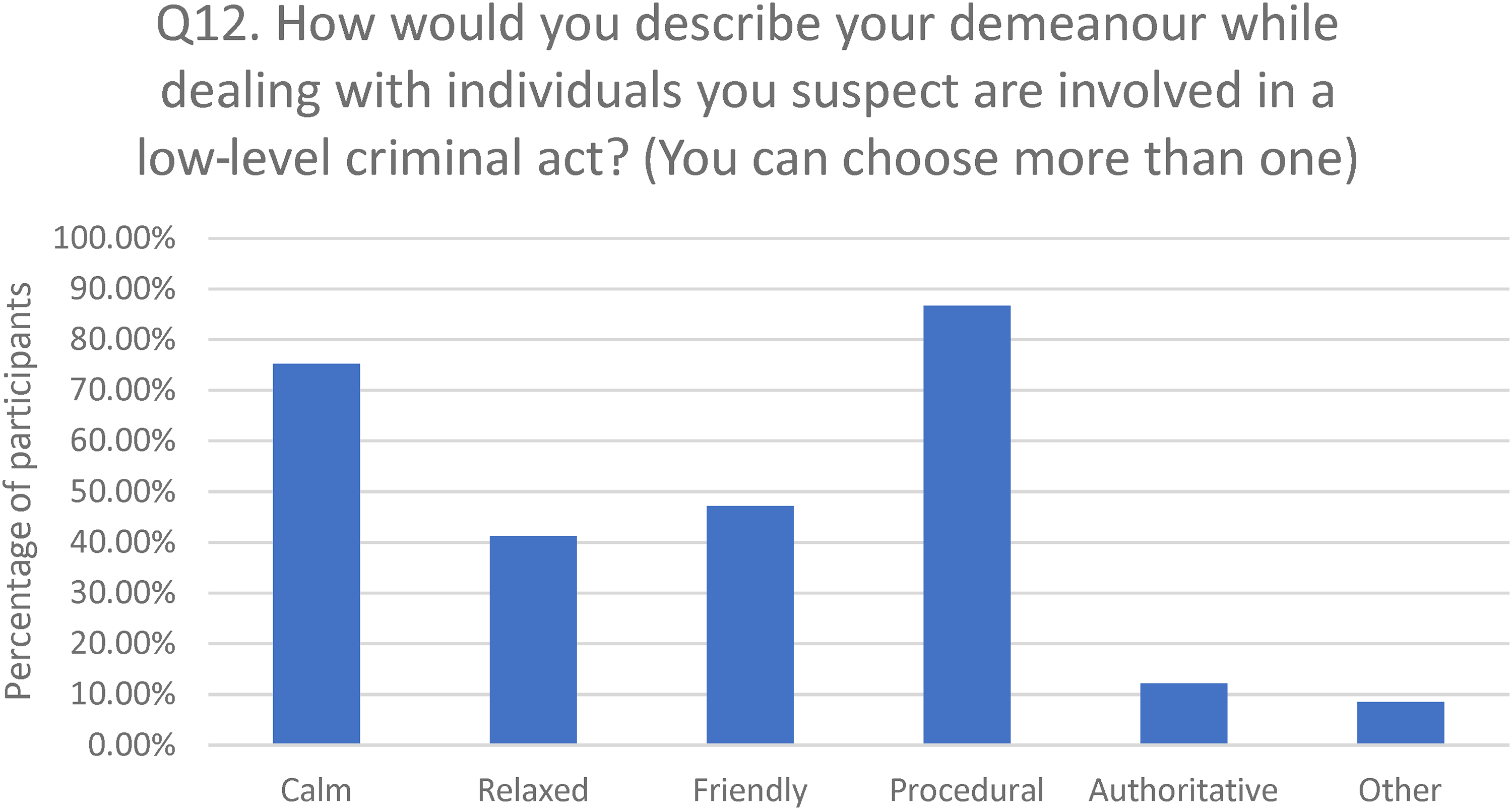
Participant responses to online survey question 12.
Perhaps unsurprisingly, a wide variety of suggestions were made in the survey free-text boxes, ranging from the more neutral ‘reliable and listening’ to perhaps less-predictable options such as ‘empathic’ and ‘humorous’ in describing interactions with the public. There were, however, suggestions that the participants’ approach was a little more robust when dealing with a possible suspect. Interestingly, the verb ‘depends’ features rather prominently in both sets of circumstances, suggesting a degree of flexibility in the approach taken to such interactions (Q13 and Q14).
The results would seem to indicate that the findings of this research project align with those of Nix et al. (2017) in that there are indications that the attitude of the individual being spoken to would affect the behaviour of the police officer. Participants’ comments in relation to this notion included: ‘It also depends a lot on the customer's attitude’, ‘Depends on the customer's mood’ and ‘Their behaviour determines how they are treated’ (Q14). This phenomenon is borne out by Roufa (2019), who notes that good communication skills can lead to more positive interactions between the police and the general population.
Perceptions of ‘successful’ policing
The online survey contained two questions that would potentially provide participants with an opportunity to express their understanding of what constituted ‘successful’ policing. Almost all participants who expressed an opinion relating to ‘successful’ policing described an inability or a restricted ability, owing to limited resources, to provide the level of service the public deserve. It may be possible to derive from these comments that, at least for the participants, successful policing is the ability to provide a good level of service in all parts of the country.
Focus group participants described the general attributes of what they felt constituted a ‘successful’ police officer. These included good communication skills for patrol officers and detectives (FG1P2, FG1P3, Q12, Q19) and a controlled curiosity and patience for technical support officers (FG1P2).
Focus group participants also related comparative stories of Finnish policing and policing within other jurisdictions. The first is in relation to a criminal suspect repatriation: Two Finnish police officers were sent to the USA to collect a fugitive who was not voluntarily returning to Finland. At the airport they were confronted by a large group of rather militaristic looking police officers that were treating the deportee in an aggressive way. The individual was in turn responding with similar behaviour. The American police were rather surprised at the response to the procedural approach the Finnish police officers took, talking in a calm and restrained manner to the detainee. As a result, the individual calmly walked onto the aircraft and quietly sat in his place where he stayed for the entire journey. (FG2P3) I have worked in the aliens’ department and I have been involved in repatriation jobs. And you get on much better when you are friendly and know how to talk to people. If you are polite, and explain that this is something that is going to happen and we will be doing it like this. Just get them prepared and you don’t immediately go to violence to deal with things. (FG2P2)
Other examples were given in which polite and calm matter-of-fact attitudes towards people in such situations are reflected back to the police officers. This style of interaction is prominent within the procedural justice literature (TR Tyler and Huo, 2002).
Although there was an expressed understanding of the need and purpose for clear guidelines and procedures, there was also a feeling among participants that there needs to be flexibility in policing. Indeed, it was suggested that for this more relaxed form of policing to be effective, police officers need the freedom to adapt to the situations in which they find themselves. A focus group participant also noted that: Yeah, and the basic nature of the Finns is what it is … and the majority of Finnish police are the same basic nature … and the customers aren’t the type of people that will readily start throwing stones and burn car tyres. They would rather stay calm and we are the same. Why make a big deal out of something if it can be dealt with in an easier way? (FG2P3)
Challenges for Finnish policing
Although good communication and fairness would appear to be important to many of the research participants, individual officers expressed other attitudes towards non-native people in the online survey free-text boxes, whereas others commented on such attitudes in the focus groups. Other participants described experiences of inappropriate behaviour by some officers towards their colleagues. This took the form of female officers feeling that they were expected to prove themselves to be competent to their male counterparts in ways that male officers were not. Further research on these issues would clearly be of value.
Leadership and management in any organisation are often fraught with tensions, but in the rank-oriented system of policing the apparent communicative gulf between the rank and file and police managers has been well documented (Davis and Silvestri, 2020). The subject was raised by all of the focus groups, in one form or another, and was widely commented upon in online survey responses to Q10 (What are the biggest challenges faced by Finnish police officers?). Many participants commented negatively on their experiences with police management, with the following providing a summation of many of the comments made in response to Q10: Management and the Police Board (Q10)
and Most of the police management have no police training, experience and substance expertise in police work. (Q10) There is not enough time to do everything that needs doing. There is so much to do that I have experienced, from time to time, cumulative stress and related problems. (Q10) Many of us have burned out as a result. They have had to go on sick leave and be off work. (FG3P4)
It might be a good thing to do to widen your parameters as to what it means to have done your job well. For example, I can feel that I have done my job well if I get all my cases done before they expire. That they have moved forward. And that I haven't had to take sick leave as a burnout. (FG3P3)
Although these findings would suggest that there are underlying issues related to police officer numbers and the workload expected of them, participants also pointed out that there are systems in place that provide opportunities for officers to transfer to alternative duties if they feel that they are not coping. According to participants, these transfers between tasks are relatively easily accessed.
The discussion section of this article brings together the various aspects of this research to consider how cultural norms and a particular approach to policing may indeed be perceived as a form of procedural justice, albeit an accidental one.
Discussion and conclusion
It would seem unlikely that any single aspect of the Finnish approach to policing will adequately explain the position of trust and legitimacy the police have in Finnish society. To develop a discussion of possible contributing factors, this section considers each of the issues raised in the data collection section of this article in relation to the tenets of procedural justice.
Some aspects of Finnish recent history are likely to have contributed in some way to Finnish social norms and behaviour. However, at face value, issues such as Nordic communitarianism (Pylkkänen, 2007) and feelings of national identity would seem to have little in the way of connection to the police and questions of procedurally just policing. It should perhaps be borne in mind that a positive attitude towards authority figures, including the police, may actually be seen as a civic duty on the part of the Finnish population, as much as a personal opinion. Indeed, this may be an important factor in an environment that is, to date, predisposed towards acceptance of the authority of the police. This may, in turn, contribute to a cycle of virtue. If the legitimacy of the police is seldom seriously challenged, there is little need for the police to demonstrate their position of power, which may in turn make interactions less confrontational (van Dijk et al., 2015). As a result, one of the tenets of procedural justice, uninhibited communication, may be achieved almost by accident. Indeed, compliant attitudes found among the Finnish population, coupled with the diminutive size of that population may provide a suitable set of circumstances needed to enhance this apparently procedurally just approach to policing.
A further example of the accidental nature of procedural justice within Finnish policing can be seen in relation to the limited resources at the disposal of the police. Operationally, this means that there are too few officers and insufficient equipment to conduct an order-maintenance form of policing that controls the population and suppresses the opportunity to commit crime, as covered by Schulhofer et al. (2011). It is this limited access to resources that would seem to be a contributing factor in the Finnish authority's apparently alternative approach to policing and social stability. Rather than expending time and effort solely in the apprehension and prosecution of individuals who have already become involved in a criminal lifestyle, it is considered more efficient to approach crime prevention at its root with education and familiarity, instead of overpowering force (Oikeusministeriö, 2016). It would seem that by functioning in this way, the Finnish police are working to promote the notion that they are one of the social services, rather than purely a law enforcement agency (Oikeusministeriö, 2016). The Finnish approach to policing has elements in common with Bjørgo's description of crime prevention being a multi-agency challenge involving situational prevention strategies as well as more conventional approaches (2016). This approach may be responsible for a form of ‘accidental’ procedural justice in which the Finnish police appear to operate in a disinterested procedural manner as a pragmatic response to their workload, rather than a conscious application of procedural justice theory in its truest sense.
The data collected for this study indicates that, rather than seeing themselves as a group apart from the general public, the participants report seeing themselves as members of the public that they are serving. In so doing there is the potential for the Finnish police to perform their duties with fewer stereotypical notions and biasing preconceptions concerning non-police personnel than may be the case if they were to isolate themselves. Here again, there is an indication that there may be certain unplanned aspects of Finnish policing, namely unbiased interaction, which fit reasonably well with the tenets of procedural justice.
The Finnish Police University College has invested a great deal of time and effort into the development of an approach to police training that is primarily academic in nature. Although Finnish students of policing do receive training in coercive measures and weapons training, emphasis is given to law studies, communication and organisational skills (POLAMK, n.d.). It may be that the academic rigour of this approach to police education equips officers with an ability to make operational decisions with a systematic consideration of information, which in turn leads to appropriate outcomes. From a procedural justice perspective, however, there may be some encouraging signs. Police officers who are taught from the earliest stages of their career the importance of good communication skills, coupled with a sound understanding of the law would appear to provide, if properly applied, valuable tools in the construction of a procedurally just approach to policing.
Although certain aspects of the Finnish approach to policing are encouraging from a procedural justice perspective, others were less so. Participants suggested that they are suffering from widespread levels of exhaustion that regularly lead to officers burning out and having to take time off work. This being the case, the officers that remain are, presumably, required to take on additional duties, potentially adding to their work pressures. Perhaps surprisingly, high levels of exhaustion and stress may actually contribute to the impression of something akin to procedural justice in the eyes of the general public. Exhaustion and stress can lead those suffering from it to withdraw emotionally and become distant (Lambert et al., 2013). In certain circumstances, this may give the impression that a police officer is attempting to remain neutral. Indeed, not becoming emotionally involved in an investigation or dispute to provide an impartial outcome would fulfil the requirements of procedural policing.
It became apparent that at least some of what is being reported both by and about the Finnish police does indeed resemble procedural justice. This may be borne out by the high levels of trust and/or legitimacy the Finnish police apparently have in the eyes of the general public. Although it would be challenging to describe Finnish policing as procedural, it would seem that both the police and the Finnish public see the benefits of something that bears certain similarities to procedural justice. If this is the case, then it may provide a semblance of encouragement for agencies interested in implementing procedurally just policing, but are daunted by the notion of a fully planned system. It would seem that a sufficiently integrated multi-agency approach and open communication, with an emphasis on crime prevention, may provide something akin to procedural justice almost by default.
This analysis of the Finnish approach to policing has shown that, as is the case with other large organisations, Finnish policing comprises a combination of institutional, human and local cultural factors. From a procedural justice perspective, the Finnish police would seem to be performing with varying degrees of success, perhaps leading to an accidental form of procedural justice. On the one hand, the Finnish police are reportedly underfunded and under-resourced. According to the data collected for this study, this has put undue strain on police officers with apparently high levels of stress and burnout. On the other hand, there is an apparent aspiration for the Finnish police to be considered part of the well-developed social services of that country. In doing so, the Finnish authorities appear to have limited the degree to which the police are in a position of conflict with the public, potentially allowing for a more even-handed approach to the provision of social justice than may be found elsewhere. In addition, there have been concerted efforts to improve the training given to what are referred to in Finland as students of policing. Indeed, it may be that expecting police officers to take part in academic-style education in policing before becoming an officer may cause them to become more communicative and perhaps allow them to make more considered decisions in the course of their duties. Although this would seem to suit the tenets of procedural justice rather well, the academic training of police officers, introduced in 2014 (POLAMK, n.d.), has not been in place in Finland long enough to make a categorical statement that it has made an impact on either public opinion or the standard of policing in that country.
When it comes to the question of the human factor in Finnish policing, again there were aspects that put the Finnish police in a positive light from a procedural justice standpoint, whereas other issues were less so. Expressions of discriminatory attitudes, such as the desired removal of non-native people from the country and the need for female officers to ‘prove’ their abilities over and above what is expected of male colleagues, potentially risk the perceived legitimacy of Finnish policing. These comments, however, comprised a very small percentage of participant statements and would appear not to be a widely held position at the time of data collection. There were, however, indications that Finnish police officers see themselves very much as part of the community they serve. In doing so, it may be that Finnish police officers are maintaining a level of communication with the general public that is unlikely to be as smooth in agencies in which officers more commonly maintain a distance. Indeed, this may be a key point in understanding the social position of the Finnish police.
It would seem then that in order to attain and maintain a high level of public trust and/or legitimacy, it is not necessary for a policing agency to be perfect in every way. Rather, as suggested by Bowling (2007), it may be sufficient for policing to be ‘good enough’. Finnish police officers who participated in this research appear to have a clear understanding of their role as a public servant in Finnish society. This is supported by a non-confrontational, pragmatic approach to their duties. Although the Finnish approach to policing may not be procedural justice in the purest sense, it would appear to be close enough to procedural justice theory to inspire the high levels of public trust and/or legitimacy the Finnish public reportedly have in the police.
Footnotes
Declaration of conflicting interests
The author(s) declared no potential conflicts of interest with respect to the research, authorship, and/or publication of this article.
Funding
The author(s) received no financial support for the research, authorship, and/or publication of this article.
