



Abstract
Although who chooses to become a police officer and why they do so is pivotal for understanding policing, few studies explore recruit motivations. We help to fill this research void through analysis of open-ended narratives penned by police recruits during the academy in a large rust belt city explaining why they want to become police officers, supplemented with qualitative follow-up interviews conducted with randomly selected participants. Of the existing studies on police recruit motivation, nearly all use fixed-response surveys of researcher-selected answers. Despite our respondents being completely free to use their own words, their motivations demonstrate a striking similarity to the findings of previous literature. These stated motivations of altruism and community concern also stand in stark contrast to the public behaviors of police. We suggest this consistency in stated motivations and disconnect with public behavior evinces a publicly oriented vocabulary of motive in which police recruits are attempting to voice the “appropriate” reasons for joining the force.
Introduction
Following a year of uprisings across the United States demanding police reform and accountability, as well as the 6 January 2021 storming of the United States Capitol by a crowd that contained dozens of current and former law enforcement members (Ben-Menachem, 2021), there is increasing interest in who is comprising our nation's police forces. At the same time, police departments across the United States are struggling to recruit new officers (Smith, 2022). As such, there may be no point in American history in which so many people are interested in who decides to become a police officer and why. The motivations of those who chose to enter an institution invested with such awesome powers of arrest and use of force seems intuitively like a topic that would flourish within the wide field of policing studies.
Notwithstanding the significant social impact of understanding who chooses to enter the field of policing and why they chose to do so, there is surprisingly scant scientific literature on the subject. Over the past decade there have been only a handful of published studies examining the stated reasons of recruits for joining the police (Campbell, 2015; Clinkinbeard et al., 2021; Cross and Fine, 2021; Oberfield, 2014; Rossler et al., 2020; Todak, 2017), leaving “a need for a more contemporary examination of motivations for becoming a police officer” (Raganella and White, 2004: 502). In addition, nearly all studies of officer motivation rely on fixed-response questionnaires, with only two studies we were able to find using open-ended questions (Gibbs, 2019; Todak, 2017). As such, the already-limited pool of data regarding motivations for joining the police is further limited by a focus on predetermined responses rather than allowing space for respondents to voice their own perspectives.
Given that the stated motivations of police recruits have been consistent over several decades (Clinkinbeard et al., 2021; Foley et al., 2008; Lester, 1983) and have consistently been out of line with objective evaluations of American policing, we argue that what is being observed here is an example of a publicly oriented vocabulary of motive (Manning, 2009; Mills, 1940; Welsh et al., 2020) for those who choose to join the police. To what extent these attitudes are their “true” motivations or what they feel are the “correct” motivations to express remains an open question (and may well be some combination of the two), but the consistency of stated motivations in studies across time and geography suggest there are an identifiable set of motivations that have clearly been marked as “acceptable” within the police world and transmitted to those joining the organization.
This study adds to the extant literature through a content analysis of 70 recruit narratives from a police training academy and 5 follow-up interviews of officers in the large rust belt city of “Rockport”. The narratives were composed and collected as part of required academy paperwork asking the recruits to provide two to three paragraphs explaining why they wanted to become police officers. Beyond simply adding some much-needed data to this unfortunately under-explored question, these narratives also present a rare instance of officer motivation data not being drawn from fixed-response questionnaires providing respondents with a limited set of researcher-selected answers. Rather, the recruits at the academy were free to identify whichever motivations they felt best fit them, as well as expand on their reasoning, offer examples, or include any other information they felt pertinent, allowing for the possibility of much wider variation among respondent answers.
What we know about the motivation to become a police officer
Despite limitations in the extant data, two over-arching themes have emerged from studies about why people chose to become police officers; the first centers on practical material concerns regarding things like job security and income, whereas the second could best be described as ideological or aspirational, including altruistic ideals of giving back and helping, combined with idealized visions of who police officers are and what they do. In line with broader work on the policing subculture (Moskos, 2007; Skolnick, 1964; Sobol, 2010), these motivations are fairly consistent across demographics, with only minor variations across race and gender.
Although various studies have found some differences in the relative importance attached to these most common motivations or the ordered rankings police recruits assign to them, for the past several decades the “reasons commonly cited for choosing police work have been fairly consistent”. (Foley et al., 2008: 3). In terms of material concerns, past studies have found that those joining the police do so in part because of the job security of police officers (Lester, 1983; Raganella and White, 2004; Seklecki and Paynich, 2007), the benefits associated with the job and the potential for early retirement (Linos, 2018; Oberfield, 2014), or in the case of seasonal police officers, the potential for networking and eventual career advancement (Campbell, 2015).
The most commonly offered motivations, however, focus on more ideological and altruistic ideals. These motivations tend to hue fairly closely to the idealized vision of policing often found in popular media and touted by departments themselves, things such as helping others, protecting the vulnerable, and serving the community (Clinkinbeard et al., 2021; Foley et al., 2008; Gibbs, 2019; Hageman, 1979; Lester, 1983; Martin and Jurick, 1996; Oberfield, 2014; Seklecki and Paynich, 2007; Todak, 2017). Similarly, many recruits report being motivated by the idea that policing is adventurous and exciting, or that they have a desire to fight crime (Hageman, 1979; Linos, 2018; Raganella and White, 2004; Todak, 2017). Finally, a number of studies have found that people join policing as the culmination of a lifelong dream and the desire for the “brotherhood” offered by the profession (Gibbs, 2019; Haarr, 2005; Lester, 1983; Raganella and White, 2004; Todak, 2017).
Although these motivations are broadly shared by those who chose to become police regardless of gender or race/ethnicity (Gibbs, 2019; Lord and Friday, 2003; Raganella and White, 2004; Todak, 2017; White et al., 2010), a few studies have found some meaningful differences in motivation for different demographics. Lester (1983) found age, race, and gender all made a measurable impact on stated motivations; older officers were more likely to highlight pay, retirement, and job security as ongoing motivators, White officers were more likely to highlight family tradition, whereas Black officers placed more importance on paramilitary structure and job security, and female officers placed more importance on helping others and less importance on factors of power and status compared with male officers. Foley et al. (2008) similarly found officers of color place more importance on the possibility of career advancement and autonomy in the workplace than their White counterparts.
Most recently, Clinkinbeard et al. (2021) and Rossler et al. (2020) both found women and people of color entering policing expressed significantly more reticence about their place on the force, worrying about the potential they will not be accepted by their future coworkers, whereas Clinkinbeard et al. (2021) found both groups place much more emphasis on leaving a legacy as a prime motivator for joining the police when compared with their White, male counterparts. However, most findings are similar to Raganella and White (2004: 512) who found similar gender and racial differences in the relative importance attached to various motivations, but even though “statistically significant differences emerged among officers of different race and gender, they mostly involved factors that were not ranked as overly influential”.
Police vocabularies of motive
Beyond the remarkable consistency in the literature on police recruit motivation, what stands out about these stated ideals is how strongly they contrast with the actual practice of American police. The widely documented racial discrimination, harassment, and physical abuse meted out by police across the United States is incompatible with a force comprised of people who hold these motivations. Although this was not the case at the time of the study, the Rockport Police Department currently staffed by the recruits in our study is now under a consent decree established in the mid-2010s because of a continued pattern of racial discrimination and excessive use of force, with the Department of Justice (DoJ) publicly declaring the Rockport Police Department presents a danger to the residents of the city. The DoJ report noted the city has paid out tens of millions of dollars in brutality settlements over the past decade, and its investigation revealed that many Rockport residents fear the police as much as they fear criminal victimization, with only half of city residents reporting a belief that police officers follow the law. Simply put, a police department staffed by officers with the stated ideals found in these recruit narratives should not be displaying such significant problems.
A possible explanation for this discrepancy is a change in officer attitude over time as they are socialized into the policing world (Catlin and Maupin, 2004; Conti, 2009; Moskos, 2007). Van Maanen (1975) argues police recruits go through a “metamorphosis” from their initial attitudes to those of their senior colleagues, arguing that by the time they have reached six months on the job they have shed their initial beliefs and experience “some rather vivid attitude changes” (Van Maanen, 1975: 221). His study found that altruistic beliefs and motivations fell off precipitously the longer officers were on the job, with successfully making arrests becoming the only salient motivator. Similarly, Skolnick (1964) argues the strength of the police subculture tends to push police officers toward a shared worldview.
The idea that recruits enter policing with high-minded, publicly oriented principles only to have these ideals eroded by their experiences with the policing bureaucracy and selective contact with the public is at least partially supported by the literature on police cynicism. Consistent with Van Mannen's (1975) metamorphosis argument, research has found that the more police witness crime and experience stressful interactions with the public the more cynicism they express (see also Griffen and Bernard, 2003; Sobol, 2010). Poor experiences with police leadership and bureaucracy also lead to growing levels of cynicism among officers (Enciso et al., 2017), and officers with more interactions with the public are more likely to express a negative view of the public (Morin et al., 2017). White et al. (2010) found that for officers six years into the job, the opportunity to help people was still an important motivator but had dropped from most influential and been overtaken by a number of more practical matters, such as salary and working conditions. Similarly, Clinkinbeard et al. (2021) found that serving and protecting were reported as less important with each year on the job.
Yet longitudinal data on how police motivations and attitudes may change over time is even less common than the already scant literature of one-time cross-sectional studies on the topic. Although there remains a significant need for examining the institutional and subcultural pressures that may lead to a shift in attitudes, there is also reason to believe that the stated motivations and attitudes of police recruits are better understood as publicly oriented vocabularies of motive.
As developed by Mills (1940), the concept of vocabularies of motive refers to the socially situated nature of stated motivations. He argues that “motives are of no value apart from the delimited societal situations for which they are the appropriate vocabularies” (Mills, 1940: 913). That is to say, motives do not denote any innate inner qualities of the individual, but rather serve as explanations for “anticipated situational consequences of questioned conduct” (Mills, 1940: 905). The situational context is central to vocabularies of motive, as different institutional environments call for different acceptable motivations. Mills (1940: 907) argues that when any social actor vocalizes a particular set of motives, they “are not merely stating ‘reasons’. [They are] influencing others and [themselves]”.
In the context of joining the institution of policing, it is quite telling that the consistently stated motivations of new recruits so closely mirror the idealized imagery of the profession that police departments attempt to project (Manning, 2009; Meehan, 1993; Tobias and Joseph, 2020; Wender, 2008). Perhaps this is not terribly surprising given that a significant number of police report initially becoming interested in the career because of television shows about policing (Todak, 2017). Even a significant amount of internal police communication is properly understood as outwardly focused, less about what actually has happened or should happen, but rather about making sure the actions of officers are portrayed in a positive light for the public (Manning, 2009; Welsh et al., 2020).
As Mills (1940: 904) argues, linguistic behavior is not something to be found in the “private states [of] individuals, but by observing its social function of coordinating diverse actions”. Motives are not simply subjective sources of actions, but instead serve “ascertainable functions in delimited societal situations” (Mills, 1940: 904). Given that the police training regimen is as much about socializing recruits into the world of policing as it is about imparting practical skills (Conti and Doreian, 2014; Haarr, 2005; Moskos, 2007; Skolnick, 1964; Wender, 2008), it is clear part of the informal socializing of new police consists of instilling in them the appropriate motivations for joining the force. Thus the consistent profession of a narrow range of stated ideological motives for new recruits can be understood as part of the larger project of socializing them into projecting a particular image of policing and those who do it.
Of course, the stated motivations of recruits so closely resembling the image police forces want to project does not preclude those motivations being genuine for many recruits. In positing these responses as shaped by publicly oriented vocabularies of motive we are not suggesting people entering the policing world are necessarily being disingenuous, but rather that the form of expression their motivations take is clearly influenced by social and institutional factors regarding what is expected to motivate police officers. That is to say, by the time new police recruits have entered the training academy, they are already clearly well versed in the vocabularies of motives regarding policing and within police departments.
Even within our data set of open-ended narratives in which recruits were allowed to use whatever language they liked and to name their own motivations free of pre-ordained responses, the relative uniformity of answers given by the recruits demonstrates the narrow range of vocabularies of motive within the policing world. Despite having only spent a small amount of time within policing when writing these narratives, it is clear the recruits already had a strongly formed and broadly uniform vocabulary of motives. In addition, the academy staff took steps to remind recruits constantly that they could be expelled from the training at any time for the most minor of infractions or deficiencies, and the narratives were collected at the height of their paranoia while acclimating to the paramilitary environment (Conti and Doreian, 2014). Although it remains an open empirical question of whether the stated motivations of police recruits are their “true” motivations, which are then changed through the socialization process into policing (Conti, 2009; Moskos, 2008; Skolnick, 1964; Van Maanen, 1975), or they are publicly oriented vocabularies of “appropriate” motives, the current study demonstrates that recruits at the police academy are already well steeped in the vocabularies of motive of the policing world and consistently deploy those vocabularies as their own motivations.
Data and methods
These data are drawn from a larger study of a recruitment class at the Rockport Police Department's training academy. The class consisted of 70 entering recruits and lasted for 21 weeks from late 1999 to early 2000. Ethnographic data were collected through participant observation over the course of training and social network data were collected through a series of three questionnaires administered at the beginning, middle and end of the academy. In the first few weeks of the academy session, September 1999, the recruit class was required to complete a form asking them to explain, in the course of two or three paragraphs, why they wanted to join the police department. They filled these forms out by hand and turned them into the academy staff. Weeks later, during a typing class, the forms were returned and the recruits were told to type them up into something more like an official form. Photocopies of both sets of documents were provided to the second author as he was collecting data for an ethnography and social network analysis of the recruit class.
To determine the main themes in the collection of all 70 recruit narratives, we employed an iterative process of repeated readings of the narratives until dominant themes began to emerge organically from the sources themselves (Glaser 1992; Kendall 1999). After each author completed their independent analysis, we discussed the main themes and achieved consensus on the coding scheme which reduced full sentences to one- or two-word codes. For instance, any mention of having an immediate family member who is or was employed as a police officer was coded as “family tradition”, any mention of being part of a team or working alongside others was coded as “camaraderie”, and mentions of policing as the culmination of a lifelong dream or as something much larger than just a job were coded as “calling”. After multiple rounds of independent coding and group discussions, initial codes were revised into an agreed-upon set of representative codes capturing all of the stated motivations in the narratives, resulting in 48 distinct codes. 1 A dummy variable was created for the presence or absence of each code, allowing us to test the connections between our identified themes, as well as between the themes and the demographic profiles of the recruits.
After the coding all of the motivations mentioned within the full set of narratives, we ran a few exploratory statistical tests to examine the presence or absence of correlations between particular motivations and demographics of recruits, as well as to see which motivations were correlated with the presence of other particular motivations. Similar to the open-ended coding of the motivations, the statistical analysis was purely exploratory, designed merely to investigate what if any correlations may exist among the responses of the recruit class. Because of the paucity of meaningful correlations (discussed below), the raw frequencies of codes proved to be the most interesting and meaningful result and as such we present only those frequencies here, although tables for correlations and logistic regressions are available upon request.
Only two statistical methods were used in the quantitative data analyses. In predicting (or not) the impact of the quantitative variables on the binary outcome variables we used logistic regression. When doing this we included the intercept term. Excluding it forces the probability of occurrence (i.e., the dependent variable is 1) to be equal to 0.5 when the values of all independent variables are equal to 0. The usual recommendation is that the intersection term be left in the model. We followed this recommendation because the estimates of the other parameters are likely to be biased. Consistent with this, none of the predictors was significant when it was included. For the correlational analyses reported here, we used the pwcorr option in STATA to estimate the correlations and the corresponding p-values (STATA Corp, 2015).
Finally, to further explore the themes emerging from our content analysis of the narratives, we conducted five open-ended qualitative interviews during spring 2022 with randomly selected research participants whose contact information was still available, four of whom are still members of the Rockport Police Department and one who has since left the department for another career. Four of the five respondents were male and all were White. Interviews averaged a length of 35 minutes and consisted of questions designed to elicit reflections on motivations for both joining and staying in the police field. With the exception of P3, who was our point of contact for this phase of the research, none of the other officers saw his academy narratives before his recent interviews. The respondents are identified as P3, P22, P33, P37 and P70 based on prior coding (Doreian and Conti, 2017).
Results
Narrative analysis
Although the data demonstrate some interesting patterns, the most striking result of our analysis is that despite the open-ended questions requiring the recruits in this study to supply their own verbiage, there is remarkable uniformity in their stated motivations for joining the police force. Achieving intercoder agreement in developing the coding schema was quite easy because of the significant similarity in the narratives. Perhaps more interesting than the correlations we found are the correlations we did not find, as many motivations held true across race, gender, age, education level, and other respondent attributes.
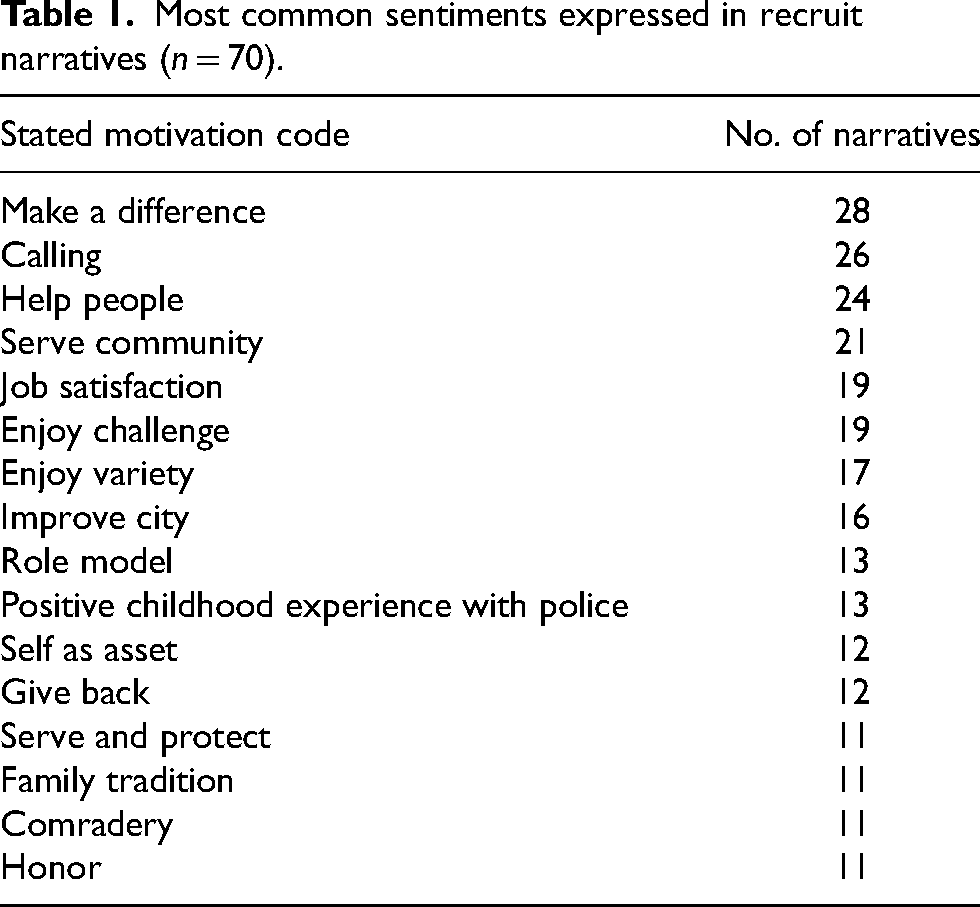
Of the 48 total codes covering the sentiments expressed in the recruit narratives, a full third (16) were mentioned by at least double-digit numbers of respondents, with 4 of them mentioned by 20 or more of our 70 respondents (Table 1). The four most common stated motivations were the desire to make a difference (n = 28), viewing policing as a calling (n = 26), the desire to help people (n = 24), and the desire to serve the community (n = 21). Although these results are very much in line with the existing literature, notably absent were expressions of more material concerns such as salary or career advancement. The only code which spoke to material concerns was “provide for family” and occurred in only 3 of the 70 narratives.
Most common sentiments expressed in recruit narratives (n = 70).
In an interesting departure from prior literature, our analysis shows gender, age, and race as having a very minimal impact on stated motivations for joining the police. We did not find any correlations between the age or race of the recruits and any stated motivation for joining. Gender only showed a correlation with two motivations, “protect” (r = .349 p = .004) and “role model” (r = .266 p = .029), although the latter is only significant at the p < .05 level. Gender did not show a significant correlation with any other stated motivation. Interestingly, gender did show some relationship to the racial identification of the recruits in our study, as those identifying as White were overwhelmingly male, those identifying as Hispanic somewhat less so, and those identifying as Black were split evenly between identifying as men and women. However, it must be noted that all of our results concerning gender should be viewed cautiously due to the limited gender diversity of the recruits in our study.
In testing for the existence of correlations between any of the 48 distinct stated motivations we identified, there were only seven significant relationships, all of which were largely intuitive. The strongest of these is that those explicitly expressing “respect for police” were significantly more likely to mention that they had relatives who currently are or previously were law enforcement of some kind, which we coded as “family tradition” (r = .482 p = .000). Those who explicitly mentioned “respect for police” were also significantly more likely to express an interest in the camaraderie of policing (r = .337 p = .005) and to view policing as a calling (r = .278 p = .022). Perhaps unsurprisingly, there is also a correlation between those who view policing as a calling and those who are interested in camaraderie (r = .261 p = .031).
The three remaining statistically significant correlations between expressed motivations are similarly predictable. Those who expressed an interest in “helping people” were quite likely to also express an interest in “making a difference” (r = .459 p = .000), whereas those who expressed an interest in “making a difference” were also likely to see themselves as having uniquely relevant experiences or bringing valuable attributes to the role of police officer, which we coded as “self as asset” (r = .3246 p = .0069). Those who expressed a desire to be seen as a “role model” were also quite likely to specifically mention joining the police because of a concern for children and youth (r = .432 p = .000).
Finally, given the time elapsed since collection of the data, we also examined potential correlations between demographics, stated motivations, and career outcomes, comparing those who are still on the force 23 years later with those who left. Of the original 70 recruits, 21 are no longer with the Rockport Police Department. After removing the 6 who either transferred to different law enforcement agencies, passed away, or retired due to medical issues, 15 members of this training class left policing for other careers (n = 10), were dismissed for committing some form of crime (n = 4), or failed out of the academy (n = 1). In comparing those who stayed with those who left for non-police careers or were forced out of the profession, there are no statistically significant differences in our data. Neither age at time of joining, stated race, nor stated gender had any correlation with who stayed or left, and neither stayers nor leavers expressed any significant motivational differences.
Interviews
Although many of the interview answers provided similar themes to those elicited from the narrative analysis, whether it was the greater space for reflection provided by interviews or the time elapsed since the narratives were written, interview responses revealed interesting nuances in stated motivations as well as new and differing motivations that have developed over the course of their careers. Interview responses still highlighted many of the publicly oriented motivations identified in the narrative analysis. P3 spoke of her desire to join the police from a young age, noting “I mean, I was born and raised in the city of Rockport, and I wanted to give back to my community” or P37 who said he joined because “I always wanted to be a police officer … and to help people. Honestly, it was a calling to help people”. However, respondents were also much more willing to disclose motivations that they recognized might not sound as noble. In response to why he was interested in policing, P22 explained, So yeah, I’ll give the academy answers versus the real answers. Academy answers are always I like helping people. But truth be told, it's different every day, you know? It's the thing that doesn’t happen at most other jobs; you go today, tomorrow, Wednesday, Thursday, Friday is just more repetition ‘til you get to a weekend. In policing … it's you never know what is happening next, so two minutes from now could be the easiest part of your day or the craziest part of your day.
P70 similarly cited the unpredictable workplace as a central appeal in joining the police force for him, explaining, [T]o be quite honest, college wasn’t an option for me, and I gravitated toward a wild lifestyle. There was a girl I went to high school with who had a father was a street cop in Rockport and he did a career day. The outlandish stories of guns, robberies, car chases, foot chases, etc. appealed to me, and there was no college needed. At the time the show COPS was wildly popular and it seemed exciting to me.
Interestingly, all interview respondents mentioned television as their prime source of information on what they thought it would be like to be a police officer prior to actually joining, with three of them specifically noting the reality show COPS as giving them the impression it would be exciting, fast-paced work.
In strong contrast to the narratives, and more in line with the prior literature on officer motivation, interview responses now identified material concerns as important motivators, especially in responses to questions about why they have remained on the police force. Career security and the possibility for promotion factored heavily into respondents’ motivations for remaining in policing, such as P3 who mentions she stayed because “in a larger department there's a lot of opportunities here, there's a lot of room for advancement … you can get promoted within three to five years, you can advance to a specialized unit”, as well as because although it is a “decent living, it's not the best” the job does come with “good medical benefits”. P37 similarly noted that although “you’re never gonna be super rich being a cop”, you will know that “you’re gonna have enough to raise a family and make a decent living, and then of course on most police jobs you’ll be 48 years old with 25 years of service and you can retire before most people in society”. He went on to explain the position is much better than “going into a factory or some other job that people feel like is a dead-end kind of thing or have to work ‘til they’re 65 or older”.
In addition to their shifting motivations, interview respondents also showed signs of growing cynicism over their time as police officers. P22 spoke of his changing views of the public, explaining “there's a lot more dirty in the world than I ever expected … Like, you couldn’t believe it, so bizarre that people will justify what I consider to be not only immoral, but obviously illegal as well”. He complained that as time went on during his career, police would find “less and less what I would call ‘true victims’, people who didn’t put themselves in a circumstance … you know, people trying to buy drugs and getting robbed, like okay, you’re not really a true victim”.
Finally, P22 finds himself less willing to risk his own safety on behalf of the public, noting, [A]s we get towards the end of our career, I think we're more protective of ourselves as opposed to willing to put ourselves out there. You know, back before it was just doing the right thing and now sometimes it's like doing the thing that's going to keep you out of the problem, as opposed to just because it's right.
P37 similarly complains of the way he feels policing has changed, especially in how younger officers are being trained for the job. He complains that “we’ve gotten away from tactical training to more of being like a friendly officer type of thing. Which I think is important, you know, to be good with the community, but the tactics are lacking now”.
When asked what advice they would give their younger selves as they began their policing careers, every respondent jokingly suggested they’d advise choosing another career but earnestly stressed a need to take the mental health challenges of the occupation more seriously. P15, who left the police force after several years to join the Rockport Fire Department instead, offers a representative response, chuckling and responding, [H]a ha, in all honesty I would tell them to run like hell from a job in policing … becoming a fireman was the greatest thing I could ever do for myself, and now my family. My mental health, physical health, relationship health, family health are all through the roof because I truly love what I do for a living. I wouldn’t say the same if I was still a policeman.
P37 similarly joked his advice to his younger self would be “take the fire test next time, because they just show up and they go back to the firehouse and watch tv and cook dinner. So next time, be a fireman”. After pausing to think a bit more, he went on to say, [N]o, honestly, I would say … boy, there's not a whole lot I would change personally, but the advice I would say would be about health … eating healthier, not being as stressed. I think it's a big thing, a lot of people have passed away and I think if they lived healthier lives or got help for their mental stuff, they could have survived on this job longer and been happier.
P3 struggled a bit to think of advice she’d give her younger self, noting she's accomplished all of her career goals. After thinking a bit longer, she offered, [U]m … don’t marry a police officer? Because that's a pain in the ass because they go through the same trauma. No, I love my husband, but it does play a role. I think really focusing on your mental health and having that separation between work, even though this is a career that kind of overwhelms you … I think focusing on my mental health a little more. I gave a lot to the job, and I think looking back I would like to slow that down a little bit and not give so much of myself.
P22 similarly spoke to how the stressors of the job impact marriage, explaining, [A]s policemen we automatically look at the worst possible outcome; that's how we train, and so we tend to convert that over to the rest of life. I went through the divorce; I did the standard police divorce … I’d like to see the numbers on marriages, because I think the downside is our behavior changes once we become a policeman and we’re used to giving orders instead of requests, and that doesn’t work very well for family life.
Discussion
Despite the incredibly high level of public spending and the immense power granted to them, there is a rather startling lack of scientific literature on who joins the police and why they do so (Clinkinbeard et al., 2021). Writing nearly 20 years ago, Raganella and White (2004) noted the urgent need for more examination and understanding of the motivations for becoming a police officer, but few have answered the call. The current study adds to the extant literature through the provision of one more datapoint on the subject, but we join with them in highlighting the need for more research on the motivations of those who become police officers. It is both surprising and more than a little concerning how much the field of criminology has ignored such a central question as why someone would join the police force.
For the most part, the results of this study are in line with prior research, finding that the stated motivations of police recruits focus principally on ideologically and altruistically driven concerns regarding serving, giving back to the community, and acting as a role model. Despite the fact that we were analyzing open-ended narratives in which recruits were given no directions other than to explain why they wanted to become police officers, our findings are remarkably similar to the existing literature which overwhelmingly relies on researcher-selected fixed-response measures.
There are a few notable differences between our findings and those of the extant literature. Although previous studies have found some variance in stated motivation by different demographic groupings (Clinkinbeard et al., 2021; Lester, 1983; Raganella and White, 2004; Rossler et al., 2020; Seklecki and Paynich, 2007; Todak, 2017), we found no correlations between either age or race and any of the stated motivations within our population. Although we did find some minor correlations between gender and stated motivation, they were rather weak, likely due to the limited gender diversity within our population.
A more notable difference between our findings and the previous literature is that the recruit narratives in our study did not discuss material concerns in explaining why they chose to enter policing. However, prior studies that found recruits place importance on things like job security or benefits all used fixed-response surveys. In our examination of open-ended responses, there was virtually no discussion of material concerns; things like job satisfaction, pay, and career advancement were only mentioned in a separate narrative that specifically asked recruits to discuss their career goals within policing. Given the freedom to craft their own responses, it is notable that the recruits in this study focused exclusively on altruistic motivations, possibly reflecting their assumption that idealistic motivations better fit the department's accepted vocabularies of motives more so than material concerns might.
In contrast to the narratives, in the follow-up interviews taking place 23 years later, after respondents had gone from recruits to long-tenured officers, material concerns were regularly cited as reasons they remained on the job. When asked why they remained on the police force instead of pursuing other job opportunities, interview respondents rarely invoked ideological or altruistic motivators such as desire to give back, serve, or protect the community. Rather, their answers focused much more on direct material concerns such as variety in the workday, job security, and retirement age.
Interview answers also featured a much more cynical view of the public than was expressed in the narratives. When mentioned in the recruit narratives, the public were exclusively invoked as innocents in need of defense, the idealized victims these recruits were signing up to protect. Although interview respondents still expressed a desire to help people, they also demonstrated a marked shift in their view of the public. Now respondents separated out the “true” victims from those presumably not deserving of police protection and spoke of being as or even more concerned with their own safety than with the safety of the public. Every interview respondent mentioned wishing they had taken mental health concerns more seriously earlier in their careers, detailing the many different ways stress and poor mental health caused by their work had affected their lives and their relationships.
A central question left unanswered by the extant literature on police recruit motivations is why police forces stocked with recruits who profess a desire to help, serve, and protect their communities often behave in ways so contrary to their stated ideals. Although this is arguably true of police forces throughout the United States, it is certainly the case in Rockport, where the behaviors of these officers and their colleagues were so contrary to the stated ideals of these recruits that they were deemed a threat to the community by the DoJ and the force placed under a consent decree.
There are several potential explanations for the differences between the stated motivations of recruits in their narrative and their stated motivations as officers 23 years later, as well as for the differences between stated ideals of Rockport police recruits and the actual behaviors of Rockport police officers. Some of the differences may be attributable to basic impression management, because the narratives were collected by their employer as part of what was essentially an extended job interview. By contrast, all of the interview respondents were long-tenured and secure in their positions speaking with a researcher who has no affiliation with their employer. The near exclusive focus on positive idealistic motivations in the narratives may be as simple as recruits attempting to put their best foot forward with a new employer. Yet this does not fully explain why these recruits felt these particular motivations would be viewed positively by the Rockport Police Department.
Our data offer some support to the argument of officers going through a “metamorphosis” (Moskos, 2007; Van Maanen, 1975) in which idealistic young recruits experience the stressors and contradictions of the police world and become increasingly cynical in their views over their time on the force. In this view, the officers expressing such positive motivations in their recruit narratives are not engaging in impression management or manipulating an available vocabulary of motive, but instead genuinely believe in their stated ideals. It is only over time as they experience the dark realities of the world that they come to reject their earlier ideals in favor of a more cynical view of the public. Although interview respondents displayed a number of attitudes consistent with the metamorphosis hypothesis, our data is unable to speak to whether these cynical views developed over time on the force or were always present but simply not expressed in the recruit narratives for a variety of reasons.
Finally, our data are consistent with the argument that these narratives reflect recruits’ understandings of the vocabularies of motive (Mills, 1940) for joining the police. Although it is impossible to fully uncover the “true” motivations of police recruits, the consistency of stated motivations across decades (Clinkinbeard et al., 2021; Foley et al., 2008; Gibbs, 2019; Hageman, 1979; Martin and Jurick, 1996; Raganella and White, 2004; Rossler et al., 2020; Todak, 2017) in combination with the public behaviors of officers that so often directly contradict these stated ideals, all lend support to the argument that these kinds of narratives are part of the vocabularies of motive of the policing world. As Mills (1940: 905) argued, stated motives do not so much reveal innate inner qualities of an individual as much as they serve as explanations for “anticipated situational consequences of questioned conduct”. This is not to imply that the recruits in our study were lying about their motivations, but rather that the remarkable uniformity in stated motivations suggests recruits are aware on some level of the “correct” reasons for joining, which influences how they express their personal motivation. Indeed, one interview respondent even went so far as to distinguish between his “academy answers” and his actual feelings.
However, all of this is really an open empirical question because of the paucity of scholarly attention on police officer motivations. Future research is necessary to answer a host of relevant questions regarding what motivates those who chose to enter policing. Although the consistency in stated motivations across studies strongly suggests police recruits are receiving a message about the “proper” motivations for joining the force, it is not at all clear where these messages are coming from. It is likely that media depictions of policing play some role here; all of our interview respondents noted policing reality shows were central to their motivation, and recent research has found changing media depictions of police are impacting the willingness of young people to join the police (Cross and Fine, 2021). Given how much the stated motivations of police recruits align with the image many police departments themselves attempt to project (Manning, 2009; Meehan, 1993; Tobias and Joseph, 2020; Wender, 2008), it is also possible that recruits are attempting to signal they understand the goals and expectations they are “supposed” to have when entering the profession.
There is an urgent need for longitudinal studies of police officer motivation to illuminate how and why officer attitudes and motivations change over the course of their careers. Although our follow-up interviews provide some interesting glimpses into changing motivations and the potential causes of these changes, the sample is far too small to draw any significant conclusions. Following one or more cohorts as they move from the training process to a policing career would help to uncover whether changes in police officer attitudes and motivations are a process of metamorphosis (Van Maanen, 1975) changing officers over the course of their career, or if stable attitudes are simply revealed over time as the vocabularies of motive (Mills, 1940) available to officers change due to their differing institutional and social positions.
Footnotes
Declaration of conflicting interests
The author(s) declared no potential conflicts of interest with respect to the research, authorship, and/or publication of this article.
Funding
The author(s) received no financial support for the research, authorship, and/or publication of this article.
