




Abstract
Political communication has transformed drastically since the Internet made its way into the political arena. Political parties seem unable to do without a website or a social networking profile any longer, particularly in election campaigns. One of the many approaches to studying online political communication is measuring specific website features political parties, politicians and candidates utilize in order to engage visitors in the political process. Even though the analysis of online political communication has evolved over the years, website-feature analysis is still a valid instrument to study political actors. The explanations sought to understand website-feature utilization are found in earlier cross-national comparative studies (technological and human development) as well as new ones (political systems characteristics, ideology, participation and engagement). This study looks back on two prior cross-national comparative research projects and reports on a cross-national comparative analysis of 1026 candidate and party websites from 17 countries participating in the European Parliament (EP) elections of 2009. To analyze these data, some methodological improvements are made compared to earlier studies.
Keywords
Introduction
In the first week of June 2009 the seventh EP elections were held. Although the number of member states has increased rapidly over recent years, the general interest and turnout of voters at these elections show a steady decline in various countries. In many Western countries politics increasingly suffers from declining interest and participation of citizens in the political arena. Also, media attention to the European Union (EU) varies considerably across these nations: comparing 1999 to 2004, in about half of the EU countries, media (i.e. newspapers and television) devoted slightly more attention to EP elections, while the other half paid less attention. However, media attention was predominantly negative about the EU (De Vreese et al., 2006). The observed democratic deficit from which the EU suffers (Norris, 2011; Van Os et al., 2007) is related to the declining voter turnout and the prevalent Euroskepticism (Lubbers and Scheepers, 2010). More generally, the political involvement of the general population is said to be dwindling across Europe (Flickinger and Studlar, 2007).
Given these problems, the challenge is to overcome the democratic deficit in EU politics. Sometimes solutions are sought by reforming electoral systems (Farrell, 2001). For instance, a recurring debate is that a party-centered system (e.g. the Netherlands) does not engage citizens, due to its impersonal stance. Increased engagement could be achieved in a candidate-centered and regionalized system (cf. the US, Great Britain). Other types of electoral systems are unfavorable to smaller parties, thus creating an advantage for established parties (e.g. in Great Britain). Changing an electoral system, however, is a long-term endeavor and would probably be of especial benefit to those not in power. Those in power, and thus able to change the electoral system, would undermine their own position by doing so, making changes in the electoral system less likely in the short run. Apart from these proposed political systemic solutions, Anderson and McLeod (2004) state that the democratic deficit is, in fact, a communication deficit due to a lack of both expert help for MEPs and financial support for communications, as well as shortcomings regarding communicating the EP’s achievements to the public. If so, a more straightforward approach to close the gap between political actors (i.e. parties and candidates) and citizens would be to change or even modernize their media campaigning strategy. The Internet, offering new possibilities, was especially hailed as being potentially beneficial to close the gap between politicians and citizens (cf. Bimber, 1998).
To investigate how candidates and political parties try to close this communication deficit in elections, a new field of research slowly emerged in the last decade of the twentieth century, called website-feature analysis. In this research approach (Jackson and Lilleker, 2010; Kluver et al., 2007; Norris, 2001), websites are coded, for instance, on the presence of informing and connecting features. These studies provide insight into how parties and candidates utilize technology not only to facilitate informing and communicating with citizens (Norris, 2003), but also to involve and mobilize them (Foot et al., 2007b), or even provide debate and feedback (Cunha et al., 2003).
Research questions
The aim of this study twofold. First, we want to asses to what degree countries still differ in terms of the utilization of website features and to what degree this is related to the level of development of the different countries. This line of research builds further on Norris’s and Foot et al.’s approach. Second, we want to extend the theoretical framework by including elements of the political system. Simultaneously, we also incorporate party and candidate characteristics – conceptualized at the individual level – that shed light on the strategic campaign decisions to utilize web technologies on websites. This results in the following questions:
To what extent do political parties and candidates for the 2009 EP elections across the EU differ on these website-feature dimensions?
How can these differences be interpreted in terms of differences in developmental theory and political system characteristics and individual characteristics?
Website-feature studies
The predominant focus in website-feature analysis is on single elections, comparing competing parties and candidates (Chen, 2010; Lilleker and Malagón, 2010; Strandberg, 2009), sometimes comparing two countries (Gibson et al., 2003), sometimes using longitudinal studies (Schweitzer, 2008). Less numerous are cross-national comparative analyses that enable cross-national comparisons of both party and candidate sites (Foot et al., 2007b; Norris, 2001). The reasons for the lack of comparative analysis are the elaborate scope of the research design as well as the limited number of elections suitable for cross-national comparative research. For instance, the EP elections take place every five years.
These cross-national comparative studies were focused mainly on the utilization of Web 1.0 features (i.e. static features implemented by the site producer and not open to change by visitors) in national elections. Norris set out to chart the use of the web by political parties across the world. Her research questions were focused on establishing whether new media technology levels the playing field, diminishing the advantage established parties have over the rising and challenging parties, as well as establishing what factors are responsible for country differences in utilizing this new media technology in general (Norris, 2001). Norris’s research focused on mapping the geographical spread of digital politics across parties of different ideologies and sizes. In trying to explain which parties in specific countries utilize website features, Norris focuses on three general developmental explanations at the country level: technological, human and political development. Her analyses show that the more technologically advanced countries are, the more parties utilize websites in general, specifically the information and communication function on their websites. Human (i.e. socio-economic) development is merely related to communication functions on websites. Political development, in particular referring to the level of democratization, which is thought to be related especially to the communication function of websites, is in fact not related at all: neither is it related to either the information or the communication function.
Foot et al. (2007a) expanded Norris’s model in two ways. First, they did not limit themselves to political party websites, but included the websites of other political actors (i.e. press, labor unions, NGOs). Furthermore, instead of Norris’s two-dimensional structure (information and communication), Foot et al. distinguish four dimensions: informing, involving, connecting, and mobilizing. Foot et al. (2007a) use similar explanatory factors in their model as Norris (i.e. human, technological and political development). However, because of differences in the composition of the sample (i.e. Norris’s worldwide and Foot’s predominantly European focus) different indicators are used to measure these concepts (e.g. measurement for democracy). Foot et al. also expanded the theoretical model by incorporating the level of political participation and the level of engagement in different countries. They also added the type of website (i.e. party and candidate website), which turned out to be the strongest predictor of the four dimensions of website features. In general, party websites were most equipped with features intended for informing, connecting, involving and mobilizing. Developmental explanations showed significant relations only for connecting. More concrete, technological development was, as expected, positively related to utilizing connecting features. However, political development, and in particular human development, were negatively related to utilizing connecting features. 1
Theory
In this section we will focus on the use of website features by candidates and parties in the context of EU countries in different developmental stages and differing political institutions (cf. Anstead and Chadwick, 2009; Franklin et al., 1996). Due to the complex nature of cross-national comparative political communication, a mono-theoretical approach based on development theory is considered to be insufficient to explain the variation in the use of web campaigning practices across political systems as well as across parties and candidates. As such we consider the use of website features within the context of different political systems (cf. Pfetsch, 2004), characterized by systemic variables, such as fractionalization, the type of voting system, and citizens’ trust in politics. Apart from these macro-level characteristics, we also take into account the individual characteristics of the candidates who own the websites, such as their sex and the ideology to which they subscribe.
Institutional approach: the implementation of web features in different societal and political contexts
The EP elections are considered to be second-order elections (Marsh and Franklin, 1996), i.e. of less importance, corroborated by less media attention to these elections (Semetko et al., 2000). Therefore, engaging citizens in EP elections is much more difficult than in national elections (Semetko, 2007). Given these conditions, online campaigning, bypassing traditional media and the Fourth Estate, might be the best low-cost option to inform people about political issues with minimal effort. As such the implementation of websites and their features for election campaign purposes is a deliberate action by parties and candidates.
Political systems characteristics
One view on elections is that they are markets where parties use marketing strategies to “sell” their party program to the electorate in exchange for their vote. If a system is dominated by a few parties, they tend to monopolize the political market of ideas: parties’ ideas tend to converge to the center of the ideological spectrum and become more alike (Cox, 1997), whereas in multiparty systems the ideological breadth is larger. The reason that countries with monopolized party system campaigns are less dependent on utilizing the web as a campaign tool than countries with a multiparty system is that in a two-party system, the media have ample opportunity to cover both perspectives. In a multiparty system – a fractionalized system (Rae, 1968) − the media attention is heavily skewed toward the larger parties, leaving less popular, smaller and newer parties with little media attention (Scholten and Ruigrok, 2006). To compensate, these less well-known fringe parties and candidates might utilize web technology more frequently to compensate for the lack of media attention to increase online visibility and by-pass traditional media. This would consequently result in more overall utilization of website features in these multiparty systems than in monopolized systems that are more dominated (i.e. less fractionalized) by a few parties. We therefore hypothesize:
Hypothesis 1. The more fractionalized a political system is, on average the more website-features will be utilized.
Countries also differ in how they organize elections. Whereas in some countries the party is at the forefront in the campaign, in other countries candidates are the focal point. A relevant distinction in this study is whether electoral systems are more conducive to party-centered or candidate-centered campaigning (Carey and Shugart, 1995; Farrell, 2001). It can be argued that in party-centered systems, a candidate campaigns not for him- or herself but on behalf of the party. In a candidate-centered system a candidate will pursue primarily the personal vote, not hindered by party considerations. Regarding the use of the web for electoral campaigning, one might argue that in candidate-centered systems the utilization of the web is more prominent than in party-centered systems. It is expected that in countries where some sort of preferential voting exists, candidates use the web for personal campaigning more extensively than in countries with non-preferential voting. Therefore, our hypothesis is as follows:
Hypothesis 2. The utilization of website features in countries with preferential voting is higher than in countries without preferential voting.
Citizens’ engagement in politics
People’s view of politics is one of the core concepts in political communication research. Earlier research has shown that more trust in politics and parliament results in voting (Hadjar and Beck, 2010), whereas for trust in politicians the findings are somewhat contradictory (Gronlund and Setälä, 2007; Hadjar and Beck, 2010). People’s cynicism and trust have especially been the object of study (Hanson et al., 2010), particularly in the context of negative campaigning (cf. malaise theory; Kleinnijenhuis et al., 2006; Schweitzer, 2010), suggesting that negative news and negative campaigning are effective (Wu and Dahmen, 2010), although not all studies demonstrate consistent findings (cf. De Vreese, 2005).
The reverse relation – whether varying degrees of trust lead to varying degrees of politicians’ communication activities – is largely uncharted territory. Norris’s most recent study shows that people receiving more information from mass media experience less democratic deficit (2011: 174), even though Internet use has a positive effect on democratic aspirations and a negative effect on democratic satisfaction. This suggests that more information or even communication from candidates might increase these aspirations. A strategy to build trust for politicians through online communication would particularly be expected in countries where trust is low. Whether this is the case is unclear. Because of the exploratory nature of our expectation we pose the following question:
Research question 1: To what extent is the general level of trust in political institutions in different countries related to the utilization of website features?
Developmental theory
Norris (2001) and Foot et al. (2007a) provide some developmental explanations for why the level of information and communication, mobilization and connection varies in different countries. Human development refers to the ability of people to enlarge their choices with respect to healthy living, acquiring knowledge, and having access to resources for a decent standard of living (OECD, 2003). The higher the level of human development, the larger the utilization of website features is to be expected. People in countries with a higher level of human development have a higher level of education and more skills to become empowered and emancipated in order to find their way in modern society. As such, the increased utilization of the website features finds an audience that is well equipped with skills to use them.
Another developmental characteristic is technology, which indicates the degree to which the country and its population invests and is able to acquire and make available new technology. Because technological development is a prerequisite for extensive website-feature utilization on the web in general, and specifically on party and candidate websites, it is viewed as important.
In conclusion, the expectations are that – in general – the higher the level of development, the more sophisticated online political campaigns are. However, although this sounds plausible, the findings of previous studies suggest a different picture. In Norris’s study (2001) technology seems to be the driving force for utilizing website features on party sites, for both the communication and the information functions. Human development affects the extent to which communication features are used on websites, but is unrelated to providing information features. In Foot et al.’s study (2007a), developmental explanations do not hold because they are unrelated to the utilization of website features. Some developmental concepts are even negatively related to features facilitating connection: the more humanly and politically developed, the less connection features exist on websites. As such these findings are contrary to expectations. The new media index, indicating technological development, provides an explanation for the presence of connecting website features, but not informing, involving, or mobilizing. There are two major reasons to retest the relations that have already been tested in previous studies. First, both studies (Norris, 2001; Foot et al. 2007a) constructed scales without checking the dimensionality of the set of indicators and without reporting the internal consistency of the scales. Second, their data are sampled from a clustered population (websites within countries). Because they used OLS regression, the standard errors of the regression estimates may be underestimated. Their claims of finding effects conceptualized at the country level may in fact be random and non-existent (Rasbash et al., 2009). Other studies also fail to take account of these issues (Lilleker et al., 2011; Lusoli, 2005). Still, because these expectations on a theoretical level are plausible and the absence of empirical relations in the previous study might have been obscured due to the internal inconsistency of scales, the scales in our study might be able to explain these developmental notions. For human development we thus hypothesize as follows:
Hypothesis 3. The higher the level of human development, the more website-features will be utilized.
Regarding technological development we hypothesize:
Hypothesis 4. The higher the technological development, the more website-features will be utilized.
Explanations based on individual characteristics: ideology, site type and sex
The political conviction of EP candidates is expected to be related to the use of website features. Gibson and Römmele (2001) suggest that right-wing parties are more likely to utilize a business-like, professional campaign strategy which is disliked by left-wing parties. However, a recent study into the use of Twitter in the EP campaign in the Netherlands does not suggest such a clear-cut difference between opposite poles of the ideological spectrum. Moreover, it was mainly moderate candidates who were using Twitter more actively, even though the total number of Twitter users was still small (Vergeer et al., 2011).
Site type (i.e. a candidate’s site or a party site) turned out to be the strongest predictor in Foot et al.’s study, party websites being the most equipped with features. An interpretation of this finding is that it is less costly to develop a single feature-rich party website than to develop many feature-rich websites for individual candidates. Also, the party website can be considered to be the flagship of the party, and most likely to be the portal for information about the party and its candidates. We also distinguish between the websites of male and female candidates, although we do not have specific expectations regarding sex as a discriminating factor.
Furthermore, we explored whether there are relations between dimensions of website features, specifically between those that can be classified as Web 1.0 (informing and personal reputation) and as Web 2.0 (connecting and sharing, audio-visualizations). Although the implementation of Web 1.0 features preceded that of Web 2.0 features it is not clear whether the adoption of Web 1.0 increases the likelihood of Web 2.0.
Method
Data
The case we use to revisit website-feature analysis is the EP elections of 2009 (European Parliament, 2009a, 2009b). There are several reasons for selecting the EP elections as the preferred type of election to perform cross-national comparative research. The first is that these elections took place within a very short timespan in all countries (between 4 June and 7 June 2009), and applied to the same parliament (i.e. the EP). Furthermore, the level of available (i.e. existing) web technology (e.g. AJAX, Flash, XML) for website designers and developers to use is identical across countries, even though the actual use of web technology may differ significantly between countries. This enables us to control factors that might affect website-feature utilization by parties and candidates. Also, according to De Vreese (2009) campaign styles in the EP elections differ from those used in national elections. As such, national and EP elections are not interchangeable, and this merits the choice of the EP elections for web-feature analysis.
In this study, websites from political parties and candidates from 17 countries 2 were coded using an elaborate, online hosted, coding instrument. The coding scheme used intricate ways of routing and administering to ensure little time was needed for coding, thereby avoiding coding fatigue and ensuring higher coding quality. The coding scheme measured detailed information on what website features were present and to which specific sharing sites, SNSs (social networking sites) and blogs parties and candidates were linked.
For countries with a large number of candidate websites a systematic random sample was drawn. Also, for each country, the top three candidates for each party were selected. As such the sample is somewhat biased towards the higher-ranked candidates. This procedure resulted in 1026 websites from 17 countries: 31.3 per cent party websites and 68.7 percent candidate websites.
National experts from participating countries were instructed during a two-day training session to assess inter-coder reliability by coding websites which were subsequently compared to the expert coding of the principal research team. An agreement of 80 percent or more was considered to be sufficiently reliable, which all coders achieved (range: 82.7−91.0 percent).
Measurements
Dependent variables
In this study we use 14 indicators of web features (see Figure 1). Subsequently an exploratory factor analysis on the set of website-feature indicators resulted in four dimensions (criteria: eigen value > 1; factor loading >.30; oblique rotation). Interpreting the factor loading pattern leads us to label the dimensions as follows: informing (Cronbach’s α = .60), personal reputation (Cronbach’s α = .74), connecting and sharing (Cronbach’s α = .60), audio-visualizations (Cronbach’s α = .63).
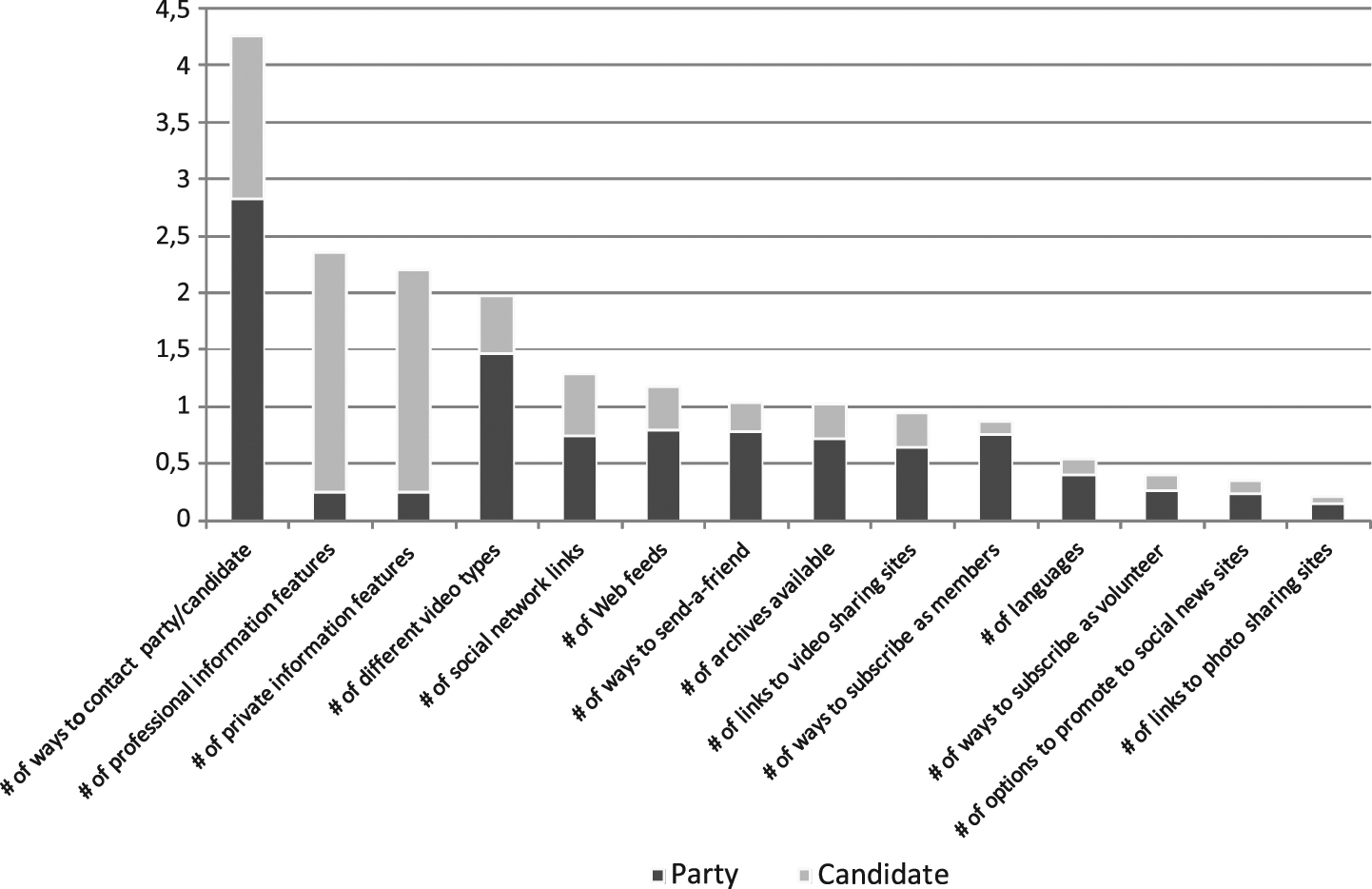
Generic measurements for European Parliament 2009 web campaigning on websites (means).
The first two dimensions, informing and personal reputation, represent Web 1.0, whereas connecting and sharing and audio-visualizations represent Web 2.0. Based on the findings of the factor analysis, summated scales for separate dimensions were computed.
Dimensional structure of website features in Europe in 2009.

Note: Criteria: eigen value > 1, factor loading > .200, oblique rotation was applied; factor loadings < .250 are not reported.
Independent variables
Political systems
Previous cross-national studies have used composite indices to measure political development, i.e. those provided by the Freedom House 3 and the Vanhanen index of democracy. 4 However, due to the relative uniformity of the countries selected, the Freedom House scale does not provide any insight into differences for the countries in our sample, due to the near absence of variation. The Vanhanen index dates back to 1998 and is considered outdated. Instead, we opted for other concepts tapping participation (i.e. membership and voter turnout), engagement (i.e. trust), and the characteristics of the electoral systems. In our study we used two measurements for political development: (1) whether or not countries use a system of preferential voting and (2) the degree of electoral fractionalization. European electoral fractionalization (Rae, 1968) – as obtained from the data set of the Piredeu project (cf. Czesnik et al., 2010) – was used to measure whether the political playing field was actually dominated by a few parties or many. 5
Political trust was measured using data from Eurobarometer EB71 (European Commission, 2010). 6 Based on the respondents’ replies to three questions concerning their trust in political institutions (i.e. parliament, government, politicians), averaged national percentages were computed.
Measuring political ideology, particularly in a cross-national setting, is very difficult and still a topic of debate in political science (cf. Keman, 2007). Therefore, we decided to use the fraction parties have joined in the EP as a proxy for ideology (Czesnik et al., 2010). Those parties that were not elected and are not known for their affiliation to a fraction have been grouped in an additional category of ‘unknown’.
Human development
An important element of human development is people’s ability to read and write. However, because this study focused on the web, we opted for Internet literacy as measured by the extent to which people have skills to perform specific tasks on the Internet (i.e. use a search engine; send an email with attachments; post to chat rooms, newsgroups or any online discussion forum; use Internet telephone; use P2P file sharing; create a web page). Cross-national comparative data on people’s Internet skills to measure Internet literacy were obtained from Eurostat (2009a).
Technological development
We use investments in research and development (R&D) as a proxy for technological development. Investment in R&D was measured as a percentage of GDP. The averaged percentages of 2007 and 2008 were used to limit the possibility of a particular year being an exception (Eurostat, 2009b).
Site-type and sex
A distinction was made between party websites and candidate websites. Candidate websites could be further subdivided into male and female candidate sites. Because these three types of websites (party, female or male candidate website) are mutually exclusive, a single nominal variable with three categories was constructed.
Analysis
To test our hypothesis we use multilevel analysis (Raudenbush and Bryk, 2002), allowing us to model country and individual characteristics simultaneously. The data are organized in a nested manner: individual websites within countries. Neglecting this structure leads to underestimated standard errors of parameters, consequently leading to a false acceptance of the hypothesis. The software used is MLwiN (Rasbash et al., 2009). Prior to the analyses, measurements were centered around the mean, so coefficients reflect differences from the average website in the sample. Nominal variables (i.e. voting system, ideology, website type) were entered as dummy variables (Cohen et al., 2003).
Results
In Figure 2 the cross-national variation of the utilization of website features is presented. It shows that candidates and parties from Sweden and Ireland utilize website features most extensively, followed by Belgium, France, Austria, Romania, the Czech Republic, the UK and Poland. Other countries (Slovakia, Germany, Hungary, Estonia, Cyprus, Portugal and the Netherlands) show less utilization of website features. Greece shows the least utilization of website-features. The Internet in Greece has a very low adoption rate amongst the entire population, and Greek people show low levels of Internet skill (Eurostat, 2009a; Lappas et al., 2008).
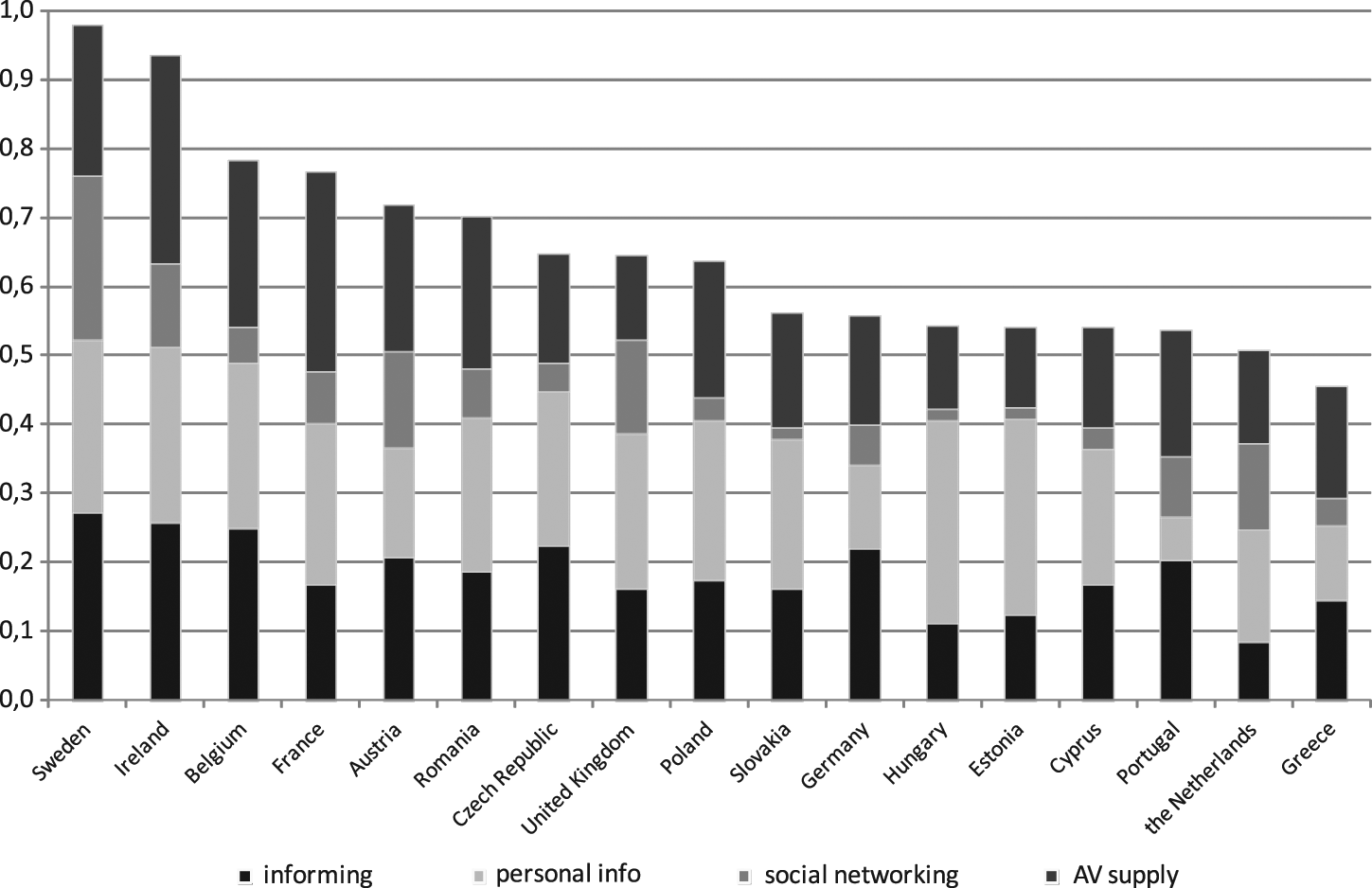
Cross-national variations of four dimensions of website features.
Table 2 compares four models, showing an increase in fit as we add more variables to the model. It shows that there is significant country-level variation for all website features, besides individual-level variation. Incorporating individual-level variables further increases the fit significantly for all website-feature dimensions. However, adding country-level variables only increases the fit significantly for informing and personal reputation, and not for connecting and sharing or audio-visualizations.
Changes in model fit: reduction in deviance (−2LogLikelihood) attributable to different models.
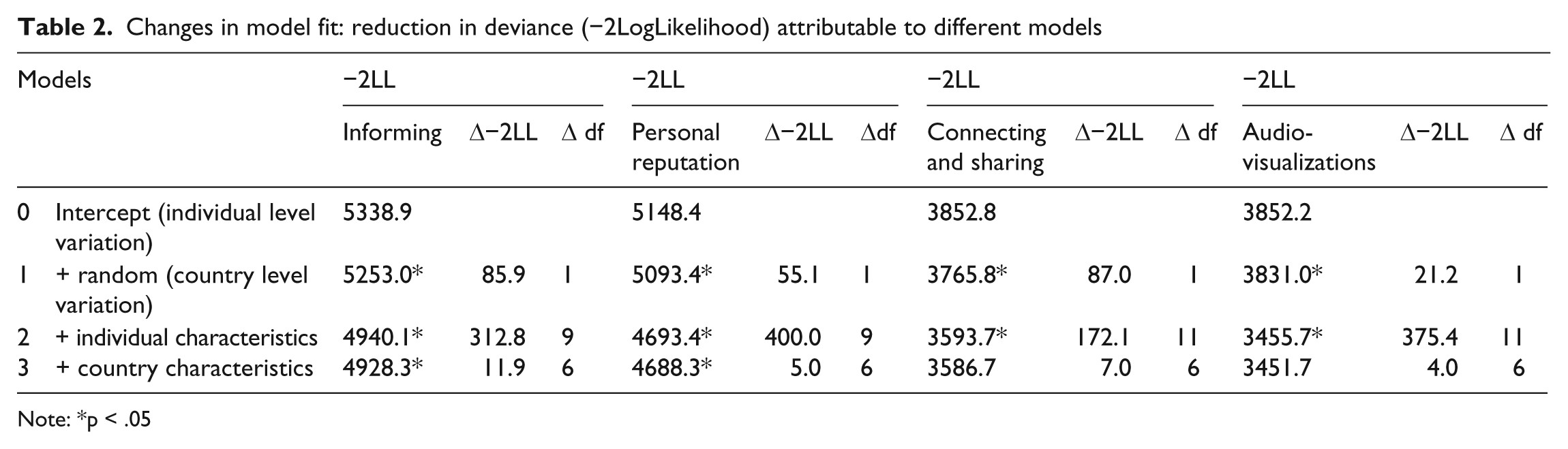
Note: *p < .05
In Table 3 we present the findings regarding the proposed hypotheses and research question. The findings show that there is no difference between countries with a lower degree of fractionalization (Hypothesis 1) with regard to any of the dimensions of website-feature utilization: countries that are dominated by only a few parties show neither more nor less website features than countries that have parties that are equally popular.
Multilevel analysis of country and individual characteristics on website-feature dimensions.

N = 1026; *p < .05, ** p < .025, p < .01. Coefficients are unstandardized. The regression coefficients for ideology are ordinal: each category is compared to the one above, allowing a comparison of EP fractions from right-wing to left-wing. The ‘unknown’ category of ideology is compared to the last category (i.e. GUE/NGL).
In Hypothesis 2 we assumed that countries that differ with respect to having a system of preferential voting would affect the utilization of website features. The findings, however, show that this is not the case. The only difference found was that countries with the system of a single transferable vote utilize more informing website-features than countries with a non-preferential voting system (p < .025).
Regarding the question of whether the utilization of website features is related to the level of political trust in different countries, the findings show that there is a significant relation for website features on personal reputation: the less trust there is in a country, the more website information on personal reputation is displayed on websites. Other relations between political trust and website features are non-significant. On whether countries with a higher level of human development (as measured by Internet skills, Hypothesis 3) on average show higher levels of website-feature utilization, we find that there are no significant relations. As for technological development (Hypothesis 4), predicting that higher levels of investments in R&D would coincide with greater utilization of website features, we found this was supported for informing website-features. However, for the other types of website features, we found no relations whatsoever.
Turning to the individual-level explanations, we expected differences between different ideologies. The findings show that there are many differences between different EP fractions. The Greens/EFA websites display relatively few informing features as compared to their ‘neighboring’ fractions ALDE and S&D. The other fractions do not differ significantly from their neighboring fractions on informing features. As for personal reputation features, we see that the ECR fraction utilizes these features considerably more than their neighboring fraction EFD. ALDE shows fewer personal reputation features than their neighboring fraction EPP. The other fractions show little differences on personal reputation features. Overall, there are no clear ideological patterns observable that suggest that right-wing candidates utilize more website features than their center or left-wing counterparts, or fewer for that matter.
Regarding the website type (i.e. male candidate, female candidate or party), we find that party sites differ significantly from male candidates’ websites (i.e. reference category). The results are similar to Foot et al.’s (2007a) findings regarding informing and audio-visualizations: party websites show more features than candidate websites. Party websites have less personal reputation features, which is logical since these focus more on the party as a whole rather than on candidates. As for connecting and sharing features, these are also present less often on party websites. These activities make more sense on personal websites than party websites. On none of the dimensions of web features do we see significant differences between male and female candidate websites.
Finally we look at the relations between what we consider Web 1.0 features (i.e. informing, personal reputation) and Web 2.0 features (connecting and sharing, audio-visualizations). Informing website features are related to connecting and sharing features as well as audio-visualizations. Personal reputation features are positively related to connecting and sharing features, but not to audio-visualizations.
Discussion
In this study focusing on website features in the 2009 EP campaign, we found four distinct and reliable dimensions. These arose from a factor-analytic approach: (1) informing, which provides site visitors with options to acquire information and be informed automatically; (2) personal reputation, which provides information about the candidate’s professional and private life; (3) connecting and sharing, which focuses on setting up and maintaining (reciprocal) relations and sharing information with the candidate, and (4) audio-visualizations, which refers to features that guide visitors to online sites where audio-visual material can be viewed. The first two dimensions are closely related to Web 1.0 technology, whereas the latter two are associated more with Web 2.0 technology.
There appear to be considerable cross-national differences in website-feature utilization (research question A). Some Mediterranean countries (Greece, Portugal and Cyprus) show significantly lower utilization of website features, while Sweden and Ireland rank highest. However, there is too little consistency to claim that there is a North−South divide across Europe for web campaigning as it existed for general Internet use in the last decade of the last century (cf. Norris, 2000).
Regarding the question of how these differences between countries can be interpreted (research question 2), this study focuses on a number of explanations conceptualized at the country and individual level. The multilevel analysis showed that the proposed country-level relations were mostly absent. Fractionalization did not offer an explanation, whereas the type of voting system did only for personal reputation features, although not in the expected direction. Websites displayed more personal reputation features in countries where political trust was lower, although the relation is weak. More investment in R&D, as an indication for technological development, was associated with more informing features. However, investment in R&D was not associated with the remaining three dimensions of website features.
The most pronounced relations are found at the individual level: ideology and website type. With regards to ideology – on candidates’ conviction how society should be organized, what societal goals should be achieved and how to accomplish them – there are considerable differences between fractions. However, the differences are difficult to interpret in terms of left-wing versus right-wing, or Euroskeptics versus pro-EU. As for website type, it is clear that party websites are best utilized, i.e. have the most features, suggesting that campaigners opt for the least costly option, preferring to make abundant use of features on party websites, and only marginal use of features on candidate sites. There are no significant differences in the extent to which male and female candidates utilize website features.
Conclusion
In the study of political communication, website-feature analysis has become a research tradition in its own right. Increasingly, national studies are undertaken to study web campaign strategies conducted by political parties and their candidates. Cross-national analyses of political party and candidate websites are less abundant but necessary to establish whether differences exist that are attributable to systemic differences (e.g. political, cultural, media system).
However, analyzing political party and candidate websites on the utilization of website features, as demonstrated in this study, is not without its problems, for several reasons. First, the development of a cross-national comparative theoretical framework to explain the use of the make-up of websites is still in its early stages of development. In this study, we tried to re-use some theoretical notions from earlier studies (i.e. developmental theory) and to extend the existing framework with those of political systems theory. However, because findings show that there is very little variation attributable to country differences, the theoretical framework still needs further development, particularly at the individual level. Also, this study focused solely on European countries. The spread and use of Internet technology in political communication across the EU is pervasive, maybe even due to the European Commission’s digital agenda. If country differences are to be conceptualized, it might be worthwhile not to limit the sample to a single continent but to sample countries across continents (Europe, Asia, Africa, Australia, North and South America). This touches upon the issue of the sampling strategy itself, because different strategies can affect the empirical outcome as well (cf. Seawright and Gerring, 2008).
However, the development of theories and subsequent testing is further complicated by the object of study: the web has changed considerably in the last decade and still has not fully matured. First, web technology became more advanced and user-friendly via technologies such as AJAX as well as user-friendly software to develop websites (e.g. blogger.com, WordPress, Drupal, Joomla). At the same time, web presence increased due to the availability of free services that offer an empty infrastructure − a platform to be filled with user-generated content by the users themselves (e.g. Facebook, Bebo, YouTube, Vimeo; cf. Gueorguieva, 2008). These developments brought web presence within the reach of all parties and candidates. Due to this rapid and ongoing evolution of the web, explanations that were valid in the early stages (Web 1.0) might not be valid at later stages (Web 2.0). To discover to what extent this is the case, one would not only have to focus on cross-national comparative analysis, but also on a research design that allows for longitudinal analysis. To make matters even more complex, the future of online political campaigning may change and even move away from the web towards dedicated applications (so-called apps) on devices such as smart phones and tablet computers. Already popular platforms (e.g. Twitter, Facebook) are accessible outside the web browser and on mobile devices (e.g. Digsby, Echofon, Socialite, TweetDeck, Ubersocial). These apps provide users with a different experience from both the sender’s and the receiver’s perspectives than a website does. What this entails for the future of political web campaigning or for political Internet campaigning in general has yet to be discovered and framed in theory and will provide scholars with further challenges to tackle. This process, combined with increased individualized campaigns more detached from the political party (cf. Bimber and Davis, 2003), and facilitated by social media (cf. Vergeer and Hermans, in press), is likely to change politics in the coming decades. Assessing whether this will benefit parties and politicians or politics in general is unclear.
Footnotes
Acknowledgements
The authors would like to thank the following people for coding the websites in their respective countries. Austria: Flooh Perlot and Peter Filzmaier; Belgium: Eva De Smedt and Wim Vanobberghen; Cyprus: Dimitra Milioni; Czech Republic: Václav Štetka; Estonia: Ülle Toole; France: Karolina Koc Michalska and Thierry Vedel; Germany: Eva Schweitzer; Greece: Marianna Psilla, Nikos Leandros, Sofia Fourouli and Vassiliki Paliatsa; Hungary: Gabriella Szabó and Zsuzsanna Mihályffy; Ireland: Lugh O Braonain; Italy: Cristian Vaccari and James Newell; the Netherlands: Liesbeth Hermans, Nicole Louwers, Maurice Vergeer; Poland: Michal Jacunski; Portugal: Carlos Cunha; Romania: Dorina Gutu; Slovakia: Branislav Ondrasik; Sweden: Lars Lundgren; United Kingdom: Darren Lilleker and Nigel Jackson.
Funding
This research received no specific grant from any funding agency in the public, commercial, or not-for-profit sectors.
Notes
Maurice Vergeer received his PhD in Communication Science from Radboud University, Nijmegen. His work focuses on people’s Internet use and social capital, journalists’ use of the Internet, and political communication on the Internet.
Liesbeth Hermans is Assistant Professor in the Department of Communication Science, Radboud University, Nijmegen. She also works as a senior researcher at the Media Research Centre, University of Applied Science, Windesheim. Her field of research is journalism studies and political communication. She is coordinator of the project ‘Journalists in the Digital Age’, a longitudinal study of trends in Dutch journalism.
Carlos Cunha, PhD in Political Science, is Executive Chair of the Faculty at Dowling College in Oakdale, New York. He is also a Research Associate in the Centro de Investigação de Estudos Sociológicos (CIES) at Lisbon University Institute (Instituto Superior de Ciências do Trabalho e das Empresas/ISCTE/IUL). He wrote The Portuguese Communist Party’s Strategy for Power, 1921−1986 (Garland, 1992), and has published numerous articles, book chapters, and reviews on various aspects of Portuguese politics, specializing on the use of new media in the nation as well as the Portuguese Communist Party.
References
Supplementary Material
Please find the following supplemental material available below.
For Open Access articles published under a Creative Commons License, all supplemental material carries the same license as the article it is associated with.
For non-Open Access articles published, all supplemental material carries a non-exclusive license, and permission requests for re-use of supplemental material or any part of supplemental material shall be sent directly to the copyright owner as specified in the copyright notice associated with the article.
