



Abstract
Recent national, regional, and community-level research has shown that the Internet has the potential to provide a powerful medium for political engagement. Yet, systematic analyses that consider space and place as critical components of this area of research are lacking. This issue is important inasmuch as the extant literature has clearly shown that the diffusion of sophisticated Internet technology to some places has been slow and that the use of high-speed broadband modems has a significant impact on using the technology for social and economic purposes. The data for this study come from the nationally representative Pew Internet and American Life Study conducted in November 2008 directly after the United States presidential election. Although the results are consistent with previous research on both spatial and digital inequality in terms of Internet use, the interactions between race and place suggest that it is not just that the Obama campaign used new media to mobilize constituents, but that these efforts were realized in a particular region of the country and were particularly influential in given segments of the population. Implications for future research and the value of digital capital are discussed.
Introduction
Since 2004, the research exploring the use and role of information and communication technologies in politics has exploded (Chadwick, in press). This upsurge in studies is generally attributed to the relative ubiquity of the technology as well as the success stories where political campaigns used new media in mobilizing voters (Garcia-Castañon et al., 2011). However, interest in understanding the role of new media in politics is encouraged by several specific factors including the dramatic rise in rates of home access, and in particular the increase in high-speed access and Internet-enabled hand-held devices in recent years (Horrigan and Murray, 2006). Moreover, after 2004, a substantial amount of political candidates’ financial contributions to campaigns were coming from online donations, resulting in more emphasis on ‘web campaigns’ (Herrnson et al., 2007), including Howard Dean’s 2004 Democratic primary run and President Obama’s 2008 campaign (Talbot, 2008). More recently, national-level research has shown that a full 80 percent of respondents went online to find information about political campaigns in 2008 (Smith, 2009). Still, previous research has provided many equivocal findings. For example, some studies suggest that online political behavior is an extension of offline behavior, yet it is a medium used and controlled by the privileged (e.g. Norris, 2001; Witte and Mannon, 2010). However, other studies have shown that some of the traditional markers for offline political engagement (e.g. socio-economic status) are not pervasive in online political endeavors (e.g. Jenson et al., 2007).
One key factor that may clarify the role of the Internet in political participation is taking into account space and place. The research addressing general spatial differences in Internet usage is voluminous. Taken as a whole, however, research suggests that Internet usage differs dramatically by place as a result of unequal diffusion of technologies, in particular high-speed availability outside of urban and suburban places (e.g. Mossberger et al., 2008; Sylvester and McGlynn, 2010; Whitacre, 2010). Other social variables, including political affiliation, racial diversity, socio-economic status, educational attainment, and median age all vary spatially as well (Lobao, 1996, 2004). These personal characteristics are also suggestive of varied levels of political participation (Oliver, 1984) and are traditional markers of digital inequality regardless of infrastructure and diffusion (DiMaggio et al., 2004; Hargittai, 2010). Still, scant attention has been given to the matrix consisting of space (both in terms of rurality and region), use of the Internet for political purposes, and inequality.
To address this gap in the literature, our paper investigates how spatial and regional variation, political affiliation, race, and other traditional markers of digital inequality impact the general use and perceived importance of the Internet for engagement in the political process. 1 We also explore the differences in the importance of online political media versus more traditional forms such as television and radio. In doing so, we draw on theories of political participation, which provide a lens for our discussion. In addition, we focus on digital capital − the role that proficient use of the Internet and access to broadband technologies plays in using the technology for political purposes.
Theoretical background
Theories of political and civic participation emphasize the importance of social and economic resources as well as networks ties to politically active individuals as the basis for individual action (Brady et al., 1995; McAdam and Paulsen, 1993; Rosenstone and Hansen, 1993; Stern and Fullerton, 2009) because there must be factors that increase or decrease the costs and benefits associated with political participation. For example, Verba et al. (1995: 272) and Oliver (1984) suggest that citizens participate in civic or political matters because: (1) they have the time and money to offset the costs of participation (e.g. registering to vote, waiting in line on election day, and acquiring information about candidates and issues); (2) the issues or candidate is salient to them; or (3) members of their social networks are civically or politically involved.
Despite the fact that the model above emphasizes resources and political engagement (Verba et al., 1995: 270), longitudinal studies of political participation in the US tend to find that socialization, the political climate, and recruitment are vital components as well (Rosenstone and Hansen, 1993). For example, Rosenstone and Hansen’s (1993) strategic mobilization perspective suggests that people participate in the political process when encouraged to do so. They found that nearly half of the decline in voter turnout between the 1960s and the 1980s resulted from the declining efforts of parties to mobilize voters. However, their results also show that educated, employed, and wealthy individuals were most likely to be contacted directly by political parties and campaigns. Demographic differences notwithstanding, other panel studies have examined the ‘primacy principle’, which suggests that political attitudes are learned early in life and are fairly stable over time (Searing et al., 1976).
These historical perspectives on political engagement fit with discussions regarding online political participation quite well. For example, there is little doubt that the Internet is a resource. Yet, research has shown that it is used to its fullest potential by wealthier and more highly educated people (DiMaggio et al., 2004; Hargittai, 2010). In addition, the fact that individuals can quickly and easily communicate with their social networks via email, Twitter, or Facebook, for example, means that mobilizing one’s network, or being mobilized to vote or otherwise become politically engaged, could be easier than ever before. That is, information can be shared in ways that are faster and easier than in previous eras. The latter point is not lost on politicians, as evidenced by the social networking site http://www.barackobama.com, which some argue helped provide a decisive win for Obama in the 2008 Democratic primary (e.g. Talbot, 2008). However, issues associated with a lack of access to and aptitude with information and communication technologies cannot be understated in this discussion.
What is digital inequality?
Digital inequality refers to a situation where certain groups have unequal access to and proficiency with Internet technologies (e.g. DiMaggio et al., 2004; Hale et al., 2010; Hargittai, 2010; Stern et al., 2009). While numerous studies have shown that disparities in access and usage exist, Witte and Mannon (2010) argue that the outcome of these disparities is the consolidation of access to information in the hands of the most powerful segments of society. In addition, previous research has shown that variables traditionally associated with various other forms of inequity such as race, rurality, region (e.g. the Southern US), income, and educational attainment also predict this ‘new form’ of inequality (DiMaggio et al., 2004).
These disparities are increasingly being understood as ‘digital capital’, or the extent to which information technologies provide new or more efficient opportunity structures for those who can proficiently use them (Stern et al., 2011). For example, research has shown that people who have high-speed access to the Internet tend to have larger and more diverse social networks (Boase, 2010) − one of the factors related to political participation (Verba et al., 1995). Numerous other studies have shown that people who are regular users of information technologies are more politically and civically engaged (e.g. Mossberger et al., 2008; Norris, 2001). In general, these studies suggest that it is not necessarily that the Internet serves as a conduit for political engagement but rather it is a tool to further engage those who are already active − thus, the rich get richer (Stern and Dillman, 2006). Still, the degree of online engagement in the 2008 presidential election seems to contradict the ‘rich get richer’ model of digital inequality, especially given the diversity of individuals who report using the Internet for searching out political information during this time period (Garcia-Castañon et al., 2011).
The reason for this apparent contradiction may be found in Chadwick’s (in press) use of the computer science concept of ‘granularity’. In short, granularity refers to breaking down large projects into smaller, more manageable pieces. Chadwick uses the term to consider the online environment and argues that ‘informational public goods may be disaggregated into tasks of varying magnitude, where magnitude is understood as a function of resources, such as time, knowledge, experience, cognitive processing, and so on, that people are able to mobilize in the pursuit of collective and individual goals’ (in press: 4). Therefore, if the civic and political engagement models outlined above translate to online political behavior, reducing the costs associated with being politically involved (e.g. the short amount of time needed to search for or read information and ease of searching for or receiving this information) could circumvent some of the results from previous studies. Granularity, then, suggests that there could be sources of information such as blogs, which can be very detailed and where the reader must be very involved, but there could also be other sources of information requiring a smaller time investment (e.g. as the friend of a Facebook page or receiving short emails or text messages through a Listserv), which could benefit less proficient users. Still, whether there are differences by traditional inequality markers in how people use Internet resources to political ends has not been well explored.
What is spatial inequality?
Lobao (2004: 1) defines spatial inequality as ‘stratification within or between territorial units’. Therefore, studying spatial inequality requires the empirical examination of variation across spatial units and the consideration of how varying degrees of access to resources impact different segments of society (Lobao et al., 2007).
Most of the studies addressing spatial inequality and Internet use have focused on the problems associated with unequal Internet access in rural places. For example, Warren (2007) argues that rural residents have the most to gain by the declining significance of physical distance and geographical boundaries resulting from Internet use. Yet, they also have the most to lose with poor or inefficient access to and low proficiency in using the technology. What is more, rural populations tend to have lower levels education, which results in less experience with information technologies. Thus, while all rural residents may be at some disadvantage, the most vulnerable segments of rural populations, including the poor and those with lower levels of education, will be left even further behind.
The current theme running through much of this research is a focus on technological diffusion, and in particular high-speed access. In terms of spatial inequality, there are two interrelated angles from which one must consider this issue: the demand side and supply side (Khatiwada and Pigg, 2010). In terms of supply side, the argument has been that the expense of bringing high-speed broadband access to remote places is not offset by the profits that could be made in doing so because residents are not motivated or capable of paying for the services (Whitacre, 2010). However, Whitacre and Mills (2007) have used longitudinal data to examine policies that promote broadband infrastructure. They found that these programs are most successful after residents understand the benefits of the technology (see also Whitacre, 2008). Mossberger et al. (2008) provide support for this position by showing that when broadband is available in communities, technological proficiency increases, as does the diversity of uses. Two socio-cultural perspectives are useful in understanding the particulars of this issue: Silverstone et al.’s (1992) ‘domestication theory’ and Jenkins’ (2006) concept of ‘convergence culture’. Taken together, they suggest that that new media are developed and integrated into everyday life through a process that involves (1) the adoption and ‘ownership’ of new technologies at the individual or consumer level, and (2) innovation/development based on types of usage at the developer level. That is, new media users, through their own actions using new media, become participants in how technology companies − and in our case politicians − make decisions on what new technologies are developed or put into use. Thus, as people gain access to broadband their usage changes, and from this bottom-up perspective we see the disseminators and innovators of new media reacting to new audiences and usages.
Nonetheless, there is still variation within and between spatial units (e.g. regions and counties) in terms of broadband availability and connectivity. For instance, Figures 1–3 show substantial spatial clustering of broadband connectivity, as measured by connections per 1000 households, across US counties as well as within the Southern US region and a particular Southern state. 2 At each level, rural areas tend to experience lower rates of connectivity and, as shown in previous studies, fewer providers and below-median household incomes (Khatiwada and Pigg, 2010). Regardless of this ‘rural penalty’ regarding high-speed Internet access, it remains to be seen if or how this impacted use of the Internet around the 2008 presidential election, and whether the findings were spatial (e.g. regional).

Spatial distribution of broadband connections, local indicators of spatial autocorrelation (LISA) cluster maps, and an indicator of global spatial autocorrelation (Moran’s I). US counties, 2008.a
Race, space, and the 2008 presidential election
Thus far, we have discussed previous perspectives on political participation, the role of Internet access and proficiency in using the technology in diverse ways, and the role of spatial inequality in usage. Our analysis focuses on data collected directly after the 2008 US presidential election. This election was unique in two ways, which makes it ideal for assessing the use of information and communication technologies while also incorporating traditional markers of inequality and space.
First, there has been a great deal of attention given to the Obama campaign’s use of ‘new media’ to mobilize young voters. Garcia-Castañon et al. (2011: 119) note that while the 2004 Dean campaign was the first presidential run to use more than simple Listservs, message boards, or both to communicate with potential supporters, the Obama campaign was far more aggressive in targeting the youth vote and employing experts, including one of the original developers of Facebook. Most analysts suggest the strategy was a great success. In addition to having its own site, the Obama campaign had a presence on popular social networking sites such as Facebook and MySpace as well as lesser-known sites (Garcia-Castañon et al., 2011). They also employed more traditional and varied forms of communication, online and offline (Vargas, 2008). Taken together, the 2008 Obama campaign serves as an illustration of Chadwick’s (in press) use of the term ‘granularity’. That is, people − youth and others − had numerous ways of getting information, thus reducing social costs such as time, money, or investment in a learning curve.
Second, in addition to mobilizing the youth vote, Obama had a powerful influence on African-Americans registering and voting, particularly in the South. The campaign worked very hard to get African-Americans registered and to the polls preceding the tight primary race with Hillary Clinton (Bullock, 2009). Although Obama did not carry the South, he surpassed in electors previous Democratic candidates dating back over 30 years to Carter’s 1976 campaign, in part, not surprisingly, by mobilizing the African-American electorate (Bullock, 2009). In an analysis of the voting patterns in the South, Bullock (2009: 6) demonstrated that Obama ‘attracted 98 percent of the African-American vote in four states’ and did better than other candidates among Latino/as in Florida. Yet, few studies have examined any differences in how people received information spatially by race or political party and whether any traditional markers of inequality mitigate or intervene in these relationships.
Theoretical summary and propositions
The question that remains to be answered is whether there were regional or spatial and racial patterns in the use of information technologies during the period surrounding the 2008 presidential election. Taken as a whole, the research outlined above suggests: (1) resources are critical in mobilizing the electorate; (2) Obama’s campaign mobilized youth and African-American to register and vote; (3) this campaign effectively used new media in its efforts; and (4) the relationship between rurality and access to high-speed Internet has a potentially powerful effect on usage patterns.
In order to address these questions, we will analyze how a variation in spatial factors (i.e. rurality and region), political affiliation, race, and other traditional markers of digital inequality impact the general use and perceived importance of the Internet for engagement in the political process. We also explore the differences in the importance of online political media versus more traditional forms such as television, newspapers, word of mouth, and radio. Based on the previous literature, we expect rurality and broadband usage to continue to have a strong impact on whether people use information at all. However, we do not anticipate many other substantive differences in usage to exist given the ubiquity of the technology. Taking into account what we know about the strategies of the Obama campaign, and that he was the first African-American candidate to win the primary, we predict that the importance of the different media will vary by race, age, and region along with the previously mentioned rurality and broadband access.
Method and procedures
The data for this study come from the Pew Internet and American Life Project’s telephone survey conducted by Princeton Survey Research Associates, which was carried out directly after the 2008 US presidential election, in November and December; of the sample, 1420 were eligible for inclusion in our models. The sample for this survey is a random digit sample (RDD) of telephone numbers selected from telephone exchanges in the continental United States. In this study, 85.1 percent of those contacted were found eligible for the interview and 86.9 percent of eligible respondents completed the interview, which led to a final response rate of 23.3 percent (see Smith, 2009).
Independent variables
We have three sub-groups of independent variables. First, we have spatial variables including rurality, region, and broadband access. The rurality variable is based on the 2003 Beale Codes. We use the full variable in the multivariate models. In the predicted probabilities analysis we use the US Census definition for ‘rural’. The Census Bureau defines residents as ‘urban’ if they reside within a central city of a metropolitan statistical area, as ‘suburban’ if they reside within a metropolitan statistical area county that is not in a central city, and as ‘rural’ if they reside in a non-metropolitan statistical area county. Region variables are divided into South, Northeast, West, and Midwest (reference group). Finally, to measure high-speed Internet usage and access we use the question that focuses on the type of home access: Does the computer you use at HOME connect to the Internet through a dial-up telephone line, or do you have some other type of connection, such as a DSL-enabled phone line, a cable TV modem, a wireless connection, or a T-1 or fiber optic connection? We recoded the choices into a dichotomy between dial-up versus DSL, cable, and wireless/fiber optic connections.
The second set of independent variables focus on political affiliation. In our models, we use a set of dummy variables for party affiliation: self-identified Democrats (voting for Obama), Republicans (voting for McCain), and other/Independent (reference group).
The final set of independent variables includes traditional markers of digital inequality. These variables include age (measured in years), income (less than $10,000; $10,000 to under $20,000; $20,000 to under $30,000; $30,000 to under $40,000; $40,000 to under $50,000; $50,000 to under $75,000; $75,000 to under $100,000; $100,000 or more), education (none, or grades 1−8; high school incomplete; high school graduate or GED certificate; technical, trade or vocational school after high school; some college, no four-year degree which included associate degree; college graduate; post-graduate training/professional school after college), and race (Non-Hispanic black or African American = 1).
Dependent variables
There are two sets of dependent variables where the first set includes three dummy variables for: (1) using email to communicate or get information about political issues or candidates; (2) using text message to communicate or get information about political issues or a candidate; and (3) using political or civic group website to communicate or get information about political issues or a candidate. We also include a cumulative scale variable that ranges from 0 to 3, where 3 equals using all three media and 0 indicates using none. The analysis of these variables is limited to Internet users (N = 579). In our second set of analyses, the dependent variables include a set of eight ordinal variables that range on a four-point scale from ‘not important at all’ to ‘very important’ to gauge how important different media are to respondents. The variables include the importance of (1) social networking sites; (2) television; (3) radio; (4) online news sites; (5) political websites; (6) political blogs; (7) talking with others; and (8) newspapers. 3 In the analysis of these variables, we include the full sample (N = 1420).
Analytic strategy
We use two different types of logistic regression based on the question we are seeking to address and the dependent variables’ level of measurement. Because the first set of dependent variables has dichotomous outcomes, we use binary logistic regression models. In the second set of models, we use ordered logistic regression models. We estimate these models to examine the importance of the various types of traditional and online political material to the respondent. This approach is appropriate because when a dependent variable takes on more than two values the definition of a ‘success’ becomes more heavily reliant on theory (see Long and Freese, 2006; O’Connell, 2006) In these models, given k number of possible ordered responses, in this case the levels of importance of a certain media, for example, the researcher determines the particular outcome of interest (data can be broken down into k − 1 cut points). This method successively dichotomizes the data in a way that makes interpretation of the coefficients similar to a binary logistic model. Finally, we graph predicted probabilities and use two path models to explicate and visually represent our interaction effects. 4
Results
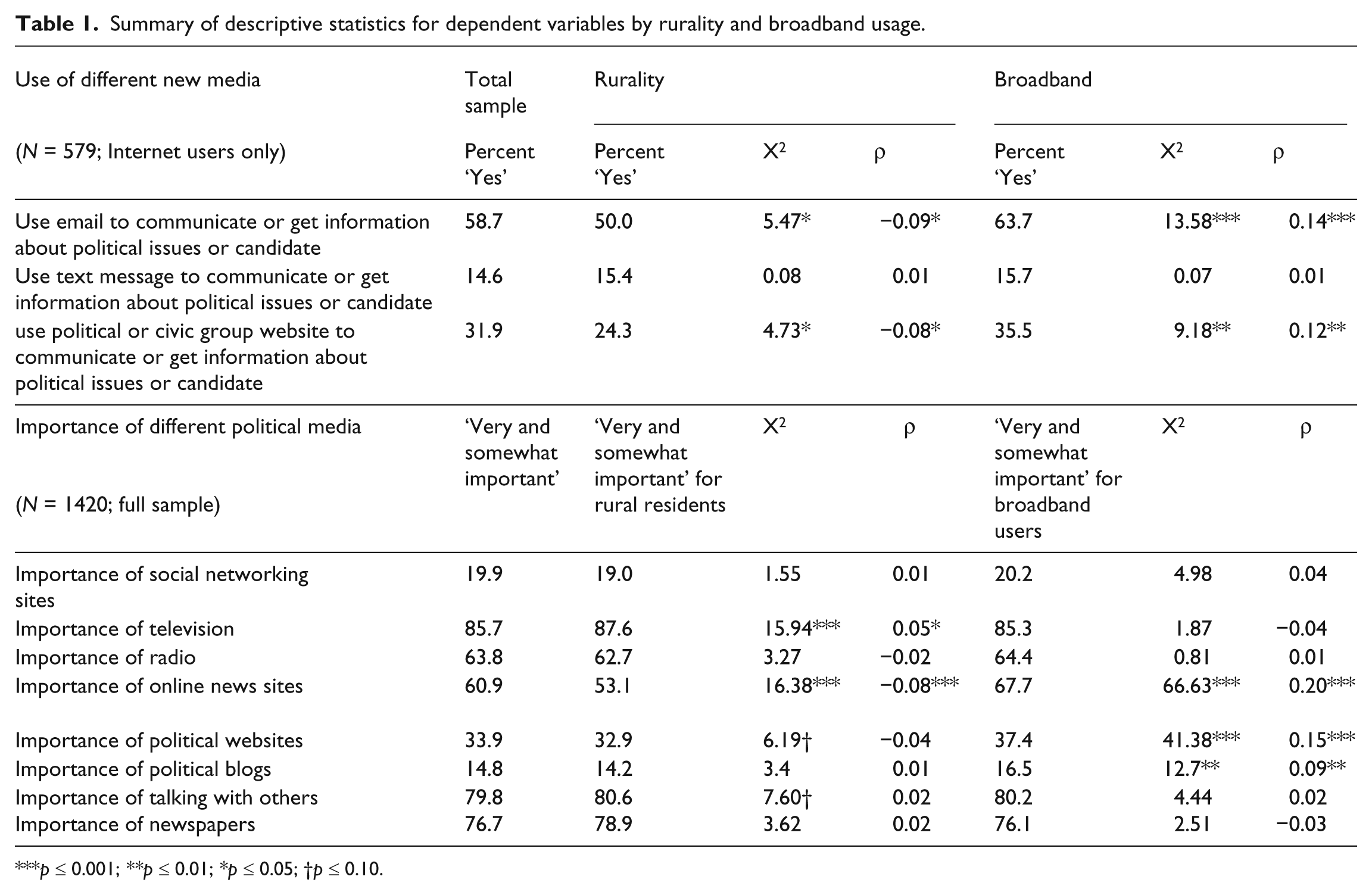
Descriptive statistics for the dependent variables as well as their relationships with rurality and broadband access are presented in Table 1. We start with the set of dichotomous variables for Use of different new media to communicate or get information about political issues or a candidate. Starting with the use of email, over half of Internet-using respondents report using this form of communication to get information about a political issue or candidate (59 percent). Using this form of communication is negatively and significantly related to rurality (X2 = 5.47; p ≤ 0.05/ρ = −0.09; p ≤ 0.05); yet positively and significantly related to broadband access (X2 = 13.58; p ≤ 0.001/ρ = 0.14; p ≤ 0.001). Far fewer respondents used text messaging to get information about political issues or a candidate (15 percent) and there were no significant difference between rural respondents or broadband users. Finally, about a third of respondents used a political or civic group’s website to get information about political issues or a candidate (32 percent). Similar to the use of email, using this form of communication is negatively and significantly related to rurality (X2 = 4.73; p ≤ 0.05/ ρ = −0.08; p ≤ 0.05) and positively and significantly related to broadband access (X2 = 9.18; p ≤ 0.01/ρ = 0.12; p ≤ 0.01).
Summary of descriptive statistics for dependent variables by rurality and broadband usage.
p ≤ 0.001; **p ≤ 0.01; *p ≤ 0.05; †p ≤ 0.10.
We now turn to the importance of different media. Generally speaking, traditional forms of information and media are viewed as more important than new media (second half of Table 1). For example, 86 percent of respondents listed television as important or very important in learning about political matters or candidates, especially for rural residents (X2 = 15.94; p ≤ 0.001/ρ = 0.02; p ≤ 0.05), followed by talking to others (80 percent), newspapers (77 percent), and radio (64 percent). Online news sites were seen as important or very important by 61 percent of respondents, but this form of media is negatively and significantly related to rurality (X2 = 16.38; p ≤ 0.001/ρ = −0.08; p ≤ 0.001) and positively and significantly related to broadband access (X2 = 66.63; p ≤ 0.001/ρ = 0.20; p ≤ 0.001). The importance of political websites and blogs had similar results regarding their positive and significant relationship with broadband access (X2= 41.38; p ≤ 0.001/ρ = 0.15; p ≤ 0.001; X2 = 12.70; p ≤ 0.01/ρ = 0.09; p ≤ 0.01, respectively). About 20 percent of respondents reported that social networking sites were important or very important in learning about political matters or candidates; rurality or broadband access had no bearing on these feelings.
Do spatial variables, political affiliation, or digital inequality factors affect the general use of ICTs for political purposes?
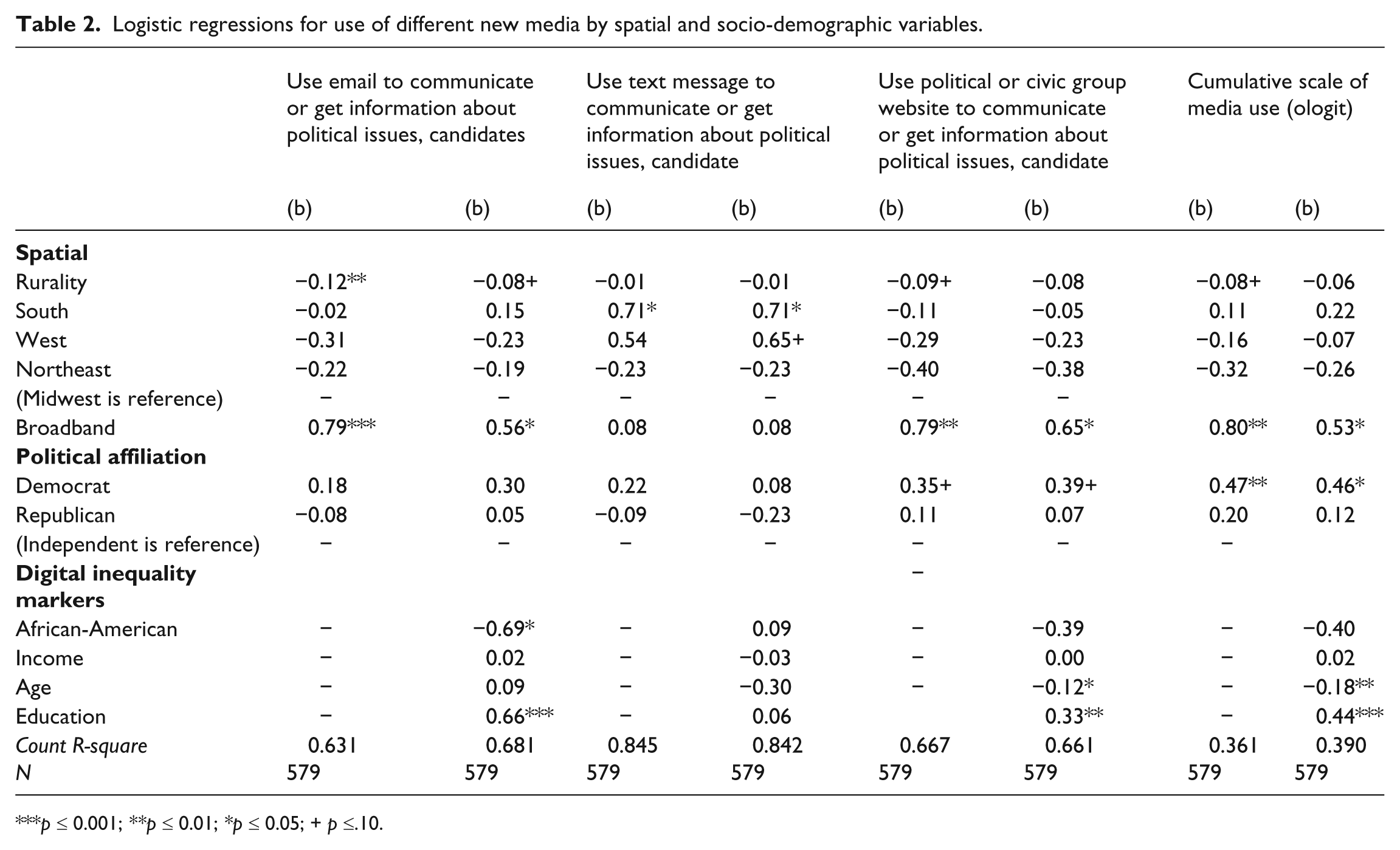
We now turn to our multivariate analyses starting with use of different new media to communicate or get information about political issues or a candidate (Table 2). The models are broken down into two parts for each of the dependent variables. We begin by adding the spatial and party affiliation variables and then we add the digital inequality markers. Regarding the use of email, in the full model we find that rurality is negatively related and broadband is positively related to email use (b = −0.08; p ≤ 0.10, b = 0.56; p ≤0.05, respectively). Race and age were also significant, with African-Americans being less likely to use email (b = −0.69; p ≤ 0.05) and the more highly educated having increased levels of usage (b = 0.66; p ≤ 0.001). Moving to the use of text messaging, we see that Southerners (b = 0.71; p ≤ 0.05) and Westerners (b = 0.65; p ≤ 0.10) were significantly more likely to use this form of media than people in other regions.
Logistic regressions for use of different new media by spatial and socio-demographic variables.
p ≤ 0.001; **p ≤ 0.01; *p ≤ 0.05; + p ≤.10.
Turning to use of a political or civic group’s website to get information about a political issues or a candidate, broadband usage and Democratic Party affiliation are positively and significantly related to using this form of information (b = 0.65; p ≤.0.05, b = 0.39; p ≤ 0.10, respectively). In addition, age is negatively related to use of a political or civic group’s website to get information about political issues or a candidate (b = −0.12; p ≤ 0.05), whereas educational attainment is positively related to doing so (b = 0.33; p ≤ 0.01). Finally, we examine the cumulative scale variable. The results are similar to those for use of a political or civic group’s website to get information about a political issue or a candidate in direction and magnitude. Broadband, Democratic Party affiliation, and educational attainment are positively related and age is negatively related to the summative scale.
Given these results and our propositions, we provide predicted probabilities for email usage and use of a political or civic group’s website to get information about political issues or a candidate by rurality and broadband. As shown in Figures 4 and 5, non-rural residents with broadband are most likely to use these media, whereas rural people with no broadband are the least likely. However, rural residents with broadband are more likely to use these forms of media than non-rural people without broadband access. With these results in mind, we conducted a path analysis to examine some of the mitigated and intervening relationships using our cumulative scale variable (Figure 6). Interestingly, while rural residency is not significantly related to the scale on its own, it is negatively and significantly related to broadband access and Democratic Party affiliation, which are positively and significantly related to the scale. In general, the results presented in Figures 4–6 and in Table 2 suggest that Republican rural residents without broadband were less likely to use these technologies than others in 2008.
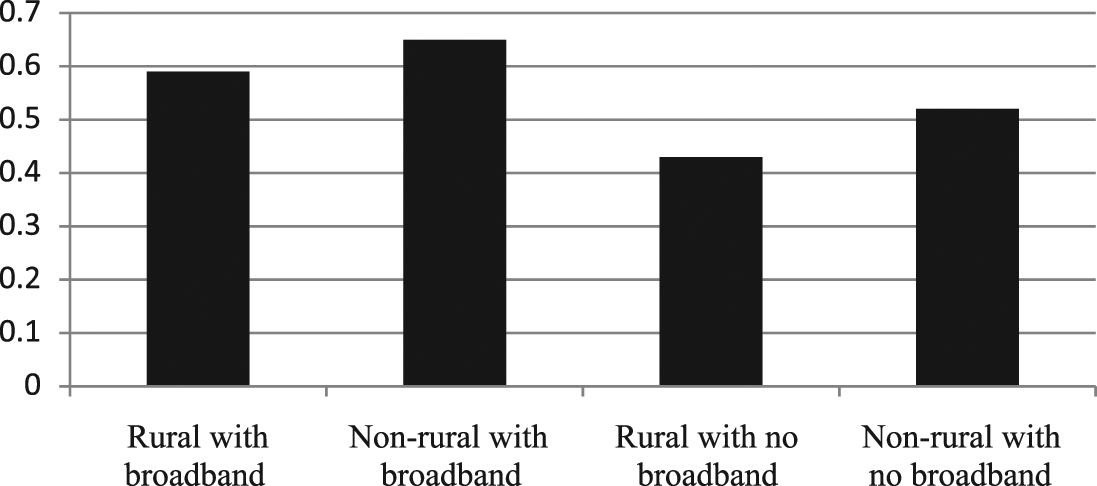
Predicted probabilities for use of email to communicate with or learn about political candidates/issues.
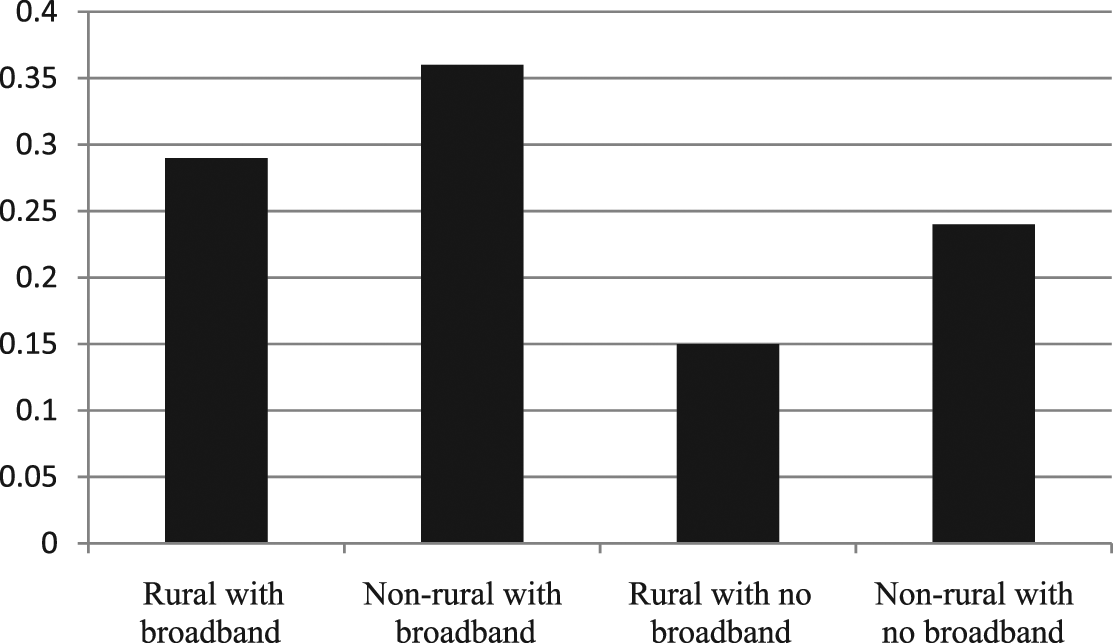
Predicted probabilities for use of group/candidate websites.
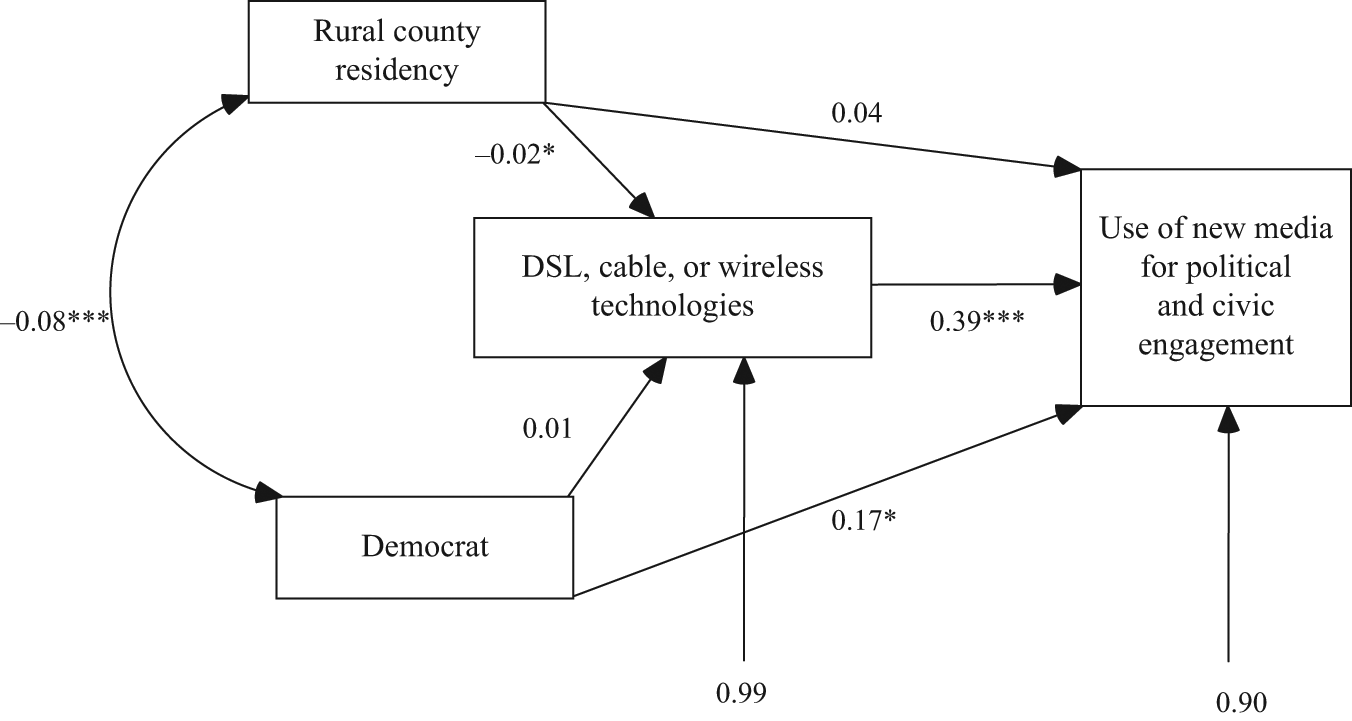
Path model for intervening relationships.
Do spatial variables, political affiliation, or digital inequality factors affect the importance of ICTs for political purposes?
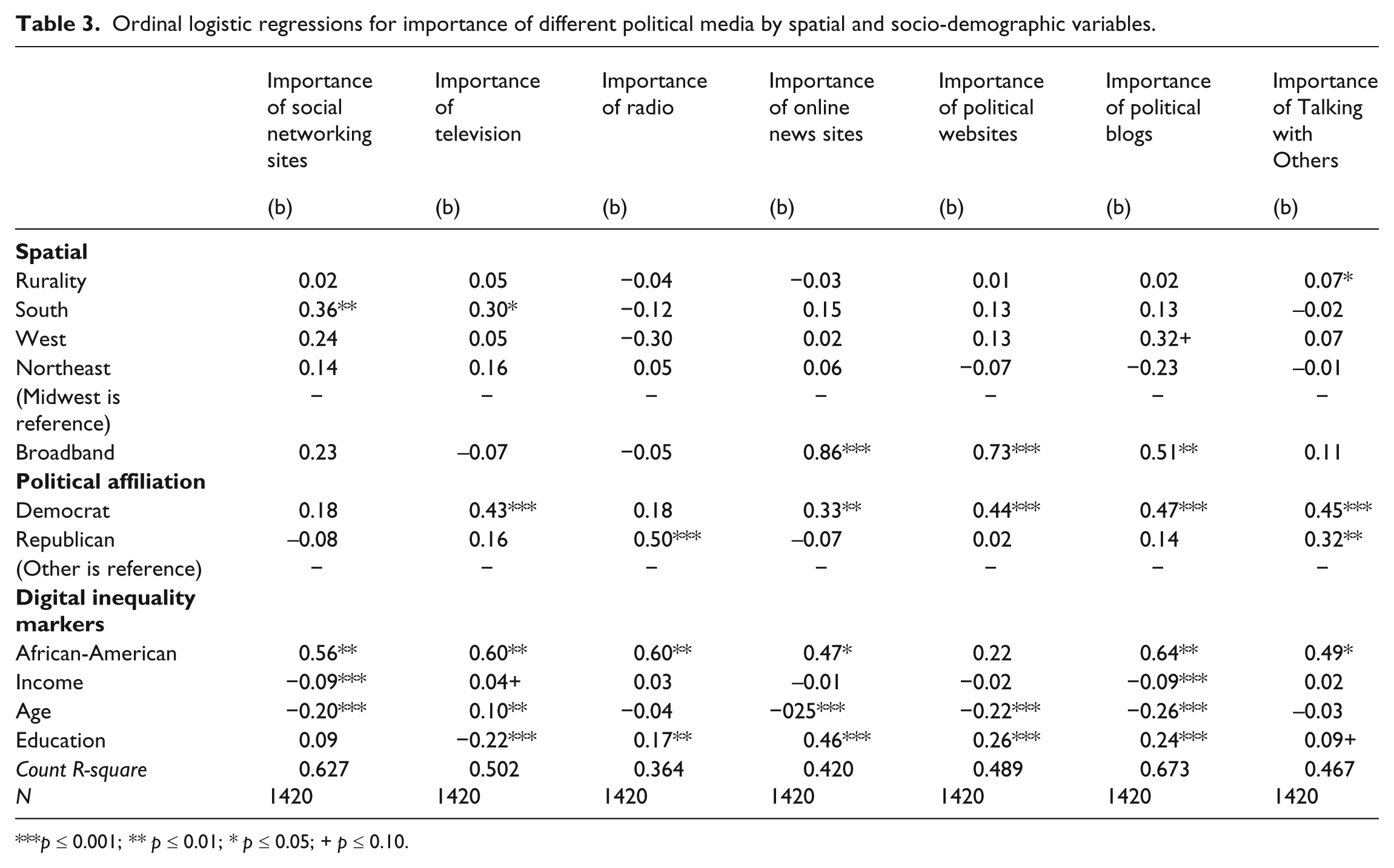
Regarding the ordinal logistic regression models for importance of different media, only full models are presented due to the increased number of dependent variables (Table 3). Being a Southerner, a Democrat, and African-American, along with income and age, are all positively and significantly related to rating television as important, but as education increased, the importance of television decreases. Turning to radio, Republicans are more likely than Democrats to rate this media as important (b = 0.50; p < 0.001) and there are positive results for African-Americans (b = 0.60; p ≤ 0.01) and with increases in education (b = 0.17; p ≤ 0.01). Talking to others is significantly more important to rural residents than others (b = 0.07; p ≤ 0.05). Interestingly, both Democrats and Republicans rate this source of information as important at statistically significant levels.
Ordinal logistic regressions for importance of different political media by spatial and socio-demographic variables.
p ≤ 0.001; ** p ≤ 0.01; * p ≤ 0.05; + p ≤ 0.10.
In terms of the importance of social networks sites, it is interesting that Southerners and African-Americans were significantly more likely to suggest that this form of media was important than were others (b = 0.36; p ≤ 0.01, b = 0.56; p ≤ 0.01, respectively). Not surprisingly, older individuals and those with higher incomes were less likely than others to rate this form of media as important.
The results for online news sites and political websites are nearly identical. With both variables, those with broadband access, those who report being in the Democratic Party, and those who have higher levels of education are significantly more likely to see these media as important. However, as age increases, there is a decrease in the likelihood of seeing these sources as important. While the findings for political blogs are similar to those for online news sites and political websites with broadband access, Democratic Party affiliation, education, and age, there are two additional findings of interest. First, African-Americans are more likely to report blogs as important (b = 0.65; p ≤ 0.01). Second, income is negatively related to viewing blogs as important (b = 0.09; p ≤ .0.001).
Just as in our first set of analyses, we use predicted probabilities and a path model here to further unpack these findings. Given what the literature says about the Obama Democratic presidential campaign’s use of social networking sites and efforts at mobilizing African-Americans in the Southern US, we focus on these relationships. Starting with the predicted probabilities for the importance of social networking sites (SNS) (Figure 7), we show that African-American Southerners found these sites a bit more important than other groups. The path model (Figure 8) shows that there are multiple forces at work in how African-American Southerners come to find social networking sites as important. As shown in Figure 8, there are positive relationships between Southern residency, Democratic Party affiliation, and race. These variables are, independently and in concert, significantly related to viewing social networking sites as important. In the end, these findings partially support our second proposition, which suggested that the importance of the different media would vary by race, age, region along with the previously mentioned rurality and broadband access.
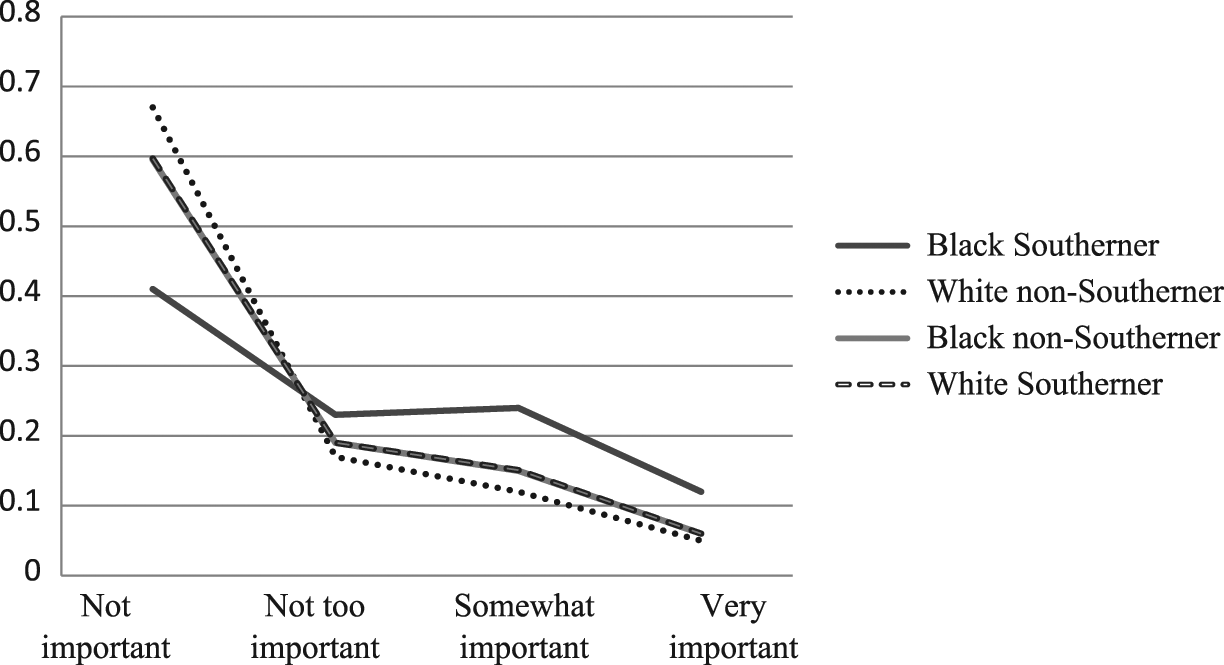
Predicted probabilities for importance of SNS.

Path model for intervening relationships.
Discussion and conclusions
In this paper, we sought to investigate how spatial factors (both in terms of rurality and region), use of the internet for political purposes, and digital inequality interacted in the period surrounding the 2008 Presidential Election.
Specifically, we aimed to understand how spatial and regional variation, political affiliation, race, and other traditional markers of digital inequality impacted the general use and perceived importance of the Internet for engagement in the political process during this period. Given the extant literature, we expected that rurality and broadband use would influence whether or not different information and communication technologies were used to learn about candidates and political issues as well as to interact with others. Yet, with the specifics of the 2008 presidential election in mind, such as Obama’s efforts to mobilize Southern and other African-American voters through the use of new media, we expected to see racial and regional differences in the self-rated importance of new media versus more traditional media for learning about candidates and issues. While these propositions were only partially supported, two findings are of particular interest to the present study and should be considered in future studies of new media and politics.
First, the differences between the usage of new media for political purposes and the relative importance of these sources of information should not be understated. In this study, we found that what was true in terms of predicting the importance of different forms of media shared much less than one might anticipate with simply using these sources of information. That is, when we looked at whether respondents used email, text, or a political website to gain information or communicate with a candidate, we had what could be described as more ‘traditional’ findings where rurality and broadband access played a role; region, race, and political affiliation were inconsistent across models; and educated people used these forms of media/communication more often than others. However, when it comes to the importance of different sources of information we see something different, which could bear watching. Although new media sources had somewhat predictable results in terms of broadband use, education, and age, African-Americans were more likely to rate most forms of media, including new media, as important relative to others. What is more, Democrats were clearly invested in the use of these forms of information when compared to respondents from other parties.
Second, in 2008 there were regional differences in the importance of social networking sites for political engagement and, based on previous studies and our results, this seems to be the result of a specific political strategy. Controlling for traditional markers of digital inequality (i.e. age, income, and education), Southerners, and in particular Southern African-Americans, tended to view social networking sites as important for political and civic engagement. This finding is consistent with studies suggesting that Obama’s campaign, in general, actively mobilized constituents using social networking sites. However, it appears that accounting for spatial differences, in this case geographical region, helps clarify the role of new media in political participation and thus represents a significant contribution of this research. The independent effect of space suggests that it is not just that the Obama campaign used new media to mobilize constituents, but that these efforts were realized in a particular region of the country.
Taken together, these results suggest that traditional views of political engagement and more contemporary outlooks on new media are far from mutually exclusive. For example, on the one hand, much of the political mobilization literature emphasizes resources (Verba et al., 1995) and the recruitment of supporters because people participate in the political process when they are encouraged to do so (Rosenstone and Hansen, 1993). On the other hand, most perspectives on digital capital (Stern et al., 2009) and spatial inequality (Lobao, 2004; Lobao et al., 2007) focus on unequal access to resources, in this case information and communication technologies, which results in inequality. These perspectives complement each other in this study inasmuch as researchers need to analyze access to resources, diverse strategies for and new ways of mobilizing voters, and the way new media is used by traditionally underrepresented segments of society in terms of race, class, and region. Naturally, in considering this issue we must return to our discussion of Whitacre’s work (2008, 2010) regarding the supply-side and demand-side aspects of this issue. There have been efforts to ameliorate or offset some of the economic realities of broadband diffusion. For example, the US administration’s economic stimulus package, otherwise known as the American Recovery and Reinvestment Act of 2009, focuses on the lack of diffusion and adoption of broadband Internet access in rural areas. Even if this program is successful, the question whether this will lead to greater political participation among underrepresented groups remains to be seen.
Today, people can use face-to-face communication, landline telephones, cell phones, mail or any of the new computer-mediated communications such as email or instant messengers to engage in politics or be recruited to a particular cause. In general, this bevy of choices is described as the ‘media multiplexity’ (Stern, 2008) where people have a number of choices of the mode of communication they prefer to use based on the particulars of a given situation not unlike granularity. As seen in this paper, it is obvious that people have added new media to their options for political engagement, but we must remember that people gained information through face-to-face interactions at high levels as well. Nonetheless, we do believe this paper provides some evidence that if recruited, and with the available new media resources in place, traditionally underrepresented groups can be mobilized to become engaged.
When cross-sectional surveys are used, it is important to exercise caution in interpreting results and not to overshoot the data. That is, we must consider our results with a full appreciation of the fact that there was a relatively small response rate and that telephone surveys have their own unique coverage error issues in the age of mobile-only households, where respondents are still resistant to complete surveys on their mobile devices (Dillman et al., 2009). Other limitations include not having specific questions on candidates or about whether a respondent was mobilized or encouraged to use new media to learn about a candidate or issue, as well as not having more theoretically informed control variables to better assess the importance of our key independent variables. As a result of these issues, we ultimately use proxies for these measures and attempt to put the pieces together in a way that makes sense. Nonetheless, there is an element of speculation in the absence of complete measures.
There are two final questions we must consider in conclusion. First, what does this research tell us about the relationship between digital capital and space in the study of politics? It seems to us that these results show that groups not typically associated with the use of cutting-edge information and communication technologies can be effectively mobilized with these tools given the right amount of outreach. Therefore, while we have tended to focus on income, education, age, and more rural areas as the reason that, for example, Southerners are not as adept at using new technologies in diverse ways as, say, Northeasterners, we have seen that this view could be shortsighted. Future research must focus on understanding the role of mobilizing people to use these technologies in reducing digital inequality.
Second, were these findings the product of one election or do they suggest something about future elections? This question is difficult to answer. It seems clear that Obama’s presence on the ballot and the campaign’s strategy to use new media played a role in mobilizing Southern African-Americans, most likely as a result of the combination of strategy and his race. However, it is important to note, in considering this question, that Southern African-Americans did not turn out in record numbers for the 2010 midterm elections. In order to answer the question, this study should be replicated with additional measures during the 2012 presidential election period. What is more, supplementing the survey data with qualitative results would provide some valuable insights into the role new media have on the political process.
Footnotes
Funding
This research received no specific grant from any funding agency in the public, commercial, or not-for-profit sectors.